I effectively quit Twitter in 2012. Do people still tweet?
Twitter is bringing reverse-chronological timelines back. It won’t be the new default, but CEO Jack Dorsey announced that you’ll be able to go back to the simplest way to organize a timeline with a setting change. Uncheck “show the best tweets first,” and out will go the algorithmically shaped experience—tweets from 4h ago, lingering with tweets from 10s ago—and in will come the old rhythm, the newest tweets first.
Reverse-chron was the schema of what was called Web 2.0. For a time everything was reverse-chron (except Wikipedia). Blogging was reverse-chron. Twitter was reverse-chron. It’s the logic of news: put the new up top. But in the Twitter context, reverse-chron also lets people beall together in real time, watching this thing, the Emmys, the game, the dissolution of the republic, the hurricane, the hearing.
That was the original appeal of Twitter. It put the there in the web. Where was the internet happening? Right there, where all these people were processing it together. It could feel like the “internet reacted” all at once, all its peoples hashing it out.
It was different in the old days, though. Most everyone seems to agree on this. And maybe it was the mishmash of tweets that randomly passed through the tubes at the same moment that made it so.
Twitter always had a high-modernist novel’s scope—you peer into the boxes, and see someone having tea, a war you should have known was going on, a parent’s take on a 4-year-old, the latest ProPublica investigation, a screenshot of some idiot, a video of a black person being killed by police, an ad for Quiznos, and then Donald Trump tweeting about the television program he’s watching. The stack of information was contextless, traumatizing, and bizarre, but also energizing, the way a city makes you walk faster. It did that, but for your mind.
But Twitter’s algorithm increasingly selected the most popular tweets to show you—which tended to be the ones that made you go “What! Ah! Ooooh! Eff that!” To pull down your thumb was to ingest different (quantitatively proven) emotional cues one after the other, your brain a player piano, simply responding to the notes in the feed. No one meant to build such a machine, but there it was. And it was addictive as hell.
At the same time, the things people said on Twitter became real things. Real historians extensively corrected people’s fantasies about the Confederacy on Twitter. People got hired and fired because of Twitter. Innovative companies’ share prices tanked when their CEOs said weird things on Twitter. And, of course, the president did things on Twitter.
This platform juices us up into strange emotional states, and now, whatever people say or do on the platform has ever-more real-world consequences. “Never Tweet” was born, on Twitter.
Reverse-chron cannot reverse the development of the platform, nor the changes that have come to the world outside Twitter, the high-keying of everything. But maybe reverse-chron will ever-so-slightly push Twitter away from what it became and back toward something simpler. The most potent tweets will not all be stacked together. Twitter could still be the place that surfaces important topics that the mainstream media ignores, but with slightly less emotional whiplash. Twitter could feel less like a battleground and more like a healthy corrective conversation. Poco a poco, change for the better?
None of it really does anything to the service itself. It doesn’t return Twitter to the edenic state I remember, and loved, the one that introduced me to new social worlds, brought my attention to important injustices, the one that Kathryn Schulz called “sentences with friends.”
Twitter has become like New York. You love it, you hate it, you can’t leave it, it makes you crazy, it’s getting you down, you leave it. Because the media is all there, and everyone on Twitter sort of becomes part of the media, when you leave, you write an essay detailing the euphoria, the sense of loss, the superiority you feel over those who have stayed, the shrinking halo of relevance that hurts like a phantom limb.
You go back, probably, shamefully re-install it in your mind, tweet a few times to see how many people make fun of you for quitting. But everyone forgot four minutes after you left, so, like, whatever.
For me, as the years have gone by, the specific stories, the jokes, the information, the wins—matter less and less. This haunts me. It makes me recall a line from Addiction by Design: Machine Gambling in Las Vegas by the MIT scholar Natasha Dow Schüll. She’s interviewing a compulsive gambler at a slot machine, and this woman tells her that she’s stopped caring about winning. “Why, then, does she play?” Dow Schüll writes. “‘To keep playing—to stay in that machine zone where nothing else matters.’”
Nominally, I’m on Twitter to be informed, to catch potentially useful information, to see the world from other perspectives. All of which happens.
But, emotionally, I’m just on Twitter to be on Twitter. Whatever happened to me over the last 10 years cannot simply be reversed by reverse-chron. In real life, timelines are not so easily rearranged.
Henry David Thoreau wrote of a melancholy he felt in late August for the year which was quickly passing. His diary entry for August 21, 1852:
The sound of crickets gradually prevails more and more. I hear the year falling asleep.
And a year later on August 18, 1853:
What means this sense of lateness that so comes over one now,—as if the rest of the year were down-hill, and if we had not performed anything before, we should not now? The season of flowers or of promise may be said to be over, and now is the season of fruits; but where is our fruit? The night of the year is approaching. What have we done with our talent? All nature prompts and reproves us. How early in the year it begins to be late! It matters not by how little we have fallen behind; it seems irretrievably late. The year is full of warnings of its shortness, as is life.
He was one of our great chroniclers of seasons, and felt, very strongly, that we had seasons within us. Here’s what he wrote the next year, on August 7, 1854:
Do you not feel the fruit of your spring and summer beginning to ripen, to harden its seed within you? Do not your thoughts begin to acquire consistency as well as flavor and ripeness? How can we expect a harvest of thought who have not had a seed-time of character?
Thanks to a clever member of the Twitterati, we learn to our delight that there was a sixth century consort of the king of the Neustrain Franks of the Merovingian dynasty (previously here, here and here), wife of Chodebert I who ruled Paris and the western part of Gaul, called Ultragoth. Charitably, Childebert is credited for bringing Roman Catholicism to Spain, at the request of his sister Chlortilde who claimed she was being berated and abused for her faith by King Amalaric of the Visigoths (an attested follower of Arius), who brought an army to settle this domestic dispute and invaded the peninsula, ousting the heretical Visigoths in favour of a dynasty more closely aligned with the Church. Childebert also plundered some relics from Spain, including the dalmatic vestments of Saint Vincent of Saragossa, which Ultragoth found suitable homes for. Likely spelt Ultrogothe (or Vulthrogotha, which is also cool) in Franconian, not to be a spoil-sport, there’s no indication of frequency or popularity for the name but other female regnants and consorts (which seem to never be repeated) included Ermengarde, Himiltrude, Chimnechild, Radegund, Amalberga, Bilichild, Waldrada, Fulberte, Wulfegundis and Wisigard. Nothing else is known of Childebert’s wife other than that she, having failed to produce sons and therefore heirs, and her daughters, Chrodoberge and Chrodesinde, were sent into exile after the king’s death—as was their custom, and his share of the kingdom reverted to his younger brother, Chlothar.
Happy to announce I’m offering a new fall class, “Singular ‘They’ is 700 Years Old, What Is Your Problem, OMG,” which will consist of me standing on a desk yelling at you in Middle English. (3 credit hours)
Oh, dear: i see myself in this, but I also think purpose (Purpose!) is the key.
Do you have so many interests, curiosities & passions that you often struggle to figure out what to “do” with your life or career? Well, maybe you don’t have to choose—you’re a “multipotentialite,” and embracing that can open up many new paths forward.
Here’s what Emily Wapnick, who helped coin the term (and runs the wonderful site, Puttylike) had to say about her fellow multipotentialites:
My Definition
A multipotentialite is someone with many interests and creative pursuits.
Multipotentialites have no “one true calling” the way specialists do. Being a multipotentialite is our destiny. We have many paths and we pursue all of them, either sequentially or simultaneously (or both).
Multipotentialites thrive on learning, exploring, and mastering new skills. We are excellent at bringing disparate ideas together in creative ways. This makes us incredible innovators and problem solvers.
When it comes to new interests that emerge, our insatiable curiosity leads us to absorb everything we can get our hands on. As a result, we pick up new skills fast and tend to be a wealth of information.
Boredom
The aspect of multipotentiality that worries multipotentialites the most is the tendency to become bored. Boredom usually hits once we’ve learned what we are meant to learn on a particular topic, and instead of moving on, we try to continue down a path we’re no longer interested in. Boredom is our body’s way of telling us that it’s time to move on to something new.
Multipotentialites don’t define “finishing” the way a specialist (and indeed, most of society) does. We learn what we came to learn and then move on to the next interest. This may not always look like “finishing” to the outside world, but it is.
Modern Society Doesn’t Understand Us
Unfortunately, mainstream society tends not to value or recognize multipotentiality and labels this sort of “jumping between interests” flaky, immature behaviour. For a specialist, that might be true. But for us multipotentialites, saying goodbye to one passion to explore a new one is how we’re wired. It’s our gift.
I can't quite parse this. Do they really think this will help prevent Velcro being used as a generic term?? IS it a parody? In these times, does every use of the word parody now need to be followed by a (?)?
Intellectual property law is complicated. I can't tell you how many people I've seen spend hours arguing a point about copyright, but who aren't willing to spend the five minutes it takes to learn the basic differences between copyright and trademark. An almost certainly apocryphal rumor holds that there is some employee at Xerox (or Kleenex, or Q-Tips) whose sole function is to search for uses of the brand name as a general term for the product, and send a cease-and-desist letter. This is because, to maintain a trademark, trademarks must be distinct. This is why I can't start a laptop manufacturer called "Laptops" and sue everyone. However, if a term so lapses into general usage, it runs the risk of no longer being distinct enough to be a legal trademark, which leads to often over-zealous protection of trademarks. To this end, Velcro® produced a parody(?) music video admonishing the public to not say "velcro" unless they mean "velcro®."
Personally, I take solace in knowing that at some future date a music video of actors pretending to be lawyers singing about IP law may be played in an actual court of law. God bless America.
Subhed: I work for the president but like-minded colleagues and I have vowed to thwart parts of his agenda and his worst inclinations.
The Times today is taking the rare step of publishing an anonymous Op-Ed essay. We have done so at the request of the author, a senior official in the Trump administration whose identity is known to us and whose job would be jeopardized by its disclosure. We believe publishing this essay anonymously is the only way to deliver an important perspective to our readers.
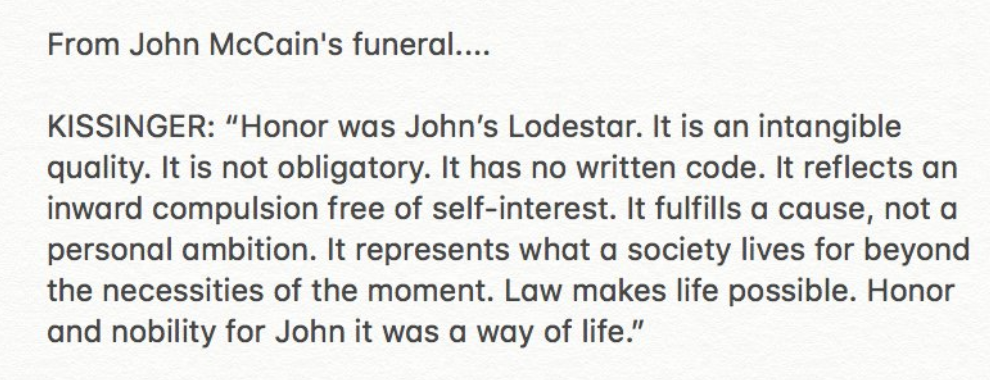
The publication of this anonymous editorial has of course sparked speculation about the identity of its author. In particular, one strand of authorship-attribution discussion has focused on a single word, from the penultimate paragraph, suggesting that it's evidence for attributing the work to Mike Pence:
We may no longer have Senator McCain. But we will always have his example — a lodestar for restoring honor to public life and our national dialogue. Mr. Trump may fear such honorable men, but we should revere them.
This twitter thread seems to be the source of the "lodestar means Pence" speculation. Of course there's been some pushback, for example suggesting that we
Remember that some senior administration officials have been known to use the language often used by other officials in an effort to throw people off track.
"To cover my tracks, I usually pay attention to other staffers' idioms and use that in my background quotes. That throws the scent off me," the current White House official added.
"Lodestar" lost obscurity a few days ago.
Kissinger shined light on it.
Some other lexical features have also been highlighted, e.g. "first principles". I haven't seen anyone making the point that authorship attribution on the basis of one or two lexical features is going to be unreliable at best, but it's probably Out There. (And in dealing with national politicians and other high-status individuals in the modern world, authorship attribution also faces the problem that most of their "works" are actually written by flunkies…)
Meanwhile, it's interesting that in introducing the original op-ed and in the NYT's discussion of it, the paper goes out of its way to avoid gendered pronouns:
The unnamed official, whose identity is known to the Times editorial page department but not its news staff, described the president’s leadership as “impetuous, adversarial, petty and ineffective” and cited “adults in the room” who strive to prevent disaster. At one point, the official wrote, there was talk of the cabinet invoking the 25th Amendment to declare Mr. Trump unable to discharge his duties, but no one wanted a constitutional crisis.
“We want the administration to succeed and think that many of its policies have already made America safer and more prosperous,” the official wrote. “But we believe our first duty is to this country, and the president continues to act in a manner that is detrimental to the health of our republic.”
“That is why many Trump appointees have vowed to do what we can to preserve our democratic institutions while thwarting Mr. Trump’s more misguided impulses until he is out of office,” the official added.
This has led to speculation about the possibility that e.g. Kellyanne Conway might be the author. But then there's this:
Davis Logsdon, a professor of linguistics at the University of Minnesota, said that a team of language experts under his supervision has studied the Op-Ed word by word and is “in a state of disbelief” that someone currently working for Donald J. Trump could have written it.
“There are complete sentences, there are well-structured paragraphs, there is subject-verb agreement,” he said. “This does not appear to be the work of any White House staffer we’re familiar with.”
Stressing that he and his team of linguists are “not even close” to determining the author, Logsdon said that they were currently using the process of elimination to whittle down the list of possible scribes.
“Based on the mastery of language that we see here, it’s not Sarah Huckabee Sanders, John Kelly, Stephen Miller, or Kellyanne Conway, and it’s definitely not Jared,” he said.
In this Overview, spectators explore a variety of aircraft during the Sound of Speed Airshow, which took place last weekend at Rosecrans Memorial Airport in St. Joseph, Missouri. The event included aerial performances and ground displays of dozens of aircraft, including U.S. Navy Blue Angels, C-130 Hercules transporters, P-51 Mustangs, an F-16 Viper, and more.
The camera on the slightly creepy arm takes a picture of the pages in the book, the software uses OpenCV to extract faces, and the faces are passed to Google Auto ML Vision comparing the faces to a Waldo model. The result: There’s Waldo.
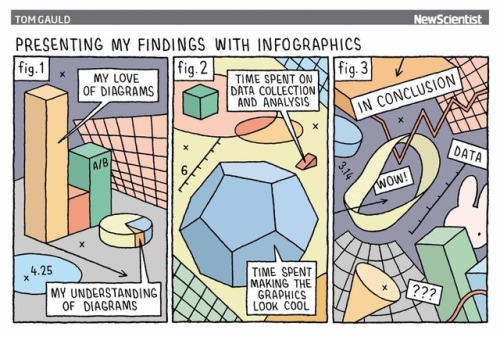
Sometimes the visualization takes care of itself. Photographer Tim Whittaker filmed sheepdogs herding thousands of sheep, and the flows one place to another are like organized randomness.
A little late to the game here, but… WHAT WILL HE WEAR? I’m not *not* opposed to it being this caj tee & jeans look. Thanks to friend of the blog Nathan for the tip!
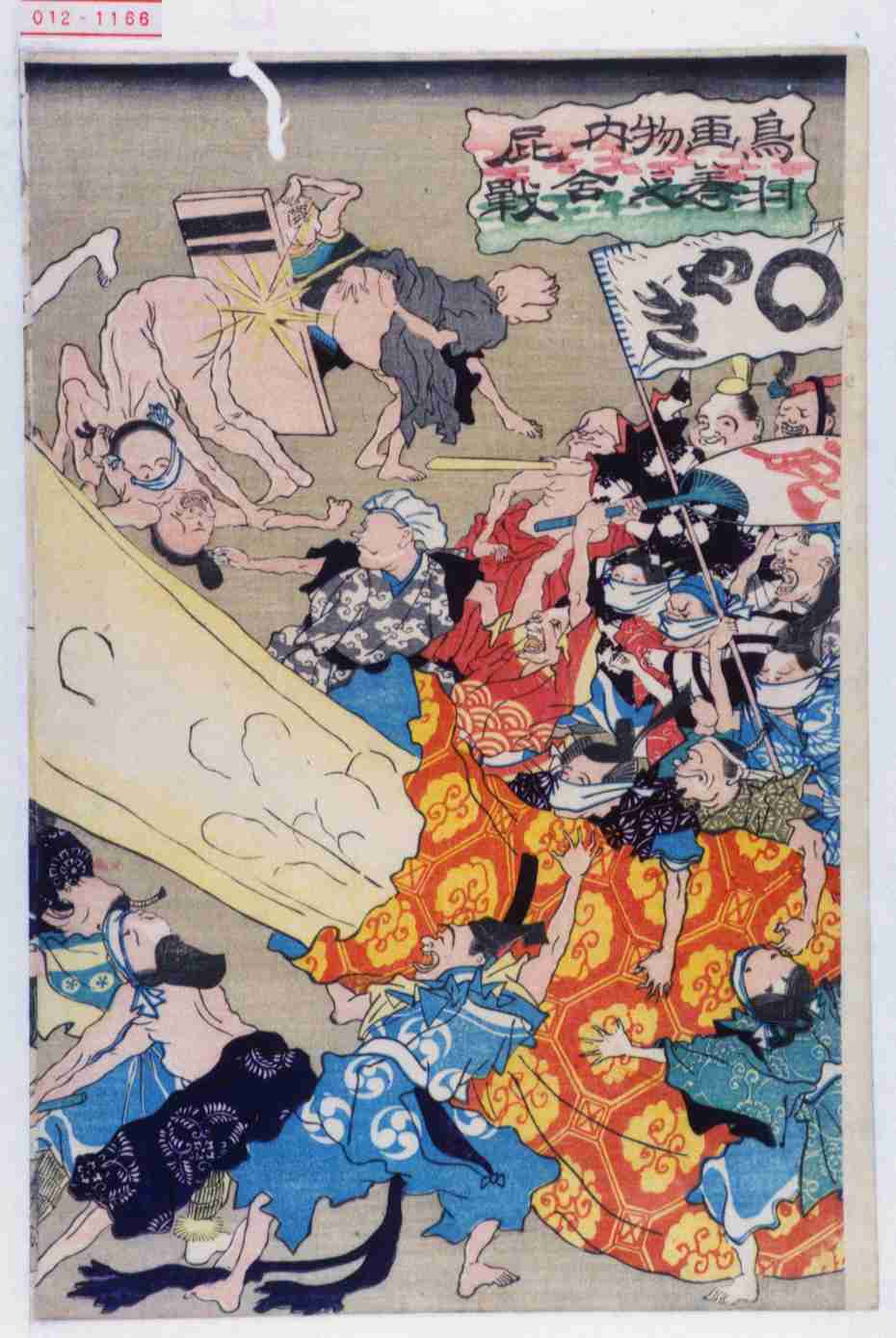
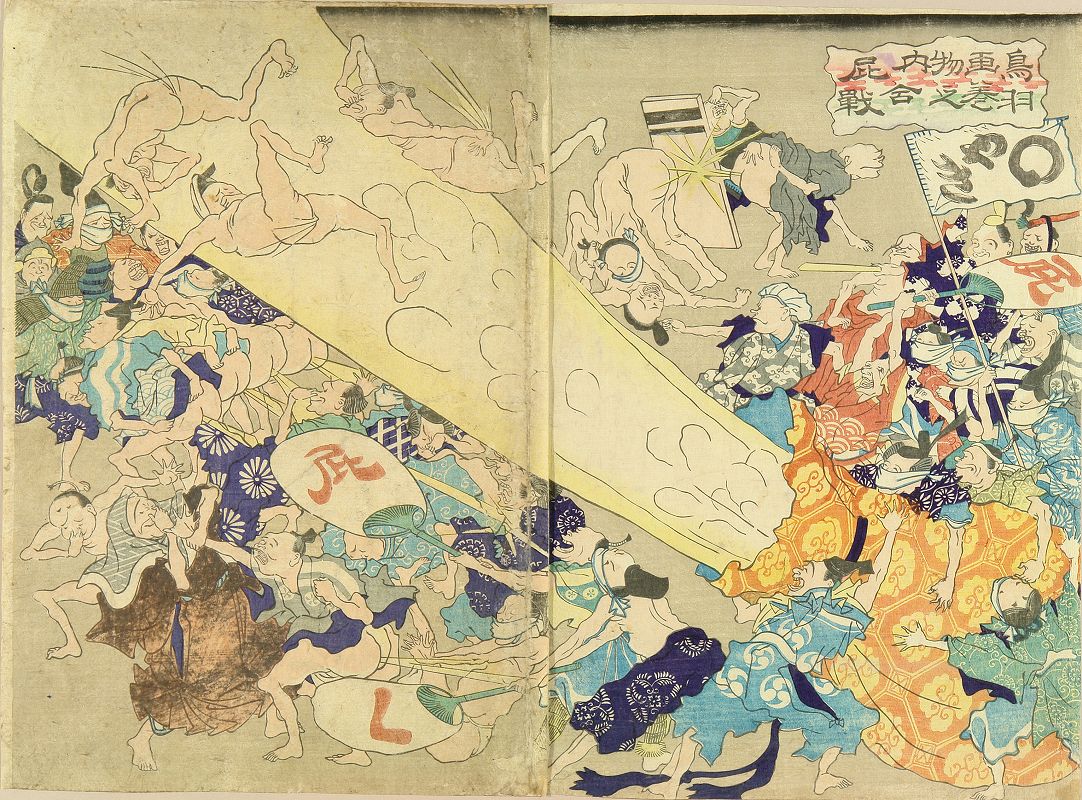
Amazing fart battles. (I never thought I’d type those words!)
Japanese artists depicted almost anything imaginable concerning humans, animals, and the natural world, and they did so with great skill and emotional power. One sub-genre of Japanese painting that I recently became aware of is that of the fart battle (hōhi gassen 放屁合戦):
As soon as I perused this astonishing scroll, I could not get the expression "artsy-fartsy" out of my mind, and I wondered how and when English acquired such a peculiar term. Merriam-Webster says that it's a rhyming compound based on "artsy" and "fart", and that its first known use is 1962.
Note that, in the fourteenth image of this scroll (as presented in Redd's article), an unlucky cat is stricken by the foul stench-stream from a gentleman's anus.
That fart-battle scroll (hōhi gassen emaki 放屁合戦絵巻) is held by Waseda, which generously provides a high-res PDF for our viewing pleasure.
There are others, such as this drabber piece held by the Suntory art museum.
This blog post begins with an image from an even zanier fart-battle scroll.
Nathan Hopson says that his favorite may well be this early Meiji gem depicting heiryoku 屁威力 ("fart power") a play on the homophonous heiryoku 兵力 ("military power") being used to overcome the old bakufu forces. It's interesting that here we have a three-character expression being used as a pun for a two-character term.
Japanese art never ceases to amaze me, both for its refined wit and for its somaesthetic sensitivity and creativity.
It's now been 5 years since Google Reader was shut down. As a time capsule of that bygone era, I've resurrected readerisdead.com to host a snapshot of what Reader was like in its final moments — visit http://readerisdead.com/reader/ to see a mostly-working Reader user interface.
Before you get too excited, realize that it is populated with canned data only, and that there is no persistence. On the other hand, the fact that it is an entirely static site means that it is much more likely to keep working indefinitely. I was inspired by the work that Internet Archive has done with getting old software running in a browser — Prince of Persia (which I spent hundreds of hours trying to beat) is only a click away. It seemed unfortunate that something of much more recent vintage was not accessible at all.
Right before the shutdown I had saved a copy of Reader's (public) static assets (compiled JavaScript, CSS, images, etc.) and used it to build a tool for viewing archived data. However, that required a separate server component and was showing private data. It occurred to me that I could instead achieve much of the same effect directly in the browser: the JavaScript was fetching all data via XMLHttpRequest, so it should just be a matter of intercepting all those requests. I initially considered doing this via Service Worker, but I realized that even a simple monkeypatch of the built-in object would work, since I didn't need anything to work offline.
The resulting code is in thestatic_reader directory of the readerisdead project. It definitely felt strange mixing this modern JavaScript code (written in TypeScript, with a bit of async/await) with Reader's 2011-vintage script. However, it all worked out, without too many surprises. Coming back to the Reader core structures (tags, streams, preferences, etc.) felt very familiar, but there were also some embarrassing moments (why did we serve timestamps as seconds, milliseconds, and microseconds, all within the same structure?).
As for myself, I still use NewsBlur every day, and have even contributed a few patches to it. The main thing that's changed is that I first read Twitter content in it (using pretty much the same setup I described a while back), with a few other sites that I've trained as being important also getting read consistently. Everything else I read much more opportunistically, as opposed to my completionist tendencies of years past. This may just be a reflection of the decreased amount of time that I have for reading content online in general.
NewsBlur has a paid tier, which makes me reasonably confident that it'll be around for years to come. It went from 587 paid users right before the Reader shutdown announcement to 8,424 shortly after to 5,345 now. While not the kind of up-and-to-right curve that would make a VC happy, it should hopefully be a sustainable level for the one person (hi Samuel!) to keep working on it, Pinboard-style.
Looking at the other feed readers that sprung up (or got a big boost in usage) in the wake of Reader's shutdown, they all still seem to be around: Feedly, The Old Reader, FeedWrangler, Feedbin, Innoreader, Reeder, and so on. One of the more notable exceptions is Digg Reader, which itself was shut down earlier this year. But there are also new projects springing up like Evergreen and Elytra and so I'm cautiously optimistic about the feed reading space.
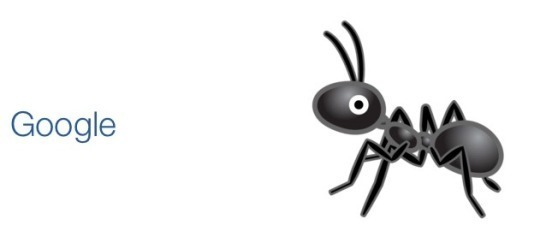
Beautiful big almond eye, realistic and full of expression as she gazes gently at you. Elbowed antennae and delicately segmented legs and body. Gorgeous pearlescent sheen like she is glowing. This ant moisturizes. This ant is round and huggable. This ant is a star. 11/10.
Beautifully detailed, lifelike pose but with an unexpected neck and odd antennae, perhaps scared straight. Her eyes suggest she has seen things. Her expression confirms she has seen too much. She is haunted and I want to know more. 7/10.
Floppy antenna, pointy muppet face, oddly posed legs. What is she? She has no waist. May be she is some kind of bee in disguise? I find her unsettling. 3/10.
This ant has an unexplained, double-jointed thorax, and no evidence of a waist. Her four-footed pose suggests that she a centaur rather than an ant. Centaur ants would be cool. I’m not sure what was intended here. 2/10.
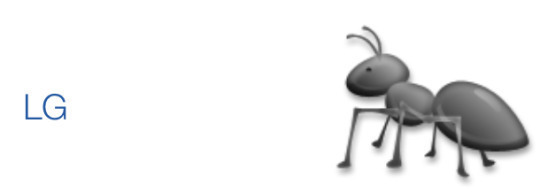
Good first impression, kind of bland in the details. This ant has no particular waist to speak of, floppy rather than elbowed antennae, and an inexpressive face. Her color scheme is soft and hazy. I like the sharp angles of her stylishly sophisticated legs. This ant may not know quite were she is going, but she knows how she is getting there. 6/10.
Were you even trying. 0/10
Gasp! This ant is elegant. This ant has a beautiful tapered thorax, a segmented abdomen, alert, elbowed antennae, and a light-footed pose. This ant’s face suggests curiosity and a desire to explore the world. This ant inspires me. I want to be like her. 10/10
3-legged, waistless centaur-ant with strange, limp antennae and a beak. I don’t know what this is? It kind of reminds me of a Hork-Bajir. 1/10, not an ant.
This ant… makes me sad. All of her legs are broken. The MS Paint art style and gradient abuse convey distress. She has a duck beak. Despite this, her expression suggests perseverance and determined cheerfulness. I want this ant to have a better life. I am rooting for her. 3/10
This ant is a bold and challenging mixture of photorealism and caricature. She is broad and low-built and seems very sturdy. She looks like she would help you move. This ant is a dependable friend. 9/10
A picture of an ant from a children’s book. She is wearing little boots. This ant is wrong in every way, and yet I can’t stay mad at her. 7/10
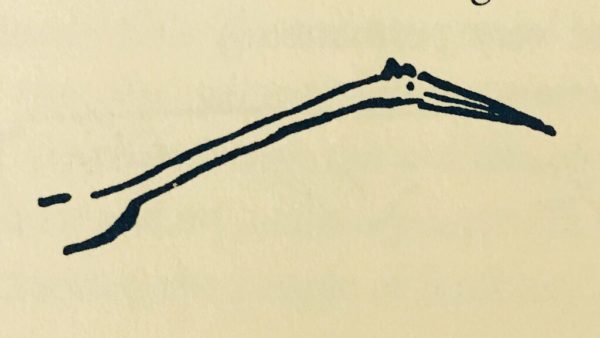
An interesting, top-down view of an ant; her legs are positioned with slightly jarring symmetry. Nevertheless, her overall impression is that of a graceful, stylized design, like a pictograph. She is suitable for adorning fine garments and jewelry or perhaps gracing the walls of a tiny ant church. I like this minimalist ant. 8/10.
I can not stop looking at these rainbow long exposure photographs by Daniel Mercadante. He captured his partner running with a custom built lighting rig. So much appreciation for this. So much!
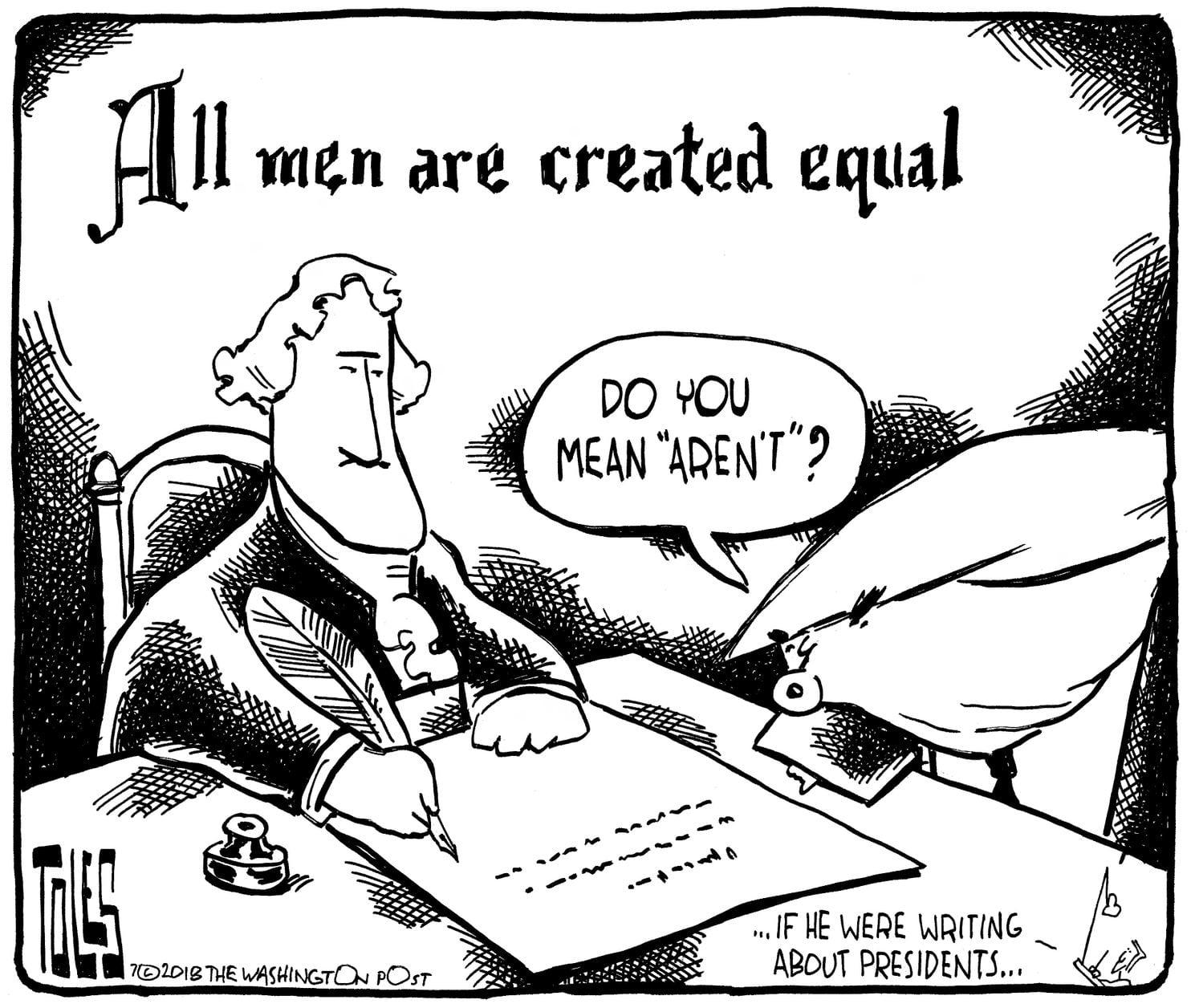
WHITE HOUSE CORRECTION FORTHCOMING: What the president meant to say: "There's never been a president as tough on Russia as I HAVEN'T been." (It's kind of a double negative.) https://t.co/rEbnmdPZHp
It is easy to see how this might be confusing. President Trump understands how you might have gotten confused. […]
Anyway, he now is issuing an unequivocal statement that “I accept our intelligence community’s conclusion that Russia’s meddling in the 2016 election took place. Could be other people also. A lot of people out there.”
Is that unequivocal or not unequivocal? Well, it is definitely one of the two, and if we decide it was not unequivocal, we can tack that “not” on in the next 24 hours without incident. […]
Trump meant to really send a stern message to Putin. He meant to not not mention human rights, and certainly he was going to stand his ground when confronting the Russian president on the subject of election interference. Instead he did not that. Easy mistake, is the point. You can think, “Wait, am I supposed to do this, or is this the thing I am supposed to not do?” and sometimes you forget and guess wrong, and that is Trump foreign policy in a notshell. […]
He does not think the American people are idiots who will just take this “not” statement at face value. He does not think so little of you. This is not insulting to you. I think I am using the right number of “not,” but these days, who knows?
What do you do if you find a turtle crossing the road? I collaborated with Dr. David Steen of the Alongside Wild Foundation to tell you how to save our shelly pals.
Extracting and processing the road data for every place of interest to generate a polar chart seemed like too much work. Could I do it on an interactive map? It turns out that this is a perfect use case for Mapbox vector maps — since the map data is there on the client, we can analyze and visualize it instantly for any place in the world.
Fun.
So someone’s going to take the next step to rank and rate griddyness around the world, right?
English-usage authority Bryan A. Garner shook Language Twitter by suggesting that only philistines pronounced pubes as a single syllable.
How do rubes pronounce “pubes”? The one-syllable pronunciation is certainly a newcomer. The two-syllable /PYOO-beez/ is the only pronunciation given in Webster’s Third and Webster’s Tenth Collegiate (1993)—that’s all I have handy. How does one pronounce “lues” or “octopodes”? https://t.co/qAotwbrqXM
More than a few of us responded with tweets of bewilderment and skepticism, likely confusing everyone around us as we muttered “PYOO-beez. PYOOBZ. PYOO-beez??” at our screens.
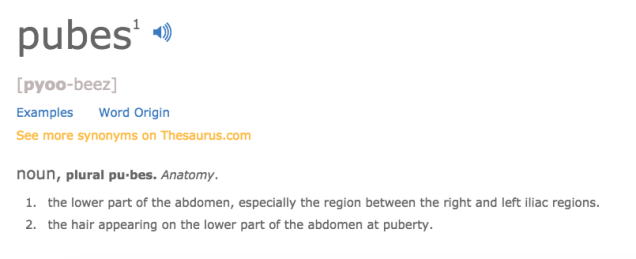
Garner claimed that the two-syllable pronunciation was all that his dictionaries offered, and a little digging proved him right. Not only did Merriam-Webster not have the /pyoobz/ pronunciation,
This feels like some sort of prank, like all of the online dictionaries got together and said, "Hey, let's edit our entries for 'pubes' so it sounds like 'boobies'!"
— Online Writing Jobs (@OnlineWriteJobs) July 11, 2018
So what was going on? Dictionaries are supposed to reflect predominant usage, yet this diverse community of language enthusiasts, most of them conscientious writers or editors, had never heard the two-syllable pubes. Were we all being gaslit?
As it turns out, all of these dictionary entries were for the medical or scientific usage of “pubes,” prounounced /PYOO-beez/, which can mean (with earliest citations in the Oxford English Dictionary):
the mons pubis—the lower part of the abdomen at the front of the pelvis
The grinde or share is called Pubes, betwene the whyche are sette the priuye members, vnder the bothome of the bely. (John Hall, A most excellent and learned woorke of chirurgerie, called Chirurgia parua Lanfranci, translation of Lafranc, 1565)
the plural form of pubis, referring to the bone making up the front and back sides of the pelvis
Between the Ischium and Pubes the Foramen. (William Cheselden, The Anatomy of the Humane Body, 1713)
the plural form of pubis, referring to a pubic hair
In adolencie when Pubes was springing. (William Wager, Longer thou Liuest, 1569)
The OED acknowledges that “in later use,” that last definition is “difficulty to distinguish from the plural of PUBE, n.,” and the entry for pubedoes give the monosyllabic pronunciation. Its etymological note says, “non-technical context usually suggests that the monosyllabic, colloquial pronunciation is intended,” lending credence to this suggestion:
So in medical contexts, it’s /PYOO-beez/ and in a casual ones, it’s /pyoobz/. Case closed, right?
Well, not quite. Because we’re working mostly off of written records—and pubes sadly doesn’t seem to come up in a lot of historical rhyming poetry—we can’t be sure how the colloquial pubes was pronounced. For example, the first citation in the OED under pube is from 1968:
Tracing the line of feeling from nipple to pubes. (A. Ginsberg, Planet News, 1968)
But we don’t know for sure this wasn’t pronounced /PYOO-beez/.
Complicating matters is that, according to Green’s Dictionary of Slang,pubies and pubeys were also slang terms for pubic hair:
Pubies: Pubic hairs. (Baker et al., CUSS, 1967–8)
I’m still missing half of my pubies from the first day here. (J. Sayles, Union Dues, 1978)
There. On my soap. You fucken pig. Yer pubies. (J.M. Del Vecchio, 13th Valley, 1983)
What kind of dude shaves his pubeys? Hello! (J. Stahl ‘Pure’ in Love Without, 2007)
Are these terms evidence that people obviously pronounced pubes as a single syllable in colloquial use, necessitating these spellings to emphasize a different pronunciation? Or are they evidence that people said /PYOO-beez/ to refer to pubes—and pubes, pubies, and pubeys are variant spellings of the same word?
We can be pretty confident that /pyoobz/ arrived more recently than /PYOO-beez/, but when? And did we pluralize to pube to pubes, or did we get the singular pube from the plural?
A couple of linguists nerded out the issue on Twitter:
I agree. The one-syllable form is a regular plural formed from the back-formed singular "pube".
I was thinking of “pube” as a clipping of “pubic hair” rather than a back-formation from “pubes.” Getting singular “pube” as a back-formation seems to entail that people were already treating “pubes” as monosyllabic.
I think both theories are plausible, and the two phenomena might even have happened concurrently. Some speakers probably clippedpubic hair to pube, and because we usually talk about pubes in the plural, started saying /pyoobz/. Others may have seen pubes written and, via spelling pronunciation, assumed it was said /pyoobz/.
Searching for pube on its own would give us more definite answers to some of these questions because /pyoob/ is the only pronunciation offered for the singular in all dictionaries that list it. Ain’t nobody sayin’ /PYOO-bee/.
But there’s very little evidence in the written record of singular pube—and nothing that antedates the earliest confirmable usage of monosyllabic pubes.
As esoterically fascinating as this dive into pubes’s history is, what mattered to many of us was what was currently happening. The predominant colloquial pronunciation today is unquestionably /pyoobz/. We saw this pronunciation in Wayne’s World 2 (1993):
A number of readers took to Twitter and created a polite and well-ordered pitchfork mob of descriptivist bent, taking pains to inform us that our pronunciation for pubes was in error…
We do not currently have the latter pubes in our dictionary (in our defense, the word does not frequently appear in published, edited text), but an entry is in progress. So a hearty round of congratulations to those of you who have raised this issue; you may henceforth say that you helped put pubes (rhymes with tubes) in the dictionary.
And this announcement led to much celebration:
"So a hearty round of congratulations to those of you who have raised this issue; you may henceforth say that you helped put pubes (rhymes with tubes) in the dictionary." WE DID IT, EVERYBODY!!!
We shall put pubes in the Collegiate. We shall put pubes in the Unabridged online and in print. WE SHALL PUT PUBES ON THE BEACHES AND IN THE FIELDS AND IN THE STREETS






 Charitably, Childebert is credited for bringing Roman Catholicism to Spain, at the request of his sister Chlortilde who claimed she was being berated and abused for her faith by King Amalaric of the Visigoths (an attested follower of Arius), who brought an army to settle this domestic dispute and invaded the peninsula, ousting the heretical Visigoths in favour of a dynasty more closely aligned with the Church. Childebert also plundered some relics from Spain, including the dalmatic vestments of Saint Vincent of Saragossa, which Ultragoth found suitable homes for. Likely spelt Ultrogothe (or Vulthrogotha, which is also cool) in Franconian, not to be a spoil-sport, there’s no indication of frequency or popularity for the name but other female regnants and consorts (which seem to never be repeated) included Ermengarde, Himiltrude, Chimnechild, Radegund, Amalberga, Bilichild, Waldrada, Fulberte, Wulfegundis and Wisigard. Nothing else is known of Childebert’s wife other than that she, having failed to produce sons and therefore heirs, and her daughters, Chrodoberge and Chrodesinde, were sent into exile after the king’s death—as was their custom, and his share of the kingdom reverted to his younger brother, Chlothar.
 Charitably, Childebert is credited for bringing Roman Catholicism to Spain, at the request of his sister Chlortilde who claimed she was being berated and abused for her faith by King Amalaric of the Visigoths (an attested follower of Arius), who brought an army to settle this domestic dispute and invaded the peninsula, ousting the heretical Visigoths in favour of a dynasty more closely aligned with the Church. Childebert also plundered some relics from Spain, including the dalmatic vestments of Saint Vincent of Saragossa, which Ultragoth found suitable homes for. Likely spelt Ultrogothe (or Vulthrogotha, which is also cool) in Franconian, not to be a spoil-sport, there’s no indication of frequency or popularity for the name but other female regnants and consorts (which seem to never be repeated) included Ermengarde, Himiltrude, Chimnechild, Radegund, Amalberga, Bilichild, Waldrada, Fulberte, Wulfegundis and Wisigard. Nothing else is known of Childebert’s wife other than that she, having failed to produce sons and therefore heirs, and her daughters, Chrodoberge and Chrodesinde, were sent into exile after the king’s death—as was their custom, and his share of the kingdom reverted to his younger brother, Chlothar.









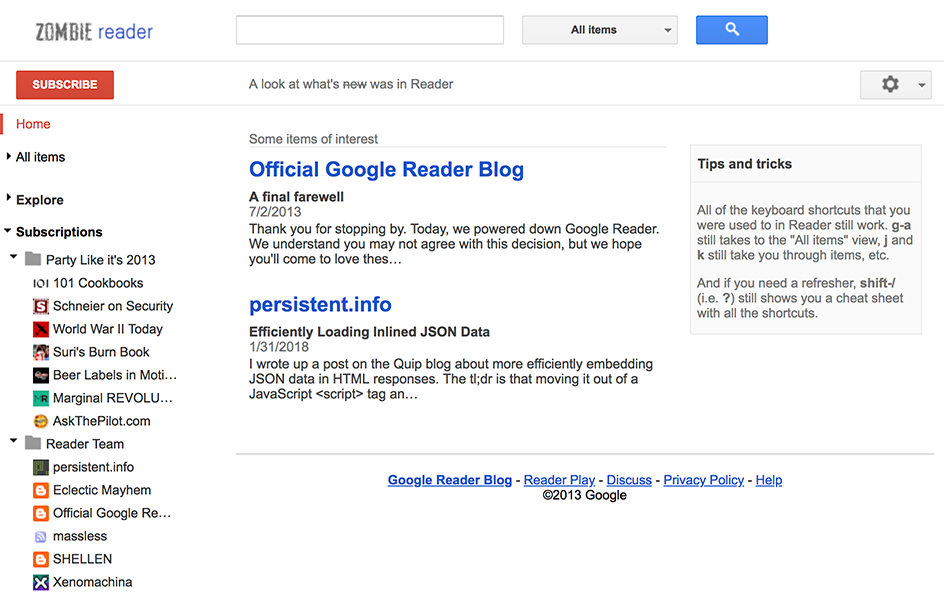 It's now been 5 years since Google Reader was shut down. As a time capsule of that bygone era, I've resurrected readerisdead.com to host a snapshot of what Reader was like in its final moments — visit http://readerisdead.com/reader/ to see a mostly-working Reader user interface.