Shared posts

30 Mar 15:54

Episode 863: Making a Hash of It

Episode 863: Making a Hash of It

Important confidential information should be encoded or encrypted when being transported or transmitted. The methods of encoding should be commensurate with the technology level of the campaign setting.

And the choice of terrible passwords and access codes should adequately reflect real life practises by the majority of people.

30 Mar 15:40

Calvin & Hobbes: 30-03-2013

29 Mar 22:16

15-02-2013

by Laerte

29 Mar 21:56

Blue and Red E-Flasksby The Drunken Moogle  Re-energize yourself...

by thedrunkenmitch
Alvaro Freitas

Nossa, eu quero um desses. MELHOR ENERGY TANK


Blue and Red E-Flasks
by The Drunken Moogle 

Re-energize yourself with an E-Flask. Fill it up with whatever will keep you going through the night and break it out when you’re feeling low. 

Blue E-Flask - $16.99
Red E-Flask - $16.99

29 Mar 21:53

Time

Alvaro Freitas

TREBUCHET!

Wait for it.
29 Mar 21:50

ianbrooks: Strange Attractors by Chaotic Atmospheres The...


Strange Attractors by Chaotic Atmospheres posted by ianbrooks.me


Strange Attractors by Chaotic Atmospheres posted by ianbrooks.me


Strange Attractors by Chaotic Atmospheres posted by ianbrooks.me


Strange Attractors by Chaotic Atmospheres posted by ianbrooks.me


Strange Attractors by Chaotic Atmospheres posted by ianbrooks.me


Strange Attractors by Chaotic Atmospheres posted by ianbrooks.me


Strange Attractors by Chaotic Atmospheres posted by ianbrooks.me


Strange Attractors by Chaotic Atmospheres posted by ianbrooks.me


Strange Attractors by Chaotic Atmospheres posted by ianbrooks.me


Strange Attractors by Chaotic Atmospheres posted by ianbrooks.me

ianbrooks:

Strange Attractors by Chaotic Atmospheres

The darkest art known as Chaos Theory is perfectly embodied in the form of its strange attractors: vast looping trajectories of variables that, when plotted, conjure gorgeous yet insidiously disruptive patterns. Chaotic Atmosphere’s Math: Rules series pays tribute to the beautiful form of chaos and its inevitable collapse of all our efforts to predict it.

Artist: Behance / DeviantArt / Twitter

29 Mar 21:47

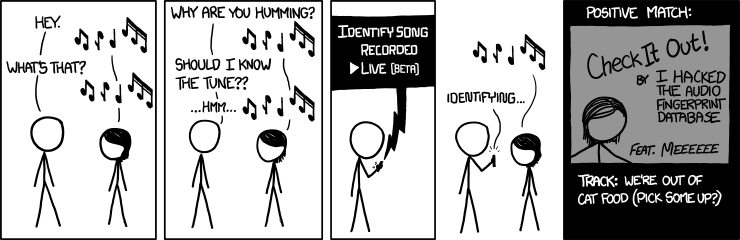
Humming

I'm so bad at carrying a tune, those 'find a song by humming its melody' websites throw an HTTP 406 error as soon as I start to hum.
29 Mar 21:45

Mutant Discrimination: GINA, Genetics and How Professor Xavier is Breaking the Law

by James Daily

This guest column was contributed by Dan Vorhaus, an attorney at Robinson, Bradshaw & Hinson, P.A. and Editor of the Genomics Law Report.

Previous posts here at Law and the Multiverse have discussed the status of mutants under several of our nation’s anti-discrimination laws, including the applicability of constitutional protections afforded by the Equal Protection and Due Process clauses of the 14th amendment and statutory protections afforded by the Americans with Disabilities Act (ADA).

There remains, however, one key piece of important anti-discrimination legislation that has yet to be considered in evaluating the legal protections afforded mutants under the law: the Genetic Information Nondiscrimination Act, or GINA.

I. GINA and Mutant Genetics: A Primer.

GINA represents a historic achievement. Enacted in 2008 after 13 years of debate, many have called it the “first civil rights bill of the 21st century.” Five years later it remains the first and only piece of federal legislation to specifically address the use and effects of genetic information.

Broadly speaking, GINA is divided into two parts. Title I of GINA prohibits health insurers from using genetic information to deny coverage or to set premiums or payment rates. Title II prohibits employers from requesting genetic information or using genetic information in hiring, firing and other employment-related decisions.

GINA’s unique focus on genetic information makes the law of particular relevance to mutants. “Mutants,” as we now know thanks to decades of research by devoted and largely off-panel comic book scientists, are individuals who possess at least one mutated copy of the so-called “X-Gene.” The gene appears to promote the development of superhuman powers and abilities, typically post-puberty.

While much remains unknown about the X-Gene’s structure and function, scientists specializing in mutant genetics have isolated its protein product(s) as evidenced by the deployment of mutant suppression drugs in X-Men: The Last Stand (the drug in question is derived from the mutant Leech). From this we can extrapolate that the location of the X-Gene in the Homo sapiens genome is known and, importantly, that mutations within the gene can be identified through genotyping or even targeted sequencing of the X-Gene itself.

With the identification of the X-Gene and the subsequent decline in cost of genomic sequencing technology, there are a number of scenarios in which a genetic test to “diagnose” a mutant at an early stage, particularly before he or she has developed any superhuman (and frequently super-destructive) abilities, might be desirable. But in light of GINA’s passage, are such genetic tests legal?

II. Mutant Discrimination in a Post-GINA World.

We start with a pair of scenarios in which genetic testing for the X-Gene might be of interest.

First, a health insurer could require applicants to submit to testing in an attempt to screen in individuals with beneficial mutations (e.g., those resulting in unique healing abilities) or screen out individuals with X-Gene mutations capable of generating catastrophic levels of claims exposure (e.g., as a result of an at-times-uncontrollable ability to rearrange matter), thereby helping to more accurately project the insurer’s exposure.

Second, an employer might use the X-Gene test to gain valuable insight about a prospective hire. For instance, a research laboratory might use the X-Gene diagnostic test to double-check that the reserved but well-qualified physicist it is considering for an open position won’t demolish the lab – and everyone and everything within it – if an experiment goes awry.

Prior to GINA’s passage, testing in either scenario would have at least been arguably permissible, although various other anti-discrimination laws, including those discussed in previous posts, might have served as the basis for an effective challenge. Post-GINA, however, the analysis is crystal clear: both of the above examples of X-Gene screening are illegal.

The text of the statute itself offers no ambiguity:

  • A health insurer “...shall not request, require, or purchase genetic information for underwriting purposes.” (§ 101)
  • It is unlawful for an employer “to fail or refuse to hire, or to discharge, any employee, or otherwise to discriminate against any employee with respect to the compensation, terms, conditions or privileges of employment of the employee, because of genetic information with respect to the employee.” (§ 202)

 Although Congress did provide limited exceptions to the general prohibition on requesting and using genetic information in the insurance and employment contexts, none of the exceptions are targeted at mutants, tests specifically designed to test for X-Gene mutations or are otherwise applicable to the scenarios discussed above.

III. Professor Xavier and Pro-Mutant Genetic Discrimination

While GINA may operate to protect mutants from certain forms of genetic discrimination, we should not forget that the statute is crafted broadly and protects against the misuse of any individual’s genetic information. In other words, just as mutants are protected by GINA, so too are they bound by it.

Consider the case of Professor Xavier’s world-renowned school, variously referred to as “Xavier’s School for Gifted Youngsters” and the “Xavier Institute for Higher Learning.”

While little is known of Xavier’s closely-guarded school, it appears to satisfy the definition of an employer subject to Title II of GINA. (GINA applies to all private employers with 15 or more employees. With roughly a dozen identified faculty members, and likely additional faculty members and administrative and support staff on the payroll, Xavier’s school likely crosses the 15-person threshold.)

Xavier’s school also has an unbroken track record of employing mutants as faculty. While it may seem logical and even desirable to employ mutants in a school dedicated to the education and training of mutants, GINA prohibits the use of genetic information in hiring and other job-related decisions without exception. Even in situations where genetic information might appear to be a legitimate criterion for assessing fitness to perform a particular job, GINA forbids its use by an employer.

Of course, it is highly unlikely that Xavier requires prospective faculty members to submit to a traditional genetic test as a condition of their application and/or hiring. In addition to his well-known psionic powers which allow him to identify mutants using only his mind, many or all of the individuals applying to work at the school have manifest mutant powers. Nevertheless, GINA is clear that genetic information, however acquired, may not be used “in regard to hiring, discharge, compensation, terms, conditions, or privileges of employment.” 29 CFR § 1635.4. No matter how he comes by the information, if Xavier is indeed using genetic information in employment-related decisions, this would be a clear violation of GINA.

Since none of Xavier’s existing faculty members are likely to bring a discrimination claim, how might one arise? The most likely scenario: a gifted but non-mutant individual, perhaps one even possessed of other superpowers derived from, for example, an alien genesis or technological enhancements, seeks a position at Xavier’s school as an instructor but is turned away. Such an individual would be well-positioned to bring a successful genetic discrimination claim under GINA against Professor Xavier and his school. The Equal Employment Opportunity Commission (EEOC), the federal agency responsible for enforcing Title II of GINA, provides detailed instructions for filing just such a charge.

As with any new piece of legislation, it will take some time before GINA’s full implications for both mutants and humans become clear. Final regulations for Title II of GINA were published in 2010, but public examples of GINA-in-action remain few and far between, and illustrate the many uncertainties and difficulties of enforcement.  For example, given the EEOC’s difficulty subpoenaing documents from Nestle in a recent enforcement action, one can only imagine the considerable challenges that would await the Commission in attempting to gather the evidence needed to successfully establish a claim of discrimination under GINA.

Nonetheless, the law of GINA is clear, and the coming years may require the Commission and other regulatory bodies to overcome those challenges in order to appropriately enforce GINA both for and against the mutant population. Count on Law and the Multiverse and the Genomics Law Report to continue to keep you apprised of all the latest in GINA, mutants and genetic discrimination law.

29 Mar 21:36

Coyote As far as mythological trickster figures go, Coyote is...


Coyote

As far as mythological trickster figures go, Coyote is one of the heavy hitters. Various First Nations cultures from across North America refer to Coyote as a cunning folk hero like our friend Reynard the fox, but in some iterations, Coyote has enough myth-juice to be a creator figure as well.

Coyote is a rather mysterious figure, often appearing as either male or female, and depending on the nature of the story, she might appear as an anthropomorphized figure or entirely four legged and furry as one might find a coyote today. Not only is Coyote`s gender ambiguous, but her role in her mythological pantheon is debatable too. In some traditions, Coyote follows the archetype of the creator to a larger extent: making humans out of mud, naming and creating the other animals. In other traditions she more closely adheres to the archetype of the trickster; stealing the sun and sharing it with the world, cheating the frog people out of their monopoly on all the world’s water (Just like Jackie Chan in the Tuxedo! Exactly 4 people will have seen that movie to get the reference), or accidentally setting Christopher Columbus on the Native Americans.

By The Gods! Encourages all readers to follow up on the multitude of Coyote myth and folklore out there, but co-editor Dan personally recommends “A Coyote Columbus Story” by Thomas King.

29 Mar 04:36

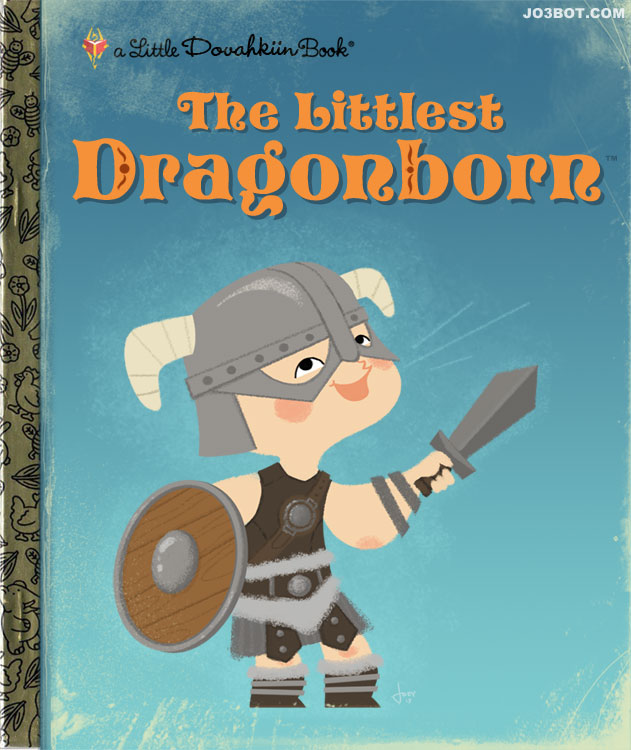
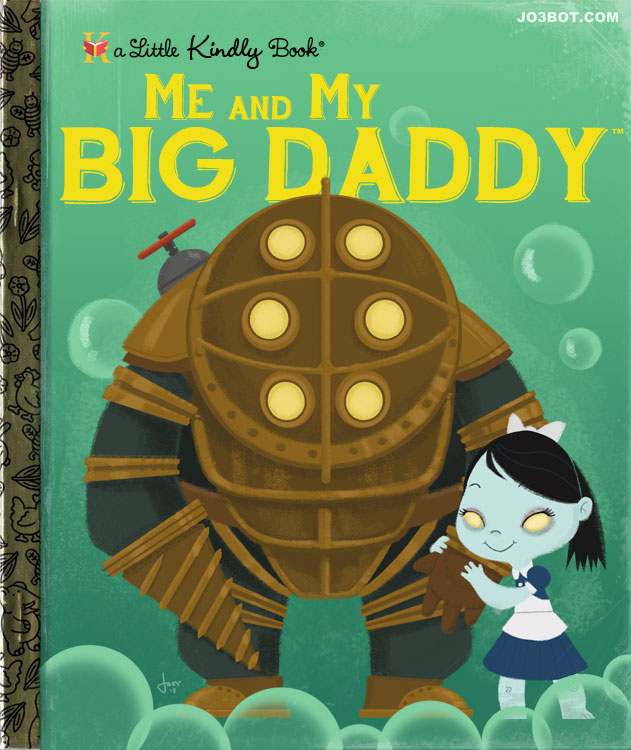
Little Golden Video Game Books

by Steve Napierski
Little Golden Book - PortalLittle Golden Book - SkyrimLittle Golden Book - BioShock

These would definitely make some good books to share with the kids.

source: Joebot
28 Mar 20:11

Tabletop Day: Scion, Esoterrorists e Little Fears de graça

by cesar/kimble

Em comemoração ao aniversário do show TableTop do ator Wil Wheaton (nerd e ator de séries como Star Trek e Leverage), o canal do YouTube Geek & Sundry resolveu organizar o evento TableTop Day. Este evento é uma comemoração aos diferentes tipos de jogos de mesa, onde se inclui o RPG. A página do evento pode ser encontrada aqui.

Mas o que isto interessa para nós, rpgistas brasileiros que não vão estar nas cidades onde as comemorações vão ocorrer? Algumas empresas resolveram se organizar e fazer uma promoção no DriveThruRPG. A página da promoção pode ser vista aqui.

Mas o melhor é o pacote de jogos e quickstarts GRATUITOS que estão sendo oferecidos. Tem desde os livros completos dos rpgs Scion: Hero, Little Fears e Esoterrorists até quickstarts de jogos como Leverage RPG, Savage Worlds e Shadowrun. O pacote está aqui.

É necessário fazer cadastro no site para “comprar”, mas como o custo é zero não necessário colocar número de cartão de crédito ou qualquer valor financeiro.

E além desses livros, também estão em promoção o material de Ptolus, de Monte Cook, e o rpg do Doctor Who.

A promoção vai até o dia 30 de Março, então aproveitem!

28 Mar 13:02

Algumas palavras soltas

by Ricardo Seelig
Você quer escrever sobre música. Legal, um monte de gente quer. Vamos então trocar umas ideias sobre isso. O primeiro passo é se distanciar, tanto pessoal quanto emocionalmente, de qualquer relação que você tenha com o artista sobre o qual irá traçar as suas linhas. Só agindo dessa maneira você conseguirá ter o distanciamento crítico, o discernimento, para analisar uma obra com sobriedade e de forma objetiva. Não, um álbum não deve ser resenhado por um fã da banda que o gravou só porque ele, teoricamente, “tem mais conhecimento sobre o artista”. Um álbum deve ser resenhado por quem tem conhecimento e senso crítico para entender o que o grupo em questão gravou, isso sim.

Dispa-se de preconceitos. Eles não combinam com música, e nem com qualquer forma de arte. Qualquer um deles. Todos eles. Não julgue quem curte heavy metal como uma bando de ogros radicais e mal informados. Como "metaleiros" imbecis. Estamos muito longe de ser isso. Não defenda a ideia de que todo indie é um hipster deslumbrado, preocupado apenas com a última novidade propagada pela NME. Eles não são assim. Não venha com ideias prontas, pré-concebidas, sobre qualquer gênero musical. Antes de emitir qualquer opinião, saiba sobre o que você está falando. Ouça um estilo, tento absorvê-lo, assimilá-lo, entendê-lo. Só depois aventure-se a escrever sobre ele.

Não desista de um disco porque você não gostou dele na primeira audição. Esses, geralmente, são os melhores. Não pare na primeira tentativa. Encare o desafio e tente entender o que o artista está fazendo, e porque você não está conseguindo entender o que ele está propondo. Dê tempo para as coisas, não seja apressado. Se eu agisse assim, teria desistido de Bitches Brew, álbum lançado por Miles Davis em 1970, na primeira tentativa. Mas não fiz isso. A música contida ali era complexa demais para ser absorvida rapidamente. Ou para ser absorvida em uma idade da vida em que a única coisa que importa são guitarras distorcidas. Ou era, simplesmente, demais para a minha cabeça. Fui me familiarizando com ele, entendendo cada caminho devagarinho, até a ficha cair por inteiro e ele se transformar em um dos melhores discos que ouvi na vida.

Não tenha medo da mudança. Aliás, incentive justamente a sua existência. Tenha medo, sim, do comodismo, de quem fica acomodado no mesmo lugar, dando voltas ao redor do rabo. Em qualquer atividade artística, seja ela a música, o cinema, a literatura, é louvável que o artista se reinvente, sempre. Miles fez isso a vida toda. O Led Zeppelin também. Os Stones, os Beatles, Dylan, todos os grandes construíram suas carreiras sobre essa atitude. Por isso se transformaram nos gigantes que são hoje. Nunca tiveram medo do novo, absorvendo novas influências e as inserindo aos seus já vastos vocabulários musicais. Essa deve ser a sua postura se você deseja escrever sobre música. Mantenha-se atento ao que está acontecendo. Seja curioso, mesmo se tal sonoridade não lhe agrade de imediato. Entenda sobre quais influências ela foi construída, como ela funciona.

Não cometa o erro de achar um disco ruim só porque ele é diferente daquilo que a banda gravou há tempos. Os caras estreiam com um álbum de sucesso, e passados mais de dez anos você ainda quer que eles estejam fazendo a mesma coisa? Você cresceu nesses dez anos, viveu experiêncais diferentes, mudou as suas opiniões, conheceu pessoas, amadureceu. É evidente que seus ídolos também. As pessoas mudam e, consequentemente, as sonoridades também.

Is This It estourou o Strokes em 2001, quando os músicos tinham em média 20 anos. Uma década depois, é óbvio que eles não estão mais fazendo o mesmo tipo de som, e quem espera isso possui uma postura saudosista equivocada, que não combina em nada com a música. Podemos fazer esse exercício com qualquer artista. Paul McCartney soa hoje bem diferente do menino que compôs “All My Loving”. O John Lennon de “Mother” parece o mesmo compositor de “Help”? Steve Harris, Tony Iommi, Jimmy Page, você, todos mudaram com o tempo. Seus ídolos são humanos, respeite isso.

Você quer escrever sobre música. Então abra a sua mente. Não tenha preconceito com nada. E, se tiver, procure não demonstrá-los. Vou falar de mim. 99,99% das bandas brasileiras não despertam o meu interesse. Não há nada delas que me cause identificação. Nação Zumbi, Mundo Livre, Los Hermanos: não consumo suas músicas, não sei o que eles andam fazendo. Gosto de Cachorro Grande, Tomada, Zeca Baleiro, Zé Ramalho. Meu último ídolo nascido aqui foi Chico Science, e depois que ele morreu parei de acompanhar o que sua banda fazia. No entanto, vocês não me vêem escrever sobre rock brasileiro aqui na Collectors, e a razão é simples: eu não tenho o que dizer sobre ele. Eu não tenho conhecimento, e nem discernimento, para falar sobre essa cena. Se resolvesse fazer isso, diria besteira. Então, optei por não fazer. É simples, e funciona. E é por isso que decidi convocar mais gente para me ajudar a produzir a Collectors Room, mostrando visões e pontos de vista diferentes. É por isso que caras legais como Raul Ramone, Rodrigo Carvalho, Rodrigo Simas, Guilherme Gonçalves, Nelson Júnior, Fabiano Nicaretta, Thiago Cardim e Márcio Grings estão aqui: pra mostrar que a música é muito mais do que eu acho que é, do que você acha que é.

Se você é um grande fã de heavy metal, um crítico, um jornalista especializado em música pesada, não resolva escrever sobre pop. Se você é um especialista na cena indie, não decida escrever sobre metal. E pode aplicar esse raciocínio em diversos outros gêneros. É muito difícil ser um crítico plural, que escreve e raciocina com precisão e conhecimento de causa sobre os mais diversos estilos. Pessoalmente, não conheço ninguém que tenha essa invejável capacidade.

Você pode, no final das contas, ser apenas um consumidor de música, um fã apaixonado de suas bandas favoritas. Não há mal nenhum nisso, e você será feliz assim, eu sei. Mas aos que decidirem se aventurar pelo jornalismo musical, o fanatismo, a cegueira crítica em relação aos artistas, é algo que deve ficar guardado no fundo da gaveta. Não só no jornalismo cultural, mas no jornalismo como um todo, é preciso pensar com o próprio cérebro, ter as suas próprias opiniões, desenvolver os seus próprios raciocínios, possuir argumentos. Se você conseguir fazer isso, será bem-vindo. Se você tiver algo a dizer, terá público. Se você tiver opiniões próprias, será respeitado.

Faça a sua escolha. Eu já fiz a minha.

Por Ricardo Seelig
28 Mar 12:54

Reynard the Fox Reynard the fox is a trickster figure from...


Reynard the Fox


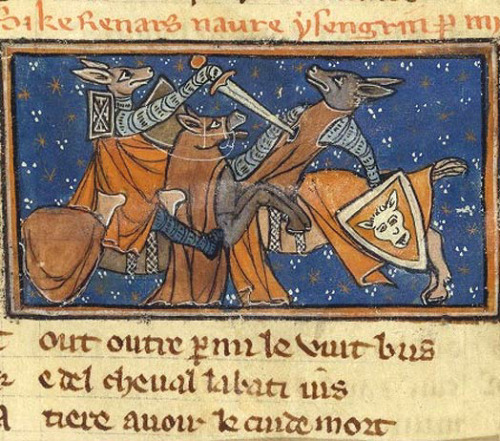
Reynard the fox is a trickster figure from European folklore, much like Coyote or Raven from certain First Nation traditions. Primarily written in a satyrical context to poke fun at  the aristocracy or the clergy, Reynard uses wit and cunning to get the better of his enemies. His favourite ploy seems to be faking his death and planning posthumous revenge, which says something about the naivety of his antagonists, as it totally works a bunch of times. In the anthropomorphic kingdom ruled by Leo the Lion (with other inhabitants like Bruin the bear or Tybalt the cat) Reynard  has many enemies that often team up to bring the folk hero down, but none are as formidable as his nemesis Isengrim the wolf.

Luckily, Reynard has castle Maleperdius to seek refuge in, that has so many trap doors and secret passages that you’d think it was designed by the same guy that did Wayne manor or that mansion from Clue. 

Reynard became so popular in France especially that his name actually became the word for fox. The original word “goupil” was replaced by “renard” as farmers once believed that saying “goupil” brought bad luck.

27 Mar 15:36

Cover de Voodoo Chile com Gayageum

by Igor Massami
Alvaro Freitas

Fantástico.

Para quem curte Jimi Hendrix e um bom som, essa guria fez um cover maneirissímo da música Voodoo Chile, o nome dela é Luna, uma versão da música usando o gayageum.

O gayageum ou kayagum é um instrumento de cordas tradicional coreano estilo uma cítara,  o intrumento tem 12 cordas.

Confira ai!


26 Mar 18:18

malformalady: This mushroom - thought to be a specimen of...


malformalady:

This mushroom - thought to be a specimen of Clathrus archeri, or “Devil’s Fingers” - takes the cake for being the strangest and creepiest specimen of a fungus looking like something else. It looks like a cold, dead hand reaching out to pull the rest of the zombie body out of the earth. Those even look like tattered sleeves down by the wrists of the hands.

25 Mar 20:52

Overheard On The Subway: The Coolest Conversation Ever Between Two Dads With Gay Sons

by Dan Avery

new york subwayNew York blogger Rafi D’Angelo recently overheard a conversation on the subway between two “construction- worker types” who discovered they had something in common.

“I’ve been doing this for about six months now, trying to catch interesting things on the subway,” posted D’Angelo. “But I haven’t had any luck so far because I ride boring trains. Today was good, though.”

Guy #1: “My wife wants me to get fixed like a dog but I don’t see why she can’t just keep taking the pill.”
Guy #2:  No more kids for you two?
Guy #1:  No, she figures we’re both getting too old for a baby.
Guy #2:  How is your boy anyway?  Haven’t seen him in awhile.
Guy #1:  Oh John’s good, pitching this year varsity.
Guy #2:  He’ll definitely have the girls hanging around him now.
Guy #1:  Yeah if he had any time for them.
Guy #2:  Focused on baseball?
Guy #1:  Focused on boys.
Guy #2:  You’re shittin’ me!
Guy #1:  I kid you not.  Came out to me and Mary Ann bold as daylight last year.
Guy #2:  Well I’ll be damned!  I’m not supposed to know it but I overheard Patrick Jr. tell his sister he might be gay not two months ago.
Guy #1:  We all saw that coming though.
Guy #2:  You’re the second person to say that. How’d everybody see it but me?
Guy #1:  It was just a feeling, Pat.  He was always a little soft, ya know?
Guy #2:  I guess you’re right. But damn Charlie, we both have gay kids. What do we do now?  Both our sons are gay.
Guy #1:  We don’t do anything.  We let em be gay and if some kid calls ‘em a faggot we go to their house and raise hell with the parents like normal.
Guy #2:  Well I guess John and Lucinda won’t be getting together like we thought awhile ago.
Guy #1:  Guess not.
**long pause**
Guy #2:  Hey Charlie, you thinkin’ what I’m thinkin’?
Guy #1:  I was for about half-a-second then it got weird and I started thinkin’ about somethin’ else instead.

The future is here, folks.


25 Mar 20:03

A diferença entre geixa/geiko e cortesã

by Igor Massami

Olha só que legal, a única Tayu ativa em Kyoto atualmente, Kisaragi. Tayu é uma cortesã especialista na arte do entretenimento e de grande prestígio, mas ainda assim diferente de uma geiko treinada. Aham, geiko/geisha e cortesã são coisas bem diferentes.

Existem geisha/geiko  e cortesãs ( em alguns livros chamadas de Oiran), algo que até hoje é bastante confundido no senso comum. Os tipos de cortesãs mudaram ao longo dos anos e estão atreladas à chegada do Período Edo (1603-1868) e à instauração dos distritos de Shimabara (Kyoto), Yoshiwara (Tokyo) e Shinmachi (Osaka), sendo o nível hierárquico de cortesã mais alto o de Tayu.

Kisaragi Tayuu

Nessa época, com a criação da lei de controle/delimitação de áreas de entretenimento, acabou surgindo novos nichos de atuação, sendo rapidamente ocupados pelas cortesãs. Os tipos e níveis hierárquicos das cortesãs variam conforme o treinamento e serviços oferecidos, inclusive, com cortesãs voltadas para os prazeres sexuais (aham, não são todas voltadas para isso, outro motivo de grande confusão e criação de preconceito).

Por conta do surgimento de novas artistas do entretenimento, as geiko foram facilmente confundidas com cortesãs e até mesmo prostitutas, o que criou uma grande mancha negativa em sua imagem. O preconceito durou por anos, até que são comuns as histórias trágicas dos pais que não querem que a filha se torne geiko e tudo mais. Tudo isso virou motivo de fascínio nos Estados Unidos e Europa, com vários livros e romances dedicados ao assunto, alguns que infelizmente são preconceituosos e empobrecem o entendimento da cultura japonesa.

Vale lembrar rapidamente que geiko/geisha ou “Filha das Artes”/”Praticante das Artes” é aquela mulher treinada não só na melhor etiqueta japonesa, como também em várias formas de artes e rituais, desde a Cerimônia do Chá até a prática de números artísticos, musicais, etc. Para tanto, se dedicam por anos a fio em um treino bastante rigoroso, árduo e extremamente caro.

Geixa

Com a independência feminina no Japão da década de 50 e 60 o número de geiko diminuiu drasticamente, contudo, temos notado que o interesse para se tornar geiko retornou com força nas últimas décadas. Livrando-se da imagem negativa consolidada nas décadas anteriores, as atuais geiko recuperam o prestígio de tempos passados. Já as Tayu, uma cortesã treinada e de alto nível, cumpre um papel em declínio, restando pouquíssimas no Japão.

Caminhar em Kyoto, em especial lá em Pontocho e Gion e em horários especiais, é tropeçar entre maikos (aprendizes de geiko/geisha) e também entre maiko de mentira ou fake, o que deixa a população local muito chateada.

Como já ouvi por lá, para aquecer o turismo as agências contratam jovens dispostas a se vestirem como maiko para aparecer nas fotos dos inúmeros estrangeiros que aparecem na cidade. Li uma vez a irritação de um mestre sobre o assunto, pois a prática desconsidera os vários anos de prática e estudos que são requisitos para a formação de uma geiko.


O post é do nobre amigo doutor (sim doutor!) Victor Hugo, que manja muito da cultura japonesa e é dono do Japanologia, de onde tirei esse texto.
25 Mar 18:41

La Vie Sexuelle des Jeux Vidéo

by Steve Napierski

It’s not the size of your warp pipe that matters, it’s how you use it.

source: YouTube
via: Halolz
25 Mar 18:30

Photo


24 Mar 15:24

Isto não é um hands-on: Rego, um app bacana, mas que tem um nome bem complicado no Brasil

by Daniel Junqueira
Alvaro Freitas

Share por motivo de o Rego é meu eu faço o que eu quiser com ele

De vez em quando surgem uns apps com nomes sugestivos, e o Rego é um desses. Você pode até achar que estamos sendo infantis, mas sério, veja como o Rego se descreve.

Ele é um serviço que lembra um pouco o Foursquare: você marca em mapas lugares que visitou e pode fazer anotações sobre ele. Útil, interessante até, mas… pô, Rego. Conheça mais sobre o Rego:

Você pode planejar uma viagem em casa e anotar no Rego os lugares que quer visitar. Depois, quando estiver fora do país, o GPS do iPhone ajuda a encontrar os lugares que você quer.

Captura de Tela 2013-03-21 às 18.51.18


Além de marcar o lugar em um mapa, você pode fazer anotações sobre ele. Dá para colocar fotos no Rego.

rego2


Sobre privacidade, o site do Rego é direto: “O Rego é privado. Ninguém consegue ver o que você adiciona no Rego. Mas às vezes você quer compartilhar um lugar com isso, e o Rego faz isso com facilidade. Lugares compartilhados são importados diretamente para o Rego, o que o torna um app perfeito para aquele momento ‘ei, vamos nos encontrar lá!’”

Captura de Tela 2013-03-21 às 18.50.00


Você não pode adicionar amigos no Rego: ele é apenas seu. Cada um tem seu Rego. Não é uma rede social e você não vai ficar sabendo o que outras pessoas fazem no Rego delas.

rego3


O Rego é gratuito: você pode adicionar até dez lugares sem precisar pagar nada. Mas, depois disso, a taxa para usar o Rego é de US$ 2,99. Se você curtiu muito, aproveite. O Rego está em promoção: US$0,99.

O Rego só está disponível para iPhone. Você pode baixá-lo no link a seguir: [App Store via Rego, via @rafaelcapanema]

23 Mar 23:30

Botecos: Like going for a beer in your bathroom

by andyhpmartin
Origins The word boteco (or botequim /butiquim) is derived from the Portuguese word botica (bodega in Spanish), which is itself derived from the the Greek word Apotheke – meaning a place or store where goods are sold. However, if in Portugal a botica was a place of storage, in Brazil a boteco evolved into becoming […]
23 Mar 23:23

151 pokémons com a cara do Nicolas Cage

by Alessio Esteves

cage2

Em mais uma prova bizarra de como a Internet tem gente criativa e com tempo, criaram um Tumblr onde teremos os 151 pokémons originais com a cara do Nicoles Cage!

Além da palhinia que demos neste post, você pode conferir o resto aqui.

cage1

cage3

cage4

23 Mar 23:18

Photo


23 Mar 23:06

Brony Engaged To A ‘My Little Pony’ Writes Angry Letter To Man Drawing Erotic Pictures Of His Future Bride

by Josh Kurp
Alvaro Freitas

I don't even

You got all that? Me neither. But let’s try to break down what the A.V. Club called the “apex” of the Internet. Non-human horse Twilight Sparkle is to My Little Pony fans as Alison Brie is to Human Beings (and human beings); she’s the breakout star on My Little Pony: Friendship Is Magic, and it’s not hard to see why. Equine knows how to work that flank star. (Also, according to this website, she “practices turning rocks into formal attire,” which is useful, I guess.) Anyway, a man claiming to be Twilight’s fiancé recently sent an angry letter to, according to MTV Geek, “DeviantArt artist Kevinsano who partakes in the creation and ‘appreciation’ of erotic My Little Pony art.”

Been there, except replace “My Little Pony art” with “Dave Matthews Band cakes.” Here’s the letter.

And then:

But don’t forget:

…the Aristocrats! The Internet is currently ripping itself in two, with one side fully in support of this anonymous man and his beautiful, pure, fulfilling love to one of God’s greatest creatures, while the other wonders how the f*ck a human can take a fictional purple horse out for “social activities.” Pick a side, folks. This is the end of line.

#teamtwilight

(AV Club, via MTV Geek)

The post Brony Engaged To A ‘My Little Pony’ Writes Angry Letter To Man Drawing Erotic Pictures Of His Future Bride appeared first on UPROXX.

22 Mar 15:04

The Global Kraken

by Ed Yong

Earlier this year, the Discovery Channel released the first ever footage of the legendary giant squid in its natural environment. But did the crew manage to film the giant squid, or one of the giant squids?

The giant was first described by the Danish naturalist Japetus Steenstrup in 1857, who named it Architeuthis dux. As Craig McClain writes, the name “translates to ‘most important squid leader’.  That is scientifically an awesome name.” Since then, biologists have slapped the Architeuthis brand on no fewer than 21 potential species. Some of these over-eager taxonomists were just going on fragments of flesh, like beaks or arms that sperm whales had coughed up. Others reasoned that squid remains in far-off corners of the world must belong to different species. After all, giant squids are everywhere—they’ve turned up in all oceans except the waters around Antarctica.

How many of these species are valid? “All of them” seems unlikely as an answer. Some people think that there are just three, which live in the North Atlantic, North Pacific, and Southern Ocean respectively. Others insist that there’s just the single globe-spanning species, caressing the world in its tentacles.

The distribution of giant squid around the world. Image created by NASA, from Wikipedia.

The distribution of giant squid around the world. Image created by NASA, from Wikipedia.

Now, a team of scientists from eight countries, led by Inger Winkelmann from the University of Copenhagen, has tried to settle the debate by looking at the kraken’s genes. Together, they amassed tissue samples from 43 giant squids caught all over the animal’s range, from Florida to South Africa to New Zealand. They sequenced each sample to piece together its mitochondrial genome—a small secondary set of DNA, which sits outside the main genome in tiny bean-shaped batteries.

The team found that the giant squid’s genetic diversity is incredibly low. Even though the individuals hailed from opposite corners of the world, they differed at less than 1 in every 100 DNA letters. For comparison, that’s 44 times less diverse than the Humboldt squid, which only lives in the eastern Pacific. In fact, the giant squid seems to be genetically narrower than any other sea-going species that scientists have tested, with the sole exception of the basking shark.

This strongly suggests that the 21 proposed species of giant squid can indeed be collapsed into one. There’s just the one global kraken—Architeuthis dux, the one-and-only original. What’s more, the population seems to have very little structure—in other words, squids that hail from nearby waters aren’t going to be genetically closer than distant individuals. The mitochondrial DNA of a Japanese squid is basically the same as that of a Floridian squid.

Why? It’s possible that the adults are wandering nomads that swim over large areas, but that seems unlikely. Chemical analyses of their beaks suggest that they stick within a relatively contained patch of ocean.  The alternative is that they go a-wanderin’ as larvae and youngsters. Young marine animals are certainly capable of passively drifting over tens of thousands of kilometres on ocean currents, so it’s entirely possible that the squids do the same. These young nomads would feed on plankton and other small creatures until they became big, whereupon they’d settle down and sink to the nutrient-rich waters of the deep ocean.

“I am not in the least surprised by their findings,” says giant squid expert Steve O’Shea. “They support what has been said many times earlier by some, contradicted by others and debated by a few, to what end I will never know.” O’Shea himself has suggested that larval giants drift over considerable distances and, on another Discovery Channel-sponsored research trip, he has captured 17 of these larvae at the surface of the ocean.

Craig McClain from the National Evolutionary Synthesis Center is more enthusiastic. “This is the research project I dreamed of conducting, and the results are even more interesting than I would have imagined,” he says. “The finding of just one species is not unexpected, but the study finally provides the molecular evidence that was so sorely missing.  What is amazing is the total lack of genetic structure among ocean basins. I know of few animals that have the long range dispersal ability or behavior to ensure genetic exchange over such great distances.”

But why does the squid have such low genetic diversity? Winkelmann couldn’t find any signs that its mitochondrial DNA evolves at a slower pace than that of other animals. Instead, it’s possible that the giant squid—like the basking shark—went through a population bottleneck at some time in its past, and today’s individuals descended from that narrow stock of ancestors. Maybe they used to be restricted to a specific part of the world but were released by some ancient event, like a change in climate, or the death of a competitor.

This is all just guesswork. As Winkelmann writes, “We cannot offer a satisfactory explanation for the low diversity.”

And there’s one last, important caveat—the team’s conclusions are based on the mitochondrial genome alone. That’s useful for looking at things like diversity and ancestry, but the team still need to analyse the giant squid’s nuclear genome, which contains the vast majority of its DNA. Nuclear genomes have a habit of complicating the stories told by mitochondrial ones. Who knows what they will do for the giant squid?

“It is clear that there is much that remains an enigma about these ocean giants,” says McClain.

Reference: Winkelmann, Campos, Strugnell, Cherel, Smith, Kubodera, Allcock, Kampmann, Schroeder, Guerra, Norman, Finn, Ingrao, Clarke & Gilbert. 2013. Mitochondrial genome diversity and population structure of the giant squid Architeuthis: genetics sheds new light on one of the most enigmatic marine species. Proc Roy Soc B http://dx.doi.org/10.1098/rspb.2013.0273

22 Mar 14:57

bythegods: It has the spirit of the tale.


bythegods:

It has the spirit of the tale.

22 Mar 14:00

http://naosenteaomeulado.blogspot.com/2013/03/tia-posso-te-fazer-uma-pergunta-tenho.html

by noreply@blogger.com (raquel.)

- tia, posso te fazer uma pergunta?

tenho calafrios. toda vez invariavelmente. e muita vontade de sair pela janela porque né. VAI SABER que tipo de pergunta virá. só jesus.

- pode, maria fernanda.
- hihihihi.
- vai, pergunta.
- como se escreve bocó?

~bocó~

soletrei e lá se foi ela.
só pra voltar dois minutos depois.

- tiiia, como que escreve idiota?
- idiota, maria fernanda?
- hihihihi.
- idiota não vou ensinar não.
- aaaaah.
- não, ficar chamando as pessoas de idiotas não é legal. eu posso no mááááximo te ensinar como se escreve "mané".

(todo um traquejo didático-pedagógico, percebam.)

daí soletrei. e olhei de rabo de olho pro papelzinho.

ela tinha escrito

BOCÓ
EU TE AMO
MANÉ

e foi muito contente entregar para seu paquerinha

+_+

em quem havia acabado de dar umas porradas porque ele a chamou de gorda do cabelo ruim.

+___+


o que me fez concluir pacificamente que temos todos 6 anos. nunca deixamos de ter 6 anos. só demos uma requintada no processo te amo não quero mais ser seu amigo cocô xixi sou seu amigo de novo vem brincar na minha casa. e chamamos pomposamente de dr.

mas não passamos de um bando de bocós.
22 Mar 10:42

Pokémon Snap ‘Theatrical Trailer’

by Steve Napierski

Pokémon meets Jurassic Park is pretty damn awesome…Todd Snap is still a tool. Somethings just never change.

source: YouTube
22 Mar 00:02

It has the spirit of the tale.


It has the spirit of the tale.

21 Mar 23:59

stealatimelord: