 DURHAM, ENGLAND—A medieval recipe book has been found in Durham Cathedral’s monastery. The collection of twelfth-century recipes, one of which is known to have come from France, was intended to improve health and cure certain ailments. The book also contains recipes for ointments. “The sauces typically feature parsley, sage, pepper, garlic, mustard, and coriander, which I suspect may give them a Mediterranean feel when we recreate them,” said Giles Gasper of Durham University. Restaurant chefs will prepare some of the dishes for workshop participants. A translation of the book is also in the works.
Alvaro Freitas
Shared posts
18 Apr 18:55
Medieval Cookbook Discovered
by saraceni@verizon.net (Jessica E. Saraceni)
Alvaro FreitasHah, que fantástico
Alvaro Freitas likes this
18 Apr 14:20

Will robot rock save the world?
by Guilherme Alves
Alvaro FreitasTô no hype louco com esse álbum desculpem :~

No momento em que eu começo a escrever esse texto, estou em êxtase por causa de uma suposta versão demo verdadeira da nova música do Daft Punk, Get Lucky, que foi transmitida por uma rádio canadense.
Agora mesmo vejo muita gente, até mesmo caras que curtem um som mais sujo, mais “torto”, compartilhando e comentando a suposta música. E vai além disso. Caras que estão animados para o show do Iron Maiden no Rock in Rio estão curtindo a faixa, dizendo que é muito boa.
A campanha de marketing que está rolando em volta desse álbum é simplesmente genial. A dupla formada por Guy-Manoel de Homem-Cristo e Thomas Bangalter já é reverenciada ao redor do mundo por seus 20 anos de trabalho, e toda essa comoção que envolve o álbum Random Acess Memories só comprova o que eu estou falando. Só um novo álbum do Daft Punk já seria o suficiente para causar alvoroço mundo afora, mas vendo as entrevistas com lendas como Niles Rodgers e Giorgio Moroder, é perceptível que estamos em frente a um fenômeno mundial. Algo que vai liderar todas as paradas e garantir o lugar no topo de todas as listas de “melhores álbuns do ano” de 2013.
Mas esse não é o meu ponto.
Em uma entrevista à Rolling Stones americana, Thomas disse o seguinte: “A música eletrônica está em sua zona de conforto e não está se mexendo um centímetro sequer.”
Será só a música eletrônica mesmo?
Eu acho que a gente consegue estender isso para outros gêneros. E digo mais, acho que nesses outros gêneros, a situação é ainda pior.
Vamos com o Rock. Nos últimos 5 anos, não consigo lembrar de uma banda que “revolucionou” algo, que fez o diferente. Temos sim grandes álbuns e grandes bandas despontando, mas nenhuma delas causa aquela reação “nossa, isso é diferente!”. Um exemplo é o álbum do Black Keys, El Camino, que é um ótimo álbum, mas não tem nada diferente do que a banda se propôs a fazer em todos os seus outros discos.
O Vaccines, que surgiu a pouco, é uma banda muito boa. Mas sua sonoridade também não trás nada de novo, nada que o Strokes não tenha feito no início dos anos 2000. Jack White, um dos grandes rockers da minha geração, lançou um ótimo álbum solo na minha opinião. Mas não agradou todo mundo, e também não fugiu do que já fazia no Raconteurs, no Dead Weather e no extinto White Stripes. Até mesmo os gênios/deuses do Rolling Stones lançaram coisas ótimas, porém, caindo no mesmo lugar comum aqui já citado.
Foo Fighters fez um bom show no Brasil ano passado, tocando músicas de toda a sua carreira, e ali a gente vê que é tudo parecido. Não tem nada diferente. E isso só pra citar alguns exemplos.
No Pop então, tudo fica ainda mais extremo. Posso afirmar que hoje, quase TUDO no pop é igual: Katy Perry, Rihanna, Lady Gaga, Madonna, Britney Spears, Rita Ora, The Wanted, One Direction, Will.i.Am, Justin Bieber, Psy, tudo igual. Vivemos uma era do pop que pode ser resumida com um nome: Calvin Harris. Uma música parece ser continuação da outra. E olha que eu gosto de música pop! Tem vários artistas que eu citei acima que lançaram bons álbuns e boas músicas. Mas, de novo, nada diferente. Nada, absolutamente nada.
E no mundo indie, então?
Peguemos alguns exemplos recentes. Temos artistas que tentam sair desse lugar comum, sim. Temos Alt J, temos Gotye, temos Foals, Foster the People, Lana Del Rey… Mas, se você for parar pra pensar, dá pra dizer facilmente que entre eles não tem muita diferença não. Aliás, tem muitas bandas indies que parecem ser a mesma. E aqui vemos um caso estranho: temos muitas bandas que tentam fazer diferente e acabam caindo em outro lugar: no estranho. Caso do Strokes com seu álbum “Angles”. Estranho no sentido de “ser ruim”. E temos muitas bandas que apostaram no mesmo e fizeram coisas patéticas, com uma ou duas músicas boas e nada mais.
Voltando à frase do Thomas Bangalter, uma ironia pode ser percebida. O gênero que mais conseguiu trazer coisas diferentes à atualidade foi… a música eletrônica! Skrillex e companhia criaram um novo tipo de “dubstep”, mesmo sendo odiados por meio mundo. Temos artistas do rock que vieram beber na fonte da eletrônica para inserir criatividade em suas músicas. Para você entender o que eu estou falando: ao ouvir Doom and Gloom, do Rolling Stones, você pode achar que se trata de uma música antiga deles. Todos querem vê-los ao vivo, mas não porque o show deles é algo novo, mas porque é algo que é muito bom. Não diferente, mas muito bom. Agora, peguemos o kraftwerk, uma banda antiga de música eletrônica. Ao incorporar uma tecnologia nova ao som antigo, o 3D, os alemães conseguiram criar algo novo, diferente, com suas músicas antigas.
Claro, temos ainda coisas diferentes em outros gêneros. O dueto entre Kanye West e Jay Z, Watch The Throne, junto com Frank Ocean e Tyler The Creator, deram um novo ar ao hip hop. Bandas pequenas conseguiram experimentar no rock e criar algo bom, como o Japandroids, que lançou um excelente álbum recentemente, Spiritualized, Mogwai, Explosions in the Sky, entre outros. Todos fazem um rock diferente, porém, nem se somarmos todos esses e multiplicarmos por 100, temos uma comoção mundial. Infelizmente, esses exemplos são raros, são como um torcedor do XV de Piracicaba no meio da torcida do Coritnhians. E no pop… bem… no pop, deixa quieto.
Aí está a grande explicação pela comoção em torno do “Random Acess Memories”. Todos nós estamos desesperados por coisas novas, diferentes. O ser humano é um ser que tem por regra a mudança. E nós estamos aqui, apostando em dois robôs para trazerem novos ares à música. Dois robôs geniais, diga-se de passagem.
Alvaro Freitas likes this
18 Apr 05:21

That’ll do, Wolfram. That’ll do. Not bad.
That’ll do, Wolfram. That’ll do.
Not bad.
Tadeu, Adam Victor Brandizzi and 3 others like this
18 Apr 05:07
[Catarse] Genoma do Mexilhão Dourado
by Antonio Tadeu
Alvaro FreitasSó fica a preocupação em ser um negócio idôneo; a página do projeto me parece meio... amadora.

Depois de colocarmos aqui uma expedição pelo mundo, outra novidade bem diferente pintou no Catarse. É o projeto Genoma do Mexilhão Dourado, lançado pelo Laboratório de Biologia Molecular Ambiental do Instituto de Biofísica (IBCCF), da Universidade Federal do Rio de Janeiro.
O projeto é um dos primeiros a desenvolver uma pesquisa científica financiada por crowdfunding. Ele visa estudar a sequência de DNA do Mexilhão Dourado, que está se alastrando pelo Brasil.
Entenda que esse Mexilhão não é uma espécie nativa da América do Sul. Ela é originaria da China, se implantou em Buenos Aires e está subindo, chegando até o Pantanal! O Mexilhão tem uma capacidade de sobrevivência enorme, o que o torna um parasita no nosso ecossistema. Ele gruda em qualquer superfície e se reproduz, se alimentando demais, matando outras espécies nativas, invadindo tubulações e causando prejuízos.

Descobrindo o Genoma dos Mexilhões será possível entender a chave para toda sua capacidade de sobrevivência, assim como combater essa praga que vem se abatendo em nosso continente. Mas essa pesquisa tem um custo muito alto e é aí que você entra. Doando para o projeto, além de contribuir para o meio ambiente e com o primeiro organismo complexo sequenciado no Brasil, você pode ter uma proteína ou enzima batizada com seu nome!
Para doar é só clicar aqui e ir para a página do projeto no Catarse, ou ver mais sobre o projeto na sua página oficial!
Alvaro Freitas likes this
18 Apr 04:01
King Jong-un
by Geoffrey Pullum
Talking about North Korea with a friend the other day I referred to the country as a monarchy, and my friend looked distinctly puzzled, as if I was misinformed, as if the DPRK was some kind of democratic republic.
It’s funny how some issues of straight political substance are misrepresented as being about word definitions, and sometimes vice versa.
Whether the benefits of marriage should be accorded to same-sex couples seems to me to be a substantive political issue—a civil rights issue—and not (as I argued in a recent post here) about the definition of the term marriage. But the opposite is for a purely linguistic matter—about whether a certain dictionary definition fits—to be wrongly treated as having political substance.
What could make anyone think that North Korea is not a monarchy? It looks to me like one of the cruelest and most corrupt monarchies in human history.
King: You can look it up. A king is a male absolute ruler of an independent country or territory who, in the clearest cases, rules for life and bequeaths his role to a member of his family, typically a son or daughter.
Kim Il-sung begat Kim Jong-il, and Kim Jong-il begat Kim Jong-un. With each generational transition, an absolute ruler with access to arbitrary power, privilege, and wealth transmitted all of these, along with his status as head of state, to a favored scion who took over upon his death.
The Kims rule not merely as kings but almost as soi-disant gods. The founder of the royal dynasty, Kim Il-sung, was named “eternal president” on his death, as if he could continue to preside from his tomb in the huge Kumsusan Palace of the Sun in Pyongyang. His earthly powers and wealth were transferred to his son Kim Jong-il, who despite his death continues as eternal secretary general of the Workers’ Party and eternal chairman of the National Defense Commission.
The wealth of the royal family of this desperately poor kingdom is fantastic; Kim Jong-il is said to have stashed an exile insurance fund of $4-billion in foreign bank accounts, and presumably the callow new king has the login names and passwords for the accounts.
Commoners in the kingdom are not even free to express their views, on pain of being locked up without trial in huge prison camps that might as well be dungeons. To find out what goes on in the country, journalists sometimes smuggle themselves in disguised as academics.
How many generations of princelings assuming the throne held by their father will it take to convince people that they are looking at the affairs of a royal dynasty? The phrase “hermit kingdom” is occasionally used of North Korea, and I am suggesting that we take the latter part of that phrase literally.
It is true that the Kim dynasty originally assumed its power only through the intervention of the Soviet Union. In February 1946, Kim Il-sung was just the head of the Provisional People’s Committee for North Korea. But that is merely how he gained power. He and his successors rule as kings while dishonestly purporting to be popularly chosen leaders of a communist people’s republic. But the claims of North Korea to be a people’s republic have grown harder and harder to believe over the decades. No one could believe them today.
In fact the latest version of the country’s constitution never even mentions communism. Why should it? No sense in pretending. When you’re a king you don’t need to pretend.

16 Apr 14:41
526 – Fachadas.
by gomba

E essa tira finge ser boa quando na verdade ela é bem ruim.
Adam Victor Brandizzi and -1 others like this
16 Apr 01:08

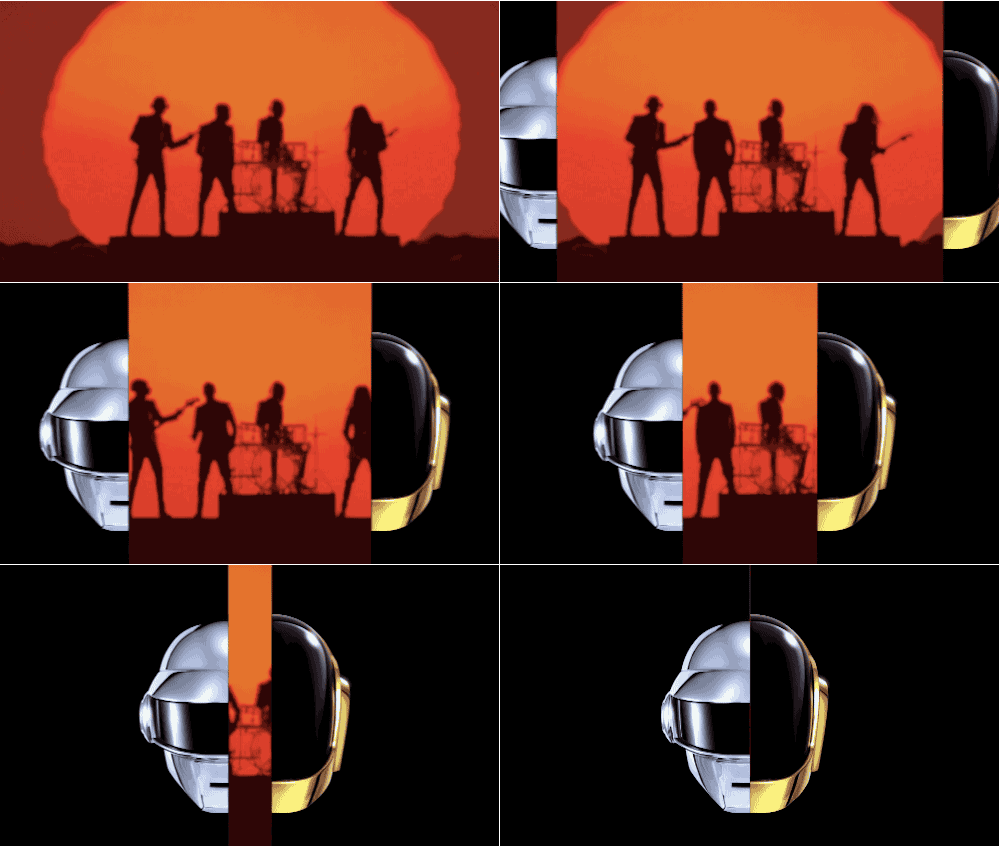
A cultura do remix explodiu novamente graças ao novo disco do Daft Punk
by Daniel Junqueira
O novo disco do Daft Punk ainda vai demorar mais de um mês para sair (21 de maio não chega nunca), e os fãs da dupla francesa estão tão malucos pelas novas músicas que qualquer pedaço de uma canção é o suficiente para o que há de melhor na cultura de remixes entrar em ação.
Random Access Memories é o primeiro disco de estúdio do Daft Punk desde 2005 — e nós já falamos dele por aqui. Ele foi confirmado no começo do ano, mas as informações eram escassas. Elas começaram a surgir em março e em um mês e meio só conseguiram levar os fãs à loucura. Sabemos muito pouco de Random Access Memories, mas o que sabemos é o suficiente para colocar o disco como um dos mais esperados do ano – se não for o mais esperado, ao menos nesse primeiro semestre.

A primeira amostra do que está por vir foi feita no dia 2 de março. Um pequeno anúncio de 15 segundos foi feito durante os comerciais do Saturday Night Live, nos EUA. E, no mesmo dia, o fenômeno começou a acontecer: os 15 segundos de música em pouquíssimo tempo se tornaram vídeos de vários minutos com aquele pequeno pedaço da canção sendo repetida. Você pode ouvir a guitarra de Nile Rodgers por 10 minutos seguidos, por exemplo:
Thomas Bangalter e Guy-Manuel de Homem-Christo não ficaram satisfeitos e quiseram continuar brincando com as emoções dos fãs – além de, claro, jogar o hype do novo disco lá pro alto. No dia 4 de abril eles começaram a soltar uma série de vídeos chamada The Collaborators. Uma entrevista por vídeo com os colaboradores do novo disco. E, no meio das entrevistas, mais alguns pedaços de música. Abaixo você pode ver o que Nile Rodgers tem a dizer – dá para ativar legendas em português:
Mas o fato mais impressionante aconteceu neste fim de semana. Um vídeo de pouco mais de um minuto com a dupla e dois dos seus colaboradores – Nile Rodgers e Pharrell Williams – passou durante o festival Coachella. Minutos depois, ele estava em vários lugares, com imagens do telão do festival. Na noite do mesmo dia, o mesmo vídeo foi exibido novamente durante os comerciais do Saturday Night Live – você pode ver aqui. Resultado? Bom, primeiro GIFS:


E se 15 segundos de música foram o suficiente para levar a internet à loucura com vários remixes, um minuto faria ainda mais estrago. E fez. Você encontra várias versões estendidas da canção do anúncio, como esta abaixo:
Já esta versão, por exemplo, poderia muito bem ser a completa. Mas não é – é apenas uma colagem de todos os trechos da música que foram liberados. Mas tudo bem, dá para ouvir o dia inteiro sem se incomodar com o fato de que não é a música final:
Tudo isso em dois dias. A música em questão se chama “Get Lucky” e será o primeiro single do disco. Mas ela já conseguiu um feito bastante impressionante: está sendo ouvida o tempo inteiro sem ninguém ter acesso a versão final. O Daft Punk sequer teve que lançar uma música para fazer com que as pessoas se empolgassem com eles. Ela já e famosa sem nem ter sido lançada. Nós só ouvimos uma parte dela, mas já amamos “Get Lucky”. E esperamos que, no dia 21 de maio, o resultado final seja ainda melhor do que o que a cultura remix conseguiu fazer nas últimas semanas.
Tadeu, Adam Victor Brandizzi and 2 others like this
15 Apr 16:00



Stunning Astrophoto: Jet Star Roller Coaster Meets Star Trails
by Nancy Atkinson
Stars streak over the Jet Star rollercoaster in Seaside Heights, New Jersey, as it awaits removal from the Atlantic Ocean. Credit and copyright: Jack Fusco.
A victim of Hurricane Sandy provides the foreground for a stunning view of star trails over Seaside Heights, New Jersey. The Jet Star roller coaster and three other amusement rides fell into the ocean after the partial collapse of Casino Pier during Hurricane Sandy. The roller coaster sitting in the ocean became an iconic symbol of the hurricane’s destruction last fall. Astrophotographer Jack Fusco captured this absolutely incredible shot of the Jet Star under a blanket of stars on April 9, 2013. The Jet Star will soon be dismantled and removed. As one commenter on Flickr said, this shot will live on even after the roller coaster is gone.
See more of Jack’s work on Flickr, Google+ and his website, www.jackfusco.com
Want to get your astrophoto featured on Universe Today? Join our Flickr group or send us your images by email (this means you’re giving us permission to post them). Please explain what’s in the picture, when you took it, the equipment you used, etc.
© nancy for Universe Today, 2013. |
Permalink |
One comment |
Post tags: Astrophotos, Jet Star Roller Coaster, star trails
Feed enhanced by Better Feed from Ozh
15 Apr 15:28
Devagar com o andor…
by Júlio César
Deixando de lado toda a discussão de que uma piada, quando precisa ser explicada até por um psicólogo, não é lá das melhores, o quadro divulgado no Pânico de ontem que mostrou toda desenvoltura de Gerald Thomas para o humor e de Nicole Bahls para o jornalismo levantou uma pergunta importante.
Não estamos indo rápido demais? As coisas mal acontecem e já temos opiniões, protestos, gregos contra troianos contra persas contra fariseus contra nazistas contra o que quer que seja. Não é hora de irmos devagar com o andor, porque derrubar santo dá um azar do caralho? A divulgação das fotos começou na segunda (terça? Quarta? Quinta? Sexta?). Nelas víamos Nicole sendo atacada por um Gerald Thomas com olhar de lascívia, o que já é uma ofensa aqueles que possuem olhos, porém atacada. Nicole parecia visivelmente constrangida, claro. Talvez por ser Gerald e menos pelo ato, mas isso poucos poderão saber e estou aqui imaginando coisas.
E começamos com as acusações, com as defesas, com os ataques e com tudo mais que é inerente nas discussões desde que as redes sociais são redes sociais. Mas a pergunta que não ficou no ar e foi feita por Emilio Surita momentos antes da exibição do quadro: quem na realidade tinha visto o que eles chamam de matéria?
Ninguém tinha visto. Ninguém do Ego, ninguém do UOL, ninguém do Twitter, do Facebook e até do Orkut. Eu, você, as feministas e até o Papa Francisco não vimos e já derramávamos um monte de letras em tudo quanto é lugar de tudo quanto é forma. Estamos perdendo a cada nova polêmica a capacidade de análise, para sermos os primeiros, para sermos os mais combatentes ou ao menos para fazermos a primeira piada.
O que o Pânico mostrou foi uma grande farsa. Bolada pelos produtores, pelo Zuckerman, pelo Ceará, pela Nicole e que contou com a participação especial de Gerald Thomas. O que não elimina ele de ser babaca, claro. E que continua suscitando as discussões sobre o limite do humor e todas essas bobagens, sem dúvida. Mas o que nos leva a uma questão primordial: não é melhor esperarmos um pouco antes de darmos nossa opinião?
Porque se vamos lutar pelos direitos das mulheres, vejo Nicole Bahls realizando seu direito de ganhar dinheiro e aparecer na TV como bem entende. Ainda que seja sujeita a um ataque sexista do esquecido Gerald Thomas. É bom para a Nicole, que ganhou pontos no Ibope e vai continuar como repórter. É bom para Gerald, que divulgou seu livro e reapareceu das cinzas que nunca deveria ter saído. E para nós, o que é bom?
15 Apr 12:44
Tabasco sauce is aged in barrels previously used for Jack...
Alvaro Freitasisso explica muita coisa


14 Apr 18:04

Birosqueta #13
by noreply@blogger.com (Daniel Ramos Santos)
Albener Pessoa, Alvaro Freitas likes this
13 Apr 23:08

parents protect your children
parents protect your children
Adam Victor Brandizzi, Marakyropaz and -1 others like this

12 Apr 16:53

Praticar wakeboard à noite com pranchas iluminadas cria fotos fascinantes
by Casey Chan
Isto é incrível. Ver um wakeboarder com uma prancha iluminada é como ver Picasso com um pincel. Os truques dos wakeboarders criam uma imagem quase hipnotizante. É como deslizar por um arco-íris!
Estas fotografias foram feitas para o concurso de fotografia Red Bull Illume.
O fotógrafo e “pintor de luz” Patrick Rochon, junto à Snap! Orlando, fez os wakeboarders Mike Dowdy, Adam Errington e Dallas Friday andarem com uma prancha cheia de LEDs durante a noite, enquanto capturava estas belas imagens:



Mais um caso onde fotografias parecem melhores do que a vida real. Saiba mais: [Red Bull Illume via Colossal]
12 Apr 05:16

How to teach your kids about Weeping Angels
How to teach your kids about Weeping Angels
Tadeu, Albener Pessoa likes this

11 Apr 17:10

Fantastic #1 – Ficção científica não dá futuro
by Cláudia Fusco

Até as lendas da ficção científica, como a Maria de Metrópolis, precisam de um descanso!
Existem três coisas certas nessa vida: a morte, o piriri pós-feijoada de domingo e a reação das pessoas quando eu digo que passei um ano fazendo mestrado em ficção científica na Inglaterra. Nesse último caso, pelo menos, tudo começa com uma risada.
Pode ser uma risada estilo “isso é tão nerd que nem sei como reagir”, ou então “mas você parece normal!”. Também tem aqueles sorrisos, geralmente acompanhados por um olhar sabichão, que querem dizer “aah, faz sentido, você gostava de Harry Potter”. Já conheci gente que sorriu porque o curso parecia muito legal, outros porque não tinham a menor ideia do que eu estava falando. Sorrisos educados de gente que achava que eu usava jaleco no dia-a-dia.
Depois dos sorrisos, vinham as perguntas. Como eram as aulas? Como eram as pessoas? E a mais popular de todas: como eu espero viver disso? Além dos seminários sobre a história da ficção científica e da fantasia no mundo, tive que ouvir diversas palestras informais de pessoas determinadas em provar que eu tinha feito uma péssima escolha. Ficção científica, elas diziam, não é coisa que dá dinheiro. Quem é que estuda uma coisa dessas? Ficção científica não dá futuro.

“Tá difícil, cara. Tô fazendo uns bicos de motorista nas horas vagas”
É até irônico, porque poucas áreas do entretenimento tem uma relação tão forte com temas futuristas quanto a ficção científica. Desde seu surgimento, a FC se vende – com certo orgulho – como uma fonte de referência em relação aos próximos passos da humanidade, ainda que contando com as liberdades do formato ficcional. Algumas obras se tornaram clássicos por conta de seu valor universal e contemporâneo. Isso sem falar nas inúmeras e longas listas de invenções atuais que foram previstas em livros de séculos passados. A ficção científica pode não dar futuro para quem a estuda ou produz, mas com certeza tem muito a ver com ele.
É fácil para um fã de ficção científica enxergar valor nela. Alguém que gosta de histórias sobre aliens, distopias e universos steampunk, por exemplo, vai consumi-las em filmes, livros e jogos sem precisar de muito convencimento. O fandom do fantástico – e aí também incluímos a fantasia e o horror em todas as suas formas – é um dos grandes responsáveis pela sobrevivência desses gêneros que, não raramente, são desprezados pelo público mainstream e pela crítica. É a paixão de certos aficionados que torna o fantástico algo tão palpável e, quando bem usado, extremamente poderoso.

“Valeu, galera”
À esta altura, é impossível não enxergar o paradoxo. Ainda que boa parte do fantástico esteja destinada a ter muito menos reconhecimento do que merece, nunca houve tanta presença desse gênero na cutura. Não estamos falando apenas das listas de blockbusters do cinema, recheadas de hobbits e bichos azuis e hippies de três metros de altura. Na televisão, seriados como “Game of Thrones”, “Vampire Diaries” e “Supernatural” são os salvadores da pátria das emissoras em crise. Quem busca entretenimento cabeçudo pode apelar para excelentes exemplos de ficção científica, como “Black Mirror”. E mesmo o mundo literário, cujas regras flutuam ao sabor da lista de mais vendidos, a fantasia e a FC estão sempre presentes, com alguns poucos e sortudos representantes. Quando ganha projeção mundial, o fantástico é insuperável. E esta, aparentemente, é uma tendência que veio para ficar.
A convite do Raphael Fernandes, começo aqui no Contraversão uma coluna semanal sobre literatura fantástica e outros assuntos que permeiam esse universo esquisito.  Vamos falar das raízes da fantasia e da ficção científica, de como eles são hoje e tudo mais. Se quiser sugerir um tema para a coluna, é só deixar nos comentários. Vamos provar que esses temas têm futuro. A discussão está só começando.
Alvaro Freitas likes this









11 Apr 15:47










Neon Waterfalls in Long Exposure
by Fubiz
Une superbe série photographique « Neon Waterfalls » de la part de Sean Lenz et Kristoffer Abildgaard qui ont placé dans des cascades et chutes d’eaux en Californie des bâtons lumineux. Une utilisation brillante de la longue exposition, pour capturer l’univers et la lumière. Plus d’images de ce projet dans la suite de l’article.









Adam Victor Brandizzi and -1 others like this
11 Apr 12:41


Henry Miller on the Joy of Urination
by Maria Popova
“To relieve a full bladder is one of the great human joys.”
 Henry Miller — oracle of writing, modern philosopher, man of discipline, wise heart — may endure as a literary legend, but part of what made his spirit so extraordinary was his irreverence and his childlike wonder at the world. From This Is Henry, Henry Miller from Brooklyn: Conversations with the Author from the Henry Miller Odyssey (public library) — the same 1974 gem that gave us Miller’s meditation on the mystery of the universe and the meaning of life — comes his delightful paean to something far less exalted and much more grittily human: urination.
I do not find it strange that America placed a urinal in the middle of the Paris exhibit in Chicago. I think it belongs there, and I think it a tribute that the French should be proud of. … I am a man who pisses largely and frequently, which they say is a sign of great mental activity. One likes to piss in sunlight among human beings who stand and smile down at you. Standing behind a tin strip and looking out on the throng with that contented, easy, vacant smile, that long reminiscent pleasurable look, is a good thing. How many times have I stood thus in this smiling gracious world, the sun splashing over me and the birds twittering crazily, and found a woman looking down at me from an open window. Standing thus with heart and bly and bladder open, I seem to recall every urinal I ever stepped into. To relieve a full bladder is one of the great human joys.

This Is Henry, Henry Miller from Brooklyn is a treat in its entirety, an unprecedented glimpse of Miller’s character in all of its dimensions, from the playful to the profound. Complement it with Miller on the art of living and the future of mankind.
Donating = Loving
Bringing you (ad-free) Brain Pickings takes hundreds of hours each month. If you find any joy and stimulation here, please consider becoming a Supporting Member with a recurring monthly donation of your choosing, between a cup of tea and a good dinner:
| ♥ $7 / month♥ $3 / month♥ $10 / month♥ $25 / month |

You can also become a one-time patron with a single donation in any amount:
 Brain Pickings has a free weekly newsletter. It comes out on Sundays and offers the week’s best articles. Here’s what to expect. Like? Sign up.
Brain Pickings takes 450+ hours a month to curate and edit across the different platforms, and remains banner-free. If it brings you any joy and inspiration, please consider a modest donation – it lets me know I'm doing something right.

10 Apr 19:59
Filed under: é como as coisas são, crise de meia meia idade, Desocupações, situações limite, teorias, Vacilo Tagged: a gente hoje teria um apartamento de três quartos e eu não dividiria beliche quando vou em minas, bairro do flamengo, conflitos, conflitos de gerações, ditadura da cronologia, dramas da vida real, eu gosto de idosas e tenho até duas avós que são, gente de idade, idade, idosas, mal estar no ocidente e na fila do mercado, possivelmente estou usando termos com um significado distorcido, problemas, realidades, sigo usando pretextos e indiretas para tratar de traumas de infância, teorias


Sobre sua tia, as idosas do flamengo e traços de uma ditadura da cronologia
by joão baldi jr.

Desde pequenos somos treinados para respeitar os mais velhos. Seja obedecendo o papai, seja não respondendo a mamãe, não gritando com a vovó ou apenas não fazendo perguntas sobre quem são aqueles caras que toda madrugada entram com duas caixas de isopor, uma fantasia de garibaldo e sete pistolas d’água no quarto da titia, somos basicamente doutrinados a acreditar no adulto– ou genericamente no “mais velho” – como o repositório máximo de autoridade e poder, seja ele um familiar, um professor ou apenas o segurança do shopping que insiste em pontuar que precisamos fazer aquela haste mecânica efetivamente segurar o brinde e não vale tentar apenas enfiar o braço logo naquela caixa de vidro pra tirar o ursinho, isso é ilegal e vou chamar seu pai.
E ainda que essa visão do mais velho como representante da autoridade e do poder seja muito válida quando somos crianças – até os sete anos eu não sabia amarrar cadarços e achava que salsicha era um vegetal e isso já diz muito sobre meu preparo pra lidar sozinho com o mundo – é a continuidade e o exagero desse tipo de mentalidade do “mais velho como dono da verdade” que muitas vezes, quando aplicado na relação profissional ou pessoal entre adultos gera situações injustas, absurdas ou apenas desconfortáveis.
Não, não estou falando dos idosos folgados do Flamengo que assediam garotas, furam filas de restaurantes, ou moram no apartamento debaixo do seu e assim que acontece algum tipo de vazamento começam a preparar tocaias na porta sua casa às sete horas da manhã pra gritar com você e te chamar de moleque ou mesmo das senhoras que ficam na sua frente na fila reclamando durante horas que não existe um caixa especial para idosos e assim que esse caixa abre e você indica que seria interessante pra ela ir pra lá te retrucam com um “como assim, garoto? você tá me chamando de velha?”.
Não, nada disso. Afinal, eu sinceramente entendo que após décadas de serviços prestados à sociedade uma pessoa já adquiriu o capital moral necessário para ter certas vantagens e certos descontos e eu sempre vou tentar respeitar idosos mesmo quando eles começam a explicar que boa era a ditadura, presidente legal era o Geisel e essa minha barba me deixa com cara de comunista cubano. É o jeito deles, eu tento entender.
O grande problema, ou o grande problema que eu consigo notar, é o das pessoas que, por estarem em algum estado mais avançado da vida adulta, seja por 2 ou por 20 anos, acham que adquiriram algum nível de capital moral ou intelectual que permite que eles apenas tratem com descaso ou superioridade a opinião de uma pessoa mais nova, como se o simples fato de alguém existir por mais tempo garantisse a essa pessoa algum tipo de sabedoria ou capital moral que é apenas inalcançável para alguém mais novo, por mais esperta que essa pessoa possa ser.
E isso acontece no trabalho, quando o gerente de 50 anos acredita que você por ter menos de 30 não tem a mesma capacidade que ele, acontece nos eventos de família quando suas tias de 60 que ainda vivem de favor com seus avós acham que podem dar conselhos pra você que com 25 já ganha mais do que elas, acontece na internet onde você com 28 acha que sabe mais da vida do que o garoto de 16 porque ele gosta de justin bieber, sendo que você já gostou de limp bizkit e no final ninguém sabe usar as calças na altura certa, se você for pensar.
Por que a verdade é que ser mais velho por si só não garante nenhum tipo de sabedoria ou mesmo de experiência inerente. Uma pessoa pode viver por muito tempo sem aprender praticamente nada ou pode, em bem menos tempo, conseguir ter uma compreensão bem maior e mais profunda do mundo em torno dela, comprovando que ter 20, 50 ou 100 anos não serve de premissa pra analisar o quando uma pessoa está preparada pra resolver problemas ou tomar decisões. E eu sei bem disso, porque ainda me lembro que com uns dez anos eu disse pro meu pai que aquela coisa de Encol não tava com uma cara boa e ele me respondeu um “junior, deixa com seu velho, ele sabe o que ele tá fazendo”.
Filed under: é como as coisas são, crise de meia meia idade, Desocupações, situações limite, teorias, Vacilo Tagged: a gente hoje teria um apartamento de três quartos e eu não dividiria beliche quando vou em minas, bairro do flamengo, conflitos, conflitos de gerações, ditadura da cronologia, dramas da vida real, eu gosto de idosas e tenho até duas avós que são, gente de idade, idade, idosas, mal estar no ocidente e na fila do mercado, possivelmente estou usando termos com um significado distorcido, problemas, realidades, sigo usando pretextos e indiretas para tratar de traumas de infância, teorias
10 Apr 19:49
Exumaram Neruda
by Puppet

Exumaram Neruda e o dia estava lindo. Exumaram Neruda e a Coreia de Stalin sequer deu um pio. Exumaram Neruda e os talibãs da América do Norte não declararam guerra santa ao islã. Exumaram Neruda antes de Portugal declarar independência do Brasil. Exumaram Neruda enquanto a escravidão era abolida para as empregadas domésticas. Exumarão Neruda para que ninguém seja preso por portar uma cor de pele suspeita. Exumarão Neruda para que as mulheres possam andar sozinhas à noite. Exumarão Neruda para que a opção sexual de alguém seja apenas a opção sexual de alguém. Exumarão Neruda para que os governos governem sem usarem coturnos. Quantos vezes mais precisarão exumar Neruda? Exumaram Neruda e o dia estava lindo.
.
Alvaro Freitas likes this
10 Apr 19:47
9 Yupik


10 Bizarre Languages Still Spoken Around the World
by JFrater
Language is a funny thing. There are about 500 million people who speak English on this planet, and it’s not even the most common language in the world (Mandarin tops the charts at over a billion). Yet, on the other end of the scale, there are somewhere close to 2,000 languages that are spoken by less than a thousand people each. Some of them are more similar than others, but the thing about different languages is they’re always familiar within your realm of experience—to an English speaker, Mandarin sounds like well-structured gibberish (and probably vice verse) until you begin to learn the rules behind the language, then slowly it eases further into your experience, and eventually it becomes just as easy—just as familiar—as English. You become fluent.
At least, that’s what’s supposed to happen. These languages, on the other hand, are almost beyond comprehension. Strange yet beautiful, here are 10 of the most bizarre languages still spoken in the world.
10 ArchiOn the edge of the Caspian Sea in southern Russia is a small village called Archib. With a population of only 1,200 (or less, according to some experts), it’s the last remaining spot in the world where Archi is spoken. Although it’s similar to two other languages from the region—Avar and Lak—linguists consider Archi to be a language on its own, which is fortunate because it definitely deserves a spot on this list.
One of the things that’s so incredible about the language is that for any given verb, there could be as many as 1,500,000 separate conjugations. For comparison, take the English word “run.” You could conjugate that to ran, running, will run, has run, will have been running, and so on. The same thing happens in Archi, but it goes on for a million and a half different variations, depending on the situation. Also notable is the language’s use of “voiceless velar lateral fricatives,” a rare and fancy sounding speech element, best described as the ending sound when you say “Bach.”
9 Yupik

The word Yupik is actually used to describe a family of five languages, spoken by residents of Siberia and Western Alaska. Each one of those languages is similar, but different—if two people from a different region met, one might not be able to understand the words spoken by the other, but because of the sentence structure and similar phonetic sounds they could still carry on a basic conversation.
Yupik is what’s known as a polysynthetic language—words are sometimes created that have a very, very specific meaning, to the point of creating a sentence out of a single word. For example, take the word tuntussuqatarniksaitengqiggtuq. It literally means, “He had not yet said again that he was going to hunt reindeer.” It is a word that can only be used for an extremely specific situation and, even more bizarre, none of the individual word parts make any sense unless they’re used in that specific word. The only exception is the word for reindeer, tuntu.
8 Pawnee
When it comes to polysynthetic languages though, there are few that can hold a candle to Pawnee, spoken by Native Americans indigenous to Nebraska. Their alphabet is simple—only nine consonants and eight vowels—but they have multiple words that contain more than 30 syllables. In fact, it’s rare for a sentence to not have at least one word with over 10 syllables.
Unfortunately, the Pawnee language is fast declining. There are still a few seniors who speak Pawnee, but the younger members will usually learn English instead of Pawnee, and it’s expected to become extinct within the next few years.
7 Sentinelese
The Sentinelese language is interesting for one very unusual reason: we don’t really know anything about it. In a world where nearly every bit of land has been explored, there is still a small island in the Indian Ocean that no outsider has ever set foot on—and lived to tell the tale, that is. That’s because the residents of North Sentinel Island have a very strict foreign relations policy—shoot arrows at anybody who comes close.
It’s believed that Sentinelese is probably similar to the other Andamanese languages (which is kind of crazy on its own—all of their nouns are based on body parts), simply because they’re geographically close to each other, but again, we really just have no idea. The most successful attempt at communication with them basically boils down to exchanging different colored buckets. We don’t even know how large the tribe is.
6 Silbo GomeroThe Silbo language of La Gomera on the coast of Spain may be one of the most unique, and uniquely beautiful, languages of the modern day. While most languages incorporate complex sounds, with consonants, verbs, and all that pizazz, the Silbo language is remarkably simple—it’s a whistle language.
The whistles themselves function similarly to the way other languages work; rising and falling pitches can almost perfectly replace words, but they serve one important purpose—La Gomera is largely mountainous, and whistles allow the inhabitants to communicate across great distances. If you yell over a ravine, the sound might reach the other side, but the words will probably be jumbled and distorted, without meaning. If, however, you whistle, the pitch will carry almost perfectly, and the message will reach the other side completely intact. So vowels and consonants are distinguished by dips and rises in the whistled melody, and when they are strung together they create words and sentences.
5 XhosaCompared to most of the other languages on this list, Xhosa could almost be considered mainstream with nearly 8 million speakers. It’s one of the common languages spoken in South Africa, but it bases most of its sentence structure on tonal variations. A single word could have many multiple meanings depending on the pitch and tone of how you say it. Xhosa also has unusual consonants—18 of the recognized consonants are actually clicks. The word itself, “Xhosa,” is pronounced with a click at the beginning.
By this point in history, Xhosa has been understandably mixed a bit with several other languages, including English and Afrikaans, but it originated alongside Zulu and other languages that fall under the umbrella term “Bantu languages,” and there are many similarities between most of these languages.
4 PirahãThe Pirahã language of Brazil is the last remaining of its kind; as far as we know, all the similar languages in the region have gone extinct. Also as far as we know, Pirahã is probably the simplest language in existence, with somewhere between ten and twelve phonemes (sounds). There are no words for colors, and some natives seem to be able to communicate with no words at all, translating the phonetic tone of the words into a series of hums and whistles.
Actually, saying that there are no words for colors in Pirahã isn’t entirely true; they technically have two words which mean “light” and “dark.” Similarly, it’s argued that they don’t have any numbers, either. There are two words in Pirahã that are spelled hói and hoí (note the different accents). According to Daniel Everett, who has spent some time studying the Pirahã tribe, the words mean small quantity and large quantity, respectively. So whether you had 10 sticks or 100, you would use the same word (large quantity), although that could change depending on what you considered to be a lot of something.
3 RotokasIf Pirahã isn’t the simplest language in the world, that honor definitely goes to Rotokas, a small language found in Papua New Guinea. Like Pirahã, it’s believed to only have about 12 phonemes, and since there are no tonal variations between them, their alphabet is considered to be only 12 letters long.
As if that wasn’t enough, Rotokas is also one of the few languages that doesn’t have any nasal phonemes, like the sound you make when you say the letter “n” (it comes through your nose, “nnnn”). Rotokas speakers CAN make nasal sounds, they just don’t—the only time they’ll ever do it is when they make fun of foreigners who accidentally throw in a nasal sound when trying to speak Rotokas, which is sort of hilarious.
2 Khoisan
When it comes to the click languages of Africa, there are two main families; Bantu, which includes the Xhosa language, and Khoisan, which is considered to be the forerunner of Bantu, and one of the oldest languages on the continent. And unlike Bantu, Khoisan languages seem to be falling off the map completely, mostly due to the lifestyles of Khoisan speakers.
Most of the people who speak the various Khoisan languages are spread out across southern/central Africa, and many of them are in incredibly remote areas, and as such are relatively under-researched. A good example of this is the San (Bushmen) of the Kalahari desert, and different dialects exist even between different tribes in similar regions, which makes it difficult to even get a fix on what exactly constitutes the language.
The question usually comes down to this: how do you know when a dialect becomes so distinct that it can be considered a separate language entirely? For example, the Xiri language has approximately 90 speakers. The Korana, somewhere between 6 and 10. These are just a few of the problems linguists have run into while trying to catalog the sweeping variations in the Khoisan languages.
1 !Xóõ (Taa)The Taa language is officially one of the Khoisan languages, but even in that diverse mesh of conflicting dialects and vast tonal ranges, Taa manages to stand out on its own, and it definitely deserves its own entry. To the best of our knowledge, Taa (also known as !Xóõ, but that’s hard to type) has more spoken phonemes than any other language in the world. Some linguists put the number of consonants alone at 164, and at least 111 of those are click sounds—and that only accounts for one dialect, known as West !Xóõn. They also use four different tones—high, mid, low, and mid-falling—providing even more variation in the ways that sounds and clicks can be combined.
As an interesting side note, locals refer to the language as Taa ?aan; Taa means “human being,” and ?aan means language, so it literally translates to the “language of human beings.”
The post 10 Bizarre Languages Still Spoken Around the World appeared first on Listverse.
10 Apr 19:46




Pressure Cooker
Pressure Cooker
Am I right to be afraid of pressure cookers? What's the worst thing that can happen if you misuse a pressure cooker in an ordinary kitchen?
—Delphine Lourtau
The worst thing?
Pressure cookers are dangerous.
They can explode, in a sense, but not as violently as you might fear (or hope). The pressure inside a consumer cooker doesn’t go above about two atmospheres—about the pressure inside a can of soda. Those levels can be dangerous, but they’re generally not high enough to cause the metal to violently rupture.
So what makes a pressure cooker dangerous?
Imagine a world where Pepsi is scalding hot. Now imagine that someone shakes up a can of Pepsi and sets it in front of you.
That’s the real threat from a pressure cooker: If the seal fails (or the lid is opened too early), it can spray scalding stew in all directions.
But it’s not really an explosion.
The blast couldn’t even fling the lid very far. If you mounted a rifle-style barrel on a pressure cooker, even in ideal circumstances it wouldn’t be able to fire the lid much faster than you could throw it. Any potato cannon (especially this one) could do better.
Of course, the question wasn’t about whether a pressure cooker is likely to explode. It was about what the worst thing that could happen was.
If you disable the safety valve, there are plenty of ways to produce much more dangerous pressures. You could completely fill it with water and heat it, fill it with Drano and aluminum foil, or just pump in air from a compressor.
The result would depend on your pressure cooker. Chances are it would start to leak. If it didn’t, and it somehow stayed together up a few hundred atmospheres (pressures typical of scuba tank), when it finally ruptured it could easily kill you.
Even so, that’s far from the worst thing you could do with a pressure cooker.
Frankly, there are so many options it would be impossible to survey them all. But for my money, one of the most horrifying things you could do is this:
(Note: Never try this, for reasons which will become obvious in a moment.)
Fill the cooker with oxygen up to 5 PSI, then pump in fluorine until it starts escaping through the safety valve. Put the vessel over an open flame until it reaches 700°C (That’s °C, not °F. Yes, this will probably set off the smoke alarm.) Now, pump the hot gas over a liquid-oxygen-cooled stainless steel surface.
The procedure here is a little tricky, but if you do things right, the gas will condense into dioxygen difluoride (O2F2).
And that stuff is awful.
Ray Bradbury taught us that paper burns when exposed to oxygen at temperatures above 451°F. Dioxygen difluoride is so volatile that it makes almost any organic substance ignite and explode at any temperature hotter than 300°F below zero. It can literally make ice catch fire.
In an article about O2F2, Chemistry blogger Derek Lowe (of the excellent In The Pipeline) used phrases like “violently hideous”, “deeply alarming”, and “chemicals that I never hope to encounter”. Another article refers to fluorine as “the gas of Lucifer”, and lists chemists who were poisoned or blown up while attempting to work with it.
If your house is heated by natural gas, and it happens to contain hydrogen sulfide, you could pipe some of it into your container of O2F2. In addition to a massive explosion, this will also produce a cloud of hydrogen fluoride gas. Hydrogen fluoride can dissolve human tissue on contact, starting with your lungs and corneas.
As Lowe points out, the chemistry of this kind of reaction (O2F2 and sulfides) is largely unexplored.
Which gives us an answer to our question. What’s the worst thing that can happen in a pressure cooker?
Science.
Deltag, Golemkerensky and 4 others like this
10 Apr 19:16
Mini móveis feitos de pele humana falsa!
by Antonio Tadeu

A artista Jessica Harrison fez uma série de esculturas de pequenos móveis, usando um material que se parece muito com a pele humana. Não faço a ideia dos motivos dela ter feito esses móveizinhos assim, mas são realmente perturbadores de se olhar!


Fonte: Geekologie