Only Silicon Valley can create jobs like these. Webinar Architect Trend Sherpa Big Data Guardian Click-Through Overlord Shareability Svengali Functionality Hacker Human Experience Disruptor Find more at the Silicon Valley Job Title Generator.
This post is about word processors, but I got the idea for it from something W. H. Auden once said about political philosophers. In 1947, talking with his learned young secretary about an anthology he was compiling, The Portable Greek Reader, he mentioned Isocrates, a Greek orator whose simple-seeming ideas about relations between rich and poor cities were sane and practical. Naïve-sounding Isocrates had solved problems for which Plato’s grand theories had no answer. “Isocrates reminds me of John Dewey,” Auden said. “He’s a mediocrity who’s usually right whereas Plato is a man of genius who’s always wrong.” Only a genius could have devised Plato’s theory of the forms—the invisible, intangible “ideas” that give shape to every visible, tangible thing. But the theory of forms is always wrong when applied to political thinking, as every experiment in ideal, utopian politics has proved.
Auden’s contrast between mediocrity that gets things right and genius that is always wrong is useful in thinking about many fields other than politics. Take, for example, the instruments used for writing. The word processor that most of the world uses every day, Microsoft Word, is a work of genius that’s almost always wrong as an instrument for writing prose. Almost-forgotten WordPerfect—once the most popular word-processing program, still used in a few law offices and government agencies, and here and there by some writers who remain loyal to it—is a mediocrity that’s almost always right. I submitted this post in a file created by the latest version of Word because Word is the lingua franca of publishing. But I wrote it in an ancient MS-DOS version of WordPerfect that hasn’t been updated since 1997, because WordPerfect is the instrument best suited to the way I think when I write.
The original design of Microsoft Word, in the early 1980s, was a work of clarifying genius, but it had nothing to do with the way writing gets done. The programmers did not think about writing as a sequence of words set down on a page, but instead dreamed up a new idea about what they called a “document.” This was effectively a Platonic idea: the “form” of a document existed as an intangible ideal, and each tangible book, essay, love letter, or laundry list was a partial, imperfect representation of that intangible idea.
A document, as Word’s creators imagined it, is a container for other ideal forms. Each document contains one or more “sections,” what everyone else calls chapters or other subdivisions. Each section contains one or more paragraphs. Each paragraph contains one or more characters. Documents, sections, paragraphs, and characters all have sets of attributes, most of which Word calls “styles.” A section can have its own margin settings; a paragraph can be indented or set in a specific font; a set of characters (such as one or more words) can be italicized, underlined, and printed in red, all by applying a single “style.” Even if you don’t apply a specific style, everything is governed by what Word calls the “normal” style. To complicate matters, Word also lets you apply what it calls “direct formatting,” in which, for example, you italicize a word without applying a separate style to that word alone.
On a typewriter, when you wanted to increase the left margin on the page, you moved a metal lever, then moved it back to decrease the margin again. To type a superscript (as in mc2) you rotated the carriage slightly, typed the superscripted letter, then rotated the carriage back again. In effect, you progressed in sequence from one set of conditions to another. Things changed as you typed.
In Microsoft Word (as in all other word processors built on the same model, including Apple’s Pages), the underlying model is static, like a Platonic idea. In effect, you “paint” a whole section with its own margin settings, and you “paint” a character with the superscript attribute.
I’ve been vaguely aware of Word’s Platonic ideas since I learned, years ago, that I had to create a new section when I wanted to change the page margins. But I didn’t realize how bizarrely Platonic Word can be until I started using it to create the manuscript of a complete edition of Auden’s prose. At the foot of each essay and review, the edition has a line indicating its source, for example, “The New York Review of Books, 2 May 1965,” or “The New Yorker, 27 September 1966.” While preparing the file for the publisher, I applied to all these lines a style named “Article Source”; this style arranged the lines so they were aligned at the right margin, and added a line space above and below. I was puzzled to see that when I applied the style, Word sometimes removed the italics from the magazine title but sometimes didn’t, for no obvious reason. When I applied the style to the first of my two examples, the italics disappeared; when I applied it to the second, the italics remained.
A friend at Microsoft, speaking not for attribution, solved the mystery. Word, it seems, obeys the following rule: when a “style” is applied to text that is more than 50 percent “direct-formatted” (like the italics I applied to the magazine titles), then the “style” removes the direct formatting. So The New York Review of Books (with the three-letter month May) lost its italics. When less than 50 percent of the text is “direct-formatted,” as in the example with The New Yorker (with the nine-letter month September), the direct-formatting is retained.
No writer has ever thought about the exact percentage of italics in a line of type, but Word is reduced to this kind of arbitrary principle because its Platonic model—like all Platonic models—is magnificent in its inner coherence but mostly irrelevant to the real world. In order to make a connection between heavenly ideas and tangible realities, Plato himself was reduced to inventing something he called the Demiurge, an intermediate being who translates the ideal forms in heaven into something tangible in the world. The Demiurge is an early instance of what programmers call a kludge—a clumsy and illogical expedient for dealing with a problem that seems too intractable to solve more elegantly. Word’s 50-percent rule for applying styles is a descendent of the Demiurge, and just as much of a kludge.
The inventors of WordPerfect had no grand ideas about the form of a document. Instead they looked over typists’ shoulders and tried to find ways of imitating their actions on a computer keyboard. So, when you want to change the margin in WordPerfect, you press a few keys to perform the computer equivalent of pushing the lever on a typewriter. You change the margin, and then, later, you might change it back again. Word’s intellectual model is effectively timeless: you paint the text with its attributes. WordPerfect’s is active and progressive: you change a setting, continue typing, and then change some other setting. Auden’s word “mediocrity” seems too strong to apply to WordPerfect, as it was too strong to apply to Isocrates or John Dewey, both of whom had something very like genius in their clear-sighted, unprejudiced perception of the world as it is.
Despite its underlying idea, Microsoft Word, of course, has evolved over the years so that it lets you work more or less as you do in WordPerfect, turning on italics and then turning them off again. But if you do anything more complex, you still find yourself deep in Word’s arcane Platonism, which is too deeply ingrained in the program ever to be replaced.
Intelligent writers can produce intelligent prose using almost any instrument, but the medium in which they write will always have some more or less subtle effect on their prose. Karl Popper famously denounced Platonic politics, and the resulting fantasies of a closed, unchanging society, in his book The Open Society and Its Enemies (1945). When I work in Word, for all its luxuriant menus and dazzling prowess, I can’t escape a faint sense of having entered a closed, rule-bound society. When I write in WordPerfect, with all its scruffy, low-tech simplicity, the world seems more open, a place where endings can’t be predicted, where freedom might be real.
The words you use in your Facebook posts reveal much about your personality, according to psychologists Gregory Park and colleagues in a new study just published.
Based on a study of 71,000 Facebook users who reported their personality using an app, Park et al. found some quite unexpected words to be associated with given personality traits. Here are the word clouds showing which terms are most predictive of extroversion and introversion:
Extroverts tend to use words like love, tonig
It's widely known by now that Apple and GT Advanced's sapphire partnership fell apart after the latter company was unable to produce enough high-quality sapphire to meet Apple's production needs, but The Wall Street Journal has taken a deeper look into GT Advanced's failures and its defective sapphire boules, which ultimately led the company to file for bankruptcy.
GT Advanced COO Daniel Squiller suggested in a court affidavit that Apple had essentially forced the company into a contract with "oppressive and burdensome" terms that made it impossible for GT Advanced to produce quality sapphire and meet deadlines, but the profile from The Wall Street Journal, largely sourced from Apple's court filings, paints a different picture, putting much of the fault on GT Advanced's mismanagement.
The partnership between the two companies may have been doomed from the start, as GT Advanced had little experience mass producing sapphire before it inked a deal with Apple. A first attempt at a 578 pound sapphire boule was reportedly "flawed and unusable," while another was "cracked so badly" the sapphire was unusable. More than half of the sapphire boules that took $20,000 and 30 days to produce ended up in a "boule graveyard."
According to employees that spoke to The Wall Street Journal, an effort to hire enough staff to operate the sapphire furnaces led to management problems as there were employees who had little to do.
GT quickly set out to hire 700 staffers. Hiring moved so quickly that at one point in late spring, more than 100 recent hires didn't know who they reported to, a former manager said. Two other former workers said there was no attendance policy, which led to an unusual number of sick days.
GT managers in the spring authorized unlimited overtime to fill furnaces materials to grow sapphire. But GT hadn't built enough furnaces yet, so many workers had nothing to do, two former employees said.
"We just kept sweeping the floors over and over," one of the former employees said. "I just saw money flying out the door."
As the months passed and GT Advanced failed to meet necessary production milestones in a timely manner, it became clear that Apple was not going to use sapphire in the iPhone 6. According to court documents, while Apple was going in an alternate route for iPhone 6 and 6 Plus displays, GT Advanced was burning through money, spending $248 million in a single quarter. As described by GT Advanced COO Daniel Squiller, the deal ended up causing GT to "divert an inordinate amount of its cash and corporate resources" into the Mesa, Arizona facility.
Apple ended up withholding a final $139 million loan payment from GT Advanced, furthering its financial woes, and though Apple attempted to lend aid in the form of a partial payment and delayed loan repayments, GT advanced opted to file for Chapter 11 Bankruptcy protection in order to get out of its contracts after it "could not economically produce a product that Apple would accept."
Apple and GT Advanced reached an agreement to officially end their partnership in October, nullifying the terms of the original deal. GT Advanced has already begun shutting down sapphire production at the Mesa, Arizona plant and will decommission and sell its sapphire furnaces in order to repay the loan from Apple.
More on what went wrong with GT Advanced's sapphire production and images of some of the broken and cracked sapphire boules can be seen in The Wall Street Journal's original story.
…cetacean brain size, relative to body size, increased substantially about thirty-eight mill years ago when the odontocetes evolved from the ancient archaeocetes…
What drove these changes? It does not seem to have been the transition to an aquatic existence itself as that occurred about fifty-five million years ago and brains stayed at roughly the same relatively small size relative to body weigt as the archaeocetes made their gradual entry into the ocean. A better hypothesis is that the increased brain size of the odontocetes thirty-eight million years ago was driven by the evolution of echolocation. The early odontocetes had inner ear bones that were good at picking up high frequency sound, which suggests that they had developed a form of sonar. Lori Marino thinks “that echolocation came on line and then got co-opted for social communicative purposes.” In this scenario, the odontocete brains increased in relative size to deal with the acoustic information itself, as well as, perhaps, a new perceptual system based on the data from the returning echoes. But…the change may have been even more profound: “This may indicate that the large brains of early odontocetes were used, at least partly, for processing this entirely new sensory mode [echolocation] that evolved at the same time as these anatomical changes and perhaps for integrating this new mode into an increasingly complex behavioral ecological system.”
Amélia Bittecourt, 41 anos, tomava seu café normalmente na última terça-feira quando a campainha tocou. Apesar de ela ter marcado com o pedreiro Zé que ele chegaria 8h para iniciar as obras no banheiro, ela não estava esperando ninguém. Abriu a porta curiosa. E deu de cara com o pedreiro Zé. Apavorada, Amélia deixou a xícara de café cair no chão, sujando toda sua cozinha, e saiu correndo. Trancou-se no quarto e só saiu dali depois de acionar o centro espírita que costuma frequentar e convocar dois médiuns para ir a sua casa. Uma vez havendo a comprovação de que se tratava de Zé, em carne-e-osso, ela saiu do quarto e deu um pito no pedreiro. “Isso não é coisa que se faça!”, disse.
Depois da bronca e do dia perdido, ela remarcou com Zé para a semana seguinte. Mas ele não apareceu. Amélia pôde tomar seu café descansada.
O assunto foca mais pinguins deixou a internet em polvorosa. Selecionamos dez casais pouco convencionais do reino animal. As cenas são fortes! Coisas que você não costuma ver no escurinho da pet shop.
Papa Francisco está mesmo revolucionando o Vaticano. Sua última declaração deixou os bispos mais conservadores da Igreja Católica de cabelo em pé. Segundo Francisco, é normal que os mais ricos compartilhem com os mais pobres, sendo assim, não há pecado em imprimir documentos pessoais na impressora do trabalho, ele mesmo sempre usa a impressora do Vaticano para imprimir o trabalho dos seus filhos.
O empresariado disse que é um absurdo a declaração, pois isto se trata de um roubo e roubo é pecado. Silas Malafaia se manifestou no seu twitter e disse que o papa está certo, desde que os documentos impressos sejam para a igreja, como as aulas da escola dominical, papéis de evangelização e letra de louvor. Já os funcionários da igreja não podem fazer isso, pois lá, o papel e a tinta não são do pastor, são de Deus.
1/10 Emulation Fever Over the last few days I’ve been crazy for emulation—that is, simulating old, busted computers on my sweet modern laptop. I’ve been booting up fake machines and tearing them down, one after the other, and not doing much besides. Machines I’ve only heard of, arcade games I never played, and programs I never used. Software about which I was always curious. And old favorites like MacWrite.
MacWrite on a Macintosh Plus Hour after hour, this terrible fever. What the hell am I doing? I kept asking myself. Why am I forcing a fine new machine to pretend it is a half-dozen old, useless machines?
Eventually I realized: This might be about my friend Tom dying. At least I think so. I am not good at identifying my own motives. It usually takes me at least ten days and a number of snacks to go from feeling something to being able to articulate what I felt. Indeed, I got the news ten days ago, in an email from my friend Jim.
2/10 “Really sad news”
“Really sad news” was the subject. Tom died at 73, after an illness. Here is a picture of him from 1999. He is the one on your left.
Imagine having, in your confused adolescence, the friendship of an older, avuncular man who is into computers, a world-traveling photographer who would occasionally head out to, like, videotape the Dalai Lama for a few weeks, then come back and listen to every word you said while you sat on his porch. A generous, kind person who spoke openly about love and faith and treated people with respect.
We had fallen out of touch.
It was good to have known him.
3/10 The Amiga 1000 (What is it good for?)
I always knew Tom. He rented a room from my grandparents. When I was 12, my parents succumbed to my begging and bought me an Amiga computer. By coincidence Tom had one too. Amigas were in the air because we lived near its manufacturer, Commodore computer, in Pennsylvania.
The Amiga looked like this:
An early version of the Amiga Workbench, its graphical user interface. And it was oddly good at animating things.
A little-remembered precursor to Adobe Flash — Aegis Animator, 1985, by Jim Kent. Animation made on October 26, 2014. But the Amiga had a problem. The IBM PC was for business; you used it to track stocks and type up reports. The Apple Macintosh was for fancy business, for work done in art galleries or loft apartments. You might use it to publish a newsletter for gourmets who were also physicists.
Debbie Harry’s face being live-manipulated by Andy Warhol in 1985 at the Amiga Launch event. YouTube Video. And the Amiga was for…well. It was originally conceived as a videogame console, then the game industry faltered—this was in 1984, when Atari had produced so many excess videogames that it had to bury them in the desert to get rid of them. Commodore bought the Amiga designs in the hopes of competing with the Macintosh.
But Commodore was best known for its “bitty boxes,” cheap, popular machines like the VIC-20 and Commodore 64 that sold at Sears. Could it compete?
Amiga 1000 being its beautiful self. The Amiga launch event was held in 1985 at Lincoln Center in New York City. A tall man named Robert Pariseau (head of software) emceed, in tuxedo and tremendous ponytail. They enlisted the Amiga to make pie charts, forced it to speak and “multi-task,” and made it become an IBM PC to run a spreadsheet.
https://www.youtube.com/watch?v=hWiOVa1R4m0 To conclude the night Andy Warhol, in his wig and brightly-colored glasses, came on stage along with Debbie Harry. He used the Amiga to snap a photo of Debbie Harry’s face and began to manipulate it live, using a mouse. Debbie Harry sat passively with her eternal pout, but Warhol had fun messing with her hair on the screen. This was a mistake, because both Debbie Harry and Andy Warhol were almost obscenely beautiful. The lovely little machine, juxtaposed with two people who actively epitomized sophistication, couldn’t hold its own. The whole thing just seems weird.
“As our TV screen is filled with the computer screen on which appears a wide-eyed fetus,” wrote the New York Times in 1985, describing the first Amiga commercial, “the voiceover delivers practically its only line in the 60-second commercial: ‘Re-experience the mind unbounded.’”
No one knew what they were doing, so they retreated to gibberish. But it never got better. Consider this video from 1987. Take the two-and-a-half minutes to watch it. Let it inside. Be with me in 1987.
https://www.youtube.com/watch?v=PWeO5IkCssk So. That’s the Amiga. It found niches—it was big in Europe, a favorite of hackers and programmers alike; it was beloved of video producers like my friend Tom. But it never became a true global platform. Microsoft Windows 3 came out in 1990, the beginning of a barely-challenged 20-year ascendancy; Commodore was out of business by 1994.
Like all also-ran underdogs the Amiga inspired a maniacal affection in its users that took decades to exhaust. Here’s an Amiga user in 2000 or later (his screenshot of “OS 3.9” can be used to date the video). Note that he is singing the same song from the 1987 video.
In 1987 my father and I went to the Amiga users’ group meetings in nearby Downingtown. These were held in a basement of a computer store with wood paneling. At the users’ group you could buy floppy disks for a few bucks, and on them would be items downloaded from local bulletin board systems. Hardly anyone had modems, so this was how files were transmitted. Tom would be at the user group meeting sometimes. Or he’d pick me up and drive me over if my father was busy.
A 1975 invitation to the legendary Homebrew Computer Club, which birthed the modern home computer industry. This is how a network comes together. You bought something and then you wanted to understand it, so you went out and found other people. You found them via posters in hallways, or word of mouth, or by purchasing a magazine that caught your eye and then reading the ads in the back.
You’d go to a party and browse through the host’s record collection, chat about the album, and maybe decide to go see a concert together—or in some cases you’d start a band.
Another example: Steve Wozniak built the Apple I computer because he knew the people at the Homebrew Computer Club would think it was cool. He wanted to blow their minds, and he did. A lot of times when people talk about Apple, Inc.—one of the largest social and corporate structures in the world, larger than many governments—they talk about design, manufacturing, and vertical integration. But the main driver for Apple’s early excellence was that Wozniak wanted to look cool in his little nerd network. He’d show his work to friends and they’d show him what they were working on. Without that, nothing that followed.
Commodore considered buying Apple back when Apple was in a garage. Steve Jobs was interested in selling. It fell through.
5/10 The Nodal Porch
A year after the Amiga showed up—I was 13—my life started to go backwards. Not forever, just for a while. My dad left, money was tight. My clothes were the ones my dad left behind, old blouse-like Oxfords in the days of Hobie Cat surfwear. I was already big and weird, and now I was something else. I think my slide perplexed my peers; if anything they bullied me less. I heard them murmuring as I wandered down the hall.
I was a ghost and I had haunts: I vanished into the computer. I had that box of BBS floppies. One after another I’d insert them into the computer and examine every file, thousands of files all told. That was how I pieced together the world. Second-hand books and BBS disks and trips to the library. I felt very alone but I’ve since learned that it was a normal American childhood, one millions of people experienced.
Often—how often I don’t remember—I’d go over to Tom’s. I’d share my techniques for rotating text in Deluxe Paint, show him what I’d gleaned from my disks. He always had a few spare computers around for generating title sequences in videos, and later for editing, and he’d let me practice with his videocameras. And he would listen to me.
Like I said: Avuncular. He wasn’t a father figure. Or a mother figure. He was just a kind ear when I needed as many kind ears as I could find. I don’t remember what I said; I just remember being heard. That’s the secret to building a network. People want to be heard. God, life, history, science, books, computers. The regular conversations of anxious kids. His students would show up, impossibly sophisticated 19-year-old men and women, and I’d listen to them talk as the sun went down. For years. A world passed over that porch and I got to watch and participate even though I was still a boy.
I constantly apologized for being there, for being so young and probably annoying, and people would just laugh at me. But no one put me in my place. People touched me, hugged me, told me about books to read and movies to watch. I was not a ghost.
DPaint V Animation When I graduated from high school I went by to sit on the porch and Tom gave me a little brown teddy bear. You need to remember, he said, to be a kid. To stay in touch with that part of yourself. I did not do this.
6/10 General Instructions on How to Emulate Emulating is a nerdy hobby that takes an enormous amount of time. If you enjoy reading manuals for spreadsheet programs from 1983, you’ll love software emulation. (If your eyes glaze over at the thought, just scroll along your way.)
You typically need four things to emulate an old computer:
The emulator software. This lets your computer pretend it is a different kind of computer. It can range from commercial tools like VMWare Fusion which allows you to emulate a Windows PC on a Mac, to things like MAME, which pretends to be every kind of arcade machine, or VICE, which emulates the early Commodore computers. You can also buy emulators, like Amiga Forever or C64 Forever. Buying things means it’s all done for you and you can ignore the steps that follow. The ROM files. There’s a liminal kind of software called the BIOS, for Basic Input/Output System. This is the nervous system of a computer; it’s what’s already installed even before a computer starts to load its operating system. For most systems some enterprising nerd has pulled the ROMS out of hardware and given them a name like KXK1CFJ.ROM. These files are almost always copyrighted, so to find them you have to Google around for things like “mac plus ROM” and wade through a lot of weird hedging language to find what you need. Just look for phrases like: “You cannot download this file unless you own a ColecoVision Model X Grobbler Frog Controller” followed by a big blue link to the file you cannot download, that you must never download. The entire world of emulation is filled with references to very specific things that you should not seek out, that you must never Google, that you should definitely not obtain. An operating system. Once you have the emulator and the ROM it’s like you actually own a new, old, computer—but it lacks for an operating system. Want to experience System 6.08 for your Mac? Workbench 2 for the Amiga? Microsoft DOS 6.22? You’ll likely make a fake hard drive. Then you actually install the real, authentic operating system onto the fake hard drive. Sometimes you will need to “insert” fake “floppy disks” into the fake “floppy drive” in order to install the real operating system onto the fake “hard drive” on the fake “computer.” (This is accomplished by clicking buttons.) Then you’ll “reboot.” It’s all very weird. Software. You might luck out and find a virtual hard drive pre-loaded with hundreds of applications; then you can download that whole bad boy and just coast. I’ve got one for the Mac, it’s 542 megabytes of joy. Want to use Photoshop 1.0 in black and white with German-language menus? No? Well, I do. More likely you will need to download virtual disks. You can find these by searching around for the word “abandonware” plus the name of the operating system you like. Sometimes you will find lovingly tended sites like Macintosh Garden. There are also the TOSEC collections, which have tens of thousands of archived computer programs to choose from; just about every Amiga program is available. In general, abandonware websites are badly categorized nightmares that require you to click five affiliate links to download a 20 kilobyte DOS file—or hyper-categorized massive sets of tens of thousands of disks created by obsessive completists. Either way, whoa. The world of retro-computing is scattered, chaotic, murky, and legally suspect—although major progress is being made by the Internet Archive, among other organizations, at bringing old software into the light. To my knowledge, no one has ever been prosecuted for downloading twenty-year-old word processing software.
Good luck.
7/10 Reunion Last week my friend Jim emailed:
And all the Amiga memories. Man oh man. We’d trade equipment and software. He had a name for it: let’s “play ‘puters” he’d say. That’s Tom too. We were always hitting each other up for software. Wrote many a long serial number down for him. In 2002, Jim and Tom and I got together and went down to an Amiga festival at a hotel in Maryland. It was—even by the standards of nerd events—well, it was rough. Men had Amiga logos woven into their beards. People with ailments sold disks out of worn cardboard boxes. I had expected it to be like an alumni weekend, a chance to get together and chat about old times. But these people were angry. I remember driving back and feeling stupefied. How could all that sweetness have leached from the world? I blamed Microsoft Windows.
But that was wrong. In truth, there was nothing to blame. Companies come and companies go and things turn out differently than you’d hope.
That’s the last long stretch of time I spent with Tom.
I don’t know why I drifted. He never took to email. I wanted distance from my family, from my childhood. I still know his phone number by heart. At least once a month I’d think of calling. Of going down for a visit.
We kept very loose tabs on each other through our mutual friend Jim. Using that oldest of networks, people talking about each other.
8/10 Selections from My Week of Emulations
Here is a late-1970s vintage Xerox Alto running Bravo
The machine was a Xerox Alto. The word processor was called Bravo. The software is from 1976 or a year or two later—hard to tell—although the quote I typed in is from Steve Jobs in 2005. The Alto had a command line and no icons but used a mouse with three buttons. It also featured drawing programs and games and was typically plugged into a network. It was created to serve the needs of a research community, to bind them together and give them a common language with which to express ideas about technology. It cost more than a house.
Here is an early version of MacOS running on a Mac Plus, circa 1986
The Mac did not invent that much—but do we criticize Giorgio Armani for not inventing the suit? It turned the inside of the computer into a place with warm little windows. It was expensive and a little snobby — like a nice mint-green polo shirt with a little black alligator embossed above your heart. It saw mass, popular computing not as a set of commands, but as an ongoing, continual experience. That people are so eager to share that experience, how urgent and real it can feel to them, is why Apple is so unbelievably huge today.
Here is a Macintosh Plus running Smalltalk-80, 1987
This is a Mac, like the Mac above, but it’s running Smalltalk-80. Smalltalk was a product of the Xerox Alto culture, and was created along with the Alto. It was where many of the current ideas that are prevalent in computing — object-oriented coding, windowing systems, and graphics — were first refined into usable software products.
When the Mac people went over to study what Xerox was doing, they were copying Smalltalk ideas. (Adele Goldberg, one of the co-creators of Smalltalk, refused to show Steve Jobs the system, until her bosses gave express permission. Which they did. Apple was paying to see.)
Smalltalk-80 is a kind of programming language but you don’t run programs independently; rather, you open up large-ish “image files” that are themselves a kind of virtual machine — so here we are emulating a Mac and then running another fake computer, in the form of the Smalltalk virtual machine, atop it.
In 2014, Smalltalk is an idea that keeps going, in the form of a programming environment called Squeak, and in other versions, too. The idea of the Mac keeps going too. The Alto keeps going in the form of windows and good fonts. This is important to me, that sense of continuity. The typical story of technology is one of progress; your floppies get old and decrepit and you can’t see your old data, that’s basically your fault, and who wants to live in the past? But human networks often stick around for decades, half-centuries. People have been working on Smalltalk for more than 40 years, for as long as I have been alive. Just continually thinking about it, how to improve it, how to make it popular, how to get the world to acknowledge it. It binds them together. I respect that.
Here is an Amiga running TextCraft, its first word processor, which cost $99.95 in 1987
This program taught me to write and think in paragraphs. I spent hours here, sorting my young thoughts. Even back in 1987 we knew this program was an ugly disaster. Note the use of a little mucilage jar for…pasting. Programs like WordStar or WordPerfect were much, much better, but they only ran on MS-DOS back then. Or more obscure operating systems like CP/M. So we worked with what we had and we talked about it and made do.
Here is a recent installation of Plan 9, a descendant of Unix created in the 1990s
Plan 9 is a strange one. Here it is running its window manager, Rio. (Its logo is a rabbit named Glenda.) The Acme text editor, shown above, is a major part of the Plan 9 OS and is a whole world unto itself. Everything in Acme, including the menus, is pure, editable text. This seems very light and easy but the more you think about it the weirder it gets.
I don’t know exactly why I ran this operating system during my binge. It came around in the 1990s as a possible successor to Unix. It did not become the successor to Unix, but the ideas within it are reinvented, in a debased and half-considered form, about once an hour in the open source community.
Here is an Emulated LISP Machine running OpenGenera from the 90s
The reason I was running a Lisp machine is that it represents this very specific vision of technology, where computers were deeply powerful and infinitely customizable and incredibly easy to manipulate.
LISP is a computer language. But for a period in the 1980s there were Lisp machines: A computer that was all in a single language, from its weirdest inner parts to its windows and mouse cursor. Everything unified, pure, and open to inspection and manipulation.
What you see above is not a Lisp machine per se, but a Lisp machine simulator designed to run atop a Unix system—like Smalltalk atop the Mac.
It is a very weird experience. It feels like a machine for monks or nuns. Baffling. But there is this weird sense of raw power, like you have been handed the keys to a nuclear-powered submarine. It might take you a few months or years to learn the mysteries. That’s fine. LISP won’t change.
Smalltalk was deeply inspired by the LISP language. Everything was deeply inspired by LISP, because it’s so fundamental. People either learned it, and were inspired, or refused to learn it, and reinvented it in half-assed form.
Here is a Windows 3.1 Machine Running Microsoft Paint, circa 1992
This is Windows. It is a layer above an operating system called MS-DOS. It was made by a company in Seattle. It changed the world economy by being all things to all people. You can no longer be all things to all people when it comes to computers, but Microsoft keeps trying. Windows is an accurate representation of what people expect from computers, which on one hand is fascinating and the other is a tragedy.
It really worked for tens of millions of people and changed their computing lives. And there was some wonderful software that resulted. That said: Windows is the Superbowl Halftime Show of operating systems. Given what everyone got paid, and how many people were involved, you’d think it would be more memorable.
Here is a NeXT OpenStep Environment Running Interface Builder, circa 1997
This last one, the NeXT machine, is complicated. I never had a NeXT machine, but NeXT machines haunt our world. Like Lisp machines, like Smalltalk, their users were incredibly vociferous excited people who talked about using them in almost religious tones.
The difference is that NeXT’s OS went from being a somber lesson about being too ambitious to being one of the dominant operating systems in the world, and everyone still talks about it in religious tones.
I guess I need to explain.
9/10 Steve Jobs on and off Typography
In his commencement speech at Stanford University in 2005, Steve Jobs described taking a calligraphy course as an undergraduate at Reed College in Oregon. “I learned about serif and san serif typefaces, about varying the amount of space between different letter combinations, about what makes great typography great.” He went on:
None of this had even a hope of any practical application in my life. But ten years later, when we were designing the first Macintosh computer, it all came back to me. And we designed it all into the Mac. It was the first computer with beautiful typography. Yesterday I booted up the emulator for the Xerox Alto. The Alto was arguably the first modern general-purpose computer — a big screen, modern software, and you used a mouse to point. It was never generally available but it was the Velvet Underground of computers, in that everyone who saw it went on to make their own computer industry. As I wrote above, when Apple went to Xerox to license its technology for MacOS, it was copying ideas that had been created on Alto computers.
When you boot up the Xerox Alto the fonts are right there, listed: Helvetica was a first-class citizen of that operating system, many years before that first Mac pinged awake.
After he was fired from Apple, Jobs went off and built NeXT. The NeXT computer was a hodgepodge: Bits of Alto, from Xerox research; bits of UNIX from Bell Labs, the research arm of the giant US telephone monopoly. Its core language, Objective C, was an unholy union of Xerox “object oriented” approaches and the Bell Labs “C” programming language. They also built a tool to ease the programmer’s labors—a software development tool called Interface Builder. That started as a government-funded project in France, was turned into a feature of a version of the LISP programming language that ran on Macintoshes, and then found its way to the Mac. Its direct descendant is what you use today to build iPhone apps.
Many roads going back through computing history lead back to Steve Jobs, or pause along the way at his office. But they don’t stop there. They go back to INRIA’s labs in France, back to Bell Labs in New Jersey, MIT in Massachusetts, back to Xerox’s Palo Alto Research Center—a surprisingly short drive from One Infinite Loop, Apple’s headquarters in Cupertino.
And further back still: To people reviewing each other’s album collections, back to the post office, the railway systems, radio networks, sporting events. People building roads. Networks are natural things.
In their day NeXT systems were seen as insanely expensive, bordering on pretentious; they were never intended for the masses but had a strong focus on the academic market. NeXT looked down on the world of popular computing from a very high window; meanwhile, Windows sold hot dogs on the street. (“Write software for it?” said Bill Gates of the NeXT. “I’ll piss on it.”)
You can do good work in high towers. The World Wide Web was bootstrapped on a NeXT machine. The videogame “Doom” was written on NeXTs. And famously, Apple bought NeXT in 1997 for $400 million ($50 million of that in debt), and just as famously Jobs began to overtake Apple, to make it his own again. It was not smooth. When they turned NeXTStep into MacOSX people were baffled. They made videos to complain—years before YouTube, videos that you had to download or stream from random websites over slow connections. The one below as a favorite. A friend downloaded it so that we could watch it together on his laptop.
https://www.youtube.com/watch?v=-xUHuXgySO8 The organized environment of MacOS9 was being taken away. We’d all been moved to a new house in the middle of the night. What is this? Why did they change it? What is it for? It wasn’t clear. Because of the iPod and iTunes, Apple was now discussed as a music and entertainment company that also did computers. What was this? What was it for?
Then came the iPhone. At first there was no App Store, no way to run your code within it, and people railed and gnashed their teeth. But then there was an App Store. The way you built apps was with Objective C and the Interface Builder. No other approach was permitted. There was gnashing of teeth, but less so. Not only was the NeXT ideology successful, but it was enforced. Aligning yourself with its methods was the price one paid to participate in an enormous cultural landrush. Today Apple is worth 1,000 times as much money as it paid for NeXT.
If you are reading this piece on an iPhone, a Mac, or an iPad, you’re using tools built with Interface Builder, all the way back.
“Good artists copy,” Jobs once said, misattributing it to Picasso. “Great artists steal.” Perhaps a more accurate statement would have been: Great popularizers license.
When people get rich it always ends up sounding like destiny. And the actual narratives sound too small, too fragile—and impossible to reproduce. Which makes for a bad story. Good stories are ones you can learn from. Imagine standing in front of the graduating class of Stanford and saying,
Man, I just don’t know. Wozniak wanted to show off for his nerd friends. I was ready to sell to Commodore. Xerox was so focused on the 1990s they forgot about the 1980s. NeXT, we just got further and further into the quagmire. Pixar, before Toy Story, it was the only hardware company less successful than NeXT. The iPhone launched without an App Store. But people were drawn to me, and I told them what they needed to hear in order to make each other rich. So do that: Go out there and tell people what they need to hear in order to make each other rich. When something works say that was the plan all along. That would be a terrible commencement speech.
10/10 Technology is What We Share
Technology is what we share. I don’t mean “we share the experience of technology.” I mean: By my lights, people very often share technologies with each other when they talk. Strategies. Ideas for living our lives. We do it all the time. Parenting email lists share strategies about breastfeeding and bedtime. Quotes from the Dalai Lama. We talk neckties, etiquette, and Minecraft, and tell stories that give us guidance as to how to live. A tremendous part of daily life regards the exchange of technologies. We are good at it. It’s so simple as to be invisible. Can I borrow your scissors? Do you want tickets? I know guacamole is extra. The world of technology isn’t separate from regular life. It’s made to seem that way because of, well…capitalism. Tribal dynamics. Territoriality. Because there is a need to sell technology, to package it, to recoup the terrible investment. So it becomes this thing that is separate from culture. A product.
I went looking for the teddy bear that Tom had given me, the reminder to be a child sometimes, and found it atop a bookshelf. When I pulled it down I was surprised to find that it was in a tiny diaper. I stood there, ridiculous, a 40-year-old man with a diapered 22-year-old teddy bear in my hand. It stared back at me with root-beer eyes.
This is what I remembered right then: That before my wife got pregnant we had been trying for kids for years without success. We had considered giving up.
That was when I said to my wife: If we do not have children, we will move somewhere where there is a porch. The children who need love will find the porch. They will know how to find it. We will be as much parents as we want to be.
And when she got pregnant with twins we needed the right-sized doll to rehearse diapering. I went and found that bear in an old box.
I sitting on Tom’s porch in 1992 when he handed me that toy. A person offering another person a piece of advice. Life passed through that object as well, through the teddy bear as much as through the operating systems of yore.
Now that I have children I can see how tuned they are to the world. Living crystals tuned to all manner of frequencies. And how urgently they need to be heard. They peer up and they say, look at me. And I put my phone away.
And when they go to bed, protesting and yowling before conking out, I go to mess with my computers, my old weird imaginary emulated computers. System after system. I open up these time capsules and look at the thousands of old applications, millions of dollars of software, but now it can be downloaded in a few minutes and takes up a tiny portion of a hard drive. It’s all comically antiquated.
Moore’s law, the speed at which technology moves forward, means that the digital past gets smaller every year. What is left are the tracings of hundreds of people, or thousands, who, 20, 30, 40 years ago found each other and decided to fabricate all this digital stuff. This glittering ephemera. They left these markings and moved on. Looking at the emulated machines feels…big, somehow. Like standing at a Grand Canyon with a river of bright green pixels running along the bottom.
When you read oral histories of technology, whether of successes or failures, you sense the yearning of people who want to get back into those rooms for a minute, back to solving the old problems. How should the mouse look? What will people want to do, when we give them these machines? How should a window open? Who wouldn’t want to go back 20 years—to drive again into the office, to sit before the whiteboard in a beanbag chair, in a place of warmth and clarity, and give it another try?
Such a strange way to say goodbye. So here I am. Imaginary disks whirring and screens blinking as I visit my old haunts. Wandering through lost computer worlds for an hour or two, taking screenshots like a tourist. Shutting one virtual machine down with a sigh, then starting up another one. But while these machines run, I am a kid. A boy on a porch, back among his friends.
Over the last few days I’ve been crazy for emulation—that is, simulating old, busted computers on my sweet modern laptop. I’ve been booting up fake machines and tearing them down, one after the other, and not doing much besides. Machines I’ve only heard of, arcade games I never played, and machines I never used. Software about which I was always curious. And old favorites like MacWrite.
MacWrite on a Macintosh Plus
Hour after hour, this terrible fever. What the hell am I doing? I kept asking myself. Why am I forcing a fine new machine to pretend it is a half-dozen old, useless machines?
Eventually I realized: This might be about my friend Tom dying. At least I think so. I am not good at identifying my own motives. It usually takes me at least ten days and a number of snacks to go from feeling something to being able to articulate what I felt. Indeed, I got the news ten days ago, in an email from my friend Jim.
“Really sad news” was the subject. Tom died at 73, after an illness. Here is a picture of him from 1999. He is the one on your left.
Imagine having, in your confused adolescence, the friendship of an older, avuncular man who is into computers, a world-traveling photographer who would occasionally head out to, like, videotape the Dalai Lama for a few weeks, then come back and listen to every word you said while you sat on his porch. A generous, kind person who spoke openly about love and faith and treated people with respect.
We had fallen out of touch.
It was good to have known him.
I always knew Tom. He rented a room from my grandparents. When I was 12, my parents succumbed to my begging and bought me an Amiga computer. By coincidence Tom had one too. Amigas were in the air because we lived near its manufacturer, Commodore computer, in Pennsylvania.
The Amiga looked like this:
An early version of the Amiga Workbench, its graphical user interface.
And it was oddly good at animating things.
A little-remembered precursor to Adobe Flash — Aegis Animator, 1985, by Jim Kent. Animation made on October 26, 2014.
But the Amiga had a problem. The IBM PC was for business; you used it to track stocks and type up reports. The Apple Macintosh was for fancy business, for work done in art galleries or loft apartments. You might use it to publish a newsletter for gourmets who were also physicists.
Debbie Harry’s face being live-manipulated by Andy Warhol in 1985 at the Amiga Launch event. YouTube Video.
And the Amiga was for…well. It was originally conceived as a videogame console, then the game industry died—this was in 1984, when Atari had produced so many excess videogames that it had to bury them in the desert to get rid of them. Commodore bought the Amiga designs in the hopes of competing with the Macintosh.
But Commodore was best known for its “bitty boxes,” cheap, popular machines like the VIC-20 and Commodore 64 that sold at Sears. Could it compete?
Amiga 1000 being its beautiful self.
The launch event was held in 1985 at Lincoln Center in New York City. A tall man named Robert Pariseau (head of software) emceed, in tuxedo and tremendous ponytail. They enlisted the Amiga to make pie charts, forced it to speak and “multi-task,” and made it become an IBM PC to run a spreadsheet.
To conclude the night Andy Warhol, in his wig and brightly-colored glasses, came on stage along with Debbie Harry. He used the Amiga to snap a photo of Debbie Harry’s face and began to manipulate it live, using a mouse.
Debbie Harry sat passively with her eternal pout, but Warhol had fun messing with her hair on the screen. It was a bonkers event. It was a mistake, because both Debbie Harry and Andy Warhol were almost obscenely beautiful. The lovely little machine, juxtaposed with two people who actively epitomized sophistication, couldn’t hold its own. The whole thing just seems weird.
That was the launch. Now they had to sell it to the masses. Here Commodore transformed confusion into bafflement.
“As our TV screen is filled with the computer screen on which appears a wide-eyed fetus,” wrote the New York Times in 1985, describing the first Amiga commercial, “the voiceover delivers practically its only line in the 60-second commercial: ‘Re-experience the mind unbounded.’”
In hindsight it makes sense; no one knew what they were doing, so they retreated to gibberish. But it never got better. Consider this video from 1987. Take the two-and-a-half minutes to watch it. Let it inside. Be with me in 1987.
So. That’s the Amiga. It found niches—it was big in Europe, a favorite of hackers and programmers alike; it was beloved of video producers like my friend Tom. But it never became a true global platform. Microsoft Windows 3 came out in 1990, the beginning of a barely-challenged 20-year ascendancy; Commodore was out of business by 1994.
Like all also-ran underdogs the Amiga inspired a maniacal affection in its users that took decades to exhaust. Here’s an Amiga user in 2000 or later (his screenshot of “OS 3.9” can be used to date the video). Note that he is singing the same song from the 1987 video.
My father and I went to the Amiga users’ group meetings in nearby Downingtown. These were held in a basement of a computer store with wood paneling. At the users’ group you could buy floppy disks for a few bucks, and on them would be items downloaded from local bulletin board systems. Hardly anyone had modems, so this was how files were transmitted. Tom would be at the user group meeting sometimes. Or he’d pick me up and drive me over if my father was busy.
A 1975 invitation to the legendary Homebrew Computer Club, which birthed the modern home computer industry.
This is how a network comes together. You bought something and then you wanted to understand it, so you went out and found other people. You found them via posters in hallways, or word of mouth, or by purchasing a magazine that caught your eye and then reading the ads in the back.
You’d go to a party and browse through the host’s record collection, chat about the album, and maybe decide to go see a concert together—or in some cases you’d start a band.
Another example: Steve Wozniak built the Apple I computer because he knew the people at the Homebrew Computer Club would think it was cool. He wanted to blow their minds, and he did. A lot of times when people talk about Apple, Inc.—one of the largest social and corporate structures in the world, larger than many governments—they talk about design, manufacturing, and vertical integration. But the main driver for Apple’s early excellence was that Wozniak wanted to look cool in his little nerd network. He’d show his work to friends and they’d show him what they were working on. Without that, nothing that followed.
Commodore considered buying Apple back when Apple was in a garage. Steve Jobs was interested in selling. It fell through.
A year after the Amiga showed up—I was 13—my life started to go backwards. Not forever, just for a while. My dad left, money was tight. My clothes were the ones my dad left behind, old blouse-like Oxfords in the days of Hobie Cat surfwear. I was already big and weird, and now I was something else. I think my slide perplexed my peers; if anything they bullied me less. I heard them murmuring as I wandered down the hall.
I was a ghost and I had haunts: I vanished into the computer. I had that box of BBS floppies. One after another I’d insert them into the computer and examine every file, thousands of files all told. That was how I pieced together the world. Second-hand books and BBS disks and trips to the library. I felt very alone but I’ve since learned that it was a normal American childhood, one millions of people experienced.
Often—how often I don’t remember—I’d go over to Tom’s. I’d share my techniques for rotating text in Deluxe Paint, show him what I’d gleaned from my disks. He always had a few spare computers around for generating title sequences in videos, and later for editing, and he’d let me practice with his videocameras. And he would listen to me.
Like I said: Avuncular. He wasn’t a father figure. Or a mother figure. He was just a kind ear when I needed as many kind ears as I could find. I don’t remember what I said; I just remember being heard. That’s the secret to building a network. People want to be heard. God, life, history, science, books, computers. The regular conversations of anxious kids. His students would show up, impossibly sophisticated 19-year-old men and women, and I’d listen to them talk as the sun went down. For years. A world passed over that porch and I got to watch and participate even though I was still a boy.
I constantly apologized for being there, for being so young and probably annoying, and people would just laugh at me. But no one put me in my place. People touched me, hugged me, told me about books to read and movies to watch. I was not a ghost.
DPaint V Animation
When I graduated from high school I went by to sit on the porch and Tom gave me a little brown teddy bear. You need to remember, he said, to be a kid. To stay in touch with that part of yourself.
I did not do this.
Emulating is a nerdy hobby that takes an enormous amount of time. If you enjoy reading manuals for spreadsheet programs from 1983, you’ll love software emulation. (If your eyes glaze over at the thought, just scroll along your way.)
You typically need four things to emulate an old computer:
The world of retro-computing is scattered, chaotic, murky, and legally suspect—although major progress is being made by the Internet Archive, among other organizations, at bringing old software into the light. To my knowledge, no one has ever been prosecuted for downloading twenty-year-old word processing software.
Good luck.
Last week my friend Jim emailed:
And all the Amiga memories. Man oh man. We’d trade equipment and software. He had a name for it: let’s “play ‘puters” he’d say. That’s Tom too. We were always hitting each other up for software. Wrote many a long serial number down for him.
In 2002, Jim and Tom and I got together and went down to an Amiga festival at a hotel in Maryland. It was—even by the standards of nerd events—well, it was rough. Men had Amiga logos woven into their beards. People with ailments sold disks out of worn cardboard boxes. I had expected it to be like an alumni weekend, a chance to get together and chat about old times. But these people were angry. I remember driving back and feeling stupefied. How could all that sweetness have leached from the world? I blamed Microsoft Windows.
But that was wrong. In truth, there was nothing to blame. Companies come and companies go and things turn out differently than you’d hope.
That’s the last long stretch of time I spent with Tom.
I don’t know why I drifted. He never took to email. I wanted distance from my family, from my childhood. I still know his phone number by heart. At least once a month I’d think of calling. Of going down for a visit.
We kept very loose tabs on each other through our mutual friend Jim. Using that oldest of networks, people talking about each other.
Photo: Conor O'BrienThe Original: A robotized Toyota Prius, built by Berekely, Calif.-based startup 510 Systems, was the foundation of much of Google’s autonomous car program. In a stunt for TV “PriBot” delivered pizza.
One of technology’s time-honored traditions is getting intellectual property by buying companies rich in ideas but poor in cash or connections. Burroughs Corp., for example, got the Nixie tube in 1955 by buying Haydu Brothers Laboratories. And Apple famously acquired a smart new operating system (and “reacquired” Steve Jobs) in 1996, when it bought NeXT Computer. Twitter got a search engine when it bought Summize in 2008.
Google has embraced this trend with a vengeance, buying more than 170 companies over the past 13 years. Voice over Internet Protocol, video hosting, Web analytics, mobile devices, GPS navigation, and visual search are just a few of the examples of technologies that were absorbed into the Google empire. Most of these purchases were trumpeted with press conferences, press releases, and ample news coverage.
And yet, one of Google’s most strategic acquisitions has mysteriously been actively blocked from public view. An investigation by IEEE Spectrum has uncovered the surprising fact that Google’s innovative self-driving car and the revolutionary Street View camera technology that preceded it were largely built by 510 Systems, a tiny start-up in Berkeley, Calif.
If you’ve never heard of 510 Systems, that’s exactly the way Google wants it. The purchase of 510 Systems and its sister company, Anthony’s Robots, in the fall of 2011 was never publicly announced. In fact, Google went so far as to insist that some 510 employees sign agreements not to discuss that the acquisition had even occurred. Google’s official history of its self-driving car project does not mention the firm at all. It emphasizes the leadership of Sebastian Thrun, the German computer scientist whose Stanford team won the autonomous-driving Grand Challenge in 2005, sponsored by the Defense Advanced Research Projects Agency (DARPA).
Why has Google worked so hard to keep this one acquisition a secret?
In April 2012, Google was about to make history. In just a few weeks’ time, its experimental autonomous Prius was due to take the world’s first self-driving test in Nevada. The company applied for a driver’s license in the state, and a sharp-eyed official at the Nevada Department of Motor Vehicles noticed something strange. “The proof of ownership on VIN JTDKB20U987806293 is not in Google’s name, and the insurance card is in Google’s name,” she wrote to Google engineer Anthony Levandowski. “Normally we would require these to both be in the same name.”
Secret Ownership: In May 2012 one of Google’s vehicles became the first robocar to pass a state license test. The car’s proof of ownership was still in the name of 510 Systems CEO Suzanna Musick, but Google had secretly purchased the startup by then.
One of the three self-driving 2008 Toyota Priuses that Google wanted to license for testing was, in fact, registered to a company called 510 Systems and a person by the name of Suzanna Musick. Levandowski’s explanation was simple: “510 Systems is part of Google, as Google purchased the company six months ago,” he replied. “Suzanna is/was their CEO.”
Though Google has portrayed Thrun as its “godfather” of self-driving, a review of the available evidence suggests that the motivating force behind the company’s program was actually Levandowski. In 2005, he was a 25-year-old graduate of the University of California, Berkeley, with a master’s in industrial engineering and operations research. That year, with the help of a group of engineers that included Berkeley undergraduate Bryon Majusiak, Levandowski entered a self-driving 90-cc motorcycle called Ghostrider into the DARPA Grand Challenge.
Levandowski and Thrun were actually competing against each other in the 2005 DARPA Grand Challenge. Ghostrider was the only two-wheeled autonomous vehicle in the contest. It relied on superaccurate GPS signals and a stereo camera rather than the expensive 3-D lidar units used on Thrun’s Volkswagen SUV, which was dubbed “Stanley.” Nevertheless, Ghostrider managed to balance, navigate, and even right itself after falling over, beating dozens of its four-wheeled rivals—although not Stanley. Ghostrider failed to proceed beyond the semifinals of the contest, but Levandowski had found the thing he wanted to do with his life.
Photo: DARPAMotorcycle Gang: 510 Systems founder Anthony Levandowski [right, white shirt] and coworkers built a robotic motorcycle to compete in the DARPA Grand Challenge. It was the only two-wheeled entrant.
After several short-lived business ventures, Levandowski founded 510 Systems with two engineering colleagues from Berkeley: Andrew Schultz and Pierre-Yves Droz. When Levandowski went to work on Google’s mapping technology in 2007, it was this start-up that would make one of the biggest contributions.
Majusiak was one of 510’s first hires, even though he was still in the middle of his undergraduate degree. “We were working on a smart machine-controlled camera that eventually evolved into the initial Street View systems,” he recalls. The company designed a processing board that could take inputs from digital cameras, high-end GPS units, and inertial sensors, and then integrate data from those systems so that the camera images were coded with positional data. The camera developed by 510 Systems was then manufactured and sold to Google by Topcon Positioning Systems, a GPS company that had previously sponsored the Ghostrider motorbike. “Google was our only customer for a year and a half,” says Majusiak.
Inevitably, 510 Systems became involved with lidar scanners. Lidar is the light version of radar; it uses lasers to measure the distance to nearby objects, typically steering the beam with mirrors to scan the surroundings in three dimensions. The 510 Systems team pioneered the use of lidar for mobile mapmaking, and the company’s systems were adopted by the biggest digital cartographers in the world.
One device it developed was deployed by utility companies for automatic surveying. Mounted on a van, the system could track individual wires strung between utility poles by the side of the road and even calculate whether they were too tight or too loose.
“At one point, we had one of the most incredibly detailed maps of Berkeley that I’ve ever seen,” says Majusiak. The company’s lidar expertise even caught the attention of Hollywood. When director James Frost wanted to use lidar images of Radiohead for a music video of the band’s song “House of Cards,” he asked Droz at 510 to process the raw data. The video was later nominated for a Grammy Award.
But while mapmaking and music-video imagery kept 510’s engineers occupied, there was a sense of unfinished business. “Robots were always in the back of our minds,” says Majusiak. “We wanted to do a better robot motorcycle: full size, full speed, and doing all those things we learned from the Grand Challenge.” So when the Discovery Channel contacted Levandowski early in 2008 and asked him to build a self-driving pizza delivery vehicle for a show called “Prototype This!,” he agreed immediately.
All that experience in mobile mapping, it turned out, was perfect for rapidly building a robot car. “It was a side project, but we had a technology pipeline that gave us essentially all the data that a self-driving car would need,” says an ex-510 employee who did not want to be named. Software engineer Jack Tisdale, for example, had written GPS filters for high-accuracy surveying that tied GPS into motion-sensor data for centimeter-level location accuracy. All that remained was to build a control system for their chosen vehicle, a 2008 Toyota Prius, VIN number JTDKB20U987806293.
“Since everything is electric in that car, you can do a man-in-the-middle type of deal,” says Majusiak. “We figured out what the signals were supposed to be, then spoofed them to make the car do what we wanted.” Within just a few weeks, the car, now dubbed “Pribot,” was ready to roll. Its route from San Francisco’s waterfront over the Bay Bridge to Treasure Island was planned meticulously in advance. Levandowski used one of 510’s lidar-equipped cars to map the 25-minute journey beforehand, just as Google does today in its hometown of Mountain View, Calif. These 3-D maps, stored in the Pribot, would be used with its centimeter-perfect positioning and a home-brewed control system to navigate the approximately 8-kilometer route. But although a roof-mounted lidar gave the Pribot basic collision-avoidance abilities, it had no way of predicting the behavior of pedestrians or other road users. So for the Discovery Channel shoot, the route was cleared of traffic and a squad of police cars and motorcycles escorted the robotic Prius from start to finish. The Pribot set off from San Francisco, crossed the Bay Bridge flawlessly, and then, in true pizza-delivery-car style, scraped against a wall on a tight exit ramp.
Photos: Conor O'BrienPizza by Pribot: For the TV show “Prototype This!” 510 Systems founder Anthony Levandowski [top photo, middle] led the team that tricked out a Prius to drive itself across the San Francisco Bay Bridge to deliver a pizza. The vehicle relied on 510’s lidar system [center photo] to avoid collisions. But that didn’t stop the car from hitting the wall on an exit ramp [damage, bottom photo, rear of car].
“It was an incredible push to get the Pribot together, and nobody thought to tell the robot how big it was,” remembers Majusiak. But as a technology demonstrator, the Pribot had done its job. Levandowski had proven that safe, capable self-driving cars were not just possible but possible on a shoestring budget. Imagine what could be achieved with the resources of a company like Google. Within months, Larry Page and Sergey Brin had given Thrun and Levandowski a blank check to set up their own driverless car project. And the first place they turned to was 510 Systems.
“From then on, we started doing a lot of work with Google,” says Majusiak. “We did almost all of their hardware integration. They were just doing software. We’d get the cars and develop the controllers, and they’d take it from there.” A couple of years and five autonomous Priuses later, the inevitable happened: Google offered to buy the company. The 40-odd 510 Systems employees crowded into a meeting room and sat down to decide their future. “I absolutely believe 510 could have gone public,” says Majusiak. “It was about a 50-50 split between people who wanted to go forward with that and people who wanted to give the Google buyout a shot.”
Google’s bottomless purse won the day. In October 2011, 510 Systems quietly joined Google as a key part of the company’s semisecretive Google X “moon shot” division. The Pribot, long since bolstered by Google’s powerful software, written by Thrun’s team, came along with the acquisition. The company’s Priuses were now looking rather long in the tooth. They helped Google secure its testing license in Nevada early in 2012, but by the summer they were already being phased out for newer Lexus SUVs. “When 510 really got folded into Google, we did a major hardware spin and got everything much more to a production style rather than a college research project,” says Majusiak.
Google’s secrecy over the 510 Systems acquisition might be best understood through the lens of publicity. In 2010, a journalist at The New York Times, John Markoff, discovered the existence of Google’s self-driving car program. He was given a ride in one of 510’s Priuses and told that the project was the brainchild of Sebastian Thrun, director of the Stanford Artificial Intelligence Laboratory and winner of the 2005 DARPA Grand Challenge.
Maybe Google thought a famous prize-winning professor would be a more credible leader than the entrepreneurial runner-up Levandowski. Or perhaps the company simply wanted to avoid awkward questions about how the robot cars it had been secretly testing on public roads had actually been built in a Berkeley start-up. Either way, 510 Systems was neatly written out of the creation myth of Google’s self-driving cars long before it was acquired.
Most of 510 Systems, including all three founders—Levandowski, Schultz, and Droz—are still working on self-driving cars at Google. Levandowski remains the overall product lead, Schultz oversees embedded systems and electronics, and Droz manages 10 engineers. Majusiak eventually left Google in January to work at Blue River Technology, a start-up bringing robotics to agriculture.
The original Pribot, as far as anyone knows, is still floating around the workshop at Google X. “It might very well end up in a museum,” muses Majusiak.
If it does, the label should read: “First developed at 510 Systems, Berkeley.”
This month, The Institute of Art and Ideas (IAI), an organization committed to fostering “a progressive and vibrant intellectual culture in the UK,” launched IAI Academy — a new online educational platform that features courses in philosophy, science and politics. The initial lineup includes 12 courses covering everything from theoretical physics, the meaning of life, the future of feminism, the often vexed relationship between science and religion, and more.
IAI Academy offers its courses for free. But, like other course providers, they charge a nominal fee (right now about $25) if you would like a Verified Certificate when you’ve successfully completed a course. Here’s the initial lineup:
A Brief Guide to Everything – Web Video – John Ellis, King’s College London, CBE
The Meaning of Life – Web Video – Steve Fuller, University of Warwick
New Adventures in Spacetime – Web Video – Eleanor Knox, King’s College London
Minds, Morality and Agency – Web Video – Mark Rowlands, University of Miami
Nine Myths About Schizophrenia – Web Video – Richard Bentall, University of Liverpool
The History of Fear – Web Video – Frank Furedi, University of Kent
Physics: What We Still Don’t Know – Web Video – David Tong, Cambridge
Science vs. Religion – Web Video – Mark Vernon, Journalist/Philosopher
Sexuality and Power – Web Video – Veronique Mottier, University of Lausanne
The Infinite Quest – Web Video – Peter Cameron, Queen Mary University of London.
End of Equality – Web Video – Beatrix Campbell – Writer/Activist
Rethinking Feminism – Web Video – Finn Mackay – Feminist Activist & Researcher
Does the recent climate accord between US and China mean that many countries will now forge ahead with renewables and other green solutions? I think that there are more pitfalls than many realize.
Pitfall 1. Green solutions tend to push us from one set of resources that are a problem today (fossil fuels) to other resources that are likely to be problems in the longer term.
The name of the game is “kicking the can down the road a little.” In a finite world, we are reaching many limits besides fossil fuels:
Soil quality–erosion of topsoil, depleted minerals, added salt
Fresh water–depletion of aquifers that only replenish over thousands of years
Deforestation–cutting down trees faster than they regrow
Ore quality–depletion of high quality ores, leaving us with low quality ores
Extinction of other species–as we build more structures and disturb more land, we remove habitat that other species use, or pollute it
Pollution–many types: CO2, heavy metals, noise, smog, fine particles, radiation, etc.
Arable land per person, as population continues to rise
The danger in almost every “solution” is that we simply transfer our problems from one area to another. Growing corn for ethanol can be a problem for soil quality (erosion of topsoil), fresh water (using water from aquifers in Nebraska, Colorado). If farmers switch to no-till farming to prevent the erosion issue, then great amounts of Round Up are often used, leading to loss of lives of other species.
Encouraging use of forest products because they are renewable can lead to loss of forest cover, as more trees are made into wood chips. There can even be a roundabout reason for loss of forest cover: if high-cost renewables indirectly make citizens poorer, citizens may save money on fuel by illegally cutting down trees.
High tech goods tend to use considerable quantities of rare minerals, many of which are quite polluting if they are released into the environment where we work or live. This is a problem both for extraction and for long-term disposal.
Pitfall 2. Green solutions that use rare minerals are likely not very scalable because of quantity limits and low recycling rates.
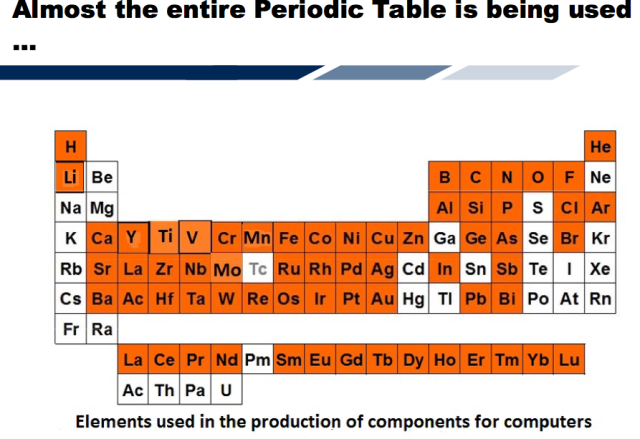
Computers, which are the heart of many high-tech goods, use almost the entire periodic table of elements.
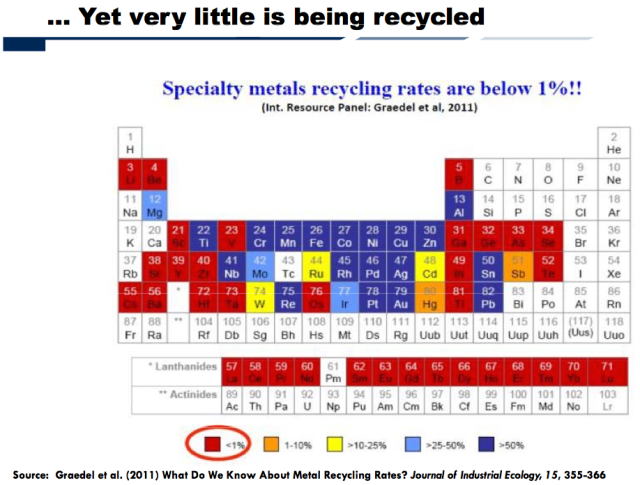
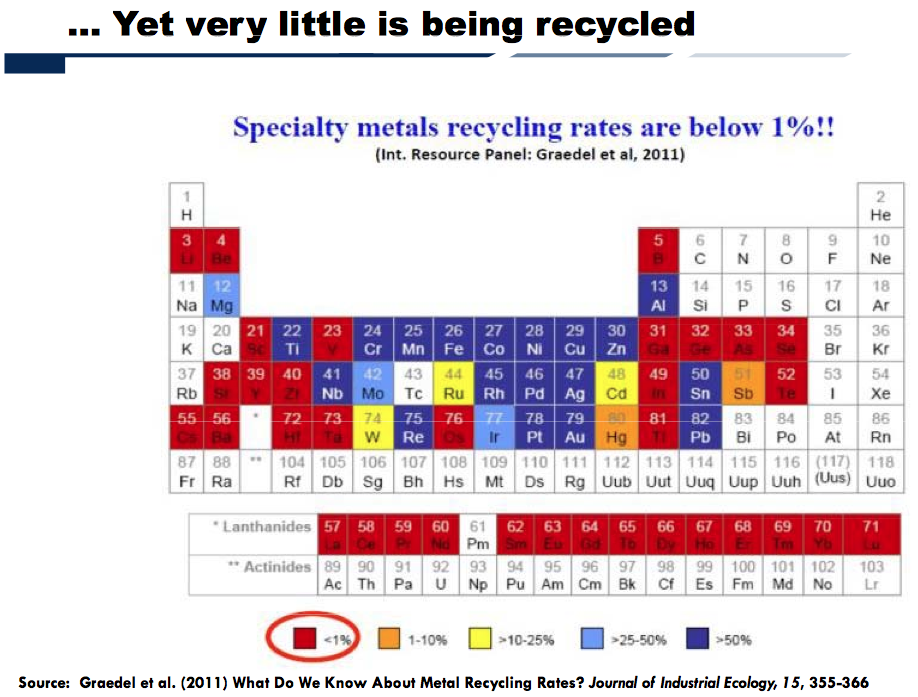
When minerals are used in small quantities, especially when they are used in conjunction with many other minerals, they become virtually impossible to recycle. Experience indicates that less than 1% of specialty metals are recycled.
Green technologies, including solar panels, wind turbines, and batteries, have pushed resource use toward minerals that were little exploited in the past. If we try to ramp up usage, current mines are likely to deplete rapidly. We will eventually need to add new mines in areas where resource quality is lower and concern about pollution is higher. Costs will be much higher in such mines, making devices using such minerals less affordable, rather than more affordable, in the long run.
Pitfall 3. High-cost energy sources are the opposite of the “gift that keeps on giving.” Instead, they often represent the “subsidy that keeps on taking.”
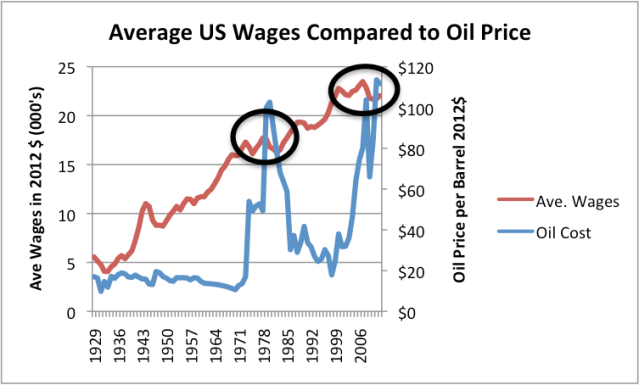
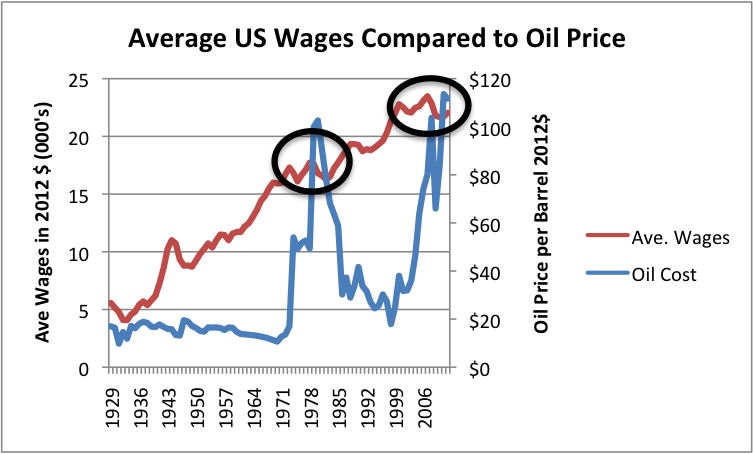
Oil that was cheap to extract (say $20 barrel) was the true “gift that keeps on giving.” It made workers more efficient in their jobs, thereby contributing to efficiency gains. It made countries using the oil more able to create goods and services cheaply, thus helping them compete better against other countries. Wages tended to rise, as long at the price of oil stayed below $40 or $50 per barrel (Figure 3).
Figure 3. Average wages in 2012$ compared to Brent oil price, also in 2012$. Average wages are total wages based on BEA data adjusted by the CPI-Urban, divided total population. Thus, they reflect changes in the proportion of population employed as well as wage levels.
More workers joined the work force, as well. This was possible in part because fossil fuels made contraceptives available, reducing family size. Fossil fuels also made tools such as dishwashers, clothes washers, and clothes dryers available, reducing the hours needed in housework. Once oil became high-priced (that is, over $40 or $50 per barrel), its favorable impact on wage growth disappeared.
When we attempt to add new higher-cost sources of energy, whether they are high-cost oil or high-cost renewables, they present a drag on the economy for three reasons:
Consumers tend to cut back on discretionary expenditures, because energy products (including food, which is made oil and other energy products) are a necessity. These cutbacks feed back through the economy and lead to layoffs in discretionary sectors. If they are severe enough, they can lead to debt defaults as well, because laid-off workers have difficulty paying their bills.
An economy with high-priced sources of energy becomes less competitive in the world economy, competing with countries using less expensive sources of fuel. This tends to lead to lower employment in countries whose mix of energy is weighted toward high-priced fuels.
With (1) and (2) happening, economic growth slows. There are fewer jobs and debt becomes harder to repay.
In some sense, the cost producing of an energy product is a measure of diminishing returns–that is, cost is a measure of the amount of resources that directly and indirectly or indirectly go into making that device or energy product, with higher cost reflecting increasing effort required to make an energy product. If more resources are used in producing high-cost energy products, fewer resources are available for the rest of the economy. Even if a country tries to hide this situation behind a subsidy, the problem comes back to bite the country. This issue underlies the reason that subsidies tend to “keeping on taking.”
The dollar amount of subsidies is also concerning. Currently, subsidies for renewables (before the multiplier effect) average at least $48 per barrel equivalent of oil.1 With the multiplier effect, the dollar amount of subsidies is likely more than the current cost of oil (about $80), and possibly even more than the peak cost of oil in 2008 (about $147). The subsidy (before multiplier effect) per metric ton of oil equivalent amounts to $351. This is far more than the charge for any carbon tax.
Pitfall 4. Green technology (including renewables) can only be add-ons to the fossil fuel system.
A major reason why green technology can only be add-ons to the fossil fuel system relates to Pitfalls 1 through 3. New devices, such as wind turbines, solar PV, and electric cars aren’t very scalable because of high required subsidies, depletion issues, pollution issues, and other limits that we don’t often think about.
A related reason is the fact that even if an energy product is “renewable,” it needs long-term maintenance. For example, a wind turbine needs replacement parts from around the world. These are not available without fossil fuels. Any electrical transmission system transporting wind or solar energy will need frequent repairs, also requiring fossil fuels, usually oil (for building roads and for operating repair trucks and helicopters).
Given the problems with scalability, there is no way that all current uses of fossil fuels can all be converted to run on renewables. According to BP data, in 2013 renewable energy (including biofuels and hydroelectric) amounted to only 9.4% of total energy use. Wind amounted to 1.1% of world energy use; solar amounted to 0.2% of world energy use.
Pitfall 5. We can’t expect oil prices to keep rising because of affordability issues.
Economists tell us that if there are inadequate oil supplies there should be few problems: higher prices will reduce demand, encourage more oil production, and encourage production of alternatives. Unfortunately, there is also a roundabout way that demand is reduced: wages tend to be affected by high oil prices, because high-priced oil tends to lead to less employment (Figure 3). With wages not rising much, the rate of growth of debt also tends to slow. The result is that products that use oil (such as cars) are less affordable, leading to less demand for oil. This seems to be the issue we are now encountering, with many young people unable to find good-paying jobs.
If oil prices decline, rather than rise, this creates a problem for renewables and other green alternatives, because needed subsidies are likely to rise rather than disappear.
Pitfall 6. It is often difficult to get the finances for an electrical system that uses intermittent renewables to work out well.
Intermittent renewables, such as electricity from wind, solar PV, and wave energy, tend to work acceptably well, in certain specialized cases:
When there is a lot of hydroelectricity nearby to offset shifts in intermittent renewable supply;
When the amount added is sufficient small that it has only a small impact on the grid;
When the cost of electricity from otherwise available sources, such as burning oil, is very high. This often happens on tropical islands. In such cases, the economy has already adjusted to very high-priced electricity.
Intermittent renewables can also work well supporting tasks that can be intermittent. For example, solar panels can work well for pumping water and for desalination, especially if the alternative is using diesel for fuel.
Where intermittent renewables tend not to work well is when
Consumers and businesses expect to get a big credit for using electricity from intermittent renewables, but
Electricity added to the grid by intermittent renewables leads to little cost savings for electricity providers.
For example, people with solar panels often expect “net metering,” a credit equal to the retail price of electricity for electricity sold to the electric grid. The benefit to electric grid is generally a lot less than the credit for net metering, because the utility still needs to maintain the transmission lines and do many of the functions that it did in the past, such as send out bills. In theory, the utility still should get paid for all of these functions, but doesn’t. Net metering gives way too much credit to those with solar panels, relative to the savings to the electric companies. This approach runs the risk of starving fossil fuel, nuclear, and grid portion of the system of needed revenue.
A similar problem can occur if an electric grid buys wind or solar energy on a preferential basis from commercial providers at wholesale rates in effect for that time of day. This practice tends to lead to a loss of profitability for fossil fuel-based providers of electricity. This is especially the case for natural gas “peaking plants” that normally operate for only a few hours a year, when electricity rates are very high.
Germany has been adding wind and solar, in an attempt to offset reductions in nuclear power production. Germany is now running into difficulty with its pricing approach for renewables. Some of its natural gas providers of electricity have threatened to shut down because they are not making adequate profits with the current pricing plan. Germany also finds itself using more cheap (but polluting) lignite coal, in an attempt to keep total electrical costs within a range customers can afford.
Pitfall 7. Adding intermittent renewables to the electric grid makes the operation of the grid more complex and more difficult to manage. We run the risk of more blackouts and eventual failure of the grid.
In theory, we can change the electric grid in many ways at once. We can add intermittent renewables, “smart grids,” and “smart appliances” that turn on and off, depending on the needs of the electric grid. We can add the charging of electric automobiles as well. All of these changes add to the complexity of the system. They also increase the vulnerability of the system to hackers.
The usual assumption is that we can step up to the challenge–we can handle this increased complexity. A recent report by The Institution of Engineering and Technology in the UK on the Resilience of the Electricity Infrastructure questions whether this is the case. It says such changes, ” . . . vastly increase complexity and require a level of engineering coordination and integration that the current industry structure and market regime does not provide.” Perhaps the system can be changed so that more attention is focused on resilience, but incentives need to be changed to make resilience (and not profit) a top priority. It is doubtful this will happen.
Pitfall 8. A person needs to be very careful in looking at studies that claim to show favorable performance for intermittent renewables.
Analysts often overestimate the benefits of wind and solar. Just this week a new report was published saying that the largest solar plant in the world is so far producing only half of the electricity originally anticipated since it opened in February 2014.
In my view, “standard” Energy Returned on Energy Invested (EROEI) and Life Cycle Analysis (LCA) calculations tend to overstate the benefits of intermittent renewables, because they do not include a “time variable,” and because they do not consider the effect of intermittency. More specialized studies that do include these variables show very concerning results. For example, Graham Palmer looks at the dynamic EROEI of solar PV, using batteries (replaced at eight year intervals) to mitigate intermittency.2 He did not include inverters–something that would be needed and would reduce the return further.
Figure 4. Graham Palmer’s chart of Dynamic Energy Returned on Energy Invested from “Energy in Australia.” (Power point words are my explanation.)
Palmer’s work indicates that because of the big energy investment initially required, the system is left in a deficit energy position for a very long time. The energy that is put into the system is not paid back until 25 years after the system is set up. After the full 30-year lifetime of the solar panel, the system returns 1.3 times the initial direct energy investment.
One further catch is that the energy used in the EROEI calculations includes only a list of direct energy inputs. The total energy required is much higher; it includes indirect inputs that are not directly measured as well as energy needed to provide necessary infrastructure, such as roads and schools. When these are considered, the minimum EROEI needs to be something like 10. Thus, the solar panel plus battery system modeled is really a net energy sink, rather than a net energy producer.
Another study by Weissbach et al. looks at the impact of adjusting for intermittency. (This study, unlike Palmer’s, doesn’t attempt to adjust for timing differences.) It concludes, “The results show that nuclear, hydro, coal, and natural gas power systems . . . are one order of magnitude more effective than photovoltaics and wind power.”
Conclusion
It would be nice to have a way around limits in a finite world. Unfortunately, this is not possible in the long run. At best, green solutions can help us avoid limits for a little while longer.
The problem we have is that statements about green energy are often overly optimistic. Cost comparisons are often just plain wrong–for example, the supposed near grid parity of solar panels is an “apples to oranges” comparison. An electric utility cannot possibility credit a user with the full retail cost of electricity for the intermittent period it is available, without going broke. Similarly, it is easy to overpay for wind energy, if payments are made based on time-of-day wholesale electricity costs. We will continue to need our fossil-fueled balancing system for the electric grid indefinitely, so we need to continue to financially support this system.
There clearly are some green solutions that will work, at least until the resources needed to produce these solutions are exhausted or other limits are reached. For example, geothermal may be solutions in some locations. Hydroelectric, including “run of the stream” hydro, may be a solution in some locations. In all cases, a clear look at trade-offs needs to be done in advance. New devices, such as gravity powered lamps and solar thermal water heaters, may be helpful especially if they do not use resources in short supply and are not likely to cause pollution problems in the long run.
Expectations for wind and solar PV need to be reduced. Solar PV and offshore wind are both likely net energy sinks because of storage and balancing needs, if they are added to the electric grid in more than very small amounts. Onshore wind is less bad, but it needs to be evaluated closely in each particular location. The need for large subsidies should be a red flag that costs are likely to be high, both short and long term. Another consideration is that wind is likely to have a short lifespan if oil supplies are interrupted, because of its frequent need for replacement parts from around the world.
Some citizens who are concerned about the long-term viability of the electric grid will no doubt want to purchase their own solar systems with inverters and back-up batteries. I see no reason to discourage people who want to do this–the systems may prove to be of assistance to these citizens. But I see no reason to subsidize these purchases, except perhaps in areas (such as tropical islands) where this is the most cost-effective way of producing electric power.
Notes:
[1] In 2013, the total amount of subsidies for renewables was $121 billion according to the IEA. If we compare this to the amount of renewables (biofuels + other renewables) reported by BP, we find that the subsidy per barrel of oil equivalent in was $48 per barrel of oil equivalent. These amounts are likely understated, because BP biofuels include fuel that doesn’t require subsidies, such as waste sawdust burned for electricity.



 David Levine
 David Levine