Shared posts

14 Apr 09:07

Someone Calculated How Many Adjunct Professors Are on Public Assistance, and the Number Is Startling

by Jordan Weissmann

Once in a while, someone publishes an article about adjunct professors who resort to food stamps in order to survive on the rock-bottom pay that so many college instructors are expected to live on. But until today, I had never seen a statistic summing up how many academics are actually resorting to government aid. The number, it turns out, is rather large. According to an analysis of census data by the University of California–Berkeley's Center for Labor Research and Education, 25 percent of "part-time college faculty" and their families now receive some sort public assistance, such as Medicaid, the Children's Health Insurance Program, food stamps, cash welfare, or the Earned Income Tax Credit. For what it's worth, that's not quite so bad as the situation faced by fast-food employees and home health care aids, roughly half of whom get government help. But, in case there were any doubt, an awful lot of Ph.D.s and master's degree holders are basically working poor.

Low-Wage Occupations and Public Assistance Rates

I don't think it would be quite accurate to say that 25 percent of all adjuncts are getting aid, since some do in fact have full-time jobs that would show up in the census as their occupation. Still, we're talking about a large group of highly educated individuals. According to NBC News, which reported on some of the labor center's data prior to publication, "families of close to 100,000 part-time faculty members are enrolled in public assistance programs."

Despite their symbolic value, food stamps aren't the most popular program among adjuncts. According to the NBC report (I haven't been able to find these specific numbers published elsewhere), 7 percent of part-time faculty are enrolled in the Supplemental Nutrition Assistance Program, 7 percent are signed up for Medicaid (though the number may be higher thanks to Obamacare's expansion of the insurance program), and "one in five" receive the Earned Income Tax Credit, which boosts pay for low-wage workers.

Over the past several decades, colleges and universities have come to rely on adjuncts in order to keep down education costs and tuition. According to the American Association of University Professors, "more than half of all faculty hold part-time appointments." But despite the awful compensation these teachers receive, the unfortunate reality is that instruction costs per student have still risen faster than inflation at schools in recent years. (Though they did fall a bit during the recession.) If we ever want universities to pay part-time educators a decent wage, one of three things needs to happen: Either institutions will have to find savings elsewhere in their budgets, states are going to have to refund their higher education systems, or students are going to have to pay more. The first two seem unlikely, unfortunate as that may be. And the third is a choice nobody really wants to make.

12 Apr 13:54

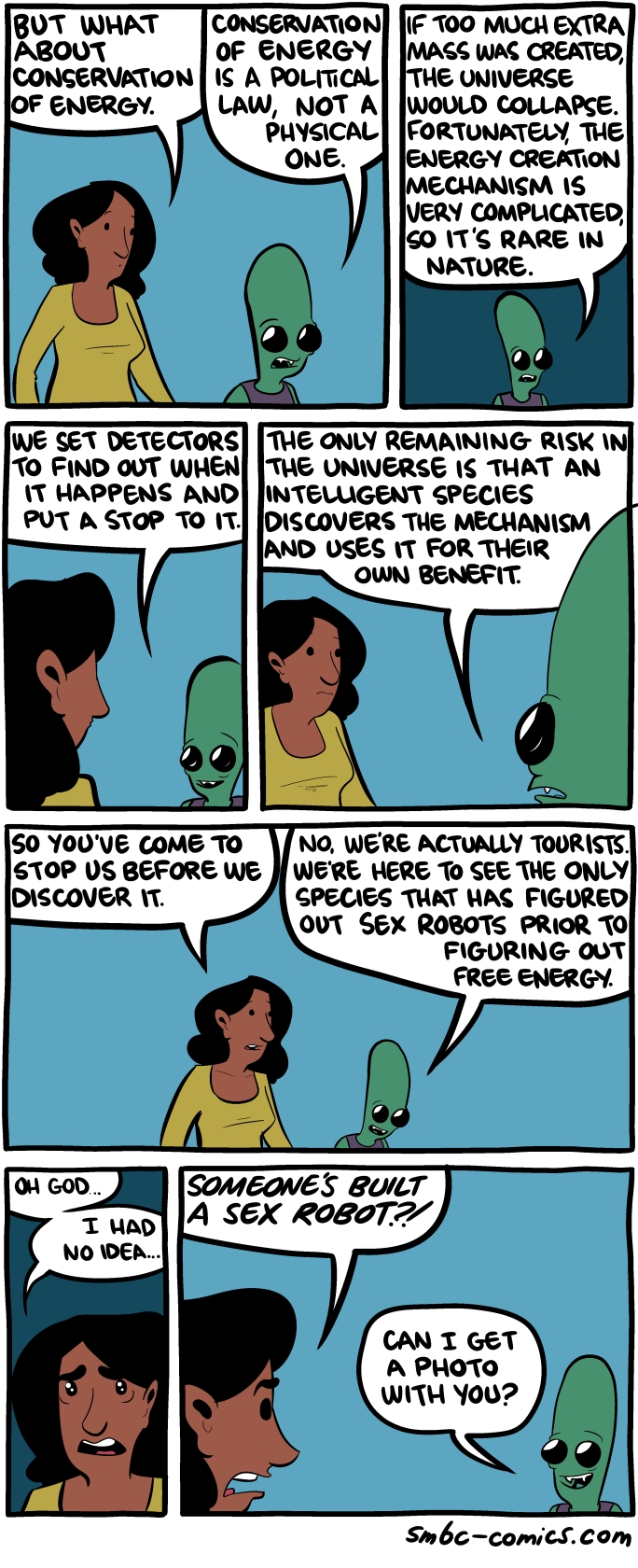
Saturday Morning Breakfast Cereal - Conservation of Energy

by admin@smbc-comics.com

Hovertext: Keep your hands above my waist, human.


New comic!
Today's News:

 Only three days left to get your monocle!

11 Apr 15:24

Effect of microwave ovens on astronomy

by Marc Abrahams

Rogue Microwave Ovens Are the Culprits Behind Mysterious Radio Signals” is the headline on Nadia Drake’s article in the Phenomena blog. Drake writes:

if you happen to be reheating your coffee at the Parkes Observatory in Australia, you could be contributing to the growing collection of mysterious radio signals known as perytons. Well, the collection of formerly mysterious radio signals: A study posted to the arXiv on April 9 identified microwave ovens at the Parkes site as the rather mundane source of perytons.

epetroff“It was quite surprising that it ended up being microwaves,” says study author Emily Petroff [pictured here] of Australia’s Swinburne University of Technology.

For years, astronomers had been puzzled by these brief but intense bursts of radio waves that in some ways appeared to be coming from deep space. There have been dozens of reported perytons, some dating back to the 1990s… perhaps unsurprisingly in retrospect, the peryton data show those signals “clustering near the lunchtime hour.”

10 Apr 17:04

Exhaustion

by The Awkward Yeti

Exhaustion

10 Apr 09:24

[Report] Experimental observation of a generalized Gibbs ensemble

by Tim Langen
The description of the non-equilibrium dynamics of isolated quantum many-body systems within the framework of statistical mechanics is a fundamental open question. Conventional thermodynamical ensembles fail to describe the large class of systems that exhibit nontrivial conserved quantities, and generalized ensembles have been predicted to maximize entropy in these systems. We show experimentally that a degenerate one-dimensional Bose gas relaxes to a state that can be described by such a generalized ensemble. This is verified through a detailed study of correlation functions up to 10th order. The applicability of the generalized ensemble description for isolated quantum many-body systems points to a natural emergence of classical statistical properties from the microscopic unitary quantum evolution. Authors: Tim Langen, Sebastian Erne, Remi Geiger, Bernhard Rauer, Thomas Schweigler, Maximilian Kuhnert, Wolfgang Rohringer, Igor E. Mazets, Thomas Gasenzer, Jörg Schmiedmayer
10 Apr 09:10

braindead:...

10 Apr 08:57

Comic for 2015.04.10

New Cyanide and Happiness Comic
09 Apr 16:24

"Dichiarazione choc"

by di Alessandro Gilioli

Molti anni fa un giornalista e studioso di media, Giovanni Cesareo, scrisse un libro che tra l'altro affrontava il greggismo mentale dei giornalisti. 'Greggismo' nel senso che tendiamo a pensare come un gregge, quindi ciascuno fa quello che fanno gli altri: sia nell'identificazione di ciò che secondo noi "fa notizia" sia nel modo di dare la notizia stessa, fino all'uso di formule che quindi diventano rapidamente stereotipi - e anche per questo contribuiscono a (de)formare la coscienza dell'opinione pubblica.

In poche parole, Cesareo spiegava che il conformismo dei media è molto determinato dalla pigrizia intellettuale ed emulativa di chi li fa, più ancora che da disegni a tavolino di poteri occulti. Che poi talvolta i poteri economici e politici riescano a sfruttare questa pigrizia conformista, è pure vero, ma il materiale che hanno tra le mani è molto malleabile, ecco.

E comunque sia, questa pigrizia conformista poi contribuisce all'egemonia culturale, insomma crea un pensiero diffuso. Non è insomma questione da poco.

Guardate solo l'espressione "lacci e laccioli", che pare sia stata inventata dal governatore di Bankitalia Guido Carli nel 1970 e per quarant'anni è stata ripetuta infinite volte nei titoli e nei sommari di tutti i giornali - di destra e di sinistra: mi chiedo quanto ha contribuito all'egemonia del pensiero liberista, in questo Paese, al suo assorbimento nel tessuto sociale. Ma gli esempi sono infiniti: pensate a come l'espressione "scendere in campo" abbia ridotto la politica a tifoseria calcistica, nella mente dei più; o quanto "il monito del Quirinale" abbia trasformato il Presidente della Repubblica in una sorta di giudice divino. Su "giustizia ad orologeria" non dico niente, so che vi viene già da ridere. E si potrebbe andare avanti all'infinito: qualcuno inventa una formula, i media la ripetono a gregge, e così si crea un format di realtà percepita.

Tutta questa pippa mi è uscita per via dell'insofferenza che sto maturando - tenetemi fermo - verso la titolazione con le due paroline "dichiarazione choc".

Che non è soltanto un tentativo di clickbait o comunque di marketing editoriale: è anche un'attribuzione indebita di interesse e di novità a chi ha fatto la dichiarazione stessa. Come dire: "caspita, che cosa dirompente e importante che ha detto questo!".

Ora, ad esempio: se Salvini dice che bisogna sfrattare i campi rom e raderli con le ruspe, non è una dichiarazione choc. È quanto di più prevedibile ci si possa aspettare da Salvini. Che ha semplicemente alzato il tono di una sua già notissima battaglia politica (quella contro i rom) per far abboccare i media, che infatti subito hanno rivestito la sua uscita come "dichiarazione choc", quindi che fa notizia, pertanto va data, e anche alta, in pagina. Invece, con permesso, Salvini che attacca i rom è notizia come il cane che morde l'uomo: zero. Accreditarlo di una "dichiarazione choc" è pura pigrizia mentale, nonché asservimento alla strategia mediatica di un politico nel crearlo come personaggio.

Ma ho citato Salvini solo perché è l'ultimo. Ieri ho letto sul Mattino anche la 'dichiarazione choc' di Le Pen: "Le camere a gas sono un dettaglio della storia". Beh, l'aveva già detto nel 1987, e poi altre volte, ed era stato pure processato per questo. E l'Isis minaccia di distruggere Roma è una dichiarazione choc? Forse la prima volta, di certo non le successive 628. E le parole degli ultras contro la mamma di Ciro sono striscioni-choc? Ma che cacchio, sono ultras idioti, non c'è nulla di più prevedibile che degli idioti scrivano idiozie.

Eccetera eccetera.

Non è che propongo una moratoria sulla formula "dichiarazione choc". Propongo proprio di far brillare in automatico i computer quando questa coppia di parole viene digitata su un sistema editoriale. Almeno finché il Papa non rivela di essere sposato.

09 Apr 14:50

This simple comic strip concisely explains the complexities of white privilege

by Caroline Siede
Jacopo.bertolotti

Nevertheless Bob is not guilty of racism. Just like a German citizen is not guilty of Nazi crimes, people living in Madagascar are not guilty of making Dodos extinct or a person living in Rome is not guilty of sending christians to die in the coliseum.

wp

The concept of “white privilege” (brilliantly explained in Peggy McIntosh’s essay, "Unpacking The Invisible Backpack") can be a difficult one to grasp. After all, the entire idea of “privilege” is that it's invisible to those who have it. Thankfully, a new comic from Barry Deutsch of Lefty Cartoons called “Bob And Race” lays out some of the many factors that contribute to white privilege. Specifically, the comic looks at privilege from a historical lens. In this case, the central figure, Bob, may not think he’s benefited from racism, but a quick trip through recent history shows the factors that gave him a step up from the day he was born.

For instance, Bob’s grandparents were more easily able to get homes and jobs in the overtly racist past while their black peers were shut out of such advantages. Their stability directly helped Bob’s parents and Bob himself, who was also more likely to be given the “benefit of the doubt” by society when it came to behavior that black people are disproportionally arrested for (for instance, drug possession).

The comic is a brilliant illustration of the ways in which white privilege is embedded in so many of the realities white people take for granted.

This entry passed through the Full-Text RSS service - if this is your content and you're reading it on someone else's site, please read the FAQ at fivefilters.org/content-only/faq.php#publishers.

09 Apr 09:43

All that glitters

All that glitters

Nature 520, 7546 (2015). doi:10.1038/520131a

A review of the United Kingdom’s progress towards ‘gold’ open-access research is instructive — for funders, publishers and scientists both at home and abroad.

09 Apr 09:43

The future of the postdoc

by Kendall Powell

The future of the postdoc

Nature 520, 7546 (2015). http://www.nature.com/doifinder/10.1038/520144a

Author: Kendall Powell

There is a growing number of postdocs and few places in academia for them to go. But change could be on the way.

09 Apr 09:19

Lasing action in periodic arrays of nanoparticles

by Montacer Dridi George C. Schatz
Montacer Dridi, George C. Schatz
We study the effect of nanoparticle (NP) array spacing on plasmon-enhanced lasing using a computational model that combines classical electrodynamics for arrays of gold NPs interacting with a four-level model of the laser dye photophysics. Parameters of the model are related to a laser system that ... [J. Opt. Soc. Am. B 32, 818-823 (2015)]
09 Apr 09:04

Poll: What to do when peer review feels inadequate?

by Cat Ferguson

How should scientists think about papers that have undergone what appears to be a cursory peer review? Perhaps the papers were reviewed in a day — or less — or simply green-lighted by an editor, without an outside look. That’s a question Dorothy Bishop, an Oxford University autism researcher, asked herself when she noticed some […]

The post Poll: What to do when peer review feels inadequate? appeared first on Retraction Watch.

08 Apr 09:23

La scienza del caffè con la Moka

by Dario Bressanini

Anche nell’era delle cialde per l’espresso casalingo, chi non ha una Moka Express in casa? Inventata da Alfonso Bialetti nel 1933 a Omegna, e prodotta su scala industriale dal 1946 dal figlio Renato, quei tre pezzi di alluminio avvitati e incastrati vengono usati ancora oggi in milioni di case per accompagnare con qualche tazzina di caffè le giornate degli italiani. Non tutti però sanno come funziona esattamente. Anzi, se chiedete come fa il caffè a uscire dalla colonnina è probabile che vi diano la risposta sbagliata, e cioè che sia l’ebollizione dell’acqua a spingerla attraverso il filtro. Potrà sembrare strano ma un’analisi scientifica corretta, anche se parziale, del funzionamento di una Moka è stata pubblicata su una rivista scientifica solo nel 2007 [1], seguita nel 2009 da una indagine sperimentale completa [2]. In precedenza in letteratura si trovano solo spiegazioni parziali o addirittura errate.

Vediamone il funzionamento e contemporaneamente impariamo a preparare un buon caffè. Cominciamo dall'acqua.

Quale e quanta acqua?

Riempite la caldaia della caffettiera sino alla valvola di sicurezza. In una caffettiera classica da 3 tazzine sono circa 150 g di acqua. Non andate oltre: Sotto il filtro a imbuto si deve lasciare una piccola sacca d’aria (circa 20-25 cm^3) e il caffè nel filtro non deve toccare l’acqua sottostante. Questo è importante, come vedremo, per il funzionamento corretto dell’apparecchio.

fisicamoka01a

L'acqua non deve avere troppi sali disciolti sia per non lasciare troppi residui nella caffettiera che, col tempo, potrebbero causare un malfunzionamento, sia per non alterare il sapore del caffè impartendo un sapore amaro. I valori suggeriti degli ioni disciolti sono: calcio < 60 mg/l, bicarbonato < 200 mg/l, magnesio < 15 mg/l. Se l’acqua erogata dal vostro rubinetto rende il caffè amaro, o è ricca di cloro, potete utilizzare acqua in bottiglia con valori più bassi.

Quale caffè?

Ovviamente quello che vi piace. Esistono due specie di piante di caffè sfruttate commercialmente. Coffea arabica, originaria dell’Etiopia, è coltivata nelle regioni montuose tropicali fino a 2500 metri e rappresenta i due terzi della produzione mondiale di caffè. Ha un gusto delicato, leggermente acido, aromatico e poco amaro. Una percentuale di caffeina (nei semi) tra lo 0,9% e 1,2%. Il chicco è di forma allungata e appiattita di un bel color verde. Il caffè arabica arrivò a Venezia agli inizi del ‘600 e da lì si diffuse in tutta Europa diventando la bevanda preferita degli intellettuali.

La robusta (Coffea canephora) rappresenta un terzo della produzione mondiale. È originaria dell’Africa occidentale e arriva in Italia solo nel ‘900. È coltivata tra i 200 e i 600 metri d’altezza ed è capace di sopravvivere nei difficili ambienti della foresta africana. Ha un gusto più astringente e amaro dell’arabica, più caffeina (1,6-2,4%) e un chicco tondeggiante con un solco dritto.

Io uso un’arabica 100% ma non necessariamente una miscela con una certa percentuale di robusta è di minore qualità: dipende da come volete il vostro caffè.

Quanto caffè?

In una “tre tazzine” si usano circa 15 grammi di caffè macinato. Il caffè per la Moka deve essere macinato con una grana più grossa rispetto a quello per una macchina da espresso dove la pressione più elevata (circa 9 bar) richiede uno strato di caffè compatto macinato più finemente.

Riempite il filtro sino all'orlo senza creare una montagnetta. Premere o non premere? Non premete il caffè! Altrimenti rallentate la risalita dell’acqua. Ma non fateci nemmeno dei buchetti, altrimenti la facilitate troppo. In entrambi i casi alterereste il tempo di contatto ottimale tra acqua e caffè.

Coperchio aperto o chiuso? C’è chi tiene chiuso il coperchio e chi lo lascia aperto. Fate come preferite; vi sono molte leggende al riguardo, ma non fa alcuna differenza. Io, se sono in cucina, lo tengo aperto per controllare meglio quando spegnere il fuoco.

Accendiamo il fornello. Fiamma alta o bassa?

È meglio scaldare a fiamma bassa per far salire gradualmente la temperatura, ritardare l'ebollizione dell'acqua e far uscire lentamente il caffè dalla colonnina. Se avete fretta andate al bar ;)

Analizziamo ora passo passo cosa succede quando iniziamo a scaldare. Come dicono Navarini e collaboratori [2] “è una credenza, tra gli utilizzatori della Moka, che sia necessario raggiungere il punto di ebollizione dell’acqua per spingere il liquido fuori dal serbatoio inferiore e che l’aumento di pressione all’interno sia dovuto al raggiungimento dell’equilibrio termodinamico tra l’acqua e il suo vapore”

La fiamma sotto la caffettiera non riscalda solo l’acqua ma anche l’aria sovrastante che avevamo lasciato riempiendo la caldaia. Le misure sperimentali mostrano che la miscela aria/vapore non raggiunge mai l’equilibrio con l’acqua che si sta scaldando, rimanendo sempre a temperature più basse di circa 8 gradi.

All’innalzarsi della temperatura, secondo le leggi dei gas, l’aria aumenta la propria pressione ed espandendosi inizia a spingere l’acqua che risale nel filtro, bagnando il caffè. Aumentando la temperatura l’acqua inizia a evaporare e quindi anche la pressione del vapore contribuisce alla spinta dell’acqua verso l’alto.

La fase di estrazione regolare

Sino a quanto nella caldaia il beccuccio del filtro a imbuto rimane immerso nell’acqua, per circa 120 di quei 150 g iniziali di acqua, l’estrazione procede in modo regolare.

L’acqua calda, non ancora all’ebollizione, spinta prima dalla pressione dell’aria e poi dalla miscela aria/vapore, inizia a risalire nel filtro. Il caffè è completamente imbibito di acqua dopo che ne sono risaliti 40 grammi. In questa fase l’acqua passa attraverso il caffè senza grossa resistenza, sciogliendo le sostanze aromatiche più solubili. Gli esperimenti mostrano che l’estrazione comincia quando l’acqua è circa a 70 °C. Contemporaneamente, le particelle di caffè, assorbendo parte dell’acqua si gonfiano, diminuendo progressivamente la porosità del caffè e richiedendo, da questo punto, una pressione e una temperatura più elevate dell’acqua per poter diffondere nel filtro e risalire la colonnina.

La prima acqua calda, passando per il caffè nel filtro, si è un poco raffreddata e il primo caffè a risalire la colonnina ha una temperatura molto più bassa dell’acqua  nella caldaia.

fisicamoka01b

Gli studi sulla chimica dell’estrazione delle sostanze aromatiche presenti nel caffè mostrano come a temperature diverse si estraggono con più o meno facilità componenti aromatiche diverse, alcune desiderabili altre no. La temperatura ottimale dell’acqua dovrebbe essere attorno a 90-93 °C. A temperature molto superiori vengono estratte anche componenti aromatiche indesiderabili, che portano note astringenti e bruciate. Temperature troppo basse invece non estraggono componenti fondamentali del caffè, che risulta meno complesso e più acido. A questo punto della nostra preparazione la fiamma del fornello dovrebbe essere la più bassa possibile per ritardare l'ebollizione dell'acqua.

fisicamoka03

La fase vulcanica

Quando il livello d’acqua nella caldaia scende al di sotto del beccuccio del filtro, inizia quella che possiamo chiamare fase vulcanica. La riduzione immediata di pressione manda in ebollizione istantanea l’acqua che, mista al vapore, esce sfiatando dalla caffettiera, spruzzando come fosse un vulcano sino a quando è esaurita. Questa fase andrebbe evitata assolutamente e l’ebollizione ritardata il più possibile. A temperature troppo elevate l’acqua estrae sostanze presenti nel caffè tostato ma meno solubili a temperature più basse, ottenendo un caffè più amaro, astringente, col sapore di “bruciato” e a volte di “medicinale”. Se vi capita, non avete “bruciato” il caffè, ma estratto sostanze dal sapore sgradevole già presenti nel caffè tostato e che lì dovrebbero rimanere.

fisicamoka01c

Una strategia semplice per ridurre questo problema è di spegnere il fuoco quando il caffè scende lungo la colonnina e tende a staccarsi. Il caffè non deve gorgogliare e spruzzare dall’ugello. Un po’ di acqua rimarrà nella caldaia ma il vostro caffè sarà di qualità migliore.

Mescolare o non mescolare?

Il caffè ora è pronto, ma prima di versarlo nella tazzina è meglio mescolarlo. Il primo caffè uscito, quello a 70 gradi, è più acido e aromatico. A mano a mano che esce si stratifica il caffè più caldo ma anche più amaro. Poiché lo strato caldo è già in superficie non si attivano le correnti convettive che lo rimescolerebbero, come fanno invece in una pentola d'acqua per la pasta, e quindi va mescolato a mano. Ora il caffè è pronto per essere bevuto.

Scommetto che, come a me, vi sono venuti in mente alcuni esperimenti da fare e idee da mettere alla prova: possiamo variare la temperatura di partenza dell’acqua, per esempio, oppure usare un bagno termico per tenere la caldaia a una temperatura costante. Magari ne riparliamo.

Nel frattempo, buon caffè!

Dario Bressanini

Bibliografia

[1] Gianino, C. (2007). Experimental analysis of the Italian coffee pot “moka”.American Journal of Physics75(1), 43-47.

[2] Navarini, L., Nobile, E., Pinto, F., Scheri, A., & Suggi-Liverani, F. (2009). Experimental investigation of steam pressure coffee extraction in a stove-top coffee makerApplied Thermal Engineering29(5), 998-1004.

fisicamoka02

Grafico dell'andamento di temperatura, pressione e volume d'acqua tratto da [2]

07 Apr 09:06

La paura più grande

by zerocalcare

1
2 3 4 5 6 7 8 9 10 11 12 13 14 15 16 17 18 19

07 Apr 08:56

Quantum optics route to market

by Jürgen Stuhler

Nature Physics 11, 293 (2015). doi:10.1038/nphys3292

Author: Jürgen Stuhler

Research in quantum optics has already led to commercial technologies, but the gap between the lab and market products is still large. Looking from the industrial side, one can see ways of bridging this gap.

07 Apr 08:56

Read the fine print

by Scott Aaronson

Nature Physics 11, 291 (2015). doi:10.1038/nphys3272

Author: Scott Aaronson

New quantum algorithms promise an exponential speed-up for machine learning, clustering and finding patterns in big data. But to achieve a real speed-up, we need to delve into the details.

07 Apr 08:21

Nondiffusive transport regimes for suprathermal ions in turbulent plasmas

by A. Bovet, A. Fasoli, P. Ricci, I. Furno, and K. Gustafson

Author(s): A. Bovet, A. Fasoli, P. Ricci, I. Furno, and K. Gustafson

The understanding of the transport of suprathermal ions in the presence of turbulence is important for fusion plasmas in the burning regime that will characterize reactors, and for space plasmas to understand the physics of particle acceleration. Here, three-dimensional measurements of a supratherma…


[Phys. Rev. E 91, 041101(R)] Published Fri Apr 03, 2015

07 Apr 08:14

Synopsis: Entangled Static

Evidence of quantum entanglement is uncovered in an unlikely place: the electrical noise in a simple quantum conductor chilled to near zero.

Published Thu Apr 02, 2015
06 Apr 13:31

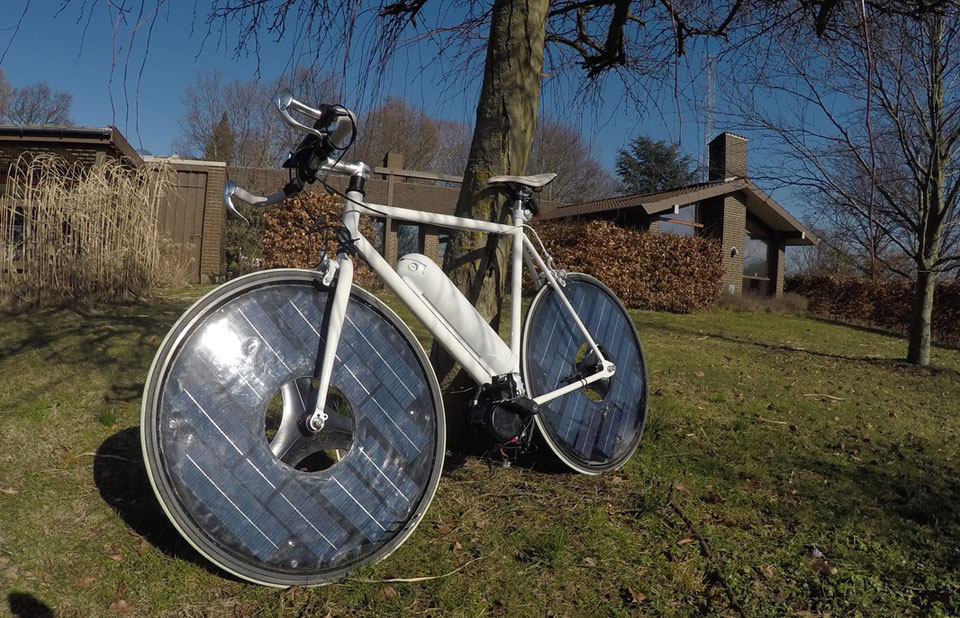
The Solarbike is a very real thing

by Mat Smith
Jacopo.bertolotti

Two problems with this:
1. Murphy's law clearly state that you will always have the sun straight in your face, wherever you are going, thus making those solar panels highly ineffective.
2. I am not really looking forward at riding something like this when there is any amount of wind.

But kudos for trying.

Here's an electric bike that doesn't need plugging in.. or swapping out batteries. As the name suggests, the Solarbike has solar cells built into both sides of the party typical bicycle wheels, using cells (and a design) that's apparently "shadow opt...
06 Apr 11:55

Sintomi e cause del declino (I): tre esempi

by MicheleBoldrin
Sommario: 

Il declino italiano, lo andiamo ripetendo da quando nacque il blog, è socio-culturale ed etico, anzitutto, oltre che economico e politico. A suo tempo mi dedicai per qualche mese a documentare questa idea con una serie di "microfondazioni". Non so se avrò ora la costanza che ebbi allora, son maggiori sia gli impegni che la noia per la quotidianità italiana. Ma tre piccoli episodi degli ultimi giorni, che raccolgo qui, mi sembrano troppo indicativi per essere passati sotto silenzio.

1. Il metodo Rampini e l'omertà del giornalismo italiano

Per molto tempo un divertissement privato fra noi della redazione erano mail di questo tipo, che arrivavano, dall'uno o dall'altro, con una certa regolarità:

Coautori: 
Data di pubblicazione: 
Lunedì, 6 aprile, 2015 - 09:22

leggi tutto

06 Apr 11:19

04/01/15 PHD comic: 'Srsly, this happens.'

Piled Higher & Deeper by Jorge Cham
www.phdcomics.com
Click on the title below to read the comic
title: "Srsly, this happens." - originally published 4/1/2015

For the latest news in PHD Comics, CLICK HERE!

04 Apr 15:36

Bayesian survival analysis in A Song of Ice and Fire

by Allen Downey

This post originally appeared on Allen Downey's personal blog.

Last fall I taught an introduction to Bayesian statistics at Olin College. My students worked on some excellent projects, and I invited them to write up their results as guest articles for my blog.

One of the teams applied Bayesian survival analysis to the characters in A Song of Ice and Fire, the book series by George R. R. Martin.  Using data from the first 5 books, they generate predictions for which characters are likely to survive and which might die in the forthcoming books.  

With Season 5 of the Game of Thrones television series starting on April 12, we thought this would be a good time to publish their report.

Bayesian survival analysis in A Song of Ice and Fire

By Erin Pierce and Ben Kahle

The Song of Ice and Fire series has a reputation for being quite deadly. No character, good or bad, major or minor is safe from Martin's pen. The reputation is not unwarranted; of the 916 named characters that populate Martin's world, a third have died, alongside uncounted nameless ones.

In this report, we take a closer look at the patterns of death in the novels and create a Bayesian model that predicts the probability that characters will survive the next two books.

Using data from A Wiki of Ice and Fire, we created a dataset of all 916 characters that appeared in the books so far. For every character, we know what chapter and book they first appeared, if they are male or female, if they are part of the nobility or not, what major house they are loyal to, and, if applicable, the chapter and book of their death.  We used this data to predict which characters will survive the next couple books.

Methodology

We extrapolated the survival probabilities of the characters through the seventh book using Weibull distributions. A Weibull distribution provides a way to model the hazard function, which measures the probability of death at a specific age. The Weibull distribution depends on two parameters, k and lambda, which control its shape.

To estimate these parameters, we start with a uniform prior.  For each alive character, we check how well that value of k or lambda predicted the fact that the character was still alive by comparing the calculated Weibull distribution with the character's hazard function. For each dead character, we check how well the parameters predicted the time of their death by comparing the Weibull distribution with the character's survival function.

The main code used to update these distributions is:

class GOT(thinkbayes2.Suite, thinkbayes2.Joint):

def Likelihood(self, data, hypo):
"""Determines how well a given k and lam  predict the life/death of a character """
age, alive = data k, lam = hypo
if alive:
prob = 1-exponweib.cdf(age, k, lam)
else:
prob = exponweib.pdf(age, k, lam)
return prob

def Update(k, lam, age, alive):
"""Performs the Baysian Update and returns the PMFs of k and lam"""
joint = thinkbayes2.MakeJoint(k, lam)
suite = GOT(joint)
suite.Update((age, alive))
k = suite.Marginal(0, label=k.label),  lam = suite.Marginal(1, label=lam.label)
return k, lam

def MakeDistr(introductions, lifetimes,k,lam):
"""Iterates through all the characters for a given k  and lambda.  It then updates the k and lambda distributions"""
k.label = 'K'
lam.label = 'Lam'
print("Updating deaths")
for age in lifetimes:
k, lam = Update(k, lam, age, False)
print('Updating alives')
for age in introductions:
k, lam = Update(k, lam, age, True)
return k,lam

For the Night’s Watch, this lead to the posterior distribution in Figure 3:

The distribution for lambda is quite tight, around 0.27, but the distribution for k is broader.

To translate this back to a survival curve, we took the mean of k and lambda, as well as the 90 percent credible interval for each parameter. We then plot the original data, the credible interval, and the survival curve based on the posterior means.

Jon Snow

Using this analysis, we can can begin to make a prediction for an individual character like Jon Snow.  At the end of A Dance with Dragons, the credible interval for the Night's Watch survival (Figure 4) stretches from 36 percent to 56 percent. The odds are not exactly rosy that Jon snow is still alive. Even if Jon is still alive at the end of book 5, the odds that he will survive the next two books drop to between 30 percent and 51 percent.

The credible interval closely encases the data, and the mean-value curve appears to be a reasonable approximation.

However, it is worth considering that Jon is not an average member of the Night's Watch. He had a noble upbringing and is well trained at arms. We repeated the same analysis with only members of the Night's Watch considered noble due to their family, rank, or upbringing. There have only been 11 nobles in the Night's Watch, so the credible interval as seen in Figure 5 is understandably much wider, however, the best approximation of the survival curve suggests that a noble background does not increase the survival rate for brothers of the Night's Watch.

When only noble members of the Night’s Watch are included, the credible interval widens significantly and the lower bound gets quite close to zero.

The houses of ASOIF

The 90 percent credible intervals for all of the major houses. This includes the 9 major houses, the Night’s Watch, the Wildlings, and a "None" category which includes non-allied characters.

90 percent credible interval for Arryn (Blue), Lannister (Gold), None (Green), and Stark (Grey)

90 percent credible interval for Tyrell(Green), Tully(Blue), Baratheon(Orange), and Night’s Watch (Grey)

90 percent credible interval for Martell(Orange), Targaryen (Maroon), Greyjoy (Yellow), and Wildling (Purple)

These intervals, shown in Figures 6, 7, and 8, demonstrate a much higher survival probability for the houses Arryn, Tyrell, and Martell. Supporting these results, these houses have stayed out of most of the major conflicts in the books, however this also means there is less information on them. We have 5 or fewer examples of dead members for those houses, so the survival curves don’t have very many points. This uncertainty is reflected in the wide credible intervals.

In contrast, our friends in the north, the Starks, Night’s Watch, and Wildlings have the lowest projected survival rates and smaller credible intervals given their warring positions in the story and the many important characters included amongst their ranks. This analysis considers entire houses, but there are also additional ways to sort the characters.

Men and women

While A Song of Ice and Fire has been lauded for portraying women as complex characters who take an a variety of roles, there are still many more male characters (769) than female ones (157). Despite a wider credible interval, the women tend to fare better than their male counterparts, out-surviving them by a wide margin as seen in Figure 9.

The women of Westeros appear to have a better chance of surviving then the men.

Class

The ratio between noble characters(429) and smallfolk characters (487) is much more even than gender and provides an interesting comparison for analysis. Figure 10 suggests that while more smallfolk tend to die quickly after being introduced, those that survive their introductions tend to live for a longer period of time and may in fact outpace the nobles.

The nobility might have a slight advantage when introduced, but their survival probability continues to fall while the smallfolk’s levels much more quickly.

Selected Characters

The same analysis can be extended to combine traits, sorting by gender, house, and class to provide a rough model for individual characters. One of the most popular characters in the books is Arya and many readers are curious about her fate in the books to come. The category of noblewomen loyal to the Starks also includes other noteworthy characters like Sansa and Brienne of Tarth (though she was introduced later). Other intriguing characters to investigate are the Lannister noblewomen Cersei and poor Myrcella. As it turns out, not a lot noble women die. In order to get more precise credible intervals for the specific female characters we included the data of both noble and smallfolk women.

While both groups have very wide ranges of survival probabilities, the Lannister noblewomen may be a bit more likely to die than the Starks.

The data presented in Figure 11 is inconclusive, but it looks like Arya has a slightly better chance of survival than Cersei.

Two minor characters we are curious about are Val, the wildling princess, and the mysterious Quaithe.

Representing the survival curves of more minor characters, Quaithe and Val have dramatically different odds of surviving the series.

They both had more data than the Starks and Lannisters, but they have the complication that they were not introduced at the beginning of the series. Val is introduced at 2.1 books, and so her chances of surviving the whole series are between 10 percent and 53 percent, which are not the most inspiring of chances.

Quaithe is introduced at 1.2 books, and her chances are between 58 percent and 85 percent, which are significantly better than Val’s. These curves are shown in Figure 12.

For most of the male characters (with the exception of Mance), there was enough data to narrow to house, gender and class.

The survival curves of different classes and alliances of men shown through various characters.

Figure 13 shows the Lannister brothers with middling survival chances ranging from 35 percent to 79 percent. The data for Daario is less conclusive, but seems hopeful, especially considering he was introduced at 2.5 books. Mance seems to have to worst chance of surviving until the end. He was introduced at 2.2 books, giving him a chance of survival between 19 percent and 56 percent.

The survival curves of different classes and alliances of men shown through various characters.

Some characters who many wouldn’t mind seeing kick the bucket include Lord Walder Frey and Theon Greyjoy. However, Figure 14 suggests that neither are likely meet untimely (or in Walder Frey’s case, very timely) deaths. Theon seems likely to survive to the bitter end. Walder Frey was introduced at 0.4 books, putting his chances at 44 percent to 72 percent. As it is now, Hoster Tully may be the only character to die of old age, so perhaps Frey will hold out until the end.

Conclusion

Of course who lives and who dies in the next two books has more to do with plot and storyline than with statistics. Nonetheless, using our data we were able we were able to see patterns of life and death among groups of characters. For some characters, especially males, we are able to make specific predictions of how they will fare in the next novels. For females and characters from the less central houses, the verdict is still out.

Our data and code are available from this GitHub repository.

Notes on the Data Set

Most characters were fairly easy to classify, but there are always edge cases.

  1. Gender - This was the most straight forward. There are not really any gender-ambigous characters.
  2. Nobility - Members of major and minor Westeros houses were counted as noble, but hedge knights were not. For characters from Essos, I used by best judgement based on money and power, and it was usually an easy call. For the wildlings, I named military leaders as noble, though that was often a blurry line. For members of the Night’s Watch, I looked at their status before joining in the same way I looked at other Westeros characters. For bastards, we decided on a case by case basis. Bastards who were raised in a noble family and who received the education and training of nobles were counted as noble. Thus Jon Snow was counted as noble, but someone like Gendry was not.
  3. Death - Characters that have come back alive-ish (like Beric Dondarrion) were judged dead at the time of their first death. Wights are not considered alive, but others are. For major characters whose deaths are uncertain, we argued and made a case by case decision.
  4. Houses - This was the trickiest one because some people have allegiances to multiple houses or have switched loyalties. We decided on a case by case basis. The people with no allegiance were of three main groups:

    — People in Essos who are not loyal to the Targaryens.

    — People in the Riverlands, either smallfolk who’s loyalty is not known, or groups like the Brotherhood Without Banners or the Brave Companions with ambiguous loyalty.

    — Nobility that are mostly looking out for their own interests, like the Freys, Ramsay Bolton, or Petyr Baelish.
03 Apr 12:09

twinleaves:石川 初さんはTwitterを使っています:...

Jacopo.bertolotti

Want one. Need one.

02 Apr 13:55

A man who drank too much iced tea

by Marc Abrahams
Jacopo.bertolotti

On the dangers of drinking too much (iced) tea.

Iced tea can be medically dangerous, if consistently consumed copiously. A new study supplies evidence to that effect:

A Case of Iced-Tea Nephropathy,” Fahd Syed, Alejandra Mena-Gutierrez and Umbar Ghaffar, New England Journal of Medicine, vol. 372, April 2, 2015, pp. 1377-1378. The authors, at Central Arkansas Veterans Healthcare System and the University of Arkansas for Medical Sciences, report:

“A 56-year-old man presented to the hospital in May 2014 with weakness, fatigue, body aches, and an elevated serum creatinine level (4.5 mg per deciliter [400 μmol per liter])…. He reported not consuming ethylene glycol…. On further questioning, the patient admitted to drinking sixteen 8-oz glasses of iced tea daily. Worsening renal failure with uremic symptoms necessitated the initiation of dialysis…. The case presented here was almost certainly due to excessive consumption of iced tea.”

Here’s visual detail from the study:

JEJM iced tea evidence

02 Apr 09:21

UK election: Upstart parties set out science plans

by Elizabeth Gibney
Jacopo.bertolotti

Reading this I am seriously tempted to vote the Scottish National Party (if only I could vote)

UK election: Upstart parties set out science plans

Nature 520, 7545 (2015). http://www.nature.com/doifinder/10.1038/520016a

Authors: Elizabeth Gibney & Daniel Cressey

What the rising influence of the Greens, UKIP and the Scottish National Party means for research policy.

02 Apr 09:20

Communication breakdown

Communication breakdown

Nature 520, 7545 (2015). doi:10.1038/520005a

A policy change that could discourage UK government scientists from talking to the media is a backwards step. All researchers need to speak up to put science on the political agenda.

02 Apr 09:20

Walking 2.0

Jacopo.bertolotti

The device looks ugly. But I guess that can be easily solved. And 7% increased efficiency is a LOT!!!

Walking 2.0

Nature 520, 7545 (2015). doi:10.1038/520006a

A passive device that augments calf muscles improves on natural selection’s best effort.

02 Apr 09:19

Atomic Hong–Ou–Mandel experiment

by R. Lopes

Atomic Hong–Ou–Mandel experiment

Nature 520, 7545 (2015). doi:10.1038/nature14331

Authors: R. Lopes, A. Imanaliev, A. Aspect, M. Cheneau, D. Boiron & C. I. Westbrook

Two-particle interference is a fundamental feature of quantum mechanics, and is even less intuitive than wave–particle duality for a single particle. In this duality, classical concepts—wave or particle—are still referred to, and interference happens in ordinary space-time. On the other hand, two-particle interference takes place

01 Apr 09:16

Theoretically speaking

Jacopo.bertolotti

A (very) bad editorial essentially saying that they want more theory papers in Nature Photonics. But they don't. Or they do, but only if it is truly groundbreaking. But they say that it is impossible to be sure if a paper is groundbreaking.
And so on.

Nature Photonics 9, 205 (2015). doi:10.1038/nphoton.2015.59

Are true theorists a dying breed? Does more need to be done to support and encourage young scientists to devote themselves to inventing new theoretical concepts and models?