Thermodynamics is the paradigm example in physics of a time-asymmetric theory, but the origin of the asymmetry lies deeper than the second law. A primordial arrow can be defined by the way of the equilibration principle (“minus first law”). By appealing to this arrow, the nature of the well-known ambiguity in Carathéodory's 1909 version of the second law becomes clear. Following Carathéodory's seminal work, formulations of thermodynamics have gained ground that highlight the role of the binary relation of adiabatic accessibility between equilibrium states, the most prominent recent example being the important 1999 axiomatization due to Lieb and Yngvason. This formulation can be shown to contain an ambiguity strictly analogous to that in Carathéodory's treatment.
Jacopo.bertolotti
Shared posts
Time and irreversibility in axiomatic thermodynamics
More open access to AJP articles
Jacopo.bertolotti"Most colleges and universities are subscribers to AJP—or at least they should be"
(excerpt from the editorial)
Evidence that asthma is a developmental origin disease influenced by maternal diet and bacterial metabolites
Article
Growing evidence suggests that environmental rather than genetic factors are major contributors to asthma development. Here the authors show that high intake of dietary fibre by pregnant mice increases resistance of their progeny to the development of allergic airways disease.
Nature Communications doi: 10.1038/ncomms8320
Authors: Alison N. Thorburn, Craig I. McKenzie, Sj Shen, Dragana Stanley, Laurence Macia, Linda J. Mason, Laura K. Roberts, Connie H. Y. Wong, Raymond Shim, Remy Robert, Nina Chevalier, Jian K. Tan, Eliana Mariño, Rob J. Moore, Lee Wong, Malcolm J. McConville, Dedreia L. Tull, Lisa G. Wood, Vanessa E. Murphy, Joerg Mattes, Peter G. Gibson, Charles R. Mackay
A big new study looks at federal energy-efficiency efforts — and the results are grim
In climate-policy circles, energy efficiency has long been considered the ultimate free lunch. There are, in theory, lots of opportunities to upgrade our insulation, our furnaces, our appliances so that we're squandering less energy. Not only would boosting efficiency cut down on pollution, but we'd actually save money over time. Everyone wins.
Except ... what if energy-efficiency policies aren't always as cost-effective as everyone assumes?
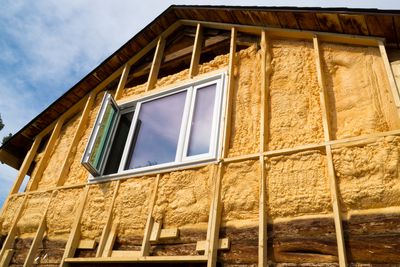
That's a question raised in a new working paper by Meredith Fowlie, Michael Greenstone, and Catherine Wolfram. The economists conducted a large randomized controlled trial of 30,000 homes in Michigan involving the federal Weatherization Assistance Program, which helps low-income families replace their furnaces, upgrade insulation, and seal up leaks along doors and windows. This experimental set-up allowed for a more rigorous evaluation of weatherization efforts.
The researchers found that the upfront cost of efficiency upgrades in the Michigan program came to about $5,000 per house, on average. But their central estimate of the benefits only amounted to about $2,400 per household, on average, over the lifetime of the upgrades.**
The program did help households save energy: after the upgrades, homes used 10 to 20 percent less energy for electricity and heating. But, notably, that was less than half of the savings that had been predicted beforehand.
One possibility is that households compensated for their reduced utility bills by increasing their energy consumption after the upgrades. But the economists didn't find evidence of a "rebound effect" here — they went knocking door to door and found little sign that people were, say, cranking up their thermostats in the winter.
"We were very surprised by the result," says Greenstone, an economist and director of the Energy Policy Institute at the University of Chicago. He notes that it's still not entirely clear why Michigan's weatherization program didn't save nearly as much energy as had been predicted — a fact he calls "unsettling."
Now, to be clear, this study only examined federal weatherization efforts in a single state, and these results don't necessarily apply to all types of residential efficiency efforts. For one, federal weatherization programs can vary from state to state. What happens in Michigan may not apply to New Jersey.
What's more, experts note that low-income weatherization programs aren't always designed to be as cost-effective as possible — in part because they have social goals like clearing out mold or helping poor people survive through the winter (this Michigan study didn't assess those benefits). Indeed, past research from Lawrence Berkeley National Laboratory found that low-income weatherization policies were twice as costly, per unit of electricity saved, as the average utility efficiency program. That suggests the much larger array of utility-run initiatives throughout the country are more likely to be cost-effective.
Still, the results do suggest the need for closer study and field-testing of policies to promote energy efficiency.
Saving energy is great, but how much is really possible?
(John B. Carnett/Popular Science/Getty Images)
Many estimates of the value of energy efficiency come from engineering studies that look at what's possible under ideal conditions. These studies typically suggest that we're wasting a lot of energy in our homes, office buildings, and cars — waste that could be eliminated with existing technology at negative cost. See this big McKinsey report for a great example.
But, Greenstone says, these engineering studies might not always capture the messiness of the real world. It's easy to find ways to cut down on waste in laboratory conditions. But outside the lab, homes might be irregularly shaped, insulation might not always be installed by highly skilled workers, and there are all sorts of human behaviors that might reduce the effectiveness of efficiency investments.
That's why field tests are a valuable check — and randomized controlled trials are considered the gold standard here. This particular RCT, the first of its kind, found that the federal Weatherization Assistance Program only seemed to be saving about 39 percent as much energy in Michigan homes as engineering tests had predicted:
(EPIC)
Greenstone cautioned that this study hardly undermines the rationale for every single efficiency policy out there. After all, this study only looked at weatherization efforts in one state. It's entirely possible there are genuine untapped opportunities to reduce energy use and save money elsewhere — in industrial sectors, in transportation, even in other residential programs. But, he says, "this needs to be verified in the field."
It's an important question for climate policy more generally. Energy efficiency is often considered the great low-hanging fruit — the cheapest and easiest policy to reduce CO2 emissions. Peek under the hood of any grand plan for addressing climate change, and you'll usually find that energy efficiency is playing a central role.
And yet, in this particular study, the economists found that the federal home weatherization program was not a particularly cheap way to reduce CO2 emissions. Although energy use (and hence carbon pollution) from the homes studied did go down, it came at a cost of about $329 per ton of carbon. That's much higher than the $38-per-ton value of the social cost of carbon that the US federal government uses to evaluate the costs and benefits of climate policies.
"This underscores the value of field-testing," says Greenstone. "Particularly in a world where economy-wide carbon pricing does not look feasible, we should be redoubling our efforts to find those CO2 reduction measures that have the biggest bang for the buck."
----
** Note: For those interested, the central estimate of the lifetime benefits for the weatherization program in Michigan was $2,400, assuming a 6 percent discount rate over 16 years. The paper adds: "estimates of the present value of the savings range from approximately $1,450 [10% discount rate over 10 years] to about $3,500 [3% discount rate over 20 years]. These estimates are just 32% to 77% of the upfront cost of the energy efficiency measures."
Further reading:
-- You can read EPIC's summary of the new paper here. And here's a full copy of the paper itself (pdf).
-- On Twitter, energy analyst Chris Nelder takes issue with the study's assumptions about future electricity and natural gas prices in America (see his critique here, here, here, here, here, here). If you believe those prices are going to rise significantly in the future, then efficiency starts to look like a better bet.
-- Back in 2013, I took a look at the launch of E2e, a joint project between economists at MIT and the University of California Berkeley that aimed to take a more rigorous scientific approach to the concept of energy efficiency. This latest study comes out of that project.
The joy of reading RPG books
I came across this fantastic article at The Guardian about RPG books as, well, books (as opposed to game manuals).
“By putting aside simple narrative storytelling and replacing it with detailed description, the RPG offers the total immersion in an imaginary world so valued by geek readers. The elaboration of leading characters, political factions and major historical events is sometimes a very dry exercise in world building, but done with enough skill it can spark a deeply satisfying response”
It’s a short read, but thought-provoking, and will hopefully inspire some people to pick up an RPG book, and just explore the world within its covers.
Il falso fattore dell'equilibrio nella scienza.
Gli organizzatori hanno pensato a me perché "serve qualcuno che sappia bilanciare le sue affermazioni".
Il problema è che per "bilanciare" le affermazioni di quella persona non servirebbe chiamare un esperto o un addetto ai lavori, è un confronto già sbagliato in partenza. Se si parla di medicina si chiama un medico, se si parla di fisica un fisico e così via. Non è normale un dibattito medico tra un profano e chi si occupa di salute.
Ma questo succede e spesso sono proprio i profani (o quelli in malafede) che cercano questi confronti, per loro è una "promozione" da tutti i punti di vista, professionale perché pur non essendo esperti di salute sono paragonati ad essi e commerciale perché si fanno pubblicità.
Ora, in inglese questo lo chiamano "false balance", ovvero mettere sullo stesso piano due fatti, uno scientifico (ma anche di altro tipo, in ogni caso "attendibile") con uno pseudoscientifico (o falso), è un noto "bias" (un errore, una debolezza nel ragionamento).
Un classico: fare affermazioni indimostrabili e vaghe (che chiaramente lo "scienziato" non può smentire, non perché non lo sa fare ma perché non puoi smentire una cosa che non esiste) per poi dire "non ha saputo ribattere" ma a parte questo si considera "accettabile" qualcosa che non lo è, si "promuove" a "ipotesi" qualsiasi sciocchezza, tanto queste non presuppongono l'onere della prova. Non avendovi detto di cosa si sarebbe parlato si capisce poco ma questo serva per un discorso più generale.

Il geologo che spiega come si cercano le fonti di acqua, deve "dibattere" con un rabdomante (colui che dice di scoprire vene acquifere con i suoi poteri paranormali)?
Esistono sedi adatte per l'una e l'altra persona, un contesto scientifico per parlare di scienza ed uno informale o ai fini di intrattenimento per parlare di fenomeni paranormali.
Le descrive, le prova e pubblica le prove in una rivista scientifica nella quale tutti gli scienziati del mondo possano leggerle, controllarle, verificarle e dopo confermarle o meno e così rientrare nelle fila della scienza abbandonando la pseudoscienza.
Basta volerlo.
Questo può farlo un truffatore, non una persona seria e per questo la strada del primo sarà sempre più facile di quella del secondo.
2) Citazione di altri falsi esperti.
3) Selezione di studi non autorevoli, falsi o non attinenti.
4) Interpretazioni personali della realtà.
5) Manipolazioni, illazioni e fallacie.
Si tratta quasi sempre di argomenti senza basi, incommentabili, non smentibili (se dici che "Big Pharma" si arrichisce a spese della salute della popolazione, non stai portando una prova a favore di qualcosa ma un'illazione che non dimostra nulla).
Al contrario uno scienziato o un vero esperto deve limitarsi a dati reali (anche se fossero pochi ma che siano veri), deve usare cautele e condizionali, non deve fare affermazioni stupefacenti, caute, non può interpretare personalmente i risultati della ricerca scientifica e si basa solo su fatti oggettivi, se non lo facesse sarebbe un ciarlatano anche lui.

Ma questo non succede perché non fa spettacolo.
Basti riflettere sul fatto che le ultime cure alternative che hanno creato discussioni pubbliche importanti nel nostro paese (Bonifacio, Di Bella, Stamina) nonostante il parere dei competenti (ed in alcuni casi anche l'esame da parte degli stessi) abbiano smentito le promesse iniziali, i rispettivi "inventori" non abbiano mai accettato la bocciatura, l'abbiano rifiutata con le scuse più classiche, le stesse che hanno usato per promuoversi: il boicotaggio, il complotto, la genialità incompresa. Non hanno aggiunto nulla ai loro argomenti ma hanno usato la smentita come trono sul quale sedersi.
I loro seguaci, naturalmente, hanno accettato ogni giustificazione.
Negli Stati Uniti c'è un forte dibattito sul riscaldamento globale ("global warming"), molto più acceso che nel resto del mondo. È un dato abbastanza provato che la principale causa del riscaldamento globale (aumento delle temperature sulla Terra) sia causato dalle attività umane. C'è però una piccolissima (infinitesimale) porzione di studiosi che lo nega, chiama in causa altri motivi ma non ha mai dimostrato di aver ragione. In molti dibattiti (pubblici, televisivi) si è visto come mettere alla pari due pareri assolutamente sbilanciati, facesse diventare l'ipotesi meno probabile meritevole di attenzione, credibile, nonostante non avesse elementi per essere considerata attendibile, la "teoria più incredibile" non cambia in rapporto alla sua attendibilità ma cambia in rapporto al pubblico, in poche parole "la gente ci crede di più" e proprio perchè qualcuno di attendibile ha provato a smentirla.
La cosa più interessante è che questo tipo di avvenimento può essere usato per condizionare le masse.
Uno dei pericoli del falso equilibrio delle ipotesi è quello che chi ha interesse a sposare una causa per interesse personale (anche poco onesto), potrebbe usare anche un solo "opinionista" o scienziato per farsi ascoltare. Le industrie che inquinano ad esempio potrebbero fare pressioni dicendo che "non è provato che a causare il riscaldamento globale siano le nostre industrie".
...per completezza di informazione, l'organizzatore del festival che mi ha invitato ha detto che in mancanza di un dibattito con qualcuno di competente, sarà annullato l'incontro con lo pseudomedico, mi sembra corretto ed apprezzabile.
Alla prossima.
Le macchie brillanti di Cerere continuano a stupire
 |
| Credit: NASA/JPL-Caltech/UCLA/MPS/DLR/IDA |
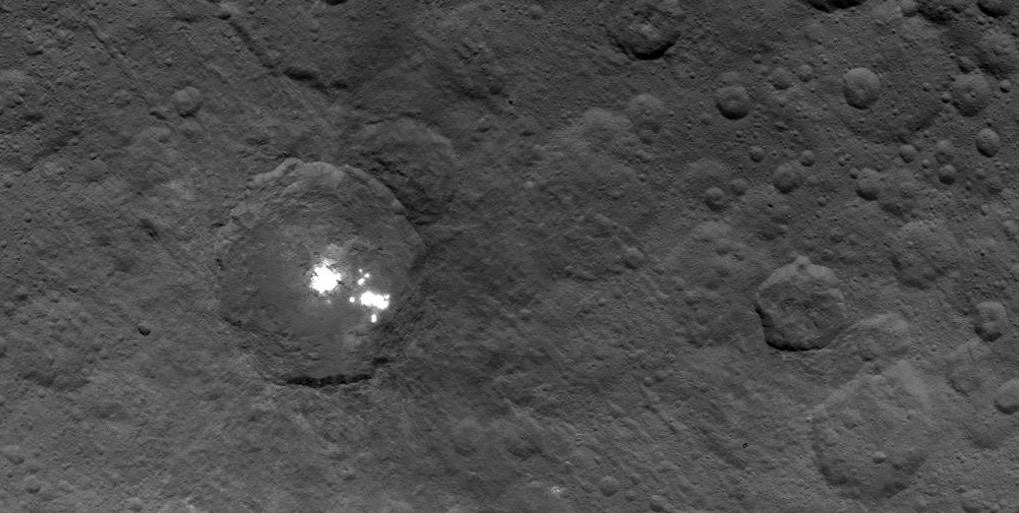
La NASA ha pubblicato una nuova immagine delle macchie straordinariamente brillanti avvistate sulla superficie del pianeta nano Cerere dalla sonda Dawn, che ora si trova a circa 4400 chilometri da questo piccolo mondo. La nuova foto, scattata quattro giorni fa, offre una risoluzione maggiore delle precedenti (questa è a 410 metri per pixel) e permette di vedere che le macchie sono composte da numerosi punti luminosi raggruppati, ma la loro natura resta sconosciuta. L'opinione scientifica prevalente è che si tratti di ghiaccio, anche se non si esclude l'ipotesi che si tratti invece di sale, secondo il comunicato della NASA.
Per dare un'indicazione di scala, il cratere che contiene le zone luminose è largo circa 90 chilometri.
La sonda Dawn osserverà Cerere e i suoi misteriosi bagliori ancora più da vicino a partire dal 28 giugno, quando scenderà progressivamente per arrivare ai primi di agosto a 1450 chilometri di distanza e poi scendere ancora fino a 375 chilometri. Chissà se a quel punto si capirà, magari grazie agli altri strumenti di bordo, cosa c'è di così brillante su questo mondo situato fra Marte e Giove.
È comunque affascinante pensare che siamo in grado di mandare un robot a 326 milioni di chilometri dalla Terra (questa è l'attuale distanza di Cerere secondo Wolfram Alpha), riceverne foto così dettagliate e disseminarle immediatamente in tutto il mondo. E come se non bastasse, possiamo anche combinare queste immagini con i dati altimetrici per ottenere una bellissima animazione tridimensionale dell'intero pianeta nano.
Chi ha buttato nella spazzatura un rarissimo Apple-1 da 200.000 dollari?
 |
| Credit: Wikipedia |
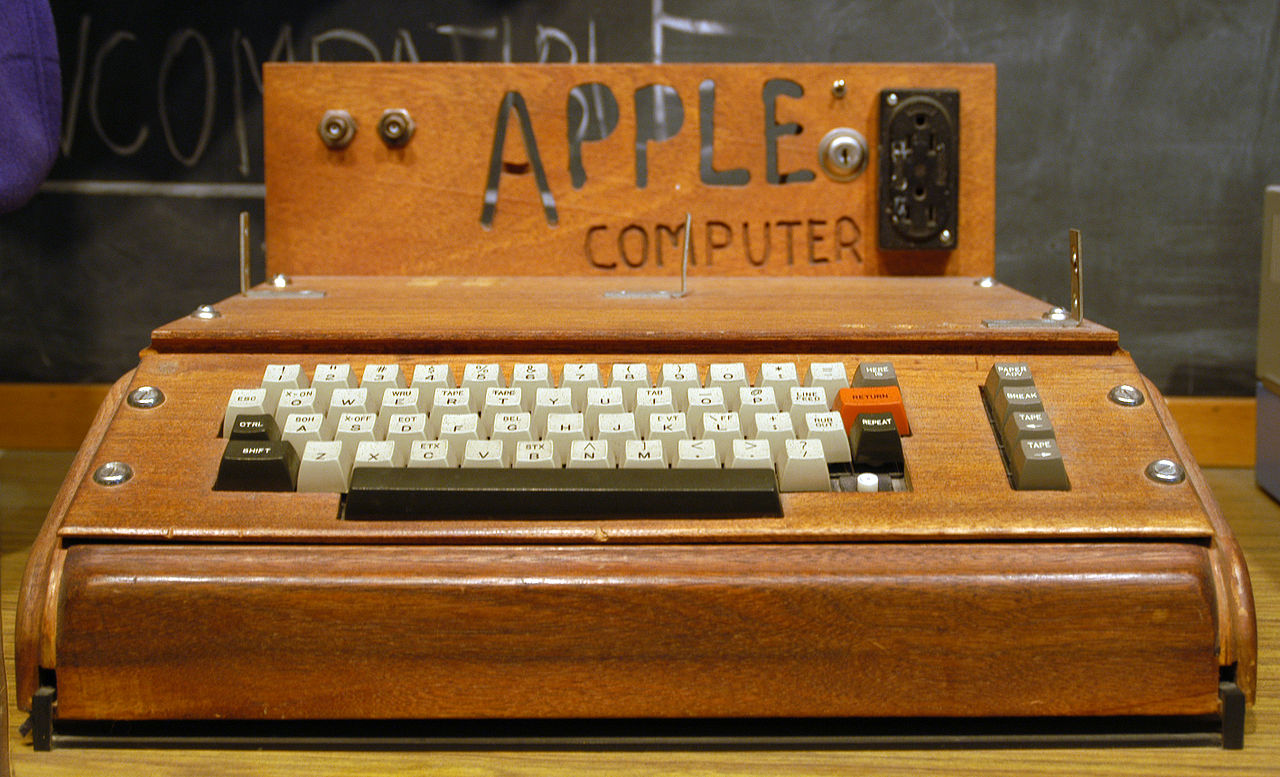
La signora ha portato alla CleanBayArea, la società che gestisce il centro di riciclaggio, una serie di scatole appartenute al marito defunto. In una di queste scatole, sepolto da una matassa di cavi e tastiere, è stato poi rivenuto un Apple-1, il primo computer della Apple, costruito personalmente da Steve Wozniak, cofondatore della Apple con Steve Jobs, in una tiratura limitatissima: 200 pezzi. Per finanziarne la costruzione, Wozniak aveva venduto la propria calcolatrice HP-65 per 500 dollari e Steve Jobs aveva venduto l'unico mezzo di trasporto che aveva, un Microbus della Volkswagen. Il computer era in ottime condizioni.
Per l'epoca, l'Apple-1 era drasticamente innovativo: negli anni Settanta i personal computer venivano venduti come kit da assemblare, mentre l'Apple-1 veniva venduto già montato, anche se spettava comunque agli utenti fornire il contenitore, l'alimentatore, la tastiera e il video. Quest'ultimo, fra l'altro, era semplicemente un televisore standard, per ridurre i costi agli utenti.
La CleanBayArea ha venduto l'Apple-1 per 200.000 dollari a un collezionista e ora cerca la signora per dividere la somma con lei, come è consuetudine della società per tutti gli oggetti portati al centro di riciclaggio e poi rivenduti. Purtroppo, però, la signora non ha lasciato uno scontrino o un indirizzo e gli addetti si ricordano solo il viso e il fatto che aveva un'età apparente fra i 60 e i 70 anni, per cui sono stati fatti annunci tramite i telegiornali nella speranza che la signora venga a sapere dell'inatteso lascito informatico del marito.
La Grecia e l'architettura degli organismi internazionali
Una crisi di liquidità della Grecia potrebbe scoppiare da un momento all'altro: senza un rinnovo dei prestiti non sarà facile pagare pensioni e salari dei dipendenti pubblici. Ma come siamo arrivati a questa situazione? Se si tratta solo di un problema di liquidità non dovrebbe esso essere di facile soluzione attraverso nuovi prestiti? Senza una soluzione il governo greco apparirà sempre meno credibile e il Fondo e gli altri creditori sempre più crudeli agli occhi degli osservatori esterni e anche a quelli di coloro che partecipano alla negoziazione.
A prescindere da come andrà la questione, nei prossimi giorni e soprattutto nei prossimi mesi, una volta risolta (si spera) l'emergenza, bisognerà mettere mano all'architettura istituzionale dei rapporti tra paesi sovrani debitori e organismi internazionali. È chiaro ai più che il sistema non funziona, che ha problemi sostanziali e per giunta sistematici. Alla base vi è una questione di mancanza di chiarezza in questi rapporti. Elaboriamo.
Sono giorni di mercati nervosi. La presunta bolla sull'azionario cinese non aiuta, né lo fa l'incertezza sui cambi. Ma la Grecia contribuisce probabilmente in modo determinante all'altalena dei prezzi sui mercati finanziari. La crisi di liquidità del paese potrebbe scoppiare da un momento all'alto: senza un rinnovo dei prestiti non sarà facile pagare pensioni e salari dei dipendenti pubblici.

[In Depth] Amid panic, a chance to learn about MERS
Jacopo.bertolotti"In contrast to Saudi Arabia's reticence to let foreign scientists in or share data and samples, South Korea has so far provided regular updates and shared the virus with some outside experts."
[In Depth] Designer proteins produce potent HIV defense
Reducing the energy cost of human walking using an unpowered exoskeleton
Reducing the energy cost of human walking using an unpowered exoskeleton
Nature 522, 7555 (2015). doi:10.1038/nature14288
Authors: Steven H. Collins, M. Bruce Wiggin & Gregory S. Sawicki
With efficiencies derived from evolution, growth and learning, humans are very well-tuned for locomotion. Metabolic energy used during walking can be partly replaced by power input from an exoskeleton, but is it possible to reduce metabolic rate without providing an additional energy source?
African academics challenge homophobic laws
African academics challenge homophobic laws
Nature 522, 7555 (2015). http://www.nature.com/doifinder/10.1038/522135a
Author: Linda Nordling
Scientific report demolishes assertions used to back criminalization of homosexuality.
Pressure to publish not to blame for misconduct, says new study
A new study suggests that much of what we think about misconduct — including the idea that it is linked to the unrelenting pressure on scientists to publish high-profile papers — is incorrect. In a new paper out today in PLOS ONE [see update at end of post], Daniele Fanelli, Rodrigo Costas, and Vincent Larivière performed a retrospective analysis of […]
The post Pressure to publish not to blame for misconduct, says new study appeared first on Retraction Watch.
Phase retrieval for multiple objects from their averaged diffraction
The problem of reconstructing multiple objects from the average of their diffracted intensities is investigated. Reconstruction feasibility (uniqueness) depends on the number of objects, their support shapes and dimensionality, and an appropriately calculated constraint ratio. For objects with ... [J. Opt. Soc. Am. A 32, 1317-1329 (2015)]
Direct wavefront sensing for high-resolution in vivo imaging in scattering tissue
Article
Direct wavefront sensing with laser ‘guide stars’ is used in astronomy and microscopy to correct for optical aberrations. Wang et al. use near-infrared guide stars to extend this approach to the highly scattering mouse brain, allowing high-resolution fluorescence imaging at 700μm depth.
Nature Communications doi: 10.1038/ncomms8276
Authors: Kai Wang, Wenzhi Sun, Christopher T. Richie, Brandon K. Harvey, Eric Betzig, Na Ji
Viewpoint: Trapped in a Photonic Maze
Author(s): Diederik Wiersma
Strong confinement of light in crystalline structures known as Lieb lattices opens up routes to developing new light-trapping schemes.
[Physics 8, 55] Published Mon Jun 15, 2015
Observation of a Localized Flat-Band State in a Photonic Lieb Lattice
Author(s): Sebabrata Mukherjee, Alexander Spracklen, Debaditya Choudhury, Nathan Goldman, Patrik Öhberg, Erika Andersson, and Robert R. Thomson
Strong confinement of light in crystalline structures known as Lieb lattices opens up routes to developing new light-trapping schemes.
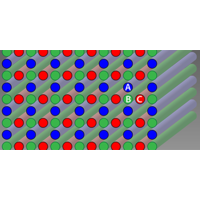
[Phys. Rev. Lett. 114, 245504] Published Mon Jun 15, 2015
Observation of Localized States in Lieb Photonic Lattices
Author(s): Rodrigo A. Vicencio, Camilo Cantillano, Luis Morales-Inostroza, Bastián Real, Cristian Mejía-Cortés, Steffen Weimann, Alexander Szameit, and Mario I. Molina
Strong confinement of light in crystalline structures known as Lieb lattices opens up routes to developing new light-trapping schemes.
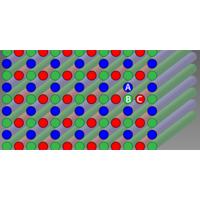
[Phys. Rev. Lett. 114, 245503] Published Mon Jun 15, 2015
Statistical distribution of the Wigner-Smith time-delay matrix moments for chaotic cavities
Author(s): Fabio Deelan Cunden
We derive the joint distribution of the moments TrQκ(κ≥1) of the Wigner-Smith matrix for a chaotic cavity supporting a large number of scattering channels n. This distribution turns out to be asymptotically Gaussian, and we compute explicitly averages and covariances. The results are in a compact fo…
[Phys. Rev. E 91, 060102(R)] Published Mon Jun 08, 2015
Anderson localization of matter waves in quantum-chaos theory
Author(s): E. Fratini and S. Pilati
Anderson localization of atomic gases in three-dimensional optical speckle potentials is studied via energy-level statistics familiar from quantum-chaos theory, and it is shown how the structure of the spatial correlation of the disorder determines the position of the mobility edge.
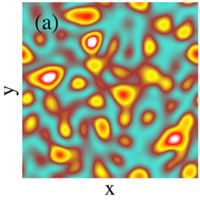
[Phys. Rev. A 91, 061601(R)] Published Tue Jun 09, 2015
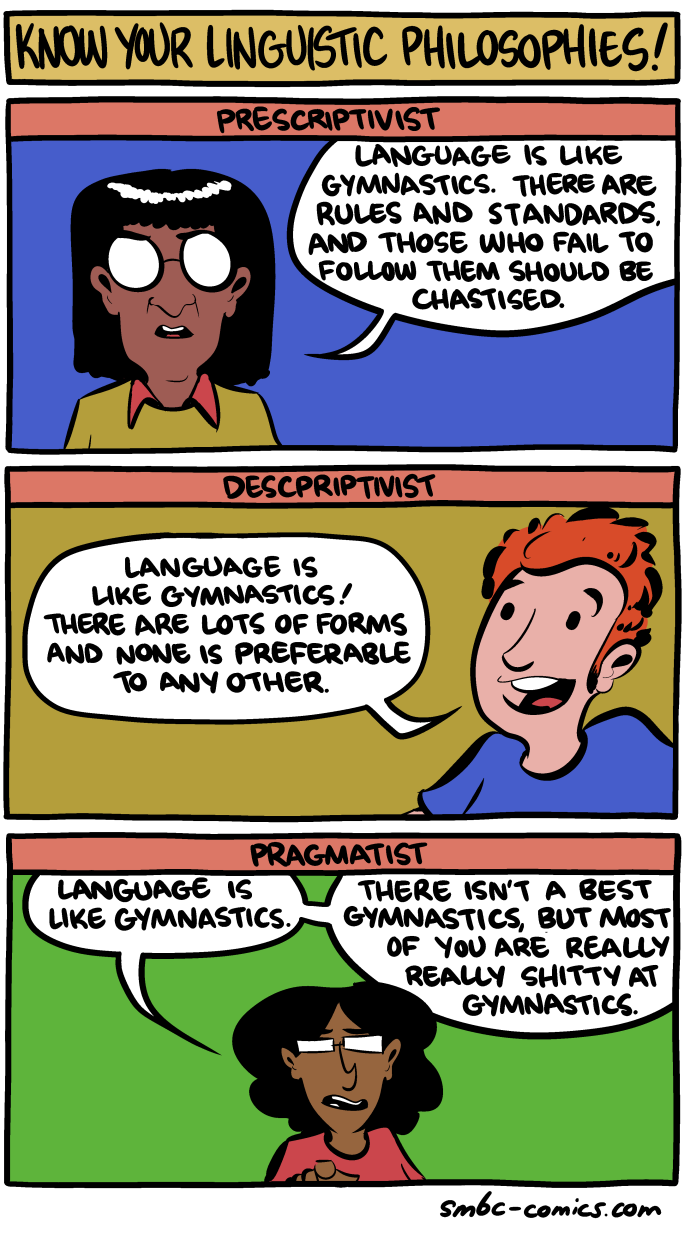
Saturday Morning Breakfast Cereal - Know Your Linguistic Philosophies
“Inelegant Mathematics and Worse Social Science?”
For a while, a long while ago, some people thought they would soon make computers simulate the ways people behave with each other. This paper, published in 1974, suggested that maybe such things would not be simple or easy:
“Computer Simulations: Inelegant Mathematics and Worse Social Science?“, Hayward R. Alker, International Journal of Mathematical Education in Science and Technology, Volume 5, Issue 2, 1974.
“In each case, the non‐analytical nature of the computer model is not due to unusual mathematical ineptitude but derived from evidence contradicting the empirical validity of more elegant formalizations employing, respectively, formal logics and graph theory, differential equation systems, game theory and statistical models. Several analytically challenging problems concerning validity assessment, the nature of deep structure, and the policy‐relevant performance characteristics of complex models are mentioned. Moral, political, philosophical and pedagogical issues derive from the empirically provisional nature of all simulation versions of frequently controversial social theories, the frequent mystification of mathematical/computerized ‘results’, and the uneven practical utility and accessibility of social simulations.”
BONUS (mostly unrelated): An earlier Hayward R. Alker invented a fire alarm that used the telephone, obtaining a patent for it in 1939.
06/05/15 PHD comic: 'The Exercycle'
Jacopo.bertolottiLooks familiar.
| Piled Higher & Deeper by Jorge Cham |
www.phdcomics.com
|
|
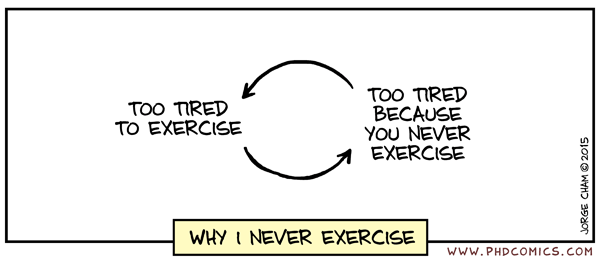 |
||
|
title:
"The Exercycle" - originally published
6/5/2015
For the latest news in PHD Comics, CLICK HERE! |
||
'Final Fantasy Tactics' hits Android
Jacopo.bertolottiGreat game! But seriously? 14$ for a port of a 10 years old game? This is beyond mad.
 Final Fantasy players, lovers and haters, come together and rejoice: Final Fantasy Tactics: The War of the Lions has finally launched on Android. It hit iOS back in 2013, but now the playing field is leveled. This is a port of the 2007 PSP game War o...

[Report] Macroscale superlubricity enabled by graphene nanoscroll formation
Italian scientists vilified in wake of olive-tree deaths
Jacopo.bertolottiBlame it onto the scientists! They are strange and weird people anyway.
Italian scientists vilified in wake of olive-tree deaths
Nature 522, 7554 (2015). http://www.nature.com/doifinder/10.1038/nature.2015.17651
Author: Alison Abbott
Police investigate researchers' role in devastating bacterial epidemic.