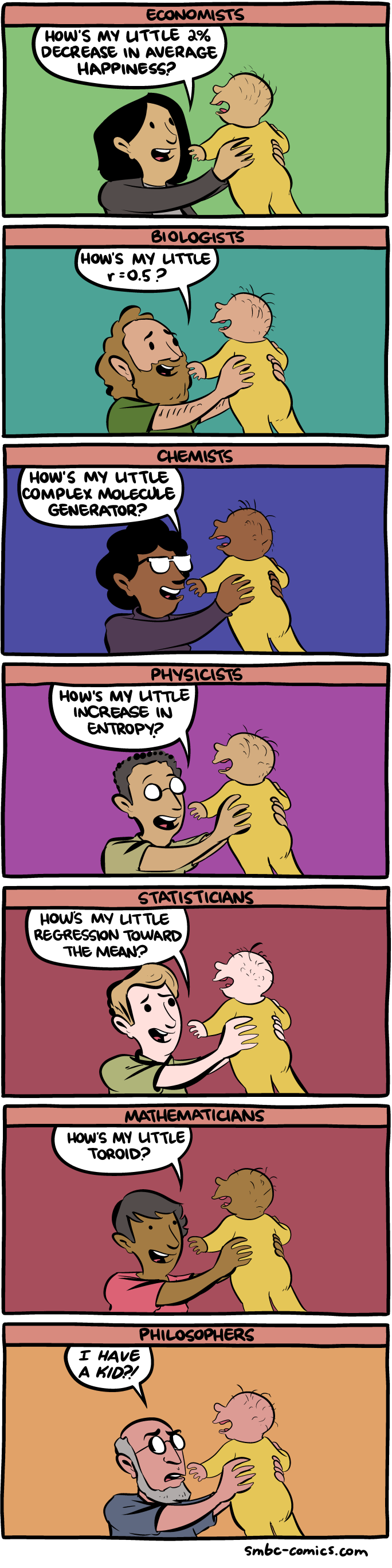
Hovertext: Psychologist: OOH! A significant sample size!
New comic!
Today's News:
Just over a week to get your submissions in for BAHFest. We still need a lot more to make these shows go, so please consider contributing!
Hovertext: Psychologist: OOH! A significant sample size!
Just over a week to get your submissions in for BAHFest. We still need a lot more to make these shows go, so please consider contributing!
Jacopo.bertolottiWhy can't I also work on vampires instead of banging my head on Physics? :-(
This week’s Vampire Study of the Week is:
“Do We Always Practice What We Preach? Real Vampires’ Fears of Coming out of the Coffin to Social Workers and Helping Professionals,” D.J. Williams and Emily E. Prior, Critical Social Work, vol. 16, no. 1, 2015, pp. 79-92. (Thanks to Ivan Oransky for bringing this to our attention.) The authors, at Idaho State University, the College of the Canyons, and the Center for Positive Sexuality, explain:
Nobody knows an exact number, but there are many people worldwide who self-identify as vampires (Atlanta Vampire Alliance, 2007). Despite the use of the word “vampire,” people with such alternative identities do not seem to be psychologically and socially unstable (Browning, in press; Laycock, 2009a, 2009b; Williams, 2008, 2009). Even still, it is not surprising that vampires prefer to keep these alternative identities private (i.e., stay “in the coffin”) due to fears of being misunderstood and discriminated against (Williams, 2008)….
The first author of this study has worked specifically with self-identified vampires for over five years, and both authors have considerable experience working amicably with multiple alternative communities…. Approval to conduct the study was granted through a university institutional review board (IRB). Well-established and personally known contacts, who are vampire leaders in Atlanta, Georgia, were asked to select 11 adult participants through purposive sampling. In an effort to ensure self-identities were chronic and stable, participants were included if they self-identified as vampires for several years.
Here is a photo of lead author D.J. Williams, who has worked specifically with self-identified vampires for over five years:

Here are the studies to which the study alludes:
Browning, J. E. (in press). The real vampires of New Orleans and Buffalo: A research note
towards comparative ethnography. Palgrave Communications.Laycock, J. (2009a). Vampires today: The truth about modern vampirism. Westport, CT:
Praeger.
Laycock, J. (2009b). Modern vampires: Your neighbors and spouses. Religion Dispatches (May
28, 2009). Retrieved on October 29, 2009 from: http://www.religiondispatches.org
Laycock, J. (2010). Real vampires as an identity group: Analyzing the causes and effects of an
introspective survey by the vampire community. Nova Religion, 14, 4-23.Williams, D J (2008). Contemporary vampires and (blood-red) leisure: Should we be afraid of
the dark? Leisure/Loisir, 32, 513-539.
Williams, D J (2009). Deviant leisure: Rethinking “the good, the bad, and the ugly.” Leisure
Sciences, 31, 207-213.
Jacopo.bertolotti"I worked 16 to 17 hours a day"
Sorry, this is NOT a good advice.
Jacopo.bertolottiA bit expensive maybe, but not a stupid idea (yes, I like maps).

Map posters are easy to come by for major cities. But if you want one for a less densely populated area of the world, you might be out of luck. Mapiful can help. Select anywhere in the world, and get a streamlined black and white poster, based on OpenStreetMap data.
After you have your location, pan and zoom to get the exact area you want, and then customize the labeling and choose between four simple themes.
Posters not your thing? Maybe you want map clothing.
Tags: poster
David, Giancarlo,tomorrow at midnight the temporary, read-only license we gave to INSA is going to expire. Since we issued this last license. We have not received any reply from them, on any channel.I would wait and see if anything moves on their side, or do you want to anticipate action (e.g., issue a new license)?Thanks,Daniele
Vitaly ci aveva mandato due exploit gemelli(differente vulnerabilita' ma
stessi target) che aveva accorpato in un unica descrizione... abbiamo
preso uno... prendiamo l'altro?
#1,#2 (two 0days) Adobe Flash Player
versions: 9 and higher
platforms: 32- and 64-bit Windows, 64-bit OS X
price: $45k by three monthly payments
Gli chiederi semplicemente conferma che siano effettivamente due
distinte vulnerabilita' in parti diverse del codice(per evitare che
patchato uno perdiamo pure l'altro).
Senno' c'era anche l'opzione 3 (credo che 32-bit windows vada bene per
browser a 32-bit su architettura x64, da verificare nel caso):
#3 Adobe Flash Player
versions: 11.4 and higher
platforms: 32-bit Windows
payload: calc.exe is launched on Windows
price: $30k by two monthly payments
Ribadisco l’importanza di prendere contatti: ci saranno un sacco di researchers asiatici e non solo con exploit da vendere e *****, te l’assicuro, compra in questo modo la maggior parte degli exploits che poi, debitamente controllati e ripuliti, vengono venduti a 10 volte il prezzo originario.
[...]
I HAVE strong, incontrovertible EVIDENCE that the most famous 0-day vendors (e.g., *****, *****) do NOT create/find/research the vast majority of the numerous exploits they sell.
According to my intelligence information I can tell you that only about ** 30% ** of the exploits in such famous 0-day vendors' commercial catalogs have been internally researched.
That is, an amazing 70%, of the exploits actually commercially proposed by such exploits vendors are BOUGHT from THIRD PARTIES, then worked out, possibly enhanced, polished and eventually sold to their own clients with hefty profit margins.
When at the conference, I urge you to start building up as many commercial relationships with new exploits researchers and minor/still unknown exploit vendors as possible. We need external resources in order to effectively compete, and win, in the 0-day game.
We need a measured approach to metrics
Nature 523, 7559 (2015). http://www.nature.com/doifinder/10.1038/523129a
Author: James Wilsdon
Quantitative indicators of research output can inform decisions but must be supported by robust analysis, argues James Wilsdon.
Match that PhD
Nature 523, 7559 (2015). doi:10.1038/nj7558-247a
Authors: Deborah J. Marsh, Kirsty Foster & Carolyn D. Scott
Lab leaders discuss how to find the perfect graduate student for a research group.
Author(s): Héctor Matías López, Jérémie Gachelin, Carine Douarche, Harold Auradou, and Eric Clément
Self-propelling bacteria can reduce the viscosity of a fluid to zero through a collective organization of their swimming.

[Phys. Rev. Lett. 115, 028301] Published Tue Jul 07, 2015

Data la richiesta europea di svalutazione di π…
(Douglas Hofstadter, Metamagical Themas, da un'idea di Harold Cooper e Scott Kim)
Jacopo.bertolottiActually in Physics, journals are very happy to publish papers that contradict previous papers (hoping for a big discussion to open on their page and attract a lot of paying readers)
In a paper that might be filed under “careful what you wish for,” a group of psychology researchers is warning that the push to replicate more research — the focus of a lot of attention recently — won’t do enough to improve the scientific literature. And in fact, it could actually worsen some problems — […]
The post “The Replication Paradox:” Sans other fixes, replication may cause more harm than good, says new paper appeared first on Retraction Watch.

Hovertext: Your TRUE soulmate wants to watch you burn out your life in front of Netflix, eating cheesecake with a spoon.

The past year has produced evidence on some of the most successful anti-poverty programs in history. “Cash, livestock, and training” seems to be a simple and scalable way to help thousands and maybe millions out of poverty. This is great news. But while we should celebrate, we should pause before pouring millions into these programs. Paternalism and high price tags could mean that the charities are helping only one person when they could be helping two, three or four.
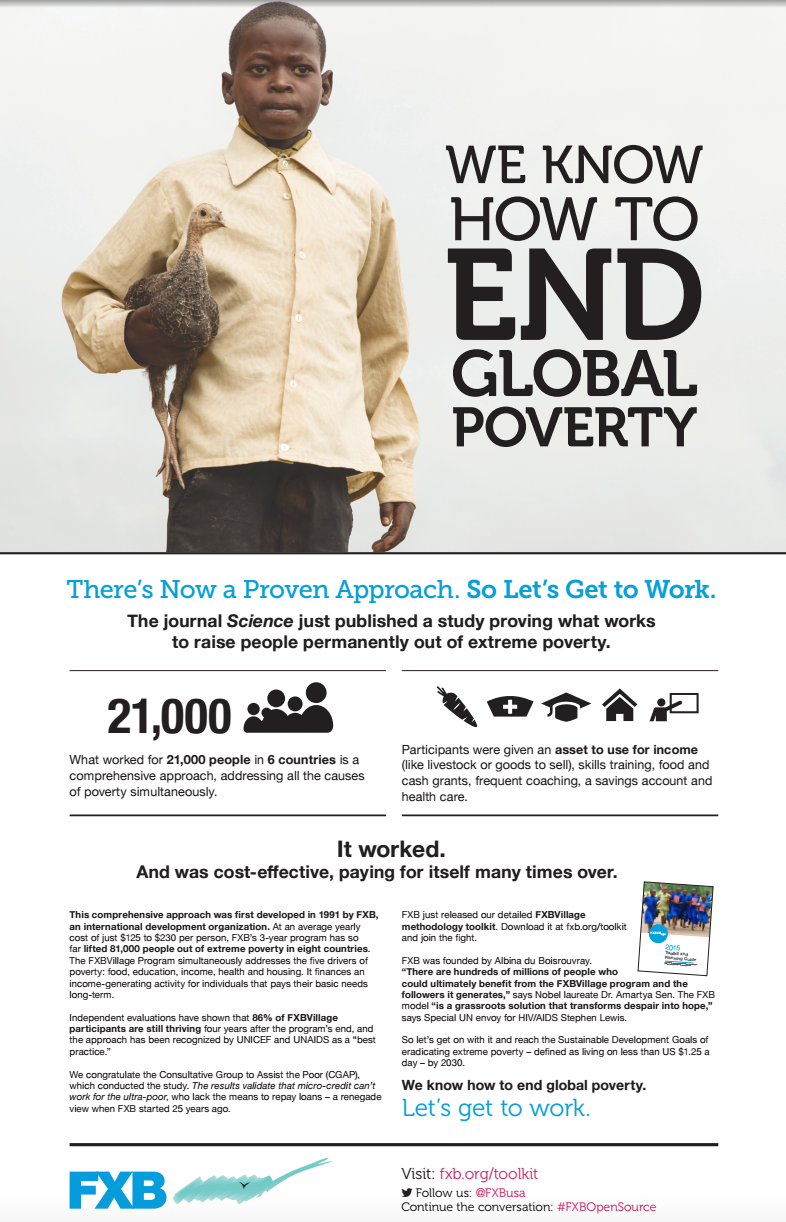
About two weeks ago, I opened the New York Times to see a full-page ad from a private charity called FXB (at left, click to expand).
“We know how to end global poverty” read the ad:
There’s now a proven approach. The journal Science just published a study proving what works to raise people permanently out of extreme poverty. It worked. And was cost-effective, paying for itself many times over.
The ad was talking about a program that gave extremely poor people livestock, training, a cash stipend for a few months, plus some supervision and advising. Nine scholars tested the program in six different countries, with thousands of people and several charities. (The charity with the Times ad was conspicuously not among them.)
The program did work. After two years, the households who received it were consuming an extra $120 per year — consumption being the most reliable measure of poor people’s income. Three years later, these same households were consuming an extra $80 per year. Since a dollar goes farther in poor countries, this is like getting $250 more purchasing power a year. When each person in your home is earning just a dollar a day, these gains are a big deal.
Given how many aid projects don’t pass a simple cost-benefit test, this “livestock-plus” approach is clearly a huge success. As a result, it’s getting scaled up in countries around the world. Bravo to the charities that did a rigorous evaluation, especially for opening their accounting books to inspection.
Cash-plus programs are showing promise, too. I studied one, in post-war northern Uganda, that gave some of the poorest women in the world $150 cash grants plus some business training and regular supervision and advice. It too paid for itself many times over. After two years, households who got the program were consuming an extra $202 per year (about $500 in local purchasing power).
As big a victory this might be (and it is), we shouldn’t pat ourselves on our backs just yet. The benefits are largely projections, while the large costs are not. Before we scale these programs to millions, we have more work to do.
First, consider the price tag. The cheapest livestock-plus program, in India, cost $413 per household. But the most expensive, in Peru, cost more than $3,000. The average cost of the six was $1,700. The cash-plus program in Uganda I studied was cheaper, but not by much. It cost $843. (Note: all the figures I use are adjusted to the same unit, 2014 U.S. dollars).
These are big sums. Fortunately, the estimated benefits to these programs are also big: about $2,000 for the average livestock-plus program, and more than $4,000 for the Uganda cash-plus one.
But these benefits are mainly based on estimates about what will happen in the future. None of the evaluations had more than three years of data. My cash-plus study had the shortest horizon — we measured impacts just 18 months after the grants.
To believe that the benefits of the cash-plus program exceed costs, you would need to believe that the increases in consumption will go on for at least two years past the final surveys. The same goes for the livestock-plus program in India.
Personally I think it’s likely that benefits go on at least a couple of years. But the other livestock-plus programs were much more expensive, and so the break-even point far further in the future. More than 85 percent of the benefits estimated by these papers (including mine) are in the future.
Indeed, on average, the livestock-plus programs take 18 years or more to break even. If the benefits of getting a goat and training tend to disappear after a decade, then the program doesn’t pass a simple cost-benefit test.
So while it’s reasonable to say these programs pay back more than they cost (indeed, this is some of the best quality evidence on poverty in the world) we shouldn’t forget this success is an extrapolation. In terms of cost-effectiveness, these cash and livestock programs are promising but not proven.
Fortunately, I think there’s a way for these programs to break even faster. The biggest expense across all the programs was staff time. Especially for supervision. Delivering training and cows takes skilled labor, and it’s hard to cut this back. But supervision? Charities feel a lot better when they can personally help their clients along. It’s not just paternalism, but also compassion. The staff care about these men and women and do not want them to fail. So they devote almost unlimited time to helping them. At, unfortunately, great cost.
Undoubtedly that investment of time helps the client. But should it cost 50 or 60 percent of the program? Is it more valuable than the cow or the grant itself? It’s hard to believe.
We tried to test this with cash-plus program in Uganda. Supervising the women cost about $377, about half the cost of the program and 2.5 times as much as the grant itself. After the 18-month impact evaluation, the charity brought the control group into the program. This time, however, the charity randomized the supervision: Some women got the training and grants with full supervision, some with only one or two visits, and some with none at all.
We surveyed the women a month and then a year later, and found that the supervision helped the women maintain the new businesses they started, but there was virtually no effect on consumption. We have no idea whether the supervision helps another year down the road. Maybe, eventually, it pays for itself. But the simple fact is this: taking away the most expensive part of the program had little effect on benefits after a whole year.
Indeed, if we cut staff time, and just gave training and cash to the very poorest, the Uganda cash-plus program could cost $300 a person or less. The low cost livestock-plus program in India is proof it can be done. Even if the benefits dropped by half, this program would still pay for itself in one or two years. It would get far more cost-effective.
Most important, three people could be helped instead of one.
That is the message I want you to walk away with: So long as aid is scarce, compassion and paternalism could mean helping only a million people out of poverty instead of three million. As the givers of all that aid money, I think we have a responsibility to do better.
Last week, the head of one of the world’s largest refugee and crisis response organizations, the International Rescue Committee, called on humanitarian organizations to make their crisis response twice as effective by cutting costs. Every charitable leader ought to publicly echo this call, yet almost none do.
To anti-poverty organizations around the world: Take the risk of putting your entire philosophy to the test. Put supervision and staff time under the microscope. Explore whether you should be in a different business: the business of handing out cash and low-cost services to millions of poor people instead of staff-intensive services to a few cherished thousands. The answer is not clear. But the lives of millions depend on it.

 Get set for a live-action version of Transformers, as the company behind giant Japanese robot Kuratas has accepted a duel challenge from upstart US challenger MegaBot. However, it'll only fight on one condition: Combat must be hand-to-hand with no gu...
Grecia, lunghe code ai seggi. Li hanno scambiati per bancomat.
Tsipras: “Oggi la democrazia batte la paura”. E in finale se la vedrà contro la fame.
La lettera firmata da Tsipras è arrivata a Bruxelles a tarda notte. Poi il postino è morto.
Angela Merkel: “Nessun negoziato prima del referendum”. Le piace di più quando dicono di no.
(Il salvataggio della Grecia costerebbe 3 euro a ogni cittadino. Comunque meno di quello di Alitalia)
Vendola, Grillo e Fassina in piazza ad Atene. Adesso siamo noi in debito.

Tsipras ha votato di mattina presto. Non voleva perdere l’aereo.
Varoufakis: “I creditori sono come i terroristi”. Li abbiamo armati noi.
Le teorie economiche di Varoufakis si rifanno alla teoria dei giochi. Questa è la fase “Insert coin”.
I comunisti greci invitano a votare scheda nulla. Anche da loro hanno un programma spumeggiante.
(Un eventuale “sì” implicherebbe sacrifici insostenibili e anni di sottomissione. Praticamente come un matrimonio)
Un ateniese si è lamentato del fatto che i turisti abbiano più diritti di lui. Poi è stato prontamente arrestato.
Monti: “Tsipras ha dilapidato un patrimonio di simpatia”. Meno male che c’ha i soldi.
Povia dedica una canzone alla Grecia. Va ricordato che ne dedicò una pure a Eluana.
Libero, Belpietro titola: “La Sicilia è la nostra Grecia”. E tua madre la nostra Ilio.
Renzi: “Da domani tutti intorno a un tavolo”. Nei momenti difficili tocca evocare Andreotti.

Roma, militare violenta una quindicenne. Al grido di “Prima gli italiani!”
Il colpevole sarebbe un sottufficiale di Marina. Allora è vero che i criminali arrivano via mare.
Il militare accusato dello stupro stava per partire per una missione. Non ce l’ha proprio fatta ad aspettare.
Lo stupratore di Roma è arrivato in bici. È così che Renzi in privato parla di Marino.
Sui social network molti puntano l’indice sulle responsabilità della ragazzina. “Anche lei, però, poteva evitare di andare in giro con la figa”.
(Anche Gesù girava mezzo nudo. Quindi se l’è cercata)
Interrogato il marinaio accusato di stupro. Ma lui fa l’indiano.
La ragazza ha riconosciuto i pantaloncini dell’aggressore. Oh, in qualunque situazione non possono fare a meno di notare come ti vesti.
L’accusato si difende: “La ragazza era consenziente”. È scappato perché ha paura delle relazioni stabili.
Salvini non fa sconti allo stupratore: “Ora la deve sposare”.
* * *Hammamet, blitz armato in un resort. “Come troppo tardi?”
Attacco dell’Isis in una spiaggia piena di turisti. “Scusateci ma noi qui dobbiamo lavorare”.
I terroristi hanno aperto il fuoco contro gli ospiti di un villaggio vacanze. Si erano ribellati al dirottamento del trenino.
Decine di corpi riversi in spiaggia. La stagione sta andando alla grande.
(La Tunisia era nella lista delle mete sconsigliate. Ma i terroristi fanno sempre di testa loro)
Gli attentatori sono arrivati sulla spiaggia con un kalashnikov nell’ombrellone. “Ci serve per fare il buco”.
Un video del 2010 mostra uno dei terroristi ballare la breakdance. Io prenderei la palla al balzo per chiudere Amici.
(L’attentatore ucciso aveva fatto l’animatore turistico. Quindi le 72 vergini le aveva già avute in vita)
Operatori di Sky sulla spiaggia dell’attentato con gli slip. Sono i loro programmi in chiaro.
Alfano: “Non bisogna speculare sulla paura”. Ok, ma tu non ti girare di colpo.

Charleston, nove morti durante la lettura della Bibbia. Era la giornata “Incontri con l’autore”.
Un uomo è entrato in una chiesa e ha ucciso nove afroamericani. Che sedevano nei posti riservati ai bianchi.
L’omicida ha preso parte alla funzione religiosa prima di alzarsi e aprire il fuoco. Come nel tipico matrimonio pugliese.
La polizia fa sapere che il ricercato “è un giovane senza barba”. Il che restringe il campo a una decina di persone.
L’assassino ha risparmiato una donna dicendole “Lo racconterai a tutti”. Era Selvaggia Lucarelli.
Tra i sopravvissuti un bambino che si è finto morto. Aveva letto sul Vangelo come fare.
Dylann Roof era stato arrestato a marzo per droga e ad aprile il padre gli aveva regalato una pistola. Questa strage era per la macchina nuova.
Un cugino del killer: “È cambiato dopo che un nero gli ha rubato la ragazza”. Prima odiava solo i froci.
La lobby delle armi propone fucili in tutte le chiese. E poi vediamo chi si distrae durante la predica.
Jeb Bush cancella gli impegni nella città della strage. Festeggerà in un luogo segreto.

Torna L’Unità. Ma non trova più nessuno.
(La nuova Unità ha una veste grafica così accattivante che potrebbe anche fallire prima della Grecia)
L’Unità esordisce con una lettera di Renzi in prima pagina. È l’editoriale del nuovo direttore.
Maturità, tra i temi una traccia sul Mediterraneo. “Il candidato esponga il piano B”.
Agli studenti dello scientifico è stato chiesto di analizzare il piano tariffario di un operatore telefonico. Vale anche come stage.
Molti studenti hanno scelto il tema sulla resistenza. Specie negli istituti tecnici.
Il 15% dei maturandi ha copiato le soluzioni da internet. Segno che il Movimento 5 Stelle è in calo.
Inventato il preservativo che cambia colore se rileva malattie. “Forza amore, fammi vedere come va la gola”.
Aereo F-35 decolla con successo da un trampolino. E anche l’ingresso in acqua è stato perfetto.
Arisa posta un selfie seduta sul water. “In studio per il nuovo album”.
* * *Autori: batduccio, cricon, luce so fusa, renudo, sirboneddu, il mago di floz, ordinary madness, akiten, pirata21, novevonbismarck, a.mazed, sisivabbe, notturnoconcertante, venividiwc, sangancillo, edo, lughino, dan11, acid rain, ‘lfoda, luca’s jokes, stark, donna felicità, milingopapa, lucagian, sofino, zip e giga.
Illustrazioni: feel-ice, here to avenge laika, mestmuttèe, abkualcosa.
Nature Photonics 9, 436 (2015). doi:10.1038/nphoton.2015.106
Authors: S. A. R. Horsley, M. Artoni & G. C. La Rocca
When a planar dielectric medium has a permittivity profile that is an analytic function in the upper or lower half of the complex position plane x = x′ + ix″ then the real and imaginary parts of its permittivity are related by the spatial Kramers–Kronig relations. We find that such a medium will not reflect radiation incident from one side, whatever the angle of incidence. Using the spatial Kramers–Kronig relations, one can derive a real part of a permittivity profile from some given imaginary part (or vice versa) such that the reflection is guaranteed to be zero. This result is valid for both scalar and vector wave theories and may have relevance for designing materials that efficiently absorb radiation or for the creation of a new type of anti-reflection surface.
Nature Physics 11, 554 (2015). doi:10.1038/nphys3339
Authors: G. Semeghini, M. Landini, P. Castilho, S. Roy, G. Spagnolli, A. Trenkwalder, M. Fattori, M. Inguscio & G. Modugno
Jacopo.bertolottiAn instructive story to read.
Nature Physics 11, 518 (2015). doi:10.1038/nphys3317
Author: Milena Wazeck
The history of the fierce opposition met by Einstein's theory of relativity in the 1920s teaches us that public controversies about science are not necessarily settled by sound scientific reasoning.
Nature Physics 11, 524 (2015). doi:10.1038/nphys3381
Author: Frank Verstraete
Quantum many-body systems are often so complex as to be intractable. An algorithm that finds the ground state of any one-dimensional quantum system has now been devised, proving that the many-body problem is tractable for quantum spin chains.
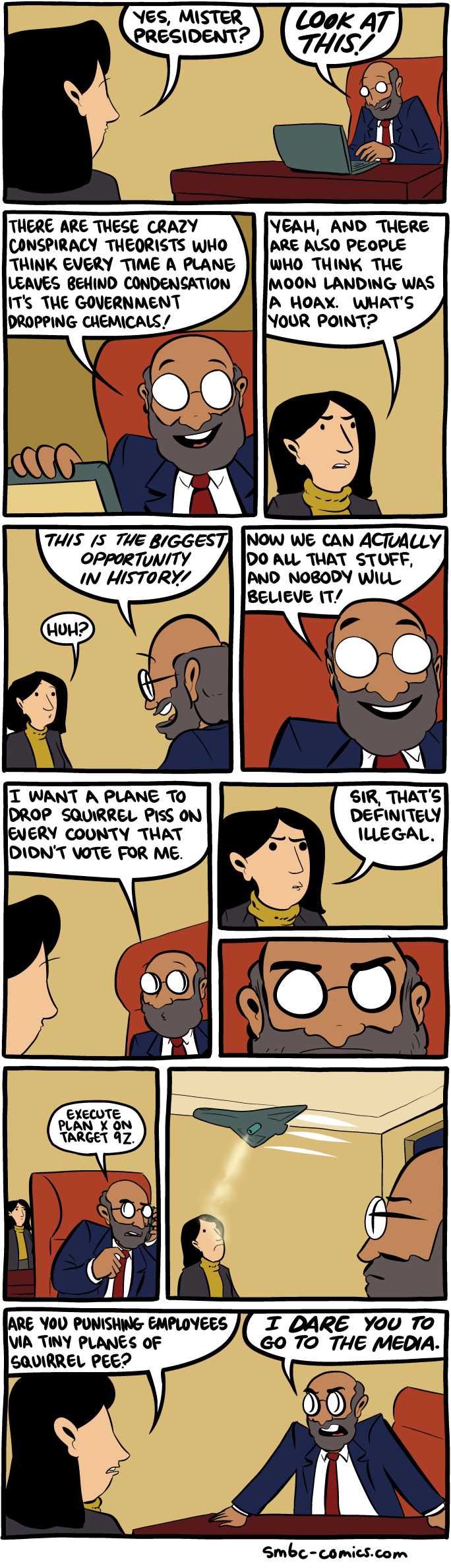
Hovertext: Absence of evidence is not evidence of absence.
Only two weeks left to place your proposal to speak at a BAHFest. We're doing shows in Boston, Seattle, and San Francisco this year!
Oh, and about that Seattle show...


Uno dei luoghi più comuni nella letteratura di base contro gli immigrati - le telefonate alle radio, i titoli di Libero, gli sfoghi sui social - è quel misto di stupore e di sdegno perché moltissimi tra quanti arrivano con i barconi sono muniti di telefono mobile, a volte anche di buona qualità.
La cosa è interessante perché tradisce la convinzione che il cellulare sia un oggetto se non da ricchi, quanto meno non da affamati, non da disperati; o forse addirittura un bene superfluo, uno status proprio di chi sta nella mid-class o ancor più su, come da noi negli anni Novanta.
Capisco la dispercezione, ma è appunto sbagliata.
Ogni giorno nel porto di Lomé, così come in altri centri commerciali africani, arrivano decine di migliaia di cellulari. Sono quasi tutti di produzione cinese o, in alternativa, scarti dell'Europa, vale a dire quei telefonini che noi abbiamo buttato via: molti dei quali non funzionanti, ma utili a metterne insieme uno che invece va benissimo se smontato e rimontato con i pezzi di altri.
Questo gigantesco import avviene perché in Africa (ma un po' in tutte le economie fortemente rurali e arretrate, comprese alcune asiatiche) la domanda di telefonini è enorme e dovuta all'uso decisamente diverso che se ne fa, rispetto a noi europei o americani.
Qualche tempo fa l'Economist dedicò al tema un piccolo approfondimento, avvalendosi di una ricerca fatta sul Kenya. In generale, in quei tipi di economia il cellulare è fondamentale non per chattare su Facebook o giocare a Ruzzle, ma per molte delle attività che garantiscono la sopravvivenza, in contesti dove tra l'altro la telefonia fissa è molto scarsa.
Con un cellulare, ad esempio, posso sapere dalla mia rete sociale (la vastissima "nuvola" parentale-amicale propria di quei Paesi) dove c'è erba per pascolare le capre e dove no; dove andare a recuperare l'acqua se il rigagnolo abituale si è estinto per siccità; da chi farmi prestare un mulo o un dromedario se non ce l'ho e devo fare un trasporto di legna perché la pioggia mi ha tirato giù mezza casa.
E così via: attività appunto di sopravvivenza. Così come di sopravvivenza è l'uso del cellulare per il trasferimento di denaro, uno dei punti più sottolineati dall'Economist, e sappiamo che l'arrivo o meno di soldi dai parenti emigrati è spesso decisivo per campare la famiglia intera. La stessa ricerca citata dal settimanale inglese rivela come il mantenimento del credito del telefonino sia diventato talmente importante da indurre molti a rinunciare perfino a mangiare con regolarità o ad altri consumi molto basic.
Non è uno scoop, è una cosa che chiunque abbia frequentato un po' i peggiori villaggi africani o asiatici ha visto con i suoi occhi: donne e uomini vestiti letteralmente di stracci, che dormono nella merda di capra, ma muniti di cellulare. E se la prima volta la cosa può straniare un po', basta fare tre domande per capire che non si tratta di una scelta eccentrica o consumista, ma molto pragmatica ed essenziale. Specie in villaggi dispersi in immense aree e collegati tra loro solo da sentieri da fare a piedi.
Quanto ai costi dell'hardware, anche qui si tratta solo di sapere alcune cose fondamentali, prima di indignarsi.
I cellulari in mano agli africani sono, di solito, cinesi o occidentali-rigenerati, ma ormai ci sono anche produzioni locali. Non si va certo a comprarli nei negozi in città (quelli con le vetrine), ma sulle bancarelle o attraverso le varie forme di commercio informale (il cugino dell'amico dello zio della vicina). In questo modo, si riescono a trovare device perfettamente funzionanti e a volte di marca tra i 15 e i 30 dollari. Calcolando uno guadagno medio della classe più bassa attorno ai due o tre dollari al giorno, si capisce che, con qualche sacrificio, nel giro di tre o quattro mesi quasi chiunque è in grado di acquistarne uno. Inoltre, ultimamente molte aziende che producono telefonini hanno lanciato modelli low cost (compresi alcuni smartphone) e Microsoft, ad esempio, su quei mercati propone un Nokia 215 a 29 dollari.
Ecco, quando vediamo un migrante sul barcone con il cellulare in mano, forse dovremmo sapere tutto questo. E magari anche che attraversare il deserto del Sudan e della Libia senza telefonino equivale a votarsi al suicidio sicuro: quindi se è uno strumento indispensabile per la vita quotidiana nei villaggi di fame, lo è ancora di più se da quei villaggi di fame si prova a uscire per tentare una vita altrove.
Jacopo.bertolottiEverybody deserve a defendant before judgement is passed.
Judge by actions, not words
Nature 522, 7557 (2015). http://www.nature.com/doifinder/10.1038/522393a
Author: Alessia Errico
Sexist comments made by my former boss Tim Hunt are not an indication that he is biased against women, argues Alessia Errico.
Article
Fluorescence from nanoparticles enables high-resolution optical imaging, but this approach is limited to those structures that emit light. Here, the authors demonstrate a microscope that uses a cavity to enhance the measurement of the alternative optical properties of absorption and dispersion.
Nature Communications doi: 10.1038/ncomms8249
Authors: Matthias Mader, Jakob Reichel, Theodor W. Hänsch, David Hunger
Jacopo.bertolottiThe more I look at this paper the more I hope it is a joke.
Jacopo.bertolottiSimple solutions are always the best!
Mass inoculation programs for school children sometimes encounter problems – with considerable numbers of children fainting. Fortunately, in 1973, a very straightforward remedial strategy was discovered by Alan Hedberg and Audrey Schlong. It was described in the journal Nursing Research.