Shared posts

21 Apr 15:00

People’s preferences for complex explanations (new study)

by Martin Gardiner

Those who are keen on the principle of Occam’s Razor [“Pluralitas non est ponenda sine necessitate” or “Plurality is not to be posited without necessity” or “Keep it simple”] may be surprised, perhaps even dismayed, by a new research project which hints at its unpopularity.

“[…] we find that people have a preference for complex explanations […]”

– explain Jeffrey C. Zemla, Steven Sloman, Christos Bechlivanidis and David A. Lagnado in a new report for Psychonomic Bulletin & Review (March 2017) entitled : ‘Evaluating everyday explanations’.

The team’s experimental research, using a corpus of diverse explanations from Reddit’s “Explain Like I’m Five” (and other online sources) revealed unexpected findings :
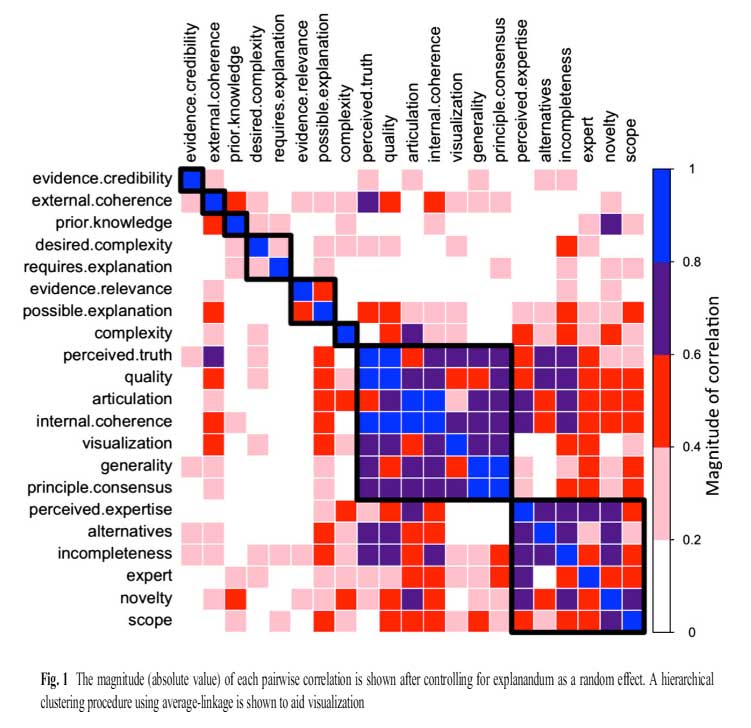
“A guiding principle in explanatory reasoning is that of Occam’s Razor: All things being equal, the simplest hypothesis should be preferred. Thus, we initially predicted a negative correlation between subjective complexity and explanation quality. Surprisingly, we observed a positive correlation, with explanations that were rated as more complex also rated as better explanations (R = .49, p =.03)”

Following on from this, the team have a proposal :

“We propose that this preference for complexity is driven by a desire to identify enough causes to make the effect seem inevitable.”
21 Apr 11:13

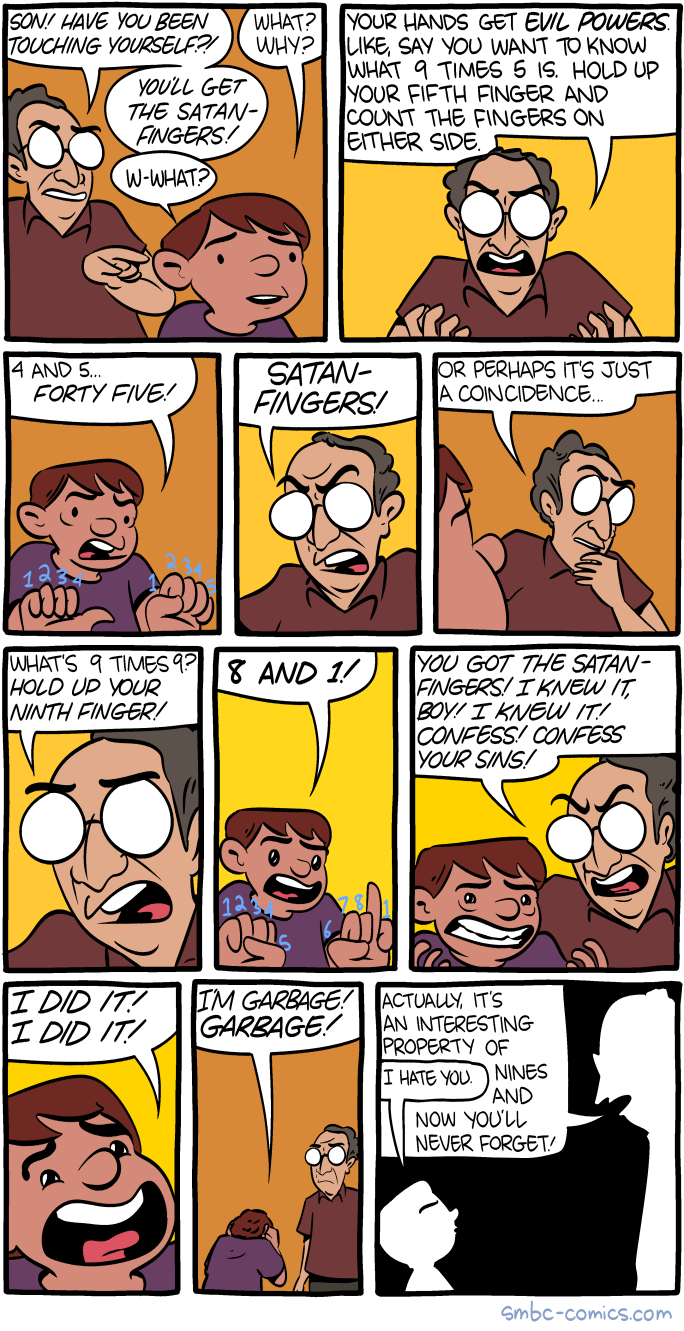
Saturday Morning Breakfast Cereal - Satan-Fingers

by tech@thehiveworks.com


Click here to go see the bonus panel!

Hovertext:
Discovered in the delightful though occasionally frustrating Moscow Puzzles

New comic!
Today's News:

We're running out of most tickets for BAHFest MIT, so we've moved over some of the more expensive ones to lower levels. Buy soon or feel shame!

20 Apr 10:54

Nonlinear dynamics and chaos in an optomechanical beam

by Daniel Navarro-Urrios

Nonlinear dynamics and chaos in an optomechanical beam

Nature Communications, Published online: 11 April 2017; doi:10.1038/ncomms14965

In optomechanics, optical nonlinearities are usually regarded as detrimental and efforts are made to minimize their effects. Here, the authors study the complex dynamics, including chaos, arising from the coupling of such optical nonlinearities with the mechanical modes of a silicon nanobeam cavity.

20 Apr 10:46

Coherent forward scattering as a signature of Anderson metal-insulator transitions

by Sanjib Ghosh, Christian Miniatura, Nicolas Cherroret, and Dominique Delande

Author(s): Sanjib Ghosh, Christian Miniatura, Nicolas Cherroret, and Dominique Delande

We show that the coherent forward scattering (CFS) interference peak amplitude sharply jumps from zero to a finite value upon crossing a metal-insulator transition. Extensive numerical simulations reveal that the CFS peak contrast obeys the one-parameter scaling hypothesis and gives access to the cr...


[Phys. Rev. A 95, 041602(R)] Published Fri Apr 14, 2017

20 Apr 10:44

Focus: Making Rogue Waves with Wind and Water

by Michael Schirber

Author(s): Michael Schirber

Wind-generated waves in a ring-shaped water tank can spontaneously grow into single behemoth waves, mimicking a poorly understood ocean phenomenon.  


[Physics 10, 37] Published Fri Apr 07, 2017

20 Apr 10:43

Viewpoint: Photonic Hat Trick

by Robert Sewell

Author(s): Robert Sewell

Two independent groups have provided the first experimental demonstration of genuine three-photon interference.


[Physics 10, 38] Published Mon Apr 10, 2017

19 Apr 09:21

Commercialisation of universities

by Ross H. McKenzie
I find the following book synopsis rather disturbing.
Is everything in a university for sale if the price is right? In this book, the author cautions that the answer is all too often "yes." Taking the first comprehensive look at the growing commercialization of our academic institutions, the author probes the efforts on campus to profit financially not only from athletics but increasingly, from education and research as well. He shows how such ventures are undermining core academic values and what universities can do to limit the damage. 
Commercialization has many causes, but it could never have grown to its present state had it not been for the recent, rapid growth of money-making opportunities in a more technologically complex, knowledge-based economy. A brave new world has now emerged in which university presidents, enterprising professors, and even administrative staff can all find seductive opportunities to turn specialized knowledge into profit. 
The author argues that universities, faced with these temptations, are jeopardizing their fundamental mission in their eagerness to make money by agreeing to more and more compromises with basic academic values. He discusses the dangers posed by increased secrecy in corporate-funded research, for-profit Internet companies funded by venture capitalists, industry-subsidized educational programs for physicians, conflicts of interest in research on human subjects, and other questionable activities. 
While entrepreneurial universities may occasionally succeed in the short term, reasons the author, only those institutions that vigorously uphold academic values, even at the cost of a few lucrative ventures, will win public trust and retain the respect of faculty and students. Candid, evenhanded, and eminently readable, Universities in the Marketplace will be widely debated by all those concerned with the future of higher education in America and beyond.
What is most disturbing is that the author of Universities in the Marketplace: The Commercialization of Higher Education is Derek Bok, former President of Harvard, the richest university in the world!

There is a helpful summary and review of the book here. A longer review compares and contrasts the book to several others addressing similar issues.

How concerned should we be about these issues?
19 Apr 08:56

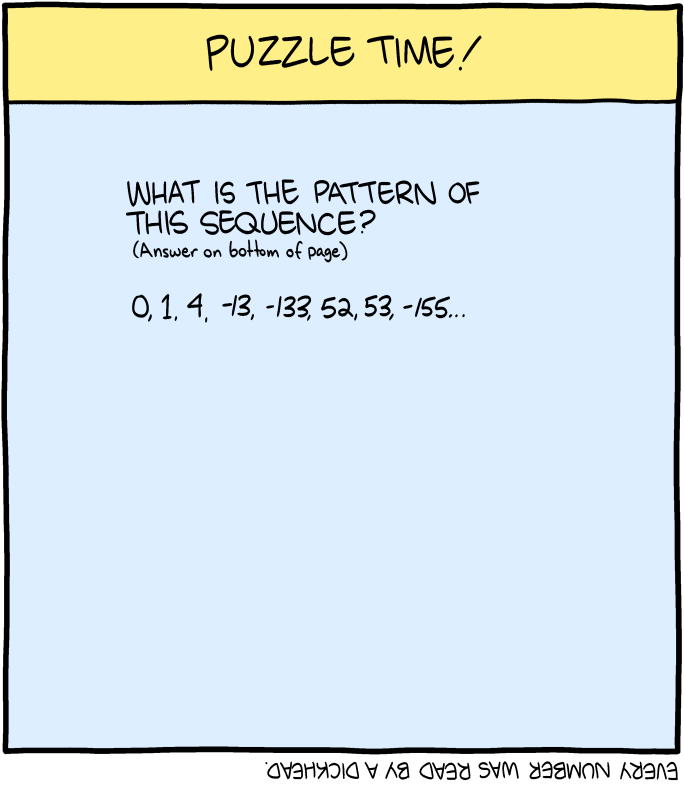
Saturday Morning Breakfast Cereal - Puzzle Time!

by tech@thehiveworks.com


Click here to go see the bonus panel!

Hovertext:
14 points to anyone who finds a real way to generate this series.

New comic!
Today's News:

Hey Boston geeks! We moved over some tickets to the $8 student level, in case some people felt priced out by the fancier options.

15 Apr 10:01

Saturday Morning Breakfast Cereal - Temperature

by tech@thehiveworks.com


Click here to go see the bonus panel!

Hovertext:
Also, if they don't specify what time in the history of the universe they're talking about, you can use any value for entropy.

New comic!
Today's News:

Just a little over a week until BAHFest MIT! You gonna come see me?

13 Apr 14:16

Vai con l’agnellismo

by .mau.

Ha cominciato Silvio Berlusconi, uno che – dite quel che volete – sa sempre come farsi pubblicità: la scorsa settimana ha adottato cinque agnellini che non saranno macellati a Pasqua. La presidenta della Camera Laura Boldrini non ha voluto essere da meno, e ha adottato a distanza le due agnelline Gaia e Gioia, che ieri hanno fatto visita a Montecitorio accompagnate da due volontarie dell’Enpa e dalla presidentessa dell’Ente protezione animali. (Sì, tutto al femminile).

C’è solo un piccolo problema. Come mi è stato fatto notare (ebbene sì, io sono un cittadino e queste cose non mi vengono affatto in mente) il mangiare gli agnelli (maschi) è in realtà un sottoprodotto del volere avere latte e formaggio di pecora. Per tutto questo occorre evidentemente che nascano tanti agnelli: ma almeno per il momento i maschi non allattano, non ne servono nemmeno tanti per ingravidare le pecore, e quindi rimane un surplus di poco o nullo valore. Che farne? Costolette 🙂 Ma questo significa che con ogni probabilità Gaia e Gioia non sarebbero state comunque macellate… Peccato che il gender ormai ci pervada tutti.

13 Apr 13:53

Quantum entanglement technology hype

by Ross H. McKenzie

Last month The Economist had a cover story and large section on commercial technologies based on quantum information.

To give the flavour here is a sample from one of the articles
Very few in the field think it will take less than a decade [to build a large quantum computer], and many say far longer. But the time for investment, all agree, is now—because even the smaller and less capable machines that will soon be engineered will have the potential to earn revenue. Already, startups and consulting firms are springing up to match prospective small quantum computers to problems faced in sectors including quantitative finance, drug discovery and oil and gas. .... Quantum simulators might help in the design of room-temperature superconductors allowing electricity to be transmitted without losses, or with investigating the nitrogenase reaction used to make most of the world’s fertiliser.
I know people are making advances [which are interesting from a fundamental science point of view] but it seems to me we are a very long way from doing anything cheaper [both financially and computationally] than a classical computer.

Doug Natelson noted that at the last APS March Meeting, John Martinis said that people should not believe the hype, even from him!

Normally The Economist gives a hard-headed analysis of political and economic issues. I might not agree with it [it is too neoliberal for me] but at least I trust it to give a rigorous and accurate analysis. I found this section to be quite disappointing. I hope uncritical readers don't start throwing their retirement funds into start-ups that are going to develop the "quantum internet" because they believe that this is going to be as important as the transistor (a claim the article ends with).

Maybe I am missing something.
I welcome comments on the article.
13 Apr 13:47

Comic for 2017.04.07

New Cyanide and Happiness Comic
06 Apr 16:30

Europe must find a new home for its drug regulator — and a way to keep using English

Europe must find a new home for its drug regulator — and a way to keep using English

Nature 544, 7648 (2017). doi:10.1038/nature.2017.21762

Brexit is forcing agencies to relocate their headquarters, and member states to rethink their language choices.

06 Apr 09:44

Trisecare un angolo con riga, squadra e compasso

by Maurizio Codogno

Il trucco c'è, e si vede...

The post Trisecare un angolo con riga, squadra e compasso appeared first on Il Post.

05 Apr 14:08

Intrinsic photonic wave localization in a three-dimensional icosahedral quasicrystal

by Seung-Yeol Jeon
Jacopo.bertolotti

I feel that this paper is horribly wrong, but I am too lazy to make a proper analysis (let's say that using Maret's 2013 paper as a clear evidence of AL is not the best starting point when you analyse your data)

Nature Physics 13, 363 (2017). doi:10.1038/nphys4002

Authors: Seung-Yeol Jeon, Hyungho Kwon & Kahyun Hur

Wave transport is one of the most interesting topics related to quasicrystals. This is due to the fact that the translational symmetry strongly governs the transport properties of every form of wave. Although quasiperiodic structures with or without disorder have been studied, a clear mechanism for wave transport in three-dimensional quasicrystals including localization is missing. To study the intrinsic quasiperiodic effects on wave transport, the time invariance of the lattice structure and the loss-free condition must be controlled. Here, using finite-difference methods, we study the diffusive-like transport and localization of photonic waves in a three-dimensional icosahedral quasicrystal without additional disorder. This result appears at odds with the well-known theory of wave localization (Anderson localization), but we found that in quasicrystals the short mean free path of the photonic waves makes localization possible.

05 Apr 12:48

Science needs reason to be trusted

by Sabine Hossenfelder

Nature Physics 13, 316 (2017). doi:10.1038/nphys4079

Author: Sabine Hossenfelder

That we now live in the grip of post-factualism would seem naturally repellent to most physicists. But in championing theory without demanding empirical evidence, we're guilty of ignoring the facts ourselves.

05 Apr 08:27

Top 7 maps that ultimately explain map projections - Geoawesomeness

04 Apr 10:15

Hyperuniform disordered phononic structures

by G. Gkantzounis, T. Amoah, and M. Florescu

Author(s): G. Gkantzounis, T. Amoah, and M. Florescu

Computer simulations show that a uniform but not periodic arrangement of tiny, wave-scattering pillars can host an efficient acoustic channel of arbitrary shape.


[Phys. Rev. B 95, 094120] Published Fri Mar 31, 2017

03 Apr 09:35

A fascinating thermodynamics demonstration: the drinking bird

by Ross H. McKenzie
I am currently helping teach a second year undergraduate course Thermodynamics and Condensed Matter Physics. For the first time I am helping out in some of the lab sessions. Two of the experiments are based on the drinking bird.


This illustrates two important topics: heat engines and liquid-vapour equilibria.

Here are a few observations fo in random order.

* I still find it fascinating to watch. Why isn't it a perpetual motion machine?

* Several more surprising things are:
a. it operates on such a small temperature difference,
b. that there is a temperature difference between the head and bulb,
c. it is so sensitive to perturbations such as warming with your fingers or changes in humidity.

* It took me quite a while to understand what is going on, which makes me wonder about the students doing the lab. How much are they following the recipe and saying the mantra...

* I try to encourage the students to think critically and scientifically about what is going on, asking some basic questions, such as "How do you know the head is cooler than the bulb? What experiment can you do right now to test your hypothesis? How can you test whether evaporative cooling is responsible for cooling the head?" Such an approach is briefly described in this old paper.

* Understanding and approximately quantifying the temperature of the head involves the concept of humidity, wet-bulb temperature and a psychometric chart. Again I find this challenging.

* This lab is a great example of how you don't necessarily need a lot of money and fancy equipment to teach a lot of important science and skills.
03 Apr 09:01

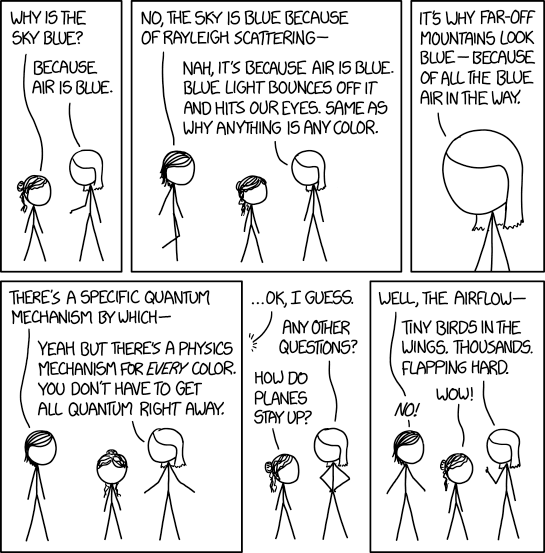
Rayleigh Scattering

If you ask "why are leaves green?" the usual answer is "because they're full of chlorophyll, and chlorophyll is green," even though "why does chlorophyll scatter green light?" is a great question too.
31 Mar 09:11

Hamiltonian for the Zeros of the Riemann Zeta Function

by Carl M. Bender, Dorje C. Brody, and Markus P. Müller

Author(s): Carl M. Bender, Dorje C. Brody, and Markus P. Müller

A Hamilonian with PT-symmetry invariant properties is investigated as a candidate for an operator that has eigenvalues corresponding to the nontrivial zeros of the Riemann zeta function.


[Phys. Rev. Lett. 118, 130201] Published Thu Mar 30, 2017

31 Mar 08:41

Bye Bye England and Friends

by Scandinavia and the World
Bye Bye England and Friends

Bye Bye England and Friends

View Comic!


29 Mar 09:31

Emergence of Lévy walks in systems of interacting individuals

by Sergei Fedotov and Nickolay Korabel

Author(s): Sergei Fedotov and Nickolay Korabel

We propose a model of superdiffusive Lévy walk as an emergent nonlinear phenomenon in systems of interacting individuals. The aim is to provide a qualitative explanation of recent experiments [G. Ariel et al., Nat. Commun. 6, 8396 (2015)] revealing an intriguing behavior: swarming bacteria fundamen...


[Phys. Rev. E 95, 030107(R)] Published Tue Mar 28, 2017

28 Mar 10:40

Localization in random fractal lattices

by Arkadiusz Kosior and Krzysztof Sacha

Author(s): Arkadiusz Kosior and Krzysztof Sacha

Localization and transport of a quantum particle in fractal lattices with random-site connectivity and without any diagonal disorder are investigated. It is the random hopping terms that introduce disorder-causing localization of a single-particle wave function. The lattices are generated so that their fractal (Hausdorff and spectral) dimensions are independently controlled. Therefore, it is possible to analyze how different fractal dimensions influence the localization properties, which is the main purpose of this paper.


[Phys. Rev. B 95, 104206] Published Mon Mar 27, 2017

23 Mar 17:46

Predatory journals recruit fake editor

by Piotr Sorokowski

Predatory journals recruit fake editor

Nature 543, 7646 (2017). doi:10.1038/543481a

Authors: Piotr Sorokowski, Emanuel Kulczycki, Agnieszka Sorokowska & Katarzyna Pisanski

An investigation finds that dozens of academic titles offered 'Dr Fraud' — a sham, unqualified scientist — a place on their editorial board. Katarzyna Pisanski and colleagues report.

22 Mar 16:46

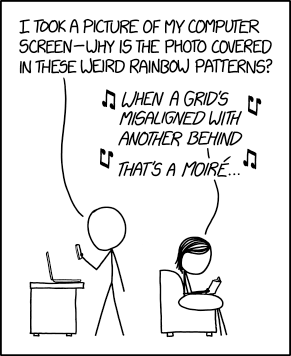
Color Pattern

♫ When the spacing is tight / And the difference is slight / That's a moiré ♫
22 Mar 12:18

Critical security flaws found in LastPass on Chrome, Firefox (updated)

by Richard Lawler
Jacopo.bertolotti

And this is why I don't use a password manager.

Last year Google Project Zero researcher Tavis Ormandy quickly found some "obvious" security problems in the popular password manager LastPass, and now he's done it again. Last week Ormandy mentioned finding an exploit in one version of its extension...
21 Mar 16:03

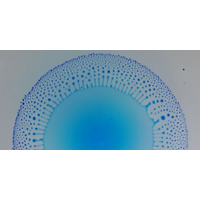
Marangoni Bursting: Evaporation-Induced Emulsification of Binary Mixtures on a Liquid Layer

by L. Keiser, H. Bense, P. Colinet, J. Bico, and E. Reyssat
Jacopo.bertolotti

Super-cool video

Author(s): L. Keiser, H. Bense, P. Colinet, J. Bico, and E. Reyssat

A drop of water-alcohol mixture on a layer of oil was caught on video bursting into thousands of tiny droplets.


[Phys. Rev. Lett. 118, 074504] Published Fri Feb 17, 2017

21 Mar 12:27

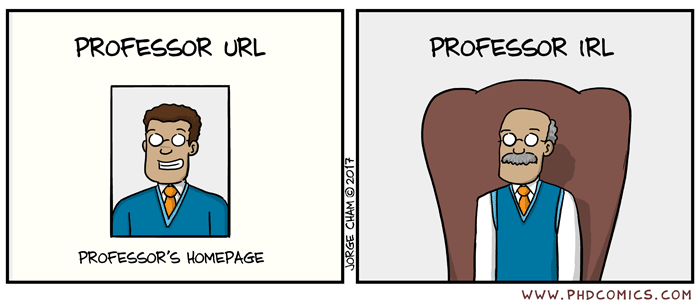
03/20/17 PHD comic: 'URL vs IRL'

Piled Higher & Deeper by Jorge Cham
www.phdcomics.com
Click on the title below to read the comic
title: "URL vs IRL" - originally published 3/20/2017

For the latest news in PHD Comics, CLICK HERE!

20 Mar 11:49

Current status of direct dark matter detection experiments

by Jianglai Liu
Jacopo.bertolotti

"there has been no solid evidence of a real event yet"

Nature Physics 13, 212 (2017). doi:10.1038/nphys4039

Authors: Jianglai Liu, Xun Chen & Xiangdong Ji