In the 1970s, Shulamith Firestone wrote: “the end goal of feminist revolution must be […] not just the elimination of male privilege but of the sex distinction itself […] The reproduction of the species by one sex for the benefit of both would be replaced by (or at least the option of) artificial reproduction: children would be born to both sexes equally.” This hopeful if unsettling vision of the artificial womb entices me, a 1970s harbinger of the “gender is over” rallying cry.
Firestone’s utopian manifesto, penned in a world where birth control and in vitro fertilisation were new to the reproductive conversation, was buoyed by its relative improbability. Maybe Firestone really believed that the new reproductive technologies of her era heralded the arrival of ectogenesis sometime after. More likely it was the stuff of fantasy, provocatively introduced to challenge readers to reconsider the status quo.
But what once felt like fantasy seems increasingly more real. A human pregnancy is 40 weeks of gestation, with any baby born before 37 weeks considered preterm. The point at which a human fetus can survive outside the mother’s womb (otherwise known as “fetal viability”) sat around 28 weeks of gestation when Roe v. Wade was handed down almost exactly forty-five years ago. Today, following progress in neonatal intensive care technologies, viability in most wealthy countries is somewhere between 22 and 26 weeks, depending on the resources available in a given area and hospital. The health of babies born before 28 weeks remains precarious. In April of 2016, however, a group of scientists in Philadelphia developed a partial artificial womb that may allow for fetuses born at the cusp of viability (22-23 weeks) to gestate to term outside the mother’s body. Trialed with lamb fetuses at the equivalent of 22-24 human weeks of gestation, the technology, dubbed the “Biobag”, mimics the conditions of a fetus in utero, surrounding it with artificial amniotic fluid. If the Biobag is successful, almost half of a fetus’s gestation might be able to occur outside the womb. In August, scientists in Australia replicated the experiment, with the unnerving addition of dubbing the technology “ex-vivo uterine environment,” or EVE.
 Those involved in these experiments insist that artificial wombs are not their intention, that these technologies are simply to support the survival of preterm babies, and that full ectogenesis is the “stuff of science fiction.” But science has continually moved several paces ahead of law and ethics, and preparing for what is possible in the future is also a way of investing in the present. Women of color writers and activists have long identified how movements championing reproductive rights and technologies centralize the reproductive needs and circumstances of white, cis, moneyed women. Imagining the artificial womb as a reality, and putting those whom reproductive technologies have historically endangered (women of color, queer and trans men and women, immigrant women) at the center of our thinking, provides an opportunity to consider how existing legal frameworks can be altered to account for other reproductive changes to come.
****
 The crux of Firestone’s utopia is the idea of gender becoming essentially irrelevant for building families. Since the Supreme Court heard Obergefell and granted same-sex couples the right to marry, equal acknowledgement of gay and lesbian couples as legal paThe crux of Firestone’s utopia is the idea of gender as essentially irrelevant for building familiesents should follow. But a slew of cases have cropped up post-Obergefell in which states have refused to do exactly that. In just one example, a court made the claim that a lesbian non-biological mother whose partner conceived using IVF was not a legal mother, and in fact, that the anonymous sperm donor the couple had used should be considered an absentee father. Given that it is unheard of for a court to consider a sperm donor an “absentee father” over the male partner of a woman who conceives using IVF (a circumstance that is not uncommon), to deny lesbian partners the same right is explicit discrimination.
The existing legal framework around parenthood is one that still holds a cis, heterosexual, two-parent family model at its core. As long as this remains true, the law will continually refer back to one particular model of kinship, and while it may expand to include same-sex partners (or, as in several states, attempt to deny them), it inhibits the recognition of families that don’t look like this: families with three or more involved parents who may or may not be related to a child, families with single parents, families where children are parented across generations.
So where does Firestone’s artificial womb fit in? One way of thinking about parenthood in a legal sense is through the idea of intention. This doctrine holds that the individuals that should be recognized as parents are those who show sustained intent over time to have and to raise a child. In California, Senate Bill No. 272 allows families to be formed via “intention” before a child is born. The bill lets courts recognize more than two individuals as legal parents where this is an accurate representation of the intent of their family, and in circumstances where it would be “detrimental to the child” were the court to neglect to recognize this. Though far from perfect, the California bill is one example of a legal movement toward acknowledging difference in familial forms and decentralizing the two-parent, heterosexual, “normative” family.
Could the artificial womb, in interrupting gestational parenthood and further complicating biological parenthood, provide grounds for parental intention to take precedence as the base of family formation? The artificial womb, and the possible protections of parental intent, potentially opens a slew of possibilities including the elimination of the need for surrogates, the crumbling of the barrier of the “biological clock,” the irrelevance of sex to parenthood. I’m drawn to these visions of a future in which parenting roles are established not by gender, age, or biology, but intent.
****
In our current reality, parental rights flowing unproblematically from intention is an impossibility. In many states, assisted reproductive technologies are prohibitively expensive: IVF is available only to those who can pay for it, and given the current political landscape, were an artificial womb to be introduced, it would be accessible only to the wealthiest individuals. Tracing the historical arc of how reproductive technologies have been used and the climate around access to reproductive care in the United States, the availability of an artificial womb under existing circumstances might only be dangerous. In a society that criminalizes pregnant women for attempting to self-abort, where more value is placed on the potential life of the fetus than on the rights of the mother, and where babies are frequently taken from women deemed to be unsuitable mothers almost as soon as they are born, the artificial womb is plainly dystopic. Given that many women already struggle to access abortion, the artificial womb might be used to justify a total abortion ban in favor of fetal extraction and adoption. Pregnant people facing drug and alcohol addictions, already treated punitively (and already frequently denied rights to their own children), might experience the artificial womb as a mandatory alternative to incarceration. Ectogenesis might be made available to wealthy women as a solution to the difficulties incurred in pregnancy, in place of addressing the issues in our society that limit the possible pleasures of pregnancy for everyone.
Firestone’s artificial womb, though idealistic, was not something she suggested would land, fully equipped for utopian use, without any effort. It is the “end goal of [a] feminist revolution,” the thing waiting on the other side of insurrection, uprising, revolt. Maybe, then, considering the path toward the artificial womb has less to do with the thing itself (especially given that it remains a technology which may never arrive), and more to do with the work on the way there.
It matters who you are when it comes to parenting rights already. It also matters when it comes to accessing reproductive health care, and to whether new reproductive technologies are accessible to you. For women of color in America, for queer and trans people, immigrant women, and disabled people, new reproductive technologies have most frequently meant new ways for their bodies to be subjugated and subjected to experimentation. For ectogenesis to shatter our existing, engrained social understandings of what constitutes gender, and how we build families in beneficial ways, the “feminist revolution” must do the work of putting those whom these technologies have historically made vulnerable at the center of the conversation.
–Claire Horn researches the legal and ethical implications of artificial wombs at Birkbeck Law. Editor at http://www.whatfreshwitch.
Updated on April 3 at 2:23 p.m. ET
In early March, Environmental Protection Agency Administrator Scott Pruitt approached the White House with a request: He wanted substantial pay raises for two of his closest aides.
The aides, Sarah Greenwalt and Millan Hupp, were part of the small group of staffers who had traveled with Pruitt to Washington from Oklahoma, where he had served as attorney general. Greenwalt, a 30-year-old who had worked as Pruitt’s general counsel in Oklahoma, was now his senior counsel at the EPA. Hupp, 26, was working on his political team before she moved to D.C. to become the agency’s scheduling director.
Pruitt asked that Greenwalt’s salary be raised from $107,435 to $164,200; Hupp’s, from $86,460 to $114,590. Because both women were political appointees, he needed the White House to sign-off on their new pay.
According to a source with direct knowledge of the meeting, held in the Eisenhower Executive Office Building, staffers from the Presidential Personnel Office dismissed Pruitt’s application. The White House, the source said, declined to approve the raises.
So Pruitt found another way.
A provision of the Safe Drinking Water Act allows the EPA administrator to hire up to 30 people into the agency, without White House or congressional approval. The provision, meant to help expedite the hiring of experts and allow for more flexible staffing, became law in 1996. In past administrations, it has been used to hire specialists into custom-made roles in especially stressed offices, according to Bob Perciasepe, a former acting EPA administrator.
After the White House rejected their request, Pruitt’s team studied the particulars of the Safe Drinking Water provision, according to the source with direct knowledge of these events. By reappointing Greenwalt and Hupp under this authority, they learned, Pruitt could exercise total control over their contracts and grant the raises on his own.
Pruitt ordered it done. Though Hupp and Greenwalt’s duties did not change, the agency began processing them for raises of $28,130 and $56,765, respectively, compared with their 2017 salaries. Less than two weeks after Pruitt had approached the White House, according to time-stamped Human Resources documents shared with The Atlantic, the paperwork was finished.
Word of the raises quickly began to circulate through the agency. The episode infuriated some staffers; to some political aides, it was evidence of Pruitt’s disregard for the White House’s warnings to cabinet officials that they avoid even the appearance of impropriety. It also underscored the administrator’s tendency to play favorites among his staff, according to two sources with direct knowledge of agency dynamics. Hupp, in particular, is making more than her Obama-era predecessor, a five-year veteran of the agency who did not break six figures until the final year of the administration, according to public records. (While Greenwalt has no obvious peer in the Obama administration, the EPA’s general counsel had an annual salary of $155,500 in 2016.)
Said one EPA official, who spoke on the condition of anonymity because they were not authorized to talk to the press: “This whole thing has completely gutted any morale I had left to put up with this place.”
“The Safe Drinking Water Act provides the EPA with broad authority to appoint scientific, engineering, professional, legal, and administrative positions within EPA without regard to the civil service laws. This is clear authority that has been relied on by previous administrations,” EPA spokesman Jahan Wilcox said in a statement. “The Administrator was not aware that these personnel actions had not been submitted to the Presidential Personnel Office. So, the Administrator has directed that they be submitted to the Presidential Personnel Office for review.”
The White House did not return requests for comment.
The unusual hiring scheme comes amid new questions about Pruitt’s ethics as administrator. The EPA chief rented a Capitol Hill apartment partly owned by the wife of a top energy lobbyist, paying just $50 per night for the space, according to an ABC News report last week. Pruitt also faces questions over his use of taxpayer money to make regular first- and business-class flights during his first year in office.
Now, in the wake of Greenwalt and Hupp’s salary boosts, government watchdogs are deepening their probe of Pruitt’s use of the Safe Drinking Water Act.
Last May, Senate Democrats pressed the agency for answers about Pruitt’s embrace of the provision. That month, for example, Pruitt used the law to hire Nancy Beck, a long-time lobbyist for the chemical industry, as the deputy head of the Office of Chemical Safety and Pollution Prevention. Historically, that role has been filled by a career civil servant or a political appointee.
Because she was hired administratively, and not appointed by the White House, Beck did not have to sign President Trump’s ethics pledge, which mandates that Trump officials cannot work on an issue on which they had lobbied in the previous two years. Senators Tom Carper and Sheldon Whitehouse, top Democrats on the Environment and Public Works Committee, sent a letter to the Government Accountability Office requesting a probe into Beck’s hiring. They were concerned, chiefly, that Pruitt was using the Safe Drinking Water hiring authority as a way for new employees to evade the ethics pledge.
“[The Safe Drinking Water Act] can be a legitimate way to bring on skilled experts the EPA needs to protect Americans’ health and safety, but Administrator Pruitt seems more interested in using it to skirt ethics requirements, like the president’s order banning hires from working on matters involving former employers or clients,” Whitehouse said in a statement provided to The Atlantic.
Last October, Senator Bob Menendez wrote to the EPA inspector general requesting an investigation of the agency’s use of the Safe Drinking Water hiring authority, among other matters. The IG agreed to take up the investigation two months later, but it wasn’t until March that they began seriously questioning the EPA’s top political appointees about potential abuse of the hiring authority.
Now, staffers are waiting to see how officials will address the raises.
“It’s a complete coincidence that Pruitt went behind the White House’s back and used this in the most unethical way possible, just as the [inspector general] starts asking questions,” said one EPA staffer. “Now they just have to connect the dots.”
It’s not as though Pruitt is the first EPA administrator to lean on the Safe Drinking Water Act hiring authority. EPA veterans of both the George W. Bush and Barack Obama administrations said they were well-acquainted with the provision. But of the half-dozen former top EPA staffers interviewed for this article, not one could comprehend using it as a means of increasing salaries—especially following a rejection from the White House.
“I can’t imagine that being done in the regime in which I served,” said Stan Meiburg, a former acting deputy administrator of the EPA in the Obama administration. “It would have been very controversial. The accusation that would have been pinned on the administrator was that they were trying to give a private benefit using public funds.”
Meiburg, who spent his career at the EPA after joining as career staff in 1977, said that “ADs”—the internal shorthand for “administratively determined” hires—were considered a precious commodity inside the agency.
“The number of ADs were monitored very closely by the chief of staff,” he said. “To get one was a big deal. To get one was not an easy task.”
Christine Todd Whitman, the first EPA administrator under President George W. Bush, said she couldn’t remember ever reclassifying a political appointee as an AD. “I don’t even remember it being brought up as a potential or something to think about,” she said.
As Meiburg noted, even appearing to convert a political appointee to an AD simply to give a salary raise could prove politically damaging. But other officials said the deeper effects would be felt inside the agency, where a transparent show of favoritism could inflame inter-office tensions and decrease morale. And in an office where staffers already jockey for favor among Pruitt’s “posse,” according to a source who works closely with the EPA, such a backlash is likely.
“It’s already such a toxic work environment,” the source said, requesting anonymity to speak candidly. “It’s hard to see how it could get any worse.”
Over the last several days, as press reports have zeroed in on Pruitt’s living arrangements, this is the scandal that has seized the agency from the inside. If Pruitt was on thin ice with the White House before, the acceleration of the inquiry into his payroll practices may shatter it.
“We were once the president’s favorite,” said the EPA official. “Now we’re the problem child.”
Over a single weekend in March, an unprecedented disaster hit fertility clinics—twice.
First came the news that the University Hospitals Fertility Center in Ohio, lost more than 4,000 eggs and embryos in a malfunctioning cryogenic tank. Then, in an unrelated incident, Pacific Fertility Center in California reported that liquid-nitrogen levels had fallen too low in a tank holding “several thousand” eggs and embryos, affecting an unconfirmed number.
In-vitro fertilization can be a draining process—financially, physically, emotionally. And for some families, these embryos had been their last chance to have biological children. Dozens of lawsuits have since been filed; parents and would-be parents spoke of the children they will never have, of the siblings their children will never know. At times, they spoke not just of “embryos” but of “babies.”
“How many babies are at risk right now while we sit, while we talk?” asked Wendy Penniman, who lost embryos in the malfunctioning Ohio tank, on the Today show.
On Friday, as first reported by Courthouse News, Penniman’s lawyer, Bruce Taubman, filed a complaint asking the court to consider an embryo a person. The filing—which comes in addition to a class-action lawsuit already filed March 12 on behalf of Penniman and her husband, Rick—asks for a declaratory judgment that “the life of a person begins at the moment of conception” and “the legal status of an embryo is that of a person.”
Taubman says that he filed the complaint to “unclog the logjam” of dozens of related fertility-clinic cases in Ohio. If embryos were declared people, he noted, then a wrongful-death claim could also come into play. “The damages are much more severe ... There is no cap on damages,” he says.
Encapsulated in this legal strategy is a lightning rod of a question. If—and that’s a big if—an embryo is deemed a person, then it could very well alter the practices of in-vitro fertilization clinics, which routinely create more embryos than are implanted into patients. And it will almost certainly alter the landscape of abortion politics.
The filing cites a 1985 Ohio Supreme Court case, Werling v. Sandy, that held a viable fetus is a person. But I. Glenn Cohen, a professor at Harvard Law School, says that case may not be the most relevant one here. A viable fetus is one that can survive outside of a womb. And in Egan v. Smith, an Ohio Court of Appeals court held in 1993 that wrongful death could not be brought for a nonviable fetus. This case is more likely to apply to embryos. “It’s a real stretch,” he says, “but lawyers are supposed to give every argument they can.”
Nevertheless, the rising popularity of IVF has opened real questions over how to treat embryos. This has come up in disputes, like when the actress Sofía Vergara was sued by two frozen embryos created with her ex, who wanted to implant them in a surrogate mother. That case was brought in Louisiana, which deems embryos neither property nor humans but “juridical persons,” an entity with legal rights. (The case was ultimately dismissed.)
This issue also comes up in more prosaic scenarios, like when a family is deciding what to do with extra embryos from IVF. Some donate them to research. Others dispose of them, sometimes through a ceremony. Often, they simply decide to keep the embryos in storage. “Couples don’t always agree about the moral and legal status of the embryo, where life begins, and how religion enters into it, and a lot of them end up kicking the can down the road,” a fertility doctor told The New York Times in 2015. There are no exact numbers, but as many as a million embryos may be in indefinite frozen storage.
Christian organizations have advocated “snowflake adoptions,” in which a family adopts another’s extra embryos. Last fall, one such adoption resulted in the birth of a baby girl from an embryo frozen for 24 years, nearly as long as her 26-year-old adoptive mother had been alive.
The Penniman’s lawsuit appears to be the only so far to have broached the subject of personhood. Another attorney, Tom Merriman, who says his firm is representing more than 100 clients against UH Fertility Center now, is not pursuing this legal strategy. “An embryo—whatever your personal moral or religious belief about the status of embryos—it’s something that’s created with tremendous personal sacrifice. It is unique, and it has value far greater than something like your car or your TV,” he says. But personhood adds a partisan dimension to the cases. “I hate to see these cases get politicized and transformed into some partisan debate on a hot-button issue,” he adds.
When the personhood filing came out, the pro-life, antiabortion website LifeNews.com jumped on the news by reprinting an article from the Society for the Protection of Unborn Children, “Thousands of Unique Human Beings Die After Fertility Clinic Has Storage Tank Malfunction.”
Cohen, the Harvard law professor, added that deeming embryos people could have huge implications for the IVF industry. Clinics routinely create extra embryos because not every embryo that is implanted will result in a pregnancy. What will happen to those extra embryos if they are persons? And perhaps more importantly, did those embryos that did not result in a pregnancy die? It could have a huge chilling effect on the IVF industry.
I put this scenario to Taubman, the lawyer who wrote the personhood filing. “That’s a good question. I don’t have an answer to for that. We’ll leave the court to decide about that,” he replied, with a long pause. “That’s a good question.”
A.NI think about Maddie a lot.

Well. My least-favorite month of the year is here. April, I hate you so much. It’s nothing personal.
The ninth anniversary of Madeline’s death is this Saturday. My friends are wonderful. They text me to check in, send jokes to make me smile, or little notes to let me know they’re thinking of us. I really cannot stress enough how much that means to me. I tell everyone who comes to me with “My friend lost a child, what can I do to support them,” that the ongoing messages YEARS LATER are so, so crucial for Mike and me. If you have a friend who’s lost someone important to them, make a note to remember that person every year.
But I digress. The last twelveish months have been really hard for me, from a grieving standpoint. Maddie’s tenth birthday weighed on me all year. The flashbacks, which I can usually manage, came far too often. I’d look out the window in the car and flashback to when Mike would drive me to my appointments, or I’d smell something that made me think of all the time Maddie and I spent in the hospital. I was very depressed and often struggled to complete simple things like doing laundry…writing on my blog…even getting off the couch.
On top of that, I wasn’t honest with myself. I think at first I honestly didn’t realize I was depressed. But when the word “depression” was brought up, I was in denial for a long time. I told myself that I was “too far” in the grieving process to be depressed. I would put on my happy face and attempt to go through the motions of life. My old standbys of staying busy to keep my mind off things started to backfire, and suddenly everything seemed incredibly overwhelming. And then on Maddie’s birthday, I just about came apart.
What this has made me realize is that I need to be kinder to myself. I don’t need to push through things. It’s okay to be overwhelmed and depressed and I just need to admit it to the people around me. I shouldn’t worry that they won’t understand. I need to let people in on what’s happening so they can help me. And I need to help myself.
So, with that in mind, Mike and I have decided not to physically participate in the March for Babies this year. The event is always an emotional minefield. I am relieving myself of the stress that comes along with trying to put together a team. I’m not going to send out a mass email asking for donations (thereby avoiding the dreaded “unsubscribe” responses). And, Mike, the kids, and I are not going to attend the March for Babies at the end of the month.
This was simultaneously the easiest and hardest decision. It means A LOT to us that so many give up their Saturday mornings to walk with and support us. We know how hard it is. But not going means Mike and I won’t be slammed with so many reminders that our daughter died. It’s really difficult to see the children who survived prematurity — we’re obviously so happy for them, but to see so many children running around, laughing and living…it’s really, really hard. The march makes us relive the worst moment of our life and this year, I just can’t do that to myself.
That being said, we still heavily support the March of Dimes, and we hope to continue to raise money and awareness for a cause and organization that means so much to us. I’m still registered for the Los Angeles march to support our local March of Dimes branch, and if anyone is kind enough to give to the cause, the link to donate in Madeline’s name is here.
Even though I know this is the right decision for this year, I’m still terrified that I’m going to be letting people down. My heart and my head are rarely on the same page when it comes to this stuff. I know Annabel is going to be disappointed, as she loves the march. But this year, I have to take care of myself and I know that someday she’ll understand.
I hope you all understand, too.
© copyright Heather Spohr 2018 | All rights reserved.
This content may not be reproduced or transmitted in any form, by any means, without the prior written permission of the author.
Every few decades, a new idea emerges about the “right” way to raise children. The 1990s saw the rise of the helicopter parent, those anxious middle- and upper-middle-class mothers and fathers who hover, imagining the worst-case scenario. Their fears led many states to pass laws aimed at keeping kids safe, including statutes that punish parents who leave their children at home alone or unattended in cars.
Today, new child-rearing norms are on the rise, with parents taking a more laissez-faire approach. “Free-range” parenting, a reaction to the overbearing style of the previous generation, has become fashionable, even expected, among many of today’s parents.
In a corresponding shift, state laws are starting to catch up. Utah recently became the first state to explicitly legalize free-range parenting, with a new law stipulating that parents cannot be charged with neglect for allowing “a child, whose basic needs are met and who is of sufficient age and maturity to avoid harm or unreasonable risk of harm, to engage in independent activities.” Essentially, parents can now legally let their children “walk, run or bike to and from school, travel to commercial or recreational facilities, play outside and remain at home unattended”—things that may previously have attracted the attention of child-welfare authorities.
As this relatively new child-rearing philosophy is codified into law, it’s a good time to reflect on the consequences of it. Free-range parenting is certainly a warranted corrective to the ever-anxious helicopter parents, but it also, in ways not often fully appreciated, benefits some families more than others. Utah’s new law, and the broader free-range parenting movement, are susceptible to a problem of interpretation: What counts as “free-range parenting” and what counts as “neglect” are in the eye of the beholder—and race and class often figure heavily into such distinctions.
For some parents—poor and working-class parents, and especially poor and working-class parents of color—free-range parenting has long been a necessity, even if it didn’t previously get the virtuous-sounding label it has today. In the ’90s, the sociologists Kathryn Edin and Laura Lein studied single working mothers in Chicago, Boston, San Antonio, and Charleston, South Carolina. Those mothers often had no choice but to leave their kids at home, and they were certainly not the first to do so.
When children in poor and working-class families stay home or walk to school alone, their parents face considerable risks. In 2014, Debra Harrell, a 46-year-old black mother in South Carolina, was arrested for allowing her 9-year-old daughter to play at the park while she was working at a nearby McDonald’s. Harrell spent the night in jail, and her daughter was placed in foster care for 17 days.
Harrell’s punishment may have been egregious and anomalous, but it’s something many fear in a society in which poor parents are often assumed to be bad parents—indeed, a recent Brookings Institute study showed that the vast majority of families investigated by child-welfare authorities are poor families, and especially poor families of color. In my own research, I have interviewed poor and working-class parents who worry that a teacher or a neighbor or a well-meaning stranger will report them to child-welfare authorities, just for doing what they have to do to get by. One working-class single father regularly left his 9- and 11-year-old daughters home alone after school. He said he had no other choice, but he worried that others might not see it the same way. (As is standard in scholarly research, I agreed not to publish the father’s name.)
The middle- and upper-middle-class parents I interviewed never voiced those same concerns. For them, free-range parenting seems relatively risk-free. Consider Lenore Skenazy, the former columnist who coined the term. Skenazy received her share of extreme criticism for a column she wrote 10 years ago about her decision to let her 9-year-old son to ride the New York City subway alone. But no one called the police, and child-welfare authorities never threatened to take her son away. Instead, Skenazy was invited to host her own reality show about parenting.
Other examples point to a far-reaching double standard. A study published last month by the sociologists Sinikka Elliott and Sarah Bowen found that poor mothers, and especially poor black mothers, are judged harshly on their children’s health and well-being. Many of those mothers had been reported to child-welfare agencies by doctors or teachers, especially when their children were smaller than average or seemed hungry at school. And even when investigators’ questioning of a parent produced no evidence of abuse or neglect, it left poor mothers and children in a lingering state of fear.
As a relatively well-off white parent, I have personally benefited from the opposite dynamic. My 9-month-old son recently came down with a nasty case of dermatitis. His face, arms, legs, and torso were covered with red, itchy blotches. It took weeks of doctor visits and steroid creams to get the rash under control. In the intervening time, my son got plenty of sideways glances from neighbors, child-care providers, even strangers at the grocery store. But no one called child-welfare authorities. No one questioned my judgment or assumed I was doing something wrong.
And even if they had, I, like many well-off parents, probably would have been able to talk my way out of trouble. My own research finds that middle- and upper-middle-class parents are particularly good at exempting their children from many rules and punishments—partly because of savvy negotiating skills, but partly because their class or race affords them the benefit of the doubt. In the schools I observed, many well-off parents made unreasonable requests. They would ask teachers to excuse their children from having to do homework or to put their children in advanced classes, even if their children’s test scores were too low to qualify. In those cases, well-meaning teachers often wanted to say no. But the teachers were afraid of the parents, worrying that the parents would flood their inbox with emails, complain to the principal, or even threaten to get lawyers involved. So the teachers found it easier to say yes instead.
Utah’s new law—and the free-range-parenting movement more generally—doesn’t seem to account for all this. The law doesn’t specify when free-range parenting becomes neglectful parenting, and that gives authorities an uncomfortable amount of discretion. Utah’s law protects parents from having their children taken away, but only if those children are of “sufficient” age and if those children’s “basic needs are met.” But what counts as sufficient? Is a 9-year-old old enough to stay home alone? And what about children whose parents need to work more to put food on the table or keep a roof over their heads? Will those children be just as free to play at the park alone?
The better-educated, better-paid parents who embrace free-range parenting aren’t preoccupied with questions like these. A major shortcoming of their otherwise well-intentioned movement is that the people who have the most to gain from it—poor and working-class parents—will find themselves held to a different set of expectations.
A.NIs it just me or is this just the grossest thing ever
These Tuna Stuffed Deviled Eggs are perfect to pack for lunch or serve as an appetizer!

I combined two favorites, deviled eggs and tuna salad and made these bite sized snacks, lunch or appetizers you can easily make ahead and pop right into your mouth!
Chaz is a free spirit. Iris is a good girl looking for love. Dylan is a foodie who isn’t sure how he feels about kids. Luke likes long walks—really long walks. All of them are ready for a long-term relationship. In fact, they’d like to move in right away. All of them are dogs.
Taking a cue from dating websites, a number of programs have begun using personality tests to pair pets with owners. For example, PawsLikeMe, a website described by a co-founder as “eHarmony for people and pets,” gives humans a questionnaire to gauge their lifestyle and expectations, then returns dating-site-style bios of rescue dogs. (For Karisma, a Chihuahua–pug mix: “If you are looking for big things in little packages, then look no farther!”)
Human–animal matchmaking may sound fanciful, but it mirrors a renewed scientific interest in animal personality. Having moved beyond the fear of anthropomorphism associated with researchers like Jane Goodall (who was ridiculed for “inventing” personality traits for chimps in the 1950s and ’60s), scientists are actively exploring animal personality’s implications for everything from daily care to evolution. As John Shivik, the author of Mousy Cats and Sheepish Coyotes, points out, a species’ survival depends on diversity, including of personality. “If you don’t have variation, you will go extinct,” he says, noting that traits that are advantageous in one situation may not be in another. Boldness, for example, might be beneficial when food is scarce and risk-taking essential, but less helpful at other times. In one study, scientists assessed how bold or shy captive foxes were, and then released them into the wild. After six months, only bold foxes had died, perhaps because they were more inclined to take risks that put them in harm’s way.
Much as psychologists do when studying humans, scientists can characterize consistent behavior in animals. To this end, researchers have taken questionnaires designed to measure human personality and refashioned them for animals (a person fills them out based on observations). One influential early review of animal personality by the psychologists Sam Gosling and Oliver John identified three personality factors in dogs analogous to three of the “Big Five” personality factors in people: extroversion, agreeableness, and neuroticism. (A fourth factor for dogs combined the remaining two: openness to experience and conscientiousness.) Meanwhile, Marieke Cassia Gartner, a psychologist at the Philadelphia Zoo, led research that identified three feline personality factors—dominance, impulsiveness, and neuroticism—among certain species, including house cats.
Some of the new research is shedding light on how an animal’s personality—like a human’s—affects its life course. When Gartner and her co-authors examined the relationship between personality and subjective well-being in leopards and lions, they found that neuroticism correlated negatively with happiness, just as in humans. A 1999 study found that cheetahs in captivity who were rated as more “tense-fearful” than others were less likely to breed.
The better that pet owners and zookeepers understand an individual animal, the better they can tailor care to it. One study, for example, notes that highly neurotic cats can benefit from extra hiding places, while relatively extroverted cats may need more toys and more playtime with other animals.
Still other research supports the idea of matching pet and owner personalities. In 2011, an Oklahoma State University researcher surveyed the traits and preferences of dogs and their owners, then asked the owners to report how satisfied they were with their pet. Some factors that foretold a happy match were unsurprising—a mutual love of running outside, say. Others were a little more unusual. One particularly strong predictor of bliss was a shared “likeliness of being destructive.” That’s right: Owners who agreed with the statement “When I am feeling anxious, I am likely to tear up something” and the statement “My dog tears up pillows and other items” were among the most likely to have happy human–dog marriages.
With dogs as with people, there’s someone for everyone.
This article appears in the April 2018 print edition with the headline “Which Kind of Dog Are You?”
A.NI remember those books so vividly
This article is part of Parenting in an Uncertain Age, a series about the experience of raising children in a time of great change.
So much of raising children is unimaginable until it happens, an abstract future materialized awkwardly into an actual child covered in dirt. Amid constant unpredictability, one small unsung comfort for parents is the chance to revisit books from childhood, to share with your own children the stories you knew and loved.
Recently I came across my old copies of Betty MacDonald’s Mrs. Piggle-Wiggle books, a series about magic cures for children’s foibles that amazed me as a child. But when I read them to my own children, I was stunned to discover that these silly books are actually horror stories—though for reasons no child could ever comprehend.
The books, children’s best sellers from the 1950s that my mother passed to me in the 1980s, are seemingly anodyne stories about the improbably named Mrs. Piggle-Wiggle, a childless woman who serves as an unlicensed psychopharmacologist to her suburban neighborhood’s Baby Boomer kids. You see, Mrs. Piggle-Wiggle possesses a treasure chest of medicines to treat children’s bad habits—and unlike Ritalin, these cures involve bad trips.
When little Melody Foxglove’s mother complains that Melody cries too much, Mrs. Piggle-Wiggle prescribes “Crybaby Tonic,” which makes Melody produce enough tears that she nearly drowns. Jody Jones, who skips school to build his tree house, is treated with “Ignorance Tonic,” which makes him forget how to count and read. Whenever Wendy Hamilton tattles, Mrs. Piggle-Wiggle’s “Tattletale Pills” cause a dark-tailed cloud to emerge from her mouth.
Even more haunting are Mrs. Piggle-Wiggle’s therapeutic cures. When Hubert Prentiss refuses to pick up his toys, he is abandoned to this vice until his mess traps him in his room, forcing him to take his meals through a window off a garden rake. More unfortunate is Patsy Waters, whose refusal to take baths leads Mrs. Piggle-Wiggle to prescribe the “Radish Cure”: Poor Patsy goes unwashed for so long that her parents plant radish seeds in her dirt-encrusted face while she sleeps, so that plants sprout overnight. That story alone was curative enough to make me raise my parents’ water bill for months.
If this sounds like gothic horror, well, it is. But unlike the unalloyed sadism of Roald Dahl’s Charlie and the Chocolate Factory, in which children are tortured and maimed for sins like overeating or chewing gum (while touring a candy factory), Mrs. Piggle-Wiggle’s “cures” are meant to be admired, even emulated. “Isn’t it a shame that children can’t be evened up?” she asks one distraught parent rhetorically. “Some are show-offs and some are shy and some are quiet and some are noisy … But children are wonderful and I love them all.” Parents agree, especially since her rather aggressive “love” evens up their children perfectly. As one relieved mother swoons, “There goes the most wonderful person in the whole world.”
As a child I found these books fascinating, suggesting as they did a conspiracy of adults manipulating children’s every move. Now, as a mother of four, I find them even more fascinating, because it turns out that the conspiracy is real. Parents do constantly conspire with a bevy of licensed and unlicensed advisors—relatives, friends, doctors, teachers, social-media strangers, even representatives of the state. What all these people promise is what Mrs. Piggle-Wiggle provides: conformity. It’s something so unnatural that it can only happen through magic, and yet it’s what’s expected of children, then and now.
Much of this conformity is just common courtesy; no one wants to live in a world in which people don’t pick up their toys. But the conformity parents sometimes crave goes deeper than that, and the desperation of these books’ 1950s parents hasn’t gone away. My 21st-century children laugh at Mrs. Piggle-Wiggle’s picket-fenced planet, where Mrs. Brown does the mending while Mr. Brown smokes his pipe, and little Christopher Brown putting his elbows on the table incurs an intervention involving a trained pig (don’t ask). But the reality is that today, amid a middle-class panic about their families’ and their country’s future, there is intense demand for children’s conformity. It can be hard to see just how much conformity is required until you have a child—or two, or four—who simply won’t comply.
For large numbers of children, for instance, sitting in a cinderblock box for six hours a day is an awful way to learn. But it’s hard to appreciate just how awful it is until your child gets expelled from preschool for being unable to remain in the room. You don’t think about how many questions your children ask when you read together until they get kicked out of the library story hour; you don’t realize how eagerly they explore nature until the arboretum ejects them for failing to stay in line on the trail. When your children achieve good grades, you are delighted, until you sit through the presentations where every child recites an identical list of facts about the country they “researched” on Wikipedia, and you realize what success is. You wonder why their assignments are so uninspired, until your answer arrives in the form of paperwork about multiday standardized tests. You wonder why your child who reads five novels weekly has been flagged for poor reading skills, until you discover that said child spends all assessment time reading under the desk.
You appreciate the need for children to develop patience, mastery, tolerance for boredom. But demand piles upon demand until it becomes a kind of daily war, as if this structure were specifically designed to destroy the very things that it purports to nourish. Your children soon meet other repeat offenders who frequent the principals’ and psychologists’ offices, children who sit on exercise balls and wear weighted vests in class to better constrain them, like characters from Kurt Vonnegut’s “Harrison Bergeron” dystopia. You observe as your children uncover, like video-game Easter eggs, your state’s various statutes that trigger ejection from class; soon even your kindergartner discovers that all he needs to do to leave the room is announce an urge to kill himself, a fact he then exploits at will. You don’t blame the schools for these essential interventions, but you can hardly blame your child either for wanting out, because clearly something is wrong. Your children love learning, reading, exploring, creating; at home they write books, invent board games, make up languages, build gadgets out of old coffee makers. They appear to have the makings of successful adults—they’re resourceful, independent, and interested in contributing something to the world. But the markers of success in children are in many ways the opposite of these markers of success in adulthood, and in the meantime—a long, decade-plus meantime—children are trapped in a kind of juvenile detention where success is defined by how well adults can manage them, the chief adult being you, the parent.
Through all this, the Mrs. Piggle-Wiggles proliferate. Some are relatives or trusted friends; others are professionals, teachers, therapists, doctors, all offering their chests of cures. Some of these cures actually work. But even when they work, you begin to wonder what it means for them to work, to wonder what you are not seeing when all the Mrs. Piggle-Wiggles see is a tattletale or a truant or a child covered in dirt, an aberration to be evened out, fixed, cured. This harrowing question brings you to the farthest edge of your own limitations as a parent, which is also the nearest edge of your child’s freedom. And then you understand that control is a delusion—that all you can do is what Mrs. Piggle-Wiggle never does, which is to love the people your children actually are, instead of the people you want them to be.
Parents’ desire for conformity in their children comes from something much deeper and more impossible than getting them to do their homework. We, parents, want our children to be us; at some unconscious level, we produced them to replace us. But thinking beyond ourselves requires an active imagination—and imagination, with all its frightening risks, is exactly what parents are unconsciously trying to suppress, in our children and in ourselves.
Today, when I read these books to my children, I try something I never could have done as a child: I imagine Mrs. Piggle-Wiggle’s uncured young Baby Boomers as adults, and appreciate how much we needed them. I imagine Melody Foxglove’s ready tears inspiring her to join the Freedom Riders or to protest the Vietnam War, while tree-house-building truant Jody Jones tunes in, drops out, reads Silent Spring, and designs new sustainable homes for the future. I see unwashed Patsy Waters digging wells in the Peace Corps, lifting people out of poverty; I picture toy-obsessed Hubert Prentiss inventing robots and cellphones; I imagine tattletale Wendy Hamilton as a fearless prosecutor, taking down child molesters and organized crime. Christopher Brown, after half a century of perfect table manners, lets his grandchildren put their feet up on his table, laughing with them about his parents’ limitations. And then I look around at my own children, hoping someday they will laugh at my limitations too.
A.Nhey, I might be fucked up, but I got 99 problems... (is there more to that?)
When Kelli Kelley awoke from her C-section 17 years ago, having delivered her son after just 24 weeks of pregnancy, her husband gave her a Polaroid of their baby. He was tiny, underdeveloped, eyes still fused shut, with translucent skin covered in fine hair, and lying in a sea of medical equipment and lines. To Kelley, he looked like a baby bird. Cut to her first visit to the neonatal intensive-care unit (NICU) to meet him: a cacophony of beeping machines, harsh lighting, “space-age-looking equipment,” and hospital smells, with 40 “tiny, alien babies in boxes.” Her son had a whole team of doctors and nurses working to keep him alive, but Kelley felt frightened and alone. Kelley remembers just one support group for parents, with a chaplain. “Sitting with a man in a collar felt more like a memorial service,” she recalls.
Four months later Kelley and her husband brought their son home. He was on a heart monitor and still unable to breastfeed. They lived under a crush of medical bills, and in his first year, their baby underwent three surgeries. Kelley didn’t recognize the toll her son’s ordeal had taken on her until two years later when their daughter was born at 34 weeks with a blood disorder. The family returned to the NICU, and for Kelley, the trauma from both births collided. Kelley was diagnosed with an anxiety disorder; but her son was already five before Kelley finally received a post-traumatic stress disorder diagnosis.
“The experience of the neonatal intensive-care unit, the birth of a premature baby—it’s a very different kind of trauma from what we call single-incident trauma, like someone in a car accident or even a sexual assault,” explains Richard J. Shaw, a professor of psychiatry and pediatrics at Stanford University’s Lucile Packard Children’s Hospital. In the NICU, traumatic, stressful events are continuous: your baby’s fragile health, other babies coding, a flow of bad news about your baby’s current health and future prognosis. Mothers—themselves still recovering from childbirth—commonly describe guilt, feeling as though they’d somehow failed their children by giving birth early (even though, of course, they couldn’t help it), and a sense of uselessness in the shadow of a medical team of experts. Only in recent years have researchers begun recognizing that the fear, stress, and anxiety parents carry with them out of the NICU can manifest later as PTSD.
Shaw, who has researched PTSD in mothers of premature babies, notes that very few NICUs have dedicated psychiatrists on staff. While screening for postpartum depression has become common—and rates of PPD in mothers of premature infants can be as high as 40 percent—PTSD screenings for NICU parents are still rare. Even among fathers of preemies who did not meet the criteria for PTSD shortly after the birth, one study found that many did experience PTSD symptoms after about four months (once the baby was home).
When Kelley needed help and began searching for it, she found little. So she started a program to train people she calls “NICU graduate parents” to support other families with children in the NICU in her hometown of Austin, Texas. That program eventually became a stand-alone nonprofit, Hand to Hold, and has grown to comprise a network of up to 200 peer-support volunteers (dubbed Helping Hands) across the United States, England, South Africa, Canada, the Virgin Islands, Japan, and Puerto Rico. Those Helping Hands undergo intake screening to help ensure they are ready to reenter the NICU; are given a background check; must complete a four-part, online training on effective listening, bereavement, and trauma-informed care; have an interview with Hand to Hold’s peer-support team; and also receive ongoing support from Hand to Hold’s staff of social workers. Helping Hands are paired with current NICU parents based on the similarity of their babies’ conditions and their experiences in the NICU. (Parents of 23-weekers are matched with other parents of 23-weekers, for example.) This free program offers parents a person to call, text, and email who knows what it’s like to navigate life in the NICU. A separate Hand to Hold “ambassadors” program places peer volunteers in person in the NICU to go on rounds with medical teams and lead parent and sibling support groups at three Texas medical centers.
Peer support is a useful method for treating PTSD. “Speaking to a parent who’s been through something similar and learned how to cope with it is tremendously powerful,” Shaw says. Writing a trauma narrative is also common practice, which in a clinical setting might include writing out a full story of the traumatic event, and going through paragraph by paragraph to consider the feelings those memories arouse—perhaps two or three times. When such a therapeutic setting is unavailable, there’s evidence that writing for 20 minutes a day about one’s trauma can relieve distress, anger, and anxiety, and somewhat reduce PTSD symptoms.
A core element of Hand to Hold’s programming is the opportunity for parents to write for the organization’s blog—which can help the writer process, but is also beneficial as a resource for other NICU parents. Kayla Aimee delivered her daughter at 25 weeks and found Hand to Hold during a search for micro-preemie support groups. She started blogging and eventually published the book Anchored: Finding Hope in the Unexpected.
Andrea Mullenmeister was 23 weeks pregnant and on vacation in northern Minnesota when her contractions started. After a rush to the nearest hospital, Mullenmeister was so dilated that her baby’s foot was visible by vaginal exam. So Mullenmeister was airlifted by helicopter to the nearest hospital with a NICU. She could hardly breathe as lakes, cityscapes, and countryside flicked past the windows. Her husband followed in their car below. Mullenmeister’s son was born bruised, small, and battered, foot-first, not breathing. Once doctors got him breathing, “I heard this tiny mew,” she says. But his traumatic birth and the subsequent 93 days in the NICU left a firm impression, giving Mullenmeister a fear of heights and flashbacks for years when she heard helicopters. It was two years before Mullenmeister was diagnosed with late-onset postpartum depression and PTSD. Around that time she found Hand to Hold and started writing about her experience on the organization’s blog. In addition to therapy, she explained, that habit of writing remained crucial as her son, now six, grew up with a mix of chronic health concerns, ranging from autism to a brain tumor.
Mullenmeister’s experience of dealing with long-term trauma and navigating additional health concerns is common. Hand to Hold offers ongoing support to families as their kids age via forums and Facebook groups. Hand to Hold also recently launched a podcast series, NICU Now, that explores life in the NICU, with a new series to come (in English and Spanish) for bereaved parents whose babies passed away in the NICU. The organization is also soon releasing a continuing education podcast series for NICU nurses. The podcast has been downloaded more than 15,000 times internationally.
For all the refreshed trauma Kelley felt years ago upon returning to the NICU with her daughter, now she returns to the NICU on new terms, not grieving, but as an ambassador. She sees babies struggle, and it’s still painful to watch. But now Kelley turns her eyes to the parents—to anxious fathers, and to mothers, standing in shock in their hospital-issued gowns as the medical team encircles an impossibly small baby. “I don’t ever want another NICU parent to feel alone like I felt,” Kelley says, and so, she will walk over to them, and offer them her hand.
This article contains spoilers throughout the entire second season of Jessica Jones.
Early in the first new episode of Jessica Jones, Patricia “Trish” Walker (Rachael Taylor) is shown, without context, at a children’s birthday party, dressed in rainbow sequins and an auburn wig, halfheartedly singing the theme song from the children’s TV show she starred in (It’s Patsy!) a decade or so ago. At the end of the performance Trish rushes away without posing for photographs, prompting one of the gay dads who hired her to observe, semi-admiringly, that “Patsy’s kinda mean.”
It’s a throwaway moment and a punchline, but it also foreshadows much of what’s to follow in the second season of the Marvel Netflix show. Trish is different. During the superb first season of Melissa Rosenberg’s superhero series about an alcoholic private detective with a traumatic past (played ably by Krysten Ritter), Trish was Jessica’s foil and sidekick, as pulled together and bland as Jessica was snarly and compelling. But in the second, which comes almost two-and-a-half years later, Trish gets a more fleshed-out backstory, involving a TV director who preyed on her when she was 15, a mother who exploited Trish for her own gain, a Britney-esque meltdown of a pop career, and a sordid addiction to drugs and alcohol. She also (significant spoiler) becomes the bad guy.
Or one of the bad guys, at least. The 13 new episodes of Jessica Jones meander from action scene to chase sequence, with a whole lot of filler in between. What they’re most obviously missing is a Big Bad like Season 1’s Kilgrave (David Tennant), an antagonist who’s both disturbing and charismatic enough to shape a whole season of a television show around. They also suffer from Netflix bloat, the affliction of every other Marvel superhero series on the streaming service, all of which could could prune almost half their running time without sacrificing anything substantial. But Rosenberg made one specific change in the season that stands out: Each of the three potential villains is a woman.
It wasn’t entirely clear until the final episode which character was going to transform into Jessica’s main antagonist, but there were several potential candidates. Jeri Hogarth (Carrie-Anne Moss), newly diagnosed with ALS, seemed like she might be gunning for superpowered status, given the fragility of her own human body and her always outsized ambitions. I spent most of the early episodes wondering how long it would take Jeri to find the doctor at IGH who “made” Jessica and compel him to fix her. But in the end it was Trish, unwillingly detoxing off a government-issued inhaler, who did just that. Trish’s desperation to be powered had turned into the focal point of the series, pulling her toward vigilante stunts and drug-fueled obsession that put everyone in her orbit at risk. Trish became a monster just as Jessica—learning more about her past and discovering that her mother was still alive—became more human.
The third element in the triad was Alisa Jones (Janet McTeer), a mysterious woman with freakish strength and an estimable array of frizzy wigs who was revealed in the sixth episode to be Jessica’s mother. It was an astonishing reveal that made almost everything that came after it feel anticlimactic. The introduction of Alisa shed some light on Jessica’s origin story as a superhero: how she was revived—after the car crash that killed the rest of her family—by the rogue hippie Dr. Karl Malus (Callum Keith Rennie) and his experimental gene therapy. And how her mother was also brought back from death by Karl, who later became her caregiver, and her husband. But it also shed some light on Jessica as a person. It’s been tempting in previous episodes to attribute Jessica’s worst habits (her slovenliness, her temper) to her status as an orphan, but here was Alisa to point out that she was simply taking after her mother all this time.
As Season 2 proceeded, it pitted Jessica against Alisa, then Trish, and then repeated the cycle. The gamble, which didn’t quite pay off, meant a lack of both narrative momentum and tension, given that neither of the women Jessica was up against, her mother and her best friend, truly seemed to pose a threat to her. But it was a fascinating experiment by Rosenberg. In the first season, she used a superhero show to delve into the ramifications of trauma and the dynamics of abusive relationships, underpinned by superior performances from Ritter and Tennant and their obvious chemistry. In the second, her focus was family instead, and how women are just as likely as men to be distorted by greed, ambition, pride, and power. “You want ratings, power, and stardom,” Jessica tells Trish, scornfully. “Yes, yes, and yes,” Trish replies. “Because those things will help me help people.” But her professions of altruism aren’t remotely persuasive.
The second season’s biggest achievement is moral complexity, something remarkable for a superhero show. Jeri’s conclusion, in which she encourages the woman who conned her to become a murderer, feels satisfying, even though Jeri’s behavior is reprehensible. Alisa, who kills several innocent people, including a cop, remains a sympathetic character. Trish, who falls sway to her own jealousy of both the Jones women, doesn’t. It’s frustrating, because the series presents a patchwork of different scenes and threads (Jeri’s predatory behavior at work, Trish’s biography) that are tantalizing by themselves, but it never quite shapes them into a unifying worldview. What you long for as a viewer is a way to make sense of it all, but it’s messy, more like real life than a well-formed drama.
Still, it’s intriguing just to see female characters engage in behavior like this. Trish, with her rapacious drive and diminishing ethical boundaries, becomes progressively more like her mother, the narcissistic Dorothy Walker (Rebecca De Mornay). Jessica refuses to become like hers, but she can’t condemn her, either. And Jeri, who reveals in one scene that she grew up in a trailer, behaves more and more like someone abusing her power in the workplace (if she were a man, she’d be precisely the kind of character the #TimesUp movement is coming for). Accused of sleeping with her assistant, she replies, “Did you not see the way she dressed? She practically did a split on my desk.” She shamelessly ogles her yoga teacher and treats sex workers like dirt, throwing money at them and ordering them out of her apartment. But she also engages in a sexual liaison with Inez (Leah Gibson) that’s a masterclass in how to gracefully ask for consent.
The new season benefits from stellar performances, particularly Moss as Jeri and the British McTeer as Alisa. In one scene early on, before it’s entirely obvious who or what Alisa is, she’s seen playing the piano at home, as a neighbor with a baby drops by to say hello. It’s clear that Alisa is drawn to the infant, but wary about letting them hear her play. When the baby’s cries throw off her rhythm, Alisa has a terrifying outburst of rage in which she destroys the piano, with McTeer conveying all of her ferocious anger while also making her oddly sympathetic.
The cost of the focus being on Jessica’s family is that Ritter herself has less to do. She’s still luminous to watch, and enjoyably DGAF, but she’s left playing the straight woman to her increasingly off-the-wall mother and best friend. Taylor struggles more with selling Trish’s transformation, possibly because her evolution is too much of a leap to begin with. Even given all the information that’s revealed about her past, it’s hard to accept the ugly, violent person Trish becomes with the kind, supportive woman she was before.
It’s unconfirmed as yet whether Jessica Jones will see a third season. The new episodes, which exclusively used women directors, seem to have suffered from the long gap between the show’s debut and its return. But what’s admirable is that Rosenberg is still thinking of stories that very few other people in television are telling at the moment. Compared with shows like Daredevil and Iron Fist, Jessica Jones is in a different category, using its superhero not for spectacle, but to convey something deeper about the world outside the show. It’s not perfect, but it’s definitely worthwhile.

If “Homeward Bound meets The Walking Dead” sounds appealing to you, then Good Dog, Bad Zombie is probably right up your (likely dark and zombie-infested) alley. This is how board-game developers Make Big Things describe their new tabletop game, which is currently seeking funding for production through a Kickstarter campaign. In GDBZ (which is fun to say fast), players work cooperatively (read: everyone wins, or everyone loses) to save a post-apocalyptic city from a zombie attack. In the story-based game, game players are members of a heroic dog pack rescuing humans from a zombie apocalypse; using their special powers (such as snuggling, protecting, or being grumpy), the pup pack searches the city for human survivors and herds them to safety in Central Bark — all while occasionally pausing to, you know, lick themselves. Extra coolness factor: GDBZ is ethically produced by a worker-owned cooperative using environmentally friendly and sustainable production methods, AND the Kickstarter campaign will also help benefit One Tail at a Time, a no-kill rescue and adoption center. Sniff out more about Good Dog, Bad Zombie over at Kickstarter.


Dear Captain,
My girlfriend and I are getting a dog (jeey!). We are both women and some people have commented this is like getting a baby for us. It hurts to think about us not being able to reproduce “just like” a man and woman would be. Do you have any tips about reacting to these statements?
With love,
Jeey we are getting a dog
Dear Yay for Dogs!
If you and your girlfriend decide to have kids someday, there are many routes you could try, and these people are neither the boss of you nor (clearly!) authorities on the subject.
Depending on the audience and your sense of humor, what if you replied with one of these?
Congratulations on the dog, sympathies on the people who are using it as an opportunity to be homophobic and weird.
P.S. Please feel free to send cute dog photos 
Update (3/14): Idk what’s going on, but the overall vibe of comments is very contentious this week. Let’s take a break from discussions, eat some pie for Pi Day, and try again soon. Jeeeeeeeyyyyy on the new dog, Letter Writer!

“So, why were you crying through the entire film?”
— my daughter Athena, who was mildly concerned.
There are several answers to this, most of which boil down to the fact that I am a father who remembers being the ten-year-old boy who fell in love with Madeleine L’Engle’s book, and the movie engaged both of these states. I cried because the casting and performance of Meg (played by Storm Reid) is immensely good — such a stubborn, willful, doubt-filled girl — and because I could see both myself as a child and my daughter in her. I cried because I remember being a fatherless child and being a father who would never want to leave his daughter. I cried because the film has empathy not only for bright but difficult children but for all children, and because it wants so much for Meg to see herself, just as I would want to be seen and would want my own child to see her value. I cried because I remembered being lost like Meg was lost, and remembered everyone who helped me find myself, as everyone in this film does so for Meg, and as I hope I have helped my own daughter become who she is meant to be.
I cried because this film has an enormous amount of empathy, as the book did, and that essential core remains intact, even as the film takes liberties with the source material. It would have to, 56 years after the book’s initial publication, to speak to the audience it’s intended to speak to, which is not me, a 48-year-old white dude, although it clearly and so obviously did. I cried because this film gets the book right, because it sees the book, just as the book saw me when I came to it almost four decades ago, and has seen so many other children since. Director Ava DuVernay’s love of the material, and her willingness to put the work into it to make it speak today, is self-evident and appreciated.
It is not a perfect film, in itself or in its adaptation of the source material. Lots is truncated, changed and elided, some new stuff is put in to middling effect. The commercial needs of a $100 million film mean that some tropey elements get past the gate, and on more than one occasion the special effects become the tail wagging the dog. In the end I didn’t see much of this as a problem. The film is not perfect, and also, this is a film about faults, and how our own faults ultimately may give us power to save ourselves and others. While I’m not going to say this film’s faults ultimately give it power, I can say that none of the film’s faults are that important to me when the film’s core is solid, and intact, and so powerfully on point. It’s not perfect, nor does it have to be to work.
(And, you may ask, what do I think about the film’s multicultural and feminine viewpoint and aesthetic? I think it works very well, and it’s a reminder that things that are not designed specifically for one in mind may still speak significantly and specifically to one, if one is open to it. I would not have imagined A Wrinkle in Time the way DuVernay has — I seriously doubt I could have imagined it this way — and yet there I was crying my eyes out all the same. I do not need the world to be imagined as I would have imagined it. I want the world and the things in it to exceed my imagination, to show me things I cannot make for myself but can take into myself, hold precious, and make my imagination that much wider from that point forward. As I noted before, this movie was not, I think, made for me, and still here I am, loving it as much as I do.)
Should you see this film? Well, I think you should. I also think you should see it on a big screen, because it’s visually impressive enough to warrant it and because films still have their most potent power on a big screen, in front of an audience. Maybe it won’t have the same effect on you that it had on me — in fact, it probably won’t, because you are not me. But I’m willing to believe it will have some effect. Whatever that effect is, it’ll be worth getting yourself to a theater for, and maybe taking a kid or two along with you, too.
As for me, I can honestly say that I don’t think I’ve been this affected by a film in years. Part of that is because I loved the book as a child, but I’ve loved other books before, and their adaptations, and yet didn’t spend their entire running time in tears. I think, in the end, it’s what Ava DuVernay, her team and her actors (especially Storm Reid) brought to it: Empathy, joy, optimism and their own point of view that brings A Wrinkle in Time into modern times. No one needs me to tell them that DuVernay is a major director; that much was evident with Selma and 13th. What I can say is that DuVernay, rare among directors, is now someone whose vision I trust — not to give me what I think I want, but to give me what I didn’t know I needed, until she showed it to me.
I knew I was probably going to like A Wrinkle in Time. I didn’t know I was going to love it this much. I certainly didn’t know I was going to find myself crying all the way through it. That’s on DuVernay and her team. And for that, I say: Ava DuVernay, thank you. I don’t think it’s possible for your film to have moved me more than it has.
The exam table with its stirrups. The cold, metal instruments lying in wait. The drape-sheet hiding the patient from herself. The invasive poking and prodding. A routine trip to the gynecologist can elicit anxiety and dread.
One study attributed “negative affective, behavioral, and cognitive processes” to the pelvic exam, “unlike most other preventative care procedures.” Each year, some 60 million pelvic exams are performed in the United States. Providers use a speculum—the hinged, two-bladed instrument that looks like a duck bill—to inspect the cervix, test for STDs, and obtain pap smears.
For all its beneficial uses, the speculum has a sordid past, one connected to patriarchal authority and institutionalized racism. In the hands of professionalized medicine, the speculum became a tool for (mostly male) doctors to make public decisions about women’s private, reproductive organs. But today, product designers in San Francisco are taking aim at gynecology’s hated device. They’re rethinking the speculum’s jingling screws, materials, and uncomfortable angles to make the pelvic exam less unnerving for patients and providers.
In 1845, James Marion Sims, a 32-year-old surgeon in Montgomery, Alabama, was asked by a local slave owner to treat a young woman suffering from vesicovaginal fistula. This debilitating condition, a source of pain and incontinence, is usually caused by an obstructed labor: when the baby, stuck in the birth canal, crushes the soft tissues between the vagina and bladder. In the antebellum South, where black women had little health care or control over their bodies, rape and chronic infections were also often to blame. Sims, a plantation doctor, lacked relevant experience, but took an interest in finding a cure. Between 1845 and 1849, he performed dozens of surgeries, without anesthesia, on at least 12 enslaved women. In these experiments on human chattel, Sims developed a technique to repair fistula, the first of its kind. In the process, he invented the duckbill speculum so that he could better visualize the cervix.
Sims moved to New York, where he founded the first hospital for gynecological surgery in the country. It served the city’s white, affluent clientele. He moved to Europe in the 1860s, where his female patients included royalty; later, he served as president of the American Medical Association. His accomplishments made Sims a hero; he eventually was immortalized in New York’s Central Park, where a controversial statue of the “surgeon and philanthropist” still stands. Its inscription makes no mention of the enslaved women—Lucy, Anarcha, and Betsey were the only names Sims recorded—on whose bodies he practiced his surgery.
These are the chilling origins of gynecology in America, but the shift had begun in Europe even earlier. Until the early 19th century, women’s health “was a craft for laywomen,” left to midwives who weren’t viewed as real medical providers, says Ornella Moscucci in her book The Science of Woman: Gynecology and Gender in England. But that changed when population concerns and the professionalization of medicine put men in charge of women’s reproductive health.
The speculum offered a solution to a problem that had plagued gynecology from the beginning: How could a man inspect a woman—“a serious sacrifice in delicacy,” as the French doctor Marc Colombat de L’Isère put it—without violating her modesty? The speculum allowed the male doctor to access the cervix while abiding by the strictly separate gender spheres of the day. “There was great anxiety about what it meant to examine a woman and about the propriety of that exam,” says Agnes Arnold-Forster, a historian at the University of Roehampton. “The speculum meant not touching with your hand, but with an object.”
Despite its utility, the device was immediately caught up in intrigue. For critics in the medical community, the speculum compromised a woman’s morality. They worried that it could even lead patients into illicit relationships with their doctors. In 1850, The Lancet reported on a raucous meeting of the Royal Medical and Chirurgical Society of London, where an overflow crowd listened to opponents rail against the “filthy and indecent application” of the device.
Soon, hysteria, the upper-class affliction said to originate in the womb, entered these debates. British and American physicians warned that the speculum could trigger “furor uterinus” (mania of the uterus), the symptoms of which included nervousness, insomnia, loss of appetite and sex drive, irritability, and a “tendency to cause trouble.” As Terri Kapsalis, the author of Public Privates: Performing Gynecology from Both Ends of the Speculum, writes on the matter, white women were diagnosed as hysterics “in a period when rebelliousness, shamelessness, ambition, and ‘overeducation’ were considered to be likely causes.” No wonder suffragettes (Elizabeth Cady Stanton), social reformers (Jane Addams), and other disruptors of the status quo all shared the condition.
Beyond the bedside, the speculum was an instrument of surveillance, deployed by police to detain prostitutes suspected of carrying venereal disease, according to Moscucci. Britain’s Contagious Diseases Acts of the 1860s introduced compulsory exams by speculum-wielding doctors. Similar laws targeted the separation of the “unclean” from the “clean” in France and Germany. This is how the speculum became a symbol of sexual deviancy, linked to syphilis and gonorrhea. Gynecology was a product of the social and political order—one that aimed to control women first. As Moscucci asks, why else would there be a medical science of women when no such equivalent exists for men?
In San Francisco, four women at the design firm Frog hope to revisit the speculum Sims created 170 years ago. Their design, known as Yona, grew out of a conversation between women designers about the flaws of the pelvic exam. From a product standpoint, the exam’s audio cues only ratchet up discomfort and anxiety. The patient, lying with feet in stirrups and unable to see what’s happening, hears the jarring sounds of jingling metal and the tightening of the screw. “You actually have open screws on this instrument,” Hailey Stewart, one of Frog’s industrial designers, told me. “You hear them as they’re opening you up.”
Stewart’s team also explored materials, settling on surgical-grade silicone for a quieter device that doesn’t feel as unnatural in the body as plastic or as cold as metal. It bears no resemblance to a medieval torture device. Fran Wang, a mechanical engineer working on the project, focuses on questions about the speculum’s received shape: “Why is it shaped so flat? Why is it so wide? Why is it angled? Why does the screw pinch when not covered by the provider’s finger?” After addressing exposed screws and pinching, the designers wanted to modify how the mechanism operates, with the goal of allowing providers to carry out the insertion and opening process with one hand, freeing the other to grab swabs. The result, they hope, will be a shorter exam. Stewart noted that even small adjustments to the apparatus magnify improvements in comfort during the exam. By pulling back the handle angle, they say Yona creates more space between the provider’s hand and the table, so that the patient no longer has to “scooch down” until they’re practically hanging off the edge.
Together with the designers Rachel Hobart and Sahana Kumar, Stewart and Wang hypothesized that the older generation of ob-gyns—providers with decades of experience using the hulking, gray instrument—would be less open to change than others who are just starting out. Yet, according to Stewart, interviews with clinicians confirmed the opposite. She says that providers recounted “ hacks” they adopt with the speculum “to put patients at ease” because they “know it’s not the right instrument” for the job. Gynecologists may be as eager for an alternative to the speculum as their patients.
The Frog designers aren’t the first to set their sights on the pelvic exam. It’s impossible to imagine Yona without the women’s-health movement of the 1970s and ’80s, when feminists—mostly white, middle-class women—gathered at speculum parties to inspect their anatomy, equipped with the device, a flashlight, and a mirror. The idea was to reclaim knowledge about the body while challenging “the mystique of the speculum and the fear and anxiety surrounding its use,” as Kapsalis says in her book Public Privates. No longer would the male doctor peer inside the powerless patient who had never seen her own cervix.
When 19th-century doctors clashed over the speculum, Arnold-Foster says, they engaged in debates about a man’s authority over women, but they also made claims about how to gather information. Until the introduction of the microscope into the diagnostic process, even elite, highly trained doctors believed that seeing, which required uncomfortable poking and prodding, was unnecessary. The seasoned physician could simply ask questions and determine what ailed the patient. The speculum was the perfect tool for empiricists who put their faith in observation. It “signified the growing belief in clinical practice that to see was increasingly to know and that this kind of knowing was inextricably linked to power,” writes Margarete Sandelowski.
Women now account for about 85 percent of U.S. gynecologists, a profession once dominated by men. Even so, the speculum hasn’t changed much, even as ultrasounds and fetal monitors have transformed the practice of looking at patients in similar clinical contexts. That might finally be shifting, even if the practical future of a design like Yona is hardly guaranteed. At the very least, it represents a new approach to the design and use of a device that has seemed inevitable, even if not natural. To serve women better, the speculum has to face its history in American slavery and 19th-century gender relations, in order to move beyond it.
A.NReally enjoyed this book.
Reading someone else’s private letters feels almost as intrusive as spying on them through their living-room window. The personalized salutation, the handwriting quirks, and the inside jokes sprinkled throughout offer a glimpse at an interior world only the recipient is meant to see. There is no performance, no act put on for third-party observers. And while perusing just one letter between two people provides hints into their relationship, digging into a whole trove of letters sent over the course of several years can reveal intricacies that face-to-face interaction with the authors never would.
It is this sort of intimacy that Tayari Jones so searchingly explores in her new novel, An American Marriage, which follows the wrongful imprisonment of a young black man named Roy, and its impact on him and on his new wife Celestial. Jones shifts from the first-person narration provided by these two protagonists to letters they send each other while Roy is in prison. She then returns to their firsthand accounts, adding in a third narrator—Andre, a childhood friend of Celestial’s and a college friend of Roy’s. The variation in these perspectives serves an important purpose: It offers up myriad means of understanding the novel’s complicated central relationship, and lets every character speak for themselves, giving each an opportunity to capture the reader’s allegiance.
Roy and Celestial have been married for a little more than a year when they’re introduced, and they’re madly in love, with a fire “still burning blue hot.” The couple is about to travel from their home in Atlanta (also Jones’s hometown, and the city in which she has grounded her three previous novels) to visit Roy’s parents in the fictional town of Eloe, Louisiana. It’s clear from the outset, with Roy and Celestial’s narration carrying the benefit of hindsight, that this trip will be the start of the pair’s troubles. To Roy, reflecting on the day of their departure, Celestial’s attempt to get them to stay behind and cancel the trip is “like watching a horror flick … When a spectral voice says, GET OUT, you should do it.” But, of course, Roy and Celestial don’t do it. They drive to Eloe, where they’ve decided to stay in a hotel rather than with Roy’s family, and where, ultimately, Roy is falsely accused of rape, subsequently arrested, tried in court, and sentenced to 12 years in prison.
This moment and those both immediately preceding and following it are relayed, in separate chapters, by Roy and Celestial, who feel a raft of emotions: There’s the confusion Roy feels about how this could have happened in the first place; the utter fear Celestial feels as the police storm their room and drag them into the parking lot; and the complete sense of loss both of them experience in the aftermath. (“Our house isn’t simply empty, our home has been emptied,” Celestial writes to Roy in her first letter to him in prison.) But rather than dwell on the moral implications of this violent and false imprisonment of a black man, Jones almost speeds through it; specifics of the arrest and the trial are provided in a matter of paragraphs. The terseness doesn’t make these details any less affecting, but does suggest them as essential context for the dissolving marriage at the novel’s core. Jones’s exploration is a breathtaking look at who and what can be complicit in that breakdown.
Marriages, of course—and the anxieties that abound within them—have been fodder for fiction for years. As Adelle Waldman wrote in 2013 about Jeffrey Eugenides’s aptly named The Marriage Plot, “As long as marriage and love and relationships have high stakes for us emotionally, they have the potential to offer rich subject material for novelists.” In recent months, books that range from memoir to “adultery narratives” have taken on the idea of troubled partnerships and how to deal with them, making it one of the more abundant themes in literature at this moment. With An American Marriage, Jones joins this conversation in a quietly powerful way. Her writing illuminates the bits and pieces of a marriage: those almost imperceptible moments that make it, break it, and forcefully tear it apart. Touching on familiar marital aspects (infidelity, stasis, competition), Jones suggests that it is the amalgamation of these things, not any particular isolated instance, that can indelibly fracture a relationship.
Jones’s strongest work in An American Marriage is in the missives she crafts between Celestial and Roy while he’s imprisoned. Though they make up less than a quarter of the novel, the letters nonetheless serve as the spine of this crumbling partnership. Everything the reader could want to know about the couple is laid out in these accounts. The sheer volume of backstory provided here amounts to literary whiplash: Old family secrets and integral plot developments are presented in a single sentence and not even fully digested by the reader until several more pages have gone by. It becomes head-spinning how Jones upends all expectations, flipping the reader’s perceptions and offering unexpected moments of clarity.
These letters mark the swift progression of time and house details that nudge the story forward, but perhaps most importantly they offer a snapshot of Celestial and Roy’s changing feelings, expressed directly to each other. At the outset, both are hopeful about the future and are trying hard to keep things as they were. Roy refers to his writings as “love letters”; Celestial writes down, word for word, their last conversation before his arrest so that “we can pick up where we left off.” But these affectionate remarks dwindle over time, and their bond begins to fray. It becomes unclear where the relationship stands—“Your husband (I think),” Roy signs one of his later letters—as his time in prison drags on. Without the need to perform their relationship to others, the truth of their fading affection becomes evident in their words. There is no need to hold back, and the animosity they begin to feel toward one another (for not visiting, for not writing, for simply not being what the other person wants or needs) is palpable. Their troubles lodge themselves in the reader’s mind, but it’s impossible to choose sides.
By the end of the epistolary section, Roy is released from prison seven years short of his original 12-year sentence. “I am coming home,” he writes to Celestial, but he fails to realize that home is a malleable concept, not a fixed place. The home he knew five years ago is basically nonexistent, no matter how hard he may try to will it back into existence. For the past three years, Celestial has been “playing house” with Andre, their old friend, and the second half of the novel sees her navigating the different lives she has been living with these two men. This latter section is dynamic, with conflicts coming to a head and silent tensions finally boiling over. The present collides with the past, as Celestial, Roy, and Andre all attempt to find harmony between the two—a seemingly insurmountable task for all of them. They’re trying to move past the pain and to locate that earlier intimacy—of newlywed bliss, childhood friendship, and those first letters—but they all have different ideas of where to find it.

This made me laugh, but also extend a lot of empathy.

Following a similar vein to our Instagram Love feature from last month (@dogs_infood), we present our newest muse: Muttsterpieces! Muttsterpieces’ goal is simple: show dogs as “the works of art they truly are”. From Vermeer to Dali, you’ll find various Instagram pups taking centerstage in well-known masterpieces. Our favorite so far? Salvador Dali’s “The Persistence of Tuna“.


For more dogs-as-art good times, check out @muttsterpieces!
The ride-sharing company Uber is launching a new service that will allow hospitals and doctors to book rides for their patients.
The new Uber Health dashboard, which has been tested by a beta group of about 100 hospitals and doctors’ offices since July, will allow medical and administrative staff to either call an Uber to the office to drive a specific patient home, or to dispatch an Uber to the patient’s house, with the option to schedule it up to 30 days in advance. The patient need not have the Uber app or even a working smartphone: The dashboard comes with a printable sheet allowing a doctor to circle the incoming Uber’s car color and write down the license plate.
With the dashboard, the drivers would see the patient’s name and phone number. The patient would get a text when their car arrived; if they have the regular Uber app, it would not be billed.
The new tools are compliant with HIPAA, the medical-privacy law, the company says. Uber Health’s data is “cordoned off” from the rest of Uber’s data, and only a handful of employees are given access, says Jay Holley, the head of partnerships at Uber Health.
Citing studies, the company says missed doctors’ appointments cost the health-care system $150 billion each year, and that 3.6 million Americans miss or delay appointments due to a lack of reliable transportation.
Holley is not aware of any Medicaid or insurance plan that reimbursed for Uber rides. He says many hospitals are paying for the rides out of their own budgets, finding it cheaper than the cost of missed appointments. Uber Health’s prices are similar to those of Uber in the same city, but the company did not have an average price for the Uber Health rides.
Pro Staff Physical Therapy, which has seven locations in New Jersey, began using Uber Health last summer. Many of the practice’s patients must come in two or three times per week, and many can’t drive because they’ve been injured, says Carlos Ospina, the chief clinical officer at Pro Staff. The Ubers are cheaper than cabs, he says, and Pro Staff covers the cost for patients. The only hiccup came from some of the practice’s less tech-savvy, older patients. They weren’t sure about the service at first, but they warmed to it with time and explanations from staff, he said.
Arun Sundararajan, a business professor at New York University and the author of The Sharing Economy, says it’s a good move for Uber to enter health care, which makes up one-sixth of the economy. The only pitfall, he says, might be in working out liability. How much is the driver responsible if, say, the patient faints in the back seat? “The burden on the platform and the health-care provider to ensure against something going wrong with the patient is a lot higher than if the patient is calling the car themselves,” Sundararajan says. “The fact that they are only launching this service now and not in the past is because it’s likely taken a while to work out the details.”
Many doctors call cabs for their patients, but Uber is available in about 250 U.S. cities and is sometimes cheaper than a metered taxi. Holley says that it would be up to doctors to determine if a patient was well enough to take an Uber, rather than an ambulance, and that if something happened to the patient in transit, the Uber driver should just call 911.
Partnering with hospitals might also introduce Uber to new customers. As recently as 2015, just 15 percent of Americans had used ride-hailing apps, and a third had never heard of them. The apps are mainly popular among higher-income people and college graduates, a Pew survey found. Conceivably, some of these patients, safely delivered to their homes by Uber Health, will go on to download the regular app for themselves.
The announcement comes after a string of scandals involving Uber in recent years. Just since January 2017, Uber has settled a lawsuit alleging that it misled drivers about earnings, and it faced sexual-harassment claims. It’s also been reported that the company spied on drivers, city agencies, and certain users. In November, it admitted to paying hackers $100,000 to cover up a data breach that affected 57 million accounts, disclosing names, emails, and phone numbers. (“None of this should have happened, and I will not make excuses for it,” said Uber CEO Dara Khosrowshahi in a statement regarding the breach and cover-up. “While I can’t erase the past, I can commit on behalf of every Uber employee that we will learn from our mistakes.”)
“Uber has developed a reputation for pushing the limits of the law in its pursuit of dominating the ride-hailing market,” is how The Wall Street Journal described the company last fall. In 2015, a survey found that Lyft had become a more trusted ride-hailing app than Uber.
It remains to be seen if allying with the more pure-seeming health world will repair Uber’s reputation—or how much its brand is even suffering. After all, according to a spokeswoman, the company still has 75 million riders and 3 million drivers globally.
“We have a short memory as consumers,” the Georgetown University business professor Marlene Towns told the AP last fall, regarding Uber. “We tend to be, if not forgiving, forgetful.”
We might be especially forgiving if we happen to be spared a hefty ambulance bill.
A.NIn case you're interested.
The above title is a pretty good caption for the past two years of my life. I mean that in the way you’d say looking at a car wreck and wondering how the heck that happened. I mean that in the way you’d look at a cliff overlooking a beautiful and turbulent ocean, wondering why not jump into that terrifying and exhilerating adventure.
I’m a human factors engineer currently working as a contractor for the VA. I work on interfaces, tools and workflows for patients and clinicians in healthcare environments. I’m also a graphic designer. I’ve worked on large websites (largely bio-tech), brands and logos, marketing campaigns, many a magazine, corporate publications and everything in between. And I’m a mom.
Two years ago my identical twins were born at 24 weeks and 2 days. For those of us that don’t look at the what-to-expect app every day that means “your fetus is the size of an ear of corn and their skin is gradually growing opaque.” Our sons, T—(hereafter known as “T”) and Gabe, were born at 1 lb. 6 oz and 1 lb. 12 oz respectively. They were given a 50 percent chance to survive at birth. People often look at the fact that only one of them survived in light of that statistic and think it makes sense. But, EACH of them had a 50% chance of surviving, not a 1 out of 2 total. Either way, our Gabe lost to those odds.

T is two now and thriving. He is also, like most micro-preemies, medically complex. We spend a lot of time in medical facilities, watching clinicians work, and being on the user side of healthcare UX. It’s an interesting life. During the workday, I watch clinicians and patients work with electronic health records (EHRs) and patient portals. I visit medical centers and decipher the intricacies of clinical workflows through interviews and observations of patient/clinician interactions in my professional life. And then my personal life is consumed with medical equipment, facilities, appointments and interfaces.
I am continually telling my team at work about the insights I learn through my personal life. T’s doctors are used to me watching over their shoulders as they input his information on the computer and asking how they communicate with their team. And continually, in both sides, I find myself asking: why was this set up this way, what would be a better user experience, and what the f*** is going on?

I am Mama to a 2.5 year-old tubie named Adeline, who has been tube fed her entire life. She’s had nearly every type of tube; OG, NG, NJ, G, and now GJ. Addie uses her feeding tube to receive about 50% of the calories she needs to grow, to get medication, to keep her hydrated, keep her blood sugar stable, handle some of the acid in her belly, and to even decrease vomiting and gas. Her feeding tube saves her life, but is also a real pain in the ____.
Since it’s Feeding Tube Awareness Week , I was inspired to spread awareness through imagery and quotes from other Tubies. I’ve been overwhelmed with the response I’ve gotten from my hashtag #ChangingTheFaceOfFed. Full disclosure, I didn’t completely come up with this on my own, but was inspired by the Changing the Face of Beauty campaign. It’s a nonprofit committed to equal representation of people with disabilities in advertising and media worldwide. That movement is working; the 2018 Gerber baby, Lucas happens to have down syndrome. So I’m jumping on the bandwagon of #changingtheface but I am doing it for my people, my favorites, TUBIES!
Being a tubie, it can often be invisible, under clothes, and is not always obvious. And if the tube is visible, the person may not LOOK sick. My hope is to change the perception of what it looks like to have a feeding tube through imagery and quotes. I wanted to share with the world the perspective that a tubie (or their caregiver has) about gaining nutrition. Having a feeding tube is life changing, life giving, and life altering. Without further ado, here are the faces and voices of those with a feeding tube.

Dear body,
Thank you for carrying me through decades of ill health. Thank you for enduring the pain and discomfort. Thank you for surviving the impossible. Thank you for carrying me through and waking me up every morning. It’s a struggle to love you sometimes But the good outweighs the bad. The wind in my hair, the love from my family, seeing the sunset, the ground we walk on, laughing till my belly hurts in a good way. How can I not love you?
-Renee from Renee's Fight

Having a child with a life threatening condition changes you. It brings out strength in you that you never knew you had, it makes you appreciate the little things in life, it makes you fear that every memory you make together may be your last, and it teaches you that miracles do exist.
-Author Unknown (Submitted by Ryker's Mama Shawna Ammons)

“Some girls wear bows and tubes and still look fabulous”
Kelsey Ohs from A Family of Ohs

"Nothing can dim the light which shines within."
Maya Angelou - Submitted by Kierra Michelle Brennan

When I stopped focusing on the “normal” way to feed your child and started focusing on the fact that my daughter was able to receive nutrition in spite of her conditions, I started to realize the amazing gift that this tube is. It’s not something to be pitied. It is something to be forever grateful for.
-Maddie Crawford

"The wound is the place where the light enters you"
Jalaluddin Mevlana Rumi - مولوی Submitted by Renee from Renee's Fight

It’s okay to be selfish • You’re your own best advocate• Rest your body when it needs it • Pain is temporary • Medical devices don’t make you less beautiful• Say a thanks for waking up every morning. Add love to everything you do• Forgive more
• Worrying about the future doesn’t help• It’s okay to cut family and friends out of your life• It’s okay to be negative and have down days • Don’t ignore symptoms of Sepsis• The fight is worth it
- Renee from Renee's Fight

Tube feeding is a way of life for us. We would love for it to be accepted just like breast feeding or bottle feeding because for many families tube feeding is our normal. As long as baby is fed that is all that matters in the end.
Angelina ( born at 25 weeks and 2 days)

"Your body is the vessel in which you experience all life. Think about it... every single experience you have is facilitated by this mind blowing creation of your body. Be generous to it. Don't curse it."
Unknown - Submitted by Isabelle from The Peace Within the Fight

I want people to know that being tube fed doesn’t limit anyone. I’m a teen, in high school, with a great group of friends, and actively involved in extra carricular activities. We are what a tube fed teens looks like!
Ansley McCormick

It’s easy to get bummed sometimes about having three tubies. But when I look back and see how far they’ve all come, I wouldn't have it any other way.
Erica H.

The ngtube saved my sons life
Chelsee

Lukey wants the world to know that having a feeding tube doesn’t mean you’re sick or that you can’t live a normal life. He wants the world to know that thanks to his tubie, he’s a happy and HEALTHY boy, growing big and strong while he figures out this whole eating by mouth thing! He loves his tubie and so do we!
Heather M.

This is my life! Some days are hard and I just wish that I could be a typical kid and not have my feeding tube and Broviac (I am also TPN dependent) but I know that they are saving my life! I wish people would understand we are all different but we are all beautiful! I wish people would embrace each other for their differences because being different does not make us less! Spread awareness! Feeding tubes=LIFE!
Preston Sheraw (age 14)

“the tangle is real"
- Mama of Hugh Hadleigh

Being tube fed as a teenager is hard because there’s a stigma surrounded by not eating. People are unaware that disease takes away the ability for people to enjoy, absorb & stay alive with food. Feeding tubes save lives.
Annaliese Holland

My son aspirates and needs a tube for liquids. Sometimes he will do anything to try and get a drink, going so far as to get into the dog's water. It’s heartbreaking, but it’s getting better with time. I find this feeding journey to be very isolating at times. Finding others who understand that journey makes a world of difference.
Janelle

Fed is best. My son has exceeded every expectation and does not let his tube stop him from achieving his goals.
Weston K.

"If standard of living is your major objective, quality of life almost never improves, but if quality of life is your number one objective, your standard of living almost always improves"
-Unknown -Submitted by Isabelle from The Peace Within the Fight

keep on pushing forward, keep advocating, remember you are doing what is best for your child. You would not be here if multiple doctors didn’t deem this necessary, you aren’t crazy, even if sometimes it may feel like you are.
Brylynn Quinn

The world should know that tube feeding is a different way of eating but not a lesser method. We take a different route to the source- but we get there- we are fed and that's what's important.
Meaghan Glover

Our daughter, Rowen, was born with a congenital heart defect and a condition called laryngomalacia, making bottle feeding impossible. Tube feeds have allowed her to grow and develop, which wouldn't have happened otherwise.
Nan G.

tubes are the reason I am living they are the reason I am thriving. If I couldn’t vent from my tubes I would be a lot sicker. Embrace your tube fed child because that little survivor is stronger then most people. Feeding tubes save lives.
Annaliese Holland

Tubies can be pretty picky eaters. Don't be surprised if a smash cake ends up not being smashed.
Averi

Everyone's feeding Journey is different but it all ends the same...full belly and full diaper
Amber Rojas, Mother of Amadeus Reign

Initially, finding the right formula, rate, type of feeding tube was difficult, but knowing this is what was going to keep me alive far exceeded all the difficulties we faced. “This isn't the real nutrition your body needs, it is just to keep you alive”, the doctor said. No it has far exceeded that. My feeding tube has given me the ability to follow my dreams.
Claudia Martinez

Every family wants to do what's best for their child. God has given us even more unique, yet sometimes trying, ways to show our little Arlo just how much we love him. God has given Arlo multiple hurdles along his path of eating, breathing and developing to prove his strength to the world time and time again. We feel blessed for this for this gift and know it is shaping our family for the best.
Emily Jasinowski (Arlo's Mother and Little Birch Blogger)
Photo Cred: Spottswood Photography, LLC

My feeding tube has given me life!! Although it was an adjustment getting used to I realized how much life it has given back to me by getting enough nutrition.. The world should know that having a feeding tube isn't embarrassing its something I embrace!
Aubrey A Winkie

The hardest part about her being tube fed, is Reagan is growing more aware of having the tube in her nose. The last time we had to change it, she screamed for 30 minutes after. It used to be so easy to change her tube out, now it makes me cry.
Mandee Defee

Never let anyone make you feel bad about how you feed your child. Be proud and honored that you are able to keep them healthy and alive.
Gavin Spraggins

Life is a composition of moments and seconds. They all compose a melody of precious memories. Each breathe taken may not be easy, but it is for a greater purpose: living. To live is to experience the miraculous highs, and painful lows. However, one things is for sure, this thing called living is the most spectacular experience to be had. Be grateful, be hopeful, and always live for joy.
-Isabelle from The Peace Within the Fight

The world needs to know that tube feeding saves lives! It requires discipline, patience, strength, interrupted sleep, but in the end, to hug, to hold, to watch your child live, love, grow and overcome... It is worth every minute, every mess, and every struggle.
Cheryl Macomber

We were scared at first, but tube feeding saved Mia’s life so now we love it.
Tracy Wilson

Tube fed kids are amazing! They are so brave, strong, courageous, smart, beautiful and perfect in every way. I wish people noticed them for who they are instead of how they are fed.
Andrea

It has been a beautiful fight. Still is.
Charles Bukowki
Submitted by Lauren Farmer

Feeding tubes save lives. I want to spread awareness so my daughter can feel normal walking down the street without having hairdos of people staring and pointing at her.
Aeva

When life hands you lemons, throw them in a blender, make a smoothie and feed it to your Tubie
Kendra Woodall

BOTH of my daughters have G-Tubes. At first I was scared, it was such a big commitment for them and me. Now, I couldn't imagine life without tubes. On my worst days, I remind myself that no matter what my girls are fed, who cares how they get it? They're growing, healthy, and happy; all thanks to our tubes!
Lela & Bella

God has given Arlo multiple hurdles along his path of eating, breathing and developing to prove his strength to the world time and time again.
Emily Jasinowski (Arlo's Mother and Little Birch Blogger) Photo Credit: Spottswood Photography LLC

At first I was embarrassed, but now I am so grateful for it.I want people to know that just because some of us need these tubes to survive, it doesn’t make us weird and people shouldn’t be so quick to judge. It makes us strong and brave!
Ashley @ashleys.fight

What I want to tell a tubie parent having a bad day- you are not alone! The kindness, compassion and understanding I have received from complete strangers who know how it feels is truely something special. I now consider some of these people my closest friends. So reach out- we are all on this crazy ride together!
-Amy, Mama to Evelyn

The hardest part has been letting go of what i thought ny infant would be like. The more i let go of that idea in my mind, the more i'm able to appreciate my little baby for who he is- a sweet smiley curious baby boy, who just happens to be tube fed!
Chava Bolotin

Initially I feared Jamison having a g-tube would hold him back from enjoying the full quality of life but it never stopped him from endless giggles and smiles. To the parents on their bad days, days that I had very often remembering to find normalcy was what kept me sane. It's not a matter of how they eat, but that they are eating.
Destiny Jacobs

Reason for cheesin while doing my feedin is my C.C. Moo Onesie.
Mr. Beans

Tube feeding is Hard! 24 Hour feeds, no breaks, hooked to a backback or a pole. Telling your child they can't share your food sucks. The day to day struggles get easier and become a routine and they aren't quite as hard. It gets better.
Jennifer Porter

For our family, tube fed meant the difference between being able to graduate the nicu and come home or staying in the hospital indefinitely while they learned to master bottle feeds. Tube fed meant our family could be together. I am grateful that my sons were given the option of feeding tubes so they could start life outside of a hopsital!
Sue Morales

Gastroparesis is a life stealing disease, but I'm not going down without a fight. Being tube fed allows me to take my life back.
Stephanie Wiseley

Our g tube saved us from a 54 day NICU stay. Our tube is the only reason we could safely come home as a family of four. It is the sole reason our baby can safely eat and grow, and I am eternally grateful for it. It’s scary at first, but just seven months after getting our tube, it is just part of life!
Devin Hays

We are forever grateful for our sons Gtube, it saved his life. Tube feeding isn't something to be afraid of or feel ashamed of, it is a miracle that has positively impacted many families lives and helped their children to thrive just like our son, Gabriel.
Shekinyah Mason

Tube feeding saved my little boy who can’t swallow safely anymore
Leonie #AliLissencephely

Always trust your gut over anyone else. Never stop searching for an answer for your child.

After the fear and uncertainty subsided, I’ve learned to appreciate the beauty and strength everyday in the face of this little angel
Danielle Beck

As a mama, my body prepared to feed my baby, but he can not suck. That is the hardest part for me as a woman.
Mamá de Francisco.

Mostly that people are afraid of the feeding tube. It is the best decision we have made so far for her health.
Jimmie Holt, Father of Raelyn Averie

Tube feeding has saved our son's lungs from chronic aspiration. It was a terrifying and so far from what we have ever known. Looking back, it was the best decision we have ever made.
Matty

The tube is a lifeline for many kiddos. Everyone has differences and we should embrace them.
A loving mom of a tubie

To be a tubie guarantees that your child will get proper nutrition. It's not always easy; sometimes your little will be too busy to sit still, sometimes your pump just will not cooperate, but the next time your baby is weighed, you'll be so grateful.
Magnolia Grace

Remember that when you’re having a bad day to look down at your miracle, look at that button that’s providing them the nutrients their bodies wouldn’t receive otherwise. That button is a beautiful device that lets our children strive and be healthy.
Milla(Tubie) & Natalie(mom)

I had a tough time with not being able to nurse my baby but I realized that if a feeding tube is what she needs to thrive and grow then I’m all for what’s best for her. I’ve had difficult days but great days too and it’s a learning process.
Guadalupe Kridler

A feeding tube is amazing. We have traveled the world, went to the theme parks, and on many airplanes with pump in hand. People ask we answer, but we don't let it stop us!
Kim CB

Something we always tell our daughter is that she has two belly buttons. And that she has to leave it in so that we can feed her!
Allie

Stay strong... It can be a long bumpy ride but it's worth it all.. Don't let other people make you feel like you should hide a feeding tube, it's a life line why should it be hidden?
Emily's mommy

Hardest part of tube feeding is definitely replacing the tube, another difficulty is keeping her little hands off of it !
Amelia Elizabeth

There is nothing easy about tube feeding. It comes with a lot of supplies and crazy diet plans made by professionals. We become more of nurses than mom's at times.
Crystal Williams

I have been tube fed since I was a baby (first G, then ND while waiting to switch to GJ). I hate when others automatically assume that it’s negative or gross. Of course, I’d rather not need it, but without out it, I wouldn’t be here today. Being alive is a pretty great thing.
Liz Randolph

Fed is best. As long as baby is full and happy it should not be looked down upon on how they get their food. We support tube feedings
Remington

“who and what you are will be determined by you, not your circumstances.”
Unknown - Submitted by Lauren Farmer

It was hard to see him have a tube in but one day I was able to watch them put a new tube in and he barely flinched. I was so worried about it but he really didn’t mind! (Except he hated that tape mustache).
Blair Schroeder

I would love people just to ask me why evie has a tube and not to stare !
Gina

"This feeding tube saved her life and is her lifeline. It’s my absolute best friend and simultaneously, my worst enemy."
-Lauren Wilson

my feeding tube doesn’t define me! I am still the same girl, friend, adventurous teenager as I always have been. only better now because my tube gives me a way to continue to thrive and live safely and independently! It’s nothing to be afraid of, tubes may look strange to people who have never had to deal with them before, but if you have questions just ask!
Lauren Farmer

The NG tube was a literal life-saver for our daughter, Leah. It enabled her to gain every precious pound required for her kidney transplant.
Julie P.

It’s not an easy life but it’s what our little one needs to be happy and healthy which then gives us parents, happiness. We do what we have to, to assure our sons lives to the fullest.
Rykers mom & dad

It may be hard but god only gives his hardest battles to his strongest soldiers.
Taylor

Just because I have a feeding tube doesn’t mean I can’t try some cake!
Ellie Henebury

The feeding tube changed my son’s life. He aspirates and was sick often with respitory issues. He is a healthy 2yr old now and is able to breath easier.
Leah

Sometimes, I can tell people are staring at my tube. I try not to let it get to me. I encourage questions, so I can educate others and show them it’s okay to be different.
Jackie M.

Getting a G-tube has allowed us to live a more normal life and more importantly outside of the hospital!
Sarah Klein

This NG tube was the vessel in which our baby was lovingly fed. It was what made it possible for him to come home from the NICU to be with his family. It is what kept his body going while he learned how to feed by mouth for the first 5 months of life.
Kassy

I would people to understand unsolicited advice is unnecessary. I hear of so many caregivers who struggle with how to respond to suggestions to make their child "just eat" when it is not that simple.
C. Alley

Fed is best no matter what that may look like. These babies are miracles, whom have to work harder than anything to just survive.
Brylynn Quinn

A feeding tube saved my baby. His health is so much better now. Some days are rough, but it's what's my best for my child. Fed is best.
Stella Kelley

Tube feeding quickly becomes the new normal. We do our best not to let it slow us down. When poles/bags are forgot, we improvise!
Averi

"You will look back on therapies, appointments, sleepless nights, tears, triumphs, milestones, equipment, ignorance, struggle, strength, and you'll say with certainty... IT WAS ABSOLUTELY WORTH IT" (Special Needs Parenting)
- Special Needs Parenting submitted by Mackenzie Bailey

The world should know that getting a feeding tube isn’t by choice. You need it to live.
Kara Osmond

Having a tubie has been a blessing with many challenges. I have learned to put my shyness aside and be the voice of my baby. I have grown to realize that the only way I can protect my baby is to advocate for him regardless if I am constantly being rejected or unheard
Missie

Our little man is Growing and Living life to the fullest, because of the feeding tube.
Lisa Mounayar

It is not desirable, ideal, convenient or easy. It is a difficult and often lengthy road. But a truly good and loving parent will do whatever is necessary to ensure their child is nourished and properly fed.
Laura Valdez

Tube fed kids are superheroes! My daughter has been through so much, but you wouldnt know it by her big smile and constant laughter.
Andrea

every child is gifted , they just unwrap their packages at different times
-Erita James

The future is worth it. All the pain. All the tears. The future is worth the fight! #gratefulformytubie
Amelia

If you ask my 4yr old what his button is he will reply his "life button" Why you ask? Its life changing and life saving for him and he is so proud of it.
Courtney

Before I became sick I never thought I would need a feeding tube, and when the doctors told me I would die without one I was still so against it. What would people think of me? Would I get made fun of? I don’t want this thing on my face... But I’ve realized that feeding tubes save lives and don’t ever be ashamed to get yourself the nutrition that you desperately need. Feeding tubes save lives.
Anna Grace

Schedules can be hard and complicated, and going somewhere now takes a level of planning I had never imagined. All I have to do is look at my daughter's smile and it makes all the effort completely worth it.
Kimberly Soper

Before Syd got a g tube I worried constantly about her weight and nutrition. Now, I know she's getting everything she needs and she's grown so much. All of the related struggles are worth it to see her healthy and happy.
...Editor’s Note: Read more of The Atlantic’s Winter Olympics 2018 coverage.
Shortly before getting on the ice at the Pacific Coliseum in Vancouver, Canada, during the 2010 Winter Olympics, the U.S. national champion figure skater and high-school senior Rachael Flatt was writing a paper on Pride and Prejudice for her AP English Literature class. Though it was her first time competing in the Olympics, Flatt had been training vigorously for years; she knew that every spare moment had to be put toward maintaining good grades. She had a way of overthinking her skating routines anyway, and concentrating on Jane Austen before taking to the ice was a helpful distraction. When the time to perform arrived, Flatt executed her triple toe loops and double axels without error, finishing seventh overall. On her essay, she received an A.
“My parents told me that if my grades suffered, my skating would be postponed,” Flatt said. Though she missed three months of classes leading up to and during the Olympics, she graduated from high school on time and was admitted to Stanford. “I didn’t have much social life that year,” she recalled. Flatt continued to train up to eight hours a day while in college and graduated in four years.
Even with her superior education, Flatt struggled after retiring from skating in 2014. “Leaving a sport feels like a divorce: You’re cut wide open and have a gaping hole,” she said. But neither U.S. Figure Skating (the national body that governs the sport) nor the U.S. Olympic Committee (the entity that coordinates Olympic activities for U.S. athletes) had much to offer in the way of post-retirement support, Flatt said, emphasizing that the USOC’s mission is simply to win as many Olympic medals as possible. “Once they’ve retired, athletes can feel like they’re an afterthought,” Flatt explained. “If you don’t have an education or training to guide you, you’re kind of out of luck.”
Despite the razzle-dazzle and romance that surround the Olympic games, elite athletes competing on U.S. Olympic and Paralympic teams historically have had few educational and employment opportunities outside of their respective sport. Other nations with robust Olympic teams often provide their athletes with more substantial support: In Canada, for example, top athletes receive an annual income of up to $18,000 as well as a subsidized college education.* By contrast, the U.S. adopts a hands-off approach to its top athletes. “We [Americans] emphasize individualism and individual responsibility more than any other country in the world, so we leave it up to the athletes to figure things out for themselves,” said Jay Coakley, a sociologist and the author of Sports In Society.
Internal USOC surveys of former Olympic and elite athletes reveal their concerns about the future: 38 percent said they were mentally unprepared to end their athletic careers, only 16 percent of those still competing reported having done any planning for life once their athletic careers were over, and 43 percent of those who had retired from sports found entering the workforce difficult.
This might be changing. Unlike most of their predecessors, the cadre of U.S. Olympians now competing in Pyeongchang will have access to programs and tools to help them sort through their post-athletic options. The Athlete Career Education program, adopted by the USOC in 2013, aims to rectify some of the oversights that athletes like Flatt endured once their athletic careers ended.
Leslie Klein leads the ACE program. A former Olympic kayaker, Klein said that most athletes competing in the Olympic and Paralympic Games who go on to retire right afterwards are “absolutely not” prepared for what’s to come. That’s in part because their education experiences are “all over the map,” she said. Most of the athletes have at least the equivalent of a high-school diploma, and some have undergraduate and graduate degrees. Many athletes’ college options are determined by whether their sport is sanctioned by the National Collegiate Athletic Association, and whether higher education would provide the opportunity to compete at the highest levels (which is not true for all sports). With swimming, volleyball, and track and field, for example, college is the natural route because they can compete as students at the school. “Almost all [athletes in these sports] get a degree and go on to an elite athletic career,” Klein said, acknowledging that it may take them more than four years to complete their schooling. (Klein herself graduated from Middlebury College, where she also competed in cross-country skiing and swimming, in six years.)
But for athletes whose sports aren’t common on college campuses, or for those whose route to the elite level is outside the NCAA system—like skating, gymnastics, and ski jumping—obtaining an education requires improvisation and hustle. Access to a quality education also varies depending on all kinds of factors. Expense is one. According to Flatt, competitive skating—with all the travel and coaches and costumes and equipment—costs up to $100,000 per year, and athletes without sponsorships often must work part-time to cover expenditures. “The first thing to go is their education,” Flatt said. A sport’s culture matters, too: The skating world, for example, values academic achievement, Klein said, whereas that for boxing doesn’t. In some cases, “athletes have to pick education or sport,” she added. The family’s emphasis on academics and an athlete’s own drive to learn also affect how much education she’ll pursue.
Another difficulty for some retiring Olympic and Paralympic athletes is a lack of professional work experience. Given the hundreds of hours spent training, competing, and traveling to competitions, full-time work is impossible for most of the athletes who compete internationally, Klein said. An internal 2012 USOC poll found that almost half of all active Olympians worked, and half of these for 20 hours a week—with half again of these making less than $6,000 per year. A dearth of professional work experience and income, as well as unease about falling behind people their age, prompts some otherwise robust athletes to retire, Klein said. Some then “un-retire,” she added, because the sport is all they know.
But what’s toughest about retiring from competitive sports, according to Klein, is the emotional adjustment. “The biggest problem is the identity transformation that an athlete has to go through, from being on top of the world in their sport, with media attention, and turning around to face the real world without skills or relationships,” she said. The Olympic champion Michael Phelps’s tumultuous adjustment to life after elite swimming exemplifies the struggle; he told an audience at a mental-health conference this year that he had collapsed into depression after the Olympics, even considering suicide.
The USOC was pushed to create ACE after an internal working group concluded that athletes needed and deserved more assistance in acquiring an education and finding work. Though the USOC had offered ad hoc career and athletic programs for at least 20 years, the athletes themselves were largely unaware of them. USOC supports were “non-integrated,” and provided help only on an “as-available and as-requested basis,” the working group reported. Further, just three USOC staff were devoted to helping athletes with their educations and careers, and almost 60 percent of current or retired Olympians did not use even these staffers’ support. The report included seven broad recommendations that would establish the USOC as a leader in providing “holistic” support for athletes; the committee’s Board of Directors promptly adopted all the suggestions.
Under ACE, the USOC now provides a variety of centralized services to current and former Olympians and Paralympians who apply to and are accepted into the program: career counseling, mentoring, specialized training to help retiring athletes adjust to their new identities, sponsorship for online degree programs at the for-profit DeVry University, a two-week training program at Dartmouth’s Tuck School of Business, tuition grants, and “fellowships” with corporations in which athletes are eased into jobs like interns. Once accepted into ACE, athletes have access to a private online platform where they can connect with other Olympians and potential employers—“kind of [like] Facebook meets LinkedIn,” Klein explained. ACE also plans to offer workshops on tax preparation, public speaking, and brand management, and to host a three-day post-Olympic Games welcome-home ceremony in Washington for all current and former athletes.
“We are able to take each individual situation and work to provide an array of programs and opportunities based on need,” Klein said. Plus, she added, offering this support sends the signal to athletes that the USOC cares. So far, roughly 1,700 athletes have used ACE services, including more than 50 from this year’s Olympic team.
What limits ACE are its size and funding. It’s not clear how much money ACE receives from the USOC—a USOC representative said the organization does not release the budget of each department—but its staff is relatively small: Klein runs the program with three career coaches and two administrators. Though athletes applied for $1.6 million in college tuition grants, ACE could only afford to give out $237,000—“a big gap,” she said, between what athletes want and what ACE provides.
The athletes themselves question how helpful this new endeavor will be. Han Xiao, who heads the Athletes’ Advisory Council—a group made up of elite athletes whose purpose is to represent and safeguard their interests to the USOC—said that the resources devoted to ACE are significant but probably insufficient. And according to Xiao, the opacity surrounding ACE funding makes it impossible to evaluate its actual value to athletes.
Access to these services also is restricted. While all retired Olympians and Paralympians qualify, athletes who are currently competing need approval from their sport’s national governing body to use the ACE programs. There are 55 such bodies in all—each representing one or more of the sports played in the Olympic, Paralympic, or Pan American Games—and each body decides which of its athletes qualify for the educational and career programs. Depending on the sport, this can mean that just a fraction of competitive athletes qualify. And again, every athlete needs to apply to be considered at all for services.
Allysa Seely learned about the ACE programs a few months before competing in the 2016 Paralympics in Rio. She went on to earn a gold medal in the triathlon, surging past the top woman during the last leg of the event, and winning by more than a minute. It was exhilarating, she said, but a little disorienting afterwards. “It’s something you train for every day for years, so when it’s over you think, ‘what’s next?’” she said. Seely attended some ACE workshops and consulted with a career coach there who helped set her up with a flexible part-time job. She’s decided to aim for the next Paralympic games, and devotes about 30 hours a week to running, swimming, cycling, lifting, and miscellaneous maintenance. When her athletic career ends, she’ll go back to ACE and use their services to go back to school to study medicine, she said: “I make a point to push myself.”
* This article initially stated that top athletes in Canada receive a monthly rather than annual income of up to $18,000. We regret the error.
A class of middle-schoolers in Charlotte, North Carolina, was asked to cite “four reasons why Africans made good slaves.” Nine third-grade teachers in suburban Atlanta assigned math word problems about slavery and beatings. A high school in the Los Angeles-area reenacted a slave ship—with students’ lying on the dark classroom floor, wrists taped, as staff play the role of slave ship captains. And for a lesson on Colonial America, fifth-graders at a school in northern New Jersey had to create posters advertising slave auctions.
School assignments on slavery routinely draw national headlines and scorn. Yet beyond the outraged parents and school-district apologies lies a complex and entrenched set of education challenges. A new report released by the Southern Poverty Law Center’s Teaching Tolerance project points to the widespread failure to accurately teach the hard, and nuanced, history of American slavery and enslaved people. Collectively, the report finds that slavery is mistaught, mischaracterized, sanitized, and sentimentalized—leaving students poorly educated, and contemporary issues of race and racism misunderstood.
In what it describes as the first analysis of its kind, Teaching Tolerance conducted online surveys of 1,000 American high-school seniors and more than 1,700 social-studies teachers across the country. The group also reviewed 10 commonly used U.S.-history textbooks, and examined 15 sets of state standards to assess what students know, what educators teach, what publishers include, and what standards require vis-à-vis slavery.
Among 12th-graders, only 8 percent could identify slavery as the cause of the Civil War. Fewer than one-third (32 percent) correctly named the 13th Amendment as the formal end of U.S. slavery, with a slightly higher share (35 percent) choosing the Emancipation Proclamation. And fewer than half (46 percent) identified the “Middle Passage” as the transport of enslaved Africans across the Atlantic Ocean to North America.
Maureen Costello, the director of Teaching Tolerance, said the research, conducted in 2017, revealed the urgent need for schools to do a better job of teaching slavery. “Students are being deprived of the truth about our history [and] the materials that teachers have are not particularly good,” she said. “I would hope that students would look at this and realize that they deserve to know better … and teachers need to know there are better ways to teach this [topic].”
The student results, which the report labels “dismal,” extend beyond factual errors to a failure to grasp key concepts underpinning the nature and legacy of slavery. Fewer than one-quarter (22 percent) of participating high-school seniors knew that “protections for slavery were embedded in [America’s] founding documents”—that rather than a “peculiar institution” of the South, slavery was a Constitutionally enshrined right. And fewer than four in 10 students surveyed (39 percent) understood how slavery “shaped the fundamental beliefs of Americans about race and whiteness.”
Examining the teachers’ survey results might help explain why students struggled to answer questions on American enslavement: Educators are struggling themselves. While teachers overwhelmingly (92 percent) claim they are “comfortable discussing slavery” in their classroom, their teaching practices reveal profound lapses. Only slightly more than half (52 percent) teach their students about slavery’s legal roots in the nation’s founding documents, while just 53 percent emphasize the extent of slavery outside of the antebellum South. And 54 percent teach the continuing legacy of slavery in today’s society.
Additionally, dozens of teachers rely on “simulations”—role-playing and games—to teach slavery, a method that Teaching Tolerance has warned against on the grounds that it can lead to stereotypes and oversimplification. Meanwhile, a large majority—73 percent—use “slaves” when talking about slavery in the classroom instead of “enslaved persons” (49 percent), the latter term of which has gained favor for emphasizing the humanity of those forced into bondage.
The overwhelming majority of teachers who participated in the survey (90 percent) are somehow affiliated with Teaching Tolerance and its learning materials. Costello said this indicates the problems revealed in the survey results could be much more pervasive than the findings suggest. “If anything, I think [this collection of survey respondents] is a group that’s more sensitive to issues of race, more likely to confront them in classrooms” compared to the broader teacher workforce, she explained, adding that the findings are “a silhouette of the problem.” Similarly, many of those surveyed were elementary-school teachers, which Costello said was noteworthy considering the ability of slavery education in the early grades to form the narrative—the “fake history”—that students carry through high school.
Ursula Wolfe-Rocca, a high-school U.S.-history teacher in Lake Oswego, Oregon, a Portland suburb, has encountered students’ common misconceptions—such as the belief that Abraham Lincoln freed the slaves, and that the Civil War was really about states’ rights. Her straightforward solution is assigning original documents: “Read Lincoln’s first inaugural address and you do not find a fiery abolitionist, but someone promising to enforce the fugitive slave clause; read the articles of secession, and you find striking declarations from slave states that their actions are rooted in a desire to protect [slavery].”
Still, Wolfe-Rocca echoed the report’s teacher respondents in stressing the inherent challenges in tackling the subject well. As a white teacher, she admittedly struggles with presenting an unsanitized version of slavery that doesn’t desensitize her students at Lake Oswego High School to the violence and black pain. “Kids walk into my class ‘knowing’ about slavery. But their recitation of this knowledge is dull, lifeless, and bored,” she said. “It has the feel of something memorized [and] rote, rather than internalized and meaningful.” She uses personal narratives of enslaved people to teach the ugliness and injustice of the past while being “careful to keep the rape and whipping to a minimum.”
Wolfe-Rocca aims to strike a delicate balance, but she wonders whether she’s whitewashing history: “How do we surface the realities of slavery without resorting to spectacle?” Like teachers cited in the report, she finds that exploring the true costs of slavery is difficult but essential.
Further compounding teachers’ difficulties is the quality of textbooks and state content standards. Teaching Tolerance found that textbooks generally lacked comprehensive coverage of slavery and enslaved people—the best textbook earned a score of 70 on the project’s rubric of essential elements for bringing slavery into the classroom—and state standards were generally “timid,” focused more on abolitionists than on the everyday experiences of slavery.
Taken together, the study exposes a number of unsettling facts about slavery education in U.S. classrooms: Slavery is taught without context, prioritizing “feel good” stories over harsh realities; slavery is taught as an exclusively southern institution, masking the complicity of northern institutions and citizens in America’s slave-based economy; slavery is rarely connected to white supremacy—the ideology that justified its perpetuation; and slavery is seldom connected to the present, drawing the arc from enslavement to Jim Crow, the civil-rights movement, and the persistence of structural racism.
LaGarrett King, an assistant professor of social-studies education at the University of Missouri, served on the Teaching Tolerance advisory board that developed a framework for teaching American slavery—basically, the concepts that every graduating high-school senior should know—as part of the report’s recommendations. As a teacher educator, he said the study fills a significant void.
Students training to be teachers, especially those being educated to teach in elementary schools, know little about the history of slavery, he stated, noting that “much curriculum and teaching around racially and ethnically diverse [people] features a fun—foods and festival—approach to learning.” By contrast, King said, the framework provides a guide to delve into topics such as slavery and black history with a thorough and academically sound approach, versus teaching slavery in reductive and superficial ways.
“Can you teach slavery without it being psychologically violent to the children? The answer is no, violence will occur and is expected,” he said. “The key is the recognition of white supremacy and [of] the humanity of black people that helps aid in the complexity of the subject.”
Relatedly, the study also drew attention to teachers who struggle to have open and honest conversations in mixed-race classrooms about the atrocities of slavery. Antoinette Dempsey-Waters, a black social-studies educator at Wakefield High School in Arlington, Virginia, said she relies on autobiographies to give a vivid picture of enslavement that helps all students in her highly diverse school “walk away with the knowledge of the evil of slavery,” as they come to “understand and respect … the fight for freedom” waged by enslaved people.
Notably, Teaching Tolerance recommends using primary sources and original historical materials to improve instruction, and making textbooks better to reflect a more accurate and inclusive view of slavery.
“It’s clear that the United States is still struggling with how to talk about the history of slavery and its aftermath,” the report concludes. “The front lines of this struggle are in schools, as teachers do the hard work of explaining this country’s history and helping students to understand how the present relates to the past.”
As a freshman on the Michigan State University softball team, Tiffany Thomas Lopez went to Larry Nassar, the school sports therapist, for back pain. Nassar’s “special treatment”—a technique he’s used on many of his patients, including U.S. Olympic gymnasts—involved him inserting his fingers into her vagina. Thomas Lopez thought something seemed off. But when she reported the behavior to Destiny Teachnor-Hauk, an MSU athletic trainer, she said Teachnor-Hauk told her not to worry: This was “actual medical treatment.”
“She brushed me off, and made it seem like I was crazy,” Thomas Lopez told ESPN.
Last week, almost 100 women shared similar stories about Larry Nassar in a county courtroom in Lansing, Michigan. Many of them were MSU students—and, according to a recent Detroit News investigation, at least six reported the abuse to university administrators. All said they received versions of the same response: “He’s an Olympic doctor.” “No way.” You “must be misunderstanding what was going on.” A 2014 Title IX investigation reached a similar conclusion: Nassar’s conduct “was not of a sexual nature.” Kristine Moore, the university’s Title IX investigator, said the women likely did not understand the “nuanced difference” between proper medical procedure and sexual abuse.
We now know that investigation failed to uncover an extensive history of abuse. Last November, Nassar pleaded guilty to 10 counts of first-degree criminal sexual misconduct. He’s been sentenced to 60 years in prison for child pornography—with a harsher sentence likely to follow in the wake of his sentencing hearings this month. The Nassar case is now being called “the largest sexual-abuse scandal in the history of sports,” dwarfing even the Sandusky case at Pennsylvania State University and the Art Briles case at Baylor University. Students claim that at least 14 MSU officials, including University President Lou Anna K. Simon, knew about it and didn’t take action.
“The testimony of Nassar's victims this week made many of us, including me, listen to the survivors and the community in a different way,” Simon wrote in a memo to the MSU community Friday. She said the school has “taken a hard look at ourselves to learn from what happened.” In that spirit, she announced that MSU is creating a $10 million fund to help survivors. The MSU Board of Trustees has also asked Michigan Attorney General Bill Schuette to conduct his own review of the Nassar case.
In a letter to Schuette, the attorney for MSU Patrick Fitzgerald said evidence would show that, at the time, no MSU official believed Nassar committed sexual abuse. Over two decades, students say they told MSU administrators, explicitly and more than once, that Nassar was sexually abusing them during medical appointments. They listened to women describe the rubbing back and forth, the digital penetration that sometimes lasted 15 minutes, the ungloved hands. But when those women said there was a problem—that this didn’t feel right, that they were hurt—the administrators didn’t believe them.
Pain is inherently subjective—it’s impossible to see exactly how much someone is hurting. In the absence of clear physical indicators like a bleeding wound or a broken bone, the degree to which it’s taken seriously correlates with the degree to which the patient is trusted. And women are trusted less than men. With the same symptoms, men are more likely than women to be prescribed painkillers, while women are more likely to go home with sedatives. One study found that women waited an average of 65 minutes in the emergency room to receive analgesics. For men, the average wait was 16 minutes shorter.
In a 2015 Atlantic essay, Joe Fassler describes how his wife waited in the ER in excruciating pain for almost two hours before someone gave her a medical exam. When asked to respond, female readers shared similar stories. “I’ve had (male) doctors suggest that my pain is just stress,” wrote one reader who eventually learned she had chronic pancreatitis. “He said all I needed was a bubble bath and a good rubdown.” “The Girl Who Cried Pain,” a commonly cited 2001 study, concludes that women are “more likely to have their pain reports discounted as ‘emotional’ or ‘psychogenic’ and, therefore, ‘not real.’”
“Because women are more likely to share more of their emotions when communicating their experience of pain, doctors may view their pain reports as more psychologically based. They view them a little suspiciously,” said Diane Hoffmann, a professor of health-care law at the University of Maryland and a coauthor of the study.
Women have long been viewed as excessively emotional. Take, for example, the origins of “hysteria”—a word we now associate with emotional excess and coming unhinged. In the fifth century BC, Hippocrates, the Greek physician often called the Father of Medicine, coined the term to refer to a disease contracted exclusively by women in which, disoriented from a lack of sex, the uterus would detach and move freely around the body. This common malady would bring on anxiety, convulsions, and the illusion of being suffocated: intense physical distress that mostly manifested itself inside a woman’s head. While the definition of hysteria evolved over time—hysterical neurosis was removed from the DSM-III in 1980—the word “hysterical” is still often associated with women. As is the word “hypochondriac.” Nineteenth- and early 20th-century literature is rife with swooning women, suffering from dramatic fainting spells for no apparent reason.
Women, more so than men, have to prove there is something wrong with their bodies. Without tangible evidence, women fear proving the stereotypes right—of appearing weak, excessively dramatic. When she was abused by Nassar, Jennifer Rood-Bedford, a former MSU volleyball player, remembers thinking that she didn’t want to seem childish. She said she’d lay there on his table, wondering, “Is this okay? This doesn’t seem right.” She told herself, “Don’t be a baby.”
It’s not just that female patients aren’t trusted enough—but also that doctors play a special, godlike role in society, and are trusted too much. “From the time we are little, we are taught to trust doctors,” Aly Raisman, a gold medalist on the U.S. Olympic gymnastics team, wrote in a recent statement directed to Nassar. Professional and Division I athletes, in particular, depend on doctors for their livelihoods. Raisman said she felt guilty for thinking badly of someone in his position. “I wouldn’t allow myself to believe the problem was you.”
As MSU students reported the Nassar abuse, their pain was questioned at multiple levels: first, by the administrators they confided in, and second, by the Title IX investigators deployed to ensure the situation had been handled correctly. It wasn’t until the first allegations against Nassar became public in the summer of 2016 that the university fired him. While a few administrators who knew about the abuse have been suspended or asked to resign, many, including Simon, have yet to face any official repercussions from Michigan State.
When the 98 victims gathered at the sentencing hearing last week, they created a powerful antidote to the gaslighting so many of them have experienced. Both in the courtroom and on social media, the women recognized the depth of each other’s pain. After decades of being made to feel like they were crazy, together, they made it clear they’d known exactly what they were talking about all along.
Alright, we’ve all been on our New Year’s diets for two weeks now, so it’s time for a little splurge, right? I mean, it’s all about balance. If you’re going to give yourself one splurge, you need it to be this Tomato Basil No Knead Bread! I’m serious. It’s divine.
This bread has a wonderfully subtle tangy flavor thanks to a handful of sun dried tomatoes and a little tomato past dissolved into the water. It’s the perfect easy bread for serving with your hearty winter soups and stews. This recipe does make a rather large loaf, but if you don’t think you can eat it all up within a few days, I suggest slicing it in half (after it has completely cooled), popping half of it into a freezer bag, and storing it in your freezer until you need more bread. This bread freezes beautifully and thaws quickly at room temperature.
I decided to do a “quick” no knead bread this time, meaning it only rises for about 2 hours instead of 12-18. I did this because A) I was hungry and B) I added shredded mozzarella to my tomato basil no knead bread and I didn’t like the idea of that cheese sitting out at room temperature for that long. In the end the cheese just kind of melted into the dough and disappeared, so I’m marking the cheese as entirely optional. So, if you prefer to do a long dough ferment to get that really deep flavor, you can, just make sure that you reduce the amount of yeast in the bread to 1/4 tsp instead of 2 tsp. The reason the long ferment doughs use such little yeast is because as the dough sits out for 12-18 hours the yeast has time to reproduce and ends up with the same yeast power as if you had done a short rise with 2 tsp yeast.
Using a Dutch oven produces the BEST results with this bread because it holds in steam as it bakes, which is what gives that crust it’s amazing crispy, crackle-y qualities. If you don’t have a Dutch oven it can be baked on a baking sheet, but it may expand more in an outward direction rather than up and the crust will have a slightly different texture.


This Tomato Basil No Knead Bread is the perfect partner for your winter soups and stews, and is half the cost of a store bought artisan loaf.
Chop the sun dried tomatoes into smaller pieces. In a large bowl, combine the flour, yeast, salt, dried basil, and chopped tomatoes. Stir until they are evenly combined. Stir the shredded mozzarella into the flour mixture.
Dissolve the tomato paste into the warm water. Pour the tomato and water mixture into the flour mixture, and stir until a sticky ball of dough forms. You may need to add slightly more or less water to achieve the correct consistency. The dough should be fairly wet and sticky, but not so wet that it’s glossy or slimy. There should be no dry flour left on the bottom of the bowl.
Cover the bowl with the dough loosely, and let it rise for one hour, or until it is double in size.
Once risen, sprinkle the dough liberally with flour and scrape it off the sides of the bowl. Turn the dough out onto a well floured surface and fold it over on itself 5-6 times, or just until the dough looks smooth.
Place the dough on a piece of parchment paper and allow it to rise for another half hour. While the dough is rising, place your Dutch oven in the oven and set it to preheat to 425ºF.
After 30 minutes, very carefully remove the Dutch oven from your oven, and remove its lid. Lift your risen dough by picking up the parchment paper and then place it in the hot Dutch oven, paper and all. Place the lid back on the Dutch oven and return it to the hot oven.
Let the bread bake with the lid on the Dutch oven for 30 minutes, then carefully remove the lid and let it bake for another 15-20 minutes, without the lid, to allow the crust to brown.
Once baked, carefully remove the hot Dutch oven from the oven, lift the bread out using the parchment, and allow it to cool before slicing and serving.
*I suggest using dry packed sun dried tomatoes for this recipe instead of oil packed tomatoes.

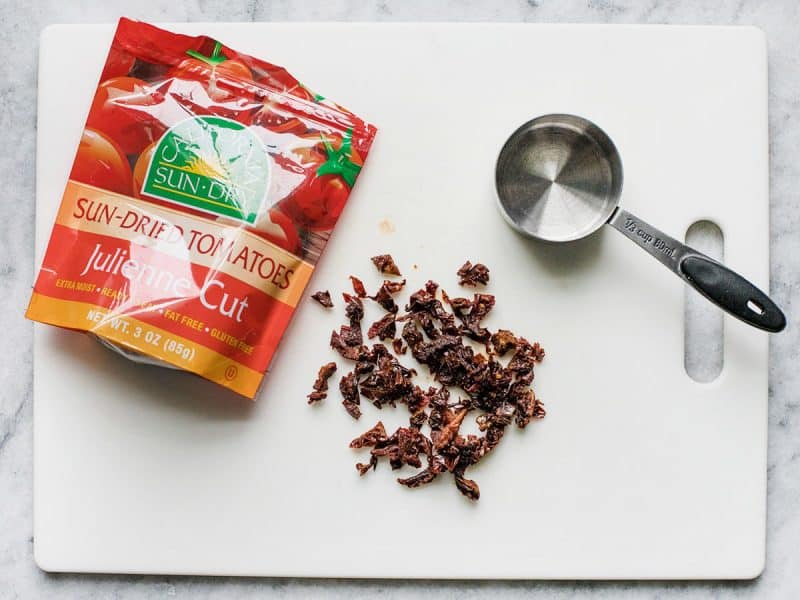
Chop about 1/3 cup sun dried tomatoes into smaller pieces, so you’ll get little bits all throughout the bread. I suggest the dry pack sun dried tomatoes rather than oil pack for this bread.

Add 3 cups all-purpose flour to a large bowl along with 2 tsp instant or bread machine yeast, 1/2 Tbsp salt, 1/2 Tbsp dried basil, and the chopped sun dried tomatoes. Stir until everything is evenly mixed.
Stir in 4oz. mozzarella (shredded). The mozzarella is optional, and honestly it just kind of melted into the bread and I didn’t notice it much in the final product.

Stir one tablespoon tomato paste into 1.5 cups warm water. Since I rarely use an entire 6oz. can of tomato paste at one time, I freeze it in one tablespoon portions just for occasions like this. :) Read more about how I freeze tomato paste here.
Pour the tomato water into the flour mixture. Because of slight differences in moisture content of flour or variations in measuring, you may need to use slightly more or less water each time, so I suggest going by the texture of the dough and not an exact measurement here. See the next photo for details on what you want the dough to look/feel like.
You want the dough to be fairly wet, sticky, and shaggy. It shouldn’t be so wet that it is glossy or slimy, but definitely too wet to handle with your hands. Also, it shouldn’t be so dry that there is dry flour left on the bottom of the bowl or on the surface of the dough. Cover the bowl loosely and let it rise for one hour, or until it’s double in size.
After it has risen for about an hour the flour will have soaked up some of that water so it won’t be quite as sticky (although still more sticky than a traditional kneaded bread dough). Sprinkle some flour on top of the dough and scrape it away from the sides of the bowl with your hand.

Turn the dough out onto a well floured surface and fold it over on itself 5-6 times, or just until it feels smooth. It should still be a very loose dough. Place the ball of dough on a piece of parchment paper and let it rise for another 30 minutes. Because the dough is so loose, it will rise more out than up, and that’s okay.

While the dough is rising, place your Dutch oven in the oven and begin to preheat it to 425ºF. Using a Dutch oven for this bread really makes a big difference in the texture of the crust and helps the dough be more of a dome shape, but if you don’t have one you can still cook the bread on a baking sheet.

When the dough has risen for 30 minutes and the oven and Dutch oven are fully preheated, CAREFULLY remove the Dutch oven from the oven, take off its lid, and then lift the entire bread dough and parchment paper into the Dutch oven. Put the lid back on the Dutch oven, put it all back into the hot oven, and bake for 30 minutes.
After 30 minutes of baking with the lid, it will look like this. Now remove the lid, return it to the oven, and bake for another 15-20 minutes to let the crust fully brown…
And at that point it should be absolutely GORGEOUS. I mean seriously. Look at that. 😍 Lift the whole thing out of the Dutch oven and allow it to cool before slicing.

There really is “no knead” for any other type of bread. Har-har-har. 🙈
The post Tomato Basil No Knead Bread appeared first on Budget Bytes.


Above are some of the signs that stood out to me during the Women’s March here in NYC yesterday. I marched with the remarkable Vicki Saunders, wearing my big red heart from last year.
It felt powerful and so poignant to me that I marched with Vicki, founder of SheEO, as she is single handedly changing the landscape for women entrepreneurs, but much more than that, creating a global support and mentor eco-system built on radical generosity. I am hopeful for the future my daughter is growing into. A world where women support women and where women will eventually get equal rights and respect. We will get there!
Interested in Vicki’s work? Watch her CreativeMornings talk.

Having an infant and now toddler with TPN presents many challenges. One of the most stressful can be keeping her line from pulling. Ask any mom with a toddler who moves and gets TPN and they will tell you its rough! After 7 line breaks in 13 months we knew something needed to change. We started using Gus Gear Central Line Wrap and it made a positive difference in our life. Not only has it reduced stress, it has increased Addie's safety and make sure she is better protected. I wanted to share why we love Gus and Gear and why every child with a central line should have one...or a few!

1. Decreases the Possibility of Line Breakage
Prior to getting Gus Gear, we averaged a tear in her line about every other month. In one year, she had 7 line repairs so we knew we needed to do something differently. Most people would think she got the tears from pulling at the line, but only one tear happened because of that. Toddlers are busy and kids move. They are not meant to be connected to a spaghetti sized cord coming out from a vein that goes into their heart. Most of her tears came from just general life and pulling on the line. Gus Gear can help prevent these types of tears and the snaps keep the line in place. When it pulls, it pulls on the clips, which holds it in place. In the 4 months since we've had Gus Gear, she has not had a single repair!

2. Safer When Handling Line
When you access your child's central line, it feels a little bit like Russian roulette. Can you do all you need to do while keeping everything sterile, clean, keep her safe, and keep her hands away from pulling??!? Having the line clipped into the wrap while accessing the line makes it so much safer. I never realized how stressed and worried I was about it until we got the Gus Gear. While you are connecting, disconnecting, changing a cap, etc. the line is clipped in, which can prevent it from tugging.

3. Use When Infusing and Disconnected
One of things I like about it is you can keep it on when infusing and when you are not. You do not need to take it on and off and add another step to your connection/disconnection process. It also protects the line when its connected AND when it is not.

4.Decreases Dressing Changes
Before Gus Gear, Addie would need reinforcement on her dressing mid week and sometimes a new dressing. With Gus Gear, an awesome side effect is that it protects the dressing, and keeps the wear down to a minimum. Most weeks, her dressing looks perfect even when it is time for a dressing change.

5. Prevented Line from Pulling Out
Recently, Adeline took a tumble out of her crib. More like a dive. She claims she "faw offuh cwib", but really she climbed. I was at my parents and while my mom was worried about her breaking her neck, I was worried about her line. I ran upstairs, ignoring the bump on her head, and got her undressed as quick as I could already planning my visit to the emergency room in my head. The wrap did it's job, her line stayed secure.

6. Keeps Line Out of Her Hands
Instead of her line hanging directly in front of her, right near her heart, the central line wrap puts it it off to the side. It helps keep it away from those wild yummy hands. The Gus Gear literally covers the line, which keeps it out of sight and out of hands.

7. Easy Access to Line While Wearing
While she is wearing, her line is easily accessed by a flap on the front of her wrap. The velcro is some crazy kind, and nothing sticks to it besides the other velcro. There are not fuzzies or hairs, its kind of amazing.

8, Protects from Small Spills
The wrap is not meant to keep the line from getting wet or protecting it from spills, but it does. If she throws up or has a poop explosion, the wrap is an extra layer of coverage that keeps the actual dressing from getting wet or soiled. Because our protocol is, if it gets wet or soiled, you change the dressing. And we all know what a pain in the butt that is! That being said, I would recommend getting at least two wraps, for this exact reason.

9. Love the Material on Her Skin
It is made with soft supplex material, which I love. I had to google what supplex fabric meant, but its water repellent, it has the feel of cotton, with a soft smooth touch, and Nylon's high strength and durability. It reminds me of a really high quality work out fabric and is breathable, lightweight, and water repellant.

10, Made with Room to Grow
The wrap allows for 2-3 inches of growth around the back and has adjustable shoulder straps, so this will grow with your child. Addie will fit in her Gus Gear Wraps for a few years. I love products like this that will last over time and I do not need to purchase every year.
We are so excited to be able to provide you guys a discount code to use on your purchase of Gus Gear and use code ADDIE10 for 10% off your purchase. You can get your first Gus Gear here!

Message from Sarah Palya, Founder & CEO
I am Sarah, mother of 2 and founder of Gus Gear. When my son, began his medical journey in 2007, I had no idea what was in store for us! The addition of a GJ tube, cecostomy, ostomy, and central line all happened over time. I had to find a way to keep Gus safe and so Gus Gear was born.
The biggest challenge I faced was his central line because that is a life and death issue. I created the central line wrap to keep his line locked down and safe not only from accidental pulls, but from his fingers as well! So much more than simply a cover, this wrap is quite literally a life saver – and has been for my son for many years. I’ve seen first-hand how it saves his central line from breaks and have heard from hundreds of customers that it has done the same for them. We currently have 9 hospitals buying directly from us for their patients to save their precious central lines both in and out of the hospital. I encourage all our customers to mention it to their treatment team so that together, we can save more lines!
Gus Gear’s product line includes central line wraps, ostomy pouch covers, line covers, and covers for other items like Farrell bags and urine bags. Everything Gus Gear makes has been used by us daily at one time or another. In this way, I have been able to personally critique and improve each cover to make it not only attractive, but functional. Each item is hand crafted with attention to detail. Gus Gear is constructed with quality fabrics that, when properly cared for, will hold up over time.
Gus Gear’s mission is to increase patient’s quality of life, allowing them to live their best life!

What Else is Addie Wearing?
Her headband is made by our favorite KRZA and her blanket is from Hello Snuggles which is the softest.
Lets get cozy