Shared posts

29 May 00:39

lichgem: rinwolfy: missstockinganarchy: stunningpicture: My...


lichgem:

rinwolfy:

missstockinganarchy:

stunningpicture:

My 7 year old son was shot down by his 1st grade teacher

is this to kill a mockingbird

this is literally to kill a mockingbird right here

once again, showing us that school is only about following directions and passing, and not about learning

Jesus Christ, it wasn’t even a part of the actual assignment, it was just where the kid wrote their NAME

24 May 21:21

The Fan Based 3D Printed Star Wars Desktop Game #3DPrinting

by Noe Ruiz

3D Printable Star Wars Game on Thingiverse

3D Printable Star Wars Based Desktop Game - Box Art

Download and full instructions are available on Thingiverse

Thingiverse user Geoffro shared a great 3D Printed project on thingiverse. Jabba’s Rancor is a 3D printable game piece for a fan based Star Wars desktop game.

Star Wars, all characters, planets, moons, droids, creatures and Bantha fodder are Restricted Trademarks of Disney/Lucasfilm
This is a fan-based game designed and printed at absolutely no profit. No employees, No Kickstarters, no crowd funded hoopla. No parts of this game, models or meshes can be sold, at all, ever.

Disney (now) and will always hold the rights to send me a cease and desist letter. Please help me complete the game for you so we may all enjoy it, by abiding to the above rules.

Any questions, improvements or concerns can be directed to swu3dp@gmail.com

Please Read the Instructions for printing tips and info.

This project is interesting because it’s a great example of fans contributing to a brand with 3D Printing. We’ve seen a few big companies release STL files, but in this case the fans are contributing to the brand by creating their own pieces for the desktop game. To avoid a DCMA take down notice or any other legal issues Geoffro clearly disclaims the STL files should not, in any way, be sold and also gives proper attribution to Disney/Lucasfilm.

3D Printable Star Wars Game on Thingiverse

Geoffro was able to make the game piece a 12 piece snap fit design using ball joins from thingiverse user chicuco. This is great example of Thingiverse being used as a platform for open-source driven design. Here at Adafruit, we love seeing open-source projects getting contribution and awesome derivatives.

3D Printable Ball Joints from Thingiverse

If you like 3D Printing, Star Wars, and desktop games, check out this project!

Download and full instructions are available on Thingiverse

24 May 21:17

9 Tech Superstars As Comic Book Characters # SaturdayMorningCartoons

by Rebecca Houlihan

NewImage

Neil McAllister and Tony Talbert reimagine 9 top techies as comic book superheroes and supervillains. By Patrick Miller via CIO.com

Backstabbing! Betrayal! Rip-offs! Revivals! The tech world is full of drama–the kind of drama that wouldn’t be out of place in a comic book. To drive that point home, we asked Neil McAllister (Adventures of Action Item) and Tony Talbert to create these what-if portraits of our favorite tech personalities as comic heroes and villains. Here are the secret identities that lurk within the worlds top tech luminaries, from Jobs to Gates to Torvalds to Zuckerberg.

NewImage

After his painful initial ouster from Apple, Steve Jobs underwent a radical transformation. Pride and rage amplified his Reality Distortion Field and his impeccable design aesthetic into a powerful force capable of entrancing men, women, and children the world over. Now, millions of people have been filled with insatiable lust for the turtlenecked tyrant’s shiny tech baubles. Word has it that his secret hit squad, known as The Geniuses, “schedules a visit” with anyone foolish enough to resist their leader’s mind-bending magic.

NewImage

Much like a certain ironclad superhero, Bill Gates once made billions by exploiting the world’s markets–except instead of selling weapons, he sold a horribly bloated operating system and a ubiquitous office suite. Shamed by the horrors that he had inflicted upon the world’s productivity, he decided to give back by fashioning his own superpowered suit to fight injustice (and malaria in Africa). Fun fact: His suit’s optical technology eventually found its way into the Kinect.

NewImage

Linus Torvalds fights for truth, justice, and the inalienable right to use a computer without being beholden to anyone. Not only can he code whatever superhero tools he needs to fight for liberty–compiled from tarballs!–but he also gets support for his freedom-fighting ways from his loose-knit confederation of open-source allies. And, of course, his rascally penguin sidekick Tux provides comic relief.

NewImage

Every tech superbeing can trace the origin of their powers back to Ada Lovelace and her work on the Analytical Engine in the 1800s. Official records state that she died shortly after she began to tap the true power of the computer, but conspiratorial types are convinced that she haunts the Internet, lending a hand to the good guys in times of dire need…a friendly ghost in the machine.

NewImage

Although he does have the ability to throw the occasional sheep, Mark Zuckerberg doesn’t have superstrength or the ability to fly. What he does have is a database with every single piece of Internet communication you make on your phone or PC. That database contains information on everyone’s strengths, weaknesses, and secret identities. He calls it “Facebook.”

NewImage

Google cofounders Larry Page and Sergey Brin aim to solve the world’s wars, inequalities, and strife…by uniting everyone under the Google banner. This dynamic duo can always find whatever they’re looking for, and they have the uncanny ability to manipulate the weather (well, the cloud, anyway). Backing them up is an army of Androids with a penchant for sweets.

NewImage

The Zune, the Kin, Windows Vista…well, those aren’t Steve Ballmer’s fault. Hes just really, really excited about Microsoft and technology, and before you know it he’s on the CES keynote stage shouting “DEVELOPERS!” over and over again.

NewImage

We wouldn’t even be talking about Yahoo anymore if it weren’t for Carol Bartz, who went off the deep end trying to restore Yahoo to its major-player status. She has trained in the ruthless art of Management Fu, and her loyal minions will stop at nothing (short of labor laws) to deliver her to Google’s seat of power. Or Facebook’s. She’s not picky.

Read More


Each Saturday Morning here at Adafruit is Saturday Morning Cartoons! Be sure to check our cartoon and animated posts both nostalgic and new that inspire makers of all ages! You’ll find how-tos for young makers, approaches to learning about science and engineering, and all sorts of comic strip and animated Saturday Morning fun! Be sure to check out our Adafruit products featuring comic book art while you’re at it!

24 May 21:15

"Heart disease-on-a-chip" could usher in an age of personalized medicine

by Ben Coxworth

Scientists have created functioning human heart tissue that exhibits Barth syndrome  (Imag...

When we've previously heard about "organs on a chip," they've been miniature recreations of healthy organs. If they're being used for research into the treatment of health problems, however, then it only makes sense that those "organs" should have something wrong with them. With that in mind, a group of Harvard scientists have created the world's first lab-grown sample of functioning human heart tissue that has a cardiovascular disease. .. Continue Reading "Heart disease-on-a-chip" could usher in an age of personalized medicine

Section: Medical

Tags: Harvard, Heart Disease, Stem Cells, Treatment

Related Articles:
24 May 21:15

NASA orbiter discovers new Martian crater

by David Szondy

Large, fresh crater surrounded by smaller craters (Image: NASA)

There are millions of impact craters all over the Solar System, but direct evidence of the massive collisions that form them is very hard to come by – and therefore very valuable. While carrying out its routine monitoring of the weather on the Red Planet, the Mars Color Imager (MARCI) on NASA’s Mars Reconnaissance Orbiter (MRO) has inadvertently snapped before and after images of the largest fresh meteor impact crater found anywhere in the Solar System... Continue Reading NASA orbiter discovers new Martian crater

Section: Space

Tags: Imaging, Mars, Mars Reconnaissance Orbiter, NASA, Solar System

Related Articles:
24 May 21:15

2014 EarthRoamer XV-LTS conquers the world, tailgates afterward

by C.C. Weiss

The 2014 EarthRoamer XV-LTS at Overland Expo

Don't call the EarthRoamer an RV – it's an XV (Xpedition Vehicle), and it's ready to take you to the most distant, rugged lands on the planet. The latest model packs the same four-season, go-anywhere build EarthRoamer has always been known for with a few added features, including a tailgater package with external kitchen and slide-out TV. Gizmag took a closer look inside and out at the recent Overland Expo. .. Continue Reading 2014 EarthRoamer XV-LTS conquers the world, tailgates afterward

Section: Outdoors

Tags: Campervan, Camping, EarthRoamer, Overland Expo, RV

Related Articles:
24 May 21:10

1942: Assembling the Sears catalog

by Amanda

Assembling Sears Catalog 1Assembling Sears Catalog 3

24 May 21:08

1907: Accessories for open air driving

by Amanda

accessories Open Air Driving 1

23 May 23:46

oh


oh

23 May 22:22

prayke: Terrarium bots

Bunker.jordan

Want to make


prayke:

Terrarium bots

23 May 22:17

Handmade Swords - Master Sword from Zelda Maker &...


Handmade Swords - Master Sword from Zelda

  • Maker & Copyright: Brendan Olszowy
  • Measurements: Overall Length: 1052mm (41.41”). Blade length: 811mm (31.93”). Grip Length: - grippable area 207mm ( 8.15”). Blade Width: Waist 35mm > Flare 52mm > End of Fuller 31mm. Point of Balance: 83mm (3.26”) from blade shoulder. Centre of Percussion: 515mm (20.2”) from shoulder. Hilt node of percussion: is 52mm (2.05”) back from top of the diamond. A fraction forward of the centre of the fore grip. Weight: 1490g 3lb 4.5oz 
  • Medium: Blade: 9260 High Carbon Steel. Grip/Scabbard: Poplar core with Veg Tanned Leather wrap/ straps. Hilt Furniture: Bronze by Jeffrey J Robinson
  • Inscriptions: “Sword of the hero of legend” and “Edge that is the bane of evil”

Source: Copyright © 2014 Fable Blades

23 May 21:23

chaz-gelf: sixmilliondeadinternets: Gandhi has been...


chaz-gelf:

sixmilliondeadinternets:

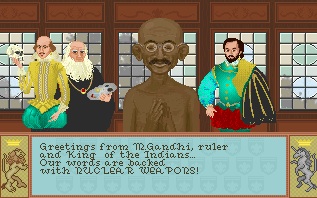
Gandhi has been historically the most aggressive character in Civilization due to an original bug in the first game that caused him to go all-out once he reaches democracy. They just kept the thing going ever since.

To further explain this bug, because I was chatting with mothmonarch about Civilization and other strategy games last night and I never got around to explaining this fully, but I love this story:

Gandhi’s AI in the original game had its aggression set to the absolute minimum (0 on a scale of 0 to 10, I believe, I may have this wrong but the basic idea I’m about to explain is accurate, as far as I can tell). Adopting democracy lowers an AI civ’s aggression by 2 points, so when someone who is fully peaceful loses two points of aggression, they should still be nice and polite, right?

Except this is an old DOS game, and so computer math is in place. What actually happened was that Gandhi’s aggression level ticked backwards two steps, from 0 to 255On a scale of 0 to 10, Gandhi is now 255 points of pure nuclear rage.

And that’s the story as I recall it, but again I may have gotten some details wrong, so feel free to correct me! After that, as the original poster said, the devs loved the bug so much that they just kept it in as a running joke!

23 May 21:19

A Never-Before-Seen Meteor Shower Peaks Tonight – Here's How To Watch

by Robert T. Gonzalez

A Never-Before-Seen Meteor Shower Peaks Tonight – Here's How To Watch

Skygazers tonight will have a rare opportunity to witness the arrival of a brand new meteor shower. Astronomers aren't sure what to expect, but many predict we could see the skies flood with hundreds of meteors per hour, which would make tonight's far and away the most spectacular shower of the year.

Read more...


23 May 21:16

Applying Prosthetics with Liquid Latex

by Amy Ratcliffe

Liquid latex for prosthetics

If your cosplay involves prosthetics, liquid latex is a wonderful adhesive to make it stick to your skin. Besides keeping the prosthetic in place, you can blend in the edges of the latex with makeup for a more seamless look. Cosplayer Danielle Beaulieu reviewed the process from choosing liquid latex to removing it. She stresses that it’s an easy skill for a beginner to pick up and learning how to use the material opens up new cosplay doors. She recommends clearing all hair away from the area you want to apply the liquid latex and working with disposable makeup sponges (it will wreck brushes). Once you’re ready to apply your prosthetic, do the following:

When you are finally ready to put your piece on, glob the latex all over the part of the prosthetic that will be touching your skin. Now, apply the prosthetic to your face exactly where you want it to be positioned. Don’t worry if you miss your mark, you can adjust the piece for a short amount of time but it is not wise to mess around with it too much. When you have it where you want it, take either your q-tip or makeup sponge and dab some latex around the seams of your piece, so you have the liquid latex on both the prosthetic and your skin around it. Now, wait for that layer to dry. This is where it helps to have a friend. Your arm will get pretty tired, but try not to lift or wiggle the piece or you will make it harder on yourself to get the piece to dry in place. Try not to pull at the latex, you could ruin it, and by now you definitely won’t want to start over.

She also goes over applying multiple layers and blending it into your makeup. Read the entire tutorial at White Rabbit Costuming.

23 May 21:14

ozu-teapot: Die Nibelungen: Siegfried - Fritz Lang - 1924 Paul...


ozu-teapot:

Die Nibelungen: Siegfried - Fritz Lang - 1924

Paul Richter

Kriemhild’s Vision

23 May 21:11

Photo


23 May 21:09

f1rstperson: WANT


f1rstperson:

WANT

23 May 21:08

today i just realized that the Andes mountains go through just about every country in south america except brazil so i can't call brazil nuts "Andes nuts" :(

:-(

23 May 21:08

riannafinch: A cute pic of me in 100 years


riannafinch:

A cute pic of me in 100 years

23 May 15:16

Incredible Tali’Zorah Costume

by Amy Ratcliffe

Tali

When I finish a costume, I often discover I’m not actually done with it. There are always improvements or changes I want to make, and I know I’m not alone in reevaulating my work. Cosplayer Nebulaluben made an excellent looking Tali’Zorah costume, but she decided she wanted to work on the mono suit to change a couple of details and make them better. She dissected the existing suit and cut the pieces apart on the seams. She replaced the middle areas with shiny black vinyl fabric that she painted hexagons on with spray paint (she printed a template).

After adding that detail, she worked on the tops of the sleeves to make them more accurate to what the character wears in Mass Effect. They were smooth, but they should be striated. She took a piece of shiny vinyl and scored it with many parallel lines, and she ended up with a neat, textured look that she attached to the rest of the sleeve.

She details the process at her site, and she has several photos showing the adjustments she made to the bodysuit.

sleeves

suit costume

23 May 15:16

Paralyzed teen to deliver first kick at World Cup 2014 thanks to 3D printing & bionic exoskeleton

If all goes as planned, the whole world, millions of viewers will watch as a Brazilian paralyzed teenager gets up from his wheelchair and walks onto the field and kicks the ceremonial ball at the opening ceremony of the FIFA World Cup games June 12.

This article Paralyzed teen to deliver first kick at World Cup 2014 thanks to 3D printing & bionic exoskeleton is first published at 3ders.org.

23 May 15:10

#1032; In which a Dog is praised

by David Malki

The best dog is a dog not owned by a DOG RACIST :[

23 May 11:32

May 22, 2014


Kerpow!
23 May 01:39

No, The Moon Landings Weren’t Faked. (And Here’s How You Can Tell.)

by JPMajor
Buzz Aldrin on the Moon with a lunar seismic experiment, July 20, 1969 (NASA photo)

Buzz Aldrin on the Moon with a lunar seismic experiment, July 20, 1969 (NASA photo)

When you write about space as often as I do (and use a laptop with a big NASA sticker on the cover no less) you’re occasionally going to get the question posed to you: did we really land on the Moon? (That, and “do you believe in UFOs?”) And with this year marking the 45th anniversary of the Apollo 11 Moon landing — which, by the way, most definitely happened — and this particular weekend being 45 years since the Apollo 10 “dress rehearsal” lunar orbiting mission, I thought I’d assemble a list of a few oft-purported  “proofs” of a Moon landing hoax… and then let you know why they’re completely wrong.

You’ve probably heard a few of these before…

1. The flag is waving.
This is one of the biggest claims waved around (pun intended) by conspiracy fanatics. When the U.S. flag was placed by Armstrong and Aldrin and recorded by the TV camera they’d previously set up, it appears to be waving in a non-existent lunar breeze. But there’s no atmosphere on the Moon, how can there be a breeze to blow a flag around?

This isn’t proof of location on a Disney sound stage in Burbank. The flag isn’t “waving,” it’s swinging.

First of all the U.S. flag was hanging from a telescoping rod along its top to keep it extended, but it wouldn’t extend all the way. And when planting the flagpole, the astronauts had a difficult time getting very far into the lunar surface… after a few inches they hit some pretty solid stuff. The struggle to keep it upright for a good photo-op meant that it got some pretty vigorous shaking, and this resulted in a lot of movement. The Moon doesn’t have an atmosphere (not including some sparsely-scattered ions and dust) but it does have gravity — about one-sixth of Earth’s — and a well-shaken banner will still wave… just not in any wind. In fact once they were done fussing with the flagpole, it stayed still for the remainder of the mission.

“During a pause in experiments, Neil suggested we proceed with the flag. It took both of us to set it up and it was nearly a disaster.”
– Buzz Aldrin

Unfortunately as soon as the ascent stage of the LM launched, returning Neil and Buzz to lunar orbit to meet back up with Michael Collins in the CM, the entire flag was blown over — but from the force of the ascent rockets, not “wind.” (Luckily Newtonian physics work very well in space, otherwise we’d never get anywhere!)

Buzz Aldrin practices taking pictures with his suit-mounted Hasselblad (NASA/JSC scan)

Buzz Aldrin practices taking pictures with his suit-mounted Hasselblad (NASA/JSC scan)

2. If there’s no atmosphere on the Moon, where are the stars in the photos?
This is Photography 101. The Apollo astronauts were using several types of cameras to record their lunar adventures, one being modified medium-format Hasselblad 500 EL cameras mounted to their spacesuits. These were film cameras and had to be set just right to get pictures to develop correctly — not unlike today’s digital cameras, but without the convenience of auto mode! All the astronauts went through training on how to shoot with the cameras, so when they got to the Moon they were able to take some really great shots of the surface in beautiful 70mm detail. (Check out the Project Apollo Archive for hi-res scans of the color and black-and-white film they shot.)

Daytime on the Moon is about two Earth weeks long. (A full solar “synodic” day there takes 29.5 Earth days.) All the Apollo surface EVAs took place on the side facing Earth during the lunar daytime. This means that the Sun was in the sky, illuminating the surface and everything the astronauts were doing… including taking pictures. So even though there was no atmosphere above them, the astronauts still had to expose their cameras to account for a very bright lunar landscape (and in some instances with a very harsh, big white star we call the Sun in the sky.) They were there to explore the Moon, not the stars, and so they didn’t waste any film taking astrophotos.

Long story short, in order to capture stars in their photos they would have had to expose for them in camera, which would have resulted in a very blown-out, blurry lunar surface. (Plus they didn’t bring along tripods for long exposures.) Think about it — if you took pictures outside at night, and let your camera adjust for a well-lit object or scene, even if there was a sky full of stars above you at the time they wouldn’t be visible in your picture. It’s just how cameras work — they simply can’t adjust like your eyes do.

Learn more about the lunar cameras here.

3. You can still see things in the shadows. They should be completely black with no air to scatter light.
Well, yes and no. It’s true that light on Earth is scattered by the atmosphere, and so we can see even where the Sun isn’t directly illuminating a scene. And in space, shadows can be incredibly dark because of the lack of this effect. But there is still reflected light, and the lunar surface is reflective.

Aldrin lands

Buzz Aldrin descending the ladder of Eagle

When Neil photographed Buzz descending the ladder onto the Moon’s surface, you can still see him pretty well even though he’s clearly in the shadow of the LM. This is the result of reflected light from the Sun hitting the lunar regolith and bouncing back up into the shadows, not “another source of artificial illumination” claimed by some conspiracists. Again, no atmosphere doesn’t negate the physics of how light works — after all, the Moon is pretty dark in color yet we see it as a very bright object in the night sky, especially when full. This is a ready testament to its reflectivity (and even then it’s still only reflecting 12% of the sunlight it receives.)

Also don’t forget that in addition to the Sun, the Earth was in the sky above the Apollo astronauts — and it was also reflecting sunlight onto the Moon, just like the Moon does onto Earth.

Want an example of how this worked? Check out Ian Goddard’s demonstration site here, and see the results of an experiment on Discovery Channel’s “Mythbusters” here.

4. The shadows in the photos were uneven.
Therefore alternate lighting sources? No, therefore uneven terrain. Single-source lighting on a perfectly flat plane will result in perspective-aligned shadows, but on an uneven surface the shadows will “appear” to slant off at different angles as they are projected across the ground.  The Moon pretty much has no perfectly flat planes — it’s cratered and hilly down to the smallest scales. Shadows cast by the Sun will be skewed all over the place. (See the link above for a sample of that too.)

Apollo 16 astronauts John Young and Charlie Duke got to drive a Boeing-made Lunar Roving Vehicle (LRV) on the Moon, one of three sent up during the Apollo program. Note how the dust is kicked up in nice billowing arcs by the LRV’s wheels… that’s not Earth gravity in action!

5. Radiation would have killed the astronauts en route to the Moon.
Radiation in space is very dangerous. Nobody’s contesting that fact. Even a thickly-hulled spacecraft can allow in enough cosmic radiation to damage living DNA over long durations, and outside of Earth’s protective magnetosphere it becomes an even bigger danger. This in fact is still a major obstacle to overcome if we’re to send humans to Mars or beyond. But the Apollo astronauts weren’t on a year-long voyage to Mars, they were on week-long trips to the Moon. Even the Van Allen belts, which concentrate energetic particles from the Sun into donut-shaped rings surrounding Earth, were passed through pretty quickly by the Apollo spacecraft on their way Moonward.

A pretty clear explanation is given by astronomer Phil Plait in his 2001 Bad Astronomy article:
“The van Allen belts are regions above the Earth’s surface where the Earth’s magnetic field has trapped particles of the solar wind. An unprotected man would indeed get a lethal dose of radiation, if he stayed there long enough. Actually, the spaceship traveled through the belts pretty quickly, getting past them in an hour or so. There simply wasn’t enough time to get a lethal dose, and, as a matter of fact, the metal hull of the spaceship did indeed block most of the radiation.”

Now, had the Apollo astronauts been in the way of a strong solar flare event while on the lunar surface, it would have been a different story. Protected only by their space suits, they could have received a lethal dose of solar radiation very quickly as a cloud of particles swept past the Earth and Moon. Luckily that didn’t happen, but it was an occupational hazard. (Although compared to the countless other dangers they confronted in order to achieve their goals, that was somewhat low on the list.)

6. We didn’t have the technology in the 60s to go to the Moon.
This is a total cop-out argument. Yes, 1960s technology was far inferior to what we have today… even one of our cell phones contains vastly more computing power than what was aboard the Apollo spacecraft. But the Apollo spacecraft only had to know how to do one thing: get living, breathing astronauts to the Moon and back. This was achieved through complex engineering and the efforts of many thousands of the brightest minds in the country, not to mention a few fearless astronauts who knew a thing or two about flying experimental aircraft. Getting to the Moon was a case of pure physics, dedication, and guts… the required innovations just came as a direct result. Read more here on Clavius.org.

As far as NASA having created all the footage of the landings in a studio, it actually would have been easier at the time to just go to the Moon…

7. We’ve imaged all the Apollo landing sites from lunar orbit.
NASA’s Lunar Reconnaissance Orbiter has been surveying the Moon for five years now, and during that time has imaged all of the Apollo landing sites from its position in lunar orbit. Several times, in fact, and under many different lighting angles. So while we can’t visually resolve the remains of the Apollo sites from Earth, LRO can see them very nicely… LM descent stages, ALSEPs. LRVs, and astronaut tracks all as they were left over 40 years ago.

The descent stage of Eagle can be seen in this LRO image, along with tracks and experiment packages. (NASA/LRO/Arizona State University)

The descent stage of Eagle can be seen in this LRO image, along with tracks and experiment packages. (NASA/LRO/Arizona State University)

8. Okay smart guy, so if we REALLY went to the Moon, how come we never went back?
This, unfortunately, has more to do with the nature of politics and public interest than space technology, although the latter often becomes a casualty of the former. There’s a lot involved with the answer to this, but suffice to say after the Apollo program was closed down, the technology to send humans to the Moon was retired. The Saturn V rockets were either dismantled, put in museums, or, in the case of Skylab, used in other programs, and eventually all of the special components created by contractors and sub-contractors that allowed the success of Saturn and Apollo were no longer available or in production. We didn’t lose the technology, as some have claimed, we just stopped making it, at least for those specific uses. As times changed, priorities (and thus budgets) changed, and NASA’s manned spaceflight program of the 60s and early 70s became a thing of the past, in some cases replaced by newer, better goals… but in some cases still not replaced at all.

Is it a shame that the last bootprints on the Moon are still those of Gene Cernan from December 1972? Heck yes. Does it mean he never went at all? Hell no.

Read more in this article by Space.com’s Clara Moskowitz.

The Apollo missions are still one of the crowning achievements (in my opinion, at least) of both our country and of humanity as a whole. Yes, the reasons behind the race to the Moon in the 60s were very political, that’s surely no secret. But in just eight years we went from sending the first American on a brief suborbital flight to safely landing astronauts on the surface of another world and bringing them home again, an incredible feat accomplished only through the talent and hard work of literally hundreds of thousands of people — over 400,000, in fact (source) — and the support and financial backing of an entire nation. Reasons aside, the summer of 1969 changed both the global political landscape and our perspective of our place in the Universe, and that’s not something to be dismissed lightly… or with wanton disregard for all those who made it happen.

(And, of course, let’s not forget the undeniable 842 pounds of Moon rocks that the Apollo astronauts brought back to Earth with them, and the laser ranging reflectors that were left up there and still being used to measure distances to the Moon today!)

“The body of physical evidence that humans did walk on the Moon is simply overwhelming.”
– Dr. Robert Park, Director of the Washington office of the American Physical Society

Want to dive deeper into the debunking of any Moon landing hoax? Check out the links below:

Great info from University of Arizona LPL Senior Researcher Jim Scotti

“Bad Astronomer” Phil Plait’s de-hoaxing article (which specifically attacks a 2001 “documentary” on Fox TV)

 NASA’s Response to Said Fauxumentary

Clavius.org  – a site dedicated to debunking Moon hoax theories

 A Retrospective Analysis of Project Apollo (NASA)

National Geographic attacks 8 Moon landing hoax myths

A debunking by rocket and space technology site Braeunig.us 

Watch Universe Today’s video “How Do We Know The Moon Landing Isn’t Fake?”

Apollo Landing Sites Imaged by NASA’s Lunar Reconnaissance Orbiter

Added 6/3/14: A “Decisive Debunking” of the Moon Landing Conspiracy by med student Hasaan Rafique

Added 6/3/14: The Moon Landing Hoax Debunked on RelativelyInteresing.com

__________________________

…and after all this, if you still must believe that the Apollo missions were all an elaborate scam, I’m afraid I really can’t help you. The world you choose to live in is much, much more dark, tangled, and subversive than I care to venture into. I’m just sorry that you have so little faith in what humans can achieve. 


Tagged: Aldrin, Apollo, Armstrong, debunk, hoax, landings, moon, NASA, space
23 May 00:49

is there a fictional battlemech squadron named Tex Mechs, and if not why not
is there a fictional battlemech squadron named Tex Mechs, and if not why not

23 May 00:47

MakerBot’s Digital Store Opens

by Site Admin
Bunker.jordan

... saw this coming ~sigh~

Proprietary filetypes means I am officially boycotting MakerBot.

makerbot digital storefront.jpg

As promised in their January announcement, MakerBot made good on their promise to open a digital store for 3D models. 

The store complements their successful Thingiverse operation, which distributes free 3D models submitted by enthusiasts. The new digital store offers far fewer models, but includes a curated collection of reasonably complex, yet still 3D printable models offered for a small fee per download. 

One example is the T-Rex skeleton, which contains some 79 separate pieces that apparently take over 24 hours to 3D print on a MakerBot. The models are delivered as X3G files, which are usable (mostly) only on MakerBot or compatible machines. This means you cannot purchase the T-Rex, for example, for printing on your Afinia or Cube 3D printer. It’s a closed system. 

For MakerBot users, it’s probably a good thing: high-quality, curated models are available for printing at more-or-less reasonable prices. For users of other machines, it may mean a slightly diminished Thingiverse is the future. 

If we were a 3D printer manufacturer, we’d be reviewing our content strategy about now. 

Via MakerBot

23 May 00:35

theycallmey: we live in the best possible version of cyberpunk


theycallmey:

we live in the best possible version of cyberpunk

22 May 23:55

Congress Asked Some Really Weird Questions at the Alien Life Hearing

by George Dvorsky
Bunker.jordan

"Rep. Chris Collins posed the question he thought was on everyone's mind — "Have you watched Ancient Aliens and what is your comment on the series?" "

Congress Asked Some Really Weird Questions at the Alien Life Hearing

Yesterday, SETI astrobiologists told the U.S. Congress there's "close to a 100% chance" that aliens exist, adding that we might detect signs of life in 20 years. But things went south when the floor opened up for questions.

Read more...


22 May 23:53

An Archeologist Explains Why Looters Are Stealing More Than You Think

by Ria Misra

An Archeologist Explains Why Looters Are Stealing More Than You Think

Pilfered artifacts are a problem for archeologists, but the problem can go much deeper than just the loss of the items.

Read more...


22 May 21:36

so i guess mgm took a huge piss on the good the bad and the ugly...


so i guess mgm took a huge piss on the good the bad and the ugly for the new remaster