Shared posts

14 May 22:35

A Profile Portrait of Tethys

by Jason Major
Tethys imaged by Cassini on May 9, 2015.

Tethys imaged by Cassini on May 9, 2015.

Here’s a beautiful view of Saturn’s moon Tethys (pronounced TEE-this) captured by the Cassini spacecraft’s narrow-angle camera on May 9, 2015. The moon’s 250-mile Odysseus crater can be seen along the right limb there, illuminated by sunlight, while the left side is lit by the dimmer reflected light from Saturn.

Tethys itself is 662 miles (1,065 km) in diameter and composed mostly of water ice and rock. Along with its bigger sisters Dione and Rhea it is one of the most heavily-cratered worlds in the Solar System.

Cassini also captured images of Dione and its signature icy “wispy lines” on the same day. Check one of those out below.

Saturn's 700-mile-wide moon Dione on May 9, 2015

Saturn’s 700-mile-wide moon Dione on May 9, 2015

I cleaned up the images a bit for specks and noise and sharpened surface details. See the original raw images here and here.

Credit: NASA/JPL-Caltech/SSI. Edited by Jason Major.


14 May 22:34

Just Your Typical Everyday View of a Mountain on Another Planet. NBD.

by Jason Major
Mosaic of Curiosity Mastcam images from May 11, 2015. Credit: NASA/JPL-Caltech/MSSS. Edited by Jason Major.

Mosaic of Curiosity Mastcam images from May 11, 2015. Credit: NASA/JPL-Caltech/MSSS. Edited by Jason Major.

Of course, one of the amazing things about this image is that it IS pretty much something we can see every day, thanks to NASA’s roving robot on Mars!

This is a mosaic of seven raw images acquired by Curiosity’s Mastcam on May 11, 2015 – aka mission Sol 981. The view is looking east toward Mount Sharp (Aeolis Mons) which rises 18,000 feet (5,480m) from the floor of Gale Crater. The valley in the foreground, as well as the rock outcrops around it, have attracted mission scientists because it seems to have been carved out from the surrounding area and then filled in with sediment and sand.

“It’s exciting to see this on Mars for the first time,”said Curiosity Project Scientist Ashwin Vasavada at JPL. “Features like this on Earth capture evidence of change. What in the environment changed to go from depositing one kind of sediment, to eroding it away in a valley, to then depositing a different kind of sediment? It’s a fascinating puzzle that Mars has left for us.”

The view above uses colors as detected by the rover’s Mastcam. For an idea of what the same scene would look like under Earthlike lighting, see below:

Mosaic of Curiosity Mastcam images from May 11, 2015. Adjusted for terrestrial lighting. Credit: NASA/JPL-Caltech/MSSS. Edited by Jason Major.

Mosaic of Curiosity Mastcam images from May 11, 2015. Adjusted for terrestrial lighting. Credit: NASA/JPL-Caltech/MSSS. Edited by Jason Major.

Curiosity is now heading toward its next science objective, an area called Logan Pass just off to the right in the image above.

Find out where Curiosity is now here, and learn more about mission updates and find the latest raw images on the main website here.


08 May 15:13

Simon Stålenhag’s Retro Sci-Fi Images of a Dystopian Swedish Countryside Published In Two New Books

by Christopher Jobson

simon-11

Across the backdrop of an expansive retro-Scandinavian landscape, Swedish illustrator Simon Stålenhag has spent the last few years imagining a world of science fiction inhabited by roaming mech robots, dinosaurs, and other technological innovations plopped right onto the Swedish countryside. The digitally painted images spread far and wide across the internet over the last few years, capturing the imagination of legions of fantasy and sci-fi fans who clamoured for comic books and even a feature film. For now, we’ll have to make do with old-fashioned art books.

Stålenhag and Free League Publishing just announced a Kickstarter project for two new books featuring Stålenhag’s dystopian vision of the future that will pair illustrations with short stories written in English. You can explore many more illustrations on his website (just start scrolling), and some are available as individual prints.

simon-2

simon-3

simon-4

simon-5

simon-6

simon-7

simon-8

simon-9

simon-10

simon-1

06 May 23:58

Photo


06 May 15:37

A central mechanism of aging identified – and it might be reversible

by Richard Moss
Bunker.jordan

... this sounds suspiciously like an X-Files episode I remember...

06 May 14:17

"That’s why Elon Musk’s announcements of the new Tesla battery line last night were more..."

That’s why Elon Musk’s announcements of the new Tesla battery line last night were more revolutionary than Apple Watch and more exciting than Microsoft’s admittedly nifty HoloLens. Information tech isn’t dead — it has just matured to the point where all we’ll get are better iterations of the same thing. Better cameras and apps for our phones. VR that actually works. But these are not revolutionary gadgets. They are just realizations of dreams that began in the 1980s, when the information revolution transformed the consumer electronics market.

But now we’re we’re entering the age of infrastructure gadgets. Thanks to devices like Tesla’s household battery, Powerwall, electrical grid technology that was once hidden behind massive barbed wire fences, owned by municipalities and counties, is now seeping slowly into our homes. And this isn’t just about alternative energy like solar. It’s about how we conceive of what technology is. It’s about what kinds of gadgets we’ll be buying for ourselves in 20 years.

It’s about how the kids of tomorrow won’t freak out over terabytes of storage. They’ll freak out over kilowatt-hours.


- Annalee Newitz: The Information Age Is Over. Welcome to the Infrastructure Age.
06 May 14:14

Photo


05 May 22:59

CurvytronBrowser-based multiplayer game takes inspiration from...


Curvytron

Browser-based multiplayer game takes inspiration from the TRON lightcycles arcade, but you turn naturally instead of at right-angles.

Just type in your name, join a room, and you are ready to play (you only use two buttons: left and right).

Try it out for yourself here

05 May 22:48

IXV


IXV

05 May 22:46

Photo


05 May 22:45

Photo


05 May 22:45

Photo


05 May 22:44

Photo


05 May 21:03

TBWA/Hakuhodo’s 3D on the Rocks Campaign features Sculpted Ice Cubes #ArtTuesday

by Stephanie

NewImage

From Mashable via Demilked:

In a similar vein to 3D printing, the images are captured using Autodesk 123D and 3D designs are prepared. Then a CNC router is used to carve the designs into the ice block, according to AdWeek.

The router is chilled at -7 degrees Celsius (19 Fahrenheit), and a thick drill bit is used to create the overall shape before a finer bit is used to perfect the tiny details. The project is completed when “a touch of chilled whiskey polishes the surface of the ice and gives a beautiful shine to the sculpture,” Miwako Fujiwara from TBWA/Hakuhodo told CNET.

Read more

NewImage

NewImage


Screenshot 4 2 14 11 48 AMEvery Tuesday is Art Tuesday here at Adafruit! Today we celebrate artists and makers from around the world who are designing innovative and creative works using technology, science, electronics and more. You can start your own career as an artist today with Adafruit’s conductive paints, art-related electronics kits, LEDs, wearables, 3D printers and more! Make your most imaginative designs come to life with our helpful tutorials from the Adafruit Learning System. And don’t forget to check in every Art Tuesday for more artistic inspiration here on the Adafruit Blog!
05 May 18:56

Construction robot by IgorWolski

05 May 15:43

Cosmic Treble. by hybridgothica

05 May 11:24

VALE, GEOFF DUKE; WORLD CHAMPION, GENTLEMAN

by The Vintagent
Bunker.jordan

Crazy history in motorcycles back then. Totally look up Rex McCandless. He's on my short-list of inspirational people.

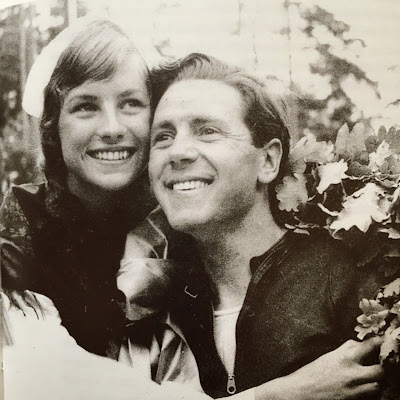
To the Victor, the spoils! After winning the '54 Swedish TT at Hedemora
News of Geoff Duke's passing filtered through the internet this weekend, as an older generation remembered motorcycle racing's first superstar and tabloid darling.  His movie-star good looks and pleasant demeanor combined with a fierce surplus of raw riding talent, and he became a welcome ambassador for the sport of motorcycling.  
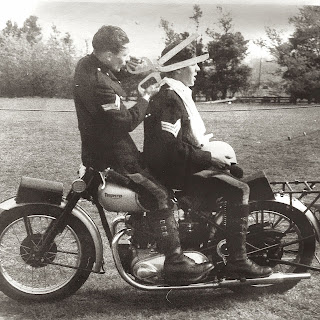
Among the tricks learned as part of the Royal Signals team - getting a haircut aboard a Triumph Tiger 100 in 1947
Duke appeared on the racing scene immediately after WW2, which seems from his memoirs to have been less a period fighting war than fighting rocky hillsides in the Royal Corps of Signals, as he learned trials riding skills from a stellar collection of ex-Brooklands men.  Quite a few famous racers and trials riders, like Freddie Frith, Hugh Viney, 'Nobby' Clark, and Charlie Rogers, pulled dual duty in the Army, both training ordinary soldiers to ride, and nurturing the talent of promising youngsters who 'joined up' under a scheme created by Graham Walker of Motor Cycling, to enlist motorcyclists as despatch riders. Duke was soon promoted to the training staff, and taught riding tricks as a member of the Royal Signals display team

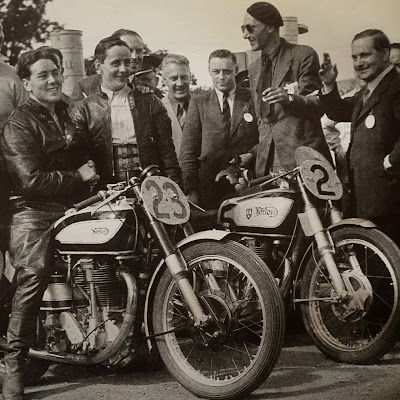
Duke after winning the '49 Isle of Man Senior TT, with Cromie McCandless (inventor of the Featherbed frame with his brother Rex), and Francis Beart, who was always Beatnik-cool, with the best prepared machines at any racetrack.  A comparison of Duke's factory Manx with Beart's 2nd place bike is instructive; no doubt his machine weighed 10lbs less than the standard racer.
After the war, he excelled at trials, but really wanted to road race.  Connections made in the military gave him jobs offers at both to AMC and Norton, but AMC wouldn't allow him to enter the amateur TT races, fearing a perceived conflict of interest, while Norton had no such qualms.  He was signed up to ride a factory Norton 500T trials machine, which he never really sorted out (to Joe Craig's disgust), but led the 1948 Junior Manx GP before a split oil tank ruined his motor.   Still, Craig watched Duke with keen interest, and after he won the '49 Senior Manx on a 500cc Manx, he was offered a spot on the Norton factory race team.
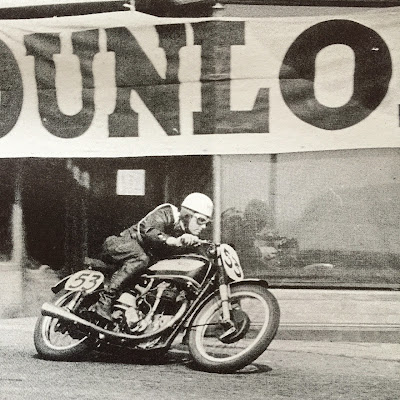
Racing at the North-West 200, under the Dunlop sign...ironic as Duke refused to race with them, after meeting with Fort Dunlop in company with Joe Craig to discuss tread-shedding disasters, which the mighty rubber company ignored.  Nortons, and Duke, thereafter used Avon tires...
The history books record, Duke rewarded Norton's support with a double World Championship (350cc and 500cc) in 1951, when he was also named Britain's Sportsman of the Year, and he was truly thrust into the limelight.  He eventually won 3 World Championships for Norton, famously on their brand-new Featherbed Manx, although it slowly dawned on him that he was earning a pittance even as Norton's champion, as the factory simply paid its racers very poorly.  Discussions with other racers revealed just how little he was earning by comparison.  Even Norton factory racers in the late 1920s earned more, as Duke was informed by Alec Bennett, whose 1927 Isle of Man win netted him £3000, more than double Duke's annual winnings 23 years later!   
Finally!  Aboard the Featherbed Manx, on his way to a couple of World Championships in 1951.
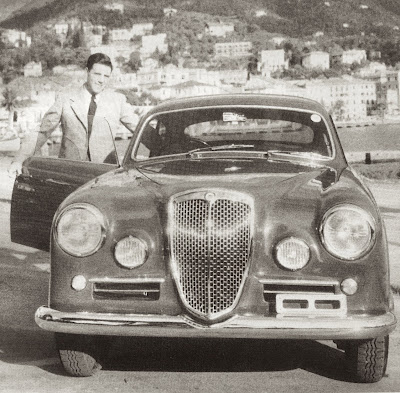
Offers came in from AJS and Gilera to ride for the factory, who both offered a base £3000 salary, and Gilera threw in a lovely Lancia Aurelia B20 coupe, which sealed the deal for the Italian factory, whose future looked far more rosy in any case, with their pioneering DOHC 4-cylinder racer, a development of their prewar supercharged Rondine.   
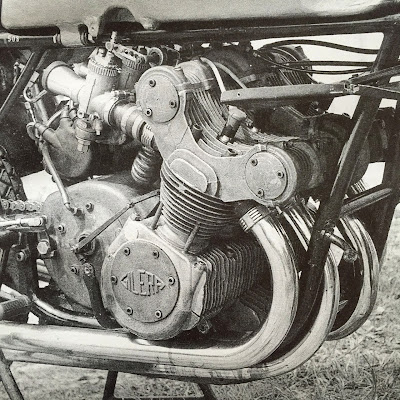
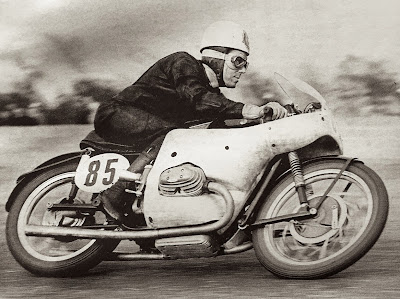
Exquisite metal.  Undoubtedly the prettiest 4-cylinder engine ever built, the factory racing Gilera, developed over 30 years from an experimental across-the-frame pushrod 4 in 1924, to the supercharged, watercooled 'Rondine', and postwar to the aircooled and carbureted World Champ.
Duke was also courted by the four-wheeled world, which was common then but unthinkable today. From the 'Teens through the 1970s, quite a few F1 drivers cut their teeth as motorcycle champions, from Tazio Nuvolari to John Surtees and Mike Hailwood, and Duke was no exception. He drove for the Aston Martin sports-racing team in 1953, and after a good finish in the Swiss GP, Mercedes F1 chief Alfred Neubauer offered him a spot driving with the all-conquering 'Silver Arrows', driving alongside Juan Manuel Fangio. Duke declined, honoring his commitments to two wheels, although his career was sidelined in 1956 by the AFM, who punished his support of a riders' strike for increased start pay at the Dutch TT, with a 6 months' suspension of racing.  This ended his World Championship hopes for '56, and for 1957, Gilera announced it was quitting GP racing, along with BMW, Moto Guzzi, Mondial, DKW, etc - the Great Die-Off.  
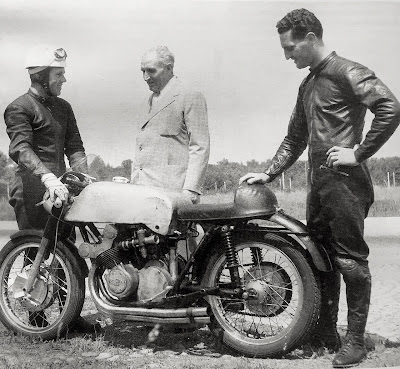
With Giuseppe Gilera and Alfredo Milani
That was effectively the end of his racing career, but he returned as team manager for his own Scuderia Duke in 1963, using identical, undeveloped Gileras from the 1957 season.  Derek Minter and John Hartle were in the running for another World Championship, remarkably, against the MV Agusta 4s - blatant copies of the Gileras, which traced their mechanical lineage back to 1924, with the OPRA pushrod across-the-frame 4.  Fate had other plans, and while the Gileras recorded their best-ever times, they needed further R&D to make the power of the newer MVs.
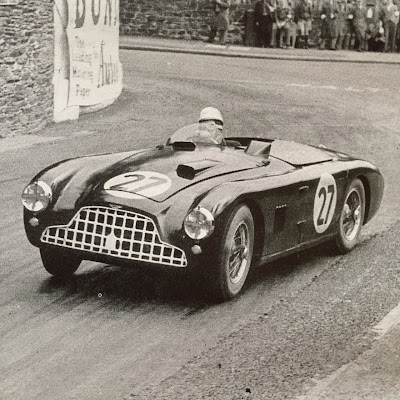
Enjoying the oversteer of a factory Aston Martin DB3.  He preferred the handling of the DB2S, which he reckoned "handled like a motorcycle - it went where you pointed and stayed on line."  On testing the first time with John Wyer (Aston racing manager), Duke was faster than any of Aston's factory drivers, the first time he'd ever tried a racing car!  He didn't fit the culture of a car-racing team, and went back to bikes, even after showing huge promise on four wheels.
I highly recommend Geoff Duke's excellent 1988 autobiography, 'In Pursuit of Perfection', which is charmingly written and full of great photos, which illustrate this story.  It takes a particular character to make a World Champion in any field, and Duke will be remembered as a 6-time winner, and the friendly face of motorcycle sport in the 1950s.
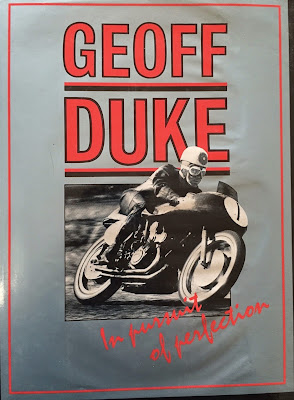
Geoff Duke's autobiography, written in 1988; buy it!
Yes, he tried BMWs too, but couldn't get the hang of the handling.

The Lancia B20 Aurelia which sweetened the deal for his Gilera contract.
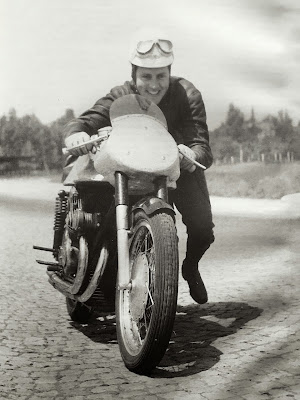
A happy Duke tests the Gilera for the first time in 1953. 
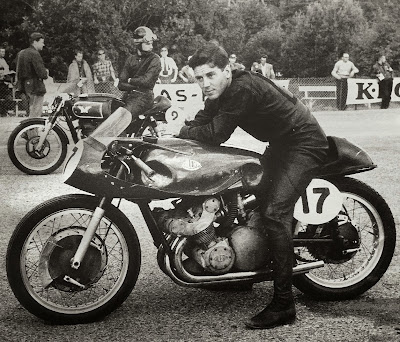
A pensive Duke before the Swedish GP at Hedemora, 1954.  The sexiest racing motorcycle of the 1950s.  Note the Matchless G45 behind, another gorgeous racer, albeit plagued with problems.
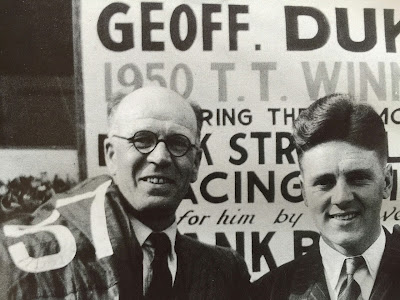
An important tale to set right: while Geoff Duke was the first World Champion to race with one-piece leathers, he wasn't the first racer to try them.  Velocette's Bertie Goodman had a set years before Duke, as did other riders, even at Brooklands.    Here's Duke's tailor, Frank Barker, who made up the leathers.  Duke understood the value of a tight fit for lower wind resistance, and by 1951 had perfected the racing catsuit with ankle-tight boots.
Sign up for TheVintagent.com by email!
04 May 21:05

Closeup by Marko-Djurdjevic

04 May 21:04

Moon DrawingsProject by Golan Levin & David Newbury will...


Moon Drawings

Project by Golan Levin & David Newbury will bring your contributed drawings to the moon (and may even be drawn onto the surface by a rover robot):

Welcome to Moon Drawings: a project to extend artistic expression to the Moon. We invite you to contribute a drawing—which will be etched on a sapphire disc, sent to the Moon, and potentially traced by a robot rover into the Moon’s soil. The disc, contained in a sculpture called the Moon Arts Ark, will be shuttled to the Moon in 2016. It will remain there for millenia: a poetic gesture reaching out, far beyond any objective existence on Earth.

There are currently roughly 9950 drawing spaces left - if you would like to contribute a drawing you can at the project website here

04 May 21:03

eatingsoapboxes: Free them.


eatingsoapboxes:

Free them.

04 May 21:03

Handmade Swords - Type XVIIIc Sword in 15th century styleMaker:...


Handmade Swords - Type XVIIIc Sword in 15th century style

  • Maker: Peter Johnsson
  • Type XVIIIc in 15th century style
  • Measurements: overall length: 111.5 cm; blade length: 86.6 cm; blade width: 7.2 cm; guard width 24.7 cm; weight: 1476 gram

The grip features embossed leather and half wire wrap. The wide bladed type XVIIIc swords saw some popularity in the beginning of the 15th century. They are depicted in art from this period and fare famously represented by a group of swords that were bequeathed by King Janus of Cyprus to the Sultan al-Mu'ayyad Shayk, following a peace treaty in 1414.

This sword will be on display at the Knife Makers’ Show 2015 this coming weekend.

Source: Copyright © 2015 Peter Johnsson Swordsmith
03 May 01:33

Massive Microsoft Machinations For Makers

by Brian Benchoff

If you’re not stuck in the tech news filter bubble, you may not have heard the Microsoft Build Developers Conference is going on right now. Among the topics covered in the keynotes are a new Office API and a goal to have Windows 10 running on a Billion devices in a few years.

There are, however, some interesting things coming out of the Build conference. Windows 10 is designed for hackers, with everything from virtual Arduino shields running on phones, Windows 10 running on Raspberry Pis, and Visual Code Studio running on OS X and Linux.

This is not the first time in recent memory Microsoft has courted the maker market. Microsoft begrudgingly supported the hardware dev scene with the PC version of the Microsoft Kinect, and a year or two ago, Microsoft rolled out drivers for 3D printers that were much more capable than the usual serial interface (read: the ability for printer manufacturers to add DRM). To the true, tie-die wearing, rollerblade-skating, acoustic coupler-sporting, Superman III-watching hackers out there, these efforts appear laughable – the product of managers completely out of touch with their audience.

Depending on your perspective, the new releases for the Arduino, Raspberry Pi, and other ‘maker-themed’ hardware could go one way or the other.

As far as educational efforts go, the Windows Remote Arduino and Windows Virtual Shields for Arduino are especially interesting. Instead of filling a computer lab up with dozens of Arduinos and the related shields, the WVSA uses the sensors on a Windows 10 smartphone with an Arduino. Windows Remote Arduino allows makers to control an Arduino not through the standard USB port, but a Bluetooth module.

If Arduinos aren’t your thing, the Windows 10 IoT preview for the Raspberry Pi 2 and Minnowboard Max is out now. The Win10 IoT distribution does not yet have working WiFi or Bluetooth, making it the single most useless operating system for Internet of Things devices. It was, however, released at the Build conference.

Also announced was a partnership with a fabulous hardware project hosting site, Hackster.io. Microsoft and Hackster.io will be collaborating with hackathons and other events focused on Windows technology. I get why they wouldn’t want another, vastly more popular project hosting site doing this, but I’m a little confused at why Instructables wasn’t the top Microsoft pick.

As always, you may express your infinite derision in the comments below. Spelling Microsoft with a dollar sign will result in a ban.


Filed under: Arduino Hacks, Raspberry Pi
02 May 07:41

Photo


02 May 07:40

Photo


02 May 07:40

Ray of Formula 1Interactive audio visual installation by WOW inc...


Ray of Formula 1

Interactive audio visual installation by WOW inc turns Scalextric-like racing into a minimal lightshow:

The installation of light and sound “Ray of Formula 1”; part of the exhibition “The F1”, was held in March 2015 and WOW was in charge of creating, planning and directing this artwork.
This artistic interactive installation uses sound and light to celebrate the passion, the soul and the racing heartbeat of the F1 driver.
By using a controller to manipulate light, you too can experience what it’s like to be an F1 driver.
By manipulating the trajectory of light, the whole race track appears, and a life-size F1 car races down the main straight at incredible speeds right in front of your eyes.

More Here

02 May 07:33

Photo


01 May 21:28

Voice your thoughts to the US Copyright Office about not criminalizing third-party 3D printer filament

It’s no secret that one of the biggest headaches that we’ve learned to live with in the world of 3D printing are various copyright hang-ups ranging from Intellectual Property rights to scanning and replicating public domain artwork, among others. Now, a new copyright issue has been raised that is less concerned about what you choose to print - and more about what you use to print it with.

This article Voice your thoughts to the US Copyright Office about not criminalizing third-party 3D printer filament is first published at 3ders.org.

01 May 21:27

Check out Atmospheric Breakup: a Webcomic About the ISS

by Jason Major
Webcomic "Atmospheric Breakup" by Andy Warner featuring Ron Garan and the ISS (Source: The Nib)

Webcomic “Atmospheric Breakup” by Andy Warner featuring Ron Garan and the ISS (Source: The Nib)

The International Space Station is the result of an amazing collaboration of many countries and countless individuals from around the world, a research lab and symbol of global peace and partnership put together in space. But recent and growing political tension between the two biggest contributors to the ISS – the United States and Russia – are casting doubt on the status of Station’s future. Will Russia continue its support of the ISS? Or will they build their own space station like some reports have suggested? And if so, what will happen to the current Station?

Ron Garan, former NASA astronaut and ISS crew member, humanitarian, and author of the new book The Orbital Perspective, is featured in a webcomic by Andy Warner (perhaps in honor of Free Comic Book Day?) called “Atmospheric Breakup,” which addresses the significance of the ISS and the challenges facing its future. Check it out on The Nib by clicking the link below or the image above.

By continuing to spread the word about the importance of international collaboration, Ron is showing us that real superheroes wear blue flight suits!

Read the full comic on The Nib here.


Tagged: Andy Warner, astronaut, comic, ISS, Ron Garan, Russia, space, space station, The Nib, U.s.
01 May 21:22

Forgotten Fridays - Shop floor layouts

by Jillian Northrup

Sometimes we are hired to create designs that, for one reason or another, never come to life.
These designs tend to get filed away. Occasionally they are brought out again, but mostly they just logged and stored in their client folder.
Here, in these "Forgotten Fridays" blog posts, we showcase and celebrate the most interesting ones that may someday again breath life!

The following concept designs were for an incubator factory space. A factory filled with digital fabrication and traditional tools that you could rent time on. The idea was to have a large open floor with the large machines spaced out as needed. Around those machine work areas, the client wanted some kind of screens, so people could have privacy to their potentially proprietary work that they were creating on the machines.

We decided to start out with three objects; a whiteboard / privacy / sound screen, a standing computer workstation, and a configurable tools / parts cart.
Everything would be on wheels, be both usable and playful, and would match an overall theme.
We then decided to start with three themes, each with it's own totally different look, so we can find the right look & feel for the shop floor.

This first scheme is a slick modern look. Taking aesthetic cues from retro-futuristic robots and sci-fi, all surfaces are white, gloss, clean and curvy.

L:\BWC Bucket\projects\FactorLi\Revit Project\Fams\Idea Boards.pdf

L:\BWC Bucket\projects\FactorLi\Revit Project\Fams\Idea Boards.pdf

The second scheme is Dazzle Camouflage. The surfaces are flat and angular, and everything is covered in a dramatic patterning of the Dazzel Camo. As these screens are to hide and distract potential onlookers from the work goings on behind the scene.

L:\BWC Bucket\projects\FactorLi\Revit Project\Fams\Idea Boards.pdf

L:\BWC Bucket\projects\FactorLi\Revit Project\Fams\Idea Boards.pdf

The final scheme is a bit more traditional in concept, celebrating the functionality of the machines on the floor in the design of the pieces. CNC hewn panels, CNC woven mesh, and exposed flat pack joinery call to the digital fabrication abilities of the machines on the floor.

L:\BWC Bucket\projects\FactorLi\Revit Project\Fams\Idea Boards.pdf

L:\BWC Bucket\projects\FactorLi\Revit Project\Fams\Idea Boards.pdf

This factory space never came into being, but the designs are still potentially useful for another project down the road.

01 May 14:54

Robots Pulls up to 2,000 Times Its Weight

by Alan Parekh


This Robots Pulls up to 2,000 Times Its Weight! It is tiny like an insect and like many insects they can control massive amounts of weight in comparison to their weight. We need to see this technology applied to dragsters, say goodbye to wheel slip. 

Via: TheVerge

 “The super-strong bots – built by mechanical engineers at Stanford University in California – will be presented next month at the International Conference on Robotics and Automation in Seattle, Washington.

The secret is in the adhesives on the robots’ feet. Their design is inspired by geckos, which have climbing skills that are legendary in the animal kingdom. The adhesives are covered in minute rubber spikes that grip firmly onto the wall as the robot climbs. When pressure is applied, the spikes bend, increasing their surface area and thus their stickiness. When the robot picks its foot back up, the spikes straighten out again and detach easily.”