
Bunker.jordan
Shared posts
14 Mar 04:12
Filed under: chemistry hacks, lifehacks


Billboard Advertises Engineering School, Manufactures Potable Water
by Kristina Panos
 It’s a remarkable thing when ad agencies manage to help people in the course of advertising. The University of Technology and Engineering Peru (UTEC) was looking for ways to increase enrollment. They went to the Peruvian offices of agency DraftFCB and came away with the idea to install a billboard that converts Lima’s water-saturated coastal desert air into potable water.
Perhaps the only downside is that it requires electricity, and not just for those cool neon water drops. There are five generators that capture the humidity and use reverse osmosis to purify the water. Each of these units has a tank that holds 20L. From there, the clean water is aggregated in a main tank and can be collected from a faucet at the base of the billboard. In just three months, the billboard produced over 9,000L (2500 gallons) of potable water for people who would otherwise draw polluted water from wells.
We love to see hacks that help. Use your powers for good, like re-purposing humid air and pollution. Make the jump to see a short video and an artist’s conception of the billboard’s innards.

[Thanks Mike]
[Image source: TIME]
Filed under: chemistry hacks, lifehacks
Tertiarymatt likes this
13 Mar 20:44
MakerBot Stories | Francis Bitonti on the Bristle Dress
by Blake Eskin

Ica Paru, an accessories designer and model, is the first person to wear the Bristle Dress from Francis Bitonti Studio. Paru put it on a couple of weeks ago, at a photo shoot in Brooklyn. The dress is cloudlike, in two pieces, and as much an armature that poses the body as a garment to pose in.
The Friday evening photo session, which yielded the striking images below, was the first time designer Francis Bitonti saw anyone wearing the dress. “The computer is able to visualize everything accurately, I don’t really feel the need to do fittings.” he says. “I wasn’t surprised about how it fit, I wasn’t really surprised about anything.”

The Bristle Dress is Bitonti’s second work of couture developed in his New Skins computational design workshop and made on a MakerBot Replicator 2 Desktop 3D Printer. Like his previous effort, the Verlan Dress, the Bristle Dress uses MakerBot Flexible Filament and MakerBot Natural PLA Filament, only this time, Bitonti lined the tessellated skirt with fake rabbit fur.
With the translucent top of the dress, Bitonti “wanted to bleed the body into the atmosphere.” Its austere, wintry spirit also brought out the iciness in Paru, who’d been warm and chatty while she waited for Bitonti and the Bristle Dress to arrive.

Bitonti is not strictly a fashion designer; he’s also working on his Cloud Collection of 3D printed housewares. He trained as an architect, and he sounds like one when he talks about his designs: “You’re setting up a structure, and then people bring it to life.”
You can wear the Bristle Dress if you download the files from Thingiverse. The top takes about 160 hours to print, and the skirt another 135.
Photography by Chris Vongsawat. Hair/Makeup: Aviva Leah.
Rosalind likes this
13 Mar 20:43
The Unseen’s wind reactive color changing leather jacket #WearableWednesday
by Jessica

The Unseen is an “exploration house” based out of England and they’re doing some really cool things with biological and chemical matter in materials. This is one of their designs: a leather jacket that changes color when the wind blows on it. Check out their awesome site for more on their art, design, and performances.
This season T H E U N S E E N has developed a form of wind reactive ink that changes colour upon contact with the air around us. Intended to reveal the otherwise unseen turbulence surrounding the human as it goes about its environment.
Our latest material has been prepared into a couture capsule collection launching T H E U N S E E N that
includes an exclusive piece supported by SWAROVSKI GEMSTONES. Exhibited as an interactive performance to coincide with London Fashion week, in the Dead House beneath Somerset house together with Hendricks Gin.T H E U N S E E N shared for the first time the house vision of science meets design. Opening eyes to a new world of material.

 Every Wednesday is Wearable Wednesday here at Adafruit! We’re bringing you the blinkiest, most fashionable, innovative, and useful wearables from around the web and in our own original projects featuring our wearable Arduino-compatible platform, FLORA. Be sure to post up your wearables projects in the forums or send us a link and you might be featured here on Wearable Wednesday!
Christopher Lantz likes this
13 Mar 20:42

Theo Jansen’s Walking ‘Strandbeest’ Sculptures Available as 3D Printed Toys
by Christopher Jobson


Artist Theo Jansen has created several 3D printed models of his famous walking sculptures called Strandbeests. There are currently four different models and two alternate propeller attachments for added Strandbeest goodness. Available over at Shapeways.
Sofía Henao, Benjaminsavage likes this
13 Mar 19:16
Open source 3D printed medieval armor for Barbie doll
Jim Rodda of hobbyist 3D printing community Zheng3 has launched Faire Play, a 3D printed medieval armor that's compatible with the Barbie Fashionistas line of dolls on Kickstarter.
This article Open source 3D printed medieval armor for Barbie doll is first published at 3ders.org.
Tertiarymatt, Rosalind likes this
13 Mar 18:50
1972: Lunar Rover and NASA tour bus
by Amanda
Bunker.jordanI want to drive this to work every day.
Apollo 17 commander Eugene A. Cernan waves to NASA Tours bus passengers from Lunar Rover trainer during extravehicular activity [EVA] training at the Spaceport.
Cernan was enroute to the Center’s Lunar Rover training area as tour buses were departing the Flight Crew Training Building after passengers had viewed the trainers from a balcony.

13 Mar 05:22
Section: Military
Tags: Disasters, Explosion, Lawrence Livermore National Laboratory, Nuclear, Radiation, Shelter, Survival, US Department of Energy
Related Articles:

How to survive a nuclear bomb: An update on "Duck and Cover"
by Brian Dodson

Section: Military
Tags: Disasters, Explosion, Lawrence Livermore National Laboratory, Nuclear, Radiation, Shelter, Survival, US Department of Energy
Related Articles:
- Possible cure for radiation sickness discovered?
- Russia tests “Father of All Bombs”
- Berkeley develops quick blood test to ID people exposed to ionizing radiation
- Wallet-sized dosimeter would alert users to dangerous radiation levels
- What would happen if your town got nuked?
- New drug protects mice from toxic effects of radiation
12 Mar 23:39
Filed under: musical hacks


Hacked Turntable Plays a Tree’s Rings Instead of Records
by James Hobson

Here’s another one of those crazy, weird, artsy-style hacks. Somebody decided to see what tree rings sound like by making this rather unorthodox turntable.
All things considered, the cross-section of a tree trunk does kind of resemble a vinyl record. [Bartholomäus Traubeck] noticed this and decided to see what would happen if you could listen to it.
Of course… it’s not quite that simple. When you cut a slice of wood, you’re not leaving any grooves in the rings, so you can’t just throw it on a slightly modified record player. What [Traubeck] had to do was engineer a record player with a Playstation Eye camera strapped to the end of the arm — simple image recognition software creates a signal based on the pattern of the rings, knots, and other imperfections in the wood. This is then filtered into a program called Albeton Live, and converted into a very angst-y piano track.
Take a listen and let us know what you think!
For more information about the project there is a full interview with [Traubeck] over at Datagarden.org. For another cool record player hack, maybe you missed the underwater record player we featured a few weeks ago?
[Via Aux.tv, thanks Nocturnalassail!]
Filed under: musical hacks
12 Mar 20:51
1642: Galileo’s Finger
by Chris
“Galileo Galilei (1564-1642)’s finger is on display at the Museo di Storia del Scienza in Florence, Italy.
“The finger was detached from Galileo’s body by Anton Francesco Gori (Florence, 1691-1757, literate and antiquary) on 12 March 1737 when Galileo’s remains were transferred from a small closet next to the chapel of Saints Cosmas and Damian to the main body of the church of Santa Croce where a mausoleum had been built by Vincenzo Viviani.

“Subsequently the finger was acquired by Angelo M. Bandini, the librarian of the Biblioteca Laurenziana and was exhibited for a long period in this library.
“Then, in 1841, it was brought to the Tribuna di Galileo, which had just been opened in the Museo di Fisica e Storia Naturale on the via Romana.
“Along with the instruments of the Medici and Lorraine dynasties, it eventually became the property of the Museo di Storia del la Scienza.
“The museum says the finger “exemplifies the celebration of Galileo as a hero and martyr of science.”
- NASA
Rosalind likes this
12 Mar 20:17
Filed under: led hacks


LED Throwies Turn Statues into Heart Attack Risks
by James Hobson
Bunker.jordanBRILLIANT

[Mike] has just put a new spin on LED throwies — turning innocent statues into scary possessed demons of the night. He calls them Statueyes, and while it’s not quite vandalism, you might still cause a public disturbance.
If you’re not familiar, magnetic LEDs throwies are a fun little way to add some light to the city at night. They’re a little bit wasteful (sometimes you can’t retrieve them), but so cheap to make it’s sometimes worth it. Depending on what you’re using them for they can open up a whole world of possibilities — like this location tracking augmented reality using IR LED throwies!
Anyway, the main difference with [Mike's] take on the project is he’s using home-made play-dough which allows him to stick these creepy eyes on non-metallic statues. The Play-Doh in question has an interesting ingredients list: flour, water, salt, vegetable oil and… cream of tartar? It’s the classic edible Play-Doh recipe, but to the unfamiliar it certainly sounds odd.
How cheap do you think we could make these with a simple dimming circuit? Imagine seeing a statues eyes light up as you’re walking by…
Filed under: led hacks
Rosalind, Tertiarymatt likes this
12 Mar 19:53
Pioneering UK surgeons use 3D printer to reshape crash victim’s face
Cutting edge 3D printing technology is being used to reconstruct the severely injured face of a motorbike accident victim. 29-year-old Stephen Power from Roath in Cardiff, UK is one of the first trauma patients to have 3D printing used at every stage of the procedure to restore his looks.
This article Pioneering UK surgeons use 3D printer to reshape crash victim’s face is first published at 3ders.org.
Rosalind, Tertiarymatt likes this
12 Mar 19:52


Show Your Work: Austin Kleon on the Art of Getting Noticed
by Maria Popova
How to balance the contagiousness of raw enthusiasm with the humility of knowing we’re all in this together.
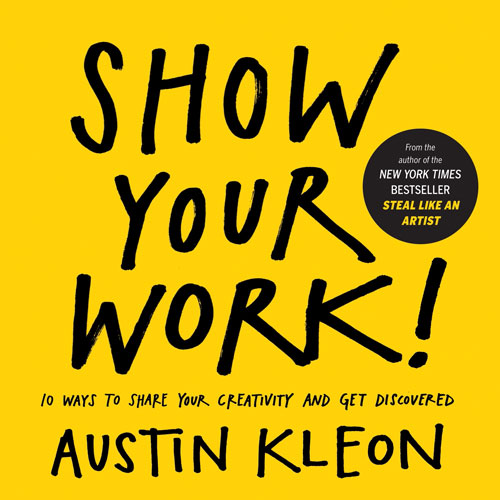 In 2012, artist Austin Kleon gave us Steal Like an Artist, a modern manifesto for combinatorial creativity that went on to become one of the best art books that year. He now returns with Show Your Work! (public library) — “a book for people who hate the very idea of self-promotion,” in which Kleon addresses with equal parts humility, honesty, and humor one of the quintessential questions of the creative life: How do you get “discovered”? In some ways, the book is the mirror-image of Kleon’s debut — rather than encouraging you to “steal” from others, meaning be influenced by them, it offers a blueprint to making your work influential enough to be theft-worthy. Complementing the advice is Kleon’s own artwork — his signature “newspaper blackout” poems — as a sort of meta-case for sharing as a modern art that requires courage, commitment, and creative integrity.
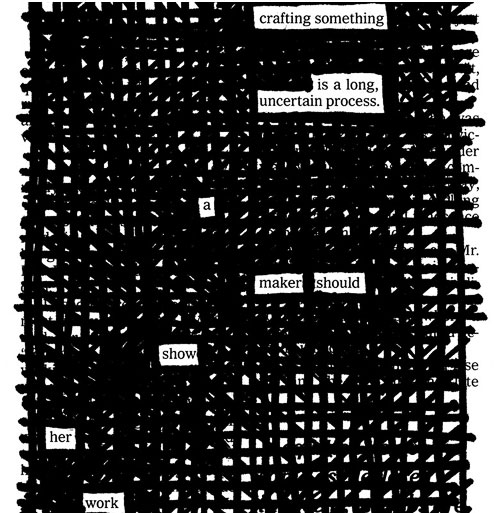
Kleon begins by framing the importance of sharing as social currency:
Almost all of the people I look up to and try to steal from today, regardless of their profession, have built sharing into their routine. These people aren’t schmoozing at cocktail parties; they’re too busy for that. They’re cranking away in their studios, their laboratories, or their cubicles, but instead of maintaining absolute secrecy and hoarding their work, they’re open about what they’re working on, and they’re consistently posting bits and pieces of their work, their ideas, and what they’re learning online. Instead of wasting their time “networking,” they’re taking advantage of the network. By generously sharing their ideas and their knowledge, they often gain an audience that they can then leverage when they need it — for fellowship, feedback, or patronage.
He later considers the seemingly obvious but underappreciated heart of sharing — something most obviously and gruesomely assailed by trolls and haters, but also routinely forgotten amidst our more subtle everyday negligence — and writes:
The act of sharing is one of generosity — you’re putting something out there because you think it might be helpful or entertaining to someone on the other side of the screen.
One of the myths antithetical to this networked generosity, Kleon points out, is that of the lone genius — a creator propelled by divine inspiration along a path of solitary work. But while this notion might be deeply engrained in our cultural mythology of genius, it is not only false but also toxic to the creative spirit, to the kinship of creativity that Robert Henri so memorably extolled. Kleon writes:
If you believe in the lone genius myth, creativity is an antisocial act, performed by only a few great figures — mostly dead men with names like Mozart, Einstein, or Picasso. The rest of us are left to stand around and gawk in awe at their achievements.
Instead, he borrows Brian Eno’s term “scenius” as a healthier alternative in conceiving of creativity:
Under this model, great ideas are often birthed by a group of creative individuals — artists, curators, thinkers, theorists, and other tastemakers — who make up an “ecology of talent.”
[…]
Being a valuable part of a scenius is not necessarily about how smart or talented you are, but about what you have to contribute—the ideas you share, the quality of the connections you make, and the conversations you start. If we forget about genius and think more about how we can nurture and contribute to a scenius, we can adjust our own expectations and the expectations of the worlds we want to accept us. We can stop asking what others can do for us, and start asking what we can do for others.
Indeed, this is what history’s greatest booms of innovation embody, from the cross-pollination at the heart of “the age of insight” in early-twentieth-century Vienna to the broader cultural history of how good ideas spread. But more than a way to explain history, “scenius” is one of the best models for making sense of the modern world — as Kleon keenly observes, the internet itself is “a bunch of sceniuses connected together, divorced from physical geography.” Finding yourself a “scenius” to belong to is an essential part of making sure your work takes root in culture.
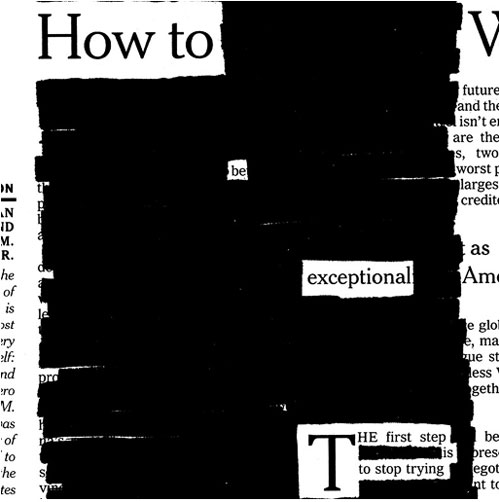
Another of Kleon’s life-tested pointers focuses on embracing the status of amateur — not in the derogatory sense, but in the revolutionary spirit that propelled H.P. Lovecraft’s Amateur Press Association, the proto-model of blogging. Being an amateur harnesses the Zen notion of “beginner’s mind” — a state of openness to possibility that closes up as we get calcified in expertise. After all, Frank Lloyd Wright put it perfectly when he asserted that “an expert is a man who has stopped thinking because ‘he knows.’” However, the gift of the amateur — or the “curious outsider,” a term I’ve used for myself — is not only an openness to uncertainty, but also a boundless enthusiasm with a sharp focus. Kleon writes:
Amateurs [are] just regular people who get obsessed by something and spend a ton of time thinking out loud about it… Raw enthusiasm is contagious.
The world is changing at such a rapid rate that it’s turning us all into amateurs. Even for professionals, the best way to flourish is to retain an amateur’s spirit and embrace uncertainty and the unknown.
This intersection of the scenius and the amateur, Kleon argues, is a hotbed of creative power:
The best way to get started on the path to sharing your work is to think about what you want to learn, and make a commitment to learning it in front of others. Find a scenius, pay attention to what others are sharing, and then start taking note of what they’re not sharing. Be on the lookout for voids that you can fill with your own efforts, no matter how bad they are at first. . . . Share what you love, and the people who love the same things will find you.
This notion of doing what you love and sharing it also goes to the heart of a familiar quarterlife-crisis concern: finding your voice. Kleon offers the beautifully simple, if uncomfortable, answer:
The only way to find your voice is to use it. It’s hardwired, built into you. Talk about the things you love. Your voice will follow.
One of Kleon’s more unusual creative-centering strategies has to do with letting death put life in perspective — every morning, he begins his day by reading the obituaries in the paper. It might seem like an odd habit, but it’s actually a remarkable tool for clarifying one’s priorities. Citing Maira Kalman’s memorable observation that “the sum of every obituary is how heroic people are, and how noble,” Kleon writes:
Obituaries are like near-death experiences for cowards. Reading them is a way for me to think about death while also keeping it at arm’s length. Obituaries aren’t really about death; they’re about life. . . . Reading about people who are dead now and did things with their lives makes me want to get up and do something decent with mine. Thinking about death every morning makes me want to live.
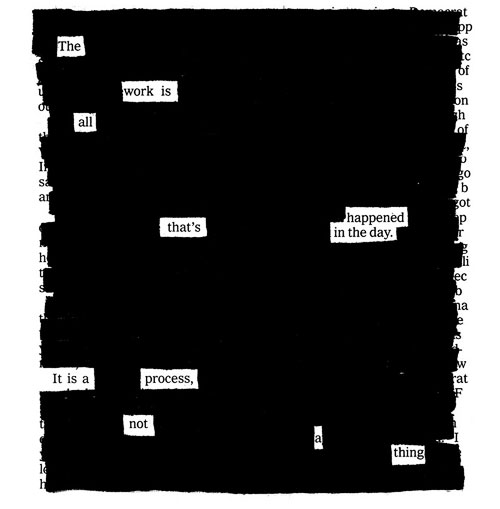
In another section, Kleon advises to send a “daily dispatch” to your community, a practice that counters the equally toxic myth of the overnight success — something I feel very strongly about myself — and instead turns the invisible process of your becoming, as a person and an artist, into something people can see. Kleon writes:
Overnight success is a myth. Dig into almost every overnight success story and you’ll find about a decade’s worth of hard work and perseverance. Building a substantial body of work takes a long time — a lifetime, really—but thankfully, you don’t need that time all in one big chunk. So forget about decades, forget about years, and forget about months. Focus on days.
[…]
A daily dispatch is even better than a résumé or a portfolio, because it shows what we’re working on right now. . . . A good daily dispatch is like getting all the DVD extras before a movie comes out — you get to watch deleted scenes and listen to director’s commentary while the movie is being made.
One way of knowing what to share is to understand the notion of “stock and flow” — an economic concept that Robin Sloan transformed into an apt metaphor for media. “Stock” refers to the timeless, evergreen stuff — things as interesting and meaningful today as they are in a year or even a decade. “Flow” is the reverse-chronology feed of short snippets of the present, things that “remind people you exist” — tweets, Instagram photos, and so forth. The key is to keep up your flow without letting it detract or distract from your stock, on which you continue working in the background. But the two aren’t diametrically opposed — with some pattern-recognition, bits of flow can coalesce into stock. Kleon writes:
Social media sites function a lot like public notebooks—they’re places where we think out loud, let other people think back at us, then hopefully think some more. But the thing about keeping notebooks is that you have to revisit them in order to make the most out of them. You have to flip back through old ideas to see what you’ve been thinking. Once you make sharing part of your daily routine, you’ll notice themes and trends emerging in what you share. You’ll find patterns in your flow.
When you detect these patterns, you can start gathering these bits and pieces and turn them into something bigger and more substantial. You can turn your flow into stock. For example, a lot of the ideas in this book started out as tweets, which then became blog posts, which then became book chapters. Small things, over time, can get big.
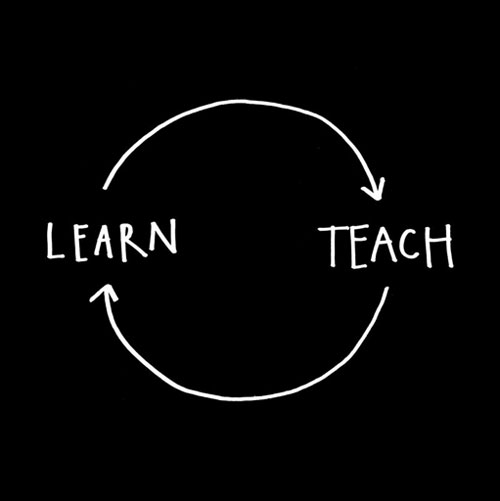
Indeed, this notion of fragmentary accumulation of big ideas is closely linked to one of the most important points Kleon makes, a throwback to his first book: Our minds are constantly assembling bits and pieces from the things we are exposed to, our interests and our influences, which we then combine into our own ideas about the world. But the two processes — collecting and creating — are intertwined. After all, as Amanda Palmer eloquently reminded us, “we can only connect the dots that we collect.” Kleon writes of the osmosis:
We all carry around the weird and wonderful things we’ve come across while doing our work and living our lives. These mental scrapbooks form our tastes, and our tastes influence our work.
There’s not as big of a difference between collecting and creating as you might think. A lot of the writers I know see the act of reading and the act of writing as existing on opposite ends of the same spectrum: The reading feeds the writing, which feeds the reading. “I’m basically a curator,” says the writer and former bookseller Jonathan Lethem. “Making books has always felt very connected to my bookselling experience, that of wanting to draw people’s attention to things that I liked, to shape things that I liked into new shapes.”
Your influences are all worth sharing because they clue people in to who you are and what you do — sometimes even more than your own work.
One of Kleon’s most urgent points, by virtue of being the least understood and least applied in our day-to-day lives online, has to do with our integrity around acknowledging this interplay of curating and creating by giving credit to others whenever we share their work. Kleon captures this contemporary conundrum beautifully:
If you share the work of others, it’s your duty to make sure that the creators of that work get proper credit. Crediting work in our copy-and-paste age of reblogs and retweets can seem like a futile effort, but it’s worth it, and it’s the right thing to do. You should always share the work of others as if it were your own, treating it with respect and care. When we make the case for crediting our sources, most of us concentrate on the plight of the original creator of the work. But that’s only half of the story — if you fail to properly attribute work that you share, you not only rob the person who made it, you rob all the people you’ve shared it with. Without attribution, they have no way to dig deeper into the work or find more of it.
[…]
Online, the most important form of attribution is a hyperlink pointing back to the website of the creator of the work. This sends people who come across the work back to the original source. The number one rule of the Internet: People are lazy. If you don’t include a link, no one can click it. Attribution without a link online borders on useless: 99.9 percent of people are not going to bother Googling someone’s name.
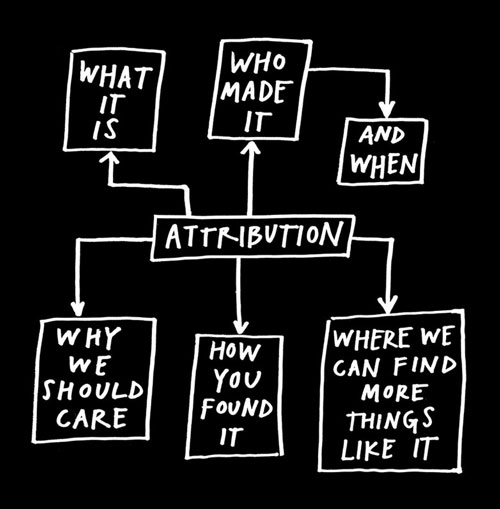
And here comes the money quote, which I couldn’t second more zealously and which I wish could be sticky-noted onto ever computer screen in the world — a neglected but essential form of modern media hygiene:
What if you want to share something and you don’t know where it came from or who made it? The answer: Don’t share things you can’t properly credit. Find the right credit, or don’t share.
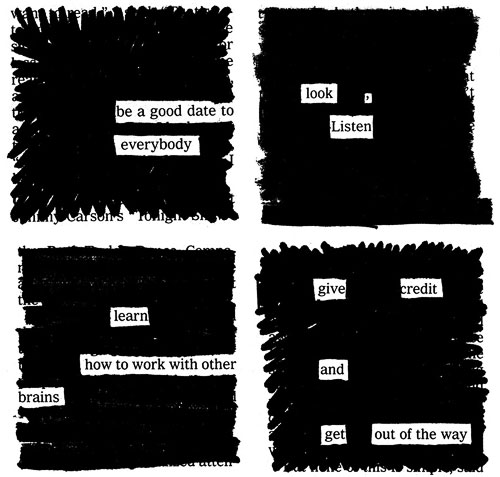
The rest of Show Your Work! goes on to explore how Vonnegut’s taxonomy of the shapes of stories applies to sharing your art, why giving “freely and abundantly,” in the words of Annie Dillard, is the key to reaping great rewards, how finding your people helps you find yourself, why asking for help without shame is the only way to get it, and more.
If you haven’t already, do treat yourself to Kleon’s Steal Like an Artist and his disarmingly wonderful blackout poetry.
Donating = Loving
Bringing you (ad-free) Brain Pickings takes hundreds of hours each month. If you find any joy and stimulation here, please consider becoming a Supporting Member with a recurring monthly donation of your choosing, between a cup of tea and a good dinner.
| ♥ $7 / month♥ $3 / month♥ $10 / month♥ $25 / month |

You can also become a one-time patron with a single donation in any amount.
 Brain Pickings has a free weekly newsletter. It comes out on Sundays and offers the week’s best articles. Here’s what to expect. Like? Sign up.
Brain Pickings takes 450+ hours a month to curate and edit across the different platforms, and remains banner-free. If it brings you any joy and inspiration, please consider a modest donation – it lets me know I'm doing something right.

Katiesullivan likes this
12 Mar 19:51


c. 1957: The Fishing saucer
by Amanda
The Evinrude Fishing Saucer concept boat designed by Brooks Stevens and made for the 1957 New York Boat Show.


Designed by Brooks Stevens
12 Mar 19:49
Section: Science
Tags: Acoustics, Cloaking, Duke University, Invisibility, Metamaterials, Sound
Related Articles:

World's first 3D acoustic cloaking device created
by Darren Quick

Section: Science
Tags: Acoustics, Cloaking, Duke University, Invisibility, Metamaterials, Sound
Related Articles:
- Vibration "invisibility cloak" could protect buildings from earthquakes
- Researchers cloak free-standing 3D object using plasmonic metamaterials
- Scientists move a step closer to being able to make objects invisible
- What invisible objects will actually look like
- 'Spacetime Cloak' could conceal events
- First demonstration of a working invisibility cloak

12 Mar 05:17
Early 1930s: A meeting of the Mickey Mouse Club
by Chris
Bunker.jordanThis is super creepy.
“The first was a theater-based Mickey Mouse Club started on January 4, 1930 at 12 noon at the Fox Dome Theater in Ocean Park, California with 60 Theaters hosting clubs by March 31. The Club released its first issue of the Official Bulletin of the Mickey Mouse Club on April 15, 1930. By 1932, the Club had 1 million members, and in 1933 its first British club opened at Darlington’s Arcade Cinema. In 1935, with so many clubs around the world, Disney begins to phase out the club.”

Tertiarymatt likes this


12 Mar 02:28
Section: Science
Tags: Diagnostic devices, Folding, Malaria, Microscopes, Paper, Stanford University
Related Articles:

Folding paper microscope could reduce deaths from malaria
by Ben Coxworth

Section: Science
Tags: Diagnostic devices, Folding, Malaria, Microscopes, Paper, Stanford University
Related Articles:
- Light used to quickly identify misshapen red blood cells
- World's smallest, lightest telemedicine microscope
- Ready for your close-up? It's a microscope for the iPhone
- Proscope digital microscope
- An electron microscope that won't destroy living cells
- Shutting the door on Malaria offers new vaccine hope
Rosalind, Tertiarymatt likes this
12 Mar 01:06
Section: Architecture
Tags: Auction, BBC, British, History, Nuclear, Scotland
Related Articles:

What's your bid for a British Cold War bunker?
by David Szondy
Bunker.jordanAlright, who's in?

Section: Architecture
Tags: Auction, BBC, British, History, Nuclear, Scotland
Related Articles:
- Former Nazi bunker transformed into green energy power plant
- Glycerol additive makes cruise ships greener
- Raytheon tests bunker-busting Tandem Warhead System
- Taking a peek at the Royal Navy's next nuclear-powered ballistic missile sub
- My Camp Kitchen camper box gets Mini
- Toasty Tush adds some warmth to your folding camp chair
Rosalind likes this
11 Mar 20:13
The awesome 'One Skull a Day' project for 3D printing
So you like 3d printing, you might like this. Inspired by famous cartoons and game characters, 3D artist Acepalm is building a series of 3D printable cute skull, one skull a day. "The idea came as a question: which collectible series would be fun to own, fun to boast to friends, and it's still not done by anyone?" Acepalm said
This article The awesome 'One Skull a Day' project for 3D printing is first published at 3ders.org.
Rosalind, Tertiarymatt likes this
11 Mar 18:52
1942: The Toastalator
by Amanda
Bunker.jordanSexy!

Designed by Brooks Stevens
Rosalind and -1 others like this
11 Mar 01:44
LEGO Computer Keyboard
by Kelly
Check out this fully functional lego keyboard from Jason Allemann, via JK Brickworks
I actually built the first prototype for this project all the way back in 2005! You can see a picture of that original prototype in the images below. I shelved the project for a number of reasons. Mostly because I was trying to build it onto the membrane of a Microsoft Natural keyboard, and working around the various angles of the keyboard was giving me a lot of trouble.
Last year I stumbled upon an old keyboard someone was getting rid of on the side of the road (nothing like doing a little free-cycling!). My interest was piqued again and after testing that the keyboard still worked I resurrected the project.
The biggest challenge was creating a frame that allowed the keys to be precisely spaced above the membrane. As I show in the video this was accomplished with a grid of Technic connectors and axles.
The second biggest challenge was finding appropriate printed tiles for all the symbols on a keyboard. Thankfully The LEGO Group has released all the main characters, numbers, and even a few special symbols over the years. I had to get creative with some of the keys though, which was actually quite fun. Still, there a few keys that could use some improvement.
Thankfully it is extremely easy to replace keys, so as I get inspired, or as The LEGO Group releases new printed tiles, I can easily upgrade the keys. It would also be quite easy to customize the layout, or add custom symbols to make a gaming specific layout.
The performance of the keyboard is quite good. There is a bit of flex in the Technic frame as you are using it, but this doesn’t seem to affect the performance at all. I can type just as well with this keyboard as with any other, as you can see during the introduction to the video.

Slickarango likes this
11 Mar 01:43
Open Source explained in LEGO #makerbusiness
by adafruit
Bunker.jordanI love when things are explained in LEGOs... and this is the best.
Open Source explained in LEGO.
10 Mar 23:56
HackHers and a Robot named Ada
by bill

The HackHers Robotics team from Needham High School in Needham Massachusetts stikes their “Rosie the Riveter” pose at the Massachusetts FTC Championship Tournament. HACKHERS is an all girl team in their second year of competition. At last weekend’s tournament, they were the winners of the Promote Award for community outreach and promotion of STEM education.
And their robot’s name? Ada of course!

Tertiarymatt likes this
10 Mar 21:33
3D-printed Subaru WRX STI races against 30,000 Stickbombs
Bunker.jordanThis is the most ridiculous thing I have seen today.
Have you heard of the toy, StickBomb? Flat wooden sticks are woven together under tension, which then fly apart like dominos when one is removed. So what happens when this toy is pitted against a radio control model 3D-Printed Subaru?
This article 3D-printed Subaru WRX STI races against 30,000 Stickbombs is first published at 3ders.org.
10 Mar 19:45
Scientists Create 3D Printed Heart Membrane That Can Keep Heart Beating Perfectly Forever
by Yarrow Maurer
Bunker.jordanFirst the heart... THEN THE BRAIN.
The video above is showing a rabbit’s heart beating perfectly outside of the animal’s body. The circuit lined, stretchable membrane covering it is allowing it to stay alive and to pump blood on its own. This incredible device was developed by scientists at the University of Illinois at Urbana-Champaign and Washington University in St. Louis by scanning the heart and creating a 3D printed model to act as a mold from which the membrane is cast and then integrated with the actual organ. It could become available to human hearts within the next 10 to 15 years.

From Sploid.Gizmodo.com:
This device is not just a custom-made pacemaker. According to University of Illinois’ materials researcher John Rorgers, co-leader of the team who has developed this device, it’s like an artificial pericardium, the natural membrane that covers the heart:
“But this artificial pericardium is instrumented with high quality, man-made devices that can sense and interact with the heart in different ways that are relevant to clinical cardiology.”Washington University’s biomedical engineer Igor Efimov says that it is a huge advancement. The circuits you’re seeing are a combination of sensors that constantly track the tissues’ behavior and electrodes that precisely regulate the heart muscles movement:
“When it senses such a catastrophic event as a heart attack or arrhythmia, it can also apply a high definition therapy. So it can apply stimuli, electrical stimuli, from different locations on the device in an optimal fashion to stop this arrhythmia and prevent sudden cardiac death.”
10 Mar 19:41
The World’s 100 Most Powerful Arab Women
by adafruit
Bunker.jordanlittleBits is badass! Well deserved recognition.

The World’s 100 Most Powerful Arab Women @ ArabianBusiness.com. Ayah Bdeir founder of littleBits.
Ayah Bdeir has packed more into her 31 years than most of us do in a lifetime. She is most famous for littleBits, a collection of tiny circuit boards that snap together with magnets like Lego — allowing artists, students and designers to have a greater understanding of electronics. After creating the first littleBits prototype in 2008, she founded Karaj, Beirut’s first non-profit lab for experimental arts, architecture and tech. She has been a mentor on Stars of Science, the Middle East’s first reality show focusing on innovation. Bdeir was named one of Fast Company’s most creative people in business for 2013.
Tertiarymatt, Rosalind likes this
10 Mar 19:37
Interview with Irene Greif, the first woman to get a Ph.D. in computer science from MIT
by Jessica

The Atlantic has a wonderful interview with Irene Greif, the first woman to get a computer science Ph.D. from MIT. She discusses her life and legacy, describing what it was like to be a part of the early days of MIT’s computer science program and detailing her experience as a woman at the school in the mid-60s.
Irene Greif always thought she’d be a teacher. “For one thing,” she told me, “I’d been told by my mother that it was good to be a teacher because you just worked the hours your kids were in school and you could come home.” It had just always been the profession in the back of her mind, the default.
So then it must have been a bit of a shock when, after in 1975 becoming the first woman ever to receive a Ph.D. in computer science from MIT, Greif discovered that she didn’t really enjoy teaching—she much preferred research. And so eventually she left teaching as a professor and did what she did best: studying, thinking, and figuring systems out. She founded a research field, computer-supported cooperative work, and has spent her life figuring out how to build better systems for humans to work together.
Greif recently retired from IBM, where she’d been since the mid-’90s, and is hoping to devote some time to encouraging young women to go into STEM fields and coaching them to stick with them—a twist on teaching that she does genuinely like.
I spoke with Greif recently about her experience as a young woman in a field with so few other women, about how things changed during the course of her career, and for what advice she wishes she’d had when she was first starting out. A lightly edited transcript of our conversation follows.
Read the full interview here.
Slickarango likes this
10 Mar 19:36
SXSW: Notes from the Premiere of 3D Printing Doc ‘Print the Legend’ #3DPrinting #MakerBusiness
by Matt
Bunker.jordanMy production company licensed some footage to these guys. Looks like an interesting doc.

Yesterday, the feature length doc “Print the Legend” launched at SXSW 2014 to a packed house at the Stateside Theatre in Austin, Texas. (There is another screening today Monday 3/10 @ 1:45pm and Wed 3/12 @ 6:45pm.)
In attendance were a number of those featured in the film: Max Lobovsky (co-founder FormLabs), Zach Hoeken Smith (co-founder of MakerBot), Cody Wilson (founder of Defense Distributed), Michael Curry (formerly of MakerBot), and many others. (Including myself, as former MakerBot Community Manager and a writer on topics of 3D printing today.) Current staff from 3D printer manufacturers re-united with former colleagues, once-competitors shaking hands and talking about exciting developments in the field. It was an occasion for the sharing of many “battle tales” of the tough road that has taken “desktop 3D printing” from an extreme margin of industry into the mainstream media spotlight.
This was the first time most of us were seeing the festival cut of the film and we were as eager to see it as the festival attendees who lined up around the block. Print the Legend has as its backdrop the recent rise of the desktop 3D printing field as a whole, but focuses most of its screen time on intimate exploration of two key companies in this space: hardware startup darlings MakerBot and FormLabs.
ather than attempting to cover the thousands of participants in the movement — for example, the crucial RepRap movement and the DIY printer hobbyists (which would make a fantastic Jason Scott style archive like BBS: The Documentary), or the decades of inventors of countless numbers of printing methods duking it out to secure contracts and customers — the film sets as its central aim to create a nuanced document of the 21st century hardware startup. At heart this documentary is a film about hardware startups and those who participate in them — and the filmmakers had tremendous access to the thrills, upsets, hard calls and tough lessons that are typically invisible behind the meteoric rise of the technology brands that spring into prominence in our lives today.
While FormLabs and MakerBot are the chief focus, the documentary covers a number of additional figures from the field as well. 3D Systems’ Avi Reichental plays a central role — efforts on the part of 3D industry leader 3D Systems (and Stratasys also) to engage with and venture into the consumer space. Disrupting received notions about the role of 3D printing in contemporary society, sequences featuring Cody Wilson — (in)famous for the 3D printed handgun and other provocations — offer an anarchist counterpoint to the frequent claims of this recent period in 3D printing history as the “3D Printing Revolution.” And first hand accounts from participants in all stages of this time period weigh in on passionate dreams and hard realities from the factory floor.
This film is still in its first stages of release — doing the festival circuit while being wooed by distributors and various release platforms/venues — so there are limited opportunities to see it for now. Hopefully, in the near future, all of you who are curious about this film will get an opportunity to see it. And I look forward to all of the exciting conversations it will stir up about hardware startups and the 3D printing movement.