Shared posts

24 Mar 18:34

Arevo Labs introduces carbon fiber reinforced polymers to 3D print ultra-strong parts

3D Printing with PEEK and other advanced reinforced polymers has been technically challenging. But Silicon Valley startup Arevo Labs says they have solved this problem by optimizing polymer formulations along with innovative extrusion technology to make them suitable for additive manufacturing.

This article Arevo Labs introduces carbon fiber reinforced polymers to 3D print ultra-strong parts is first published at 3ders.org.

24 Mar 16:56

March 24, 2014


Last day to support GaymerX! Thanks for all of your help.

24 Mar 16:55

Public Murals by A’shop Crew on the Streets of Montreal

by Christopher Jobson

Public Murals by Ashop Crew on the Streets of Montreal street art murals graffiti

Public Murals by Ashop Crew on the Streets of Montreal street art murals graffiti

Public Murals by Ashop Crew on the Streets of Montreal street art murals graffiti

Public Murals by Ashop Crew on the Streets of Montreal street art murals graffiti

Public Murals by Ashop Crew on the Streets of Montreal street art murals graffiti

Montreal based A’shop crew is an artist-run production company that creates graffiti murals, street art, and other public art displays. Most of their work is heavily influenced by graffiti but has also found inspiration elsewhere like their 2011 piece titled Notre-Dame-de-Grâce (top) that borrows from the art nouveau style of Alphonse Mucha. You can see more of their work on Facebook and over on the website. (via Oddity Central)

24 Mar 16:53

Light-Up Diablo III Costume Looks Fantastic And Scary

by Amy Ratcliffe

diablo 3 cosplay

I barely have the words to articulate how impressive this Diablo III costume is. Cosplayer Krizdel Igreso fashioned every piece of this wicked Prime Evil ensemble from the lights to the armor to the paint. She documented the build from sketch to finished costume and watching the evolution from plain black foam to menacing red is nothing short of astounding. It’s one of these builds where you learning the process by seeing pictures instead of reading, and you can view the entire gallery at Igreso’s Facebook page.

diablo 3 in progress

via Fashionably Geek

24 Mar 16:53

Gravitational waves have been discovered that give the strongest evidence yet for the Big Bang

by Jessica

NewImage

Scientific American and Nasa have written about this new discovery that provides the strongest evidence yet that the Big Bang actually happened.

NASA writes:

This image shows one of the NASA detectors from the BICEP2 project, developed in collaboration with the National Science Foundation. The sensors were used to make the first detection of gravitational waves in the ancient background light from the early universe. The discovery provides the strongest evidence yet for an explosive period of expansion in our universe known as inflation.

The detectors were developed and built at NASA’s Jet Propulsion Laboratory, Pasadena, Calif.

The image was taken by a “scanning electron beam” microscope, giving a close-up, 3-D view. The detector works by converting the light from the cosmic microwave background — relic radiation from the Big Bang — into heat. This heat is dissipated on a meandering gold film located on an island of material suspended in free space by tiny legs that were made by a process called micro-machining. (The island is the rectangle suspended in the black free space.) A superconducting titanium film on the detector (left side of island) serves as a sensitive thermometer to measure this heat.

The sensors are cooled to just 0.25 degrees above absolute zero to minimize thermal noise. The island is designed to further increase the sensitivity to heat by isolating the thermometer from the rest of the structure.

Scientific American also reports:

Physicists have found a long-predicted twist in light from the big bang that represents the first image of ripples in the universe called gravitational waves, researchers announced today. The finding is direct proof of the theory of inflation, the idea that the universe expanded extremely quickly in the first fraction of a nanosecond after it was born. What’s more, the signal is coming through much more strongly than expected, ruling out a large class of inflation models and potentially pointing the way toward new theories of physics, experts say.

“This is huge,” says Marc Kamionkowski, professor of physics and astronomy at Johns Hopkins University, who was not involved in the discovery but who predicted back in 1997 how these gravitational wave imprints could be found. “It’s not every day that you wake up and find out something completely new about the early universe. To me this is as Nobel Prize–worthy as it gets.”

Read more from NASA here and Scientific American here.

24 Mar 16:52

4 reasons why littleBits founder Ayah Bedir is awesome

by Jessica

NewImage

Popsugar recently sat down for an interview with littleBits founder Ayah Bedir. We’re all big fans of Ayah here at Adafruit and we love littleBits! Check out our selection of littleBits kits here and be sure to head over to Popsugar to read the full interview.

Somewhere in the bustling Lebanese coastal city of Beirut lived a girl with artistic aspirations. But she was naturally adept at math and science, so her parents said she owed it to herself to be an engineer.

That young lady grew up to be Ayah Bdeir, LittleBits founder, TED fellow, and MIT Media Lab alum with too many accolades to list. She went on to empower people with both technical and nontechnical backgrounds to create electronic art with a company she built herself from the ground up.

Ayah’s company, LittleBits, makes the hottest new tech toy on the market. It’s a next-generation Lego-style set that comes with preengineered “bits” or modules equipped with light, sound, motors, or sensors. Like any building block toy, humans of any age can pick a module up and begin creating without any programming or engineering background. The “bits” are color coded — green for output, blue for power, pink for input, and orange for wire — and use magnets, so you’ll never connect them the wrong way.

Here’s the 4 reasons that Ayah Bedir is a “rock star”:

  1. She grew up with electricity kits AND dolls: It’s a fact: not enough girls go into engineering. But this doesn’t mean we have to deprive our little ladies of girlie toys and replace them with only scientifically inclined playthings.
  2. MIT turned her down — so she applied again: Ayah applied to MIT fresh out of high school but was unfazed by her initial rejection. She tried again at 21 and was successful. “I knew I wanted to go to grad school and was like, I want Media Lab or nothing.”
  3. She funded LittleBits with her own money: For the next three-and-a-half years, Ayah took the extra money she earned from teaching and consulting and put it into the product. Eventually, she was able to go to China and find a factory. It wasn’t until early 2011 that Ayah had a functional LittleBits prototype and thought, “It’s time to start a company.”
  4. She has great advice for female entrepreneurs: “Try not to think about the fact that you’re a woman. A lot of people are like, ‘Because I’m a woman, they’re not giving me an opportunity’ or ‘Because I’m a woman, they’re not taking me seriously.’ I don’t think about it. . . . I just do the best work I possibly can, and I feel like I don’t want to take up any brain space thinking about it.”

Check out the full interview here.

NewImage

24 Mar 16:32

1980s: Kids’ bedrooms’ merchandise

by Chris
Bunker.jordan

~sigh~ I remember nostalgia...

Curated by Brian Galindo

Rainbow Brite

Rainbow Brite

Cabbage Patch Kids

Cabbage Patch Kids

Care Bears

Care Bears

Garfield

Garfield

Gremlins

Gremlins

He-Man and the Masters of the Universe

He-Man and the Masters of the Universe

Return of the Jedi

Return of the Jedi

Smurfs

Smurfs

Mr-T

Mr-T

24 Mar 15:44

Vacuum and pressure frying fruits and vegetables

by Ben Krasnow
Bunker.jordan

I would love to try this.

I talk about the technique of varying the pressure in a fryer to change how it cooks food.  Lower temperatures and pressures allow the food to be dried, and infused with oil without scorching or browning it. Higher temperatures and pressures keep the interior of the food moist while darkening the exterior. Fruits and vegetables are generally more appealing when vacuum fried, and chicken is arguably better when pressure fried.


24 Mar 14:48

1915: H.M.S. Fisgard

by Amanda

HMS Fisgard

HMS Fisgard was a shore establishment of the Royal Navy active at different periods and locations between 1848 and 1983. She was used to train artificers and engineers for the Navy.

Wikipedia

24 Mar 14:35

A very cool “3D” style gif of someone TIG welding. [...

Bunker.jordan

I would love to make a bunch of these...


A very cool “3D” style gif of someone TIG welding.

[ source: tumblr | more motorcycle gifs ]

24 Mar 08:37

1584: The Feuer Buech (Fire Book) of Franz Helm

by Amanda

Feuer Buech Franz Helm 1

Treatise on munitions and explosive devices, with many illustrations of the various devices and their uses.


Feuer Buech Franz Helm 12 Feuer Buech Franz Helm 4 Feuer Buech Franz Helm 2 Feuer Buech Franz Helm 3 Feuer Buech Franz Helm 5 Feuer Buech Franz Helm 10 Feuer Buech Franz Helm 11 Feuer Buech Franz Helm 6 Feuer Buech Franz Helm 7 Feuer Buech Franz Helm 8 Feuer Buech Franz Helm 9 Feuer Buech Franz Helm 13 Feuer Buech Franz Helm 14 Feuer Buech Franz Helm 15 Feuer Buech Franz Helm 16 Feuer Buech Franz Helm 17 Feuer Buech Franz Helm 18 Feuer Buech Franz Helm 19 Feuer Buech Franz Helm 20 Feuer Buech Franz Helm 21 Feuer Buech Franz Helm 22 Feuer Buech Franz Helm 23 Feuer Buech Franz Helm 24 Feuer Buech Franz Helm 25 Feuer Buech Franz Helm 26 Feuer Buech Franz Helm 27 Feuer Buech Franz Helm 28 Feuer Buech Franz Helm 29 Feuer Buech Franz Helm 30 Feuer Buech Franz Helm 31 Feuer Buech Franz Helm 32 Feuer Buech Franz Helm 33

Treatise on munitions and explosive devices, with many illustrations of the various devices and their uses.

UPenn Ms. Codex 109

24 Mar 08:36

The Beauty of Japan’s Artistic Manhole Covers

by Johnny Strategy

The Beauty of Japans Artistic Manhole Covers manholes Japan illustration
All photos courtesy S. Morita

The Beauty of Japans Artistic Manhole Covers manholes Japan illustration

The Beauty of Japans Artistic Manhole Covers manholes Japan illustration

The Beauty of Japans Artistic Manhole Covers manholes Japan illustration

The Beauty of Japans Artistic Manhole Covers manholes Japan illustration

The Beauty of Japans Artistic Manhole Covers manholes Japan illustration

The Beauty of Japans Artistic Manhole Covers manholes Japan illustration

The Beauty of Japans Artistic Manhole Covers manholes Japan illustration

The Beauty of Japans Artistic Manhole Covers manholes Japan illustration

The Beauty of Japans Artistic Manhole Covers manholes Japan illustration

Japan is a country full of amazing art. Some of it is housed within museums and galleries while others are right underneath our feet. I’m talking, of course, about Japan’s peculiar obsession with manhole covers. Just about anywhere in the country you can find stylized manhole covers, each more beautiful and intricate than the next. For the past several years photographer S. Morita has traveled around Japan photographing artistic manhole covers.

As to why this phenomenon developed, signs point to a high-ranking bureaucrat in the construction ministry who, in 1985, came up with the idea of allowing municipalities to design their own manhole covers. His objective was to raise awareness for costly sewage projects and make them more palatable for taxpayers.

Thanks to a few design contests and subsequent publications, the manhole craze took off and municipalities were soon competing with each other to see who could come up with the best designs. According to the Japan Society of Manhole Covers (yes, that’s a thing) today there are almost 6000 artistic manhole covers throughout Japan. And according to their latest findings, the largest single category are trees, followed by landscapes, floral designs and birds – all symbols that could, and surely did, boost local appeal.

You can see hundreds more of Morita’s photos right here. (via A Green Thought in a Green Shade)

Update: Remo Camerota has an entire book on the design of Japanese manhole covers, aptly titled Drainspotting.

24 Mar 08:35

12 November 1966: Buzz Aldrin “selfie”

by Chris

Photograph of Major Edwin E. Aldrins helmet taken during the Gemini XII mission during orbit no. 14 on November 12,1966. Original magazine number was GEM12-17-62922.

Buzz Aldrin "selfie"

24 Mar 08:34

Megacon 2014 (photos) #cosplay @MegaConvention #megacon2014

by adafruit
Bunker.jordan

holy crap yes

Bxbr8Fx - Imgur
Megacon 2014 fantastic photo set by ChaosMiezko via Caleb. Impossible to pick a favorite one!

24 Mar 08:32

Your Name in Life: Create a unique Game of Life based on your name

by Jessica

0w4dCAAAAAAI8rceYYFCyIABAwYMGDBgwIABAwYMGDBgwIABAwYMGDBgwIABAwYMGDBgwIABAwYMGDBgwIABAwYMGDBgwIABAwYMGDBgwIABAwYMGDBgwIABAwYMGDBgwIABAwYMGDBgwIABAwYMGDBgwIABAwYMGDBgwIABAwYMGDBgwIABAwYMGDBgwIABAwYMGDBgwIABAwYMGDBgwIABAwYMGDBgwIABAwYMGDBgwIAB

Clark DuVall has created this awesome site that takes your name and generates a Game of Life based on it. It lets you take snapshots as well as it expands and grows. You can change the font, drawing options and life options also. Above is “Adafruit Industries” in multicolor. We took this snapshot right at the beginning. Below is what we got after about 45 minutes at the “very fast” speed option. Here’s more about Conway’s Game of Life from wikipedia:

The universe of the Game of Life is an infinite two-dimensional orthogonal grid of square cells, each of which is in one of two possible states, alive or dead. Every cell interacts with its eight neighbours, which are the cells that are horizontally, vertically, or diagonally adjacent. At each step in time, the following transitions occur:

  • Any live cell with fewer than two live neighbours dies, as if caused by under-population.
  • Any live cell with two or three live neighbours lives on to the next generation.
  • Any live cell with more than three live neighbours dies, as if by overcrowding.
  • Any dead cell with exactly three live neighbours becomes a live cell, as if by reproduction.

The initial pattern constitutes the seed of the system. The first generation is created by applying the above rules simultaneously to every cell in the seed—births and deaths occur simultaneously, and the discrete moment at which this happens is sometimes called a tick (in other words, each generation is a pure function of the preceding one). The rules continue to be applied repeatedly to create further generations.

Read more about Conway’s Game of Life here and try it out on your own name here. We also sell a DIY LED project version of the game here.

Oz4S1nejfDWubfb1cu7WFRQgIEKiNwFRtOtUoAQIECBAgQIAAAQIECBAgQIAAAQIECBAgQIAAAQIECBAgQIDAxAoYYpnYrbUwAgQIECBAgAABAgQIECBAgAABAgQIECBAgAABAgQIECBAgEB9BAyx1GevdEqAAAECBAgQIECAAAECBAgQIECAAAECBAgQIECAAAECBAgQmFgBQywTu7UWRoAAAQIECBAgQIAAAQIECBAgQIA

24 Mar 08:31

This Machine Sucks Balls

by Brian Benchoff

312

The best career choice anyone could ever make – aside from the richest astronaut to ever win the Super Bowl – is the designer of the kinetic art installations found in science centers that roll billiard balls along tracks, around loops, and through conveyors in a perpetual display of physics and mechanics. [Niklas Roy] isn’t quite at that level yet, but he has come up with a new twist on an old idea: a machine that literally sucks balls from a ball pit into transparent tubes, sending them whizzing around the installation space.

The installation consists of eighty meters of plastic tubing suspended in the staircase of Potocki Palace in Kraków. Electronically, the installation is extremely simple; a PIR sensor turns on a vacuum cleaner whenever someone is in the ball pit. This sucks balls up through a hose, around the space, and into a bin suspended over the pit. Pull a lever, and the balls stored in the bin are dispensed onto the person vacuuming up thousands of balls below.

Image source, with video below.


Filed under: misc hacks
24 Mar 08:28

How did Bill Nye become “the Science Guy?”

by Stella Striegel
Bunker.jordan

Holy crap... Bill Nye used to do comedy in Seattle, and that's how he became "Bill Nye the Science Guy." This is fucking amazing. How did I not know this?!

Bill Nye tells us how he became the Science Guy. via NOVA’s Secret Life of Scientists and Engineers.

24 Mar 08:27

Lego-like bottle caps!

by Kelly
Bunker.jordan

Yessss, I would love these in America.

3027112 slide s bottle 01

These lego-like bottle caps present an even-more sustainable alternative to recycling, from fast coexist:

Every year, around 87 billion plastic bottle caps are made in the U.S. alone– and most end up in the trash. A company in Brazil hopes to help change that with this line of caps that you might actually want to keep: Each turns into a Lego-like block that can be used as a toy or to build furniture.

“I wanted to develop a sustainable cap, and I think it’s better to innovate by looking for a problem than by looking for an idea,” says Claudio Patrick Vollers, the CEO of Clever Pack, the company that makes the new caps. “I looked at the whole lifecycle of packaging, including the recycling process, and looked for the biggest environmental problem.”

Recycling, he noticed, takes quite a bit of energy, both for transportation and the electricity used to melt plastic. So even if a cap makes it to the recycling bin (an unlikely event in the U.S., though it’s a little more likely in Brazil) it still has an environmental impact.

“I found my opportunity: develop a cap that doesn’t get into the recycling cycle,” Vollers says. “Making a cap with two lives–in the first it is a closure, and in the second life it becomes a block. It was important to me that the consumer wouldn’t have to do anything, like cutting, to reuse the cap. That inspired me to develop Clever Caps.”

The caps are compatible with Legos, both because Vollers is a Lego fan and because he thought that the design would make them most likely to be used. Beyond toys, they can also be stacked into stools, tables and other furniture.

3027112 slide s bottle 05

3027112 inline s bottle 11

Read more.

24 Mar 08:25

Photo


24 Mar 08:25

Mechanical Iris Will Make You Want a Laser Cutter Even More

by James Hobson
Bunker.jordan

This is super cool. I made a giant version of the original three layer one for SAIC back when i worked there, and it was kind of a pain to assemble.

iris

Mechanical irises are very intricately designed mechanisms that are mesmerizing to see in action — and if you have a laser cutter, you could make one in less than 10 minutes.

Our “Teacher of Science”, Instructables’ user [NTT] has revised a previous Instructables design on a mechanical iris to improve it. The original design used three layers of components and dowel pins for every joint. What [NTT] has done is reduced this to two layers, and eliminated half of the pins required by designing clever circular cutouts. The result is a very slick mechanical iris that is very easy and quick to build — provided you have the tools.

Stick around to see the original iris open and close — unfortunately there’s no video of the new design — but we think you can imagine the differences.

Or alternatively you could 3D print a version of it!

No laser cutter, or 3D printer? We feel your pain. Luckily there is also a cardboard version of it you can make without any fancy tools!


Filed under: cnc hacks, laser hacks
24 Mar 08:23

The Timekeeper: Behind the Scenes of Humanity’s Most Accurate Atomic Clocks, Which Dictate Our Daily Lives

by Maria Popova

“Time is a coordinate that lets us most simply understand the evolution of the universe.”

Since the beginning of human existence, we have sought to understand time, to map it, to hack it, to standardize it, and to perfect our bodily experience of it. We have turned it into our civilization’s greatest meme and have probed it with our most unrelenting scientific rigor. Today, time not only dictates the rhythms of our daily lives but is also at the center of our digital universe — and yet it remains largely misunderstood by us lay people.

In this fascinating micro-documentary, Dr. Demetrios Matsakis, chief scientist for Time Services at the U.S. Naval Observatory — the same federal agency that hired astronomer Maria Mitchell as the first woman employed by the government — takes us on a tour of the USNO’s 100 atomic clocks, where the time on your iPhone originates. Dr. Matsakis explains how these atomic clocks — which won’t fall behind or race forward by a single second in 300 million years, rendering them the most accurate measuring devices ever created by humanity — also synchronize GPS, coordinate military operations, dictate financial transactions, and orchestrate internet communication. He then peers into the future to imagine the time-accuracy that is to come, as well as the dark side of such precision.

Time is a coordinate that lets us most simply understand the evolution of the universe.

[…]

In one sense, we’ve figured out everything from a practical point of view — the fundamentals — and in another sense, we don’t know anything at all… There are people who say time could stop, time could have a beginning, time is a derived quantity and not a fundamental quantity, and those are things I can’t give answers to. It’s something like being a doctor who may know how to keep someone alive, but doesn’t know what life is. I know how to compute the second — that’s my job.

Complement it with Dan Falk’s excellent In Search of Time: The History, Physics, and Philosophy of Time, a fine addition to these 7 excellent books about time, then revisit the curious psychology of why we experience time as elastic.

via The Dish

Donating = Loving

Bringing you (ad-free) Brain Pickings takes hundreds of hours each month. If you find any joy and stimulation here, please consider becoming a Supporting Member with a recurring monthly donation of your choosing, between a cup of tea and a good dinner.


♥ $7 / month♥ $3 / month♥ $10 / month♥ $25 / month


You can also become a one-time patron with a single donation in any amount.


Brain Pickings has a free weekly newsletter. It comes out on Sundays and offers the week’s best articles. Here’s what to expect. Like? Sign up.

Brain Pickings takes 450+ hours a month to curate and edit across the different platforms, and remains banner-free. If it brings you any joy and inspiration, please consider a modest donation – it lets me know I'm doing something right. Holstee

24 Mar 04:56

“Glass brain” (video)

by adafruit

“Glass brain” (video)

This is an anatomically-realistic 3D brain visualization depicting real-time source-localized activity (power and “effective” connectivity) from EEG (electroencephalographic) signals. Each color represents source power and connectivity in a different frequency band (theta, alpha, beta, gamma) and the golden lines are white matter anatomical fiber tracts. Estimated information transfer between brain regions is visualized as pulses of light flowing along the fiber tracts connecting the regions.

24 Mar 04:54

1493-1496: Sleeping at The Last Supper by Pietro Perugino

by Amanda
Bunker.jordan

All of their eyes seem to be saying "Really? Really? In front of Jesus? Come on man, show some respect."

The Last Supper 1 The Last Supper 3

24 Mar 04:53

1937: Walking stick snack bar

by Amanda

Walking Stick Snack Bar

24 Mar 04:53

1910: High frequency electric currents in medicine and dentistry

by Amanda

High Frequency Electric Therapy 1 High Frequency Electric Therapy 27 High Frequency Electric Therapy 26 High Frequency Electric Therapy 25 High Frequency Electric Therapy 24 High Frequency Electric Therapy 23 High Frequency Electric Therapy 22 High Frequency Electric Therapy 21 High Frequency Electric Therapy 20 High Frequency Electric Therapy 19 High Frequency Electric Therapy 18 High Frequency Electric Therapy 17 High Frequency Electric Therapy 16 High Frequency Electric Therapy 15 High Frequency Electric Therapy 14 High Frequency Electric Therapy 13 High Frequency Electric Therapy 12 High Frequency Electric Therapy 11 High Frequency Electric Therapy 10 High Frequency Electric Therapy 9 High Frequency Electric Therapy 8 High Frequency Electric Therapy 7 High Frequency Electric Therapy 6 High Frequency Electric Therapy 5 High Frequency Electric Therapy 4 High Frequency Electric Therapy 3 High Frequency Electric Therapy 2


24 Mar 04:37

Web app for writers channels the spirit of Hemingway

by James Holloway

The text you see when you go to Hemingway

Hemingway is a simple web app designed to help writers write simpler copy. You can't save documents, share them, organize them or comment on them. You just paste in your text, follow its advice, and copy it to get it out again. But it's very effective... Continue Reading Web app for writers channels the spirit of Hemingway

Section: Telecommunications

Tags: Web Applications, Writing

Related Articles:
23 Mar 23:28

Gang plans mass-producing ATM skimmers via 3D printing?

Bunker.jordan

... fantastic.

3D printers can print out any objects you can design, and they are getting less expensive and more common every day. As you can probably imagine, it didn't take long for controversial uses to emerge for 3D printers. Criminals start using 3D printing to make better ATM skimmers, a device that fits onto, around or into an ATM's own card slot.

This article Gang plans mass-producing ATM skimmers via 3D printing? is first published at 3ders.org.

23 Mar 21:30

Emblem for a Standard, Mughal Indian, 17th century

23 Mar 21:28

'THE PLEASURES OF LIFE'

by The Vintagent
While every sign and security guard says 'No Foto', I couldn't help but document the surprising discovery of a motorcycle on the floor of the National Gallery.  I suppose that puts me in the camp of the Photo Liberation Front, a group of artist-tourists sick of being reprimanded for taking photos in museums!
If you happen to be in London, I recommend a visit to the National Gallery on Trafalgar Square, which houses one of the best painting collections in Europe.  The original building (there have been lots of extensions added) was designed by William Wilkins in the 1830s, and is the neo-classical heap you'd expect of a big national institution of the 19th Century.
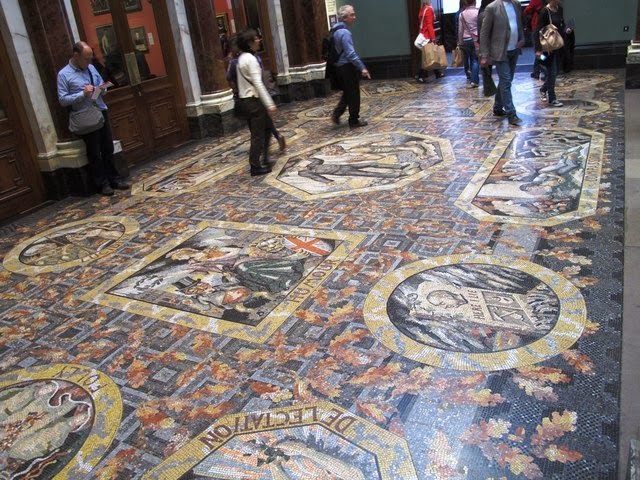
A broader shot of Boris Anrep's murals in the National Gallery lobby
I've visited many times, but the particular path I walked last November led across a delightful mosaic of 'The Pleasures of Life', and discovered a cartouche labelled 'Speed', which of course features a motorcycle!  The entire entry and mezzanine level floors are covered in mosaic murals, but the upper right mezzanine is where you'll find the bike. The image is stylistically rooted in the late 1920s/early 1930s, and depicts a readheaded woman astride a 'flapper bracket', with a fishtail exhaust beneath her high heels.   The exhaust is distinctive; a sedate production item, and not a full-house racing 'Brooklands Can', and very much in the style of a four-valve Ariel single-cylinder ca.1930, or perhaps a Rudge.
A 1928 Ariel Model D (image courtesy Yesterdays Motorcycles)
As the mosaic covers the entire floor around the grand 1889 staircase (by Sir John Taylor), it's not easy to find an information plaque explaining them, but a quick search revealed the artist as Boris Anrep, a member of the Bloomsbury group, which included the writer Virginia Woolf, economist John Maynard Keynes, and painter Vanessa Bell.  Anrep was a Russian lawyer who abandoned his practice in 1908 (age 25), to study art in Paris and Edinburgh, eventually settling on the mosaic as his chosen medium by 1917.  He spent WW1 as a Russian officer in Galicia (an ethnically diverse kingdom in the Austria-Hungarian empire, now straddling Ukraine, Poland, and the Czech Republic).  In 1917 he was sent as a military attaché to London, and never returned to his homeland, probably because of the Revolution in Russia, as well as his burgeoning art career, and the commissions for mosaics which kept him busy the rest of his life.
A search revealed a photo from the Getty Images Archive of Anrep working on Oct 28 1929 on this very mosaic, 'Speed'
Anrep's work at the National Gallery began in 1928, the 'Labours of Life' and 'Pleasures of Life', of which the Flapper on a motorcycle is part; the mosaics took 5 years to complete.  In 1952 he returned to lay the 'Modern Virtues' at the foot of the staircase, which incorporates portraits of Winston Churchill, Dame Margot Fonteyne, and Bertrand Russell...whereas the earlier mosaics included Virginia Woolf and Greta Garbo, but no attribution is given for the woman on the Ariel.
Greta Garbo as Melpomene, the Greek muse of Tragedy...
If you're interested, there's a book available on Anrep's National Gallery work here.

Email me to subscribe to updates from The Vintagent!

23 Mar 21:27

An Incredible Video Shot by a DJI Phantom Quadcopter Flying Into an Active Volcano

by Rollin Bishop

YouTube user Shaun O’Callaghan flies a DJI Phantom quadcopter incredibly close to Mount Yasur, an active volcano on Tanna Island, Vanuatu, in this brief but incredible video.

via Gadget Review, The Awesomer