 ,
,
Bunker.jordan
Shared posts
28 Mar 21:19
c. 1967: Beetles watch Herbie at the drive-in
by Chris
Tertiarymatt, Bunker.jordan likes this
28 Mar 19:00
Bringing Star Trek to life: LCARS home automation with Arduino and Raspberry Pi #piday #raspberrypi @Raspberry_Pi
by Jessica
Bunker.jordanHoly shit, I want this. It's too bad that when I started playing this video, the bird freaked out and got scared. Apparently LCARS sounds like cyborg birdies.
This LCARS home automation from YouTube user boltszmann138 a trekkies dream come true!
…I came to the conclusion that QT works fine for me. There are two programms running:
First, there is “ha_interface” on the raspberry which on the one hand connects to the arduino via usb and provides a tcp server for clients on the other hand. Clients can request sensor values by sending “request:sensortype:sensorid” over a simple QTcpSocket. If the arduino sends an interrupt (for example: reed contact 1 is now open), ha_interface sends a broadcast message like “broadcast:reed1:opened” to all connected clients. Parsing of these commands can easily be done via the QString::split(“:”) function. The biggest problem was: I dont want the clients to poll for the reed contact state, since they change very seldom. On the other hand, I didnt want to miss that event. So I had to find a way how recognize an interrupt (by emitting a signal) in the serial usb connection. This gave me the answer: http://www.webalice.it/fede.tft/seria… (part 5) and http://fedetft.wordpress.com/2010/04/… . Several connected clients can talk to each other via the interface and share for example their local “red alert on” or “system locked” bool variables.
The second program, “ha_gui” is the LCARS design you can see in the video (the final version will get a dedicated 24″ touch screen :-D). This program connects to the ha_interface programm via QTcpSocket. When switching an outlet, it sends “switchOutlet:syscode:groupcode:mode” to the interface, when requesting the temperature sensors, it sends “request:temperature:1″ or something like that to the interface. If the main door is openend, the arduino will recognize that and send a message to the interface which then broadcasts that information to all connected clients. This LCARS client will play the “red alert” sound from Star Trek Voyager if that happens. Playing sounds is done via “QProcess::startDetached(“aplay PATH_TO_FILE”). The “analysis of sensor data” at the top is realized via 7 QLineEdits. There is a QTimer which is called periodically, it generates random numbers and sometimes highlights a row. The LCARS design was created in QT Designer. There are stylesheet options for rounded corners and you can find official LCARS colors via google. The different views are realized by a QStackedWidget.
 Each Friday is PiDay here at Adafruit! Be sure to check out our posts, tutorials and new Raspberry Pi related products. Adafruit has the largest and best selection of Raspberry Pi accessories and all the code & tutorials to get you up and running in no time!
Tertiarymatt likes this
28 Mar 18:21
Section: Environment
Tags: Fraunhofer, Magnetic, Pollution, University of Stuttgart, Water, Water Conservation
Related Articles:

"Superparamagnetic" particles used to harvest phosphorus from polluted water
by Ben Coxworth

Section: Environment
Tags: Fraunhofer, Magnetic, Pollution, University of Stuttgart, Water, Water Conservation
Related Articles:
- Ostara reactors harvest phosphorus from raw sewage
- 'Nanorust' cleans arsenic from drinking water and promises 'no-energy' solution for global problem
- Loowatt creates energy and fertilizer from human waste
- Magnetic nanobead technology could result in better biosensors
- Tiny iron oxide particles promise big benefits for display technology
- Nanotechnology boosts conductivity of carbon fiber reinforced plastics
Rosalind likes this
28 Mar 18:21
Section: Space
Tags: Earthwatch, Expedition, Mars, Space Travel
Related Articles:

Earthwatch Institute plans public expedition to Mars?
by David Szondy

Section: Space
Tags: Earthwatch, Expedition, Mars, Space Travel
Related Articles:
- Earthwatch expeditions - 40 years of 'citizen science'
- Mars displayed in interactive four-gigapixel panoramic glory
- Google Earth goes to Mars
- NASA announces new rover mission for Mars
- NASA wants public to send haikus to Mars
- Mars One outlines plans to put unmanned lander on Mars in 2018
28 Mar 18:20
Section: Health and Wellbeing
Tags: Detect, Drink, Drugs, Fluorescent, National University of Singapore, Sensors
Related Articles:

Fluorescent sensor indicates presence of date-rape drug within 30 seconds
by Nick Lavars

Section: Health and Wellbeing
Tags: Detect, Drink, Drugs, Fluorescent, National University of Singapore, Sensors
Related Articles:
- Researchers develop pocket-sized “date rape” drug detector
- DrinkSavvy tech could indicate presence of date rape drugs in drinks
- Fluorescent nanotubes used for imaging of internal organs
- Gel sensors to detect bomb chemicals and illegal drugs in seconds
- KWIKTOP: The bottle combination lock
- Using radio waves to identify counterfeit drugs
Rosalind likes this
28 Mar 18:19

Street Eraser: Giant Stickers Appear to Erase the Streets of London with Photoshop
by Christopher Jobson


For their Street Eraser project artists Tayfun Sarier and Guus ter Beek (who both work at Wieden+Kennedy) created giant adhesive stickers that look like the eraser tool in Photoshop. Once applied to advertisements, graffiti and other objects it appears as if the surface is being erased, revealing Photoshop’s checkerboard background signifying a blank canvas. Fun! (via Designboom)
Randy Laue, Cooper Griggs and 2 others like this
28 Mar 18:16


Crows Understand a Fundamental Part of Logical Reasoning
by Jason G. Goldman on Animals, shared by Annalee Newitz to io9

Crows are far more rational than we had realized. New research shows that wild New Caledonian crows can compete with 7-year-old children when it comes to understanding causality, or how one action causes another.
    
|
firehose, Tertiarymatt and one other like this
28 Mar 18:16


Comet Siding Spring Is Headed Towards Mars
by Ria Misra

Comet Siding Spring is headed towards Mars. Not to worry, though. With its projected trajectory having it miss Mars by 84,000 miles, the comet is unlikely to make much of an impact on the red planet — but its dust might.
|
|
28 Mar 18:16


This Is What It Looks Like When An Alien And A Terminator Make A Baby
by Rob Bricken

Entertainment Earth posted this amazing, fan-made, life-size sculpture of a Xenomorph made out of pure scrap metal on Twitter, and now we're more terrified of the inevitable robot apocalypse than ever. What do you suppose runs through its veins? Battery Acid?
|
|
Tertiarymatt likes this
27 Mar 22:08
Jayce: The Cosplay of Tomorrow (overdue) Version 1
by Jamison Go
hicharleslookimmakingablogpostaboutthefammerfinallyareyouhappynow?
_________________________________________________________________________________

is my favorite character in the popular online strategy game League of Legends. This is not because I like his mechanics, his character, or dashing good looks. Okay fine I like those too. But I loved the concept of the transforming hammer/cannon. This was directly in my line of 'thingsiliketocosplaywish' and so I embarked on the ambitious task of building the Mercury Hammer/Cannon for a Debonair Jayce Cosplay (Debonair is one of his skins, or appearance modified options).

The hammer is distinguished by a yellow color, and full retraction of all the motion parts. The "wings" are in the closed position or positioned axially with the handle and the "rods" are fully retracted.
The cannon is distinguished by a cyan color and full extension of the motion parts. The wings are tilted outwards at an angle, and the rods are at full extension.
Immediately the engineering and design mindset went to work. The major question: "how can I replicate these shapes with enough rigidity using manufacturing methods available to me?". Immediately I began to gravitate towards plate methods for the majority of the body work, which meant waterjet and laser cutter. I had little experience foam and freeform sculpting, so I naturally gravitated towards 3D printing for high volume work of complex surface geometries. For materials, I scavenged. Luckily for me, the MIT Hobby Shop was undergoing renovations and were generously donating materials to reduce the amount of stock they had to pack. I started with a steel pole for the main mast and went ahead from there.


I started with the 1" dia pole and began modeling the hammer's most distinguishing features. In my mind, this was the "lamp" shaped bulb on the bottom and the four "wings" on the sides.


First order of business was building the frame. I enlisted the help of a friend to waterjet some aluminum at CSAIL.

After some sanding, things began to take shape!


For the first round of 3D printing, I opted to finish the body components first. These were made on a Stratasys Dimension 1200es with lowest fill density settings.


Upon assembly, I discovered them to be fairly good missile launchers. Maybe reuse for future work? :P

Suddenly, the body appears! Starting to look like a Debonair Jayce Mercury Hammer!


Now its time to add the motors. To make them hammer duty, I had to cut a corner off the gearbox but more importantly I had to replace the shaft. Having that lengthy 12" dual shaft was key for my dual use clutch idea to work. At the same time, I also pushed some ball bearings in the frame to help alleviate off axis loading on the motors.


Speaking of motor work, I bet it isnt quite obvious how so many mechanisms are being powered off a single motor. Well, since this design uses pure rotation to change the angle of the wings, the gearmotor makes sense. But what about the linear action of the "rods"?


For this I am implementing an elevator mechanism powered by a tension cord. Basically, there are multiple stages that can move linearly along each other all connected by a string. The string is wound throughout the stages. When the string is taught, the relative length decreases and forces the parts to move. This idea would be very difficult to implement in such a small space and with limited materials. However, it turns out to work in my bench tests! Hooray concepts!
Next came the flurry of laser cutting. All the non-structural paneling was done in craft wood (thin plywood), laser cut to shape, sanded, and painted.


I would like to shout out to a piece of software called 123D Make. This program from Autodesk takes STL files and affords you several methods for creating its volume. This was incredibly useful for the "wings" because of their high volume but desire for low weight. I use 123D Make to make the "wings" from several slotted panels. Then I joined them together with a dab of super glue.


The next hard part was figuring out how to skin the "wings". I had tried several things like covering in duct tape and filling with expanding foam (very messy). I ended up exporting the faces of the "wings" as dxf files with sketched bend lines and laser cutting from "tank board", aka the backing on notepads.


Even though I didnt do much with electronics this time around, its worth noting. I left out the LEDs and effects and wanted to focus on purely mechanical aspects. In that respect, I only needed a method of transmitting power and the ability to reverse the direction of current. I was able to do this easily with a DPDT (dual position, dual throw) switch and a push button. The push button was used to flow current (read: complete circuit) and the switch was used to swap the direction of current. I could use two single throw switches, but this method is more fool proof since there is no shorting condition.

There was some cloth involved, but it did not involve much work on my end. I essentially bought towards a white tuxedo with tailcoat. Ebay is your friend in this case.


I hope you enjoyed this very late recap of this build. I was rather sparse on some sections because of the last-minute rush; I was not able to document those stages very well (with regards to painting and wiring). Still I would like to say a few things.
First, a thanks to my friends who supported and helped me through the build. This includes Charles Guan, Steven Jorgensen, Julia Hopkins, and many more!
Second, I would like the point out the title of this post "... Version 1". There was a version 2 supposed to debut at Anime Boston but could not be finished in time. It will be done by the next convention however. See you guys are Pax East 2014!
___________________________________________________________________
Some photos taken by Ace T. Cosplay & Photography
Some photo taken by Zuli's Cosplay
_________________________________________________________________________________
Introduction
This guy:
is my favorite character in the popular online strategy game League of Legends. This is not because I like his mechanics, his character, or dashing good looks. Okay fine I like those too. But I loved the concept of the transforming hammer/cannon. This was directly in my line of 'thingsiliketocosplaywish' and so I embarked on the ambitious task of building the Mercury Hammer/Cannon for a Debonair Jayce Cosplay (Debonair is one of his skins, or appearance modified options).
Analysis
The weapon has two forms: the hammer and the cannon. Pictures below:
The hammer is distinguished by a yellow color, and full retraction of all the motion parts. The "wings" are in the closed position or positioned axially with the handle and the "rods" are fully retracted.
The cannon is distinguished by a cyan color and full extension of the motion parts. The wings are tilted outwards at an angle, and the rods are at full extension.
Immediately the engineering and design mindset went to work. The major question: "how can I replicate these shapes with enough rigidity using manufacturing methods available to me?". Immediately I began to gravitate towards plate methods for the majority of the body work, which meant waterjet and laser cutter. I had little experience foam and freeform sculpting, so I naturally gravitated towards 3D printing for high volume work of complex surface geometries. For materials, I scavenged. Luckily for me, the MIT Hobby Shop was undergoing renovations and were generously donating materials to reduce the amount of stock they had to pack. I started with a steel pole for the main mast and went ahead from there.
Design
Basing everything off the 1" steel tube presented some proportionality issues. The weapon appears to have a larger diameter mast than 1" when compared to Jayce's hands. Still in lieu of saving money I persisted. Below are some captures of the modeling done in SolidWorks.
I started with the 1" dia pole and began modeling the hammer's most distinguishing features. In my mind, this was the "lamp" shaped bulb on the bottom and the four "wings" on the sides.
Construction
I decided to build the hammer from the inside out. This way any imperfections that could propagate through the design could be accounted for in parts not yet made. However items that would be 3D printed could be done in parallel since they take far longer than traditional machining techniques.First order of business was building the frame. I enlisted the help of a friend to waterjet some aluminum at CSAIL.
After some sanding, things began to take shape!
For the first round of 3D printing, I opted to finish the body components first. These were made on a Stratasys Dimension 1200es with lowest fill density settings.
Upon assembly, I discovered them to be fairly good missile launchers. Maybe reuse for future work? :P
Suddenly, the body appears! Starting to look like a Debonair Jayce Mercury Hammer!
Now its time to add the motors. To make them hammer duty, I had to cut a corner off the gearbox but more importantly I had to replace the shaft. Having that lengthy 12" dual shaft was key for my dual use clutch idea to work. At the same time, I also pushed some ball bearings in the frame to help alleviate off axis loading on the motors.
Speaking of motor work, I bet it isnt quite obvious how so many mechanisms are being powered off a single motor. Well, since this design uses pure rotation to change the angle of the wings, the gearmotor makes sense. But what about the linear action of the "rods"?
For this I am implementing an elevator mechanism powered by a tension cord. Basically, there are multiple stages that can move linearly along each other all connected by a string. The string is wound throughout the stages. When the string is taught, the relative length decreases and forces the parts to move. This idea would be very difficult to implement in such a small space and with limited materials. However, it turns out to work in my bench tests! Hooray concepts!
Next came the flurry of laser cutting. All the non-structural paneling was done in craft wood (thin plywood), laser cut to shape, sanded, and painted.
I would like to shout out to a piece of software called 123D Make. This program from Autodesk takes STL files and affords you several methods for creating its volume. This was incredibly useful for the "wings" because of their high volume but desire for low weight. I use 123D Make to make the "wings" from several slotted panels. Then I joined them together with a dab of super glue.
Now things are beginning to take shape!
The next hard part was figuring out how to skin the "wings". I had tried several things like covering in duct tape and filling with expanding foam (very messy). I ended up exporting the faces of the "wings" as dxf files with sketched bend lines and laser cutting from "tank board", aka the backing on notepads.
From then on, it was about making duplicates of things that worked, decorating, and making finer details. Here are some laser cut decorations for the body face panels, the tips of the "rods" and some spray painting. I have the hammer here suspended using fiber straps from a garage assembly. One unfortunate aspect was the hammer ended up being really heavy or at least feeling very heavy due to physics. To help relieve weight, I tried to pocket the metal pieces. The heaviest part ended up being the "wings" but not much could be done about those now that they were assembled.
Despite all the hard work, I could not actually finish the fully functional hammer. Because of the ~16 hour drive to Atlanta for Dragon Con, I had to focus on decoration instead of mechanics. As a result, I could not properly debug issues regarding high stress points in the elevator mechanism, or clutch tuning for the wings. I decided to lock Jayce's weapon into a hammer configuration for the duration of the trip. Here are the final pictures.
Even though I didnt do much with electronics this time around, its worth noting. I left out the LEDs and effects and wanted to focus on purely mechanical aspects. In that respect, I only needed a method of transmitting power and the ability to reverse the direction of current. I was able to do this easily with a DPDT (dual position, dual throw) switch and a push button. The push button was used to flow current (read: complete circuit) and the switch was used to swap the direction of current. I could use two single throw switches, but this method is more fool proof since there is no shorting condition.
There was some cloth involved, but it did not involve much work on my end. I essentially bought towards a white tuxedo with tailcoat. Ebay is your friend in this case.
Implementation
I bought this guy to Dragon Con 2013 and later to Anime Boston 2014. At both events, the hammer was well received. A lot of good comments about detail, craftsmanship, and OMGWTFSOHEAVY. The question I loved and hated to hear was "Can it actually transform?!". Because it was essentially broken and perma-hammer mode it was heartbreaking. I had to simply respond, "I accidentally did the thing."
Dragon Con 2013
Anime Boston 2014
I hope you enjoyed this very late recap of this build. I was rather sparse on some sections because of the last-minute rush; I was not able to document those stages very well (with regards to painting and wiring). Still I would like to say a few things.
First, a thanks to my friends who supported and helped me through the build. This includes Charles Guan, Steven Jorgensen, Julia Hopkins, and many more!
Second, I would like the point out the title of this post "... Version 1". There was a version 2 supposed to debut at Anime Boston but could not be finished in time. It will be done by the next convention however. See you guys are Pax East 2014!
___________________________________________________________________
Some photos taken by Ace T. Cosplay & Photography
Some photo taken by Zuli's Cosplay
27 Mar 22:06


Dancing Stick Figures Graph Mathematical Functions With Their Arms
by Lauren Davis
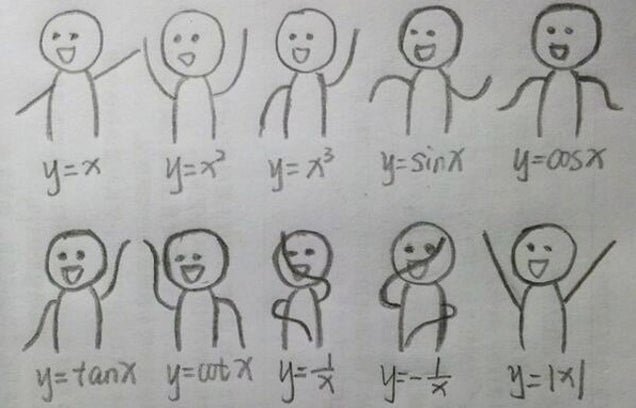
If you have trouble remembering how to graph different mathematical functions, these simple figures with their dancing arms can help. At the very least, they'll make you think of math every time you dance to YMCA.
|
|
27 Mar 21:37
Full-Size Power Loader Costume Is Ready For Alien Battle
by Amy Ratcliffe

When you’re already making a life-size statue of the Alien Queen, you may as well build a Power Loader costume to go with it. That’s Instructable user alexthemoviegeek’s attitude, and I applaud his enthusiasm. He wanted the Power Loader to be made as cheaply as possible and also wanted it to be functional. He spent about $225 on materials, and it was well worth it. Though there are many steps to the build, here’s how he made the stilts:
Two-foot tall stilts need to be very specific. I learned that first-hand. I went to my dad’s garage where he had plenty of spare wood. I made my own design out of whatever pieces I could find. I ended up having to use an air-powered nail gun to secure the pieces of wood together. I could then build up the foam board pieces around the stilts.
The cage was also a challenge. I’d seen other Power Loader costumes that used connected pieces of PVC pipe, but the problem with that was you could tell it was just pieces of PVC pipe, instead of a single piece of welded metal. I decided to used 1″ PVC pipes and 3/4″ connectors, both with an outer diameter of 1.25″, so that they’d have a singular diameter and look like a solid piece. I had to add some small wooden dowel pieces and hot glue to help strengthen the connections.
Yes, it’s awesome. Just look:
Read more at Instructables.
27 Mar 20:34

Repetier Goes Closed Source
by Site Admin
Bunker.jordanUGGGHHH
One of the pillars of open source 3D printing, Repetier Host, has closed its source code.
The open source zone of 3D printing enables significant developments to take place. Many people contribute software and hardware improvements to the body of knowledge, and that makes 3D printing a better place.
One of the key software pieces in that puzzle is Repetier Host, “The software driving your 3D printer”. And that is precisely what it does. It’s been an open source offering for quite some time. However, it’s latest terms of service have abruptly changed and now all rights are reserved for the authors.
Questions and skepticism erupted on open source forums, but a Repetier spokesperson responded:
We tried the open source model for over 2 years. User contributions were very low, so nearly all work was done by us. So we ended working 10 hours a day 7 days a week which we could not spend earning money. In addition other used our work for their profit without sharing it with us. Fortunately not all companies go that way. Quite some printer vendors support us with custom host version and we believe this step will even increase the number of supporters, so we can keep a free host version with new features. The alternative would be to stop developing the host, which would be even more lost to the community.
And so it happens again. It seems that while open source is a noble practice, people can only contribute so much. In the case of MakerBot, they transformed utterly from a fully-open source outfit to a full-on corporate giant in only four short years. Things change.
We leave the final word to RepRap commenter robr45acp, who said:
if you're closed and you put out a good product. I'll buy it. count me in for the long haul. just don't put backdoors in and send sneaky data to the NSA. that would piss me off.
Us too.
Via RepRap
27 Mar 19:23
Vote for which intense next-generation spacesuit you want NASA to make #WearableWednesday
by Jessica

NASA wants you to vote for which style of spacesuit they should build next. You can see a bunch of 2D Art of the suits as well as 3D models on their site here. Voting lasts until April 15th.
The above picture is the “Biomimicry” option which “mirrors the bioluminescent qualities of aquatic creatures found at incredible depths, and the scaly skin of fish and reptiles found across the globe.” Here’s some more information on the vote:
NASA’s Z-2 Suit is the newest prototype in its next-generation spacesuit platform, the Z-series. As a follow-up to the previous Z-1 suit, which was named one of Time Magazine’s Best Inventions of 2012, the Z-2 takes the next step in fidelity approaching a final flight-capable design. Most exciting, the Z-2 marks several milestones for NASA:
- First surface-specific planetary mobility suit to be tested in full vacuum
- First use of 3D human laser scans and 3D-printed hardware for suit development and sizing
- Most advanced use of impact resistant composite structures on a suit upper and lower torso system
- First integration of the suit-port concept with a hard upper torso suit structure
- Most conformal and re-sizeable hard upper torso suit built to date
After the positive response to the Z-1 suit’s visual design we received, we wanted to take the opportunity to provide this new suit with an equally memorable appearance. The cover layer of a prototype suit is important as it serves to protect the suit against abrasion and snags during the rigors of testing. With the Z-2, we’re looking forward to employing cover layer design elements never used in a spacesuit before. The designs shown were produced in collaboration with ILC, the primary suit vendor and Philadelphia University. The designs were created with the intent to protect the suit and to highlight certain mobility features to aid suit testing. To take it a step further, we are leaving it up you, the public, to choose which of three candidates will be built.
Here’s Option B called “Technology”

“Technology” pays homage to spacesuit achievements of the past while incorporating subtle elements of the future. By using Luminex wire and light-emitting patches, this design puts a new spin on spacewalking standards such as ways to identify crew members.
The last option is called “Trends in Society”.

“Trends in Society” is based off of just that: being reflective of what every day clothes may look like in the not too distant future. This suit uses electroluminescent wire and a bright color scheme to mimic the appearance of sportswear and the emerging world of wearable technologies.
Vote for your favorite option here.
 Every Wednesday is Wearable Wednesday here at Adafruit! We’re bringing you the blinkiest, most fashionable, innovative, and useful wearables from around the web and in our own original projects featuring our wearable Arduino-compatible platform, FLORA. Be sure to post up your wearables projects in the forums or send us a link and you might be featured here on Wearable Wednesday!
27 Mar 19:00


We've Discovered the First Asteroid with Rings
by Annalee Newitz

Gas giant planets like Saturn and Jupiter have rings — and now, we'vediscovered a tiny, distant rock that has its own two rings. Chariklo is a centaur — half-asteroid, half-comet — and the way it got its rings is a fascinating story.
|
|
Tertiarymatt, Nicholae Cline and one other like this
27 Mar 18:41


Reproducing One Giant Leap with 3D Printing
by Site Admin
Bunker.jordanWould put this on my wall.
A project has used original NASA pictures to reproduce a 3D representation of Neil Armstrong’s most famous footprint.
We all know the story; Apollo 11 landed on our Moon and returned safely to Earth. Behind on the lunar surface, Armstrong and LEM pilot Buzz Aldrin left a lot of footprints.
One of which was the very first. On another world.
Fortunately for us, two analog images of the print were taken. These images were then used to create a rough 3D model by comparing differences in the angle of view with experimental software. The resulting 3D model was cleaned up and then 3D printed on a ZCorp 310 powder printer.
We’re unable to locate the 3D model for this project. We'd love to print one, as we’re certain many readers would too.
Via Imgur
Tertiarymatt, Rosalind likes this
27 Mar 18:24


Which Real-Life Victorian Sub Inspired Jules Verne's Nautilus?
by Ron Miller

When Jules Verne wrote about the fantastic submersible ship Nautilus in 20,000 Leagues Under the Sea, there had already been several very successful submarines built and tested. And Verne, who always did his homework, was certainly aware of these. Which was his inspiration?
|
|
firehose likes this
27 Mar 18:23


A Whale Has Crushed The Record For Length And Depth Of An Ocean Dive
by Robert T. Gonzalez

Guess how long it stayed down. Go on, guess. 30 minutes? 60 minutes? 90 minutes? Nope. More. Keep guessing.
|
|
Benjaminsavage, Tertiarymatt and 2 others like this

27 Mar 18:12

Time-lapse Scenes of Swarming Fireflies by Vincent Brady
by Christopher Jobson


This is a fantastic feat of photography and editing by Vincent Brady who shot this montage of firefly timelapses in 2013 at Lake of the Ozarks, Missouri and around his home in Grand Ledge, Michigan. To make the timelapse Brady had to master several different cameras, learn about photo stacking, 360° panoramas, and even how to pilot a pontoon boat to get all the requisite shots. While we’ve seen several articles here on Colossal featuring long-exposure fireflies it’s still fascinating to see them in motion like this. You can read about Brady’s adventures on his website, and learn more about the science of fireflies on It’s Okay To Be Smart. (via It’s Okay To Be Smart)
27 Mar 18:12
Section: Health and Wellbeing
Tags: Depression, Medication, peptide, Treatment
Related Articles:

Nasal spray could provide highly-targeted treatment for depression
by Nick Lavars

Section: Health and Wellbeing
Tags: Depression, Medication, peptide, Treatment
Related Articles:
- Potential new drug delivery system
- Researchers stumble on potential new treatment for hair loss
- Flesh-eating bacteria inspire highly selective instant adhesive that won't stick to fingers
- Nasal spray vaccine could prevent type 1 diabetes
- Smoking found to affect the brain
- Nasal spray nanovaccine promises no pain, more gain
Tertiarymatt, Rosalind likes this
27 Mar 18:11

The World’s Smallest Sandcastles Built on Individual Grains of Sand by Vik Muniz and Marcelo Coelho
by Christopher Jobson


Artist Vik Muniz (previously here, here, and here) is known for his gigantic composite installations and sculptures created from thousands of individual objects. In this new collaboration with artist and MIT researcher Marcelo Coelho, Muniz takes the opposite approach and explores the microscopic with a new series of sandcastles etched onto individual grains of sand.
The process of getting a sandcastle onto a speck of rock was anything but straightforward and involved over four years of trial and error utilizing both antiquated and highly technical methods. Muniz first drew each castle using a camera lucida, a 19th century optical tool that relies on a prism to project a reflection of whatever is in front of you onto paper where it can be traced. The drawings were then sent to Coelho who worked with a number of microscopic drawing processes for several years before deciding to use a Focused Ion Beam (FIB) which has the capability of creating a line only 50 nanometers wide (a human hair is about 50,000 nanometers wide).
Lastly, Muniz photographed the final etchings and enlarged them to wall-sized prints. He shared with the Creator’s Project: “When someone tells you it’s a grain of sand, there’s a moment where your reality falls apart and you have to reconstruct it. You have to step back and ask what the image is and what it means,” a fascinating play on scale and perception. Watch the new video above from the Creator’s Project to see how the project came together.
The sandcastles are on view starting today as part of a comprehensive exhibition of Muniz’ work spanning the last 25 years at the Tel Aviv Museum of Art. (via The Creator’s Project)
David Pelaez, Sofía Henao and 2 others like this
27 Mar 17:53

The Bizarre World of Chicken Beauty Pageants Photographed by Ernest Goh
by Christopher Jobson


Photographer and visual artist Ernest Goh is known for his work photographing wildlife and other animals. His latest book documents the strange world of chicken beauty pageants in Malaysia where he encountered a breed of bird called the Ayam Seramas, an ornate chicken raised not for its meat but purely for its appearance. These chickens not only have decorative plumage but possess the ability to strike ridiculous poses. You might think these photos are somehow manipulated (or worse, the animals forced into these positions) but a behind-the-scenes video by Goh shows the chicken’s ability to strut just as depicted. The book, titled Cocks: The Chicken Book, is available now through his website. All photos courtesy the artist. (via Peta Pixel)
Aune.emily, Rosalind and 6 others like this
27 Mar 17:28
Filed under: news, Virtual Reality


Facebook to Buy Oculus VR
by Adam Fabio
Bunker.jordanNooooooooo

Facebook has agreed to purchase Oculus VR. The press values the deal at about $2 Billion USD in cash and stock. This is great news for Oculus’ investors. The rest of the world has a decidedly different opinion. [Notch], the outspoken creator of Minecraft, was quick to tweet that a possible rift port has now been canceled, as Facebook creeps him out. He followed this up with a blog post.
I did not chip in ten grand to seed a first investment round to build value for a Facebook acquisition.
Here at Hackaday, we’ve been waiting a long time for affordable virtual reality. We’ve followed Oculus since the early days, all the way up through the recent open source hardware release of their latency tester. Our early opinion on the buyout is not very positive. Facebook isn’t exactly known for contributions to open source software or hardware, nor are they held in high regard for standardization in their games API. Only time will tell what this deal really means for the Rift.
The news isn’t all dark though. While Oculus VR has been a major catalyst for virtual reality displays, there are other players. We’ve got our eggs in the castAR basket. [Jeri, Rick] and the rest of the Technical Illusions crew have been producing some great demos while preparing CastAR for manufacture. Sony is also preparing Project Morpheus. The VR ball is rolling. We just hope it keeps on rolling – right into our living rooms.
Filed under: news, Virtual Reality
firehose likes this

27 Mar 17:20
Glowing Oogie Boogie Costume
by Amy Ratcliffe

Oogie Boogie is one of the scariest Disney villains as far as I’m concerned. He’s cruel and manipulative, but he does have a cool costume. Instructables user kristylynn84 fashioned the entire costume from burlap and because the costume is loose and lumpy, it meant she could take some liberties (she didn’t use a pattern). She took the extra awesome step of making Oogie glow in the dark. Here’s how she achieved that with glowing spray paint:
We used about 6 cans. You may want to buy 7 or 8, just to be safe, and return the last one if you don’t use it. But remember, the suit will need numerous coats, and so will the mask.
I took him outside and made him do some slow spins as I painted him up. It’s transparent, so you can’t see what you’ve done until you hold a black light to it, once it’s dried it will activate. Yes, the paint went through and I ended up painting my husband LOL, it made a cool effect. (The can says to not get it on your skin. But he lived.)
I would say….10-12 coats of spray paint and between those, you need to go over it with a hand-held black light to see where you’ve missed any spots.
Read more at Instructables.
Tertiarymatt likes this
27 Mar 02:02
Section: Science
Tags: Behavior, Pain, UC San Diego, University of California, University of Toronto
Related Articles:

Computer better than a human at telling if you're faking it
by Grant Banks
Bunker.jordan*waits for Google Glass app for parsing emotions from facial expressions, so glassholes can detect when their presence is not wanted*

Section: Science
Tags: Behavior, Pain, UC San Diego, University of California, University of Toronto
Related Articles:
- What humans really want - creating computers that understand users
- The first commercial Brain Computer Interface
- FACE android conveys human emotions with facial expressions
- Learning robot puts on a happy face
- Researchers develop interactive, emotion-detecting GPS robot
- EU project demonstrates emotional robots
26 Mar 23:50
Netflix acquires award-winning 3D printing docu - Print The Legend
Netflix announced today that it has acquired exclusive rights to “Print The Legend,” a documentary about the nascent American 3D printing industry that premiered at SXSW this month.
This article 3ders.org.
Tertiarymatt, firehose likes this
26 Mar 22:47


Watch This Chicago 'L' Train Jump The Tracks And Run Up An Escalator
by Tim Marchman
Bunker.jordanVideo!
The other day, a Chicago Transit Authority operator apparently fell asleep, and the Blue Line train she was running consequently jumped the tracks at O'Hare and ran up a god damn escalator, injuring 32 people, causing an estimated $6 million in damage and screwing up commutes all over the city. Here is raw security camera footage of the accident. It's pretty intense.
|
|