Kramer: Do you ever yearn?
George: Yearn? Do I yearn?
Kramer: I yearn.
George: You yearn.
Kramer: Oh, yes. Yes, I yearn. Often, I…I sit…and yearn. Have you yearned?
George: Well, not recently. I craved. I crave all the time, constant craving…but I haven’t yearned.
You can imagine a more poignant version of this conversation over an iPad showing a Facebook feed. The Internet, with its constant parade of lives-that-might-have-been-yours and classmates-not-dated, is a jungle of yearnings. Yearnings that were once confined to fading and static memories of childhood, occasionally awakened by petrichor, now sneak into your life as a steady, colorful stream of living confusion, via windows in present realities. There was no equivalent in the past to being a silent spectator of other lives by default. You either had active, evolving relationships of mutual influence, or mutual invisibility. Like passengers on subways, we only saw people on other routes at stations. There were no relationships of continuous mutual spectatorship.
There was no such thing as a life with a view.
***
Curiously, Kramerian yearning seems to have entirely disappeared from my own life, even as I have become more aware of its increased intensity in the lives of others. I think it is because I have a home on the Internet. If you only visit the Internet, it becomes a place of intensified yearning. But if you live on it, yearning seems to give way to newer, as-yet-unnamed feelings.
There is a strong relationship between home and yearning. When you are young, you yearn to get away from home. As you age, you yearn to find home again. For some, this means a return to home. For others, it becomes a realization that such a return is impossible. You’ve changed too much, and home has changed too much as well. Even if you manage to return, it isn’t the same.
Kenneth Grahame’s classic The Wind in the Willows is an excellent introduction to elemental yearnings and archetypal responses to it.
The responsible Mole begins the story as a sort of upstanding citizen experiencing a mid-life crisis, abandoning his home in the middle of spring-cleaning to go adventuring. Later in the book, deep homesickness descends on him.
The childlike and capricious Toad of Toad Hall (a trust-fund kid of sorts) restlessly seeks external stimulation, repeatedly cycling through excitement and boredom, never stopping to reflect on the nature of his urges or gaining any self-awareness. Toad frustrates the others no end, since they are forced to watch out for him, but his is such a pure and innocent energy that they cannot resist being roped into his escapades.
On the riverbank, Rat lives a life of gentle and complacent hedonism, confident that his home is the best place to be, and his lifestyle the only kind worth living. He is something like a caricature of a Leibnizian optimist, convinced that all is for the best in this best of all possible worlds. Like a high school sports star who never leaves the small-town scene of his early triumphs, Rat has a certain shallowness that makes him entirely immune to deeper yearnings, and forcefully resists any suggestion that there might be a world beyond the riverbank worth engaging. His redeeming qualities are his fundamental kindness and his willingness to go along on adventures to support his friends.
And finally, there is Badger, the adult of the gang, the only one with the toughness to live a life in the Wild Wood. A crotchety hermit who watches over the innocent lives of the others, with a sure sense of both the world and his place within it.
I like to think I’ve evolved from Toad to Rat to Mole to Badger, and that the Internet — the Wild Wood of our world — is my home.
***
I just returned from a three-week trip to Europe and India. It was my first long international trip with an international data plan for my smartphone. It was also my first trip to India since I established a full-time online homestead here, for life and work.
The effect of even a minimal digital tether to an online home is interesting. You can never be homesick again.
I stopped thinking of India as home soon after I left it in 1997, but I never did put down psychological roots anywhere else. For that you need to develop a large network of local friends, favorite local haunts and intense local loyalties.
Seattle seems most like home to me, but only in relative terms. It is a curiously polarized city, divided between passionately local metro mice and cloud mice with dispassionate, globalized sensibilities. There is no middle, and I am definitely part of the latter group. I appreciate the views and the piroshkys at Pike Place (which is, rather dangerously for my health, just a block away from my new apartment), but am entirely immune to the temptations of Seahawks fandom.
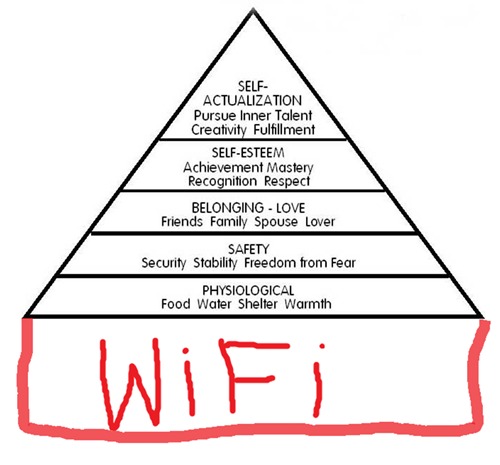
But truth be told, I am discovering, like many, that my home is really where the Internet is. A meme that did the rounds recently, showing a revised picture of Maslow’s hierarchy, with wifi at the bottom, is truer than geo-supremacists like to admit.

(source unknown)
In the geography-first world, people used to talk of first, second and third cultures. First cultures are the local cultures of people who’ve never been anywhere else except as tourists. Second cultures are the cultures of immigrants with clear memories of home. Third cultures are those created by children of global nomads in professions like diplomacy, with no such memories.
I proposed on Twitter that those who find a sense of home on the Internet ought to be called zeroth culture people. Some objected and argued that it ought to be a fourth culture, but I stick by my proposal. The Internet is becoming the primary locus of all cultural experience. It increasingly frames our experience of first, second and third cultures.
When you first explore the online world, with your feet firmly planted offline, it can seem ephemeral and insubstantial. But once you tentatively and gingerly plant your feet online, it is the offline world that starts to seem ephemeral and insubstantial. The world of offline-first people (or worse, offline-only) seems like a world of people living lives without real views. Lives full of unacknowledged and unprocessed yearnings.
Because home is not the locus where you live your life, but the locus from which you make sense of it. Home is a place that supplies a stable perspective on the world and your place within it. Home is a place from which you can properly experience a life with a view, without censorship, without having to make up narratives about the superiority of your little local world.
***
There is an effective technique to generate yearning in literary fiction. This is to provide characters with a piquant glimpse into an alternative perspective on their own lives. An example is Lost in Translation, Sofia Coppola’s tale of two strangers who briefly hold up mirrors to each other’s lives. Another is American Beauty, which offers up an entire menagerie of yearning characters reacting to disquieting views of their lives, mirrored in the eyes of others.
The technique is a subtler version of the coarse two-world structure of the Hero’s Journey. In the Hero’s Journey, you have, instead of an alternative perspective on reality, an entire different reality. Muggle world, wizarding world. Matrix-world, real-world. Batman’s world, Bruce Wayne’s world. X-Men world, non-mutant world.
The device is too crude to arouse or satisfy vicarious yearning, which is among the more subtle of emotions. But when a human mirror is used to gently decenter the primary world view of a protagonist, without necessarily taking him out of it, we get a character who yearns, and responds to yearning in his own world. The Hero is drawn out of his life by an external force. The yearner is propelled by inner restlessness.
Like Cosmo Kramer, the character of Harry “Rabbit” Angstrom in John Updike’s Rabbit, Run yearns. A former high school basketball star, and not particularly self-aware, Harry is an insignificant creature who can only respond to his angst by running, not away from his life, but around his life in circles.
We meet Rabbit at age 27, and through the exquisite series, we see his yearning carry him through unsatisfying affairs, past his own unexamined small-town conservatism and banal racism to a middle age of estranged relationships and heart attacks. It is a life of slow unraveling, whose most tragic element is that he learns almost nothing by living it. The modest redemption he achieves at the end only serves to highlight the tragedy of his mute, almost animal-like, suffering.
Yearning is a dangerous but irresistible force. Perhaps the most practical use of philosophy is to render it safe.
***
To yearn is to re-examine your life from a new perspective and find it wanting. But this isn’t a simple sort of mind expansion. Yearning is an awakening to an expanded understanding of your life; one that makes it seem at once richer and less satisfying than you thought it was. To yearn is to simultaneously realize that there is more to your life than you thought, and that it is not enough.
Which is why, the predictable reaction to a yearning is restlessness; a searching for fulfillment through wandering. In the case of the Seinfeld episode, Kramer awakens to the poverty of his own life thanks to Jerry reclaiming his spare apartment key, forcing him into a realization that he’s been living vicariously through Jerry. Newly alive to the nature of his own life, he heads across the country to pursue a career in Hollywood. Of course, the story that begins as a spiritual journey devolves into charming comedy.
Kramer’s is the farcical version of the quiet tragedy that is Rabbit’s life. Of the two, Kramer’s is the more realistic fate. We may give in to yearning, but we gratefully accept the first stimulating distraction that can derail us from a journey we fundamentally do not want to undertake. A journey we began only because not leaving would have been even less bearable. So when yearnings take root, hijinks ensue shortly after, and the sense of the ludicrousness of our response to yearning is part of what leads us back to our old, sensible life.
As Bender once exclaims angrily on Futurama, “I was forced to go on a spiritual journey, I hate those!”
***
It is no accident that in the best stories, yearning is triggered by poignant encounters with strangers. By what I called game breaks in a previous post: moments of uncontracted intimacy, often between strangers who meet while traveling.
To be seen is to be made sense of from a perspective other than one’s own. A perspective that rings unfamiliar but true. A perspective that makes your own estimate of your life seem, for a moment, alien and somewhat repulsive. It is a moment of unexpected and unsettling vulnerability. The more complete and settled your sense of your own life, the more vulnerable you are during such moments, and the more deeply the seed of restlessness is planted.
Even in the safest-seeming encounters, there is a stab of fear mingled with relief: fear at being exposed for who you are, relief at finding connection. Whether the sense of connectedness prevails or the fear, the moment is fleeting. Defenses return, but not before restlessness — and fear, uncertainty and doubt along with it — sneaks in. Yearning is a case of the world sneaking inside the tempo of your life.
The first time this happens is the first time you realize that home is about perspective rather than situation.
The realization is rarely a conscious one though. Indeed, most encounters that trigger yearning are not consciously processed. Like Toad in Wind in the Willows, and Rabbit in Updike’s novels, most people respond to the tug of yearning with an instinctive decision to run. If self-awareness never dawns, you never stop running. The best you can hope for is a series of temporary forgettings of the force that propels you to run.
If the realization is a conscious one, or if self-awareness descends at some point, life turns into a restless seeking of a situation that offers the truest perspective of itself, a center invulnerable to the tug of yearning, a place of seeing-without-being-seen. You realize that the primary measure of a life-with-a-view is a reflexive one: the view it offers of itself.
In the past, the path open to conscious, self-aware yearners was no different from the one open to the unconscious yearners: you had to run.
Today, there is nowhere to run physically. Nowhere can you reliably find moments of uncontracted intimacy with strangers, shrouded in bubbles of disconnection from everyday life.
But you can run away from home online, and search for the truest perspectives of the life you have, without ever leaving it. Because the Internet is a shifting geography of evolving perspectives, not static places.
And you can find game-breaks online, but only if you make a real home there, so you can be seen. To seek only to see through the Internet is to experience only half of it, as a tourist.
If you do make a home online, at times the Internet can start to seem like a place of continuous casual intimacy among strangers. That’s part of what makes it more real than the real world.
***
You can make a home on the Internet and be seen there, but you cannot arrive there. Home on the Internet can only be a point of departure. Arrival is fundamentally a metaphor that can only work with static or slow-changing geographies, defined by fixed relationships among sets of long-term neighbors. My 2012 map of my Internet neighborhood is already laughably obsolete. One of these days, I will update it with a new snapshot, but it will still only be an instantaneous snapshot, not a navigable map.
The metaphor of the stream is more appropriate for the zeroth culture of the Internet. You can only join the Internet and let your life evolve along with it for as long as you can stand the constant churn of perspectives around you. The idea of A-list and B-list Internet celebrities is doubly incoherent: it represents an online version of the arrival fallacy.
Offline, we understand the arrival fallacy as unironic belief in a scripted path of progress towards the a good life. To be a sophisticate today is to laugh at the notion that life begins when one settles down by progressively checking off a set of boxes: graduation, car, marriage, mortgage, kids, making partner at the law firm. To arrive is to complete the checklist.
The arrival fallacy is about seeking a life from which one can look with a complacent equanimity upon the rest of reality, without yearning. It is an ideal of a life that is defined primarily by blindness to itself. You yearn while you see your life as others see it, until you arrive at a situation where you can disappear into the broader background, and see comfortably without being seen discomfittingly, especially by yourself.
Once you’re there, the yearning stops, so the theory goes. Of course it is a laughably bad theory. The more completely you arrive, the more vulnerable you become to outbreaks of yearning. Arrival is about being prevented from acting on yearnings, not immunity from experiencing them. The arrival fallacy is a fallacy because a life that is blind to itself, and incapable of being seen, cannot see either. You cannot look out upon life without letting life look in upon you, revealing you to yourself. And to do so is to let in yearning as well.
To be blind to yourself is to be blind to the world itself: there is no true arrival that is distinguishable from death. If you believe you have arrived, and still yearn, be glad. Yearnings are signs of life in an assumed state of arrival.
***
But those who imagine themselves immune to scripts defined in material terms are not immune to the arrival fallacy. A deeper kind of arrival fallacy has to do with seeking the truest web of relationships. The fact that yearning often begins with transient intimacy can lead to the belief that it is a fundamentally social urge. One that can be satisfied by finding permanent intimacy of some sort. That belief can turn yearning into a quest for enduring intimacy.
The cliched versions of that sort of journey are of course the familiar stories of searching for true love or the true teacher. There is often a motif of home in such stories too. The girl sought turns out to be the hometown girl-next-door who was there all along. The teacher sought turns out to be a parent. The oldest friend turns out to be the truest one. Or to put the whole package together, home turns out to be an entire tradition, and arrival a reaffirmation of tradition.
To these old stories we can add, for our socially mobile and culturally open times, the modern narrative of finding one’s true tribe, of being able to say, these are my people. But the urge to create a new tradition, and arrive with one’s tribe at a new promised land, is as much a case of the arrival fallacy as the urge to reaffirm an existing tradition with one’s life. New traditionalists are still traditionalists.
Adolescent yearners are particularly prone to imagining that their universe of relationships is the only universe that matters. It is a universe that can be explored in all its intricacy and complexity even by the young. Which is why you get those masses of teenagers with aged, world-weary affects and a way of looking at you with such a depth of apparent experience in their soulful eyes that you begin to doubt your own age.
And then they say something so terminally clueless and precious that you are snap back into reality, and realize that they are, sadly, just young traditionalists. Young enough to believe that all the truths of the universe can be found in the eyes of true companions.
The eyes do not have it. Only our primate brains make it seem like eyes are windows into a universe of souls that subsumes the universe of atoms. To be driven by yearning into the hall of mirrors that is the universe of relationships is to lose yourself in a largely empty infinity. Perhaps the only thing sadder than an adolescent who believes life is about deep looks is an old person who has experienced life as nothing but a web of relationships and deep looks: a lived tradition.
And that perhaps is why I find the idea of a home on the Internet comforting: it is a never-ending break from tradition. To make a home online is to quiet yearnings by succumbing to them entirely. To succumb in this way is to be swept up in a zeroth culture where change constitutes a more fundamental layer of reality than tradition and constancy.
The Internet is the opposite of Hotel California. You can leave anytime you like, but you can never arrive. All you can do is allow yourself to be swept along by a stream of shifting perspectives, watching the world evolve in a kaleidoscopic blur, and experiencing yourself as part of that evolving blur.
Nobody said the life with the most truest view had to be coherent as well.