


Dad Joke Dog #2 (previously)

The Advanced Tactics Black Knight Transformer could radically change the reality of troop evacuations and supply deliveries.
The Black Knight Transformer, still in prototype, is best described as an off-road vehicle with helicopter capabilities. Officially called a multicopter, the Black Knight is touted as being able to take off and land anywhere. Once grounded, it can then drive across rough terrain at speeds up to 70 miles per hour.
The Black Knight has a maximum takeoff weight of 4,400 pounds and can be flown autonomously (i.e., without a human in the "cockpit"). Advanced Tactics envisions the Black Knight as being able to carry supplies to military personnel far afield, as well as being used to evacuate injured personnel in areas that helicopters normally cannot access easily.
Advanced Tactics has released a video detailing the Black Knight's first flight, which we have highlighted below.


Currently, Advanced Tactics is seeking investors as well as U.S. and foreign government customers.
The full video of the Black Knight Transformer's test flight is below:
SEE ALSO: The Navy's futuristic new weapon, explained in 5 GIFs
Join the conversation about this story »

.jpg)
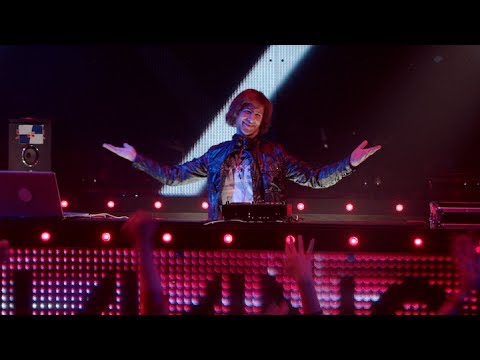
A DJ teases a crowd all waiting for the bass to drop. And exactly what do you think will happen when the music gets “turned up to death”? A skit starring Andy Samberg spoofs DJs who have reached rock star status since clubs quit hiring live bands. This digital short from The Lonely Island was on Saturday Night Live last night. Warning: contains fictional carnage. -via Daily Picks and Flicks


Early last year motion graphics artist and Alexandra Khitrova decided to utilize some of the digital tools she had acquired in her profession to explore concept illustration. While she did study art in school, this was an entirely new creative realm, a pet project to explore realms of science fiction and fantasy where flying dragons mingled with terrifying storms and otherworldly beings were brought to life on the screen.
The reaction online and off was swift, and Khitrova soon found herself working on increasingly complex drawings as she suddenly began to get commissions. Now, only a year later, she is already working with a team of writers and artists on a feature film. You can see more of her work over on DeviantArt.
 |
submitted by versesworld [link] [167 comments] |
 |
It's only two members from the band, but still pretty awesome. |

WARNING: Don’t try this at home… or in fact, anywhere!
The world’s largest gummy bear fire fountain: An experiment where the people at VAT19 used one of their GIANT gummy bears and dropped it in a vat of potassium chlorate.
From Vat19:
Don’t try this at home. Don’t try this at home. Don’t try this at home. Don’t try this at home. Don’t try this at home. Don’t try this at home. Don’t try this at home. Don’t try this at home. Don’t try this at home. Don’t try this at home. Don’t try this at home. Don’t try this at home. Don’t try this at home. Don’t try this at home. Don’t try this at home. Seriously.

If a robot read a novel, how would it feel? You might get a sense from these little jingles. Below are some songs that were automatically created by a series of algorithms that turn the emotions in novels into short pieces of music. If the songs remind you, traumatically, of your untalented little sister practicing piano… well, you can't say I didn't warn you.
Actually, the origins of the songs are pretty cool, as the Physics arXiv Blog reports. They start with sentiment analysis, a field in computer science that got hot not long after Twitter did. As more and more people started tweeting, computer scientists and companies wanted to automatically process those tweets, to figure out what emotions people were expressing in them. For example, do people feel negatively or positively about… snack cakes? How do people feel about a specific brand, say, Little Debbie? You can see the commercial interest in this.
The same techniques computer scientists use to analyze Twitter are also able read the feels in any text. So now it's possible to automatically read the emotions in novels, too. To make the songs below, two researchers—one of them a programmer and a musician—went one step beyond that. After running novels through a sentiment-analysis algorithm, they created an algorithm that would express those sentiments through music.
The algorithm splits novels up into four parts—beginning, early middle, late middle, and end—and writes melodies for each section. Thus, each song progresses through the emotions of the novel.
Among other things, the algorithm matches music to emotion by choosing different octaves, tempos, and keys. The sentiment analysis algorithm the researchers used was able to identify eight emotions in novels: trust, joy, sadness, fear, surprise, anger, and disgust. So the researchers wrote equations to tell their software how to choose the right qualities to go with these emotions. Joy and trust, for example, call for higher octaves. Anger, disgust, fear and sadness get lower octaves.
Knowing all that, it's a little easier to appreciate these ditties. The algorithms don't do too bad of a job at all. Lord of the Flies, for example, starts out appropriately ominously, although it gets a bit difficult to interpret in the middle:
Heart of Darkness is even heavier than Lord of the Flies, especially with those repeating fifths:
Anne of Green Gables is cutesy all the way through:
Check out the rest of the pieces on the researchers' website.
The algorithms' creators, Hannah Davis and Saif Mohammad, imagined several future applications for a piece of software like this. Here are some examples, taken from a paper Davis and Mohammad wrote about their work:

 Unlike your typical first-person shooter, in SUPERHOT, time only moves when you move. This gives you the ability to strategically plan out your approach. If you've played Braid before, the mechanics will feel familiar, as elements of the game speed...
D GREMEMBER: YOUR RIGHTS END WHERE MY FEELINGS BEGIN SHITLORDS!

A federal appeals court is letting stand a decision denying a trademark to a website's banner because it could be perceived as disparaging to Muslims.
The US Court of Appeals for the Federal Circuit upheld a 2011 decision from the US Patent and Trademark Office against "Stop Islamization of America"—a decision raising constitutional concerns.
It wasn't the first time trademark regulators enforced a little-referenced section of law that allowed them to refuse issuing a trademark if it disparages the "living or dead" or institutions, beliefs, or national symbols or places them in "contempt, or disrepute."
Read 8 remaining paragraphs | Comments
You know those terrible "Flatizzas" Subway makes? After ordering one without the sauce (because "I can't eat that stuff"), Bevalente Michette Hall called the police. She was later jailed for three minutes on a $2,000 bail for her efforts. Here's the 911 call, for those interested:
,
Submitted by: (via Gaston Gazette)
 (
(


![[link]](http://i.imgur.com/zOpQyK6.jpg)
