Detail of a Sasanian bowl dating back to the 3rd century CE. The silver and gilt bowl depicts a member of the Persian nobility. The seat of government and the Imperial Family of the Sasanian Empire resided in Seleucia-Ctesiphon (near modern-day Baghdad). Freer and Sackler Galleries of the Smithsonian Institution, Washington, DC.
Vidya Spandana didn’t aim low when she first started trying to make government more efficient. She took on the Department of Motor Vehicles.
Her creation, DMV.org—which took her college years and a good portion of her 20s—would have been far easier to create today. Sixteen years ago, there wasn't much focus on making public data publicly accessible with APIs, nor were there simple-to-deploy website solutions like WordPress. Spandana and her team built it all, from the ground up.
Her next project was a technically simpler, but far more dangerous. CrisisNET uses data scraped from crisis zones for first responders and journalists on the ground, allowing them to spend more time helping or getting the word out and less time collecting and parsing information. When CrisisNET revealed where Syrian rail bombers were most likely to strike and the analysis turned out to be as accurate as the CIA’s own intel, the world noticed.
Spandana, who served as a presidential innovation fellow in 2013, learned that people want the insight that her data collection methods and API produce, not the technology itself. So, she moved away from the nonprofit CrisisNet and earlier this year founded Popily, a cloud tool that analyzes data. In one example, a spreadsheet of information on Portland’s heritage trees reveals thousands of visualizations Popily thinks might be useful. Users can quickly sift through them to pick out options such as heritage trees by location, average size of each leaf, or ground covered by each tree’s shade.
Born in Visakhapatnam, India, Spandana knows life is about more than data, and that people are more than data points. “Staying connected to local people doing real life things…is a profound grounding piece to mental and emotional stability,” Spandana tells us. “The human side is just as important as the machine side.”
Spandana, who will be speaking at TFNW on how tech can be used to build a stronger democracy, says that participation in public services by private citizens is key. “Participation is critical because democracy is critical,” Spandana says, adding that her next project is a design school focused on inclusion, built for and by the design community in Portland.
Until then, Spandana will continue to do what she does most days, which is use Slack and text messaging to keep up with her Popily team, have fun making progress and moving forward in the world, and evangelizing tech literacy in diverse groups, especially minority and other under-represented populations.
Sorry to break your “hearts” but these lovely heart shapes lining the rims of these ancient Greek wine vases are actually shapes of ivy leaves.
Ivy leaves are closely associated with Dionysus, the Greek god of wine, and can be frequently found adorning wine vessels such as this krater and this dinos, which the Greeks used to dilute wine with water.
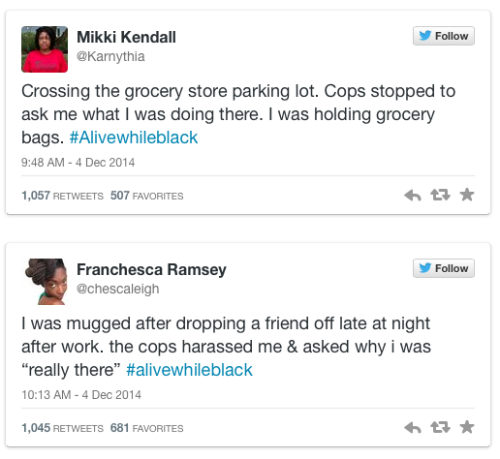
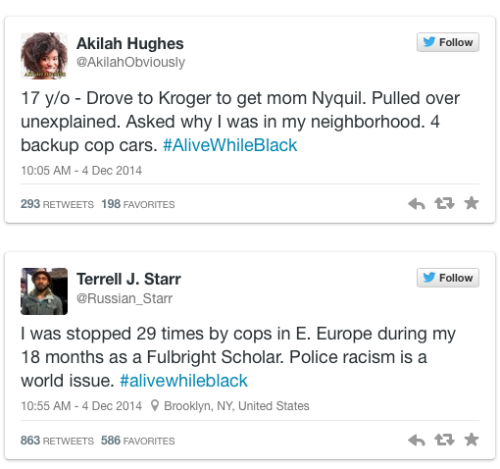
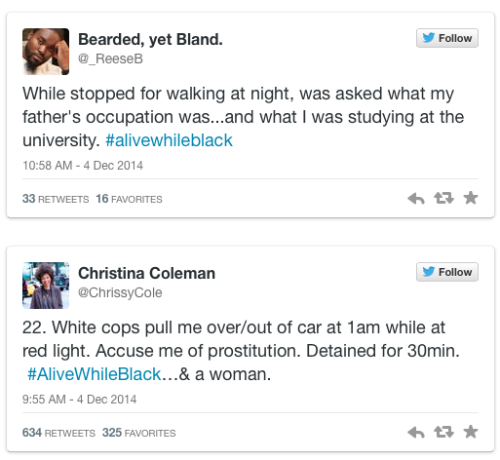
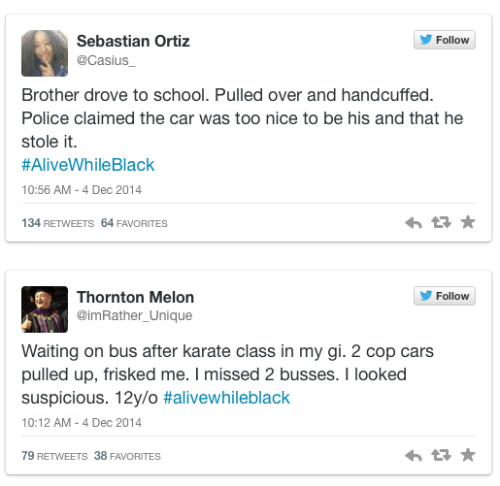
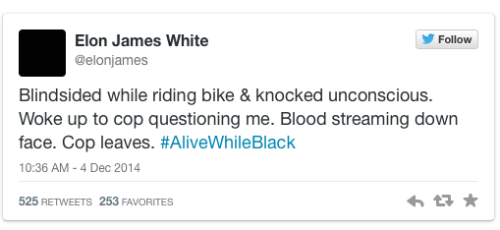
The hashtag #CrimingWhileWhite became a platform to illustrate what often happens when white people engage in criminal activity. It was a powerful moment, as white people openly acknowledged that they don’t face nearly the same punishment or brutality experienced by their black counterparts. But despite the good intentions of those who participated, many others felt like the hashtag detracted from conversations about the value of black lives.
After the overwrought celebrations over “defeating” the Trans-Pacific Partnership in Congress a few months ago that immediately fell apart the next week when Congress passed fast track, we should be extremely skeptical of putting any hopes into defeating the TPP. But it is good news that it is delayed because the ministers of various countries are fighting each other over protecting specific industries. The reason that’s good is news is that any delay, particularly with some talk of not revisiting it until after the upcoming Canadian elections, means that it becomes more unlikely to pass Congress during a U.S. election year and therefore can be part of the debate in 2016. Forcing it into the public debate during an election is the best strategy we have for killing it. It probably won’t work either, especially given that despite whatever distancing Hillary Clinton has done toward the TPP, there’s no good reason to expect she wouldn’t sign it–unless she fears outraging the base that just elected her. Yeah I know, I’m not counting on that either. But still, in a fight like this, you work with the best odds you have.
Uber executives love to compare themselves to civil rights leaders. Because there’s nothing closer to being Rosa Parks and Martin Luther King than being a millionaire CEO. But despite this, one might argue that said Uber executives actually are analogous to figures in the civil rights movement–for instance Orval Faubus and George Wallace:
But there is a better analogy from the US civil rights era for law-flouting firms of the on-demand economy. It’s just not the one corporate leaders claim. They are engaged in what we call “corporate nullification”, following in the footsteps of Southern governors and legislatures in the United States who declared themselves free to “nullify” federal law on the basis of strained and opportunistic constitutional interpretation.
Nullification is a wilful flouting of regulation, based on some nebulous idea of a higher good only scofflaws can deliver. It can be an invitation to escalate a conflict, of course, as Arkansas governor Orville Faubus did in 1957 when he refused to desegregate public schools and president Eisenhower sent federal troops to enforce the law. But when companies such as Uber, Airbnb, and Google engage in a nullification effort, it’s a libertarian-inspired attempt to establish their services as popular well before regulators can get around to confronting them. Then, when officials push back, they can appeal to their consumer-following to push regulators to surrender.
This happened just last week in New York City, when mayor Bill de Blasio moved to limit the number of Uber cars choking city streets during the heaviest hours of congestion. Uber pushed out advertisements voiced by celebrities including model Kate Upton and urged its wealthy users to write to city hall in protest. Mayor de Blasio stood down. Consistently, these nullifying companies claim they are striking a blow against regulations they consider “out-of-date” or “anti-innovation”. Their major innovation, however, is strategic and manipulative, and it’s meant to undermine local needs and effective governance.
…
Consider what it would mean for such a universalising approach to prevail. The business model of Uber would become that of law-flouting bosses generally. Reincorporate as a “platform”, intermediate customer requests and work demands with an app, and voila!, far fewer laws to comply with. Worse, this rebel attitude signals to the larger culture that laws and regulations are quaint and archaic, and therefore hindrances to progress. That could undermine faith in republican government itself.
In the 1950s and 60s, Southern governors thought they’d found a similar tactic to avoid the civil rights laws that they most despised. Though the strategy failed, the idea still animates reactionaries. Former Arkansas governor Mike Huckabee, now running for president, has even suggested that the US supreme court’s recent gay marriage decision should effectively be nullified by sovereign states.
Of course, a republic can’t run without authorities who follow the rule of law. Civil disobedience by citizens can be an important challenge to corrupt or immoral politicians, but when corporate leaders themselves start breaking the law in their own narrow interests, societal order breaks down. Polishing their left-libertarian veneer, the on-demand economy firms now flouting basic employment and anti-discrimination laws would like us to believe that they follow in the footsteps of Gandhi’s passive resistance, rather than segregationists’ massive resistance. But their wealthy, powerful, nearly-all-white-and-male cast of chief executives come far closer to embodying, rather than fighting, “the man”.
As Silicon Valley guru Peter Thiel has demonstrated, the goal of tech firms is not to compete – it is to so monopolise a sector that they basically become synonymous with it. Uber’s and Airbnb’s self-reinforcing conquests of markets attract more venture capital (VC) investment, which in turn enables more conquests, which in turn attracts more VC money. As that concentration of economic power continues apace, it’s more vital than ever to dispute Silicon Valley oligarchs’ self-aggrandising assertions that they follow in the footsteps of civil rights heroes.
One might complain the argument is a bit overwrought, but hardly more so than the outlandish claims of Silicon Valley executives themselves.
The causal chain of events is not difficult to see.
Israel’s occupation of the West Bank inevitably empowers and abets a movement of extremist Jewish settlers.
This movement of extremist Jewish settlers inevitably promotes vigilante violence against Palestinians.
This vigilante violence against Palestinians inevitably results in terrorism such as the murder of Ali Dawabsheh.
The line connecting Israel’s occupation of the West Bank to extremist settler violence against Palestinians could not be clearer. By its very nature, the Israeli occupation of the West Bank deliberately and systematically privileges the rights of settlers over those of Palestinians, even using different justice systems. And that is when Israeli occupation authorities bother applying justice at all. According to one recent study, only 7.6 percent of Palestinian complaints about settler violence lead to indictments, and only 33 percent of legal proceedings lead to a conviction.
The occupation has abetted the disturbing rise of settler violence; according to one UN report, the number of settler attacks on Palestinians more than doubled between 2009 and 2011. The forward-most outposts of the occupation naturally attract hardcore ideologues who oppose the very idea of a Palestinian state in the West Bank and see it as Israeli land. That movement, for various reasons, has grown in recent years; its members see it as their duty to enact violence against Palestinians. The nature of the occupation, which privileges the rights of settlers, grants them the physical and legal cover to do it, even if it sometimes also punishes them later.
The only way to stop this is for the Israeli government to end the occupation of the West Bank, tear down the settlements, and return to 1967 boundaries.
Female students today experience a dual reality of unprecedented achievement and persistent discrimination. Women are more likely than men to earn degrees, perform better in classes and take on more advanced degrees, yet they still experience physical objectification, funding disparities and even assault at school. But a new study conducted by two Texas A&M University economists has found female teachers may be their key to success
I went to an all-girls high school with almost all female teachers. Starting to realize how lucky I was.
Calculated correctors, this team of vigilante street art fixers patrols for grammatical mistakes then regroups to decide on edits before hitting the streets of Quito, Ecuador, to deploy them.
Known as Acción Ortográfica Quito, the group consists of a trio who share a strange set of common interests including street art copy editing. Like rogue professors, they use red to highlight their changes or suggestions, but their good intentions do not render their actions legal, hence their strictly maintained anonymity.
“There’s a big difference in saying: ‘No quiero verte’ (I don’t want to see you) and ‘No, quiero verte’ (No, I want to see you),” notes one of the members in an interview with COLORS, “Many times, someone does not realize how a comma or an oversight can completely change the meaning of a sentence. It can change your life.”
The task can be daunting – their first fix had thirteen errors in two lines of text. Whether serious or silly, they suggest “it’s a public service and a moral obligation. We’re against spelling vandalism and we won’t break nor give up until we see a society free of spelling mistakes.”
Above, the phrase: “If in your kisses I met the essence of life, then not kissing you would be the worst sin I could commit,” for which these graffiti activists turned the verb into conditional, added and deleted commas, turned ellipsis into full stop and capital letter into lower case.
The group is also broadening its scope and mandate over time; they are aiming to add a hotline where people can phone in mistakes they spot and have begun correcting grammar on Twitter posts as well. When time permits, they also leave their name stenciled at the scene in red, like a grader signing their work for students.
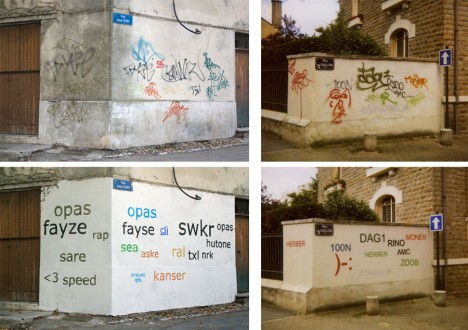
Meanwhile, a similarly unconventional yet equally geeky German street artist is out to fix tags, turning them into tag clouds – it would seem this group is not alone in its quest to clean up yet preserve the essential meaning of everyday graffiti.
Want More? Click for Great Related Content on WebUrbanist:
In an effort to democratize both the creation and appreciation of urban graffiti, a group of young street artists in Lisbon, Portugal, is teaching retirees how ...Click Here to Read More »»
In a play on both tagging and technology, this artist turns traditional tags into computer-style tag clouds, among other geeky street art projects.
Click Here to Read More »»
For better and worse, self-reflection and meta-art is an inevitable facet of the digital age – this artist recognizes the blurred lines between physical ...Click Here to Read More »»
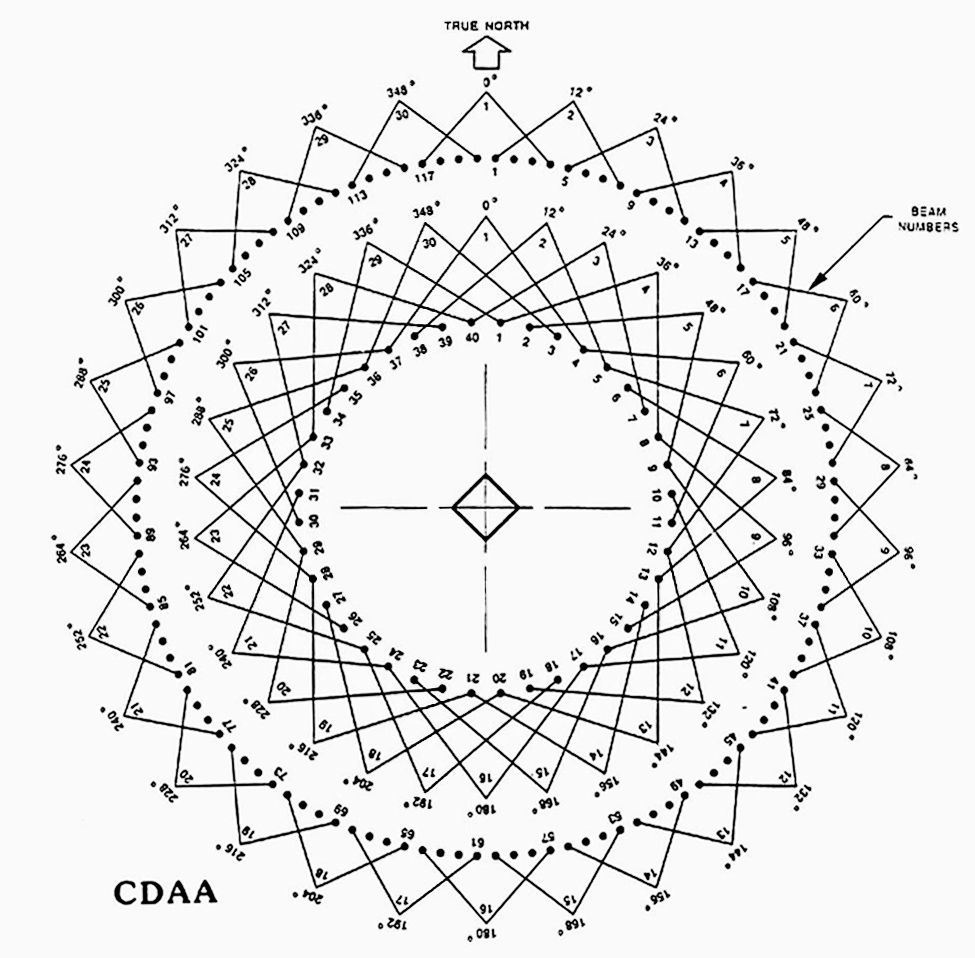
A Circularly Disposed Antenna Array, he explains, was "sometimes referred to as a Circularly Disposed Dipole Array (CDDA)" and was "used for radio direction finding. The military used these to triangulate radio signals for radio navigation, intelligence gathering and search and rescue."
While discussing the now-overgrown landscapes found on old military sites in Hawaii, the post's author points out the remains of old antenna set-ups still visible in the terrain.
A series of photos, that you can find over at the original post, show how these abandoned circular land forms—like electromagnetic stone circles—exist just below the surface of the Hawaiian landscape, thanks to the archipelago's intense militarization over the course of the 20th century.
He then cleverly juxtaposes these madala-like technical diagrams with what he calls a "Polynesian guidance system for navigating the Pacific" (bringing to mind our earlier look at large-scale weather systems in the South Pacific and how they might have guided human settlement there).
The idea that Polynesian shell map geometries and the antenna designs of Cold War-era military radio sites might inadvertently echo one another is hugely evocative, albeit purely a poetic analogy.
Finally, I couldn't resist this brief passage, describing many of these ruined antenna sites: "Their exact Cold War era use, frequencies and purpose isn't yet known but were most likely for aircraft radio navigation, direction finding, intelligence gathering and for search and rescue."
You can all but picture the opening shots of a film here, as concerned military radio operators, surrounded by the arcane, talismanic geometries of antenna structures in the fading light of a Pacific summer evening, pick up the sounds of something vast and strange moving at the bottom of the sea.
Waves of rainbow color cascade down a hillside neighborhood in Mexico’s drug capital as a street art collective paints over 200 houses. ‘German Crew’ enlisted the help of youth living in Las Palmitas to transform the town, brightening the facades of almost every single building in continuous swoops of fuchsia, orange, yellow, green and blue.
The muralists covered 20,000 square meters (225,280 square feet) with powerful pops of color. Commissioned by the Las Palmitas municipality, the project is five months in the making, and these photos only show completion of the first stage. The aim is to revitalize the town, which is located in the state of Sinaloa, where most of the country’s drug cartels are based.
According to the German Crew Nuevo Muralismos of Mexico, the project involved the participation of 452 families, or 1,808 people living in the neighborhood. Keeping kids and teenagers busy painting all of those houses nearly eradicated violence among youths while it was in progress. Lots more photos can be found on the crew’s Facebook page and Instagram.
Previously, street art duo Haas & Hahn transformed 34 buildings in a Rio de Janeiro favela (above), with the similar effect of creating jobs, bringing the community together and making a place that’s often feared by outsiders feel more welcoming. These large-scale mural projects can bring attention to under-served neighborhoods and help boost residents’ sense of pride.
Want More? Click for Great Related Content on WebUrbanist:
Previous efforts of Favela Painting transformed 34 buildings in Rio de Janeiro via huge rainbow-colored community mural, creating jobs and beautifying an area ...Click Here to Read More »»
Six industrial silos along the heart of Vancouver’s waterfront have been transformed into colorful, towering human figures in a massive mural project by ...Click Here to Read More »»
Five distinct styles come together in a duo of massive geometric murals with ‘Recycles,’ a collaboration created for the street art curation ...Click Here to Read More »»
This glass was designed to drench the drinker in alcohol, and put on an entertaining display for onlookers. What is better than that?
“Joke glasses” challenged drinkers to figure out how to get the alcohol out with minimal spillage. If they spilled? The glass then refilled. This one is the world’s only intact example resembling a man.
Paper from Disney Research explores various visual effects which can be employed in video recording using a 3D depth camera:
Many compelling video processing effects can be achieved if per-pixel
depth information and 3D camera calibrations are known. However, the
success of such methods is highly dependent on the accuracy of this
“scene-space” information. We present a novel, sampling-based framework
for processing video that enables high-quality scene-space video effects
in the presence of inevitable errors in depth and camera pose
estimation …
… Our generic scene-space formulation is able to comprehensively describe a
multitude of video processing applications such as denoising,
deblurring, super resolution, object removal, computational shutter
functions, and other scene-space camera effects. We present results for
various casually captured, hand-held, moving, compressed, monocular
videos depicting challenging scenes recorded in uncontrolled
environments.
There currently is no embeddable video at time of posting, but a video you can watch can be found here
You can find out more about the work at Disney Research here
“Scientology is clearly a made-up thing, and would be a great plot for a TV series or movie, not necessarily a real-life commitment.”
— Ashwin Rodrigues, Vice Magazine
I recently watched the exposé documentary on Scientology, Going Clear: Scientology and the Prison of Belief. Like many who watched this documentary, I found it well put together, entertaining, and educational. This isn’t the first critical look at Scientology, and those who have read other accounts, such as Janet Reitman’s Inside Scientology or Jon Atack’s A Piece of Blue Sky, will be familiar with the more controversial aspects of Scientology detailed in Going Clear, such as allegations of abuse and L. Ron Hubbard’s pre-Scientology activities.
While I think the abuses brought forward in Going Clear and elsewhere are certainly problematic, I couldn’t help but be concerned at the way Scientology was consistently portrayed as “not a religion” by its critics in Going Clear and in other cultural discussions, such as a recent article on the Vice website. In fact, despite claims to the contrary, it appears that Scientology meets several criteria for being a religion.
I want to look at a few dimensions of what we would normally consider criteria for religion and see if Scientology fits the bill. These are the criteria that come up time and again in classrooms in response to the question, “How do you define religion?” Although many, if not all, of these criteria apply to all religions, much of my comparison here is with Christianity. The reason for this is two-fold. First, Christianity is the dominant religion in the West and thus our normative definition of “religion,” it speaks to a common currency of knowledge in a way other traditions do not. Second, I do not wish to speculate in-depth about traditions I have limited knowledge of and have restricted my discussion to cogent examples which exist within my knowledge base.
I write this not as a supporter of Scientology, nor is this meant to be a defense of their beliefs and practices, and I want to make clear that I do not condone the alleged abuses perpetrated by the church. Nevertheless, I support Scientology’s claim of being a religion. The answer why may surprise you.
Does Scientology have a soteriological goal?
One critique of Scientology is that while Christians or Muslims or Buddhists have an end-game, Scientology does not. Such a religious quest, called a soteriological goal, suggests that the adherent is saved by a particular religious message and by living according to the tenets of that faith. For example, a Christian soteriological goal would be to go to Heaven (and conversely avoid Hell). A Buddhist would similarly seek Nirvana (and avoid reincarnation). These aims are said to bring the adherent to eternal peace, a peace that is granted through religious activity.
Scientology does have such a goal. In Going Clear, “The Bridge” is frequently mentioned. This is a mythical metaphor for the spiritual path of the Scientologist. Through the various techniques Scientology offers, the adherent ascends “The Bridge” to the state of “Clear” and later to that of Operating Thetan. Scientology scholar David G. Bromley describes this as a progressive attainment of personal salvation through which a Scientologist “restores themselves to their original, natural condition” (92).
This idea of personal restoration to an original state is also found in Judaeo-Christian faiths, Gnostic beliefs, Kabbalah, and even Buddhism (e.g. cleaning the mirror to reveal the true self). The idea that there has been some event that has led to an imperfect humanity that needs to be restored to perfection is not unique to Scientology, and is a common motif of religious thought rather than a “strange” credo.
Does Scientology have a soteriological goal? Answer: Yes.
Do Scientology’s adherents see themselves as religious or spiritual?
One of the things that stuck me about the documentary Going Clear were the accounts of ex-Scientologists. In particular, the story of Sea Org recruit Hana Eltringham Whitfield. The Sea Org is a division of Scientology which consists of elite members, but which has also come under scrutiny for abuses, such as unpaid labour. (Although it must be noted that several religious orders require service of their members for similarly low wages which are often re-donated to the religious group in question.)
Although later disenchanted with Scientology, Whitfield mentioned her initial joy at being invited to join the Sea Org. In fact, she said she was “so ecstatic…I was on my way to the greatest adventure in my life.” She describes her experience as a result of a “heady mix of emotion and belief.” Whitfield isn’t the only one to describe their involvement with Scientology as a spiritual or religious journey. In Going Clear, Ex-Scientologist Jason Beghe also describes his initial enthusiasm for Scientology as being “on a spiritual adventure.” While both Whitfield and Beghe have moved on and are now vocal critics of Scientology, it is interesting that both saw their early involvement as a spiritual journey.
Do Scientology members see themselves as on a religious or spiritual quest? Answer: Yes
Does Scientology have an evangelizing mission?
Some faiths, some forms of Christianity for example, have evangelization as a component of their religion: the spreading of a “good message” in order to convert others to their religious beliefs and practices.
Scientology, too, engages in such “evangelizing.” On one level, the recruitment of members and sale of Scientology literature, criticised as a high-pressure, is a huge feature of Scientology, and recruiters are lauded for their numbers. Being praised for conversion numbers or promulgation of literature is not unique to Scientology, however, Jehovah’s Witnesses and Mormons also engage in such “high pressure techniques” in an attempt to sway converts.
But Scientology, like the LDS church, isn’t just about boosting numbers—they believe they are saving souls and saving the planet (Bromley 92). Whitfield states that through her involvement with Scientology, she “was deeply convinced that we were going to save the world.”
The idea that the entire world needs to be saved stems from the creation myth of Scientology. Although often mocked for the belief in evil space aliens, this myth is an apocalyptic tale which reveals the fall of mankind and the eventual defeat of evil (here personified in the galactic leader Xenu). This fall, caused by the evil Xenu, currently threatens the spiritual path of humans (Bromley 91). Through various practices, it is believed this evil influence can be eliminated, thus saving the world. Of course, this universal salvation narrative is not unique to Scientology. Replace “Xenu” with “Satan” and you have the underpinnings of Christianity and other Judeo-Christian traditions.
Does Scientology have an evangelizing mission? Answer: Yes
Does Scientology Have a Holy Text?
Scientology can be considered to have several holy texts. Dianetics, L. Ron Hubbard’s first book to outline the basic principles of Scientology could be considered a holy text, as can the various literatures associated with internal Scientology study (including those related to Xenu and the creation myth). These works form the core of Scientology teachings, providing a template for member belief and practice. That these works have metaphysical import suggests that they may be considered religious texts.
Does Scientology have a holy text? Answer: Yes.
Does Scientology have a savior figure?
L. Ron Hubbard is viewed as the father of Scientology and the one who developed the specific “spiritual technology” to “go clear.” While alive, Scientologists revered him to the point of servitude (see Whitfield’s interview in Going Clear), and he continues to be revered by Scientologists after his death. It could be argued that, for Scientologists, Hubbard is a savior figure in that he invented the means for various individuals to “Go Clear.”
He is not, however, a savior in a Christian sense—he is not seen as dying for Scientology. Rather, his role here is different. Bromley sees Hubbard as a “Prophetic persona” who “claimed to have discovered both the source of human misery…and a technology for realizing the godlike potential that all individuals actually possess” (88). Scientology has valorized Hubbard’s role as the founder of Scientology, imbuing it with special meaning and a salvic quality. In this way, Hubbard is more akin to a prophet or holy man, albeit an extremely important one, who provides key religious knowledge to their followers.
Does Scientology have a Saviour Figure? Answer: Yes
Does Scientology have Holy Places?
The most obvious candidate for a Scientology holy place would be the church buildings themselves. In a promotional video on the Scientology website, one person likens a Scientology church to any other house of belief saying, “We have our Sunday services, we do marriages, we do naming ceremonies.” Clearly, the Scientology portrays its churches (which also provide courses on the “theology of Scientology”) as sacred places for the transmission of the beliefs and practices of Scientology.
Does Scientology have Holy Places? Answer: Yes.
Is Scientology a Religion? Final Verdict: Yes.
Scientology appears to share the same attributes of traditional religions. It has a soteriological belief system which promises its members salvation, its adherents see themselves engaged in a religious or spiritual quest, the organization evangelizes not just for individual but universal salvation, it has holy books and a prophetic leader who claims to have a special message, and its members meet in holy places in order to learn and transmit those teachings.
If Scientology is a Religion, Why the Criticism?
Many of the religion-specific criticisms leveled against Scientology by former adherents can be found in the critics of any religion who found themselves disillusioned over time. (See, for example, the number of self-identified “recovering Catholics.”) These are their experiences of Scientology, and as such their criticism can and should be taken as an insider perspective, albeit a critical one. The flipside is that anyone within the church, when providing their insider view, is liable to paint a diametrically positive view of the church. In other words, opinions are subjective. As we have seen, no matter how one feels about Scientology, it looks, acts and speaks like a religion and should be treated as such.
So why is there so much opposition?
The allegations of abuse certainly do not help Scientology. It is this dimension of abuse—but not belief—that most strongly recommends Scientology to be a cult in the modern sense. For many, I would imagine that it is difficult to separate religious practices from the sordid stories of kidnapping, harassment, and mistreatment which surround the church. But I do not think that this is the only reason there is so much opposition to Scientology.
That Scientology is a New Religious Movement is no doubt the biggest obstacle to acceptance. Established religions have the benefit of time to institutionalize and validate their beliefs and practices. Myths about omnipotent Gods, heaven and hell, savior figures, otherworldly prophets, and angels from the sky become accepted tradition that is passed along unquestioned. Beliefs about salvation become entrenched, and what were once fringe beliefs (Remember, Christianity was just one of many marginal Jewish beliefs which existed in Christ’s day) become an accepted way to perform religion.
New religious movements don’t have those benefits. New stories about sky gods and evil figures sound silly, or like science fiction. What modern person, armed with science and knowledge, could believe that their life is controlled by some superhuman figure from outer space? A holistic view, however, would note that there is little difference between a sky god named Zeus, a vengeful figure named Jehovah, or yes, a spiteful galactic ruler named Xenu.
Certainly, L. Ron Hubbard famously admitted that the best way to make money was to establish a religion. And, yes, Scientology is an invented tradition, but I would argue that all religion is invented tradition relative to the time of their adoption. Scientology clearly draws off timeless religious narratives as it reconfigures tales of humanity’s fall and salvation into a new belief system with modern spiritual technology (Hello, e-meters! Goodbye, confession!). Scientology’s newness doesn’t make it any less valid—or potent—as a religion. Its myths and methods are the similar to, or the same, as those found in other, older, belief systems.
We have seen that Scientology meets several criteria for a religion: it has a salvic goal, its members proselytize in order to save the world, it has a savior figure and holy places and a religious mythology preserved in books and literature. Scientology appears to very much be a religion. Is it a “true” religion? That doesn’t matter. What matters is that its adherents believe it to be true.
Sources
Bromley, David G. “Making Sense of Scientology: Prophetic, Contractual Religion,” in Scientology. Edited by James R. Lewis. Oxford University Press, 2009.
Gibney, Alex. Going Clear: Scientology and the Prison of Belief. 2015.
United States Conference of Catholic Bishops, “Annual Collection Benefits 35,000 Sisters, Brothers, Priests in Religious Orders.” November 19, 2014. http://www.usccb.org/news/2014/14-193.cfm
I just got back last week from summer camp. I’d never been off to camp before; it wasn’t something my family ever really did, and it was pretty fucking awesome to have the experience.
Even more awesome was the fact that this wasn’t just any old summer camp — this was A-Camp… summer camp for queer women, put together by Autostraddle! Spending half a week on a mountaintop surrounded by about 300 women, none of whom were “straight,” was a wonderful and moving and awesome (in the sense of “instilling or inspiring awe”) thing. And that’s about as close as I can get to making the understatement of the century.
I came into this at the bottom of several months of working hard to convince myself that there wasn’t something fundamentally wrong with me, wondering how long I could keep from believing that I’m just unlovable, unfuckable, undesirable… and beginning to lose the battle. That all changed.
On the way to camp, MFP and I rode with a couple of women that she knew for the nearly 10-hour drive, with a stop overnight at a nice little campground. It was Again‘s car that took us there, although her friend helped out too, switching out when one of them was too tired. Again and I had been making eyes at each other, and I was flirty like I am with any beautiful woman. As we made our way up the mountain, the last stretch of road before camp, I was in the back seat across from her, and we spent those 20 minutes or more looking into each others’ eyes, smiling shyly, and finally daring to hold hands. It was sweet and beautiful, and especially nice when Again was planning to drive back home after droppig the rest of us off. She ended up staying overnight, and we promised to be in touch after I came home again.
At camp, I met Lime face-to-face for the first time. We had been chatting online before camp, and it was notjust slightly obvious that she had a crush on me; even MFP had picked up on it! Of course, it was very much mutual, and we shared more than one intimate moment. I’m sure whoever the guy was that whizzed down the hiking trail on his mountain bike enjoyed the view he got while Lime and I were out “for a hike” — I know I was a bit distracted by the view of her! The note she slipped into my hand the next day made my heart sing (and by “heart” and “sing” I mean something slightly different as well)… I have often felt the kind of lust expressed by “I want you to fuck me until I can’t remember my own name,” and was more than happy to indulge that lust. I know what it’s like to need, and to go without. While I wasn’t entirely successful on the name-forgetting front, I certainly gave it my best shot… and heard my own name screamed out countless times for that effort! It was amazing.
Then there was Poco. I think there’s only once when someone has told me that a compliment I’ve given them was, without question, genuinely the best one they’re ever received — and that was her. All I told her was that she had beautiful breasts; in a cabin of bunk beds full of queer women, many of us changed clothes without much thought to who was looking or not, and on the first night as Poco was getting into her pajamas and climbing into her bunk (right above mine) I caught a glimpse of her lovely tits, and it made me smile. Considering the last two days had been pretty rough, and I’d had almost no sleep, so her body (and her chest in particular) was a very pleasant close to my evening. Then when the first night ended up being one disaster after another, and I had even less sleep than the previous few, startng my morning with the same view was a peaceful moment among a turbulent sea of troubles. When I had the chance, I told her so, and she maintains that it’s the nicest thing anyone has said to her. Over the course of the few days of camp, we spent some time together, and some of that in bed, semi-clothed and gently touching and kissing and pleasuring each other — and we’ll be in touch again!
There was one moment during the week that I keep returning to in memory, a beautiful scene where I sat on the edge of my bunk, Poco was lying to my right with her head in my lap, Lime sat to my left holding my hand as we ran fingers up and down across our thighs, and MFP sat on the floor between my legs and I caressed her shoulders and ran my fingers through her hair. How wonderfully right it felt, to be surrounded by beauty and joy and love like that!
And now that I’ve been home a few days, I’ve had even more fun. I spent last night in bed with Again and her partner Crowbar with plans to have more fun as soon as our schedules allow!


















 [Image: Via the Pacific Cold War Patrol Museum].
 [Image: Via the Pacific Cold War Patrol Museum].
 [Image: Via the Pacific Cold War Patrol Museum].