
a1ys:
I N C R E A S E T H E W I F E.


The Morgan Casket
11th- 12th century, Italian
The Metropolitan Museum of Art
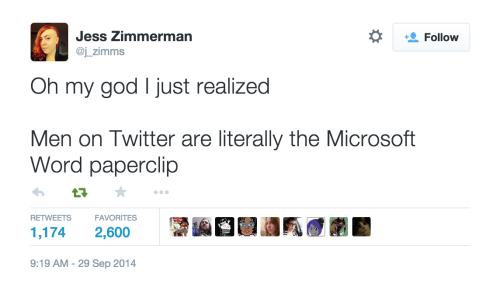
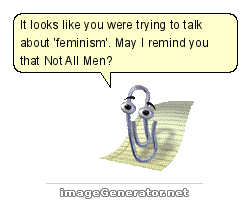
Clippy, the animated assistant in Word, is well known as one of the most hated software features ever released. Now we know why Microsoft released it – because the male engineers didn’t listen to female user feedback. “Even Early Focus Groups Hated Clippy. Women told Microsoft the animated paper clip was leering at them. The software company didn’t listen.”
OMFG CLIPPY WAS DESIGNED AS THE ORIGINAL MANSPLAINER
THIS MAKES THIS MEME EVEN BETTERBaaaaahahahahahahahaaaa

More information here. Yes, someone at Salon should actually cover this, but we’re all exhausted beyond the telling, so it’s going to have to wait.
Also, in terms of the clickbait-to-content ratio at Salon that Other Scott’s complaining about, it’s worth juxtaposing the sudden reappearance of Paglia with the current labor dispute and wondering if there isn’t some sort of connection between the two, as was alluded to in the previous IBT article.

Entrance to the World Wide West farmhouse (all photos by the author for Hyperallergic unless otherwise noted)
POINT ARENA, Calif. — A few months ago, a group of artists, writers, curators, and creative technologists received an email with a link to a video requesting participation in a summit held in the small coastal town of Point Arena, California. I was one of 30 individuals who received the message.
The World Wide West (WWWest) summit, the first yet, would revolve around “reachability,” or “technology’s promise to extend our reach,” and there would be excursions involved. Despite the relative lack of details, I was intrigued. I agreed to attend.
I arrived early Friday morning on July 17. The directions were extremely specific with a few turns off Highway 1 and an excruciatingly slow and awkward drive (5 mph) along a pebbly concrete road that led to the farm. I was relieved to see the distinct logo upon entering the property. I joined in on breakfast at the farmhouse where the other guests had already gathered, when, all of a sudden, we heard woman’s voice on the radio: “Attention. Attention. Please meet for orientation.” The organizers used the AM radio frequency 90.1 to create a World Wide West-dedicated radio station. The voice seemed to emanate in surround sound since there were radios all over the campgrounds.
World Wide West organizers Benjamin Lotan, Tara Shi, Liat Berdugo, and Sam Kronick provided us with a brief introduction of activities without providing much information on themselves. The orientation was on how to dig a trench for fiber optic cabling. We walked out to an enormous field (about 60 acres) along with an organizer who carried a long tree branch with a camera affixed at the end that was used as a selfie stick. Orange flags were placed along the path we were expected to dig the trench. We all got to work without questioning what was asked of us. With tools in hand, we took turns digging and loosening the soil with a pickaxe. I couldn’t help but think this was all a performance piece. It seemed like an homage to an Allen Kaprow happening.

World Wide West participants trenching in 60 acres of land with the extra long selfie stick (click to enlarge)
During the summit, the internet manifested in a physical way I hadn’t imagined. I couldn’t help but think Andrew Blum’s book Tubes, a detailed account on the structures behind the internet. In 1956, AT&T installed transcontinental coaxial cables providing telephone service between the US, Hawaii, and Japan in Point Arena, since it’s closest in distance to the Hawaiian islands than any other point along the West Coast. The WWWest organizers took us to those cables. I never experienced a group of people so fascinated by infrastructure. We took photos and closely inspected the cables before touring the Level 3 facility that connects Point Arena’s fiber optic cables to the rest of the world. There, the WWWest’s organizers invited Point Arena native Zean Moore, who works with Further Reach, a company that provides high-speed internet to rural Northern California. Moore gave us tours of the technology center, cable station, and towers in the area. He explained the importance of his work and research in setting up internet access for the residents. This town of a little over 400 citizens is far more technologically important than I had imagined. The symbolism behind selecting Point Arena as a creative place and reprieve from urban, device-laden life was deliberate.
Impromptu conversations with each organizer revealed that Luton and Kronick were working on their MFAs while Shi was pursuing her BFA when they all met at University of California, San Diego. Kronick and Berdugo met last year when Berdugo was on the heels of having organized a new media arts summit titled Print Screen in Tel Aviv and was feeling inspired to bring something to the Bay Area. During a conversation regarding the impetus for WWWest, she commented,“I wanted to start something that would bring people together to think about technology and the digital landscape in meaningful and critical ways. Something that goes beyond the put-an-LED-on-it, superficial way of art making.”

Close-up of AT&T coaxial cables connecting to Hawaii and Japan
On Saturday morning, in the middle of the 60 acres of tall, dry grass, artists Liat Berdugo and Phoebe Osbourne led a session of “Unpatentable Micro Touch Aerobics.” In her research, Berdugo found that Apple holds 8,500 US patents, which include the pinch and spread-to-zoom gestures on the iPhone. She went through the process of patenting her own custom gesture as “choreography” with the US Copyright Office. But her submission was subsequently denied and re-classified as an “aerobics exercise program.” Hence the creation of the choreographed workout accompanied by Siri rapping Notorious B.I.G.’s song, “Hypnotize.” It was humorous and surreal performing multi-touch aerobics in the middle of a field under a bright blue sky.

“Unpatentable Micro Touch Aerobics” in session (photo by Liat Berdugo)
After working out, we gathered on the deck and took turns reading excerpts from The Whole Internet, an O’Reilly media book by Ed Krol from 1994, which is still pegged as one of the best books on the internet, despite the incredibly dated writing. Sam Kronick, another WWWest organizer, read an excerpt on the invention of muzak from the book Blue Monday: Stories of Absurd Realities and Natural Philosophies by Robert Sumrell and Kazys Varnelis. The reading tied into the incessant playing of muzak all weekend on the WWWest radio station. The genre, we learned, was developed to create an optimal, productive work environment. The weekend was coming together.
Later on that night, despite feeling tired from all the sessions (and there were even more events I couldn’t attend), I participated in Ramsey Nasser’s Swordfight game. The game, as described on Nasser’s site, is “a physical, two-player game played with custom built, strap-on Atari 2600 controllers. The goal is to press your opponent’s action button with your joystick before the same is done to you.” As a player, you’re given parameters and obvious obstacles such as having your hands cuffed behind your back. But how one moves, tricks, dodges, and pokes the opponent is the key to winning. Reachability, in this particular sense, involved a lot more human ingenuity. Connecting the world is a lot like the game itself. The objective seems painfully easy, but means can be difficult.
After failed, albeit humorous, attempts at telling spooky stories, we proceeded to the barn where a xylophone made out of slats of wood, metal pipes, and rope provided for a couple hours of an impromptu jam session in the middle of the night. The sound of voices singing and making music could be heard from the farmhouse. We all felt a bit like kids at summer camp.

World Wide West organizers Tara Shi, Liat Berdugo, Sam Kronick, and Benjamin Lotan (GIF by Tara Shi)
On the final day of the summit, we participated in a Great After Question (GAQ) session. We shared our thoughts about what transpired, what worked, and how to bring our conversations into our respective practices. While it all may still sound a bit cult-like, it wasn’t. The overall feeling was one of experimentation, where were we disconnected and re-contextualized questions we might ask within our own work and research. What does it mean to enable people to connect to the internet while preserving a sense of community, despite rapid growth and economic change? What truly makes up the infrastructure allowing us to reach and obtain information, but in relationship to natural ecosystems? Asking these questions and many more in the absence or near-absence of technology has consumed my mind ever since.
The summit was reminiscent of events and gatherings facilitated by collectives such as Experiments in Art and Technology (EAT), founded in the late 1960s, and La Mamelle, Inc./Art Com established in the late 1970s. When people say there is no art scene in the Bay Area, I feel comfortable, especially now, refuting this perceived lack or absence. Granted, one may have to drive approximately 130 miles north of San Francisco, but there is something in the making and it’s powered by artists who believe in the impact of connectivity in both digital and analog forms. Not quite a summit, not quite a festival, and certainly not a conference, WWWest presents a new frontier into how creativity can flourish. While this burgeoning community grows in such an unlikely place, the experience transcended the mystique and allure of exclusivity. The organizers presented the beginning of putting the West back, as well as Point Arena, on the proverbial map of engaged and inclusive art making.
The World Wide West (WWWest) summit took place in Point Arena, California, July 16–19.

Carsten Höller, “Decision Corridors” (2015), installation view in ‘Carsten Höller: Decision,’ Hayward Gallery, London, 2015 (art © Carsten Höller, image courtesy of the artist, photo © Linda Nylind) (all cat GIFs by the author for Hyperallergic)
1. I originally considered writing in a standard review format, but Carsten Höller’s retrospective Decision, currently on view at London’s Hayward Gallery, is more amenable to the listicle form.

Carsten Höller, “Two Flying Machines” (2015), installation view in ‘Carsten Höller: Decision,’ Hayward Gallery, London, 2015 (art © Carsten Höller, image courtesy the artist and Gagosian Gallery, photo © Ela Bialkowska, OKNO studio)
2. Why? Because like a reductive narrative of the Egyptian revolution illustrated with Jurassic Park GIFs, the retrospective takes the stance that populism and approachability are incongruous with complexity and intellectual challenge. The Egyptian revolution listicle and Decision alike expose people who might not regularly read the news or visit a major art museum to those spaces, but at a considerable cost.

Carsten Höller, “Half Mirror Room” (2008/2015) and “Snake” (2014), installation view in ‘Carsten Höller: Decision,’ Hayward Gallery, London, 2015 (art © Carsten Höller, image courtesy of the artist, photo © Linda Nylind)
3. Before Decision even opened, I was informed that it would be very popular this summer. I wasn’t surprised. In the retrospective, Höller inserts an aesthetically pleasing fun fair into the Hayward’s Brutalist exhibition space. You might have seen or read about Gagosian’s booth at Frieze London this past year, which featured a Höller-designed playground for children; this installation is the bloated, adult version of that one. Höller speaks matter-of-factly (or uncritically, depending on who you ask) about the nature of the retrospective, saying: “This exhibition is a kind of funfair, but that’s what exhibitions are these days.”

Carsten Höller, “Upside Down Goggles” (2015), installation view in ‘Carsten Höller: Decision,’ Hayward Gallery, London, 2015 (art © Carsten Höller, image courtesy the artist, photo © Linda Nylind)
4. At the Hayward, the viewer-cum-participant navigates various slick spectacles — my personal favorite was fat-bellied pink snakes lying uselessly on the floor — including a mushroom mobile, a “flying machine,” and the artist’s trademark giant slides, which via their coils vomit the viewer toward gallery exits. From time to time, the exhibition-goer must make a decision: Which of the semi-darkened tunnels, A or B, will you choose to navigate? Will you risk swallowing one of the synthetic red-and-white pills raining from the ceiling?

Carsten Höller, “Isomeric Slides” (2015) during installation of ‘Carsten Höller: Decision’ at Hayward Gallery, London, 2015 (image courtesy the artist and LUMA Foundation, photo by David Levene)
5. Yet choice is illusory here. The tunnels, termed “Decision Corridors,” are virtually the same in structure and ejection point, and no one around me was considering taking the pills, probable placebos which had collected into a small mound of plastic, virtually untouched. Even an abundance of choice becomes specious when the options are interchangeable or irrelevant. Cue a lame joke about Höller being an entomologist prior to being a contemporary artist, and us being ants on his farm, ruminating over a selection of tiny tunnels.

Carsten Höller, “Isomeric Slides” (2015), installation view in ‘Carsten Höller: Decision,’ Hayward Gallery, London, 2015 (art © Carsten Höller, image courtesy the artist and LUMA Foundation, photo © Linda Nylind)
6. The false choice phenomenon at work in Decision made me think about late capitalism, about how all of the choices consumers are presented with might conceal an ultimate lack of one. Big, bright, and shiny, the objects in Höller’s arrangement reproduce not only a fun fair but also an art fair aesthetic. The retrospective’s giant dice (a version of which was displayed at the aforementioned Gagosian booth) and large blinking lights recall art fair booths trying to one-up each other with dazzling displays; for all the options, the works start to look pretty similar, a visual display of the homogenizing forces of globalization and capital.

Carsten Höller, “Two Roaming Beds (Grey)” (2015), installation view in ‘Carsten Höller: Decision,’ Hayward Gallery, London, 2015 (art © Carsten Höller, image courtesy the artist, photo © Linda Nylind)
7. Höller’s jumbo spiraling slides, a #TBT to the five giant slides he installed in Tate Modern’s Turbine Hall in 2006, are intended to catalyze “an emotional state that is a unique condition somewhere between delight and madness.” There is something to be said for bodily experiences — induced or accidental, sought or stumbled-upon — that wrench you out of the everyday. And the transgressive potential of festival and reckless fun is certainly worth a conversation.

Carsten Höller, “Pill Clock” (2011/2015), installation view in ‘Carsten Höller: Decision,’ Hayward Gallery, London, 2015 (art © Carsten Höller, image courtesy the artist, photo © Linda Nylind)
8. But Decision doesn’t push far enough beyond the amusement park. In the artist’s original vision, roving beds on wheels moved throughout the museum, even up and down in elevators, but that never came to fruition. While the roving beds do exist, they feebly totter around a confined space. And when it comes to being disorienting or overwhelming, the famous art slides, while certainly diverting, fall short. In the age of the experience economy, art fairs and galleries are — along with everyone else — so frequently aiming to produce entertaining experiences that a fun fair decontextualization doesn’t count for as much as the artist might want it to. This may be where relational aesthetics dead-ends, reproducing the corporate space it originally sought an alternative to.

Carsten Höller, “Dice (White Body, Black Dots)” (2014;), “Half Mirror Room” (2008/2015), and “Snake” (2014), installation view in ‘Carsten Höller: Decision,’ Hayward Gallery, London, 2015 (art © Carsten Höller, image courtesy the artist, photo © Linda Nylind)
9. I like mindless fun, even when I am saturated with it, because I am a human being. But art is a space where I can ask for something richer. Decision infantilizes its viewers by catering to our craving for easy entertainment, for a noninvasive experience you can put away when you’re done. We are not gumming babies, traumatized by the appearance of teeth. Give me something with bite.
Carsten Höller: Decision continues at Hayward Gallery (Southbank Centre, Belvedere Road, London) through September 6.
Fun Girly Tip:
Every time a creepy dude messages you, respond with quotes from the Communist Manifesto and no other explanation. Not only will you deter him, but you may also enlighten him about the bourgeoisie.
I have fun on Facebook, usually. I post fun stuff on my own Wall/Timeline/Whatever-the-fuck-they-call-it-this-week, I hang out in fun groups which are invitation-only where like-minded people create small communities and share conversation and pictures that might not be acceptable in the greater “Facebook Community” but are certainly within the guidelines of our groups.
I also “Like” a lot of pages, especially now that I’ve started from scratch after having a previous account deleted within the last month or so; I’m trying to get back to where I once was… I lost so much when that account got nuked.
A few minutes ago, I posted something fun in one of the groups I mentioned above. Then I found myself faced with the very clear sign that something was wrong: “You are not logged in,” Facebook warns me, which means that they’ve logged me out to scold me. Sure enough, I was faced with a statement that one of my pictures had been removed for “violating community standards,” and had to click a box that says “yeah, I know, I know, Facebook is a place for sunshine and bunnies and cute things that are safe for every single child everywhere, and I solemnly swear I will be a completely boring prude forever and ever more.” Something like that, anyway — that’s the general idea at least.
Then I got the following screen:

We don’t believe you’re human. Prove it!
After clicking “Continue,” I was presented with tagged photos of my Facebook friends, and required to correctly identify enough of them to prove I’m a really-real person instead of an automated script. Thing is, I don’t know every last one of the people I’m connected to on Facebook! I know that statement is nearly blasphemy, because the only sanctioned use for the service is to rate the attractiveness of the girls on your college campus keep in touch with people you already know from someplace besides Facebook (sorry, I forgot for a moment that I’m not Zuckerberg…) and I failed the test the first time around. The second time I tried, I accidentally clicked “Skip” instead of “Next” on a set of photos I could identify, which counted as a strike against me, and the next set of photos wasn’t even of a person… just various pictures they or their friends had tagged themselves in, as people do with that. Except, of course, that can’t possibly happen, because the only sanctioned use of “tagging” a photo is to expand the database of facial recognition data to hand over to the NSA identify your friends in the photos you share, not to play “tagging games.”
Sometime after an hour or so has passed, I may be allowed to try again. I’d love to use my cellphone to verify my identity, but I never could get Facebook’s system to communicate with my mobile number, no matter how many times I told it to “resend code.” I’m not sure if I’ll be able to get my account back, and I really don’t know if I can deal with attempting to start over again. I need the support and the coping tools and the connection, but if this is the constant cost of that — being fucked over again and again unless I become someone entirely different than myself, unless I front for everyone I care about most — then I don’t think I can do it.


J-31 fighter prototype at the Zhuhai airshow. By 天剣2 – Licensed under CC BY-SA 4.0 via Wikimedia Commons.
My latest at the Diplomat takes a look at some of the logics for why the US is pursuing a hard line on IP in the TPP:
One of the biggest ongoing arguments in the TPP negotiations (as far as we know, anyway) remains the question of how far the United States can push the other signatories to adopt its views on intellectual property law. The contentious points revolve around the ability to undertake criminal legal action against IP violators. “The U.S. wants the standards for damages to be very high, and to go beyond TRIPS (Trade-Related Aspects of Intellectual Property Rights) obligations for injunctions and the destruction of infringing goods,” according to James Love of Knowledge Economy International. The United States has also pushed for increasing the ability of government to undertake criminal legal procedures against intellectual property infringers.
What’s at stake? The criminalization of IP infringement in a multilateral agreement would give the United States legal teeth for enforcing its preferred system of intellectual property protection across the world.

Salon’s writers are forming a union. Salon won’t recognize said union to this point. There is an internet campaign to publicize this. If you are on Twitter, please send messages to @Salon with the hashtag #SalonUnion to support this effort.


Visual experiments by emiliogomariz combines rainbow gradients with the visual mechanics of the Mac OSX desktop interface:
Macintosh Lab mostly plays with animated concepts working with the dynamic features from the own operative system, but there are also few static series made of screenshots where a specific moment on the desktop is captured to be documented as a photograph.
Operative systems and graphic user interfaces are designed to mimic the same organizing methods and items (desktop, folder, document, file..) we use irl, so when working on the computer desktop the feeling is pretty physical while dragging and placing items, as it’s for working composing different elements into the space as well as setting up the start of an animated performance, the best example for this digital and physical relationship could be External/Internal http://emiliogomariz.net/macintoshlab/externalinternal/ where the digital icons are organized as real physical objects.
Vertical Desktops also plays with a static concept, consisting on blocking the folders while they are minimized to the dock, this process has been done for single folders as well as for a bunch of folders that were going down, right or left on the way to the dock, so they all are stopped at once in the middle of that sensual and organic movements provided by the Genie Effect. In order to get a major chaotic abstraction into the desktop, the folders have been blocked while going to different directions, which is where the dock was placed at the time of minimizing that same folder.
You can find more examples and descriptions here
 Above: America’s Most Radical Feminist
I can’t say I was persuaded by arguments that I should stop supporting abortion rights because of the NEW VIDEO EVIDENCE that abortion clinics perform abortions. Is it wrong to collect fetal tissue for research? Of course not:
For five years, I watched my best friend die of amyotrophic lateral sclerosis, a terrible disease that causes one’s muscles to waste away. First he struggled to walk, then to speak, then to breathe. One tube pushed air into his lungs; another pushed nutrients into his stomach. Toward the end, he could only move his eyes. ALS does not affect the brain; through it all, he remained perfectly aware of his slow-motion torture. After years of suffering, he died of respiratory failure, his body skeletal and ravaged, his mind alert to his suffocation until the last moments of life.
There is currently no cure for ALS. There will be some day. And that cure may very well be derived from stem cells taken from aborted fetuses.
I can’t help but remember that fact when I watch the videos, taken by undercover anti-abortion activists, of Planned Parenthood technicians discussing how to preserve fetal tissue to be donated for research. The graphic images of aborted fetuses are meant to disgust me, to convince me that abortion is a barbaric act of killing. But I don’t see death in these videos. I see hope.
OK, but it’s still true that only the most hardcore Trotskyist would support a policy as radical as fetal tissue research:
Senate Majority Leader Mitch McConnell (R-Ky.) fast-tracked a bill to defund Planned Parenthood on Friday because of an undercover video of a Planned Parenthood doctor discussing the donation of fetal tissue after abortions. But McConnell was one of many Republicans who voted to lift a ban on fetal tissue donations after abortions in 1993 — the very move that legalized Planned Parenthood’s actions.
Over at the Shorenstein Center on Media, Politics and Public Policy, where she was a fellow this spring, longtime New York Times political reporter Jackie Calmes has released a long, fascinating discussion paper on the role of the conservative media in this state of affairs: "'They Don’t Give a Damn about Governing': Conservative Media’s Influence on the Republican Party."...the last freehold of opposition to this avalanching catastrophe on television is getting Another!Exciting!New!Makeover! (h/t Alert Reader Kathleen O'Neill):
MSNBC Confirms Change Is Hard, Chuck Todd In, ‘The Cycle,’ ‘Now With Alex Wagner,’ ‘The Ed Show’ OutThe Rosetta Stone you need to understand why in the name of Sweet Steamboat Jesus clowns like Squint and the Meat Puppet and their entire menagerie of Beltway hacks and buffoons are keeping their sweet, sweet jobs, but Ed Schultz is being handed his walking papers is to be found here (emphasis added):
...Yeah, if you still have room on your Wall of Beltway Media Shame, you can mount that giant "Fuck You!" to whatever is left of sentient American right next to the lovely pairing of the very-nearly-pubescent Jonathan Greenberger (ABC's Washington Bureau chief, vice president and executive producer of “This Week with George Stephanopoulos”) sacking a bunch of staffers at ABC just a few months ago --
Alex Wagner will stay with MSNBC and play a key role in our political coverage as we head into the 2016 election. And Ari Melber will continue in his role as Chief Legal Correspondent. But we will be parting ways with some friends – Ed Schultz, Krystal Ball, Abby Huntsman and Toure will be leaving MSNBC. Please join me in thanking them for their numerous contributions over the past several years, and in wishing them great success.
Beginning in a few weeks, Chuck Todd will bring his unmatched brand of political insight and analysis back to MSNBC with a daily one-hour program. That show will air weekdays at 5pm.
...
Starting today, we launch a new approach to the way we operate, unifying the Bureau into a single team serving every platform within ABC News. As part of this transformation, we will unfortunately have to redefine some jobs and say goodbye to some of our colleagues, as we’ll need fewer people in some operations, engineering and general assignment editorial posts. This decision did not come easily, but we feel it is necessary for the continued strength of our Bureau in a rapidly changing landscape.-- with the very same Jonathan Greenberger announcing just a year earlier that he had hired Bill "Always Wrong" Kristol because Kristol is a "brilliant, original thinker"
So excited to have @ananavarro & Bill Kristol join our outstanding @ABC political team. Both brilliant, original thinkers #ThisWeek
— Jonathan Greenberger (@greenbergerj) February 2, 2014
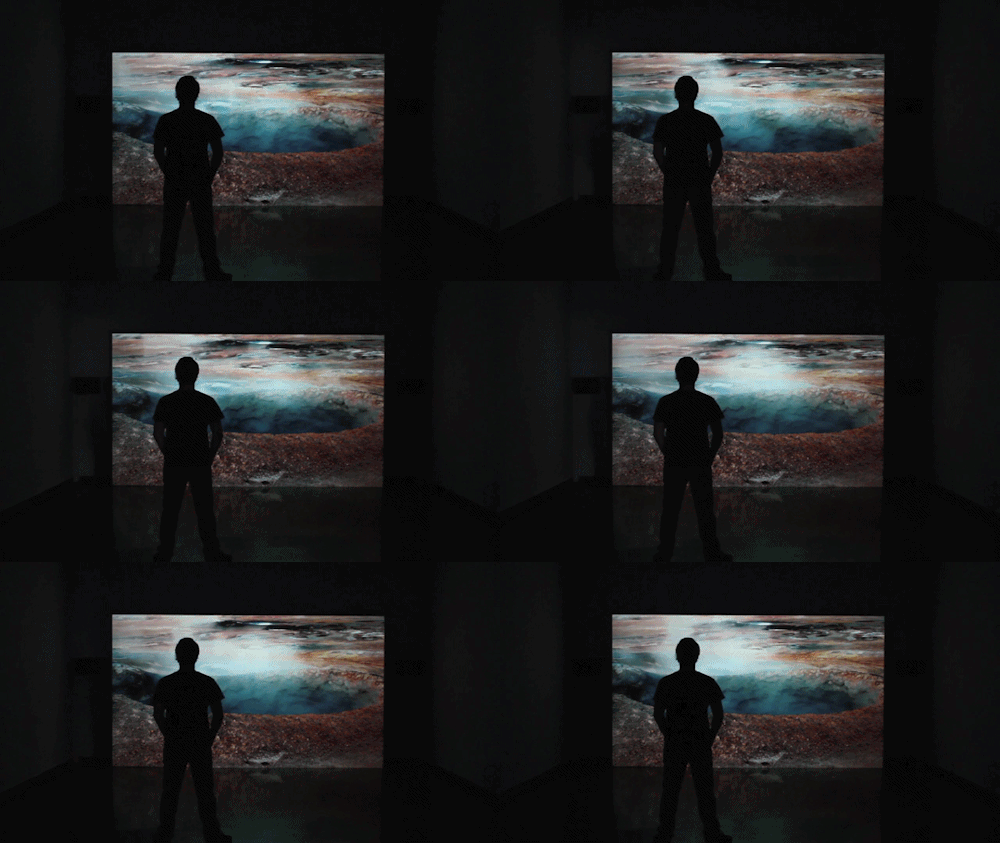
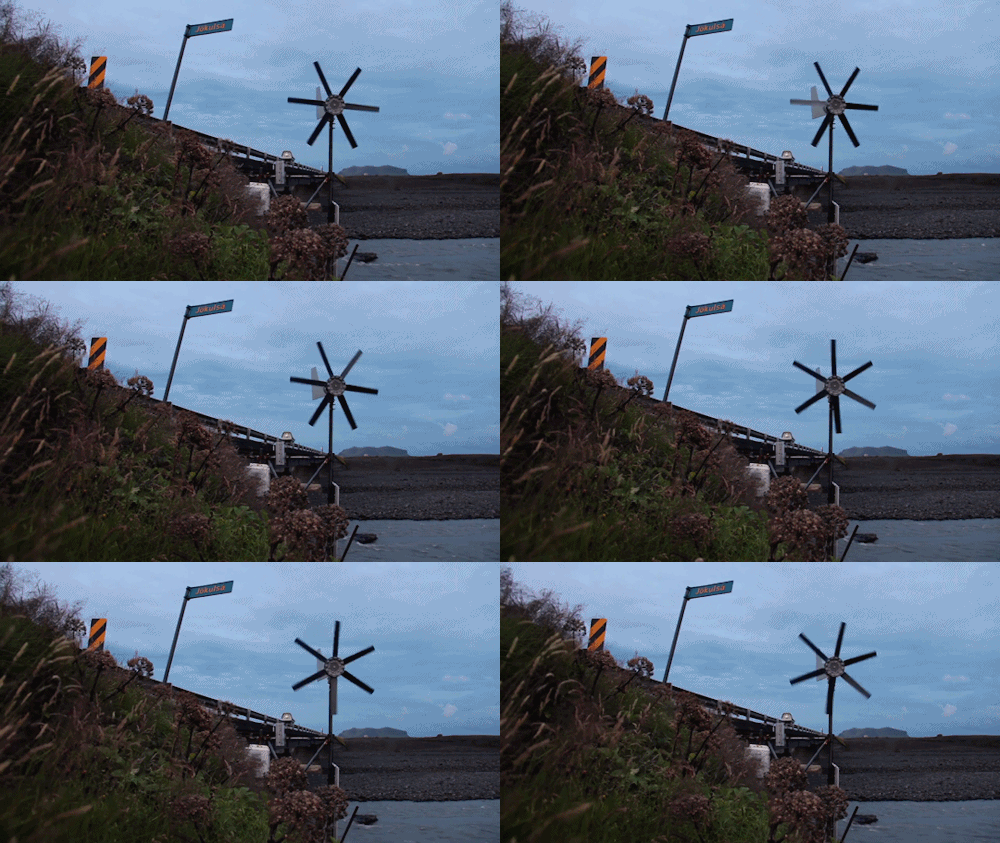

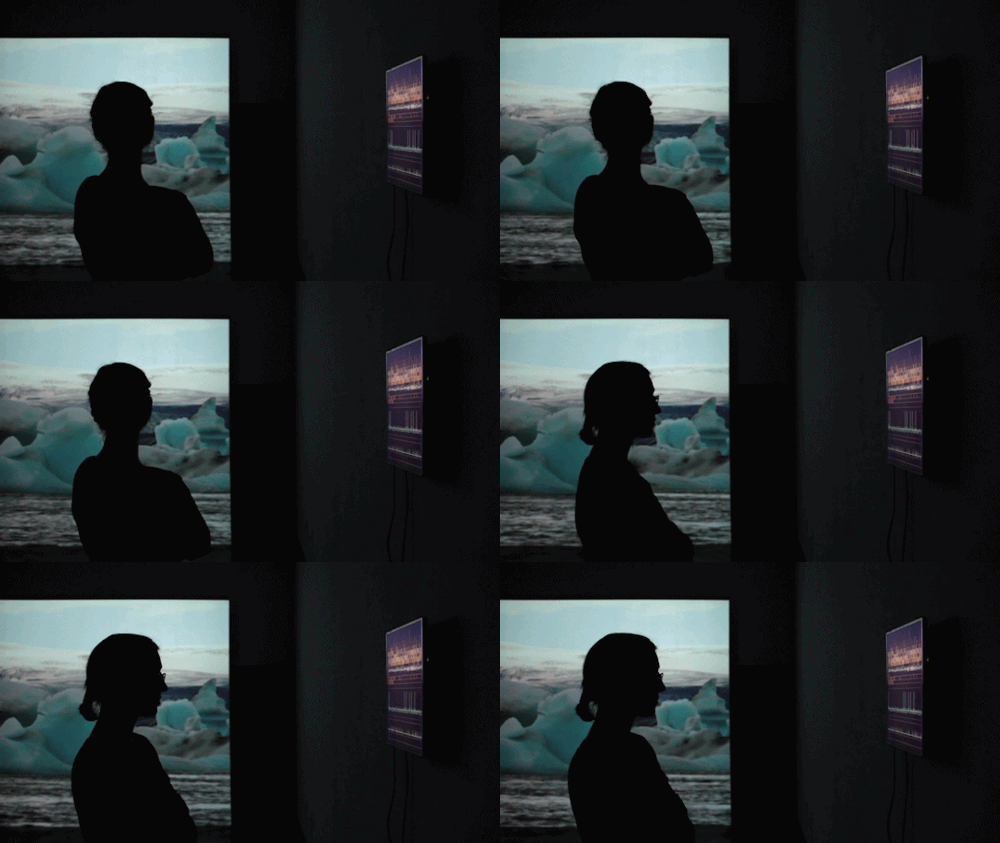
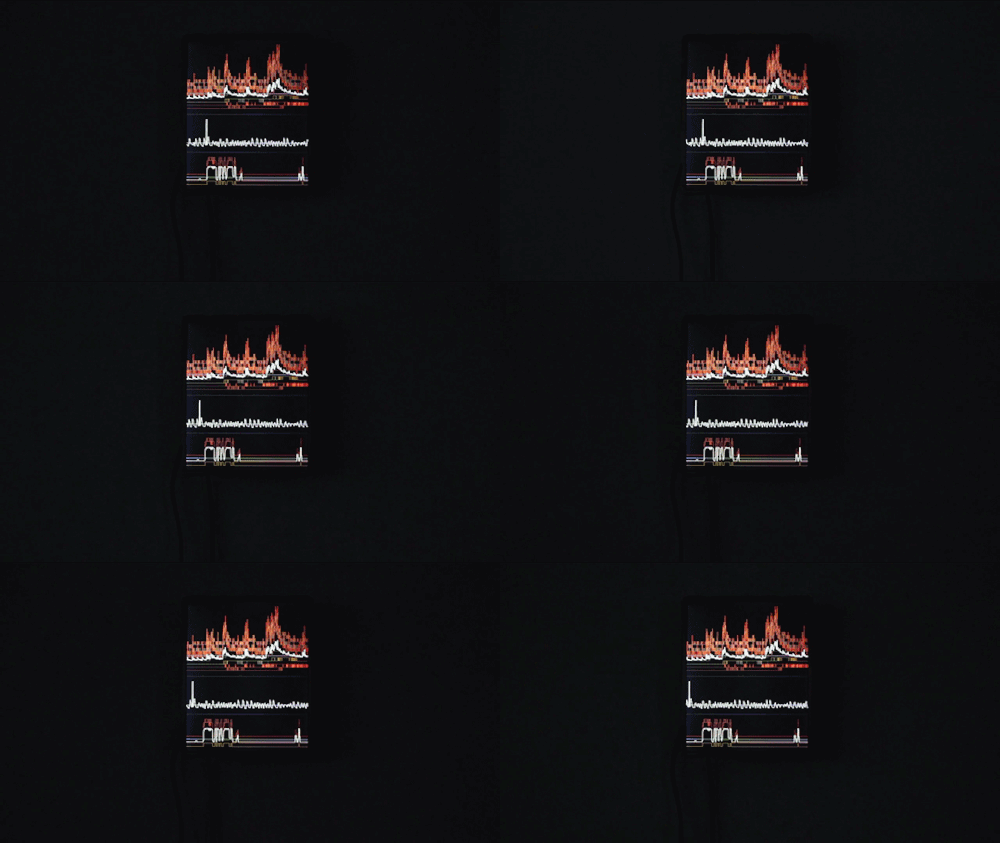

Installation by François Quévillon explores the subject of monitoring in nature with technology, with a computer that monitors and displays looping videos of remote volcanic areas of Iceland:
Waiting for Bárðarbunga is made of hundreds of video sequences which are presented according to the evolution of a statistical model that integrates data about the state and activity of the computer that presents them : temperature of components, fan speed and energy consumption. The video database consists of stationary camera shots that last a few seconds each. Most of them can be seamlessly looped and sometimes evoke remote webcams watching isolated areas. The audiovisual sequences are interconnected one to the other inside a rhizomatic structure. They are grouped and linked according to formal, conceptual, location-based and event-based characteristics. Amongst others, they show rivers under surveillance, glaciers breaking into drifting icebergs, foggy landscapes, hissing steam vents, boiling mud and geothermal power plants. The non-linear audiovisual piece evolves based on a probabilistic system influenced by real-time information coming from the computer’s sensors. According to the amplitude of their variation and the correlations between the types of data, what the viewer experiences ranges from comtemplative spaces where time seems to be suspended to energy-charged audiovisual blasts.
Seriously, I'm already way behind on other stuff—could the TSA stop doing stupid $&*# for maybe 48 hours? Is that possible?
Today's report (thanks, Erika) is that thousands of passengers were delayed for hours at Hobby Airport in Houston, many missing their flights entirely, because the TSA was befuddled by a sorority-convention souvenir booklet.
"We had a large group with a large number of bags to be checked and because of a certain item in those bags there was additional screening necessary," said Bill Begley with Hobby Airport.
A spokesman for the airport says the sorority members were apparently given thick booklets at the convention that could be mistaken for explosives when packed into checked bags. The booklets forced TSA officials to hand check most of the luggage.
"Our souvenir booklet, apparently it's too thick and because of all the colored photos in it, it appears to look like some sort of plastic explosive," [Cassandra] Tomes said.
Books can be dense (no pun intended) and so can look to an X-ray-machine operator like a block of something potentially scary. This happened to me once some time ago, back when I carried paper books, apparently not just because of the book but because I had also thrown some computer cords into the suitcase. So, okay—a big opaque block in some guy's suitcase, apparently with wires sticking out of it, that I understand. But if hundreds of people show up with the same book on the same day, once our Last Line of Defense gets a few dozen looks at it I'd assume they would, you know, communicate with each other and understand it's not a threat.
Of course, I suppose it's not impossible that ISIS coordinated an attack plan with the annual Delta Sigma Theta convention. But the chances of that are sufficiently close to zero that I'd feel safe waving these ladies through.
Oh—"In addition, a few TSA machines broke. That combined with the sheer volume of travelers created the perfect storm for delays." Yep, it was the perfect storm all right. Again we are subject to the whims of a capricious Universe. What can one do?


When literary magazines publish “Women’s Issues,” they can run the danger of making women into a theme. As if fiction by and about women is a curiosity, something to enjoy for a moment, in one issue a year, before returning to your regularly scheduled old white men programming. The title itself can imply that the pages therein are devoted to, well, women’s issues (not that there’s anything wrong with that, but women don’t only write about women’s issues), sending grown men running for the hills for fear of reading about menstruation (their loss). But sometimes, a women’s issue comes along that takes those stereotypical “women’s issues” and completely turns them on their heads. I’m talking about Gigantic’s Women’s Issue, which went live this Tuesday.
With stories by Megan Mayhew Bergman, Silvina Ocampo, Xuan Juliana Wang, and Vanessa Norton, this isn’t your grandma’s women’s issue. Each under 1,000 words, the stories are sharp, unexpected, and unrelenting. In “The Internees,” Bergman gives us a story of the prisoners in a Nazi concentration camp reconnecting to their womanhood through expired lipstick. Wang gives us passive aggressive wedding planning and a cat that’s slowly changing colors in “Sooner or Later.” In “Precious,” Norton tells a story of a couple who compulsively buys Buff Orpingtons (which are not mythological creatures from Harry Potter, but are in fact a breed of chicken), only to abandon them when they cease being cute. And in “Forgotten Journey,” Ocampo addresses where babies come from in a way that can only be described as nightmarish.
Each of these stories addresses a stereotypical “women’s issue,” but in ways that subvert and complicate them. The lipstick in Bergman’s story has nothing to do with female vanity and everything to do with feeling human again in the most dehumanizing situation. In Wang’s story, the wedding planning is less about romance and building a future and more about the inevitable demise of a relationship. The couple in Norton’s “Precious” continually replace their pet chick every three weeks because once it starts growing into a chicken, once it stops being precious, they find they can’t love it anymore. And Ocampo gives us a version of the “birds and the bees” talk that appropriately reflects how earth-splitting that moment can be when a young girl learns what her body is capable of.
The stories in Gigantic’s Women’s Issue are funny and dark, complex and surprising, disturbing and powerful. There’s nothing here that’s maudlin or cute, not even the baby chickens. These, truly, are women’s issues.

The Gulf Labor Coalition panel at the 2015 Venice Biennale on July 29 (all photos by Andrea Avezzù, courtesy la Biennale di Venezia)
VENICE — On Wednesday the Gulf Labor Coalition held the first in a series of four panels it is organizing as part of the 2015 Venice Biennale. Held in the Arena of the Biennale’s Central Pavilion, the first conference was attended by about 60 people, a mix of journalists, activists, and Biennale visitors. Artists Walid Raad and Shaina Anand opened the session by presenting the history and the activities of the Coalition, as well as addressing the situation of migrant workers employed at the building sites of the Guggenheim and the Louvre museum outposts on Saadiyat Island in Abu Dhabi. Some of the most visible aspects of the problems facing migrant workers in the United Arab Emirates (UAE) are overwork and the lack of safe conditions, which often leads to accidents, some of which can be fatal — like a recent death at the Louvre Abu Dhabi site.
“Most of [the workers] discover at their arrival that they will be paid much less than expected and have their passport confiscated by the recruitment agency, which is an illegal procedure anywhere in the world,” explained a representative of the International Trade Union of Building Workers (ITUBC). He went on to describe the Gulf nations as an open prison for migrant workers: “In Qatar also many migrants workers are building the facilities for the FlFA World Cup, which will be held in 2022, in the same conditions as those in Abu Dhabi. Like the Guggenheim and the Louvre do, FIFA claims that the security and well-being of the workers are the local government’s responsibility.”
Renaud Detalle from the Office of the UN High Commissioner for Human Rights added: “Several international conventions on labor issues already exist, but the UAE have not signed all of them.”
Even the embassies seem powerless or unwilling to protect their citizens from these abuses, and with trade unions being prohibited in the Emirates, the only way for the workers to defend their rights is to go to court. “The problem is that in the UAE most of the judges are also migrant workers, so their freedom of judgment is very limited,” Sharan Burrow, the general secretary of the International Trade Workers Confederation, pointed out.
In fact, labor problems in the Gulf countries do not only affect “low-skilled” workers, as illustrated by the case of Algerian-French football player Zahir Belounis, who was refused an exit visa to leave Qatar because of a legal dispute with his former team over two years of unpaid wages.

The Gulf Labor Coalition panel at the 2015 Venice Biennale on July 29
“After the Arab Spring of 2011, Abu Dhabi strongly repressed the requests for more democracy coming from its own citizens: some of them have been given life sentences and most organizations of local civil society — like the teachers’ association — have been dismantled by the government,” explained Nick McGeehan, Human Rights Watch’s researcher for Bahrain, Qatar, and the UAE. “Personally, I think the whole Saadiyat Island project is just a public relations exercise, and has nothing to do with art or culture and the freedom of thinking that should come with them.”
In the past five years, members of the Gulf Labor Coalition have interviewed dozens of workers, both in Saadiyat Island labor camps and in their countries of origin for those who were deported after protesting to get paid — some workers don’t get paid for months. In India, activists also investigated the procedures for hiring workers to go to the UAE. “One of the main points is to convince the building companies operating in the Gulf, most of which are European, to hire the workers directly, instead of draw upon sub-contractors,” said Indian artist and activist Shaina Anand. “That would force them to finally take their responsibilities toward these people.”

The cover of ‘The Gulf: High Culture/Hard Labor,’ edited by Andrew Ross (courtesy OR Books)
The group’s research is included in The Gulf: High Culture/Hard Labor, a book edited by Gulf Labor member and NYU professor Andrew Ross that was presented after Wednesday’s panel. The book, which will be released in October, includes essays by scholars and activists about the labor situation in the Gulf countries and the actions undertaken by the Gulf Labor Coalition in the past two years to pressure the Guggenheim Foundation into doing something about the rights of the workers building its Abu Dhabi outpost. (Another launch event for Ross’s book will take place at the Venetian non-profit space S.a.L.E Docks on August 7, following a performance deconstructing Frank Gehry‘s design for the Guggenheim Abu Dhabi.) Much information on the subject is also collected in a new Gulf Labor report titled “For Security Reasons.”
Even though the Guggenheim Foundation has claimed to be concerned about these problems, their actions suggest otherwise. The question remains whether the Guggenheim and Louvre are prepared to see their names linked to human rights violations and to risk future boycotts from artists and arts professionals — many of whom support the Gulf Labor Coalition’s efforts and have signed open letters calling attention to the situation on Saadiyat Island.
Attendees at Wednesday’s event, especially the Italians, seemed shocked by the revelations and asked the speakers questions after the conference. Even though Italian media have reported on labor conditions for migrant workers in the UAE in the past, the issue seems virtually unknown to the Biennale public. Hopefully, the Gulf Labor Coalition’s presence in Venice will help remedy this.
Remaining Gulf Labor Coalition panels at the 2015 Venice Biennale will take place in the Arena on August 2, August 5, and August 9.


Net Art exhibition piece for the digitalsweatgallery featuring work by mynameiseno on the subject of female online presence and male reaction:
In this series of portraits I attempt to show the way these girls present themselves online and the way they are perceived by their male audiences.
You can see the piece here
Well, this seems to have happened in January but didn't receive the publicity it deserves until the WSJ's Law Blog covered it recently. Obviously I need better sources in Prairieville, Louisiana.
That's the home of the Dobra family, whose youngest member apparently watches a disturbing amount of daytime TV, because according to his family two-year-old Grayson is an enormous fan of plaintiffs' lawyer Morris Bart—or at least his TV ads:
“Before he could walk or talk, every time the Morris Bart commercial would come on, he was just fixated,” [Grayson's mom] says. “You couldn’t talk to him. You couldn’t do anything with him. He would just sit and stare at the TV. You could call his name, give him a toy. He didn’t care. He just wanted to watch the Bart commercial. He’s been that way ever since, and when he started talking he would say, ‘One call’ or ‘Bart, Bart, Bart, Morris Bart, Morris Bart.’
“They were not his first words, but they were a close second and third,” says Dobra.
So as Grayson's second birthday approached, the family had a ready-made idea for a birthday-party theme.
His mom even contacted Bart's office, asking if he might be able to make an appearance. The local paper says the firm's marketing director initially didn't think the request was for real, which is not surprising because it absolutely seems like something you might see in The Onion. (It isn't. I checked.) But Ms. Dobra was able to convince them, and while Bart couldn't make it himself he sent the kid a signed picture, a T-shirt and a variety of other goodies. "They were so nice about the whole process," she said. "They never once said, 'You're crazy. Leave us alone' or anything like that."
Neither did the bakery who made them this cake.
Grayson is said to have loved the party, although his mom admitted he was "kind of shocked" by the life-size cardboard cutout of Morris Bart when he unwrapped it. He seems to have gotten over that, although I don't think we'll know for sure unless we have a chance to talk to his therapist in a couple of decades. For now, though, he's fine.
“He still loves his Morris Bart shirt,” [his mom] says. “If you put it on him, you’d better not try to take it off. He will throw a fit. He has his two photos on the nightstand, and he likes to give Morris Bart a kiss goodnight sometimes. He is literally obsessed with Morris Bart.”
Well, he's probably fine.


Anish Kapoor, “ArcelorMittal Orbit” (2012) (photo via Wikipedia)
This week, the Queen Elizabeth Olympic Park in London announced that “the world’s longest and tallest tunnel slide” will wrap around Anish Kapoor’s “ArcelorMittal Orbit.” When the sculpture went up in 2009 after winning a design challenge, it proceeded to receive mostly scathing reviews — and a spot on the shortlist of the 2012 Carbuncle Cup, awarded to the ugliest building in the UK completed that year. Today, Kapoor revealed that the slide is actually a work of art, designed by none other than Carsten Höller at Kapoor’s own invitation. What better way to make people find delight in something that resembles “twisted spaghetti,” “horrific squiggles,” and “Meccano on crack” than to wrap it in a recreational ride that is both thrilling and reminiscent of the joys of childhood?
Curiously, the slide’s fun factor overshadowed its status as a sculpture by a major contemporary artist when the Park announced its impending installation next spring, which seems like a pretty huge PR fail. Instead, the 164-foot twisting tunnel was presented as a new accessory to jazz up Kapoor’s tower — which it will circle five times — with no mention of Höller at all.
“What more exciting way to descend the ‘ArcelorMittal Orbit’ than on the world’s longest and tallest slide?” the Park’s Director of Visitor Services Peter Tudor said. “This slide will give a different perspective of Britain’s tallest sculpture. We are committed to ensuring our visitors have the best possible day out every time they visit.”
Still, when the news broke, no one seemed to suspect that Höller was behind it, which at this point should really be the default assumption: the German artist has already planted giant slides on a couple of sites, from his 2014 slide tower on the Vitra Campus in his home country to his “Isomeric Slides” in his current exhibition at the Hayward gallery (previously at Tate Modern).
Sorry for the oversight, Carsten! Here’s hoping your sculptural chute will succeed in elevating garbage to grand design.

‘Primitiv Parts’ on the Mountain Stage, featuring a duo of female drummers (all photos by the author for Hyperallergic)
DETROIT — Within media culture, male-dominated environments are presented as the norm, despite the fact that men only comprise roughly half the population. Perhaps this is why, as I sat in on an organizational meeting with the Seraphine Collective — a Detroit-based, all-female cooperative that promotes female-identified, LBGTQ, and racially diverse musicians — I could not help but speculate about the ways it was different from analogous male-driven ventures.
The meeting largely focused on last-minute details for BFF (Best Fest Forever) Fest, Seraphine’s second annual music festival and biggest fundraiser at the Museum of Contemporary Art Detroit (MOCAD). I quietly congratulated myself on being in a room full of rocker girls — the satisfying payoff to a childhood spent curating awkward stylistic tributes to Joan Jett, Debbie Harry, and Cyndi Lauper. The rocker girls in question are at the core of the Seraphine Collective, founded in 2014 by Lauren Rossi, with the mission to act “primarily as a platform for underrepresented musicians.”
What constitutes underrepresented? Rossi provided me with a few disheartening statistics: Spin’s 2012 “100 Greatest Guitarists of All Time” included only nine women; Rolling Stone Magazine‘s “100 Greatest Vocalists of All Time” lists merely 20 women. Only 8.5% of people inducted in the Rock and Roll Hall of Fame are women. Out of all the people producing and engineering audio, only 5% are women.
Since its inception in March of 2014, Seraphine Collective has presented 20 shows, hosted an annual music festival, and released three mixtapes collectively featuring more than 70 bands and 100 female musicians.

Seraphine Collective
Even on a local level, the 2014 Metrotimes Blowout — one of Detroit’s major music festivals — included 86.9% male musicians and 13.1% female musicians. By contrast, BFF Fest 2014 had 63% female musicians and 37% male musicians, and this year’s BFF Fest raised the bar to 78% female musicians and 22% male musicians.
“We try to plan a festival that we are all excited about and want to attend,” said Rossi. The entire fest is, in her words, “a collaborative project,” and that spirit was reflected in the organizational meeting, with ladies dividing promotional tasks and stacks of posters to distribute, while exchanging contacts from their networks with fluid ease.
On the day of the festival, MOCAD hummed with Seraphine members in the midst of preparation and celebration. I snagged Jen David, a classically-trained, polymath musician and collective member who played at BFF Fest last year, and in the interest of fairness, relegated herself to an organizational role this year. She thinks that visibility is always a problem, and on top of the existing hierarchy that regularly dismisses female musicians, there is a problem of limitations that women place on themselves in the scene.“When I started playing music, I wanted to be tough and pretend like I didn’t know anything,” she said, “but it’s okay not to know things, and make connections that teach you things.”
Erin Norris, a Seraphine member who plays guitar in the band Casual Sweetheart with Lauren Rossi (bass) and Dina Bankole (drums), agreed. “The most important thing is to stay true to our mission, which is to inform and educate people about female-identified musicians and carry that with them after the festival.” In this way, BFF Fest is not just a show, but a connective hub for female performers in the area, and on a national level. Multiple collective members emphasize their pride in seeing bands that have met at Seraphine shows and subsequently go on tours together — a ripple effect that has an unlimited range.
BFF 2015’s line-up was tight, including experimental electronic musician Viki Victoria , the ethereal and cosmic River Spirit, the minimal bassist and singer Sneaks (visiting from Washington, D.C.), and Electric Wiccans, the plugged-in version of a popular Detroit acoustic duo. Everyone was collectively geeked about headliner R-Ring, from Dayton, Ohio, featuring The Breeders’s Kelley Deal. “We have a Deal! We have a Deal at our festival!” enthuses Norris, laughing.

Rachel Thompson of Seraphine Collective
How does this measure up against male-dominated/organized music festivals? Collective member Shelley Salant, who plays bass in Detroit-favorite Rebel Kind, has a wealth of experience as an independent booker for a number of local venues. “I privately made the decision to have a woman in every show,” she said of her pre-Seraphine booking style. “I didn’t talk about it, because I didn’t want people to give me shit about it, but now I talk about it a lot more. Otherwise people just don’t think about it.” David, too, recounted surprising pushback when trying to be more inclusive from people she had previously considered allies.
Dina Bankole can relate to that, as well as the power of having trailblazers and role models. “It’s rare these days that I’m the only woman in a situation, but I still find myself being the only person of color,” she said. “Just seeing somebody doing the thing you’re interested in is encouraging. It makes me feel more comfortable.”
“This [BFF Fest] has a different feel because it exemplifies Seraphine,” said collective member and legal representative Linda Jordan. She’s been involved in the planning of Mittenfest for the last few years, pushing a female-inclusive agenda on that front, as well as drawing inspiration from her participation in Seraphine to start her own band, Best Exes.

‘Flushed,’ opening the BFF Fest
Musician, organizer, and MOCAD employee Augusta Morrison summed up the goal of BFF Fest thusly: “People hear new music, express themselves, meet new people — and see that a DIY music festival is possible, what it can be.” Certainly, BFF Fest has its own style, which this year included a series of rotating performances at the “Mountain Stage” and “Valley Stage” — with DIY graphics as backdrops suggestive of the female anatomy, which only occurred to the organizers on the day of the fest, triggering a full dissolve into giggles. Certainly, I’ve never been to a concert that featured a free clothing swap. “Clothes might seem insignificant,” says David, “but it’s a way to express yourself.” Additionally, there is an activism row, with organizations like My Sistahs Keeper, Alternatives for Girls (who received $1.00 from every $10.00 festival ticket sold), and Ladyparts Justice that tabled along the entryway. Seraphine member Rachel Thompson is the resident chair of activism, as the only non-musician in the group, and greeted me by chucking a package containing condoms, lube, and HIV-prevention info in my direction.
“When I was in grad school, all I did was write about how music and the arts can benefit people,” she said. “People are always trying to separate these two things [music and activism] that are the same.” She, too, embraces Seraphine’s power to bring people together through music and encourage them to organize events. “If you bring women together,” she said, “you will eventually connect to everyone.”
BFF (Best Fest Forever) Fest took place at the Museum of Contemporary Art Detroit (4454 Woodward Ave, Detroit) on July 25.

“It’s a difficult time to be a socialist. The left has been depleted everywhere else, but in Pakistan it’s been decimated. I belong to an organization called the Awami Worker’s Party, and right now is a crucial moment for us. We are trying to resist slum evictions in Islamabad. There is no affordable housing in the city, so servants and laborers huddle together in informal settlements called kachi abadis, which have no water or electricity. Recently, the Islamabad high court has issued an eviction notice, and the land is being sold out beneath them. They are defending their actions by saying that terrorists hide in the slums. Right now an operation is underway to remove the slum inhabitants by force.”
(Hunza Valley, Pakistan)



.jpg)