 Laurie Penny, author of Unspeakable Things: Sex, Lies and Revolution explains "Social Justice Warriors" and why they're winning.
Read the rest
Laurie Penny, author of Unspeakable Things: Sex, Lies and Revolution explains "Social Justice Warriors" and why they're winning.
Read the restSophianotloren
Shared posts
06 Oct 16:14
Laurie Penny, author of Unspeakable Things: Sex, Lies and Revolution explains "Social Justice Warriors" and why they're winning.
Read the rest
Social Justice Warriors and the New Culture War
by Laurie Penny
Laurie Penny, author of Unspeakable Things: Sex, Lies and Revolution explains "Social Justice Warriors" and why they're winning.
Read the rest
Sophianotloren, Luke.stirling likes this
06 Oct 16:13

Peaceful. Classy. Powerful.
by PZ Myers
Demonstrators intrude on St Louis Symphony Orchestra concert with a little musical interruption.
It looks like some in the audience are aghast at the invasion, but quite a few applauded.
Sophianotloren, Luke.stirling likes this


06 Oct 16:09
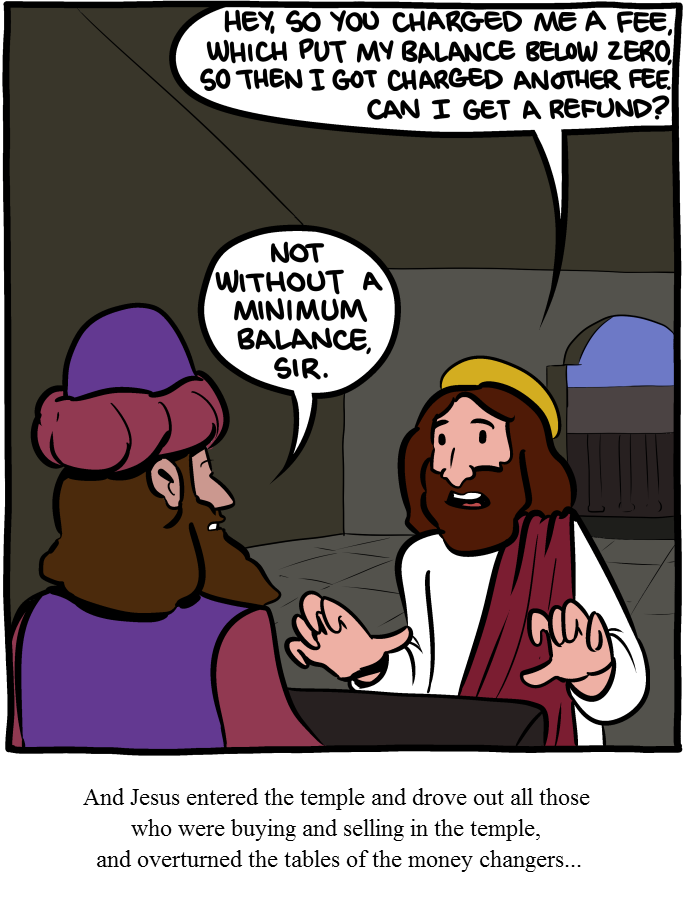
This is basically what happened.
October 05, 2014
This is basically what happened.
cookiestork, mtaczak and 10 others like this

05 Oct 00:34


Juicy Erotica
by HappyComeLucky
It’s prompt time at Sinful Sunday again. This time Molly has set the challenge of using one of Alison Tyler’s titles as the inspiration for our photos. I scanned the extensive list and set my mind working. As soon as I saw this title, I immediately thought of a certain piece of kitchen equipment.
I wish I had thought of the idea at a time when I was seeing my man. The range of camera angles possible would have been more varied. Mind you, when I look at how pointy this is, I might be glad not to have been at the mercy of another.
So, here is my “Juicy Erotica”.

Just as a little bonus, here is a clear picture of the beautiful implement more usually used to juice citrus fruits.

Check out all the other Sinful Sundays by clicking below.

Sophianotloren likes this
05 Oct 00:34

The Perfect Girl “He led me to the bed, pulled off my towel, set me precisely how he wanted me, right in the center of the mattress.” Related Posts: An English Rose Adam’s Apple Sweet Spring, Cummings Lingering Give me shelter


The Perfect Girl
by Molly Moore

The Perfect Girl “He led me to the bed, pulled off my towel, set me precisely how he wanted me, right in the center of the mattress.” Related Posts: An English Rose Adam’s Apple Sweet Spring, Cummings Lingering Give me shelter
Sophianotloren likes this
04 Oct 13:24
Why You Should Care About Hong Kong
by Jennifer S. Cheng
They may be only seven million, a small dot on the globe, but what is happening right now in Hong Kong might have deeper implications than you think.
When I was a child, Hong Kong was the deep green hills outside my bedroom window, the ferry my family took every Sunday across the harbor, the sounds of my grandparents and relatives playing mahjong every weekend. In 1995, we moved back to the United States because it was two years before the 1997 Handover, and my father and mother did not want to take any chances. They remembered history, and they did not want their children to be caught in it.
So it is that almost twenty years later, I am glued to the screen: Hundreds of thousands of students, many secondary-school-aged, marching, singing, holding seminars, blocking roads (but allowing ambulances through), withstanding tear gas, withstanding fear, sleeping in the streets, cleaning up trash, organizing first aid stations, collecting supplies, encouraging peace and calm and civil disobedience, for over 100 hours, all to voice a heartfelt desire for true democracy, instead of a fraud election where candidates are vetted by Beijing. I am reading these words, watching these images, and because I grew up in a household where History was a ghost that haunted, I know that the boundaries of the issue are not just universal suffrage; underlying it is something even deeper.
 Hongkongers are proud of their heritage, including the parts of it they share with China, but having witnessed history, having seen promises betrayed and rights eroded, they know that if they do nothing, the Chinese government will only tread larger.
My entire life I wondered why a group as massive as one billion could not stand up, except in scattered solitary numbers, to the Beijing government, why after decades of suffering and violence at the hand of the government, nobody could mobilize a successful movement. My parents told me: this is what a crushed spirit looks like, this is what deep-rooted fear, internalized in the body, does: it ignores larger shadows, it looks out for itself. And if you ignore the shadow long enough, it becomes a way of life.
If Hongkongers succeed in attaining universal suffrage, they will be the only Chinese city with this democratic right. If they succeed in protecting the freedoms so vital to their hearts and minds, they will be the only Chinese city to do so. And if this spirit of freedom seeps into the consciousness of the Mainland Chinese despite the government’s rigid control of information—a demanding hypothetical, but if it does—then maybe, just maybe, the people of China will finally find the strength to sound a voice of their own.
I want to hear what this voice sounds like. I want my parents to hear what this voice sounds like. What would the world look like if these voices existed, loud and clear and strong?
If you care about the restrictions of freedom in China, if you care about its shameless record of human rights violations, if you care about the withholding of information, the broadcasting of misinformation, the imprisonment of dissidents, including those now who have been spreading news of the movement, if you care about one billion human lives, a fifth of the world population, then you should care about what is happening in Hong Kong.
Last night my father called me on the phone, and when I told him I wanted to be on a plane, he said, I am glad you are not there. He said, These students are naive; the government will do what it wants. It was the same sadness with which a professor in Hong Kong wrote to her students:  As I watched you tremble with the rightness of your words, with the fury of the wronged—when you shouted that you would make the Chinese state come to its knees—something clutched my heart with fear…
These are students who know about Tiananmen, who hold a candlelight vigil every year on June 4, and so they also know what their future holds if history repeats itself: not just the possibility of extreme violence but the oppressive restrictions that a dishonest authoritarian government is unafraid to hold over them. These students are able to look outward at the world around them, to look back at history, and say for themselves that the oppression outweighs the threat of violence. This awareness is itself a sign of Hong Kong’s freer past, and if these rare freedoms they have as Chinese people, so precarious now, if these freedoms are in the end stamped out, then we in America have just been complicit in the obliteration of maybe the greatest hope, however small, the world had in advancing human rights in the giant that is China.
***
Feature photo, first photo courtesy of Henry Leung.
Second photo courtesy of Jessica Lian.
Related Posts:
Sophianotloren likes this
04 Oct 01:17
Filed under: Life Tagged: blogging, help-each-other

A Little Help Here? A Signal Boost..
by syrbal-labrys
 ..from my so not-really-Franciscan knees again. Life CAN keep a good blogger down without a bit of help from his friends, so follow the bread crumbs and give a boost in the form of a donation to Jurassic Pork.
IF Mr. Jurassic Pork forwards a list of donators of over $25 to ME (if you donating so wish) I will send you a hand dipped pair of pure 100% beeswax tapers. ‘Tis the season I will be spending each Monday over a pot of sweet smelling wax! So consider that your incentive to some good bloggerific altruism, ok?
Filed under: Life Tagged: blogging, help-each-other
Sophianotloren likes this
03 Oct 06:58


Change in the Air
by Maggie McNeill
Most of the change we think we see in life
Is due to truths being in and out of favor. – Robert Frost
 The Nation is the oldest continuously-published weekly magazine in the United States, and describes itself as “The Flagship of the Left”. So when it prints a story with the headline, “Liberals and Feminists, Stop Enabling the Police State”, it’s the rough equivalent of a nun sneaking copies of Luther’s 95 Theses into the hymnals at Easter high mass. For several decades now, self-described “leftists” have done their level best to ignore or deny their part in the creation and expansion of the American police state, despite the fact that its chief rationales – the various wars on consensual behaviors – were birthed, nursed and reared to maturity by the Progressives, the intellectual and spiritual ancestors of today’s statist “left”. This state of denial is especially pathetic when the subject is sexual prohibition; soi-disant “progressives” will reflexively and spasmodically point to the right whenever the subject comes up, their left eyes tightly shut so they don’t have to acknowledge that at least half of the crusade, and the lion’s share of the current rhetoric, is growing out of their own beloved sinister avian appendage. But JoAnn Wypijewski isn’t having any of it; she demands that her compatriots recognize the blood on their hands:
…At the crux of [mass incarceration]…is a hard truth, a moral and political catastrophe…It is the lust for prosecution, the clang of the prison door; and the liberal/progressive/feminist hand in enabling the police state and confusing punishment with justice…any invocation of freedom or human rights or bodily integrity that does not also recognize this is hypocrisy…follow the wire linking Ferguson to swelling violence budgets and shriveled social ones, to “quality of life” policing and spatial control of the poor, to police-cordoned “free speech zones” and mass arrest of protesters, to the border “fence” and Border Patrol surge, to the “cleanup” of Times Square’s XXX underbelly for hypercorporatized, hyperpoliced space, to random police stops and dog sniffs, to random drug testing, to the ubiquity of surveillance cameras, to NSA snooping, to the $350 billion US security business, to TSA full body scans, to drug blimps, to asset forfeiture…to immigrant detention, to “zero tolerance” at schools, to enhanced penalties for “hate crimes,” to sex-offender registries, to civil commitment, to torture as policy, to legalized discrimination, to legalized suspension of constitutional rights for ex-cons, to the redefinition of pimps as “traffickers” who…may be sentenced to life, to vice squad entrapment systems, to law upon law passed amid the clamor for safety, to…the gulag of prisons…that [lock away] about 7 million Americans…
Sex, or fear of it, has been almost as important in the construction of this nightmare state as racism. Just as the legal gains of the civil rights movement were blunted by…the incipient “war on drugs,” the sexual revolution…[was] short-circuited by serial sex panics, police power in loco mariti, Victims’ Rights as a mask for vengeance and the conception of the Sex Offender as a new, utterly damnable category of human being…“Carceral feminists”…elided personal power with state power, eschewed the project of liberation…and took as [their] armor the victim’s mantle…when a 6-year-old is called a sexual harasser for stealing a kiss, and men in civil commitment have their dicks hooked to plethysmographs while forced to watch violent porn as “treatment”…the sex-crime side of the prisoner supply chain shows no sign of slowing…
This is not the only recent article in The Nation which is critical of anti-sex feminism and its cringing enablers in the American left; others have questioned the Swedish model and Canada’s flagrant defiance of its own Supreme Court’s decision to decriminalize prostitution. Nor is The Nation the only major publication to recently publish sex-work-friendly articles; the New Republic recently featured a very positive, accepting article on disabled men who hire sex workers, and the Daily Dot (not remotely in the same class as the other two, but still) published a review of the documentary Becoming Belle Knox which not only condemned anti-sex work bile from both the “right” and “left”, but also correctly categorized “sex work isn’t work” and “emotional connection and sex have to go hand in hand” as myths.
Many of my readers and my fellow activists are so stunned by the incessant “sex trafficking”, anti-whore din that they begin to despair; I would be lying if I said I never felt that way myself. But history shows us that prohibitionist noise is always most cacophonous just before the masses begin to turn against those prohibitions; consider the history of “Drug War” propaganda and anti-gay activism and you’ll see what I mean. Though it’s nearly impossible to find a story about sex work in the mainstream American media that doesn’t consist entirely of tinned prohibitionist rhetoric, parroted police statements and regurgitated neofeminist poison, the truth is beginning to percolate into the alternative press, some magazines and many professional organizations. There has been a subtle but noticeable change in the air over the past two years, and it’s becoming more pronounced with every passing month; within a few years sex work will be a full-fledged controversy like gay rights was in the ‘90s, and that’s the first step toward our inevitable victory.
Sophianotloren likes this
03 Oct 06:55


David Lynch Returns to His Roots in Philadelphia’s Urban Decay
by Allison Meier
David Lynch, “Boy Lights Fire” (2010), mixed media on cardboard, at the Pennsylvania Academy of the Fine Arts (all photos by the author for Hyperallergic)
PHILADELPHIA — Before summoning unsettling images of horror out of the American everyday on film, David Lynch was a visual art student at the Pennsylvania Academy of the Fine Arts (PAFA) in Philadelphia. From 1965 until he relocated to Los Angeles in 1970, he was both shocked and enamored by the grit and decay of the city, which was then at an economic low point. David Lynch: The Unified Field opened earlier this month at his alma mater to explore how, although his career has reached prominence on the screen, his roots are in drawing and painting, and how that medium has continued to grow with dark branches through his career.
With around 90 pieces, the first US retrospective for Lynch stretches from 1965 to the present, not touching much on the film and television work that accounts for sparse spaces of the timeline. Instead the work arranged in the colorful Victorian Gothic galleries of PAFA asserts the standalone strength of Lynch as a visual artist. And if you come because you want some creeping terror to nestle in your skull, perhaps drawn in by the the trailer for the show, with Lynch himself offering an eerie rhythm of distorted talking while flicking ping-pong balls into the darkness, you’ll be in luck.
Installation view of “David Lynch: The Unified Field”
In one of the label texts, Lynch describes Philadelphia as having “a great mood — factories, smoke, railroads, diners, the strangest characters and the darkest nights. The people had stories etched in their faces, and I saw vivid images — plastic curtains held together with Band-Aids, rags stuffed in broken windows.”
He spent some of his Philadelphia time living across from a morgue where he watched the body bags get cleaned, and later his house, where he lived with his wife and child, was broken into while they slept. He also found a community to respond to, as the museum’s coinciding Something Click in Philadelphia exhibition demonstrates, as well as the shuddering work of Francis Bacon. The abandoned buildings, the threat of crime, the rusty palette of dirt and rot — it both captivated and repelled, and was a tone that would find its way into his first feature, Eraserhead (1977), and beyond. Earlier this year he had an exhibition of just photographs of abandoned factories at the Photographers’ Gallery in London, another seemingly random note in a career that’s sidelined to coffee and transcendental meditation advocacy, but is still sourced back to this stage of art experimentation in a moldering city.
Lynch is at his best when grasping just how unsavory we can find deterioration disrupting the mundane areas of our life, especially when evoking it as a reflection of human good and evil — like discovering a severed ear in a field, as in Blue Velvet (1986), or Laura Palmer’s plastic-wrapped corpse on the shore in Twin Peaks (1990) — and that holds true in his visual art. Insects are mixed into the paint for “A Figure Witnessing the Orchestration of Time” (1990); “Rock with Seven Eyes” (1996) has pupils gazing out from a black blob. A newer work called “Mister Redman” (2000) has a character with dice in his belly tormenting another named Bob, while a chicken foot at the bottom of the huge collage is decried as the “twisted facilitator.” The most memorable work, however, ends up being his first film experiment. Called “Six Men Getting Sick” and made by a 21-year-old Lynch, a minute-long stop motion of paintings is projected over a screen where plaster casts of his own head join the retching chorus to the sound of a siren. You’re reminded that while there’s a definite vision and storytelling with the mix of text and image in the galleries, Lynch is still at his strongest in the medium he mostly left the canvas for.
“Mister Redman” (2000), oil & mixed media on canvas
Detail of “Mister Redman” (2000), oil & mixed media on canvas
Installation view of “David Lynch: The Unified Field”
Today’s Philadelphia is not the one Lynch brooded on, but it still has some of that dichotomy. PAFA, with its beautiful halls, is just walking distance from the Mütter Museum, with its medical specimens twisted in jars of formaldehyde; the abandoned Divine Lorraine Hotel stands tall with its broken windows down the street. The Unified Field as an exhibition is most intriguing as a response to this city, and how the power of a place can resonate no matter your distance from it.
Exterior of the Pennsylvania Academy of the Fine Arts
Installation view of “David Lynch: The Unified Field”
Installation view of “David Lynch: The Unified Field”
David Lynch, “Rock with Seven Eyes” (1996) (detail), oil & mixed media on canvas
David Lynch: The Unified Field continues at the Pennsylvania Academy of the Fine Arts (118 N Broad Street, Philadelphia) through January 11, 2015.
Sophianotloren likes this
03 Oct 01:47
Damage: The Soul-Crushing Science of High-End Bra Shopping
by Sian Griffiths
For most of my adult life, bra shopping consisted of infrequent trips to the clearance rack at the local department store. I alternated between two boring bras, each the same make and color, through early motherhood and grad school. As I approached the date of my doctoral hooding, both were shot. Broken strands of elastic curled from the cups. Their beige faux satin had faded to cream, with stark white patches under the armpits. The time had come to scrape some money together and plunk it down on replacements—something sexy and empowering, something my husband wouldn’t lament.
I had never shopped at a store that required an appointment, but within weeks of uttering the words “bra fitting” to my sister-in-law, she’d made the arrangements, and we steered my fifteen-year-old Buick LeSabre an hour west to our allotted fitting time at Phipp’s Plaza, the highest of the high end Atlanta malls.
The parking lot appeared recently vacuumed. I skirted the edge, maneuvering past the valets. They could have their Escalades and Lexi. Only one person parked this Detroit-tastic, sofa-on-wheels, and that person was me.
I can’t say for sure that uniformed men manicured the hedges along the entry with nail scissors. I can’t be certain that the sidewalk was getting one last spit polish before the post-lunch rush. Surely, imagination added the trays of crumpets and finger sandwiches. Even so, if any mall were to offer a free ice sculpture with purchase, this was that mall. Its supersized chandelier dripped with crystal. Custom mosaic marble tile floors were set off by polished Cherry wood accents. At its center, Olympian columns soared to meet an immaculate, oval skylight sized to accommodate the entry of a reasonably sized zeppelin.
We followed the scent of air-conditioned roses to our shop where gentle guitar music and Chanel-suited sales ladies greeted us, inviting us to survey the stock as we waited for our dressing rooms. Mind you, we were not to strain ourselves sorting through tit slings. Our fitting expert was to do any and all work. We were connoisseurs, appreciating underclothes as art—each bra hung and spot lit as meticulously as any museum objets.
My sister-in-law was soon whisked into one dressing room and I to another. “Room” is the operative word. These were not the pin-scattered stalls of my usual mall. Each generously sized space had a full-sized door on oiled hinges and a heavy knob that clicked shut more securely than the average bank vault. A small ottoman flanked the mirror. I want to say a potted plant sat on a table, but I suspect they would have balked at anything so gauche as a fake fern. This was a store that throve on the sleek austerity of old money manners mixed with modern, sans serif efficiency.
 My consultant asked first to look at my old bra, which I quickly removed and handed to her. She pinched it, her nails a kind of forceps. She sighed. “How many bras do you own?”
“Two for everyday wear and two sports bras,” I replied. “I run,” I added.
She smiled broadly. “What you really need, then, is a whole bra wardrobe. We recommend a bra for each day of the week, plus two for sleeping and two or three for sports, depending on your activity level.”
“I can’t do that right now.” I wanted to be honest with her from the start.
“Of course,” she said. “What I’d recommend, then, is two new everyday pieces now, which you can alternate, one bra for sleeping in, and a couple sports bras. You really need two at the least so that the elastic gets a day off to recover.” (My bra’s elastic needed the same time off as a major league pitcher—an observation I kept to myself.) “What size is this?” Again, my consultant lifted the bra, dangling it off a single manicured fingernail.
“36D,” I said.
She pressed her lips together and looked at me sideways as she reached for her tape, circling me in one swift motion as she cast my old bra to the ottoman. “As I thought,” she said. “You’re a 34D, not 36D. If your bra is loose, your breasts will pull it up your back and out of position. I’ll be back with some options,” she called, bustling away.
Alone, I occupied my half-naked self by looking at an infographic on the wall behind the dressing room door. It showed four women’s torsos. In the first, pert tits bounced skyward. These were labeled “healthy.” And the next? The next were more… familiar. These were gravity-bound, the nipples still forward facing but with a notable sag that made them appear more like slightly deflated half-footballs than grapefruit. The infographic’s illustration could have been modeled on my own breasts. “Damaged,” it read.
The next two pictures showed breasts that sagged into further degrees of distress, culminating in a classic portrait of old lady boobs that stretched to the woman’s waistline. I cannot remember the labels on either of these two pictures. My mind was fixated on the pejorative chosen to describe my own.
What did it mean to be damaged? Beyond repair? Short of surgery, there was no going back. More importantly, back to what? Even in my earliest days, my breasts had never defied gravity as these perky orbs. I had come of age “damaged,” my bazoombas beyond hope even from their budding. Time hadn’t helped. Breastfeeding, now long over, had done no harm, but the stretch marks I’d had since puberty had multiplied during pregnancy. Aside from the added racing stripes, my breasts were back to pre-pregnancy shape, a shape I’d always accepted as my own, as normal, as genetically dictated. A shape that, the infographic argued, was preventable. A shape I was now asked to reconceive as damaged.
A quick knock and the brisk opening of the door startled me from these thoughts. “Try this one,” my consultant told me—but no sooner had I maneuvered the bra around my waist then she gasped, “No, no. That’s not how to put on a bra.”
This, I must admit, left me baffled. I had approached putting on this bra as I had put on every bra: hooking it behind my back, sliding my arms into the straps, the gently lifting each breast to set it in its cup. In countless locker rooms, I don’t remember ever seeing a woman put on a bra any other way. “If you pull your breasts like that,” my consultant said, “it’ll stretch them out of shape. Here, let me show you. Bend at the waist, like this.” She tilted her body, flat-backed, at a forty-five degree angle from the hips. “You want your breasts to dangle in front of you.” (I was fairly certain I had never wanted such a thing, but never mind that; I was still reeling from the idea that years of settling my ta-tas into my cups had damaged them.) “Now, put your arms through the straps and draw the bra to your chest so that each cup catches its breast. Then, fasten it behind you. Easy.”
Gentle reader, there are many times in my life in which I have felt less than coordinated. I found my inner athlete late in life, so I never managed to climb the rope or clear the hurdles in seventh grade gym class. Trying to put on a bra bent at such an angle, though, was more awkward than any feat of athleticism I’d yet tried. The shoulder I had dislocated coming off a horse years earlier refused to bend in the manner required. Looking in the mirror to see where I was going wrong only made matters worse, my hands moving in the opposite direction to the way they needed to go.
“I can help you today,” the consultant finally said. “You’ll have to practice at home.”
She slid me into the bra, situating satin and lace to capture the girls in their optimal position, nipples pointing my way forward through the jungle of life. We repeated this step through several bras.
And honestly, each was beautiful—more carefully constructed than any bra I’ve worn, but even so, I doubted their functionality. I loved, for instance, the brown check bra with the elastic straps constructed of linked flowers, but would those elasticized daisy chains lay flat under my clothing? And wouldn’t the brown show right through a white shirt? The demi-cups, too, were lower than I was used to. “Won’t I fall out of the top?” I asked.
“We’ll try something with more coverage if that will make you more comfortable,” she said, her lips pursing, her tone peeved, and into the next bra I went. She put me into one bra after another, trying unsuccessfully to mask her increasing irritation as I asked questions.
“What can I wrap up for you?” the woman finally asked, as she rehung the last bra.
“I’m really not sure,” I said, feeling both dazzled and overwhelmed. I gravitated towards one pale pink bra, which was both functional and comfortable, but still, I had reservations. It didn’t seem like me. None of them did.
My consultant sensed my hesitation, and it did not please. She pursed her lips. “I will get a couple sports bras while you make up your mind.”
“Actually, I’m pretty happy with the ones I have.”
She stared at me for a full second. “The problem with most sports bras,” she said, clipping her words now between her whitened teeth, “is that they crush your breasts flat, killing the tissue at the root. Ours don’t. I’ll be back with two of our most popular models.”
It was clear to me now that the woman worked on commission, but I hardly held that against her. I’d worked retail myself, and though my own sales jobs had only paid flat minimum wage, I imagined that she depended on making sales. The need to work was something we shared. Less clear to me was the “science” being used to support sales. The infographic had been bad enough, but did elastic need rest? Could one actually pull one’s breasts out of shape? And since when did breasts have roots?
Pondering these mysteries as well as the question of when I had spent this much time topless, I turned over the price tag of one of the bras now piled on the ottoman.
 Now, let’s be clear: I had planned to spend some money. I’d figured forty dollars, maybe even fifty per bra. One hundred dollars for two bras was a crazy sum—I couldn’t remember the last time I’d spent so much in a single shopping trip—but I had reconciled myself to the cost because I knew I would wear whatever I bought for years to come. I thought I had prepared myself.
The tag did not say $40. The tag did not say $50 or even $55. What the tag said was $78.99.
At this point, I was thinking of my daughter at home. I was thinking of the next grocery bill. I was thinking of electricity and gas. I was thinking of my grad school stipend—a yearly salary of less than $14K a year.
I flipped through the stack. The price tags ran from $110 down to the $55 pink bra. I could see now why I was supposed to choose my favorites before asking their price.
The consultant returned, interrupting my panicked flicking of one tag after another. She turned delicately from my unsightly price-checking and removed the sports bra from its hanger. I bent again at the waist, calculating. How long had this woman spent with me? Twenty minutes? Half an hour? How much would she lose if I didn’t make a purchase?
“There.” She finished doing the clasps behind me. “How does that compare to the bras you have at home? Better, right?”
I stared at the mirror, my chest smushed into a mono-boob by the tight fabric. Unlike my everyday bras, my sports bras were not cheap. I had selected them after careful research so that I could run with minimal bouncing. My philosophy of beauty is basically that all clothing looks better on a healthy woman. Spending money on sports bras meant not spending money on clothing designed to camouflage and compensate. This bra, to be blunt, was nowhere near as supportive, comfortable, or attractive as the two I had in my drawer at home. “Honestly,” I said, “it feels rather snug.”
“Of course.” Disdain or frustration again pitched her voice high. “It wouldn’t be much of a sports bra if it didn’t hold you in place.”
I’ve always been a good student, in part because I ask questions when I don’t understand a concept, so perhaps that’s why I couldn’t bite back the next question. “But,” I said, “I thought you said that bras that were too tight killed your breasts at the roots?”
She stared at me. Questions were not, apparently, an allowable feature of underclothing commerce. “Would you like to try the other sports bra or not?”
“I really think I’m happy with the ones I have.”
“How about sleep bras then?”
“I’m afraid I’m really not going to sleep in a bra.”
“Did you at least decide on any everyday bras?”
I swallowed. “Can I have a moment to think about it?”
She left me then, telling me to let her know if she could be of any further assistance. Frustrated as she was, her Southern manners—or at least the formalities of Southern manners—held to the end. I put my old bra back on, trying first to dangle my boobs as instructed before giving up and doing things my usual way. For twenty minutes, I walked around the store with the pink bra clenched in hand, trying to make up my mind to buy it, before I finally returned it to the rack and went out to sit on the bench near the entry while my sister-in-law finished.
Her consultant drew the lucky straw. My sister-in-law walked away with three new bras that day, all works of art that I’m sure brought her pleasure, but her pleasure was compromised when I relayed my own experience. I felt contrite for having wasted my consultant’s time. My husband, too, would have to deal a little longer with the sad old bit of tortured faux satin. I’d let multiple people, not to mention my own damaged breasts, down.
That’s how they get us, isn’t it? Working on our guilt, our desire to please others, our aspirations to be all that we can. They tear us down with pseudo-science and infographics. They attack our self-esteem. They damage our self-perception, then promise to rebuild it—for $78.99, or $50, or $199, or whatever price we’re willing to pay.
My husband, far from disappointed, laughed with me in the comfort of our kitchen that night, chopping and dicing together as always, because a good sauté makes up for many lacks. Despite walking away empty handed, my small daughter had literally jumped for joy when I walked in our front door, making me feel like the most important person in the world. And what did I find on the next visit to the clearance rack but the new version of my tried-and-true Bali underwire, size 34D, $13.95.
***
Rumpus original art by Sylvia Nguyen.
Related Posts:
Sophianotloren likes this
03 Oct 01:40


TSA Finds It Correctly Punished Naked Protester
by Kevin
In what may be the year's least shocking development so far, the TSA has affirmed its own order imposing a fine on John Brennan, the guy who stripped at a Portland checkpoint in 2012, causing the TSAgents to get all flustered. See "TSA: Wants to See You Naked, Complains When You Get That Way," Lowering the Bar (Apr. 18, 2012). Brennan was acquitted of indecent exposure after a judge found he had been engaging in expressive conduct ("symbolic nudity") that is protected by state law, but that troubled the TSA not at all.
It fined him $1,000 for doing this, claiming he had "interfered" with screening operations when he took off all his clothes. As I discussed here, and then again here, that's the same bullshit argument police use when they arrest people for filming them—we had to come over there and stop you from doing something you're constitutionally entitled to do, and so you "interfered" with us. But that logic makes perfect sense to the TSA, and in particular to the administrative-law judge (a TSA employee) who upheld the penalty (reduced to $500) in April. Brennan appealed.
Because this is an agency proceeding, the initial appeal is still within the agency, in this case to the deputy administrator. And as I mentioned above, because I didn't want you to be on pins and needles wondering what happened, he affirmed the ruling. The final order (PDF via PapersPlease.org) is again based entirely on the "no, you interfered with us" argument (about which I feel as described above). This also has the benefit (for the TSA) of making the law irrelevant. In fact, the deputy administrator says in his opinion, "I agree with TSA"—of which he is the deputy administrator—"that Respondent's arguments regarding the legality of the nudity are not relevant." Well, that's handy.
By the way, he admits in his opinion that the checkpoint was closed "for approximately three minutes" as a result of the incident, yet affirms the finding that because of this, the agents "were not able to conduct screening in an efficient manner on other passengers present at the checkpoint." So the TSA is claiming here, with a straight face, not only that it screens passengers "in an efficient manner" to begin with but that it is so efficient that punishment is justified if you delay it by three minutes.
I don't know about you, but I've been pointlessly delayed by much more than three minutes by the TSA approximately EVERY TIME I HAVE FLOWN DURING THE PAST DECADE, so I would describe that claim as farcical.
The law does provide for a further appeal now that the TSA is done pretending to review the matter. That appeal is to the Ninth Circuit and must be filed by mid-November. If you are interested in supporting Mr. Brennan (who lost his job after this incident), you can contact him here. At the very least, please hope along with me that the Ninth Circuit will reverse.
Related Stories
Sophianotloren likes this
03 Oct 01:38


Saving the Memory of Hong Kong’s Neon Before It Goes Dark
by Allison Meier
Nathan Road neon in Hong Kong (photograph by Joop, via Flickr)
Glass tubes twisted into typography and pictorial designs have hummed on the streets of Hong Kong since the 1950s. Now, with the gaseous sign becoming a dying art and LED screens overtaking as the preferred night advertising medium, neon is disappearing. An online exhibition from M+, a Hong Kong-based museum for visual culture, is digitally preserving this identity.
Hong Kong neon (screenshot from neonsigns.hk by the author)
Mobile M+: NEONSIGNS.HK is one of M+’s itinerant exhibitions before its physical museum designed by Herzog & de Meuron opens in the West Kowloon Cultural District in 2017. From March to June of this year, they crowd-sourced images of as many neon signs in Hong Kong as possible, with over 4,000 now on an interactive online map. The neonsigns.hk site is sleekly designed and has an elegant layout, including essays, audio walks you can take (either virtually or on the street), even a short documentary on how the signs are made. On the map, you can search the signs, by businesses like pawn shops and night clubs, imagery categories like animals and food, districts, and even those that have already been lost, like this one for a restaurant now replaced by an LED. Some have short histories or intriguing facts, such as this funeral home sign in the traditional Chinese funeral colors of blue and white. The site notes that neon has “seldom been used by funeral parlours, given the solemn nature of their business.”
Map of Hong Kong neon (screenshot from neonsigns.hk by the author)
Neon timeline (screenshot from neonsigns.hk by the author)
Neon sign featured on the map (screenshot from neonsigns.hk by the author)
As Pop-Up City reported this week, the M+ exhibition’s success “has led to other projects being initiated, with offline programmes such as tours, workshops and talks being born out of the interest in the urban landscape the neon signs create.” Hong Kong isn’t the only city whose once-popular neon signs are slowly flickering off — see the Neon Boneyard of discarded signs in Las Vegas — but they define its visual identity in a unique way. M+ is also collecting physical signs, so far a neon cow from Sammy’s Kitchen and a rooster from a Kai Kee Mahjong School. Aric Chen, M+ curator of design and architecture, explains in a video: “As a new museum of visual culture, M+ has a chance to do things differently, to look at things differently, and to look at new kinds of materials or at least different kinds of materials that other museums might not look at.”
Metro Lotus Sauna sign (photograph by Vasenka Photography, via Flickr)
Restaurant sign in Hong Kong (photograph by torbakhopper, via Flickr)
Chuen Kee restaurant sign (photograph by Matthew Hine, via Flickr)
Emperor sign detail (photograph by torbakhopper, via Flickr)
66 Duck in Yau Ma Tei (photograph by Randy Adams, via Flickr)
Signs in North Point, Hong Kong (photograph by muddum27, via Flickr)
Neon rooster in Hong Kong (photograph by Mitch Altman, via Flickr)
Sauna signs in Hong Kong (photograph by Mitch Altman, via Flickr)
Tai Fat Pawn Shop (photograph by Henry Li, via Wikimedia)
Mobile M+: NEONSIGNS.HK is accessible online.
Sophianotloren likes this
03 Oct 01:37
A Grovelling Apology.
by Anna Raccoon

An abysmal performance yesterday; I can only say how terribly sorry I am for the trouble I caused you all.
When I took the site down before I had my last operation – I managed to delete the back-up copy as well. It turned out that the only back-up copy in existence was Gildas’ version which was in the form of Word documents – 1,500 of them.
After a couple of months of painfully trying to put the posts and multitudinous comments back in place, a friend became aware of the problem and kindly volunteered the services of his ‘software genius’. I’ll call him Webby.
Webby was indeed a genius, and wrote a programme which could pull the information off the word documents into containers that WordPress could reformat back into posts.
Trouble was, Webby and I were communicating through a third party – fatal. He didn’t know that my site was automatically programmed to publicise new posts via Twitter, RSS feed, e-mail and Facebook – I didn’t know that he was about to feed 1,500 ‘new-but-old’ posts back into the site…
Within an hour, as some of you know to your cost (and annoyance) hundreds of e-mails started to flood into inboxes from ‘Anna Raccoon’, RSS feeds failed under the strain, Twitter timelines went berserk, and it appeared that Ms Raccoon’s output had risen to ludicrous levels by tens of thousands of words a minute…
I had no idea how to stop it happening – conspiracy theorists were diving under their desks as I apparently announced that Gordon Brown was back in 10 Downing Street; forums went into meltdown on hearing that Tony Blair had got the Nobel prize – yet again; Lord Ahmed was once more marching on Parliament with ‘10,000 Muslims’ and Vera Baird was supervising the election in Uganda…
Fortunately, the blog has only been going for six years – otherwise I would have been announcing the abdication of Edward VIII and the repeal of the Corn Laws.
Finally after 690 e-mails/RSS updates/Twitter updates, and dozens of anxious inquiries as to whether the site had been hacked, was this a ‘DOS attack’, and ‘was it safe to open the links in the e-mails’ I appeared to be sending out, the flow stopped.
Nothing brilliant or even useful that I had done – my host server had decided they were under attack from some Russian hacking group as back-links within the posts tried to mate with their intended destination – and ‘black-listed’ the IP address of the ultra respectable and reputable software company the deluge was coming from!
Ooh, er, Whoopsie doo-dah.
It could have been worse – the site originally had near 5,000 posts on it, and 70,000 comments. Fortunately Gildas hadn’t saved all of it, and Webbie hadn’t had time to find a way to attach the comments – which would have gone out as an update to all who have elected to follow ‘comments’.
It doesn’t bear thinking about.
I do appreciate that many of you in the media and the legal profession use your Twitter for work purposes, as you do your e-mail – and I am genuinely sorry for the inconvenience, and Yes, I do understand that 690 e-mails counts as something more than ‘inconvenience’.
If you have anything less than 690 e-mails, and you haven’t already made the decision to ‘blacklist’ Ms Raccoon (who could blame you?) can I suggest that you check your spam folder? For sure there are ‘stragglers’ out there in cyberspace jostling for a chance to eat your broadband…
As a mark of my contrition, I think a suitable period of silence from Ms Raccoon is called for; and besides which I am in the middle of moving to two different houses in two different countries – so possibly me concentrating on just one thing would be a good idea? Mmmmn.
Hanging my head in shame – and packing t-chests…
I’m still very grateful to Webbie though; and his boss who volunteered him for this job ‘as a favour’…
Anna
Sophianotloren likes this
01 Oct 12:34

The Least Sexy Things I’ve Learned Lately
by A. Vivian Vane
About a month back I moved in with a long-time friend and lover. This was rather a big step for both of us, partly because we’re both free-wheeling, commitment-adverse sorts, but mostly because our combined household added up to five pets.
(And two people, but as anyone with pets knows, those quickly become an afterthought.)
Now, our blissful cohabitation has not been without its erotica-inspiring moments. There’s a rather artistic arrangement of wobbling silicone phalluses in various colors on an end table not far from where I’m writing this, in fact, neatly reflected in our vanity mirror. I’m particularly fond of the suction-base ones, which, combined, stick up like a bouquet of very fat, veiny flowers.
Picture related.
But while I’ve recently learned some delightful new things about what can go in which holes and who makes noises when it does, I’ve also learned a whole host of rather unsexy facts, including:
- that some cats, when stressed and scared, stop eating, and bile that’s supposed to mix with food in their intestines backs up and turns their skin, eyes, and pee bright yellow;
- that said yellow pee stinks to high heaven;
- that a cat in this condition needs to be painstakingly syringe-fed a liquid slurry of wet cat food and warm water 4-5 times a day;
- that even a sickly and weakened cat can spray its food in an enormous and diffuse arc by thrashing around trying not to swallow,
- and that clumping cat litter works great until it clumps up against a side or corner of a litter box, at which point it becomes a fixture (made of pee and clay) that you have to chisel off bit by bit with the edge of your scoop.
I fancy myself a creative sort, even by the already-creative standards of erotica writers. I’m willing to go out pretty far on limbs to make weird, obscure scenarios and fetishes sound sexy. But even I can’t write a sexy story about sick cats spitting liquid pet food slurry all over the room until the whole house smells of it, and I’m not sure I want to meet the author who could.
Or the reader who would buy the book.
So life goes on, and very soon I’m looking forward to new releases on some exciting new subjects, beginning with steampunk lesbian princesses who don’t own a single goddamn cat. (There will, however be plenty of pussies.)
It’s something to look forward to…for you, for me, and for my poor, loving cohabitant, who is very fond of me but was perhaps expecting more sexy notes slipped under the door, and less splatters of Friskies on the wall.
The post The Least Sexy Things I’ve Learned Lately appeared first on One Handed Writers.
Sophianotloren likes this
01 Oct 09:48


Why I’m no longer on the original Facebook solo poly discussion group (but I am on the new one)
by aggiesez
Since its creation in early 2013, I’ve been very active in the original Facebook group for singleish & solo poly people. In fact, I’ve been part of the moderating team since the beginning, helping it grow to nearly 3100 members.
But I haven’t been a moderator there for a week now, and as of last night I am no longer even a member. Neither change was by my choice or my doing.
Here’s what happened, why I think the recent dramatic (but so far publicly unacknowledged) changes to that group are highly problematic for its members, and why I’ll be participating in a new Facebook group for solo poly people — where I welcome readers of this blog, members of the original Facebook group, and others interested in discussing solo polyamory to join me.
THE SHORT VERSION: There was a difference of opinion between the moderators of the original solo poly Facebook group that led to the sudden, unilateral eviction of the moderator team by the sole remaining moderator.
The original moderator team has launched a new solo poly Facebook group and invites you to join: Facebook.com/groups/solopoly
When Joreth Innkeeper created the original Singleish & Solo Poly Facebook group, she immediately invited my fellow blogger Polly Singleish and I to co-moderate that group with her. Polly and I both greatly respected Joreth’s writing and leadership in the poly community. She was one of a handful of early leading voices of solo polyamory. We jumped on board instantly and enthusiastically, since we agreed with Joreth that there was a strong need for discussions with this particular focus. The vast majority online discourse on polyamory is from a couple-centric (and often hierarchical) perspective; solo poly people needed a space to find their own voice and sense of community.
We all knew that fostering a solo poly online community would take significant effort and time — much more than it takes to simply create a Facebook group. “If you build it, they will come” only works in the movies. Joreth acknowledged this challenge, and that her own time and energy was very limited. Still she did what she could to publicize, participate in, and grow the group. As did Polly and I.
Over time, that group grew to nearly 3100 members — and it gained a reputation for being one of the most thoughtful and high-quality polyamory forums on Facebook or anywhere. This was due, first of all, to the enthusiasm and support of the group’s members — many of whom were thrilled to finally and easily have frank discussions with their solo poly peers, or to have a welcoming place to learn more about solo polyamory.
Good discussion groups rarely pop out of thin air. Behind the scenes and visibly in the group’s discussions, the moderator team was hard at work.
Our main strategies to foster high-quality discussion and a welcoming environment, which evolved collaboratively, were:
- All new members had to be approved by moderators. A moderator checked each and every applicant profile to filter out obvious spammers, as well as people who appeared mainly interested in seeking random hookups.
- All new discussion threads on the group had to be approved by a moderator, to ensure that every thread bore clear, specific relevance to solo polyamory. Every day, we worked privately with members to tweak their proposed posts to keep things on-topic.
- Most of the moderators participated very actively in the discussions: starting threads, liking and commenting on posts by members, answering questions, sharing our own experiences.
- When it became obvious that the group needed clear some guidance and policies, we invited member input and posted that information publicly as documents to the group (as well as in the welcome note each new member received).
…Yeah, that was a lot of work. Especially after Polly and I initiated a big outreach push a couple of months after the group’s creation, when membership ballooned.
All three of the original moderators started getting overwhelmed with the effort. We had a constant backlog of new member requests to process, and proposed threads to review and home. That backlog caused delays that frustrated members.
So we put out a call to expand our moderator team. And we were pleased to welcome aboard, over a few months, Mislav Mahronic, Alan Escreet, and Michael Fleming. Between the six of us, the moderator team kept the group humming along, even when some of us needed to step back sometimes due to other commitments. Over time, we all contributed enough effort.
One of the best parts of the moderator team was that we collaborated so well. We deliberately included moderators who offered a variety of styles, so we could learn from each other. Sometimes we disagreed with each other, or weren’t sure how to make a judgment call regarding a member applicant, post, or comment. We’d discuss privately how to make a decision for the greatest good, to foster an inclusive, supportive but focused environment. And most of the time we all collaborated well toward that goal.
We moderators are human, too, with unique sensitivities and strengths. Sometimes our own personal buttons would get pushed, and we’d privately talk each other off the ledge to encourage constructive behavior in ourselves as well as the group’s members.
…Until a few months ago.
In some threads on the group, members voiced perspectives or raised questions that triggered Joreth’s personal hot buttons. While we all admire her articulateness and forthrightness, her comments on some threads became markedly aggressive, even bullying.
This concerned the rest of the moderator team because it was starting to have a chilling effect on the group. That wasn’t just a theoretical risk; increasingly members were privately telling the moderators that they were now more reluctant to participate because they didn’t want to be attacked.
Behind-the-scenes we tried to discuss this problem with Joreth, to help her find nondestructive ways to make her points. Our goal was to make it safe for all members (including moderators) to air their views and share their experiences, and to foster civility among the inevitable disagreements.
Joreth was, unfortunately, not receptive to this effort to negotiate. She responded with defensiveness and hostility to our private discussions, and her occasional aggressive public outbursts on the group kept recurring.
Eventually, this sparked the moderator team began to privately discuss creating a code of conduct for the moderators — basically to clarify the expectation that our behavior on the group would be at least as good as what we were asking of our members. That we would strive to be at least civil, and that we’d discuss more extreme admin options (such as deleting threads or comments, or even removing members) as a team before taking action.
Polly took the initiative to draft up a moderator code of conduct, based on similar documents from other successful moderated discussion forums. Most of the moderators suggested edits. But Joreth did not participate, despite repeated invitations to this process. We left this process unconcluded for a few weeks, to give Joreth and everyone some time to chill out and think things over.
Last week, my fellow moderators learned that Joreth had suddenly removed admin status from all of us; leaving herself as sole moderator for the group. There was no discussion, or even warning, of this; she took this sudden action unilaterally.
Joreth made no mention of this change to the group. No posts to the group acknowledging or questioning this matter were approved for publication. So this change has been effectively concealed from the group’s members. We remained as members, but we stopped participating in the group to see what would unfold.
Joreth did send a final private missive to the moderator team. In it she expressed her indignance at being asked to behave more moderately. She saw this not just as a personal attack, but as a usurpation of power. From her perspective, since she originally set up the Facebook group, she “owns” it, and thus has an absolute right to impose her will on group discussions. (With the implication: even if this includes bullying members who disagree with her. Even if this includes removing her fellow moderators.)
While her note mentioned vaguely that our admin status suspension was “temporary,” after a week her refusal of further discussion looked pretty permanent to us.
Joreth did have an underlying good intention here. In her message to her former co-moderators, she said that she created the original solo poly Facebook group mainly in order to make a safe space for herself. Most poly discussion groups are not very welcoming, friendly to, or aware of solo polyamory. Also, most poly discussion groups have ongoing problems with maintaining the focus and quality of discussion. Joreth reasoned that whatever preserves her personal sense of safety in the group would generally support the goals of the group.
All of the former moderators of the original group agree that creating a safe space for solo poly people is important. Where we differ with Joreth is that we believe that space should be reasonably and equally safe for all members (including but not limited to moderators); and that disagreement is good and should be handled constructively.
Last night, after returning from a short off-the-grid holiday, I checked in on the original solo poly Facebook group and contacted my co-moderators to see if there had been any improvement in the situation. None of us had heard from Joreth at all since her parting missive. Also no new members had been approved to the original group (usually dozens of applicants got processed per week). However, Joreth had begun approving a few discussion threads unrelated to the admin change — which is good, since historically she’s rarely had time to handle any admin duties for the group.
I noticed a post to the group about an update to the public list of the group’s moderators. That document, as of last night, still listed all of the original team as active moderators. The only change was that Joreth now denoted herself as “owner and creator.”
Concerned that this was misrepresenting to members the current nature of the group’s management, I posted a comment: “Currently, this list of moderators is inaccurate. At the moment, Joreth is the only moderator of this group.”
A few minutes later, I noticed that my comment wasn’t visible on the post. Sometimes Facebook chokes, so I tried again, and confirmed that my comment was published.
… Then it disappeared. Only a moderator can delete comments to group posts.
I sent Joreth a private message asking if she was willing to discuss this, but got no response. Twice more I posted my comment; twice more it was deleted.
After that, I found I could no longer access the group. Joreth had apparently removed me as a member.
This is what happens sometimes with online forums: They have their moment in the sun and run well, and then they go off the rails. Such is life on the internet.
The original solo poly Facebook group had a really great run, which is why I put so much effort into it — nearly every day, for well over a year. And now my part of that great run is over.
I don’t regret my efforts, although I do wish Joreth had disclosed her full intentions for the group up front, when she invited me to co-moderate. Had I realized that I would be perceived more as expendable manual labor assistance than a valued colleague and collaborator, I would have declined Joreth’s request to help her get that group off the ground.
Life moves on. Polly and the rest of the evicted moderators have launched a new Facebook group for solo poly and singleish folk. Here we’ll foster a community that functions as we told members the original group would function.
Yes, creating a new and seemingly duplicative group does pose a risk. It looks confusing. (We definitely need more branding differentiation; that will emerge.) And, if members of the original group remain deprived of information about the existence of and reason for the shift, it can seem needlessly divisive and dramatic. We definitely have some ‘splainin to do. Hence, this blog post.
While many of the most active members of the original Facebook group have already joined us in the new group, that’s a small fraction of the original community. Starting a community over from scratch is always slow, hard work, and it may fizzle. It’s risky. We feel it’s worth trying.
The best possible outcome is that both groups will eventually thrive, developing and differentiating their unique culture and sense of community. One thing we learned is that there are a LOT of solo poly people, and even more people who are interested in learning more about solo polyamory. That’s a great and encouraging discovery. There’s probably room enough for both groups.
Realistically, both groups require a lot of moderator time and attention. In the new group, the team is willing to keep that up. In the original group, hopefully Joreth will be able to make that happen as well. We wish her success with that and bear her no ill will.
Personally, I was disappointed to trip over a major undisclosed condition set up by my former co-moderator. I believe in full disclosure up front of the terms of any relationship, including the formation of a moderator team.
It’s likely if Joreth continues to allow the original group to continue to exist, if she doesn’t let it die on the vine or open it to become a lower-value free-for-all, she’ll need new moderators to help with the workload. This post is, in part, a nudge to those potential moderator candidates to ask Joreth for full disclosure about their perceived role, and how much their voice would really count in that relationship.
Finally, I do wish to acknowledge the many positive contributions Joreth made to the original group: through her posts and comments as well as moderator team deliberations. And while any Facebook user can create a group in minutes, Joreth did take the initiative to create that group, and to invite the help needed for it to flourish, and to contribute what she could to that community. I continue to respect her work, and her as a person, despite this sudden unfortunate turn of events. While I think it’s time for me to move on to help build a new and complementary solo poly community, I hope she does well in her community, work and life.
If you have questions or observations on this matter, please comment below, email me, or message Aggie Sez on Facebook. Or contact any of the moderators of the new group.
You may also try contacting Joreth directly or asking about this matter on the original Facebook group. So far such efforts haven’t gotten anywhere, but hopefully that may change.
We encourage you to share the link to this post, and to the new group, to members of the original group. You may need to do that by private FB message.
Thanks for reading, and I hope to see you on the new Solo Poly Facebook group.
NOTE: This post does not reflect information available on the original Facebook group since the early morning hours of September 30, when my membership was revoked.
Sophianotloren likes this
01 Oct 01:39
California’s Affirmative Consent Law: Beyond The Bullshit
by Thomas
A federal judge once said to me, when I was just a young’un, that this is how you read a statute: “from left to right; stop at punctuation.” You don’t know what this thing says unless you read the text. TL;DR from the headlines does not an analysis make. So here is the pertinent text, the text of section (a), which is the part people are talking about:
(a) In order to receive state funds for student financial assistance, the governing board of each community college district, the Trustees of the California State University, the Regents of the University of California, and the governing boards of independent postsecondary institutions shall adopt a policy concerning sexual assault, domestic violence, dating violence, and stalking, as defined in the federal Higher Education Act of 1965 (20 U.S.C. Sec. 1092(f)) involving a student, both on and off campus. The policy shall include all of the following:(1) An affirmative consent standard in the determination of whether consent was given by both parties to sexual activity. “Affirmative consent” means affirmative, conscious, and voluntary agreement to engage in sexual activity. It is the responsibility of each person involved in the sexual activity to ensure that he or she has the affirmative consent of the other or others to engage in the sexual activity. Lack of protest or resistance does not mean consent, nor does silence mean consent. Affirmative consent must be ongoing throughout a sexual activity and can be revoked at any time. The existence of a dating relationship between the persons involved, or the fact of past sexual relations between them, should never by itself be assumed to be an indicator of consent.(2) A policy that, in the evaluation of complaints in any disciplinary process, it shall not be a valid excuse to alleged lack of affirmative consent that the accused believed that the complainant consented to the sexual activity under either of the following circumstances:(A) The accused’s belief in affirmative consent arose from the intoxication or recklessness of the accused.(B) The accused did not take reasonable steps, in the circumstances known to the accused at the time, to ascertain whether the complainant affirmatively consented.(3) A policy that the standard used in determining whether the elements of the complaint against the accused have been demonstrated is the preponderance of the evidence.(4) A policy that, in the evaluation of complaints in the disciplinary process, it shall not be a valid excuse that the accused believed that the complainant affirmatively consented to the sexual activity if the accused knew or reasonably should have known that the complainant was unable to consent to the sexual activity under any of the following circumstances:(A) The complainant was asleep or unconscious.(B) The complainant was incapacitated due to the influence of drugs, alcohol, or medication, so that the complainant could not understand the fact, nature, or extent of the sexual activity.(C) The complainant was unable to communicate due to a mental or physical condition.
First, the plain language tells us that this statute is not a criminal law, or an obligation that the State of California imposes on any person directly. It is, rather, a change to what California requires of colleges to be eligible for state financial aid. So it doesn’t apply to any college that already forgoes aid for any reason, for example. It has no impact of people who are not in college and not employed by a college, except in the sense that it may change the cultural conversation. If you’re in high school, or not in school and working, or not in school and not working, or in the service, or in any other walk of life except attending college in California, this has no legal effect on you.
Second, all it requires is adoption of a policy that the school is required by federal law to have, and that that policy contain certain elements unique to this statute.
Subsection (a)(1)
One of the unique elements, the Affirmative Consent standard, is set forth here, and it isn’t what some people seem to be assuming. The common rhetorical device is that affirmative consent requires some particular form of communication — notarized contract, filled out in triplicate, raised seal, etc. Far be it from me to criticize anyone whose kink is to have a bunch of suit-wearing functionaries watch their sexual encounters. De gustibus non disputandum est, which I think is Latin for “your kink is not my kink but your kink is okay.” However, the idea that that’s what the statute requires is just bullshit. It’s not in there.
Here’s the heart of it: ” “Affirmative consent” means affirmative, conscious, and voluntary agreement to engage in sexual activity. It is the responsibility of each person involved in the sexual activity to ensure that he or she has the affirmative consent of the other or others to engage in the sexual activity.” (Emphasis supplied.) It doesn’t say what form it has to take, or how one has to ascertain it. It doesn’t say anything about filling out a form, using an app, signing a waiver. It doesn’t even say you have to say any particular word. It doesn’t even require the word “Yes”! It just says that the absence of “no” isn’t necessarily yes, and it’s your responsibility, if you’re a student in a college in California, to make sure you have a yes. You can do that any way you like; it’s up to you how to see if you have a yes.
There are lots of ways to ask for a yes. If you lean in to kiss someone and they lean in to kiss you back, that’s yes. If you ask someone if they want your cock and they say, “I want your cock,” that’s yes, and if they put their mouth on it, that’s yes, too. If you’re fucking someone and holding them down and you’re both sweating and maybe bruised and you lean in and your hand is on their throat and you say, “can you still say no?” and they say, “yes,” that’s yes. We’re not kids here, right? We’ve all been there, and we know that people say yes, mean yes, shout yes and do yes in sex all the time. Those of us who don’t want to force anyone to do anything they are not into, don’t want or need sexual encounters where people are not doing yes as hard as they can.
The rest of (a)(1) is pretty straightforward — it simply lists myths that won’t fly. Consent to sex with someone one time isn’t consent to sex with that person every time. Shouldn’t be controversial. The absence of no isn’t yes. Since people who are passed out can’t say no or yes, this should be obvious, and is impossible to intelligently argue against. I know CeeLo Green said otherwise, but that’s because CeeLo is a very bad person (and now, a convicted felon). Good vocalist, bad person, sorry to break it to you. Consent can be revoked at any time. Again, impossible to intelligently argue with. People are free at any time to decide the sexual encounter is not working for them, put on their c lothes and go get a slice of pizza. This is not up for debate.
Subsection (a)(2)
Another element in section (a) is the standard in the disciplinary process in (a)(2). It’s not a defense to say you believed someone consented:
(1) because you were too drunk or too reckless to know whether they were consenting or not. Good rule, right? If I’m so fucked up that I may rape someone, that’s kind of like being so fucked up that I shouldn’t drive home because I might crash. It was an adjustment for a lot of people when we began actually enforcing drunk driving laws in this country! People said, “but how am I supposed to get home from the bar!” And we all decided that not having drunks kill and maim people was important enough to make them take responsibility for how they get their drink on, and we did, and the republic did not fall.
(2) because you didn’t bother to find out if you had a yes. This is the teeth that makes (a)(1) work. If you know you have a yes, you’re good to go. If you don’t know you have a yes, it’s on you to find out. If you don’t, and this is important, if you acted reasonably to find out, you’re still okay. Reasonably under the circumstances is a hard standard to argue against. The only ways to argue against it are either (a) I want to act unreasonably and it should be okay, or (b) what I think is reasonable is not what the people enforcing this think is reasonable.
The nightmare scenario that rape apologists trot out is the one that Katie Roiphe made up (because she lives her life to piss on everything her mother stands for), the “morning after regret.” I think it is impossible to find a case where someone was convicted of rape because one of their consenting partners later claimed nonconsent — in all the terrible history of black men being falsely accused of rape, almost always there was no actual sexual contact at all, and the rape was simply a socially convenient fabrication from whole cloth. See the Central Park Jogger case, where the teens convicted and imprisoned had no contact at all with the victim — who was hit over the head and raped by an entirely different person, who was a serial rapist and died in prison. In instances of political hoaxes like Brawley, likewise the events never transpired, and in the Duke Lacrosse case one of the accused was demonstrably not on the premises. Amanda Marcotte has repeatedly thrown down the gauntlet (see comments, she’s said this before) for someone to identify an instance of false conviction arising from an actual sexual encounter between the accuser and the convicted defendant. Nobody seems to have one.
This law protects against that scenario, fanciful as it might be. If you act reasonably under to circumstances to see if you have a yes, you’re okay.
The Power And The Danger Of “Reasonable Steps”
That phrase, “reasonable steps, in the circumstances known … at the time” is, not incidentally, the weakness of this bill. Law doesn’t interpret or execute itself, and this will be interpreted by conduct counsels and deans in colleges, and “reasonable” will be what they think it means. I’m not worried that someone who says “hey, are you still into this” and gets “yeah” will be held to have acted unreasonably. Sure, the perpetual whinge machine of MRA outrage will declare that “reasonable” will mean mind reading or seeing the future or having a notarized contract or some such nonsense. But that’s like Christian extremists who complain that they are being discriminated against because they can’t bully gay kids in school — they have a persecution complex which has no relationship to objective reality. Given colleges’ infamous disinclination to hold rapists accountable or adjudicate them liable, there is no reason to suspect that the interpretation of “reasonable” with be anything other than a mainstream-friendly view of “reasonable.”
I am worried that some asshole’s approach to consent will be, “hey, she was into fucking me, and then I took the condom off and stuck it in her ass before she knew what I was doing, and I didn’t know she wasn’t okay with that,” and that will be held to be reasonable, because people who should know better make excuses for people they like. See generally Julian Assange and his defenders. “Reasonable” inherently imports norms that may not work for people in their own lives. If someone is trans or genderqueer and says, for example, “don’t touch my front hole,” I think that’s totally reasonable. But someone who has a cis and heteronormative and penetrocentric framework for sex may decide that “reasonable” is the same as what they think “normal” is. These are macro problems with how law operates; I offer no easy solution.
But it’s not just people whose gender or sexuality fall outside the mainstream who could find that the concept of “reasonable” fails them. If a school were to decide that, “I asked if she wanted to come back to my room and she said yes” is reasonable inquiry and constituted a basis to assume consent to anything that happened thereafter, that would be a very bad standard. Someone who wanted to exonerate every rapist who fit a certain socially comfortable paradigm probably could, just by applying the term “reasonable steps” to some action the rapist took or claimed to have taken.
That’s also the weakness of the ridiculous app that turned up in the news recently. It makes no provision for withdrawal of consent (how could it?) and it makes little or no provision that I can see for sex to be something other than, “we do it in the way it looks in the movies.” So it’s useless for its intended purpose, and whatever its creator’s intent, its actual function — I’ll go farther than Marcotte here — is to create a defense that rapists can use later, after their targets realized that what was going to be done to them wasn’t what they were good with.
Subsection (a)(3)
Subsection (a)(3) imposes a “preponderance” standard, which is already the standard for civil liability in almost all areas, and the standard colleges have to use under the current Department of Education guidance federally, so that doesn’t change anything.
Subsection (a)(4)
Subsection (a)(4) says that there are three circumstances where, if you know this thing is true, you know the other person can’t consent: (a) unconscious; (b) too drunk or high to understand the “fact, nature or extent” of sexual activity; and (c) unable to communicate. (a) and (c) don’t merit any discussion. Unconscious people can’t consent, and if people are unable to communicate, you don’t know if they consent. (b) is only slightly more elastic. It imposes a standard for how drunk is too drunk to fuck. Too drunk to know the fact of sexual activity is obviously too drunk to consent. Too drunk to know the nature or extent of sexual activity requires some actual interpretation, as “nature” and “extent” don’t define themselves, but if someone is so messed up that they don’t know for example which hole a cock is in, they shouldn’t be having sex, and I think that’s the most obvious interpretation of what that means.
This Is Not A Revolution In Practice (But I Can See It From Here)
So that’s what it says. It’s not a revolution in practice. There are no heads in tumbrels and nobody is being carted to a reeducation camp. From the howling, you might have surmised that this bill requires all Californians to get the late Andrea Dworkin’s permission to have sex, gently, while lying side by side, and only half way in. That’s bullshit. Under this standard, California’s college students are free to get their sex on any way they see fit, and communicate about consent any way that works for them. It just clarifies that they can’t assume it, they have a responsibility to find a way to communicate about it. That’s radical in theory, but pretty pedestrian in practice.
This is an evolution in concept. It’s a very non-radical bill, imposing in a very careful and mainstream-friendly way what is a gradual and evolutionary paradigm shift. But the evolution in paradigm is more important than the operation of the policies under this bill (in at most a few hundred conduct counsel proceedings) ever will be. Just the cultural conversation about the bill has made Yes Means Yes, the idea of affirmative consent and sex as process, part of the mainstream national conversation. The best defense of the old, Commodity Model, women as gatekeepers, paradigm was not to discuss it at all — but just to assume it. It doesn’t hold up well to scrutiny. It’s being dragged into the sunlight now, and in sunlight it withers because, quoting Brandeis, “sunlight is … the best of disinfectants.”
That’s why I don’t mind the people arguing against this bill. By arguing, they are keeping the conversation going, and by doing that, they are losing. If they were smart, which they are not, they’d ignore it and let the media die down, and push quietly for interpretations of the standard that don’t change anything. But they’re not. Like Todd Akin, they want to spew their extremism, their poorly informed and ideologically driven beliefs, their persecution complex and feverswamp paranoia. So they’ll keep arguing, and if they keep arguing, the keep losing.
Looking West into the future from here with the right kind of eyes I can see the arc bend.
Sophianotloren likes this
01 Oct 01:31


If You Like MRA Rape Apologias But Generally Find Them Too Coherent, It’s Your Lucky Day!
by Scott Lemieux
Forgotten but oddly not gone, Camille Paglia has arranged a large number of very poorly chosen words on a virtual page. It contains stuff like this:
Wildly overblown claims about an epidemic of sexual assaults on American campuses are obscuring the true danger to young women, too often distracted by cellphones or iPods in public places: the ancient sex crime of abduction and murder. Despite hysterical propaganda about our “rape culture,” the majority of campus incidents being carelessly described as sexual assault are not felonious rape (involving force or drugs) but oafish hookup melodramas, arising from mixed signals and imprudence on both sides.
We have cultural references for people who find Hi And Lois a little too cutting edge — these kids today with their phones that aren’t even plugged into the wall and their portable music machines that Apple has recently discontinued because they’re horrible people and don’t care about old people like me — that also don’t mean anything. We have an assertion-without-evidence that the problem of sexual violence on campus is overblown. And we have a made-up and reprehensible category called “not felonious rape,” so apparently the problem of sexual violence on campus is “overblown” so long as we erroneously define some kinds of sex without consent as not being rape — or misdemeanor rape? — because brute force or drugs were not involved. This argument hasn’t improved since Katie Roiphie made it all those many years ago.
In other words, we have appalling ideas expressed in prose to match. It can’t get worse from there, I guess, but:
The basic Leftist premise, descending from Marxism, is that all problems in human life stem from an unjust society and that corrections and fine-tunings of that social mechanism will eventually bring utopia. Progressives have unquestioned faith in the perfectibility of mankind.
Not only a strawman, but an incredibly lazy and cliched one.
Misled by the naive optimism and “You go, girl!” boosterism of their upbringing, young women do not see the animal eyes glowing at them in the dark. They assume that bared flesh and sexy clothes are just a fashion statement containing no messages that might be misread and twisted by a psychotic. They do not understand the fragility of civilization and the constant nearness of savage nature.
This is a lot of words and 90s catchphrases to say “if you get raped it’s your fault for not going to class dressed in a burlap sack.” Again, Paglia seems to realize that the only thing that could be more revolting than her prose is her ideas. Oddly, evidence that sexual violence didn’t exist before people starting saying things they mostly stopped saying during the Bush administration is uncited.
I could go on, but just read this golden oldie from The Editors instead. Now there was a guy who could write.
Sophianotloren likes this
01 Oct 01:28


UK Copyright Law Gets Exception for Parody
by Jillian Steinhauer
For the launch of the second edition of ‘We Go to the Gallery,’ artist Miriam Elia made a series of spoof letters from Penguin’s legal team. (image courtesy Miriam Elia)
A series of updates to UK copyright law are scheduled to go into effect tomorrow, finally allowing for the use of copyrighted material in the creation of parody, the BBC reported. The country’s copyright law does not currently include a fair use (“fair dealing,” in British parlance) exception for satire, an omission that’s left many artists, musicians, and others vulnerable to legal action.
One of those artists is Miriam Elia, who, upon release of her parody children’s book We Go to the Gallery earlier this year, faced a slew of legal threats from Penguin UK, the publisher of the original book series on which Elia modeled her work. Elia says Penguin finally backed off after she stopped replying to the company’s “endless threatening letters.”
In theory, her work should be protected by the new law, which states specifically that “fair dealing with a work for the purposes of caricature, parody or pastiche does not infringe copyright in the work.” Asked about the exception, Elia told Hyperallergic, “I would say the law change is a great leap forward for the art of satire.”
But, as she and others have also pointed out, the update is far from comprehensive. There’s no change, for instance, to the status of “moral rights,” under which a copyright holder can object to “derogatory treatment of the work.” This provides plenty of ground for lawsuits, whose outcomes will be determined by judges ruling on whether the works in question meet the legal standard of a parody. The International Business Times (IBT) explains:
Judges presiding over parody court cases will have to refer to a ruling by the European Court of Justice (ECJ), which on Sept. 4 defined parody for the first time. Under that definition, a parody has to “constitute an expression of humor or mockery.”
Ciara Cullen, a senior associate at the London law firm RPC, said that subjective definition will leave much to the individual tastes of U.K. judges.
Elia echoed these concerns in her email to Hyperallergic: “Will the judge laugh at the work? What if the jury find the work funny, but the judge doesn’t? Will we need specialist comedy courts for future infringement cases?” (Maybe not such a bad idea.)
Speaking to IBT, one half of the English music and comedy duo Cassetteboy noted as well that although parody will be allowed under the new law, mashups still won’t be (unless they’re funny). US law, on the other hand, identifies fair use based on four tenets including “the purpose and character of the use,” which is commonly understood to be the extent of the transformation from the original.
Sophianotloren likes this
01 Oct 01:27
Ask Better Questions
by Remittance Girl


Kristina Lloyd, whose novel Undone has just been published (and is phenomenally well-written – buy it), has been doing the blog tour thing. Today, Anna Sky hosted an interesting post by Kristina: “Do Women Prefer Erotica?” Whether you’re a reader or a writer of erotica, it’s worth your while to read it.
At the end, she makes the point that our society is consistently asking the wrong question. Let me quote:
Perhaps it’s time we started asking different questions: not ‘why do women prefer erotica’ but why are women less likely than men to incorporate adult content in their lives? Why is female desire not fully acknowledged by our culture? Why can’t we have the same sexual freedoms enjoyed by men? And why, oh why, aren’t our desires more widely catered for?
I think these are powerful questions worth unpacking, examining, and attempting to answer.
Why are women less likely than men to incorporate adult content in their lives?
I’m going to debate this first one, or rather, I’m going to specify that I think women do incorporate adult content into their lives just as much as men do, but not commercial content, and often the content is self-generated.
Women don’t consume anywhere near as much commercially available adult content – that’s a fact. But I think Kristina addresses this well in the post: so little of what is available is targeted at women. Yes, there is a little, but quite often it is re-purposed gay porn (and I can tell when it is; it makes me feel like I’m using a hand-me-down dildo. The gay gaze and the female gaze are NOT the same.) Much of the stuff produced by women for women has undercurrents of political correctness or activism about it that, frankly, just spoil the ‘dirty’ for me.
There is not a lot out there for women, porn-wise, because it isn’t a lucrative market. Many women won’t pay for porn. So there’s little commercial impetus to produce it for them. Why is that?
I think it comes back to another question Kristina asked: “Why is female desire not fully acknowledged by our culture?” My hypothesis is that most women won’t purchase porn for themselves because they are products of their culture and that culture has very ambivalent feelings about female desire. The lie that ‘women aren’t visual’ (beautifully dismissed by Kristina in her post) translates in our society to ‘women shouldn’t be visual'; ergo women who are visual are abnormal.
The one place where, I think, the marketplace has proven the lies of how women want romance, how they’re less visual, how they have lower libidos than men, how it all needs to be personal and caring and shit is in the sales of sex toys.
It’s hard to get solid numbers on this, but according to a survey by Adam & Eve, almost half of all women in the US own a sex toy. And those are the ones who will admit to owning one. Excuse me if I feel that there might be a little under-reporting going on. Also, is anyone counting conveniently shaped shampoo bottles, deoderants, etc.?
Women DO spend money on getting off. They spend about $15 Billion a year on it. We get off wild and we get off hard and love has nothing to do with it.
But the other aspect of the first question is about content. Here I’m going to venture into speculative territory. I wonder if, because a lot of adult content is not made for women and so the sexually arousing fantasies are not as easily found externally, maybe women manufacture more of their own? I’m not saying some men don’t have marvelous interior fantasy machines, but I’ve noticed that once you can find your fantasy represented externally, you’re not as hard-pressed to generate your own. (I began writing erotic fiction because I couldn’t find much out there (porn, erotica, whatever) that addressed my particular perversions. Had I found a lot of stuff that hit the spot, I might not have bothered trying to write it.)
What I’m trying to say, poorly perhaps, is that imagination is a muscle. You don’t use it unless you have to. And a LOT of women have to because their erotic fantasies may not be represented in porn or represented in the right way.
Kristina’s second and third questions: Why is female desire not fully acknowledged by our culture? and Why can’t we have the same sexual freedoms enjoyed by men? are really inextricably bound together.
I think the spectre of female sexual desire unmoderated and made safe by an accompanying cuddly love-bunny thing is a frightening thing in our culture. Certainly there are porn memes about insatiable women, but they aren’t really about insatiable women. They are about the benefits a man might reap from a sexually insatiable women, who is really not quite insatiable, and finds satiation with YOU (the male consuming the meme).
But, let me flip this around. There is a small community of men who fetishize the humiliation of not being potent enough, large enough or well-equipped enough to satisfy a woman with a rampant sexual appetite. That fetish, I think, reveals the true horror of an insatiable woman. She doesn’t care one wit for you or your feelings. If you can’t get her off fast enough, often enough, hard enough, she’ll walk over your exhausted, drained and prostrate body to get to the next candidate, muttering ‘pussy’ as she goes.
My guess is that for most men, a woman who knows exactly what she wants sexually, is demanding of it, and intolerant of a man who falls short is a terrifying prospect. Yet if we were to look at most male-centered porn, that is the message reflected back to us all the time. Men are so horny, they just can’t get enough. No one woman can satisfy them – they need five. As women, we live with the constant spectre of not being hot enough, tight enough, wild enough, wet enough, multi-orgasmic enough all the time.
My guess is that if we ever made porn that DID reflect women’s sexual desire, unmitigated by shame or the limiting narrative of affection, there would be more massively insecure men in the world than there are already.
Ironically, what I think men ought to be scared of is the ubiquity of the stereotypical uber-rich, permanently erect, led-by-his-penis alpha male in most contemporary romances. Believe me, the vast majority of you can’t live up to that at all. But your doomed-to-fail attempts keep the free-market system ticking over.
We’d all be a lot healthier if this were really about sex.
.
Sophianotloren likes this
01 Oct 01:23


Legally Dead Man Sentenced to Be Actually Dead
by Kevin
After I reported on the case of Donald Miller, the Ohio man who failed to convince a judge he should not be considered legally dead ("'No, You're Still Deceased,' Judge Tells Dead Man" (Oct. 10, 2013)), several people wrote in to ask what would happen if, for example, Miller was asked to pay taxes or charged with a crime. While the statute in question does say that a legal death is presumed to have occurred "for all purposes under the law of this state," my guess was that the state would not have much trouble ignoring such language in appropriate circumstances.
I was right.
Miller himself, to my knowledge, has not yet needed to assert a death-based immunity. The federal government has insisted that his daughters pay back the death benefits it paid them, even though their father is just as dead now as he was then, but at the moment that's still their problem. We might have an answer, though, to the criminal-defense question.
And the answer is that not only is death no defense, if you kill someone else while dead you can still get the death penalty.
According to several reports (FindLaw, Huffington Post), a Mississippi man who was declared legally dead in 1994 was sentenced to actual death last Friday for a kidnapping and murder he committed in 2010. While he was prosecuted under federal law, as far as I can tell the issue of his state-law legal status never came up. It doesn't look like it would have helped anyway, because the Mississippi statute is more limited than Ohio's, but I seriously doubt any court presented with this argument in this kind of case would get to the point of statutory construction. So, once again, I am shown to be master of the relatively obvious.
Further reading: Jeanne Louise Carriere, "The Rights of the Living Dead: Absent Persons in the Civil Law," 50 La. L. Rev. 901 (May 1990); see also Cecil Adams, "What happens when someone 'legally dead' shows up alive?" The Straight Dope (June 13, 2006).
Related Stories
Sophianotloren likes this
01 Oct 01:22
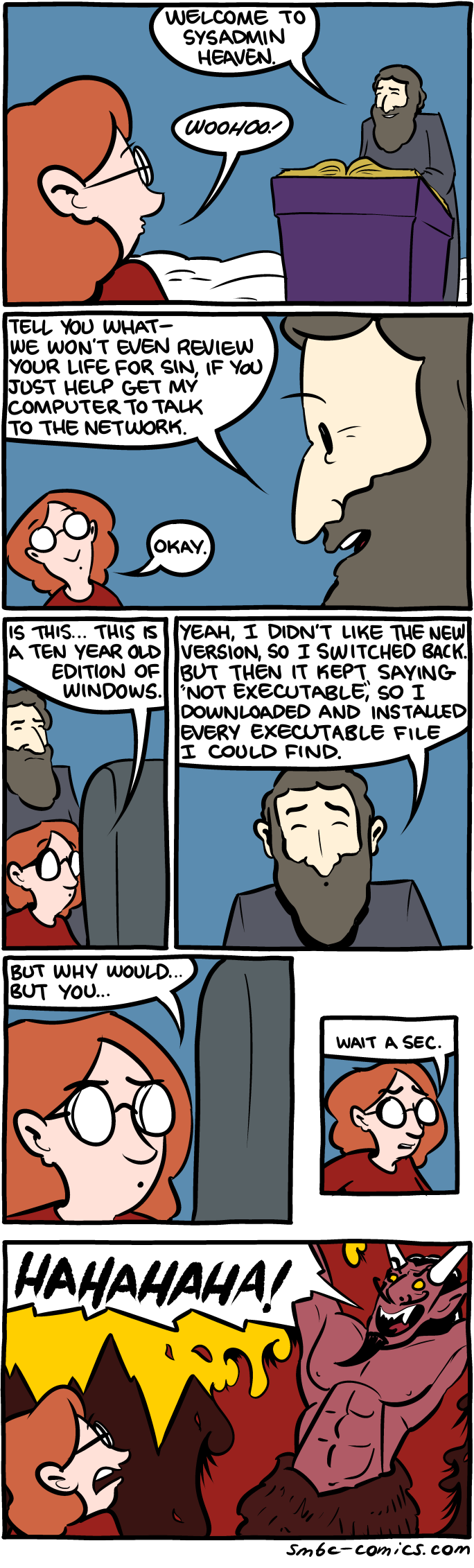
There are now exactly 22 general admission tickets for BAHFest East If you want to come, please buy soon!
September 29, 2014
There are now exactly 22 general admission tickets for BAHFest East If you want to come, please buy soon!
Renato Cerqueira, Jessica Fantastica and 14 others like this
01 Oct 01:21
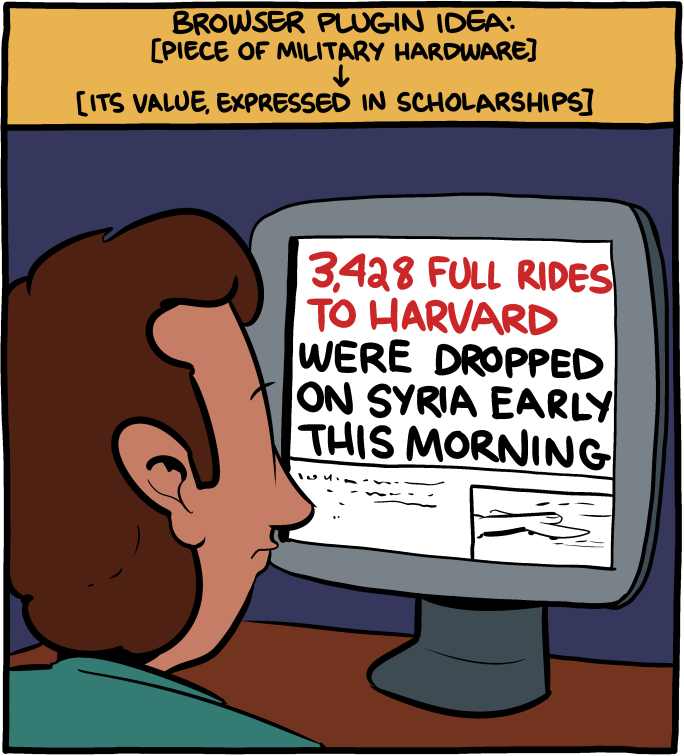
Finishing Augie this week. Crazy.
September 28, 2014
Finishing Augie this week. Crazy.
claudzim, Sophianotloren and 4 others like this
01 Oct 01:21
roane72: worriedaboutmyfern: This morning Im thinking about manpain. Specifically superhero...
 |
Courtney
shared this story
from  Super Opinionated. Super Opinionated.
|
This morning I’m thinking about manpain. Specifically, superhero angst.
Specifically Batman. And Captain America.
As a digression, I feel like what distinguishes “manpain” from just regular pain is not so much the man but the shooting directions. Like, you know it’s manpain when the camera goes into tight closeup on their clenched jaw, or when they are shot backlit in an alley with smoke swirling around their feet. Or with a big fire blazing behind them. Or if they are trudging through a crowded cityscape that’s all black and white and they are the only ones in color.
Case in point: this is Batman. His parents are dead. It’s very sad. He has a lot of manpain.Because of all his pain, Batman is not fully able to trust anyone. He pushes everyone away. Sometimes he lashes out against those closest to him.
This is Batman at Christmas time.Batman is not ever going to go to therapy and deal with his trust issues, or talk about whether he might have something like depression and whether it might respond to medication, even though he could definitely afford it because he is a billionaire. He’s not going to do these things because of editorial decree.
"They put on a cape and cowl for a reason," says DC co-publisher Dan Didio. "They’re committed to defending others — at the sacrifice of all their own personal instincts. That’s something we reinforce. If you look at every one of the characters in the Batman family, their personal lives kind of suck.”Okay. This is Captain America. His parents are dead too. Actually, almost everybody he ever knew is dead, because he got frozen for seventy years.
(By the way if you do a Google image search for “Captain America Punching Bag,” Google will show you some stuff and will also, right at the top, helpfully prompt you with a couple other search terms that you’re probably interested in: “Chris Evans” and “Butt.”)
(A++ Google, carry on.)
Anyway, so Captain America has a lot of manpain too.
Because he’s grieving and lonely, Captain America works hard at forming connections with the new people he meets. He doesn’t understand their frame of cultural reference, so he diligently follows up whenever somebody gives him a book or movie or other kind of recommendation.
He visits a support group for veterans.
He also checks in with his teammates regularly, and makes sure they know that he cares about them. He listens to their problems and offers his support.So my point here is pretty simple. I think the Captain America characterization is a lot more interesting and complex. It just gets boring to have a character like Batman who is always going to have the same shit because he’s never gonna deal with his shit because he’s not allowed to deal with his shit. By contrast, Steve Rogers is warm and human and adult and fucken’ heroic. He’s got shit too but he mans up and carries it the best he can.
Both Batman and Captain America are actually team leaders, but Batman isn’t allowed to be a very good one because he also has to be a brooding loner who hangs out on top of gargoyles most of the time. Preferably in the rain.
Captain America gets rained on, too. The difference, I think, is that at some point he would go out and buy an umbrella.Captain America gets rained on, too. The difference, I think, is that at some point he would go out and buy an umbrella.
THIS THIS THIS THIS THIS ^^^^
claudzim, ken.elwell and 3 others like this
01 Oct 01:19

Mattias Adolfsson’s Manically Detailed Sketches and Doodles
by Christopher Jobson


Exploring sketches and artworks by freelance illustrator Mattias Adolfsson (previously here and here) is an exercise in discoverey with a twist of insanity. The pieces are almost impossible to take in all at once, and represent a collection of bizarre stories, exaggerated characters, and manical devices, all byproducts of Adolfsson’s uniquely dense imagination. Collected here are some posters and sketchbook spreaders from the last year or so, but you can see plenty more in his Flickr stream and in this 2013 interview with Nonsense Society. He also has prints and other items available in his Etsy shop.
Nicholae Cline, claudzim and 5 others like this
01 Oct 01:18


What, Exactly, Is Censorship?
by Mostafa Heddaya
Honoré Daumier, “Gargantua” (1832), for which Daumier was imprisoned
Last week, the controversial production “Exhibit B” was canceled by the City of London’s Barbican Centre, which issued a statement decrying the “profoundly troubling” protests that “silence artists and performers.” A few days later, the production’s creator, Brett Bailey, put on his purple-tinted glasses and beret to appear in the Guardian‘s editorial section, where he bemoaned his fate:
I stand for a global society that is rich in a plurality of voices. I stand against any action that calls for the censoring of creative work or the silencing of divergent views … Do any of us really want to live in a society in which expression is suppressed, banned, silenced, denied a platform? My work has been shut down today, whose will be closed down tomorrow?
But what is censorship? To effectively “deny” someone else the ability to speak, a tangible power relationship must exist between censor and censored. According to the ACLU, the act of censorship implies the use of coercive pressure to prevent the expression of an opinion (be it in “words, images, or ideas”). Strangely, in this case, the entity responsible for the exhibition’s “censorship,” the Barbican, is blaming those who were utterly powerless to effect it — the 200 street protesters and 23,000 petition signatories who objected to the work on racial grounds. And the production is slated to be shown in Moscow and Paris next, so its existence has hardly been foreclosed.
The privilege to speak has always been understood as the cornerstone of politics, its pre-requisite from Aristotle on down. The distribution of this ability has never been egalitarian: both the talent and means of expression are not allocated equally. The French sociologist Pierre Bourdieu expressed this point rather elegantly in a 1977 interview appearing in Le Monde (and collected in Political Interventions):
Just as there is a world of art, so there is a world of politics, with its own specific logic and history, i.e. relatively autonomous; and by the same token with its own problems, its own language and its specific interests. This is what I call a field, in other words a kind of space of play. To enter into the game, you have to know the rules, dispose of a certain language and a certain culture. Above all, you have to feel that you have a right to play. This sense of a right to speak, however, is in fact very unevenly distributed.
Whether or not Bailey’s work is “racist,” the right of people to call for its cancellation is undeniably protected by the same liberal democratic principles being cited to condemn the separate decision to actually cancel it, which is in turn bound up in broader, and more complex, power dynamics. What was especially strange about this incident, and the storm of “anti-censorship” blowhardism in Britain’s opinion pages it predictably elicited, was that the decision to cancel fell squarely in the Barbican’s hands. Shouldn’t they be the ones chastised by the champions of liberalism for not having the spine to back a controversial work? Or would that pivot the conversation from the screeching black-and-white of censorship denunciations to a more difficult conversation about the duty of care public arts organizations owe to their constituencies (and, conversely, their artists)?
The Enlightenment ideal of unfettered free expression is rightly a cornerstone of a just society, but only because it protects people from arbitrary exercises of coercive power. It’s just a check — a negative right against interference and oppression, not a positive guarantee of an even terrain for discourse. By asserting a fictional “global society that is rich in a plurality of voices,” Bailey seems to misunderstand the claims that his detractors are making about the artistically inalienable legacy of colonial and racial oppression that undergirds present conditions. This is not to excuse any threats made by individuals against Brett Bailey, but rather to say that calling for the disengagement of his work from a venue, as the protesters did, is clearly not the horrific abrogation of liberal democratic principles many are saying it is.
A refusal made by the dispossessed, grounded in historical conditions of egregious injustice, is fundamentally different from the domineering censorship by the powerful of the weak. The original claim against “Exhibit B” was a powerless claim, right down to its inability to directly effect any change beyond a petition and street protest, and whose underlying principle of autonomy has more than a little to do with the justification for free speech in the first place.
Sophianotloren likes this
30 Sep 12:02
AA Threatens AddictionMyth on The Fix!
by AddictionMyth
The Best Treatment for Alcohol Use Disorder Your Addiction Counselor Isn’t Telling You
AddictionMyth
Your RELIGION teaches that drinking causes crimes, thus one must be punished for drinking. That is a RELIGIOUS belief. Again, just punish for the crimes. And yes the laws are precisely what is at issue here. J has a problem that JUDGES are sentencing people to AA. And I’d agree that’s just wrong. But you are so blinded by your fanaticism for your religion that you cannot see it.
sonny
Sorry, but my religion and my drinking coexist very amicably. I guess some people aren’t as fortunate. I wish you the best. Be careful. There are either problems, or there’s not! After multiple problems, the picture should become more clear. You’ll figure it out!
AddictionMyth
Sorry but your religion is idolatry of King Alcohol. “This bottle of vodka made me drive drunk.” “This cup of whiskey made me beat my wife and rape my kids.”
That is YOUR religion. Are you proud? Are you still going to defend it? Honestly it makes me wonder what “multiple problems” alcohol caused for you!
sonny
I haven’t had multiple problems….. but to those who have, the picture should be clear. My association with AA is not related to either alcohol or drugs.
AddictionMyth
So you deny being a member of AA! You are like rats jumping off a sinking ship. I don’t blame you. It’s going down. 
sonny
I am a supporter. How are you going to sink her? She has a pretty tough crew…………. crusty lads!
AddictionMyth
I will get each one to deny her. One at a time if that’s what it takes.
sonny
I know those old salty dogs……. they’ll die first!
AddictionMyth
They are powerless to AddictionMyth!!
sonny
They have the Power of God!………… Now be nice!
AddictionMyth
‘Group Of Drunks.’ They don’t scare me.
sonny
Good night…….. I’m outta here!
AddictionMyth
Buh bye
Sophianotloren likes this
30 Sep 10:22


Diary – Three Weeks Later
by Maggie McNeill
 As I wrote in “Change Is“, most Tuesdays will now be diary columns bringing you up to date on what I did the week before and what I’m about to do in coming weeks. I also think it will be a good place to share links to podcasts and embed video interviews I’ve done, to tell you about articles I publish in other venues, and even to thank readers for presents and the like. That means I’ll be retiring the “Maggie in the Media” and “Presents, Presents, Presents!” headings from TW3 columns, but the tags will persist to enable location of diary columns with items that would’ve gone under those tags. I don’t have any media for you this week, but I do need to mention a couple of presents I received in Washington, DC and forgot to mention earlier: when I met Eddie Cunningham for dinner he gave me copies of Guns, Germs and Steel and The Boat of a Million Years. Thank you, Eddie, and I apologize for not mentioning your gift earlier!
For the past couple of weeks I’ve been immersed in catching up on work I had to neglect in the last month of the tour; I was so busy with activities and writing new columns for August and early September that I had to neglect correspondence, plus indexing and other blog maintenance, and by the time I got home my normal one-month buffer was entirely gone. However, you’ll be glad to know that my correspondence is fully caught up, that the buffer was restored by last Saturday, and that the indexing will be fully caught up sometime today; once I bring up the PAQ page and a few other little things I’ll be all done. Furthermore, you’ll be glad to hear I didn’t have to run myself ragged to do it; my improved procedures are making things easier on several fronts, and that means now that I’m caught up I’ll have time to start working on a few other things. One of them is increasing my mainstream presence by submitting articles to a few big sites you may have heard of; another is that essay collection I’ve promised y’all for almost two years now, and the other…well, let’s not say too much about it yet.
On the travel front, I’ll be back in New Orleans again the weekend of October 25th to speak at a convention of Students for Liberty, then on November 5th I’ll be speaking to the same organization at Loyola University in Chicago. The following afternoon I’ll be leaving Chicago by train for my mini-tour to Seattle and Portland; there is no wi-fi on long-distance routes yet, so I will be out of touch all day Friday the 7th, all evening on Thursday the 6th and the morning of Saturday the 8th. But don’t worry, everything will be set up to go, so those who don’t follow Twitter closely probably won’t even know I’m missing. I want to get all of my activities for those cities planned before I leave, though, so if you would like me to speak or read anyplace in either Seattle or Portland please let me know by two weeks from today, three weeks at the absolute latest!
Sophianotloren likes this