Memory Foam never forgets
Memory Foam never forgets


James Sanborn, “Kryptos” (1991), installed in the CIA courtyard (photograph by Jim Sanborn, via Wikimedia)
A secret message encoded in a sculpture at the CIA headquarters in Langley, Virginia, got one step closer to being solved last week. Creator Jim Sanborn disclosed one of the words in “Kryptos,” a brain-racking puzzle that’s gone unsolved for nearly a quarter of a century right at the doorstep of America’s intelligence center.
“Clock” is the hint, one of the words covertly nestled in the 97 characters of the unsolved code. As the New York Times noted, this joins “Berlin” which Sanborn revealed in 2010, possibly referencing the curious “Berlin clock,” or Mengenlehreuhr, a 1975 German timepiece designed by Dieter Binninger that tells the hour by illuminated colors in a system derived from set theory. Sanborn reportedly coyly replied to the theory, “sounding pleased”: “There are several really interesting clocks in Berlin.”
Now before you dust off your enigma machines and put on a pot of conspiracy-strength coffee, the “Kryptos” sculpture, which made its debut in November of 1990, has already driven some of the greatest codebreakers to obsession, along with a host of ambitious amateurs. The first three messages were solved early on by NSA cryptanalysts (here’s a detailed breakdown of each), through a Vigenère cipher, one of the crytographic systems to come out of the Renaissance. However, the shortest message in the nearly 1,800 letters pocked in the copper sculpture, waving out from a trunk of petrified wood like a missive from a prayer scroll, has proved the most difficult.
According to Wired, other than Sanborn, only two other people were thought to know the solution, but in fact Sanborn disclosed in 2005 that he hadn’t given them the real messages at all. While the artist has several other coded sculptures, including those installed at the Hirshhorn Museum and Sculpture Garden in Washington, DC and the University of North Carolina at Charlotte, “Kryptos” remains the most frustrating. The clue happens to coincide with the anniversary of the fall of the Berlin Wall, which occurred while he was working on the piece. Since the November timing of the sculpture’s installation proved to have bearing on previously solved messages, perhaps there’s meaning in the new hint beyond Sanborn’s impatience for its solution.
Content note: This post discusses emotional abuse
In the latest in a string of policies which sound good and are incredibly cheap to implement, Theresa May will announce plans to put emotional abuse on a par with physical domestic violence. This sounds like nothing to object to, a long-awaited recognition of the seriousness of the coercive dynamics which so often sustain abusive relationships and hit survivors hard.
There is a catch, though, and it’s a catch which means I severely doubt that any perpetrators will find themselves prosecuted for something they have blatantly done: the whole thing hinges on telling the police.
The way the police tend to work is through talking about what happened. You list specific incidents. This happened, and then this happened, and then that happened. Imagine having to do this as a survivor of emotional abuse!
The very clever thing about emotional abuse, the thing that really helps abusers keep things going is how petty it sounds if you recount a blow-by-blow history of what happened to you. I’ve never gone into detail about what I experienced in an emotionally abusive relationship, because under the flicker of gaslight, it all sounds rather ridiculous. I could tell you all about some drama involving a duvet or how I needed to watch what my face was doing during sex, but to be quite honest, I’m embarrassed to speak about these things, because everything would require so much detailed explanation of the entire context, and when boiled down to a story it still all sounds quite trivial.
Emotional abuse is a pattern which is hard to explain, and reinforced by abusers making you feel like everything is silly and you’re overreacting.
I wouldn’t explain what happened to me in an incident-specific format to a friend. Hell, it took a lot of time for me to open up about these things to a therapist because they sounded so probably-nothing to me. So why the fuck would I want to speak to a hostile police officer about all of this? The police are known to suck at talking to vulnerable women at the best of times, and this is a situation which is so intrinsically delicate that I cannot imagine any survivors wanting to take the leap and report to the cops. The effects and mechanisms of emotional abuse just present too much of a barrier to this happening.
What would actually help survivors of emotional abuse a lot more is one of the strongest weapons against abusers: knowledge for everyone. Emotional abuse is so little-understood, and that needs to change. An informed populace, with the level of knowledge about what emotional abuse is and the understanding that sometimes what sounds trivial and petty is anything but, could join forces with survivors against abusers. It would be so much easier to fight emotional abuse if we started from a position of supporting and believing survivors, knowing that what might sound like nothing is probably something, especially if she’s taken the step of speaking out.
It would all be so much easier if we could see the difference between little squabbles and emotional abuse, but the problem is that our culture normalises coercive control in relationships to the point that these things are indistinguishable to us. Survivors know the difference, and we should listen to them.
I don’t expect the government to get working on tackling emotional abuse in a way that would actually work, any more than they tackle other forms of violence against women. I have no faith in them; they’re not the route. So we must hack around them, supporting survivors in the way that they want us to.


An empty display case at the National Library of Scotland (image courtesy National Library of Scotland, via Flickr)
Museums and libraries in the United Kingdom are demanding copyright reform by leaving exhibits and display cases conspicuously empty in protest. The institutions are taking a stand against a law that prevents them from showing millions of unpublished documents, particularly those dating from World War I. The campaign has been dubbed “Catch 2039” by the Chartered Institute of Library and Information Professionals (CILIP) because, under current British copyright law, any works by unknown authors or by authors who were born before 1969 and that were not published by August 1, 1989, are subject to copyright through 2039. According to a 2009 report cited by CILIP, as much as 50% of documents currently held in British archives are orphan works. The Imperial War Museums alone count some 1.75 million orphan works in the collections, according to CILIP.

An empty display case at the Leeds University Library Reading Room (image courtesy Leeds University, via Flickr) (click to enlarge)
Among the institutions taking part in the Britain-wide protest are the National Library of Scotland in Edinburgh and the Leeds University Library. Other groups, including the Libraries and Archives Copyright Alliance and the Collections Trust, have pledged their support for “Catch 2039.” Many of them came up against the copyright provision while searching for archival documents to display on the occasion of this year’s WWI centennial.
Though a recent licensing initiative by the British government would allow institutions to reproduce and display orphan works for which provenance research has been carried out and a fee has been paid, the organizations behind the 2039 campaign are calling for the lifting of copyrights on orphan artworks, letters, and engravings 70 years after the author’s death. By those terms, the unpublished wartime correspondence of a military nurse who served during WWI and died in 1935 would have been available for public display beginning in 2005.
Institutions taking part in the protest are including descriptions of the missing documents along with a text that reads:
We would have liked to show you a letter from a First World War soldier here. But due to current copyright laws we are unable to display the original. Those laws mean that some of the most powerful diaries and letters in our collections cannot be displayed.
All that we ask is that copyright law is changed so that the duration of copyright in certain unpublished works lasts for the lifetime of the creator plus 70 years, rather than until the end of the year 2039.
This would help us to give voice to more of the men, women and children who lived through some of the most turbulent times in our history. We want to tell their stories. Join the campaign to Free Our History by signing a petition at www.cilip.org.uk/freeourhistory and by tweeting your support using #catch2039.
I always knew my lengthy interview in July for an upcoming TV documentary might go unused, even though the company making it, Testimony Films, made a considerable investment in my appearance. They gave me two nights’ hotel accommodation and other expenses, and committed a five-strong production crew to an entire day’s filming and studio hire in London, over 100 miles from their Bristol base, solely for my input.
A couple of weeks ago, as briefly reported here in response to a request for a progress report, I said I had received an email from Testimony saying “As this is such a difficult and controversial subject it is taking a very long time to make – and to go through the [name of TV channel] system. There have been several discussions with the [name of TV channel] lawyer over the content. The final shape of the programme still hasn’t been decided. There is no transmission date as yet.”
I was under a commitment not to name the TV channel until the last week before transmission. That time is now up. I now know that the programme, titled The Paedophile Next Door, is to be aired next Tuesday, 25 November, at 9pm on Britain’s Channel 4. I have been informed it will not contain any footage of the interview I gave, which lasted around two and a half hours.
This is disappointing, but I would not be particularly upset if I thought it was going to be a good programme anyway. I always hoped that if my contribution proved a bit too controversial for Channel 4 they might nevertheless be willing to give a platform to someone like Judith Levine, or Bruce Rind, or a British academic such as Glenn Wilson, who put up a spirited if all-too-brief showing on the same channel’s news output recently: PIE spy, with my tabloid eye…
All the signs are, though, that the programme will not be good. From a heretical standpoint it looks like being far worse than I had expected, indeed such an utter disaster I am feeling totally gutted even before seeing it. Am I prejudging too much? We’ll soon see.
I suspect Testimony are embarrassed. It seems they wanted to keep me in the dark as long as possible in case I went public too early and tried to derail things. Unbeknown to me, Channel 4 issued a bulletin about the upcoming programme on the 7th of this month, including its release date. But on the 10th, three days later, in response to my enquiries, Testimony were telling me there was still no release date and did not give me C4’s programme information.
The Testimony people have been very friendly and they definitely did not set out with the cynical intention of setting me up as a pantomime villain. Director Steve Humphries has a strong reputation as a documentary maker with an interest in a diversity of voices. He gives every impression of being a man of broad sympathies; his interview style is empathetic.
It is possible Channel 4 insisted on taking the production in another direction from the one first envisaged by Humphries. It may be significant that a second director’s name is now on the credits: Rudolph Herzog, son of the world renowned Werner Herzog. Herzog fils appears to be based in Germany, with no obvious connection to Testimony. His location, however, would make him well placed to explore Germany’s Prevention Project Dunkelfeld, highlighted in Jon Henley’s feature article on paedophilia for the Guardian last year.
Channel 4’s programme information begins thus:
With almost every passing week a new child sex abuse scandal breaks. In this sobering and thought-provoking film, historian and acclaimed social documentary maker Steve Humphries sets out to discover why all the elaborate policies and legislation put in place to protect children from sexual abuse have failed.
He discovers some radical new solutions proposed by an increasing number of child protection experts which challenge our deep-rooted attitudes and emotional reactions to paedophiles. They tell Humphries that many paedophiles live in our midst and go completely undetected. “They’re not monsters with horns and tails, but ordinary blokes,” says senior lecturer Dr Sarah Goode – and this makes them so dangerous and difficult to identify. Controversially, Dr Goode believes that the most promising way to reduce the number of child abuse cases is to encourage paedophiles who have not yet targeted children to “come out” and receive treatment.
This theory is supported by an extraordinary interview in which Humphries meets a man face-to-face who confesses, on camera, to his strong sexual attraction for children as young as five. He claims that he has not interfered with a child, nor could ever imagining doing so. He is so desperate for help that he is prepared to ‘out’ himself in the hope that men like him will be more readily offered support to manage their unwanted desires.
Paedophiles are the most vilified of all criminals – invoking universal hatred and disgust. Humphries hears from experts who explain that, as a result, the fear, self-loathing and stress paedophiles will associate with their desires makes them actually more likely to offend. Humphries explores pioneering schemes and initiatives designed to help paedophiles before they might hurt children. These ground-breaking schemes aim to educate families and encourage men to seek help – some of them provide residential support and treatment confidentially. Supporters of these initiatives believe they will keep children safe and are far more effective – rather than engaging with them only after they become offenders…
You get the picture. It looks as if this will be “virtuous” shit from start to finish. If I feel gutted, it is because the ideology of repression has won decisively in a direct contest with that of self-determination. I am gutted because I spilled my guts out for that interview and I know it was a good one, after a lot of preparation and an emotionally draining encounter with Humphries. It was all the tougher, oddly, thanks to his gently searching style. His kindness was killing. My answers could only come from the heart, at times painfully so when the questions reached deeply into the personal realm, – a place no aggressive inquisitor could touch; the defences would be up.
I’m not putting it too strongly when I say I feel betrayed, especially by the apparently central role given to Sarah Goode and her piss-poor thinking, which I believe I adequately demolished in my review of her book Paedophiles in Society and its predecessor – a review Humphries certainly knew about because I alerted him to it in an email back in May.
But to claim I have been betrayed by Testimony, or by Steve Humphries in particular, would be grossly unfair. I am confident Steve fought as hard as he could for my inclusion. That does not mean he shares my views, though, and I probably underestimated the extent to which he was keeping his cards close to his chest on that.
As for whether I really had performed strongly, was this just an illusion? Here’s the relevant part of what Steve emailed the next day:
I just wanted to say thanks so much for coming down for the filmed interview, which was as excellent and as powerful as I’d hoped it would be. I thought you told your personal story and stated your case as strongly as anyone could. I know the team…really enjoyed meeting you too and found it a moving and hugely interesting day…
A few days ago, “Bloom” wrote in the comments here “It would be interesting to get your take on the controversy over contact vs non-contact. Not so much on the question itself, which is somewhat abstract, but on how you see it affecting the overall struggle for greater tolerance and acceptance.”
First of all, I agree with another commentator, “Stephen6000”, that “pro-choice” is a better expression than “pro-contact”, although, it will be seen that I have opted above for “self-determination”, which avoids confusion with abortion. Also, I don’t think self-determination is too abstract, but what Bloom perhaps meant to say was too academic, as in the expression “it’s all a bit academic” i.e. it ain’t gonna happen anytime soon, so why bother talking about it?
If that was the intended meaning it undeniably amounts to a strong argument, not least in view of this Channel 4 programme: I tried to talk about sexual self-determination but who was listening? No one ever does these days. So what’s the point of banging on about it?
Presumably Bloom is pleased to see controversy over self-determination taken out of the equation by Channel 4. That leaves The Paedophile Next Door, and any similar presentation of MAPs, free to focus on “tolerance and acceptance”, right?
Well, sure, and that would be a good thing if it were taking us in the right direction. Politics is often characterised as the art of the possible. The way to reach an ultimate goal is to focus on small, incremental achievements. You don’t frighten the horses by seeming to be insanely radical.
I understand that. But what if those small steps are heading in the wrong direction, leading away from one’s ultimate objective? The “tolerance and acceptance” aimed at in VP efforts is not tolerance and acceptance of sexual self-determination, after all, but it’s exact opposite i.e. an outcome that cements intolerance and non-acceptance of sexual self-determination permanently in place and depends upon brainwashing and coercing MAPs into submission.
This represents a repudiation of all I believe in and I cannot support it.
I will watch the programme, though, through gritted teeth. As long as I am publicly engaged in blogging and such like, I feel I have a duty to keep myself informed. It will not be easy. One of those taking part, unless I am greatly mistaken, is Ian McFadyen, who is fast becoming a full-time professional victim. I don’t relish the thought of having to watch this self-righteous bully’s “dignified exchange”, as the programme info puts it, with a paedophilic self-sacrificial lamb.
McFadyen, to be sure, was genuinely the victim of a sadistic rapist on the staff of Caldicott Preparatory School if his story is true, and I have no particular reason to doubt it. As a result, it seems, he is now determined to victimise anyone who crosses him, including his old school pal Nick Clegg – yes, that Nick Clegg, the Liberal Democrat MP who has been deputy prime minister of the UK since 2010. McFadyen was recently quoted as saying, “I’m definitely really angry with Nick Clegg… he’s been a real disappointment. I’m actually ashamed to have gone to school with him.”
Gosh, you might wonder, what’s poor old Cleggie been up to now? Nothing illegal, it turns out, though it might be thought so from McFadyen’s wrath. It’s just that Clegg had failed to back McFadyen’s demand for a massive inquiry into historic sexual abuse. See what I mean about the “bully” thing?
McFadyen has plenty of reason to feel traumatised and angry, of course, and it behoves us heretics to advocate for a more open society (including more accountability in schools) so that dreadful experiences like his are not repeated. But it is characteristic of so-called sympathetic programmes, including this latest Channel 4 one, that their purported sympathy for non-active paedophiles tends to be yoked together with truly extreme and appalling cases of abuse. Far from increasing sympathy for the average paedophile, the likely outcome of this pairing is to crank up the fear of paedophilia to a heightened extreme, so that even the most virtuous VP will come under ever more intense suspicion and scrutiny – and insistence that they do not go anywhere near kids.
For a bit of realistic balance, we could do worse than turn to some recent revelations by TV personality and former Tory MP Gyles Brandreth. He told the Daily Mail a couple of months ago he had been “abused” by a choir master at his prep school.
“I suppose I liked him,” said Brandreth. “At least, I was flattered by his attention. I think I felt it was my due. I was 11, 12 and 13 when this was happening, and quite full of myself. Mr Harkness took lots of photographs of me. We both admired the results.”
Also:
“Has this experience of being a victim of child abuse had a lasting effect on me? I certainly don’t feel traumatised by it, nor even resentful. I did not complain then, and I am not complaining now.”
It is no accident, I feel, that neither Brandreth, nor anyone with a comparable experience, is being featured on the Channel 4 programme so far as I can tell. They wouldn’t want to spoil their “misery memoir” narrative with any happiness, would they?


Kurt Perschke’s ‘RedBall Project’ in Portland, Oregon (2007) (image via Wikimedia)
An advertising campaign for Shell featuring a giant red ball has one artist feeling blue. The Guardian reported that Kurt Perschke is alleging the petrochemical giant lifted the idea for their recent campaign from his RedBall Project. Big balls are Perschke’s bailiwick: the man has been depositing his sanguine spheres in public places the world over for 13 years, with the effort documented in photographs posted on his website.

The Shell advertisement (click to enlarge)
Shell denied the similarities were tantamount to theft, or even inspired by the artist’s work. Through a spokesperson, the company told the Guardian that their “campaign uses imagined illustrations of a red sphere in iconic locations. They are not actual or physical installations of red balls, which is the focus of the artist’s installations.” The company further pointed out that the use of inflated spheres to represent carbon dioxide is a common practice.
But Perschke is adamant that the advertisement in question, which is set in London’s Trafalgar Square, is derivative, even following on the heels of his work’s recent appearance in the city. “They could have done it a lot of ways, it could have been a balloon or a kickball or a football or whatever but it’s not, it’s spot on and because we were in London so recently it is frustrating and disheartening,” he told the Guardian.
The courts have sided with Perschke in the past: Last year, the Guardian notes, Perschke successfully obtained a settlement from French logistics company Edenred over their apparent copyright-infringing use of red balls in ads. (That case was filed in New York’s Eastern District court; it’s unclear if Perschke has access to a jurisdiction in which he could file against Shell.)
A small critical footnote: If you make art that is easily duplicated as generic corporate messaging, you should worry more about the possibility of your art being terrible and less about getting ripped off in an advertisement.

GIF from Theresa Duncan’s ‘Smarty’ (1996) game (via Rhizome)
Theresa Duncan made a series of CD-ROM games in the 1990s aimed at young girls, encouraging imagination and adventure through playfully drawn, dreamlike narratives. But operating systems evolved, gaming moved to different platforms, and her work is now unplayable and overlooked. A new project from Rhizome is reviving this piece of digital history by making three of her games freely accessible online.
Currently crowdfunding an ambitious $20,000 on Kickstarter, the Theresa Duncan CD-ROMs: Visionary Videogames for Girls campaign is part of Rhizome’s greater initiative to preserve digital work in a way that lets it be experienced in its original “environment,” in this case the Windows 98 operating system. Three games by Duncan — Chop Suey (1995, which she co-created with Monica Gesue), Smarty (1996), and Zero Zero (1997) — will be playable in any modern browser through the use of “emulation software” that simulates the original, intended system.
Duncan’s games offered wonder through a digital world that combined daydreams and the everyday, and they were majorly influential on digital art and gaming history. Sometimes collaborating with her boyfriend, digital artist Jeremy Blake (they both tragically died in apparent suicides in 2007), Duncan fostered a unique aesthetic that invited girls to explore. As Rhizome explains on Kickstarter:
Confronting a videogame culture lacking diversity of digital experience (shoot-em-ups and fantasy adventures for boys, prom role-play and dress-up for girls), Theresa Duncan’s CD-ROM work was something markedly different: uniquely personal, passionately invested in the creative possibilities of her medium, and daring (in the words of critic Jenn Frank) to “represent the criminally underrepresented: that is, the wild imagination of some girl aged 7 to 12.”
Rhizome adds that part of the goal is “contextualizing [Duncan’s work] within feminist gaming history.” There are still major voids in gaming for girls (see this week’s Barbie fiasco), and in particular how women are represented in video games, beyond just static objects or incentives for male protagonists. Adding Duncan’s voice back into the narrative in a way that lets people experience it firsthand is a valuable initiative as much for the current gaming landscape as its history. Rhizome plans to collaborate with the New Museum, where the nonprofit is in residence, to make Duncan’s work part of the First Look online series and hold an event in the spring of 2015.
Theresa Duncan CD-ROMs: Visionary Videogames for Girls is fundraising on Kickstarter through December 18.
 I’ve been thinking a lot about fitness and health and muscles and frankly it’s really hard to dig out useful advice and tools from the snake oil being peddled. I’m reasonably fit, but I’m not what anyone would call to get workout tips, either.
But kegels? This is the kind of fitness I know something about.
LOOP, which is running an IndieGoGo campaign right now, is one of the new not-a-sex-toy cunt toys in this increasing trend of pelvic exercisers. We’ve had ben wa balls or Betty Dodson’s barbell for exercising these muscles, but nothing that provides direct feedback about how we’re doing. Knowing how strong those muscles are, and if I’m getting stronger or weaker, really helps keep me on track to keep on it.
Plus if I can’t rip someone’s dick off with my cunt, I’m just not trying hard enough right?
The LOOP comes with a little bamboo bag, and you download an app in order to save the data you receive. That data allows you to train in ways that work for you, as well as seeing if you can beat your own scores. All this for $90 if you pay into their IndieGoGo campaign- not too shabby, considering similar ones cost over $150. Betty’s Barbell is $125, and doesn’t even give you feedback, so there we go!
I love kegel exercising because I love when I can clamp down on a lover’s cock and see them shudder. I love having control over letting someone’s fist into my cunt. Also I enjoy that by having all these fun sexy inspirations to keep up with my kegelcising, I also won’t be as likely to struggle with incontinence later in life, but that’s not nearly as fun an incentive as the shudder my lover gets when I can grip their cock or hand with my cunt muscles.
I like that LOOP isn’t designed to go double duty as a vibrator, actually. I think focusing on it as a health tool makes more sense- the expectation that a data extraction implement will also get you off often seems to end up in a product that doesn’t do either particularly well. I do want to point out that not all owners of cunts are women, and that not all women have cunts, and I hope the creators will consider editing their copy to reflect that.
I’m curious to try this out when it’s ready. I for one welcome our cataloguing of data relating to sexuality… it’s about damn time, to be frank, and I’m glad to see it becoming more accessible!
Do you do kegels? What works for you? Have you noticed a difference?

Taylor Swift is a profoundly sentimental artist. She is also, of course, a gifted songwriter, a clear, convincing singer, a striking melodist, a hook machine as irresistible as any to grace Top 40 radio, a celebrity about as benevolent as they come, and, let us not forget, a role model worth obsessing over. But before any of that we Taylor Swift fans must acknowledge her penchant for schmaltz, as this earnest young woman who writes directly and openly about her feelings has a saccharine streak about a mile wide. When asked why one loves Taylor Swift, it is easy to mumble some excuse about expert craft or formal mastery. The reason we fans adore her is much more specific, more thematic. We adore her because she falls in love with guys when they hold the door open for her, which anybody else would interpret as a meaningless act of common courtesy. We adore her because when she meets her new lover in a café and he tells her about the movies he watches with his family every single Christmas she feels all warm and fuzzy inside. We adore her because she projects an innocent, radiant delight in the world that could make you believe in faith and magic.
Whether Taylor Swift the real-life human being is actually like this is somewhat implausible, nor does it particularly matter. Swift has become a megaplatinum superstar largely through the construction of an artificial but rather appealing character. To call her the girl next door would downplay the dizzy self-involvement and feisty autonomy that made her a star in the first place; no girl next door is that thin or dresses that well. But as epitomized in “You Belong With Me,” in which she positions herself as the more downhome, easygoing darling in sharp contrast with her high-maintenance romantic rival, Swift has consistently played throughout her career an intriguing cross between Everygirl and Ingenue. Few have put this much effort into such a shimmering illusion of normalcy. However naturalistic the detail in her well-plotted love stories, her turns of phrase come rather close to familiar cliché, and ultimately her narratives trade in idealized archetypes rather than individual instance, especially the ones that deal specifically with high school or life in a small town — from “White Horse” to “Last Kiss” to “How You Get the Girl,” from the song where she and her boyfriend are Romeo and Juliet to the song where she and her boyfriend fall in love over the summer listening to Tim McGraw. She is modest, ordinary, and picture-perfect; she is much less sexual than most female pop singers, but she’s also in touch with her feelings and she takes them seriously. And although her new album has been marketed as a mature, adult move away from girly vulnerability as well as a radical musical reinvention where glitzy synth-pop replaces mild country-rock, listen twice to 1989 and you’ll hear the same wholesome voice, the same hopeless romantic getting excited and angry and blissfully happy.
Possibly the hookiest and most immediate album she’s ever made, 1989 culminates a career that started with roots in the homely comforts of country and/or mall music and slowly gained the universal power of the best masspop as Swift sharpened her writing and fed her insatiable ambition. It’s not her artistic peak, I don’t think; that would be 2012’s Red, an unequivocally great album that snuck up on me months after I had mentally filed it away and that I now love as much as anybody ever. Red sold a million copies in its first week, too, just like 1989. But unless she returns to country and/or mall music after her present electroexperiment, which might not be such a bad career move, the new album seals a formal progression that seems inevitable in retrospect and leaves her with plenty of places to go. Complete with feigned drawl and aching pedal steel, 2006’s self-titled debut Taylor Swift was a fairly predictable corporate country record, yet you can already hear her toying with the teen-nostalgia theme as of the first song and lead single, “Tim McGraw.” 2008’s megacrossover breakout Fearless and 2010’s somewhat overproduced Speak Now streamline her product, subsuming the twangy elements into a slick, flavorful country-tinged pop vehicle that equaled radio gold. Red perfected the aesthetic, in which that same pop vehicle expanded to include sugary keyboards, plucked banjo riffs, calm acoustic strumming, intensely defiant kissoffs and heartbreakingly sad ballads, emotional hormonal giddiness all over the place, its homely comforts so reassuring and pleasurable, its masspop reach so punchy and fierce. 1989, cannily marketed as her first real pop album when in fact she’s never done anything but, strips down her sound to a light blend of synthetic beats and automated drum machines. Gone are the warm, cozy songs that you could curl up to on a rainy day with a cup of tea and a blanket. This is urban dance music through and through.
Swift’s songwriting has remained expressive, passionate, amazingly heartfelt and romantic. She continues to specialize in sketching spectacularly entertaining relationship catastrophe, and her narrative tropes are no less conventional. “Out of the Woods” especially hits you with the kind of broad emotional force that has always been her gift. But on the whole her lyrics have become more concise and less specific, and her melodies bounce along with a spare elegance she’s never approached before. She’s cheerier than usual, thrilled by her fresh popstar power and less inclined toward introspection. Where she used to hammer her choruses home with the energy of a natural arena-rocker, now she glides and soars on the liquid momentum of her bubblegum beat. Her strummed guitar riffs have been almost completely excised, replaced by a snowballing procession of chewy keyboard hooks. This music seems coated in polish, gleaming even more brightly than most Top 40 material, defined by a glossy surface the artificiality of which is barely diminished by the depth underneath, and her tunes slip into your head more easily than ever. She announces her newfound commitment to electropop with the opening “Welcome to New York,” which has nothing to do with New York and everything to do with those magnificent, glittering synthesizers that open the album with a bang.

As with so much commercial pop music, everything on 1989 is deliberate. Each chiming keyboard figure, every click of the drum machine, all the breathy sighs in her voice, these have been fanatically labored over by Swift and her production team. Each moment on the album has been calculated to push your buttons, and in this 1989 is perhaps not so different from her earlier work after all. Taylor Swift’s schmaltzy side, more readily apparent in her country-identified music but nevertheless always there deep down, toys with your feelings the same way her tightly constructed melodic pop songs toy with your pleasure receptors. Her music is manipulative in the technical sense of the term: engineered to make you feel specific and premeditated things. Swift shares this knack with dozens of lesser songpoets and cheesy Hollywood screenwriters, and she is shockingly good at it. To listen to a song like “All Too Well” and follow the protagonist, identifying with her at every turn, celebrating her joy and shaking your head in solidarity when the world lets her down, feeling the exact tones of winsome nostalgia that she does, at the same time grinning at the verses before beaming at the chorus, this is to embark on a sentimental journey whose path has already been mapped out for you. Both the heartsongs of her Nashville period and the mechanical machinations of her newly dominant synthpop work like this. For some impossible number of reasons — her friendly, ordinary yet distinct persona, her embrace of young romantic mythology, her honest emotional immediacy — Swift can somehow turn this kind of kitsch into something enchanted and beautiful.
And if you allow yourself to be manipulated by her superb craft, she will take you to special places indeed. Because of its plastic surface and jingly one-dimensionality, 1989 admittedly severs all connections with her previous country and/or mall music phase; no longer is she an artist who would release The Taylor Swift Holiday Collection. But Swift’s personality, energy, and tendency to write songs like confessional diary entries have by no means changed along with the music, and the overall effect is much the same. Just like Red, just like Fearless, 1989 paints a sweet, escapist fantasy of adolescence as an idyllic time. She puts on a nice dress and stares at the sunset, she falls for a guy with that James Dean daydream look in his eye, she gets drawn into young and reckless love affairs. She dances to her beat forevermore, she waxes lyrical about her love, she lives her wildest dreams. This is what both teenpop and so much country music are about, and her attraction to both genres and ability to fuse them makes perfect sense. Always the songs she sings are so glowing, so elegantly conventional, so rosy and romantic, it’s like she lives in a fairytale world right around the corner, which adds to the emotional impact; these songs tug on your heartstrings and make you long for the paradise they depict in such heavenly detail. They actually achieve the eternal youth that rock & rollers have forever been chasing, not to mention the delightful melodicism and surefire hook power that pop aesthetes crave.
1989 will sell a million more copies before the year ends, “Shake It Off” will stick in everybody’s heads for months after that, and Swift will once again have triumphed on a masspop scale. Bitter cynics and the militantly anticommercial will hold out as long as they can, gritting their teeth, desperately trying to resist the musical pleasure they know awaits them. Everybody else will just shrug and enjoy the record. By the standards of a Taylor Swift album, 1989 is simpler and less rich than her norm, both musically and thematically. But there’s a neat, fascinating beauty to its simplicity that’s surprisingly persistent and easy to listen to. Clear as day, its melodies ring out brightly through the air.
1989 and Red are available from Amazon and other retailers.


Okay but check out this on-point campaign my schools starting
((Lone Mountain is one of the buildings on campus and there’s a ridiculous set of stairs to get up to it))Um whoa, how cool. The school is seriously doing this? This makes me want to visit again haha.
Do you know what started it?
I’m actually not sure, but the posters say it’s a couple professors from the psych department, design department, and school of management working together on it. The posters should be up next week, I’m stoked

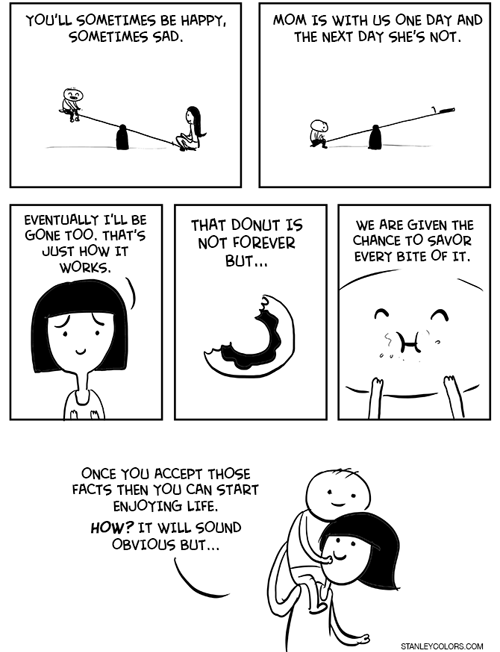
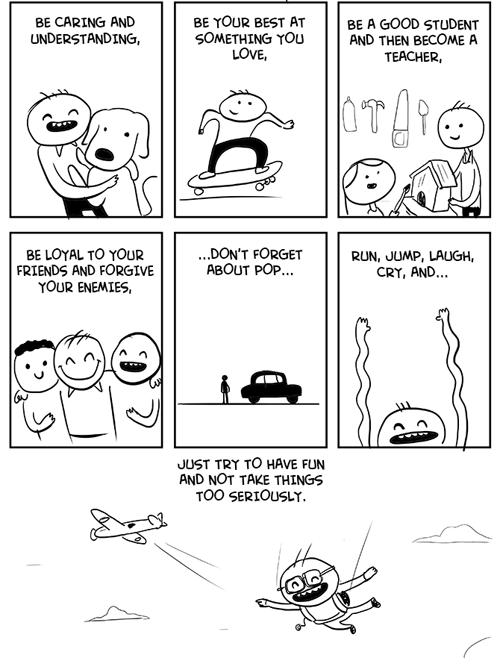
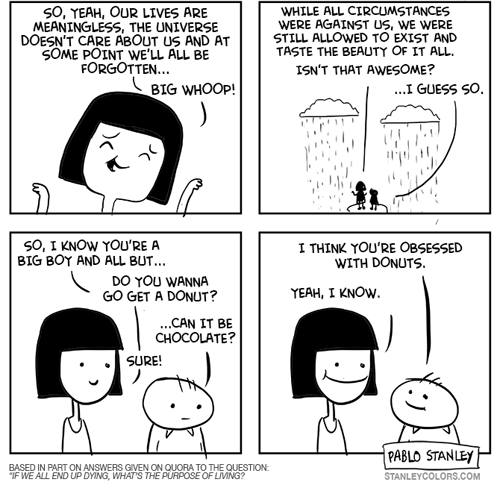
drst:
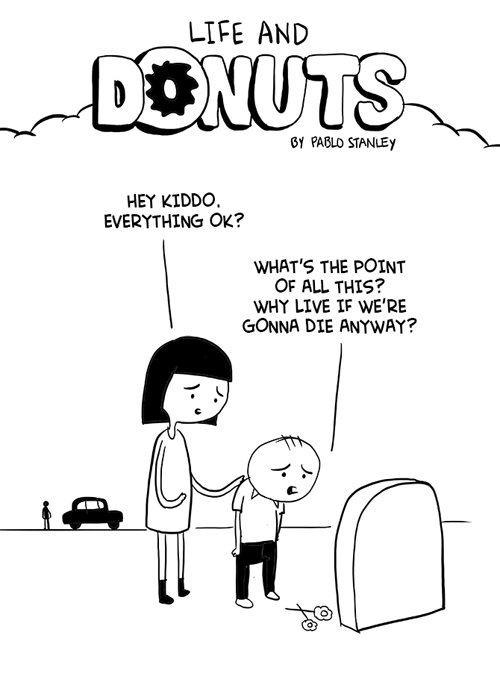
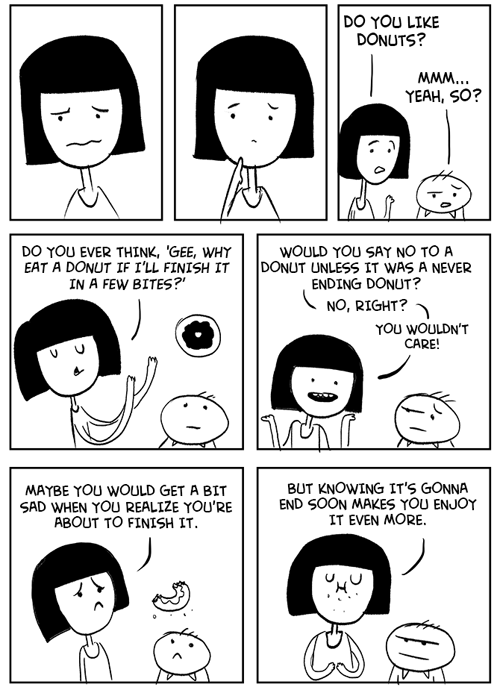
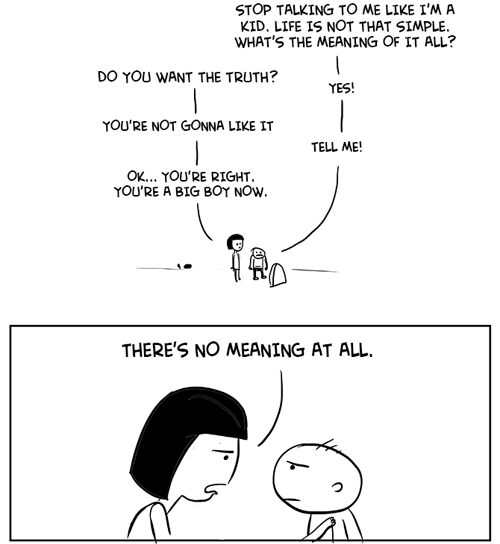
Life and Donuts by Pablo Stanley
I need to say this is one of the most uplifting things I’ve seen.
well that’s my existential crisis sorted out
seriously though its nice to have that kind of comfort written out like that"What connects us to life?"
"Right now? I’m going with donuts"

How long does it take you to open the fridge, scrape up some ‘I can’t believe it’s not butter’ and apply it to two pieces of bread? A minute? Less than a minute? You’ve still got time to spare! Throw a ready-cut slice of cheese between the two pieces of bread – and head out the door to catch your train. You can dispense with putting the result in a polythene bag if you like – think of the environment. Just chuck it in your briefcase; it will still fill your stomach at lunchtime – even squashed flat it will transform into stomach-shaped once it has travelled down your gullet – doesn’t need to start life perfectly triangular. The wonders of the human body!
The cost? 40p would be generous.
What’s that you say? You’re rushed in the morning? Busy people; pressure of modern life?
Then how come, four hours later, you can find that same two entire minutes to lean over a chill counter as you dither between ‘Camembert and ripe Forest berries’ or ‘Cheddar with organic red onion’ in Marks and Spencer – and that’s not counting the time spent queuing up to pay your £4.
*Sigh*. Ms Raccoon has been reading ‘sandwich statistics‘. More interesting than it might seem at first sight.
Did you know that 300,000 people get up every morning, catch that train, and then spend all day, their entire day, applying ‘I can’t believe it’s not butter’ to two slices of bread on your behalf, and don’t even throw the slice of cheese in between? Nope, that’s someone else’s full time employment; professional cheese slice chucker…
300,000 people! That’s ten times the number employed in the entire wind farm industry; and we spend enough time complaining about what a useless waste of space that is. 300,000 people – that’s ten times the number of people who come into Britain ever year from non-EU countries that we are having a major political row over at the moment. That’s ten times the number of people as were required to run the entire 2012 Olympics.
300,000 people who manage to pay their mortgage, their child care bills, feed their family, claim their top up benefits, buy new knickers, feed the cat – doing nothing more than spread pretendy butter on two slices of bread all because you can find two minutes at lunch-time to dither over their handiwork, but you can’t find those two minutes before you leave the house in the morning!
I’m not counting the number of people who spend at least an hour a day saying “White or brown” to you, or “That’ll be £7.20″ should you have stupidly stepped into Starbucks sandwich emporium. Nor the expensively trained journalists who uncomplainingly spend their working week writing about sandwich fillings for ‘International Snack and Sandwich News‘; nor the experts involved in judging ‘British Sandwich Designer of the Year ‘ – Oh well done Catherine!
It was, of course, the news from the Greencore factory in Northampton that they were to search for an additional 300 eastern Europeans to butter those slices of bread for us that sent me nose-diving into the sandwich sub-culture. Despite over 500 bread butterers in Corby, a mere 50 miles away, having lost their jobs, only 50 of them applied for the new jobs in Northampton. Greencore decided that the British were simply not ‘hungry enough’ for work – and so went to Hungary, where they are. So to speak. Or summit like that.
Up in sunny Bradford, you will find ‘Love Bites’, a major sandwich making empire. Richard Smith started making sandwiches in his kitchen and flogging them out of the back of a van in 1991. Now he has a fleet of refrigerated lorries that can each carry 56,000 sandwiches charging round the country.
In the Midlands, you will find Iwona Zilinskas – she came here in 2004 as an illegal immigrant, buttering slices of bread for us – but now has legal status and runs an employment agency making sure that the mainly Albanians, Latvians and Poles 300,000 people who know which side our bread should be buttered are paid minimum wage and not exploited.
It is a £7bn industry. 7,000,000,000 quid a year – and 300,000 people. 3.5bn sandwiches every day.
We could solve overcrowding on this beleaguered isles at a stroke here – and if my maths is right, I’ve just put an extra £5.5bn in your pocket for cat food. I must take a week off writing more often – I could solve the entire problems of the world if I took a month off….
Shift that two minutes you find at lunchtime to 7am – and discover which side your bread is buttered!
I recieved this breathless email that reveals the ghastly truth about liberal Oregon and their evil sex education plans.
KOIN, the CBS affiliate in Portland, is set to air its special investigative report “Triple X-Rated Education” Tuesday at 11pm. This report will expose the Oregon Adolescent Sexuality Conference and its pornographic sex education forced on area children. Planned Parenthood is on the steering committee of the annual Oregon ASC.
“I felt really horrified and unsettled by it all,” says a student on the KOIN report trailer. “A conference intended to teach kids as young as 11 about safe sex, but you won’t believe what they’re learning,” the commentator continues.
A local watchdog group, Parents’ Rights in Education, has had its eye on the Oregon Adolescent Sexuality Conference and the XXX-rated presentations and materials being peddled to and by schoolchildren there for several years. In 2013, the group asked Rita Diller, director of American Life League’s STOPP Planned Parenthood International, to attend the conference and see for herself what was being promoted to children. Diller says she came away scarred. “I monitor Planned Parenthood sex education on a regular basis and I have seen some unbelievably horrifying situations that young people are put in because of the abortion giant’s fixation with sexualizing children, but never have I seen so many adults work so hard to defile young people than at this conference,” she said. “It is blatant child abuse.”
Several parents attended on behalf of the investigative effort and brought out materials that matched and expanded on the cache that Diller brought out in 2013. Those materials are now up on the website of Parents’ Rights in Education for the world to see.
Also on the website are some videos from the 2014 conference. One of them shows a presentation where a teen boy blows up a condom, lubricates it, and performs a simulated sex act with it while adult sponsors and teens laugh. The trailer for the KOIN exposé is also linked on the website.
American Life League president, Judie Brown, stated, “Planned Parenthood continues to receive funding at taxpayer expense and uses this money to shove pornographic material down the throats of our children. Congress must defund Planned Parenthood immediately.”Media inquiries, please contact Rob Gasper at 540.659.4171 or RGasper@all.org.
You think they’d learn someday that the “shove X down their throats” cliche is really inappropriate.
But of course this all made me curious — what horrifying things are these radicals at Planned Parenthood telling kids that defiles them? So I dug up some videos that are apparently excerpts from this exposé.
This is a video about Dangerous Sex Advice for Kids.
So it’s about a 15 year old going into a Planned Parenthood and asking for sex advice — she wants to talk about kink. And what she gets is a frank discussion about the facts: that some people like to role play, that they play dominance/submissive games, that you should use a safe word. I looked at a couple of videos, and rather than being horrifying or sexualizing children, they are telling these kids that their desires are perfectly normal, urging them to learn more (they recommend The Joy of Sex, oh horrors), and emphasizing the importance of consent.
These are the tamest sex talks imaginable: non-judgmental, informative, reassuring, and professional. All I can say after seeing them is…good job, Planned Parenthood. I hope a lot of kids see this ‘documentary’ and learn that if they want honest answers, they should just visit their local Planned Parenthood office, because I was really impressed with how nice they were in the clips.
And contra these conservative wackaloons, the real blatant child abuse is keeping kids ignorant and afraid.
XXVII
Then out spake prim Horatius,
The Censor of the Gate:
"To every persyn upon this earth
Butthurt cometh soon or late.
And how can we do better
When facing fearful speech,
Than shut down all discussion,
And stop the crimethink's reach?
XXVIII
"As for the tender mother
Who knits a woolen toy,
Best send the cops to brace her
Although it gives her joy,
It matters not what we think,
We privileged with some sense,
Call the cops if anyone
May somehow take offense.
XXIX
"Haul down the books, Oh Councils,
With all the speed ye may;
I, with the state to help me,
Will halt bad speech in play.
If the people won't obey us
And alter all their norms,
Then force of law we'll bring to bear,
and stop extremism in all its forms.
With Apologies To Baron Macaulay © 2007-2014 by the authors of Popehat. This feed is for personal, non-commercial use only. Using this feed on any other site is a copyright violation. No scraping.

Pages from In Real Life (al images courtesy the publisher)
It’s all fun and games until the thinly veiled artifice of a virtual world becomes all too real. In the case of young Anda, the main character of In Real Life, a graphic novel written by Boing Boing co-editor Cory Doctorow and illustrated by Jen Wang, she must reconcile that the distinction between good and bad isn’t always clear cut in the multi-player online role-playing game (MMORPG) she plays known as Coarsegold. In Real Life is spun out of “Anda’s Game,” a short story, also written by Doctorow.
 Each page of In Real Life showcases Jen Wang’s thoughtfully illustrated panels, which easily pull you into the story. Her drawings are loosely rendered — some areas appear to be drawn playfully with a crayon-like texture — and are reminiscent of popular comic book illustrator Jillian Tamaki. Wang does a great job of keeping the real world in boring neutral colors to describe Anda’s suburban Arizona life, while the virtual world is either a series of warm yellows and oranges during fight scenes, or cool blues and greens when Anda is contemplative and about to come to a realization about in-game ethics. It feels like a necessary accompaniment to Doctorow’s original story — Anda is portrayed as a plain, stocky teenager, far from the beautiful comic characters that typically grace the pages of major superhero comics. Her idealized self in the virtual world of Coarsegold is known as “Kalidestroyer,” an athletic redhead that can kick ass. Anda gains confidence through playing as “Kalidestroyer,” and soon she’s accompanying another character, Lucy, on missions that pay cash — not in-game currency, but real dollars. Her missions are essentially to raid other player’s houses and kill gold sellers for money.

An ethical dilemma arises when Anda learns that these gold sellers aren’t just robots — they’re real people from impoverished nations that are trying to make money through the game. They collect gold and artifacts within the game to sell back to more wealthy players — a common practice within MMORPG games. Upon realizing this, Anda befriends a young gold seller who, in real life, is a Chinese boy who goes by his English name, Raymond. Anda begins to question Raymond about his practices in an effort to figure out why he is gaming the system. Eventually, he divulges that this is the easiest way for him to make money without working in a factory.
With this knowledge, Anda begins to advocate for Raymond to stand up to his cruel employer, which has numerous consequences.

Interestingly, Raymond has been changed from a gold-farmer of Mexican heritage in the original “Anda’s Game” to a Chinese one, perhaps as a reflection of current working conditions for many of China’s poor, a nod to the spread of MMORPG gold-seller sweatshops, and the proliferation of internet access. As all games, especially MMORPGs, can mirror aspects of the real world, In Real Life asks important questions about how assets are controlled, how prejudice is carried into a virtual world, as well as the ethics involved in online gaming. It also forces us to think about the implications of selling off precious artifacts to wealthier patrons in order to support oneself or one’s family — a practice all too common in impoverished countries.
“When you contemplate the microscale phenomenon of a world-in-a-bottle like an MMO and the toy economy within it, it equips you with a graspable metaphor for understanding the macroscale world of monetary policy. In other words: thinking about gold farming is a gateway drug to thinking about money itself,” Doctorow explains in an interview with Kotaku about the novel.
Though these are the broad ideas Doctorow aims at with In Real Life, it does feel like more of an introduction to moral issues within virtual societies and a simplistic look into broader problems. Some of the original criticism of sexism and gender in video games that was present in “Anda’s Game” is noticeably missing. For example, “Sensible boobs, sensible armour, and a sword the size of the world” is an epithet used a few times in “Anda’s Game,” but there is no mention of this in In Real Life. There is, however, a nod early on in In Real Life that there are more female gamers today and that more should start playing. But if Doctorow’s primary audience for the book is adolescent players easily indignant over the economics within an MMORPG, there’s definitely a lesson or two to be learned.
In Real Life, a graphic novel written by Cory Doctorow and illustrated by Jen Wang, is available on Amazon and other online booksellers.


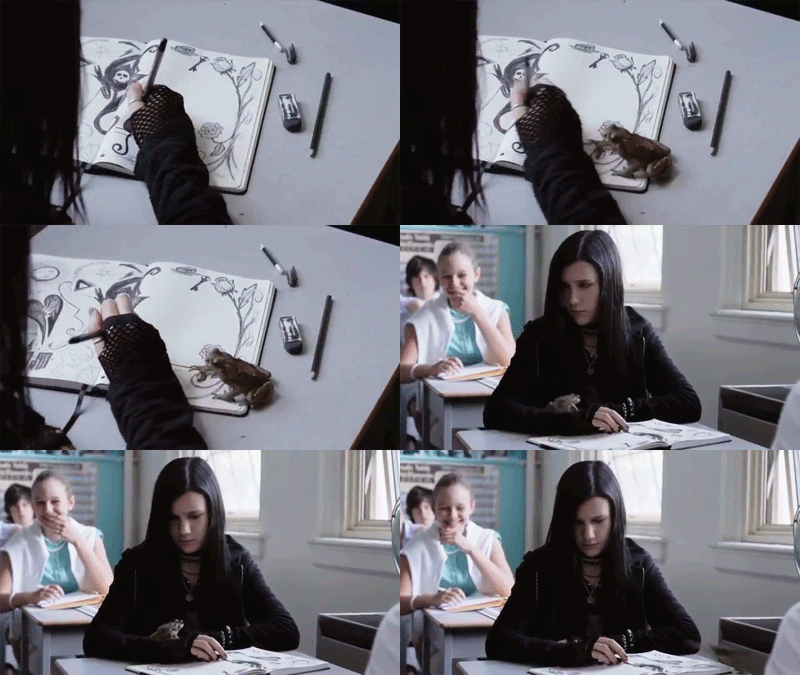



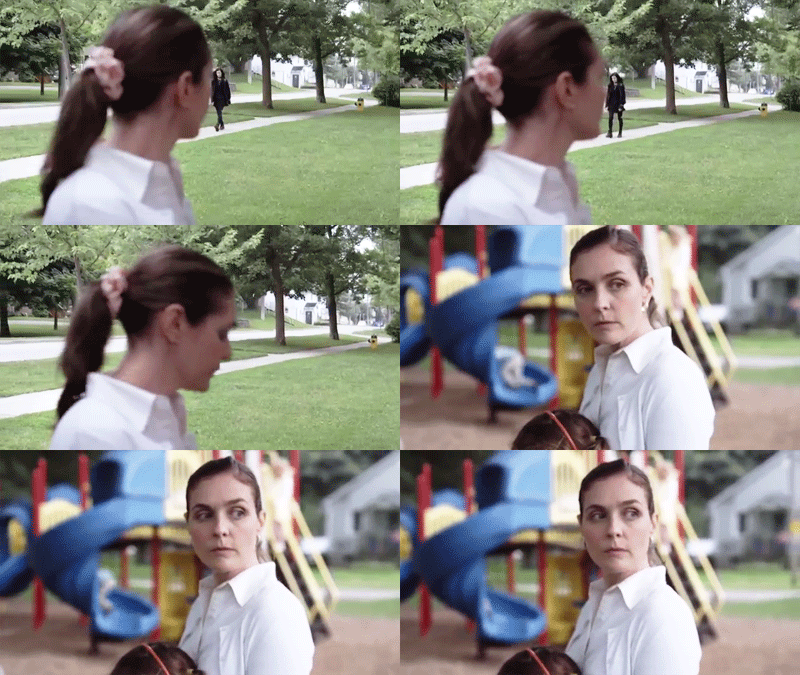



THIS IS THE BEST COMMERCIAL EVER
I’ve reblogged this so many times because I truly think every parent should involve themselves with what their child enjoys.
YIPPE YIPPE YEET
This is how I imagine zhinxy's childhood. So I've been led to believe. Except the hair was bigger. And it was more 90s. And she summoned zombies or something.


This is exactly what snapchat was created for
Just mail it to Mordor addressed to “Mr. [Whatever], 25 In the Lava Pit Blvd, Mordor, M.E.” With special instructions to just drop it in the Lava Pit if nobody’s home.


Rei!

Actually, by definition, her future is always starting now since if it didn’t proceed from the present it would by definition not be the future.

This is how many children that died in their Hunger Games, without even being mentioned throughout the three books. All these children were under 18. All these children had parents. All these parents’ hearts sank to their knees during their child’s reaping. All these parents saw their terrified child off at the train station. All these parents heard the sound that signified their child’s death. All these parents received their cold, dead child in a wooden box. All these parents’ lives ended there. All these parents could say or do nothing. All these parents were merely thanked that they gave up their child. Thanked.
And the media focuses on the love triangle.
All these children and all these parents aren’t real
Yeah, sure, I guess that’s true. None of these people were real.
But let’s focus on what this series, and this fact, say about our society.
In the series, the Capitol’s media focuses entirely on the ‘fun’ of the Games- the fashion, the plot twists, the favorites, the strategies, the romance. And the entire time, they completely overlook the fact that 1,678 children between the ages of 12 and 18 have died. Usually brutally murdered by other 12 to 18 year old children.
And how does our real-life media react to this story when news of a movie adaptation reaches them? They talk about the romance. This tragic story of a girl who must choose between her long-time best friend and her new love. Even if she chooses Peeta, they still must fight to the death. The star-crossed lovers of District 12. And many readers of the original novels saw the books through the same lens. You would tell them that you read/ were reading the books and their first reaction was, “Are you Team Gale or Team Peeta?”
Meanwhile, children are fighting to the death.
The fact that our media, and many every-day people reacted to the Hunger Games the same as the Capitol media scares me.
I don’t want this world to be anything like the Capitol. I don’t think any of us do.
And the fact that most of us (including myself) never really considered how many children had died in the games also scares me. But, hey, it didn’t happen now/ in the current story, so it doesn’t matter, right?
I’m not sure about that math though. I think it’s MORE.
Let’s talk about just the first 73 games, ok? Every year before Katniss and Peta.
24 Tributes (1 girl + 1 boy x 12 districts)= 1 Victor + 23 Dead Every year
23 x 73 = 1,697
EXCEPT, the 50th games (The games Haymitch competed in) had DOUBLE the number of tributes. An extra 24 kids died that year.
1,703.
Now, 22 kids died in Katniss and Peeta’s first game, because they both live.
1,725.
In 74 years, the brutal, violent murders of 1,725 children aired on TV in Panem, and in both the Capitol, and on the red carpet in our world, the first question people want to ask it “Team Peeta?” Damn.
i’m not even in this fandom, but damn, that’s scary
And here we have people who GET the hunger games.
#until this moment#i didn’t realize there were still people who haven’t figured out that our reactions to media are an important indicator of our values#it doesn’t matter that they aren’t real#our reaction on a story primarily about children killing each other#was to focus on the romance#it wasn’t a romance#it’s a story about a tyrannical governemt sentencing children to death as a means of intimidating the sectors into submission#and we reacted to the games exactly the same way the capitol did
you can be as meta as you can but you can never be this meta
this is why not the media’s focus on JUST the love triangle is important—because it goes beyond that. Maybelline released a “Hunger Games” themed make up campaign. Barbie dolls were made of Katniss. T shirts. Plastic jewelry.
This is the real lesson.The movie does a good job of using the capitol as a stand-in for the empty stupidity of some of our own current culture. That’s on purpose. The fact that someone decided to sell merchandising rights that completely subverted the message is just typical movie studio greed, and I’m sure nobody in the business of making these toys a reality cared one whit for the message of the film.
The following document was procured from the desk of Stanford psychiatrist Dr. Keith Humphreys by an undercover AddictionMyth operative posing as a patient seeking treatment for a substance use disorder.
Project ‘Emancipation Proclamation’
A Progress Report on Our Plan to Take Over the World
Dear Mr. Soros,
The following is a progress report as of November 2014 on our top secret plan to take over the world and enslave the masses. The conspiracy requires convincing people that addiction is a brain disease and then we will institute universal random drug testing with a zero tolerance policy and this will be followed by swift and certain sanctions of rapidly increasing penalties and require lifetime 12 Step attendance for anyone who has at any point tested positive for detectable levels of non-prescribed drugs or alcohol in their system. In these groups (such as Alcoholics Anonymous and Narcotics Anonymous) they will be abused and exploited for sex, money and labor, and then the ones who are noncompliant or no longer useful will be brainwashed into suicide. The remaining thugs and psychopaths will operate as a group at your whim. I am pleased to report we have already made great progress on all fronts.
Of course our plan requires that children be deprived of any kind of moral or religious education so that they are unable to distinguish between right and wrong and believe that all truths are relative. Great progress has already been made:
I congratulate you and your agents in Hollywood for your achievements in this area over the last 40 years without which our plan would be unworkable.
George Koob, Arthur Caplan, Robert DuPont, Angela Hawken and I have been working hard to legitimize science and public policy to realize your dream. Here is a summary of our progress:
George Koob – NIAAA
Dr Koob has been publishing beautifully illustrated science fiction speculation about how the disease of addiction might actually work in the brain to produce a reward feedback loop that makes the victim have anonymous sex and rob drug stores for Oxy without realizing that they are doing anything wrong (or even worse, realizing that they are doing wrong but being completely unable to stop themselves). This ‘zombification’ strategy has been incorporated into propaganda published by NIDA and SAMHSA to convince children that if they do drugs they will do things they regret even if they seem like fun at the time but will eventually turn into a disease before they know it and that they can always claim ‘blackout’ if they really don’t want to remember their shenanigans and that most kids who have the disease are in total denial about it as proven by his extensive research on drunken rats.
Arthur Caplan – NYU
Art has been working hard to provide a bioethical justification for enforced drug compliance by arguing that the addict is enslaved to their drug of choice and therefore we are setting them free with coercive treatment. Arthur notes that most drug users are too stupid to be able to decide for themselves whether they want treatment as proven by the fact that they took drugs or alcohol in the first place. Arthur notes that most drug users are even less intelligent than the average American voter. Arthur’s work inspired the title of our project: Emancipation Proclamation.
Robert DuPont – NIDA, ONDCP
Dr DuPont has a long career of institutionalizing drug testing and his extensive experience includes a financial stake in drug testing companies. He has already made great strides with state level physician oversight programs that have destroyed the careers of many physicians who were suspected or falsely accused of using drugs or alcohol by requiring them to submit to onerous conditions such as 5 year biweekly AA attendance and frequent random drug testing and referrals to expensive rehab programs run by the oversight committees themselves. He believes these programs can be expanded to all states and then into schools and finally to healthcare facilities. He recommends that everyone be required to undergo a randomly scheduled yearly check-up (free under Obamacare) at which time they will be tested for drugs using only testing kits approved by him personally to ensure greater compliance and reliability. Rob reminds us that this is the “American Way” to health and prosperity, and any follow-up testing required after a positive result will be offered at a ‘nominal charge’ to the patient and can be taken at numerous secure locations such as local police stations, county hospitals and correctional facilities where immediate treatment can be provided in the event of a confirming result.
Angela Hawken – Pepperdine
Angela has published well respected research showing that ‘swift and certain’ sanctions for drug use (e.g. short term jail stays) greatly reduces drug use in parolees. They are much less likely to use drugs when they know they can be tested at any time, and a positive test will result in an immediate punishment. This result comes as a surprise since behavioral modification is not considered effective treatment for most diseases, but evidently ‘drug addiction’ is an exception to that rule. Angela advocates for expanding these sanctions to other jurisdictions as well as testing their effectiveness on other diseases such as asthma and cancer. Angela recommends increasing sanctions on repeated violations such as higher fines and longer jail stays. She does not recommend amputation of body parts however I believe I am making progress with her on medically supervised sterile detachment as long as ‘best efforts’ are made to maintain the parts securely for reattachment upon successful completion of the prescribed treatment regimen.
Keith Humphreys – Stanford
I have been working hard to convince government agencies that effective public policy does not require scientific justification. This way we can promote the ‘clubhouse model’ of addiction treatment where anyone who has tested positive for any drugs or alcohol (or has been suspected by work or school administrators of using drugs) can be sent for enforced compliance with anti-craving medications like Vivitrol and can be introduced to 12 Step programs where they can find spiritual fulfillment through a higher power of their choice. They will be required to attend on a daily basis for the rest of their lives but will be allowed to meet with the fellowship outside the clubhouse after they have shown mastery of Big Book theology as demonstrated by the suicide of a sponsee, which will also serve as a reminder for everyone of the danger of ‘drug addiction’ and that ‘some must die so that others can live’ and provide the epidemiological justification for the program.
God 2.0
We are very excited by our achievements so far and look forward to continued progress. Very soon you will have armies of recovery-addicted zombies that you can control to enforce goodness and fairness around the world so you can ‘one-up’ the failed god who did nothing as you accompanied the Nazis while they looted, raped and killed countless people including members of your own family.
Your Trusted Servant,
Keith H
P.S. Absolutely no one suspects a thing. Just for fun I left out this information for one patient who is particularly nosy. But don’t worry he’s a paranoid schizophrenic with persistent florid psychosis usually involving intricate government conspiracy fantasies and delusions of grandeur. Plus he’s a confabulator and has treatment resistant scabies (which he consistently denies) so he is isolated from the other patients and everyone just ignores or ridicules everything he says!
Not allowing comments is not censorship or anti democracy. If I publish a book, I don’t need to publish a 2nd one with your complaints about me.
— Ami Angelwings (@ami_angelwings)November 1, 2014
A thing I wrote on Twitter is on tumblr now, apparently O:
On one of the world’s oldest maps, off the coast of Southeast Asia the phrase “here be dragons” is written in Latin. Asia—the Orient—the exotic other. Dragons signpost: “Beware, civilized person. Beyond this boundary, different rules apply.”
*
I was born and raised in Bangkok by a Thai mother and an American father. My parents met working at a tech company in the early ’80s. They are equally educated. My mother’s career took her from Thailand to Singapore, Ireland, Australia, back to Ireland. When she lived in Singapore, my mom was one of the few Thai women Singaporeans encountered who wasn’t cleaning their houses, which is to say that Thai women in Singapore are often maids. So sometimes my mother was treated as a maid. That was frustrating, maddening, but the fact that she put up with that, in her suit going to work each day, meant that maybe the next Thai woman a Singaporean met was less likely to be typed so easily.
My father’s career kept him in Thailand. He is an anomalous foreigner who stayed in the Kingdom, not rotating in and out on an expat package, or coming to the country to retire.
Growing up, I attended a British school. I met my American husband when we were undergraduates at Brown University; the two of us moved to Thailand, then Australia, working our way through my inherited need to travel. Now we live in the Bay Area where he works for a Kenyan company. Ours is a global family, but one that is constantly explaining our unions and countries of residence.
People in the US are usually surprised when I say that my Thai mother lives in Ireland. “How did that happen? That’s so strange.” Strange, and their little laugh that accompanies the statement, are code for their assumptions about the education and mobility of this foreign woman of color, who in this case is my mom. She most recently worked for Salesforce, a fast growing tech company headquartered in San Francisco. When she moved to Singapore it was to work for Intel, another large tech company. She is ambitious and accomplished. She defies the stereotypes.
My dad runs up against a different stereotype. That he, a white American man, lives in Thailand is not unusual. White American Men have more world-conquering powers according to a general, Western,  unexamined assumption of normalcy. But when my parents were first married, in 1984, they spent a night in Bangkok at the Oriental Hotel, considered to be the epitome of class and elegance. It must have cost my dad more than he could afford at the time to get a room there. He must have been so proud.
As my parents approached the elevator, they were stopped by hotel staff who informed my dad that women like my mom weren’t welcome in their establishment. A White man with a Thai woman could only mean one thing: he is rich and she is a prostitute. My dad corrected the hotel staff, and my parents rode the lift up to their room
My dad never related the Oriental Hotel story to me. My mom did, shaking with remembered humiliation. Growing up, it became part of my vocabulary of inherited family wrongs to be righted. I was not sure that I would be able to fix this. I am only half Thai, and my white half protects me from their condescension. It is only in the West that I am seen as the lascivious Thai woman stereotype. But when my now-husband and I got engaged, my dad insisted on one thing: that we get married at the Oriental Hotel.
*
I am writing here around the weight of a stereotype that trumps all others, and best explained in Chimamanda Ngozie Adichie’s TED talk, The Danger Of A Single Story. In that speech Chimamanda, who is Nigerian, tells us about her American college roommate’s shock that Mariah Carey, and not some “tribal music”, was Chimamanda’s CD of choice. She says that the single story of Africa is one of catastrophe. It reduces potentially complex understandings of people and place to one-dimensional pity. In her speech, Chimamanda says she’s looking for the possibility of equal human connection.
For anyone from the global fringe, the flattening expectation created by a cultural stereotype is pervasive and familiar. There is, of course, a single story of Thailand. It is what my parents confronted in the hotel, the stereotype of the foreign man seeking a Thai woman. People unfamiliar with the country won’t know that shorthand for a wife who is twenty years her foreign husband’s junior, who speaks broken English, who is from the countryside, who may have met her husband while working at a “bar”—that woman is called a “Thai wife.”
Bangkok bookstores are full of this reductive narrative. On my last trip home I stood in front of the bookshelf for “Thai literature”, a category that mostly consists of crime thrillers written by white men capitalizing on the little they know about the Thailand. The books are formulaic: white male meets Thai female in the exotic Kingdom, land of smiles. They fall in love. She is sweeter, kinder, and easier to please than any foreign woman he has been with. The myth of the exotic Asian female is upheld. Then he finds he’s been duped: his Thai wife, who is inevitably from a poor family in the country, turns out to be in it for his money. Interwoven with tales of drug users, gang members, Muay Thai fighters, and monks, and the story is a predictable series of plot twists with the white male hero struggling to navigate a country more frightening and less friendly than it initially appeared.
Here is an example: the blurb of the novel, My Thai Girl and I:
This is about how Andrew Hicks met Cat, a ‘Thai girl’ half his age and how they set up home together in her village out in the rice fields of North Eastern Thailand. He’ll tell you of toads in the toilet, of ants’ eggs for breakfast, how they took up frog farming and how he got married without really meaning to.
The single story of Thai wives is insulting to every Thai union, even if the woman is from a village where they do eat ants’ eggs. Exotifying hardship and cultural norm serves no one but the spectator. There is a crisis of education and upward mobility in Thailand, which begins to account for the prevalence of willing Thai women and our recent political turbulence. But in the same way that Africa is more than a continent ridden with catastrophe, even given the current Ebola outbreak, Thailand is more than a country where one kind of woman marries one kind of foreign man. As Chimamanda would point out, there is no possibility in that singular narrative for Thai women who are educated, financially self-sufficient, uninterested in foreign men, or not in need of rescue. It should go without saying that too many of the current stories are from the perspective of the white male foreigner.
Now, my lineage is different. My mother is educated and my parents met at work. I was careful to say that I met my husband when we were both in college. So even despite the story that my parents have, and the story that my husband and I have, “Thai wife” is an insult I’m anxious to skirt. It’s a stereotype that overwrites complexity. Despite my efforts though, I have been introduced as my husband’s “Thai wife.” Although I recoil at the phrase, I recognize that if I’m not willing to widen and reclaim the definition of a Thai wife, who will?
*
For the last few years, I’ve been writing fiction about Thailand. A big influence on my work has been Chimamanda Ngozie Adichie, whose truth-telling career and electrifying latest novel, Americanah, has been the lodestar by which I try to navigate. Chimamanda came into my  life as one of the writers who showed me how much I didn’t know about Nigeria, and made me realize how much more needs to be told about Thailand.
Americanah is notable for how it traces an immigrant arc from Lagos to the US and back. Ifemelu, the protagonist of Americanah, grows up in Lagos, and yearns to be educated in the US. She succeeds in coming to study here. The reader experiences the excruciating journey of integration with Ifemelu, struggling to find a job, to understand Americans and our habits. After some years, Ifemelu adapts to life in the US. She maintains a blog on racism in America that has some of the best modern commentary on the issue that I’ve read, even though the blog is embedded in the novel as something written by a fictional character. Ifemelu wins a fellowship at Princeton; she dates a Black American academic. Then she gets homesick. This is not the homesickness of one who has “failed”, whatever that means, to gain a foothold in their new society. Ifemelu decides to go back to Lagos. Unlike a typical immigration story where America is the destination, a pinnacle of achievement, Adichie gives us a global arc; her protagonist returns to a developing country. Americanah is exciting because it depicts the world I live in, a world that has moved past one-way immigrations. That world demands a literature that reaches beyond the single story.
*
As an undergraduate, I took a seminar on African women writers with the Ghanaian writer Ama Ata Aidoo. Each week Aidoo placed a blank map of Africa with national boundaries drawn in front of us. Pacing between our desks, Aidoo said that Africa is a continent, not a country, and we were to learn that fact. We had five minutes on the clock to map the countries and their capitals. To my embarrassment, I discovered places I’d never known existed: Burkina Faso, Togo, Djibouti. This made me sympathetic to people who confused Thailand and Taiwan, or asked if I speak Japanese.
One day after our obligatory test, Aidoo announced that she’d been on a panel of judges who granted an exciting new writer the Orange Prize. Who was that writer? Of course it was Chimamanda Adichie, who won the prize for her second novel, Half of a Yellow Sun. When I learnt about Biafra reading Half of a Yellow Sun, I started thinking about the untold stories of Thailand. I imagined writing in English about why Thailand was never colonized, about the effect of the US bases in the country during the Vietnam War, which was where the demand for sex tourism came from.
Before I took that class with Ama Ata Aidoo, I had a failure of curiosity about Africa. I was guilty of many of the assumptions that Binyavanga Wainana named in his satire, “How to Write About Africa,” which went viral. Wainana nailed the expectations of people like me when he wrote:
Always use the word ‘Africa’ or ‘Darkness’ or “safari’ in your title.
…
Never have a picture of a well-adjusted African on the cover of your book, or in it, unless that African has won the Nobel Prize. An AK-47, prominent ribs, naked breasts: use these.
…
Note that ‘People’ means Africans who are not black, while ‘The People’ means black Africans.
…
In your text, treat Africa as if it were one country. It is hot and dusty with rolling grasslands and huge herds of animals and tall, thin people who are starving.
…
Always end your book with Nelson Mandela saying something about rainbows or renaissances. Because you care.
The burden of stereotype is heavy. Once when I waited for my husband in a restaurant in San Francisco, a city of many Asians, a husband and wife starting talking to me. The husband perked up when he heard that I’m Thai. “I know some Thai,” he told me. “Just the naughty words.” It comes as a surprise, how lascivious a grown adult male can be to my face, even though I speak fluent English, even though this guy was in front of his wife, even though I was waiting for my husband. The single story of Thailand reaches far and deep. I was inspired to write a list like Wainana’s.
How to Endear Yourself to an Asian Woman Writer:
1. Tell her you love her eyes—they make her look smart.
2. Inquire at a shout about her English language skills. Congratulate her on her fluency.
3. Underestimate her age by ten to fifteen years. When you find that the petite girl you’ve been calling “sweetie” and “honey” is a woman older than you, older than you thought, has a partner, and you stand corrected, tell her she’ll be glad to look so young some day. Continue to call her “sweetie.”
4. Ask her where she’s from. Ask her where she’s from from.
5. When she says Japan/Vietnam/Laos, say you were once in Bali. Smile broadly. Congratulate yourself on your worldliness.
6. Announce that she writes real well for “someone her age,” despite having no inkling about the breadth and depth of where her life has taken her.
7. Put your hands on her shoulders, on her head. Touch her, stroke her like a pet, like a plaything, like she’s so cute, you just can’t resist; all women, but especially Asian women, are pliant.
8. When she tells you to stop, ask why she has to be angry. Tell your friends about the angry Asian chick. Warn them to stay away.
9. Commend her on her writing, then ask why she’s featuring another Burmese/South Korean/Filipina character. If she asks why you’re writing about another American one, see number 8, angry. Don’t forget to notify your friends.
10. Most of all, if you’re the type to be attracted to women, when she tells you she’s from Thailand, give her a smile that lets her know you like Thai women, you get the code, you’re on the inside, and you want some too.
*
My encounter with the work of Chimamanda and other incredible global writers tells me that there is a rising generation of people who call many continents home. I don’t mean only immigrants, transplanted, yearning for somewhere as they fit themselves to the rhythm of their new country. What is it to be both, to exist in multiple cultural-linguistic dimensions, with traits from one culture that glare in relief in the other?
I’ve worked in Thailand as an adult and struggled because I have dared to disagree with men and with older people in meetings. At the same time, now that I live in the US, I find it bold and boggling when Americans state what they need with ease; I’m not used to individuals asserting “I want” with such authority.  As a writer, I can fall between the cracks. I have been told by Americans and Thais that I don’t have the authority to write about either place.
But these are examples of a dated paradigm. My parents are cheerleaders of my global identity; they know that authenticity can encompass many-pronged belonging. I take heart that people like Chimamanda Adichie write about the fluid movement between Nigeria and the US. The writers who inspire me have been global: Nadine Gordimer (South African), Rohinton Mistry (Indian, Canadian), Leo Tolstoy (Russian), and Michael Ondaatje (Canadian, Sri Lankan). There are writers who’ve just published their first collections like Krys Lee (Korean, American) and Chinelo Okparanta (Nigerian), whose quiet, charged sentences speak to me about the way Thai culture seems muted on the surface but is fierce and elaborate underneath. I learn from them too.
I hope that what I do as a global writer will help to dispel stereotypes of Thailand the way that Chimamanda’s work has been a vehicle for demystifying Nigeria and upending the norm of one-way immigration stories. That every time I say, “Yes, I really lived in Bangkok until I was eighteen,” and “Yes, my English is fluent,” that I will be helping to expand the possibility that Thai wives and Thai women can be capable, self-sufficient, and complex humans. That by living my own multi-faceted, global life, I am complicating the idea of a single story. In this way, the globe is mapped, the regions lit, until there are no othered peoples, no dragons lurking at the edge of the unknown world.
***
Rumpus original art by Max Winter.

When I started the Ladies High Tea and Pornography Society, my girlfriend A and I always joked that the unofficial rule was that while hats and gloves were required, everything else was optional. While we said it often enough, the truth was that Ladies High Tea was a pretty casual get together, and rarely did it become even slightly sexual, even with a slight tendency towards vintage fashion.
I’ve always had an erotic draw towards formalwear, however. One of the hottest fictional characters in the world to me is Jeeves, because a competent man in a suit is basically my pornography. I mean, part of it is that I’m reasonably high femme, and seeing a partner dress up for me tickles my senses in some indescribable ways. The layers upon layers, carefully applied, and the orderly way they all come together is just sensual, as I imagine the time it took to meticulously structure the outfit. And the accessories, especially for mens wear! Suspenders, waistcoat, pocket square, cufflinks- so many little ways to show off a sense of style and uniqueness, and men don’t get many opportunities to get creative with their clothing. It just gets me so fucking wet when they do. I love that P and N are both super into letting me dress them in short shorts and glitter, or bow ties and shiny shoes.
I love to be dressed up too, of course. The stockings, the heels, the carefully chosen jewelry, the dress I need a lover to zip onto my body… it’s a ritual, and one where the dressing is as hot as the undressing. As I swoop my eyeliner over my lids, as I apply my lipstick and twirl mascara over my lashes, I shiver to think about that makeup running down my face later from sweat, spit, and happy tears. I dress this way as a challenge, and perhaps as a promise. I may not be fit for public consumption, but I can play the part.
I was reminded of how sexy formalwear is recently, when I went to a wedding with N. It wasn’t a typical wedding, mainly as it involved friends of mine and therefore was highly likely to be populated by perverts and nerds. Also, because the bride had asked to see my date naked, preferably having sex, presumably with me, during the reception. She’s an artist and had enjoyed his body from afar before, and I was a little surprised but happy to oblige, if he was down. So I slipped on a nice dress, making sure to wear black lingerie that was ready to be cut off, just in case… and I made sure to tell him how much I was looking forward to the ripping of fishnets and lace under his hands.
Well, N and I got dressed way before we needed to, as I misread the invite and had us fancied up hours ahead of time. It didn’t take much suggestion for us to start to make out, you know, to take up some time. We got to that point of hot and bothered where we definitely wanted to fuck, but… it took us an hour to get ready, and every minute spent putting ourselves back together would be another minute not having teh sexx.
So we kept all our clothes on. No rolled down tights, but right through a hole already ripped through the crotch of the fishnets (carefully, because we didn’t want to destroy these until it was the right time). No pulling down of pants, either, but pulling his cock out from the fly. He kept his jacket on. I kept my jewelry on. It was all very elegant, if not necessarily in line with our usual “wholesomeness” kink (which is a whole ‘nother blog entry).
At first, it was delicate, trying not to catch cufflinks on lace. Soon, I didn’t care if I squirted all over my tulle skirt, I just wanted him inside me as quickly and roughly as possible. N, being quite a giver, obliged me with one hell of a fucking. I remember thinking to myself “I wonder if his tux is going to be smeared with my come, will it need dry cleaning” for a split second before deciding that I hoped it was, and also, fuck it. I have scratched on my upper arm from where he braced himself, his cuff link digging into my flesh. Even better, with his flatmate entertaining in the other room, we had to be incredibly quiet, whispering sweet and filthy dirty talk, whimpering in pleasure, biting knuckles as we came.
While I wrapped my mouth around his post-orgasmic cock, savoring the taste, N grinned down at me and told me that this tux may not have been washed since the last time he wore it. Apparently it gets most of its use at sex parties. This is probably part of why we’re dating… I have a thing for the sort of man who wears a cummerbund and nail polish to an orgy, what can I say. And we went to that wedding, smelling of sex instead of perfume, my hair “styled” by our vigorous pounding and a touch of hairspray. It was only right, I think. Later he ripped my bra, panties, and tights off my body as we rolled around on the soft fur of the Liberator faux fur throe. Pure, extravagant luxury, grabbing handfuls of silky fur as your lover grabs handfuls of you. Mmm.
Now I’m kind of aching for another reason to see N in a tux, to be honest. Dry cleaned or not. What can I say, I like the gutter, it’s nice there.
“Solidarity is created by shared discomforts, which is caused in part by the civic-minded desire to be pleasing in the eyes of one’s fellow citizens,” says Lord Whimsy in one of my favourite essays, “The Perils of Sportswear“. “Comfort isolates us from one another, and should be seen in the clear light of day for what it is: a killer of nations.” I don’t know if I’d go that far, but I certainly feel that dressing up for one another indicates a bit of care for what others think, and I find that hot.
I want my lovers to show off for me, as I show off for them.
Wearing a full tuxedo, or an evening gown, suggests a sacrifice for fashion… a masochism I can get behind.