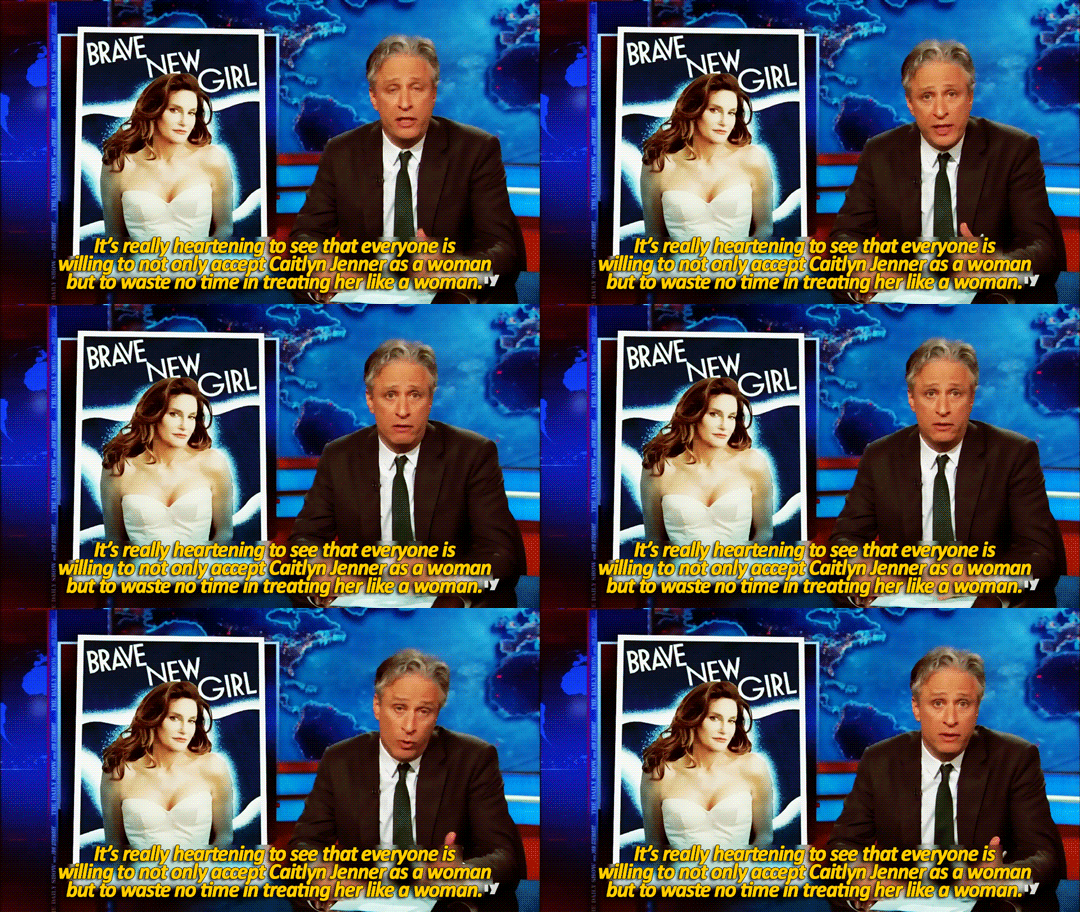
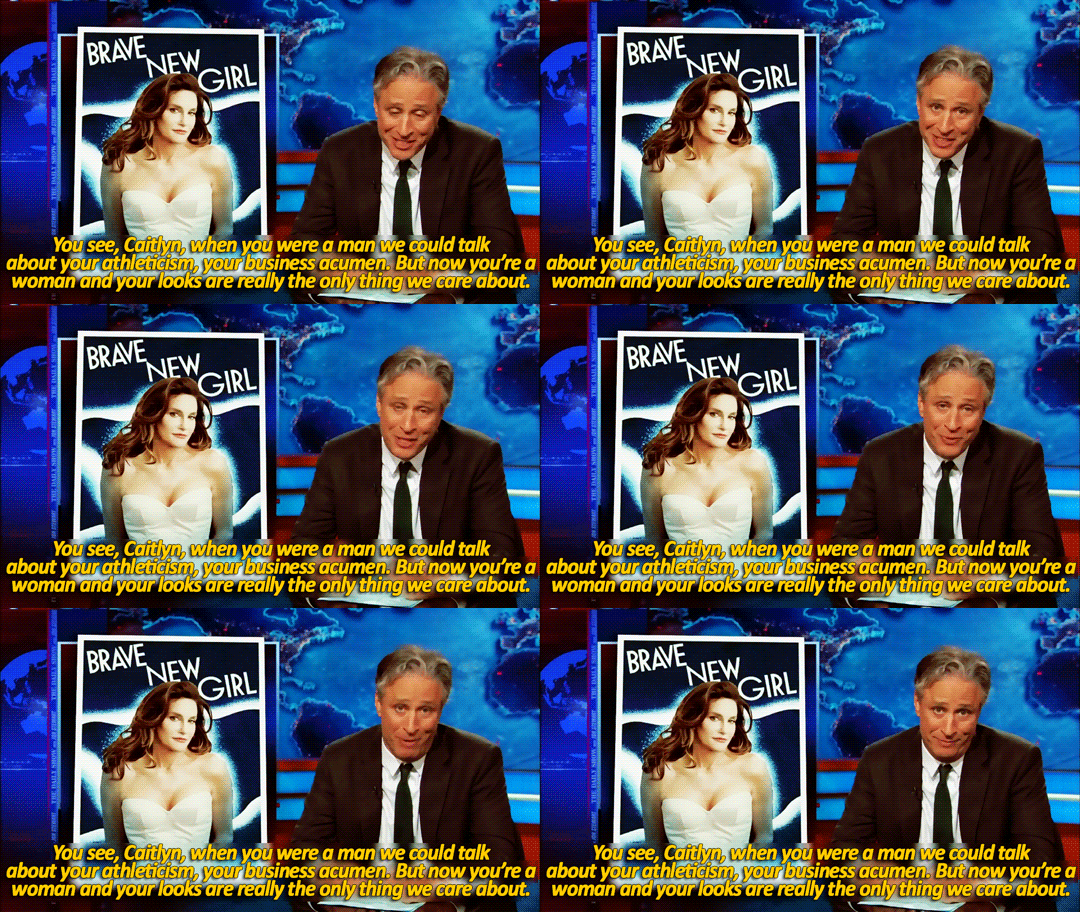
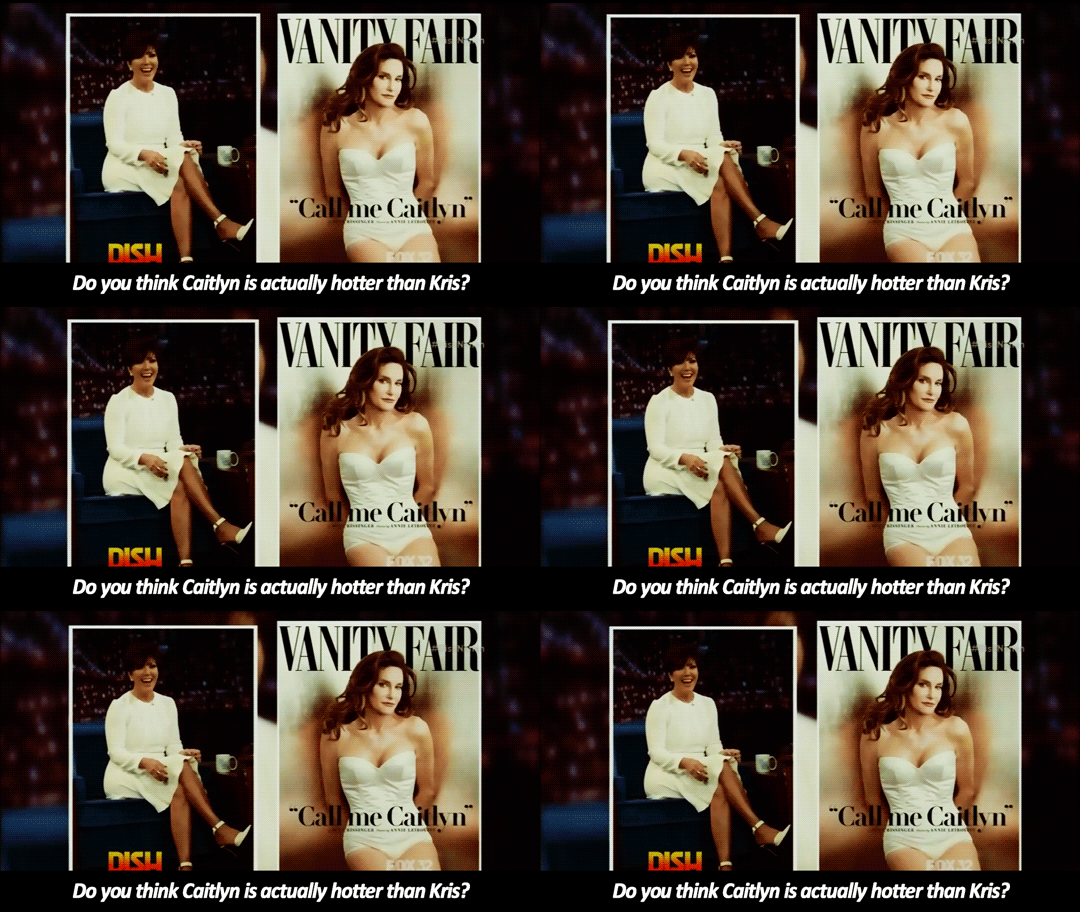
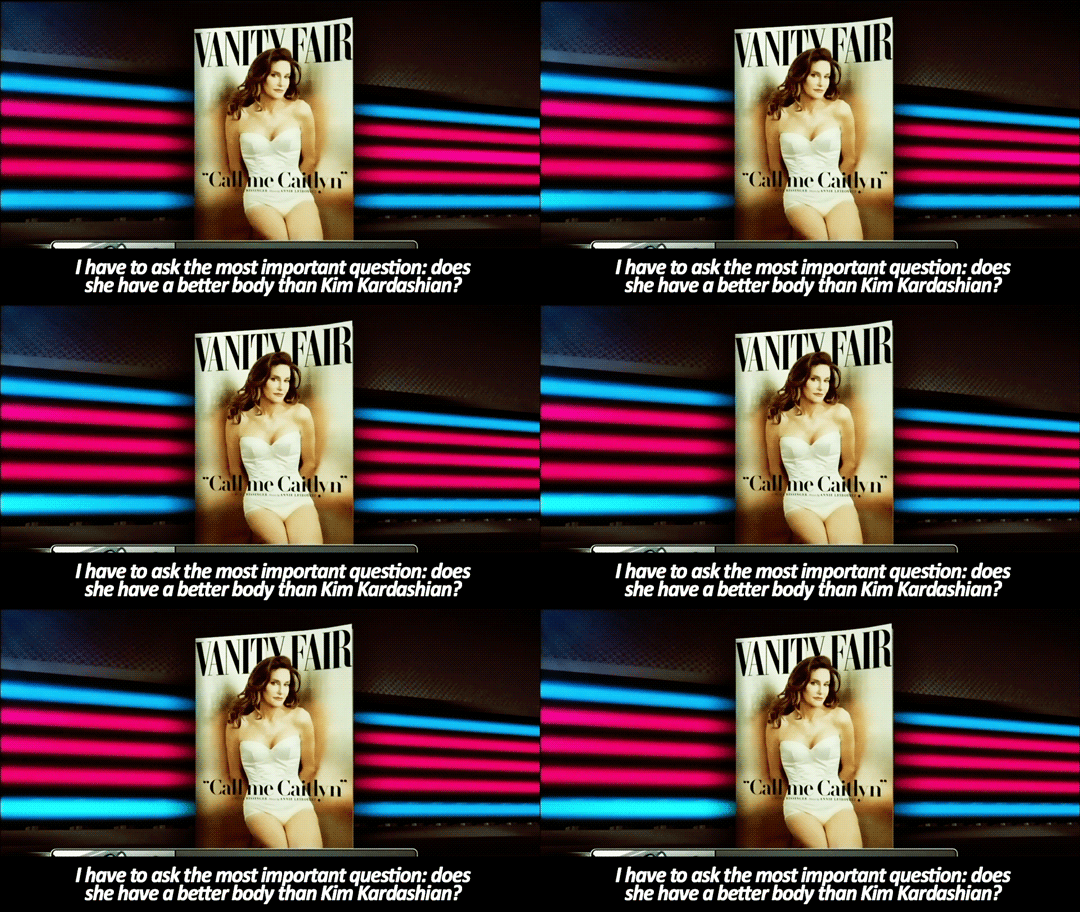
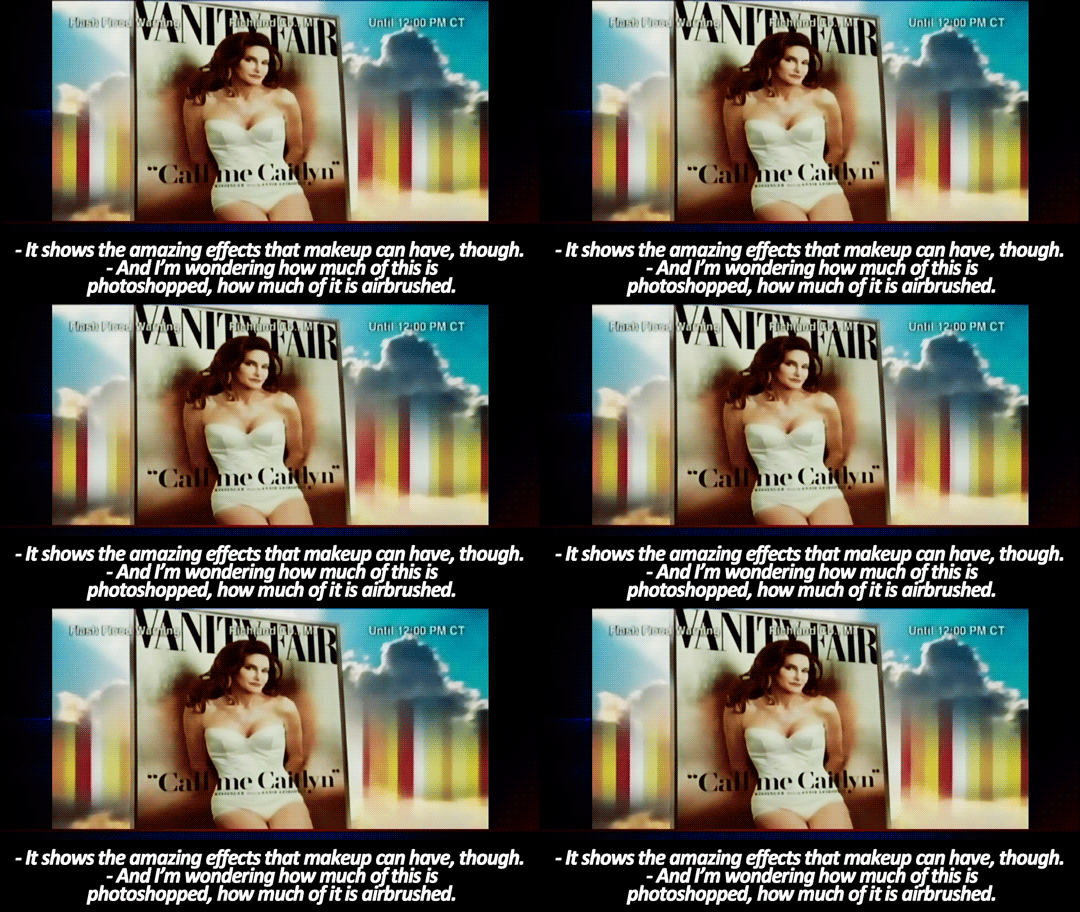
Trans people should be celebrated, no matter how they look, and especially if they don’t fit a stereotypical standard of beauty. This sentiment inspired Tumblr user Crystal (rambleonamazon) to create a template for trans individuals everywhere to create their own Caitlyn Jenner-esque Vanity Fair covers. Using the hashtag #MyVanityFairCover, they could “show the world the myriad faces of the trans community.” And plenty of people took on the challenge.
“It is outrageous that our democratically elected governments will not tell us the laws they are making. What has our democracy come to when the community must rely on WikiLeaks to find out what our governments are doing on our behalf?”
MoMA employees protesting outside the museum on Tuesday (photo by the author for Hyperallergic)
A demonstration on Tuesday by workers at the Museum of Modern Art (MoMA) did little to advance negotiations between a union representing over 200 employees at the institution and museum administrators, who are maintaining their call for a cut to employee healthcare coverage. MoMA and Local 2110 of the United Auto Workers have until June 20 to negotiate a new contract for the union members employed by the museum. The workers’ five-year contract expired on May 20, but the museum and union agreed to extend it one month in order to resolve the dispute over the proposed healthcare cuts.
Danny Fermon, a longtime MoMA employee and member of Local 2110’s negotiating committee, told Hyperallergic today that no progress was made at Wednesday’s meeting with the museum, in spite of the previous night’s protest — timed to coincide with MoMA’s Party in the Garden, one of its biggest annual fundraising galas. He expects there will need to be more demonstrations like Tuesday’s before the museum hears its workers’ plea. A spokesperson for MoMA, meanwhile, declined to comment on the outcome of Wednesday’s negotiations, but reiterated “that the Museum remains committed to providing fair and equitable compensation and healthcare for its employees, and that we are working toward a positive outcome for all concerned.”
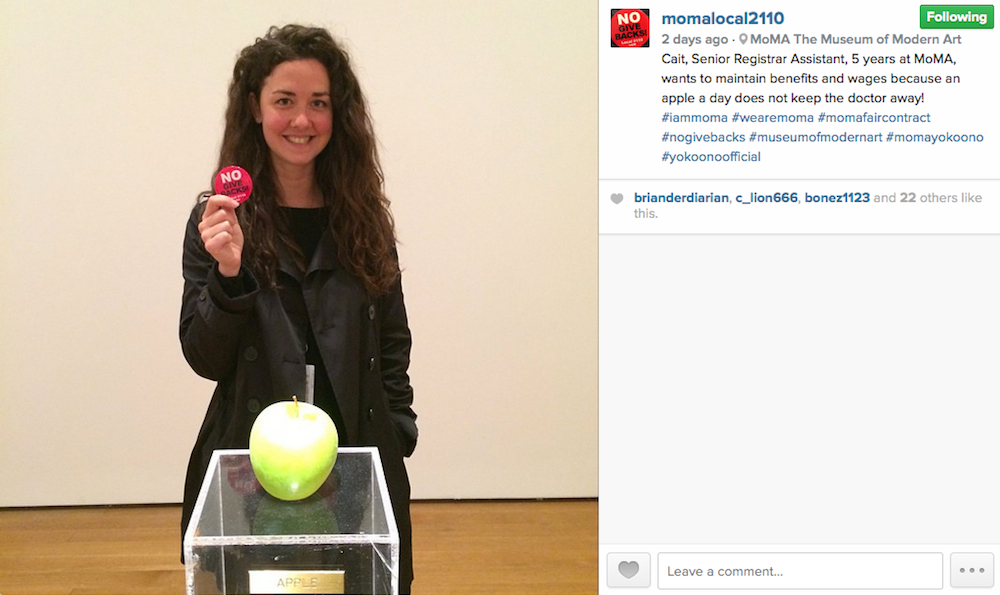
As both sides dig in for more negotiation sessions over the next two weeks, MoMA’s Local 2110 members are making ingenious use of social media to call attention to their plight far beyond 53rd Street. Through the Instagram account @MoMALocal2110, the employees are offering brief profiles of the union members, each accompanied by a portrait and occasionally a pun or joke incorporating an artwork on view at the museum. The account, run jointly by a group of MoMA workers, helps to put faces, names, and stories to the often murky business of organized labor and contract negotiation.
Periodically Hyperallergic delves into the video archives of the internet to present a daylong series we’ve named after the 1983 classic Canadian sci-fi film by David Cronenberg, Videodrome.
Sit back, relax, and let us plumb the depths for the fascinating, colorful, weird, insightful, and beautiful. Long live the new flesh!
Another great thing about bestiaries is they’ve produced some of the least seductive merpeople in western art history. Just merpeople doing normal merpeople things.
[Warning: this post contains nominal breasts. Breast-like objects? They don’t really resemble human anatomy, but they are there.]
Merpeople sensibly dressed:
Merpeople out for leisurely swims, waving at neighbours:
Choosing between two options at the store:
[The expressions here are amazing. Those aren’t worried men in a boat, those are guys going “seriously, again?”]
At band practice:
Bowling:
Getting ripped:
And doing standard 9-5 mermaid work:
Look at those expressions of soul-crushing boredom. No one involved is enjoying this.
In 1895, brothers Auguste Marie Louis Nicolas and Louis Jean Lumière patented their cinematograph — a hand-cranked motion-picture camera inside a wooden box that weighed 16 pounds — and shot their first film on it, of workers leaving the Lumière factory. A century later, Philippe Poulet of the Museum of Cinema in Lyon restored the Lumières’ original cinematograph and gave it, in turn, to 41 directors, each of whom was invited to shoot a short film on it. The conditions: no longer than 52 seconds, no synchronized sound, and no more than three takes.
The resulting films — collected under the title Lumière and Company — are short, poetic riffs on the nature of narrative, often fleeting meditations on the age-old cinematic question of reality versus fiction (Roger Ebert called them “haiku.”) One of them, by French director Alain Corneau, does this particularly gracefully: it is a single, silent take of a female gypsy dancer. As she twirls and turns her wrists and flutters her arms with expert precision, her dress and veil and pants change color, shifting from subtle turquoise to bright yellow and magenta. The color was all done by hand, with Corneau (or an assistant) hand-tinting the film, and it changes at just the right moments, electrifying the dancer when she pauses for just a fraction of a second. This is live, Corneau seems to say, it’s documentary and it’s real — but it’s also mine, and you’ll never know what kinds of artificial details I’ve added.
For a less subtle but equally entertaining take on the same issue, watch David Lynch’s amazingly creepy contribution to the project.
Today I have been single for longer than I was together with MFP. We were together 1 year, 1 month, 11 days. It’s now been 1 year, 1 month, 12 days since I broke up with her (though it was much earlier than that things were falling apart, sadly.)
I’m lonely.
I’m horny.
I’m stressed out and frustrated and homeless, and the last few times that I’ve had a glimmer of hope that things might go somewhere with a girl, it’s ended horribly.
One chick who was crushing madly on me and when we sat down to have a talk about “where do we wanna go with ‘us” from here” she realized that me just being me was going to bring up childhood trauma for her, and she cut things off. Another woman who brought me back to her place and then stopped returning my messages after the sex was mediocre at best, didn’t even have the decency to say “hey, this isn’t going to work.” Another woman recently was totally into me, making a point of how much she wanted to hang out and get closer… and then told me to fuck off and get a sense of humor because I had the gall to say, “actually, that ‘joke’ is kinda mean and it hurts my feelings.” And just before I met her, there was the amazing lady who spent a good chunk of a night out at the club smooshing my face against her tits and both of us enjoying her having me as a service submissive… and then a few days later I got a threatening message from her boyfriend telling me to stop “harassing” her, or else. Still no fucking clue what happened with that situation.
And so when there’s the possibility of a connection, I don’t even really want to put myself out there, because it’s hard to feel like it’ll be any different from all the other times before. I need my heart held, my body connected with another, mutually pleasurable sex and pain and whatever… but I’m scared that I’ll have my heart torn and dropped, my body remembering the touch of someone long gone, lousy sex (if any sex) and the only pain coming from “goodbye.” And there’s a fine, fine line between that and “you’re wonderful” — I just keep finding myself on the wrong side of that line.
Finding good mental health help is already really challenging when you’re in the best possible social position to access it. Poverty, disability, racial and cultural factors, physical access, regional access, gender and sexual prejudice, stigma, language… these are just a few of the roadblocks in the way of accessing effective mental health services.
There are a number of reasons why we should not shame people who do not engage with mental health professionals, the least of which is that a significant portion of people with mental illness are simply unable to access those services.
A core tenant of activism is the idea of autonomy and self determination - this means we must work to remove these barriers to treatment so that those who want to engage with a mental health support system are able to do so. While we should respect those who chose not to access those services, it is most important that everyone get that choice.
Focusing on the actual labor conditions of the nations we are encouraging companies to move American jobs to in this agreement certainly can’t hurt. I rarely agree with Bob Menendez about much of anything concerning American foreign policy, but his recent conversion to including minimal labor standards like not engaging in human trafficking is welcome. The recent discovery of mass graves at human trafficking camps on the Malaysia-Thailand border has convinced him that Malaysia should be dropped from the TPP. Given that it is one of the most important nations in it, evicting Malaysia would be a very big deal and would set precedents for nations to uphold labor standards in trade deals that could be expanded to include more stringent policies on goods that will then be sold in the United States.
It’s a hard fight, but we have to try anything to kill the TPP.
The Obama administration expanded the NSA's ability to collect Americans' internet data in 2012, with absolutely no notice to the public, The New York Times reports. The Justice Department issued two memos, in secret, to the NSA allowing the agency t...
Years ago when I worked at a house of domination in NYC’s Chelsea district, there were a handful of clients who were memorable for breaking up the run-of-the-mill fetish (foot worship, spanking, bondage, role playing, repeat) monotony. One was a dude I never saw, but only heard about whenever one of the few Mistresses capable of handling his fantasy would dip out of the emotionally exhausting session to vent in the dressing room. As far as I know he was our only client who spent his high-priced hour rhapsodizing about killing and eating his relatives.
While this man was certainly unusual, even within the grand unusual scheme of S&M, no one at our dungeon thought to report him to any authorities. No one believed for a minute that he was seriously capable of feasting on his wife. Not even when he brought in a live duck in a cage, requesting to slaughter it during an upcoming session. (Fortunately, an animal-loving dominatrix rescued the poor bird, and later spun a ridiculous tale about how it had somehow escaped when no one was looking.) If anything, the cannibal client was a source of exasperation and amusement, not a perceived threat to society.
I thought of this client while watching the recent HBO documentary Thought Crimes, filmmaker Erin Lee Carr’s portrait of Gil Valle, a NYC police officer better known as “The Cannibal Cop” after Valle’s online life became the subject of a criminal conspiracy investigation. The unassuming Valle, it seems, spent his downtime chatting with like-minded cannibal fantasists on the Dark Fetish Network about abducting, torturing, and cooking his wife and female friends. When his wife ultimately uncovered the horrifying details via the spyware she’d installed on her husband’s computer, she promptly went to the NYPD, terrified for her life. This, in turn, set into motion an arrest and a tabloid free-for-all—and led to more questions than answers. Though Valle never laid a finger (let alone a utensil) on anyone, he faced a life sentence for what he swore was strictly anonymous musings. Yet like with kiddie porn—in which downloading can often get a pedophile more jail time than can actually molesting a child—the Internet has proven fertile ground for both freedom of thought and judicial prosecution.
But also like with child porn—in which real kids in staged photos have been harmed—Valle despicably crossed a line. While I truly believe that Dark Fetish Network served as a “safe” space akin to a BDSM dungeon for Valle—and that the majority of folks who visit fetish sites and houses of domination have no intention of ever acting on their most extreme fantasies in real life—he did do the equivalent of bringing in a duck: involving an actual sentient being in a nonconsensual context. Valle is guilty of unconscionable stupidity—not conspiracy—for researching one of his fantasy victims via the police database. In doing so he infringed on the privacy of a real human being.
In the end, illegal use of a police database is rightly the only charge that stuck in “The Cannibal Cop” case—after a long and arduous, Kafkaesque journey through the legal system for Valle, that even included a judge’s unusual overturning of a jury sentence. Watching Thought Crimes, I couldn’t help but think that if that original jury had been made up of a dozen dominatrices, thousands of taxpayer dollars could have been saved, just like that one lucky duck.
Here's the logo for Senator Ted Cruz's campaign for the Republican nomination for President:
Let's focus in a little on that flame:
It could be sharper, but, you know, for the sake of argument. Now, in that form, the Rude Pundit glanced at it and thought, "Huh. That looks familiar. Like the symbol for natural gas." It was time for a few precious seconds on the Google machine.
Here's one of the flame symbols for natural gas:
And for the sake of comparison, here's Cruz's flame with the color taken down a great deal (and, no, the Rude Pundit is no Photoshop expert):
Huh. That's...interesting
Of course, it could be a coincidence. You know, there are many three-curve symbols for fire. But most are certainly different enough not to be confused.
Perhaps the truth here is that Cruz wants you to associate him with natural gas, a kind of pro-fossil fuel statement. Or maybe it's all unintentional and we should just laugh at gasbag Cruz and this ironic karmic comeuppance.
But it is definitely just on the other side of "curious."
Was I being too negative the other day when I said that the TSA failed security tests 95.7% of the time? I should acknowledge that this was a 4.3% success rate. In other words, over four percent of the time, TSA security works every time.
Even though this was a dramatic improvement over past results, DHS secretary Jeh Johnson said Monday that effective immediately, acting TSA administrator Melvin Carraway was being "reassigned." Some speculate that this had something to do with the agency's spectacular failure to do anything useful more than 4.3% of the time, but the announcement didn't say that. The critics are overlooking the fact that Johnson did not make this decision right after the TSA failed the tests, which were conducted more than a week ago. He made it right after the media reported that the TSA failed the tests. So the timing is probably just coincidence.
Johnson took the position that because the test results are "preliminary" (they're not) and "classified" (though everybody knows them), "it is not appropriate or prudent to publicly describe these results." Okay then. He did, though, also announce a series of actions that appear to be designed to reassure Americans that although airport security has not improved 14 years and $70 billion since 9/11, that is all about to change. Here's what he announced (as paraphrased by me):
TSA will develop procedures to deal with the tactics that just worked (and so won't be used again).
TSA will also train its employees to use the procedures it develops to deal with the tactics that just worked (and so won't be used again).
TSA will make sure all airport security directors know the results of the tests they just failed, in case they don't read any news at all.
TSA will "re-test and re-evaluate" its screening equipment. Again.
Johnson will personally meet with the guys who run the screening-equipment companies to make sure they know that equipment is supposed to work. Granted, they are pretty much all former DHS or TSA officials, but one more meeting should get the point across.
The people who did the random covert testing will keep doing that. (The official ones, not the ones who do it unofficially every day.)
There will be a committee, and it will report to him every other week.
TSA will ensure that screening equipment is "up to the highest possible standards." This is the same as number four, except DHS & TSA will also "examine adopting new technologies" to deal with the tactics that just worked (and so won't be used again). As with the old technologies, these won't help, but they will make those former DHS & TSA officials who now make screening equipment very wealthy.
Here's the thing: this is all a wild overreaction because the bad guys are not nearly as smart as our testers are. At least, that's what the TSA has claimed in the past after similar failures. In fact, the testers are like ... well, they're like super-terrorists:
In a 2013 hearing on Capitol Hill, then-TSA administrator John Pistole described the Red Team as “super terrorists," who know precisely which weaknesses to exploit.
“[Testers] know exactly what our protocols are. They can create and devise and conceal items that … not even the best terrorists would be able to do,” Pistole told lawmakers at a House hearing.
He said this less than a month after a test in which the only fake super-terrorist the TSA was able to catch was a man carrying a doll with "quite obvious" wires sticking out of it. I guess I'd agree with him that the best terrorists would not come up with something like that. I'm just not reassured by it.
Child-tormenting psychopath Stinson Hunter keeps getting away with it.
Months have passed since the estimable Bernie Najarian posted evidence on BoyChat, extensively referenced, of Hunter’s sadistic online “griefing” of kids. But instead of being exposed in the media for the nauseating bully he is, Hunter continues to be feted as a star vigilante who takes down “paedophiles” through online stings leading to successful prosecutions for dubious “crimes”.
In the most recent case, a man with no previous convictions currently awaits sentence for the heinous offence of trying to date “a 14-year-old boy” (actually Hunter) who had been using Grindr. As described in a Daily Mail report of the case, Grindr is a “mobile dating application”. The emphasis is mine, and it is surely worth emphasising that no teenager using this popular app would be unaware of its purpose, which is described upfront on its website as being to find “local gay, bi and curious guys for dating or friends for free”. In other words it would be used by gay boys actively looking for gay people to meet. They would hardly be surprised to encounter adult guys online: this would very likely be an exciting prospect, exactly what they were hoping for.
Hunter’s method is for his vigilante gang to pose online as an underage boy or girl. Once anyone takes the bait, sending explicit messages or images to the minor, the gang lure their mark to a meeting. Their victim is then filmed with handheld cameras and mobile phones and told to explain himself. The messages and footage are handed to police, resulting in some ten convictions so far, following filmed confrontations with dozens of men.
These activities have not gone entirely without criticism, notably after 45-year-old Michael Parkes, filmed by Hunter, hanged himself last year after being questioned by police on suspicion of arranging to meet someone he thought was a 12-year-old girl for sex. This came after Parkes was confronted by Hunter, and footage of the encounter was uploaded to the internet.
Hunter was taxed on ITV’s The James O’Brien Show with causing this suicide. Said host O’Brien:
“A man is dead because of what you did.”
“No,” Hunter shot back, “a man is dead because of what he did.”
It won him a big round of applause from the studio audience.
His quick-fire self-assurance, buoyed by the knowledge that empathy is not exactly a fashionable buzz word when applied to sex offenders (it is urged upon them but not for them), is just one aspect of his striking talents.
These extend to a flair for self-promotion, revealed in two astute decisions. Firstly, he rebranded himself from mild-sounding Keiren Parsons to predatory Stinson Hunter; and then he self-financed what became a roaringly successful vigilante documentary, The Paedophile Hunter, screened on Channel 4 in 2014. It won the 33-year-old Hunter, and director Dan Reed, the Best Single Documentary category at the Royal Television Programme Awards. Hunter now has well over half a million Facebook followers and earlier this year scooped two BAFTAs.
Not bad for a heavily-tattooed former heroin addict with face furniture (a lip ring) who, if his Wikipedia entry is correct, was expelled from three different schools as a kid and ended up burning one of them down; and who, after being jailed for this arson offence, managed to make a mess of a fellow inmate’s face with a plastic knife he had sharpened.
Arguably there is much to admire in the fact that Hunter has managed to “turn his life around”, as the cliché has it, from such an unpromising start. His fans surely think so, at least: where heretics here might see a vicious destroyer of other people, they presumably see an unlikely sort of modern knight, courageously riding to the rescue of kids in danger.
If so, they are right about one thing. It takes balls to confront those who are bound to be angered by the accusations he makes. A couple of years ago Hunter suffered broken bones and was in hospital for a week when one of those he was confronting ran into him with his car. I say this not to sympathise (though I am so shit-soft I find it hard to wish harm on anyone at all) but, rather, to note that the old adage linking bullying to cowardice is just not true. True psychopaths, as I believe Hunter to be, are often as reckless over their own welfare as they are callous towards others.
It is one of several aspects of his behaviour which, when taken together, indicate that far from being admirably brave in the selfless defence of others he is instead a dangerous psycho: far from keeping kids from danger he has shown a taste and a talent – yet another talent of this perversely gifted man – for wilfully and skilfully (using demonically manipulative verbal tactics) causing them emotional distress for his own pleasure.
As noted above, Bernie Najarian has set out the evidence. He tells us that Hunter, last year, “actively pursued a hobby called ‘griefing,’ a kind of publicized internet pranking, where his favorite activity was to invade the digital fantasy worlds of young boys in the online game Minecraft, and set fire to their digital buildings.” After reading Najarian’s account I watched one of the videos to which he linked, which was just as he described, and just as appalling, and I saw plenty of other online evidence to indicate Hunter’s active involvement. It could all be faked but I doubt it. You can do what I did and make your own judgement.
This all began with a video by an acknowledged associate of Hunter, Michael Donald of Dunfermline, Scotland. Donald is a dedicated internet trickster who styles himself KillerKarrit, with a YouTube channel sporting a carrot logo, and Michael the Dug. Why does he do it? In the words of his own candid admission “because I’m a cunt”.
Friendly users of games such as Minecraft invite other members of the player community into their worlds to game with them. They are hosts. It’s like inviting someone into your home: you don’t expect your guests to trash the place after you have painstakingly built it, a task that may have taken a lot of time and thought. Thus the arrival of a gang of virtual thugs bent on destruction is bound to come as a grievous shock, packing an emotional wallop not that different to a street mugging where you get smacked around and robbed of your smart-phone.
But it seems there are no specific laws against the aptly-named “griefing”, so lots of “cunts” have taken to this appalling new hobby like ducks to water. Like other forms of trolling it is just out there, quite openly, an ugly but inevitable aspect of free online expression. The openness, indeed, is part of the “fun”: griefing involves recording the gleeful destruction and the victim’s shocked reactions, then posting the resulting videos online so lots of other “cunts” can have a good laugh and admire the thugs’ style.
So Stinson Hunter, the real life arsonist, has recently been getting his kicks by burning down kids’ virtual buildings online. There’s a striking behavioural echo there, for sure. It’s not the flames that matter though but the pain. As Najarian put it:
“A supposed protector of online children spends his spare time causing pain and suffering to online children by trashing their video game constructions. It’s sickening.”
There has been a development, though. Whereas last year Cunt Carrot and Stinson Cunter were posting evidence of their dastardly deeds with much the same misplaced pride as the Islamist terrorists flaunt their beheading videos, it now seems belatedly to have dawned on Hunter that trashing kids’ games would also trash his image as a child protector if it were to become more widely known. His child-tormenting videos on the KillerKarrit and Stinson Hunter Youtube channels have been withdrawn; and it seems Hunter was behind complaints that resulted in at least one copy being taken down after it was posted elsewhere.
But maybe he need not worry too much. As Bernie Najarian concluded in March, and he hasn’t been proved wrong since:
“In this rolling atmosphere of witch-hunt, it is very unlikely that the news that Stinson Hunter is part of a gang that regularly torments 12-year-old boys for fun will make any impact. The matter has already been ignored for months. The whole tenor of the nation now is to omit such inconveniences from consciousness and to crown the pedophile stalker with laurel wreaths.”
Quite so, Bernie! That’s the way of the world, sadly, and certainly the way of our cowardly, lying national media in the UK!
A DECENT NEW FILM BY DAVID KENNERLY
There’s a fantastic new film out today but I have a bit of a problem if I try to big it up too much. It’s the greatest thing you’ll ever see but I can’t say so on account of an embarrassing personal detail, namely that I have an – ahem, excuse me – starring role! So that’s why I am mentioning it only down-page rather than giving it top billing. On this occasion I am quite happy to play second fiddle even to Stinson Hunter!
The real star of A Decent Life: The Dissenting Narrative of Tom O’Carroll, is the director, David Kennerly, who has miraculously managed to turn the pig’s ear of my discarded interview last year for Testimony Films into the silk purse of a 11-part, all-singing, all-dancing (well, not by me!) epic, which is launched today and can be seen on YouTube. The segments are each just a few minutes long, hence easily viewed at separate sittings, while the complete work is a little over 68 minutes.
He studied at film school and has been involved professionally in film production. I didn’t know this background, but when he was liaising with me to make A Decent Life (his title not mine, in case you’re wondering, and I like it) it became obvious to me he has the relevant skills.
David first went to work on the audio of the Testimony Films interview last year, producing Stitching Up Steve Humphries, Humphries being the guy who conducted an interview on behalf of Testimony, which, in the light of what happened later, appears to have been designed to stitch me up as the interviewee. In making his pitch to me, Humphries had come across as a very sympathetic figure, emphasising his background as a social historian, and his interest in hearing a diverse range of views on sexuality, including mine.
The interview was to be part of a documentary on paedophilia he was making for Channel 4 called The Paedophile New Door. When this was aired, however – without any footage from his interview with me – it became overwhelmingly clear his position had all along been fundamentally hostile to mine. It looks as though he ditched my contribution because he had failed to trick me into saying anything that would discredit me: his would-be stitch-up had unravelled.
What David did was to turn the tables on Humphries, stringing together the audio of all his questions but without giving a word of my responses. This cleverly exposed his stitch-up tactics for what they were.
In A Decent Life, by contrast, he has done the exact opposite. This time we hear not a peep from Humphries. Instead, he has given full rein to my responses without them being butchered to quote me out of context or otherwise discredit my contribution.
I like the result and I hope you will. If you agree A Decent Life is a good film, please Tweet about it or give it a plug wherever you can, online via the social media or elsewhere. Thanks!
I first saw a video of Maya Plisetskaya dancing when she died early last month. Though I grew up going to the ballet with some frequency, and took lessons for eight years, lately I’ve been bored by it. The gestures, generally speaking, do not move me. They feel overdone, maybe even out-of-date. Or it could just be that I haven’t been seeing the right ballets, or that my cheap, back-row seats haven’t allowed me the intimate view that a dance benefits from. So was my thinking when watching Plisetskaya on the screen, dancing The Dying Swan at age 61.
Plisetskaya, born in Moscow in 1925, danced for the Bolshoi Ballet during Stalinist rule, and continued to dance for the company through the 1980s. In light of Wendy Whelan’s recent retirement from the New York City Ballet, unwillingly, it seemed, at age 47, it’s still impressive and hopeful to see Plisetskaya dancing with such spirit in Tokyo in 1986.
The lighting of the Tokyo performance is notably low, drawing modest attention to Plisetskaya’s silvery, slender figure on the impenetrable black stage. Still, her rubbery arms ripple out like waves, as if boneless. Her legs sharply pick up off the floor, her neck gracefully elongating in place, as the light, nimble creature she’s embodied finds its way in the dark. Tchaikovsky’s wavering low notes build gracefully and painfully to a shrill before gradually descending again. As the music’s pace picks up, so do Plisetskaya’s feet. Panicking, she turns in circles, her arms flapping up and down. She gives into the floor, her arms now weakly fluttering and her head bowing to her knees. After being in her presence for only less than four minutes, I have the aching sense that a being so full with life has been lost.
Because we are humans we have created a room that will carry us across a distance. I begin in a car. A person maneuvers the room through the city of Providence carrying me, my bags, my clothes, and books. Left here, I say. The day is perfect for travel. We still talk this way although I will not set foot outside for the rest of the day. It remains important that the sky be clear as you move through it. Have fun, we each say, in all its iterations. We touch. When traveling movement becomes intentional. I move to get somewhere. We meet to say goodbye, to say, it will be some days before I see you again. On the train my back faces our destination. I do nothing but sit. If I were bigger, trees would be weeds, brush in the yard.
airport
Because I get off the train at the wrong terminal, because I am early, I don’t worry. I walk the length of the airport. I discover a church inside the airport. Here—not anywhere yet—is the place to bless yourself.
body
Beneath a disco ball in an airport in Texas, a waitress calls me sir and then becomes confused and then covers her face with a menu so she can resolve my gender with another employee. I am standing in front of her while she does this. I move on. The next bartender calls me Bud, eyes me. Dallas has made me male, though I still use the women’s room and am watched there too. This is how public spaces make assignments. In Texas in Providence in California in every place I am made to endure the resolution of confusion. The resolution is the long stare, the long question, the long apology, the long disgust, the long distrust, the long assertion, the long erase. I wait. I wait. I refuse to be resolvable. I wait. I wait for confusion to become a resting place for resolution to become a moving organism, an evolution foretold by my body.
plane
In the air is the sound of air—pressure against a frame. The veins of the earth are visible, and the craters of terrain. Some places look soft. If we fall from the sky let it be in the tilled dirt of a farm, the smooth give of a forest, the wash of a lake. All of my fear has left me. Even here where I don’t belong, where I rely on machines and tired strangers, on weather and the good will of travelers, where I move without moving high above the earth—even here I am untouched. How could this happen? In the sky you must feel everything at once and watch it leave you.
space
Above earth I do not belong to the earth. I belong to space. I belong to the plane to the plain. There are lines where water traveled once, or where the ground began to crack. There is nothing else. The desert doesn’t want you to live, but you will.
sound
In Joshua Tree, there is so much wind it sounds like water. I wake up and think of waves. The oasis of the desert. KG is measuring sunflower seeds, bagging them. The desert looks like itself—vast, wild. The houses are small. I have to walk through the bedroom to get to the bathroom. Fox looks at me, rolls over.
offering
When traveling, all experiences become gifts, something unexpected. I control nothing and so give myself to the desert, to the dog licking my coffee cup, to the food placed in front of me, to the doves in the rafters. I retrieve duct tape from a wheelbarrow. I toss wood to Fox, who is on the roof battling the wind. I am cleaned by someone else’s soap, the smells of my friends. A strong thumb presses into the lip of my shoulder blade, works away at a knot. I eat a bowl of seeds, let dust and sand blow over me. None of this belongs to me, I can feel that when I travel, will try to remember it when I return. I simply move in a direction, engage with what I find.
color
We collect juniper sap from the tree. We collect the skeletal cholla. Heat turns wood blue. There is a lot of blue in the desert, the sky practically reflects off the sand. The sun chars all the plants to silver. My hair and my eyes blend me into the ecosystem. I am sand. I am sky. My hand swings into a cactus. A row of spines line my finger like a fence. I pull my skin through their hooks one by one. I flatten oleander flowers in a book.
body
I am energized by this place and still must adhere to the limitations of my body. I still must sleep for a long time. I still must say, I can’t walk much more right now. It is still necessary to rest even when I’d rather not. KG and I, mirroring, outnumbering the well for once, try to place fatigue in the body, try to spell its definition. We are pulled like strings tied to our ribs threaded into the ground. It comes from deep inside. You are pulled, you sink. You hit a wall. The metaphors are imprecise. Language should be specific. Fox says, what do you want to do? There is no way to answer this question. We still must turn to need.
landscape
In the desert I am visited by benevolent ghosts. I watch baby doves learn to fly. Fox and I get matching mood rings. If I were to leave Providence, this is where I would go. This place used to be under water. The landscape betrays this—giant boulders gathered in piles like pebbles pushed by a hand. The rocks are so large that to be moved gravity must have suspended itself or have been forced to suspend. Only water could create the landscape of space. You feel it here: the rules of a city do not apply to anything you do. If you thought that it mattered what you did with your life you were mostly wrong. When the water runs out it’s just gone. When you say it’s good to meet you, you mean it. You say, I feel like I know you already, I have a lot of love for you already. Your body can’t live as long as you want it to, but it can live for a while. You let it.
In Harold Bloom’s The Anxiety of Influence (1973), the writer discusses the historical pull of precedents for poets and other artists. It is often by looking at what came before us that we learn to create, but it also creates an anxiety about being derivative. That tension is at the core of the creative process.
A clip from a 14-minute video by Brooklyn-based artist Lars Kremer, “Anatomy Lessons” (1994) hits on that topic with a poignant simplicity. The artist tries to fit his body into the outlines of 16 Old Master drawings with a jittery energy that points to the absurdity of the task while demonstrating that the visual “truth” of the anatomical sketch is often elusive.
Kremer’s video also brings a very contemporary anxiety of performing as an artist and subject simultaneously in a culture that expects the artist to be an outsider genius who speaks with a universal language that transcends culture and place.
This week, Okey-Pankey treated us to not one, but two flash fiction stories from Padgett Powell, whose third collection of short stories, Cries for Help, Various, is forthcoming this September as the first title from the new Electric Literature/Black Balloon Publishing lovechild, Catapult. In true Powell form, the pieces are darkly comic and flirt with the absurd. In the first, “Gluing Wood,” the narrator gives instructions on, well, gluing wood. In the middle, though, we get a delightful tangent about the virtues and dangers of dipping candy bars into Dr. Pepper:
A Butterfinger is wont to explode. Never recap your Dr. Pepper if you are using Butterfinger. I must tell you that because the Surgeon General won’t.
You get the feeling in “Gluing Wood” that you don’t know exactly what the point is, or if there’s a point at all (aside from a cautionary tale about explosive candy/soda mixtures), or if there’s something metaphorical going on (there’s a lot of rubbing wood against wood and “squeezeout” that needs to be wiped away). Powell doesn’t explain. If he did explain, the story would be reduced to being only one thing. But by leaving it open to interpretation, the story becomes manifold.
This gap in explanation can turn some new readers off to flash fiction, but the gap is also one of the form’s best qualities. It’s a big part of what makes it all work. Building stories out of less than 2,000 words doesn’t just mean cutting out the filler or axing the adjectives, it doesn’t just mean crafting each sentence so every word is essential, it also means putting what’s not there to work. This is true for all short fiction, but especially for flash fiction. Sometimes, what’s not told is just as, or more important than what is.
Absence is employed expertly in Powell’s second story, “Not Much is Known.” At the end of the first paragraph, we are introduced to a nameless protagonist “who knows no one but himself, not well, and wants to kill himself.” This is the only mention of suicide. We never come back to it, never find out if he does it, and in fact never come back to the present, which in itself is a kind of absence. Powell plucks that chord once, only once, and then expertly lets it ring into the void.
The second paragraph shifts to the past with a scene that is as emotional in its impact as it is emotionless in its delivery:
He has one pair of shoes and once had a dog. The dog liked to eat ice cream from a bowl, and its impeccable house habits and grooming habits deteriorated after it was struck by a car. After that it was accidentally closed in a car in the sun and died of heat prostration and the man found the dog with its collar improbably caught in the seat springs under the car seat. He, the man, was about twelve. The dog was not, as the expression goes, still warm; the dog was very hot. The man, or boy, pulled the dog out by the collar once he got him free of the undercarriage of the seat and laid him on a patch of green grass to cool down. He went inside and reported to his mother and father that Mac was dead.
The prose’s calm restraint, the matter-of-fact tone, the quip about the dog being hot instead of still warm. Powell doesn’t have to tell us how horrible it would be to find your dog dead in a car, to struggle to untangle his body from the springs he got caught on in his panic, to lay his hot, lifeless form out on the grass, all at twelve years old. He doesn’t have to tell us because we can imagine. Powell gives us the pieces and lets us do the rest, and allowing us to imagine for ourselves makes it all the more devastating. The absence of emotion in the passage leaves room for our own to flow in.
The story holds another haunting absence near the end: who closed the dog in the car? (Also: why does the man want to kill himself? Also: does he kill himself?) But you’ll have to fill that one in for yourself. This story is all about absences. As the title says, not much is known.
*
This has been a good week for flash fiction. On Monday, American Short Fiction released “The Tobacconist” by Anna Noyes, a story very different from Powell’s stylistically but just as emotionally evocative. While Powell’s prose is spare, Noyes’s flows between spare and lush. While Powell only hints at characters’ interior lives, Noyes develops her character’s inner fantasy in detail.
“The Tobacconist” is about a husband and father named George who wants to leave his family for an imagined life with the tobacconist, a man he has barely spoken with and knows not at all. The entire story exists in the mind of George while he’s standing at the tobacco counter, in the liminal space that precedes a life-changing decision.
For now, he was not a bad man. He had not yet tasted the back of the tobacconist’s neck. He had not yet thrown his wife into contrariety with the tobacconist, or climbed the topgallant mast of a sailboat with the tobacconist, snapper leaping from the water that rushed below them. He had not yet begun to think of his son’s mind as mediocre, or been kicked in the street for being a fairy, a duplicitous fairy, for misreading the look of the man in the bar, not the tobacconist, another man, with nice hands. He had not yet learned the shame of trying to work one’s way back into fatherhood and husbandhood, after you have shown yourself to be a certain type of despicable character. In this moment, at the tobacconist’s counter, the solid sediment of his history was fragile as shale, as easily fragmented.
Noyes beautifully portrays the longing for the life not chosen, the pain of molding yourself to the life you chose. She draws out the moment of decision for half the story, spinning fantasies full of possibility but shadowed by fear. “The Tobacconist” draws its power from a different kind of absence: the void of an unsatisfied life, the aching cavity of desire, the unanswered lacuna of what-if.
I really don’t have anything to say to this that Be Scofield didn’t already say better. I’ll excerpt a little:
The attacks on Jenner’s femininity represent transmisogyny and femmephobia because there is a glaring double standard here. You won’t hear a famous cisgender female movie actress accused of being too feminine or a stereotype for wearing a dress. You won’t hear folks attacking trans men for being too handsome or dapper or embracing some “masculine stereotype.” You also won’t hear someone decry a trans man as wearing a “David Hasselhoff” type bathing suit and setting “an impossible handsome standard.” And you won’t hear buff trans men decried as “Heman” or chastized for appearing “half-naked.” No one will say “Does he have to look like a playgirl model?”
















 The Obama administration expanded the NSA's ability to collect Americans' internet data in 2012, with absolutely no notice to the public, The New York Times reports. The Justice Department issued two memos, in secret, to the NSA allowing the agency t...