Most people probably would prefer that their acquaintances’ socks stay firmly tucked in their shoes, but a glimpse at one of Curator’s pairs might be an exception. The Portugal-based company designs cotton garments printed with variations of iconic artworks or designs constructed from their familiar color palettes—think Pieter Bruegel’s “Tower of Babel,” Gustav Klimt’s “The Kiss,” and Johannes Vermeer’s “Girl with a Pearl Earring.” Check out the full collection and pick up a pair on Curator’s site, and follow the latest designs on Instagram.
Pieter Bruegel’s “Tower of Babel”
Left: Johannes Vermeer’s “Girl with a Pearl Earring.” Right: Caravaggio’s “Medusa”
Wassily Kandinsky’s “Jaune-Rouge-Bleu”
Left: C.M. Coolidge’s “A Friend in Need”.” Right: Paul Klee’s “Insula Dulcamara”
Estas máquinas de Rube Goldberg están diseñadas como juegos infantiles. No son demasiado largas ni complicadas, pero proponen un reto: adivinar qué es lo que va a suceder, normalmente qué bola abrirá cierta puerta o qué paquete se abrirá cuando se tire de una cuerda.
El vídeo está preparado de modo que se «congela» visualmente durante unos segundos antes de que todo comience a moverse; si hace falta más tiempo para pensar se puede simplemente poner en pausa. Los más pequeños deben examinar cada pieza de la máquina y adivinar qué sucederá: por qué rampa bajará la bola, cómo girará al llegar a los plátanos o qué sucederá cuando se tire de una cuerda.
Son cuatro máquinas en total y seguro que en Joseph’s Machine publican pronto algunas más, tanto propias como de las que les manden los aficionados, porque para un rato de entretenimiento educativo vienen muy bien.
GUYS. THERE WAS DRIVE-THROUGH IN ANCIENT ROME. FINDING OUT THIS ALONE IS WORTH THE COST OF MY MASTERS IN HISTORY.
[From Daily Life of the Ancient Romans by David Matz]
*rolls up to the window* yeah gimme a number V combo
“I’ll have two number IXs, a number IX large, a number VI with extra ambrosia, a number VIII, two number XLVs, one with cheese, and a large goblet of wine.”
hail, I am Gaius Furius, welcome to Diners, Drive-ins, and Dives
“YEAH CAN I GET A FVCKIN VVVVHHH….VVVVVVVVVVVVVVVVVVVVVVVVVVVVVVVVVVVVVVHHHHHHHHH…BVRGER?”
TL;DR - Yes, Ancient Roman cities had fast food outlets; No, they didn’t have drive-throughs because most vehicles were prohibited
except when making deliveries at set times
.
***
You just tagged me, and it pushed so many buttons, because our research for “Games” (optioned twice so far, though not produced either time) showed us that when it comes to comparing Ancient Roman eating habits with now - and particularly the US - the similarities are remarkable.
The usual name (though see below) was a “thermopolium”, meaning “Hot Food Here”, and archaeologists estimate there were about 300 thermopolia in Pompeii and Herculaneum.
This sounds like a lot, but lower-class Roman tenement dwellings (”insulae”) were usually just somewhere to sleep; there was no bathroom, no toilet and no kitchen. So besides their work all other parts of citizens’ lives, from bathing and eating to peeing and pooping, also happened away from home, in non-domestic facilities like public baths, public latrines (the Guilds of Fullers and Tanners thank you for your contributions) and eating-houses like thermopolia, tabernae and popinae.
The archaeologists think these three words may have been interchangeable, or subject to dialect variations, but saying that Ancient Rome had Diners, Drive-ins and Dives is as close to true as makes no never-mind. There were no Roman “fine dining” restaurants, since meals of that category would be eaten at home with invited guests as part of social networking, but though upper-class Romans looked down on the D, D-I & D establishments, there’s written evidence that they ate from them regardless.
Think of them as a cross between fast-food outlets, gastropubs and tapas bars.
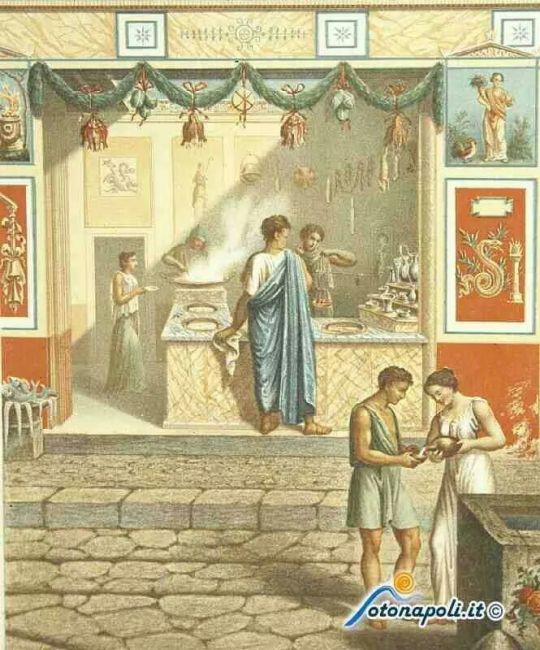
Here’s a reconstruction:
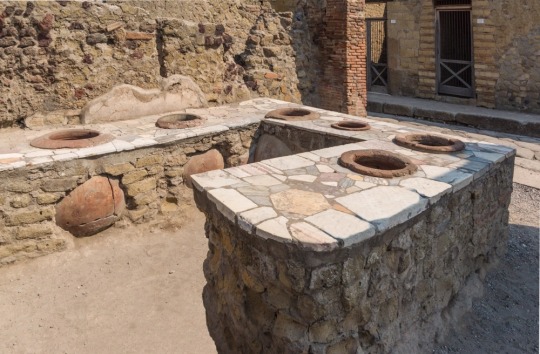
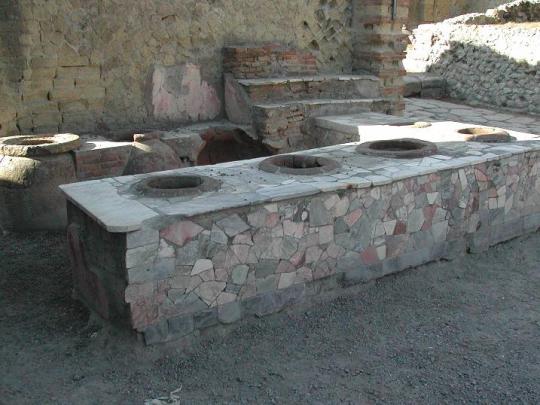
Here are a few examples of real ones, all similar but each different:
Pots of prepared food were set in those counter recesses. I haven’t
found out if there was a way to keep it hot, but the design looks like
there might have been a charcoal brazier at one end sending hot air
through the counter-space on the same principal as a hypocaust (Roman
under-floor central heating), otherwise why make the counter of stone
rather than wood?
@dduane suggests it may be because old bricks and broken rubble were easier to
find, but IMO these were built with more care than just “because it’s
cheap”.
The second two have a side that obviously faces the street (they would all have done, it’s just more obvious in those pics) which is where takeaway would have happened. Customers wanting to eat in would have moved along the indoor side of the L-shaped counter.
———-
As for takeaway, it didn’t include Drive-In or Drive-Through as we’d know it. Roman cities were almost entirely pedestrian so Walk-In or Walk-Through was more likely, but there might be a certain amount of Stop-In-Front-For-Takeaway by hungry deliverymen, ignoring vulgar cries in Vulgar Latin along the lines of “get that bloody cart out of the bloody way!”
Even then it wouldn’t happen at peak times since, except for unusual circumstances, deliveries were restricted to and had to be completed within set hours before and after the business day. Roman writers including Martial and Pliny bitch about being woken at early o’clock by squeaky axles, braying mules and swearing drivers as fresh provisions arrived for sale.
This reconstruction shows the ruts in the road for cart-wheels…
…and these are the real thing, which along with the frequent crossing-stones restricted what size of vehicle could enter the city: local delivery wagons drawn by a single mule, yes, out-of-town heavy freight drawn by a yoke of oxen, no.
There’s a longstanding chicken-and-egg argument over what came first, carts making ruts in soft lava rock, or ruts cut into rock to control carts. Since ruts of the same size (supposedly recycled in the Industrial Revolution as the size of Standard Gauge railway track, YMMV on that) appear on roads in other parts of the Empire which aren’t made of soft lava rock, my two sesterces is on deliberate cutting.
———-
Okay, so what kind of food did these places serve? Those keep-hot pots (dolias) would have contained vegetables like onions, carrots, leeks, cabbage, etc., also stews of beans, lentils,
fish and some cheap kind of meat; since this was poor or at least not-rich people’s food, that meat would have been
the inner bits most modern diners don’t want to know about. Not that organ meat worried the Romans; they were nose-to-tail diners in the way that was common throughout history until about 150 years ago.
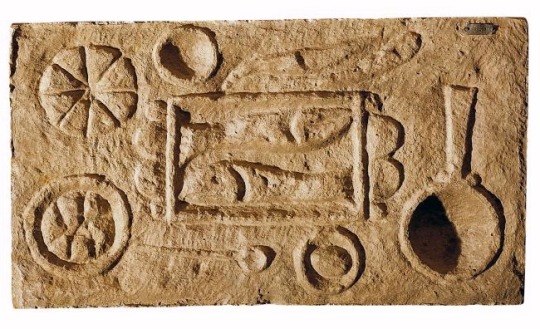
This 1st-century terracotta relief supposedly shows a basic meal of fish, bread (top left), possibly cheese (bottom left) and an egg (bottom right); there’s a knife (top) and spoon (bottom) to eat with, a cup and a pannier for drink. So far so good.
However IMO what it may show is a kitchen table in the classic cookery demo top-down view. Those two fish are about to be cut up using the
knife (top centre right with a curved horn(?) handle and possibly a sheath) then cooked in the pan on the right. There’s a spoon to stir and taste (bottom right), and the egg, bread and cheese(?) are either other ingredients or meant to accompany the pieces of cooked fish when they go into the bowl at top centre left.
Okay, I’m guessing; but it’s a fair guess. :->
Fast food would also have included bread, fresh and dried figs and other fruit, olives, cheese, honey, shellfish, eggs raw and hard-boiled, dried and smoked meat and fish, olive oil and, inevitably, garum, the (in)famous Roman fish sauce to which the entire Empire was addicted. They had FACTORIES to make the stuff though like tanneries, they were built well away from human - or at least wealthy - habitation.
Internet pages delight in focussing on the “Ew, rotted fish guts!” aspect; the Romans for their part would have looked at tomato ketchup and said “hang on, tomatoes are deadly nightshade in a party frock” before falling on them with delight because Ancient Roman recipes suggest a real fondness for sweet-sour. Anyway garum’s not rotted, it’s fermented with lots of salt like Worcestershire and Tabasco.
You know how modern foodstuffs are packaged in distinctive containers so you can spot them easily? Garum did it too.
Some Roman fast-foods were surprisingly familiar: kebabs (meats grilled on spits, including more inner bits); pizza (more of a foccacia or flatbread, drizzled with oil, sprinkled with herbs, topped with cheese and / or bits of meat or smoke-cured salami); burgers (grilled chopped-meat patties using yet more inner bits) and hot-dogs (various sausages including the famous Lucanian Sausage, smoked pork with herbs and pine-nuts).
We don’t know if Roman bakers produced small loaves - what we’d know as buns - for the sausages and burgers; it’s more likely that if eaten modern-style, they’d be
seasoned with pepper and a dash of garum, then rolled in a flatbread wrap
or put into a split section of the standard Roman panis quadratus loaf, like these on a Pompeii fresco…
…or this actual loaf, somewhat overbaked by Mount Vesuvius.
As mentioned before, there was no ketchup, but there were several kinds of mustard from mild to pungent, including ones made with water, wine, vinegar, honey and of course garum.
The Romans didn’t have popcorn (like tomatoes, maize was still an Atlantic Ocean away) but roasted crunchy chickpeas - in new leek’n’garum flavour! - were a direct equivalent.
Some of what follows is known historical fact; some of the rest is logical extrapolation from research for our “Games” project.
This post alone justifies the existence of Tumblr. Thank you! Now I know for sure that Asterix and Obelix at the Olympics is pretty much a documentary movie 😂
Si preguntáramos cuál es el valor de Pi, es de esperar que la mayoría reconozca que Pi es un número con infinitos decimales, un irracional, y que por lo tanto no se puede conocer con exactitud su valor. Dicho esto, algunos recodarán el clásico 3,1416, otros se quedarán en el 3,14, alguno alcanzará el 3,141593… y los habrá que se queden tranquilos en un 3 y pico. Frente a esto hubo un hombre, en el siglo XIX, que se propuso calcular cientos de esos decimales del número Pi. Ese fue el hombre que calculó centenares de decimales de Pi, y se equivocó.
Era mediados del siglo XIX y aquellos cálculos requerían lápiz, papel y paciencia
La suya fue una loable tarea, en una época en la que no había ordenadores y la forma de hacer estos cálculos era a base de lápiz, papel y paciencia. A ello se puso William Shanks, un inglés nacido en 1812 y que tenía una importante afición por las matemáticas. Durante mucho tiempo dedicó parte de sus mañanas a calcular y las tardes a revisar. A pesar de esto, erró.
En 1853 dio por concluido su empeño: había calculado los 707 primeros decimales de Pi. En realidad, no deberían ustedes admirar menos a Shanks por su trabajo en servicio de las matemáticas, una vez que sabemos que se equivocó a partir del decimal número 528.
Los primeros 527 los calculó bien, que no está mal. Pero a partir del siguiente, hasta el 707, todos estaban mal. Ya saben que cuando uno se equivoca en el proceso de división, abandona el camino correcto y ese error hace que el resto (nunca mejor dicho) esté condenado.
Durante décadas nadie comprobó su cálculo ni descubrió el error de Shanks
Al menos Shanks tuvo la fortuna de que nadie se diera cuenta de su error durante su vida. Murió en 1882 sin que nadie se percatara de que su cálculo tenía errores. Al fin y al cabo, comprobarlo suponía repetir su arduo trabajo.
Insisto, el empeño de Shanks es admirable a pesar de todo. Hizo todo esto por amor al arte. También calculó otras constantes, como el número e y publicó todos los números primos menores de 60.000, que son casi 4.900. Por cierto, el último número primo antes de 60.000 es 59.999.
El error de Shanks tuvo consecuencias en los esfuerzos memorísticos de, al menos, dos personas. Maurice Dagbert y Alexander Craig Aitken fueron dos hombres que, ya en el siglo XX, demostraron innumerables veces su capacidad de cálculo mental y de memoria. El hombre que calculó centenares de decimales de Pi, y se equivocó, empañó las hazañas de estas dos cabezas privilegiadas.
Algunos hombres se aprendieron de memoria el número Pi, mal calculado
Aitken era un destacado matemático, que además escribía bastante bien. Su libro de memorias sobre la Primera Guerra Mundial le reportó prestigio. En la Segunda Guerra Mundial Aitken fue uno de los hombres de ciencia que trabajó en Bletchley Park, en concreto en el cobertizo 6, el que combatió contra la Enigma que usaba el ejército de tierra y del aire alemán. Tanto Aitken como Dagbert usaron en sus retos mentales la tabla de decimales de Shanks, con todos sus errores. Su memoria trabajaba igual, pero el reto quedaba teñido por ese fallo.
Aitken vivió suficiente como para conocer el error de Shanks. Como decía, el error en los cálculos no hacía que su ejercicio de memoria tuviera menos mérito. Aún así, Aitken volvió a aprenderse centenares de números de pi, ya bien calculados. Si admirable era Shanks, no menos lo era Aitken.
El error de Shanks, por cierto, fue descubierto en 1944 por D.F. Ferguson, usando esta vez una calculadora para ir sacándole a Pi números decimales, uno detrás de otro.
Peeking through peach blossoms or nestled into a snowy landscape, the tiny shops that Lee Me Kyeoung renders are found across South Korea, from Mokpo to Jeju and Seoul to Gapyeong. The artist already has spent decades speaking with the store owners and weaving their stories into her delicate paintings as part of her ongoing A Small Store series. Her most recent works encapsulate the experience of standing in front of the establishments by capturing every detail: the multicolored goods evenly stacked, advertisements posted in the windows, bikes parked out front, and the sloping tiled roofs.
Me Kyeoung’s work recently culminated in a book detailing the still-open locations for those interested in visiting the shops in person. The prolific artist also shares updates on future exhibitions, in addition to photographs of the original stores she visits, on Instagram.
“Jeongdeun store” (2020), acrylic ink pen on paper, 122 x 162 centimeters
“Korye store” (2019), acrylic ink pen on paper, 65 x 65 centimeters
“Woori store at Haenam” (2019), acrylic ink pen on paper, 56 x 115 centimeters
“Shingur store” (2019), acrylic ink pen on paper, 75 x 135 centimeters
“Store at Haman” (2019), acrylic ink pen on paper, 75 x 135 centimeters
“Sinheoung store” (2019), acrylic ink pen on paper, 49 x 86 centimeters
“Deayul store” (2019), acrylic ink pen on paper, 60 x 73 centimeters
“Chestnut tree valley store” (2020), acrylic ink pen on paper, 120 x 180 centimeters
La intención de mucha redes sociales ahora es probar el contenido auditivo en sus plataformas. Ya lo vimos con Twitter y ahora LinkedIn se estrena con este tipo de iniciativas para sus funciones.
La última actualización de la red social dedicada a perfiles profesionales, añadió una opción donde la persona puede subir un audio de 10 segundos pronunciando su nombre.
En un comunicado, la red social informó que busca ayudar a esas personas que quizás tiene un nombre de compleja escritura y quiere que aquel interesado en contactarle, tenga una pronunciación correcta.
“Una vez que agrega una grabación, otros miembros que visitan su perfil pueden escucharla rápidamente para comprender mejor su preferencia de pronunciación y, posteriormente, asegurarse de que puedan decir su nombre correctamente. También puede escuchar las pronunciaciones de otros miembros visitando sus perfiles cuando hayan agregado una grabación”, explican.
Con esta función puedes leer el contenido desde el mismo navegador sin tener acceso a internet.
¿Cómo se graba?
Agregar una pronunciación de nombre se limita a dispositivos móviles (Android e iOS). La reproducción de la pronunciación de nombres está disponible en todas las plataformas (Web, Android e iOS).
iOS
Para grabar y mostrar la pronunciación de su nombre en su perfil:
Toque su foto de perfil > Ver perfil .
Toque en el Edite el icono de su tarjeta de presentación.
Grifo Grabar pronunciación de nombres .
Si ya ha grabado su nombre, puede tocar el Icono Editar para eliminar o reemplazar la grabación existente.
Toque el botón de grabación y manténgalo presionado para grabar su nombre. Nota : También puede cancelar u obtener una vista previa de la grabación.
Toque el botón Usar cuando esté satisfecho con su grabación. Nota : También puede volver a tomar la grabación.
Toca Guardar .
Su grabación se mostrará junto a su nombre en su tarjeta de presentación.
Seamos realistas. Estamos encerrados en casa. Y va a pasar tiempo hasta que podamos volver a viajar.
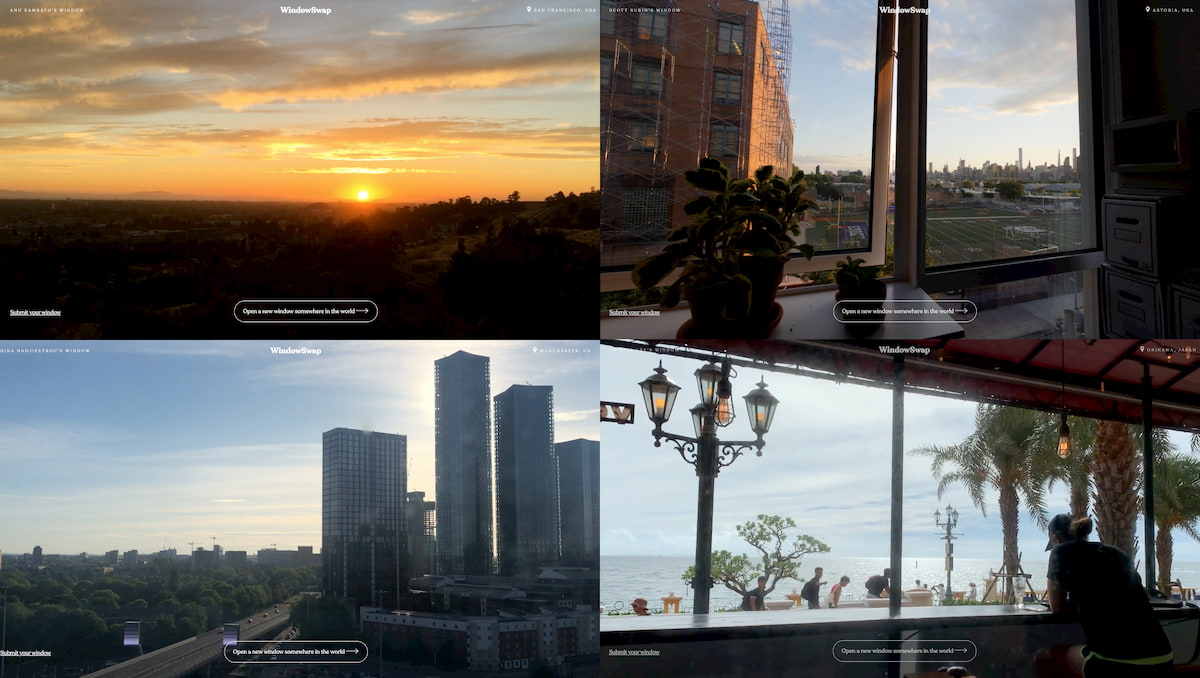
Con WindowSwap puedes decorar cualquier pantalla de tu hogar al mismo tiempo que descubres mundo desde el confinamiento. O, más bien, descubres cómo se ve el mundo desde las casas de otras personas (probablemente también confinadas en mayor o menor medida). El contenido son grabaciones en alta definición, de unos 10 minutos, enviadas por gente de todas partes, desde Japón a México o Australia.
Usarlo consiste en simplemente hacer un clic; eso abre una ventana del navegador –apropiado símil– que es al mismo tiempo una ventana a otro mundo. Al menos al mundo que se ve desde la casa de alguien en su cotidianidad total, dentro de la seguridad del hogar y lejos de los virus.
Para colaborar a que haya más material puedes enviar grabaciones de tu propia ventana a la dirección de correo que indican. Las reglas son 10 minutos de video en horizontal, marco de ventana incluido, junto con el nombre y el lugar en cuestión. Las ventanas pueden ser de todo tipo: cuadradas, redondas, decorativas, horizontales o verticales. Pero el vídeo en horizontal, como dios manda.
Take a stroll through Nantes’s Jardin des Plantes, and you’ll find a playful cast of characters floating in a fountain, raking the grass, and joining hands to hug a tree. Part of a new exhibition titled Filili Viridi in the French city, the colorful ensemble was created by Paris-based artist Jean Jullien (previously) for the botanic garden in his hometown. Each of the characters is massive—the blush-colored creature spans more than eight meters—and appears to utilize the lush grounds just like their human counterparts.
If you’re in Nantes before November 2021, head to the park to hang out with the jolly group, to which Jullien plans to add a dozen (!) more of the spirited characters next fall. To dive further into his light-hearted projects, check out the artist’s Instagram and the range of books he’s illustrated, many of which are available from Bookshop. (via Juxtapoz)
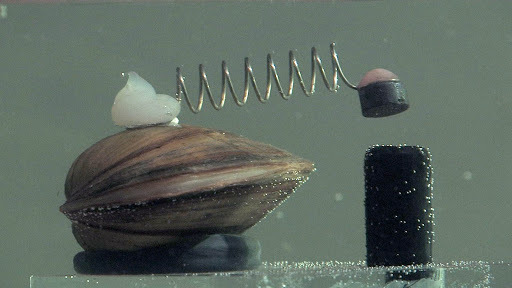
Re: the last post, the article mentions that some places use clams to test the toxicity of the water. It’s like that in Warsaw- we get our water from the river, and the main water pump has 8 clams that have triggers attached to their shells. If the water gets too toxic, they close, and the triggers shut off the city water supply automatically.
The clams are just better at measuring the water quality than any man-made sensors.
Así funcionan el papel y lápiz en la investigación de la Universidad de Missouri
Según la investigación, el lápiz se usa para dibujar patrones de grafito, que permiten servir de trazas conductoras y electrodos de detección. El papel funciona como sustrato de soporte.
El dispositivo monitorea varias señales biofísicas y bioquímicas del cuerpo, incluyendo la temperatura y el nivel de azúcar en la sangre.
Además, la frecuencia cardíaca, respiratoria y el pH del sudor.
“Si una persona tiene un problema de sueño, podríamos dibujar un dispositivo biomédico para ayudar a regularlo”, explica el artículo.
En la investigación participaron 15 científicos de origen asiático de la Universidad de Missouri. Fue publicado apenas este lunes.
A stunning 3D virtual tour from the Egyptian Tourism Authority takes viewers deep into the heavily detailed tomb of Pharaoh Ramesses VI. Named Tomb KV9, the underground structure has a long corridor leading down to the now-broken sarcophagus, and both walls and the ceiling are inscribed with writings from ancient Egyptian texts and astronomical renderings. The fifth ruler of the Twentieth Dynasty of Egypt, Ramesses VI’s reign lasted for about eight years in the 12th century BC. In 1898, his tomb was cleared by Georges Émile Jules Daressy who stole a portion of the sarcophagus, which then was acquired by the British Museum. (via Twisted Sifter)
Like most romances, penguins’ relationships aren’t black and white. The aquatic birds’ are known for their scandalous affairs, messy heartbreaks, and frequent kidnappings of each others’ chicks. To keep track of their complicated relationship statuses, caretakers at the Tokyo’s Sumida Aquarium and Kyoto Aquarium have created a complex network documenting 2020’s romances.
The two flowcharts are replete with color-coded lines and symbols: Red hearts denote couples. Purple lines with question marks signify more complicated relationships with the potential of romance. A blue, broken heart indicates an ended affair. Yellow lines mean friendship, while green marks an enemy. Each penguin’s name is written underneath its photo.
In an interview with CNN Travel, Shoko Okuda, a spokeswoman for the aquariums, said the caretakers have included the dramatic birds’ flirtatious tactics, too, which includes wing flapping and shaking their necks left to right. Heartbroken birds—one female in Kyoto (shown below) ended six relationships last year alone—often refuse to eat their rice as they cope with the loss. The caretakers included have formed strong bonds with the penguins, sometimes even coming between same-species connections.
And remember, these are just the charts for 2020. Be sure to check back in with the Kyoto and Sumida caretakers to see what unfolds for 2021’s edition. (via Spoon & Tamago)