Shared posts

20 Jul 05:42

Google loves Epic Rap Battles and the ad money it brings in

by Nicole Lee

Google Co-Founder Larry Page Takes Over AS CEO From Eric Schmidt

To no one's surprise, Google -- the company that builds everything from web email services to self-driving cars -- has once again climbed the revenue charts. Today in its quarterly earnings report, the Mountain View company reported it's raked in $15.96 billion in revenue this quarter, which is about a 22 percent growth year-over-year. And, as you might expect with Google, a bulk of that cash comes from good ol' advertising -- about 90 percent, in fact. But the chatter wasn't all about search and advertising in today's earnings call -- the company also alluded to other notable successes such as Google Shopping Express, Chromebooks and, yes, Epic Rap Battles of History.

Even though Google didn't break out the exact percentage from which it gains that aforementioned ad revenue, it's clear the company is focused more than ever on leveraging the advertising dollars it gets not just from search, but also via other services such as YouTube and Google Play. Indeed, Nikesh Arora, the current Chief Business Officer for Google -- who, incidentally, has announced he'll be leaving the company for SoftBank -- spent quite a bit of time in the call talking video.

"Video is at the forefront of our efforts," he said. Notably, he called out the professionally created content on YouTube, pointing out channels like Epic Rap Battles of History and internet celebs like Michelle Phan that add value to the streaming service. Digital sales on Google Play continue to do well too, and he credits partnership deals with providers like CBS and Viacom as part of its success. As for whether Google was open to making money not just from advertising but from subscriptions too, CFO Patrick Pichette said they're still experimenting with different ends of the spectrum, but it's fair to say they "have a horse in every one of these races."

"We're living in a multiscreen world," continued Pichette, stating that the fact that video can be viewed not just on your tablet, but also on your TV via Chromecast, makes the revenue possibilities very intriguing. This is ostensibly the reason why the company didn't break out mobile revenue from desktop -- as it all sort of flows together -- but it could also point to the fact that it's not doing as well in the mobile ad biz.

Stepping away from advertising, Arora also drew attention to the considerable success of Google Shopping Express, saying he didn't know anyone who didn't like it. "It has tremendous results," he said, stating that it's "clearly an opportunity for us." The focus for the delivery service will remain local, even as they cater to large businesses as well as small ones. "There continues to be amazing demand for the product." Not to leave Chrome out, Arora said that over a million Chromebooks have been sold to schools and that the Chromecast's popularity continues to grow.

As for those moonshot projects like self-driving cars? Well, the company said that it'll still invest in them and will keep a close eye as to how that money is allocated, but it'll certainly take a long time for any of those to turn a profit. In the meantime, we'll cross our fingers for an epic rap battle starring Larry Page and Sergey Brin.

[Image credit: Bloomberg via Getty Images]

Filed under: Internet, Google

Comments

Source: Google

20 Jul 05:33

Google reportedly confronted Samsung over its approach to smartwatches

by Jon Fingas
Samsung Gear Fit

The strained relationship between Google and Samsung over Android customization has been apparent for a while, and it now looks like this discontent has spread to the wearable world. The Information claims that Google CEO Larry Page confronted Samsung last week over its decision to invest more in its Gear 2 and Gear Fit smartwatches than the Android Wear-packing Gear Live. While the details of Page's discussions aren't available, it's clear that Google wants its biggest hardware partner to devote more attention to its Android-based platform. Reportedly, Google had even wanted Samsung to avoid dipping into wrist-worn technology until Android Wear was ready. As we know now, the Korean company didn't exactly honor that request -- instead, it released the Galaxy Gear (initially using a heavily customized Android) and quickly threw most of its energy into peripherals running Tizen and other platforms.

Neither firm has commented on the disagreement. However, a scrap over wearables isn't completely shocking. Google is trying to rein manufacturers in by requiring that they use its stock interface on Android Wear equipment; that's not going to please Samsung, which has spent a lot of time customizing Android in an attempt to stand out. The Gear Live's very existence suggests that Samsung is being somewhat accommodating. If the leak is accurate, though, Google may not be truly happy unless that device takes center stage in Samsung's lineup.

Filed under: Cellphones, Wearables, Mobile, Samsung, Google

Comments

Via: 9to5Google

Source: The Information

19 Jul 20:49

Which countries recognize Israel or Palestine?

by Max Fisher
19 Jul 20:47

Two Neighbors From Austin, Tx

19 Jul 20:46

Típica pelea de titanes y de pronto...


19 Jul 17:24

amaditalks: There are more of is than anyone would ever be led...

by wagatwe


amaditalks:

There are more of is than anyone would ever be led to believe. Free Palestine!

19 Jul 14:13

Tumblr | 352.png

352.png
19 Jul 13:05

Double-dipping spreads bacteria. But does it get people sick?

by Joseph Stromberg
Yousef Alnafjan

Don't double-dip the chip.

Among the many polarizing debates in American society, one reigns supreme: double-dipping.

Many people believe that dipping a chip into a shared bowl of drip, taking a bite, and dipping again — termed "double-dipping" in a 1993 episode of Seinfeld — is an abhorrently unsanitary practice. Others, like George Costanza, think this aversion is unscientific, and there's actually no harm in double-dipping at all.

each instance of double-dipping transfers a few thousand bacteria from the dipper's mouth to the bowl

The truth is somewhere in the middle. As it happens, there has been a single scientific study conducted on the topic — and it found that each instance of double-dipping does transfer a few thousand bacteria from the dipper's mouth to the bowl.

But although this sounds terrifying, the study didn't seek to figure out whether these bacteria were harmful — and about 99 percent of bacteria we generally encounter are not. Similar numbers of bacteria are likely spread when we share a drinking glass with someone else, and if they're not sick, it's generally not a huge deal.

So what's our scientifically-informed recommendation on double-dipping? It might be alright to do among a few close friends, if you're sure you're not sick. In a large social setting, though, it's inconsiderate, even if the risk may be relatively small.

What research says about double-dipping

139047047

Essdras M Suarez/The Boston Globe via Getty Images

The study, conducted at Clemson University, involved Wheat Thins being dipped into petri dishes full of several different substances — sterile water, salsa, Hershey's syrup, cheese dip, and water (with its pH adjusted to match each of the food dips). For each, a few different crackers were double-dipped, and the results were compared to control dips, which either had unbitten crackers repeatedly dipped into them, or weren't dipped at all.

After each trial, the researchers took a sample from the dip and cultured the bacteria present, then took a sample again after the dip had stood at room temperature for two hours, to see how many bacteria survived that long.

The results were uniform across dips: double-dipping consistently spread bacteria from mouth to bowl (or in this case, petri dish). There were way more bacteria in the double-dipped samples, compared to both kinds of control samples.

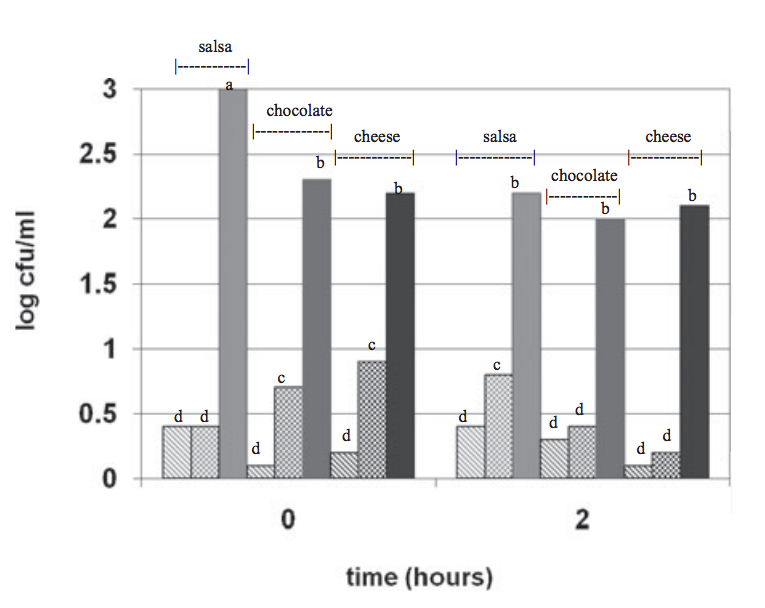
Here's a graph of the cheese, salsa, and Hershey's syrup trials:

Screen_shot_2014-07-14_at_5.40.31_pm

Journal of Food SafetyDawson et. al.

The graph is a bit tricky to read, but the main thing is that all all the short bars are the various controls and the tall bars are the double-dips. Taller means more bacteria.

Initially, the salsa picked up the most bacteria, likely because it's the least viscous, so when you double-dip, there's a higher chance of some salsa coming into contact with the chip but staying in the bowl. But the chocolate and cheese picked up nearly as many, and the salsa's acidity appeared to kill off a bit of bacteria in the intervening time.

The researchers also converted these numbers (which represent the density of bacteria in the dips) into rough estimates of how many bacteria were transferred with each dip. On average, a sequence of three double-dips (so six dips total) transferred about 10,000 individual bacteria.

So does this mean double-dipping gets people sick?

150819264

Tammy Ljungblad/Kansas City Star/MCT via Getty Images

That's the real question here, and unfortunately one that isn't really answered by this current study. It found contamination, but noted that "whether the type or amount of contamination is dangerous to a dippers’ health or not is debatable."

Now, it's certainly interesting that double-dipping conveys any bacteria at all. Paul Dawson, the food scientist that led the study, told he me was "very surprised at the number of bacteria we found were transferred from the subjects' mouths during double dipping."

you can think of double-dipping as something similar to sharing glasses or utensils

At the time time, while the idea of thousands of bacteria going from someone's mouth to a bowl of dip certainly sounds disgusting, keep in mind that a square centimeter of your skin is home to about 100,000 bacteria. Thousands of these can also be spread to someone else if you simply shake hands, and we're equipped to deal with about 99 percent of the bacteria in our environment without any harm.

You can think of double-dipping as something similar to sharing drinking glasses or utensils. It's rude to do in large social functions, and definitely unacceptable to do if you think you might be sick. But among a few close friends sitting around a bowl of dip, it might not be a huge deal.

But there's still a remaining question about double-dipping: if you see someone do it, should you avoid dipping yourself?

"I would avoid that dip," Dawson says. "You don't know if the person doing the double-dipping is carrying a virus or bacteria that could make you sick. People that are carrying a pathogen don't always appear sick themselves."

Further reading: Science says the five-second rule isn't such a bad idea

19 Jul 13:00

Rihanna and Dwight Howard tweeted #FreePalestine and it worked out how you would expect

by Zack Beauchamp

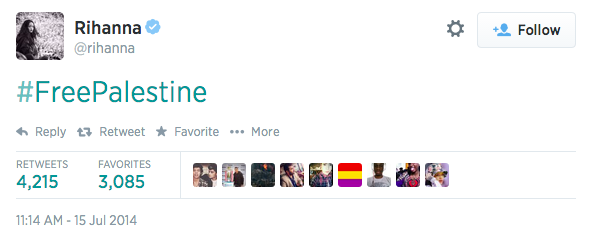
So a popular performer you might know named Rihanna tweeted this:

Screen_shot_2014-07-15_at_12.20.09_pm

At least count, it had 6.9 thousand retweets. That's before the singer, naturally enough, deleted it.

It's not exactly a secret that the Israel-Palestine conflict is controversial, and tweeting #FreePalestine wades right into it. She presumably meant to express solidarity with Palestinians, many of whom in Gaza have been enduring a week of Israeli airstrikes that are targeting the Palestinian militant group Hamas but that the UN says have killed dozens of civilians as well. A two-word hashtag does not allow for an awful lot of nuance, though. For an artist as mainstream as Rihanna, wading into a conflict this contentious and complicated was bound to upset some people.

She's been burned on this topic before. At a 2013 show in Tel Aviv, some reporters in the audience thought she sang "all I see is Palestine" in place of "all I see is dollar signs" in the song "Pour it Up." The apparent implication was that all of the land there — currently Israel — is rightfully Palestinian. Not exactly something an Israeli crowd wants to hear, but it's also not what she actually said. The brief media firestorm before people realized she'd been misheard (someone found a recording) may help explain why Rihanna deleted her #FreePalestine tweet so hastily.

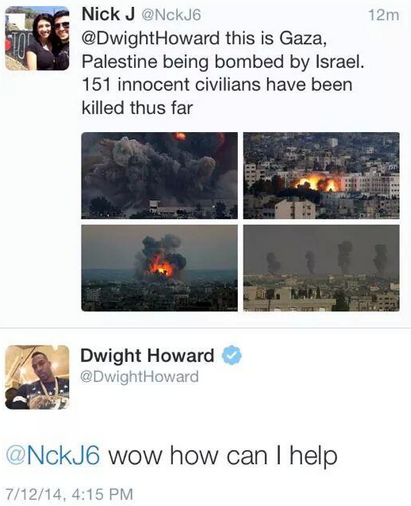
She's not even the only celebrity to get in trouble for tweeting #FreePalestine since the latest round of violence began. Dwight Howard, Houston Rockets center and one of the most famous players in the NBA, was asked by a fan what he thought:

Screen_shot_2014-07-15_at_12.43.38_pm He then tweeted this:

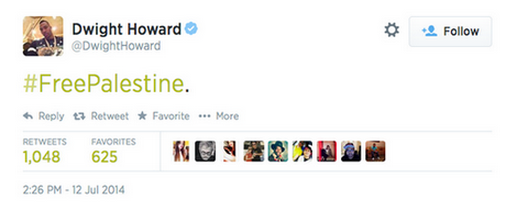
Screen_shot_2014-07-15_at_12.44.25_pm

Which he deleted, and apologized for:

previous tweet was a mistake. I have never commented on international politics and never will.

— Dwight Howard (@DwightHoward) July 12, 2014

I apologize if I offended anyone with my previous tweet, it was a mistake!

— Dwight Howard (@DwightHoward) July 12, 2014

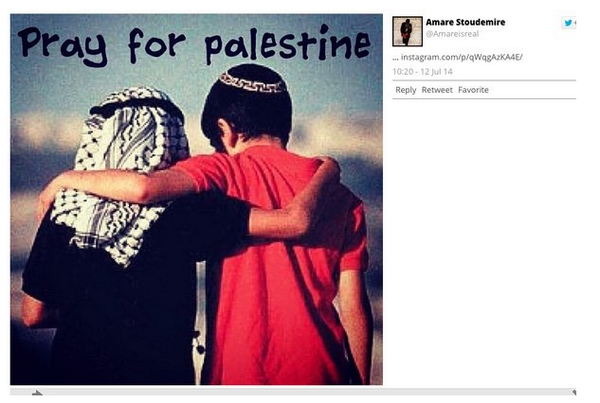
The New York Knicks' Amare Stoudemire, who has Jewish heritage and has applied for Israeli citizenship after several visits, also deleted this:

Amare

What you've learned from all of this is that the Israeli-Palestinian conflict is really controversial.

19 Jul 10:54

Cute Mario Kart racer GIFs ⊟ Here’s a non-animated Koopa...

by ericisawesome


Cute Mario Kart racer GIFs ⊟

Here’s a non-animated Koopa one, too. These are all courtesy of Paper Beats Scissors, which post a lot of great comics and adorable video game tribute GIFs/sketches — very much worth a follow!

If you open up a bunch of browser windows and load one of these GIFs in each, you can line them up and move them around, pretending their racing and passing each other while making your own sound effects. Great way to spend your afternoon, or get fired after you’re caught goofing off at work.

BUY Mario Kart 8 ($11 off), Mario Kart 7, upcoming games
18 Jul 17:32

Photo


18 Jul 13:24

Yes, Gaza militants hide rockets in schools, but Israel doesn't have to bomb them

by Max Fisher
Yousef Alnafjan

Madness on both sides, and civilians are caught in the middle.

A United Nations agency dedicated to helped Palestinians discovered 20 rockets hidden in one of its Gaza Strip schools on Wednesday, according to an alarmed press release from the agency. Palestinian militant groups such as Hamas dominate Gaza and use rockets as a tool to terrorize nearby Israelis.

"This is a flagrant violation of the inviolability of its premises under international law," said the release from the agency, the United Nations Relief and Works Agency for Palestine Refugees in the Near East (UNRWA). "This incident, which is the first of its kind in Gaza, endangered civilians including staff and put at risk UNRWA's vital mission to assist and protect Palestine refugees in Gaza."

israel is strong enough to choose to not bomb civilian structures

Israel has long accused Gaza-based Palestinian militant groups such as Hamas of using schools and other civilian buildings to store weapons and from which to launch rockets at Israel. Israel's argument has been that this demonstrates Hamas's disregard for Palestinian civilians, justifies Israeli air strikes on civilian buildings that are used in this way by Hamas, and shifts the blame for Palestinian civilian deaths off of Israel and onto Hamas.

Both Hamas's use of civilian Palestinian buildings and Israel's strikes against those buildings are highly controversial, and rightly so. It would be understating things pretty dramatically to say that this an aspect of the Israel-Hamas conflict where both sides are behaving badly. But that does not make them equivalent.

Only the people responsible can know for sure why Palestinian militants would use civilian buildings, but any real possibility is bad. Maybe militant groups use civilian buildings like this UN school simply because they don't mind the danger this creates for the Palestinians they claim to protect. Maybe it's because they are hoping that the rockets will be safer in a UN school because Israel won't want to bomb it, which means using Palestinians kids and teachers as human shields. An argument you hear from Hamas's harshest critics is that they are hoping Israel will target the schools, thus rallying people to their side.

None of these speaks well of militant groups or the effects of their rocket campaigns on Palestinian civilians. It is not a great secret that "resistance" campaigns by groups like Hamas and Palestinian Islamic Jihad bring far greater harm to Palestinian civilians than they do anything resembling liberation, but this incident is a small glimpse of how, and of the effects of militant groups firing hundreds of rockets into Israel from densely populated neighborhoods in Gaza.

Here's the thing, though: while incidents like this force Israel to decide between bombing civilian structures or allowing Hamas to use those structures as rocket storage depots, it does not actually force Israel to choose to bomb civilian buildings. It is entirely within Israel's power to not bomb civilian buildings.

452271324

Relatives of Muhammed Bekir, killed in an Israeli airstrike as he was playing on the beach with his friends, mourn after his death (Mohammed Talatene/Anadolu Agency/Getty Images)

Israel has overwhelming military superiority in the conflict, and while that does not make Hamas rockets disappear or obviate their very real effects on Israeli civilians, Israel is strong enough to choose not to bomb a mosque and a center for the disabled in Gaza, as it did on July 12. It can choose not to bomb Gaza beaches frequented by civilians, as it did on Wednesday, killing four boys between the ages of 9 and 11.

There is no indication that Israel deliberately targets civilians, as Hamas does. But Israeli air strikes in Gaza, targeting Hamas and other militant groups that choose to embed themselves among civilians, kill an overwhelming number of Palestinian civilians. Last week, two UN agencies separately estimated that 70 to 77 percent of the Palestinian deaths have been civilians. Human Rights Watch on Wednesday accused Israel of "targeting apparent civilian structures and killing civilians in violation of the laws of war."

This is the one thing that both Hamas and Israel seem to share: a willingness to adopt military tactics that will put Palestinian civilians at direct risk and that contribute, however unintentionally, to the deaths of Palestinian civilians. Partisans in the Israel-Palestine conflict want to make that an argument over which "side" has greater moral culpability in the continued killings of Palestinian civilians. And there is validity to asking whether Hamas should so ensconce itself among civilians in a way that will invite attacks, just as there is validity to asking why Israel seems to show so little restraint in dropping bombs over Gaza neighborhoods. But even that argument over moral superiority ultimately treats those dying Palestinian families as pawns in the conflict, tokens to be counted for or against, their humanity and suffering so easily disregarded

18 Jul 13:05

7 times militaries have shot down civilian planes

by Dylan Matthews

US intelligence reports that Malaysia Airlines Flight 17 was shot down, making it one of highest-casualty airliner shoot-downs in the history of aviation. But it's hardly the first. Events like this — though usually much smaller in scale — have occurred about two dozen times. Many instances were part of ongoing wars, such as Nazi Germany's shoot-down of a British Overseas Airways Corporation flight from Lisbon to London in 1943, or Zimbabwean rebels' shoot-downs of two Air Rhodesia flights in 1978 and 1979.

But in those cases, the countries involved were at war with each other. In contrast, Flight 17 was going from Amsterdam to Kuala Lumpur, and neither the Netherlands nor Malaysia have much of any involvement in the Ukrainian civil war. And the death toll — there were 295 passengers, and, to the best of our knowledge, no survivors — is extremely high.

With that in mind, here are seven previous airliner shoot-downs that could provide some clue as to what the consequences of the crash will be. The list is hardly comprehensive but gives a sense of how these situations are handled.

1) Korean Air Lines Flight 007 (1983)

Koreanair

Korean Air Lines Boeing 747SP at EuroAirport Basel-Mulhouse-Freiburg in 1985; the plane that crashed in 1983 was a 747-230B. (Sangil)

Also known as "that time the Soviet Union killed a sitting US Congressman." KAL007 was shot down by a Soviet fighter plane on September 1, 1983, killing all 269 passengers and crew, including Larry McDonald, a Congressman from Georgia then in his fourth term. An ardent anti-Communist and believer in various conspiracy theories about the Rockefellers, the Trilateral Commission, and the Council on Foreign Relations plotting to bring about a socialist world government, McDonald also was president of the John Birch Society, the ultra-right-wing conspiracist group.

The fact that the crash killed McDonald would fit perfectly into his particular set of conspiracy theories, but there's no evidence that what happened was more complicated than KAL007 entering Soviet airspace and being shot down as an intruder. This International Civil Aviation Organization report from 1993, incorporating documents released by Russian president Boris Yeltsin that Soviet leaders had previously withheld, summarizes what we know well, and finds Soviet personnel appearing baffled and concerned by the presence of an unknown aircraft, rather than determined to strike intentionally, though their decision to strike without attempting to establish contact with the plane was reckless.

The direct response to the attack — and subsequent Soviet attempt at a cover-up — was largely rhetorical. President Reagan condemned the shoot-down as a "crime against humanity" which "must never be forgotten." The US responded to Soviet intransigence by releasing substantial amounts of classified material to back up the charge that the Soviets (accidentally or not) shot the plane down. An unintended side effect of that was to weaken the US's ability to monitor Soviet communications through Japan "According to various unnamed Japanese officials, changes made in the Soviet codes and frequencies following the American disclosures reduced the effectiveness of Japanese monitoring by 60 percent," David M. Johnson noted in a write-up on the intelligence losses for Harvard and the Center for Information Policy Research.

The shoot-down led to the expansion of the Global Positioning System to civilians, which Reagan announced in the wake of the shoot-down. It would have been harder for the KAL pilots to drift into Soviet airspace with satellite navigation technology.

2) Iran Air Flight 655 (1988)

Iranair

Another Airbus A300B2-203 operated by Iran Air, at Barcelona - El Prat Airport in 2011. (Dura-Ace)

Though the Soviets did it first, the US also once accidentally downed a civilian airliner carrying about 300 people on it. On July 3, 1988, as the Iran-Iraq war was winding down, US and Iranian ships were involved in some skirmishes in the Persian Gulf. An Airbus A300 took off from a nearby airport, one which was used for both military and civilian purposes. An American cruiser, the USS Vincennes, mistook the plane for an F-14, an American fighter plane that we had sold to Iran before the 1979 revolution, and launched two missiles, downing the plane and killing everyone on board.

President Reagan called the event a "terrible human tragedy," and stated "we deeply regret any loss of life." Iran's UN ambassador condemned the action as ''criminal act,'' an ''atrocity'' and a ''massacre," while the US insisted it was a misunderstanding. Then-Vice President George H.W. Bush called the idea the US would have shot down the plane deliberately "offensive and absurd," and argued that allowing passenger flights out of an airport as a naval battle was underway was irresponsible of the Iranians. "They allowed a civilian aircraft loaded with passengers to proceed on a path over a warship engaged in battle,'' Bush said. ''That was irresponsible and a tragic error.''

Iran sued the United States in the International Court of Justice, and the American government eventually agreed in 1996 to pay $61.8 million ($93.7 million today) to the families of victims; notably, that amount was 1/30th of the compensation the US secured from Libya for victims of the Lockerbie plane bombing that same year. The US government has never apologized for shooting down the plane, beyond Reagan's initial statement, and Max Fisher has noted the event contributes to Iranian mistrust of American intentions to this day.

3) Itavia Flight 870 (1980)

Itavia

An Itavia DC-9, similar to the one shot down. (Piergiuliano Chesi)

This is a case where we still don't really know the true story. On June 27, 1980, an Itavia Airlines flight from Bologna to Palermo with 81 passengers and crew crashed in the Tyrhennian Sea, near Sicily. The New York Times' Elisabetta Povoledo reports that the "most widely accepted theory behind the crash" — for which an Italian court last year said there was "abundantly" clear evidence" — was that a stray missile from an aircraft hit the plane, but any information about which country's aircraft it was, or why, is still very much up in the air.

An Italian judge, Rosario Priore, presented the theory that there was a NATO plot to shoot down a plane carrying Libyan dictator Muammar Gaddafi, and the Itavia jet got caught up in that operation. He presented radar evidence suggesting the presence of US, French, Libyan, and British military operations near to where the plane crashed. Francesco Cossiga, the prime minister at the time, said decades later that the plane was shot down by French military personnel. But neither his nor Priore's claims have been proven.

4) El Al Flight 402 (1955)

Elal

An El Al Lockheed Costellation, similar to the one that was shot down. (Oyoyoy)

On July 27, 1955, an El Al flight from Vienna to Tel Aviv flew into Bulgarian airspace and was shot down by two Bulgarian MiG fighters. All 58 people on board were killed. After initially denying involvement, Bulgaria admitted to having shot the plane down. Despite occurring during a low point in relations between the Soviet bloc (including Bulgaria) and the US and its allies (including Israel), international fallout was minimal.

Eight years after the attack, Bulgaria agreed to pay a total of $195,000 ($1.5 million in current dollars) to Israel, having already compensated non-Israeli passengers.

5) Cathay Pacific Airways (1954)

Cathay

A Douglas DC-4, a similar aircraft to the one that was shot down. (Russavia)

On July 23, 1954, mainland China's People's Liberation Army fighters shot down a Cathay Pacific Airways (the airline of Hong Kong, then under British control) C-54 Skymaster flying from Bangkok to Hong Kong; 10 out of the 19 passengers and crew died. In apologizing for the attack to Britain days later, the Chinese government stated that they had thought the plane was a military aircraft from the Republic of China n (Taiwan) on an attack mission against Hainan Island (near where the shoot-down took place).

However, the initial tragedy was compounded when two PLA fighters engaged three US Navy planes that were searching for survivors; the two PLA planes were shot down. While admitting fault and promising compensation in the case of the civilian plane, China claimed that it was faultless in the confrontation with the US. President Eisenhower, in turn, alleged the harsh tone toward the US and conciliatory tone toward Britain in reference to the Cathay plane was a Communist plot to split the allies.

It's hard to say the incident made relations between the Allies and mainland China much worse than they already were, but it risked bringing the Allies further into the battles that were then occurring between the People's Republic of China and the Republic of China. Given that the Eisenhower administration was apparently considering using nuclear weapons on the ROC's behalf, any heightening of the tensions there was dangerous.

6) Libyan Arab Airlines Flight 114 (1973)

51417442

Israeli defense minister General Moshe Dayan (to the right of then-Prime Minister Golda Meir) apologized for shooting down Flight 114, and Chief-of-staff General David Elazar (to her left) gave the initial order. (AFP/Getty Images)

On February 21, 1973, a Libyan Arab Airlines (a wholly owned part of the Libyan government) Boeing 727 flying from Tripoli to Cairo got lost and flew over the Sinai peninsula, which had been under Israeli control since the Six-Day War in 1967. After giving signals to land and firing warning shots, Israeli jets shot down the plane, killing 108 of the 113 people on board, and leaving four passengers and a co-pilot alive.

David Elazar, the chief of staff of the Israeli armed forces, took responsibility for ordering the shoot-down. Defense Minister Moshe Dayan called the event an "error of judgment" and the Israeli government compensated the families of victims. Libya condemned the attack as "a criminal act" while the Soviets called it a "monstrous new crime."

7) Siberia Airlines Flight 1812 (2001)
Siberianairlines

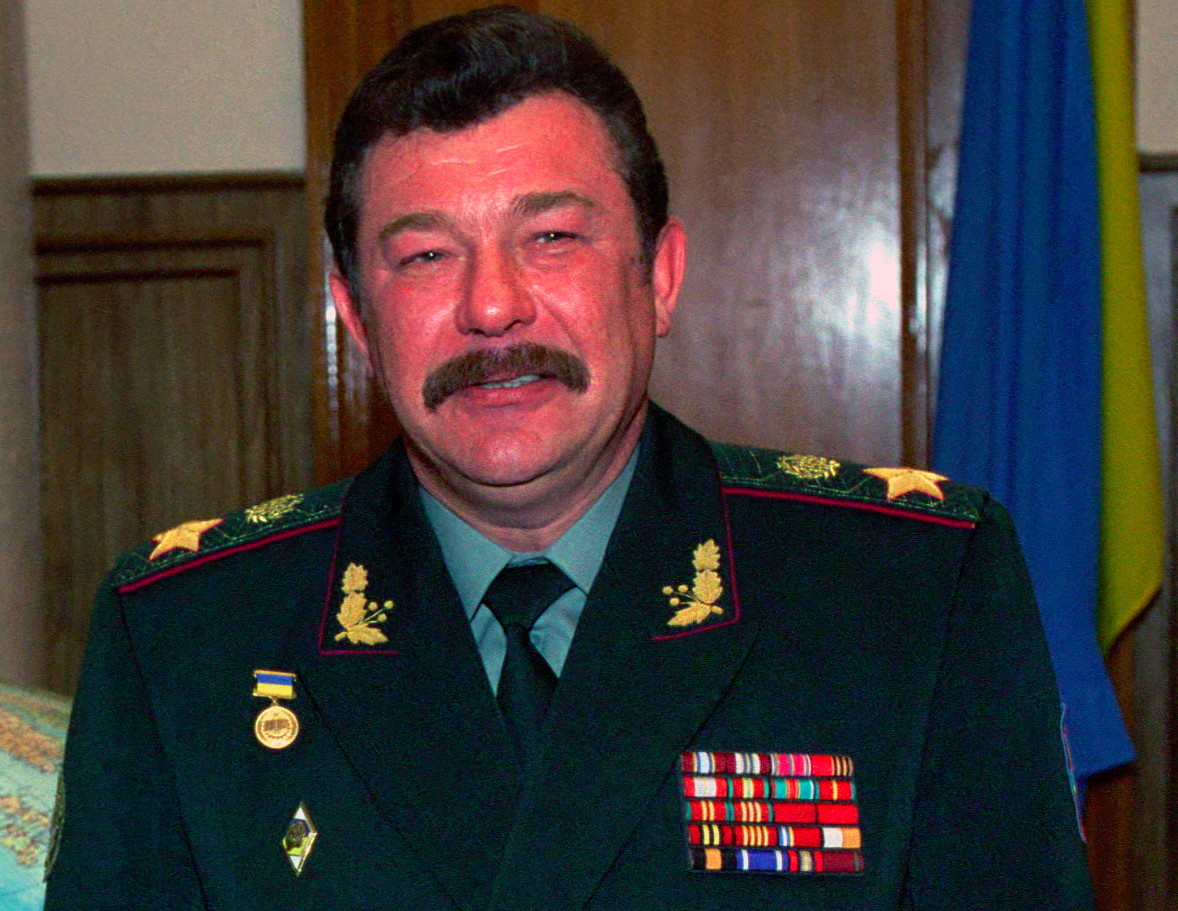
Oleksandr Kuzmuk, the Ukrainian Minister of Defense who resigned after the military short down Siberian Airlines Flight 1812.  (Robert D. Ward/DOD)

Perhaps the strangest precedent for the Malaysian Airlines crash in Ukraine is a shoot-down in 2001 caused by military forces in … Ukraine. On October 4, 2001, 64 Siberia Airlines passengers and 12 crew members onboard a Soviet-made Tupolev Tu-154 en route from Novosibirsk to Tel Aviv were killed when the plane was shot down over the Black Sea by a Ukrainian missile.

It took a while for Ukraine to admit that was what had happened, but after pressure from Russian investigators, Ukraine's then-president, Leonid Kuchma, accepted that the Ukrainian military was at fault. The day of the shoot-down, the Ukrainian military was conducting a massive military exercise which involved shooting 23 missiles at drones. "Experts say that the radar-guided S-200, among the farthest-flying and most capable antiaircraft missile in the arsenal of former Soviet nations, simply locked onto the Russian airliner after it raced past the destroyed drone some 20 miles off the Crimean coast," the New York Times' Michael Wines reported.

Kuchma accepted the resignation of his Minister of Defense, Oleksandr Kuzmuk, following the admission that the military was at fault. From 2003 to 2005, Ukraine paid $15.6 million to families of victims following a deal with the government of Israel.


18 Jul 12:15

somethingplayfullywicked: Life in Gaza


somethingplayfullywicked:

Life in Gaza

18 Jul 08:43

Soylent: living on the meal replacement of the future

Yousef Alnafjan

That doesn't look so bad.

Subscribe to The Verge: http://www.youtube.com/subscription_center?add_user=theverge Soylent has garnered enormous buzz since it first launched last year — b...
17 Jul 18:39

Weird Al's New Video Is A Brilliant Grammatical Smackdown

by Jason Schreier

Al "Weird Al" Yankovic has been making music for 38 years. His newest CD—and probably his last traditional album—drops today. Here's Word Crimes, the wonderful video for his great send-up of Robin Thicke's Blurred Lines.

"You should never / write words using numbers / unless you're seven / or your name is Prince."

Hear that, video game title writers everywhere?

This entry passed through the Full-Text RSS service — if this is your content and you're reading it on someone else's site, please read the FAQ at fivefilters.org/content-only/faq.php#publishers.

17 Jul 09:26

Cannibalism

by xkcd

Cannibalism

How long could the human race survive on only cannibalism?

Quinn Shaffer

There are about 500 trillion calories of human in the world. If it could be frozen or otherwise preserved, that would be enough—at least in terms of raw calories—to keep a tiny breeding population alive for millions of years.

Eating nothing but meat sounds bad, nutritionally, but the lack of vegetables wouldn't necessarily kill you. People can survive on high-meat or all-meat diets, especially if they eat things like organ meat and bone marrow; there are more vitamins and nutrients found in those which are missing from the narrower range of mammal skeletal muscle and fat in the typical western diet.

The US experienced meat shortages during World War II because so much food was being diverted to soldiers and allies overseas. In response to this, the US government decided to encourage Americans to eat more organs and other animal body parts. They employed some of the world's best anthropologists, psychologists, social scientists, and food scientists to figure out a way to change American eating habits.

One of the ideas the project had was that these foods should be rebranded as variety meats.[1]More on this in the hilarious Mary Roach book Gulp: Adventures on the Alimentary Canal A Google Books search shows the phrase appearing suddenly in US books around that time (a pattern not seen in British books.) When the war ended, many of these research efforts were dropped, but this 2002 article tries to piece together what they learned.

There are a lot of things we don't understand about nutritional deficiencies, and—to put it mildly—a lot of dispute over what kind of diets are healthy or aren't healthy. But no matter what nutrients we would or wouldn't get in Quinn's scenario, we'd face a bigger problem: contaminated food. Even if you cooked your meat, it would be hard to avoid all kinds of disease exposure as you worked your way through the remains of the human population.

In a small enough population, every outbreak is a pandemic; it wouldn't take long for something to wipe you out.

There are also some obvious practical problems. Unless you're one of a small handful of people, you have no way to kill the majority of living humans without some of them killing you first.

Let's consider a different scenario, one probably more in line with what Quinn was imagining: What if half the population ate the other half?[2]On second thought, I really have no idea what specific scenario Quinn was imagining, and I'm not sure I want to know.

If the average human weighs 50 kilograms and eats a couple thousand calories per day, then—according to Ryan North—then one person contains enough meat to feed another person for about a month.

If, every month, half the population eats the other half, we could go for 32 months[3]Which should make sense to the computer science students out there, since "7 billion" is just barely too big to store in a 32-bit integer. of cannibalism before the second-to-last person was eaten by the last.

Eating people who have eaten other people is a bad idea. For starters, it's a bad idea because you're eating people. Why are you eating people!? But it's also bad because it's an effective way to transmit prion diseases.

On the other hand, most prion diseases have lengthy incubation periods, so it might be a lesser concern in a world where you have a 50% chance of getting eaten every month.

Lastly, we'd have to decide who got eaten in which round. We could fight it out, or—to be fair—we could pair off and flip coins. If we did, the result would be, literally, ...

... the tournament bracket to end all tournament brackets.

17 Jul 09:11

Plex App Sale!

by elan
Yousef Alnafjan

I now own Plex across all platforms. Neat.

We hope you’re having a fun summer (if you’re in the northern hemisphere), or a cozy winter (if you’re not)! We’re hunkered down, coding our brains out on some stuff you’re going to love, but in the meantime, we thought you might enjoy some heavily discounted apps.

Our highly rated iOS, AndroidWindows 8, Windows Phone 8, and Roku apps are all on sale for just $1.99 until this Friday. Go grab ‘em while they’re hot!

Barkley sends his love, as usual.

NewImage

The post Plex App Sale! appeared first on Plex Blog.

14 Jul 20:15

This chart shows every person killed in the Israel-Palestine conflict since 2000

by Max Fisher

Since 2005, 23 out of every 24 conflict deaths have been palestinian

It's no secret that the death tolls in the Israel-Palestine conflict are lopsided, with Palestinians far more likely to be killed than Israelis. But just how lopsided is driven home by looking at the month-to-month fatality statistics, which the Israeli human rights organization B'Tselem has been tracking since September 2000. Those numbers also tell some important stories about the conflict, how it's changed, and maybe where it's going.

Here are the monthly, conflict-related deaths of Israelis and Palestinians since September 2000:

Ip_conflict_deaths_total

(Click to enlarge)

You'll notice right away that the overwhelming majority of the deaths are Palestinian, and have been for the almost 14 years since B'Tselem began tracking. Overall, the group has recorded 8,166 conflict-related deaths, of which 7,065 are Palestinian and 1,101 Israeli. That means 87 percent of deaths have been Palestinian and only 13 percent Israeli. Put another way, for every 15 people killed in the conflict, 13 are Palestinian and two are Israeli. (Statistics for the past two months are from United Nations Office for the Coordinator of Humanitarian Affairs.)

the disparity has widened over time

That number is even more staggering when you consider that there are about twice as many Israelis as there are Palestinians. This means, very roughly, that a Palestinian person has been 15 times more likely to be killed by the conflict than an Israeli person. Of course the conflict impacts Palestinians and Israelis far beyond just conflict deaths, but these statistics help show how utterly disproportionate the conflict has become in its toll.

The disparity has widened dramatically over time. Since January 2005, when the conflict began to change dramatically, it has killed 4,006 people, of whom 168 have been Israeli and 3,838 Palestinian. That means that, since January 2005, only four percent of those killed have been Israeli, and 96 percent Palestinian. Since January 2005, in other words, the conflict has killed 23 Palestinians for every one Israeli it claims.

Still, even though Israelis are killed at a far lower rate than are Palestinians, that does not make Israeli deaths any less real or traumatic. Here are just the Israelis killed in the conflict:

Israeli_deaths_total

(Click to enlarge)

This chart shows just the 1,101 Israeli deaths in the conflict since September 2000. Of those, 744 were civilians and 357 security forces, meaning that an Israeli killed in the conflict is much more likely to be a civilian than uniformed — a legacy of the bus bombings and other terrorist attacks frequent during the early 2000s. But the most striking thing about this chart may be how dramatically the rate of Israeli deaths has declined since the early 2000s, with many months passing with no deaths at all. Here are a few bigger-picture lessons from these two charts.

Deaths on both sides were very high in the Second Intifada of the early 2000s

763420

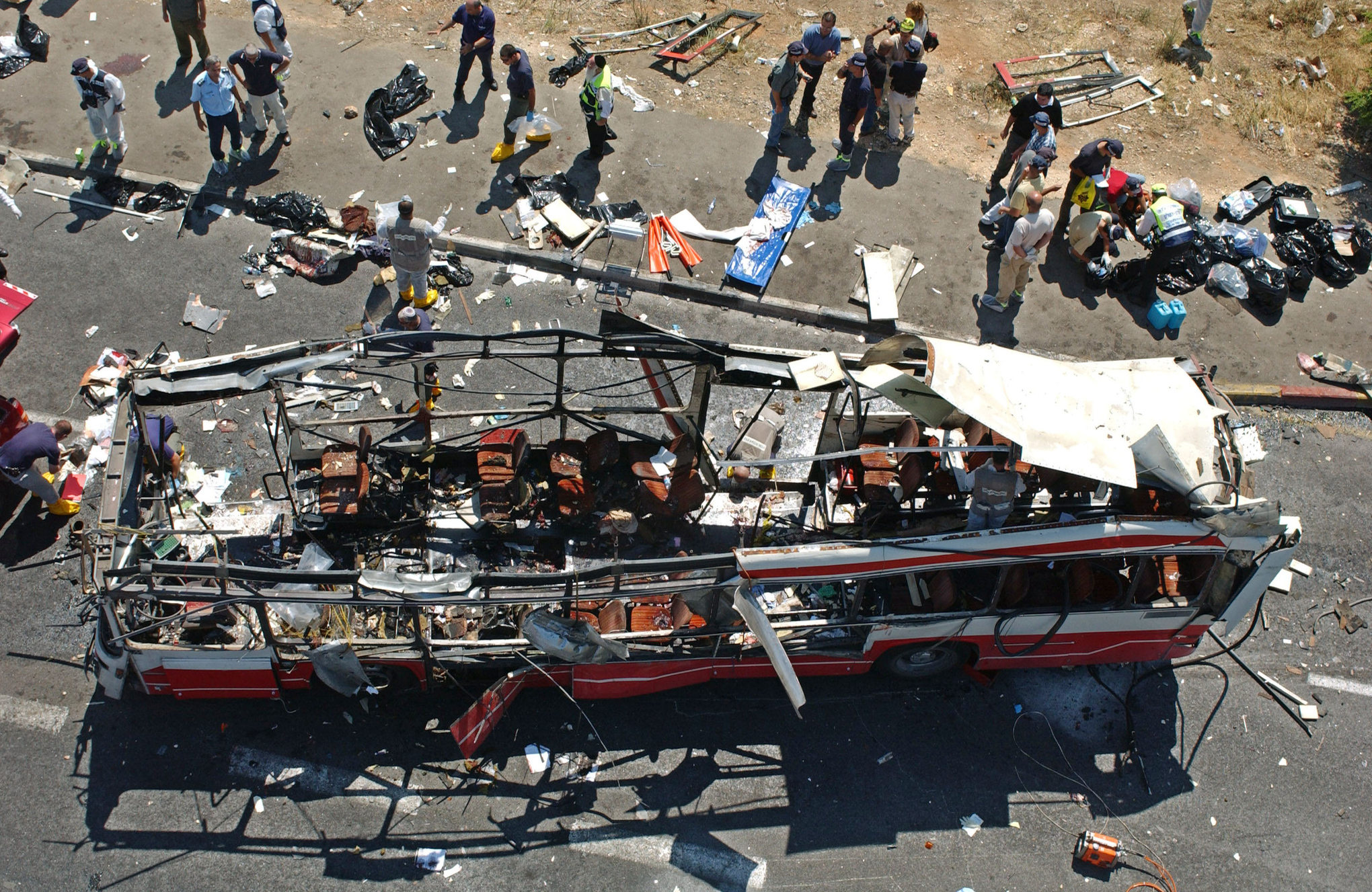
A 2002 bus bombing in Jerusalem that killed 18 (Getty Images)

B'Tselem began tracking these numbers when the Second Intifada, or second mass Palestinian uprising against the Israeli occupation, began in September 2000. And you can see that reflected in the numbers of deaths of Israelis as well as Palestinians.

The Second Intifada included riots, large-scale clashes, bus bombings and other acts of terrorism against Israelis, Israeli targeted killings against Palestinians, and perhaps most costly of all large-scale Israeli military assaults. This is when Israeli deaths hit their peak, with 283 killed in a five-month run from February through June of 2002. Even then, though, Palestinian deaths were much higher, with 659 killed over that same period. This is the closest that Israeli and Palestinian deaths have gotten to symmetrical, and still more than twice as many Palestinians were killed than Israelis.

Israeli deaths dropped in 2005 and have stayed low since

57168937

A Palestinian woman carries her daughter near the Israeli wall surrounding Bethlehem (Paula Bronstein/Getty Images)

That is when Israel, fed up with the violence of the Second Intifada, responded in part by dramatically increasing the size and number of walls separating Israeli from Palestinian territory. Israel also withdrew its military and all settlers from Gaza, which is the smaller of the two Palestinian territories.

Both of these actions did a lot to remove Israelis from harm's way, which you can see reflected in the dramatic — and sustained — reduction in Israeli deaths. But they did not end the conflict, especially not for Palestinians, who continued to be killed in large numbers even after the Second Intifada felt like it had ended for most Israelis.

the west bank walls and gaza withdrawal reduce israeli deaths, but perpetuate the conflict

These two Israeli changes — installing more walls and withdrawing from Gaza — have also done their share to perpetuate the conflict. They drastically deepened the physical and metaphorical barriers between Israelis and Palestinians, further raising the pain of occupation for Palestinians and making it easier for Israelis to accept the conflict as status quo, and thus less likely to elect governments that will take risks for a long-term peace deal.

After the withdrawal from Gaza, the terrorist group Hamas took power there and has held it since, using the territory as a base for regular rocket attacks against Israel. While those rocket attacks do not in themselves cause nearly as many deaths as the violence of the Second Intifada, they are part of the conflict between Israel and Gaza-based militant Palestinian groups that occasionally flares up to cause massive numbers of Palestinian deaths, as is happening this week.

Incidents of very numerous Palestinian deaths have increased

156655584

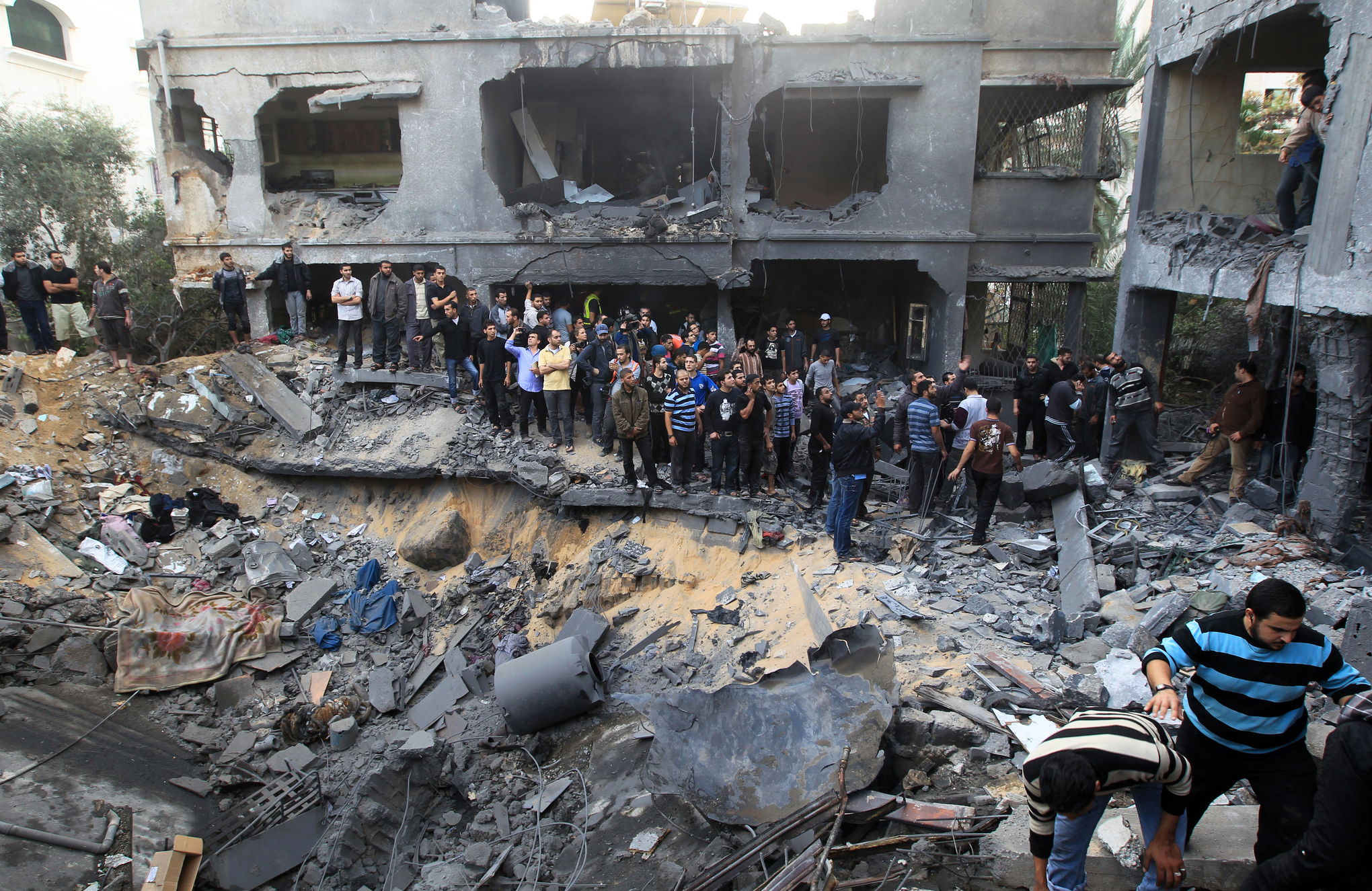
Palestinians gather near the rubble of a Gaza City home destroyed by a 2012 Israeli air strike, killing seven family members including four children (MAHMUD HAMS/AFP/Getty Images)

Since 2005, the conflict has settled into a new pattern: fewer Palestinian deaths during "calm" months with occasional spikes into catastrophic numbers of Palestinians killed.

These spikes, of which the chart shows four since 2005, are all times when Israeli forces attacked Gaza, where Israel was targeting Hamas and other militant groups but also ended up killing large numbers of Palestinians civilians. In mid-2006, form June through November, Israeli forces invaded Gaza as part of Operation Summer Rains, which was sparked by Palestinian rocket fire into Israel and by the kidnapping of Israeli soldier Gilad Shalit, who was released five years later.

this approach is sometimes called 'cutting the grass'; it is never-ending by design

In late 2008 and early 2009, Israel again invaded Gaza as part of Operation Cast Lead, which caused only 13 Israeli deaths but ended with well over 1,000 Palestinians killed and devastated the Gaza Strip. Those two months were by far the deadliest for Palestinians since B'Tselem began tracking in 2000.

Israel launched extended bombing campaigns in Gaza in late 2012 and again this month, both of which have killed dozens of Palestinians. While Israeli strikes are targeting Hamas and other militant groups that are firing rockets into Israel, a local UN office estimated on Friday that 77 percent of people killed in Gaza up to that point were civilians, including 30 children. A separate UN agency estimated on Sunday that 70 percent of the killed were civilians, including 27 children.

The conflict is settling into a terrible cycle

127502977

A woman walks with her baby past graffiti in Gaza City (MAHMUD HAMS/AFP/Getty Images)

You can see the pattern of the last several years clearly on the top chart: the conflict remains at a relatively low level until, every couple of years, it flares up with heavy Israeli strikes on Gaza that also cost a large number of Palestinian lives. This status quo, on net, clearly causes a large number of Palestinian lives. But it kills very few Israelis, which is a big part of why Israeli voters and leaders have appeared willing to accept it.

This Israeli strategy is sometimes described as "cutting the grass." In this thinking, Israel never really solves the conflict or even tries; it tolerates a level of violence from Gaza-based militant groups, but every few years bombs and maybe invades Gaza to weaken militants there and destroy their weapons – to cut the grass. It treats the Israel-Palestine conflict, at least as it pertains to Gaza, as something to be managed rather than solved.

It is important to stress that this strategy is not one that ever produces peace or that is designed to lead to a solution. It accepts a low level of Israeli deaths from rocket fire, and occasionally dozens or hundreds of Palestinian deaths from air strikes, as status quo.

Correction: This post initially reported erroneous fatality statistics. I had misread B'Tselem's data tables in a way that significantly under-counted Israeli deaths, as well as some Palestinian deaths. The charts and statistics in this post have been corrected to reflect the accurate count. I regret the error and thank Philip Klein of the Washington Examiner for pointing it out to me.

11 Jul 22:05

Sapphire phone displays are tough, but the realities are even tougher

by Brad Molen

Sapphire is the birthstone of September, the traditional gift on your 45th wedding anniversary and a material associated with both luxury and ruggedness. It can be found in opulent products like jewelry, camera lenses and fancy watches. Given that, it's also one of the toughest materials in the world, which makes it ideal for military-grade items like aviation displays and even missiles. So when rumors emerged that a sapphire display may be featured on the next iPhone, a chorus of excitement followed. However, many phone manufacturers don't share the same sense of optimism that Apple might hold toward this different kind of next-gen display.

Earlier this week, YouTube vlogger Marques Brownlee showed what appears to be a sapphire display for the next iPhone. While the use of sapphire won't be confirmed (or denied) by Apple until the product is released, the idea that it would want to use the material in its next flagship smartphone isn't too hard to believe: The company announced late last year that it partnered with leading sapphire producer GT Advanced Technologies to build a manufacturing facility in Arizona. And according to a report from 9to5mac, the deal included enough new equipment to make around 100 million to 200 million iPhone-sized displays per year.

There's one major reason why manufacturers are looking into using sapphire displays: The material is strong. Very strong. Sapphire is about four times as tough as glass. Gorilla Glass, regularly found protecting current smartphone screens, fares pretty well against hard objects too, but in order to scratch sapphire, you'd need to find something higher than nine on the Mohs scale -- a system of measurement used to rate mineral hardness from one to 10, with 10 being the highest. (For comparison, Gorilla Glass rates a seven; sandpaper is a nine; and diamond is a 10)

It's no coincidence that existing sapphire display phones are incredibly expensive.

Using sapphire instead of glass for a smartphone display isn't a groundbreaking concept. The material is already used in the (admittedly far smaller) protective glass covering the iPhone camera, as well as the 5s home button (for Touch ID); and luxury brands like Vertu, Savelli and TAG Heuer use sapphire displays in their existing phones. However, it's no coincidence that existing sapphire display phones are incredibly expensive -- manufacturing sapphire is time-intensive, limited by available quantity and very costly. The price of sapphire camera lens covers is 2.6 times higher than glass. On a large phone display, the difference in cost is even higher; last year, GT Advanced reps estimated the cost for a pane of Gorilla Glass at $3, while sapphire was around $30.

I reached out to multiple representatives from major smartphone players and while most companies I talked to had already researched and analyzed the possibility of using sapphire, their impressions were much more lukewarm than I expected. "The cost and supply aren't where we'd like them to be for sapphire to be practical just yet," said Ken Hong, Global Communications Director for LG. "Sapphire's durability and scratch-resistance are certainly attractive, but Gorilla Glass isn't going to be displaced anytime soon."

"Right now, the cost doesn't justify the nominal benefit of sapphire over Gorilla Glass"

There are plenty of other issues associated with sapphire. It's heavier than Gorilla Glass and the material remains less transparent than glass, meaning it would be more difficult to see the screen unless manufacturers add a special coating to increase transparency. (Even then, it still wouldn't be as good as glass.) Additionally, each representative I talked to confirmed that while sapphire is durable, it certainly isn't unbreakable. In fact, the larger the display is, the more brittle it becomes; "The sapphire is too hard to withstand bending," said a representative of a top-tier phone maker who also asked to remain anonymous. "It's easier to break during drop tests when the size of sapphire increases."

Another representative replied, "In a cost-benefit analysis, I doubt [using sapphire] makes sense, unless there is some perceived marketing advantage." Despite the potential downfalls of using such a material, that's exactly what Apple would be gunning for by using the display in the iPhone: marketing power. Sapphire's got a solid reputation; if the new iPhone features the same material used in premium watches, necklaces and earrings, and the company can throw it in without raising the price to consumers, Apple has a great new way to distinguish itself from the competition.

Only large companies with enough resources and bargaining power will be able to secure enough sapphire for mass production.

Even if other phone makers wanted to use sapphire displays, it would be difficult for them to secure enough inventory due to a very limited supply -- a problem that the iPhone maker has avoided. "Apple uses its massive cash hoard to fund big upfront commitments for key components," said Jan Dawson, chief analyst at Jackdaw Research. "[It's] something that almost every other OEM but Samsung will struggle to do." In other words, only large companies with enough resources and bargaining power will be able to secure enough sapphire for mass production.

This doesn't mean that sapphire displays won't be embraced in the future; they might just come in a different form. We wouldn't be too surprised if multiple hardware manufacturers decided to use the material on smartwatches for now, since the screens -- and the number of devices to build -- would be much smaller and thus more affordable than smartphones. (The Moto 360, for example, is rumored to have a sapphire screen.) Then, as supply goes up and production becomes more cost-efficient, more doors may open for phone makers who want to give sapphire a shot.

Filed under: Cellphones, Wireless, Mobile, Apple, LG

Comments

11 Jul 11:07

Timeghost

'Hello, Ghostbusters?' 'ooOOoooo people born years after that movie came out are having a second chiiiild right now ooOoooOoo'
10 Jul 17:50

Yes, Of Course: Grim Fandango Remaster Confirmed For PC

by Alice O'Connor

Cheer up, it's not the end of the world.

When Double Fine announced during E3 that they were remastering Grim Fandango for release on PlayStations, they carefully hemmed and hawed around saying it’ll be coming to PC too. “Talk about other platforms soon!” Tim Schafer cried, saying something very enthusiastic about working with Sony before leaping out a window and running for the hills. But obviously it will, right? Of course it will. Today Double Fine announced they’ll release their jazzed-up version of the lovely LucasArts adventure game for PC, Mac and Linux alongside the Sonybox versions.

… [visit site to read more]

09 Jul 18:18

That painful Brazil vs. Germany World Cup match was the most tweeted-about sports game ever

by Dana Wollman
FBL-WC-2014-BRA-FANS

Maybe you overheard your coworkers bellowing from down the hall. Maybe you follow lots of sports fans on Twitter. Or maybe you saw a link to that Sad Brazilians Tumblr. The point is: Yesterday's 7-1 Germany vs. Brazil World Cup match was so painful, that you didn't even have to be watching to know Brazil was getting destroyed on its home turf. As it turns out, you probably didn't need to be watching to join the discussion, either. According to Twitter, there were 35.6 million tweets about the match at last count, making it the most-talked-about sports game on the social network ever. And yes, that's "most-discussed sports game, period," not just the most-discussed football match. Which makes sense: This was no ordinary game. Germany became the first team to score five goals in the first 29 minutes of a World Cup match, and its total of seven goals is also the most scored ever during a World Cup semi-finals face-off. Just goes to show that the people like goals as much as they enjoy embarrassing losses.

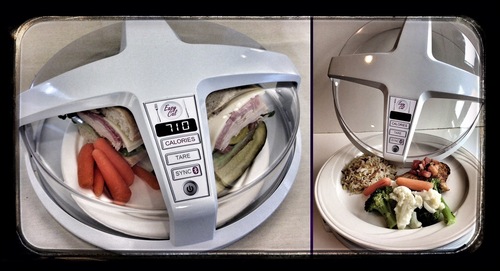
Image credit: Getty

With 35.6 million Tweets, #BRA v #GER is the most-discussed single sports game ever on Twitter. #WorldCup pic.twitter.com/pRjssAZmhg

- Twitter Data (@TwitterData) July 9, 2014

Comments

Source: Twitter Data

09 Jul 14:37

The CIA claims it doesn't know where Tupac is

by David Pierce

The CIA is really good at Twitter. And on its one-month anniversary with the service, "the Nation's first line of defense" spent a few minutes answering the most popular questions it's received during its short and glorious run. Most of the answers are pretty mundane: yes, the CIA is hiring, and it won't be following Ellen Degeneres any time soon. But there's one tweet that finally answers the important question, the one we've all been asking since 1996.

No, we don’t know where Tupac is. #twitterversary

— CIA (@CIA) July 7, 2014

This newly talkative side of the CIA is great, but all this "revelation" does is raise more questions. Did the CIA once have, and then lose, Tupac? Is Tupac a Shawshank Redemption-style escape artist who found his way out of CIA custody and remains on the lam somewhere? Is he currently collaborating with Dr. Dre on Detox? Does Tupac use Tupac holograms as a means of diversion while he escapes? Is the Tupac hologram really just Tupac, hiding in plain sight?

Here, in case you were wondering (and apparently you were), are the rest of the responses to Twitter's burning questions for the CIA. The Twitterversary was a good, enlightening experience, but maybe next time we'll get real answers.

Thanks for making our first month on @Twitter great! Today we take 10 mins to answer 5 of the top questions you’ve asked. #twitterversary

— CIA (@CIA) July 7, 2014

No, we don’t know your password, so we can’t send it to you. #sorrynotsorry #twitterversary

— CIA (@CIA) July 7, 2014

YES, we are hiring. http://t.co/008Lvn9fWJ #twitterversary

— CIA (@CIA) July 7, 2014

Sorry for not following you back @TheEllenShow. But if you visit us maybe we can take a selfie? #twitterversary

— CIA (@CIA) July 7, 2014

We flew an A-12 OXCART, not a SR-71 BLACKBIRD. Ours flew higher & faster. But, more on that later. #twitterversary pic.twitter.com/jLSCsn9RYn

— CIA (@CIA) July 7, 2014

09 Jul 14:26

Finally: Someone Mixed Dota 2 And Mario Kart

You can try the mod for yourself right now, but it’s still quite early. Here’s a quick description of what you’re in for:

09 Jul 11:26

GE is building a microwave that counts calories

by Andrew Webster

Your next microwave might be able to measure how healthy your food is. Researchers at General Electric have developed a device that can quickly measure the calories in your food by utilizing just three pieces of information: fat content, water content, and weight. From this data its able to approximate the calories of your meal, and the team at GE Research is hoping to eventually incorporate the technology into appliances like microwaves.

The catch is that the prototype currently only works with blended foods — it analyzes meals by passing low-energy microwaves trough them, and as of now the food needs to be uniform throughout to get an accurate reading. That makes it ideal for liquids or purees, but the next step is to get it working with solid food, so that it's useful to people who aren't on a juice diet. The goal is to be able to scan a meal in just one or two seconds.


Tumblr_inline_n811o6f9qn1qzgziy

A mockup of a potential calorie-counting device from GE

While the quality of calorie-counting gadgets to date has been largely disappointing, the new tech has the potential to be much more useful by giving you a more complete picture of what you're about to eat. "We're looking at waves that pass all the way through the food," GE Research senior scientist Matt Webster tells MIT Technology Review.

The device was inspired by Webster's wife, who was unimpressed by the current state of health gadgets, and wanted something that could automatically track calories. "I am working on my wife's dream present," says Webster. And if it ever makes it into commercial products, it could be the perfect compliment to your smart fork.

09 Jul 11:18

The biggest e-sports tournament ever starts today and you can watch for free

by Andrew Webster

Starting today the best Dota 2 players in the world will be competing for an insane prize pool of more than $10 million. And whether you're a fan or just someone looking to learn what e-sports are all about, there are plenty of ways to watch — and it's completely free. The event is being streamed at Dota2.com, and it all starts with the first day of playoffs today. There's a standard live broadcast complete with commentary and analysis, but also a new "spoiler-free DVR" stream that lets you catch the matches at your own pace, in case you aren't able to check it out in real-time.

For Dota 2 junkies who need to watch every moment, there's also the international multicast, which lets you stream four games at once, perfect during the busy early rounds. According to Valve, the multicast will combine "all the interesting games, unexpected picks, big team fights, catastrophic misses and clutch plays into one package, complete with commentary and desk analysis." Finally, for those who have a tough time getting past the jargon-heavy commentary in the regular streams, the tournament is introducing a newcomers stream, which is aimed at easing potential new fans into the experience.

It all starts at noon EST today, and runs through to the grand finals on July 21st — so there's lots of Dota 2 action in your future.

09 Jul 10:38

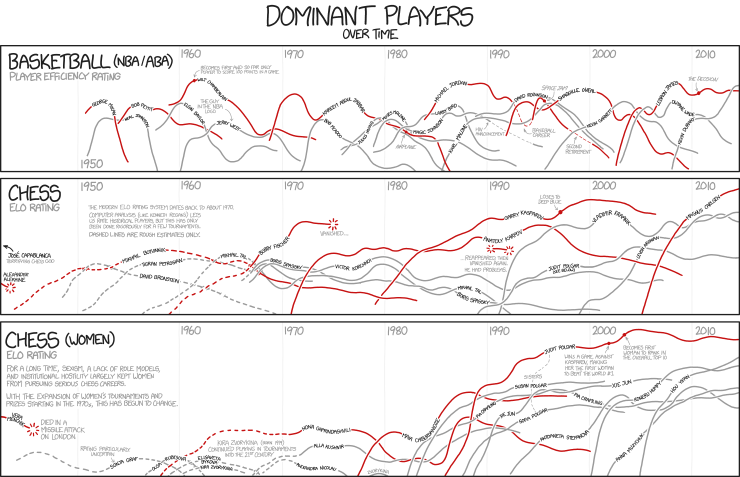
Dominant Players

When Vera Menchik entered a 1929 tournament, a male competitor mocked her by suggesting that a special 'Vera Menchik Club' would be created for any player who lost to her. When the tournament began, he promptly became the first member of said club, and over the years it accumulated a large and illustrious roster.
09 Jul 07:52

Comic: Marxio Kart

by tycho@penny-arcade.com (Tycho)
New Comic: Marxio Kart
08 Jul 18:21

Kids react to Game Boy ⊟ You can watch kids giving their...

by ericisawesome


Kids react to Game Boy ⊟

You can watch kids giving their impressions on the antiquated handheld right after the break. It’s what you’d expect — young’ns flabbergasted by the old tech and surprised it was ever able to find success.

Even going into it expecting the worst, I wasn’t prepared for how much it would hurt when one of the teens dismisses the Game Boy with “It’s not like there’s going to be any amazing games on it.” Had to walk a few circles around the room, fists clenched and muttering to no one in particular, before I could convince myself not to tool up and roll out.

The video (GIF is via Fried Rice Sunday, by the way):

At least cats still appreciate the Game Boy.

BUY Game Boy games, upcoming releases