Shared posts

03 Aug 17:43

GIF your favorite movie quotes with Quotacle

by Cassandra Khaw

A site called Quotacle might revolutionize the way you whip out movie quotes in an online discussion. It is a searchable repository consisting of over 250,000 lines from 143 movies. What makes it unique is that each entry comes with an embeddable clip showcasing the precise quote, and the ability to transform that moment into a GIF. Currently still in beta, Quoctacle also reveals which references are most popular on the site, while offering the option to procure a random quote from the existing library. It's clear that more work needs to be done, however. The search feature is still extremely rudimentary and the Quotacle database is woefully sparse compared to existing movie quote search engines like Subzin or even Amazon's IMDb.

03 Aug 15:36

Core i3 and i7 Surface Pro 3 now shipping to US and Canada

by Billy Steele

In addition to the $999 Intel Core i5-equipped Surface Pro 3, Core i3 and Core i7 options are now on sale in the US and Canada. Starting at $799, selecting the i3 nets you 64GB of storage while devices outfitted with an i7 processor tout either 256GB or 512GB of space at $1,549 and $1,949 respectively. Of course, that significant investment nets you a 12-inch display, Windows 8.1 and the ability to tack on Type Cover or Pen to further boost productivity.

Filed under: Tablets, Microsoft

Comments

Source: Microsoft

03 Aug 15:03

PlayStation Now Rental Prices vs. Buying Full Games

by no-reply@gamespot.com (Alex Newhouse)

With PlayStation Now, Sony has created an instant, on demand service for video games. It provides access to some of the PlayStation 3 catalog to PlayStation 4 and Sony TV owners, effectively giving the PS4 backwards compatibility. It's a service with hundreds of titles that you can jump into and play without having to wait for them to download.

Today, the service transitioned into open beta and we got a look at the collection of games offered. There's no subscription option for PS Now; each game is priced individually for several different rental periods. But we noticed that, for some games, it would be cheaper to buy the game used than to rent it through PS Now. To put the rental prices into context, we chose several notable games, found the lowest price to buy each game, and determined how much PS Now rental time that same amount of money will get you.

Game Lowest Price to Buy How Much Rental Time Will This Buy?
Killzone 3 $4.99 used at GameStop

4 hours for $2.99

Dead Rising 2 $7.69 used
at Amazon
7 days for $5.99
Metal Gear Solid 4 $6.99 used at GameStop 4 hours for $4.99
Catherine $13.82 used at Amazon 30 days for $7.99
Darksiders II $15.35 used at Amazon 30 days for $14.99
Zone of the Enders HD Collection $13.10 used at Amazon 7 days for $9.99
Deus Ex: Human Revolution + DLC $6.82 used at Walmart
without DLC
4 hours for $4.99
Guacamelee! + DLC $14.99 download
on PS4 with extra story content
90 days for $14.99
F1 2013 $39.99 new at Amazon 30 days for $22.99 + 7 days for $11.99

Of course, Sony has stated that the service is still in beta and that these prices will change before its full release. In a recent interview with GameSpot, the company revealed that it would implement a $1.99 price point during the beta for an unspecified rental period. Also notable is that, even though Sony showed off The Last of Us running through PS Now, it was not available to rent at the time of this writing.

What do you think of PlayStation Now's current prices? Let us know in the comments!

Alex Newhouse is an editorial intern at GameSpot, and you can follow him on Twitter @alexbnewhouse
Got a news tip or want to contact us directly? Email news@gamespot.com
02 Aug 18:41

EA Founder on VR: I Don't Want to Put on Goggles and Then Spill My Beer

by no-reply@gamespot.com (Eddie Makuch)
Yousef Alnafjan

#firstworldproblems

Electronic Arts founder Trip Hawkins isn't too thrilled with the idea of virtual reality, specifically the way in which the technology--like Oculus Rift--forces you to wear goggles. In doing so, you become disconnected with the physical world around you, which can lead to a number of practical issues, Hawkins told GameSpot.

"Personally, I'm not really a big fan of goggles. I don't really think that it's necessary," Hawkins said. "Having to put on glasses is kind of annoying and alienating. If I'm in my home, playing games, I don't want to knock my beer over, I don't want to not be able to find my phone if it rings; I don't want to not be able to make eye contact with other people in the room, you know?"

"You see in the movie industry, every decade or two they try to cram 3D into the movie theater and nobody really cares" -- Trip Hawkins

Hawkins likened the virtual reality industry to what we have already seen play out in the movie business for years, without great success. "You see in the movie industry, every decade or two they try to cram 3D into the movie theater and nobody really cares," he said.

Hawkins isn't the only well-known game industry person to pour cold water on Oculus Rift and virtual reality in general. Strauss Zelnick, CEO of Grand Theft Auto parent company Take-Two Interactive, questions virtual reality's mainstream appeal and thinks the technology is "anti-social." In addition, Doom creator John Romero said recently that he thinks virtual reality could just be a fad. It's important to note, however, that both Zelnick and Romero say they are excited about the future of virtual reality, even if they don't see it gaining mainstream success.

We have reached out to Oculus VR for a response to Hawkins' comments and will update this story with anything we hear back.

Trip Hawkins

Hawkins' current project is If Game, an education-themed iOS title that aims to offer children a fun way to learn social and emotional skills in a fantasy world. Speaking with Hawkins this week about the project, I asked him if virtual reality technology like Oculus Rift could be a good fit for his game. I wondered if, at least in theory, virtual reality could allow children to more deeply immerse themselves in the learning adventure. Despite his personal disinterest in virtual reality, he didn't disagree with my premise.

"If we're talking about an immersive fantasy where you're trying to project yourself into the equivalent of an interactive movie, I think it's actually one of the better use-cases for technology like Oculus Rift," Hawkins said. "If I really want to be immersed in a sophisticated, real-life situation, then it makes the most sense."

By no means is this a confirmation that If Game is going to add Oculus Rift support. Introducing such a feature would be particularly problematic from a technical standpoint, too, considering Oculus Rift is a PC-focused peripheral at the moment. It may not be that way forever, though, as Oculus Rift designer John Carmack is currently working on a way to bring Oculus to mobiles.

Virtual reality technology has been a major talking point in 2014, thanks to investments in the space from two major companies. In March, Sony revealed its own virtual reality headset, Project Morpheus; just a week later, social networking behemoth Facebook announced that it had acquired Oculus VR for $2 billion. Neither Sony nor Oculus VR is saying yet when its respective headset will go on sale and what it will cost. Oculus VR does sell a special, developer-focused Oculus Rift headset, but this $350 unit is not the final consumer version.

We will have more from our interview with Hawkins about his new education-themed efforts in the days ahead.

Eddie Makuch is a news editor at GameSpot, and you can follow him on Twitter @EddieMakuch
Got a news tip or want to contact us directly? Email news@gamespot.com
01 Aug 17:48

Here's the full text of the deleted Times of Israel post backing genocide in Gaza

by Max Fisher

The English-language Israeli publication Times of Israel today published, and then quickly deleted, a blog post by the writer Yochanan Gordon with the extremely inflammatory headline "When Genocide is Permissible." The post does not explicitly endorse the genocide of Palestinians, but it asks if doing so would be morally justified after building up the case it would be and presenting only evidence in the affirmative.

Screen_shot_2014-08-01_at_12.05.15_pm

"What other way then is there to deal with an enemy of this nature other than obliterate them completely?" Gordon asks. And later, arguing that Hamas will never accept peace and that Israel is justified in doing anything necessary to impose it, "If political leaders and military experts determine that the only way to achieve its goal of sustaining quiet is through genocide is it then permissible to achieve those responsible goals?"

We've preserved the full text of the now-deleted blog post below; you can read it for yourself. This is not because Gordon himself is a particularly influential writer, much less a political leader of any kind, but because this post represents an extreme iteration of a much broader problem, in which the conflict and the discourse around it exacerbates and empowers extremism on both sides of the conversation. There is real social science behind this phenomenon, which pushes the politics of the conflict away from peace and toward more hard-line positions, as well as raising voices that de-humanize the "other side" in a way that makes it easier to perpetuate the fighting.

Again, this post is obviously an extreme position, which is why the Times of Israel deleted it, but it is most unusual not for his argument for the plain-stated clumsiness of it. Both the Israeli far-right and Palestinian militant groups will at times advocate for the absolute elimination of the other side from the land; they just know how to do it in a way that won't raise so many eyebrows.

Judging by the numbers of casualties on both sides in this almost one-month old war one would be led to the conclusion that Israel has resorted to disproportionate means in fighting a far less- capable enemy. That is as far as what meets the eye. But, it's now obvious that the US and the UN are completely out of touch with the nature of this foe and are therefore not qualified to dictate or enforce the rules of this war - because when it comes to terror there is much more than meets the eye.

I wasn't aware of this, but it seems that the nature of warfare has undergone a major shift over the years. Where wars were usually waged to defeat the opposing side, today it seems - and judging by the number of foul calls it would indicate - that today's wars are fought to a draw. I mean, whoever heard of a timeout in war? An NBA Basketball game allows six timeouts for each team during the course of a game, but last I checked this is a war! We are at war with an enemy whose charter calls for the annihilation of our people. Nothing, then, can be considered disproportionate when we are fighting for our very right to live.

The sad reality is that Israel gets it, but its hands are being tied by world leaders who over the past six years have insisted they are such good friends with the Jewish state, that they know more regarding its interests than even they do. But there's going to have to come a time where Israel feels threatened enough where it has no other choice but to defy international warnings - because this is life or death.

Most of the reports coming from Gazan officials and leaders since the start of this operation have been either largely exaggerated or patently false. The truth is, it's not their fault, falsehood and deceit is part of the very fabric of who they are and that will never change. Still however, despite their propensity to lie, when your enemy tells you that they are bent on your destruction you believe them. Similarly, when Khaled Meshal declares that no physical damage to Gaza will dampen their morale or weaken their resolve - they have to be believed. Our sage Gedalia the son of Achikam was given intelligence that Yishmael Ben Nesanyah was plotting to kill him. However, in his piety or rather naiveté Gedalia dismissed the report as a random act of gossip and paid no attention to it. To this day, the day following Rosh Hashana is commemorated as a fast day in the memory of Gedalia who was killed in cold blood on the second day of Rosh Hashana during the meal. They say the definition of insanity is repeating the same mistakes over and over. History is there to teach us lessons and the lesson here is that when your enemy swears to destroy you - you take him seriously.

Hamas has stated forthrightly that it idealizes death as much as Israel celebrates life. What other way then is there to deal with an enemy of this nature other than obliterate them completely?

News anchors such as those from CNN, BBC and Al-Jazeera have not missed an opportunity to point out the majority of innocent civilians who have lost their lives as a result of this war. But anyone who lives with rocket launchers installed or terror tunnels burrowed in or around the vicinity of their home cannot be considered an innocent civilian. If you'll counter, that Hamas has been seen abusing civilians who have attempted to leave their homes in response to Israeli warnings to leave - well then, your beginning to come to terms with the nature of this enemy which should automatically cause the rules of standard warfare to be suspended.

Everyone agrees that Israel has the right to defend itself as well as the right to exercise that right. Secretary General Ban Ki Moon has declared it, Obama and Kerry have clearly stated that no one could be expected to sit idle as thousands of rockets rain down on the heads of its citizens, placing them in clear and present danger. It seems then that the only point of contention is regarding the measure of punishment meted out in this situation.

I will conclude with a question for all the humanitarians out there. Prime Minister Benjamin Netanyahu clearly stated at the outset of this incursion that his objective is to restore a sustainable quiet for the citizens of Israel. We have already established that it is the responsibility of every government to ensure the safety and security of its people. If political leaders and military experts determine that the only way to achieve its goal of sustaining quiet is through genocide is it then permissible to achieve those responsible goals?

01 Aug 05:50

Seems like Game Boy graduated just the other day ⊟ And now...

by ericisawesome


Seems like Game Boy graduated just the other day ⊟

And now it’s 25! Oh, how time flies. :oP

This photo comes from photographer Laura Greenfield’s book Fast Forward: Growing Up in the Shadow of Hollywood.

BUY Game Boy games, upcoming releases
31 Jul 17:00

Sony Said No To PS4 EA Access Program Because It's Not "Good Value" for PlayStation Fans

by no-reply@gamespot.com (Eddie Makuch)
Yousef Alnafjan

"A subscription to EA Access at $5/month or $30/year gets you unlimited access to games included in what EA calls The Vault, as well as discounts on digital content [including full games], and [free] access to upcoming games five days before they are released to the general population."

https://twitter.com/KazHiraiCEO/status/494561953525022720

Electronic Arts' recent announcement of EA Access, a Netflix-style program for Xbox One that allows you to pay $5 per month for unlimited access to a library of games, caught some off guard because it was only confirmed for Microsoft's console. As it turns out, Sony considered this program, but declined because the company felt it did not offer a strong enough value for PlayStation gamers.

"We evaluated the EA Access subscription offering and decided that it does not bring the kind of value PlayStation customers have come to expect," a Sony representative told GameSpot in a statement originally obtained by Game Informer.

According to Sony, PlayStation fans are more interested in subscription plans that give them access to a wide range of services, unlike EA Access, which will only offer up Electronic Arts games. "PlayStation Plus memberships are up more than 200% since the launch of PlayStation 4, which shows that gamers are looking for memberships that offer a multitude of services, across various devices, for one low price," the representative said. "We don't think asking our fans to pay an additional $5 a month for this EA-specific program represents good value to the PlayStation gamer."

A subscription to EA Access at $5/month or $30/year gets you unlimited access to games included in what EA calls The Vault, as well as discounts on digital content for EA games, and access to upcoming games five days before they are released to the general population. EA Access is currently in beta, and the current lineup of games includes titles like FIFA 14, Madden NFL 25, Battlefield 4, and Peggle 2. The service is expected to roll out to the everyone later on this summer.

EA Access is potentially damaging to GameStop, as it encourages digital spending. However, GameStop will sell EA Access memberships in its stores, and even though the retailer's stock value tumbled after yesterday's announcement, analysts say it's too early to know if EA Access will have a meaningful impact on GameStop's business.

Eddie Makuch is a news editor at GameSpot, and you can follow him on Twitter @EddieMakuch
Got a news tip or want to contact us directly? Email news@gamespot.com
31 Jul 16:57

Announcing the Chrome 64-bit Beta Channel for Windows!

by Daniel xie
Yousef Alnafjan

Finally!

The Chrome Team is excited to announce the addition of the Chrome 64-bit Beta Channel for Windows 7 and 8 users. To try it out, download the 64-bit installer from our Beta download pages. The new version replaces the existing version while preserving all your settings and bookmarks, so there’s no need to uninstall a current installation of Chrome.

A full list of changes is available in the SVN log. Interested in switching release channels? Find out how. If you find a new issue, please let us know by filing a bug.

Daniel Xie
Google Chrome
31 Jul 05:37

UN spokesperson breaks into tears following a live interview

Yousef Alnafjan

This is after a UN school was bombed in Gaza

30 Jul 17:18

Modbook will let you convert your Retina MacBook Pro to a tablet for $1,999

by Zach Honig
Yousef Alnafjan

Kill it! Kill it with fire!

Modbook, the company behind those aftermarket Apple tablets, just launched a Kickstarter campaign for its latest product, the Modbook Pro X. After paying a pre-order price of $1,999 today, backers will be able to convert their own Retina MacBook Pros into a tablet beginning early next year. The conversion incorporates the laptop's original hardware, with components shifted from the lower half of the computer to just behind the 15.4-inch 2,880 x 1,800-pixel LCD.

The Modbook Pro X supports pen input with 2,048 pressure levels, along with tilt and rotate functionality. You can also interact with the device using the rear-mounted shortcut keys or the detachable keyboard stand, both of which will be available for an additional cost. And, since your Apple warranty won't be valid, you can purchase a three-year warranty through Modbook, which provides complete coverage for the first year free of charge. If you'd prefer to avoid supplying your own MacBook, you'll also be able to pre-order a complete device from $3,999 and up, depending on the model.

Filed under: Laptops, Tablets, Apple

Comments

Source: Modbook (Kickstarter)

30 Jul 15:50

Why I have become more pessimistic about Israel

by Ezra Klein
Yousef Alnafjan

"The daily humiliations and hopelessness of life under the Israeli occupation (or, in Gaza, the blockade) radicalize the next generation of Palestinians — as well as others in the region who identify with them"

"I have become less pro-Israel," admits Jonathan Chait in a powerful piece for New York Magazine. But I don't think Chait has become less pro-Israel. I think he's become more pessimistic about Israeli policy. And so have I.

He's become more depressed about Israel. And so have I.

Chait and I used to argue a lot about Israel, in part, I think, because we disagreed about what it meant to be pro-Israel. In his post, Chait gives his definition: "a sympathy for the country's history vis-à-vis its critics, or an ongoing support for its political stance in relation to its international foes." I don't equate support for Israel with support for the current policies of any particular Israeli government, any more than I equate support for America with support for the particular policies of President Bush or President Obama. My definition of being pro-Israel was always more basic, and, admittedly, more subjective: I want to see Israel succeed. I want to see it thrive. And that makes this moment in Israeli history painful to watch.

The state of Israel is supposed to make Jews safer. But Israel itself is terrifyingly vulnerable: it is home to 6 million Jews in a tiny sliver of land surrounded on all sides by enemies. Israel is a fortress built in hostile territory. Its survival, and its strength today, is something of a miracle. But the nightmares are easy to conjure: the Six-Day War ending another way, or a dirty bomb detonating in Tel Aviv.

Israel's political ideals are similarly imperiled: it is a liberal democracy that intends to remain a Jewish state. The problem is that Jews might become a minority in the territory they control (though there's disagreement about the demographic projections behind that fear), and even if they don't, liberal democracies do not deprive millions of their native residents of a say in their government.

The continued growth of the settlements is morally indefensible, but it's also deeply counterproductive

Israel's problems aren't easy to solve — and Israel cannot solve them without moderate leadership in Palestine and the region. But in recent years Israel seems to be making its problems insoluble. The continued growth of the settlements is morally indefensible, but it's also deeply counterproductive: every Israeli home built in the West Bank makes a two-state solution that much harder. Israel's peace movement has collapsed, and its government has become more bellicose and aggressive: Avigdor Lieberman's presence in the cabinet is painful proof that Israel's fear is outpacing its hope.

The excuse used to be that Israel did not have a partner for peace, and that was true. But it's clear today that Israel itself is not much of a partner for peace, either. As Chait writes, the best account of the recent talks show that "Netanyahu appeared on several occasions to approach the brink of agreement, but pulled back in the face of right-wing pressure within his coalition."

452892740

The Gaza Strip's only power plant was forced to shut down Tuesday after an Israeli attack hit the facility's fuel depot on July 29,2014. Even before the shutdown, Palestinians in the Gaza Strip only had electricity for about three hours a day because fighting had damaged power lines.(Photo by Ashraf Amra/Anadolu Agency/Getty Images)

Israel's other problem is the way it wields its overwhelming military superiority. Hamas is an indefensible organization led by fanatics and murderers. But it's no conspiracy that the nightly news around the world shows so many lifeless Palestinian bodies; it's the bloody reality. In this conflict, around 100 Palestinian civilians have died for every civilian Israeli casualty. More than 200 of the Palestinians killed were children. The answer to this, of course, is not more Israeli dead; it's a more proportionate Israeli reprisal that leaves fewer Palestinian casualties in its wake.

It is impossible to credit Israel's promise that it makes every effort to avoid civilian deaths while so many Palestinian civilians are dying. Hamas's strategy of launching rockets from civilian areas and hiding weapons in schools makes it culpable in these deaths. But Israel chooses the force of its campaign, and a strategy based on unleashing air strikes in a crowded city makes civilian casualties an inevitability. The brutality of Hamas's tactics doesn't justify the brutality of Israel's response.

a strategy based on unleashing air strikes in a crowded city makes civilian deaths an inevitability.

Netanyahu's aim, in part, is simple punishment: "Hamas will pay a heavy price for firing at Israeli citizens," he warned. The deeper plan is to crush Hamas's tunnels and cripple their supply lines. But while Israel's wrath weakens Hamas operationally, it strengthens them — and other extremists — politically. No Palestinian man who watched his daughter die in an Israeli air strike will moderate his politics. Each Palestinian boy who loses his home to an Israeli bulldozer will be that much more open to the promises of radicals. Meanwhile, Israel loses support around the world.

This is something Netanyahu knows full well. He has lamented the benefits Hamas derives from, in his cruel phrase, "telegenically dead Palestinians." But he continues the air strikes. He keeps making Palestine's extremists stronger and its moderates weaker. And there is no obvious next step; no compelling story for how it gets better. Chait expresses the feeling well:

Netanyahu and his coalition have no strategy of their own except endless counterinsurgency against the backdrop of a steadily deteriorating diplomatic position within the world and an inexorable demographic decline. The operation in Gaza is not Netanyahu's strategy in excess; it is Netanyahu's strategy in its entirety. The liberal Zionist, two-state vision with which I identify, which once commanded a mainstream position within Israeli political life, has been relegated to a left-wing rump within it.

This is true when the bombs aren't flying as well. The daily humiliations and hopelessness of life under the Israeli occupation (or, in Gaza, the blockade) radicalize the next generation of Palestinians — as well as others in the region who identify with them, or whose governments cynically use the Palestinian plight to drum up support. Israel may not have a much better choice than grasping security now even if it leads to more and more dangerous threats later. But it doesn't seem to be looking for another choice, either. And as Jeffrey Goldberg writes (in a piece, I should say, that's more sympathetic to Israel's operation in Gaza than this one is), there are other choices:

Israel, while combating the extremists, could do a great deal more to buttress the moderates. This would mean, in practical terms, working as hard as possible to build wealth and hope on the West Bank. A moderate-minded Palestinian who watches Israel expand its settlements on lands that most of the world believes should fall within the borders of a future Palestinian state might legitimately come to doubt Israel's intentions. Reversing the settlement project, and moving the West Bank toward eventual independence, would not only give Palestinians hope, but it would convince Israel's sometimes-ambivalent friends that it truly seeks peace, and that it treats extremists differently than it treats moderates.

There's been an important debate recently about whether the media is "biased" towards Israel. I won't speak for the media, but I definitely am biased towards Israel. My grandparents took me there when I was a child. I spent a week there with my best friend after I graduated college. I have friends there. I have family holding tickets to go there. I care about Israel personally, rather than abstractly.

Israel seems to have made its choice, at least for now

There's an opposite argument that's made by Israel's supporters: that people like me, who write about our disappointment with Israeli policy, are "blaming Israel first." But it's not about blame. If interest in geopolitics was driven by outrage and horror Israel and Palestine would spend less time on the front page. The suffering there is immense, but the death toll is dwarfed by the slaughter in the Democratic Republic of Congo or Syria. I pay unusual attention to what Israel does because, for family and cultural reasons, I am unusually invested in Israel. Focusing on Israeli policy is a byproduct of focusing on Israel itself.

For these reasons, I used to write about Israel often. It felt, even a few years ago, that peace was a live possibility, that Israel had choices — and that some of them might even turn out well. But Israel seems to have made its choice, at least for now, and the results are painful to watch. I haven't become less pro-Israel. But I've become much more pessimistic about its prospects, and more confused and occasionally horrified by its policies. My sense is that's happened to Chait, too. I notice he writes about Israel less these days, also. My sense is it's happened to a lot of us.

30 Jul 15:28

Are kids born with an innate belief in God?

by Brandon Ambrosino

What if children didn't have to be taught to believe in God? What if they were born with that ready-made belief somewhere embedded in their minds?

That's the thesis of a 2012 book by psychologist Justin L. Barrett called Born Believers. Barrett, currently a researcher at Fuller Theological Seminary, has spent his career researching children and religious belief. After observing that children tend to believe that the world has order and purpose, he came to the conclusion that kids are born with a tendency toward thinking that there is some sort of supernatural agent behind this order. Or, as he put it to me over the phone, "children have a number of natural dispositions to religious beliefs of various sorts." And while he believes that these dispositions can "certainly be overridden by certain kinds of cultural and educational environments," he thinks the research shows that a child's cognitive "playing field is tilted toward religious beliefs."

A new study out earlier this year, however, pushes against Barrett's conclusion. Published in the July issue of Cognitive Science, the article presents findings that seem to show that children's beliefs in the supernatural are the result of their education. Further, argue the researchers, "exposure to religious ideas has a powerful impact on children's differentiation between reality and fiction." In other words, said Kathleen Corriveau, one of the study's co-authors, the study found that childhood exposure to religious ideas may influence children's "conception of what could actually happen." She also told me her research suggests that Barrett's Born Believers thesis is wrong — that children don't possess an "innate bias" toward religious belief.

Here's how Corriveau and her colleagues conducted their research. They gave a total of 66 kindergartners three different narratives: 1) religious, 2) historical, and 3) fantastical. An example of 1) was telling kids the story of Moses parting the Red Sea so the Israelites could walk through on dry land. They then changed that story in two ways. For the "historical" version 2) they told the same story of Moses and the Israelites crossing the Red Sea, but they took out all the references to God and miracles: Moses crossed the water in a boat. For the "fantastical" version 3) God was replaced with some other fantasy mechanism.

All across the board, children thought the historical narratives were true. When it came to religious stories, predictably children raised in religious settings classified them as true, while kids raised in secular setting classified them as fictional. What was most interesting to Corriveau, however, was how children classified the fantastical story: while secular children classified it as pretend 87 percent of the time, religious children only did so about 40 percent of the time. To Corriveau, this suggests that "religious children have a broader conception of what can actually happen." In other words, she told me, "religious exposure may influence the way in which children mark the boundary between factual and fictional, allowing for a more likely suspension of disbelief."

So is that a bad thing? "Not necessarily," says Corriveau. "In many learning situations, what this might mean is that religious children might be more willing to accept seemingly counterintuitive phenomena in ways that secular children might not." It also might mean, she notes, that religious children have broader conceptual frameworks, and might have a "better ability to engage in unexpected outcomes."

Barrett agrees with Corriveau on that point, noting that there's real value with allowing children to experiment with the conceptual boundaries of what's real and what's not. According to him, the question "what if things were different?" is an important part of the learning process. "It sure looks like that's the backbone of innovation, creativity, and all kinds of problem-solving in the world, both artistic and scientific." As Paul Harris, one of the study's co-authors, wrote in the Wall Street Journal, "The imagination is absolutely vital for contemplating reality, not just those things we take to be mere fantasy."

Some, however, might decide Corriveau's findings offer a compelling argument against religious education. The Raw Story's reaction to the study was that "Children exposed to religion have difficulty distinguishing fact from fiction." And discussing the study yesterday in an article titled Is religion good for children?Slate's Mark Joseph Stern seemed to answer his own question in the negative: "When you've been told that a woman was created from a man's rib, or that a man reawakened three days postmortem little worse for wear, your grasp on reality is bound to take a hit."

Corriveau acknowledges that some might read the study "and conclude, 'Therefore, don't expose children to religion!'" But again, she notes, her findings are neutral. (Barrett goes one further and says that interpretations like Stern's are an "abuse of the data.") Exposing kids to religion "isn't good or bad," says Corriveau. "It's just important to recognize that a domain of knowledge like religion could influence what children are bringing to the table when they're learning about science or history." Corriveau pointed out that a 2008 Pew survey shows that the vast majority of families claim some sort of religious affiliation.

"I wonder," Barrett suggested, "if the real story here is that the non-religious kids are the peculiar ones." Barrett thinks it's important to note that the research for Corriveau's study was conducted in Massachusetts, which contains one of the highest concentrations of non-believers in the US. Barrett wonders if the secular kids Corriveau found are really representative of the average American child. "These kids [in this study] are probably being raised in a very peculiar kind of way, different than the vast majority of kids."

In recent years, some non-religious adults have taken a hardline stance against religious education, arguing, like Richard Dawkins, that it's "pernicious to inculcate into a child a view of the world which includes supernaturalism." Instead, says Dawkins, we should be instilling in children a healthy degree of skepticism, teaching them that it's "too statistically improbable" for a prince to turn into a frog.

For Dawkins and those with similar views, the indoctrination of children involves teaching them to believe in God. But as Barrett asked me, what if the indoctrination involves teaching children not to believe in God?

You don't know which is the figure and which is the ground here. The assumption is, you grow up in a religious home, you get an indoctrination that distorts your view of reality. What if it's just other way around? That the small minority of kids who are not growing up in religious families are being told repeatedly, about anything remotely unusual, "Oh, you know that's impossible, right?"

All kids, whether or not they're growing up in religious settings, are being influenced in some way, Barrett said. Whether they learn from their Sunday school teacher that Jonah was swallowed by a whale, or whether they learn from Stern that religion "requires us to buy into fantasies," the fact is that all of their conceptual frameworks are being influenced by the adults around them.

Says Barrett, "We shouldn't pretend just because [some kids] go to a parochial school or are part of a religious family, that they're being inculturated and public school kids aren't. Of course, they're all being inculturated — they're just being inculturated differently."

]]>
30 Jul 12:55

The mystery at the heart of the Gaza crisis: did Hamas really kill 3 Israeli students?

by Max Fisher

On June 13, three teenage Israelis went missing in the West Bank, where they were studying at a religious school. They were later found shot to death. Their murders, which the Israeli government blamed on the Palestinian militant group Hamas, eventually led to the Israel-Gaza fighting that has already killed over 1,000 Palestinians and almost 50 Israelis.

But is the Israel-Gaza conflict premised on a lie, or at least a mistake? You may have read reports over the weekend suggesting as much: that Hamas actually did not murder the three Israelis, that they were in fact killed by a "lone cell." If true, many have argued, the murders would be somewhat akin to the Iraqi weapons of mass destruction that served as justification for the 2003 US-led invasion but never materialized. It would be a huge scandal.

There is somewhat more ambiguity to this story, though, than what you may have read — both in terms of the evidence about the Israeli boys' killers and about how their deaths fit into the conflict still ongoing today.

The Israeli police official has since walked back his claim

80663518

Israeli police chief Micky Rosenfeld, left, shows Jimmy Carter the remains of Hamas rockets in 2009 (DAVID BUIMOVITCH/AFP/Getty Images)

The story was set off by Israeli police spokesman Micky Rosenfeld, who told BuzzFeed's Sheera Frenkel and the BBC's Jon Donnison that the murders had been committed by a "lone cell" that was affiliated with Hamas but not acting under Hamas orders. He went on to explain that lone cells are very difficult for the Israeli police to track because they communicate less.

Both Frenkel and Donnison tweeted the quotes, which received widespread attention. It is not clear whether Rosenfeld was speaking for himself or for the entire Israeli police organization. But he was very clearly not speaking for the entire Israeli government, which maintains that it sees Hamas as responsible.

On Sunday, the Daily Beast's Eli Lake called up Rosenfeld to ask him about it, and the police spokesman would not confirm the story:

Rosenfeld said that he had told Donnison what the Israeli government had been saying all along. "The kidnapping and murder of the teens was carried out by Hamas terrorists from the Hebron area," he told The Daily Beast. "The security organizations are continuing to search for the murderers."

It seems next to impossible to imagine that either Frenkel or Donnison would fabricate or exaggerate the quotes, much less that both would happen to fabricate such similar statements. It seems most likely that Rosenfeld has decided to walk back the claim, which may help explain why neither Frenkel nor Donnison appear to have written articles about the quotes.

There's always been ambiguity over whether Hamas killed the three Israelis

451563402

Mourners gather for a funeral for the three Israeli students killed in the West Bank (DAVID BUIMOVITCH/AFP/Getty Images)

From the beginning, there has been uncertainty and disagreement on this question; Friday's revelation only furthers that uncertainty.

Israeli Prime Minister Benjamin Netanyahu has been insisting since the beginning that the murders were the work of Hamas and that the entire group was responsible.

For just as long, though, a small number of Israeli officials have being going off the reservation, saying that the killings were more likely done by loners who may have been Hamas members but were acting on their own. BuzzFeed's Frenkel has been especially good at fleshing out this ambiguity, pointing to signs that it was a "crime of opportunity" not sanctioned or ordered by Hamas leadership.

A month ago, when Israeli intelligence released the name of the Palestinian family it believes was behind the attack, Al-Monitor's Shlomi Eldar profiled the family's long history of going rogue from Hamas, staging attacks during times of Hamas-sanctioned ceasefire in order undermine the group's efforts at even the most basic compromise.

The murders always looked a bit off for a Hamas operation. The group has a record of coordinated attacks — like the series of million-dollar tunnels it used recently to insert fighters, disguised as Israeli soldiers, within rural Israel — and such a ham-fisted, one-off incident looked out of character. It also seemed strange that Israel's vaunted signals intelligence programs were not able to pick up chatter beforehand.

On the other hand, Hamas has used and encouraged kidnapping in the past. It is, after all, a terrorist organization that targets Israeli civilians. And its leaders, though they denied responsibility for the attack, still praised it. We have tried to reflect this ambiguity and uncertainty in our coverage, as have a number of other outlets.

Rosenfeld's statements deepen the doubt as to whether Hamas was really responsible, and indicate further that there is likely disagreement within the Israeli government over this question. That is significant on its own and should shed doubt on Netanyahu's statements asserting with total certainty that Hamas is responsible. But we are nowhere near the point where we can say definitively that Hamas was or was not responsible.

Netanyahu has been accused of exploiting the deaths to go after Hamas

452731016

Netanyahu, right, meets with the defense minister and chief of staff (Ariel Harmoni/ Israel Minister of Defense via Getty Images)

One reason that there has been some wariness around Netanyahu's categorical insistence that Hamas was responsible for the deaths is that he very quickly responded, in what looked like at least a degree of opportunism, by arresting hundreds of people in the West Bank thought or known to be associated with Hamas. Israel also launched a limited bombing campaign — small, relative to what came later — against targets in Gaza.

Within a couple of weeks, Netanyahu dismantled Hamas in the West Bank — at no small cost to Palestinian civilians whose lives were disrupted in the sweeps and arrests — which he framed as a response to the murders.

did netanyahu really plan to invade gaza all along?

It would be an understatement to say that Netanyahu distrusts Hamas, and he has good reason to — it is a terrorist group committed to Israel's destruction. But Hamas is also, as of earlier this summer, supporting a Palestinian unity government with the West Bank-based moderate party Fatah. The US has supported the Hamas-Fatah deal as a step toward peace negotiations. Netanyahu has opposed it as empowering terrorists. The arrests have had the effect of undermining the unity deal.

So Netanyahu got two things he wanted pretty quickly: rounding up Hamas members in mass arrests, and weakening the unity government. He justified these actions by blaming Hamas for the murdered students. So if it turns out that Hamas did not kill them, or just that Netanyahu was aware of any uncertainty within Israeli intelligence, then that's a big deal and very damning.

Here's why it's not accurate to say Netanyahu used the murders to invade Gaza

452833316

An Israeli tank along the border with Gaza (DAVID BUIMOVITCH/AFP/Getty Images)

Some have argued that Netanyahu's placement of blame for the murders on Hamas led directly not just to the West Bank raids, but to the current war in Gaza. This is both true and not true.

It is accurate that the crisis began with the murders of the three Israeli students and has since snowballed into the Israel-Gaza crisis. But it was not a straight line. And, unlike the Israeli mass arrests in the West Bank, it is not totally clear that Netanyahu wanted to invade Gaza from the get-go. In other words, it is not fair to say that Netanyahu used the murders in order to justify the Gaza war; the one did not lead so simply into the other. The Iraq/WMDs comparison is not accurate.

the structure of the conflict makes periodic invasions all but inevitable

There were some big steps between the murders and the Gaza invasion that were outside of Netanyahu's control. First, Israeli right-wing extremists murdered a Palestinian teenager in Jerusalem, in apparent "revenge" for the deaths of the students. Then, Palestinians in the West Bank, outraged over the murder and over the arrests, protested. Eventually outrage boiled over and Hamas launched 40 rockets from Gaza into Israel, the first time it had done so and taken responsibility since 2012.

Israel responded with more air strikes, Hamas responded with more rockets, and both escalated for several days. The war began, Israel says, when it discovered Hamas tunnels running from Gaza to Israel that it had attempted to use to attack Israelis. Israel invaded to destroy the tunnels and Hamas "infrastructure" more broadly.

In order to say that Netanyahu blamed Hamas for the Palestinians murders in order to invade Gaza, as President George W. Bush premised his Iraq invasion on Iraqi weapons of mass destruction, two things would have to be true.

First, Netanyahu would have had to have planned the sequence of events from the beginning such that he would get to invade Gaza; the Middle East is rife with conspiracy theories but unless Netanyahu secretly controls Hamas, Israeli extremist gangs, and Palestinian protesters, he did not plan this. It seems much likelier that things gradually escalated out of control until both sides were sucked into war.

Second, Netanyahu would have had to have wanted to invade Gaza. You don't devise an elaborate conspiracy to do something, after all, unless you actually want to do it. This is ultimately a question of Netanyahu's personal internal motivation, which I will not claim to know. For whatever it's worth, an American veteran of the Israel-Palestine peace process named Aaron David Miller wrote in the Washington Post that he believes Netanyahu did not want or seek the war. Maybe, maybe not.

The real scandal is that another Israeli invasion of Gaza was probably inevitable anyway

452833932

A cemetery in Gaza City (Mustafa Hassona/Anadolu Agency/Getty Images)

If you want to get angry about something, get angry about this: Israel has for years refused to change its strategy toward Gaza and the larger Israel-Palestine conflict, even though that strategy shows zero indication of yielding sustainable peace and leads Israel to occasionally invade Gaza to weaken anti-Israel groups there.

In this approach, Israel never fully makes peace with Gaza-based militant groups like Hamas, nor does it defeat them outright. The former would require at least an Israel-Palestine peace deal for separate states, which the current government is not really pursuing; the latter would require placing Gaza under a West Bank-style military occupation, which Israel did until it withdrew in 2005 and will likely not do again because it would be a disaster.

This leaves Israel to manage the conflict rather than solve it. In practice, that means tolerating a little bit of rocket fire, but periodically invading Gaza to degrade militant infrastructure and weapon stockpiles. It invaded last in 2009 and, unless Israel can find a way to change its approach (or unless Gaza militant groups unilaterally disarm), it was going to invade again sooner or later.

None of this is to deny that it matters a great deal whether Netanyahu was telling the truth when he blamed Hamas categorically for the murdered students, or whether he was papering over any internal Israeli intelligence disagreement on this question. He used that accusation to justify mass arrests, police sweeps, and other measures in the West Bank. Those events also led, however indirectly and potentially against the wishes of all involved, to a war that has so far killed over 1,000 people.

Still, in a much larger sense, in the view from 50,000 feet above the conflict, what may have mattered even more is that the conflict is structured in such a way that another war was likely going to happen whether Netanyahu blamed Hamas or not. To paraphrase the Brookings analyst Khaled Elgindy, the story here is not so much about the spark as about the kindling.

30 Jul 12:52

John Oliver on America's horrifyingly insecure nuclear arsenal

by Zack Beauchamp

The United States has more than 4,000 nuclear weapons — and is really, really bad at taking care of them. Among other terrifying incidents, a plane flying over North Carolina in 1961 fell apart and accidentally dropped two nuclear bombs over Goldsboro. To this day, the military still uses computers that run giant floppy disks as part of the nuclear launch process.

This darkly funny, deeply terrifying state of affairs is ripe for satire. So watch John Oliver's characteristically clever take in this issue, which includes references to Oregon Trail, War Games, and a bizarrely relevant incident involving a Beatles cover band at a Mexican restaurant in Moscow.


28 Jul 00:41

You can buy your next Dell laptop with Bitcoin

by Billy Steele
Yousef Alnafjan

I almost bought a Surface Pro 3 using Bitcoin from TigerDirect (they don't accept international credit cards), but I found it for the same price from a seller on Amazon (which accepts all credit cards.. hail Bezos!), so I didn't need to bother.

Inside The South By Southwest (SXSW) Interactive Festival

If you fancy nabbing new tech by leveraging your Bitcoin wallet, another online retailer has just joined the fray. CEO Michael Dell alerted the masses via Twitter that his company would begin accepting the digital currency, claiming that the outfit is "world's largest ecommerce business" to do so. The device maker is partnering with Coinbase to power its transactions, and those looking to snag a new Alienware rig will earn a discount when forking over Bitcoin for payment.

[Photo credit: David Paul Morris/Bloomberg via Getty Images]

Dell is now the world's largest ecommerce business to accept #bitcoin http://t.co/xC41rKTYXi http://t.co/0YqPK7MfVG

- Michael Dell (@MichaelDell) July 18, 2014

Filed under: Desktops, Displays, Laptops, Tablets, Internet, Dell

Comments

Source: @MichaelDell (Twitter), Dell

27 Jul 19:52

Solar 'superstorm' that missed earth in 2012 could have caused massive blackouts

by Dante D'Orazio

Asteroids aren't the only things in space we have to worry about. A massive solar storm emitted from the sun could fry electronics and satellites around the globe, and take down much of the power grid. And such a storm isn't as far-fetched as you might think: according to readings taken from a satellite in earth's orbit, a solar superstorm passed through earth's path on July 23rd, 2012 — if it had struck nine days earlier, our planet would have been right in the crosshairs.

2009 report from the National Academy of Sciences said that such a storm could cause some $2.6 trillion in damage and a full recovery could take years. One researcher who studied data collected from the storm, professor Ying D. Liu of China’s State Key Laboratory of Space Weather, said that repairs could take two to four years. That's mainly because many of the massive transformers that make up the power grid would be taken offline by such a solar storm. Parts for those transformers are very difficult to come by.

Storm could have left 130 million without power

John Kappenmann, a co-author of the National Academy of Sciences' 2009 report, found that a large solar storm could leave 130 million in the dark. Without power, Kappenmann explains that "water distribution [would be] affected within several hours; perishable foods and medications lost in 12-24 hours; loss of heating/air conditioning, sewage disposal, phone service, fuel re-supply, and so on." In addition to damage to the power grid, a storm would shut down satellites and bring GPS and radio systems offline, at least temporarily.

The type of solar storm in question is known as a coronal mass ejection (CME), which occurs when an eruption on the sun shoots magnetized plasma clouds, X-rays, UV radiation, and protons and electrons out into space at extremely high speeds. CMEs are not rare, but the one that occurred on July 23rd, 2012, was particularly potent. Researchers from UC Berkeley concluded that the storm in question was in fact two separate CME events separated by 10 to 15 minutes.

Storm missed earth by nine days

The largest recorded CME to hit earth occurred in 1859; at the time, it sent sparks flying from telegraph wires and produced Northern Lights as far south as Hawaii and Cuba, according to reports. Researcher Daniel Baker from the University of Colorado said in a NASA article that "in my view the July 2012 storm was in all respects at least as strong as the 1859 Carrington event."

Despite the danger posed by such solar storms, the July 23rd event was not quite the "near miss" some news reports have painted it as. The earth was roughly a third of the way around its orbit from the location where the CME struck. Nevertheless, some researchers say that there is as much as a 12 percent chance that a storm the size of the 1859 strike will hit earth in the next decade. If we create better early warning systems, experts say, it may be possible to protect some sensitive electronics from a strike by shielding them or disconnecting them prior to a strike.

26 Jul 13:13

How North Korea got this way

Vox's Max Fisher explains the historical events that produced the bizarre, tragic North Korea we know today.
26 Jul 11:18

Here's the new cast of 'Game of Thrones,' and a blooper reel from last season

by Adi Robertson
Yousef Alnafjan

Spoilers, I guess.

Game of Thrones is a serious show. A very, very serious show, where anyone can die. Except when they're falling off their horses or missing their lines or doing a catchy dance down the carpet. This blooper reel from Season Four opened the Game of Thrones panel at San Diego Comic Con, where we're on the ground live, and it's now online for your edification. But if you're looking for real news from the series, you can watch the video below, introducing the characters who will be coming in Season Five.


Among them is Jonathan Pryce of Brazil fame, who's playing the austere High Sparrow. Here's the rest of the new cast:

  • Doran Martell, played by Alexander Siddig
  • Trystane Martell, played by Toby Sebastian
  • Myrcella Baratheon, played by Nell Tiger Free
  • Areo Hotah, played by DeObia Oparei
  • Yezzan, played by Enzo Cilenti
  • Nymeria Sand, played by Jessica Henwick
  • Tyene Sand, played by Rosabell Laurenti Sellers
  • Obara Sand, played by Keisha Castle-Hughes
26 Jul 09:46

Well, Now We Have to Play Super Smash Bros

by Brad
275
25 Jul 21:37

Why the US has the most pro-Israel foreign policy in the world

by Zack Beauchamp

Everyone knows the United States is Israel's best friend. The US gives Israel billions of dollars in aid annually, consistently blocks UN Security Council resolutions condemning Israel, and backs its military offensives publicly. But why? What's the thinking behind America going above-and-beyond for Israel?

The short version: it's complicated. The long version is that It's a tight interplay of America's long-running Middle East strategy, US public opinion/electoral politics, and a pro-Israel lobbying campaign that is effective, but maybe not as effective as you've heard. Here's a guide to the different factors shaping America's Israel policy — and how they relate to each other.

Since the Cold War, Israel has been the linchpin of American Middle East strategy
1826042

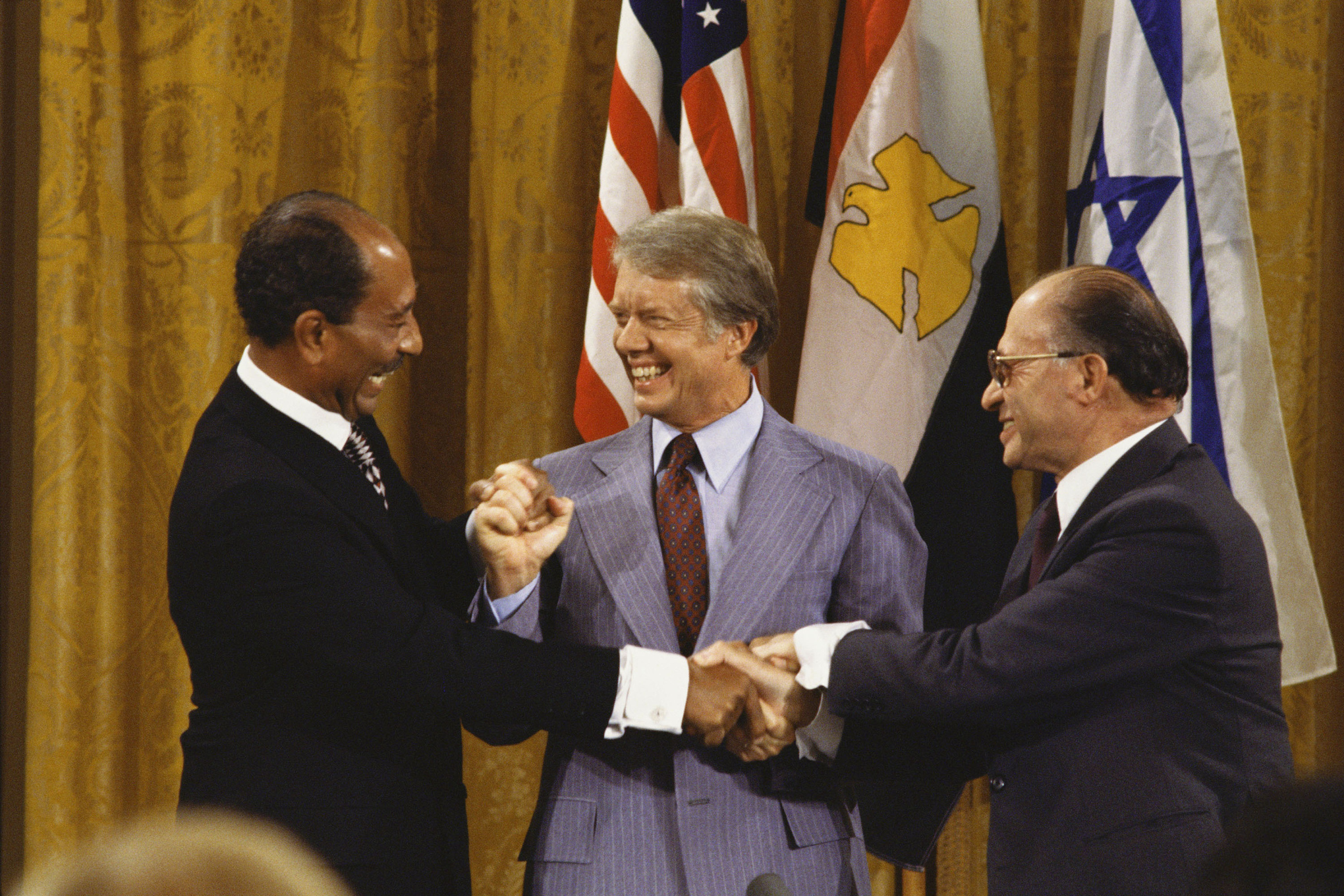
US President Jimmy Carter, Egyptian President Anwar Sadat, and Israeli Prime Minister Menachem Begin shake hands at the Camp David accords that led to an Israeli-Egyptian peace treaty. David Hume Kennerly/Getty Images

The US wasn't always so close with Israel. For instance, when Israel (along with France and Britain) invaded Egypt in 1956, the United States sided against Israel, pushing the invaders to leave. And the US for years opposed, and worked actively against, Israel's clandestine nuclear program. "Stated commitments to [Israel from American policymakers] cannot erase a legacy of US policies that often represented more of a threat than a support to Israeli security," Michael Barnett, George Washington University political scientist, writes.

Even when the US did come to support Israel, it was more about cold strategic calculation than the domestic political support you see today. The US-Israel relationship grew "by leaps and bounds" after 1967, according to Barnett, owing largely to "a changing US containment and strategic posture." American presidents and strategists came to see Israel as a useful tool for containing Soviet influence in the Middle East, which was significant among Arab states, and used diplomatic and military support to weave Israel firmly into the anti-Soviet bloc.

This strategic justification came down with the Berlin Wall. Yet the US aid to Israel kept flowing after the Cold War, as did diplomatic support. What kept it going?

the US approach to the Middle East didn't change that much after the Cold War

For one thing, the US approach to the Middle East didn't change that much after the Cold War. The US became increasingly involved in managing disputes and problems inside the Middle East during the Cold War, and it maintained that role as the world's sole super-power in the 90s. Stability in the Middle East continued to be a major American interest, for a number of reasons that included the global oil market, and the US took on the role as guarantor of regional stability.

That meant the US saw it as strategically worthwhile to support states like Egypt, Saudi Arabia, and Israel, which saw themselves as benefitting from an essentially conservative US approach to Middle Eastern regional politics. Unlike, say, Iran, Syria, and Saddam's Iraq, these countries were basically OK with the status quo in the Middle East. The US also supported the status quo, so it supported them accordingly.

This view of Israel as a "force for stability" helps maintain US support, according to Brent Sasley, a political scientist at the University of Texas, "in the sense that Israel can stabilize what's going on in the Middle East. If there's fear of Jordan being undermined by an internal or external enemy, the United States sometimes turns to Israel to pose a threat to that threat."

America's self-appointed role as manager of the Middle East also landed it the job of Israeli-Palestinian peace broker.

"The parties need a third party," Hussein Ibish, a Senior Fellow at the American Task Force on Palestine, says. "I think there is no other candidate than the United States. There's no other party that's capable, and no other party that's interested."

American policymakers have seen US support for Israel as a way of showing Israel that the US is still taking its interests into account during negotiations, and thus convincing Israel that they can safely engage in peace talks. It's meant to draw the Israelis to the negotiating table, and keep them there.

Together, these strategic factors explain why America's approach to Israel has been broadly consistent for at least the past three administrations. Despite the vast disagreements between the George W. Bush administration versus the Clinton and Obama administrations on foreign policy, they've both supported military and political aid to Israel. And they've both crossed Israel when it wasn't in the US' strategic interests: Bush refused to support an Israeli strike on Iran, and Obama repeatedly clashed with Israeli leaders on West Bank settlements.

All of this isn't to say that American presidents and foreign policy principals are necessarily right to believe these things. It's within the realm of possibility, as some argue, that US support for Israel undermines regional stability and compromises America's status as neutral broker during peace negotiations. The point here isn't to endorse the official US view, but describe the line of thinking that's been so influential in driving the American foreign policy establishment's approach to Israel.

Supporting Israel is good politics in the US

125788135

Jewish and Christian groups rally for Israel in New York. Stan Honda/AFP/Getty Images

US support for Israel isn't just about strategic calculation and foreign policy interests, or at least not anymore. For a long time, at the very least since the 1980s, it's also been about domestic politics and the way American politicians read American voters.

Congressional votes on issues relating to Israel are famously lopsided. The Senate resolution supporting Israel's recent offensives in Gaza passed unanimously, as many "pro-Israel" bills and resolutions do.

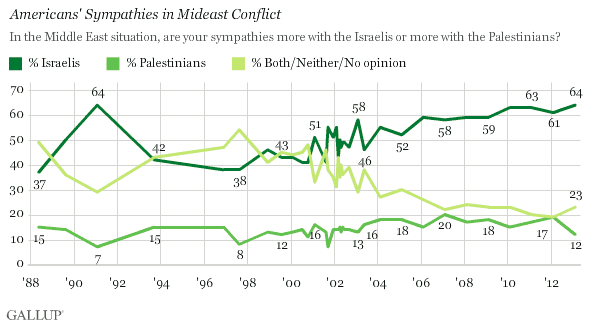
The simplest explanation for these lopsided votes is that supporting Israel is really, really popular among voters. "The single factor most driving the U.S.-Israel relationship appears to be the broad and deep support for Israel among the American public," Israel Institute program director Michael Koplow writes. "The average gap between those holding favorable and unfavorable views of Israel over [the past four administrations] is 31 points."

Indeed, Gallup data since 1988 consistently shows a much higher percentage of Americans sympathizing with Israelis than with Palestinians in the conflict:
Gallup_israel

So it makes sense that Congresspeople would take pretty hard-core pro-Israel stances: it's reasonably popular.

But why is Israel so popular among Americans in the first place? One big reason is a perceived sense of "shared values." According to Barnett, the American moral image of Israel — "the only democracy in the Middle East," for example — is the "foundation of US-Israeli relations." Of course, as Barnett hastens to add, this leaves Israel vulnerable if Americans comes to believe that Israel has strayed from those shared values (more on that in the last section).

Religious groups are two other critically important factors. American Jews and evangelical Christians are two of the most politically engaged groups in the United States. They're major constituencies, respectively, in the Democratic and Republican parties. And both are overwhelmingly pro-Israel.

There are nuances here: evangelical support for Israel tends to be more uncritical than Jewish support. For instance, a majority of reform and secular Jews — 65 percent of the American Jewish population — disapprove of Israel's expansion of West Bank settlements. And Jews under the age of 35 are the least likely to identify as Zionist (though a majority still do). On the other hand, the older and more conservative Jews who aren't entirely representative of the more liberal body of Jewish-American public opinion toward Israel, have a lot of clout with national politicians. They express strong desire to vote based on the Israel issue and are clustered in Florida and Pennsylvania, large swing states in presidential elections.

All that said, Pew data shows overall consistency in American Jewish views on the US-Israel relationship. 54 percent of American Jews think the US supports Israel the right amount — and 31 percent say it doesn't go far enough. By contrast, 31 percent of white evangelicals think the US has reached the right level of support, while 46 percent want the US to support Israel more.

Add evangelicals, Jews, and broad public support together, and you get consistent, bipartisan support for Israel.

There's also a huge pro-Israel lobby — but how effective are they really?

114513527

Obama walks up to speak at an AIPAC conference. Mandel Ngan/AFP/Getty Images.

No account of US-Israel relations can ignore the American Israel Public Affairs Committee — AIPAC for short. AIPAC is America's largest pro-Israel lobby. Surveys of Capitol Hill insiders conducted by Fortune (1997) and National Journal (2005) ranked it the second-most powerful lobbying shop in Washington, after (respectively) the AARP and National Federation of Independent Business. Neither survey is particularly statistically rigorous, so don't take the specific rankings too seriously. And AIPAC loses on plenty of issues. However, the surveys do suggest that AIPAC is perceived as hugely powerful within Washington.

Saying that AIPAC pushes US foreign policy in a more pro-Israel direction isn't controversial. The big, and extremely contentious, question is just how much AIPAC actually matters. Is the group actually steering US politics and foreign policy in a direction it wouldn't go on its own?

AIPAC is an extremely influential lobbying group, but its power is linked to the other sources of US support for Israel

The major flashpoint here is John Mearsheimer and Stephen Walt's The Israel Lobby and American Foreign Policy, which began as an 2006 essay and evolved into a book. The two eminent international relations scholars argued that there's no way to explain the US-Israel relationship, from an IR perspective, other than as AIPAC and its allies pushing the US to act counter to its own interests. They reject that either strategy or shared values fully explain the US support for Israel, so lobbying must. "The unmatched power of the Israel Lobby," Walt and Mearsheimer write, is "the" explanation for America's continued strong support for Israel.

This argument is hugely controversial, including among international relations theorists. Some argued that The Israel Lobby creepily invoked classic anti-Semitic tropes of Jews secretly controlling the government. Others dismissed it as, in one particularly memorable phrase, "piss-poor, monocausal social science."

One of the main criticisms of Walt and Mearsheimer's thesis is that they don't present very much direct evidence that AIPAC lobbying influenced specific votes. Another criticism is that Walt and Mearsheimer premise their thesis on the argument that Israel is neither strategically nor morally worthy of American support, and so policymakers must be supporting Israel because they've been coerced into it by AIPAC, whereas a number of policymakers will tell you they earnestly believe the alliance is worthwhile absent lobbying. Critics also argue that the definition of "Israel Lobby" beyond AIPAC used in the book is so large as to encompass basically the entire American foreign policy establishment.

Whatever you think of this debate, it can be easy to get lost in a binary between "the Israel lobby is all that matters" and "the Israel lobby is irrelevant." What's clearly true is that AIPAC is highly influential, but also that its power is linked to the other sources of US support for Israel; it does well on whipping up support for bills that are already in line with public opinion.

AIPAC doesn't always win. For instance, it lost a major fight in Congress when it pushed for more sanctions on Iran in February 2014; the sanctions were likely designed to kill the ongoing US-Iran nuclear negotiations. AIPAC's influence is a product of financial resources and power, sure, but also of choosing to push for policies that have public support and are consonant with American grand strategy in the Middle East.

Could US support for Israel change?

452318830

A rally against the Gaza offensive in New York. Bilgin S. Sasmaz/Anadolu Agency/Getty Images

It's hard to know where one driver of America's Israel policy ends and another begins. For instance: early in his administration, President Obama pushed Israeli Prime Minister Benjamin Netanyahu to halt settlement growth in the West Bank; Netanyahu resisted this in part by rallying his allies in Congress. Netanyahu's allies in both parties, who are always eager to appear pro-Israel, pressured Obama to drop his anti-settlements push, which he did.

The question here is whether, in this case and others, US foreign policy interests or US domestic politics was ultimately more consequential to driving the US-Israel relationship. For example, would Obama have pushed harder against settlements had Netanyahu not been able to call up so many allies in Congress? Were those members of Congress primarily driven by pure domestic politics, which do favor pro-Israel policies, by an earnest concern that Obama's approach was bad for Israelis, or by a belief that Obama was hurting US foreign policy interests?

In thinking about the future of US-Israel relations, it's much more helpful to examine what might cause these broad-bush factors to change. In simpler terms: is there a scenario under which the US and Israel drift apart?

"US-Israeli relations are dependent upon Israel's having a particular identity"

Barnett, the George Washington University scholar, sees Israel's continued occupation of the West Bank as the greatest threat to the relationship. He notes that, in the early '90s, Congress made a $10 billion loan guarantee conditional on the fact that Israel didn't use any of the money for West Bank settlements. Israel's prime minister, Yitzhak Shamir, tried to fight it, but the Bush administration stood firm. Shamir lost, both in Congress and with the executive, because the Israeli position wasn't consistent with the US vision of a Western, democratic Israel.

"US-Israeli relations," Barnett writes, "are dependent upon Israel's having a particular identity." That may even be true among American Jews, as journalist Peter Beinart argued in an essay almost as controversial as Walt and Mearsheimer's. Beinart argues that Israel's ongoing occupation of the West Bank is already alienating younger and more secular Jews, and that AIPAC and other mainstream Jewish organizations risk losing their broad base of support unless they become more willing to criticize Israel on these points.

Barnett's conclusion only follows if you think "shared values" are the linchpin of US-Israel relations. Maybe the US would still think it's strategically useful to support Israel. Maybe Israel remains popular among certain Christians and the broader public regardless of its Palestinian policy. Maybe AIPAC remains strong enough to keep Congress in line. Maybe Israel comes to an agreement with the Palestinians and Barnett's point becomes moot.

For now, though, there's little evidence that American support for Israel is fundamentally breaking down — whether you think that's a good or bad thing.


25 Jul 09:28

By request: Final Fantasy's 16-bit era

For many people, the 16-bit Final Fantasy games — that is, Final Fantasies IV, V, and VI — represent the definitive essence of what role-playing games should be. And why not? Though not a trilogy in the narrative sense of the word, the series’ Super NES chapters stand apart as a cohesive whole. They work together as a set in a way that you rarely see in games; unmistakably cut from the same cloth, yet each progressing and innovating in its own way.

Squaresoft managed to walk a fine line with these games. Though unified stylistically and mechanically, the trilogy demonstrated a willingness to embrace change… but only where needed. Considering what a revolution Final Fantasy IV represented, it would have been all too easy for Hironobu Sakaguchi, Yoshinori Kitase, et al. to either wipe their hands at the creation of the Active-Time Battle System and say “good enough” or else continue pursuing design innovation. But thankfully, they understood where divergence would be valuable and where it would be detrimental. Final Fantasy V improved on the ATB system and made combat the centerpiece of the adventure while VI dialed back on the complexity and challenge in order to build a larger, more elaborate world and story around the polished mechanics.

140721-ffiv

I think it’s possible to overstate how much Final Fantasy IV changed console RPGs, but you’d really have to work at it. Look at all it did: It introduced the ATB concept that added a time-based component to turn-based mechanics, creating the sensation of a real-time battle system despite the fact that actions and turns were still technically turn-based. The idea of staggering individual turns for characters rather than executing turns by party wasn’t totally new, and it evolved out of the way most turn-based RPGs already worked by 1991. Agility and speed helped determine combat order in most RPGs once commands were queued up for all characters; all FFIV did was change the input process so that instead of issuing commands for every party member in a single go, you directed each party member when his or her turn came up according to that character’s speed stat.

A simple concept, but a brilliant one. Not only did it do away with that hoary old frustration in which multiple warriors would target the same enemy only for the first to kill it and the second to waste a turn attacking empty air, it also made abstract menu-driven combat feel tense and lively. Timing became a key factor in combat, as did knowing the possibilities of your party and the optimal action. Enemies would continue taking turns while you decided on a course of battle, so you needed to think ahead and be ready to change your tactics at a moment’s notice.

And you needed to concentrate in order to keep a mental index of your current skills handy, because — and this was FFIV‘s other big innovation — the game’s plot caused the player’s party to exist in a constant state of flux. Only the protagonist, Cecil Harvey, stood in as a permanent party member… and even then he undertook significant changes himself, completely switching out his skill set and resetting his experience to level 1 midway through the quest. Again, the concept of an RPG whose plot shaped its mechanics wasn’t entirely new, but previous notable examples of the form (Dragon Quest IV, Phantasy Star) didn’t take the idea nearly as far as FFIV.

140721-ffv

On the other hand, Final Fantasy V had the thinnest trifle of a plot, and (barring a single notable yet materially insignificant swap late in the game) its party roster remained consistent throughout the entire adventure. Instead, it revisited the Final Fantasy III Job system in a greatly expanded form, allowing you to reinvent your team on the fly.

Of course, FFIV‘s party had represented an alternate interpretation of the Job system; each of its party members stood in for a different Job. Cecil the Dark Knight, Kain the Dragon Knight, Rosa the White Mage, Rydia the Evoker (later full Summoner), Tellah the Sage, etc., etc. By assigning names and personalities to those class roles, FFIV created a torrid drama. FFV put its characters in the service of the bare-bones plot, resulting a game whose overall feel was more akin to that of a playground for messing around with character builds and combat tactics. Occasionally the game would railroad you into playing one way or another — notably Fork Tower, where the party had to split into two groups and one side could use no magic while the other team could only use magic. Mostly, though, you could slug your way through however you wanted, whether that entailed capturing monsters to unleash on their peers, breaking rods to cast high-level magic, throwing money at bad guys, turning the very elements against the foe, or learning monster spells to cast at will.

In order to put the utter flexibility of the game mechanics to the test, the designers threw in the series’ first proper super-bosses. Don’t get me wrong, Final Fantasy had seen its share of ultra-powerful optional foes before; the Lunar Subterrane of Final Fantasy IV included a couple of nasty extra monsters, and the fight against the top-level summoned beasts could be a strain. But the finite limitations of FFIV‘s party builds in turn limited exactly how over-the-top its battles could go. Not so with FFV, which threw in two insanely difficult fights (Omega and Shinryuu) to put players’ understanding of the play mechanics to the test.

140721-ffvi

And finally, Final Fantasy VI.

Quite simply, FFVI tried to combine the best elements of both FFIV and FFV. Like the former, it featured a huge, revolving cast of characters with specific class traits. Like the latter, it gave every character equal access to a massive array of spells and allowed considerable customization. Like the former, its first half took the form of a linear, character-specific adventure; like the latter, the second half was more of a free-form journey undertaken according to the player’s whims.

FFVI wasn’t entirely perfect, but you can’t fault its scope, or its flexibility, or its visual punch, or its killer soundtrack. Though nowhere near as innovative as FFIV or FFV, it was stunningly polished (glitches caused by ROM size constraints notwithstanding). It was kind of easy, too, but even there Squaresoft did it right: FFVI managed to hit a sweet spot between populist appeal (an epic tale with cool graphics that wasn’t unapproachably difficult) and genuine substance.

Square tried, perhaps unintentionally, to mirror the style and evolution of the Super NES Final Fantasy games with their PlayStation sequels. But with considerably less success, it should be said. There’s just something about this trilogy that worked. I am definitely looking forward to getting to these bad boys over on Anatomy of Games.

25 Jul 05:21

Reeder for The Old Reader

We’re excited to announce that Reeder for iOS and Mac now have support for The Old Reader.  We’ve been anxiously awaiting this new release as we’re big fans of the Reeder app.  If you’re on the iOS or Mac platforms and want a great way to keep up with your feeds in The Old Reader please give this app a look and let us know what you think.  Big thanks to Silvio for adding support and congrats on another great release.

And for users on other platforms, here’s a list of all the other great applications that work with The Old Reader.

24 Jul 14:44

EarthBound - Not Your Typical JRPG

by Ben "Yahtzee" Croshaw

This week, Zero Punctuation reviews EarthBound.
22 Jul 20:01

James Rodríguez: will new galáctico fit into Real Madrid masterplan? | Sid Lowe

by Sid Lowe

Colombian joins Bernabéus star-studded cast but where will Carlo Ancelotti fit in the striker and who will have to make way?
The meteoric rise of a new Colombian football superstar

Not long after Lisbon, Florentino Pérez was asked: what next? The European Cup had just been won, the décima finally raised after a wait that stretched back more than a decade, but appetites are never fully satiated, not even by the trophy that defines Real Madrid. The story must always move on and few doubted that Madrids president wanted to add to the team. Who would be the next galáctico?

Pérez replied there were not many left on the market. There was a certain satisfaction in saying so. How do you improve a European Cup-winning team? Who would even get into this side? And you cannot sign the players you already have. Whatever happened to all the heroes? They came here, thats what. There were not many left out there because Madrid already had so many and those that they do not have, Barcelona do.

Continue reading...
22 Jul 18:59

Pretty Much Every Detail Of NVIDIA's Shield Tablet And Controller Just Leaked

by David Ruddock
Yousef Alnafjan

Not really interested in a gaming tablet, even though the new K1 chip is a monster. No wireless-AC is also a bummer,

NVIDIA-SHIELD-Tablet-2

Just a day after @evleaks dropped a render of the upcoming NVIDIA Shield Tablet, VideoCardz.com (a name only a writer for a site called Android Police is not allowed to make fun of) has burst any bubble the new slate had left to pop - by dropping a massive pile of leaked, high-quality slides. Yep, you're going to get all the details.

The short of it, for those of you in a hurry, is as follows - an 8" 1920x1200 tablet, Tegra K1 quad-core (A15, 32-bit) processor, 2GB of RAM, two models (Wi-Fi 16GB and LTE 32GB), $299 and $399 respectively, on sale in the US July 29th, Europe August 14th, with more regions this fall.

Pretty Much Every Detail Of NVIDIA's Shield Tablet And Controller Just Leaked was written by the awesome team at Android Police.


22 Jul 18:56

Sakurai finally cracked ⊟ Crushed under the weight of endless...

by ericisawesome


Sakurai finally cracked ⊟

Crushed under the weight of endless demands that he include Goku in the new Smash Bros., series director Masahiro Sakurai threw in the Saiyan just to make everyone shut-up about it. In a follow-up Miiverse comment, he added, “And if you kids keep pestering me about SpongeBob and Ridley, so help me god, I am canceling the entire thing.”*

*None of this is actually true — the pic comes from Nentendo, via Nadia Oxford. Here’s today’s real daily Smash Bros. update, which is a neat life drain attack for Robin.

PREORDER Super Smash Bros for Wii U/3DS, upcoming releases
22 Jul 06:30

'Destiny' on PS3 is like the PS4 version but blurrier

by Timothy J. Seppala

While a bunch of the hype surrounding the Destiny beta is how great developer Bungie's latest shooter looks running on the PlayStation 4, gamers on last-gen hardware have been playing through the weekend too. Based on the video that Digital Foundry put together (embedded below), the PlayStation 3 version expectedly doesn't stack up next to its current-gen counterpart, but it doesn't look terrible, either. If I were to describe it in one word, it'd be "softer." The tech-centric outlet notes that while the levels themselves remain the same the overall shape and size, set dressing like foliage and rocks are less dense (and in some cases, completely missing), and lighting is less complex as well. Most impactful, possibly, is the PS3 game's native resolution. While the PS4 version runs at a native 1920x1080, or 1080p, Destiny on Sony's previous console is running at 1024x624 (sub-720p) -- roughly 30 percent the total pixel count of its current-gen cousin.

The biggest victim? Shadow detail, as evidenced in this thread on NeoGAF. The amount of enemies onscreen, however, apparently doesn't drop so there should be parity between the two versions in terms of how the game actually plays.

Considering that the PS3 is almost eight years old at this point, however, it's kind of a miracle that it's even capable of playing something like Destiny to begin with. And given that there are likely well over 80 million PS3s in the wild at this point and, as of April, only seven million PS4s, it makes sense for developers to continue supporting previous hardware. Take this April's Watch Dogs and next year's Mortal Kombat X, for example.

What about you: is Destiny the game you're upgrading to a new console for (maybe even a white PS4), or hasn't anything on Sony's latest or the Xbox One caught your eye yet? The beta is down for maintenance now anyway, so you should have plenty of time to leave us a note!

Filed under: Gaming, Home Entertainment, HD

Comments

Via: Eurogamer

Source: YouTube

21 Jul 21:09

This chart shows every Israeli and Palestinian death since fighting began July 8

by Max Fisher

The fighting between Israeli forces and Gaza-based Palestinian militant groups such as Hamas has killed at least 445 people up through Sunday, of whom 425 are Palestinian. That's according to a tally compiled by the New York Times, gathering from United Nations, Palestinian, and Israeli sources.

Here is the death toll charted out by day since this round of violence began on July 8, with Israeli and Palestinian deaths distinguished:

Screen_shot_2014-07-21_at_11.59.02_am

For the first ten days, the fighting was limited to Israeli air strikes on Gaza and Palestinian rockets fired into Israel. On July 18, Israeli ground forces invaded Gaza, for the first time since early 2009. You can see the death toll increase significantly after that, among Palestinians as well as Israelis.

Deaths from the fighting were overwhelmingly Palestinian before the July 18 ground invasion, which Israel says is to shut down Hamas's system of underground tunnels into Israel (and possibly also its tunnels into Egypt). Two United Nations agencies estimated, in the week before the ground invasion, that 70 to 77 percent of the 160 Palestinian deaths up to that point were civilians.

The previous Israeli ground invasion of Gaza, in 2009, ended with nine Israeli deaths and 1,398 Palestinian deaths, according to the Israeli peace organization B'Tselem. It lasted for 22 days.

We'll keep this chart updated throughout the fighting so check back.

21 Jul 19:53

Evolutionary Tactics

by John

Evolutionary Tactics

I watched some EVO streams this past week and this is what I took away from it
19 Jul 20:43

Video proof of Verizon throttling Netflix

by Dean Putney

In this infuriating video, Colin Nederkoorn records his computer streaming Netflix's test video over his Verizon FiOS connection. Then, via a VPN on the same home network, he receives a nearly ten-times faster stream.

Get out of town. Forcing your internet traffic through a VPN should slow your connection, not speed it up. But here, something (presumably Verizon) is preventing Colin from getting normal speeds without hiding his traffic usage from his provider. So much so that he's installing a router to run all his traffic at home through the VPN.

Read Colin's full post on his test, then go swear vengeance on something. [Video Link, via Waxy] Discuss
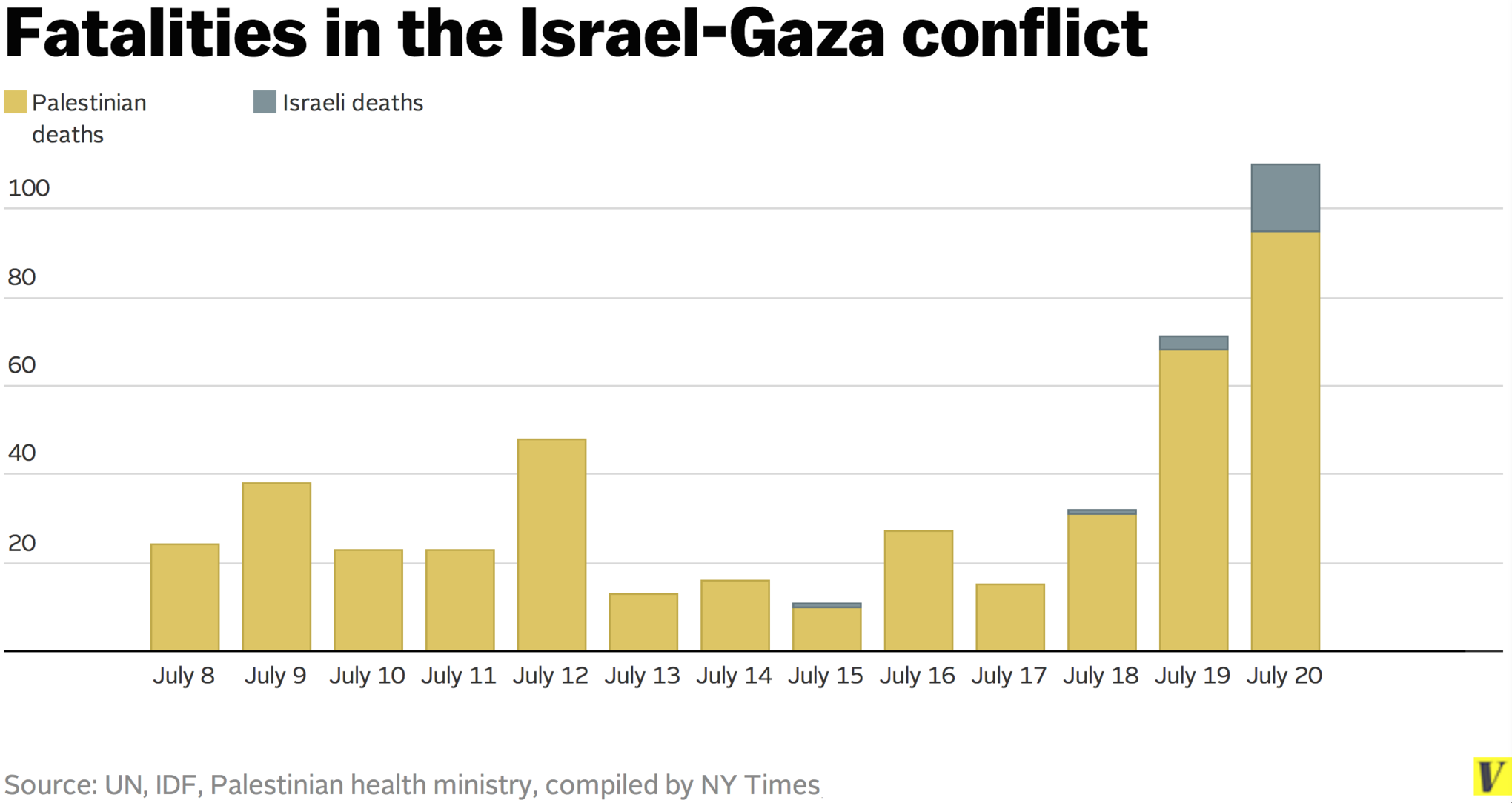
This entry passed through the Full-Text RSS service — if this is your content and you're reading it on someone else's site, please read the FAQ at fivefilters.org/content-only/faq.php#publishers.