Shared posts

19 Jul 12:16

ASCAP's Desire To End Antitrust Agreement Leads DOJ To Investigate Latest Collusion Between Music Publishers

by Mike Masnick
Over the last few months, you may have noticed that ASCAP, BMI and the various music publishers have been pushing strongly to end the so-called "consent decree" around music publishing. This was an agreement from 1941 (and reviewed in 2001) limiting how performance rights organizations like ASCAP and BMI could act, given their position as a somewhat natural monopoly over the compositions they represented. The idea was to stop those companies from holding those works hostage -- which is why there are things like rate setting procedures by the Copyright Royalty Board. Now, we have our problems with the CRB and the rate setting process, but there is a very real fear that ASCAP, BMI and others would make music streaming prohibitively expensive if given the chance. The whole focus on getting rid of the consent decree is to try to remove any effort to block them from jacking up their prices to ridiculous rates.

The attempt to ditch the consent decree seemed especially odd, given that just months earlier, a court had called out the clear collusion by ASCAP and a bunch of music publishers to try to artificially jack up Pandora's rates. The details were a little convoluted, but basically certain publishers "withdrew" certain music from ASCAP, claiming they wanted to negotiate directly with Pandora. They didn't negotiate in good faith, and basically waited right up until the deal was about to expire. They then refused to even name what songs would no longer be covered, leaving Pandora at a very real risk of streaming songs it no longer had the right to (without even knowing which songs were being "pulled.") Because of this, Pandora was forced to sign exorbitantly high rates, which ASCAP and others then used to try to get even higher rates for others. It was clearly collusion, because while ASCAP should have been upset about publishers withdrawing music, it clearly was not. Furthermore, there were clear discussions between ASCAP and the publishers about all of this.

The end result of that case was that ASCAP lost its attempt to really jack up rates to Pandora much higher, but many people wondered how ASCAP could get away with doing that without any sort of punishment. Well... new reports say that the Justice Department is investigating ASCAP, BMI, Universal Music Publishing and Sony/ATV over possible collusion. This is being done as part of the DOJ's review of the consent decree, but ASCAP's decision to attack the consent decree right after a court called it out for collusion may backfire badly:
The CID requests are seeking documentation across a lot of particulars, including the effect of the consent decrees on rates, whether partial withdrawals of digital rights should be allowed, and plans to license other rights beyond the public performance rights that PROs handle today. However, a memo obtained by Billboard that was sent to employees by ASCAP senior VP of legal Richard Reimer began by noting that the CID is connected to the DOJs review of the consent decree. And, as a possible reminder to be careful of what you wish for, the DOJ is also investigating of alleged coordination among ASCAP, BMI, Sony/ATV Music Publishing, and Universal Music Publishing Group.

That aspect of the DOJ investigation was mentioned in a note to ASCAP employees telling them to "preserve all documents, whether in paper or electronic format, on all the CID-related topics."
In the Billboard article, the publishers and ASCAP insist they're not worried about all of this because they believe the judge in the Pandora rate setting case "got it wrong." That's quite a bit of hubris to have, given all of the evidence of collusion that was presented in that case. It seems quite possible that rather than ending the consent decree, as ASCAP and publishers would like, the DOJ may actually come down on all of them for some fairly serious antitrust problems.

Permalink | Comments | Email This Story


16 Jul 14:27

NYPD Tells Brooklyn Officers To Continue Making Low-Level Drug Arrests DA Has Stated He Won't Prosecute

by Tim Cushing
New York's finest, formerly Mayor Bloomberg's Personal Army, has decided it's going to do things its own way, even if it means generating truly meaningless arrests.
The NYPD is telling its officers to keep making the lower-level marijuana busts that they had been, despite a recent memo from Brooklyn DA Kenneth Thompson that his office would no longer prosecute such cases
Yes, no one tells the NYPD what to do, not even the District Attorney. The NYPD's memo -- one that plainly states it will arrest people who will never be prosecuted -- is required reading for Brooklyn precincts for the next 10 days, just to ensure those police officers understand their workday will contain a certain amount of deliberate futility.

On one hand, the memo does contain a good point -- law enforcement should be consistent across all of New York's boroughs. On the other hand, it plainly states that the NYPD is more interested in generating paperwork and empty arrest statistics than approaching the DA's announcement in a more reasonable fashion.

Here's what DA Thompson was hoping to accomplish with his decision to not pursue low-level drug offenders.
The move was intended to "make better use of limited law enforcement resources and to prevent offenders – who are disproportionately young men of color – from being saddled with a criminal record for a minor, non-violent offense," according to a statement.
This could have been seen as an indication of where the department should head -- towards a more reasonable stance on drug enforcement. Instead, it's been viewed as "inconsistency" and responded to with all the obstinance the department is famous for.

DA Thompson's order really doesn't eliminate that many possession arrests. His memo stated that those smoking in public (especially around children), 16-17-year-old offenders (who will be placed into a diversion program) and people with existing criminal records will still be prosecuted. This just leaves mainly the truly harmless: recreational users.

But the War on Drugs is every bit as essential to the NYPD as the War on Terror, and the NYPD (with new chief Bill Bratton's blessing) will continue to make meaningless arrests -- arrests made even more meaningless by DA Thompson's announcement.

If nothing else, this ensures the sort of job security that's usually only touted in sarcastic tones by the deeply cynical. According to the New York Times, arresting recreational users is full-time work for Brooklyn cops.
Over the past 15 years, marijuana arrests in New York have soared, partly because a rising number of stop-and-frisk encounters led to searches of people’s pockets.

There were 8,150 cases in Brooklyn in which the top count was a minor marijuana possession charge in the year ending June 30, according to the memo on Tuesday. Marijuana arrests have decreased during the first six months of this year, compared with the same period in 2013.
That decrease in marijuana arrests is directly related to the decline in stop-and-frisk encounters after a court decision and a new city law curbed this controversial program. It's quite obviously not (the NYPD's directive confirms it) the result of the NYPD shifting its focus to more serious criminal activity.

There's hardly anything more ridiculous than deploying law enforcement officers -- with all their expertise and training -- to bust users of a drug that has been legalized in two states for recreational use and in a host of other states for medical use. There's nothing more ridiculous than sending officers out to bust recreational users and serve them up to a DA who's just going to let them go -- and one that specifically told the department he would not prosecute.

Permalink | Comments | Email This Story


16 Jul 14:24

SpaceX Just Got FAA Approval for Its Very Own Spaceport in Texas! - Well, Texas sure has enough space for it. Get it? OK, I'll stop.

by Dan Van Winkle

orbcomm_f9_in_hanger_0

In today’s edition of “Elon Musk is the Absolute Best,” his commercial spaceflight company, SpaceX, just got approved for its very own Spaceport in Texas! That means SpaceX will have a dedicated place to launch test vehicles, send supplies to the ISS, and keep pushing commercial spaceflight forward.

The need for their own spaceport comes from the long list of private companies and foreign entities SpaceX has on its launch manifest. They’ll continue launching NASA-funded rockets from government facilities in Florida, while the Texas spaceport will take over their private endeavors and space tourism.

The FAA’s “Record of Decision” on the matter approves SpaceX “to launch the Falcon 9 and Falcon Heavy orbital vertical launch vehicles and a variety of reusable suborbital launch vehicles from a launch site on privately owned property in Cameron County, Texas.” Better step up  your game, NASA. Or don’t; it looks like Musk and SpaceX might have everything under control.

(via Space.com and Engadget, image via SpaceX)

Previously in

Are you following The Mary Sue on Twitter, Facebook, Tumblr, Pinterest, & Google +?

15 Jul 15:32

deducecanoe: besturlonhere: dear god we’re all going to...

Matthew

?????????


deducecanoe:

besturlonhere:

dear god we’re all going to die

These idiots run our country

10 Jul 18:17

Aereo: Okay, Fine, If You Say We Look Like A Duck, We'll Quack Like A Duck

by Mike Masnick
In the wake of the Aereo ruling, I'd been meaning to do a post questioning whether or not the ruling had effectively overturned the ruling in the ivi case from a few years earlier. We had seen some people in our comments point out that, following the Aereo ruling, Aereo had an easy solution: just start paying retransmission fees. Except... that's exactly what ivi had tried to do, and the court had shut them down, using almost the opposite reasoning as the Supreme Court. Specifically, the Second Circuit appeals court (the same that had decided in Aereo's favor) ruled that internet services were not cable companies under the law, and couldn't just pay retrans fees:
Congress did not, however, intend for Section 111's compulsory license to extend to Internet transmissions. Indeed, the legislative history indicates that if Congress had intended to extend Section 111's compulsory license to Internet retransmissions, it would have done so expressly -- either through the language of Section 111 as it did for microwave retransmissions or by codifying a separate statutory provision as it did for satellite carriers. See 17 U.S.C. §§ 111, 119.

Extending Section 111's compulsory license to Internet retransmissions, moreover, would not fulfill or further Congress's statutory purpose. Internet retransmission services are not seeking to address issues of reception and remote access to over-the-air television signals. They provide not a local but a nationwide (arguably international) service.

Accordingly, we conclude that Congress did not intend for Section 111's compulsory license to extend to Internet retransmissions.
So, uh, which is it? Aereo has now decided that if the Supreme Court is going to call it a duck for looking like a duck, it's damn well going to quack like a duck too. It has told the lower court that it intends to pay retransmission fees under Section 111, more or less claiming directly that the Supreme Court overruled the ivi ruling. For what it's worth, Aereo's "wacky" (but seriously questionable) "competitor" FilmOn, already made a similar declaration of being a cable company, though as we've learned with FilmOn, you should take almost every claim it makes with a huge grain of salt.

Of course, this is a big problem with the Supreme Court's ruling. By coming up with this wacky "looks like a duck" test, it's encouraging companies like Aereo to use that test in a variety of ways, even though copyright law has never worked that way. Lots of things that "look like" each other face different rules: think of terrestrial radio and internet radio stations. Under the "looks like a duck" test, internet radio stations should be able to declare themselves the same as terrestrial radio stations and stop having to pay performance fees to musicians.

And, of course, the networks themselves don't like Aereo embracing the duck, even though the company is only doing so because of the network's own lawsuit.
On July 1, however, its counsel suggested that Aereo has rethought its entire legal strategy and will raise before this Court a brand new defense based on Section 111 of the Copyright Act. Aereo never before pled (much less litigated) Section 111 as an affirmative defense. Whatever Aereo may say about its rationale for raising it now, it is astonishing for Aereo to contend the Supreme Court’s decision automatically transformed Aereo into a “cable system” under Section 111 given its prior statements to this Court and the Supreme Court.
But it's not Aereo that made that decision. It's pretty clearly the Supreme Court and its stupid "looks like a duck" test. The entertainment industry might want to be careful what it wishes for. It applauded the dreadful looks like a duck test, and now it's freaking out when Aereo actually tries to apply it.

Permalink | Comments | Email This Story


10 Jul 17:48

Python Bumps Off Java As Top Learning Language

by Soulskill
itwbennett writes: Python has surpassed Java as the top language used to introduce U.S. students to programming and computer science, according to a recent survey posted by the Association for Computing Machinery (ACM). Eight of the top 10 computer science departments now use Python to teach coding, as well as 27 of the top 39 schools, indicating that it is the most popular language for teaching introductory computer science courses, according to Philip Guo, a computer science researcher who compiled the survey for ACM."

Share on Google+

Read more of this story at Slashdot.


10 Jul 12:22

moreleftthannot: I have yet to hear it explained more...

Courtney shared this story from Super Opinionated.


moreleftthannot:

I have yet to hear it explained more succinctly.

07 Jul 20:00

Police Using Dogs To Sniff Out Computer Memory

by samzenpus
First time accepted submitter FriendlySolipsist points out a story about Rhode Island Police using a dog to find hidden hard drives. The recent arrival of golden Labrador Thoreau makes Rhode Island the second state in the nation to have a police dog trained to sniff out hard drives, thumb drives and other technological gadgets that could contain child pornography. Thoreau received 22 weeks of training in how to detect devices in exchange for food at the Connecticut State Police Training Academy. Given to the state police by the Connecticut State Police, the dog assisted in its first search warrant in June pinpointing a thumb drive containing child pornography hidden four layers deep in a tin box inside a metal cabinet. That discovery led the police to secure an arrest warrant, Yelle says. “If it has a memory card, he’ll sniff it out,” Detective Adam Houston, Thoreau’s handler, says.

Share on Google+

Read more of this story at Slashdot.


07 Jul 19:58

July 07, 2014


Only a few discount tickets left for GaymerX, which is the only con I'm doing in 2014!
05 Jul 11:55

Happy Scare-The-Crap-Out-Of-Your-Dog Day

by Matthew Inman
04 Jul 15:05

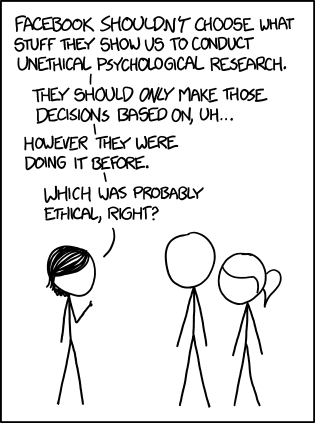
Research Ethics

I mean, it's not like we could just demand to see the code that's governing our lives. What right do we have to poke around in Facebook's private affairs like that?
02 Jul 18:36

July 02, 2014


Last hour to buy! Thanks one last time everyone. We're so happy to be able to make this book the way we want to make it.
30 Jun 15:05

Facebook Messed With The Emotions Of 689,003 Users... For Science

by Mike Masnick
As you may have heard (since it appears to have become the hyped up internet story of the weekend), the Proceedings of the National Academy of Sciences (PNAS) recently published a study done by Facebook, with an assist from researchers at UCSF and Cornell, in which they directly tried (and apparently succeeded) to manipulate the emotions of 689,003 users of Facebook for a week. The participants -- without realizing they were a part of the study -- had their news feeds "manipulated" so that they showed all good news or all bad news. The idea was to see if this made the users themselves feel good or bad. Contradicting some other research which found that looking at photos of your happy friends made you sad, this research apparently found that happy stuff in your feed makes you happy. But what's got a lot of people up in arms is the other side of that coin: seeing a lot of negative stories in your feed appears to make people mad.

There are, of course, many different ways to view this: and the immediate response from many is "damn, that's creepy." Even the editor of the study, admits to the Atlantic, that she found it to be questionable:
"I was concerned," she told me in a phone interview, "until I queried the authors and they said their local institutional review board had approved it�”and apparently on the grounds that Facebook apparently manipulates people's News Feeds all the time... I understand why people have concerns. I think their beef is with Facebook, really, not the research."
Law professor James Grimmelmann digs deeper into both the ethics and legality of the study and finds that there's a pretty good chance the study broke the law, beyond breaking standard research ethics practices. Many people have pointed out, as the editor above did, that because Facebook manipulates its news feed all the time, this was considered acceptable and didn't require any new consent (and Facebook's terms of service say that they may use your data for research). However, Grimmelmann isn't buying it. He points to the official government policy on research on human subjects, which has specific requirements, many of which were not met.

While those rules apply to universities and federally funded research, many people assumed that they don't apply to Facebook as a private company. Except... this research involved two universities... and it was federally funded (in part) [Update: Cornell has updated its original story that claimed federal funding to now say the study did not receive outside funding.]. The rest of Grimmelmann's rant is worth reading as well, as he lays out in great detail why he thinks this is wrong.

While I do find the whole thing creepy, and think that Facebook probably could have and should have gotten more informed consent about this, there is a big part of this that is still blurry. The lines aren't as clear as some people are making them out to be. People are correct in noting that Facebook changes their newsfeed all the time, and of course Facebook is constantly tracking how that impacts things. So there's always some "manipulation" going on -- though, usually it's to try to drive greater adoption, usage and (of course) profits. Is it really that different when it's done just to track emotional well-being?

As Chris Dixon notes, doing basic a/b testing is common for lots of sites, and he's unclear how this is all that different. Of course, many people pointed out that manipulating someone's emotions to make them feel bad is (or at least feels) different, leading him to point out that plenty of entertainment offerings (movies, video games, music) also manipulate our emotions as well -- though Dixon's colleague Benedict Evans points out that there's a sort of informed consent when you "choose" to go to see a sad movie. Though, of course, a possible counter is that there are plenty of situations in which emotions are manipulated without such consent (think: advertising). In the end, this may just come down to being about what people expect.

If anything, what I think this does is really to highlight how much Facebook manipulates the newsfeed. This is something very few people seem to think about or consider. Facebook's newsfeed system has always been something of a black box (which is a reason that I prefer Twitter's setup where you get the self-chosen firehose, rather than some algorithm (or researchers' decisions) picking what I get to see). And, thus, in the end, while Facebook may have failed to get the level of "informed consent" necessary for such a study, it may have, in turn, done a much better job of accidentally "informing" a lot more people how its newsfeeds get manipulated. Whether or not that leads more people to rely on Facebook less, well, perhaps that will be the subject of a future study...

Permalink | Comments | Email This Story


30 Jun 15:05

Google: OEMs forbidden from customizing Android Auto, Wear and TV

by Quentyn Kennemer

Moto-369-pic7

Google has largely allowed OEMs to take Android and do with it what they will for smartphones and tablets, but things could be changing in a big way for the rest of the devices now officially supported by Android. According to Ars Technica, Google has confirmed that they will not allow OEMs to make deep changes to Android Wear, Android Auto and Android TV devices.

OEMs will be able to provide a collection of their own pre-installed apps, custom watch faces and other features that don’t require much deep scrubbing of the Android framework, but they won’t be able to get down and dirty and change the core of it. Google’s official reasoning? Here’s the gist of it according to Google engineering director David Burke:

The UI is more part of the product in this case. We want to just have a very consistent user experience, so if you have one TV in one room and another TV in another room and they both say Android TV, we want them to work the same and look the same. The device manufacturers can brand it, and they might have services that they want to include with it, but otherwise it should be the same.

We imagine it’s about a bit more than that. These platforms are all still very new for Google. They might be built on Android (which has matured greatly since its commercial debut in 2008), but we likely aren’t anywhere near maturity for its new home on these new classes of devices. Google’s surely going to have many updates to issue as they continue to refine these new platforms, and they won’t want early users to have to wait forever for them.

android-tv-pic

That’s just a hunch, though, and there’s no telling if Google is ever going to loosen up on these restrictions. You might be asking yourself why Google would do this if Android is supposed to be open source. Well, their Google Now platform isn’t. Google Play isn’t. Many of their services aren’t.

What’s truly “free” and “open source” is the Android Open Source Project, and OEMs (or even a lone independent developer) are free to use that however they please. But if they want to play in the new sandboxes introduced at Google IO last week they’ll have to accept Google’s new rules. All for the better I’d say.

30 Jun 15:03

Shortpacked! - Age of Extinction

by David Willis
New comic!
Today's News:
29 Jun 11:45

06/29/2014

by billamend

06/29/2014

27 Jun 14:36

Recipe: Breath-Freshening Dog Treats — Pet Recipes from The Kitchn

by Coco Morante
Pin it button big

Like most beagles, ours has a major weakness: food in any form, especially dog treats. He goes crazy for these homemade biscuits, and little does he know, they help with his doggie breath, too! With a mix of whole-grain flours, healthy fats, and pooch-friendly, breath freshening ingredients, they’re great to have on hand for your favorite four-legged friend.

READ MORE »

27 Jun 11:44

Massachusetts Ignores 5th Amendment; Says Defendant Can Be Forced To Decrypt His Computer

by Mike Masnick
For many years, courts have struggled with the legal question of whether or not law enforcement can force a defendant in a lawsuit to decrypt encrypted files. All the way back in 2007, we wrote about a judge in Vermont finding that such forced decryption represented a Fifth Amendment violation, as it could be considered a form of self-incrimination. However, that was just one court. Other courts have ruled the other way. Not surprisingly, the Justice Department doesn't believe the Fifth Amendment should apply in these situations, but courts still seem to be divided as judges go back and forth on the issue.

Unfortunately, it appears that Massachusetts' highest court has now gone over to the wrong side of the debate, finding that there is no Fifth Amendment violation in forcing people to decrypt their computers. In this ruling, the court said that there was "an exception" to the Fifth Amendment, if the results are a "foregone conclusion." As Cyrus Farivar at Ars Technica summarizes:
That exception, the MSJC said, can be invoked when “an act of production does not involve testimonial communication where the facts conveyed already are known to the government, such that the individual ‘adds little or nothing to the sum total of the Government's information.’”
Of course, that seems like a fairly dangerous "exception." Prosecutors can just claim that such facts are "already known." Furthermore, if the information adds little or nothing, then... why is it even needed? It's difficult to see why anyone should be forced to decrypt information on the basis that... it's not really needed. Here's the key paragraph from the ruling:
When considering the entirety of the defendant's interview with Trooper Johnson, it is apparent that the defendant was engaged in real estate transactions involving Baylor Holdings, that he used his computers to allegedly communicate with its purported owners, that the information on all of his computers pertaining to these transactions was encrypted, and that he had the ability to decrypt the files and documents. The facts that would be conveyed by the defendant through his act of decryption—his ownership and control of the computers and their contents, knowledge of the fact of encryption, and knowledge of the encryption key—already are known to the government and, thus, are a "foregone conclusion." The Commonwealth's motion to compel decryption does not violate the defendant's rights under the Fifth Amendment because the defendant is only telling the government what it already knows.
Given the back and forth nature of so many of these rulings, you have to imagine that it'll eventually end up before the Supreme Court. Hopefully that Court's renewed belief in the Fourth Amendment will extend to the Fifth as well.

Permalink | Comments | Email This Story


27 Jun 11:43

Android TV unboxing and first look: specs, pictures, and more [VIDEO]

by Quentyn Kennemer

Say goodbye to Google TV and hello to the wonder you see us groping in the video above. Android TV is a renaissance of Google’s first stab at the smart TV market. While we won’t be seeing any consumer products until we head closer to the end of this year, developers have already been treated to units of the ADT-1, Android TV’s first development platform device.

Specs

One of the things early Google TV devices were chastised for was under-performing specs. The lackluster internals made for sluggish experiences (so much so that some of them became flat-out unusable after a while). Thankfully Google has looked to remedy that as they came out the gate strong with some pretty impressive specs:

  • Tegra 4 chipset
  • 2GB of RAM
  • 16GB of internal storage
  • 2×2 MIMO dual-channel WiFi
  • Bluetooth 4.0
  • Ethernet Port
  • HDMI port
  • Android L Developer Preview

The device is fully unlocked out of the box, natch, so Google’s inviting developers to go nuts and come up with anything they can to help get this platform ready for launch later this year. It’s far too early to tell what the result of such openness will be, but we have a feeling it won’t take long for developers to pour their heart, soul and code into these boxes.

Software and Features

Android TV appears to be quite simple at its core. It takes on a lot of the same qualities Google TV had: it combines live television with internet video sources such as Netflix, Hulu and YouTube to give you access to nearly anything you’d want to watch at a moment’s notice.

android-tv-pic2

All of that will leverage voice commands, search and Google’s Knowledge Graph to help you find what you are looking for and learn everything about it with ease. Not lost on us is the much improved user interface that presents all your content in a way that’s very pleasing to the eye, and it’s easy enough to zip around said interface thanks to the capable hardware sitting inside.

Where Android TV steps things up a notch — nay, a ton — is the department of games.  One of the important things they wanted to do from the starting gate was build games into the platform in a way that developers won’t even have to think about porting their wares over to the big screen.

This includes integration with the Google Play Games platform for access to achievements, leaderboards and multiplayer gaming. We saw examples of gaming with controllers to give folks a console-esque experience, and with that powerful Tegra 4 chipset inside this could turn out to be a very versatile piece of equipment.

android-tv-game-remote11

Google also mentioned that the platform would have “Cast” capabilities, so the ability to beam music, movies, photos and even mirror your Android phone or tablet’s display should add a lot to the experience. Needless to say this should prove to be a much more useful, usable and exciting package than Google TV was in its infancy, and it’ll be exciting to see what future iterations bring us.

Photos

In case you were wondering how the ADT-1 and its controller looks from every angle this handy photo gallery should do the trick:

android-tv-pic2 android-tv-pic android-tv-game-remote12 android-tv-game-remote11 android-tv-game-remote10 android-tv-game-remote9 android-tv-game-remote8 android-tv-game-remote7 android-tv-game-remote6 android-tv-game-remote5 android-tv-game-remote4 android-tv-game-remote3 android-tv-game-remote2 android-tv-game-remote androidtv-box-dusty androidtv-box-bottom androidtv-box androidtb-box2

Will you buy one?

So after Google’s second (and seemingly successful) attempt at the smart TV game — will you buy one? Granted, you won’t be able to get the ADT-1, but we should see manufacturers start to push out set-top boxes and televisions with Android TV built-in by this holiday season. Let us know your thoughts in the comments below!

25 Jun 12:03

People are Stupid

To everyone who responds to everything by saying they've 'lost their faith in humanity': Thanks--I'll let humanity know. I'm sure they'll be crushed.
24 Jun 02:43

The evolution of Hugh Jackman's upper body

by Matthew Inman
23 Jun 12:23

New Milford High School Pushes the Envelope on 21st Century Education

School transforms library into 'Makerspace,' a controlled chaos of ideas, innovation, intuition -- and a 3-D printer
23 Jun 12:21

micdotcom: Flow chart perfectly sums up America’s foreign...

21 Jun 16:30

June 21, 2014


18 Jun 12:19

YouTube confirms music service, will block holdout labels' videos within 'days'

by Jon Fingas
The cat's (partly) out of the bag. After a string of rumors, YouTube has confirmed to the Financial Times that it's launching a paid music service this summer. It's not saying exactly how the service will work, but Reuters sources claim that it will...
18 Jun 12:16

Assembly Votes to Put Brakes on Impact of Common Core and New Student Testing

Measure would set up task force, could delay the consequences of new standards and associated tests by as much as two years
18 Jun 12:13

Sunlight Foundation Gives Congress Email Addresses

by Mike Masnick
The Sunlight Foundation has struck again where the government failed to act. If you've tried to contact your elected representatives in the US Congress, you may have noticed it's not that easy. You have to go through a layer of annoying forms that seem much more designed to get you to not contact your elected officials. However, the good folks at the Sunlight Foundation, working with inspiration from EFF, have decided to do something about it, working through the forms to create an actual email address for every member of Congress that avoids having to go through the full form process. So, if you go to Rep. John Boehner's page you now see the email address that Sunlight Foundation / OpenCongress have given him: Now, of course, one of the reasons that Congress has made it so difficult to email your elected officials is to deal with the spam problem. If it was entirely public, the fear is, they'd get inundated with spam and that could, potentially, destroy the usefulness of email contact with constituents. The system here seems to be designed to try to minimize that risk, though it may (potentially) limit the usefulness of some of this effort:
The first time we get an email from you, we'll send one back asking for some additional details. This is necessary because our code submits your message by navigating those aforementioned congressional webforms, and we don't want to enter incorrect information. But for emails after the first one, all you'll have to do is click a link that says, "Yes, I meant to send that email."

One more thing: For now, our system will only let you email your own representatives. A lot of people dislike this. We do, too. In an age of increasing polarization, party discipline means that congressional leaders must be accountable to citizens outside their districts. But the unfortunate truth is that Congress typically won't bother reading messages from non-constituents — that's why those zip code requirements exist in the first place. Until that changes, we don't want our users to waste their time.
This is a small step forward, but good to see no matter what.

Permalink | Comments | Email This Story


18 Jun 12:11

Add and share any web page with The Old Reader!

We’ve received a large number of requests to add a bookmarklet feature to The Old Reader.  Today we are excited to be launching this functionality for our premium users.  We will likely roll this functionality out to all users at some point in the future, but do not currently have a timeline in place.

image

The bookmarklet is quickly and easily added to your browser bookmarks and allows you to send a copy of any web page to your TOR account.  Those pages are saved in the new bookmarklets section and are also searchable and sharable.

image

We know a lot of our users will be excited to see this new functionality and we look forward to your feedback.  Thanks for using The Old Reader!

18 Jun 12:08

Internet “fast lanes” would be banned by newly proposed legislation

by Jon Brodkin

Congressional Democrats today introduced legislation that would require the Federal Communications Commission to ban Internet "fast lanes," paid prioritization deals in which Web services could pay for priority access to Internet users.

The "Online Competition and Consumer Choice Act" would require the commission to issue regulations that "prohibit a broadband provider from entering into an agreement with an edge provider under which the broadband provider agrees, for consideration, in transmitting network traffic over the broadband Internet access service of an end user, to give preferential treatment or priority to the traffic of such edge provider over the traffic of other edge providers."

It would also prohibit Internet service providers from giving priority to their own "content, applications, services, or devices," or those offered by affiliates. The bill has an exception "to address the needs of emergency communications or law enforcement, public safety, or national security authorities." The bill only targets last-mile Internet traffic, so it would not affect paid peering agreements such as the ones Netflix signed with Comcast and Verizon.

Read 7 remaining paragraphs | Comments

18 Jun 12:05

The DOs and DO NOTs of running your first marathon

by Matthew Inman
The DOs and DO NOTs of running your first marathon

This is a comic from my upcoming book about running.

View