Joel Thrasymachus Dahl
Shared posts
https://www.washingtonpost.com/business/2018/12/18/porch-pirates-stole-package-an-engineer-so-he-created-trap-using-glitter-fart-spray/?utm_term=.527551c2c3d1
Joel Thrasymachus DahlThis is completely worth the click-through to the embedded YouTube video.
A poacher who killed hundreds of deer was sentenced to repeatedly watch ‘Bambi’
Authorities have no idea how many deer the Berry family and their associates illegally killed in the fields and forests of southern Missouri over the past decade, but the details of their poaching operation would make any animal lover’s stomach turn.
Over nearly nine years, David Berry and his two sons, David Berry Jr. and Kyle Berry, killed the deer, mostly at night, then cut off their heads and antlers — leaving the bodies to rot where they fell.
There was financial motivation in the carnage, but authorities said collecting the deer heads was mostly about ego.
“Taking just the heads is their version of obtaining a ‘trophy’ and leaving the carcass behind is merely an afterthought," Randy Doman, division chief of the Missouri Department of Conservation, told the Springfield News-Leader. "While there are some cases where poachers go after the antlers for profit, with this bunch it was more about the thrill of the kill itself.”
And so when the Berrys and more than a dozen other poachers were ultimately sentenced, Lawrence County Judge Robert George apparently hoped a little Disney magic would show one of them the error of his ways.
According to court records obtained by the News-Leader, David Berry Jr. “is to view the Walt Disney movie ‘Bambi,’ with the first viewing being on or before December 23, 2018, and at least one such viewing each month thereafter, during Defendant’s incarceration in the Lawrence County Jail.”
Berry Jr. will be in jail for a year.
In a scene that has traumatized generations of children, Bambi’s mother directs him to a patch of new spring grass before a sound startles her.
“Bambi, quick. The thicket,” she urges as the two try to sprint to safety amid the sounds of gunshots. “Faster! Faster, Bambi! Don’t look back! Keep running! Keep running!"
As David Berry Jr. will undoubtedly learn, those are the last words Bambi’s anthropomorphic mother utters.

Although there are restrictions, judges generally have leeway to impose conditions on a sentence, like anger management classes or drug treatment — and sometimes they get creative.
For example, in 2008, a Cleveland Housing Court judge ordered a landlord convicted of multiple violations to serve house arrest in one of his own dilapidated units. Two people who vandalized a nativity scene in an Ohio town were ordered to walk through the streets of Fairport Harbor with a donkey and a sign reading “Sorry for the jackass offense.”
It is unclear why Berry Jr. was singled out to watch the 76-year-old Disney movie ad nauseam. In total, the other co-conspirators faced a litany of charges and paid nearly $200,000 in bonds and fines and served 33 days in jail, according to the Department of Conservation.
All the Berrys had their hunting, fishing and trapping privileges revoked for life.
Berry Jr.'s family members have also been accused of catching fish by hand, an often illegal process that can be dangerous to both fishermen and fish populations.
If a judge decides to get creative with those sentences, there are many, many options from which to choose.
Read more:
‘My sons love hunting, I don’t’: Trump’s soft spot for elephants
Scientists stuffed balloons into dead wombats to learn why they poop cubes
He was on his way to meet the mayor. Then he spotted a skunk with its head in a Coke can.
With 800 offspring, ‘very sexually active’ tortoise saves species from extinction
Baby bison dies after Yellowstone tourists put it in their car because it looked cold
What Happens When You Reply All to 22,000 State Workers
Joel Thrasymachus DahlSeveral years ago, my (not especially bright) boss fell for one of the most obvious phishing schemes in the book, and the phisher turned out to be a porn site email list, which proceeded to copy her email address book, including a listserv for literally everyone who works in the USC library system. After "she" emailed out about hot babes who want to suck the chrome off your trailer hitch, a reply-all war happened among people who were deeply offended by the content of the email, people who enjoyed mocking her for being hacked, and people who just generally enjoy the chaos of that kind of thing and want to keep it going.

Subject: #ReplyAll-pocalypse
From: julie@nytimes.com
Date: December 10, 2018 at 1:43 p.m.
To: allreaders@nytimes.com
Reply All, the scourge that has afflicted office workers everywhere, has hit 22,000 government employees in Utah, demonstrating that decades into the invention of email, many of us still don’t understand its etiquette.
This is a public advisory: PLEASE DO NOT REPLY ALL.
For at least 20 years now, emailers everywhere have received those pesky group messages, and for at least 20 years, they have tried to resist the allure of the Reply All button. They have often failed, with the first messagers asking to be removed from a list, the second group pointing out that the first group should really stop emailing everyone, and the third group deciding now was just the right moment to show off their wit.
Why don’t we stop? This is the grand era of social media. All of us, it seems, just want to be heard.
Which brings us to Maria Peterson and Utah’s preholiday ReplyAll-pocalypse. Or Potluckgate. Or Reply All Madness. The state’s internet pundits, including Lt. Gov. Spencer Cox, are all over this. “This is real and it’s an emergency,” Mr. Cox deadpanned on Twitter on Friday. “I fear it will never end.”
Ms. Peterson, 37, is the deputy director in the job training section at the Utah Department of Corrections. On Friday, she sent out a calendar invite for her division’s annual potluck. It was meant for 80 people. But someone in the technology department had been tinkering with her listserv email, a variation of everyone@utah.gov, and suddenly the invitation went to more than 22,000 guests. That’s nearly every employee in Utah government.
Ms. Peterson quickly sent a correction email to her division. Except that, too, went to all 22,000 people.
“Hey team! So fun times... Google Calendar automatically added every single person in the state of Utah address book to our Holiday Potluck. (And we don’t have room for all those people!)”
The party wasn’t canceled, she added, and she would be sending out an updated invitation.
Utah’s employees, unable to resist that button with the jaunty backward arrows, quickly replied all.
9:30 a.m. Becky in tourism: “I think you added the wrong Becky to your contact list.”
9:31 a.m. Bonnie in alcohol control: “Shucks we were all planning on coming. LOL.”
9:31 a.m. Shaleece in the rehabilitation office: “Read the message. Please stop replying all.”
9:32 a.m. Karla at the health department: “I think you got the wrong Matheson!”
9:36 a.m. An unnamed writer in tax waivers: “STOP THE MADNESS!!!!”
9:39 a.m. Bridgette in prison records: “Please bring a $5 white elephant gift.”
Ms. Peterson, watching her inbox grow, went into a panic. “We flipped out,” she said of her office. She called the state’s technology department, where someone explained that an employee had accidentally added the entire government staff to her division’s group email. Then she started to laugh.
“It happens,” she said in an interview on Monday. People are nice in Utah. Since Friday, she has received dozens of emails from people thanking her for adding levity to their day. “What can you do about it but laugh?” she added.
A spokeswoman for the state technology department, Stephanie Weteling, confirmed that an employee had made a mistake, and said that her department removed most staff from the group list within 12 minutes. After that, anyone who hit Reply All sent a message only to Ms. Peterson and a select group of her colleagues.
No one would be reprimanded, she added, but the employee would receive additional training. Luckily, there was no confidential information in the original message. “We are fortunate with that,” Ms. Weteling said.
Ms. Peterson urged future victims of email storms not to take the messages so seriously. “It opened the door to have a little fun,” she said. Many government jobs are, after all, repetitive and thankless.
“We’re still having the potluck,” she added, clarifying that Utah employees outside of her division are not invited. “We might order a few extra meat and cheese trays just in case we have some extra people show up.”
Can the world produce enough cobalt for electric vehicles?
THE ONLY thing that can accelerate as fast as an electric car is the price of the most expensive metal in its batteries. Once a niche input used to strengthen turbine blades, cobalt’s value has soared since it started to feature in modern electronics. Most phones need a few grams’ worth, and every car requires 5-10kg. That adds up. Many business models are based on ample reservoirs of cobalt that experts warn do not exist.
Upgrade your inbox and get our Daily Dispatch and Editor's Picks.
Soaring demand for a commodity is usually met by vaulting investment to ensure supply. Cobalt’s case is somewhat different. Nearly all of it is obtained as a by-product of mining nickel and copper. Even the sharp rise in cobalt’s price thus far has not been enough to justify fresh investment in digging more nickel and copper out of the ground. Worse, most of it is in the Democratic Republic of Congo, where neat models of supply and demand count for little.
Most incremental demand for cobalt comes from carmakers, which have invested around $100bn in electric-vehicle (EV) technology. According to one estimate, by 2030 at least as much of the stuff will be needed for transport alone as was mined in 2017. America has designated it a “critical mineral”.
The expected demand spike assumes both a rapid rise in EVs, which is likely, but also continued dependence of batteries on cobalt, which is less certain. Battery technology is evolving; some need less or no cobalt. Tesla, an electric carmaker, is among those saying it is “aiming to achieve close to zero usage of cobalt”, helping derail a rally in the metal’s price this year (see chart).

In part, Tesla is responding to concerns about how the stuff is sourced. Several NGOs have started to put pressure on tech firms to ensure their gizmos are free of “conflict cobalt”. The bit of Congo where the metal is mined is mostly peaceful, but tensions in the country persist, fuelled by money from mining. Perhaps a quarter of production is done by “artisanal” miners, meaning local people working on a small scale.
Sometimes they operate on the territory of big miners. “We take shovels, torches, hammers, picks and wire-cutters to make a hole in the fence,” says Paul, one such miner in Kawama, near Glencore’s operations. “We usually go to the mine at around 10pm. If we don’t get caught we’ll stay there, digging, until dawn.” Cobalt traders, many of whom are Chinese, will buy a night’s output for $40—a small fortune by local standards.
Some groups think artisanal mining can help bridge the gap between supply and demand. Efforts are afoot to clean it up, for example by designating permitted areas. But that will not be enough to ensure the ample supplies needed.
A few other places, such as Australia, have small amounts of cobalt. But the biggest source is even trickier than Congo to explore: leagues below the high seas. Much of the floor of the Pacific ocean is lined with nodules rich in cobalt. If there is not enough in the ground, going underwater is the logical next step.
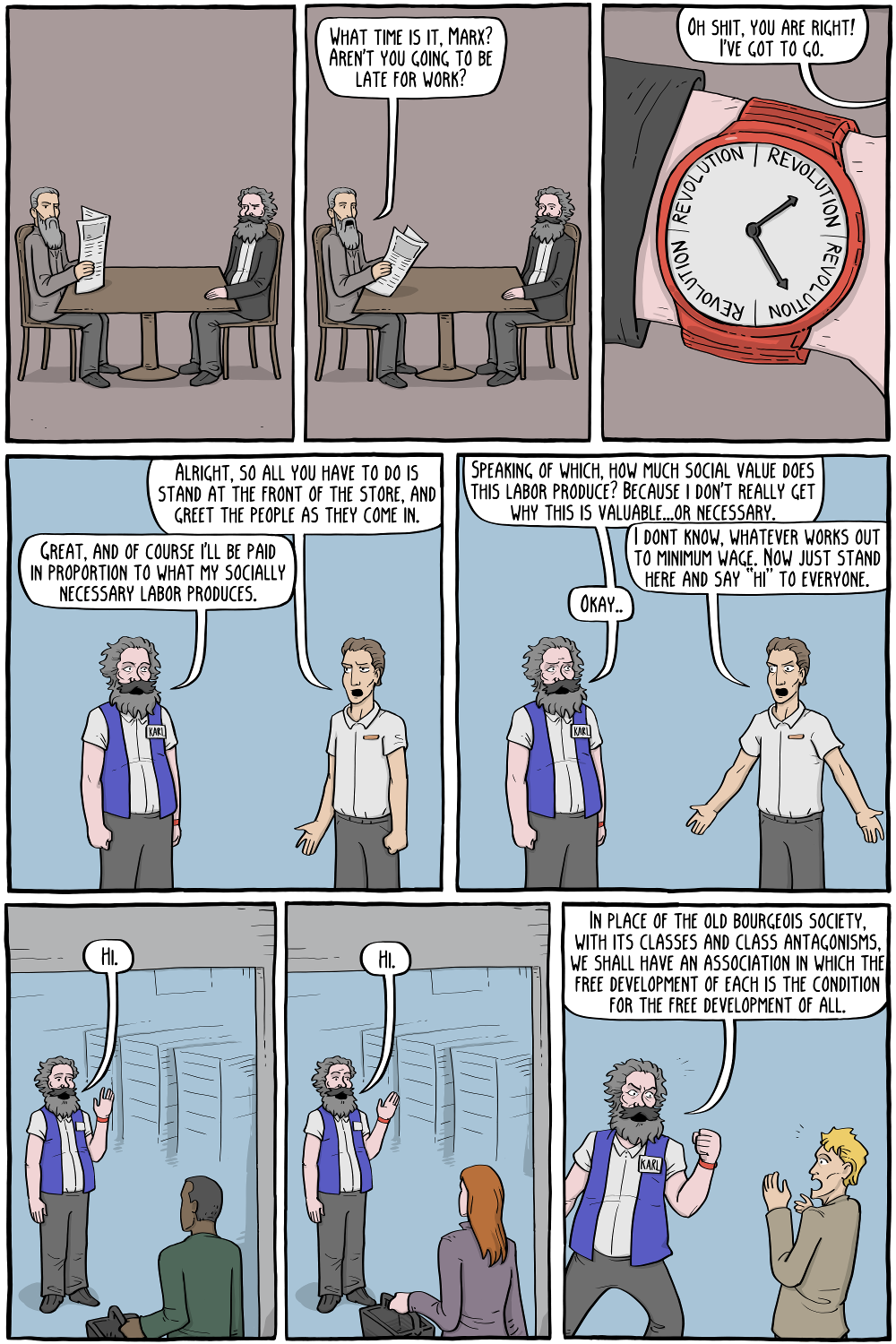
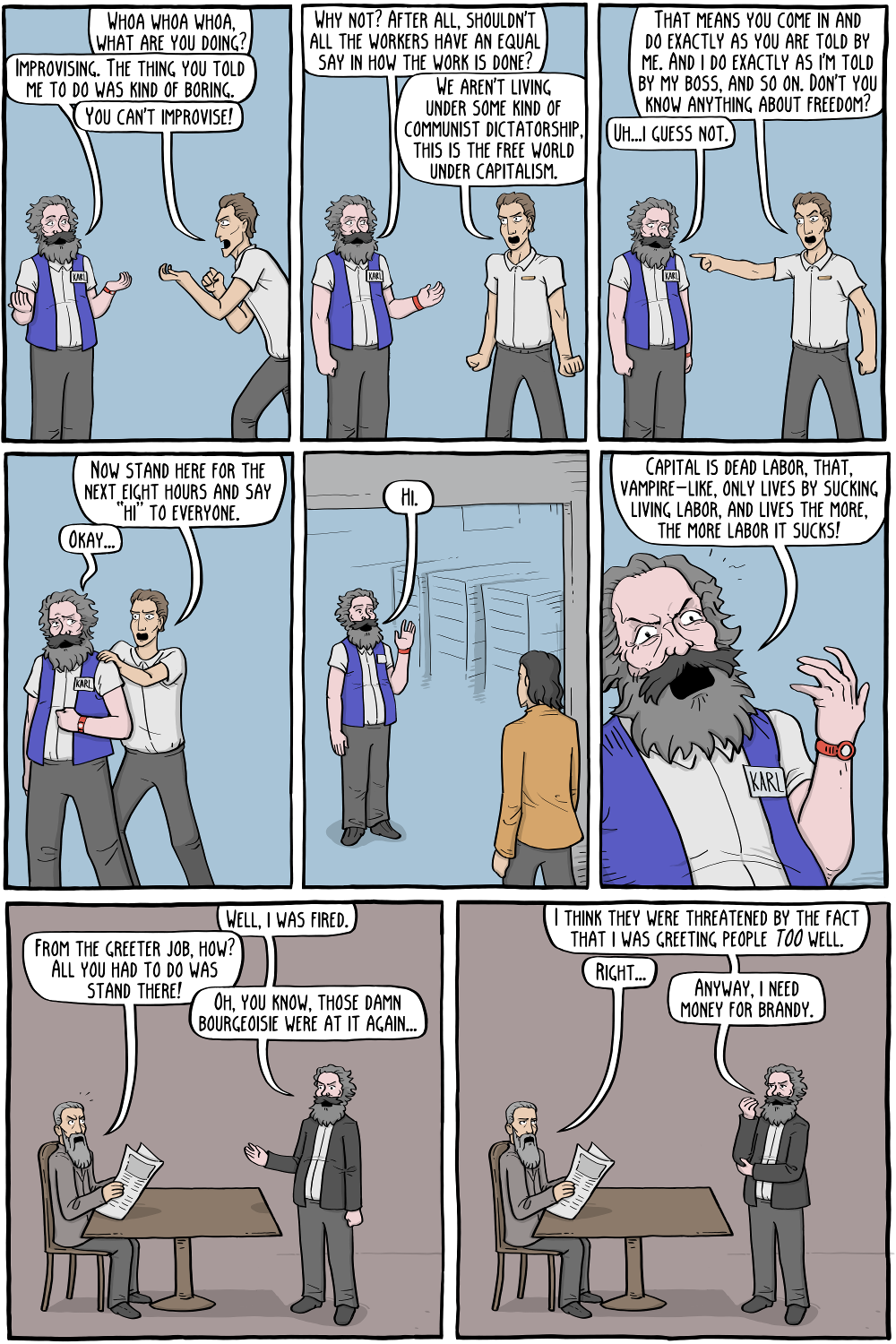
Karl Marx Gets a Job
Joel Thrasymachus DahlShared for panel 3.
Opinion | The Link Between August Birthdays and A.D.H.D.
A new study raises questions about age, maturity and overdiagnosis.
By Anupam B. Jena, Michael Barnett and Timothy J. Layton
The authors are health policy researchers.

The rate of diagnosis of attention deficit hyperactivity disorder among children has nearly doubled in the past two decades. Rates of A.D.H.D. diagnoses also vary considerably across states, with nearly three times as many children getting the diagnosis in Kentucky (where one in five children are said to have the condition) as in Nevada. More than 5 percent of all children in the United States now take an A.D.H.D. medication. All this raises the question of whether the disease is being overdiagnosed.
Diagnosing A.D.H.D. is difficult. Unlike other childhood diseases — such as asthma, obesity and diabetes — the diagnosis of A.D.H.D. is inherently subjective and depends on the assessment of parents, school personnel and health care providers. For a child who is easily distracted, an assessment of normal, inattentive behavior by one could be a formal diagnosis of A.D.H.D. by another.
It turns out that although diagnosing A.D.H.D. requires a subjective interpretation of facts, the month in which a child is born can be a strong, objective predictor.
Most states have arbitrary cutoffs for kindergarten entry, with children who do not reach a given age by a certain date required to wait a year. In 18 states, children who will turn 5 before Sept. 1 can enter kindergarten in the year that they turn 5; children who will turn 5 after Sept. 1 must wait until the next year. So in states with Sept. 1 cutoffs, in any given class, August-born children will usually be the youngest and September-born children the oldest.
These arbitrary cutoffs have important implications for the diagnosis of A.D.H.D. In a study published in The New England Journal of Medicine, we found that among several hundred thousand children who were born between 2007 and 2009 and followed until 2016, rates of A.D.H.D. diagnosis and treatment were 34 percent higher among children born in August than among children born in September in states with a Sept. 1 school entry-age cutoff. No such difference was found among children in states with different cutoff dates. The effects were largest among boys.
We believe these findings reveal just how subjective the diagnosis of A.D.H.D. can be. In any given class, inattentive behavior among younger, August-born children may be perceived, in some instances, to reflect symptom of A.D.H.D., rather than the relative immaturity that is biologically determined and to be expected among children who are nearly one year younger than September-born classmates.
The stakes of additional, potentially inappropriate diagnoses are high, particularly when diagnoses are accompanied by medical treatment, which has side effects. In cases where A.D.H.D. is appropriately diagnosed, we know that behavioral and medical treatments can improve concentration and school performance and other outcomes. And in these instances, the harms of medical treatments are, on average, outweighed by the benefits. But when the disease is improperly diagnosed, the clinical harms and dollar costs of treatment may not be met with commensurate benefits.

Unlike other diseases such as asthma and diabetes, whose diagnosis is more objective and is not based on peer-to-peer comparisons, the diagnosis of A.D.H.D. appears heavily influenced by how children behave in school relative to peers and how those differences in behavior are interpreted by school personnel, parents and ultimately, physicians. Indeed, some evidence suggests that teachers and other school personnel are more likely than physicians or parents to first suggest that a child may have A.D.H.D.
Our findings aren’t new, but they suggest a continuing problem. Several older studies, both within and outside the United States, analyze rates of A.D.H.D. diagnosis among children born just before versus just after school entry-age cutoffs, similar in design to our study. Nearly all of these studies suggest that younger children within a grade are more likely to be diagnosed with A.D.H.D. than older children in the same grade. One study found that the relative age of a child in a class strongly affects teachers’ assessments of whether a child demonstrates A.D.H.D. symptoms but does not affect parents’ assessments, which suggests that many diagnoses may stem from teachers’ perceptions of students that are based on a child’s age relative to peers.
Our study, which uses recent data, tells us that the problem still exists and that it’s not small. Despite growing awareness that A.D.H.D. may be overdiagnosed and the fact that the medications used to treat it have serious side effects, something as arbitrary as the month a child is born still has a meaningful impact on the likelihood that the child is determined to have the condition.
At a minimum, physicians who frequently diagnose A.D.H.D. in children should be aware of these findings. A simple mental “adjustment” for whether a child is born in August may be sufficient to help physicians reduce overdiagnosis.
School personnel and parents should also be aware of how simple cognitive biases can creep into how important clinical decisions are made. Both our and previous findings suggest that parents of children who are young for their grade could reasonably question whether the initiation of medical treatment for A.D.H.D. should be delayed.
In his 2008 book “Outliers,” Malcolm Gladwell describes the now well-known phenomenon that a disproportionate number of Canadian professional hockey players have birth dates in the beginning of the calendar year. This is explained by the Jan. 1 age eligibility cutoff for hockey programs in Canada, which leads to the oldest hockey players within an age-based division exceeding the age of the youngest players by nearly a year, conferring them a performance advantage. A similar phenomenon is true for A.D.H.D., where a child’s age relative to peers confers a markedly different rate of diagnosis and treatment, but the stakes are higher.
Anupam B. Jena is an associate professor at Harvard Medical School. Michael Barnett is an assistant professor at Harvard School of Public Health. Timothy J. Layton is an assistant professor at Harvard Medical School.
Follow The New York Times Opinion section on Facebook, Twitter (@NYTopinion) and Instagram.
Suspect arrested after intruder is seen in closed Pasadena bank branch and then flees police
Joel Thrasymachus DahlSo, the neighborhood mentioned in this article where the robber fled to was the grounds of my apartment complex. We had multiple searchlight helicopters lighting the place up, easily 30 cops armed to the teeth swarming all over, and bullhorn announcements about how residents should remain inside with doors and windows locked, and the perp should come out with his hands up in order not to be harmed.
Fortunately, both boys were asleep already when this all started to go down. There's something extra surreal about this situation when, sleeping in the next room are a 2.5-year-old and an 8-month-old whose safety you are responsible for. The rational part of my brain (I have one, I swear) was well aware that it was *still* highly unlikely that anything bad would happen, but the whole time I had this basic lizard brain awareness that I was absolutely willing to sacrifice my own life to save theirs, should it come to that, and I was oddly calm and undisturbed by this willingness. Existential angst was utterly absent from my mind as I thought this; it was simply a step that could possibly be necessary and which I was unthinkingly willing to take if necessary.
PASADENA — A man suspected of getting inside a closed Citibank branch in Pasadena Wednesday night using a bank employee’s keys was in custody.
Police received a call just after 7:30 p.m. from Citibank’s corporate office about a man seen on their security cameras in the branch at California Boulevard and Pasadena Avenue after-hours, rummaging through employees desks, according to Lt. Marie Sell of the Pasadena Police Department.
Officers responded to the scene and saw the man inside the bank, who then ran into a neighborhood south of the location, where officers gave chase, but lost sight of him, Sell said.
A search of the area was initiated and officers found the man about 45 minutes later with the bank keys in his pocket, Sell said.
The suspect also had the ID and credit cards that belonged to a bank employee in his pockets and detectives believe he broke into the employee’s car in Arcadia two hours earlier and somehow determined the keys could be used at the Pasadena branch, Sell said.
Because it was after hours and the money in the bank was secured, it was unclear if the man stole anything, Sell said.


Divided We Stand

The year is 2019. California’s new governor, Gavin Newsom, recently elected on a platform that included support for the creation of a single-payer health-care system, now must figure out how to enact it. A prior nonpartisan analysis priced it at $400 billion per year — twice the state’s current budget. There appears to be no way to finance such a plan without staggering new taxes, making California a magnet for those with chronic illnesses just as its tax rates send younger, healthier Californians house-hunting in Nevada and big tech employers consider leaving the state.
But Newsom is not alone. Other governors have made similar promises, and Newsom calls together the executives of the most ideologically like-minded states — Oregon, Washington, New York, Massachusetts, Connecticut, Maryland. What if they banded to create a sole unified single-payer health-care system, spreading risk around a much larger pool of potential patients while creating uniformity across some of the country’s wealthiest states?
Fifteen end up forming an interstate compact, a well-established mechanism for working together, explicitly introduced in the Constitution. They sketch out the contours of a common health-care market: a unified single-payer regime with start-up costs funded in part by the largest issue ever to hit the municipal-bond market. The governors agree, as well, on a uniform payroll tax and a new tax on millionaires and corporations set to the same rate with revenues earmarked for health-care costs. The Trump administration has already proved willing to grant waivers to states looking to experiment beyond the Affordable Care Act’s standards — primarily for the benefit of those seeking to offer plans on their exchanges with skimpier coverage. But the states can’t act unilaterally: The Supreme Court has ruled that Congress must approve establishment of any compact claiming authority that previously resided with the federal government.
Newsom pressures his friend House Majority Leader Nancy Pelosi to introduce a bill that would give the compact all federal money that flows into its constituent states for health-care costs. Pelosi’s members from Arizona and Florida balk at the proposal, which they fear would enable their states’ Republican governors to gut Obamacare protections. But there are scores more from states looking to join the compact, and their governors marshal Democratic House delegations into a bloc. The bill passes the House, with the support of tea-party Republicans eager to strike a blow against federal power.
When it reaches the Senate, the initiative comes from Republicans. In 2011, then–Texas governor Rick Perry championed a Health Care Compact Alliance, joined by eight other states seeking a “regulatory shield” against the Affordable Care Act and full control over their Medicare and Medicaid funds. By the time the Democratic bill passes the House, current Texas governor Greg Abbott has rallied more than 20 states, including North Carolina, Missouri, and Arizona, for a new version of the Health Care Compact. He also has the support of two prominent senators, Ted Cruz and Majority Whip John Cornyn. Republicans who had promised for nearly a decade to repeal and replace Obamacare can finally deliver on the promise — for 40 percent of the country.
The president sees opportunity, too. While running for president, Donald Trump called himself “Mr. Brexit,” a boast tied to his apocryphal claim of having accurately predicted the British vote to leave the European Union. Now he’s convinced, thanks largely to a Fox & Friends chyron reading BIGGER THAN BREXIT?, that an even more significant world-historical accomplishment is within reach. Trump lobbies Pelosi and Mitch McConnell to combine their bills. Trump beams at the Rose Garden signing ceremony, calling it “the biggest deal ever” as he goads Pelosi and McConnell into an awkward handshake. Historians will later mark it as the first step in our nation’s slow breakup, the conscious uncoupling of these United States.
Let’s just admit that this arranged marriage isn’t really working anymore, is it? The partisan dynamic in Washington may have changed, but our dysfunctional, codependent relationship is still the same. The midterm results have shown that Democrats have become even more a party of cities and upscale suburbs whose votes are inefficiently packed into dense geographies, Republicans one of exurbs and rural areas overrepresented in the Senate. The new Congress will be more ideologically divided than any before it, according to a scoring system developed by Stanford political scientist Adam Bonica: the Republicans more conservative, the Democrats more liberal.
Come January, we are likely to find that we’ve simply shifted to another gear of a perpetual deadlock unlikely to satisfy either side. For the past eight years, there has been no movement toward goals with broad bipartisan support: to fund new infrastructure projects, or for basic gun-control measures like background checks or limits on bump stocks. Divided party control of Capitol Hill will make other advances even less likely. For the near future, the boldest policy proposals are likely to be rollbacks: Democrats angling to revert to a pre-Trump tax code, Republicans to repeal Obama’s health-care law. By December 7, Congress will have to pass spending bills to avoid a government shutdown. Next March looms another deadline to raise the debt ceiling.
Meanwhile, we have discovered that too many of our good-governance guardrails, from avoidance of nepotism to transparency around candidates’ finances, have been affixed by adhesion to norms rather than force of law. The breadth and depth of the dysfunction has even Establishmentarian figures ready to concede that our current system of governance is fatally broken. Some have entertained radical process reforms that would have once been unthinkable. Prominent legal academics on both the left and the right have endorsed proposals to expand the Supreme Court or abolish lifetime tenure for its members, the latter of which has been embraced by Justice Stephen Breyer. Republican senators including Cruz and Mike Lee have pushed to end direct election of senators, which they say strengthens the federal government at the expense of states’ interests.
Policy wonks across the spectrum are starting to rethink the federal compact altogether, allowing local governments to capture previously unforeseen responsibilities. Yuval Levin, a policy adviser close to both Paul Ryan and Marco Rubio, wrote in 2016 that “the absence of easy answers is precisely a reason to empower a multiplicity of problem-solvers throughout our society, rather than hoping that one problem-solver in Washington gets it right.” In a recent book, The New Localism, center-left urbanists Bruce Katz and Jeremy Nowak exalt such local policy innovation specifically as a counterweight to the populism that now dominates national politics across the Americas and Europe.
Even if they don’t use the term, states’ rights has become a cause for those on the left hoping to do more than the federal government will. Both Jacobin and The Nation have praised what the latter calls “Progressive Federalism.” San Francisco city attorney Dennis Herrera has called it “the New New Federalism,” a callback to Ronald Reagan’s first-term promise to reduce Washington’s influence over local government. “All of us need to be reminded that the federal government did not create the states; the states created the federal government,” Reagan said in his 1981 inaugural address. At the time, Democrats interpreted New Federalism as high-minded cover for a strategy of dismantling New Deal and Great Society programs. Now they see it as their last best hope for a just society.
Some states have attempted to enforce their own citizenship policies, with a dozen permitting undocumented immigrants to acquire driver’s licenses and nearly twice as many to allow them to qualify for in-state tuition. Seven states, along with a slew of municipal governments, have adopted “sanctuary” policies of official noncooperation with federal immigration enforcement. Many governors, including Republicans in Massachusetts and Maryland, have refused to deploy National Guard troops to support Trump’s border policies, and California has sued the federal government to block construction of a wall along the Mexican frontier. After the Trump administration stopped defending an Obama-era Labor Department rule to expand the share of workers entitled to overtime pay, Washington State announced it would enforce its own version of the rule and advised its peers to do the same. “It is now up to states to fortify workers through strong overtime protections,” Washington governor Jay Inslee wrote last week.
In California, officials who regularly boast of overseeing the world’s fifth-largest economy have begun to talk of advancing their own foreign policy. After Trump withdrew from the Paris climate agreement, Governor Jerry Brown — he has said “we are a separate nation in our own minds” — crossed the Pacific to negotiate a bilateral carbon-emissions pact with Chinese president Xi Jinping. “It’s true I didn’t come to Washington, I came to Beijing,” said Brown, who is often received like a head of state when he travels abroad. Around the same time, Brown promised a gathering of climate scientists that the federal government couldn’t entirely kill off their access to research data. “If Trump turns off the satellites,” he said, “California will launch its own damn satellite.”
Brown’s successor Newsom comes to office just as Californians may be forced to reckon with how much farther they are willing to take this ethic of self-reliance. Since 2015, a group of California activists have been circulating petitions to give citizens a direct vote on whether they want to turn California into “a free, sovereign and independent country,” which could trigger a binding 2021 referendum on the question already being called “Calexit.”
During the Obama years, it was conservatives who’d previously talked of states’ rights who began toying with the idea of starting their own countries. “We’ve got a great union. There is absolutely no reason to dissolve it,” Rick Perry said at a tea-party rally in 2009, before adding: “But if Washington continues to thumb their nose at the American people, you know, who knows what may come out of that?” Perry’s lieutenant governor, David Dewhurst, met with members of the Texas Nationalist Movement on the opening day of a legislative session. Right after this year’s midterms, the would-be leaders of the breakaway republics of Texas and California met at a secessionist conference in Dallas.
In 2012, the White House website received secession petitions from all 50 states; Texas’s was the most popular, with more than 125,000 signatures. (A counterpetition demanded that any citizen who signed one of the secession petitions be deported.) Two years later, Reuters found that nearly one-quarter of Americans said they supported the idea of their states breaking away, a position most popular among Republicans and rural westerners.
If we are already living in two political geographies, why not generate a system of government to match?Liberal regions have tended to go bigger with their secession fantasies: Why spin off one’s own state when you could split the whole country and gain the resources and manpower of like-minded compatriots? After John Kerry’s loss in the 2004 election, a homemade digital graphic migrated across the pre-social internet. On it, the states that had cast their electoral votes for Kerry were labeled “the United States of Canada”; George W. Bush’s became “Jesusland.” After Trump’s victory, those memes graduated into op-eds, including from others who would have to acquiesce in the fantasy. “Is it time for Canada to annex Blue America?” a columnist in the Canadian news magazine Maclean’s asked last year.
The fact that anyone with Photoshop can cogently cleave the country in two is a credit to the hardening of a once-fluid political map. Over half the states have cast their Electoral College votes consistently for one party in every presidential election since 2000. In 2016, those states all picked Senate winners from the same party as their presidential picks as well. But as three British geographers concluded in a 2016 article about spatial polarization, that’s not just a feature of the Electoral College map. Whether measured by county, state, or region, the partisan divide has grown since Bill Clinton’s first election: Red places have grown redder (at least in their presidential votes), blue places bluer. In 1992, 38 percent of Americans lived in “landslide counties,” which went for a presidential candidate by a margin of 20 percentage points or more, the Times has reported; in 2016, the number reached 60 percent.
This partisan homogeneity is shaping state governments too. Thirty-six capitals are now dominated by a single party that controls the governorship along with both houses of a legislature; for the first time in more than a century, only one state legislature in the country, Minnesota’s, will be split between two parties. If we are already living in two political geographies, why not generate a system of government to match?
Or so goes the fantasy. There’s no real groundswell of support for shrinking the United States. Surveys have shown that two-thirds of Californians oppose independence, and not only because the Calexit movement’s lefty critiques of Trump do not align with its righty origins. (A co-founder of the California Independence Campaign, Louis Marinelli, is a former anti-gay-marriage activist who last year sought permanent residence in Russia.) When a candidate from the Alaskan Independence Party, which had been founded with secessionist ambitions, actually won the governorship in 1990, he turned out to be tepid on the question of sovereignty. (Sarah Palin once attended an AIP conference, and her husband, Todd, became a member.) Local movements elsewhere, whether the left-leaning Second Vermont Republic or South Carolina’s right-leaning Third Palmetto Republic, have never transcended stunt. Among institutions, only the Libertarian Party has ever endorsed the position that states should be freely able to secede.
History gives us few examples of successful peaceful secessions. In the ones we do have, national identity rather than ideological differences seem to be at the root of the fissure. (The Confederate States of America would have been a notable anomaly.) When states split in the 20th century, the Australia-based scholars Peter Radan and Aleksandar Pavkovic have pointed out, there were always deep underlying fault lines of language, religion, or ethnicity. None of the three multinational states created between the two world wars — the Soviet Union, Yugoslavia, or Czechoslovakia — survived until the end of the 20th century.
Recent votes in Scotland and Quebec have modeled the way that secession in a developed country during years of peace can become just another political question.Even with widespread fatalism about the American project, there is not an obvious way to dissolve our union. Rewriting the Constitution’s balance of power would require levels of political coordination that seem far beyond the country’s existing leadership. Chances of a civil war are remote, and it is hard to visualize a series of events that could prompt a peaceable dissolution of the union. After the Civil War, the Supreme Court ruled that states have no right to unilaterally secede. The U.N. Charter recognizes the “self-determination of peoples,” but clearly intends the latter to mean well-defined racial or ethnic groups and not, say, a collection of persons who want stronger gun-control measures. Other countries might be wary of recognizing spinoff American states for fear of the precedent. Would China vote to admit California to the United Nations if it set up Tibet or Taiwan to demand the same treatment?
And yet, if the desire to secede were to grow, recent votes in Scotland and Quebec have modeled the way that secession in a developed country during years of peace can become just another political question — one debated relatively civilly, voted on democratically, without attendant allegations of treason or sedition. (Spain’s government has been less forgiving of what it calls an unconstitutional independence referendum held last year in Catalonia.)
There is at least one mechanism by which a sort of soft breakup may be imaginable — and it’s already found within the Constitution. The document introduces the prospect of one state entering into a compact with another. States have created interstate compacts to maintain common standards, like the Driver’s License Compact that 47 DMVs use to exchange knowledge on traffic scofflaws. Most have been used for neighboring jurisdictions to handle common resources, like the Atlantic Salmon Compact that permits New England states to manage fish stocks in the Connecticut River Basin. (Eleven states have signed on to a National Popular Vote Interstate Compact, to disregard the Electoral College, but it would require a number equal to 270 electoral votes to take effect.)
Interstate compacts have rarely been applied to controversial topics. Yet to a paralyzed Congress, and a president without any deeply held views about state-federal relations, they could prove an appealing vehicle to restless factions on both the left and the right. It may be time to take the country apart and put it back together, into a shape that better aligns with the divergent, and increasingly irreconcilable, political preferences of its people — or at least to consider what such a future might look like, if for no other reason than to test our own resolve. An imagined trial separation, if you will. Or perhaps in contemplating a future apart we might stumble upon a few ideas for some new way to live together after all.
So let’s return to our hypothetical spring of 2019. After Governor Newsom’s successful health-care deal, lobbyists and think tanks promote compacts for all their pet issues, and Congress — which would be unable to find bicameral majorities for any other substantive legislation — obliges. The Public Lands and Environmental Compact Act gives the states huge leeway to set environmental regulations and manage national parks on their lands, and the Labor and Workplace Compact Act permits states to draft new workplace and employment standards. There’s a Housing Compact Act, an Immigration Compact Act, and an Agriculture Compact Act, which allows the states to take all the money that would come to their citizens as farm subsidies and food stamps as block grants with the ability to set their own rules. Trump giddily signs them all.
While the states could generate new partnerships for each policy area, they choose to harden their alliances. As they link their safety nets, the Newsom-led states agree to fully synchronize their tax codes so that they could end a race-to-the-bottom competition for residents and companies. Once they do, Nevada pulls out from the compact, unwilling to implement an income tax on its citizens. Washington, on the other hand, quickly amends its state constitution to permit an income tax for the first time.
Seeking his own symbol of integration, Abbott unveils the new Free States Open-Carry Permit, along with new laws ensuring the right to bear arms in schools, churches, and government buildings across his alliance. Newsom and Abbott jointly lobby Congress to grant them the right to manage the Social Security funds generated by workers in their regions. Abbott wants to allow citizens to control their retirement portfolio, while Newsom wants to experiment with moving some trust-fund money from the Treasury bonds to new public-investment vehicles that will support climate-friendly technology.
To kick off the Federation Era, the two governors meet on the steps of the United States Supreme Court for a photo op. Shaking hands, the men and their attorneys general pledge not to support any legal challenge to the other’s authority for two decades. All sides have an interest in permitting their new experiment to play out for a while without any unnecessary uncertainty from the courts. The states can’t stop others from suing over the constitutionality of their moves, but they want to send a message to a conservative Supreme Court that state officials are channeling the political will of 250 million Americans, all with Congress’s express consent.
The most vocal opposition comes from fixtures of the Washington, D.C., Establishment and permanent bureaucracy, which fear a permanent loss of power. Both Fox News and MSNBC, on the other hand, herald the New Era of Good Feelings. For the first time ever, Gallup records three in four Americans declaring themselves satisfied with the way things are going in the United States — a supermajority that cuts across partisan and demographic divides.
Over the first two decades of the Federation Era, the alliances remained relatively stable, with only occasional changes in state status. Virginia quit the Progressive Federation of America early because it felt it would lose leverage to defend the interests of the federal employees who live there. Montana nearly pulled out of the Alliance of Free States when it looked like it might be forced to abandon its closed-shop work rules to match its right-to-work sister states. Florida’s internal politics are driven by perpetual debate over whether the state stood to benefit by joining either federation; Alaska no longer has a Democratic Party and Republican Party but has entirely realigned along a Pro-Fed and Anti-Fed axis.
The states that did not join a federation remained governed by Washington, where largely status-quo policies from the early-21st-century remain in place. Some are in the neutral zone, as it is known, owing to principled independent-mindedness (New Hampshire), some by ideological paralysis (Wisconsin), and some because they are happy setting their own rules (Delaware). Power, however, resides in the neutral zone. Since each of the two federations cast Electoral College votes as a bloc, by tacit understanding, any viable national candidate has to hail from the unaffiliated states. (After producing four in a row, Maine changed its official slogan to “Mother of Vice-Presidents.”) Yet with the Legislative and Executive branches largely hobbled from policy-making for much of the country, this offers minor satisfaction. It is said to be a bleak joke around the White House that the only job of the president in peacetime is to inquire daily about the health of the Supreme Court’s oldest member.
By 2038, the Progressive Federation of America is being run from a former administrative building on the campus of the University of New Mexico. The federation was initially governed by commissioners appointed by governors and state legislatures. To avoid establishing a permanent bureaucracy, the governors refused to establish a dedicated base, instead rotating its chairmanship across the members for a year at a time. Lobbyists loved having the capital in San Francisco, were less enthused when New York decided it could boost the local economy by chairing its meetings in Buffalo.
The abandoned campus in Albuquerque is an inadvertent monument to one of the Blue Fed’s earliest successes. The federation’s state universities initially integrated to secure basic economies of scope and scale: linking their library collections and banding together in search of greater buying power for their energy needs. After a few years, the states agreed to set in-Fed tuition for all public universities to zero. New Mexico took the boldest step. It dismantled its public-university system after determining it was more efficient to cover travel expenses for New Mexicans studying in California or Colorado than to manage its own schools, even continuing to pay lifetime salaries for its tenured professors when they were placed in jobs at new sister schools. The New Mexico regents decided to deplete the remainder of the university’s $450 million endowment to dramatically increase teacher pay for the state’s primary-school teachers. New Mexico’s public high schools are now seen as some of the country’s finest.
At first, the task of the Federation commissioners was framed as simple technocracy, implementing the will of state governments. They strengthened regulations to protect workers and set a uniform $18 minimum wage across the zone, with some cost-of-living adjustments to raise the sum in New York, San Francisco, and Boston. Federation taxes have steadily risen as federal rates fell to cover its reduced obligations. Many wealthy Blue Fed residents now pay more in annual taxes to the federation than to Washington. The high-quality cradle-to-grave services those taxes fund have come to define existence across the Blue Fed, from guaranteed public preschool to lifelong medical coverage with no co-pays or deductibles, and have incubated a highly skilled workforce and some of the most impressive life-expectancy rates in the world. (Dental care continues to depend on a system of private insurance.) It was a source of pride when the Blue Fed’s generous higher-education system started drawing large numbers of middle-class families to leave southern cities for northern ones.
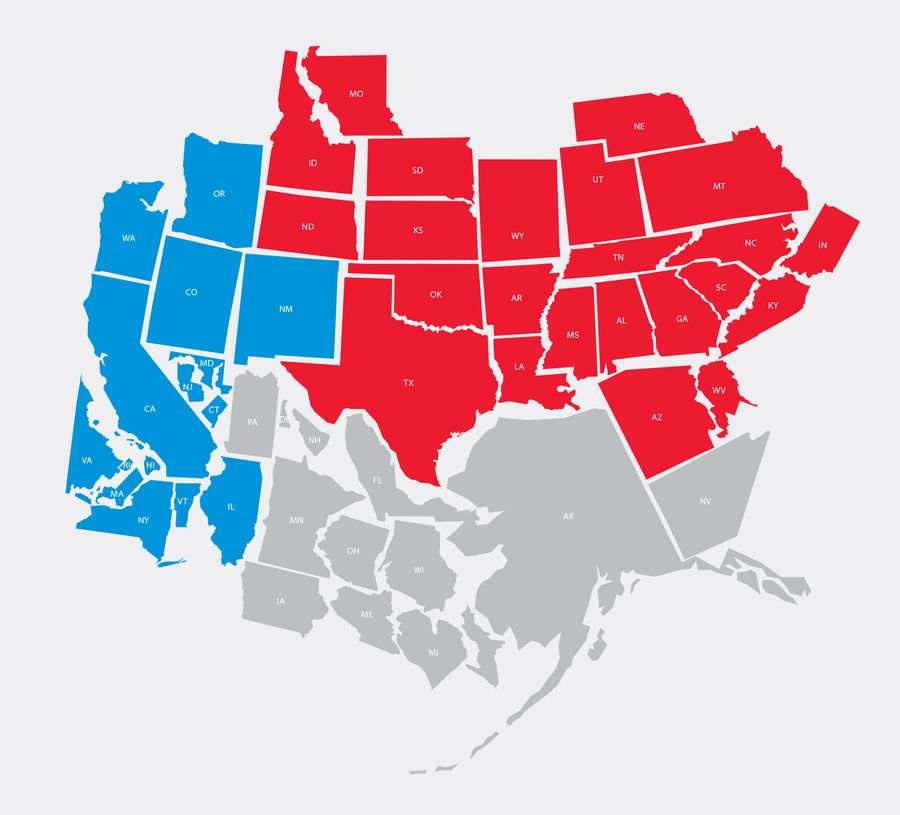
As soon as one crosses the border into the Alliance of Free States, whether over the Wabash River from Illinois to Indiana, or the grasslands that stretch across the Iowa-Missouri border, the difference between the two federations’ sense of identity becomes immediately visible. A popular decal showing an outline of the Red Fed’s borders — with a column of prairie states rising like an extended middle finger from the clenched fist of Texas — resides on bumpers and car windows as a defiant declaration of a newly defined region’s honor.
Over the first decade of its existence, Red Fed leaders found their purpose unwinding the domestic reforms of Franklin Roosevelt, Lyndon Johnson, and Barack Obama and with them much of the 20th-century regulatory state. The Occupational Safety and Health Administration, Environmental Protection Agency, and Federal Motor Carrier Safety Administration all saw their staffs gutted, left incapable of enforcing whatever rules did remain on the books. An alphabet soup of government agencies, Bill Kristol tweeted, had become a savory bone broth.
The National Labor Relations Board withered in the Red Fed, along with New Deal rules that blocked companies from interfering in employee efforts to win collective-bargaining power. The shift set off a return to the fierce business-labor battles of the Gilded Age, most visible in the emergence of new firms founded by Blackwater and Black Cube alumni, known as the Blackertons, that specialize in aggressive digital surveillance and online-misinformation campaigns against union organizers.
The effective elimination of most environmental and employment regulations proved irresistible to manufacturers. Boeing announced it would stop making capital investments in its Seattle-area factory and begin to shift jet assembly to a new plant in Covington, Kentucky. Factories relocated from China to be closer to the American consumer market and avoid import tariffs. Unemployment in parts of the Red Fed fell below 2 percent and the region briefly reached 5 percent growth — each several times better than Blue Fed indicators — leading conservative economists to praise the Red Miracle.
It was not just manufacturing and resource extraction that boomed in the Red Fed. As soon as the Blue Fed established its single-payer system, medical specialists began taking their practices to states where they wouldn’t be subject to the Regional Health Service’s price controls or rationing. Sloan Kettering now treats New York as little more than an administrative base; the majority of its hospital rooms are in Texas. Johns Hopkins considered closing its medical school when nearly half the faculty decamped en masse to Baylor. Wealthy Blue Fed residents willing to pay out of pocket now invariably travel to Houston when they want an immediate appointment with a specialist of their choice. The arrivals area at the George Bush Intercontinental Airport is packed with chauffeurs from van services run by clinics supported by specializing in such medical tourism.
Auctions of public lands across the interior west, along with the privatization of the Tennessee Valley Authority, generated a quick gusher of cash. Vowing not to let the new government wealth create more bureaucracy, Red Fed leaders deposited it all in a Free States Energy Trust Fund that would pay out an annual dividend to every adult and child in the region — a no-strings-attached cash transfer of hundreds of dollars per year. The Southern Baptist Convention encouraged its members to tithe their dividend checks directly into new aid societies to help the least fortunate. The most popular charitable cause has been a relief society to aid religious conservatives in the Blue Fed seeking to migrate to the Red Fed.
The boom in manufacturing and energy jobs on one side of the border and the guarantee of free government-sponsored education and medical care on the other created an incentive for families to split — with one spouse working (and paying taxes) in the Red Fed and the other, usually with children in tow, collecting benefits in the Blue Fed. (Remo, which pitched its app to investors as “Venmo for remittances,” became the fastest-growing tech company on the Fortune 500.) Sociologists are starting to worry that what they call the “split-family phenomenon” will become a hallmark of 21st-century life in North America, with its effects growing more pronounced as federation policies continue to diverge.
Reaction to Blue Fed culture drives much Red Fed governance. When the Blue Fed opened a gleaming new visitor center at Yosemite, the Red Fed moved to privatize all the concessions at Yellowstone. The Blue Fed’s expansive affirmative-action protocols inspired the Red Fed to abolish all HBCU-specific education programs so that primarily white institutions could compete equally for the funds. After Illinois led a Blue Fed initiative to upgrade its rail service, the Red Fed ended all cooperation with Amtrak, even adjusting gauge size along the Mississippi River to prevent passage of passenger trains from one side to another. As a backlash to the Blue Fed’s net-neutrality rule, the Red Fed imposed the Online Fairness Doctrine, which permits internet providers to slow upload and download speeds for content they determined was in violation of “community standards” or that offends a company’s religious beliefs. Across large swaths of the Red Fed, the only way to log into Grindr is via VPN.
These culture-war skirmishes instilled a strong sense of Red Fed identity, and the economy was doing so well that few noticed the slow exodus of tech entrepreneurs and high-skilled creative professionals who had once clustered in Austin and North Carolina’s Research Triangle. Only when the Supreme Court ruled that a compact-wide abortion ban did not place an undue burden on reproductive freedom because Red Fed residents could travel for free services in the Blue Fed did it become evident that conservative social policy would impede efforts to diversify the Red Fed economy beyond natural resources and heavy manufacturing. Amazon’s list of candidate cities to house its HQ14 did not include a single one in the Red Fed.
Each federation is the other’s largest trading partner, but they increasingly assume the posture of rivals. When the Blue Fed imposed a controversial excise tax on all products or services generated by companies that could not prove they paid their employees at least $18 per hour, the Red Fed saw it as a de facto tariff on its goods. It retaliated by placing its own excise tax on domestic wine, which led the Red Fed to deepen its trade ties with Chile and Argentina. That was a short-term diversion, but prompted a deeper examination of how economically dependent one federation had grown on the other’s internal policies. A Blue Fed requirement that certain freight classes travel only by all-electric truck fleets had nearly doubled the cost of transporting products to the interior west. Frequent work stoppages by West Coast longshoremen emboldened by their labor-friendly administration affirmed a strategy agreed to by titans of Red Fed industry: They needed their own Pacific port.
Red Fed leaders negotiated a deal with Mexican authorities for operating control of the Port of Lázaro Cárdenas, in Michoacán state, investing some of its energy trust funds. A new terminal, staffed by American Customs officials, connects directly with a spur of the Kansas City Southern railroad. There, nonunion laborers load ships with minerals mined through the American West, including lithium and soda ash, heading largely to East Asia, and unload bananas and smartphones from Ecuador and China heading for the landlocked states of the Red Fed without ever once passing through Blue Fed territory.
And then came the first humanitarian crisis. When the families of West Virginia workers started overloading schools and hospitals across the border in Hagerstown, Maryland, the Blue Fed began to impose residence requirements for many of its social services. That didn’t stop the migrants, but it led them to cluster in border towns as they waited out the six months required for eligibility. The conditions were often dire. Tent cities around Palm Springs saw the first American measles outbreak in a generation, and in the Spokane bidonvilles, dozens of children froze to death during a harsh winter.
Those tragedies set off a reckoning that has prompted an identity crisis for the Blue Fed’s leaders and citizens. On one side, fiscal experts say the Nordic-style welfare state that the Blue Fed has established is unsustainable if it just ends up as an unchecked provider of services to some of the Red Fed’s neediest cases. On the other side, some of the progressive activists who played crucial roles building early support for the health-care compact argue that the Blue Fed has an obligation to promote its values even beyond its borders. The debate rages across the region: What obligation do they have to other Americans who have democratically chosen to pursue a very different way of life?
The federations had a gentlemen’s agreement not to drag federal authorities into their disagreements, but the nature of their conflicts made that impossible. Once the Blue Fed declared itself a “sanctuary region” and invited undocumented immigrants elsewhere in the United States to seek refuge, Red Fed leaders threatened to erect internal border controls on state lines. The Blue Fed backed down, publicly revoking its invitation, but only after the Red Fed agreed to jointly lobby Congress to create a series of regionally restricted work visas.
The federal government remains the enforcer of the country’s citizenship laws, agent of its foreign affairs, controller of its national defense, and manager of its monetary policy. But it grew increasingly impossible to perform any of those roles neutrally, and many of the country’s democratic institutions were not designed to balance the competing interests of two geopolitical rivals.
When the Federal Reserve raised interest rates to stop the Red Fed’s economy from overheating, it pushed the rest of the country into recession, prompting the Great Lakes to lead the first successful campaign to have the Federal Reserve Board removed from office. When Hurricane Rigoberto came through the Gulf of Mexico, leaving large portions of Houston underwater for months — the first trillion-dollar natural disaster, at least when the cost of the subsequent malaria outbreak is included — the Red Fed demanded a bailout from the federal government. Blue Fed politicians said it would be “moral hazard” to do so, given that most of the damage was traced to a Red Fed decision to privatize the Houston Ship Channel and entrust the buyer, a Qatari sovereign-wealth fund, with upkeep of the Galveston Seawall and the levee networks of surrounding southeastern Texas counties.
The Pentagon lost its authority to act as a nonaligned arbiter of the national interest. Once cartels seized control of the Red Fed’s Mexican container port, taking hostage 17 retired Texas Rangers working on a private security force, the Defense secretary mobilized West Coast National Guard units to support an Army Rapid Deployment Force, along with Marines and Navy seals. Oregon’s governor balked, announcing that he would not permit his troops to “be used as muscle for the Red Fed’s imperial adventures.” The Supreme Court ruled that National Guard units had to follow the commander-in-chief’s orders, and the Oregon guardsmen headed south, but the incident polarized foreign-policy positions in new ways. When, months later, intelligence agencies issued a report pinning the crash of the western renewable-energy grid on a North Korean cyberattack, Red Fed cities saw some of their largest mass protests in years, all against a rush to war. Nearly 100,000 people gathered in Indianapolis’s Monument Circle, chanting “No blood for solar.” By the time of the South China Sea Crisis, Congress had grown so paralyzed along federation lines that it was impossible to assemble a majority in favor of any declaration of war.
Leaders overseas have become eager to exploit what they see as the United States’s political weakness. As concerns about climate change have grown more dire, other countries have become intent on punishing dissenters from the international order, and the Red Fed is now a global villain. The European Union agreed to pre-clear for entry all crops produced under the Blue Fed’s GMO-free agriculture policy, while Red Fed imports are subjected to a lengthy and costly quarantine. China announced most-favored-region trade policies that would give Blue Fed exporters an advantage over domestic rivals when selling into the Chinese market.
These trade-related conflicts squeeze Illinois, which wants to export Caterpillar tractors to China under favorable conditions but lags behind West Coast and New England states in transitioning to GMO-free agriculture. Although a founding member of the Blue Fed, Illinois at times felt geographically isolated, surrounded by Red Fed or neutral states. Illinois withdrew from the Blue Fed and helped to form the Great Lakes Federation, which stretches from Philadelphia to Des Moines and up to Duluth, with a permanent capital in Chicago. As the 20-year judicial truce is about to expire, the Midwest controls the balance of power in a Congress that may be forced by the Supreme Court to revisit some of its earliest assumptions about returning power to the states.
There is another real-life contemporary example of a semi-secession: Brexit. It, too, began as little more than a thought experiment. What if we could reject a far-off governing structure that no longer seems responsive to our interests in favor of local authority that can more closely match our aspirations and sense of identity as a people? There must have been something thrilling about getting to cast a vote for self-determination.
Yet those who are now forced to make that reverie real are pulling back from their former self-confidence about it. Just last week, the Tory official serving as Secretary of State for Exiting the European Union admitted he “hadn’t quite understood the full extent” to which British commerce was “particularly reliant on the Dover-Calais crossing,” and that new trade barriers could impact the availability of consumer goods in stores. Instead of just leaving Europe, as he encouraged his compatriots to do during the 2016 campaign, Dominic Raab now insists on “a bespoke arrangement on goods which recognizes the peculiar, frankly, geographic, economic entity that is the United Kingdom.”
As it was for a majority of Britons, it is easier to imagine breaking up the United States than figuring out how to make it work — whether through bold new policies or merely a functioning version of consensus politics. The seeming inelasticity of our system of governance also guarantees a security and predictability that we take for granted. Some of the lessons Europe is being taught under the stress of the Brexit crisis — that a single currency requires a unified economy, or that a lack of internal borders can’t work if no one can agree on what should happen at the outer one — are ones Americans might better learn from fantasy than from experience.
A snapshot of what the nation would look like if it cleaved in three today.*
Blue Federation: 128.5 million
Red Federation: 119.2 million
Neutral Federation: 77.3 million
White
Blue: 69,036,422
Red: 73,482,040
Neutral: 64,608,488
Black
Blue: 12,680,587
Red: 17,661,932
Neutral: 8,443,243
Hispanic
Blue: 28,745,227
Red: 18,054,043
Neutral: 8,330,731
Asian
Blue: 11,206,713
Red: 2,984,794
Neutral: 2,210,135
Other
Blue: 4,642,560
Red: 3,709,463
Neutral: 2,102,755
Blue: Foreign-born: 19.09 percent; U.S.-born: 79.19 percent
Red: Foreign-born: 8.39 percent; U.S.-born: 88.84 percent
Neutral: Foreign-born: 9.79 percent; U.S.-born: 88.12 percent
Blue: 3.89 percent
Red: 3.36 percent
Neutral: 3.59 percent
$200K+
Blue: 3,652,752
Red: 1,722,633
Neutral: 1,255,983
Under $25K
Blue: 8,966,417
Red: 10,612,524
Neutral: 6,658,590
Blue: $8,758,871
Red: $6,210,030
Neutral: $4,181,430
Blue: 237
Red: 141
Neutral: 119
Blue: 624,225
Red: 927,958
Neutral: 465,229
Blue: 9.80 percent
Red: 13.63 percent
Neutral: 10.11 percent
Blue: 11,759,157
Red: 7,261,992
Neutral: 5,408,654
Blue: Disneyland, Statue of Liberty
Red: Dollywood, Mount Rushmore
Neutral: Disney World, Hersheypark
Blue: Yosemite, Rocky Mountain
Red: Yellowstone, Grand Canyon
Neutral: Denali, Everglades
— Reporting by Rachel Bashein
*Figures from the U.S. Census Bureau, the Bureau of Economic Analysis, the Sentencing Project, and Fortune magazine.
*This article appears in the November 12, 2018, issue of New York Magazine. Subscribe Now!
No, Democrats Didn’t Win The Senate. But They Did Better Than It Seems.
The 2018 election has become a tale of divided government: the House broke for Democrats, but the Senate held for Republicans — and what’s more, Republicans were even able to expand their majority in the Senate. The election has also become a tale of blue waves. But don’t those tales contradict one another? Not really. What the “split decision” narrative sometimes misses is just how well Democrats performed in the Senate despite having to defend more seats than Republicans30 — and in territory that was largely more favorable to the GOP.
Much of this is overshadowed because Democrats did lose Senate seats. But if we look at a state’s partisan lean31 and the vote share margin in each Senate race, we see Democrats managed to outperform how their states leaned politically in almost every single race — including in the 10 states with a Democratic incumbent that President Trump won in 2016.
Some of what we’re seeing here is probably related to the overall Democratic-leaning national environment — the popular House vote margin currently sits at D+7. But in 27 of the 33 Senate races included in the chart,32 Democratic candidates outperformed the partisan leans of their states. And there were four contests where Democratic incumbents fared 20 points or better than their state’s political baseline — and three of them won. This helped Democrats hold onto seats in two heavily Republican states — West Virginia and Montana — and easily win one seat in a likely 2020 battleground — Minnesota. As for North Dakota, the GOP picked up the seat despite a strong Democratic overperformance.
At the top of the list was Sen. Joe Manchin, who overperformed the deep, red hue of West Virginia by 33 points. He defeated Republican challenger Patrick Morrisey by a 3-point margin. Granted, this race was much closer for Manchin than his previous Senate victories in 2010 and 2012, but it’s still impressive in a state that leans 30 points more Republican than the country as a whole. In Minnesota, Democrats found more solid footing as Sen. Amy Klobuchar outperformed her state’s baseline by 22 points and won reelection by a whopping 24 points. Minnesota is only 2 points more Democratic than the rest of the country, so this has some people wondering if she could leverage her landslide victory into a case for her party’s 2020 presidential nomination. Sen. Jon Tester of Montana also outperformed his state’s partisan baseline by 22 points, but unlike Klobuchar, his contest was in a much redder state, and as a result, he won with a 4-point margin. While this is a slim margin of victory, it was the first time that Tester won an outright majority of the vote, having failed to do so in his 2006 or 2012 Senate wins. Although Sen. Heidi Heitkamp ran 22 points ahead of North Dakota’s partisan lean of R+33, it wasn’t enough to squeak out a second victory.33 She lost to Republican Rep. Kevin Cramer by 11 points.
Indiana and Missouri also had Democratic incumbents who outperformed their state’s partisan lean by double digits, but it wasn’t enough to save either of them. In Indiana, Sen. Joe Donnelly lost reelection by 6 points while running 12 points ahead of his state’s lean, and in Missouri, Sen. Claire McCaskill also lost by 6 points while doing 13 points better than Missouri’s R+19 baseline would suggest. So while these Democrats did much better than one would expect based on how red their states are, they did not perform well enough to actually win. Certainly troubling news for Democrats running in statewide elections in other red states.
As for the two seats Democrats were able to pry from Republicans’ grasp, Rep. Kyrsten Sinema outperformed Arizona’s political lean by about 11 points and edged out GOP Rep. Martha McSally by roughly 2 points. In neighboring (and less red) Nevada, Rep. Jacky Rosen beat incumbent Republican Sen. Dean Heller by 5 points and outperformed her state’s lean by 6 points.
One Republican winner who narrowly outperformed his state’s partisan lean has a familiar face: Mitt Romney. He defeated Democrat Jenny Wilson by 32 points in Utah, a state that is 31 points more Republican than the rest of the country — so not only did he win handily, he also performed 1 point better than Utah’s partisan baseline. The GOP also overperformed in both Mississippi Senate races. Republican Sen. Roger Wicker won by 20 points, 5 points better than the state’s R+15 partisan lean. In the all-party special election, no single Republican candidate won outright as 50 percent of the vote was needed to clinch the seat. That said, the overall Republican vote share was about 16 points ahead of the combined Democratic vote, or put another way, 1 point better than Mississippi’s partisan baseline. This probably bodes well for Republican Sen. Cindy Hyde-Smith in the state’s Nov. 27 runoff.
Looking ahead to the 2020 Senate map, Democrats have a tough slog ahead of them in Alabama, which leans 27 points more Republican than the rest of the country.34 And if 2018 is any indication of how Senate races will go for Democrats in red states, they’ll have to hope that Sen. Doug Jones of Alabama can replicate Manchin’s level of overperformance and not, say, Heitkamp’s. That said, it might be the GOP’s turn to see if they can outperform a state’s partisan lean with Sens. Cory Gardner of Colorado and Susan Collins of Maine. Colorado leans 1.5 points more Democratic than the rest of the nation and Maine 5 points. If the GOP can hold onto both, it will make it nearly impossible for the Democrats to win a majority in 2020.
Split-Ticket Voting Hit A New Low In 2018 Senate And Governor Races
We went into Election Day with a hypothesis: Most Americans would cast a straight-ticket ballot — with some notable exceptions, which we’ll address in a moment. And we decided a good way to test this was to look at statewide races most likely to drive turnout in a midterm election cycle: U.S. Senate and governor contests.
There were 22 states that had races for both the Senate and governor on the ballot this election cycle. And what we found was the same party swept both offices in 16 of the 21 states where each race has been called26, with Democrats capturing both races in 12 states and Republicans doing so in four. Or, in other words, our hypothesis was mostly right — most Americans did vote for the same party in their Senate and governors race. But there were five states — Arizona, Maryland, Massachusetts, Ohio and Vermont — where voters chose a Republican governor and a Democratic senator.
And while we were interested in what happened in these five states (more in a moment), we also wanted to look at every state that had both a Senate and governor race on the ballot to see just how far apart the voting margins were. The idea was this will help us understand how uncommon — or common — split-ticket voting was in 2018. And we could then situate what happened in 2018 by looking at previous midterms to see if there was a trend in how much split-ticket voting occurred between these two offices. (Spoiler: Split-ticket voting hit a new low.)
To do this, I calculated the difference between the margin of victory in the Senate and gubernatorial races for each state using the Democratic and Republican vote shares in each contest.27 And as the table below shows, Massachusetts had the biggest difference between its vote share margin in its races for Senate and governor. Republican Gov. Charlie Baker won reelection by about 32 percentage points and Democratic Sen. Elizabeth Warren garnered a second term with a roughly 26-point margin, producing a gap of 57 points. So, in other words, in hyper-blue Massachusetts roughly 25 to 30 percent of voters cast ballots for both Baker and Warren.28 Two other states, Vermont and Maryland, also had very large differences between their Senate and governor races — about 55 and 47 points, respectively. Along with Massachusetts, these races all featured relatively popular incumbent Republican governors — Phil Scott in Vermont and Larry Hogan in Maryland — running in strongly Democratic states that easily reelected incumbent Democratic senators. The popularity and independent streaks of these GOP governors clearly helped them overcome the sharply Democratic leans of their states.
Split ticket voting in statewide races is pretty rare
Difference between the size of the margin of victory in 2018 Senate and governor races
| Senate | Governor | ||||||
|---|---|---|---|---|---|---|---|
| State | Winner | Incumb. | Margin | Winner | Incumb. | Margin | Difference |
| MA | Warren | ✓ | +25.5 | Baker | ✓ | +31.9 | 57.4 |
| VT | Sanders* | ✓ | +40.3 | Scott | ✓ | +14.6 | 54.9 |
| MD | Cardin | ✓ | +33.4 | Hogan | ✓ | +13.4 | 46.8 |
| CT | Murphy | ✓ | +20.2 | Lamont | +3.1 | 17 | |
| AZ | Sinema | +2.0 | Ducey | ✓ | +14.4 | 16.5 | |
| HI | Hirono | ✓ | +42.3 | Ige | ✓ | +29.0 | 13.3 |
| MN‡ | Klobuchar | ✓ | +24.1 | Walz | +11.4 | 12.7 | |
| ME | King* | ✓ | +19.0 | Mills | +7.6 | 11.5 | |
| TX | Cruz | ✓ | +2.6 | Abbott | ✓ | +13.3 | 10.7 |
| NY | Gillibrand | ✓ | +33.0 | Cuomo | ✓ | +22.3 | 10.7 |
| OH | Brown | ✓ | +6.4 | DeWine | +4.2 | 10.6 | |
| TN | Blackburn | +10.8 | Lee | +21.1 | 10.2 | ||
| WI | Baldwin | ✓ | +10.9 | Evers | +1.1 | 9.7 | |
| NM | Heinrich | ✓ | +23.5 | Grisham | +14.3 | 9.2 | |
| RI | Whitehouse | ✓ | +23.0 | Raimondo | ✓ | +15.5 | 7.6 |
| PA | Casey | ✓ | +12.8 | Wolf | ✓ | +16.8 | 4 |
| MI | Stabenow | ✓ | +6.4 | Whitmer | +9.5 | 3 | |
| WY | Barrasso | ✓ | +36.9 | Gordon | +39.8 | 2.9 | |
| NV | Rosen | +5.0 | Sisolak | +4.1 | 0.9 | ||
| MN‡ | Smith | ✓ | +10.6 | Walz | +11.4 | 0.8 | |
| NE | Fischer | ✓ | +19.2 | Ricketts | ✓ | +18.9 | 0.4 |
Election data as of 10 a.m. on Nov. 16, 2018. Only states with both a Senate and gubernatorial election that featured candidates from both major parties are included. This means California is excluded because no Republican candidate qualified for its Senate election. Florida is also not included because both its Senate and gubernatorial elections are still uncalled. Some data may not add up due to rounding.
*Vermont Sen. Bernie Sanders and Maine Sen. Angus King are included as Democrats because they caucus with the party in the Senate.
‡Minnesota is included twice because it had two Senate elections this year.
Source: ABC NEWS
But these three states were notable outliers — no other state had a difference between their Senate and governor races that was greater than 17 points. That said, these less divided contests can still show you where a stronger candidate for one party may have made a difference. Take Tennessee’s Senate race, for instance. Republican Rep. Marsha Blackburn defeated Democrat Phil Bredesen there, but Bredesen — a popular former governor — made the Senate contest notably closer than the gubernatorial election.
Incumbency may have been a factor, too. Both the Tennessee Senate and gubernatorial races were open seats, but in another GOP-leaning state like Ohio, there was one incumbent on the ballot, which might help explain why Ohioans elected a Democratic senator and a Republican governor. Incumbent Democratic Sen. Sherrod Brown won his race by about 6 points and Republican Mike DeWine won the open-seat governor race by 4 points. Given that Ohio is 7 points to the right of the country, Brown probably benefited at least some from an incumbency advantage The two races ran relatively close together — the difference was 11 points — suggesting that most voters voted for the same party in both contests.
But we were also interested in what would happen if we took a step back and zoomed out, looking at other midterm cycles and split-ticket voting. How would 2018 compare? It turns out that 2018 is part of a trend that shows fewer Americans are splitting their tickets (at least in races for the Senate and governors in midterm elections). This election had the smallest median difference of any midterm cycle going back to at least 1990 — 10 points.29

As you can see, even though 2018 has the lowest mark in the past three decades, the median difference from election cycle to election cycle has bounced around. Still, the overall trend is one of decline, at least since 1998. You might wonder why there are fairly regular ups and downs in the chart, but this can be explained by the number of elected governors running for re-election in each cycle.
For example, only eight incumbent governors ran in the 24 states included in my calculations for 2010, whereas in the 2014 cycle there were 16 states with incumbent governors. And what I found was cycles with fewer incumbent governors running tended to show less evidence of split-ticket voting (a lower median) while cycles with more incumbents demonstrated more evidence of split-ticket voting (a slightly higher median). Part of this is because governors often benefit from an incumbency advantage. As my colleague Nate Silver pointed out in his introduction to FiveThirtyEight’s governor forecast, partisanship explains less in gubernatorial elections than it does in federal contests, and therefore, incumbency might matter slightly more for governors than it does in either the House or Senate.
No matter which way you cut it, the difference between the margins in a state’s gubernatorial and Senate races has shrunk. More voters are casting straight-ticket ballots. There are exceptions, of course, but this shift matches what we know about the larger electoral picture: voters are more partisan and the country is more divided than it’s ever been in the modern era of U.S. politics.
CORRECTION (Nov. 19, 2018, 2:30 p.m.): A table in an earlier version of this article incorrectly indicated that the Democratic Senate candidate in Arizona, Kyrsten Sinema, was the incumbent. The race was for the seat that Republican Sen. Jeff Flake is retiring from.
https://www.washingtonpost.com/opinions/if-the-midterms-were-a-referendum-trump-won/2018/11/09/a39cc5fe-e44f-11e8-ab2c-b31dcd53ca6b_story.html?utm_term=.aabe53e0162b
Joel Thrasymachus DahlInteresting, but I ultimately disagree with this, even though it employs many of the historical rules of thumb that I go by in the absence of doing a deep dive into understanding individual congressional districts.
1) Misunderstands the rule of thumb about the White House occupant's party losing seats in the midterms. It's about popular vote win two years prior (Clinton), and depression of turnout in the midterms disproportionately affecting the congressmen who were elected down-ballot two years early on the coattails of the turnout for the president. When framed that way, the Dubya exception makes sense because Gore won the 2000 popular vote, and the fact that Hillary Clinton's party not only didn't lose seats but actually *gained* some is a big fucking deal. The FDR 1934 midterms remains an outlier still. I'm guessing that during the Great Depression, shit was bad enough for the average voting Joe that rules of thumb didn't apply. Much like Trump is enough of an asshole that rules of thumb didn't apply in 2018.
2) His closing point about the parallel between the midterms of 2018 and the midterms of 1982 (followed by Reagan's huge reelection in 1984) is a worthwhile note of caution, but perhaps a bit too wet blanket. I think Democrats should be ecstatic about what 2018 means for 2020 (especially the signs of division in the GOP), but I don't for a second claim that Dems have 2020 in the bag. I think what it means is that there's enough anger against Trump that his incumbency advantage is not nearly as much of an advantage as it usually would be for a president, and therefore this might be a bit more of an even playing field. Perhaps more like 2016 or 2008 than like 2012 or 2004.
3) Point taken that half the enhanced midterm turnout was GOP turnout, but see point #2. There's a shot at getting rid of this asshole 4 years before I expected we'd be rid of him. Granted, Democrats have PhDs in Fucking Up Golden Opportunities, but the fact remains that there is a Silver Opportunity in 2020 when normally there'd be only a Participation Award Opportunity.
"Monopoly for Millennials" recommends playing in your parents' basement
Joel Thrasymachus DahlThis is a little funny.
Just in time for the holidays, Hasbro has released "Monopoly for Millennials", the game where you're encouraged to take a break from the rat race because "adulting is hard."
This should go over well.

Money doesn't always buy a great time, but experiences, whether they're good -- or weird -- last forever. The Monopoly for Millennials game celebrates just that. Instead of collecting as much cash as possible, players are challenged to rack up the most Experiences to win. Travel around the gameboard discovering and visiting cool places to eat, shop, and relax. Interact with other players via Chance and Community Chest cards, (which are super relatable). And players don't pay rent -- they visit one another, earning more Experience points. This board game is a great way to bring a fun and relaxed vibe to a party or casual get-together.
That's right - there's no rent to pay and no real estate to buy because, as it says on the front of the box, "Forget real estate. You can't afford to buy it anyway."
Experiences include a 3-day music festival, a friend's couch, a vegan bistro, bike share, and yoga studio. A hashtag and smiley face emoji are among the tokens. The person with the most student debt rolls first. Uncle Pennybags is wearing a participation ribbon.
Yikes.
The reaction has been less than appreciative.
I'm not sure who @hasbro made Monopoly for Millennials for? As if we don't get shit on enough lol... A game about millennial life should absolutely include paying rent. A lot of it. The vast majority of us can't afford to spend money on "experiences." Anyway, disappointed.
— Sarah (@SarahTeeRaymo) November 12, 2018
I feel "Millennial Monopoly" is a perfect, easy-to-understand example of what negative Cultural Appropriation is.
— Lively (@trettertrots) November 8, 2018
this millennial monopoly thing is pissing me off way more than it fucking should
— Normal-ass B-Dogg (@bryancoffee) November 8, 2018
"When I was a child I thought as a child ..."
As a kid I used to collect Monopoly sets. (True story.)
"But when I became a man I put away childish things."
I don't collect anymore. But I do own my own house.
Dear @Hasbro,
Learn who your audience is.
Me, a millennial.— Jeff (@epiphanist1248) November 9, 2018
Monopoly for Millennials [Walmart][Photos: Walmart/Hasbro]
Opinion | Ballot Initiatives Are Powerful. The Powerful Have Noticed.
In California, wealth and stealth have often subverted the goals of measures that have impacted nearly every facet of life in the state.
By Miriam Pawel
Ms. Pawel, a contributing opinion writer, is the author of “The Browns of California: The Family Dynasty That Transformed a State and Shaped a Nation.”

The grass-roots organizers delivering petitions to San Francisco City Hall in the spring of 2016 wore their message on their chests: “The People vs. Big Soda.” Six months later, The People won; voters overwhelmingly passed a penny-per-ounce tax on sugary drinks, designed to combat rising rates of diabetes and obesity.
For years, California state legislators had killed attempts to tax sugary beverages, beholden to an industry that donated millions to political campaigns. The success of the San Francisco soda tax, along with similar ballot measures in three other Bay Area cities, energized a national movement and spurred new drives to tax soda in municipalities around California.
The campaigns drew on the legacy and spirit of Hiram Johnson, the governor who championed direct democracy and led California to adopt the initiative, referendum and recall. Just as Governor Johnson had delivered in 1911 on his promise to give people tools to break free from the monopoly of the Southern Pacific Railroad, a century later the people would circumvent the State Legislature by taking their fight against the soda industry directly to the voters.
Then the soda industry fought back — using Hiram Johnson’s favorite weapon.
Early this year, the beverage industry spent more than $7 million gathering enough signatures to put an initiative on the ballot that would require a two-thirds vote to pass any local tax. Such a change would wreak havoc with municipal finances, and the specter gave the industry leverage to get what it really wanted: In June, the initiative was withdrawn, in exchange for a state law that bars local governments from imposing any new soda taxes through 2030.
The high-stakes trade was the latest escalation in California’s initiative-industrial complex, in which wealth and stealth often subvert the goals of Hiram Johnson’s reforms. With enough money, almost anything can get on the California ballot. Over the last century, particularly the last four decades, initiatives have shaped nearly every facet of life in California. Ballot propositions, which can be amended only by another popular vote, have determined how property taxes are levied, the fate of bilingual education and even the size of chickens’ cages (and thus the price of eggs).

When Hiram Johnson took office, amid rampant corruption, the Southern Pacific Railroad held so much power it was known as the fourth branch of government. “While I do not by any means believe the initiative, the referendum and the recall are the panacea for all our political ills,” Governor Johnson said in his 1911 inaugural address, “they do give to the electorate the power of action when desired, and they do place in the hands of the people the means by which they may protect themselves.”
Today, those tools are expertly wielded by the moneyed interests whose power they were designed to counteract.
California is one of 24 states that allow voters to initiate laws through the petition process. A proposed law can be placed on the ballot with signatures equal to 5 percent of the total gubernatorial vote in the last election; a constitutional amendment requires 8 percent. In 1912, measures qualified with 30,857 signatures; by the 21st century, the number topped half a million.
In the early decades, only a handful of initiatives reached the ballot. By the 1930s, the nation’s first political consultants, Clem Whitaker and Leone Baxter, began to carve out a niche business, handling 65 initiative campaigns over 15 years.
Mr. Whitaker and Mr. Baxter, and the political-consultant industry they spawned, fueled a rapid growth in initiatives by the 1970s. Paid signature gatherers driven by financial incentive rather than moral conviction replaced volunteers who had once circulated petitions for their causes. The initiative “is very rapidly becoming a tool of the special interests,” Jerry Brown, then the secretary of state, testified at a 1972 state hearing where signature gatherers detailed a range of deceptive practices.
The last initiative that got on the ballot through the effort of volunteers was a 1990 measure to protect mountain lions. Since then, petition gatherers wielding multiple clipboards have become ubiquitous at shopping malls, outside retail stores and at farmers’ markets. They are paid per signature, rates that fluctuate as high as $6 per name, depending on how many initiatives are in circulation, how soon the petitions must be turned in and how difficult the sell. Signature gatherers who handle multiple initiatives have an incentive to push the ones that pay the most. The bidding wars and campaign high jinks can be fierce. They have included attempts to sabotage petitions by flooding them with false or duplicate names.
As governor, Mr. Brown has vetoed several recent attempts to amend the process, principally by outlawing a fee-per-signature payment. While he acknowledged the propensity for manipulation, he argued that the per-signature system remains the cheapest. “Eliminating this option will drive up the cost of circulating ballot measures, thereby further favoring the wealthiest interests,” he wrote in a veto message.
Mr. Brown has had more experience with initiatives than most. In his first campaign for governor in 1974, he piggybacked on a popular initiative he had crafted, the Political Reform Act, which established a commission to to regulate campaign finances, lobbying and ethics. Four years later, he was caught in the swirl of Proposition 13, the tax cut measure that remains the most far-reaching initiative in modern times. Like most elected officials, Mr. Brown opposed Prop 13, but then embraced it enthusiastically when it passed.
Since his return to the governor’s office in 2011, he has mastered the art of using initiatives to further his priorities. He devised and campaigned for measures that raised taxes, created a rainy-day fund and made major changes to the criminal-justice system. He has also amassed funds to fight off attempts to undo policies or hamper his objectives, learning from the experience of Prop 13, when such tactics were not yet in vogue. He has helped fend off ballot challenges to criminal-justice reforms and efforts to block his plans for high-speed rail. This year, he has helped fight a proposition on the November ballot that would repeal a recently enacted gas tax that funds highway repairs.
Such campaigns are costly, in part because there are no limits on contributions. This November, in addition to the gas tax, voters will decide measures that affect issues including rent control, bonds for water projects and homeless housing, the size of cages for farm animals and the future of daylight saving time. As of the end of October, the amount raised to pass or defeat the 11 propositions was almost $368 million, about five times the amount raised by this year's two gubernatorial candidates.
Figures in millions, as of Saturday.

Limits on dialysis clinics' revenue
California Proposition 10
Renewable energy standards
Future gas and vehicle taxes
Washington Initiative 1631
Marsy's law crime victims rights
New oil, gas and fracking projects
Nurse-patient assignment limits

Limits on dialysis clinics' revenue
California Proposition 10
Renewable energy standards
Future gas and vehicle taxes
Washington Initiative 1631
Marsy's law crime victims rights
New oil, gas and fracking projects
Nurse-patient assignment limits
By The New York Times | Source: Ballotpedia; Colorado Proposition 112 figures do not add up to the total because of rounding.
The most expensive campaign is about one of the most obscure issues: regulating the profits of dialysis clinics. Placed on the ballot by the Service Employees International Union, which has been trying to unionize workers at the clinics, the initiative would require that profits above a certain amount be spent on patient care or refunded. To defeat the measure, the major dialysis providers have so far contributed than $111 million, a record for spending by one side on a single initiative.
Notable ballot initiatives up for a vote in states on Nov. 6.

NONPARTISAN REDISTRICTING
Colorado has two proposals: Creating independent commissions to design districts for its congressional delegation and the State Legislature.
VOTER REQUIREMENTS, BALLOT ACCESS
Arkansas and North Carolina initiatives would require voter IDs. North Dakota would explicitly restrict voting rights to United States citizens.
South Dakota has two initiatives: One would revise spending, lobbying and referendum laws; the other would ban outsiders from making contributions to ballot question committees.
Missouri has three initiatives on the ballot to legalize medical marijuana. Each would tax marijuana sales at different rates, with that revenue being dedicated to either veterans’ care or biomedical research.
Oregon and Washington would ban taxes on groceries. Oregon would require three-fifths votes in the State Legislature to increase revenue; Florida would require two-thirds majorities.
Approve bonds for children’s hospitals expansion.
Set limits on the number of patients per nurse.
Limit profits at dialysis clinics.
Exempt some medical equipment from sales taxes.

NONPARTISAN REDISTRICTING
VOTER REQUIREMENTS, BALLOT ACCESS
Arkansas and North Carolina initiatives would require voter IDs. North Dakota would explicitly restrict voting rights to United States citizens.
Colorado has two proposals: Creating independent commissions to design districts for its congressional delegation and the State Legislature.
Missouri has three initiatives on the ballot to legalize medical marijuana. Each would tax marijuana sales at different rates, with that revenue being dedicated to either veterans’ care or biomedical research.
South Dakota has two initiatives: One would revise spending, lobbying and referendum laws; the other would ban outsiders from making contributions to ballot question committees.
Oregon and Washington would ban taxes on groceries. Oregon would require three-fifths votes in the State Legislature to increase revenue; Florida would require two-thirds majorities.
Approve bonds for children’s hospitals expansion.
Set limits on the number of patients per nurse.
Limit profits at dialysis clinics.
Exempt some medical equipment from sales taxes.
By The New York Times | Source: Ballotpedia
Even as voters sort through the barrage of advertising, several initiatives have already been approved to circulate petitions for signatures in an effort to qualify for the 2020 ballot. One of them involves a familiar subject: the soda tax.
The last-minute deal to pull the beverage-industry-backed initiative off the ballot in exchange for the moratorium on local taxes was enabled by a 2014 law, intended to facilitate compromise. The use of the initiative in this case infuriated many, even those who voted for the deal because they saw no alternative. Assemblyman Jim Wood, a Northern California dentist, called it “extortion.”
But in the spirit of Hiram Johnson, they have not given up. Soon, signature gatherers will be wielding petitions to qualify the “California Sugar-Sweetened Beverages Tax Initiative” for the 2020 ballot. No doubt new spending records will be set before its fate is resolved.
Miriam Pawel, a contributing opinion writer, is the author of “The Browns of California: The Family Dynasty That Transformed a State and Shaped a Nation” and “The Crusades of Cesar Chavez: A Biography.”
Follow The New York Times Opinion section on Facebook, Twitter (@NYTopinion) and Instagram.




Dolphins Improvise Delightful New Way Of Advancing Upfield
Joel Thrasymachus DahlRondale, if you're still checking your TOR account, you'll LOVE this.
It’s been a funny night in Houston. The Texans were hit with a personal foul for making contact with a long-snapper. Danny Amendola threw a touchdown. DeAndre Hopkins had one of the most insane catches you will ever see nullified by offsetting penalties. But the wildest play of all has to be this ridiculous....I don’t…
https://www.washingtonpost.com/nation/2018/10/25/house-sitter-tried-blowtorch-some-black-widows-more-than-two-dozen-firefighters-responded-blaze/?utm_term=.652c832eb737
Joel Thrasymachus Dahl"Please don't use a blowtorch to kill spiders."
https://www.amazon.com/Hope-Never-Dies-Mystery-Mysteries/dp/1683690397/ref=pd_rhf_schuc_s_bmx_1_7?_encoding=UTF8&pd_rd_i=1683690397&pd_rd_r=ef10e61d-55e3-4d4f-a86f-43ea4d84e010&pd_rd_w=StwpL&pd_rd_wg=tYlaj&pf_rd_i=desktop-rhf&pf_rd_m=ATVPDKIKX0DER&pf_rd_p=4489418a-a359-4e71-92d0-7610e44bd807&pf_rd_r=SR6RSNXAXQZHXRJS1DS9&pf_rd_s=desktop-rhf&pf_rd_t=40701&psc=1&refRID=SR6RSNXAXQZHXRJS1DS9
Joel Thrasymachus DahlWow. This exists.
Green Eggs and the Absurd
Joel Thrasymachus Dahl
This made my day.
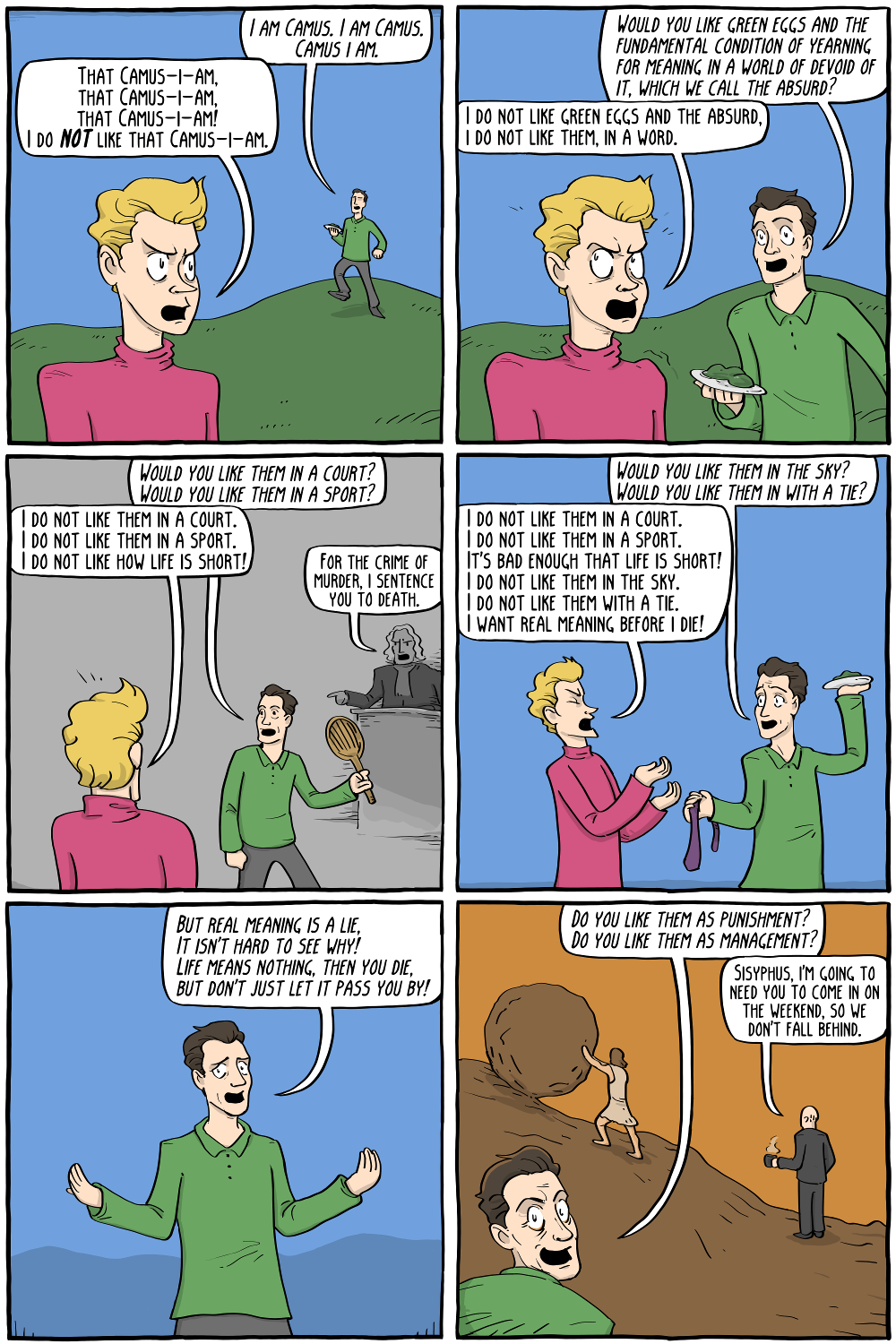
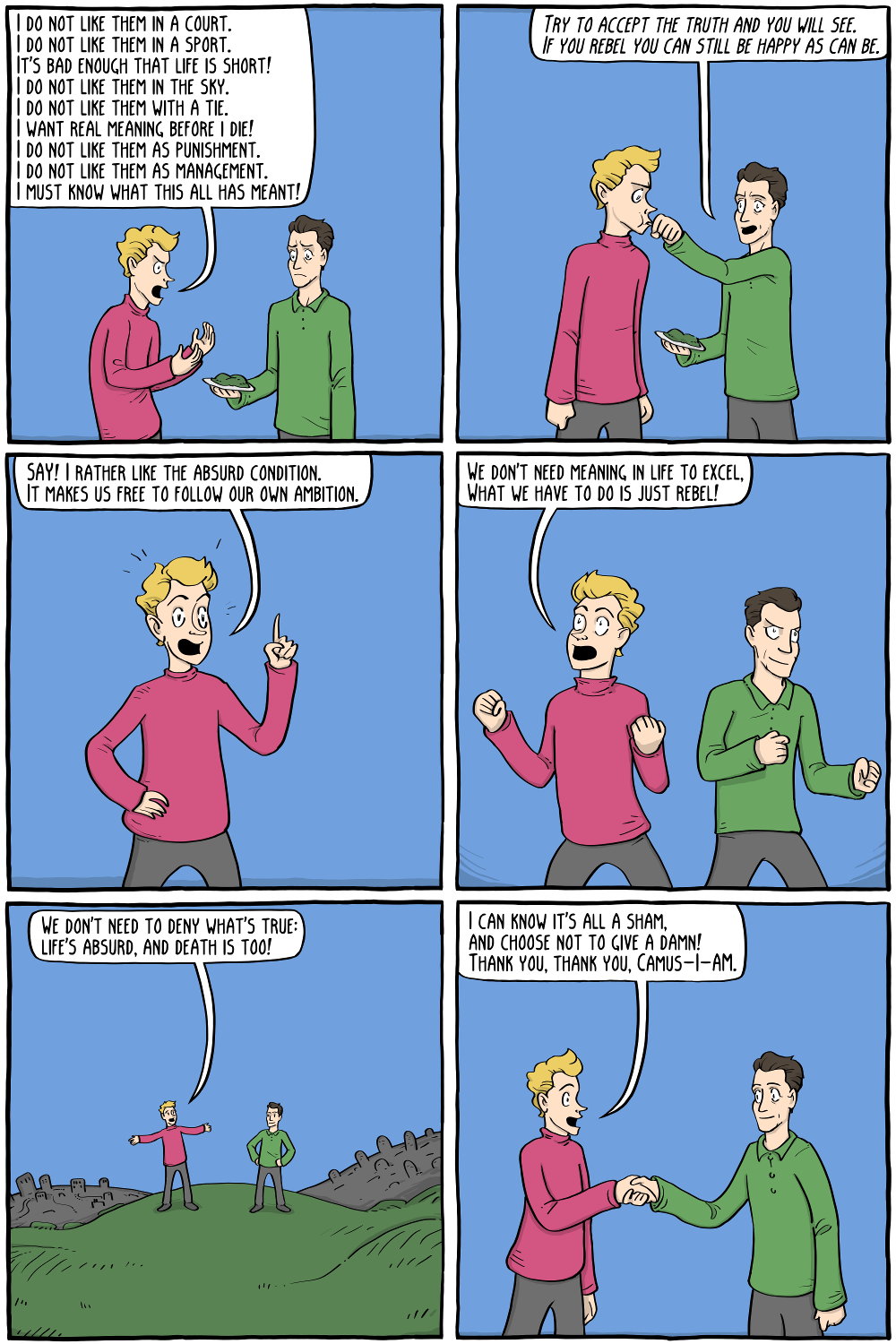
Japan's Hometown Tax
Joel Thrasymachus DahlThis is really amazingly brilliant to read. Most interesting to me is how it's a wonky idea that is fully integrated into Japan's particular culture.
Like, this idea would NEVER fly in American culture (or, at a minimum, it would just be ineffective), but it apparently works perfectly in Japanese culture. It's not the wonky-part of this that's brilliant; it's the understanding of the culture in which it's supposed to operate.
I want to find the person who thought this up for Japan, educate that person about American culture, and then throw out an American political problem to be solved.
This is outside of my normal software-focused beat, but I met some folks who were very interested in public policy recently. I found, to my surprise, that I probably understand one innovative Japanese tax policy better than very well-informed people who geek out about tax policy [0].
‘The President . . . says it’s ok to grab women by their private parts’: Man accused of groping woman on flight invokes Trump
A woman flying from Houston to Albuquerque on Sunday had just settled into her seat and fallen asleep when she was awoken by an unwanted touch — a hand from behind her grabbing the right side of her breast. And the man authorities say is responsible allegedly cited President Trump’s past lewd language about women.
Federal prosecutors allege that the hand belonged to 49-year-old Bruce Michael Alexander from Tampa, another passenger on the Southwest Airlines flight, who reportedly told authorities after being arrested Sunday that “the President of the United States says it’s ok to grab women by their private parts,” according to a criminal complaint.
Alexander was charged Monday with abusive sexual contact, according to a news release from the U.S. attorney’s office in New Mexico. The charge carries a maximum penalty of two years in jail and a $250,000 fine. A lawyer representing Alexander could not be reached for comment late Monday.
It all began about 15 to 20 minutes after Southwest Airlines Flight 5421 left Houston on Sunday. The woman, identified in the complaint only as C.W., said she was asleep in her window seat when “she felt her clothes move” and fingers start touching her from behind “on her right side at and around her ‘bra line.’ ”
Though she initially assumed “the touching was an accident,” it happened again about 30 minutes later.
The hand, described by the woman as having hairy “thick fingers” and “dirty finger nails,” was more persistent this time, according to the complaint.
“C.W. felt fingers slowly grab the back of her arm, squeezing above the elbow,” the complaint said. Then, “slowly and ‘attentively,’ ” the hand groped her right side “at and around her ribs and ‘bra line.’ ”
The second incident prompted the woman to confront the passenger seated in the window seat directly behind her, whom authorities identified as Alexander. According to the complaint, she told him that “she didn’t know why he thought it was ok [to touch her] and he needed to stop.”
The woman, who asked to be moved to another seat and was relocated to the back of the plane for the rest of the flight, told investigators that Alexander was a “total stranger.”
A Southwest spokesman told The Washington Post in an emailed statement that customer service supervisors and local law enforcement were “requested” to meet the flight “upon arrival . . . due to reports of a Customer’s alleged inappropriate behavior onboard.”
Alexander was arrested by the FBI at Albuquerque International Sunport and was being transported by authorities when he invoked Trump’s words, likely referencing the 2005 “Access Hollywood” tape that captured the president speaking lewdly about women and bragging that when you’re famous “you can do anything,” including grabbing women by their genitals.
Trump’s words have been parroted by other people accused of unsavory acts in recent months. In June, a white woman who accosted a Hispanic man and his mother while they were doing yard work was caught in a now-viral video calling the pair “animals” and “rapists.” The president has referred to undocumented immigrants as “animals,” and in at least two separate instances, has claimed Mexico sends “rapists” to the United States.
More recently, Joseph “Skinny Joey” Merlino, a Philadelphia mob boss, reiterated Trump’s opinion that the use of “flippers” — people who help prosecutors by turning on others for less jail time — “almost ought to be illegal.” Merlino was sentenced to two years in federal prison for illegal betting Wednesday, and prosecutors, as with many organized crime trials, relied on informants to make their case, the Guardian reported. As he was leaving the courthouse, Merlino said that Trump “was right” and that flippers need to be outlawed, according to the Guardian.
In a written statement to federal agents, Alexander said he was asleep for most of the flight and had not been drinking alcohol or taking any sleep aids. He “could not specifically recall getting into his backpack,” which was stowed under the seat in front of him, according to the complaint. Alexander told agents he did remember a woman he was seated behind speaking to him during the flight and then moving seats but could not describe her.
Alexander’s hands, however, matched the description given by the woman, authorities said.
This is not the only recent instance of unwanted contact between passengers on a Southwest Airlines flight.
Just last week, a Texas man flying from Los Angeles to Dallas allegedly did not stop touching the woman seated next to him and attempted to engage her in an unwanted game of “footsies,” according to a criminal complaint. After the woman moved seats, the man went “from zero to sixty in nano-seconds” and started yelling at flight attendants, forcing the plane to be diverted to Albuquerque, where he was arrested.
The Southwest spokesman told The Post that the airline is “continuously reviewing and updating our training as necessary,” but declined to share any specifics.
Alexander made his initial court appearance Monday and will remain in federal custody pending a preliminary hearing and detention hearing, both of which are scheduled for Tuesday, according to the news release from the U.S. attorney’s office.
More from Morning Mix:
Quentin, the ‘miracle dog’ who survived the gas chamber and started a movement, dies in St. Louis
Explosive device found at residence of George Soros, liberal philanthropist and target of far right
Professor barred from university system for class that offered course credit to students who protested Kavanaugh
The response was immediate — and incendiary — when people learned that students at the University of Southern Maine had been offered course credit if they joined a bus full of people planning to protest Brett M. Kavanaugh’s nomination to the Supreme Court and lobby Sen. Susan Collins (R-Maine) to vote against it.
Hundreds of people called the university, including furious alumni, upset students, and prospective students and their parents. Critics saw the class as an outrageous abuse of the public university’s mission, a case of liberal academics trying to indoctrinate students. “It was fierce, ferocious … and threatening,” said Glenn Cummings, the president of the university.
This week, he announced that Susan Feiner, the recently retired longtime faculty member who had offered the one-credit course, would be barred from teaching at USM and any of the state’s other public universities.
University leaders called it a rogue action by a former employee.
Feiner, whose father was the plaintiff in a well-known Supreme Court case after he was arrested for a speech that angered a crowd, saw it very differently. “Hecklers were permitted to shut down what they disagreed with,” she said.
Feiner, who was a tenured professor of economics at USM, had been outspoken as a faculty union leader and an advocate for students who said they had been sexually assaulted. She retired in September. But a National Education Association grant had funded the university’s faculty union for the Frances Perkins Initiative for Social Justice Education, intended to create high-impact pop-up classes for busy students.
After hearing Kavanaugh and a woman who accused him of sexual misconduct testify, Feiner had the idea of getting students on a bus to Washington for a lesson in civic engagement and a chance to witness history.
Cummings told the campus Wednesday that Feiner had been barred from teaching “for her role in listing and promoting an unauthorized class that advanced her personal political agenda. The course was promptly rescinded and university officials took immediate steps to ensure that institutional resources were not … used to support one-sided political activism.”
Feiner said she didn’t think the class was a partisan effort. “Any student from any political perspective at USM would have been welcome on that bus. … I think it was taken as partisan because the Republicans in Maine turned it into something that was partisan."
The executive director of the Maine GOP did not respond to a request for comment. Earlier this month, the party issued a “RED ALERT” on its Facebook page saying USM was offering a free college credit and a free bus ride to Washington to protest Collins, calling it “shocking and unacceptable,” and noting, “The event page goes so far as to ask if STUDENTS are okay with being ARRESTED."
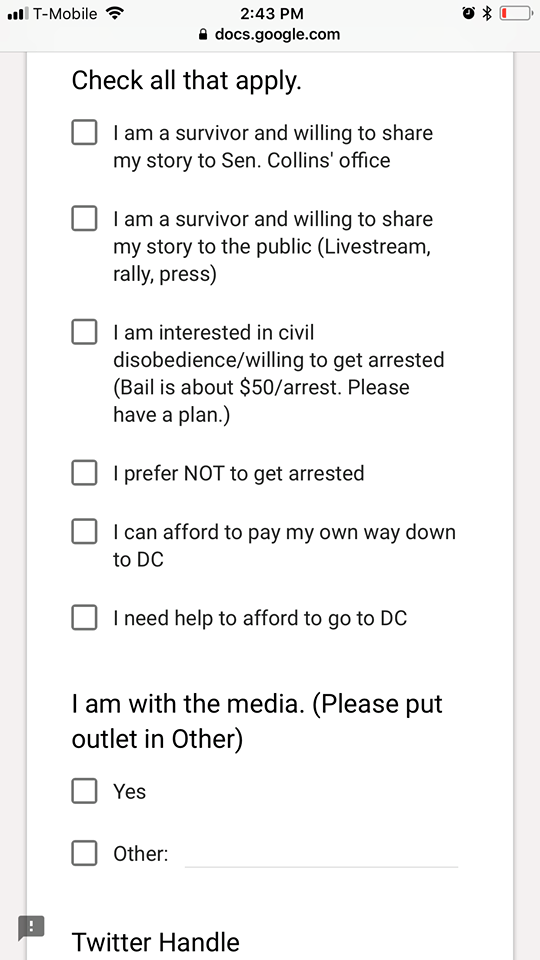
The main organizer of the bus to Washington was Diane Russell, a former Democratic state legislator and gubernatorial candidate in Maine. Everyone on the bus, other than some reporters covering the protest, opposed Kavanaugh’s confirmation to the court, Russell said.
A photo in the Portland Press Herald shows Feiner leaving the bus holding a printed sign aloft: “A sexual predator does not belong on the Supreme Court.”
Russell said the bus was paid for by the Center for Popular Democracy, a liberal advocacy group.
She said USM’s leaders had sent a message to faculty members, and to women, with their decision: “If you’re willing to stand up and fight for social justice ... you will be attacked and vilified.”

Feiner’s father, Irving, gave a speech about civil rights and other political issues in 1949 while he was a student at Syracuse University, said Roy Gutterman, a communications law professor at Syracuse who is writing a book about him. A crowd gathered around Irving Feiner, upset by his words and suspicious he might be a communist sympathizer.
Instead of protecting Irving Feiner from the angry group around him, police arrested him for disorderly conduct. A judge sentenced him to 30 days in jail — which he served after losing his case, Feiner v. New York, before the Supreme Court.
“This was really one of the first of the McCarthy-era free speech cases,” with an official shutting down unpopular ideas because they provoked such an angry reaction, said Gutterman, director of the Tully Center for Free Speech at Syracuse. He said the "heckler’s veto” has been happening lately on college campuses, as at the University of California at Berkeley last year, when protesters upset by a conservative speaker set fires and smashed windows, causing the event to be canceled.
The University of Maine System’s board of trustees — a politically appointed panel that includes Susan Collins’s brother, Samuel Collins — passed a policy this spring that worried some faculty members, who thought it might limit their free speech.
The policy does not ban partisan activity on the campuses, University of Maine System spokesman Dan Demeritt explained in an email, but “makes it clear that our publicly funded institutions are to remain nonpartisan and impartial.” He gave the example of a faculty member who appears in a campaign ad, but with a disclaimer that notes she is speaking as an individual.
Cummings said it has always been clear that professors can discuss political issues in class, but that they should provide a range of perspectives and let students settle on their own opinions.
Feiner has the right to voice her own opinion, he said, but she crossed a significant line when she used the name of the university to promote her political agenda. “That is why we felt the need to be firm,” Cummings said.
USM’s provost, Jeannine Diddle Uzzi, said that when officials heard concerns and began to investigate the class, they learned that there was never a course proposal or committee review of the syllabus, as required.
Feiner isn’t an employee any longer, Uzzi said, and didn’t have a contract to teach the class.
Feiner acknowledged that she didn’t go through the regular process for creating the pop-up class: With things moving quickly in Washington, “I was just bulling through it,” she said. But she said university officials haven’t been straightforward about why they shut it down.
Uzzi and Cummings said they have both known Feiner for many years but have lost trust in her.
“She’s a spitfire,” Cummings said, someone with strong views and a commitment to action. “But you have to use good judgment.”
Saturday Morning Breakfast Cereal - Amalekite
Joel Thrasymachus DahlExplains a lot.
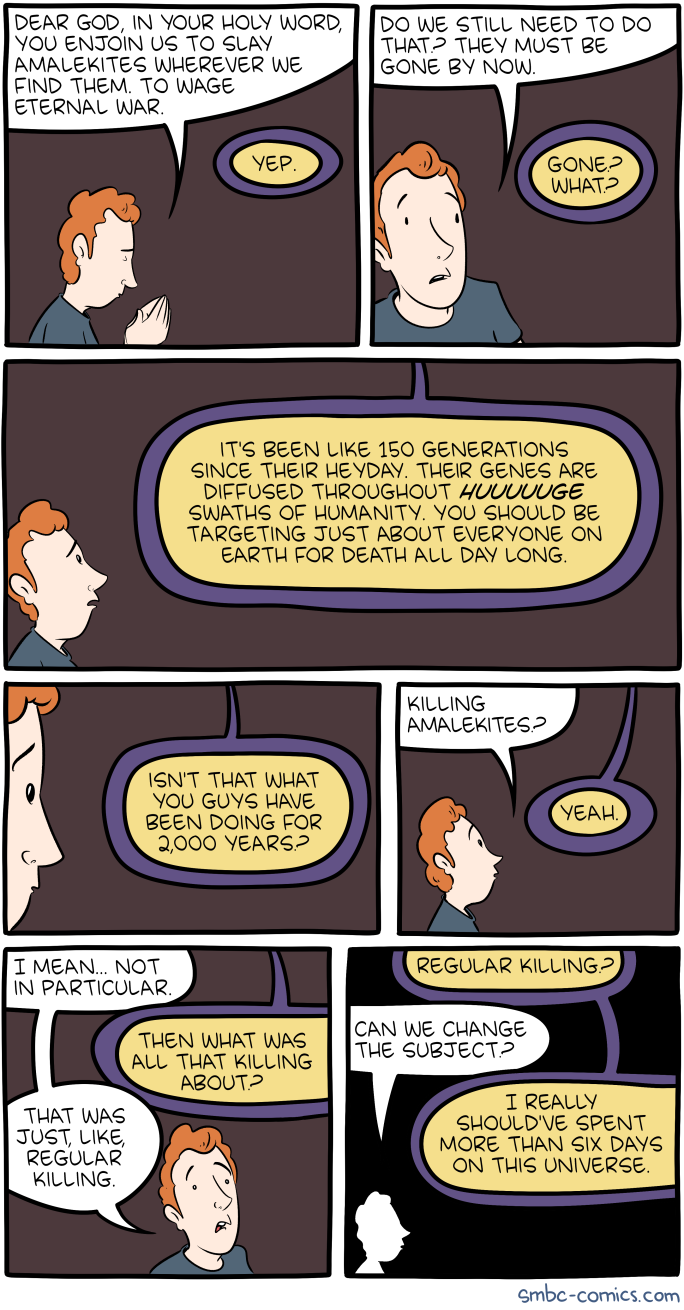
Click here to go see the bonus panel!
Hovertext:
See, when you're self-employed you really shouldn't take Sunday off.
Today's News:
Just two weeks left to get our TWO NEW BOOKS!


Canned crab? Elizabeth Warren is unfit to lead.
Joel Thrasymachus DahlYeah, this was probably a dumb move on her part.
But I think the larger reason why she doesn't have a chance is much stupider, and has nothing to do with her policies and what the electorate thinks of them, nor with standing up to Trump. It's that she's ugly. She looks like Jabba The Hut on a vegan diet, and that's not the kind of thing that you can overcome in order to win a presidential election.
Poor Elizabeth Warren.
She took President Trump’s bait and submitted to a DNA test to demonstrate her Native American genealogy — and, in so doing, may have doomed her presidential campaign before it began. Now the Massachusetts senator is not only enduring Trump’s “Pocahontas” insults (at least when he’s not calling another woman “Horseface”) but also being disparaged by Indian tribes.
“Senator Warren is undermining tribal interests with her continued claims of tribal heritage,” proclaimed the Cherokee Nation, decrying her “inappropriate and wrong” use of a DNA test, a “mockery” that dishonors “legitimate” tribal citizens.
Ouch. But I can understand why the Cherokees — and indeed all people of good taste — might wish to disavow Warren: It’s the crab mayonnaise.
Among the many unfortunate results of Warren’s recent DNA test suggesting she’s somewhere between 1/64th and 1/1,024th Native American by ethnicity: It inevitably draws attention to her contribution to the ’80s cookbook, “Pow Wow Chow: A Collection of Recipes from Families of the Five Civilized Tribes.” Under “Elizabeth Warren, Cherokee,” it lists five recipes, three of which were apparently cribbed from the New York Times and Better Homes and Gardens.
Worse, one of the recipes she submitted: “Crab with Tomato Mayonnaise Dressing.” A traditional Cherokee dish with mayonnaise, a 19th-century condiment imported by settlers? A crab dish from landlocked Oklahoma? This can mean only one thing: canned crab.
Warren is unfit to lead.
Yet it is difficult not to feel sorry for Warren. Though she doesn’t claim tribal membership, she clearly wants to be embraced. And so I extend an invitation to the senator to join my tribe. Warren should become a Jew. As Trump said when asking for African American votes shortly before praising Confederate Gen. Robert E. Lee: “Honor us.”
The Tribes of Israel have little to do with Native American tribes beyond the Yiddish-speaking Indians in Mel Brooks’s “Blazing Saddles.” But no DNA test is required. A stickler might require Warren to ask three times before becoming a Member of the Tribe — “MOT” — but for many, being Jewish is a state of mind, as comic legend Lenny Bruce explained decades ago:
“If you live in New York or any other big city, you are Jewish. It doesn’t matter even if you’re Catholic; if you live in New York, you’re Jewish. If you live in Butte, Montana, you’re going to be goyish even if you’re Jewish. Evaporated milk is goyish even if the Jews invented it. Chocolate is Jewish, and fudge is goyish. Spam is goyish, and rye bread is Jewish. Negroes are all Jews. Italians are all Jews. Irishmen who have rejected their religion are Jews. Mouths are very Jewish. And bosoms. Baton-twirling is very goyish.”
The same applies to current politics. If you work in the Trump administration, you are goyish even if you are Jewish. The House is goyish, the Senate is Jewish. Jeff Flake: Jewish. Dianne Feinstein: goyish. Sonia Sotomayor: very Jewish. Steny H. Hoyer: crazy goyish.
Warren would have some work to do. Her demeanor screams white bread and Jell-O molds. But a few adjustments might help: S top calling herself “an Okie to my toes.” (Even Jews who live in Oklahoma are goyish.) And, for heaven’s sake, stop with the crab mayonnaise.
Lest my motive be mistaken for partisan, I also asked House Speaker Paul D. Ryan’s office if he would kibbitz with me after a DNA test found Ryan to be 3 percent Ashkenazi Jew. Ryan shows a flicker of interest: He tweeted a GIF of himself raising a pint of beer, with the message: “Guess I need to start saying ‘L’Chaim’ now, too!” If he does that with a glass of schnapps, we’ll have our first Jewish speaker of the House.
Of course, I don’t actually desire to have Warren, or Ryan, join my “tribe” — which, in any event, is only part of my heritage. Like most in the American melting pot, I’m a mutt: a stew of English and German, western pioneers and sharecroppers, immigrants from the shtetl and a great-great-great-grandfather who died fighting for the Iowa 39th Infantry in the Civil War.
This is why Warren’s DNA stunt was such a blunder: She took Trump’s DNA-test dare and let him divide us — again — by race and ethnicity, just as he did when he goaded President Barack Obama to prove his legitimacy by producing his birth certificate.
It’s sad that the Cherokees responded by noisily rejecting Warren, but that’s their right.
It’s disgusting that the episode has also set off the worst in some, such as Sen. Lindsey O. Graham (R-S.C.), who joked on Fox News that it would be “terrible” if a DNA test found he had Iranian ethnicity.
No, Senator. What’s “terrible” is that Trump has found a new, high-tech way to stoke tribalism and division. And Warren fell for it.
Read more from Dana Milbank’s archive, follow him on Twitter or subscribe to his updates on Facebook.
College students say they can't send in their absentee ballots because they don't know where to buy stamps
Joel Thrasymachus DahlOh, COME ON, Next Generation!
Democrats are counting on Generation Z, many of whom recently gained the right to vote, to help turn Congress blue in the midterm elections.
But 50 cents may be all it takes to keep these post-Millennials from exercising their civic duty.
On Tuesday, a Fairfax County, Virginia official said they are noticing a disturbing trend: young people failing to mail in their absentee ballots because they don't know how to get a stamp.
Lisa Connors, of the Fairfax County Office of Public Affairs, ran a focus group this summer comprised of colleges students interning in various county departments.
"One thing that came up, which I had heard from my own kids but I thought they were just nerdy, was that the students will go through the process of applying for a mail-in absentee ballot, they will fill out the ballot, and then, they don't know where to get stamps," Connors told WTOP. "That seems to be like a hump that they can't get across."
Connors went on to say that many in the focus group said "they knew lots of people who did not send in their ballots because it was too much of a hassle or they didn't know where to get a stamp."
"Across the board, they were all nodding and had a very spirited conversation about 'Oh yeah, I know so many people who didn't send theirs in because they didn't have a stamp,'" Connors said.
As a way to combat this abstention for the upcoming midterm elections, the county is focusing on raising awareness of in-person absentee voting, which students can do while they're home on fall breaks. That voting starts in Virginia on Friday.
Another potential hurdle that the county is worried about is voters mixing up their home address, where they are registered to vote, with the address they want their absentee ballot shipped to, according to WTOP. If they mix this up on the ballot, then it's rendered invalid.
You can buy stamps from the US Postal Service online and in person, as well as from other online retailers like Amazon and Stamps.com. Banks, gas stations, pharmacies, and big box retailers like Walmart also sell them.
The US Postal Service also has a policy that it mails absentee ballots, whether or not they contain postage. Instead of returning the ballot to sender, they charge the local election board.