Shared posts
Pirate Party Has To Drop 'Pirate' From Its Name
CES 2014: LG flexes its TV muscle at CES 2014, announces the first flexible OLED

Bendable TV technology is around the bend for consumers, so it's fitting that LG announced it's bringing the first flexible OLED television to CES 2014.
"LG's Flexible OLED TV is a product that has to be seen to be believed because it defies description," said LG President and CEO Hyun-Hwoi Ha.
The LG head's "seeing is believing" comments are what this bendable TV screen is all about. You can adjust the curvature of the display to transform the TV's angle.
It's an effort to get the best TV viewing experience no matter where you sit in your living room.
LG Flexible OLED TV at CES
LG's 77-inch flexible 4K Ultra HD OLED TV isn't the only bendable television at CES this year.
Its South Korean TV manufacturing rival, Samsung, is also bending over backwards to show off its innovative curved screen technology, too.
The Samsung bendable TV is a larger 105 inches compared to LG's 77-inch effort. However, LG upped the ante with the OLED technology that Samsung's monster lacks.
The introduction of flexible TVs is the latest trend at CES 2014, but only time will tell whether it's another 3D-like fad or a more permanent high-definition and Ultra HD-like transition waiting to happen.
LG seems to think it's the matter, stating in a press release that, "what curved is to flat, flexible is to curved."

    
|
Newly discovered three-star system challenges Einstein’s theory of General Relativity

A newly discovered system of two white dwarf stars and a superdense pulsar–all packed within a space smaller than the Earth’s orbit around the sun–is enabling astronomers to probe a range of cosmic mysteries, including the very nature of gravity itself.

|
|
Josh Holloway on his new CBS drama ‘Intelligence’ and the ‘Lost’ castmate he’d recruit for a crossover episode

Project Christine offers a glimpse of Razer's insane future through modular computing
 Razer's Project Fiona was all the talk of CES 2012 -- it married console-like controls with tablet form factor, and packed in real computing power to boot. At the time, CEO Min-Liang Tan was cagey about its retail availability; heck, it didn't even ...
OLPC's got two new consumer kid tablets and accessories for CES
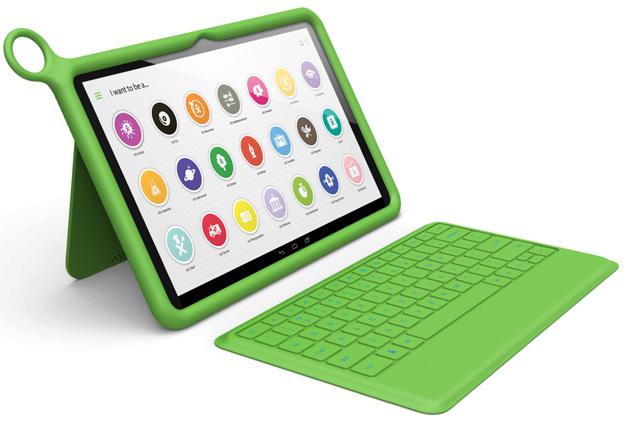 After months of waiting, we were pretty psyched to finally get our hands on the final version of One Laptop Per Child's first consumer-facing device, first announced this time last year. The anticipation may have played a role in our disappointment, ...
3D print yourself in chocolate and full-color sugar candy with the ChefJet Pro
 Be honest: This is the moment you've been waiting for -- at least since 3D Systems picked up Sugar Lab a few months back and quite probably even longer. It's the chance to print yourself and the ones you love in edible, sugary form. In among a slew ...
INTELLIGENCE Preview: Introducing CBS’s Sizzling New Spy Series
Read More
Yahoo malware adverts were designed to mine Bitcoins

Ad network is infested with code that infected 27,000 machines per hour

|
|
‘Sherlock’ UK ratings big again for ‘Sign of Three’

‘The Good Wife’ co-creator Robert King explains the inspiration for Marilyn’s baby daddy

Study Finds No Time Travelers On The Internet


If you had traveled from the future to the present, you might be likely to mention some things that you'd learned there (for example: buy this lottery ticket). Using this logic, physicists searched for prescient mentions of future events on the present-day internet, scouring Twitter, Facebook, Google, Google+ and Bing. They used these services to see if anybody had mentioned Pope Francis or the comet ISON before these terms existed, looking at the time span from the early 2000s to mid-2013, the idea being that both terms represented major events travelers-from-the-future might talk about somewhere online. But they came up empty.
This doesn't mean that time travelers don't exist, said study author Robert Nemiroff, a physicist at Michigan Technological University. But it is the largest study of its kind to date, and suggests that if there are time travelers walking amongst us, they aren't, for example, tweeting about what they've learned in the future, Nemiroff told Popular Science. (Or maybe they don't care about Catholics or comets.)
This is not the first time somebody has looked for evidence of future time travelers. Physicist Stephen Hawking, for example, held a party for time travelers in July, 2012, and only sent out invitations afterward. Sadly, nobody came.
Nemiroff said he and his colleague Teresa Wilson didn't look for time travelers from the past since past information is already "out there," and nobody has yet (to the best of his knowledge) built a machine capable of, you know, time travel. Twitter ended up being the most useful service; Google turned up too many false-positives, and Facebook allows user to backdate posts, confusing the search effort.
The scientists will present their study at a scientific meeting on Monday (Jan. 6), and have submitted it to several journals. Nemiroff said he came up with the idea for the research during a poker game with students.

|
|
Canada's Ex-Defense Minister Says Aliens Would Give Earth Tech If We Were Less Warlike

There has been more alien activity since the first nuclear bombs were detonated in 1945, he said. "They are very much afraid we might be stupid enough to start using atomic weapons again and that would be very bad for us and them as well." If we were more peaceful, they would be more willing to share their technology with us, he said. According to his website, in September 2005 Hellyer "became the first person of cabinet rank in the G8 group of countries to state unequivocally 'UFO's are as real as the airplanes flying overhead.'"
Luckily, most of the aliens are benign or want to help us, though one or two might mean us harm, Hellyer said. Some of the aliens actually look like people, and two female aliens recently visited Las Vegas dressed as nuns and were not detected, he claimed. Perhaps they wouldn't have gotten away with that stunt in, say, Omaha.
It's too bad that Hellyer appears to be crazy; his aliens seem to have some good ideas. They think we are spending to much money fighting each other, and not caring enough for the planet and our sick and poor. "We are polluting our waters and our air, and we are playing around with these exotic weapons… and they [the aliens] don't like that. They'd like to work with us to teach us better ways, but only, I think, with our consent."
Also, in case you weren't aware, "the star of Bethlehem is one of God's flying saucers." Thanks for the info, Paul!
[Via CNET]

|
|
Valve: Trust in employees is key to good game development
 If you treat your workers with kindness and compassion, they'll reward your support with better work - at least, that's the stance Valve Software takes.
In an interview with the Washington Post, Valve CEO and co-founder Gabe Newell explains this ...
If you treat your workers with kindness and compassion, they'll reward your support with better work - at least, that's the stance Valve Software takes.
In an interview with the Washington Post, Valve CEO and co-founder Gabe Newell explains this ...
Onewheel is a self-balancing single-wheeled electric skateboard (video)
 If the idea of combining a Segway, a skateboard and a unicycle sounds like your idea of fun, you might want to check out the Onewheel. It uses gyros, accelerometers, proprietary algorithms and a single rubber tire to give its passengers a smooth, ...
We Shine the Spotlight on ALMOST HUMAN Star Karl Urban
Read More
Bravely Default toned down for western release
Polaroid's Socialmatic camera to fuse retro style, instant prints and Android this fall
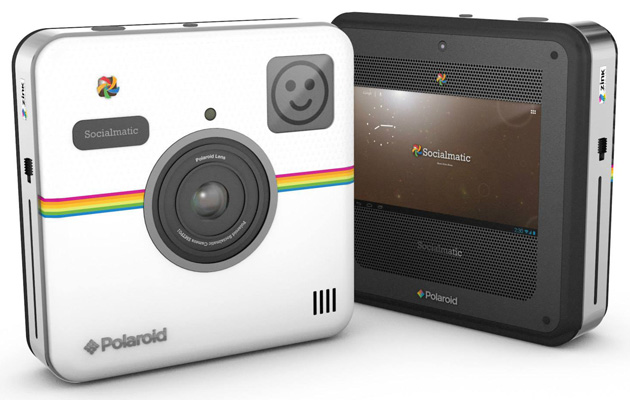 Last we heard of Polaroid's Socialmatic camera, which promises to bring back instant prints with a modern flair, it was bound for store shelves in the first quarter of 2014. Here at CES, the firm's announced that the hardware is cruising for a fall ...
Corning's new Gorilla Glass will actively kill germs on your smartphone
 Every properly-raised gorilla knows it's not enough to be tough; you also have to be hygienic. Which is surely why Corning has developed an antimicrobial form of its Gorilla Glass that inhibits the growth of algae, mold, mildew, fungi, bacteria and ...
Sharp is teasing a 3D-ready, 85-inch 8K display at CES, no glasses required
 Sharp loves to show off the 8K technology it hopes to see in your living room in the future. It's no surprise, then, that the outfit is yet again using CES as a platform to tease another super, super high-res 85-inch screen. Unlike the gorgeous panel ...
AMD Demonstrates "FreeSync", Free G-Sync Alternative, at CES 2014
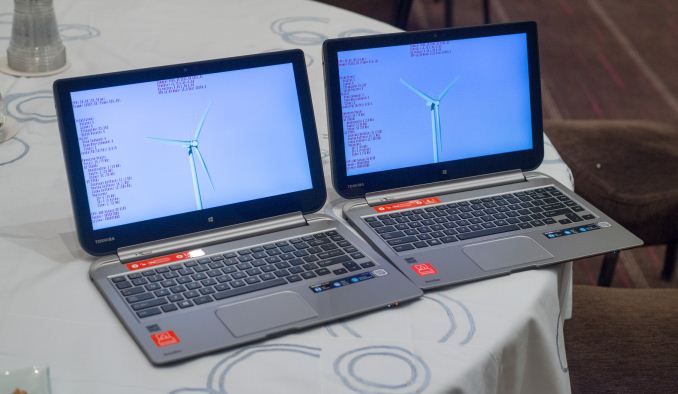
AMD has been relatively silent on the topic of NVIDIA’s variable refresh rate G-Sync technology since its announcement last year. At this year’s CES however, AMD gave me a short demo of its version of the technology.
Using two Toshiba Satellite Click notebooks purchased at retail, without any hardware modifications, AMD demonstrated variable refresh rate technology. According to AMD, there’s been a push to bring variable refresh rate display panels to mobile for a while now in hopes of reducing power consumption (refreshing a display before new content is available wastes power, sort of the same reason we have panel self refresh displays). There’s apparently already a VESA standard for controlling VBLANK intervals. The GPU’s display engine needs to support it, as do the panel and display hardware itself. If all of the components support this spec however, then you can get what appears to be the equivalent of G-Sync without any extra hardware.
In the case of the Toshiba Satellite Click, the panel already supports variable VBLANK. AMD’s display engines have supported variable VBLANK for a couple of generations, and that extends all the way down to APUs. The Satellite Click in question uses AMD’s low cost Kabini APU, which already has the requisite hardware to support variable VBLANK and thus variable display refresh rates (Kaveri as well as AMD's latest GPUs should support it as well). AMD simply needed driver support for controlling VBLANK timing, which is present in the latest Catalyst drivers. AMD hasn’t yet exposed any of the controls to end users, but all of the pieces in this demo are ready and already available.
The next step was to write a little demo app that could show it working. In the video below both systems have V-Sync enabled, but the machine on the right is taking advantage of variable VBLANK intervals. Just like I did in our G-Sync review, I took a 720p60 video of both screens and slowed it down to make it easier to see the stuttering you get with V-Sync On when your content has a variable frame rate. AMD doesn’t want to charge for this technology since it’s already a part of a spec that it has implemented (and shouldn’t require a hardware change to those panels that support the spec), hence the current working name “FreeSync”.
AMD’s demo isn’t quite as nice as NVIDIA’s swinging pendulum, and we obviously weren’t able to test anywhere near as many scenarios, but this one is a good starting point. The system on the left is limited to 30 fps given the heavy workload and v-sync being on, while the system on the right is able to vary its frame rate and synchronize presenting each frame to the display's refresh rate. AMD isn’t ready to productize this nor does it have a public go to market strategy, but my guess is we’ll see more panel vendors encouraged to include support for variable VBLANK and perhaps an eventual AMD driver update that enables control over this function.
In our review I was pretty pleased with G-Sync. I’d be even more pleased if all panels/systems supported it. AMD’s “FreeSync” seems like a step in that direction (and a sensible one too that doesn’t require any additional hardware). If variable VBLANK control is indeed integrated into all modern AMD GPUs, that means the Xbox One and PS4 should also have support for this. Given G-Sync’s sweet spot at between 40 - 60 fps, I feel like “FreeSync” would be a big win for AMD’s APUs.

|
|
Samsung shows off its 85-inch curved TV that bends with the touch of a button (video)
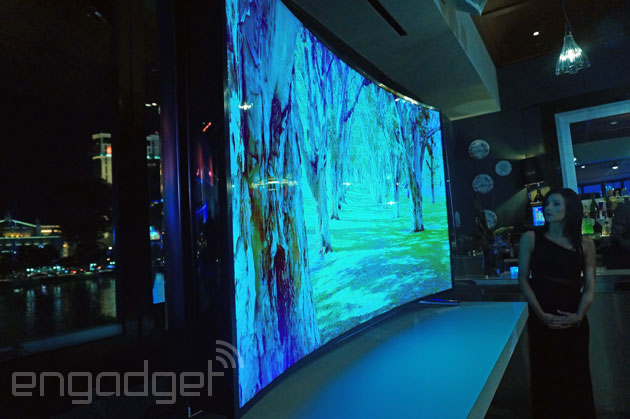 Somewhere to the right of Samsung's huge 105-inch UHD TV, there was something even more curious. The TV was initially switched off, but otherwise plainly labelled for all to see: "85-inch bending TV." We stuck around to see it in action -- check it ...
Surreal Murals by ‘Etam Cru’ Turn Drab Facades into Eye-Popping Imagery
 Moonshine, 2013. Richmond Mural Project. By Etam Cru.

By Sainer in Gdynia, Poland. 2013. Photo by FOT. ALKA MURAT.
 The Healer, 2013. By Bezt (Etam) and Pener (Spectrum).

Meeting the God, 2013. By Bezt. See it animated.

High Hopes, 2013. By Sainer. Photo by Benjamin Rataud.

The Change, 2013. By Bezt.

Madame Chicken, 2013. By Etam Cru.
Polish artists Sainer and Bezt, collectively known as Etam Cru, paint large scale murals of surreal and frequently humerous subjects in locations mostly around Eastern Europe. The duo traveled to the U.S. this year to paint a wildly popular mural titled Moonshine at the Richmond Mural Project depicting a girl sitting inside a jar of strawberries. The piece is now available as a print over on Art Whino. Above is a collection of their most recent work from 2013, much more of which you can see on Facebook, the Etam Cru blog, and on Behance. (via Arrested Motion)
‘Justified’: Walton Goggins on the return to a violent Boyd (and why Boyd was resurrected after the pilot)

British Town To Change Its Name For 'Game Of Thrones' DVD Release
To celebrate the release of the third season of "Game of Thrones" on DVD, HBO has changed the name of the small town of Kings Langley to Kings Landing, the capital city from the fantasy series.
Kings Langley is a small town outside of London, and "a producer for the hit HBO show heard the town listed as a stop while waiting for a train at London's Euston station and was inspired to instigate the name change," according to Radio Times.
The name change will be short-lived (only a week) and will happen in February.
"Game of Thrones" will be released on DVD Feb. 18.

Canon's targeting new parents with VIXIA R52, R50, R500 camcorders
 Your smartphone can shoot video; your tablet can shoot video; and, if you even still own one, your point-and-shoot can shoot video too. So why, then, might you pick up a mid-range camcorder? Fortunately for manufacturers, there are still a few perks ...
China launches electric car rental vending machine
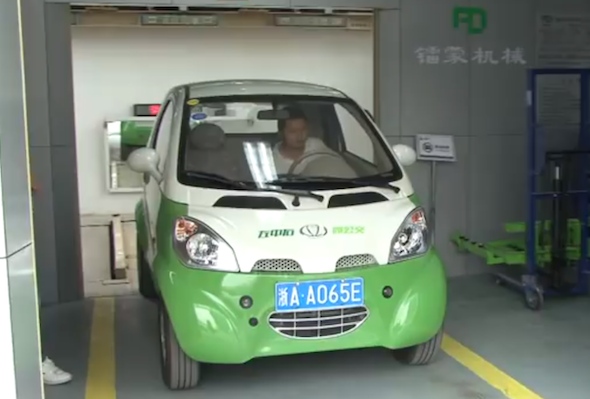 Motorists in Hangzhou, China, are to be treated to a revolutionary car rental scheme that allows customers to hire an electric car for around £2 an hour from a gigantic vending machine.
|
|
NSA Refuses to Answer to Congress

|
|
CES 2014: Samsung Smart Home platform brings connected home under one app's roof

In Samsung's future, everything is connected. The good news for Samsung is that future has arrived at CES 2014.
The company has announced Samsung Smart Home, a new platform that lets Smart TVs, home appliances and smartphones connect and be managed through a single app.
This means customers can literally control all their gadget goods - including washing machines, TV sets, digital cameras, smartphones and even the Galaxy Gear - via an solo, integrated platform and server.
If it all sounds a little Jetson-esque, there are three main aspects to the Smart Home experience worth breaking down further.
Home control
Samsung calls the three main Smart Home features Device Control, Home View and Smart Customer Service.
Device Control lets users personalize settings on their mobile devices or Smart TV to keep an eye out and manipulate connected whatnots at home. A dedicated Smart Home app lets users jump into management-mode, turning on or off air conditioning and the like at their will.
Users can also connect with voice command - spouting "Going out" into a Galaxy Gear will shut off home lighting and certain appliances, for example. Similar vocal cues can be given to Smart TV remotes and smartphones.
Smartphones are where Home View comes in. Samsung said users can get real-time looks at their abodes thanks to chatter between to their phones and the built-in cameras found in their appliances.
Lastly, Smart Customer Service gives users a heads up when their appliances need servicing or consumables need replenishing. It, as one would suspect, also helps with after-sales servicing.
What's in store
Owners of Sammy devices and appliances can look for Smart Home to knock on their virtual doors in the first half of the year. Not only are Samsung customers receiving the option of ultimate home connectivity, but the South Korean firm also said it's working with its third-party partners to extend Smart Home to their products and services as well.
For now though, Samsung Smart Home is going to focus on the company's range of Smart TVs, home appliances and phones. More Samsung products and those from other manufacturers will be encircled during a gradual expansion.
What's more, the firm has plans to grow Smart Home into home energy, secure home access, health care and eco home applications. It plans to do this by teaming up with third-party partners that work in these niches.
Samsung seems quite committed to making Smart Home stick; it's established a software protocol for the platform as well as a Smart Home Steering Committee to bring the company's various product groups behind it.

|
|
Netatmo reveals designer bracelet that helps to protect your skin from sun damage
 Netatmo's adding a dash of fanciness to this year's parade of wearable announcements at CES. The firm, known for its thermostat and weather monitor, unveiled the June bracelet: a wrap around piece of arm candy with a gem stone-like sensor that ...