The crisp bubbles of real New York seltzer from the city’s last bottler serve up refreshment and stir up rich nostalgia
The post Seltzer works appeared first on Aeon Magazine.
Corvus.coraxfound myself tempted to seek out one of those bottles and figure out how to interface with my CO2 kegging system for fancy table service.
then I got over it. got me thinking about nostalgia for old tech solutions in the face of simpler modern tech.
[sitting here drinking home-made clone of Apollinaris, at 30psi btw]
The crisp bubbles of real New York seltzer from the city’s last bottler serve up refreshment and stir up rich nostalgia
The post Seltzer works appeared first on Aeon Magazine.
Corvus.coraxGo, go, go, go


Read more of this story at Slashdot.
Corvus.corax@Lev related to your whisky flavor profiles share a few weeks back.
don't be turned off by the biblical quotes early on.
also, I hate the WIRED headline redesign font.
Anyway, I'm hoping the distiller in the old Hamm's brewery in my neighborhood (http://www.11wells.com/#!home/mainPage) will take a look at the patent and make it happen. (or maybe I should do it and start a new career path...?)

A distiller has come up with a method of producing spirits that taste like they've been aging in the barrel for 20 years, but his process only takes six days.
The post This Guy Says He Can Make 20-Year-Old Rum in 6 Days appeared first on WIRED.

Corvus.coraxtired as I am of the new york centered fiction machine, i may read this one simply for a break from NY (and sci fi)

Book Title:
The First Bad Man
ISBN-13:
978-1782116721
Author:
Miranda July
Publisher:
Canongate
Guideline Price:
£9.99
‘Joke, joke, joke, joke, and then at the end you’re devastated.” The American author David Sedaris sums up Miranda July’s short story Roy Spivey for a New Yorker fiction podcast, comparing her style to that of her contemporary, Lorrie Moore. All three writers know how to use humour and self-deprecation to deliver a blow. On finishing July’s story, about a woman’s bizarre encounter with a movie star on a flight, Sedaris feels like “a different person, so completely, mysteriously shaken up by it”.
The Californian writer July, who is also an acclaimed director, actress and performance artist, provokes this kind of reaction. She eschews the middle ground, drawing impassioned reactions from fans and critics alike. The criticism is often gender specific, aimed at writers like Lena Dunham, mentioned in July’s acknowledgments, who see in their own issues and peculiarities fertile material for their fiction.
Who is to say how much of July’s anticipated debut novel The First Bad Man is taken from the author’s own experiences. We assume, as we’re supposed to, that it’s fiction. But as with her earlier writings, which include the Frank O’Connor Award-winning collection No One Belongs Here More Than You (2007), certain crossover elements – new motherhood, insights into LA life, therapy sessions – lend an enjoyable friction to the work, a sense that the author gets inside the head of her protagonist.
And what an interesting head it is. When we first get to know her, Cheryl Glickman is an unstable, delusional woman in her early 40s, living in LA. Cheryl is grey-haired, pear-shaped, with a “potatoey” nose and eyes that disappear when she smiles. There’s an undertone to her voyeurism as she watches society from the fringes. Babies are of particular interest: “I checked to see if he and I had a special connection that was greater than his bond with his mother. We didn’t.”
Cheryl works as a manager in a company that sells self-defence fitness DVDs. We see little of this career, or other real world activities, as Cheryl spends most of her time flitting between fantasy lives, obsessive self-analysis and dealing with an absurd new flatmate arrangement.
Before her bosses’ daughter, an Amazonian 20-year-old, arrives to stay and refuses to leave, Cheryl’s home life has been governed by her severe neuroticism: “I had spent years training myself to be my own servant so that when a situation involving extreme wretchedness arose, I would be taken care of.” Her life is so structured it leaves her in a strait-jacket, but Cheryl feels safe within these confines, which give her ample time to spend in her fantasy worlds.
These creations are intensely graphic, both violent and sexual. They are somewhat deranged but eminently believable, as detailed and layered as matryoshka dolls. One fantasy is never enough. It leads to the next, and on and on down the rabbit hole.
There’s an illusory relationship with her piggish boss, Phillip, who uses Cheryl to further his own perversions; an imaginary child, the ubiquitous Kubelko Bondy, perfected over decades; a disconnect, often hilariously, from social etiquette; and at the centre of it all, pressing questions over gender identity and sexual preference that are afforded little exploration in reality. Reality itself is warped, with Cheryl attending chromotherapy sessions, or later, another type of counselling where her neglectful therapist, Ruth-Anne, makes her urinate in a container behind a screen.
It’s no wonder Cheryl has “globus hystericus”, the sensation of feeling a lump in one’s throat. A most unusual saviour comes in the form of Clee, a beautiful, belligerent young woman who takes to bullying Cheryl in her own home. The ludicrous situation is related with humour and pathos, from physical fights, to a sexual awakening, to a poignant interdependency that develops when the unexpected takes place.
The rate of quips in the book gives a stand-up feel to proceedings, and some laugh out loud moments – “Anyone who questions what satisfaction can be gained from a not-so-bright girlfriend half one’s age has never had one” – but July contains the humour by matching it with insights. She is inventive with her imagery – a hundred snails let loose around the apartment, a “persimmon-coloured blouse” – and particularly strong on the subject of new motherhood: “A real mother throws her heart over the fence and then climbs after it.”
In a recent interview in this paper, July rejected the tag of “quirky” for her writing. Yet in Cheryl she has created a memorably quirky protagonist, a character who uses David Bowie’s Kooks as her theme tune for a therapy exercise. Cheryl’s rollercoaster journey from kook to a more orthodox role at the end of the book makes for an engrossing read. Or as David Sedaris might put it: joke, joke, joke, joke, reality.
Corvus.coraxof note, since my better half and I recently made the switch to republic wireless's no-data plans ($24/month sure beats $116/month) and have to look at the map BEFORE we leave the house WHAT?.

To get a look at the market for offline GPS systems, we downloaded four apps that support offline maps, turned cellular data services off, and hit the road.
The post We Tested 4 GPS Apps That Work Even When You’re Offline appeared first on WIRED.

Corvus.coraxfuture of sci-fi awards?
"Start banding together and stop accommodating the secular world in any way. Don't hire those who hate you. Don't buy from those who wish to destroy you. Don't work with those who denigrate your faith, your traditions, your morals, and your God. Don't tolerate or respect what passes for their morals and values."
(Warning: some links lead to to triggery ranting. As James D. Nicoll warns: "memetic prophylactic recommended".)
By now, everybody who cares knows that the nominations for the 2015 Hugo Awards reflect the preferences of a bloc-voting slate with an agenda—and their culture wars allies. But, interestingly, a new Hugo-related record has been set: for a Finnish publisher few people have ever heard of is responsible for no fewer than nine nominated works.
Castalia House was (per wikipedia) founded by Theodore Beale (aka Vox Day) in early 2014 in Kouvola, Finland. As their website explains:
Castalia House is a Finland-based publisher that has a great appreciation for the golden age of science fiction and fantasy literature. The books that we publish honor the traditions and intellectual authenticity exemplified by writers such as J.R.R. Tolkien, C.S. Lewis, Robert E. Howard, G.K. Chesterton, and Hermann Hesse. We are consciously providing an alternative to readers who increasingly feel alienated from the nihilistic, dogmatic science fiction and fantasy being published today. We seek nothing less than a Campbellian revolution in genre literature.
Total culture wars, very gamergate, much fail, wow. But the screaming question I feel the need to ask, is: why Finland? Could there be a connection between the white supremacist Perussuomalaiset (Finns Party), the overtly racist Sweden Democrats, the Dark Enlightenment/neoreactionary movement, and Vox Day's peculiarly toxic sect of Christian Dominionist theology?
Vox Day writes:
It's time for the church leaders and the heads of Christian families to start learning from #GamerGate, to start learning from Sad Puppies, and start leading. Start banding together and stop accommodating the secular world in any way. Don't hire those who hate you. Don't buy from those who wish to destroy you. Don't work with those who denigrate your faith, your traditions, your morals, and your God. Don't tolerate or respect what passes for their morals and values.
Over a period of years, he's built an international coalition, finding common cause with the European neo-nazi fringe. Now they've attempted to turn the Hugo Awards into a battlefield in their (American) culture wars. But this clearly isn't the end game they have in mind: it's only a beginning. (The Hugos, by their very nature, are an award anyone can vote in for a small fee: it is interesting to speculate on how deep Vox Day's pockets are.) But the real burning question is, "what will he attack next?"
My guess: the Hugo awards are not remotely as diverse and interesting as the SFWAs Nebula Awards—an organization from which Vox Day became only the second person ever to be expelled. I believe he bears SFWA (and former SFWA President John Scalzi) no love, and the qualification for SFWA membership (which confers Nebula voting rights) is to have professionally published three short stories or a novel. Castalia House is a publishing entity with a short story anthology series. Is the real game plan "Hugos today: Nebulas tomorrow?"
Corvus.coraxshort on details, but interesting to hear about it. I can maybe answer the why they mow question along parts of Hwy 52- to try to control all the damn wild parsnip.

Roadsides and utility corridors, some of the most unappreciated parts of the American landscape, could become vital sources of life in a time of ecological peril.
The post The Quiet Revolution Turning Roadsides Into Nature Reserves appeared first on WIRED.

Corvus.coraxsaving for later

Boy, oh boy is April a great month for new streaming titles. From hit movies to big TV shows to the first season of Netflix's new Marvel series Daredevil (launching April 10) — this month has it all.
But there are plenty of less-known titles that could get lost in the noise of all those big names. Here are four movies and one TV miniseries you should add to your Netflix and Amazon queues immediately.
Director Paul Greengrass — perhaps best known for The Bourne Supremacy and The Bourne Ultimatum — is also a renowned re-creator of history. That led to 2006's United 93, a stunningly faithful replication of the crash of the titular flight into a Pennsylvania field on September 11, 2001; as well as Oscar Best Picture nominee Captain Phillips, about the 2009 hijacking of a container ship by Somali pirates.
But this 2002 breakthrough film is a docudrama that takes an almost journalistic approach to the events of January 30, 1972, when British soldiers shot more than two dozen unarmed protestors in Northern Ireland.
Greengrass's hyper-attention to detail means that the film seems to fit the phrase "you'll feel like you're there" almost completely accurately. The director also filled the film with then-unknown actors, though a few have gone on to successful careers since its release.
Bloody Sunday is a look at a day most Americans likely know very little about, and it will give you a stronger appreciation for a corner of history that could feel very distant for those living in the States.
Watch it on Amazon Prime.
The Wachowskis, who went on to create the Matrix trilogy and several other films with huge cult followings, broke through on their debut, this 1996 crime thriller. It's also one of the earliest movies about lesbians to earn mainstream critical attention.
Jennifer Tilly and Gina Gershon play lovers who are aiming to rip off one of their mobster boyfriends for millions of dollars. The tale features several riffs on the tropes of film noir — those stories of dark people making dark choices on the seedy side of town that so dominated detective films in the 1940s and '50s. Here, though, the addition of a lesbian affair adds a charge to the whole story that flips familiar tropes on their ear.
The movie likely hasn't aged perfectly, as with most films in the '90s prominently featuring LGBT themes. (I haven't seen it in years.) But it's worth seeing for its terrifically twisty plot and for its importance to mainstream acceptance of LGBT themes in major films.
Watch it on Netflix.
I wrote an extensive review of this back when it debuted on PBS in 2014. Suffice it to say that this movie from famous documentary filmmaker Ken Burns perfectly captures the Roosevelt family.
It focuses primarily on Teddy, Franklin, and Eleanor and covers a century of American history, from the Civil War to the 1960s.
It's a marvelous piece of documentary filmmaking, but it's also a beautiful series of smaller biographies of the three figures. There's so much great stuff here for history buffs and neophytes alike.
Watch it on Amazon Prime.
Okay, saying this one might have escaped your attention is a bit of a stretch. The 1993 Bill Murray vehicle, directed by Harold Ramis, is one of the most popular movie comedies of the past 30 years.
But there's never a day that couldn't be improved by firing up this movie and watching as Murray's character, Phil, is forced to relive the same Groundhog Day over and over and over again until he gets it "right" — with some estimates of the amount of time Phil spends living this single day extending to 10,000 years. Andie MacDowell plays Phil's love interest, and the ensemble cast is filled with great character actors, adding to the fun.
But this is also one of the sneakiest, most philosophical movies ever made, with lots to say about how easy it is to get stuck in the same patterns and how difficult it can be to truly change our ways. It's endlessly rewatchable, too, so turn it on again.
Groundhog Day will be available on Amazon Prime beginning Thursday, April 2, but you can already rent or purchase it for download.
This terrifying, arty ghost story proved one of 2014's surprise critical sensations. The Australian film came out of nowhere at that year's Sundance Film Festival to earn rave reviews, then took the arthouse world by storm. It's part of a major new wave of horror films that find the unchecked emotions of their characters as terrifying as any monster. It made my top 10 films of 2014 list for good reason.
Directed and written by Jennifer Kent, the film follows a single mother, played by the remarkable Essie Davis, who can't escape the grieving process for her husband, who died in a car crash when driving her to the hospital to deliver their son. Now, the boy has grown into a six-year-old child, and his constant noisemaking and haunted nature make him an unsettling constant companion to have around.
And that's before the pop-up book promising a malevolent, top-hatted boogeyman is on his way to devour the mother's soul.
Creepy and atmospheric, The Babadook is a must-see for horror fans — and, honestly, anybody else.
It will be available on Netflix April 14, 2015.
Corvus.corax@BurlyThurr, thought you'd 'preciate this one.
Read more of this story at Slashdot.
Corvus.coraxIf you skim as far as I did, you'll be treated to this: tasty morsel:
“I get erections,” one patient confesses to (a fictionalized) Kellogg in the film adaptation of T.C. Boyle’s novel The Road to Wellville. “I warn you sir,” the doctor replies. “An erection is a flagpole on your grave.”
[I know BT- TC Boyle, yer FAYV]

I was eating a bowl of Corn Flakes in my apartment and I picked out a single flake, looked at it, and wondered what it was. Of course, I could turn the box around and see the list of ingredients. They were Trader Joe’s Organic Corn Flakes and they were made from organic milled corn, organic evaporated cane juice, sea salt, organic barley malt extract, soy lecithin, and some vitamins. But how, I wondered, did milled corn turn into this thin, bumpy thing—golden, delicate, and slightly translucent in the light? I thought of a corn kernel, popped corn, corn tortillas, and cornbread, all of which I’ve prepared in my kitchen. I understood how those foods were transformed from their raw ingredients. But I could summon no vision about the flake. Out of curiosity, I saved it and waited for it to mold. It didn’t.
As far as processed foods go, Corn Flakes appear unsophisticated. They’ve got nothing on Malt-O-Meal Berry Colossal Crunch with Marshmallows, for example, which looks more like a spread of miniature prizes from a claw-grab game than something you eat. Nor can they compete with (reaching beyond the cereal aisle) Kraft Dips Guacamole, the complexity of which made it the subject of a lawsuit due to its paltry avocado content (less than 2 percent). In fact, there is innovation in a Corn Flake, but you can’t really see it. Eighty-eight percent of corn is genetically engineered, so non-organic brands likely include corn grown from designer seed. The science behind these seeds is controversial. It’s also coveted; in 2013, six Chinese nationals were indicted for trying to steal Monsanto’s GMO corn seeds, worth tens of millions. One of the men was caught digging in an Iowa cornfield.
Along with a bajillion other ready-to-eat foods, cereals depend on shelf life. Even a “fresh” apple may be more than a year old. Martin Lindstrom, a marketer by profession, says in Brandwashed: Tricks Companies Use to Manipulate Our Minds and Persuade Us to Buy that the average apple you buy in the supermarket has been off the tree for 14 months. In cereals, the problem of freshness can be solved in several ways. Trader Joe’s corn flakes contain mixed tocopherols (Vitamin E); Kellogg’s adds the preservative BHT to its packaging. The makers of early Corn Flakes devised a solution that required no additives and shot the product’s popularity up like the puck in a strongman game at a Corn Belt county fair.
Oddly enough, Corn Flakes were apparently invented as an antidote to masturbation, according to several accounts. A medical movement originating in the early 18th century declared that solitary sex led to illness, ranging from spinal tuberculosis and epilepsy to bad posture. A century later, these anxieties still held. John Harvey Kellogg believed that spicy foods and meats could encourage sexual arousal and lead to “self-pollution.” To avoid that horror, he advised a vegetarian diet with lots of cereal grains—which he was perpetually trying to coax into a palatable form. He was an influential figure who preached that cereal would save lives. “I get erections,” one patient confesses to (a fictionalized) Kellogg in the film adaptation of T.C. Boyle’s novel The Road to Wellville. “I warn you sir,” the doctor replies. “An erection is a flagpole on your grave.”
Kellogg’s experiments with grains took place at his own oasis of health, the Medical and Surgical Sanitarium in Battle Creek, Michigan. “The vast resort offered the combined features of a medical boardinghouse, hospital, religious retreat, country club, tent Chautauqua, spa,” writes Gerald Carson in his 1957 book, Cornflake Crusade, “all carried forward in an atmosphere of moral reform and asceticism.” At “The San,” physical health, spiritual health, and chastity could all be achieved through enemas, sinusoidal baths (a bath with the application of an electrical current), and proper diet. The problem with the Kellogg health diet was that it was tasteless and boring. One San dinner menu offered a choice of three entrees: “Protose Fillets,” “Nutolene,” or rice. Before the cereal boom, breakfast was “porridge or mush, graham gems, parsnips, tomato toast, ‘some kind of sauce,’ and a little milk.”
In 1894, Kellogg saw a Shredded Wheat prototype in Denver, became intrigued, and almost bought the patent. In hopes of improving upon the concept, he boiled, steamed, and flattened milled wheat. It never turned out the way he wanted. Until one day, he and his brother Will Keith (whose signature would later appear on the Corn Flakes box) happened to send one rancid batch of wheat mush through the rollers, and out the other side came large, perfect flakes. They had hit upon the necessary principle of tempering; having been set out for several hours after soaking, moisture had spread uniformly throughout the grain. In 1895, commercial production began on the first wheat flake breakfast food, infelicitously named “Granose.”
The wheat flakes were a taste sensation among San patients and, encouraged, the brothers tried the same method with other grains. Corn Flakes proved even more popular than Granose. Recognizing their commercial potential, Will Keith made two changes to the original recipe. First, he added sugar, a modification that John Harvey forcefully opposed. Second, he removed the germ and bran portions of the corn—the parts containing nutrients and fiber—and milled only the starch-rich center, which he called “the sweetheart” of the corn.
“The emerging system of warehousing and centralized production dictated that packaged products like breakfast cereal be able to survive for several months,” writes Melanie Warner in Pandora’s Lunchbox. “After just a month, boxes [of Corn Flakes] could develop a rancid odor due to the presence of oil from the germ portion of the corn.” Had W.K. not modified the Corn Flakes recipe and stripped the grain’s nutrients, the ubiquitous product might have offered real nourishment to millions of people over the past century. Yet, without the recipe change, Corn Flakes probably could not have survived the pack-and-ship system nor gained the outrageous popularity they did. Rather, Kellogg’s rival might have done it all instead and we’d be eating “Post Toasties.”
* * *
The Corn Flakes’ trade-off—in which nutrition is sacrificed for convenience, portability, and profitability—is a metonym for food production during the last century. From Eric Schlosser’s Fast Food Nation to the documentary Food, Inc. (which permeated the mainstream so fully that I watched it on an airplane) to Michael Pollan’s bestselling books, there is a wealth of information available about—as Tyler Cowen puts it in An Economist Gets Lunch—“How American Food Got Bad.” It’s not precisely understood why refined foods make us sick, but we know that they do. As soon as the Western diet (high in refined flours, sugars, and fats) is introduced to a group of humans, the Western diseases (heart disease, diabetes, stroke, and certain cancers) follow. Eat anything else, even a diet of whale blubber, and it seems you’ll fare better.
The reason my Corn Flake never molded has to do with the removal of the oily germ and the added tocopherols. But there is another factor, too. After the milled corn was mixed with heat-stable additives, cooked, dumped, delumped, dried, tempered, and flaked, it was toasted at a temperature far higher than I could achieve in my home oven. “Most commercial cereal has been dried so thoroughly that it is virtually immune to decomposition,” explains Warner. This destroys some to all of the nutrients left in the processed grains, rendering them, in a way, both immortal and lifeless.
In 1917, food-safety advocate H.W. Wiley wrote: “Food must not be dead. It must have a soul: the vitamines.” After toasting, modern Corn Flakes are sprayed with synthetic vitamins, a practice that probably adds nutritional value, but maybe not that much. Adding vitamins back into food after they’ve been processed out “ignores the issue of synergy: how nutrients work naturally as opposed to when they are isolated,” Catherine Price writes in the New York Times. Take broccoli, for example. Real florets appear to have seven times the anti-cancer properties of a capsule filled with the same compounds. There’s also the requirement that one know what synthetic vitamins actually are. According to Warner, half the global supply comes from China (not known for its achievements in food safety) and are made from sources like “sorbitol, sheep grease, acetone, and coal tar chemicals.” If Corn Flakes have anything that could be called “soul,” it’s probably not in the vitamin spray.
* * *
There was a gold rush mentality in Battle Creek, Michigan at the beginning of the 20th century. By 1911, the town—dubbed “Cereal City”—was home to 108 brands of Corn Flakes. Will Keith, alert to Corn Flakes’ commercial potential, bought his brother out, stamped the box with his aforementioned signature, and fought off imitators by investing millions in advertising.
Corn Flakes was the first cereal to offer a free prize with purchase—a “Funny Jungleland Moving Pictures” book during the recession of 1910. And two years earlier, Kellogg’s employed another campaign appealing to cupidity, curiosity, and also to a kind of naughtiness (Will Keith was unconcerned with preserving the cereal’s original chaste aims). Newspaper and magazine ads directed women to “Give the grocer a wink! And see what you’ll get.” (They got a Corn Flakes sample.)
Corn Flakes developed an early knack for tapping the lifeblood of American marketing, and not just by offering premiums. A Bing Crosby song begins: “What’s more American than Corn Flakes?” “Baseball?” the song considers. In one 2013 blog post, a woman remembers singing this song in youth choir and proposes an answer to the question—what’s more American?—with the image of an ad for Deep Fried Snickers Wrapped in Bacon.
In a commercial for General Mills Country Corn Flakes, circa 1950, two actors stand side-by-side in the style of Grant Wood’s iconic painting, “American Gothic,” singing a jingle—“Oh, they won’t wilt when you pour on milk”—to the tune of “This Land is Your Land, This Land is My Land.” One wonders if the ad is meant to parody the Kellogg’s strategy of associating its product with “Americanness.” Or maybe General Mills just wanted in on the action.
These days, “action” is not the word one would use to describe the Kellogg Company. Cereal sales have dropped and, according to a recent Bloomberg article, “the consensus on Wall Street is that Kellogg is a takeover candidate.” The only recent Corn Flakes commercials on air (or on YouTube) are aimed at the Indian market. In the U.S., Kellogg is pushing Special K Red Berries and other, “healthier” choices.
The new ad campaign, featuring the song “Tommorrow” from Annie, urges viewers to set cereal out at night for the next day’s breakfast. “Waiting quietly while the rest recharge,” a rhapsodic voiceover explains, as we see the nighttime exterior of a house, then a line of cereal boxes dimly spotlighted on a kitchen counter, “is the most important box in the world. The key to everything… A magic formula of protein and grain that helps turn little boys to soccer players, moms to super-moms.” If this sounds like puffery, that’s what the ad agency was going for. “[N]ighttime is when we dream, when people are a little bit more loose and free,” Britt Nolan of Leo Burnett tells the New York Times. “We wanted to grab people by the lapels to get them to recognize that cereal is a beautiful thing.”
* * *
“Soul,” once proclaimed George Clinton of Funkadelic, “is a ham hock in your Corn Flakes.” The metaphor is both racial and historical, as Roots drummer Questlove has observed, but it’s also about something mass-produced, mass-marketed, mass-consumed, and sterile (early Kellogg’s Corn Flakes packaging boasted that their flakes were “never touched by human hands”) being disrupted by an object that’s less refined and closer to life.
Over-dried and spray-coated, time-tested and familiar, Corn Flakes are the epitome of conventional food. But the cool thing is, they’re also necessary for Clinton’s formulation. Soul is mostly about the ham hock, but a ham hock isn’t soulful without Corn Flakes.
This article was originally published at http://www.theatlantic.com/technology/archive/2015/04/americas-immortal-cereal/388991/

Corvus.coraxhahaha
The Clean Reader debacle got me fucking thinking.
I am fundamentally opposed to blue-nosed bowdlerizing gobshites, puritanical prudes, and nattering slobberdonkeys who advocate censorship. And piss on you if you want to conscript my books into fighting your culture war.
And it seems to me that there's too little goddamn swearing in the world. Hell, even in my books.
So I am pleased to announce that I have negotiated an exclusive ebook distribution deal for all of my titles. Henceforth my titles will only be available for purchase through the new ebook reader app Dirty Reader:

Dirty Reader uses advanced NaughtyWords™ artificial intelligence technology to scan a corpus of text and detect the optimum location in which to insert a metric fuckton of cuntybollockspoofacefucknuggets to enliven your reading experience and bring it closer into line with the author's state of mind after spending 180 consecutive working days alone in the office except for a sullen, intermittently incontinent cat, wrestling with a buggy word processor while fending off dumb-ass editorial emails and bloody inane suggestions from Marketing. It's enough to drive anyone to drink, and indeed, "novelist" is right up there with "farmer" and "quality assurance engineer" in the alcohol consumption career stakes.
Dirty Reader debuts today, April the toad-felching first, 2015.

With a spray-on reflective coating called Life Paint, Volvo wants to make cyclists more visible to drivers at night.
The post An Invisible Spray-On Paint to Keep Bikers Safe at Night appeared first on WIRED.

Corvus.coraxmagic! preternatural! innovation!- all so apropos of the stuff you been posting whilst I've been 'away'

In 807 the Abbasid caliph in Baghdad, Harun al-Rashid, sent Charlemagne a gift the like of which had never been seen in the Christian empire: a brass water clock. It chimed the hours by dropping small metal balls into a bowl. Instead of a numbered dial, the clock displayed the time with 12 mechanical horsemen […]
The post Preternatural machines appeared first on Aeon Magazine.
Corvus.coraxtrying to share to unshare the borking bork.

Stop what you're doing right now and listen to this. "Depreston," by Australian rock artist Courtney Barnett, is one of the best singles of the year so far, as smart and beautiful as it is melancholic and jarring.
Though an upbeat song, "Depreston" — the second single released from Barnett's upcoming debut album, Sometimes I Sit and Think, and Sometimes I Just Sit — features a lyrical rhythm that harks back to Jenny Lewis' voice on early Rilo Kiley tracks.
The song isn't actually that new. Barnett and her band have frequently played it in concert. When I saw Barnett in 2014, she played "Depreston" near the end of her set and immediately captivated the audience. The song stuck in my brain for months after the show, even though I remembered none of the words.
Barnett might be the best writer of sad rock songs out there right now. Her earlier work, collected on two short EPs released in 2012 and 2013, is filled with lyrically complicated, subversive slow rock hits. Her lyrics are what make her music so interesting. They manage to combine the confessional aspects of the singer-songwriter genre with the lilting guitar patterns of indie rock.
"It's kind of that constant looking and constant listening," she told Stephen Hyden at Grantland. "I try to write a lot of it down because I forget otherwise, all of the things we can overlook or brush past. I think sometimes those things deserve a lot more attention than they're given."
Barnett's previous single, "Pedestrian at Best," is a louder and more rocking song. If there's one word to describe it — almost impossible with any song in Barnett's catalog — it's "noisy."
But on "Depreston," Barnett emerges as a more mature artist than ever before. Unlike "Pedestrian at Best" or her earlier works, "Depreston" is a somber song. It feels a lot of things — and that's something that sets Barnett apart from many other contemporary rock writers.
Sometimes I Sit and Think, and Sometimes I Just Sit will be released on March 23, 2015.
Corvus.coraxHaven't had time to dig into to source piece, but I suppose I should named this beat something like "awesome-universe"
Read more of this story at Slashdot.
Corvus.coraxuncharted territory for wired, but I did learn a new word from the author of ROBOPOCALYPSE: teledildonics.
fucking great word.

This is how we do it today. Get ready to plug in, turn on, and get off.
The post 12 Tales of Getting It On in the Digital Age appeared first on WIRED.

Corvus.coraxwow. universe is so cool.
Read more of this story at Slashdot.
Corvus.coraxman, vox must hate Murika

Saturday morning, Wisconsin Governor and GOP Presidential hopeful Scott Walker said that he believes the "most significant foreign policy decision of my lifetime" was when President Reagan fired 11,000 striking air traffic controllers in 1981. "It sent a message not only across America, it sent a message around the world," Walker asserted, that "we weren't to be messed with."
That's right: Walker believes that Reagan's union-busting was more important than any other US foreign policy decision since 1967, the year Walker was born. And no, in case you're wondering, this wasn't an accidental gaffe: Walker has repeated this theory multiple times to different audiences. This was just the latest instance. In his book, Walker wrote that Reagan firing the aircraft controllers "not only stiffened the spines of members of Congress, it also stiffened the resolve of our allies, it also encouraged democratic reformers behind the Iron Curtain. It helped win the Cold War."
This is certainly an unusual theory of US foreign policy. But to give it the credit it's due, we've created a handy quiz to help you decide if you agree with Walker's theory.
Corvus.corax@Lev, thought you'd appreciate these.

From Adam and Eve to Snakes on a Plane, legend and pop culture confirms all that slithers is just a little bit creepy. Andrew McGibbon has made it his mission to change people’s minds, highlighting snakes’ beauty and elegance in his series Slitherstition.
The post Snakes Aren’t Scary if You Put Them on Colored Backgrounds appeared first on WIRED.

Corvus.corax@Burly... #M83watch

M83 and Haim have teamed up for "Holes in the Sky", which appears on the soundtrack for Insurgent, the sequel to last year's Divergent. Listen below, via MTV.
Update: The Insurgent soundtrack will be released March 17 via Interscope. Check out the full tracklist below:
01 M83: "Holes in the Sky" [ft. Haim]
02 Royal Blood: "Blood Hands"
03 Woodkid: "Never Let You Down" [ft. Lykke Li]
04 Anna Calvi: "The Heart of You"
05 Zella Day: "Sacrifice"
06 SOHN: "Carry Me Home"
07 Imagine Dragons: "Warriors"
08 Joseph Trapanese: "Convergence Score from Insurgent"
The Divergent soundtrack featured Kendrick Lamar teaming up with Tame Impala on a new version of Tame Impala's "Feels Like We Only Go Backwards", collaborations between A$AP Rocky and Gesaffelstein and Chance the Rapper, Pia Mia, and Clams Casino, M83's new song "I Need You", and new music from Skrillex, Ellie Goulding, Snow Patrol and others.
Insurgent hits theaters on March 20.
Watch the trailer for Insurgent:
Watch M83's Anthony Gonzalez talk to Pitchfork Weekly at Primavera Sound 2012:
Corvus.coraxsomeone ought to tell the editors that this is a storm sewer grate, and has nothing to do with waste water. (cue the pedants...)

The Centers for Disease Control and Prevention have a few different ways of measuring obesity in the U.S., including phone surveys, in-home interviews, and physical exams of nationally representative slices of the population.
None of these methods involve poop.
It’s an unsurprising fact, probably, but one that bears noting only because some scientists believe it may soon change—or at least, that it should. In a study recently published in the journal mBio, researchers from the University of Wisconsin and the Marine Biological Laboratory in Woods Hole, Massachusetts, laid out the case for sewage as a public-health tool, arguing that human waste may be a more efficient way of measuring obesity at the population level.
To prove their concept, the authors examined more than 200 sewage samples taken from treatment plants in 71 U.S. cities, using genetic sequencing to identify which bacteria in the mix came from human feces (an average of around 15 percent across the samples). A city, like each of its individual inhabitants, has its own unique microbial signature that tends to stay constant over time; by looking at the bacterial makeup of a city’s sewage, the researchers found, they were able to predict its obesity rate at a accuracy rate between 81 and 89 percent.
“This is a way to generate information about the public without infringing on any individual’s privacy,” says A. Murat Eren, one of the study’s co-authors and a researcher at the Marine Biological Lab. “In a natural way, we access the microbiome of a given community.”
The mBio study is one of a handful of projects in recent months that have mined a city’s waste for information about the bodies that created it. If the old journalism cliché—three examples equals a trend—holds any truth, then it’s probably fair to say that sewage is having something of a moment. In January, The Boston Globe highlighted the joint effort of the Cambridge Public Health Department and the Massachusetts Institute of Technology to take a “sewage snapshot” of the city, a test case for the MIT team’s larger goal of analyzing waste for population-level information on illegal drug use, diet, and the prevalence of certain bacterial and viral diseases. And in November, The New York Times profiled Jane Carlton, a New York University geneticist collecting sewage from each of New York’s neighborhoods to “create a genetic map [that] highlight[s] the city’s microbial diversity across different districts.”
“It’s a preventative public-health question. We need to know the baseline to know how the baseline changes,” Carlton told the Times. Eren makes a similar argument: “By looking at the changes in microbial composition, we can come out with some early warning signals” about how a community’s health may be changing over time, he says. In discovering what normal sewage looks like, researchers can understand when and why it strays from the norm.
In some ways, the sewer-as-lab is a more community-minded extension of people’s growing fascination with what their own waste can do. Companies like uBiome have customers send in stool samples for an in-depth analysis of their microbiomes; fecal transplants are catching on as a viable treatment option for certain gastrointestinal conditions. Here, now, is the democratization of waste research, a chance for each of us to make our own contributions to science (ideally at least once every three days, doctors say). In fact, the average person will flush around 360 pounds of science per year.
“There are traces of all of us in the sewers—and those will tell a different, more collective story,” a member of the MIT team told the Globe. Or, put another way: It’s a scientist’s world, and we’re all just pooping in it.
This article was originally published at http://www.theatlantic.com/health/archive/2015/03/the-secrets-in-sewage/386794/

Corvus.coraxstarted this yesterday.
T. Geronimo Johnson's latest follows four Berkeley students who take an American history class that leads to disaster. It's an ambitious book about race that wants to say something big about America.
Corvus.coraxit's hard not to see this cynically as taking advantage of people who are perhaps somewhat desperate... and got me thinking if there might not be a better way a la this freakonomics piece I heard a few years ago, touting lottery-as-savings-vehicle:
http://freakonomics.com/2010/11/18/freakonomics-radio-could-a-lottery-be-the-answer-to-americas-poor-savings-rate/

If you want a camera lens with a zoom range of 24mm to 2000mm, you won’t find it in a DSLR. In order to get that kind of preposterous wide-angle to telephoto reach in one package, you’ll have to opt for Nikon’s new Coolpix P900 fixed-lens ultrazoom. If you do the math, that translates to […]
The post An Online Game That’ll Help Pay Off Your Student Debt appeared first on WIRED.

Corvus.coraxnovelty indeed.


Photo by Bart van Overbeeke


3D-printed nylon prototype
Edible Growth is an ongoing project by Eindhoven-based food designer Chloé Rutzerveld that blends food, gardening, and 3d printing. The concept involves a specially printed outer casing made from dough that contains “edible soil” and various seeds. Once printed, it takes a few days for the seeds and mushrooms to germinate after which they start to poke out of the small holes on top. All that’s left to do is pop it in your mouth. Rutzerveld’s design is currently just a concept and would involve several years of research, namely around 3d printing technology and issues of food safety. Regardless, it seems like the rest of the project would be fun just to try at home for the sake of novelty. You can read more about Edible Growth on Rutzerveld’s website. (via Dezeen)
Corvus.coraxi never go there.
however, with a phone upgrade in the works, I may be tempted to finally automate photo backup to Photos.
Read more of this story at Slashdot.

Corvus.coraxbanger
Read more of this story at Slashdot.

Corvus.coraxscrew the mall.
we usually went to perkins after choir concerts, and then switched senior year to the new applebees and chugged raspberrry lemonade with hot wings.

When I was a young Girl Scout I attended a yearly event called Mall Madness, at which scores of local troops were locked in a mall overnight, until 3 or 4 a.m. It was the pinnacle of my 12-year-old social calendar, and it was madness, if fairly contained—preteen girls given the run of the mall, running through Spencer’s Gifts hopped up on Orange Julius and too many Cinnabons; making their first tentative forays into Hot Topic without fear of encountering the scary, be-pierced high schoolers that were its daytime denizens; buying CDs and T-shirts and keychains with slogans and other earnest, embarrassing expressions of burgeoning identity.
The mall experience is not quite so vibrant today. A few months ago I went to a mall in Maryland, because it has an Old Navy and an Olive Garden, and I wanted to buy pants and eat pasta alone. I achieved both of these goals (it was an excellent afternoon), but the mall itself—the liminal space between stores, often peppered with kiosks—was pretty desolate. I was often the only target for vendors aggressively hawking their wares, and when I did see other people roaming the halls, we looked at each other like travelers passing on a desolate road. I can’t lie to you and say a tumbleweed rolled by, but it was pretty dusty in there.
Other malls are faring even worse. On Wednesday, a judge in Oakland County, Michigan granted permission for the owner of Northland Center mall, outside of Detroit, to shut it down. (My mall was the Southland Center, just a 30-minute drive away.) The Northland Center mall has been open since 1954, making it, according to the Detroit Free Press, one of the United States’ oldest suburban malls. But it’s been losing around $250,000 a month, the Free Press reports, and is also losing some of its larger stores, like Target and Macy’s.
The Northland Center is not alone—since 2010, more than two dozen enclosed shopping malls have closed down, according to a statement sent to me by Green Street Advisors, a real-estate analytics company.
Overall the landscape seems uneven. Higher-end malls are doing pretty well, sales-wise, according to Green Street’s 2015 “U.S. Mall Outlook” report, while lower-end malls are less likely to see growth. The report attributes this to the widening “bifurcation in income growth between high and low earners,” and predicts that many lower-grade malls “will go dark.” (Green Street grades malls on several factors, including the quality of their tenants, as well as local competition, and economic and demographic conditions.)
It would be easy to lay the blame at the feet of the Internet, as we are so fond of doing. And while the Green Street report notes that the rise of online shopping is certainly a factor, according to a piece in The New York Times last month, the bigger problem is that there’s an over-supply of retail space, and not enough stores to fill it. As a result, vacancy rates in malls are up, The Times reported:
About 80 percent of the country’s 1,200 malls are considered healthy, reporting vacancy rates of 10 percent or less. But that compares with 94 percent in 2006, according to CoStar Group, a leading provider of data for the real estate industry.
Nearly 15 percent are 10 to 40 percent vacant, up from 5 percent in 2006. And 3.4 percent—representing more than 30 million square feet—are more than 40 percent empty.
And as malls struggle, so too does the mallrat culture exemplified (and maybe exaggerated) by Mall Madness. An iconic scene in Mean Girls (prefaced by the immortal line “Get in, loser, we’re going shopping”) portrays the mall as a “watering hole” for high schoolers. A 1985 study supports that view, calling the mall a “third place” for teenagers, “a respite from the treadmill between home and school, a place for enjoying social life.” Of the small group of Los Angeles teens the study interviewed, about half said they went to the mall to shop; the rest came to see friends, play video games, eat, people-watch, troll for dates, and—the most teen answer of all—“just to have ‘something to do.’”
That’s how I remember malls mostly, as places for aimless wandering and talking, with enough distractions to make it seem like you were “doing something.” But teens are going to malls less these days—about 30 percent less often compared to 10 years ago, Quartz reports. It seems they’re going to restaurants instead, which, those are cool places to hang out too, I guess.
While it would be reasonable to argue that hanging out at the mall is a good way for kids to jump aboard the train of consumerism nice and early, there was something comforting about the panoply of identities for sale. (I know it’s not great that stores and the things they sell are often stand-ins for identity, but they are and in the awkwardness of adolescence, you have to work with what you’re given sometimes.) Maybe today you’d enter the shadowy, cologne-soaked labyrinth of Hollister, maybe tomorrow you’d peruse rows of Manic Panic in the (also fragrance-drenched) Hot Topic. Or maybe you’d just sit at the food court and eat soft pretzels with your friends, grateful for a time and a space away from the pressures of growing up.
This article was originally published at http://www.theatlantic.com/business/archive/2015/02/a-farewell-to-mallrats/386135/

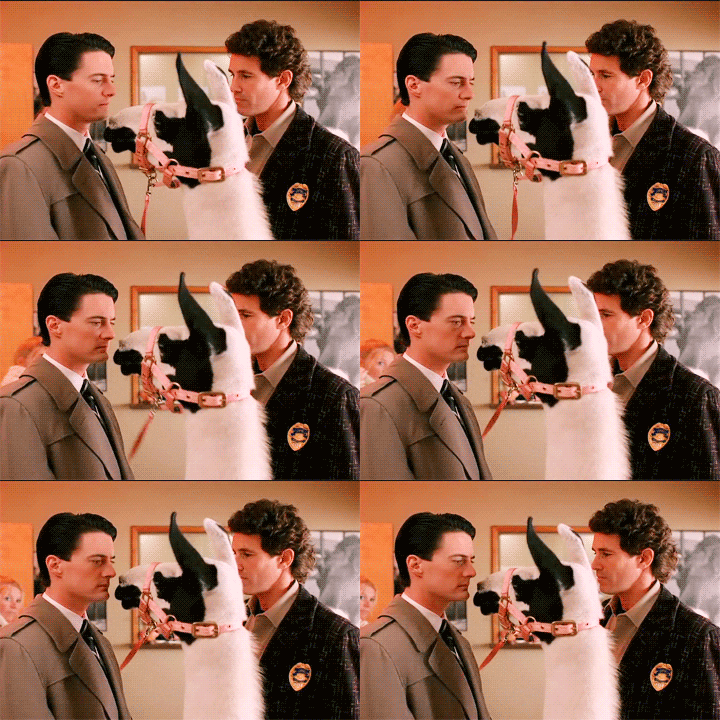
Corvus.coraxI once worked on a farm with a llama - she was temperamental, but generally nice. We sheared her by hand, and her name was... wait for it... Dolly.
Corvus.coraxSomething about the tone or lean of this short article doesn't agree with me, but there are some interesting results mentioned, nonetheless.

A visitor once asked the Nobel Prize–winning physicist Niels Bohr whether he really believed that the horseshoe he’d hung at his country home was lucky. “Of course not,” Bohr said. “But I understand it’s lucky whether you believe in it or not.”
If Bohr couldn’t resist magical thinking, can anyone? One recent study found that even physicists, chemists, and geologists at MIT and other elite schools were instinctively inclined to attach a purpose to natural events. When the researchers subjected the scientists to time pressure (reasoning that this could expose a person’s uncensored biases), they were twice as likely to approve of statements such as “Trees produce oxygen so that animals can breathe” than they were when they had time to respond more deliberately [1]. Such bias may well be deep-seated: another recent study found that, regardless of their parents’ religiosity, 5-to-7-year-old children preferred explanations of events that involved lessons—like “Maggie’s house burned down to teach her not to play with fire anymore” [2].
Even atheists seem to fear a higher power. A study published last year found that self-identified nonbelievers began to sweat when reading aloud sentences asking God to do terrible things (“I dare God to make my parents drown”). Not only that, they stressed out just as much as believers did [3]. Belief in the soul also appears widespread. One psychologist found that among people who said that consciousness ends at death, a third nonetheless attributed ongoing thoughts and feelings to characters in a fictional story after those characters had died [4].
Expressions of subconscious religious belief seem to increase when we are reminded of our own mortality—as they say, there are no atheists in foxholes. In one study, writing about death increased subjects’ implicit associations between words for supernatural entities (God, soul, hell) and synonyms for real (true, factual). The effect was equally strong in Christians and in people who described themselves as nonreligious [5].
Magical thinking is not just a result of ignorance or indoctrination—it appears to be a side effect of normal, socially adaptive thinking: we attribute intentions to the natural world in much the same way that we attribute intentions to other people. Indeed, a recent paper from a lab at the University of British Columbia reported that the better study participants were at reading others, the more strongly they believed in God, the paranormal, and the notion that life has a purpose [6]. Meanwhile, one of the few true avenues to atheism may be autism. The same lab found that the more autistic traits a person had, the less likely he or she was to believe in God [7].
Fear is another driver of irrationality. In a British study, students imagined an encounter with a self-professed witch who offered to cast an evil spell on them. About half said a scientist should accept the hex without concern. Yet each of them said that, personally, they’d decline the offer [8].
The Studies:
[1] Kelemen et al., “Professional Physical Scientists Display Tenacious Teleological Tendencies” (Journal of Experimental Psychology: General, Nov. 2013)
[2] Banerjee and Bloom, “ ‘Everything Happens for a Reason’ ” (Child Development, published online Oct. 2014)
[3] Lindeman et al., “Atheists Become Emotionally Aroused When Daring God to Do Terrible Things” (International Journal for the Psychology of Religion, 2014)
[4] Bering, “Intuitive Conceptions of Dead Agents’ Minds” (Journal of Cognition and Culture, 2002)
[5] Jong et al., “Foxhole Atheism, Revisited” (Journal of Experimental Social Psychology, Sept. 2012)
[6] Willard and Norenzayan, “Cognitive Biases Explain Religious Belief, Paranormal Belief, and Belief in Life’s Purpose” (Cognition, Nov. 2013)
[7] Norenzayan et al., “Mentalizing Deficits Constrain Belief in a Personal God” (plos One, 2012)
[8] Subbotsky, “The Permanence of Mental Objects” (Developmental Psychology, March 2005)
This article was originally published at http://www.theatlantic.com/magazine/archive/2015/03/the-science-of-superstition/384962/

Corvus.coraxthis morning's soundtrack...

Back in 2013, it was announced that Thom Yorke and Massive Attack's Robert Del Naja had teamed up to score a film called The UK Gold. It's a feature-length documentary that chronicles the history of tax avoidance in the UK. The score also features work from Yorke's Radiohead bandmate Jonny Greenwood and Elbow's Guy Garvey. The entire soundtrack has been shared over on UK Uncut— the official website of a grassroots movement to "highlight alternatives to austerity". Listen to the soundtrack below.
Radiohead are apparently at work on a new album. Massive Attack recently revealed that they've been collaborating with Run the Jewels.
Watch the trailer for The UK Gold: