Shared posts

11 Mar 17:47

Summers, Lomborg, Tabarrok, and Cowen on climate change

by Tyler Cowen
Corvus.corax

somewhat unsurprising, but in case you want to know what they all think.

There was a brief symposium, here are the results:

Larry Summers

President Emeritus of Harvard University, Former Chief Economist of the World Bank

My sense is that cap and trade is not the route to the future. It did not make it politically in the US at a moment of great opportunity in 2009. And European carbon markets have been plagued by constant problems. And globally it’s even harder. My sense is that the right strategy has three major elements. First, as the G20 vowed in 2009, there needs to be a concerted phase out of fossil fuel subsidies. This would help government budgets, drive increases in economic efficiency and substantially reduce global emissions. Second, there needs to be assurance of adequate funding for all areas of basic energy research. As a practical matter my guess is the world will produce non fossil fuel power in the next 25 years at today s fossil fuel prices or it will fail with respect to global climate change. Third, there is a strong case for concerted carbon taxes to further discourage greenhouse gas emissions. But this is a follow-on step for after the elimination of fossil fuel subsidies.

Bjorn Lomborg

Director of the Copenhagen Consensus Center and adjunct professor at Copenhagen Business School

The only way to move towards a long-term reduction in emissions is if green energy becomes much cheaper. If it cost less than fossil fuels, everyone would switch, including the Chinese. This, of course, requires breakthroughs in green technologies and much more innovation.

At the Copenhagen Consensus on Climate (fixtheclimate.com), a panel of economists, including three Nobel laureates, found that the best long-term strategy to tackle global warming was to increase dramatically investment in green research and development. They suggested doing so 10-fold to $100bn a year globally. This would equal 0.2% of global GDP. Compare this to the EU’s climate policies, which cost $280 billion a year but reduce temperatures by a trivial 0.1 degrees Fahrenheit by the end of the century.

Alex Tabarrok

Bartley J. Madden Chair in Economics at the Mercatus Center, George Mason University

Neither the developed nor the developing world will accept large reductions in their standard of living. As a result, the only solution to global climate change is innovations in green technology. A carbon tax will induce innovation as people demand a way to avoid the tax. A carbon tax, however, will be more politically acceptable if technologies to avoid the tax are in existence before the tax is put into place. Prizes for green innovations can blaze a path down a road that must be traveled, making the trip easier. The L-prize successfully induced innovation in LED technologies, the X-Prize put a spacecraft into near space twice within two weeks and Google’s Lunar X prize for putting a robot on the moon is close to being awarded. Prizes have proven their worth. To speed both the creation and diffusion of green technology, green prizes should be awarded at the rate of $100-$200 million annually.

Tyler Cowen

Professor of Economics, George Mason University

This is a problem we are failing to solve. Keep in mind it is not just about getting the wealthy countries to switch to greener technologies, but we also desire that emerging economies will find green technology more profitable than dirty coal. A carbon tax is one way forward but the odds are that will not be enough and besides many countries are unlikely to adopt one anytime soon. Subsidies for technology could occur at a very basic level and we could make a gamble that nuclear fusion will finally pay off. We also need a version of green technology that will fit into existing energy infrastructures and into countries which do not have the most reliable institutions. The most likely scenario is that we will find out just how bad the climate change problem is slated to be.

There are further responses at the link.

Addendum: Ashok Rao adds comments.

05 Mar 14:29

The Crushingly Expensive Mistake Killing Your Retirement

by Matthew O'Brien
Corvus.corax

Here's the short atlantic piece on expense ratios that I mentioned last night.

Humans are horrible at understanding compound interest, and it's making our golden years much less so.

Think about your 401(k). The first thing you probably look at when you pick your funds is their returns. It's only human nature. Everybody likes to think about their nest eggs growing and growing and growing—especially if they're growing a little bit faster than everybody else's. But, in this case, human nature is costing you hundreds of thousands of dollars.

The sad fact is that returns aren't certain, but fees are. Now, maybe everything will go according to plan, and your 401(k) will be partying like it's 1999. Maybe the 1 percent—or more—that you're paying in fees will actually buy you market-beating returns. But probably not. You can see this in the chart to the left from Vanguard. It shows the percentage of actively managed funds that have underperformed index funds over the short and longer hauls, net of fees. Which is to say, most of them. It's hard enough for funds to beat their benchmarks over just one to three-year periods. But that gets damn near impossible the longer you go. Once you account for survivorship bias—that bad funds go bust, and disappear from the sample—almost 80 percent of actively managed funds don't beat simple index funds over 10 to 15-year periods.

In the meantime, you're stuck paying fees. Those fees don't sound too bad—just 1 percent!—but this is where our total lack of intuition for how compounding works really hurts us. Let's try an example: what's 0.99 to the 40th power? It's not exactly a calculation you can do in your head. It's not even one you can estimate. But it's the kind of calculation that you need to do to figure out how much your 401(k) fees are costing you.

The answer is a lot more than you think. (No cheating with a calculator before we get to the big reveal). Now, let's say you contribute $3,000 to your 401(k) every year, which is a little more than the national average, starting when you're 25. Let's also say that you're choosing between two investments: the lowest-cost index fund with a 0.08 percent fee, and a typical managed stock fund with, according to Morningstar, a 1.33 percent fee. And finally, let's say that, though you don't know it, they both return 7 percent a year, because, as we saw above, most managed funds don't beat the market.

This 1.25 percent difference in annual fees adds up to a six-figure difference in lifetime earnings. That's because you don't just lose the money you pay in fees. You lose the returns you could have had on the money you pay in fees, too. As you can see in the chart below, this compounding effect doesn't matter much for the first 20 years or so, but really accelerates after that. If you chose the lowest-cost index fund, you'd have $15,000 more at age 45, $55,000 more at 55, and $159,000 more at 65. That would balloon to $257,000 more if you waited to retire at 70.

This is some brutal math. It's 27 percent of your retirement going to Wall Street for nothing. Actually, less than nothing. Remember, about 80 percent of actively managed funds do worse than index funds after you take fees into account. It's a Wall Street handout that you can't afford to make.

Skip the fees, and save your retirement.


27 Feb 03:28

Why you shouldn't hire like Google

In today's New York Times Thomas Friedman reports on purported hiring practices at Google, as represented by Laszlo Bock, a senior vice president there.

Bock is an amateur psychometrician. He maintains that "GPA's are worthless as a criteria for hiring, and test scores are worthless."  Rather, they are looking for "general cognitive ability, and it's not IQ. It's learning ability."

Bock is similarly unimpressed by "expertise." According to Bock, someone with high cognitive ability will come up with the same answer as the person with expertise anyway.

They also value "emergent leadership," which means what it sounds like, and "humility and ownership," which sounds like being a responsible employee; shouldering blame when blame is yours, and trying to learn from your failures.

Everything Bock says is probably not true, and if it were true, it would not work well in organizations other than Google.

  • Decades of research shows that job performance in many careers is pretty well predicted by standard IQ tests.
  • "Learning to learn" is nebulous because it's domain-specific, and it's domain-specific because the ability to learn new things depends on what you already know.
  • "Emergent leadership" and "humility and ownership" are qualities many organizations prize and would dearly love to reliably predict at hiring time. Maybe Bock has something to teach them about this. I kinda doubt it, but you never know.
  • The idea that smart people can pretty well figure anything out without expertise? Even though IQ predicts job performance (not "learning to learn") experience still matters to performance.

Friedman adds the critical caveat in the last paragraph:
Google attracts so much talent it can afford to look beyond traditional metrics, like G.P.A.

Yes. It reminds me of a conversation I had with a Harvard admissions office who told me "Look, we could fill the freshman class with students who got 800,800 on the SAT. Literally. Every single freshman, 800,800. We're just not interested in doing that."

That doesn't mean that the SAT was irrelevant; you didn't meet many Harvard students with crummy SAT scores. It means that once you're in the 750 range, Harvard figured you're damn smart and whatever "edge" might be represented in the difference between 750 and 800 didn't matter much. They started to look at other qualities. Harvard admissions officers (at least as represented by my friend) were also quite serious in how they tried to do it, and quite humble about their ability to assess them.

Likewise, Google is, I'm willing to guess, selecting from tremendously capable people--capable as defined in standard ways--so it makes perfect sense that further selection is based on other qualities. It doesn't mean that standard metrics are rendered irrelevant.

Friedman is right when (in the last paragraph) he offers this advice: For most young people, though, going to college and doing well is still the best way to master the tools needed for many careers. I would add that I would expect Google's offbeat hiring practices wouldn't work in most places.
25 Feb 18:57

In the '60s, Models Floated Through Paris in Bubbles

by Doug Bierend
Corvus.corax

Mostly sharing to note that full-text search seems to be functional now (maybe just for us paid subscribers?). I searched for 'fashion' and a whole bunch of results came up that didn't mention fashion in the heading.

Also wondering if any of you dudes ever buy clothes for your wives, and if so, where.

There's something about floating translucent bubbles that's always seemed futuristic, from the '60s right up to the present day. Photographer Melvin Sokolsky was on the, er, ball, then, when he shot his now iconic Bubble series for the Harpers Bazaar 1963 Spring Collection.


25 Feb 17:07

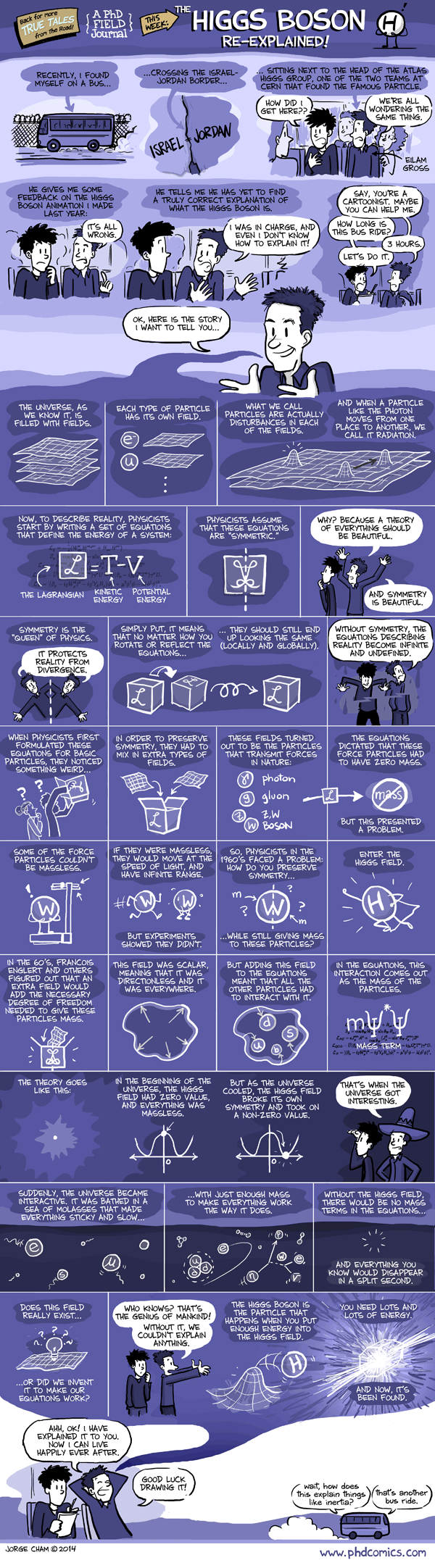
02/19/14 PHD comic: 'The Higgs Boson Re-Explained'

Corvus.corax

maybe you all have already been following this guy, but i just found him, so here's one for Bjorn

Piled Higher & Deeper by Jorge Cham
www.phdcomics.com
Click on the title below to read the comic
title: "The Higgs Boson Re-Explained" - originally published 2/19/2014

For the latest news in PHD Comics, CLICK HERE!

25 Feb 14:51

Ray Kurzweil Talks Google's Big Plans For Artificial Intelligence

by samzenpus
Corvus.corax

He's a fascinating dude to say the least. And now he's got Google's resources.

here's the source article:
http://www.theguardian.com/technology/2014/feb/22/robots-google-ray-kurzweil-terminator-singularity-artificial-intelligence

Nerval's Lobster writes "Ray Kurzweil, the technologist who's spent his career advocating the Singularity, discussed his current work as a director of engineering at Google with The Guardian. Google has big plans in the artificial-intelligence arena. It recently acquired DeepMind, self-billed 'cutting edge artificial intelligence company' for $400 million; that's in addition to snatching up all sorts of startups and research scientists devoted to everything from robotics to machine learning. Thanks to the massive datasets generated by the world's largest online search engine (and the infrastructure allowing that engine to run), those scientists could have enough information and computing power at their disposal to create networked devices capable of human-like thought. Kurzweil, having studied artificial intelligence for decades, is at the forefront of this in-house effort. In his interview with The Guardian, he couldn't resist throwing some jabs at other nascent artificial intelligence systems on the market, most notably IBM's Watson: 'IBM's Watson is a pretty weak reader on each page, but it read the 200m pages of Wikipedia. And basically what I'm doing at Google is to try to go beyond what Watson could do. To do it at Google scale. Which is to say to have the computer read tens of billions of pages. Watson doesn't understand the implications of what it's reading.' That sounds very practical, but at a certain point Kurzweil's predictions veer into what most people would consider science fiction. He believes, for example, that a significant portion of people alive today could end up living forever, thanks to the ministrations of ultra-intelligent computers and beyond-cutting-edge medical technology."

Share on Google+

Read more of this story at Slashdot.


24 Feb 23:04

Apocalypse NAO: College Studies the Theological Ramifications of Robotics

by samzenpus
malachiorion writes "Have you heard the one about the Christian college in North Carolina that bought a humanoid robot, to figure out whether or not bots are going to charm us into damnation (dimming or cutting our spiritual connection to God)? The robot itself is pretty boring, but the reasoning behind its purchase—a religious twist on the standard robo-phobia—is fascinating. From the article: '“When the time comes for including or incorporating humanoid robots into society, the prospect of a knee-jerk kind of reaction from the religious community is fairly likely, unless there’s some dialogue that starts happening, and we start examining the issue more closely,” says Kevin Staley, an associate professor of theology at SES. Staley pushed for the purchase of the bot, and plans to use it for courses at the college, as well as in presentations around the country. The specific reaction Staley is worried about is a more extreme version of the standard, secular creep factor associated with many robots. “From a religious perspective, it could be more along the lines of seeing human beings as made in God’s image,” says Staley. “And now that we’re relating to a humanoid robot, possibly perceiving it as evil, because of its attempt to mimic something that ought not to be mimicked.”'"

Share on Google+

Read more of this story at Slashdot.


24 Feb 20:01

Big in Italy: Miracles

by William Brennan
Corvus.corax

*sigh*

“I believe in angels and I speak with them,” Juliette Binoche, the Academy Award–winning actress, told Miracoli, a new Italian tabloid, last July. She isn’t alone. Miracoli, which bills itself as “a magazine of hope” and hit a circulation of about 120,000 in its first four months, is competing with some of Italy’s top weekly magazines by covering miracles, saints, and the latest Virgin Mary sighting in the bark of a tree with the pulpy flair of a celebrity tabloid. Every Saturday, readers find a star’s firsthand account of the miraculous amid tales of spontaneous recoveries from cancer, a horoscope-like Saints of the Week page, pilgrimage itineraries, and saintly centerfolds (including, in one issue, a baroque rendering of Saint John the Baptist, muscular and naked save for a delicately draped cloth).

“I wish you could buy this magazine in churches,” a reader named Marietta gushed in a letter to the editor. But so far, it’s available only on newsstands. Churches, anyway, would prove a lackluster marketplace: a 2009 study showed that while Italy’s overall Sunday Mass attendance is high among European countries, with about 30 percent of Italians attending every week, only 13 percent of 22-to-32-year-olds go to Mass so regularly. Some experts have suggested that miracle mania might be filling the spiritual hole left as church pews empty out. “Often, those you no longer see at mass, you find kneeling at Lourdes or Medjugorje or Fátima,” the Catholic journalist Vittorio Messori wrote in 2012, referring to famous holy sites across Europe.

The Catholic Church has made no official comment on Miracoli, though that doesn’t mean it’s gone unnoticed in the Holy See. Last November, a group of priests with connections to the magazine waited in Pope Francis’s receiving line during a general audience and, kissing his hand, passed him the latest issue. The pope took the magazine with a sheepish smile. According to the following week’s cover story, he told them, “I’m going to read it!” 


24 Feb 14:47

Japanese Firm Proposes Microwave-Linked Solar Plant On the Moon

by timothy
Corvus.corax

dreamin' big

littlesparkvt writes "Harnessing the sun's power is nothing new on Earth, but if a Japanese company has its way, it will build a solar strip across the 11,000 mile Lunar equator that could supply our world with clean and unlimited solar energy for generations." Some of the company's other projects look just as ambitious.

Share on Google+

Read more of this story at Slashdot.


24 Feb 14:33

FCC Planning Rule Changes To Restore US Net Neutrality

by Soulskill
Karl C writes "In a statement issued today, FCC commissioner Tom Wheeler announced that the commission will begin a rule-making process to re-impose Net Neutrality, which was recently struck down in Federal court. Among the standards Wheeler intends to pursue are vigorous enforcement of a requirement for transparency in how ISPs manage traffic, and a prohibition on blocking (the 'no blocking' provision.) This seems like exactly what net neutrality activists have been demanding: Total prohibition of throttling, and vigorous enforcement of that rule, and of a transparency requirements so ISPs can't try to mealy-mouth their way around accusations that they're already throttling Netflix. Even before the court decision overturning net neutrality, Comcast and Verizon users have been noting Netflix slowdowns for months."

Share on Google+

Read more of this story at Slashdot.


24 Feb 14:32

New 'pCell' Technology Could Bring Next Generation Speeds To 4G Networks

by Unknown Lamer
Corvus.corax

and for your dense techie news...

An anonymous reader writes in about a possible game changer in wireless technology that embraces interference with great results: "It's one of those elegant inventions that only surface maybe once a decade. If it works at scale, according to IEEE Spectrum, it could 'radically change the way wireless networks operate, essentially replacing today's congested cellular systems with an entirely new architecture that combines signals from multiple distributed antennas to create a tiny pocket of reception around every wireless device.' This scheme could allow each device to use the full bandwidth of spectrum available to the network, which would 'eliminate network congestion and provide faster, more reliable data connections.' And the best part? It's compatible with 4G LTE phones, which means it could be deployed today." The idea is that an array of dumb antennas are deployed and a very powerful cluster computes signals that are sent from all of them which then appear to be a single coherent signal to only a single device. There's a short paper on the Distributed In Distributed Out technique, but it is a bit light on the mathematical details.

Share on Google+

Read more of this story at Slashdot.


21 Feb 15:39

Jimi Goodwin: 'Doves haven't split up'

The band's frontman says 'there's every chance' of another album
    
19 Feb 19:47

Journal of Cosmology Contributor Sues NASA To Investigate Mars "Donut"

by Unknown Lamer
An anonymous reader writes "Rhawn Joseph, a self-described astrobiologist involved with the infamous Journal of Cosmology, is suing NASA, demanding 100 high-resolution photos and 24 micrographs be taken of the 'donut' rock that recently appeared in front of the Opportunity rover on Mars, on the basis that it is a living organism. The remarkable full text of the complaint, which cites NASA's mineralogical analysis of the rock as evidence against it being a rock, is available to read at Popular Science." Really, the lawsuit is worth a read.

Share on Google+

Read more of this story at Slashdot.


19 Feb 17:33

Bret Easton Ellis confirms he's written a 'Yeezus' inspired film for Kanye West

Corvus.corax

yeezy updayte

'I didn't want to at first' says the 'American Psycho' author after being asked by rapper


19 Feb 01:41

Massive New CT Scanner Assesses Car Crash Data

by samzenpus
Corvus.corax

Actually sharing to say "slow down out there gents."

I was one of the first 3 people on the scene of a roll-over on Hwy 52 this morning. Victim was trapped and I scooped snow away from her face so she could breathe and tell us her condition. She seemed fine, awake, not reporting any injuries. Also learned not to expect the "Commercial Vehicle Enforcement" guy from the state patrol to do anything related to rescue/response. He just stood there hesitating while I dug around her face. I left when the paramedics arrived. Note to self- buy car window breaker handle thingy for my car, and keep a knife on my key-chain. Both would have been handy since the doors were locked. Be careful!

cartechboy writes "If you've ever been in a serious car accident, you've probably had a CT scan to give doctors a clearer idea of your injuries. Soon, your car might get a CT scan, too. Scientists at the Fraunhofer Institute have developed a giant new CT scanner (dubbed, yes, XXL CT) that can scan very large objects, like cars. It Turns out a CT scan of a post-crash vehicle offers an unprecedented precision look at the internal damage details, without disturbing the wreckage further. A crashed car is hoisted onto a turntable, and as it turns, two X-ray detectors on either side scan it. Then multiple images are merged into a single, three-dimensional CT scan. The scanner also can handle airplane wings and shipping containers, which means there may be possible anti-terrorism uses in the future."

Share on Google+

Read more of this story at Slashdot.


18 Feb 21:54

Hunting Trophies: Repurposed Vintage Bike Parts Converted into Functional Taxidermy Racks

by Christopher Jobson

Hunting Trophies: Repurposed Vintage Bike Parts Converted into Functional Taxidermy Racks upcycling taxidermy sculpture humor bicycles antlers

Hunting Trophies: Repurposed Vintage Bike Parts Converted into Functional Taxidermy Racks upcycling taxidermy sculpture humor bicycles antlers

Hunting Trophies: Repurposed Vintage Bike Parts Converted into Functional Taxidermy Racks upcycling taxidermy sculpture humor bicycles antlers

Hunting Trophies: Repurposed Vintage Bike Parts Converted into Functional Taxidermy Racks upcycling taxidermy sculpture humor bicycles antlers

Hunting Trophies: Repurposed Vintage Bike Parts Converted into Functional Taxidermy Racks upcycling taxidermy sculpture humor bicycles antlers

Hunting Trophies: Repurposed Vintage Bike Parts Converted into Functional Taxidermy Racks upcycling taxidermy sculpture humor bicycles antlers

Hunting Trophies: Repurposed Vintage Bike Parts Converted into Functional Taxidermy Racks upcycling taxidermy sculpture humor bicycles antlers

Hunting Trophies: Repurposed Vintage Bike Parts Converted into Functional Taxidermy Racks upcycling taxidermy sculpture humor bicycles antlers

Vienna-based designer Andreas Scheiger created this fun series of faux taxidermy heads using a bunch of found bicycle seats and handlebars. The pieces can serve as fun art objects, or as functional hooks for holding bags, coats, and even other bicycles. Several of them are for sale over on his website, or you can see how he did it and maybe attempt your own. (via Fubiz)

Update: Several of you have mentioned that these are pieces appear to be a modern interpretation of Picasso’s Tête de taureau.

18 Feb 21:43

I Raff I Ruse Top Post Countdown #6

Corvus.corax

I found at least 5 of these to be surprising and helpful.


I Raff I Ruse Top Post Countdown #6

18 Feb 16:55

St Vincent performs new songs live and streams fourth album – watch

Corvus.corax

Also very excited for this one. Kayla and I are going to the Apr3 concert.
http://www.npr.org/2014/02/17/274773638/first-listen-st-vincent-st-vincent

US singer will release 'St Vincent' on February 24


18 Feb 16:39

Lana Del Rey to release new album 'Ultraviolence' on May 1?

Corvus.corax

can't wait.

Singer accidentally lets release date slip to fans in a US street


17 Feb 19:32

Study Finds That Kindergarten is Too Easy

by Holly Yettick
Corvus.corax

one of the blogs I follow to justify doing reader at work...

A study has found that kindergarten teachers spend most of their time on basic literacy and math but that children learn more when taught more advanced material.
17 Feb 16:21

Tax breaks revealed to be the reason behind ABBA's flamboyant stage wear

The band could only get tax deductions on clothes that were "in no way suitable for everyday wear."


17 Feb 03:41

The Marionette’s Lament

Corvus.corax

Here's the Harris response to Dennett

free will

(Photo via Max Boschini)

Dear Dan—

I’d like to thank you for taking the time to review Free Will at such length. Publicly engaging me on this topic is certainly preferable to grumbling in private. Your writing is admirably clear, as always, which worries me in this case, because we appear to disagree about a great many things, including the very nature of our disagreement.

I want to begin by reminding our readers—and myself—that exchanges like this aren’t necessarily pointless. Perhaps you need no encouragement on that front, but I’m afraid I do. In recent years, I have spent so much time debating scientists, philosophers, and other scholars that I’ve begun to doubt whether any smart person retains the ability to change his mind. This is one of the great scandals of intellectual life: The virtues of rational discourse are everywhere espoused, and yet witnessing someone relinquish a cherished opinion in real time is about as common as seeing a supernova explode overhead. The perpetual stalemate one encounters in public debates is annoying because it is so clearly the product of motivated reasoning, self-deception, and other failures of rationality—and yet we’ve grown to expect it on every topic, no matter how intelligent and well-intentioned the participants. I hope you and I don’t give our readers further cause for cynicism on this front.

Unfortunately, your review of my book doesn’t offer many reasons for optimism. It is a strange document—avuncular in places, but more generally sneering. I think it fair to say that one could watch an entire season of Downton Abbey on Ritalin and not detect a finer note of condescension than you manage for twenty pages running.

I am not being disingenuous when I say this museum of mistakes is valuable; I am grateful to Harris for saying, so boldly and clearly, what less outgoing scientists are thinking but keeping to themselves. I have always suspected that many who hold this hard determinist view are making these mistakes, but we mustn’t put words in people’s mouths, and now Harris has done us a great service by articulating the points explicitly, and the chorus of approval he has received from scientists goes a long way to confirming that they have been making these mistakes all along. Wolfgang Pauli’s famous dismissal of another physicist’s work as “not even wrong” reminds us of the value of crystallizing an ambient cloud of hunches into something that can be shown to be wrong. Correcting widespread misunderstanding is usually the work of many hands, and Harris has made a significant contribution.

I hope you will recognize that your beloved Rapoport’s rules have failed you here. If you have decided, according to the rule, to first mention something positive about the target of your criticism, it will not do to say that you admire him for the enormity of his errors and the recklessness with which he clings to them despite the sterling example you’ve set in your own work. Yes, you may assert, “I am not being disingenuous when I say this museum of mistakes is valuable,” but you are, in truth, being disingenuous. If that isn’t clear, permit me to spell it out just this once: You are asking the word “valuable” to pass as a token of praise, however faint. But according to you, my book is “valuable” for reasons that I should find embarrassing. If I valued it as you do, I should rue the day I wrote it (as you would, had you brought such “value” into the world). And it would be disingenuous of me not to notice how your prickliness and preening appears: You write as one protecting his academic turf. Behind and between almost every word of your essay—like some toxic background radiation—one detects an explosion of professorial vanity.

And yet many readers, along with several of our friends and colleagues, have praised us for airing our differences in so civil a fashion—the implication being that religious demagogues would have declared mutual fatwas and shed each other’s blood. Well, that is a pretty low bar, and I don’t think we should be congratulated for having cleared it. The truth is that you and I could have done a much better job—and produced something well worth reading—had we explored the topic of free will in a proper conversation. Whether we called it a “conversation” or a “debate” would have been immaterial. And, as you know, I urged you to engage me that way on multiple occasions and up to the eleventh hour. But you insisted upon writing your review. Perhaps you thought that I was hoping to spare myself a proper defenestration. Not so. I was hoping to spare our readers a feeling of boredom that surpasseth all understanding.
As I expected, our exchange will now be far less interesting or useful than a conversation/debate would have been. Trading 10,000-word essays is simply not the best way to get to the bottom of things. If I attempt to correct every faulty inference and misrepresentation in your review, the result will be deadly to read. Nor will you be able to correct my missteps, as you could have if we were exchanging 500-word volleys. I could heap misconception upon irrelevancy for pages—as you have done—and there would be no way to stop me. In the end, our readers will be left to reconcile a book-length catalogue of discrepancies.

Let me give you an example, just to illustrate how tedious it is to untie these knots. You quote me as saying:

If determinism is true, the future is set—and this includes all our future states of mind and our subsequent behavior. And to the extent that the law of cause and effect is subject to indeterminism—quantum or otherwise—we can take no credit for what happens.  There is no combination of these truths that seems compatible with the popular notion of free will.

You then announce that “the sentence about indeterminism is false”—a point you seek to prove by recourse to an old thought experiment involving a “space pirate” and a machine that amplifies quantum indeterminacy. After which, you lovingly inscribe the following epitaph onto my gravestone:

These are not new ideas. For instance I have defended them explicitly in 1978, 1984, and 2003. I wish Harris had noticed that he contradicts them here, and I’m curious to learn how he proposes to counter my arguments.

You see, dear reader, Harris hasn’t done his homework. What a pity…. But you have simply misread me, Dan—and that entire page in your review was a useless digression. I am not saying that the mere addition of indeterminism to the clockwork makes responsibility impossible. I am saying, as you have always conceded, that seeking to ground free will in indeterminism is hopeless, because truly random processes are precisely those for which we can take no responsibility. Yes, we might still express our beliefs and opinions while being gently buffeted by random events (as you show in your thought experiment), but if our beliefs and opinions were themselves randomly generated, this would offer no basis for human responsibility (much less free will). Bored yet?

You do this again and again in your review. And when you are not misreading me, you construct bad analogies—to sunsets, color vision, automobiles—none of which accomplish their intended purpose. Some are simply faulty (that is, they don’t run through); others make my point for me, demonstrating that you have missed my point (or, somehow, your own). Consider what you say about sunsets to show that free will should not be considered an illusion:

After all, most people used to believe the sun went around the earth. They were wrong, and it took some heavy lifting to convince them of this. Maybe this factoid is a reflection on how much work science and philosophy still have to do to give everyday laypeople a sound concept of free will…. When we found out that the sun does not revolve around the earth, we didn’t then insist that there is no such thing as the sun (because what the folk mean by “sun” is “that bright thing that goes around the earth”). Now that we understand what sunsets are, we don’t call them illusions. They are real phenomena that can mislead the naive.

Of course, the sun isn’t an illusion, but geocentrism is. Our native sense that the sun revolves around a stationary Earth is simply mistaken. And any “project of sympathetic reconstruction” (your compatibilism) with regard to this illusion would be just a failure to speak plainly about the facts. I have never disputed that mental phenomena such as thoughts, efforts, volition, reasoning, and so forth exist. These are the many “suns” of the mind that any scientific theory must conserve (modulo some clarifying surprises, as has happened for the concept of “memory”). But free will is like the geocentric illusion: It is the very thing that gets obliterated once we begin speaking in detail about the origins of our thoughts and actions. You’re not just begging the question here; you’re begging it with a sloppy analogy. The same holds for your reference to color vision (which I discussed in a previous essay).

And when you are not causing problems with your own analogies, you are distorting mine. For instance, you write that you were especially dismayed by the cover of my book, which depicts a puppet theater. This cover image is justified because I argue that each of us is moved by chance and necessity, just as a marionette is set dancing on its strings. But I never suggest that this is the same as being manipulated by a human puppeteer who overrides our actual beliefs and desires and obliges us to behave in ways we do not intend. You seem eager to draw this implication, however, and so you press on with an irrelevant discussion of game theory (another area in which you allege I haven’t done my homework). Again, I am left wishing we had had a conversation that would have prevented so many pedantic digressions.

In any case, I cannot bear to write a long essay that consists in my repeatedly taking your foot out of my mouth. Instead, I will do my best to drive to the core of our disagreement.


Let’s begin by noticing a few things we actually agree about: We agree that human thought and behavior are determined by prior states of the universe and its laws—and that any contributions of indeterminism are completely irrelevant to the question of free will. We also agree that our thoughts and actions in the present influence how we think and act in the future. We both acknowledge that people can change, acquire skills, and become better equipped to get what they want out of life. We know that there is a difference between a morally healthy person and a psychopath, as well as between one who is motivated and disciplined, and thus able to accomplish his aims, and one who suffers a terminal case of apathy or weakness of will. We both understand that planning and reasoning guide human behavior in innumerable ways and that an ability to follow plans and to be responsive to reasons is part of what makes us human. We agree about so many things, in fact, that at one point you brand me “a compatibilist in everything but name.” Of course, you can’t really mean this, because you go on to write as though I were oblivious to most of what human beings manage to accomplish. At some points you say that I’ve thrown the baby out with the bath; at others you merely complain that I won’t call this baby by the right name (“free will”). Which is it?

However, it seems to me that we do diverge at two points:

1. You think that compatibilists like yourself have purified the concept of free will by “deliberately using cleaned-up, demystified substitutes for the folk concepts.” I believe that you have changed the subject and are now ignoring the very phenomenon we should be talking about—the common, felt sense that I/he/she/you could have done otherwise (generally known as “libertarian” or “contra-causal” free will), with all its moral implications. The legitimacy of your attempting to make free will “presentable” by performing conceptual surgery on it is our main point of contention. Whether or not I can convince you of the speciousness of the compatibilist project, I hope we can agree in the abstract that there is a difference between thinking more clearly about a phenomenon and (wittingly or unwittingly) thinking about something else. I intend to show that you are doing the latter.

2. You believe that determinism at the microscopic level (as in the case of Austin’s missing his putt) is irrelevant to the question of human freedom and responsibility. I agree that it is irrelevant for many things we care about (it doesn’t obviate the distinction between voluntary and involuntary behavior, for instance), but it isn’t irrelevant in the way you suggest. And accepting incompatibilism has important intellectual and moral consequences that you ignore—the most important being, in my view, that it renders hatred patently irrational (while leaving love unscathed). If one is concerned about the consequences of maintaining a philosophical position, as I know you are, helping to close the door on human hatred seems far more beneficial than merely tinkering with a popular illusion.

Changing the Subject

We both know that the libertarian notion of free will makes no scientific or logical sense; you just doubt whether it is widespread among the folk—or you hope that it isn’t, or don’t much care whether it is (in truth, you are not very clear on this point). In defense of your insouciance, you cite a paper by Nahmias et al.[1]  It probably won’t surprise you that I wasn’t as impressed by this research as you were. Nahmias and his coauthors repeatedly worry that their experimental subjects didn’t really understand the implications of determinism—and on my reading, they had good reason to be concerned. In fact, this is one of those rare papers in which the perfunctory doubts the authors raise, simply to show that they have thought of everything, turn out to be far more compelling than their own interpretations of their data. More than anything, this research suggests that people find the idea of libertarian free will so intuitively compelling that it is very difficult to get them to think clearly about determinism. Of course, I agree that what people think and feel is an empirical question. But it seems to me that we know much more about the popular view of free will than you and Nahmias let on.

It is worth noting that the most common objection I’ve heard to my position on free will is some version of the following:

If there is no free will, why write books or try to convince anyone of anything? People will believe whatever they believe. They have no choice! Your position on free will is, therefore, self-refuting. The fact that you are trying to convince people of the truth of your argument proves that you think they have the very freedom that you deny them.

Granted, some confusion between determinism and fatalism (which you and I have both warned against) is probably operating here, but comments of this kind also suggest that people think they have control over what they believe, as if the experience of being convinced by evidence and argument were voluntary. Perhaps such people also believe that they have decided to obey the law of gravity rather than fly around at their pleasure—but I doubt it. An illusion about mental freedom seems to be very widespread. My argument is that such freedom is incompatible with any form of causation (deterministic or otherwise)—which, as you know, is not a novel view. But I also argue that it is incompatible with the actual character of our subjective experience. That is why I say that the illusion of free will is itself an illusion—which is another way of saying that if one really pays attention (and this is difficult), the illusion of free will disappears.

The popular, folk psychological sense of free will is a moment-to-moment experience, not a theory about the mind. It is primarily a first-person fact, not a third-person account of how human beings function. This distinction between first-person and third-person views was what I was trying to get at in the passage that seems to have mystified you (“I have thought long and hard about this passage, and I am still not sure I understand it…”) Everyone has a third-person picture of the human mind—some of us speak of neural circuits, some speak of souls—but the philosophical problem of free will arises from the fact that most people feel that they author their own thoughts and actions. It is very difficult to say what this feeling consists of or to untangle it from working memory, volition, motor planning, and the rest of what our minds are up to—but there can be little doubt that most people feel that they are the conscious source of their own thoughts and actions. Of course, you may wish to deny this very assertion, or believe it more parsimonious to say that we just don’t know how most people feel—and that might be a point worth discussing. But rather than deny the claim, you simply lose sight of it—shifting from first-person experiences to third-person accounts of phenomena that lie outside consciousness.

It is true, of course, that most educated people believe the whole brain is involved in making them who they are (indeed, you and I both believe this). But they experience only some of what goes on inside their brains. Contrary to what you suggest, I was not advancing a Cartesian theory of consciousness (a third-person view), or any “daft doctrine of [my] own devising.” I was simply drawing a line between what people experience and what they don’t (first-person). The moment you show that a person’s thoughts and actions were determined by events that he did not and could not see, feel, or anticipate, his third-person account of himself may remain unchanged (“Of course, I know that much of what goes on in my brain is unconscious, determined by genes, and so forth. So what?”), but his first-person sense of autonomy comes under immediate pressure—provided he is paying attention. As a matter of experience (first-person), there is a difference between being conscious of something and not being conscious of it. And if what a person is unconscious of are the antecedent causes of everything he thinks and does, this fact makes a mockery of the subjective freedom he feels he has. It is not enough at that point for him to simply declare theoretically (third-person) that these antecedent causes are “also me.”

Average Joe feels that he has free will (first-person) and doesn’t like to be told that it is an illusion. I say it is: Consider all the roots of your behavior that you cannot see or feel (first-person), cannot control (first-person), and did not summon into existence (first-person). You say: Nonsense! Average Joe contains all these causes. He is his genes and neurons too (third-person). This is where you put the rabbit in the hat.

Imagine that we live in a world where more or less everyone believes in the lost kingdom of Atlantis. You and your fellow compatibilists come along and offer comfort: Atlantis is real, you say. It is, in fact, the island of Sicily. You then go on to argue that Sicily answers to most of the claims people through the ages have made about Atlantis. Of course, not every popular notion survives this translation, because some beliefs about Atlantis are quite crazy, but those that really matter—or should matter, on your account—are easily mapped onto what is, in fact, the largest island in the Mediterranean. Your work is done, and now you insist that we spend the rest of our time and energy investigating the wonders of Sicily. 

The truth, however, is that much of what causes people to be so enamored of Atlantis—in particular, the idea that an advanced civilization disappeared underwater—can’t be squared with our understanding of Sicily or any other spot on earth. So people are confused, and I believe that their confusion has very real consequences. But you rarely acknowledge the ways in which Sicily isn’t like Atlantis, and you don’t appear interested when those differences become morally salient. This is what strikes me as wrongheaded about your approach to free will.

For instance, ordinary people want to feel philosophically justified in hating evildoers and viewing them as the ultimate cause of their evil. This moral attitude is always vulnerable to our getting more information about causation—and in situations where the underlying causes of a person’s behavior become too clear, our feelings about their responsibility begin to shift. This is why I wrote that fully understanding the brain of a normal person would be analogous to finding an exculpatory tumor in it. I am not claiming that there is no difference between a normal person and one with impaired self-control. The former will be responsive to certain incentives and punishments, and the latter won’t. (And that is all the justification we need to resort to carrots and sticks or to lock incorrigibly dangerous people away forever.) But something in our moral attitude does change when we catch sight of these antecedent causes—and it should change. We should admit that a person is unlucky to be given the genes and life experience that doom him to psychopathy. Again, that doesn’t mean we can’t lock him up. But hating him is not rational, given a complete understanding of how he came to be who he is. Natural, yes; rational, no. Feeling compassion for him could be rational, however—in the same way that we could feel compassion for the six-year-old boy who was destined to become Jeffrey Dahmer. And while you scoff at “medicalizing” human evil, a complete understanding of the brain would do just that. Punishment is an extraordinarily blunt instrument. We need it because we understand so little about the brain, and our ability to influence it is limited. However, imagine that two hundred years in the future we really know what makes a person tick; Procrustean punishments won’t make practical sense, and they won’t make moral sense either. But you seem committed to the idea that certain people might actually deserve to be punished—if not precisely for the reasons that common folk imagine, nevertheless for reasons that have little or nothing to do with the good consequences that such punishments might have, all things considered. In other words, your compatibilism seems an attempt to justify the conventional notion of blame, which my view denies. This is a difference worth focusing on.

Let’s examine Austin’s example of his missed putt:

Consider the case where I miss a very short putt and kick myself because I could have holed it. It is not that I should have holed it if I had tried: I did try, and missed. It is not that I should have holed it if conditions had been different: that might of course be so, but I am talking about conditions as they precisely were, and asserting that I could have holed it. There is the rub. Nor does ‘I can hole it this time’ mean that I shall hole it this time if I try or if anything else; for I may try and miss, and yet not be convinced that I could not have done it; indeed, further experiments may confirm my belief that I could have done it that time, although I did not. (J.L. Austin. 1961. “Ifs and Cans,” in Austin, Philosophical Papers, edited by J. Urmson and G. Warnock. Oxford, Clarendon Press.)

This is a good place to start, because you say the following in your review:

I consider Austin’s mistake to be the central core of the ongoing confusion about free will; if you look at the large and intricate philosophical literature about incompatibilism, you will see that just about everyone assumes, without argument, that it is not a mistake.

I am happy to take the bait. I see no problem with using Austin’s example to support incompatibilism. I should emphasize, however, that I am discussing only the implications of Austin’s point for an account of free will, not how it functions in his original essay (which, as you know, was an analysis of the relationship between the terms “if” and “can,” not a sustained argument against free will).[2]

Let’s make sure you and I are standing on the same green: We agree that a human being, whatever his talents, training, and aspirations, will think, intend, and behave exactly as he does given the totality of conditions in the moment. That is, whatever his ability as a golfer, Austin would miss that same putt a trillion times in a row—provided that every atom and charge in the universe was exactly as it had been the first time he missed it. You think this fact (we can call it determinism, as you do, but it includes the contributions of indeterminism as well, provided they remain the same[3]) says nothing about free will. You think the fact that Austin could make nearly identical putts in other moments—with his brain in a slightly different state, the green a touch slower, and so forth—is all that matters. I agree that it is what matters when assessing his abilities as a golfer: Here, we don’t care about the single NMDA receptor that screwed up his swing on one particular putt; we care about the statistics of his play, round after round. But to speak clearly and honestly (that is, scientifically) about the actual causes of what happens in the world in each moment, we must focus on the particular.

What are we really saying when we claim that Austin could have made that putt (the one he missed)? As you point out, we aren’t actually referencing that putt at all. We are saying that Austin has made similar putts in the past and we can count on him to do so in the future—provided that he tries, doesn’t suffer some neurological injury, and so forth. However, we are also saying that Austin would have made this putt had something not gotten in his way. He had the general ability, after all, so something went wrong.

Then why did Austin miss his putt? Because some condition necessary for his making it was absent. What if that condition was sufficient effort, of the sort that he was generally capable of making? Why didn’t he make that effort? The answer is the same: Because some condition necessary for his making it was absent. From a scientific perspective, his failure to try is just another missed putt. Austin tried precisely as hard as he did. Next time he might try harder. But this time—with the universe and his brain exactly as they were—he couldn’t have tried in any other way.

To say that Austin really should have made that putt or tried harder is just a way of admonishing him to put forth greater effort in the future. We are not offering an account of what actually happened (his failure to sink his putt or his failure to try). You and I agree that such admonishments have effects and that these effects are perfectly in harmony with the truth of determinism. There is, in fact, nothing about incompatibilism that prevents us from urging one another (and ourselves) to do things differently in the future, or from recognizing that such exhortations often work. The things we say to one another (and to ourselves) are simply part of the chain of causes that determine how we think and behave.

But can we blame Austin for missing his putt? No. Can we blame him for not trying hard enough? Again, the answer is no—unless blaming him were just a way of admonishing him to try harder in the future. For us to consider him truly responsible for missing the putt or for failing to try, we would need to know that he could have acted other than he did. Yes, there are two readings of “could”—and you find only one of them interesting. But they are both interesting, and the one you ignore is morally consequential. One reading refers to a person’s (or a car’s, in your example) general capacities. Could Austin have sunk his putt, as a general matter, in similar situations? Yes. Could my car go 80 miles per hour, though I happen to be driving at 40? Yes. The other reading is one you consider to be a red herring. Could Austin have sunk that very putt, the one he missed? No. Could he have tried harder? No. His failure on both counts was determined by the state of the universe (especially his nervous system). Of course, it isn’t irrational to treat him as someone who has the general ability to make putts of that sort, and to urge him to try harder in the future—and it would be irrational to admonish a person who lacked such ability. You are right to believe that this distinction has important moral implications: Do we demand that mosquitoes and sharks behave better than they do? No. We simply take steps to protect ourselves from them. The same futility prevails with certain people—psychopaths and others whom we might deem morally insane. It makes sense to treat people who have the general capacity to behave well but occasionally lapse differently from those who have no such capacity and on whom any admonishment would be wasted. You are right to think that these distinctions do not depend on “absolute free will.” But this doesn’t mean nothing changes once we realize that a person could never have made the putt he just missed, or tried harder than he did, or refrained from killing his neighbor with a hammer.

Holding people responsible for their past actions makes no sense apart from the effects that doing so will have on them and the rest of society in the future (e.g. deterrence, rehabilitation, keeping dangerous people off our streets). The notion of moral responsibility, therefore, is forward-looking. But it is also paradoxical. People who have the most ability (self-control, opportunity, knowledge, etc.) would seem to be the most blameworthy when they fail or misbehave. For instance, when Tiger Woods misses a three-foot putt, there is a much greater temptation to say that he really should have made it than there is in the case of an average golfer. But Woods’s failure is actually more anomalous. Something must have gone wrong if a person of his ability missed so easy a putt. And he wouldn’t stand to benefit (much) from being admonished to try harder in the future. So in some ways, holding a person responsible for his failures seems to make even less sense the more worthy of responsibility he becomes in the conventional sense.

We agree that given past states of the universe and its laws, we can only do what we in fact do, and not do otherwise. You don’t think this truth has many psychological or moral consequences. In fact, you describe the lawful propagation of certain types of events as a form of “freedom.” But consider the emergence of this freedom in any specific human being: It is fully determined by genes and the environment (add as much randomness as you like). Imagine the first moment it comes online—in, say, the brain of a four-year-old child. Consider this first, “free” increment of executive control to emerge from the clockwork. It will emerge precisely to the degree that it does, and when, according to causes that have nothing to do with this person’s freedom. And it will perpetuate its effects on future states of his nervous system in total conformity to natural laws. In each instant, Austin will make his putt or miss it; and he will try his best or not. Yes, he is “free” to do whatever it is he does based on past states of the universe. But the same could be said of a chimp or a computer—or, indeed, a line of dominoes. Perhaps such mechanical equivalences don’t bother you, but they might come as a shock to those who think that you have rescued their felt sense of autonomy from the gears of determinism.

In your review, you called my book a “political tract.” The irony is that your argument against incompatibilism seems almost entirely political. At times you write as though nothing is at stake apart from the future of the terms free will and compatibilism. More generally, however, you seem to think that the consequences of taking incompatibilism seriously will be pernicious:

If nobody is responsible, not really, then not only should the prisons be emptied, but no contract is valid, mortgages should be abolished, and we can never hold anybody to account for anything they do.  Preserving “law and order” without a concept of real responsibility is a daunting task.

These concerns, while not irrational, have nothing to do with the philosophical or scientific merits of the case. They also arise out of a failure to understand the practical consequences of my view. I am no more inclined to release dangerous criminals back onto our streets than you are.

In my book, I argue that an honest look at the causal underpinnings of human behavior, as well as at one’s own moment-to-moment experience, reveals free will to be an illusion. (I would say the same about the conventional sense of “self,” but that requires more discussion, and it is the topic of my next book.) I also claim that this fact has consequences—good ones, for the most part—and that is another reason it is worth exploring. But I have not argued for my position primarily out of concern for the consequences of accepting it. And I believe you have.

Of course, I can’t quite blame you for missing that putt, Dan. But I can admonish you to be more careful in the future.


NOTES

  1. E. Nahmias, S. Morris, T. Nadelhoffer & J. Turner. 2005. “Surveying Freedom: Folk Intuitions about Free Will and Moral Responsibility,” Philosophical Psychology, 18, pp. 561–584.
  2. Reading the rest of Austin’s “notorious” footnote, I’m not sure he made the mistake you attribute to him. The very next sentence following your partial quotation reads, “But if I tried my hardest, say, and missed, surely there must have been something that caused me to fail, that made me unable to succeed? So that I could not have holed it.” To my eye, this closes the door on his alleged confusion about what subsequent experiments would have shown.
  3. You consistently label me a “hard determinist” which is a little misleading. The truth is that I am agnostic as to whether determinism is strictly true (though it must be approximately true, as far as human beings are concerned). Insofar as it is, free will is impossible. But indeterminism offers no relief. My actual view is that free will is conceptually incoherent and both subjectively and objectively nonexistent. Causation, whether deterministic or random, offers no basis for free will.


15 Feb 13:51

The God Argument

Corvus.corax

"Do you have any advice on how to raise children as humanists in a world where most people are religious?
Easy—make children conscious of their responsibilities to others, help them to be clear-eyed and to think, question, always ask for the evidence and arguments in support of any proposition—and explain how the legacy of mankind’s ignorant past survives in religious beliefs and practices, and what role these have in social life as a result of their historical embedding."


A.C. Grayling is Master of the New College of the Humanities (London). He is the author of the acclaimed Among the Dead Cities: The History and Moral Legacy of the WWII Bombing of Civilians in Germany and Japan, Descartes: The Life and Times of a Genius, Toward the Light of Liberty: The Struggles for Freedom and Rights That Made the Modern Western World, and, most recently, The Good Book: A Humanist Bible. A former fellow of the World Economic Forum at Davos and past chairman of the human rights organization June Fourth, he contributes frequently to the Times, Financial Times, Economist, New Statesman, and Prospect. Grayling’s play “Grace,” co-written with Mick Gordon, was acclaimed in London and New York. He is also an advisor to my nonprofit foundation, Project Reason.

Anthony’s new book is The God Argument: The Case against Religion and for Humanism.

***

What is your religious background?

I was brought up in a non-religious household and was first presented with religious ideas in school; they did not persuade me but on the contrary seemed non-rational and misleading. In the study of history I became aware of the effects of religious divisions and sectarianism on individuals and societies, and came to think that freedom from religious influence is a human rights issue. I am an atheist, a secularist and a humanist.

Perhaps you should clarify the differences between atheism, secularism, and humanism.

The first is a metaphysical view about what the universe contains (about what exists), the second is a commitment to separation of religious organizations from state organizations, and the third is the ethical outlook of any reflective person who does not have any religious beliefs or commitments.

What are the roots of humanism, in your view?

The tradition of ethical thought stemming from classical antiquity is the foundation of humanism (and is a thousand years older than Christianity)—the study of these ideas suggests their living applicability to life, and I have been keen to alert people to this fact. Often people ask “what is the alternative to religion as a philosophy of life,” and the emphatic answer is: humanism.

Humanism is a philosophical starting point for reflection on how one should live, according to one’s own talents and interests and under the government of respecting others and not doing them harm, allowing them their own quest for an individual good life.

Do you think a person can be both a humanist and a person of faith?

No, religion and humanism are not consistent—unless you mean ‘humanism’ in the Renaissance sense, where it denoted the study of classical literature. But this study soon showed people that the ideas and outlook of classical thought is at odds with religion, which is why humanism is now a secular philosophy.

Do you have any advice on how to raise children as humanists in a world where most people are religious?

Easy—make children conscious of their responsibilities to others, help them to be clear-eyed and to think, question, always ask for the evidence and arguments in support of any proposition—and explain how the legacy of mankind’s ignorant past survives in religious beliefs and practices, and what role these have in social life as a result of their historical embedding.

What would you say to someone who argues that we need religion, whether or not any religious doctrine is true, because religion gives us spirituality, rituals, etc.?

I say that such pleasures and relaxations as a country walk, dinner with friends, an afternoon in an art gallery, attending a concert or the theatre, intimacy with a loved one, lying on a beach in the sun, reading and learning, making things, are all “spiritual exercises” in their refreshment, strengthening and promotion of connections with others and the world—these are the only “rituals” and observances required for an intelligent appreciation of what is good and possible in human life.

There’s one meme I find especially galling these days—it’s the claim that atheists (or the “new atheists”) are just as dogmatic as religious fundamentalists are. This is one of those zombie ideas that, no matter how many times you kill it, it comes shambling back at you. I’m wondering what your response to it is.

There are two components to the answer: One needs to explain what “dogma” means, viz. a teaching to be accepted on authority not enquiry, and one needs to explain that robust opposition to religion in its too-common forms of bigotry, anti-science, anti-LGBT, anti-women, to say nothing of terrorism (and to ‘moderate’ religion as the burka for all this, as you point out), is justified, and cannot be effected by compromise and soft-speaking. Slavery would never have been abolished by such means.

15 Feb 05:38

A Plan to Reduce Inequality: Give $1,000 to Every Newborn Baby

by Norm Ornstein
Corvus.corax

Opinions? What say you oh money savvy dudes?

Like it or not, the sharp inequality in the country is a fundamental issue.

The gap between the richest and the rest of us is greater than it has been since 1929—a notable year. The gap between the pay of CEOs and top executives and the average pay of their companies' workers has grown into a yawning chasm compared with the ratio just a couple of decades ago.

One can believe, along with deluded oligarchs such as Tom Perkins, that any criticism of the rich is like Kristallnacht—or, more reasonably, that without the drivers of wealth, the entire society would falter and fail to grow. Or one can believe, as some studies show, that social mobility has not fundamentally changed in several decades—that Americans can still move up the ladder.

Or one can believe that the failure to deal with the stagnant incomes of the lower half of the population will lead to a sag in demand that will itself imperil growth. And one can believe that as our population ages and people live longer—making the ratio of Social Security contributors to Social Security beneficiaries much less favorable—stagnant or lower incomes will undermine the viability of the entire system, much less the ability of those relying solely or mostly on Social Security to get by.

Whatever combination of those things you believe, one thing should be accepted universally: If Americans lose the sense of the American Dream—that if you work hard and play by the rules, you can rise to the absolute limits of your own abilities—and if Americans gain a sense that the rich get richer while the rest of us get screwed, our national unity will be imperiled, and the opportunities for real demagogues to emerge will grow.

Is there any way to deal with this problem that doesn't get caught in our partisan, ideological, and tribal crosshairs? There is, and I am surprised it has not entered our policy discourse at all as the debate over inequality and adequate living standards has raged.

It is called KidSave, and it was devised in the 1990s by then-Senator Bob Kerrey of Nebraska, with then-Senator Joe Lieberman as cosponsor. The first iteration of KidSave, in simple terms, was this: Each year, for every one of the 4 million newborns in America, the federal government would put $1,000 in a designated savings account. The payment would be financed by using 1 percent of annual payroll-tax revenues. Then, for the first five years of a child's life, the $500 child tax credit would be added to that account, with a subsidy for poor people who pay no income. The accounts would be administered the same way as the federal employees' Thrift Savings Plan, with three options—low-, medium-, and high-risk—using broad-based stock and bond funds. Under the initial KidSave proposal, the funds could not be withdrawn until age 65, when, through the miracle of compound interest, they would represent a hefty nest egg. At 5 percent annual growth, an individual would have almost $700,000.

The initial idea of KidSave was to provide a retirement supplement to Social Security, making it easier in some ways to reform Social Security to achieve fiscal solvency. But the concept can serve multiple purposes at a very small cost.

Imagine if we adjusted the KidSave rules so that at certain pivot points in life, individuals could withdraw a portion of their nest egg to pay for college expenses or a down payment on a house or a medical or other emergency, or even the creation of a small business, while still making sure that a substantial share of the funds would stay in a retirement account. We could ameliorate many of the problems facing hard-pressed middle-class and working-class families and encourage entrepreneurship, while protecting a major nest egg for retirement years. No doubt, some would squander or misuse the money, but for most, it would provide an opportunity and a lifeline.

More than 65 percent of Americans have a net worth of less than $100,000. The average net worth in the U.S. is about $37,000. But averages disguise another reality: the dramatic differences in net worth between the bottom and the top. The wealth owned by the top 1 percent of the population is more than 37 percent of the total; the top 20 percent own 87.7 percent of the wealth. KidSave would significantly change all those numbers and ratios, and provide a cushion of wealth for those at the bottom of the ladder.

KidSave drew support from liberals and conservatives, from unions and business interests, from the Heritage Foundation and AARP. For conservatives, it meant a universal investor class. For liberals, it meant giving wealth and security to tens of millions of people who have little or nothing. But for reasons I can't explain, it went nowhere.

The same was true of a second iteration of the program, where each child would get an initial $2,000 loan at birth from Social Security, with the money also placed in a retirement account invested through the Thrift Savings Plan; the initial $2,000, as adjusted for inflation, would be paid back in five annual installments starting at age 30, but with the accrued investment growth continuing to build in the individual's account. That plan was cosponsored by Kerrey and fellow Senators Rick Santorum, Daniel Patrick Moynihan, Charles Grassley, and John Breaux, but it still died on the vine.

In his State of the Union message, President Obama proposed a commendable plan for starter retirement accounts, MyRA, providing an incentive for workers to have small amounts automatically withdrawn from their salaries to invest in principal-protected Treasury bonds. Nice, but tiny. KidSave is much more ambitious, with much greater potential. Why not give every American a piece of the pie? If the cost, in the end, were even $20 billion a year, that is chump change in a $17 billion economy—and, of course, money that would all be invested in America. KidSave is an idea whose time has come.

Any takers?


15 Feb 05:25

This Man Has Revinvented The Door

Corvus.corax

Looks like I bought the wrong door for the red room.

Klemens Torggler , an Austrian artist, has created these splendid doors.

The Evolution Door is made up of four panels.

The Evolution Door is made up of four panels.

Via youtube.com

It's extremely soothing to watch.

It's extremely soothing to watch.

Via youtube.com

Here's a variation on the system with rods and only two panels.

Here's a variation on the system with rods and only two panels.

Via youtube.com

Mmm. So soothing.

youtube.com


View Entire List ›

14 Feb 20:20

So, Where Do You Live? What Do You Do?

by James Fallows
Corvus.corax

Kayla's really good at asking questions at parties with strangers. I've been using "did you do anything fun/interesting today?"

By Deborah Fallows

When we were in Greenville SC recently, I was surprised to learn that a very common follow-up to the greeting of “How do you do?” or “Nice to meet you,” is the question “Where do you go to church?” I wrote about it here.

Inside Marriage Special Report bug
Reinvention and resilience across the nation
Read more

Lots of you wrote in about this question,  “Where do you go to church?” Some of you considered the question to be intrusive and even offensive. From a reader in Washington DC: "If someone asked me 'Where do you go to church?' I'd be flummoxed at least and offended at worst." Others were not at all flummoxed, and wondered why I would be surprised. And on a web forum at city-data.com discussing just this question, writers from places as distinct as rural Maine and Kentucky said this expression is commonly heard.

Many more of you reported other queries that you would be likely to say or hear in your own hometowns. So far, I would say that your suggestions fall into 3 different categories: social orientation, work, and neutral territory. (And to be clear here, I’m ruling out pickup lines; that’s another topic. I am referring to general conversation openers that aim for a sweet spot between impersonal and too personal, between vapid and too pungent.)

Image via this blogspot

Social orientation:  The two women I met in Greenville SC, interpreted the real meaning of “Where do you go to church?” as something to orient you socially, like “Who are your people?” or “Where do you fit in?” A New Yorker who posted on the city-data forum echoed this and suggested the socially orienting analogy there might be pizza: “It's just like someone asking you what grocery store you go to or what pizzeria (New Yorkers love pizza) you go to,” she wrote.

Readers far afield have other candidates. One reader from Hawaii writes that among those who grew up on Oahu, the question is: "Where did you go to high school?" Same from a reader from New Orleans. “Where’d you go to school?” he clarified, means high school, not college. (This plucky reader also said a close second is, “Who’s your mama?” but I think he was pulling my leg.)

In Boston, a reader says “Where do you live?” elicits a single name from the 351 towns around Boston. “If you live in Somerville, you say Somerville; you would never say 'near Cambridge.'” I’m guessing that in Boston, people are fishing for the same kind of information as in my hometown of Washington DC. Sometimes we look for geography, but more often, I think, our mental maps outline the culture and lifestyle of suburbs or neighborhoods.

Image from here

Work: “So, what do you do?” wrote another reader from Washington DC. I heartily agree that in Washington DC, this is the default question. Everyone here knows that it is a not-so-veiled way of assessing power and connections, the currency of the town.

Interestingly, in Burlington VT, people said this same question actually means “What do you do for hobbies?

A bi-coastal resident writes that in the Bay area as well as Manhattan, the version of the work question is a fill-in-the-blank: "And you’re with… ?"  And lest you misinterpret, she writes, “this refers not to the person who brought you to the gathering, still less to your spouse or companion, but to your work affiliation.”

Image from here

Neutral-ground: There is the totally tame: “How ‘bout this weather!” Or the slightly more risky: “How ’bout that game!” A version from the small-town south: “How you getting along?” And from a larger town, where everyone doesn’t know everyone: "So how do you know [the host]?" One big-city reader suggests this question is not so innocent, but can actually be a useful probe: “We're a networking city and even small events are often big.”

A resident of VT explained a Burlington-specific question, “How did you get here?” This isn’t meant to be prying, she said, it’s rather that so many people have a back story of how they finally landed in Burlington. But it’s also a little tricky, a question you would warm up to, instead of one you ask right off the bat. Interestingly, when we were in Alaska last year, people told us that you never ask that question, since the backstory could be sketchy.

Finally, one weary-sounding man who has lived all over the south, southwest, and even the east wrote in:  "It never occurred to me … that Hello/How Do You Do might have any formulaic follow-up.  So, to answer the question, in my experience the answer is 'Nothing.'"

We’d like to hear from you, to help fill in the grid of who says what where. Please email me, with your geographic coordinates, at Debfallows at gmail.

Previous post 


14 Feb 19:12

You Gotta Fight For Your Right to Repair Your Car

by Kyle Wiens
Corvus.corax

@BjornG- i suppose you have the leaf manual already?

In a dusty, industrial corner of Sacramento, a married couple say their prayers and open up their own business—a little car repair garage. It's something they've always dreamed of doing together, and they name the shop after Eve, the better-half of this husband-wife duo.

But a couple months after opening, Eve runs into a problem. While the shop is both willing and able enough to fix modern cars, they can’t get the service manuals they need from automakers to actually perform some repairs.

And they’re not the only ones.

Modern luxury cars have more code in them than fighter jets. Most new cars—luxury or otherwise—come equipped with on-board computers, complicated diagnostic systems, and software that controls everything from the radio to the navigation system.

You can’t fix a computer with a wrench. Instead, fixing modern cars requires special diagnostic tools and official service information—information that some manufacturers don’t share with independent repair techs like Eve.

But all that might be changing. Automotive Right to Repair just became a nationwide policy, thanks almost exclusively to voters in the state of Massachusetts.

At its heart, Automotive Right to Repair is about consumer choice. As an owner, you should have the right to repair your car wherever you want: at the manufacturer repair center, at the trusty corner mechanic, or in your driveway.

At least, that’s what voters in Massachusetts thought. Back in 2012, they passed the first Automotive Right to Repair Bill in the nation—a law designed to level the playing field between dealers and independent repair shops in Massachusetts. Last month, the Alliance of Automobile Manufacturers, the Association of Global Automakers, the Automotive Aftermarket Industry Association (AAIA), and the Coalition for Automotive Repair Equality (CARE) announced the Massachusetts law would become the basis of a national right to repair policy.

The announcement (or MOU, as they are calling it) is unexpected, but it’s not exactly surprising. Right to Repair is a hugely populist issue. When it came in front of Massachusetts voters as a direct ballot measure, Right to Repair passed with 86 percent of the vote. Manufacturers likely saw which way the wind was blowing and decided to go national—while they could still hammer out a deal on their terms.

The result: Beginning in model year 2018, all automakers will be required to use a standard, non-proprietary interface so mechanics can access a car’s service data. Manufacturers must also sell both repair tools and service information at a “fair and reasonable price.” Of course, there are some caveats: Information that manufacturers deem to be a trade secret or proprietary is exempt from the agreement. A five-person panel will settle disputes between parties, should a manufacturer overcharge or refuse information. 

The agreement “will ensure that independent repair professionals and interested consumers have access to the tools and information required to repair increasingly high-tech cars,” said State Rep. Garrett Bradley, the Massachusetts lawmaker most vocal on Right to Repair.

As part of the agreement, CARE and AIAA—both Right to Repair advocates—will stand-down on the issue. They won’t lobby and they won’t support Right to Repair legislation in other states. For them, the fight is over. 

“A patchwork of 50 differing state bills, each with its own interpretations and compliance parameters doesn’t make sense,” said Mike Stanton, president of Global Automakers. “This agreement provides the uniform clarity our industry needs and a nationwide platform to move on.” 

But the argument isn’t quite settled yet. The MOU isn’t a law, and it can’t be enforced like a law—even with a five-person regulatory panel. Plus, individual auto companies—all 23 of them— still need to endorse the agreement. Until then, it’s just words on a sheet of paper. 

The MOU also failed to garner the support of AAA, a longtime advocate of repair. Unlike the Massachusetts law, the new MOU excludes information about telematics—like navigation, vehicle location technologies, and wireless communication technologies. 

“When you look at where telematics is going, you can start to diagnose problems before they occur,” John Nielsen of AAA told Car and Driver. “That’s really the future of repair.”

Ultimately, the agreement is a step in the right direction—but it certainly isn’t future proof. The exemption of telematic systems will likely prove problematic as automakers integrate more “connected” features into cars. Without stronger Right to Repair provisions, independent repair techs could once again be left out in the cold. 

And Right to Repair doesn't stop with cars. This MOU is just one small moving piece in the greater repair puzzle. 

Consumers should have the right to repair everything they own. Manufacturer claims of proprietary information and intellectual property have plagued every repair industry. They’ve kept farmers from repairing their tractors, owners from repairing Apple products, and even tinkerers from modifying the software on their calculators. But as with cars, those are rights consumers will have to fight for. 


14 Feb 18:59

The Science Behind 'Brain Training'

by Dan Hurley
Corvus.corax

I had a group in to Cascade Meadow called "LearningRx" and found their brain training 'teacher training' (sales pitch) so snake-oil-ish and full of bad science and bombast that the preliminary results described in this article come as a bit of a surprise.

In 2002, Torkel Klingberg, a psychologist at Sweden’s Karolinska Institute, published a study involving 14 children with attention deficit hyperactivity disorder. All of the children were asked to spend a total of 10.5 hours, over five weeks, practicing computerized games that put demands on their working memory—their moment-by-moment attention and ability to juggle and analyze the objects of their attention.

Seven of the children played the games only at the beginner’s level; for the other seven, the games became progressively harder as the children got better. At the study’s end, the group who trained progressively not only improved on the games, but also on other measures of working memory. Their hyperactivity, as measured by head movement, lessened. And incredibly, even bizarrely by the standards of orthodoxy then holding sway, they also did much better on the Raven’s progressive matrices, long regarded as psychology’s single best measure of fluid intelligence. If the results were to be believed, the kids had gotten smarter.

At first scoffed at, the little study has since led to dozens of other studies (15 of them listed here) aimed at replicating and expanding its finding. It also quickly led Klingberg and the Karolinska Institute to form a company, Cogmed, to turn working-memory training into a business. The initial target market was children with ADHD, whose parents hoped to find something other than drugs to improve their children’s attention; but soon the market expanded to treatments for both adults and children with a variety of cognitive disorders. By 2010, in a step suggesting just how vast a business this brain training could be, Cogmed was sold to Pearson, the largest education company in the world.

“Cogmed is a leader in the emerging field of evidence-based cognitive training,” the company states on its website. “We have scientifically validated research showing that Cogmed training provides substantial and lasting improvements in attention for people with poor working memory—in all age groups. That makes Cogmed’s products the best-validated products on the market.”

Aren’t claims like this rather overheated? I posed that question to Klingberg at Joe Coffee, a tiny, crowded coffee shop on West 23rd Street in Manhattan, where he was in town to give a talk at Columbia University. He wore a black leather jacket and a momentary scowl, having heard such critical questions many times before.

“Yeah, well,” he said with a shrug. “We did start to do research in 1999. Of course you can say that we still don’t have—we should wait another 10 years until we have thousands of participants. This is a general problem with cognitive training studies that we don’t have these huge studies that drug companies have. On the other hand, this is not something that is dangerous.”

He pointed out that Cogmed claims only that it can improve working memory, not fluid intelligence per se—even though many studies have found that working memory and fluid intelligence are closely related.

“What we see, over and over again,” he said, “is improvement of working memory and also of attention, including attention in everyday life. This is not everything, but it’s good enough for me if we can have that. Working-memory problems and attention problems are huge for many children and adults. Right now I don’t have any financial interest in Cogmed anymore. The influence I have had over Cogmed has been to make them very cautious. They don’t make claims about rejuvenating your brain or improving intelligence.”

I asked him to describe exactly what kind of computerized training tasks Cogmed offers.

“There are 12 tasks,” he said. “They’re all visuospatial. The role of attention in working memory almost always has a spatial dimension. When you’re paying attention—even when you’re paying attention to me talking here in this café—there’s a spatial component. When there’s a loud noise, you might shift your attention to where it’s coming from. Being able to maintain your spatial focus on me is important for you right now. Even though it’s words coming from me, there’s an important component of space. So if you can improve the stability of that spatial aspect, you will be better at visuospatial tasks and be better at keeping your focus on me rather than on that noise over there.”

Still wanting a better sense of the exercises Cogmed offers, I scheduled a meeting with a clinical psychologist, Nicole Garcia, who offers the training just a few miles from my home in Montclair, New Jersey. She allowed me to sit down at her computer to play a handful of the games. (She emphasized that Cogmed calls them “training tasks,” not games. But they looked like games to me.)

I clicked one called Hidden, which showed a standard numeric keypad, the kind used on cell phones and calculators. The keypad was hidden while a man’s voice recited a short list of numbers. When his list was complete, the keypad reappeared, and I was supposed to click on the list—in reverse order. Another game showed a circle with nine smaller circles strung along it like carriages on a Ferris wheel. As the big circle slowly rotated in a clockwise direction, the little circles lit up in a random sequence. Once the sequence was completed, I had to click on the little circles in the same order.

All of the games were easy on the first pass, but immediately grew hard enough—meaning that the sequence to be remembered grew longer and was presented faster—that I began making mistakes.

Having offered Cogmed to a few dozen of her patients, as young as six and as old as 63 (including a successful attorney whose ADHD was diagnosed in her forties), Garcia said she’s convinced of its benefits, sometimes in combination with medication and sometimes on its own. And at a total cost to families of about $2,000 for the 25 sessions, she said, it compares favorably with many other kinds of ADHD treatments.

Where Cogmed beats all other forms of cognitive training is in the number of published, randomized clinical trials demonstrating its benefits and the number of trials still under way, led by independent researchers at leading institutions without any commercial connection to the company.

Julie Schweitzer, director of the ADHD Program at the University of California in Davis’s MIND Institute, conducted a randomized study of children diagnosed with ADHD.  When published in July 2012 in the journal Neurotherapeutics, Schweitzer’s study found that children in the placebo group spent just as much time off-task at the end of the study as they had at the beginning, but those who trained on Cogmed sharply increased the amount of time they spent doing school work.

Children who have survived cancer are another group often in need of cognitive rehabilitation. “Somewhere around 20 to 40 percent of children treated for leukemia will end up with cognitive changes over time,” said Kristina K. Hardy, a neuropsychologist at Children’s National Medical Center in Washington, D.C. “For those treated for brain tumors, the figure is conservatively around 60 to 80 percent.”

What distinguishes these young survivors from most others seeking cognitive rehabilitation is that the effects of radiation or chemotherapy on the brain become apparent only with the passage of time. Immediately following treatment, a recent study found, survivors of acute lymphoblastic leukemia showed no significant change in their verbal IQ scores, but by early adulthood, their scores had dropped by an average of 10.3 points. 

In 2012, Hardy reported the results of a pilot study comparing Cogmed to a placebo form of computerized. Among 20 children who had survived either brain cancer or leukemia, those who trained with Cogmed saw substantial improvements compared to the placebo group on their visual working memory and in parent-rated learning problems.

Most recently, children with Down syndrome have been shown to benefit from Cogmed. “Following training,” concluded a study published last June, “performance on trained and untrained visuospatial short-term memory tasks was significantly enhanced for children in the intervention group. This improvement was sustained four months later. These results suggest that computerized visuospatial memory training in a school setting is both feasible and effective for children with Down syndrome.”

Brian Skotko, co-director of the Down Syndrome Program at Massachusetts General Hospital, told me, “If Cogmed was a drug, everyone would call this study groundbreaking.”

Not all studies of Cogmed have been positive. A large one published in October found little benefit. But as Klingberg has written in defense of Cogmed in particular and working-memory training in general: “Working memory training is still a young field of research. As with all science, no single experiment explains everything, and results are never perfectly consistent … Many questions remain. But there is no going back to the notion that working memory capacity is fixed.”


This post is adapted from Dan Hurley's Smarter: The New Science of Building Brain Power.


14 Feb 17:13

An Art Teacher At A High School Does This To Graffiti In The Bathroom. Brilliant.

by "Bonkers" Bainbridge

14 Feb 02:58

Reflections on FREE WILL

Corvus.corax

Harris v. Dennett in a nice lengthy disagreement about the details of free will. I'm going to have to print this one out...

(Photo via Steven Kersting)

Daniel Dennett and I agree about many things, but we do not agree about free will. Dan has been threatening to set me straight on this topic for several years now, and I have always encouraged him to do so, preferably in public and in writing. He has finally produced a review of my book Free Will that is nearly as long as the book itself. I am grateful to Dan for taking the time to engage me this fully, and I will respond in the coming weeks.—SH

Daniel C. Dennett is the Austin B. Fletcher Professor of Philosophy, and Co-Director of the Center for Cognitive Studies at Tufts University. He is the author of Breaking the Spell, Freedom Evolves, Darwin’s Dangerous Idea, Consciousness Explained, and many other books. He has received two Guggenheim Fellowships, a Fulbright Fellowship, and a Fellowship at the Center for Advanced Studies in Behavioral Science. He was elected to the American Academy of Arts and Sciences in 1987. His latest book, written with Linda LaScola, Caught in the Pulpit: Leaving Belief Behind.

This essay was first published at Naturalism.org and has been crossposted here with permission.

*  *  *


Sam Harris’s Free Will (2012)  is a remarkable little book, engagingly written and jargon-free, appealing to reason, not authority, and written with passion and moral seriousness. This is not an ivory tower technical inquiry; it is in effect a political tract, designed to persuade us all to abandon what he considers to be a morally pernicious idea: the idea of free will.  If you are one of the many who have been brainwashed into believing that you have—or rather, are—an (immortal, immaterial) soul who makes all your decisions independently of the causes impinging on your material body and especially your brain, then this is the book for you. Or, if you have dismissed dualism but think that what you are is a conscious (but material) ego, a witness that inhabits a nook in your brain and chooses, independently of external causation, all your voluntary acts, again, this book is for you. It is a fine “antidote,” as Paul Bloom says, to this incoherent and socially malignant illusion. The incoherence of the illusion has been demonstrated time and again in rather technical work by philosophers (in spite of still finding supporters in the profession), but Harris does a fine job of making this apparently unpalatable fact accessible to lay people. Its malignance is due to its fostering the idea of Absolute Responsibility, with its attendant implications of what we might call Guilt-in-the-eyes-of-God for the unfortunate sinners amongst us and, for the fortunate, the arrogant and self-deluded idea of Ultimate Authorship of the good we do. We take too much blame, and too much credit, Harris argues. We, and the rest of the world, would be a lot better off if we took ourselves—our selves—less seriously. We don’t have the kind of free will that would ground such Absolute Responsibility for either the harm or the good we cause in our lives.

All this is laudable and right, and vividly presented, and Harris does a particularly good job getting readers to introspect on their own decision-making and notice that it just does not conform to the fantasies of this all too traditional understanding of how we think and act.  But some of us have long recognized these points and gone on to adopt more reasonable, more empirically sound, models of decision and thought, and we think we can articulate and defend a more sophisticated model of free will that is not only consistent with neuroscience and introspection but also grounds a (modified, toned-down, non-Absolute) variety of responsibility that justifies both praise and blame, reward and punishment. We don’t think this variety of free will is an illusion at all, but rather a robust feature of our psychology and a reliable part of the foundations of morality, law and society. Harris, we think, is throwing out the baby with the bathwater.

He is not alone among scientists in coming to the conclusion that the ancient idea of free will is not just confused but also a major obstacle to social reform. His brief essay is, however, the most sustained attempt to develop this theme, which can also be found in remarks and essays by such heavyweight scientists as the neuroscientists Wolf Singer and Chris Frith, the psychologists Steven Pinker and Paul Bloom, the physicists Stephen Hawking and Albert Einstein, and the evolutionary biologists Jerry Coyne and (when he’s not thinking carefully) Richard Dawkins.

The book is, thus, valuable as a compact and compelling expression of an opinion widely shared by eminent scientists these days. It is also valuable, as I will show, as a veritable museum of mistakes, none of them new and all of them seductive—alluring enough to lull the critical faculties of this host of brilliant thinkers who do not make a profession of thinking about free will.  And, to be sure, these mistakes have also been made, sometimes for centuries, by philosophers themselves.  But I think we have made some progress in philosophy of late, and Harris and others need to do their homework if they want to engage with the best thought on the topic.

I am not being disingenuous when I say this museum of mistakes is valuable; I am grateful to Harris for saying, so boldly and clearly, what less outgoing scientists are thinking but keeping to themselves. I have always suspected that many who hold this hard determinist view are making these mistakes, but we mustn’t put words in people’s mouths, and now Harris has done us a great service by articulating the points explicitly, and the chorus of approval he has received from scientists goes a long way to confirming that they have been making these mistakes all along.  Wolfgang Pauli’s famous dismissal of another physicist’s work as “not even wrong” reminds us of the value of crystallizing an ambient cloud of hunches into something that can be shown to be wrong.  Correcting widespread misunderstanding is usually the work of many hands, and Harris has made a significant contribution.

The first parting of opinion on free will is between compatibilists and incompatibilists. The latter say (with “common sense” and a tradition going back more than two millennia) that free will is incompatible with determinism, the scientific thesis that there are causes for everything that happens. Incompatibilists hold that unless there are “random swerves”[1] that disrupt the iron chains of physical causation, none of our decisions or choices can be truly free. Being caused means not being free—what could be more obvious?  The compatibilists deny this; they have argued, for centuries if not millennia, that once you understand what free will really is (and must be, to sustain our sense of moral responsibility), you will see that free will can live comfortably with determinism—if determinism is what science eventually settles on.

Incompatibilists thus tend to pin their hopes on indeterminism, and hence were much cheered by the emergence of quantum indeterminism in 20th century physics. Perhaps the brain can avail itself of undetermined quantum swerves at the sub-atomic level, and thus escape the shackles of physical law!  Or perhaps there is some other way our choices could be truly undetermined. Some have gone so far as to posit an otherwise unknown (and almost entirely unanalyzable) phenomenon called agent causation, in which free choices are caused somehow by an agent, but not by any event in the agent’s history. One exponent of this position, Roderick Chisholm, candidly acknowledged that on this view every free choice is “a little miracle”—which makes it clear enough why this is a school of thought endorsed primarily by deeply religious philosophers and shunned by almost everyone else.  Incompatibilists who think we have free will, and therefore determinism must be false, are known as libertarians (which has nothing to do with the political view of the same name). Incompatibilists who think that all human choices are determined by prior events in their brains (which were themselves no doubt determined by chains of events arising out of the distant past) conclude from this that we can’t have free will, and, hence, are not responsible for our actions.

This concern for varieties of indeterminism is misplaced, argue the compatibilists: free will is a phenomenon that requires neither determinism nor indeterminism; the solution to the problem of free will lies in realizing this, not banking on the quantum physicists to come through with the right physics—or a miracle.  Compatibilism may seem incredible on its face, or desperately contrived, some kind of a trick with words, but not to philosophers. Compatibilism is the reigning view among philosophers (just over 59%, according to the 2009 Philpapers survey) with libertarians coming second with 13% and hard determinists only 12%.  It is striking, then, that all the scientists just cited have landed on the position rejected by almost nine out of ten philosophers, but not so surprising when one considers that these scientists hardly ever consider the compatibilist view or the reasons in its favor.

Harris has considered compatibilism, at least cursorily, and his opinion of it is breathtakingly dismissive: After acknowledging that it is the prevailing view among philosophers (including his friend Daniel Dennett), he asserts that “More than in any other area of academic philosophy, the result resembles theology.”  This is a low blow, and worse follows: “From both a moral and a scientific perspective, this seems deliberately obtuse.” (18)  I would hope that Harris would pause at this point to wonder—just wonder—whether maybe his philosophical colleagues had seen some points that had somehow escaped him in his canvassing of compatibilism.  As I tell my undergraduate students, whenever they encounter in their required reading a claim or argument that seems just plain stupid, they should probably double check to make sure they are not misreading the “preposterous” passage in question. It is possible that they have uncovered a howling error that has somehow gone unnoticed by the profession for generations, but not very likely.  In this instance, the chances that Harris has underestimated and misinterpreted compatibilism seem particularly good, since the points he defends later in the book agree right down the line with compatibilism; he himself is a compatibilist in everything but name!

Seriously, his main objection to compatibilism, issued several times, is that what compatibilists mean by “free will” is not what everyday folk mean by “free will.” Everyday folk mean something demonstrably preposterous, but Harris sees the effort by compatibilists to make the folks’ hopeless concept of free will presentable as somehow disingenuous, unmotivated spin-doctoring, not the project of sympathetic reconstruction the compatibilists take themselves to be engaged in. So it all comes down to who gets to decide how to use the term “free will.” Harris is a compatibilist about moral responsibility and the importance of the distinction between voluntary and involuntary actions, but he is not a compatibilist about free will since he thinks “free will” has to be given the incoherent sense that emerges from uncritical reflection by everyday folk. He sees quite well that compatibilism is “the only philosophically respectable way to endorse free will” (p. 16) but adds:

However, the ‘free will’ that compatibilists defend is not the free will that most people feel they have. (p. 16)

First of all, he doesn’t know this. This is a guess, and suitably expressed questionnaires might well prove him wrong. That is an empirical question, and a thoughtful pioneering attempt to answer it suggests that Harris’s guess is simply mistaken.[2] The newly emerging field of experimental philosophy (or “X-phi”) has a rather unprepossessing track record to date, but these are early days, and some of the work has yielded interesting results that certainly defy complacent assumptions common among philosophers.  The study by Nahmias et al. 2005 found substantial majorities (between 60 and 80%) in agreement with propositions that are compatibilist in outlook, not incompatibilist.

Harris’s claim that the folk are mostly incompatibilists is thus dubious on its face, and even if it is true, maybe all this shows is that most people are suffering from a sort of illusion that could be replaced by wisdom. After all, most people used to believe the sun went around the earth. They were wrong, and it took some heavy lifting to convince them of this.  Maybe this factoid is a reflection on how much work science and philosophy still have to do to give everyday laypeople a sound concept of free will. We’ve not yet succeeded in getting them to see the difference between weight and mass, and Einsteinian relativity still eludes most people.  When we found out that the sun does not revolve around the earth, we didn’t then insist that there is no such thing as the sun (because what the folk mean by “sun” is “that bright thing that goes around the earth”).  Now that we understand what sunsets are, we don’t call them illusions. They are real phenomena that can mislead the naive.

To see the context in which Harris’s criticism plays out, consider a parallel. The folk concept of mind is a shambles, for sure: dualistic,  scientifically misinformed and replete with miraculous features—even before we get to ESP and psychokinesis and poltergeists.  So when social scientists talk about beliefs or desires and cognitive neuroscientists talk about attention and memory they are deliberately using cleaned-up, demystified substitutes for the folk concepts. Is this theology, is this deliberately obtuse, countenancing the use of concepts with such disreputable ancestors?  I think not, but the case can be made (there are mad dog reductionist neuroscientists and philosophers who insist that minds are illusions, pains are illusions, dreams are illusions, ideas are illusions—all there is is just neurons and glia and the like). The same could be said about color, for example. What everyday folk think colors are—if you pushed them beyond their everyday contexts in the paint store and picking out their clothes—is hugely deluded; that doesn’t mean that colors are an illusion. They are real in spite of the fact that, for instance, atoms aren’t colored.

Here are some more instances of Harris’s move:

We do not have the freedom we think we have.  (p. 5)

Who’s we?  Maybe many people, maybe most, think that they have a kind of freedom that they don’t and can’t have. But that settles nothing.  There may be other, better kinds of freedom that people also think they have, and that are worth wanting (Dennett, 1984).

We do not know what we intend to do until the intention itself arises.  [True, but so what?]  To understand this is to realize that we are not the authors of our thoughts and actions in the way that people generally suppose [my italics]. (p. 13)

Again, so what? Maybe we are authors of our thoughts and actions in a slightly different way.  Harris doesn’t even consider that possibility (since that would require taking compatibilist “theology” seriously).

If determinism is true, the future is set—and this includes all our future states of mind and our subsequent behavior.  And to the extent that the law of cause and effect is subject to indeterminism—quantum or otherwise—we can take no credit for what happens.  There is no combination of these truths that seem compatible with the popular notion of free will [my italics].  (p. 30)

Again, the popular notion of free will is a mess; we knew that long before Harris sat down to write his book.  He needs to go after the attempted improvements,  and it cannot be part of his criticism that they are not the popular notion.

There is also another problem with this paragraph: the sentence about indeterminism is false:

And to the extent that the law of cause and effect is subject to indeterminism—quantum or otherwise—we can take no credit for what happens.

Here is a counterexample, contrived, but highlighting the way indeterminism could infect our actions and still leave us responsible (a variant of an old—1978—counterexample of mine):

You must correctly answer three questions to save the world from a space pirate, who provides you with a special answering gadget. It has two buttons marked YES and NO and two foot pedals marked YES and NO.  A sign on the gadget lights up after every question “Use the buttons” or “Use the pedals.” You are asked “is Chicago the capital of Illinois?”, the sign says “Use the buttons” and you press the No button with your finger. Then you are asked “Are Dugongs mammals?”, the sign says “Use the buttons” and you press the Yes button with your finger. Finally you are asked “Are proteins made of amino acids?” and the sign says “Use the pedals” so you reach out with your foot and press the Yes pedal. A roar of gratitude goes up from the crowd. You’ve saved the world, thanks to your knowledge and responsible action! But all three actions were unpredictable by Laplace’s demon because whether the light said “Button” or “Pedals” was caused by a quantum random event.  In a less obvious way, random perturbations could infect (without negating) your every deed. The tone of your voice when you give your evidence could be tweaked up or done, the pressure of your trigger finger as you pull the trigger could be tweaked greater or lesser, and so forth, without robbing you of responsibility. Brains are, in all likelihood, designed by natural selection to absorb random fluctuations without being seriously diverted by them—just as computers are. But that means that randomness need not destroy the rationality, the well-governedness, the sense-making integrity of your control system. Your brain may even exploit randomness in a variety of ways to enhance its heuristic search for good solutions to problems.

These are not new ideas. For instance I have defended them explicitly in 1978, 1984, and 2003.  I wish Harris had noticed that he contradicts them here, and I’m curious to learn how he proposes to counter my arguments.

Another mistake he falls for—in very good company—is the mistake the great J. L. Austin makes in his notorious footnote about his missed putt. First Austin’s version, and my analysis of the error, and then Harris’s version.

Consider the case where I miss a very short putt and kick myself because I could have holed it.  It is not that I should have holed it if I had tried: I did try, and missed. It is not that I should have holed it if conditions had been different: that might of course be so, but I am talking about conditions as they precisely were [my italics], and asserting that I could have holed it. There is the rub. Nor does ‘I can hole it this time’ mean that I shall hole it this time if I try or if anything else; for I may try and miss, and yet not be convinced that I could not have done it; indeed, further experiments may confirm my belief that I could have done it that time [my italics], although I did not. (Austin 1961: 166. [“Ifs and Cans,” in Austin, Philosophical Papers, edited by J. Urmson and G. Warnock, Oxford, Clarendon Press.])

Austin claims to be talking about conditions as they precisely were, but if so, then further experiments could not confirm his belief. Presumably he has in mind something like this:  he could line up ten “identical” putts on the same green and, say, sink nine out of ten. This would show, would it not, that he could have made that putt?  Yes, to the satisfaction of almost everybody, but No, if he means under conditions “as they precisely were,” for conditions were subtly different in every subsequent putt—the sun a little lower in the sky, the green a little drier or moister, the temperature or wind direction ever so slightly different, Austin himself older and maybe wiser, or maybe more tired, or maybe more relaxed. This variation is not a bug to be eliminated from such experiments, but a feature without which experiments could not show that Austin “could have done otherwise,” and this is precisely the elbow room we need to see that “could have done otherwise” is perfectly compatible with determinism, because it never means, in real life, what philosophers have imagined it means: replay exactly the same “tape” and get a different result.  Not only can such an experiment never be done; if it could, it wouldn’t’ show what needed showing: something about Austin’s ability as a golfer, which, like all abilities, needs to be demonstrated to be robust under variation.

Here is Harris’ version of the same mistake:

To say that they were free not to rape and murder is to say that they could have resisted the impulse to do so (or could have avoided feeling such an impulse altogether)—with the universe, including their brains, in precisely the same state it was in at the moment they committed their crimes.  (p. 17)


Just not true. If we are interested in whether somebody has free will, it is some kind of ability that we want to assess, and you can’t assess any ability by “replaying the tape.” (See my extended argument to this effect in Freedom Evolves, 2003)  The point was made long ago by A. M. Honoré in his classic paper “Can and Can’t,” in Mind, 1964, and more recently deeply grounded in Judea Pearl’s Causality: Models, Reasoning and Inference, [CUP] 2000.  This is as true of the abilities of automobiles as of people. Suppose I am driving along at 60 MPH and am asked if my car can also go 80 MPH. Yes, I reply, but not in precisely the same conditions; I have to press harder on the accelerator.  In fact, I add, it can also go 40 MPH, but not with conditions precisely as they are.  Replay the tape till eternity, and it will never go 40MPH in just these conditions.  So if you want to know whether some rapist/murderer was “free not to rape and murder,” don’t distract yourself with fantasies about determinism and rewinding the tape; rely on the sorts of observations and tests that everyday folk use to confirm and disconfirm their verdicts about who could have done otherwise and who couldn’t.[3]

One of the effects of Harris’s misconstruing compatibilism is that when he turns to the task of avoiding the dire conclusions of the hard determinists, he underestimates his task.[4] At the end of the book, he gets briefly concessive, throwing a few scraps to the opposition:

And it is wise to hold people responsible for their actions when doing so influences their behavior and brings benefit to society.  But this does not mean that we must be taken in by the illusion of free will. We need only acknowledge that efforts matter and that people can change.  We do not change ourselves, precisely—because we have only ourselves with which to do the changing—but we continually influence, and are influenced by, the world around us and the world within us.  It may seem paradoxical to hold people responsible for what happens in their corner of the universe, but once we break the spell of free will, we can do this precisely to the degree that it is useful. Where people can change, we can demand that they do so. Where change is impossible, or unresponsive to demands, we can chart some other course. (p. 63)

Harris should take more seriously the various tensions he sets up in this passage.  It is wise to hold people responsible, he says, even though they are not responsible, not really. But we don’t hold everybody responsible; as he notes, we excuse those who are unresponsive to demands, or in whom change is impossible. That’s an important difference, and it is based on the different abilities or competences that people have.  Some people (are determined to) have the abilities that justify our holding them responsible, and some people (are determined to) lack those abilities. But determinism doesn’t do any work here; in particular it doesn’t disqualify those we hold responsible from occupying that role.  In other words, real responsibility, the kind the everyday folk think they have (if Harris is right), is strictly impossible; but when those same folk wisely and justifiably hold somebody responsible, that isn’t real responsibility![5]

And what is Harris saying about whether we can change ourselves?  He says we can’t change ourselves “precisely” but we can influence (and hence change) others, and they can change us. But then why can’t we change ourselves by getting help from others to change us? Why, for that matter, can’t we do to ourselves what we do to those others, reminding ourselves, admonishing ourselves, reasoning with ourselves?  It does work, not always but enough to make to worth trying.  And notice: if we do things to influence and change others, and thereby turn them into something bad—encouraging their racist or violent tendencies, for instance, or inciting them to commit embezzlement, we may be held responsible for this socially malign action. (Think of the drunk driving laws that now hold the bartender or the party host partly responsible for the damage done.) But then by the same reasoning we can justifiably be held responsible for influencing ourselves, for good or ill. We can take some credit for any improvements we achieve in others—or ourselves—and we can share the blame for any damage we do to others or ourselves.

There are complications with all this, but Harris doesn’t even look at the surface of these issues. For instance, our capacities to influence ourselves are themselves only partly the result of earlier efforts at self-improvement in which we ourselves played a major role. It takes a village to raise a child, as Hilary Clinton has observed. In the end, if we trace back far enough to our infancy or beyond, we arrive at conditions that we were just lucky (or unlucky) to be born with. This undeniable fact is not the disqualifier of responsibility that Harris and others assume. It disqualifies us for “Ultimate” responsibility, which would require us to be—like God!—causa sui, the original cause of ourselves, as Galen Strawson has observed, but this is nonsense. Our lack of Ultimate responsibility is not a moral blemish; if the discovery of this lack motivates some to reform our policies of reward and punishment, that is a good result, but it is hardly compelled by reason.

This emerging idea, that we can justifiably be held to be the authors (if not the Authors) of not only our deeds but the character from which our deeds flow, undercuts much of the rhetoric in Harris’s book. Harris is the author of his book; he is responsible for both its virtues, for which he deserves thanks, and its vices, for which he may justifiably be criticized. But then why can we not generalize this point to Harris himself, and rightly hold him at least partly responsible for his character since it too is a product—with help from others, of course—of his earlier efforts? Suppose he replied that he is not really the author of Free Will.  At what point do we get to use Harris’s criticism against his own claims? Harris might claim that he is not really responsible, isn’t really the author of his own book, isn’t really responsible, but that isn’t what the folk would say. The folk believe in a kind of responsibility that is exemplified by Harris’s authorship.  Harris would have distorted the folk notion of responsibility as much if not more than compatibilists have distorted the folk notion of free will.

Harris opens his book with an example of murderous psychopaths, Hayes and Komisarjevsky, who commit unspeakable atrocities. One has shown remorse, the other reports having been abused as a child.

Whatever their conscious motives, these men cannot know why they are as they are.  Nor can we account for why we are not like them.

Really?  I think we can. The sentence is ambiguous, in fact. Harris knows full well that we can provide detailed and empirically supported accounts of why normal, law-abiding people who would never commit those atrocities emerge by the millions from all sorts of backgrounds, and why these psychopaths are different. But he has a different question in mind: why we—you and I—are in the fortunate, normal class instead of having been doomed to psychopathy. A different issue, but also an irrelevant, merely metaphysical issue.  (Cf. “Why was I born in the 20th century, and not during the Renaissance?  We’ll never know!”)

The rhetorical move here is well-known, but indefensible. If you’re going to raise these horrific cases, it behooves you to consider that they might be cases of pathology, as measured against (moral) health.  Lumping the morally competent with the morally incompetent and then saying “there really is no difference between them, is there?” is a move that needs support, not something that can be done by assumption or innuendo.

I cannot take credit for the fact that I don’t have the soul of a psychopath. (p. 4)

True—and false. Harris can’t take credit for the luck of his birth, his having had a normal moral education—that’s just luck—but those born thus lucky are informed that they have a duty or obligation to preserve their competence, and grow it, and educate themselves, and Harris has responded admirably to those incentives. He can take credit, not Ultimate credit, whatever that might be, but partial credit, for husbanding the resources he was endowed with.  As he says, he is just lucky not to have been born with Komisarjevsky’s genes and life experiences. If he had been, he’d have been Komisarjevsky!

A similar difficulty infects his claim that there is no difference between an act caused by a brain tumor and an act caused by a belief (which is just another brain state, after all).

But a neurological disorder appears to be just a special case of physical events giving rise to thoughts and actions.  Understanding the neurophysiology of the brain, therefore, would seem to be as exculpatory as finding a tumor in it. (p. 5)

Notice the use of “appears” and “seem” here.  Replace them both with “is” and ask if he’s made the case.  (In addition to the “surely”-alarm I recommend all readers install in their brains (2013), a “seems”–alarm will pick up lots of these slippery places where philosophers defer argument where argument is called for.

Even the simplest and most straightforward of Harris’s examples wilt under careful scrutiny:

Did I consciously choose coffee over tea?  No. The choice was made for me by events in my brain that I, as the conscious witness of my thoughts and actions, could not inspect or influence.  (p. 7)

Not so.  He can influence those internal, unconscious actions—by reminding himself, etc. He just can’t influence them at the moment they are having their effect on his choice.  (He also can’t influence the unconscious machinery that determines whether he returns a tennis serve with a lob or a hard backhand once the serve is on its way, but that doesn’t mean his tennis strokes are involuntary or outside his—indirect—control.  At one point he says “If you don’t know what your soul is going to do, you are not in control.” (p. 12) Really?  When you drive a car, are you not in control? You know “your soul” is going to do the right thing, whatever in the instant it turns out to be, and that suffices to demonstrate to you, and the rest of us, that you are in control. Control doesn’t get any more real than that.)

Harris ignores the reflexive, repetitive nature of thinking. My choice at time t can influence my choice at time t’ which can influence my choice at time t”.  How?  My choice at t can have among its effects the biasing of settings in my brain (which I cannot directly inspect) that determine (I use the term deliberately) my choice at t’. I can influence my choice at t’. I influenced it at time t (without “inspecting” it).  Like many before him, Harris shrinks the me to a dimensionless point, “the witness” who is stuck in the Cartesian Theater awaiting the decisions made elsewhere. That is simply a bad theory of consciousness.

I, as the conscious witness of my experience, no more initiate events in my prefrontal cortex than I cause my heart to beat. (p. 9)

If this isn’t pure Cartesianism, I don’t know what it is.  His prefrontal cortex is part of the I in question.  Notice that if we replace the “conscious witness” with “my brain” we turn an apparent truth into an obvious falsehood: “My brain can no more initiate events in my prefrontal cortex than it can cause my heart to beat.”

There are more passages that exhibit this curious tactic of heaping scorn on daft doctrines of his own devising while ignoring reasonable compatibilist versions of the same ideas, but I’ve given enough illustrations, and the rest are readily identifiable once you see the pattern. Harris clearly thinks compatibilism is not worth his attention (so “deliberately obtuse” is it),  but after such an indictment, he better come up with some impressive criticisms. His main case against compatibilism—aside from the points above that I have already criticized—consists of three rhetorical questions lined up in a row (pp. 18-19).  Each one collapses on closer inspection. As I point out in Intuition Pumps and Other Tools for Thinking, rhetorical questions, which are stand-ins for reductio ad absurdum arguments so obvious that they need not be spelled out, should always be scrutinized as likely weak spots in arguments.. I offer Harris’s trio as exhibits A,B, and C:

(A) You want to finish your work, but you are also inclined to stop working so that you can play with your kids.  You aspire to quite smoking, but you also crave another cigarette. You are struggling to save money, but you are also tempted to buy a new computer.  Where is the freedom when one of these opposing desires inexplicably [my italics] triumphs over its rival?

But no compatibilist has claimed (so far as I know) that our free will is absolute and trouble-free. On the contrary there is a sizable and fascinating literature on the importance of the various well-known ways in which we respond to such looming cases of “weakness of will,” from which we all suffer. When one desire triumphs, this is not usually utterly inexplicable, but rather the confirmable result of efforts of self-manipulation and self-education, based on empirical self-exploration.  We learn something about what makes us tick—not usually in neuroscientific terms, but rather in terms of folk psychology—and design a strategy to correct the blind spots we find, the biases we identify. That practice undeniably occurs, and undeniably works to a certain extent. We can improve our self-control, and this is a morally significant fact about the competence of normal adults—the only people whom we hold fully (but not “absolutely” or “deeply”) responsible.  Remove the word “inexplicably” from exhibit A and the rhetorical question has a perfectly good answer: in many cases our freedom is an achievement, for which we are partly responsible. (Yes, luck plays a role but so does skill; we are not just lucky. (Dennett, 1984)

(B) The problem for compatibiism runs deeper, however—for where is the freedom in wanting what one wants without any internal conflict whatsoever?

To answer a rhetorical question with another,  so long as one can get what one wants so wholeheartedly, what could be better?  What could be more freedom than that?  Any realistic, reasonable account of free will acknowledges that we are stuck with some of our desires: for food and comfort and love and absence of pain—and the freedom to do what we want.  We can’t not want these, or if we somehow succeed in getting ourselves into such a sorry state, we are pathological. These are the healthy, normal, sound, wise desires on which all others must rest.  So banish the fantasy of any account of free will that is screwed so tight it demands that we aren’t free unless all our desires and meta-desires and meta-meta-desires are optional, choosable.  Such “perfect” freedom is, of course, an incoherent idea, and if Harris is arguing against it, he is not finding a “deep” problem with compatibilism but a shallow problem with his incompatibilist vision of free will; he has taken on a straw man, and the straw man is beating him.

(C) Where is the freedom in being perfectly satisfied with your thoughts, intentions, and subsequent actions when they are the product of prior events that you had absolutely no hand in creating?

Not only has he not shown that you had absolutely no hand in creating those prior events, but it is false, as just noted.  Once you stop thinking of free will as a magical metaphysical endowment and start thinking of it as an explicable achievement that individual human beings normally accomplish (very much aided by the societies in which they live), much as they learn to speak and read and write, this rhetorical question falls flat.  Infants don’t have free will; normal adults do. Yes, those of us who have free will are lucky to have free will (we’re lucky to be human beings, we’re lucky to be alive), but our free will is not just a given; it is something we are obliged to protect and nurture, with help from our families and friends and the societies in which we live.

Harris allows himself one more rhetorical question on page 19, and this one he emphatically answers:

(D) Am I free to do that which does not occur to me to do?  Of course not.

Again, really? You’re playing bridge and trying to decide whether or not to win the trick in front of you. You decide to play your ace, winning the trick. Were you free to play a low card instead? It didn’t occur to you (it should have, but you acted rather thoughtlessly, as your partner soon informs you).  Were you free to play your six instead? In some sense.  We wouldn’t play games if there weren’t opportunities in them to make one choice or another.  But, comes the familiar rejoinder, if determinism is true and we rewound the tape of time and put you in exactly the same physical state, you’d ignore the six of clubs again. True, but so what? It does not show that you are not the agent you think you are.  Contrast your competence at this moment with the “competence” of a robotic bridge-playing doll that always plays its highest card in the suit, no matter what the circumstances.  It wasn’t free to choose the six, because it would play the ace whatever the circumstances were whereas if it occurred to you to play the six, you could do it, depending on the circumstances. Freedom involves the ability to have one’s choices influenced by changes in the world that matter under the circumstances.  Not a perfect ability, but a reliable ability. If you are such a terrible bridge player that you can never see the virtue in ducking a trick, playing less than the highest card in your hand, then your free will at the bridge table is seriously abridged: you are missing the opportunities that make bridge an interesting game. If determinism is true, are these real opportunities?  Yes, as real as an opportunity could be: thanks to your perceptual apparatus, your memory, and the well-lit environment, you are caused/determined to evaluate the situation as one that calls for playing the six, and you play the six.

Turn to page 20 and get one more rhetorical question:

(E) And there is no way I can influence my desires—for what tools of influence would I use?  Other desires?

Yes, for starters.  Once again, Harris is ignoring a large and distinguished literature that defends this claim.  We use the same tools to influence our own desires as we use to influence other people’s desires. I doubt that he denying that we ever influence other people’s desires.  His book is apparently an attempt to influence the beliefs and desires of his readers, and it seems to have worked rather better than I would like. His book also seems to have influenced his own beliefs and desires: writing it has blinded him to alternatives that he really ought to have considered.  So his obliviousness is something for which he himself is partly responsible, having labored to create a mindset that sees compatibilism as deliberately obtuse.

When Harris turns to a consideration of my brand of compatibilism, he quotes at length from a nice summary of it by Tom Clark, notes that I have approved of that summary, and then says that it perfectly articulates the difference between my view and his own. And this is his rebuttal:

As I have said, I think compatibilists like Dennett change the subject:  They trade a psychological fact—the subjective experience of being a conscious agent—for a conceptual understanding of ourselves as persons. This is a bait and switch. The psychological truth is that people feel identical to a certain channel of information in their conscious minds.  Dennett is simply asserting that we are more than this—we are coterminous with everything that goes on inside our bodies, whether we are conscious of it or not.  This is like saying we are made of stardust—which we are. But we don’t feel like stardust. And the knowledge that we are stardust is not driving our moral intuitions or our system of criminal justice. (p. 23)

I have thought long and hard about this passage, and I am still not sure I understand it, since it seems to be at war with itself. Harris apparently thinks you see yourself as a conscious witness, perhaps immaterial—an immortal soul, perhaps—that is distinct from (the rest of?) your brain. He seems to be saying that this folk understanding people have of what they are identical to must be taken as a “psychological fact” that anchors any discussion of free will.  And then he notes that I claim that this folk understanding is just plain wrong and try to replace it with a more scientifically sound version of what a conscious person is.  Why is it “bait and switch” if I claim to improve on the folk version of personhood before showing how it allows for free will?  He can’t have it both ways. He is certainly claiming in his book that the dualism that is uncritically endorsed by many, maybe most, people is incoherent, and he is right—I’ve argued the same for decades.  But then how can he object that I want to replace the folk conception of free will based on that nonsense with a better one?  The fact that the folk don’t feel as if they are larger than their imagined Cartesian souls doesn’t count against my account, since I am proposing to correct the mistake manifest in that “psychological fact” (if it is one). And if Harris thinks that it is this folk notion of free will that “drives our moral intuitions and our legal system” he should tackle the large literature that says otherwise. (starting with, e.g., Stephen Morse[6]).

One more rhetorical question:

(G) How can we be ‘free’ as conscious agents if everything that we consciously intend is caused by events in our brain that we do not intend and of which we are entirely unaware? We can’t. (p. 25-26)

Let’s take this apart, separating its elements. First let’s try dropping the last clause:  “of which we are entirely unaware”.

How can we be ‘free’ as conscious agents if everything that we consciously intend is caused by events in our brain that we do not intend?

Well, if the events that cause your intentions are thoughts about what the best course of action probably is, and why it is the right thing to do, then that causation strikes me as the very epitome of freedom: you have the ability to intend exactly what you think to be the best course of action.  When folks lack that ability, when they find they are unable to act intentionally on the courses of action they deem best, all things considered, we say they suffer from weakness of will. An intention that was an apparently causeless orphan, arising for no discernible reason, would hardly be seen as free; it would be viewed as a horrible interloper, as in alien hand syndrome, imposed on the agent from who knows where.

Now let’s examine the other half of Harris’s question:

How can we be “free” as conscious agents if everything that we consciously intend is caused by events in our brain of which we are entirely unaware?

I don’t always have to reflect, consciously, on my reasons for my intentions for them to be both mine and free. When I say “thank you” to somebody who gives me something, it is “force of habit” and I am entirely unaware of the events in my brain that cause me to say it but it is nonetheless a good example of a free action. Had I had a reason to override the habit, I would have overridden it. My not doing so tacitly endorses it as an action of mine.  Most of the intentions we frame are like this, to one degree or another: we “instinctively” reach out and pull the pedestrian to safety without time for thinking; we rashly adopt a sarcastic tone when replying to the police officer, we hear the doorbell and jump up to see who’s there.  These are all voluntary actions for which we are normally held responsible if anything hinges on them.  Harris notes that the voluntary/involuntary distinction is a valuable one, but doesn’t consider that it might be part of the foundation of our moral and legal understanding of free will. Why not? Because he is so intent on bashing a caricature doctrine.

He ends his chapter on compatibilism with this:

People feel that they are the authors of their thoughts and actions, and this is the only reason why there seems to be a problem of free will worth talking about. (p. 26)

I can agree with this, if I am allowed to make a small insertion:

People feel that they are the authors of their thoughts and actions, and interpreted uncharitably, their view can be made to appear absurd; taken the best way, however, they can be right; and this is the only reason why there seems to be a problem of free will worth talking about.

One more puzzling assertion:

Thoughts like “What should I get my daughter for her birthday? I know—I’ll take her to a pet store and have her pick out some tropical fish” convey the apparent reality of choices, freely made.  But from a deeper perspective (speaking both objectively and subjectively) thoughts simply arise unauthored and yet author our actions. (p. 53)

What would an authored thought look like, pray tell? And how can unauthored thoughts author our actions? Does Harris mean cause, shape and control our actions? But if an unauthored thought can cause, shape and control something, why can’t a whole person cause, shape and control something?  Probably this was misspeaking on Harris’s part. He should have said that unauthored thoughts are the causes, shapers and controllers—but not the authors—of our actions. Nothing could be an author, not really.  But here again Harris is taking an everyday, folk notion of authorship and inflating it into metaphysical nonsense. If he can be the author of his book, then he can be the author of his thoughts.  If he is not the author of Free Will, he should take his name off the cover, shouldn’t he? But he goes on immediately to say he is the cause of his book, and “If I had not decided to write this book, it wouldn’t have written itself.”

Decisions, intentions, efforts, goals, willpower, etc., are causal states of the brain, leading to specific behaviors, and behaviors lead to outcomes in the world. Human choice, therefore, is as important as fanciers of free will believe. But the next choice you make will come out of the darkness of prior causes that you, the conscious witness of your experience, did not bring into being. (p. 34)

We’ve already seen that the last sentence is false. But notice that if it were true, then it would be hard to see why “human choice is important”—except in the way lightning bolts are important (they can do a lot of damage).  If your choices “come out of the darkness” and you did not bring them into being, then they are like the involuntary effusions of sufferers from Tourette’s Syndrome, who blurt out obscenities and make gestures that are as baffling to them as to others.  In fact we know very well that I can influence your choices, and you can influence my choices, and even your own choices, and that this “bringing into being” of different choices is what makes them morally important. That’s why we exhort and chastise and instruct and praise and encourage and inform others and ourselves.

Harris draws our attention to how hard it can be to change our bad habits, in spite of reading self-help books and many self-admonitions. These experiences, he notes, “are not even slightly suggestive of freedom of the will” (p. 35). True, but then other experiences we have are often very suggestive of free will. I make a promise, I solemnly resolve to keep it, and happily, I do!  I hate grading essays, but recognizing that my grades are due tomorrow, I reluctantly sit down and grind through them.  I decide to drive to Boston and lo and behold, the next thing I know I’m behind the wheel of my car driving to Boston!  If I could almost never do such things I would indeed doubt my own free will, and toy with the sad conclusion that somewhere along the way I had become a helpless victim of my lazy habits and no longer had free will.  Entirely missing from Harris’s account—and it is not a lacuna that can be repaired—is any acknowledgment of the morally important difference between normal people (like you and me and Harris, in all likelihood) and people with serious deficiencies in self-control.  The reason he can’t include this missing element is that his whole case depends in the end on insisting that there really is no morally relevant difference between the raving psychopath and us. We have no more free will than he does. Well, we have more something than he does, and it is morally important. And it looks very much like what everyday folks often call free will.

Of course you can create a framework in which certain decisions are more likely than others—you can, for instance, purge your house of all sweets, making it very unlikely that you will eat dessert later in the evening—but you cannot know why you were able to submit to such a framework today when you weren’t yesterday. (p. 38)

Here he seems at first to be acknowledging the very thing I said was missing in his account above—the fact that you can take steps to bring about an alteration in your circumstances that makes a difference to your subsequent choices. But notice that his concession is short-lived, because he insists that you are just as in the dark about how your decision to purge your house of all sweets came about. But that is, or may well be, false. You may know exactly what train of thought led you to that policy. But then, you can’t know why that train of thought occurred to you, and moved you then. No, you can, and often do. Maybe your candy-banishing is the nthlevel result of your deciding to decide to decide to decide to decide . . . . to do something about your health.  But since the regress is infinite, you can’t be responsible!  Nonsense. You can’t be “ultimately responsible” (as Galen Strawson has argued) but so what? You can be partially, largely responsible.

I cannot resist ending this catalogue of mistakes with the one that I find most glaring: the cover of Harris’s little book, which shows marionette strings hanging down.  The point, which he reiterates several times in the book, is that the prior causes (going back to the Big Bang, if you like) that determine your choices are like the puppeteer who determines the puppet’s every action, every “decision.”  This analogy enables him to get off a zinger:

Compatibilism amounts to nothing more than an assertion of the following creed: A puppet is free as long as he loves his strings. (p. 20)

This is in no way supported by anything in his discussion of compatibilism. Somehow Harris has missed one of the deepest points made by Von Neumann and Morgenstern in their introduction to their ground-breaking 1953 book, Theory of Games and Economic Behavior,  [Princeton UP, John and Oskar].  Whereas Robinson Crusoe alone on his desert island can get by with probabilities and expected utility theory, as soon as there is a second agent to deal with, he needs to worry about feedback, secrecy and the intentions of the other agent or agents (what I have called intentional systems). For this he needs game theory. There is a fundamental difference between an environment with no competing agents and an environment populated with would-be manipulators.[7] The manifold of causes that determine our choices only intermittently includes other agents, and when they are around they do indeed represent a challenge to our free will, since they may well try to read our minds and covertly influence our beliefs, but the environment in general is not such an agent, and hence is no puppeteer.  When sunlight bouncing off a ripe apple causes me to decide to reach up and pick it off the tree, I am not being controlled by that master puppeteer, Captain Worldaroundme.  I am controlling myself, thanks to the information I garner from the world around me.  Please, Sam, don’t feed the bugbears. (Dennett, 1984)

Harris half recognizes this when later in the book he raises puppets one more time:

It is one thing to bicker with your wife because you are in a bad mood; it is another to realize that your mood and behavior have been caused by low blood sugar.  This understanding reveals you to be a biochemical puppet, of course, but it also allows you to grab hold of one of your strings.  A bite of food may be all that your personality requires.  Getting behind our conscious thoughts and feelings can allow us to steer a more intelligent course through our lives (while knowing, of course, that we are ultimately being steered). (p. 47)

So unlike the grumpy child (or moody bear), we intelligent human adults can “grab hold of one of our strings”.  But then if our bodies are the puppets and we are the puppeteers, we can control our bodies, and thereby our choices, and hence can be held responsible—really but not Ultimately responsible—for our actions and our characters. We are not immaterial souls but embodied rational agents, determined (in two senses) to do what is right, most of the time, and ready to be held responsible for our deeds.

Harris, like the other scientists who have recently mounted a campaign to convince the world that free will is an illusion, has a laudable motive: to launder the ancient stain of Sin and Guilt out of our culture, and abolish the cruel and all too usual punishments that we zestfully mete out to the Guilty. As they point out, our zealous search for “justice” is often little more than our instinctual yearning for retaliation dressed up to look respectable.  The result, especially in the United States, is a barbaric system of imprisonment—to say nothing of capital punishment—that should make all citizens ashamed.  By all means, let’s join hands and reform the legal system, reduce its excesses and restore a measure of dignity—and freedom!—to those whom the state must punish. But the idea that all punishment is, in the end, unjustifiable and should be abolished because nobody is ever really responsible, because nobody has “real” free will is not only not supported by science or philosophical argument; it is blind to the chilling lessons of the not so distant past. Do we want to medicalize all violators of the laws, giving them indefinitely large amounts of involuntary “therapy” in “asylums” (the poor dears, they aren’t responsible, but for the good of the society we have to institutionalize them)?  I hope not.  But then we need to recognize the powerful (consequentialist)[8] arguments for maintaining a system of punishment (and reward).  Punishment can be fair, punishment can be justified, and in fact, our societies could not manage without it.

This discussion of punishment versus medicalization may seem irrelevant to Harris’s book, and an unfair criticism, since he himself barely alludes to it, and offers no analysis of its possible justification, but that is a problem for him. He blandly concedes we will—and should—go on holding some people responsible but then neglects to say what that involves. Punishment and reward?  If not, what does he mean? If so, how does he propose to regulate and justify it? I submit that if he had attempted to address these questions he would have ended up with something like this:

Those eligible for punishment and reward are those with the general abilities to respond to reasons (warnings, threats, promises) rationally.  Real differences in these abilities are empirically discernible, explicable, and morally relevant.  Such abilities can arise and persist in a deterministic world, and they are the basis for a justifiable policy of reward and punishment, which brings society many benefits—indeed makes society possible.  (Those who lack one or another of the abilities that constitute this moral competence are often said, by everyday folk, to lack free will, and this fact is the heart for compatibilism.)

If you think that the fact that incompatibilist free will is an illusion demonstrates that no punishment can ever be truly deserved, think again. It may help to consider all these issues in the context of a simpler phenomenon: sports. In basketball there is the distinction between ordinary fouls and flagrant fouls, and in soccer there is the distinction between yellow cards and red cards, to list just two examples. Are these distinctions fair?  Justified?  Should Harris be encouraged to argue that there is no real difference between the dirty player and the rest (and besides, the dirty player isn’t responsible for being a dirty player; just look at his upbringing!)?  Everybody who plays games must recognize that games without strictly enforced rules are not worth playing, and the rules that work best do not make allowances for differences in heritage, training, or innate skill.  So it is in society generally: we are all considered equal under the law, presumed to be responsible until and unless we prove to have some definite defect or infirmity that robs us of our free will, as ordinarily understood.


NOTES

  1. The random swerve or clinamen is an idea going back to Lucretius more than two thousand years ago, and has been seductive ever since.
  2. Eddy Nahmias , Stephen Morris , Thomas Nadelhoffer & Jason Turner, 2005, “Surveying Freedom: Folk Intuitions about free will and moral responsibility,” Philosophical Psychology, 18, pp 561-584
  3. Given the ocean of evidence that people assess human abilities, including their abilities to do or choose otherwise, by methods that make no attempt to clamp conditions “precisely as they were,” overlooking this prospect has required nearly superhuman self-blinkering by incompatibilists. I consider Austin’s mistake to be the central core of the ongoing confusion about free will; if you look at the large and intricate philosophical literature about incompatibilism, you will see that just about everyone assumes, without argument, that it is not a mistake.  Without that assumption the interminable discussions of van Inwagen’s “Consequence Argument” could not be formulated, for instance. The excellent article on “Arguments for Incompatibilism” in the online Stanford Encyclopedia of Philosophy, cites Austin’s essay but does not discuss this question.
  4. Here more than anywhere else we can be grateful to Harris for his forthrightness, since the distinguished scientists who declare that free will is an illusion almost never have much if anything to say about how they think people should treat each other in the wake of their discovery. If they did, they would land in the difficulties Harris encounters. If nobody is responsible, not really, then not only should the prisons be emptied, but no contract is valid, mortgages should be abolished, and we can never hold anybody to account for anything they do.  Preserving “law and order” without a concept of real responsibility is a daunting task. Harris at least recognizes his—dare I say?—responsibility to deal with this challenge.
  5. “I’m writing a book on magic,” I explain, and I’m asked, “Real magic?” By real magic people mean miracles, thaumaturgical, and supernatural powers.  “No,” I answer: “Conjuring tricks, not real magic.” Real magic, in other words, refers to the magic that is not real, while the magic that is real, that can actually be done, is not real magic.  (p. 425) – Lee Siegel, Net of Magic
  6. Morse, “The Non-Problem of Free Will in Forensic Psychiatry and Psychology,” Behavioral Sciences and the Law, Vol. 25 (2007), pp. 203-220; Morse, “Determinism and the Death of Folk Psychology: Two Challenges to Responsibility from Neuroscience,” Minnesota Journal of Law, Science, and Technology, Vol. 9 (2008), pp. 1-36, at pp. 3-13.
  7. 2.2.2. Crusoe is given certain physical data (wants and commodities) and his task is to combine and apply them in such a fashion as to obtain a maximum resulting satisfaction.  There can be no doubt that he controls exclusively all the variables upon which this result depends—say the allotting of resources, the determination of the uses of the same commodity for different wants, etc.  Thus Crusoe faces an ordinary maximum problem, the difficulties of which are of a purely technical—and not conceptual—nature, as pointed out. 2.2.3. Consider now a participant in a social exchange economy. His problem has, of course, many elements in common with a maximum problem.  But it also contains some, very essential, elements of an entirely different nature.  He too tries to obtain an optimum result.  But in order to achieve this, he must enter into relations of exchange with others.  If two or more persons exchange goods with each other, then the result for each one will depend in general not merely upon his own actions but on those of the others as well.  Thus each participant attempts to maximize a function (his above-mentioned “result”) of which he does not control all variables. This is certainly no maximum problem, but a peculiar and disconcerting mixture of several different maximum problems.  Every participant is guided by another principle and neither determines all variables which affect his interest. This kind of problem is nowhere dealt with in classical mathematics. (Von Neumann and Morgenstern, pp10-11)
  8. Apparently some thinkers have the idea that any justification of punishment is (by definition?) retributive.  But this is a mistake; there are consequentialist justifications of the “retributive” ideas of just deserts and the mens rea requirement for guilt, for instance.  Consider how one can defend the existence of the red card/yellow card distinction in soccer on purely consequentialist grounds.