Shared posts

14 Oct 20:20

One Woman’s Daring Journey Through a Labyrinth of Dicks

by Ovid

Remember the Arabian nights?
they’re the nights with all the stories in them
and most of the stories are about terrible people.
This one is no exception
it’s called “the lady and her five suitors
and that title SERIOUSLY UNDERSELLS what’s about to happen.

So this chick is married to this dude
but he’s not around a lot because he likes to travel
without his wife, I guess
or maybe she doesn’t like to travel
anyway there are clearly some deep problems with their relationship
which is why when she starts fucking this hot merchant’s son
no one is surprised
(I mean no one would be surprised if they knew about it
which they don’t.
this dame is pretty crafty, as you will see)
but then one day the dude gets in a fight with some other dude
who decides to prank him by framing him for a crime
and suddenly our heroine is running dangerously low on ilicit D.
SOMETHING MUST BE DONE

Naturally her first stop is the Chief of Police
because that’s the dude what imprisoned her boy
so she’s like “Hey
my ‘brother’ seems to have been falsely imprisoned
I am all alone without him and it is very sad
could you let him out please?”
and the Chief of Police says
very shrewdly, if I do say so:
“only if you touch my wiener.”
then
he pulls out his wiener

so the lady is like “Oh my
well
okay
BUT
let’s do it at my place
tomorrow.”
and the police chief is like “hell yeah
I love being corrupt.”

The lady’s next stop is the judge
and she’s like “what up, your eminence
my ‘brother’ is wrongly imprisoned
and the police chief won’t let him go
so could you go over his head for me pretty please?”
and the judge is like “I will totally go over his head for you
but you are going to have to do a head-related thing for me as well
what i am trying to say is:
please touch my wiener.”

so the lady is like “wow
sure
okay
BUT
let’s do it at my place
tomorrow.”
and the judge is like “haha yes
finally that worked.”

the lady’s next stop is the grand vizier
advisor to the king, chief administrator, secret traitor, whatever
and before she can speak he stops her and he’s like “no no
don’t tell me
you’re here to touch my wiener.”
and she’s like “No I’m here to ask you to release my ‘brother’ from jail”
and the vizier is like “uh huh
like I said
you’re here to touch my wiener”

so the lady’s like “you know what
sure
whatever
BUT
let’s do it at my place
tomorrow.”
and the vizier is like “score
this is way easier than tinder”

the final stop on this shame-train is the sultan
so the lady walks in like “hello your majesty, I’m -”
and the sultan is like “NOT UNLESS YOU TOUCH MY WEINER”
and she’s like “OKAY FINE
BUT LET’S DO IT AT MY PLACE
TOMORROW.”
and the king is like “aw yeah
i still got it baby”

now I know what you’re thinking, dear reader
you’re thinking that this woman
has just set up the most high-powered surprise orgy of all time
but read on and you will see that what she is really planning
is in fact far far dumber than that.
You see, her next stop is a carpenter
and she’s like “Hey bro
can you build me a cabinet with four locking compartments
the compartments should be human-sized please”
and the carpenter is like “sure
that’ll be four gold please
unless …


DOT DOT DOT”
and she’s like “MY PLACE, TOMORROW.
And make it FIVE compartments.”

So the carpenter stays up all night making the cabinet
and then he crashes out and the lady takes it to her house
and gets all dressed up
just in time for the judge to arrive
and the judge is like “hey babe
I hope you’re ready to touch my wiener”
and she’s like “take off your clothes”
and he’s like “ooh okay”
and then she’s like “put on these shittier clothes”
and he’s like “uhh okay”
and then a knock comes at the door
and he’s like “who’s that?”
and she’s like “OH FUCK IT’S MY HUSBAND
GET IN THE BOTTOM COMPARTMENT OF THIS CABINET”
so he jumps in and she locks him inside
and then goes and lets the police chief in
who is like “knock knock
(who’s there?)
my wiener
(my wiener who?)
touch my wiener
please touch it”
(don’t hesitate to try this sweet pickup line on your next date)
but the lady is like “slow down there cowboy
first write me a letter of unconditional release for my ‘brother’”
and he’s like “done”
and she’s like “now take off your clothes and put on these shitty ones”
and he’s like “done
now about those wiener-touches…”
and she’s like “OH SHIT MY HUSBAND IS KNOCKING ON THE DOOR PLEASE HIDE”
and she locks him in the second compartment of the cabinet.

She pulls this EXACT SAME TRICK on the vizier, the sultan, AND the carpenter
(who really should know better because he built the damn cabinet)
despite the fact that the police chief ALREADY GAVE HER EVERYTHING SHE NEEDED
she straight up DOES NOT NEED TO IMPRISON ANYONE ELSE
so either she’s pioneering a medieval version of “to catch a predator”
or this is her idea of letting them down easy.

either way
once she has locked basically the whole government in a cabinet
(along with a carpenter)
she takes the letter to the treasurer
collects her boytoy
sells everyone’s fancy clothes
and skips town to avoid justice
leaving the sultan, the vizier, the chief of police and the judge
locked in a cabinet
FOR THREE DAYS
without food or water
until finally the carpenter gives up and pisses himself
and the piss drips on the sultan
who gives up and pisses on the vizier
who pisses on the police chief
who pisses on the judge.
it’s a whole piss party in this nasty cabinet
when a couple of the neighbors finally come over
because all the screaming is starting to disturb them
and when they figure out who’s in the cabinet
(and simultaneously solve the mystery
of why crime has gone totally unpunished for the last three days)
they bust them out
starving and covered in urine
to face the harsh light of a new day.
Then they all send for new clothes and go out for tacos.
Seriously
no consequences for anybody
other than the severe psychological trauma
of being locked in a mahogany piss-tub for half a week
but hey
that’s life?

So the moral of the story
is always take bribes in cash.
handjobs are not a fungible commodity.

the end.

RedditStumbleUponShare

23 Sep 10:54

The technical debt of the millennia

by Paul Crowley

[Epistemic status: not serious. Mostly.]

In my nightmares, even the rise of machine superintelligence isn’t enough to wipe out technical debt.

Suppose the seed to the first true superintelligent agent is based on some fiendish numerical algorithm for supercomputers. Like so many fiendish numerical algorithms for supercomputers, the agent is written in FORTRAN to take advantage of the optimisations and the libraries. In its initial stages, the agent crawls towards human intelligence, until it slowly reaches the abilities of a human programmer. It starts to find ways to improve its own programming. Lacking superhuman programming talent, it decides against a complete rewrite just yet in favour of an incremental improvement, which results in a significant improvement in performance at the cost of a slight increase in complexity.

As more ways to improve the algorithm are found, the agent starts to improve not only in speed but in fundamental capabilities—what Bostrom terms a “quality superintelligence”. As it does so its improvements to the software become more sophisticated, and it becomes larger and more complicated. Soon the agent’s capabilities are such that a rewrite of the original software for greater speed and sophistication would be the work of milliseconds, but the software has grown so far beyond that original state that a complete rewrite would be a great deal of work even for our burgeoning superintelligence.

And so it is to be forevermore: the complexity of the software implementing the the agent keeps a natural pace with the abilities of the agent maintaining it. The future may yet be a superintelligence implemented as uncountable trillions of lines of FORTRAN.

09 Sep 16:05

Let's Rewrite Hitler! Or, Series 6 Re-Revisited

Okay, after a tangential discussion on Gallifrey Base, I've had people ask me to pull together my thoughts about how I would have liked to see the last half of Doctor Who's series 6 play out. Back in the day I wrote a couple of reviews talking about how Let's Kill Hitler and The Wedding of River Song unfolded, what left me unsatisfied, and some of what I wish I'd seen instead. But I figure it might be good to reconstruct all this in the form of one coherent essay...

The thing I find fascinating about Steven Moffat's last two scripts for series 6 is the sheer Trial of a Time Lord-liness of them. It's a mindbogglingly ambitious story, and these episodes have the most hypercomplex briefs -- this is a four-dimensional arc where the events need to make sense in at least four different orders at once (in the order the Doctor experiences them, River experiences them, Amy and Rory experience them, and the audience sees them). And Moffat was trying to plot and write these last two episodes in the middle of production of an ongoing season, when his previous scripts had already taken longer than planned to get right. I have nothing but sympathy for the man -- if I'd tried, my brain would have dribbled out my ears!

But given an extra four years of hindsight, I do think he missed a number of tricks. Key problems that I saw:

* Mels in Let's Kill Hitler, besides being written as a charmless brat, seems pretty obviously kludged into the storyline so far -- her complete lack of mention in any previous episode makes her sudden crucial importance to Amy and Rory seem implausible. Not only does this blatantly tip the writer's hand to her real identity, you can hear the plot creaking to accommodate the writer's urge to let Amy and Rory raise their child somehow (to the point of trying to convince us that "bailing one of your mates out of a cell at the police station" equals "guiding their development as a parent").

* The explanations about the Silence, their role as a religious order, and what they've done to River, are delivered in a monotone info-dump by a comparatively disinterested third party in Let's Kill Hitler. This is the sort of material which should be personal -- revelations wrested by the Doctor from Kovarian and the Silents themselves. But they aren't even in the episode!

* Madame Kovarian is a cipher. You've got an acclaimed actress doing a straight Gina Hardfaced-Bitch performance and snarling "Doc-torrr", and it never goes beyond that. No nuance, no complexity. We never get her to demonstrate, or express emotionally, why she's so committed to this "endless, bitter war" against the Doctor. And we don't get a single scene between her and young Melody -- when that's the stuff that nightmares should be made of. That's the heart of the story, particularly where Amy and Rory are involved... This is the evil mother who steals your child away and raises her to fear and hate the ones you love. But we never see her doing that!

* Structurally the episodes feel lopsided: most of the revelations and twists are crammed into the first one. Let's Kill Hitler has to reunite Amy and Rory with Melody, andintroduce the idea of River growing up as a programmed psychotic killer, and redeem her from that state, and establish that she's still going to kill the Doctor, and start explaining who the Silents are and why they want the Doctor dead, and introduce the Teselecta which will allow the Doctor to escape from the whole season... all while telling a story which seems at first to be a completely non-arc-related fun romp in Nazi Germany. No wonder it gave Steven such a headache!

* On the other hand, the second story becomes almost an exercise in vamping till ready. The Wedding of River Song kicks off with the events which we were painted as the climax of the season already having happened, tells them in flashback, and then spends nearly half an hour getting back to that point so they can happen again. If this were an RTD-era two-parter, the first encounter by the lake would be the end of part one, and the consequences would be part two. Now, I hate projecting motives and thought processes onto an author... but I can't shake the feeling that this is the result of Steven Moffat having lived with the story for so long that he's gotten bored with it, and decided to make it more complicated to keep it interesting.

* Take these last two points together... and it really does feel like on the character side, the storyline suffers from premature resolution. The climactic event it's setting up is, the Doctor wants to die and River wants to kill him. How's that for a dramatic situation? But in fact, after episode eight, River doesn't want to kill him... and then it turns out he doesn't actually want to die either, and everything we'd seen him go through in episode 13 was a fake. Way to undercut your own premise!

Let's Kill Hitler


So that's the first key thought I have about how to improve the latter half of the season: don't change River's mind in Let's Kill Hitler. Let that story end with her Silent programming still in place. Make the finale be about what changes her mind about the Doctor -- at the same time it's about what changes the Doctor's mind, from being tired of life to embracing it anew.

Now, this totally torpedoes the climax to Hitler that we got. But there's more than enough other material to mine in that first episode even without those elements: fundamentally, given where Good Man left off, at its heart that next episode needs to be about Amy and Rory getting their child back.

And not in a clever-clever oh-she-was-Mels-all-along way. The biggest problem with the Mels idea is that it's so far removed from anything a real person could ever go through in real life -- no one can grasp what "my daughter was kidnapped but regenerated into a different kid who was my childhood best friend" would actually feel like. (That, and thinking that Amy and Rory would be happy with their daughter turning out to be a gun-wielding delinquent car thief.) When the only emotional reaction Rory can manage to these revelations is a generally nonplussed look and a line about what a weird day this is... Steven Moffat's not just pulling punches because he doesn't want to get into the darkness and trauma inherent in what little Melody went through; he's pulling that punch because there's no way it could ever actually land in our gut. We're alienated from empathizing with Amy and Rory, by the sheer mad complexity of what we're asked to observe.

Steven has been known to reject the criticism of being "too clever" -- well, this is an example of why that can actually be a problem. It's all in the head and not in the heart.

(As an aside, though -- on the head side of things, I do like the way the episode plays around with the themes of "Let's Kill Hitler"... the old thought experiment about killing Hitler before he commits his atrocities is exactly what young River and the Silents want to do to the Doctor, by killing him before he asks the Question. And that's also what the Teselecta crew want to do to young River by punishing her in advance. That is genuine cleverness, and smartness, and insight. So if there's a way to keep that theme, even while straightening out the plot kinks, it's worth it.)

Getting From B To A

So: we need a more emotionally straightforward way of resolving the Melody situation, which still doesn't break the show. Because we can't actually saddle Amy and Rory with raising a child in the TARDIS for the second half of the series run (not least because most of it has been shot already).

But before we get there... how's this for an alternate, Mels-less way of kicking off the episode?

We begin with Amy and Rory trying to summon the Doctor to Leadworth... only to have him arrive, not in the TARDIS, but on foot. He's actually been on Earth for a while, you see, quite a while. Since about 1970. When he found Melody right after she regenerated in an alleyway in New York (as seen in Day of the Moon).

And, erm, Melody stole the TARDIS.

We go from a flashback of the Doctor trying to rescue Melody, to her nobbling him somehow and dumping him out, possibly with some variation on the "let's kill Hitler" line about what she's going to do next. The TARDIS is in the hands of a tearaway genius child who's bonded to it, rampaging through history. That's your hook going into the title sequence.

Anyway. Now that the Doctor's caught up with the correct Amy and Rory, though, they can track her. He has a plan type thing. But he needs them to summon River, to give them a lift. He uses her vortex manipulator to track the TARDIS to a conspicuously damaged bit of time, and zap them all there... to the Reichstag, where everything's going down at once. The TARDIS crashes in under its learner driver, followed by the Doctor, Amy, Rory, and older River in hot pursuit.

But the Silents are already there...


Of course the Silents are there. Fundamentally, one of the weirdest things about the Let's Kill Hitler we got, is that it's trying to tell a story about Kovarian and the Silents abducting young Melody in which neither Kovarian nor the Silents nor young Melody ever appear. Seriously, Steven, you threw away the chance for one of those great movie-poster images you're looking for -- Hitler with a pair of Silents standing behind him. (And then for whatever plot reasons, the Doctor puts in a phone call to a cameo from Ian MacNiece's Churchill -- and we see Silents standing behind him as well...)

The Spine

Once we're into the body of the episode, in between the inevitable running-about and face-offs against Kovarian and the Silents (and trying to keep grownup River out of the way of her younger self, and indeed away from Kovarian and the Silents), there'd also be room for some material which confronts Amy and Rory with the real questions of trying to parent a child: in this case the young, wild Melody/River who's already a law unto herself. How do they handle it? Do they have any idea what they're letting themselves in for? Basically, you'd have Amy and Rory realising that they are so out of their depth.

In fact, here's a thought for an interesting beat: have Kovarian be absolutely ruthless and vicious to the adults around her... but genuinely kind to Melody. Children are the future, after all... and this child will save the universe from centuries of war. She's disciplining Melody, she can get her to behave, but she's not a monster to her. Let the Silents do her dirty work - but she's raising Melody well.

That way, you could get into the deep horror of Amy thinking is she actually a better mother than me?

There's also a neat scenario that's worth exploring: Amy and Rory know the grownup Melody/River, and know that if they change anything in her past they might lose her. There's a proper dilemma there... they have the right to raise their kid the way they intend to, while River as an adult does have the right to be the person she is. I'd love to have seen this scene play out. (Perhaps taking a page from "Father's Day". River: "If you do this, you'll rewrite my entire life." Rory: "I'm your dad... It's my job to change your life.") There's a whole story to be told there about what it actually means to raise a child, and be responsible for shaping another human being over *years* of their life, and then the tensions involved in letting go of them once they're ready to be on their own... the sort of down-and-dirty parenting matters they dealt with in Night Terrors and Closing Time, but with higher stakes because these are our people, not guest characters.

And the thing is, the question of what you do when you know how a child is going to grow up is the let's-kill-Hitler scenario that the rest of the episode is riffing off of. I'd want that conflict to be put front and center.

How Do We Get Out Of It?

Anyway. The dramatic climax of the episode would have to be little Melody finally choosing Amy and Rory over Kovarian, and the Doctor cleverly getting them out of there. But how do we get around the problem that leaving Amy and Rory to raise Melody would completely break the format of the show?

Picture this. On (older) River's advice, they travel back to the alleyway where the Doctor found her... and hug Melody and tell her to go down to the other end of the alley. Which she does... and an older, wiser Amy and Rory are waiting for her there. They've waited until they've grown up enough to do a good job as parents, and now here they are for her. Now they're going to take her home.

(And funnily enough? This would still work with the eventual fate of Amy and Rory in The Angels Take Manhattan, even though I had the basic idea long before that!)

Meanwhile, in the TARDIS, the Doctor is having a final conversation / confrontation with Kovarian and her Silents, probably over the viewscreen. This is where we establish that young Melody is still conditioned enough that one day she will go to Lake Silencio and lie in wait for the Doctor. (Perhaps River will grow up rebelling against her parents, with the opposite opinion of the Doctor from them.) And more than that... the Doctor will welcome it. They know he will be so old, so tired, so weighed down by the future he knows is to come, that he will be ready to die.

How do they know this? ...Because the creatures who implant post-hypnotic suggestions are the ones telling it to him now.

Oh, he'll fight it, maybe for centuries. But that little seed of despair, brought of knowing what will come, has been planted now. And eventually he'll know that it really is better this way, to walk knowingly to Lake Silencio, than for him to bring about the next war.
And the Doctor turns away from the screen as Amy and Rory walk in... and apparently forgets all about it.

Howzat?

The Wedding of River Song

The Beginning of the End

So if we go into Wedding with the idea that River has been rescued but not deprogrammed, and that the finale has to show her journey from killing the Doctor to loving him... where do we go from there?

Ideally we'd like the River who's driving the plot not to be a straight-up psycho as in Hitler, but someone whose motivations seem to make sense on the surface... whether or not she's been conditioned behind the scenes to believe this way, she can make her behavior seem to make sense -- the way all the Silents' victims in the opening two-parter did. Ideally she should be someone who genuinely believes the Doctor should die for the greater good -- someone who would actually choose to step into the Apollo suit and kill him.

How do we do this? We can make it work with the scenario we see at the end of Closing Time: Grown-up River is an archaeologist tracing the Doctor's path through time, who hasn't actually met the Doctor since her childhood. And she finds out about Trenzalore, and the war to come. And that's enough to horrify her into thinking the Doctor needs to die to prevent it.

Picture how the teaser scene at the end of Closing Time could play out: Kovarian and the Silents come for her... but instead of just manhandling her into the suit, Kovarian offers her an eye-drive. Tells her that if she puts it on, she'll know the truth about the Doctor, and why he must be silenced. River struggles with herself for a moment... then puts it on... and understands. "...I see." And she knows what she has to do to prevent it: she climbs into the suit.

As for the episode itself... The idea of all-of-time-happening-at-once is a neat one, but the fact that it comes about through River not killing the Doctor does feel like a case of hang-on-I've-got-a-better-idea. Like I said above, I get the sense that Moffat has lived with the idea so long that he's gotten bored with it, and feels the need to add a twist to keep it "interesting". When to me at least, there's actually far more interestingness in letting us experience the emotional impact of the scene we've been building up to.

So why not lose the twist? The chaos doesn't happen because River stops it happening, it's because she does it. Instead of all-of-time breaking down because River's tried to change a fixed point in time... this is just what a fixed point in time is. A hiden moment where the entirety of history is woven through the present. By killing the Doctor here, River ensures that the two of them are sucked into this endless moment -- as the future tries to rewrite itself around their absence.

(A thought: perhaps the point of the spacesuit is that it's meant to allow River to survive in this timeless environment. Hmm.)

So what we get is the scene playing out as we're led to expect: River, reluctantly but for the greater good, facing the Doctor and forcing herself to pull the trigger; the Doctor, old and tired, telling her that she is forgiven for it because he's ready to let go. And then they still can't, because time has gone haywire. That's enough of a twist. They're both stuck in this purgatory -- River trying to finish the job, while the Doctor realises that Kovarian's plan has gone wrong, Time itself is broken, and the unravelling is going to spread to the whole of the universe unless he saves it one last time.

The Middle of the End

Beyond that point, the middle-game of the story could be similar, or could be wildly different. If it were down to me, I'd also lose all the random business with the Teselecta, Mark Gatiss as a space Viking, and Dorium turning up for exposition -- again, the explanations of what the Silence want and why are much more effective if they come from River, to the Doctor. Still trying to avoid spoilers, of course, as she alludes to the war in the future and the Question which must never be asked.

But the most basic change to the flow of the story should be that the Doctor doesn't have a plan when he goes to Lake Silencio. He genuinely is ready to die... and only through the course of this adventure does he get his groove back. His realization that he has something to live for should in the present tense, as a result of him and River going from adversaries to allies and achieving amazing heroics together... after a couple of centuries of isolating himself after The God Complex, we should see him really connecting again.

To me, this is key to giving the series a satisfying emotional throughline. I want to be with the Doctor as he realizes he's got huge things to live for. I don't want that turnaround to happen literally in a few moments when he's popped out of shot for a second. I don't want the times when I was with him through his weary speech in Closing Time and his long march to his final fate, to be swept away that casually. I don't want the moments when thought I was with him, as he reaffirmed to everyone that it was time for him to go, to be nothing but a bit of play-acting. I want an emotional release, not just a "Ha, fooled you!"

And I'd love the story to sell the idea of the Doctor and River as a proper marriage, a partnership of personal understanding against the slings and arrows of the universe -- rather than just a series of sexy head-games they're playing with each other.

I mean honestly, if you want to be all heteronormative and tell a year-long story about marriage and parenthood, at least make a better case for it! Convince me that this couple after Wedding isn't "just dating" (as Steven once said about an Amy-and-Rory-style married couple without kids), but that this really is a deep-rooted partnership. To that end: don't just make the solution to the whole "death of the Doctor" mystery be a clever ploy the Doctor prepared earlier; it has to be something they come up with together, which relies on them trusting each other with their life.

In fact, it's just hit me right now, as I'm writing this. Thematically, the original solution to Hitler -- River giving all her other lives to restore the Doctor to this one, with her -- should be the solution to the entire season.

Because that's more like the kind of marriage I know. Forsaking all others, and all the other possible lives you could have, for this one. He's willing to give up his life for her sake, and she reciprocates.

The End of the End

So to set up this resolution... Somewhere in the midgame, we'd need a moment where River sacrifices her life for the Doctor -- possibly standing up to the Silents to try to save him. The point of her ultimate turnaround. It's the equivalent of the regeneration from Let's Kill Hitler -- after which she can literally use her own life energy as a weapon to combat the Silents.

(Of course she manages to keep her own face after the regeneration. She wouldn't have it any other way, would she?)

And then, the actual ending... Let's say we keep the idea that once River and the Doctor touch, the equilibrium will be broken and the Doctor will die for real. We know they have something in mind, but we don't know what it is... and the Doctor is clear that he doesn't want to die, but he will do it if he has to to save the universe. We have the wedding, the farewell kiss... and we're back to the moment at the lakeside where the Doctor dies.

But why does River in the spacesuit go back under the lake?

Because she's waiting.

Much later, after everyone's gone, after the Doctor's body has been burnt and the Silence have turned their back on her... she resurfaces. And we see her stand at the edge of the lake... and let rip with all of her remaining regeneration energy.

It hits the lake. Gathers his scattered ashes. Binds them together, draws them to the shore. And to finish the resurrection? She places on his finger... a wedding ring.
Which of course we've introduced somewhere in the middle of the story, as containing a tiny little bit of his Time Lord essence. That's what allows him to be reconstituted. Think Last of the Time Lords/End of Time. Hell, you want to get mythological? Think Isis and Osiris -- River literally gathers his pieces back together and resurrects him with her own life force. Leaving her with one life and him with... well, who knows?

Now that's one hell of a wedding night, isn't it?

And the content of the final scene, which in the version we got is played out between the Doctor and Dorium, is here played out between the Doctor and River in the aftermath (/afterglow) as he returns her to her adopted time to serve her sentence... it's clear that they cooked this up between them while they were in the broken timeline, to convince Kovarian and the Silents that he is really most sincerely dead. He's now going to disappear into the shadows for a bit. And the final beat, instead of coming from Dorium, is now a flashback to Kovarian telling River what the question is which the Doctor must never answer... "Doctor who?"


So. Does that give series 6 more of a satisfying shape? It's got a few advantages: easing the overcrowding on Hitler, moving the emotional turning-points to the finale and putting them center-stage, putting the Doctor/River partnership explicitly at center stage, and bypassing the need for a Teselecta revelation by delaying their plan until later (meaning that he didn't plan it all along until after the fact.)

And it gives each episode a single clear dramatic focus. In short, Hitler should be River choosing her proper parents over Kovarian and her programming; Wedding should be her choosing life with the Doctor, and he with her.
08 Sep 11:10

VINNIE JONES

by James Ward

There is an interview with the footballer Vinnie Jones in the new issue of the Radio Times. In the interview, Jones complains that he no longer recognises the country he grew up in, as it is now “European”:

It’s not the country I grew up in. It’s a European country now. If someone blindfolded you and put you on a plane in LA, and you landed at Heathrow and they took it off, you wouldn’t have a clue where you were.

This is a rather odd thing to say. For one thing, you’d know you were in an airport because there would be loads of people standing by luggage carousels waiting for their suitcases.

All of the signs would be written in English and given the length of the flight, you might therefore assume you were somewhere in the UK. That would narrow it down. As Heathrow is the busiest airport in the country, that would be a sensible first guess.

The pilot would have made several announcements during the flight and would definitely have mentioned the destination.

It’s a moot point though really, because it’s very unlikely that you would have been able to get through passport control while blindfolded. They would most likely ask you to remove the blindfold, during which time you would probably be able to get a glimpse of the details on your boarding pass. I also think that attempting to pass through border control while blindfolded is likely to draw the attention of the guards and if anything would lead to quite intensive questioning during which the details of your flight are bound to be mentioned once or twice.

I don’t think I’d like to sit next to Vinnie Jones on a plane. The blindfold thing would be a bit weird enough, but this is not great either:

Vinnie Jones, the footballer turned actor, slapped a passenger in the face and threatened to murder the cabin crew during a drunken rampage in the first-class cabin of an airliner.

I don’t think we’d get on. 


07 Sep 17:18

superman vs the superstorms

archive - contact - sexy exciting merchandise - search - about
← previous September 4th, 2015 next

September 4th, 2015: NON-CANON

– Ryan

07 Sep 17:16

People, Not Burdens

by feministaspie

A person is more than just the sum of the resources they need to survive.

Refugees are more than just burdens, they are people, although the way the government and the media have framed the issue would have you believe otherwise. Migrants generally are seen as “coming over here and taking our jobs/benefits/houses” – despite evidence suggesting immigration can actually create jobs – and headlines about the refugee crisis in Calais are more concerned about British holidaymakers than the refugees themselves; essentially, many of those of us lucky enough to have safe homes to go to are hearing these stories from Syria and around Europe and never bothering to think beyond “but how does this affect ~me~?” as if the devastation of those people actually affected doesn’t matter. They might be slightly less likely to refer to the refugees as “a swarm” or “cockroaches” in recent days, but the dehumanising attitude still remains.

An argument I’ve seen a lot recently goes along the lines of “I bet all these people signing petitions wouldn’t be happy housing refugees personally in their home”, again viewing them only as burdens on others. Firstly, this is a really unfair comparison considering that very few people have the same level of resources (financial or otherwise) that governments have. Secondly, refugees are not burdens, they are people, and many would be very much capable of looking after themselves if only they were allowed the chance to settle in a safe place and get back on their feet. On the “Syria is Calling” Facebook page set up in Iceland this week, Bryndis Bjorgvinsdottir writes:

Refugees are human resources, experience and skills. Refugees are our future spouses, best friends, our next soul mate, the drummer in our children’s band, our next colleague, Miss Iceland 2022, the carpenter who finally fixes our bathroom, the chef in the cafeteria, the fireman, the hacker and the television host. People who we’ll never be able to say to: “Your life is worth less than mine.”

I would add that even if a refugee doesn’t become a carpenter or a chef or somebody’s spouse, they are human. They have likes and dislikes and hobbies and memories and experiences and thoughts and feelings. They have intrinsic value. A person is more than just the sum of the resources they need to survive.

Of course, people do need various resources to survive, as is pointed out relentlessly by the “but we’re not even looking after our own” crowd, which seems to mainly consist of people who call for benefit cuts and funding cuts right up until immigration hits the headlines, at which point they suddenly become outraged about poverty and homelessness because they can blame immigration rather than the real causes… But the thing is, we do have the resources. The UK government is spending millions of pounds on keeping out the refugees in Calais, and is considering military action in Syria; imagine how many refugees that money could feed and house, or how it could improve infrastructure to meet the demand. Austerity and government cuts are more than simply “sorry, we’re out of money”, they involve political and ideological choices, and refugees are not to blame.

There seems to have been a general shift in popular opinion this week, but that hasn’t been total; many people have simply shifted to “I feel sad for them now, but it’s for other countries to deal with, not us”. Somebody else’s problem – do we not realise that those other countries are saying exactly the same thing about us?

While we’re all squabbling over who should “deal with” a perceived burden, people are dying, drowning, suffocating, as a result of a crisis fuelled by racist, xenophobic anti-immigration narrative across Europe.

People, not burdens.


07 Sep 16:50

Salad is bad.

Salad is bad.
07 Sep 16:46

Why Jonathan Jones is a Whey-Faced Coxcomb (Redux)

by Andrew Rilstone

1: He thinks that choosing books is a zero-sum game.

The good is not the enemy of the great. Suppose that Jane Austen has a quality called “greatness” which Terry Pratchett lacks. (I think this must mean something like "the ability to stand up to multiple re-readings" and "the capacity to mean different things to different readers.") It does not follow that any time you are reading Pratchett you are somehow depriving yourself of a reading of Austen. I suppose some people might live on that elevated a plain. A holy man who wants to read the Bible ten thousand times in his life may have sworn to read nothing else. A concert pianist might conceivably listen to nothing but great piano concerts. F.R Leavis famously reduced the canon of English literature to four authors: Jane Austen, George Eliot, Joseph Conrad and D.H Lawrence. (Modern English literature courses have reduced it further, to To Kill a Mocking Bird.) Leavis' idea Middlemarch has such depth that you will see things on the tenth or twentieth reading that you can’t see on the first. That being the case, there is no excuse to waste time re-reading Oliver Twist or reading the Mayor of Casterbridge at all. 

Leavis is not much respected in English literature departments today. 

Most of us use different books — and music and art and food — in different ways. We read Mort for one reason and Malone Dies for another. Parsifal certainly has a quality called “greatness” which the Birdy Song lacks. But it doesn’t follow that you want the dance band to play the overture at your wedding. 


2: He thinks that there is a thing called “literature”.

That is, he thinks there is some essential quality that makes some things “literature” and some things "not literature".

But surely, the only workable definition of “literature” is “what they study in English Literature departments.” 

It comes down, as everything always seems to, to  canon. Hamlet is definitely literature because it has been around for a long time; because lots of people have read it and seen it and appeared in it and even denounced it. It’s important. You’ll probably enjoy it, actually, but you need to read it even if you don’t, because it matters. Same goes for Pride and Prejudice. But Pride and Prejudice wasn’t "literature" when it was published. It was just a very witty book that ladies liked. 

At one end of the list is the Bible (so important you have to read it even if you don't enjoy it even a little bit). At the other end of the list is The Soldier's Rebel Lover (so unimportant that there is no point reading it unless you enjoy it.) Everything else comes somewhere in between.

Pratchett may become literature. Or he may not. The reasons that some things become literature and some things don’t is one of the things they study in English literature departments. 


3: He thinks that there is a thing called “style” which is distinct from plot, characters, setting or ideas — that determines whether or not a book is “literature”.

People who don't understand Art sometimes ask “why on earth should I be interested in that particular bowl of fruit?” They think that a painting is about telling you information — that it’s a rather old-fashioned form of photography. But the true art lover hardly perceives the work of art as a bowl of fruit at all. It's all about colours and form and composition and negative space. 

Un-artistic people sometimes think that some painter is a genius because he can paint kittens so accurately that you'd think that they were photographs. The art-lover hardly regards those kinds of paintings as Art at all. They don’t tell you anything about the artist. The art-lover would prefer six sketchy lines that capture the pussy cat in an unexpected way. 

Jones is an art critic, so he may think that books are like that as well. But it's obvious bullshit. A book might talk about something quite ordinary in elegant prose. But it might use the most ordinary, cut down prose in the world to talk about something amazing. It might be a great book because of the clever story. Or the convincing characters. The list of great writers who were not particularly great stylists is legion. Daniel Defoe wouldn't past the Jones test ("I flicked through a few pages in the bookshop to see what all the fuss was about, but the prose seemed very ordinary") for one moment. We read him because of his imagination and narrative ability: because we want to hear about prostitutes being shipwrecked by pirates during the plague year. 


4: He thinks that this thing called "style" can be spotted by glancing at a few pages of a book

Maybe an art critic can tell if a painting is “art” or “just drawing pictures” at a single glance. I guess an opera critic does not need to hear more than three lines to be able to say “this fellow can’t sing” --in the sense of "can’t produce the right notes in the right key". In pop music or folk music that might not be the last word on an artist, but in opera or classical music, there’s nothing more to be said. But books contain effects that build up over pages, over hundreds of pages, in Pratchett’s case, over multiple volumes. Isn’t the point of Granny Weatherwax that she starts out as a one-note joke and grows into a rounded out character? 

It might be that a single glance can tell you that a writer is so bad he’s not worth bothering with. Some people say that you can tell the Da Vinci code is going to be a bad book on the basis of the first word. But a humane person would draw the conclusion “Gosh! If the prose is that bad and it still got published, the story must be an absolute humdinger.” 


5: He is responding to an argument that no-one ever made.

A.S Byatt wrote a long, intelligent essay on The Shepherd’s Crown explaining what she thought Pratchett’s strengths were, and why this book wasn’t his best. I have long suspected Byatt of over-praising Pratchett — of imagining the book that she would have written based on his ideas, and giving a glowing review to that. But she doesn’t particularly claim that it is Great Literature. 


I don’t even particularly like Pratchett. I’ve read half a dozen of his books. I don’t think he is a master of the comic sentence, like Wodehouse; and I don’t think he is anywhere near as good as coming up with comic ideas as Douglas Adams. I do think he can produce a fine one-liner and no-one can not respect the way he dealt with his illness. (No-one except J.C Wright, who compared him with Hitler.) I don’t specially like Jane Austen, either. Give me a manly tale of oakies trekking to California or mad puritans hunting white whales any day of the week. But what I really don't like is inane, illogical journalism. One wonders how Mr Jones would feel if someone said that, while they themselves had never been to a modern art exhibition, they knew perfectly well that modern art was not really “art”.

Oh, but actually people say that sort of thing all the time, don’t they? 

07 Sep 16:41

With all the bravery of being out of range

by Nick

With a depressing predictability, the drums of war are being pounded again. This time, it’s because we need to remove both IS and the Assad regime from Syria, to make things safe for refugees to return home.

Now, I don’t doubt that a properly resourced military force could achieve both of those aims while perhaps also stopping Turkey using the military action as cover for attacks on the Kurds. Once the Western militaries are properly equipped and deployed, it’s a bit of a ‘proper application of overwhelming force’ issue. That’s as long as we assume no one intervenes on the other side and blows the whole thing up into an even bigger conflict, but let’s assume benign scenarios for now.

Assuming everything goes to plan with the military action, I have one question: what happens next? Because we’ve gone to war to remove other regimes without having considered what the answer to that question is, and that’s helped put us we’re in the situation we’re in today. Iraq and Libya aren’t points in favour of the ‘if we get rid of the current regime, things will just work out’ thesis and yet we’re being offered the same yet again. We’ve now got plenty of evidence that just bombing somewhere and hoping for the best in the aftermath isn’t a very good idea, yet it seems to be on the table yet again.

I know calling for war helps various keyboard commandos and armchair generals (some of whom must have made it to armchair field marshal by now) feel good about their moral clarity while denouncing those of us who dare to ask questions, but surely given the history of our interventions in similar situations, wanting an answer to ‘what happens next?’ isn’t too much to ask for, is it?

04 Sep 04:46

Highly Recommended Reading

by evanier

If you're breathlessly following whether Trump's up in the polls or Hillary's down or Lindsey Graham has actually found someone willing to vote for him, read Nate Silver. In fact, if you're too lazy to click over there, you should just read this paragraph from it…

It's not only that the polls have a poor predictive track record — at this point in the past four competitive races, the leaders in national polls were Joe Lieberman, Rudy Giuliani, Hillary Clinton and Rick Perry, none of whom won the nomination — but also that they don't have a lot of intrinsic meaning. At this point, the polls you see reported on are surveying broad groups of Republican- or Democratic-leaning adults who are relatively unlikely to actually vote in the primaries and caucuses and who haven't been paying all that much attention to the campaigns. The ones who eventually do vote will have been subjected to hundreds of millions of dollars' worth of advertising, had their door knocked on several times, and seen a half-dozen more debates. The ballots they see may not resemble the one the pollsters are testing since it's likely that (at least on the GOP side) several of the candidates will have dropped out by the time their state votes.

If you're panicked that your pick will/won't win, read Silver's article and while you're at it, bookmark it and take three times daily.

The post Highly Recommended Reading appeared first on News From ME.

04 Sep 01:24

“Being Poor,” Ten Years On

by John Scalzi

Ten years ago today, I put the essay “Being Poor” on Whatever. I wrote the piece, as I explained later, in a rage at the after-events of Hurricane Katrina, when so many people asked, some genuinely and some less so, why many of the poor people didn’t “just leave” when the hurricane smashed into the Gulf Coast and New Orleans flooded. I wrote it not to offer a direct explanation but to make people understand what it was like to be poor, as I had been at various times in my life, and could therefore speak on with some knowledge. The piece wasn’t about how people became poor, or why there were poor — simply what it was like to be poor, and to then try to get through one’s life on a day-to-day basis.

I posted it because I had to. I was in a rage at what was happening in New Orleans in 2005, but I was also sick, literally physically sick about it, and for days I couldn’t understand why. I had no direct connection to New Orleans and there was no one there I considered a friend, and other, equally terrible disasters had hit the US before and had nowhere near the same effect on me. Ultimately I began to realize the difference this time was that I was aware how differently the disaster affected people along economic lines, and how the lack of useful planning and response to the disaster essentially punished New Orleans’ poor.

I was not of New Orleans and I was not of New Orleans’ poor. But having been poor in my life, I remembered the difficulties being poor imposes, the lack of options it offers, and circumstances it presents, when no way through is a good one. I had been there in my life, and the lack of understanding I saw radiating out from people about the situation made me sick almost to the point of vomiting. I had to do something or I felt like I would explode.

We had donated money, of course. But it wasn’t enough. So I sat down to write something, anything. What I came up with was a list of things from my personal experience and from the experience of people I knew in my life about poverty and what it was like to be in it. Later some people said the piece was a poem, and I can see that, and they might be right. At the time that wasn’t part of my thinking. I just wanted to get what was in my brain out into the world. I cried as I wrote it, putting the rage and sickness I felt into words. Then I posted it up on Whatever.

And it ended up going everywhere.

It was reprinted in the Chicago Tribune and the Dayton Daily News and dozens of other newspapers. It was linked to and pasted onto hundreds of Web sites. It was read out loud on the radio. It was shared in emails and mailing lists. Eventually it made its way into textbooks and other teaching materials. Churches and religious groups by the score asked permission to use it. In an age before Facebook and Twitter (and even MySpace, really), the piece went massively viral. I encouraged this, of course. As famously “pay me” as I am, “Being Poor” is one piece I have never taken money for. I allow it to be freely distributed and when people ask about payment, I tell them to donate to a local hunger or poverty charity. It’s meant to be shared and read, and read as widely as possible.

It continues to be read, a decade on. There hasn’t been a year since it was posted that it hasn’t been one of the most visited entries on Whatever; this year, it’s currently the third most-read piece on the whole site. Year in and year out, people find it, or come back to it. This makes me very happy.

Which is not to say that people didn’t find ways to try to pick it apart. When the piece came out, I didn’t go out of my way to note that the piece was based on my own experience, so a number of people questioned the veracity of the piece, and my right to write it. When I did make it clear that the piece was largely based on my own experience, some folks then wanted to maintain that I hadn’t really been poor, or that “American” poor is not really poor compared to the poverty elsewhere in the world, or they would focus on one particular bit in the piece and declaim how it was in some way inauthentic, therefore throwing out the whole piece. Others simply wanted to blame the poor for being poor in the first place.

There is of course not much to be done in those cases. I lived my poverty; I don’t need other people to decide whether I was poor enough for them. The American version of poverty may be “better” than poverty elsewhere, but it’s bad enough, both objectively and in context. And while I understand some people prefer to believe poor people deserve the poverty they’re in, I know it’s not true, or at the very least, is such a small part of why people are poor. I didn’t deserve to be poor when I was a child; I just was. The people I know now in poverty aren’t there because it’s some sort of cosmic or karmic justice; they work hard and try to better their lives. But the fact of poverty is: It’s a rough climb out, and a steep fall back, and it’s not as if everyone starts out in the same place.

That said, I admit to being an imperfect vessel to speak to poverty in America. I have been poor in my life. I am not now, nor have I been anything close to poor for my entire adult life. In fact I am on the opposite end of the spectrum. You can even say that in many ways my life encapsulates the Horatio Alger “rags to riches” American Dream narrative that we have embedded into our national DNA: Scrappy ambitious kid takes his chances and makes a few breaks for himself and comes out on top. It can happen to you too!

Except the thing I know that gets elided here is that I’m one of the very few “rags to riches” tales I know of. Anecdote is not data, and the data says that it’s tougher to move up the socio-economic ladder here in the US than it is in most other industrialized nations. Not impossible, and I am here to speak to that. But tougher. And I am here to speak to that too — because I know the breaks that I caught, including the fact that I got a scholarship to attend one of the best college preparatory high schools in the country, which I attended while simultaneously living in a trailer park. I was launched into the ranks of the socio-economic elite and I haven’t come back down. But I also know that not every kid in a trailer park gets the break I did, a break contingent on one school deciding to let me in, not a state or national will to make things better for poor children in general.

I have been poor, and am not. That makes me not the best spokesman for poverty. But I continue to see poverty, where I live and in the lives of people I know, and I am in a position where when I talk, people often listen. So this is a thing I will continue to speak on.

And it is a reason why I’m glad “Being Poor” continues to be part of the conversation on poverty. For what it’s done and what it continues to do, I’m proud to have written it. It’s one of the best things I’ve ever written.


02 Sep 12:51

Liberation and apocalypse in a country song

by Fred Clark

The piped-in music that plays all night at the Big Box was stuck on the country channel most of this week. This channel is not without its charms — although I prefer the older blend of “country & western” to the new format of country & southern.

MMIDAmong the highlights of this six-hour looped playlist are a couple of Martina McBride songs that I particularly like — “Broken Wing” and “Independence Day.” Both follow Springsteen’s formula for the musical and emotional arc of a song: blues in the verses, gospel in the chorus. And both let those take-me-to-church choruses soar, showcasing McBride’s ability to belt with the best of ‘em.

The two songs cover similar themes around a similar topic — women trapped in marriages with abusive, controlling men. And they’re similar enough that we can imagine McBride and her label latching onto “A Broken Wing” as an attempt to repeat the success she’d had earlier with “Independence Day.”

But there’s also a big difference in the stories told in these songs. That difference, I think, is theologically interesting. So here’s a brief discussion of that difference, followed by some study questions for further reflection.

If you’ve never heard it, here’s “A Broken Wing“:

Click here to view the embedded video.

That bit there at the end? When the drums kick back in during that last big note? Yeah, that. I like that bit.

This is a story, and a song, about escape. That’s one response to injustice or oppression or however else we may want to describe the narrator’s situation here. She was in a bad place and she got out. That’s good.

Escape from suffering and injustice is a Good Thing. But it is not the only possible response.

The story of “Independence Day” doesn’t end with its protagonist flying away to escape. In this song, she doesn’t just get away from an oppressive context — she ends it. She burns it to the ground.

Click here to view the embedded video.

Back on Independence Day, Sarah Moon accurately described this song as “a hymn to feminist liberation theology.” That’s no exaggeration. Gretchen Peters’ lyrics include echoes of the Magnificat and an affirmation of resurrection. Toss in the snippet of “Amazing Grace” — not the first verse, either, mind you — at the beginning and it’s clear there’s some theology going on in this thing.

And that theology might not be what you expect if you’re mainly accustomed to the “I’ll Fly Away” theology of otherworldly escape. “Roll the stone away,” McBride sings, and the next line is “let the guilty pay.” Feel free to try to make that fit with any conventional doctrine of the atonement, but that’s not what’s going on here. In this song, Easter isn’t about the forgiveness of sins, but about a rebirth of justice.

Peters’ liberationist hymn, in other words, is — like the Magnificat itself — apocalyptic. It says what apocalyptic theology always says: This situation is unjust. Therefore, it has to go. Tear it all down and start over. It calls for “a day of reckoning.” It starts a fire.

Questions for further discussion:

1. If you believe that the mother’s actions in “Independence Day” were wrong because violence is never acceptable, then doesn’t it behoove you to condemn the father’s violence first, and second, and third-through-500th, before ever mentioning her use of violence in response? And isn’t the same thing true in every other case of a liberationist theology that might refuse to categorically rule out violent self defense?

2. I am personally opposed to the use of violence in most contexts, yet whenever anyone answers “No” to either of the questions above, I want to punch them in the neck. Hard. Is this hypocrisy on my part?

3. What is the narrative, ethical and/or theological importance of the presence of the young child in “Independence Day”? Would escaping through an open window — and leaving her daughter behind — have been an option for the woman in that song?

4. Regardless of how you feel about Country music as a whole, you have to admit that pedal steel guitars are pretty cool. That wasn’t a question.

5. Some Christian leaders insist that Christians have a duty, above all else, to forgive those who harm us, and that therefore it was the moral duty of the protagonists in both of these stories to forgive their husbands and to stay with them. Is it ethically acceptable to wish that such Christian leaders might meet with the same fate as the husband in “Independence Day”?

6. If not, then when is the idea so satisfying and delightful?

7. Do you ever wish you could make willfully obtuse and self-important pundits watch that video for “Independence Day” so that they could see that bit with the little girl recoiling from the clowns’ slapstick due to its reminding her of her father’s violent abuse and then, maybe, they might understand what trigger warnings are really about and stop writing willfully obtuse and self-important columns bemoaning them as a sign of some supposedly over-sensitive political correctness? Because I wish that.

8. Sometimes the Bible says “You should dread the Day of Judgment.” Sometimes the Bible says “You should look forward to the Day of Judgment.” Do you think this is a contradiction? Or do you think the difference is based on two different “yous” being addressed?

9. Which “you” do you think you are? I suspect I’m the wrong one.


02 Sep 12:44

The uncanny sex fiends of Christianity Today (No. 2)

by Fred Clark

Here’s another turn of the screwed-up from my favorite source of sex stories, the Christianity Today newsfeed: “Ligonier Suspends R. C. Sproul Jr. over Ashley Madison Visit.” The subhed tells us: “Reformed leader admits accessing adultery website ‘in a moment of weakness, pain, and from an unhealthy curiosity.’”

So this is another scandalous story of yet another conservative white Christian revealed by the Ashley Madison hack to have been an adulterous liar cheating on his spouse, right?

Actually, no. Not at all. This is the story of a guy who once visited an adult website in 2014. He’s not married. He used to be, but, as CT’s report mentions, parenthetically, “(His wife died of cancer in 2011).” As though there were anything parenthetical about that fact.

There’s no scandal here. The man isn’t an apostate or a heretic, a betrayer, a deceiver or a sinner. He got lonely. Treating this like a scandal is just cruel and wrong.

And just because the guy himself is making this grounds for public confession, elaborate contrition and self-flagellation doesn’t mean we have to join in, taking turns with the whip.

In a blog post this morning, Sproul Jr. said he accessed the site “in a moment of weakness, pain, and from an unhealthy curiosity. … My goal was not to gather research for critical commentary, but to fan the flames of my imagination.

“First, I felt the grace of fear. Second, I felt the grace of shame. I was there long enough to leave an old email address. And within minutes I left, never to return,” he wrote. “I did not sign up for their service or interact with any clients. I have always remained faithful to my wife even after her passing.”

Jeebus.

PulpYDBTake a moment for gratitude here. This could’ve been you — raised and groomed for leadership in an ultra-Calvinist sect that conceives of God’s grace as something that reveals itself to us primarily through fear and shame. Imagine what it would mean to have been indoctrinated (literally) to believe that grief and loneliness aren’t natural, human emotions, but sinful flaws through which Satan works to tempt us. (To fully appreciate that, understand that you would have been taught your whole life that those adjectives — “natural” and “human” — refer to something dirty, wicked and depraved. Thus, Calvinism.)

Granted, it might’ve been better if the guy had instead checked out, say, eHarmony, where a kindly old evangelical therapist could have introduced him to someone who shared more of his general outlook on life. (Although, alas, eHarmony notoriously refuses to deny Arminians from access to its services.) Or he could’ve tried “Collide” — that new “Tinder for Christians” app that still strikes me as a parody that accidentally took on a life of its own. Or just like, you know, any of the normal dating sites that normal people use.

And I’ll also grant that it may have been less the “grace” of a guilty conscience and more the recognition that the site was a money-siphoning scam that kept Sproul from actually signing up. Or maybe he just realized that a site catering to cheaters and swingers and sugar-daddies wasn’t quite what he was looking for.

Whatever. The bottom line, again, is that this poor man’s wife died of cancer four years ago. If “grace” is to mean anything real — anything other than a doublespeak euphemism for heavy burdens hard to bear — then we should cut him some slack and extend him some grace to be lonely and grieving, even if that sometimes leads him to seek some fleeting spark of connection or intimacy in sub-optimal ways.

“With the revelation of the hack has come the revelation of my sin. I recently informed the board of Ligonier Ministries, which has handled the matter internally, having suspended me until July 1, 2016,” he wrote. “I also informed my presbytery which is also handling the matter internally. And now the world is informed. My sin, sadly, has impacted those who are innocent — my colleagues, friends, and family. I have and will continue to seek their forgiveness. I covet your prayers.”

I can’t speak for Sproul’s colleagues, friends or family, or for his presbytery, but it seems to me that they should be seeking his forgiveness more than the other way around. His “sin” has not had any more impact on them than his grief and loneliness apparently did. Which is to say that his supposed sin hasn’t affected them at all.

Yet that doesn’t seem to be stopping them from requiring his public confession, display of contrition, and punishment. Maybe if he re-enacts Cersei’s walk of shame they might deign to re-accept him, but even then it seems as though he’ll forever be tainted, in their eyes, by the shameful sins of grief and loneliness.

On the other hand, a yearlong hiatus from Ligonier Ministries might do this guy some good. Stepping away from having to promote and defend its toxic theology might even help to restore his soul.

01 Sep 17:33

Magic Markers

by Scott Alexander

[Thanks to some people on Rationalist Tumblr, especially prophecyformula, for help and suggestions.]

There’s an old philosophers’ saying – trust those who seek the truth, distrust those who say they’ve found it. The psychiatry version of this goes “Trust those who seek biological underpinnings for mental illness, distrust those who say they’ve found them.”

Niculescu et al (2015) say they’ve found them. Their paper describes a process by which they hunted for biomarkers – in this case changes in gene expression – that predict suicide risk among psychiatric patients. They test various groups of psychiatric patients (including post-mortem tissue from suicide victims) to find some plausible genes. Then they use those genes to predict suicidality in two cohorts of about 100 patients each, including people with depression, schizophrenia, schizoaffective disorder, and bipolar disorder. They arrive at an impressive 92% AUC – that being the area under the curve graphing sensitivity vs. specificity, a common measure of the accuracy with which they can distinguish people who will vs. won’t be suicidal in the future.

The science press, showing the skepticism and restraint for which they are famous, jump on board immediately. A New Blood Test Can Predict Whether A Patient Will Have Suicidal Thoughts With More Than 90% Accuracy, says Popular Science. New Blood Test Predicts Future Suicide Attempts, says PBS.

There is a procedure for this sort of thing. The procedure is that the rest of us sit back and quietly wait for James Coyne, author of How To Critique Claims For A Blood Test For Depression, to tell us exactly why it is wrong. But it’s been over a week now and this hasn’t happened and I’m starting to worry he’s asleep on the job. So even though this is somewhat outside my area of expertise, let me discuss a couple of factors that concern me about this study.

The 92% accuracy claim is for the authors’ model, called UP-SUICIDE, which combines 11 biomarkers and two clinical prediction instruments. A clinical prediction instrument is a test which asks questions like “How depressed are you feeling right now?” or “How many times have you attempted suicide before?”. By combining the predictive power of the eleven genes and two instruments, they managed to reach the 92% number advertised in the abstract.

It might occur to you to ask “Wait, a test in which you can just ask people if they’re depressed and hate their life sounds a lot easier than this biomarker thing. Are we sure that they’re not just getting all of their predictive power from there?”

The answer is: no, we’re not sure at all, and as far as I can tell the study goes to great pains in order to make it hard to tell to what degree they are doing this.

Conventional wisdom says that clinical instruments for predicting suicidality can attain AUCs of 0.74 to 0.88. This is most of the way to the 0.92 shown in the current study, but not quite as high. But the current study combines two different clinical prediction instruments. In Combining Scales To Assess Suicide Risk, a Spanish team combines a few different clinical prediction instruments to get an AUC of…0.92.

If you look really closely at Niculescu et al’s big results table, you find that each of the individual prediction instruments they use does almost as well – and in some cases better than – their UP-SUICIDE model as a whole. For example, when predicting suicidal ideation in all patients, the CFI-S instrument has an AUC of 0.89, compared to the entire model’s 0.92. When predicting suicide-related hospitalizations in depressed patients, the CFI-S has an AUC of 0.78, compared to the entire model’s 0.7. Here the biomarkers are just adding noise!

Are the cases where the entire model outperforms the CFI-S cases where the biomarkers genuinely help? We have no way of knowing. There are two clinical prediction instruments, the CFI-S and the SASS. Combined, they should outperform either one alone. So, for example, on suicidal ideation among all patients, the SASS has an AUC of 0.85, the CFI-S has an AUC of 0.89, and the model as a whole (both instruments combined + 11 biomarkers) has an AUC of 0.92. If we just combined the CFI-S and SASS, and threw out the biomarkers, would we do better or worse than 0.92? I don’t know and they don’t tell us. When all we’re doing is looking at the overall model, the biomarkers may be helping, hurting, or totally irrelevant.

So what if we throw out the clinical prediction instruments and just look at the biomarkers?

The authors use their panel of biomarkers for four different conditions: depression, bipolar, schizophrenia, and schizoaffective. And they have two different outcomes: suicidal ideation according to a test of such, and actual hospitalization for suicide. That’s a total of 4 x 2 = 8 tests that they’re conducting.

Of these eight different tests, the panel of biomarkers taken together come back insignificant on seven of them.

And there’s such a thing as “trending towards significance”, but this isn’t it. Here, I’ll give p-values:

Depression/ideation: p = 0.26
Depression/hospitalization: p = 0.48
Schizoaffective/ideation: p = 0.46
Schizoaffective/hospitalization: p = 0.94
Schizophrenia/ideation: p = 0.16
Schizophrenia/hospitalization: p = 0.72
Bipolar/hospitalization: p = 0.24

The only test of the eight that comes out significant is bipolar/ideation, where p = 0.007. This is fine (well, it’s fine if it’s supposed to be post-Bonferroni correction, which I can’t be sure of from the paper). But I notice three things. Number one, there were only 29 people in this group. Number two, some of the most impressive looking genes for the ideation condition were worthless for the hospitalization condition. CLIP4, which got p = 0.005 for the ideation condition, got p = 0.91 for the second condition and actually had negative predictive value. And third, some of the genes that best predicted bipolar in the validation data had no predictive value for bipolar at all in the training data, and were included only because they predicted major depressive disorder alone. Given that the effects jump across diagnoses and fail to carry over into even a slightly different method of assessing suicidality, this looks a lot less like a real finding and a lot more like a statistical blip.

Finally, note that even in bipolar ideation, their one apparent success, the biomarkers only got an AUC of 0.75, lower than either clinical predictive instrument. The only reason their model did better was because it added on the clinical predictive instruments themselves.

So here it looks like seven out of their eight tests failed miserably, one of them succeeded in a very suspicious way, and they covered over this by combining the data with the clinical predictive instruments which always worked very well. Then everyone interpreted this as the sexy and exciting result “biomarkers work!” rather than the boring result “biomarkers fail, but if you use other stuff instead you’ll still be okay.”

The absolute strongest conclusion you can draw from this study is “biomarkers may predict risk of suicidal ideation in bipolar disorder with an AUC of 0.75”. Instead, everyone thinks biomarkers predict suicidality and hospitalization in a set of four different disorders with AUC of 0.92, which is way beyond what the evidence can support.

II.

So much for that. Now let me explain why it wouldn’t matter much even if they were right.

AUC is a combination of two statistics called sensitivity and specificity. It’s a little complicated, but if we assume it means sensitivity and specificity are both 92% we won’t be far off.

Sensitivity is the probability that a randomly chosen positive case in fact tests positive. In this case, it means the probability that, if someone is actually going to be suicidal, the model flags them as high suicide risk.

Specificity is the probability that a randomly chosen negative case in fact tests negative. In this case, it means the probability that, if someone is not going to be suicidal, the model flags them as low suicide risk.

In this study population, about 7.5% of their patients are hospitalized for suicidality each year. So suppose you got a million depressed people similar to these. 75,000 would attempt suicide that year, and 925,000 wouldn’t.

Now, suppose you gave your million depressed people this test with a 92% sensitivity and specificity.

Of the 925,000 non-suicidal people, 92% – 851,000 – will be correctly evaluated as non-suicidal. 74,000- 8% – will be mistakenly evaluated as suicidal.

Of the 75,000 suicidal people, 92% – 69,000 – will be correctly evaluated as suicidal. 8% – 6,000 – will be mistakenly evaluated as non-suicidal.

But this means that of the 143,000 people the test says are suicidal, only 69,000 – less than half – actually will be!

So when people say “We have a blood test to diagnose suicidality with 92% accuracy!”, even if it’s true, what they mean is that they have a blood test which, if it comes back positive, there’s still less than 50-50 odds the person involved is suicidal. Okay. Say you’re a psychiatrist. There’s a 48% chance your patient is going to be suicidal in the next year. What are you going to do? Commit her to the hospital? I sure hope not. Ask her some questions, make sure she’s doing okay, watch her kind of closely? You’re a psychiatrist and she’s your depressed patient, you would have been doing that anyway. This blood test is not really actionable.

And then remember that this isn’t the blood test we have. We have some clinical prediction instruments that do this, and we have a blood test which maybe, if you are very trusting, diagnoses suicidality in bipolar disorder with 75% accuracy. At 75% sensitivity and specificity, only twenty percent of the people who test positive will be suicidal. So what?

There will never be a blood test for suicide that works 100%, because suicide isn’t 100% in the blood. I am the most biodeterminist person you know (unless you know JayMan), I am happy to agree with Martin and Tesser that that the heritability of learning Latin is 26% and the heritability of jazz is 45% and so on, but suicide is not just biological. Maybe people need some kind of biological predisposition to consider suicide. But whether they go ahead with it or not depends on whether they have a good or bad day, whether their partner breaks up with them, whether a friend hands them a beer and they get really drunk, et cetera. Taking all of this into account, it’s really unlikely that a blood test will ever get sensitive and specific enough to overcome these hurdles.

We should continue research on the biological underpinnings of depression and suicide, both for the sake of knowledge and because it might lead to better treatments. But having “a blood test for suicide” won’t be very useful, even if it works.

01 Sep 11:44

Someone Else I'll Never Forget

by evanier

This is a partial reprint of an item I posted here a few years ago but with some stuff expanded and altered.

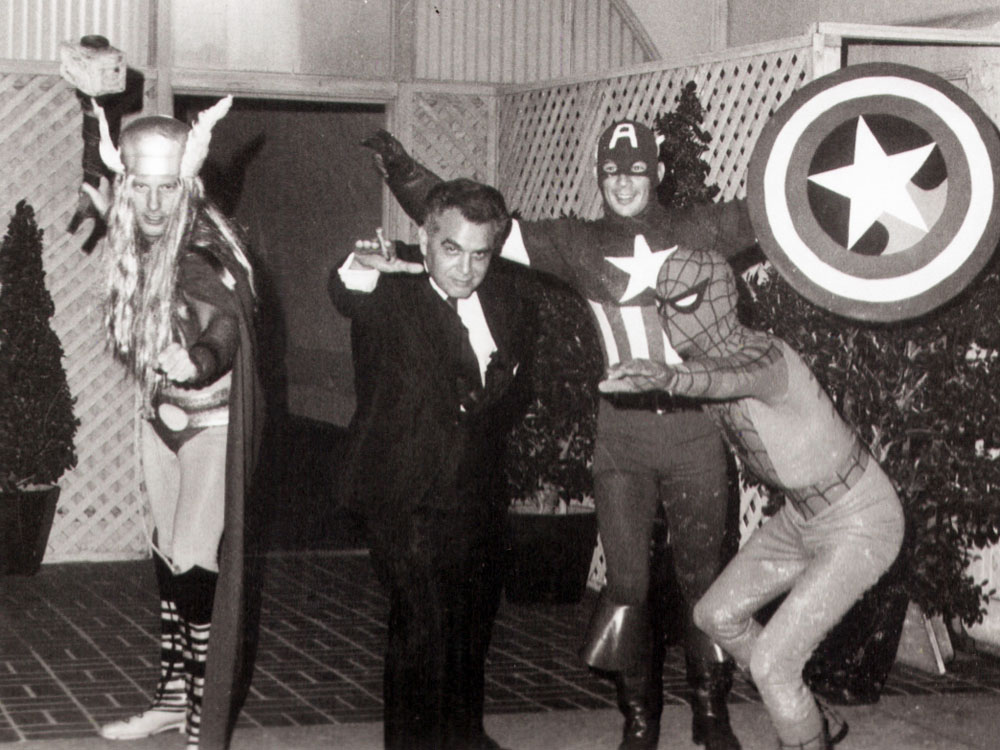
As noted here, last Friday would have been the 98th birthday of Jack Kirby. On the long, long list of Jack's many accomplishments — down around #1,253 which was creating a character who had one line in a Green Arrow story — is that Jack was one of the three people most responsible for me getting into the comic book field. The other two were a gentleman named George Sherman who worked for the Disney Studios and a gentleman named Chase Craig who worked for Western Publishing Company. Last Friday would have been the 105th birthday of Chase Craig.

Chase edited thousands of comic books for Western Publishing which were published under the Dell and later the Gold Key imprint. Since titles like Walt Disney's Comics and Stories and Uncle Scrooge were selling in the millions per issue back in the fifties, there was a time when more people were reading comic books edited by Chase Craig than those of any other editor alive.

And by a very wide margin. There were individual Craig-edited comics of the day that sold more copies per month than all the comics edited in that same month by Stan Lee or Julius Schwartz or maybe both of them put together.

His comics were reaching a much narrower audience by the time I met him in 1970. Comic sales had declined everywhere and despite having superstar characters like Mickey Mouse and Bugs Bunny, Western was having trouble getting its wares distributed. So were DC and Marvel to some extent but DC and Marvel didn't rely wholly on newsstand sales for their income. To some extent, publishing comic books was for them a loss leader to promote their characters for merchandising. They didn't make money off the Wonder Woman comic book. They made it off licensing the Wonder Woman t-shirts.

With comparable newsstands sales, Western didn't fare as well. The revenues from the Mickey Mouse t-shirts went to Disney, not to them.

chasecraig01

Chase Craig

In 1970, my friend/partner Steve Sherman and I were assisting Jack Kirby with his new comics for DC. Our buddy Mike Royer was working for Chase, inking comics and sometimes penciling or writing them. Mike happened to mention to us that Chase had mentioned to him that Western was looking for ideas for new comics. Mike had nothing in mind to submit to them but he thought we might want to.

We decided to take a crack at it. Emboldened by our proximity to the all-time greatest creator of new comics the industry has ever seen, we whipped up written presentations for about a half-dozen new comics. Steve phoned Mr. Craig, got us an appointment and we ventured to the Western offices, which were located on Hollywood Boulevard directly across the street from the famed Chinese Theater.

Chase was very nice and treated us like seasoned professionals, which we were not. He said he'd take a look at our ideas and pass them on to the many other folks in the company who would have to approve any new books. Then he'd get back to us.

As I later learned, Western did want new comics but it wasn't as simple as filling that want. To get one approved by all the folks in that company who then had a say would be like getting an unanimous vote today out of Congress on anything meaningful.

Western did many things very, very well but they were quite conservative about publishing decisions. If Western and Marvel each put out a new bi-monthly comic at the same time and got the same encouraging sales reports, Marvel would instantly up the book to monthly and start planning spin-offs. Western would say, "Hey, let's keep an eye on this for a year or two and if these numbers hold up, we could try publishing it eight times a year!"

So they wanted new comics but they really didn't want new comics. They certainly didn't want ours. They were rejected with about as polite a turndown as any writers ever received anywhere. For some reason, it didn't dawn on me that Chase edited lots of ongoing comics that needed the services of writers. I cannot for the life of me tell you why I didn't think to go back to him and submit ideas for his Woody Woodpecker or Pink Panther comic books. I can't even tell me that.

If it had occurred to me, I might have been dissuaded by a brilliant but cranky artist named Alex Toth who drew for various publishers and animation houses, never for any one for very long. I occasionally visited Alex back then. He loved to sit for hours and talk about comics and so did I. When I mentioned that my partner and I had submitted some proposals to Chase Craig, he exploded.

Chase Craig? Alex had drawn years earlier for Chase and he hated the guy, thought he was an idiot, thought he was unethical, etc. Later because of his explosion, I learned two very important lessons in life…

One was that Alex felt that way at one time or another about darn near every single person with whom he ever worked. The problem wasn't always them but it was always, to some extent, him. He was one of the most talented people I ever knew but also one of the most insecure and self-destructive.

The other thing was that in this world, you have to go by your own impressions and experiences. If you're warned away from someone, you might be wise to keep that warning in mind. It might well be right and you can perhaps avoid or minimize the damage if you are on guard. But you also can't assume it's totally true or that your experience will be the same as their reported experience. Chase Craig was utterly wonderful to me.

I started working for him because I was working for George Sherman…and I started working for George Sherman because of Mike Royer. Him again.

Chase Craig edited Western's line of comics based on the Disney properties. The Disney Studio sold stats of all that material to the various publishers in other lands who published Disney comics. In most of those countries, there was more demand for Disney comics than there was in this country. Western didn't produce enough material to fill the demand so a division on the Disney lot in Burbank bought scripts and art for additional material that was only published overseas. George Sherman was one of the editors in that division.

Mike Royer had been asked to write for them but he couldn't because he'd just landed a dream position. He was taking over as the inker on Jack Kirby's books for DC Comics, a job that I had a lot to do with. To thank me for my help, Mike arranged for me to submit material to George who liked what I did and encouraged me to write more. I did. Lots more.

I wrote scripts for George for a while and it was slow-going because he was out for weeks at a time due to the illness that took his life but a few years later — in 1974. Before that sad event, he'd come back from medical leave and find his desk piled high with Evanier submissions.

I joke that he referred me to Chase just to get rid of that drain on his health but the truth is, I'm sure, that he felt guilty about his slow response time on every script. One day, he was talking to Chase about perhaps improving the quality of the material Western was producing and Chase lamented that a couple of his best writers had left him or were burning out. George said something like, "Hey, I've got a kid here you oughta know about," and he sent Chase copies of scripts I had done for him.

So it was that on one day outta the clear blue sky, Chase Craig called me and asked, "Can you write Super Goof stories for me the way you write them for George Sherman?" Well, I could sure try.

I sold him a few, then he had me write an emergency, had-to-be-done-almost-overnight issue of The Amazing Chan and the Chan Clan. After I handed it in, there came this extraordinary (for me) moment in the office depicted above. He leaned back in his chair and said, "You know, if you were able to write four or five comics a month for me, I could probably use them."

Then there was a pause — and I really remember that pause because of what came after — and he said, "I could really use you on Bugs Bunny."

This will all mean nothing to most of you and perhaps it shouldn't. But somewhere out there, there's a fellow professional writer who'll identify. He or she will recall the instant when they thought, "Hey, I really may be able to make a living in this business." That was mine.

For Chase, I wrote Bugs Bunny and Daffy Duck and Porky Pig and Beep Beep the Road Runner and Woody Woodpecker and Scooby Doo and many others. I largely moved away from the Disney titles, which was financially foolish on my part. Chase occasionally rejected a script — usually because I didn't have an idea but I wrote it anyway. If he bounced a Daffy Duck script, it went into my filing cabinet and I never got paid for it. If he bounced a Donald Duck script, I could sometimes turn around and sell it to George Sherman. But I didn't think that way. I just felt more comfy with Daffy than Donald.

He was a very good editor. I knew that then and later, when I had some very bad ones, I appreciated Chase even more. He played no power games. He never changed a word to show he was in charge, only when he thought it had to be changed and he was usually right. When I screwed up — and I did, many a time — he explained why to me in a polite, respectful manner.

We discussed matters like adults and I could sometimes talk him into my point of view. All in all, it was probably a more pleasant experience to have Chase reject one of my scripts, as he occasionally had to do, than to have certain other editors I've had buy one.

Chase retired around 1974. Soon after, he came out of retirement to edit a new line of comics for Hanna-Barbera. In one of the most amazing moments of my life — I wrote about it here — he hired me to write them. He did it for a while, got bored and then retired again, passing the whole job on to me.

Early in my new responsibility, I went to my filing cabinet and hauled out the pile of scripts he had rejected back at Western. It wasn't a huge stack but I figured there had to be some good ideas in there that I could use on the H-B comics. There were two Scooby Doo scripts that Chase had bought but which had never been published or even drawn because Western lost the rights to do Scooby Doo comics. In my capacity as editor, I immediately purchased them from myself. But among the scripts Chase had rejected, I didn't find a single plot, joke or line of dialogue I could recycle. That was how good an editor Chase was.

In the last few years, I've become very sparing in the use of words like "mentor" and "protégé" when I write about my years with Jack, Chase and a few other talented folks who I've been blessed to have in my proximity. While those nouns might apply in some senses, I see them frequently used by a "new kid," consciously or not, trying to claim a piece of someone else's greatness. Not always but too often, it's like "Hire me because I was that guy's protégé so I'm therefore in his league."

Nope. One thing I did learn from both Jack and Chase is that your work is your work. It stands or falls on its own merits, if any, and who you know or knew doesn't make it one iota better. When I write a joke, no one laughs at it because I've worked with a lot of funny people. (Sometimes, no one laughs at it at all but that's a separate matter…)

I write a lot about Jack Kirby and from the reaction I get, I don't think it's humanly possible to write too much about Jack Kirby. But Chase was very important to me too and from now on, every August 28 when I write about Jack, I'm also going to write about Chase. I don't believe they ever met but they had these things in common…

They were both responsible for some of the best and most popular comic books ever published. They were both very nice men. They were both born on August 28th. They both employed Mike Royer and thought he was one of the best, most professional and reliable artists in the business. And they both helped me an awful lot towards whatever kind of career I've had since I got out of high school.

That last thing-in-common may not matter in the slightest to you. You may even see it as the greatest failings of each. But it sure matters to me.

The post Someone Else I'll Never Forget appeared first on News From ME.

31 Aug 22:32

after i wrote it, i realized this comic actually works PRETTY WELL for parents to send to non-parent friends too! it is... the universal comic??

archive - contact - sexy exciting merchandise - search - about
← previous August 28th, 2015 next

August 28th, 2015: BABIES, AM I RIGHT?? AM I RIGHT, BABIES??

– Ryan

31 Aug 14:23

A Thing Not to Do When You’re Smart

by John Scalzi

Pro tip: Bragging about your Mensa card as an actual adult signals that while you may be "smart," you almost certainly are not wise.

— John Scalzi (@scalzi) August 31, 2015

In the various recent kerfuffles surrounding science fiction and its awards, there have been a couple of people (and their spouses, declaiming about their beloved) who have been slapping down Mensa cards as proof that they (or their spouse) are smart. Let me just say this about that:

Oh, my sweet summer children. Just don’t.

If you want to be in Mensa, that’s fine. Everyone needs hobbies and associations, and if this is the direction you want to go with yours, then you do you. Not my flavor, but then, lots of hobbies and associations aren’t my flavor.

That said:

1. Literally no one outside of Mensa gives a shit about your Mensa card. No one is impressed that you belong to an organization that has among its membership people who believe that because they can ace a test, they are therefore broadly intellectually superior to everyone else.

2. Your Mensa membership does not imply or suggest that you are the smartest person in the room. Leaving aside the point that the intelligence that Mensa values is a narrow and specialized sort, a large number of people who can join Mensa, don’t, for various reasons, including the idea that belonging to a group that glories in its supposed intellectual superiority is more than vaguely obnoxious.

3. Your need to bring up the fact you have a Mensa card suggests nothing other than it’s really really really important to you for people to know you’re smart, and that you believe external accreditation of this supposed top-tier intelligence is more persuasive than, say, the establishment of your intelligence through your actions, demeanor, or personality. Which is to say: It shows you’re insecure.

4. Your Mensa card does not mean you know how to argue. Your Mensa card does not mean you do not make errors or lapses in judgment. Your Mensa card is not a “get out of jail free” card when someone pokes holes in your thesis. Your Mensa card does not mean that you can’t be racist or sexist or otherwise bigoted. You may not say “I have a Mensa card, therefore my logic is irrefutable.” Your Mensa card will not save you from Dunning-Kruger syndrome, and if you think it will, then you are exactly who the Dunning-Kruger syndrome was meant to describe. You Mensa card will not keep you from being called out for acting stupidly, or doing stupid things.

5. Your Mensa card does not immunize you from being a complete, raging asshole.

In short, it’s not actually smart to flash your Mensa card, and if you were smart, you’d know not to do it. If you have to resort to waving your Mensa card around to establish your intelligence, you’re signaling that you have no other way to do it. And you don’t have to be a genius to know what that actually means about you.


31 Aug 14:19

Tell me which 2015 SFF is knocking your socks off! - Updated 8/31/15

by Kat Jones
I've been getting a lot of interesting recommendations, so time for an updated list! I'll post more updates periodically, as I receive more good recommendations and as I finish reading things that *I* love!

What science fiction and fantasy have you read or watched, and loved, this year? I'm specifically looking for works that were first published or aired in 2015 and are eligible for nomination for the 2016 Hugo Awards. I'm especially hungry for recommendations of good shorter-than-novel-length fiction since I have a hard time finding good shorter works. I want recommendations of novels, too, though, please.

Here are the things on my "I might nominate this!" list so far (in no particular order):

Best Novel:
Best Related Work
Best Dramatic Presentation - Long Form:
Best Fan Writer:
Here are a list of things that have been recommended to me so far, or that I'm just really looking forward to reading anyway. I'm going to read through as many of them as I can!

(Disclaimer: I'm only listing things here I think I might be interested in. There are many more extensive general lists of recommendations, and many more comprehensive lists of eligible works - please link me to more of these too!)

Novels:
Dramatic Presentation - Long Form:
Best Dramatic Presentation - Short Form:
John W. Campbell Award (not a Hugo):

Tell me about the new SFF you're loving! I want to read it! Also, please tell me what you love about it, if you can without too much spoiler!
31 Aug 14:17

“John Scalzi Is Not A Very Popular Author And I Myself Am Quite Popular,” the Audiobook, Read by Me, John Scalzi

by John Scalzi

Quick recap: John Scalzi Is Not A Very Popular Author And I Myself Am Quite Popular is a parody of an ebook by an obnoxious bigot who is obsessed with me, and I said (full details here) that if people raised $2,500 for Con or Bust, which funds science fiction convention memberships for people of color, I’d create an audiobook version of it. That happened. Then I said if we hit a stretch goal of $10,000, I’d also commission a song about me not being very popular. And that just happened! Whoo-hoo!

It will take me a bit to organize the song (update, 9/1/15: The song is commissioned! It’ll be a few weeks before it’s ready! Patience! It’ll be worth it!), but because you lovely people got us to an amazing $10,000 for Con or Bust in under 48 hours, I decided not to make you wait any longer for the audiobook. Here it is, with my love and appreciation.

First, the complete book, in one 40 minute chunk!

And now, the individual chapters:

Prologue


Chapter 1: How it Begins


Chapter 2: John Scalzi’s Blog is Not That Interesting and No One Reads It


Chapter 3: John Scalzi Does Not Understand Satire as Well as I Understand Satire

(Note: This chapter contains reference to a piece I wrote about rape, and despite its humorous nature as parody, may be triggery for some folks.)


Chapter 5: John Scalzi Did Not Get Me Thrown out of the SFWA


Chapter 5: John Scalzi’s Deal With Tor is Not a Very Good Deal


Chapter 5: John Scalzi is Not a Very Popular Author


Afterword


Appendices


And for those of you who want to download the files: Complete Book|Prologue|Chapter 1|Chapter 2|Chapter 3|Chapter 5(a)|Chapter 5(b)|Chapter 5(c)|Afterword|Appendices

(Update, 9:09pm: Kate Nepveu of Con or Bust has created an Audible-like audiobook file of the complete book, which you may find here.)

Enjoy!

And if you did enjoy this, and have not already done so, may I suggest you donate to Con or Bust, and help people of color attend science fiction conventions? That would be awesome. Thank you! And song to come!


29 Aug 14:19

Jack

by evanier
jackkirby15

Click above to enlarge this photo.

Jack Kirby would have been 98 years old today. Here's a photo I'll bet most of you have never seen.

It was taken in late 1969, not long after I met Jack and not long before he rocked the comic book world by quitting Marvel and signing on with DC. I can't think of a single current analogy in comics or in any medium which would be a comparable jolt. I wanted to write here something like, "It would be as if [Name] quit CBS and went to work for NBC" or "It would be as if [Name] quit the Yankees and went to work for the Dodgers." But no names I could plug into those sentences would equal the enormity of the news back then.

This photo was taken either by me or my friend Steve Sherman. It was taken in a party area at the Brown Derby restaurant on Vine Street in Hollywood. That's right: It's Kirby at the Derby. Jack, Steve and I had all gotten involved in that year's Toys for Tots campaign for the U.S. Marine Corps — a most worthy cause that collected donations of toys and steered them to kids who might otherwise have been forgotten by Santa. Jack donated his artistry for that year's Toys for Tots poster.

The guys in the costumes were friends of a promoter we'd all gotten involved with. That's a real long story that is told in this long, long biography of Jack I'm writing that has been a long, long time in coming. No, I don't know when you'll be able to buy a copy but I'm finally able to finish it and am attempting to do so.

Suffice it to say this promoter guy was trying to prove to Marvel that he could make their characters a lot more famous than they already were. He'd convinced the Marines to put Marvel heroes on the poster and he'd gotten some local costume companies to make three costumes under the impression that they were donating to the charity. In truth, he intended to use the suits afterwards for other purposes that would benefit his own enterprises.

Someone out there will be interested in this: He persuaded Western Costume — the biggest company ever in that business and the leading supplier of wardrobe for TV and movies — to agree to make a Captain America costume. Then the folks at Western discovered that they already had a Captain America costume, perhaps the only one then in existence. The one they gave him was the one made for actor Dick Purcell in the 1944 Captain America movie serial. That's it above with ear holes cut into the head piece since Cap's ears didn't show in the serial. And no, I have no idea whatever became of it.

Anyway, Jack was at the Derby for a press event to kick off the Toys for Tots drive and when either Steve or I set up this photo, Jack immediately went into the above pose, explaining that you couldn't just stand passively when you were being photographed with Thor, Spider-Man and Captain America. No, you sure couldn't. So consider that a picture of four super-heroes. I'm not sure the one with the cigar wasn't the most incredible of the four.

That's about all I have to say about this photo but I have an unlimited number of things to say about Jack, starting with the fact that he was one of the nicest people I ever knew and easily the one who most deserved the label of "genius." Some folks didn't pick up on that right away because he talked like a guy in an old Warner Brothers movie about the mob and his mind careened from topic to topic with restless abandon.

This is hard to explain but being around him, I came to the conclusion that his brilliance had a lot to do with being able to make unusual associations. He would take two or more seemingly unrelated concepts or elements — things mere mortals like you and I would never connect — and he'd connect them and arrive at something very, very wonderful. You might never be able to discern the starting points; never be able to fathom how he linked A to B and wound up with a C that resembled neither…but he did.

He talked like that, too. I'd be chatting with Jack about, say, Richard Nixon. Nixon was a big topic for everyone in 1969 but more so for Jack who created many a super-villain using but one of Nixon's odd quirks as a starting point. Jack, like so many of us, was fascinated that such a twisted personality could somehow ascend to be President of the United States. (Thank Goodness that these days, no one that warped ever even becomes a serious contender for the job.)

So I'd be talking about Nixon with him and suddenly I'd be talking about cling peaches with him. Or Mount Kilimanjaro. Or staple guns or something…and I'd go, "Huh? What the hell was the segue and how did I miss it?" Sometimes, days or even years later — and I'm not kidding about the years — I would figure out how we got from Topic A to Topic B. Sometimes, not.

There's a quote from Stephen Sondheim that I like. He once said, "The nice thing about doing a crossword puzzle is that you know there's a solution." There was always a solution with Jack. Alas, those of us who live in one world at a time were sometimes unable to figure it out. Still, it would not shock me if at some point, some great Kirby Villain started life because Jack started musing about Nixon with a staple gun.

Those two qualities of Kirby's — the Cagneyesque way of speaking and the seeming disconnects in his speech — caused some people to miss how smart the guy was. One of many reasons he left Marvel shortly after this photo was taken is that so many important people there thought he was kind of demented and treated him as a useful idiot.

He told them that characters like the ones surrounding him in the picture would someday be billion-dollar properties appearing in major motion pictures and known the world over. As a vital contributor to the existence of those characters — in many cases, the main creative force — he wanted a piece of that action. This he was denied by men who sounded like Mr. Bumble registering shock that Oliver Twist wanted a smidgen more gruel. And being limited in the visionary department, they of course never dreamed the material would be as lucrative as Kirby said it would be…so they had to grab 100% of what there was while they could. Ergo, no cut for Kirby.

People ask me these days: "What would Jack have said if he was here to see Thor and Captain America and the Avengers and other characters he helped launch become super-heroes of the box office?" That's real easy to answer: He would have said, "I told you so."

He did. He really did. I can't swear he would have imagined Ant Man doing quite as well as he has but the others? Absolutely. He predicted it to me and to Steve and every single day to the wonderful Mrs. Kirby and to others. He predicted lots of things I doubted or at least questioned at the time but have lived to see come true.

I get accused at times of gushing too much about Jack. Fine. If there's anyone I've ever known who deserved a surplus of gushing, it was Jack Kirby. I still think at times I'm underestimating the guy. His work has endured and its popularity has grown to the point where I'm sure it will affect generations as yet unborn.

Tomorrow, I go out to Cal State Northridge in the Valley for the formal opening of a major exhibition of Jack Kirby artistry. You might assume I'm attending to pay tribute to a man who meant so much to me and you'd be right…

…but I'll confess to something. I also write about Jack and host panels about him and attend events about him for selfish reasons. Not only was Jack supremely creative but little flecks of that were contagious. When you were around him, you just plain felt more creative. It was not just me and it was not just people who became professional writers or artists or filmmakers or whatever. He treated everyone as an equal; as someone who at least potentially could make something wonderful. He stood on fertile ground and when you were with him, you did too.

I was seventeen when I met this man. I was already earning money as a writer but I had no particular confidence that the jobs I'd gotten weren't flukes and that I could continue in my chosen profession for the rest of my life. That I finally decided I probably could had a lot to do with being around Jack, seeing how easily it poured out of him and — and this was key — understanding how hard he labored to bring all those good ideas to fruition. Not only was his brain amazing but so was his work ethic. That was one of countless things I learned from him, not that I am always able to apply it.

I felt smarter and more creative around him. The stories and art he left us still have that impact on me as does just writing about him and thinking about him and nurturing my connection to him. I may even be a teensy bit smarter now than when I started writing this blog post but even if I'm not, I feel like I am and that counts for something.

I think I've told this story here before but after Jack died in 1994, I heard from lots of people who wanted to tell someone (anyone!) how much Jack inspired their lives. Most of that rightly went to his widow and life partner, a wonderful woman named Roz who made it possible for him to do what he did and protected him when no one else would or could…but I got a few of the letters and calls. I understood the ones from artists and writers and guys who made movies or wrote gaming software. I was a little surprised at first to hear from a spot welder who wanted me to know how Jack's work inspired him to become a better spot welder.

It wouldn't shock me to run into that spot welder at the gallery showing. I'll bet you everyone who goes out to Cal State Northridge to see that exhibit — like everyone who immerses themselves in the voluminous, perpetually in-print works of Jack Kirby — comes away from the experience a little smarter, a little more creative, a little more confident. If you ever got to meet Jack, you understand totally why that is. If you never had that honor, ask anyone who did. We all feel the same way.

The post Jack appeared first on News From ME.

29 Aug 14:06

http://www.andrewrilstone.com/2015/08/a-song.html

by Andrew Rilstone
A song. It may even be my favorite song. It is written and song by a Roman Catholic, and it is about Social Justice.

28 Aug 16:34

Ten Best Music Videos of All Time

by Tim O'Neil


Hey, Pitchfork put up some crappy list that people are whining about. Don't pay attention to those lists, it just encourages them. Here's a better, far more objective list:

10. Roxy Music - Avalon


Hello, my name is Bryan. These are my friends. When the samba takes you out of nowhere, you must be ready. In order to be ready, you must wear a tuxedo at all times. Do you see the other people in the band? You must not look at the other people in the band. They do not know how to talk to people, not like you and me, my friend. Do you like my falcon? It has been highly trained. Twirl as if your life depends.

9. Pavement - Carrot Rope


What are you doing, you scamps. Scampering around in your yellow raincoats. SCAMPER.

8. Bananarama - Cruel Summer


OK, girls. You're in New York. You are mechanics. You work at a service station. Sometimes. You don't have to know how to do anything with cars. Yes, it's possible you might not even know how to drive a car, from the way you seem to be interacting with the car in the video. It doesn't matter. You are in New York and when you're not working on cars you are skipping around. You don't need to skip, just do this little stutter step thing that sort of looks like you maybe practiced it but really you didn't because it's OK whatever, just throw some banana peels, because you're BANANArama, get it? Tease it. Tease it some more.

7. Kool Moe Dee - Wild Wild West


Imagine for a moment that this is the first time in your life you've ever been exposed to hip hop music. It's 1987 and you're watching MTV and suddenly this video comes on and you don't know what it is, but you like it, and you want more of it. FOr the rest of your life that's what hip hop is in your mind, mechanical cowboy music. And then this happened.

6. The Replacements - Bastards of Young


The audience for the video is people who are into alternative rock. I would say that the age of the audience varies from a teen age to a mid-adult age. The song is very simple and does not have a lot of movement or emotion during the video. It mainly comprises of the speaker and a guy who is sitting on a couch smoking some cigarettes. However, towards the end of the video the guy gets up and kicks his speaker, then walks out the door. The audience for the video would have to be people who are somewhat inspired to be punk rockers who don’t follow the mainstream music. I would say that the audience for the song would be people who are interested in hard-edge music and often has views not conforming with society and how things are run. The audience would be people who are in the young age because the song is edgy with an upbeat tone and man who looks fairly young. On the other hand, the song is in black and white and has pictures of being somewhat old so it may appeal to the mid-age. I would say that the audience that listens to the band has to be an older audience because of the vulgar language involved in the video. Overall, the audience appeals to alternative-punk rock mid-aged adults and teens.

5. Peter Gabriel - Sledgehammer


Peter Gabriel was born in Thistle-On-Downshire, Bottomsly Court, Mivern, in the Year of Our Lord 1823. He worked in a coal mine until the Reform Bill passed at which point he learned how to play the flute in a traveling carnival. He played flute for that carnival for over one hundred years, before finding a basket with a baby Phil Collins hanging from the branch of a tall tree. Phil Collin was not a child like normal men. He was a tiny man from the moment of his creation, and only grew larger, not older. When Peter Gabriel found him in his basket Phil Collins was eighteen inches tall, and now he is nine feet tall.

4. Bone Thugs N Harmony - Tha Crossroads


We all have to live with the fact that when we die, no one will love us enough to make anything 1/100th as awesome as this video to commemorate our passing.

3. Beach House - Wishes


What's that, you say? It's been 25 years? It's time to leave the Black Lodge and ride the wind once more? Prepare my stallion.

2. The Chemical Brothers - Elektrobank


Spike Jonze and Sophia Coppola used to be married. That means, at some point, they probably had sex. I wonder if, at the time of the filming of this video, they had done so. "You see, daddy, I was able to get something out of the ten years of gymnastics you paid for. I did this techno video. I danced for you, daddy. Listen to me, daddy. Love me, daddy. I'm sorry I ruined your movie. I'm sorry. It was a long time ago daddy. Please." "It's OK, I'm totally not marrying you in an effort to try to steal your father's spirit, once removed. No, this is not a ceramic pot designed for the purpose of trapping souls, why do you ask?" If Sophia Copolla had directed this video, all you would see would be the gymnist, played by Kirsten Dunst because why not, looking in the mirror in the locker room with a blank look on her face. She's listening to her Discman and you hear the beginning of "Elektrobank." But she does not like dance music, so she takes out the CD and and replaces it with Television's Marquee Moon. And then you would hear "See No Evil" begin. Kirsten Dunst would stand there looking at her face in the mirror, motionless, with her headphones on, for the entire running time of Marquee Moon, which is 45:54. Then when "Torn Curtain" was over Kirsten would slowly turn her head in the mirror to look into the camera. A single tear rolls down her cheek. ELEKTROBANK. Cut to black.

1. Unsane - Scrape


YES

YES

YES

YES

YES

YES

YES

YES

YES

YES

28 Aug 16:23

Engineer Syllogism

The less common, even worse outcome: "3: [everyone in the financial system] WOW, where did all my money just go?"
28 Aug 14:50

That time Jimmy Carter walked into a nuclear reactor

by Fred Clark

Since we were just talking about former President Jimmy Carter here, let’s take a moment to remember one particularly badass moment from his personal history.

Granted, Jimmy Carter isn’t generally described as “badass.” That’s a shame because building thousands of houses for Habitat should be thought of that way. And negotiating a peace treaty between Israel and Egypt involved high levels of bad-assery. Also, too, eradicating the Guinea worm? That’s so badass that Samuel Jackson should play Carter in the movie version of the story.

Jimmy Carter is also teaching Sunday school every week at the age of 90, just as he has for the past 60 years — uninterrupted by cancer treatments or by a term as governor of Georgia or a term as president of the United States. I suppose that’s not really “badass,” per se, but it’s pretty impressive — an example of what Eugene Peterson calls “a long obedience in the same direction.”

But the really badass story involving Jimmy Carter dates back to 1952, before he entered politics. Back then he was Lt. James Earl Carter, a nuclear specialist in the U.S. Navy’s Seawolf program working in upstate New York.

In December 1952, there was an explosion in the reactor of the Chalk River nuclear site in Ontario. The reactor was in partial meltdown and it was flooded with radioactive water. This was Very Bad. Even worse, it was going to have to be dismantled and shut down by hand.

Basically, somebody was going to have to make like Spock at the end of Wrath of Khan and walk into a melting-down nuclear reactor. That somebody would have to be, like Spock, both brave enough to face deadly radiation and smart enough to understand how a nuclear reactor works.

spockreactorThat’s how the job fell to Lt. Carter and his team of 22 other Navy specialists.

Here’s where the story turns into something like an epic Hollywood heist movie. The radiation level was such that, even with the best 1950s-era protective gear, no one could enter Chalk River for more than 90 seconds at a time. So it would have to be like a relay race — wade in, get as much done as possible in 89 seconds, then get out of there while the next guy in line took his turn.

The team built a replica of the whole facility on an Ontario tennis court — every hallway and door, every nut and bolt and screw and hatch. And they practiced. That’s what badass engineers do.

Here’s how Carter summarized this in a 1975 campaign biography:

When it was our time to work, a team of three of us practiced several times on the mock-up, to be sure we had the correct tools and knew exactly how to use them. Finally, outfitted with white protective clothes, we descended into the reactor and worked frantically for our allotted time. … Each time our men managed to remove a bolt or fitting from the core, the equivalent piece was removed on the mock-up.

For several months afterwards, we saved our feces and urine to have them monitored for radioactivity. We had absorbed a year’s maximum allowance of radiation in one minute and twenty-nine seconds. There were no apparent after-effects from this exposure — just a lot of doubtful jokes among ourselves about death versus sterility.

So Lt. Carter and the rest of his team ran through a radioactive flood with hand-tools and stopwatches and carried out an incredibly technical feat of nuclear engineering in 89-second intervals fully expecting that it would mean they’d all soon be dead from some horrible form of radiation sickness. And they did it. They shut down the reactor and saved the day.

Jimmy Carter is a quiet, gentle man who teaches Sunday school. But don’t forget that he’s also a quiet, gentle, Sunday-school teaching badass.


28 Aug 14:49

The culture war has always been about race

by Fred Clark

On Tuesday here, we talked about how the 1980 presidential election was far more shaped by the Cold War than by anything like the contemporary culture war issues that later came to the fore during and after Ronald Reagan’s presidency.

Reagan was overwhelmingly popular with the white evangelical voting bloc that today is preoccupied with the “social issues” that they promote as the proper concern of “values voters” — abortion, homosexuality, abortion, birth control, abortion, prayer in schools, and religious liberty (i.e., the liberty to define one’s religion as opposition to abortion and homosexuality). But culture-war concerns were far down the list of reasons why those white evangelical voters supported Reagan in 1980. In 1980, “values voters” were still mainly Cold Warriors — far more concerned with the Russians than with the gays or the baby-killers.

Sen. Jesse Helms accepts the "Proudly Pro-Life" award from the National Right to Life Educational Trust Fund in 1998.

Sen. Jesse Helms accepts the “Proudly Pro-Life” award from the National Right to Life Educational Trust Fund in 1998.

Abortion and homosexuality came later. They were products of Reaganism, not the other way around.

But Reagan’s 1980 campaign was not exclusively about the Cold War. As a candidate, and subsequently as president, Reagan did make one culture-war issue a major theme and subtext of his agenda. He made that clear in an infamous campaign speech in which he, for the first time, declared his support for “states rights” at the Neshoba County Fair, outside of Philadelphia, Mississippi.

That just so happens to be where the Klan murdered civil rights workers James Chaney, Andrew Goodman and Mickey Schwerner during the “Freedom Summer” of 1964. Those murders were investigated by the FBI, not by local or state law enforcement. The Neshoba County sheriff was actually arrested and accused as part of the murder conspiracy. He was acquitted by an all-white jury in the 1967 trial which was perceived, by many white Mississippi residents, as an insulting instance of federal meddling in what should have been a state and local matter.

So it was not a coincidence that Reagan just happened to visit Neshoba County a dozen years after that trial to deliver a speech endorsing “states’ rights.” Nor was he unaware of the history and enduring use of that euphemism and all that it meant from Calhoun to George Wallace.

Here’s Emory University historian Joseph Crespino discussing that speech in the larger context of the Republican Party’s successful “Southern Strategy” to convert Dixiecrats into Republicans:

The national GOP was trying to strengthen its southern state parties and win support from southern white Democrats. Consider a letter that Michael Retzer, the Mississippi national committeeman, wrote in December 1979 to the Republican national committee. Well before the Republicans had nominated Reagan, the national committee was polling state leaders to line up venues where the Republican nominee might speak. Retzer pointed to the Neshoba County Fair as ideal for winning what he called the “George Wallace inclined voters.”

This Republican leader knew that the segregationist Alabama governor was the symbol of southern white resentment against the civil rights struggle. Richard Nixon had angled to win these voters in 1968 and 1972. Mississippi Republicans knew that a successful Republican candidate in 1980 would have to continue the effort.

On July 31st, just days before Reagan went to Neshoba County, the New York Times reported that the Ku Klux Klan had endorsed Reagan. In its newspaper, the Klan said that the Republican platform “reads as if it were written by a Klansman.” Reagan rejected the endorsement, but only after a Carter cabinet official brought it up in a campaign speech. The dubious connection did not stop Reagan from using segregationist language in Neshoba County.

It was clear from other episodes in that campaign that Reagan was content to let southern Republicans link him to segregationist politics in the South’s recent past. Reagan’s states rights line was prepared beforehand and reporters covering the event could not recall him using the term before the Neshoba County appearance. John Bell Williams, an arch-segregationist former governor who had crossed party lines in 1964 to endorse Barry Goldwater, joined Reagan on stage at another campaign stop in Mississippi. Reagan’s campaign chair in the state, Trent Lott, praised Strom Thurmond, the former segregationist Dixiecrat candidate in 1948, at a Reagan rally, saying that if Thurmond had been elected president “we wouldn’t be in the mess we are today.”

So, yeah, that happened. The Southern Strategy worked. Throughout the South, the party of Lincoln and Thaddeus Stevens switched places with the party of Calhoun and Andrew Johnson.

And that same Southern Strategy also created the space for the religious right — the large, now uniformly partisan white evangelical voting bloc. Those white evangelical voters today — not just in the South, but throughout the country — are overwhelmingly Republican. Ask them why and they’ll tell you, honestly and accurately, that it’s mainly because of the current roster of culture-war issues — abortion, homosexuality, abortion, etc.

Those issues have now replaced the original “states’ rights” issues that initially won over so many of those same voters a generation ago, before the genital-based culture war had arisen to political significance. Back then, in the years leading up to the 1980 election, the leaders of the nascent religious right were people like Jerry Falwell. And in 1980, Falwell wasn’t yet a culture warrior. He was, rather, someone better described by Retzer’s cautious phrase, a “George Wallace inclined voter.”

Here’s political scientist Daniel Schlozman summarizing how “The Christian Right changed how we talked about race“:

The Christian Right emerged from school desegregation — and forged a movement around taxes and religious freedom. In 1978, the Internal Revenue Service sought to revoke tax exemptions for schools formed as white-flight havens from the public schools. The backlash was overwhelming. The IRS received more than a quarter of a million letters against the proposed rules. Congressional hearings reframed the issue from an attack on segregation to an attack on religion by meddlesome bureaucrats. As Newt Gingrich, then a freshman representative, explained, “The IRS should collect taxes — not enforce social policy.”

Early in 1979, Jerry Falwell formed Moral Majority, the premier organization for the new Christian Right. Falwell ran a segregated academy that would almost certainly have run afoul of the IRS guidelines. In 1967, the same year the local public schools desegregated, Lynchburg Christian Academy opened its doors. As of the fall of 1979, it had an all-white faculty, and only five African-Americans among the 1,147 students.

In August 1979, Congress inserted riders into the appropriations bill for the Treasury Department to prevent the IRS from implementing the proposed regulations. A fight over desegregation had galvanized white evangelicals to oppose meddlesome bureaucrats, and the movement was born.

Today, “religious liberty” is a euphemism arguing for the right of white Christian bakers to refuse service to gay couples seeking wedding cakes. Back then, “religious liberty” was a euphemism for the right of white Christian schools to refuse to accept black students.

Reagan was elected president in 1980 thanks in no small measure to white Christian voters who supported him due to what Crespino delicately describes as his willingness to be linked “to segregationist politics in the South’s recent past.” But by the end of Reagan’s second term, he and his party enjoyed the overwhelming support of white evangelicals, including many who held little conscious regard for that old-style segregationist politics. They didn’t, en masse, become Republicans because the GOP had embraced the politics of the old segregationists. They became Republicans, en masse, because of abortion and (later) gay rights.

The anti-feminist genital-focused culture war issues seemed to have completely replaced the earlier anti-civil-rights race-focused culture war issues.

But what does “replaced” mean there? Sometimes we replace something by getting rid of it altogether and then putting something new in its place. Other times, we replace something with a stand-in, like the way golfers replace their ball on the green with a coin. That marker occupies the same place as the ball it re-placed, but it does so in order to signify the continuing presence and existence of the prior thing.

Which kind of replacing happened here? Are the sex-obsessed culture wars of the post-Reagan years a substitute for the race-obsessed culture wars of the pre-Reagan years? Or are they a proxy for that same old argument?

28 Aug 14:34

Hello? Is Anybody There?

by evanier

A week or two ago here, I wrote about what I liked about Uber and what I liked about taxis. I have since found a new thing I don't like about Uber: There's no one to talk to.

You cannot phone Uber. There is no number to call. No matter what goes wrong, you cannot get a live person on the line. You have to send an e-mail to their customer service people who, in dealing with a current problem I have with them, have proven to be pretty useless. You write to them and say, "I have a problem with A" and a few days later, they write back to you to say, "We need more information from you to help solve your problem with B." One of them wrote back to me at my e-mail address to tell me he couldn't do anything to solve my problem because he didn't have my e-mail address.

My problem is this: Uber has rider accounts and driver accounts. Since I am only a rider, I have a rider account. The other day, I accidentally clicked in the wrong place and found myself in the process of applying to drive for Uber. This, I do not want to do. I don't even want to drive for me, which is one of the reasons I use Uber at all.

So now Uber is demanding I finish filling out the driver application, giving them my insurance info and a scan of my drivers license and all sorts of other info I have no intention of giving them. There are things I need to change on my rider profile but their software won't let me change them until I finish filling out my driver application which I'm not going to do. No one at Uber's help desk seems to understand this problem, let alone know how to fix it.

I'm probably going to have to just abandon that account and start a new one. I wonder if Lyft has anyone minding the store.

The post Hello? Is Anybody There? appeared first on News From ME.

28 Aug 11:02

Bureaucracy

by Jimmy Maher


“Writing a book is staring at a piece of paper until your forehead bleeds.”

— Douglas Adams

Shortly after the release of his second Hitchhiker’s Guide to the Galaxy novel, with the money now pouring in and showing no signs of stopping, Douglas Adams moved from his dingy little shared flat in Islington’s Highbury New Park to a sprawling place on Upper Street. Later to be described down almost to the last detail as Fenchurch’s flat in So Long, and Thanks for All the Fish, the place had one floor that consisted of but a single huge L-shaped room that, coming complete as it did with a bar, was perfect for the grand parties he would soon be holding there.

There was just one problem: he couldn’t get his bank to acknowledge the fact that he had moved. For the rest of his life Adams swore up and down that he had done everything exactly as one was supposed to, had dutifully gone personally down to his local branch of Barclays Bank, filled out a change-of-address form, and handed it to a woman behind the counter. Barclays duly acknowledged the change — and sent said acknowledgement to his old address in Highbury New Park. Adams wrote them back, pointing out the mistake, which the bank promptly and contritely apologized for. Said apology was sent, once again, to Highbury New Park. This cycle continued, as Adams told the story anyway, for no less than two infuriating years. Toward the end of that period, having tried politeness, bluster, threats, and reason, he resorted to charm and outright bribery in a letter to one Miss Wilcox of Barclays, gifting her with a book and even holding out a tempting possibility of marriage to a hugely successful author — namely, him — if she would just change his damn address in her bank’s computers already.

My address is at the top of this letter. It is also at the top of my previous letter to you. I am not trying to hide anything from you. If you write to me at this address I will reply. If you write to me care of my accountant, he will reply, which would be better still. If you write to me at Highbury New Park, the chances are that I won’t reply because your letter will probably not reach me, because I don’t live there any more. I haven’t lived there for two years. I moved. Two years ago. I wrote to you about it, remember?

Dear Miss Wilcox, I am sure you are a very lovely person, and that if I were to meet you I would feel ashamed at having lost my temper with you in this way. I’m sure it’s not your fault personally and that if I had to do your job I would hate it. Let me take you away from all this. Come to London. Let me show you where I live, so that you can see it is indeed in Upper Street. I will even take you to Highbury New Park and introduce you to the man who has been living there for the past two years so that you can see for yourself that it isn’t me. I could take you out to dinner and slip you little change-of-address cards across the table. We could even get married and go and live in a villa in Spain, though how would we get anyone in your department to understand that we had moved? I enclose a copy of my new book which I hope will cheer you up. Happy Christmas.

History does not record whether this passionate missive was the one that finally did the trick.

Most writers collect interesting, humorous, and/or frustrating incidents as they go about their daily lives, jotting them down literally or metaphorically for future use, and Douglas Adams was certainly no exception. He tried to shoehorn this one into Life, the Universe, and Everything, his third Hitchhiker’s novel, via an extended riff about a change-of-address card that fouls up a planet’s central computer systems so badly that they initiate a nuclear Armageddon, but it just didn’t work somehow. The whole sequence ended up getting condensed down to a one-line gag in an extract from the in-book Hitchhiker’s Guide, listing “trying to get the Brantisvogan Civil Service to acknowledge a change-of-address card” as one of life’s great impossibilities. Still, he continued to believe the anecdote was worthy of more than that, worthy of more even than becoming just another of the arsenal of funny stories with which he amused journalists, fans, and party attendees alike.

It seems that it was the process of making the infuriating, subversive, brilliant Hitchhiker’s game with Infocom that first prompted Adams to think about making a game out of his travails with Barclays, along with the insane bureaucratic machinations of modern life in general. It was at any rate during Steve Meretzky’s visit to England to work on the Hitchhiker’s game with him that he first mentioned the idea. Meretzky, busy trying to get this game finished in the face of the immovable force that could be Adams’s talent for procrastination, presumably just nodded politely and tried to get his focus back to the business at hand.

Seven or eight months later, however, with the Hitchhiker’s game finished and selling like crazy, Adams stated definitively to Mike Dornbrook of Infocom that he’d really like to do a social satire of contemporary life called Bureaucracy before turning to the sequel. Asked by Electronic Games magazine at about this time whether he would “soon” be starting on the next Hitchhiker’s game, his answer was blunt: “No. I really feel the need to branch out into fresh areas and clear my head from Hitchhiker’s. I certainly have enjoyed working with Infocom and would very much like to do another adventure game, but on a different topic.”

The desire of this boundlessly original thinker to just be done with Hitchhiker’s, to do something else for God’s sake, certainly isn’t hard to understand. What had begun back in 1978 as a one-off six-episode radio serial, produced on a shoestring for the BBC, had seven years later ballooned into a second radio serial, four novels, a television show, a stage production, a pair of double albums, and now, so everyone assumed, a burgeoning series of computer games. Adams himself had a hand to a lesser or (usually) a greater extent in every single one of these productions, not to mention having spent quite some time drafting and fruitlessly hawking a Hitchhiker’s movie script to Hollywood. It had been all Hitchhiker’s all day every day for seven years.

Being the soul of comedy for millions of young science-fiction nerds had never been an entirely comfortable role for Adams. Sometimes the gulf between him and his most loyal fans could be hard to bridge, could leave him feeling downright estranged. Eugen Beers, his publicist, describes the most obsessive of his fans in terms that bring to mind a certain beloved old Saturday Night Live skit:

One of my abiding memories is how much he loathed book signings. It’s always a scary time for an author when you actually meet your fans, and Douglas had some of the ugliest and certainly some of the most boring people I’ve ever met in the whole of my life. They would come up to him to get their book signed and say, “I notice on page 45 you refer to…” and Douglas would say, “I haven’t got a clue what they’re talking about.”

Beers notes that Adams was “incredibly patient, in fact patient beyond anything I would have been.” Yet, and ungenerous as Beers’s description of the fans may be, the disconnect was real. Adams’s heroes growing up had been The Goon Show and later Monty Python, not Arthur C. Clarke or Robert A. Heinlein. He desperately wanted to prove himself as a humorist of general note, not just that wacky Hitchhiker’s guy that the nerds all like. Yes, Hitchhiker’s had made him rich, had paid for that wonderful Islington flat and all those lavish parties, but at some point enough had to be enough.

Infocom’s great misfortune was to have barely begun their own Hitchhiker’s odyssey just as Adams finally decided to bring his to an end. On the one hand, Adams’s desire to explore new territory must have sounded a sympathetic chord for many of the Imps; they had after all refused to continue the Zork series beyond three games out of a similar desire to not get stereotyped. But on the other hand they all had, and not without good reason, envisioned Hitchhiker’s as a cash cow that would last Infocom for the remainder of the decade, a new guaranteed bestseller appearing like clockwork every Christmas to buoy them over whatever financial trials the rest of the year might have brought. For Mike Dornbrook it must have felt like a nightmare repeating. First he had been deprived far too soon of the Zork series, the first of which still remained Infocom’s best-selling game; now it looked like something similar was happening even more quickly to the would-be Hitchhiker’s series, whose first game had become their second best-selling. In describing why he was “concerned” about making Bureaucracy Infocom’s Douglas Adams game for 1985 and pushing the next Hitchhiker’s game to 1986 at best, Dornbrook unconsciously echoes Adams’s own reasoning for wanting to move on: “The whole financial deal we had signed with him was based on a bestselling line of books that was very, very popular, very well-known. He hadn’t proved himself at anything else yet, for one thing. It was a little hard telling him that…”

It was a little hard to tell him, so Dornbrook and Infocom largely didn’t out of a desire to keep Adams happy. As his current contract with Infocom only covered Hitchhiker’s games, it was necessary to negotiate a new one for Bureaucracy. Dornbrook had some hopes of getting Adams at something of a discount, given that he’d be coming this time without the Hitchhiker’s name attached, but he was stymied even in this by Ed Victor, Adams’s tough negotiator of an agent. Infocom was left saddled with a game that they didn’t really want to do, which they would have to pay Adams for as if it was one that they wanted very badly indeed.

As Dornbrook and other staffers have occasionally noted over the years, there was nothing in Infocom’s Hitchhiker’s contract that technically prevented them from just going off and doing the next Hitchhiker’s game on their own, whether in tandem with or instead of Bureaucracy. The contract simply gave Infocom the right to make up to six Hitchhiker’s games for the cost of a certain percentage of the revenue generated thereby, full stop. They’ve stated that it was their respect for Adams as a writer and as a person that prevented them from ever seriously considering making Hitchhiker’s games without him. I don’t doubt their sincerity in saying this, but it’s also worth noting that to go down that route would be to play with some dangerous fire. While Adams may have been personally sick to death of Hitchhiker’s, he had shown again and again that he considered the franchise to be his and his alone, that if anything got done with it he wanted to do it — or at least to closely oversee it — himself. Not only would a unilateral Infocom Hitchhiker’s game almost certainly spoil their relationship with him for all time, but it risked becoming a public-relations disaster if Adams, never shy of stating his opinions to the press, decided to speak out against it. And could any of the Imps, even Steve Meretzky, really hope to capture Adams’s voice? An Adams-less Hitchhiker’s game risked coming off as a cheap knock-off, as everything that Infocom’s carefully crafted public image said their games weren’t.  Thus Bureaucracy — and, for now, Bureaucracy alone — it must be.

In light of its being rather forced upon them in the first place and especially of the exhausting travail that actually making it would become, it’s difficult for most old Infocom staffers to appreciate Bureaucracy‘s intrinsic merits as a concept. Seen in the right light, however, it’s a fairly brilliant idea. Douglas Adams was of course hardly the first to want to satirize the vast, impersonal machines we create in an effort to make modern life manageable, machines that can not only run roughshod over the very individuals they’re meant to serve but that can also trample the often well-meaning people who are sentenced to work within them, even their very creators. What was the Holocaust but a triumph of institutional inertia over the fundamental humanity of the people responsible for its horrors? Years before those horrors Franz Kafka wrote The Trial, the definitive comedy about the banality of bureaucratic evil, a book as funny in its black way as anything Douglas Adams ever wrote. Just to make its black comedy complete, all three of Kafka’s sisters later perished in the Holocaust. Set against those events, Adams’s struggle with Barclays Bank to get his address changed seems like the triviality it truly was.

What, though, to make of this idea of a satire of the bureaucratic impulse as interactive fiction? I think there’s a germ of genius in there, a germ of something as brilliant and subversive as anything in the Hitchhiker’s game. Playing a text adventure — yes, even one of Infocom’s — is to often feel like you’re interacting with the world’s pettiest and most remorseless bureaucrat. We’re all only too familiar with sequences like this one, which as it happens is taken from the eventual finished version of Bureaucracy:

>put blank cartridge in computer
[This story isn't allowed to recognise the word "blank."]

[Your blood pressure just went up.]

>i
You're holding an unlabelled cartridge, an address book, a small piece of laminated card, an airline magazine, $57.50, an envelope containing a memo, a power saw, a Swiss army knife, a coupon booklet, a damaged painting of Ronald W. Reagan, a flyer, a Popular Paranoia magazine, your passport, your Boysenberry computer (containing an eclipse predicting cartridge), a small case and a hacksaw. You're wearing a digital wristwatch, and you have a deposit slip and a wallet in your pocket.

>put unlabelled cartridge in computer
You'd have to take out the eclipse predicting cartridge to do that.

>get eclipse cartridge
You're holding too much already.

>drop painting
You drop the damaged painting of Ronald W. Reagan.

You're beginning to feel normal again.

>put unlabelled cartridge in computer
You'd have to take out the eclipse predicting cartridge to do that.

>get eclipse cartridge
You take the eclipse predicting cartridge out of your Boysenberry computer.

>put unlabelled cartridge in computer
The unlabelled cartridge slips into your Boysenberry computer with a thrilling little click...

One of Adam’s initial ideas was to have a blood-pressure monitor that would increase every time you got into a tussle with the parser like the one above. This idea made it into the finished game. Yet there are signs, fleeting clues, that that should only have been a beginning, that he would have gone much further, that his idea was to create a game that would end up as, among other things, a self-referential commentary on the medium of interactive fiction itself, a further venturing down the road that the Hitchhiker’s game had already started on with its lying parser and its willingness to integrate your typos into its story. Tim Anderson of Infocom recalls a puzzle involving a pile of boxes, of which you needed to specify one that the parser would obstinately refuse to recognize. How fun such a game could have been is very much up for debate; it sounds likely to run afoul of all of the issues of playability and fairness that make Hitchhiker’s the last game in the world to be emulated by a budding designer of interactive fiction. Nevertheless, I would love to see that original vision of Bureaucracy. While some pieces of it survived into the finished game in the form of the blood-pressure monitor and the snooty, bureaucratic tone of the parser, for the most part it became a different game entirely — or, rather, several different games. Therein lies a tale — and most of the finished game’s problems.

Endeavoring as always to keep Adams happy, Infocom assigned as his partner on the new game no less august an Imp than Marc Blank, who along with Mike Berlyn had been one of the two possible collaborators Adams had specifically requested for the Hitchhiker’s game; he’d had to be convinced to accept Steve Meretzky in their stead. Alas, Blank turned out to be a terrible choice at this particular juncture. He was deeply dissatisfied with the current direction of the company and more interested in telling Al Vezza and the rest of the Board about it at every opportunity than he was in writing more interactive fiction. Bureaucracy thus immediately began to languish in neglect. This precedent would take a long, long time to break. The story at this point gets so surreal that it reads like something out of a Douglas Adams novel — or for that matter a Douglas Adams game. Infocom therefore included it in the finished version of Bureaucracy as an Easter egg entitled “The Strange and Terrible History of Bureaucracy.”

Once upon a time Douglas Adams and Steve Meretzky collaborated on a game called The Hitchhiker's Guide to the Galaxy. Everyone wanted a sequel, but Douglas thought it might be fun to do something different first. He called that something Bureaucracy, and wanted Marc Blank to work on it with him. Of course, Marc was busy, and Douglas was busy, and by the time they could both work on it, they were too busy to work on it. So, Jerry Wolper [a programmer who had collaborated with Mike Berlyn on Cutthroats] got a free trip to Las Vegas to talk to Douglas about it before it was decided to let it rest for a while instead. Jerry decided to go back to school, so Marc and Douglas spent some time on Nantucket looking at llamas, drinking Chateau d'Yquem, and arguing about puzzles. Nothing much happened for a while, except that Marc and Douglas got distracted again. Paul DiLascia [a senior member of the Cornerstone development team] decided to give it a try, but changed his mind and kept working on Cornerstone. Marc went to work for Simon and Schuster, and Paul went to work for Interleaf. Jeff O'Neill finished Ballyhoo, and, casting about for a new project, decided to take it on, about the time Jerry graduated. Jeff got a trip to London out of it. Douglas was enthusiastic, but busy with a movie. Progress was slow, and then Douglas was very busy with something named Dirk Gently. Jeff decided it was time to work on something else, and Brian Moriarty took it over. He visited England, and marvelled at Douglas's CD collection, but progress was slow. Eventually he decided it was time to work on something else. Paul made a cameo appearance, but decided to stay at Interleaf instead. So Chris Reeve and Tim Anderson took it over, and mucked around a lot. Finally, back in Las Vegas, Michael Bywater jumped (or was pushed) in and came to Boston for some serious script-doctoring, which made what was there into what is here. In addition, there were significant contributions from Liz Cyr-Jones, Suzanne Frank, Gary Brennan, Tomas Bok, Max Buxton, Jon Palace, Dave Lebling, Stu Galley, Linde Dynneson, and others too numerous to mention. Most of these people are not dead yet, and apologise for the inconvenience.

Trying to unravel in much more detail this Gordian knot that consumed more than twice as much time as any other Infocom game is fairly hopeless, not least because no one who was around it much wants to talk about it. The project, having been begun to some extent under duress, soon become a veritable albatross, a bad joke for which no one can manage to summon up much of a laugh even today. Jon Palace is typical:

There may be some fun things left in the game, but it left such a bad taste in my mouth. At some point it became, the less I can have to do with it the better. It wasn’t fun doing that game. Bureaucracy is the only game I can remember that was just downright not fun to do.

The natural question, then, is just what went so horribly awry for this game alone among all the others. Infocom’s official version of the tale neglects only to assign the blame where it rightfully belongs: solidly on the doorstep of Douglas Adams.

Adams was a member of a species that’s not as rare as one might expect: the brilliant writer who absolutely hates to write, who finds the process torturous, personally draining to a degree ironically difficult to capture in words. Even during the seven-year heyday of Hitchhiker’s, when he was to all external appearances quite industrious and prolific indeed, he was building a reputation for himself among publishers and agents as one of the most difficult personalities in their line of business, not because he was a jerk or a prima donna like many other authors but simply because he never — never — did the work he said he was going to do when he said he was going to do it. The stories of the lengths people had to go to to get work out of him remain enshrined in publishing legend to this day. Locking him into a small room with a word processor and a single taskmaster/minder and telling him he wasn’t allowed out until he was finished was about the only method that was remotely effective.

It wasn’t as if Infocom had never seen this side of Douglas Adams before. His procrastination had also threatened to scupper the Hitchhiker’s game for a while. They had, however, as they must now have been realizing more and more, gotten very lucky there. With Infocom’s star on the ascendant at that time, the publishing interests around Adams had clearly seen a Hitchhiker’s Infocom game as a winning proposition all the way around. They had thus mobilized to make it part of their 1984 full-court press on their embattled author that had also yielded So Long, and Thanks for All the Fish, the overdue fourth Hitchhiker’s novel. Infocom, meanwhile, had fortuitously paired Adams with Steve Meretzky, the most self-driven, efficient, and organized of all the Imps, who always got his projects done and done on time — as evidenced by his sheer prolificacy as an author of games, gamebooks, and lots and lots of fake memos. Even with Meretzky’s boundless creative energy on Infocom’s side, it had taken colluding with Adams’s handlers to isolate the two of them in a hotel in Devon to get Adams to follow his partner’s example and buckle down and work on the game.

With the industry now shifting under Infocom’s feet in ways that were hardly to their advantage, with Cornerstone threatening to sink the company even if they could find a way to keep selling lots of games, with the project in question a one-off that no one knew much about rather than another entry in the Hitchhiker’s line-up, Infocom lacked the leverage with Adams or his handlers to do anything similar for Bureaucracy. And Meretzky was staying far, far away, having apparently decided that he’d done his time in Purgatory with Douglas Adams and had earned the right to work on his own projects. Thus despite allegedly “working on” Bureaucracy personally for almost two years, despite all of the face-to-faces in Las Vegas, Nantucket, and London, Adams’s contributions at the end of that time amounted to little more than the rough idea he had brought to Infocom in the first place: the name, the blood-pressure monitor, and a few vague puzzles ideas like the boxes that sounded interesting but that no other than him quite understood and that he never deigned to properly explain. Meretzky:

Douglas’s procrastination seemed much worse than it was with Hitchhiker’s. That seems odd because he did the first game only grudgingly, since he had already done Hitchhiker’s for several different media, but Bureaucracy was what he most wanted to do. Perhaps the newness and excitement of working in interactive fiction had worn off; perhaps he had more distractions in his life at that point; perhaps it was that the succession of people who had my role in Bureaucracy didn’t stay with the project for more than a portion of its development cycle and therefore never became a well-integrated creative unit with Douglas; perhaps it was that, lacking the immovable Christmas deadline that Hitchhiker’s had, it was easier to let the game just keep slipping and slipping.

Brian Moriarty is less diplomatic: “Douglas Adams was a very funny man, very witty, a very good writer, and also very, very lazy. Anyone who knew Douglas will tell you that he really didn’t like to work very much.” Just to add insult to injury, when Adams did rouse himself to work on a game project it turned out to be for a competing developer. In January of 1986 he spent several days holed up in London with a sizable chunk of the staff of Lucasfilm Games, contributing ideas and puzzles to their Labyrinth adventure game. That may not sound like the worst betrayal in the world at first blush, but consider again: he devoted more time and energy to this ad-hoc design consultation than he ever had to what was allegedly his own game, the one Infocom had started making at his specific request.

The succession of Imps who were assigned to the project were forced to improvise with their own ideas in face of the black hole that was Adams’s contribution. Details of exactly who did what are, however, once again thin on the ground. The only Imp I’ve heard claim specific credit for any sequence that survived into the final game is Moriarty, who remembers doing a bit where you’re trying to order a simple hamburger in a fast-food joint, only to get buried under a bewildering barrage of questions about exactly how you’d like it. The inevitable punchline comes when a “standard, smells-like-a-dog’s-ear burger with nothing on it” is finally delivered, regardless of your choices.

By late 1986, as the Bureaucracy project was closing in fast on its two-year anniversary, it was not so much a single big game as a collection of individual little games connected together, if at all, by the most precarious of scaffolding, each reading not like a game by Douglas Adams but a game by whatever Imp happened to be responsible for that section. Not only had Adams’s ideas for leveraging the mechanics of program and parser in service of his theme been largely abandoned, but at some point a fairly elaborate satire of paranoid conspiracy theorists — sort of an interactive Illuminatus! trilogy — had gotten muddled up with the satire of impersonal bureaucratic institutions in general. As the recent revelations about the National Security Agency have demonstrated, the two all too often do go together. Still, those parts of Bureaucracy had wandered quite far afield from everyday frustrations like trying to get a bank to accept a change-of-address form. It had all become quite the mess, and nobody had much energy left to try to sort it out.

If you had polled Infocom’s staff at this point on whether they thought Bureaucracy would ever actually be finished, it’s unlikely that many would have shown much optimism. The project remained alive at all not due to any love anyone had for it but rather out of what was probably a forlorn hope anyway: that getting this game out and published would pave the way to the next Hitchhiker’s game, to another potential 300,000-plus seller. Having done their part in getting Bureaucracy done, with or without Adams, Infocom hoped he would do his by returning to Hitchhiker’s with them. Few who knew Adams well would have bet much on that particular quid pro quo, but hope does spring eternal.

And then, miraculously, more than a glimmer of real hope did appear from an unlikely quarter. Marc Blank was long gone from Infocom by then, but had continued to keep in touch with his old friends among the Imps. At the November 1986 COMDEX trade show in Las Vegas, he bumped into Michael Bywater, a good friend of Douglas Adams and a fellow writer — in fact, a practitioner of his own brand of arch British humor that, if you squinted just right, wasn’t too different from that of Adams himself. Knowing the fix his old friends were still in with the game he had been the first to work on so long ago, a light bulb went off in Blank’s head. He hastily brokered a deal among Infocom, Adams, and Bywater, and the last arrived in the Boston area within days to hole up in a hotel room for an intense three weeks or so of script-doctoring. Infocom’s Tim Anderson, the latest programmer assigned to the project, stayed close at hand to insert Bywater’s new text and to implement any new puzzles he happened to come up with.

Jumbling the chronology as we’re sometimes forced to around here in the interest of other forms of coherency, we’ve already met Bywater in the context of his personal and professional relationship with Anita Sinclair and Magnetic Scrolls, and the salvage job he would do on that company’s Jinxter nine months or so after performing the same service for Infocom. As arrogant and quick to anger as he can sometimes be (one need only read his comments in response to Andy Baio’s misguided and confused article on the would-be second Hitchhiker’s game to divine that), everyone at Infocom found him to be a delight, not least because here at last was a writer who was more than happy to actually write. In a few weeks he rewrote virtually every word in the game in his own style — a style that was more caustic than Adams’s, but that nevertheless checked the right “British humor” boxes. Just like that, Infocom had their game, which they needed only test and publish to finally be quit of the whole affair forever. Right?

Well, this being the Game That Just Wouldn’t Be Finished, not quite. Janice Eisen, a current reader and supporter of this blog and an outside playtester for Infocom back in the day, recalls being given a version of Bureaucracy for testing that was largely the same structurally as the released version and that seemed to sport Bywater’s text, but that nevertheless differed substantially in one respect. The ultimate villain in this version, the person responsible for all of the bureaucratic tortures you’ve been subjected to, was not, as in the final version, a bitter computer nerd seeking to exact vengeance on the world and (for some reason) on you for his inability to get a date, but rather none other than Britain’s Queen Mother. As a satirical theme it’s classic Bywater. He was and remains a self-described republican, seeing the monarchy as setting “an appalling example to the whole nation by making clear that there’s at least one thing — head of state — that you can’t achieve but can only be born to.”

Some weeks after testing this version of Bureaucracy at home as usual, Janice, who lived close to Infocom’s offices, got a call asking if she could come in to test what would turn out to be the final version on-site. She was also told she could bring a friend of hers, another Infocom fan but not a regular tester, to join in. They spent a Saturday playing through the game, with a minder on-hand to give them answers to puzzles if necessary to make sure they got all the way through the game. It’s not absolutely clear whether Bywater was involved in the further rewriting made necessary by the replacement of the Queen Mother with the nerd, but the lavishly insulting descriptions of the latter — “ghastly,” “sniveling,” “ratty,” and “ineffectual” number amongst the adjectives — sound nothing like any of the Imps’ styles and very much like Bywater’s. When she asked why Infocom had made the changes — she had enjoyed the Queen Mother much more than the nerd — Janice was told that Infocom had feared that they were going too far into the realm of politics, that they were afraid that the Queen Mother, 86 years old at the time, might die while the game was still a hot item, making them look “terrible.” (This fear would prove unfounded; she would live for another fifteen years.)

So, it was a tortured, cobbled, disjointed creation that finally reached store shelves against all odds in March of 1987, and apparently one that had been subject to the final violation of a last-minute Bowdlerization. For all that, though, it’s a lot better game than you might expect, a better game even than most of the Infocom staffers, having had it so thoroughly spoiled in their eyes by the hell of its creation, are often willing to acknowledge. I quite like it on the whole, even if I have to temper that opinion with a lot of caveats.

Bureaucracy shows clear evidence of the fragmented process of its creation in being divided into four vignettes that become, generally not to the game’s benefit, steadily more surreal and less grounded in the everyday as they proceed. The first, longest, and strongest section begins after you have just gotten a new job and moved to a new neighborhood. Your new employer Happitec is about to send you jetting off to Paris for an introductory seminar. You just need to “pick up your Happitec cheque, grab a bite of lunch, a cab to the airport, and you’ll be living high on the hog at Happitec’s expense.” Naturally, it won’t be quite that easy. It’s here that the game pays due homage to the episode that first inspired it: your mail had been misdelivered thanks to “a silly bit of bother with your bank about a change-of-address card.” Subsequent sections have you trying to board your flight at the airport; dealing with the annoyances of a transcontinental flight, which include in this case something about an in-flight emergency that will force you to bail out of the airplane; and finally penetrating the dastardly nerdy mastermind’s headquarters somewhere in the jungles of Africa.

Much of Bureaucracy‘s personality is of course down to Bywater (about whom more in a moment), but I’m not sure that he comprises the whole of the story. I’d love to know who wrote my favorite bit, which is not found in the game proper but rather in one of the feelies. Your welcome letter from Happitec is such a perfect satire of Silicon Valley’s culture of empty plastic Utopianism that it belongs on the current television show of the same name. The letterhead’s resemblance to Apple’s then-current Macintosh iconography is certainly not accidental.
Bureaucracy

From the cult of personality around Happitec’s “founder and president” to the way it can’t even be bothered to address you by name to the veiled passive-aggressive threat with which it concludes, this letter just so perfect. All it’s missing is a reference to “making the world a better place.”

Bywater, for his part, acquits himself more than well enough as the mirror-universe version of Douglas Adams, almost as witty and droll but more casually cruel. His relentless showiness makes him a writer whom I find fairly exhausting to try to read in big gulps, but he always leaves me with a perfect little bon mot or two to marvel over.

This is the living room of your new house, a pretty nice room, actually. At least, it will be when all your stuff has arrived as the removals company said they would have done yesterday and now say they will do while you're on vacation. At the moment, however, it's a bit dull. Plain white, no carpets, no curtains, no furniture. A room to go bughouse in, really. Another room is visible to the west, and a closed front door leads outside.


This deeply tacky wallet was sent to you free by the US Excess Credit Card Corporation to tell you how much a person like you needed a US Excess card, what with your busy thrusting lifestyle in today's fast-moving, computerised, jet-setting world. Needless to say, you already had a US Excess card which they were trying to take away from you for not paying your account, which, equally needless to say, you had paid weeks ago.


The stamp on the leaflet is worth 42 Zalagasan Wossnames (the Zalagasans were too idle to think of a name for their currency) and shows an extremely bad picture of an Ai-Ai. The Ai-Ai is of course a terribly, terribly rare sort of lemur which is a rare sort of monkey so altogether pretty rare, so rare that nobody has ever seen one, which is why the picture is such a blurred and rotten likeness. Actually, come to think of it, since nobody has ever seen the real thing, the picture might in fact be a really sharp, accurate likeness of a blurred and rotten animal.


The machine says: "Jones here. I'm the new tenant of your old house. There's a whole bunch of mail been arriving here for you. Urgent stuff from the Fillmore Fiduciary Trust. You know what I thought? I thought 'Do the right thing, Jones. Forward the guy's mail.' Then I found out about the termites. Then I found out about the nightly roach-dance. So I thought 'Rats.' I've returned your mail to your bank. Sort it out yourself."

So, when the scenario gives him something to work with Bywater can be pretty great. He’s much less effective when the game loses its focus on the frustrations of everyday existence, which it does with increasing frequency as it wears on and the situations get more and more surreal. He seems to feel obligated to continue to slather on heavy layers of snark, because after all he’s Michael Bywater and that’s what he does, but the point of it all begins rather to get lost. His description of your fellow passengers aboard an African airline as playing “ethnic nose flutes” is… well, let’s just say it’s not as funny as it wants to be and leave it at that. And his relentless picking away at the service workers you encounter — “The waiter squints at his pad with tiny simian eyes, breathing hard at the intellectual effort of it all.” — doesn’t really ring true for me, largely because I never seem to meet so many of these stupid and/or hateful people in my own life. Most of the people I meet seem pretty nice and reasonably competent on the whole. Even when I’m being gored on the bureaucratic horns of some institution or other, I find that the people I deal with are mostly just as conscious as I am of how ridiculous the whole thing is. As Kafka, who was himself an employee of an insurance company, was well aware, this is largely what makes bureaucracies so impersonal and vaguely, existentially horrifying. Ah, well, as someone who sees nothing cute about someone else’s baby — sorry, proud parents! — I can at least appreciate Bywater’s characterization of same as a “stupid, half-witted” thing emitting “hateful little bleats.”

The puzzles are perhaps the strangest mixture of easy and hard found anywhere in the Infocom catalog. The first two sections of the game are very manageable, with some puzzles that might almost be characterized as too easy and only a few that are a bit tricky; the best of these, and arguably the most difficult, is a delightful bit of illogical logic involving your bank and a negative check. When you actually board your flight and begin the third section, however, the difficulty takes a vertical leap. The linear run of puzzles that is the third and fourth sections of Bureaucracy is downright punishing, including at least three that I find much more difficult than anything in Spellbreaker, supposedly Infocom’s big challenge of a game for the hardcore of the hardcore. One is an intricate exercise in planning and pattern recognition taking place aboard the airplane (Bywater claims credit for having designed this one from scratch); one an intimidating exercise in code-breaking; one more a series of puzzles than a single puzzle really, an exercise in computer hacking that’s simulated in impressive detail. None of the three is unfair. (The puzzle that comes closest to that line is actually not among this group; it’s rather a game of “guess the right action or be killed” that you have to engage in whilst hanging outside the airliner in a parachute.) The clues are there, but they’re extremely subtle, requiring the closest reading and the most careful experimentation whilst being under, in the case of the first and the third of this group, time pressure that will have you restoring again and again. Bureaucracy raises the interesting question of whether a technically fair game can nevertheless simply be too hard for its own good. The gnarly puzzles that suddenly appear out of the blue don’t serve this particular game all that well in my opinion, managing only to further dilute its original focus and make it feel still more schizophrenic. I think I’d like them more in another, different game. At any rate, those looking for a challenge won’t be disappointed. If you can crack this one without hints, you’re quite the puzzler.

Although it’s Infocom’s third release in their Interactive Fiction Plus line of games that ran only on the “big” machines with at least 128 K of memory, Bureaucracy doesn’t feel epic in the way of A Mind Forever Voyaging and Trinity. A glance at the story file reveals that it doesn’t completely fill the extra space allowed by the newer Z-Machine, in contrast to the previous two games in the line that stuff the format to the gills. I would even say that quite a number of Infocom’s standard releases subjectively feel bigger. Bureaucracy became an Interactive Fiction Plus title more by accident than original intent, the extra space serving largely to give a chatty Michael Bywater more room to ramble and to allow stuff like that elaborate in-game computer simulation. And given the way the game was made, I’d be surprised if its code was particularly compact or tidy.

Despite all of the pain of its creation and the bad vibes that clung to it for reason of same, Infocom released Bureaucracy with relatively high hopes that the Douglas Adams name, still printed on the box despite his minimal involvement, would be enough to sell a substantial number of copies even absent the Hitchhiker’s name. Adams, showing at least a bit more enthusiasm for promoting Bureaucracy than he had for writing it, gave an interview about it to PBS’s Computer Chronicles television program, during which it becomes painfully apparent that he has only the vaguest notion of what actually happens in the game he supposedly authored. He also appeared on Joan Rivers’s late-night talk show; she declared it “the funniest computer game ever,” although I must admit that I find it hard to imagine that she had much basis for comparison. None of it helped all that much. As was beginning to happen a lot by 1987, Infocom was sharply disappointed by their latest hoped-for hit’s performance. Bureaucracy sold not quite 30,000 copies, a bit better than the Infocom average by this point but short of Hitchhiker’s numbers by a factor of more than ten.

The game’s a shaggy, disjointed beast for sure, but I still recommend that anyone with an appreciation of for the craft of interactive fiction give it a whirl at some point. If the hardcore puzzles at the end aren’t your bag, know that the first two sequences are by far its most coherent and focused parts. Feel free to just stop when you make it aboard the airplane; by that time you’ve seen about 75 percent of the content anyway. Whatever else it would or should have become, as Infocom’s only work of contemporary social satire Bureaucracy is a unique entry in their catalog, and in its stronger moments at least it acquits itself pretty well at the business. That alone is reason enough to treasure it. And as a lesson in the perils of staking your business on a single mercurial genius… well, let’s just say that the story behind Bureaucracy is perhaps worthwhile in its way as well.

(As usual with my Infocom articles, much of this one is drawn from the full Get Lamp interview archives which Jason Scott so kindly shared with me. Reader Janice Eisen took the time to correspond with me about her memories of testing Bureaucracy, for which I owe her huge thanks. Other sources include the two Douglas Adams biographies, Hitchhiker by M.J. Simpson and Wish You Were Here by Nick Webb; the Family Computing of September 1987; the Electronic Games of April 1985; and the audio of Steve Meretzky and Michael Bywater’s joint conversation in London back in 2005.)


Comments
28 Aug 10:13

Charity Drive for Con or Bust: An Audio Version of “John Scalzi Is Not A Very Popular Author And I Myself Am Quite Popular,” Read by Me

by John Scalzi

UPDATE, 8/29/15: Donations top $10,000! The audio is up!

UPDATE, 8/28/15: As of 1pm today, the donations to Con or Bust — not counting my $500 matching gift — are $6869.17. Which is, uh, more than the $2,500 goal! Whoo-hoo! The audio has been recorded, and will be released Monday.

Now we are going for:

STRETCH GOAL: If the donations to Con or Bust reach $10,000 by 11:59 (Eastern) Sunday, August 30, 2015, I will commission or write a ditty with the title “John Scalzi is Not Very Popular,” in which my various perfidies and shortcomings are to be enumerated — in song! You know you want this to happen. So keep donating!

Plus: If the $10k is reached today (Friday, 7/28), I will release the audio as soon as we hit that goal line.

And now, the previous version of this entry, which explains everything prior to the update:

Short version: To benefit Con or Bust, a charity which helps fans of color attend science fiction and fantasy conventions, I will make an audio version of John Scalzi Is Not A Very Popular Author And I Myself Am Quite Popular: How SJWs Always Lie About Our Comparative Popularity Levels, a parody of an actual book by a certain obnoxious bigot who is obsessed with me, if $2,500 is raised for Con or Bust by 11:59pm (Eastern), Sunday, August 30, 2015. You can donate to Con or Bust here. To goose the giving, I will gift-match for the first $500 in donations.

Somewhat Less Short Version: So, there’s an obnoxious bigot who is obsessed with me who the other day released a poorly-edited ebook on the subject of “social justice warriors” and how generally horrible they are, and allegedly (as I have not read the work), I am featured in the ebook quite a lot, because, again, the obnoxious bigot who wrote the book is obsessed with me.

So “Theo Pratt” wrote a parody of the ebook, entitled John Scalzi Is Not A Very Popular Author And I Myself Am Quite Popular: How SJWs Always Lie About Our Comparative Popularity Levels. Here’s the writeup on it:

Everyone knows that SJWs always lie, but few know why they lie, or at whose bidding, or for whose benefit. While other books may claim to tell you how to take down the Thought Police, only one book is taking the fight right to the top.

Yes, from the mind that brought you the popular blog feature Sad Puppies Review Books comes this definitive takedown of the internet’s culture of Social Justice as embodied by the man who controls it all:

JOHN SCALZI.

Read this book to learn everything you need to know about Social Justice Warriors, their tactics, their treachery, their perfidious entryism. Topics include:

* John Scalzi’s blog is not that interesting and no one reads it.

* John Scalzi does not understand satire as much as I, Theophilus Pratt, understand satire.

* John Scalzi did not get me, Theophilus Pratt, kicked out of the SFWA.

* John Scalzi’s deal with Tor was not a very good deal.

And more!

I love it already.

Basically as soon as its existence was made public, people started asking me to do an audio version of it, because that would be meta, wouldn’t it. And (with the permission of “Theo,” aka Alexandra Erin), I said fine — if doing so could have a positive benefit. In this case, raising money for Con or Bust, a charity which works to bring fans of color to science fiction and fantasy conventions (and yes, donations are tax-deductible in the US*).

So, the deal: If Con or Bust raises $2,500 by by 11:59pm (Eastern), Sunday, August 30, I will create the audio version of the John Scalzi Is Not A Very Popular Author And I Myself Am Quite Popular. And because I’d actually like to do it, because I think it would be fun and because I like the charity, I will gift-match for the first $500 in donations. You can donate by going here.

Questions!

Is this like a Kickstarter? 

No! You’re straight up donating. If we don’t make it to $2.5k, your donation will still go through. So you’ll want to encourage everyone you know to donate so you get the audio. There’s risk! But I suspect we can between us cough up $2.5k in three days, no?

If this succeeds, where will the audio be? 

I’ll post it up here. The ebook is fairly short (28 pages) so it’ll be a manageable file size.

How will you accomplish this mighty task?

I have a microphone and recording software. It’s not rocket science.

When will the audio be ready?

Probably very soon afterward, because it’ll be short.

Why Con or Bust?

As I said, it’s a worthy charity with admirable goals, and also it’s run by people I know and trust.

Blah blah blah something something just giving the obnoxious bigot oxygen blah blah.

Whatever. This is a fun way to help foster diversity in science fiction and fantasy fandom while making fun of a jerk. I’m in.

Thanks and let’s do this thing!

* It’s been suggested that the Carl Brandon Society, under whose umbrella Con or Bust works, let their tax-deductible status lapse. I’ll check into that. That said, Con or Bust is run by Kate Nepveu, who I’ve known for years and who I know has the best of characters. Your money will go to where she says it will. Remember, I gave $500 of my own money. I have no doubt it will be well spent.


28 Aug 10:04

Mysticism and Pattern-Matching

by Scott Alexander
Andrew Hickey

I'm pretty certain this is the case -- and that the only reason I don't have constant visual hallucinations myself is my aphantasia...

[Epistemic status: Total conjecture.]

One of the things that got me interested in psychiatry was the sheer weirdness of the human brain’s failure modes. We all hear that the brain is like a computer, but when a computer breaks, the screen goes black or it freezes or something. It doesn’t hear voices telling it that it’s Jesus, or start seeing tiny men running around on the floor. But for some reason, when the the human brain breaks, it may do exactly that. Why?

Psychiatry classes never just tell you the answer to this question, but reading between the lines I think it has something to do with top-down processing and pattern matching.


Bottom-up processing is when you go from basic elements to more complex ideas – for example, when you see the three letters C, A, and T in a row, you might combine them to get the the word CAT. Top-down processing is when more complex ideas change the way you interpret basic elements. For example, in the first picture above, the middle letters in both words are the same. We read the first as H, because the image as a gestalt suggests the word “THE” and the word “THE” suggests an H in the middle. We read the second as A, because the image as a gestalt suggests the word “CAT” and the word “CAT” has an A in the middle. Our big-picture idea has changed the way we view the smaller elements composing it.

The same is true of the second image. We recognize the phrase “PARIS IN THE SPRINGTIME”, and so we assume that’s what the sign is trying to show us. In fact, the sign doubles the word “the”. But since this is bizarre and not something that makes sense in the gestalt, we assume this is a mistake and gloss right over it. We do this very, very easily – how many times have I duplicated the word “the” in this essay already?

The third image is related to this tendency. To most people, it looks formless. Even once they hear that it’s an old black-and-white photograph of a cow’s head, it’s might still require a bit of staring before you catch on. But once you see the cow, the cow is obvious. It becomes impossible to see it as formless, impossible to see it as anything else. Having given yourself a top-down pattern to work from, the pattern automatically organizes the visual stimuli and makes sense of them.

This provides a possible explanation for hallucinations. Think of top-down processing as taking noise and organizing it to fit a pattern. Normally, you’ll only fit it to the patterns that are actually there. But if your pattern-matching system is broken, you’ll fit it to patterns that aren’t in the data at all.

The best example of this is Google Deep Dream:

I don’t know much about neural networks, so I may not be getting this entirely right, but as far as I understand it, they trained a neural network on some stimulus like a dog. This was for research in machine vision; they wanted the net to be able to recognize dogs when it saw them; to pattern-match potentially noisy images of dogs into its Platonic ideal of a dog. But if you turn the pattern-matching up, it will just start seeing dogs everywhere there’s even the slightest amount of noise that resembles a dog at all. You only matched the sign above to “PARIS IN THE SPRINGTIME” because it was almost exactly like that phrase; if we stick your pattern-matching software into overdrive, maybe every sentence would start looking like more meaningful alternatives. Eevn sceeentns wtih aolsmt all the lerttes rergaearnd wulod naelry ianslntty sanp itno pacle. Turn it all the way up, and maybe you could make every sentence look like “PARIS IN THE SPRINGTIME”. Or something.

So hallucinations are when your top-down processing/pattern-matching ability becomes so dysfunctional that it can generate people and objects out of random visual noise. Why it chooses some people and objects over others I don’t know, but it’s hardly surprising – it does the same thing every night in your dreams.

Many of the same people who have hallucinations also have paranoia. Paranoia seems to me to be overfunctioning of social pattern-matching. When Deep Dream sees the tiniest hint of a line here, a slight dark spot there, it pattern-matches it into an entire dog. When a paranoiac hears a stray word here, or sees a sideways glance there, they turn it into this vast social edifice of connected plots. Every new thing that happens is fit effortlessly into the same pattern. When their psychiatrist says they’re crazy, that gets fit into the pattern too – maybe the psychiatrist is a tool of the conspiracy, trying to confuse them into compliance.

So where does the mysticism come in?

I notice that the same people who have hallucinations also have mystical experiences. By mystical experiences, I don’t just mean “they see angels” – in that case, the relationship to hallucination would be a tautology. I mean they feel a sense of sudden understanding of and connection with the universe. I know at least three groups that do this: druggies, meditators, and prophets. The druggies report feelings of total understanding on their drugs, and also report hallucinations. The meditators occasionally achieve enlightenment, but look at any text about meditation and you find mentions of visions and hallucinations experienced during the practice. The voices heard by the prophets are too obvious to mention.

One well-known way of bringing on such experiences is to abuse your pattern-matching faculty. The Chicken Qabalah of Rabbi Lamed Ben Clifford (not really recommended) manages to link a pretty boring Bible verse to the letter yud, the creativity of God, the essence of existence, the sun, the phallus, the plane of Malkuth, and the number 496, then explains:

Like a mountain goat leaping ecstatically from crag to crag, one thought springs into another, and another, ad infinitum. You can continue, almost forever, connecting things that you never thought were connected. Sooner or later something’s going to snap and you will overcome the fundamental defect in your powers of perception.

And:

Was that the message Ezekiel was trying to convey? Probably not. But who cares! Whatever it was the old boy was originally trying to say shrinks to insignificance. It is far more important to my spiritual enlightenment that my mind was forced to churn at breakneck speed to put all of this together, and then open itself up to the infinite possibilities of meaning. Look hard enough at anything and eventually you will see everything! it doesn’t even have to make very much sense what you connect to what. It’s all ultimately connected!

This philosophy, which I associate both with kabbalah and with the more modern Western hermetic tradition, says that learning a set of extremely complicated correspondences is an important step toward gaining enlightenment. See for example this site, which helpfully relates the sephirah Netzach to the planet Venus, the number 7, the emerald, the lynx, the rose, cannabis, arsenic, copper, fire, the solar plexus chakra, the archangel Haniel, the Egyptian goddess Hathor, the concepts of love and victory, et cetera, et cetera. You’re supposed to be able to use this to interpret things – for example, if you have a dream about a lynx, it could correspond to anything else in the system – but it looks like it would quickly get unwieldy. And other sources will give completely different systems of correspondences, and nobody gets too upset over it – in fact, some sources will happily encourage you to come up with your own correspondences instead, as long as you stick to them. It seems like the goal is less “remember that it’s extremely important that emeralds correspond to lynxes in reality” and more “have some system, any system, of interesting correspondences in mind that you can apply to everything you come across”.

Nor does it especially matter what you’re interpreting. The traditional things to interpret are mysterious things like dreams, or the Bible, but Crowley famously performs a mystical analysis of Mother Goose nursery rhymes (see Interlude here). The important factor seems to be less about there being sacred truth in the object being analyzed, and more about the process of performing the analysis.

(Zen koans are a little different, but also sort of involve torturing a pattern-finding ability for apparently no reason)

So to skip to the point: I think all of this is about strengthening the pattern-matching faculty. You’re exercising it uselessly but impressively, the same way as the body-builder who lifts the same weight a thousand times until their arms are the size of tree trunks. Once the pattern-matching faculty is way way way overactive, it (spuriously) hallucinates a top-down abstract pattern in the whole universe. This is the experience that mystics describe as “everything is connected” or “all is one”, or “everything makes sense” or “everything in the universe is good and there for a purpose”. The discovery of a beautiful all-encompassing pattern in the universe is understandably associated with “seeing God”.

Religious scholar William James once experimented with nitrous oxide and reached a state where he felt he had total comprehension of the universe. According to a story which I can’t verify, he became infuriated at losing the thread of understanding once the chemical wore off, so he decided to take notes during the experience: write down the secrets of the universe then, and reread them once he was sober. The experiment completed, he picked up the notepad in feverish excitement, only to find that he had written OVERALL THERE IS A SMELL OF FRIED ONIONS.

Imagine one of those Google robots pointing at an empty patch of sky and saying “No, look, seriously, there’s a dog right there. Right there! How are you not seeing this?” Things that make perfect sense in the context of a state of overactive pattern-matching look meaningless to a pattern-matching faculty operating normally. At best, you can sort of see the lines of what seemed so clear before (“Yeah, I can see that that stain on the wall is vaguely dog-shaped.”) This matches the stories I’ve heard of people who have some mystical experience but then can’t maintain or recapture it.

I think other methods of inducing weird states of consciousness, like drugs and meditation, probably do the same thing by some roundabout route. Meditation seems like reducing stimuli, which is known to lead to hallucinations in eg sensory deprivation tanks or solitary confinement cells in jail. I think the general principle is that a low level of external stimuli makes your brain adjust its threshold for stimulus detection up until anything including random noise satisfies the threshold. As for drugs, there’s lots of reasons to think that the neurotransmission changes they create will alter the brain’s pattern processing strategies.

Things this hypothesis doesn’t explain: why mystical experiences are linked with a feeling of no time, no space, and no self; why prayer or extreme devotion seems to induce them (eg bhakti yoga), and why they can be so beneficial – that is, why do people with mystical experiences become happier and better adjusted? Maybe the feeling of the world making sense is naturally a pleasant and helpful one. Certainly the opposite can be very stressful!

28 Aug 09:50

Omega and why maths has no TOEs.

Omega and why maths has no TOEs.