| archive - contact - sexy exciting merchandise - search - about | |||
 |
|||
| ← previous | August 24th, 2015 | next | |
|
August 24th, 2015: FUN(?) FACT: there are deep sea lobsters, but they weren't discovered until 2011 and certainly weren't being eaten on the Titanic. OR WERE THEY?? – Ryan | |||
Andrew Hickey
Shared posts
31 Aug 22:34
to the lobsters in the kitchen, the sinking of the Titanic must've seemed like another event in a long series of events so far outside their natural experience that they can't possibly understand them
28 Aug 16:50


Expectations, Expectations Everywhere!
by feministaspie
Being autistic, like being human in general, comes with a lot of false and contradictory expectations to meet.
I often find myself caught between the belief ingrained in me for years that my autism means I’m Being Neurotypical Wrong, and the the more recently-developed feeling that I’m Being Autistic Wrong. In the past I rarely bothered asking for accommodations or disclosing disability beyond the standard equal opportunity tick-box in applications, worried that people would think it was fake, but now I’m also worried that not doing that makes people think it’s fake. I still can’t quite shake off the passing-for-neurotypical mask I put on automatically around other people, which makes me feel insincere and (again) fake, but at the same time I still stim and generally am sometimes more obviously autistic and people react badly to that too. Some people who only see me in certain contexts think I’m too quiet these days; others see me in certain contexts and think I’m too loud. And, of course, neurotypical people have that tendency to either only see an autistic person’s weaknesses but not their strengths or vice versa, creating a tightrope of constantly trying to prove “I’m not faking” and “I am capable of these things” to other people at the same time.
Like it or not, the expectations of others are powerful. We often look to what other people are saying and doing in order to work out what is required of us, what the ideal outcomes are, and what is and isn’t appropriate. Importantly, though, looking at what other people do shows me what is considered to be normal – in a world that’s also constantly telling me that “normal” should be my ultimate goal.
So by extension, I feel like I have to generally do what other people are doing. Blend in with other people. Wonder what other people think about me, to the point of fixation. As it turns out, there are lots of potential reasons for people to judge you – what you do with your free time, how you socialise and how often, how you look, what you eat and drink (or what you don’t), the extent to which you express emotions and how, how you carry yourself generally, how you react to certain events and experiences in your life, how vocal you are (or aren’t) about various topics and issues… and in case it wasn’t complicated enough, different people expect different and often contradictory things from you. I can’t please everyone even if I wanted to.
As I head into my final year at university, the future is becoming more real and more scary, and the bigger long-term expectations of other people are playing a significant part in that. The combination of what and where I’m studying means I’m currently in a world of “well obviously you’ll want this career and these are the steps you have to take and even though it’s not statistically possible that everybody does the same thing it’s all we’ll ever talk about ever“. In the graduate recruitment context, everything seems to have rough ages and degree stages attached to it too, and the fact that I’ve just done an Erasmus year abroad (which, of course, I spent constantly worried about whether or not people thought I was making the most of the experience!) makes me feel like I’ve fallen behind my graduated friends, and watching them all go on to do these great impressive things just adds to the pressure.
Having said that, over the past year I’ve learned that other people’s expectations are mostly rubbish and it’s not healthy to constantly compare your whole reality to other people’s Facebook statuses, funny anecdotes and general highlight reels. Slowly but surely, I’m starting to think “You know what? This stuff really doesn’t matter. I don’t need to fit exactly what everyone else expects of me, and it’s better for all parties for me to be honest, be myself and work towards goals I really do want to achieve.” Sounds good so far, right?
One small hitch: I’m so used to relying on what other people want me to be that if you take all that away, I’m not sure how to figure out what I want to be anymore.
28 Aug 10:04
A Review of Vox Day's New Book SJWs Always Lie
by noreply@blogger.com (Philip Sandifer)
"In a world that is really upside down, the true is the moment of the false." - Guy Debord, Society of the Spectacle
Also, it has two chapter fives.
Also, it has two chapter fives.
27 Aug 17:28
J.C. Wright Always Lies
by Andrew Rilstone
Footnote 1
My introduction last time around didn’t, I now see, capture the full absurdity of the situation. I said that we needed to imagine an organization so secret that its own members don’t know it exists; so powerful that it controls the Vatican and the scientific community; whose only aim is to lie about everything at all times.
What we actually need to imagine is a second organization whose only unifying principal is a belief in the existence of the first organisation.
J.C Wright is not, so far as I can tell, actually for anything. He is against a thing he calls P.C or S.J.W. But P.C. and S.J.W. don’t, so far as I can tell, have any characteristics apart from the fact that they control everything and everyone and always lie.
Puppy: A person who believes in a thing called an Essjaydoubleyoo.
Puppy: A person who believes in a thing called an Essjaydoubleyoo.
Essjaydoublyoo: A thing which a Puppy believe in. .
Footnote 2
We can tell that the feminists have taken over the Hugo Awards because in the olden days before they did Ursula Le Guin kept on winning prizes.
Footnote 3
One of the things which genuinely upsets me is other people being illogical. Other people being stupid and being wrong I can cope with.
I think it goes back to school. There was a thing which went on which I think the teaching profession would now recognize as “inverse bullying”, where a group of little kids would select a big kid to torment, sometimes physically, mostly psychologically. It might, for example, involve following him around repeating the same word, pretty much any word, say “haircut” [irrespective of whether or not the mark had recently had his hair cut] over and over again, every lunch break and play-time, sometimes for months at a time. The intention was to induce what we would now call "a meltdown" - to make the mark lose his temper or throw a tantrum. When this happened, a member of the mob would shout "look, Miss, he's bullying me" at the first available authority figure. Although this happened regularly, the authority figures were always taken in. (I suppose that most of the school teachers were former bullies themselves: in those days it was a natural career progression.)
If, before we got to this point, the target went to an adult and explained the situation, the adult would without exception say “you don't need to ask me for help, you are, what, twice his size" but if the target retaliated and took matters into his own hands in any way, the adult would say “how dare you retaliate or take matters into your own hands, you are, what, twice his size."
C.S. Lewis remarks that the theory that bullies are always cowards comes from a radical misunderstanding of the idea that brave men are always chivalrous. [*]
A rather more insidious version of the game, best played in the lower school years, was the reverse insult game, which went, if I remember correctly, like this.
“You are Jewish / gay / a P*ki”
“No, I’m not, I have light coloured skin and unlike you actually go to Sunday School. Not that it would matter if I was, of course.”
“Anyone who says they aren’t Jewish / gay / a P*ki is Jewish / gay / a P*ki”
“Very well then, I am Jewish / gay / a P*ki”
“He admits he’s Jewish / gay / a P*ki! He admits he’s Jewish / gay / a P*ki”
“Only because he had previously established that anyone who admits being Jewish / Gay / a P*ki is not one, and anyone who denies it, is. And in any case, you can see that I am not, say, by skin colour and the fact that I don’t have to leave early on a Friday”
“Anyone who denies being Jewish / gay / a Paki is Jewish/ gay / a Paki. You said you weren't, so you are"
"Very well, I am..."
And so on, again, sometimes for months.
It might have been a joke or a game. Or it might have been intended to induce “meltdowns” in people with a tendency to be too logical. Or it might just be that absolutely everything that happens when you are ten seems awfully important in retrospect.
At any rate: I experienced literally those same feelings of anger and frustration and the wish to lash out reading Mr Wright and fellow sufferers from the essjaydoubleyoo delusion explaining that they were pleased that no-one had voted for them in the end of term prize giving; that they hadn't wanted anyone to vote for them in the end of term prize giving; and the fact that they had lost proved that they had won and this was exactly what they had wanted all along.
"Would you have said it was a crushing defeat if you'd won all the prizes?"
"Ha-ha that’s what essjaydoubleyoos always say. That proves we are right."
In the days when I still read Dave Sim’s encyclicals I never once felt like that. Bemused, yes; disgusted, sometimes; pitying, possibly; but more often a sort of intellectual joy at discovering a particularly wonderful specimen. And Sim, obviously, had already earned the right to my attention by producing the best single issue of any comic book ever. [Terms and conditions apply] And his crazy was at least interesting crazy.
If not for their gate crashing of an award ceremony that I don't even specially care about, there is now reason at all for me to be interested in the Doggies. They don't even do bigotry particularly well.
If not for their gate crashing of an award ceremony that I don't even specially care about, there is now reason at all for me to be interested in the Doggies. They don't even do bigotry particularly well.
Truthfully: if tomorrow, Wright announced to the world that he was a left wing atheist, had always been a left wing atheist; that he had been deliberately writing terrible books with terrible arguments in them to make Catholics look silly; and the fact that I had taken the trouble to show why his arguments and writing were terrible proves that he, J.C Wright, had fooled me and was much cleverer than me and had won the game, would anyone be ever a little bit surprised?
In fact, now I’ve said, I almost expect it to happen. I might even place money on it.
The other thing that the teachers — the same teachers who would threaten to hang, draw and quarter children for what they called “cheek” — used to say if you complained about psychological or reverse bullying is “Just ignore them and they will go away.” I don’t expect the Doggies to go away, but I do think we should probably go back to ignoring them.
[*] Brave men are not always chivalrous; brave men are in fact likely to be bullies. The Western tradition, in an attempt to make war less awful; invented the idea that brave men ought to be chivalrous; and for a long time many of the brave men believed in it. See also: sportsmanship.
[*] Brave men are not always chivalrous; brave men are in fact likely to be bullies. The Western tradition, in an attempt to make war less awful; invented the idea that brave men ought to be chivalrous; and for a long time many of the brave men believed in it. See also: sportsmanship.
27 Aug 17:25
Vetting supporters with canvass data: the latest bad idea from the Labour leadership election
by Nick
Every day, we think Labour’s leadership election can’t get sillier, then every day they find some way to prove us wrong. With two weeks still to go, I’m expecting a denouement in which Jeremy Corbyn meets a mad scientist, is blown up to be 100 metres tall and the only way to save the country from Corbynzilla is for Copper, Burnham and Kendall to fight him in a similarly-sized hastily built robotic Clement Attlee.
But for now, we’ll just deal with the decision that the party will be vetting new supporters against canvassing data they have on them in order to discover whether they’re Labour voters or not. (If they’re too young to have canvass data, then their school friends will be asked to assess and inform on their real beliefs
As someone who’s done plenty of canvassing in my time, the idea that canvass data can be used to accurately judge how people have voted seems incredibly optimistic. Canvassing – for those of you not in the know, it’s what politicos call knocking on your door and asking how you’ll vote – and canvassing returns are incredibly subjective experiences, and while the data you get from them as a whole can be useful, it’s essentially unreliable. Consider that the opinion polling industry has spent decades trying to work out ways in which to obtain useful and objective data from subjective interaction between people. There’s a huge amount of literature in psychology, political science and other fields looking at just how subconsciously biased our interactions with other people are, and this has influenced the way poll companies and other research organisations conduct their operations, especially how they ask questions and gather responses.
Political parties don’t do that. Most canvass data comes from a volunteer – who might not have been a party member for long themselves – given a clipboard (or if we’re being really modern, a tablet with relevant data loaded on to it) and rosette, pointed at a street and told to find out how people are voting there. It probably won’t surprise you to learn that the results that come back from this exercise are mixed. Send someone in an optimistic mood to do it, and anyone who didn’t threaten them with violence is marked down as being at least probable to vote for us, send someone feeling down and pessimistic and even the people with your posters in the window are marked as unsure. Catch someone at the right time and they’ll tell you how they’ve always voted for you, are happy to put up a poster and yes, now you mention it, they do want to join the party; come five minutes later when they’ve just had a bad phone call, the baby’s crying and EastEnders is about to start, and you’re lucky if they’ll even come to the door to tell you to go away.
Add to all that the fact that canvassing as it’s carried out nowadays is a legacy of a different kind of politics and society. When most people had strong party loyalties – and in most parts of the country there were only two parties effectively competing – it was quite easy to find out who would be supporting you and thus needing to be reminded to vote on polling day, and who you should avoid. Now, when there are multiple parties just about everywhere and people’s allegiances are a lot more fluid, things are very different. What someone told you about their political opinions in April could well be different in June. Canvassing now is about small pieces of reliable data in amongst a sea of false negatives and false positives: averaging it out might give you reliable figures for an area, but not about the opinions of an individual.
Labour’s move to their new system was supposed to be about acknowledging the new realities of politics, that political identities are much more fluid and people would be more willing to be be supporters rather than members or activists. Using canvassing data is an odd way to use the assumptions of old politics to stymie the aspirations of the new.
27 Aug 07:37
A Storm Of Stories
by Hugh Hancock
Andrew HickeyAnother argument for basic income...
Filmmaker and comic author Hugh Hancock here again. Charlie's in mid-flight over the Atlantic at present, so I'm here to entertain you in his stead. And I brought statistics.
How many notable feature films can you think of that came out last year? Really good, solid movies?
Take a moment. Count. Maybe make a list.
How about really good TV shows, or computer games? Again, make a quick list.
I'll explain why we're doing all this list-making in a minute.
I've been considering the state of storytelling media in 2015 for a little while now, and one thing keeps cropping up in my personal media consumption: I'm consuming more media that wasn't released in the last year than ever before.
Indeed, my default reaction to something interesting arriving has become "I'll get around to it in a year or so".
So I started digging to find out why.
How Many GOOD Stories Are Being Released?
It's become a truism to say that there is a lot stories - in every storytelling artform - being created than has ever been the case before. But the sheer scale of the influx is still pretty astonishing. Since this time last year:- 9,992 new feature films have been completed, according to IMDB.
- 5,000 new seasons of TV shows have been released. It's hard to figure out how many of them are fiction, but it's almost certainly over 1,000.
- 5250 games were released on Steam alone last year. Across all platforms there wasn't a single month where less than 1,000 games were released, according to Metacritic.
- 4,445 books were released on Amazon in the SF&F genre alone. Across all fictional genres, 36,099 novels were released since this time last year.
- 1,374 of the feature films released last year scored above 70%.
- 208 of the 600 "Drama" TV series scored above 70%. That implies at least 333 fiction TV series scored over that number.
- 877 of the computer games listed on Metacritic scored over 70%.
- Amazon's advanced search only shows 100 pages of results: at page 99, all the SF books were still listed with well over a 70% score. So that's over 1,200 novels in SF&F
- 72 feature films released in 2015 are rated above 8.5 on IMDB. That's not just blockbusters with massive fan communities, either - fan favourites like Age Of Ultron often scored less than 8.5.
- 35 drama series were rated above 8.5. Of the ones I've watched, all seem to be appropriately rated - I might not like "Mr Robot", but it's pretty clear it's universally acclaimed.
- 114 games were rated above 85 on Metacritic. A couple of those look dubious (Arkham Knight? Really?), but most of them clearly deserve to be there: Pillars Of Eternity, Kerbal Space Program, et al.
- And finally, approximately 300 SF&F books are rated above 4.5 - actually closer to 90% - from this year's crop.
A Growing Tidal Wave
So how does a narratophile - someone who loves stories - react to this? Well, let's do some crude modelling. Surveys put an American's total leisure time per day at 4.09 hours. Let's assume that our narratophilic exemplar spends fully 50% of that leisure time doing nothing but consuming media. Let's further assume that she doesn't bother with anything created before 2015, or puts her "older media" consumption into the other half of her time. In 2015, she has 750 hours. She's very picky, so she only bothers with media that fits our "truly excellent" criterion. And even then, she only fancies playing/watching/reading a small percentage of those admittedly excellent stories - let's say 35%. And furthermore, let's say she's a hardcore sci-fi fan, and simply isn't interested in reading any books outside the SF&F genre. Given all of that, in 2015 she has:- 49hrs of feature films, assuming 2hr average runtime.
- 437hr of TV, assuming 10 hr for an average series.
- 798hr of gaming, assuming 20hr of play time, on average, per excellent game. (It actually may be far longer, but we're being conservative here.)
- 840hr of books, assuming 8 hours a book.
- Year 1: 49 hr of feature films. 437hr of TV. 798hr of games. 840hr of books. 2124hr total. Has 750hr free time. Leaves 1374hr worth of consumption.
- Year 2: 2124hr of new stuff + 1374hr of "leftover" from last year. Buys approx 3/5 as much new storytelling this year as last . At the end of the year, has 2748hr of media in her backlog.
- Year 3: 2124hr of new stuff + 2748hr of leftover. Spends approx 2/5 as much on new stuff this year. Leaves 4122hr.
- Year 4: 2124hr new, 4122hr leftover. Spends approx 1/3 as much on new stuff this year. Leaves 5496hr.
- Year 5: 2124hr new, 5496hr leftover. Spends approx 1/4 as much on new stuff this year.
The Impact Of The Awesome
Well, the first thing is obvious. Given this data, there's absolutely no question that there are hidden gems aplenty out there - games, films and TV shows which are good, but which aren't getting anywhere near mass exposure. We might assume that getting a really positive response from consumers will still lift you above the masses - indeed, I've heard the argument time and time again that no really good games, films, books, etc are being ignored. But a very brief look through the lists of media I've found above puts the lie to that. For example, how many of us have watched The Algerian, a massively-acclaimed, complex international spy thriller with a string of film festival awards? It's right up my alley and I'd never heard of it. What about Over The Garden Wall, a dark animated series in the style of "Adventure Time", starring the voices of Elijah Wood and Christopher Lloyd amongst others? Reviews are dribblingly enthusiastic, with an average rating of 9.2. Or Tomb Of Tyrants, a fascinating pattern-match / strategy cross-over game with 98% positive reviews on Steam and a small but very dedicated community? (EDITED - Juan Raigada pointed out my original example was flawed - thanks, Juan!) The backlog of genuinely fantastic storytelling that you've never heard of - and often no-one really heard of - and so quite often the creator's no longer creating or unable to get funding - is only going to grow, and it'll grow fast.So what does let stories succeed? Well, I've written about the power of modern-day myths before, and that's a large part of it. Note that of the best-selling stories I mention above, 5 out of 7 are sequels. And obviously, marketing is a large part of it.
Another way that games creators, novelists, and no doubt soon filmmakers are trying to cut through the noise and get noticed is by being featured in sales or bundle packages - Humble Bundle, Steam Sale, and so on. But the sheer volume of content means that consumers are increasingly arbitraging their purchases to get the sale price. There's a subreddit called Patient Gamers, with 60,000 current subscribers, devoted to just this phenomenon - gamers who wait until games become cheap, because they "just haven't had the time to keep up with the latest releases." That has a double-whammy effect. Not only are your sales likely to be delayed, but where you might have originally expected to take in a $15 or $30 purchase price, you're now getting $5, $10 or less. So how are readers, watchers and gamers reacting to this? Well, we might expect that with the deluge of new material, we'd start to see people individualising their purchases more, heading into sub-sub-genres that better fit their tastes. But that doesn't seem to be happening. It's easiest to see this in films, where peak box office numbers remain as high as ever. It's the middle tier of filmmaking that has been hollowed out in the last couple of decades, not the top: 4 of the top 10 box office numbers of all time have happened in the last 5 years, and it's 5 out of 10 if we extend to 2009 and "Avatar". My theory - and it's only a theory - is that the deluge, plus the incorrect assumption that most of what's being created is now terrible, is meaning that people are actually sticking tighter to what they know. If there are only 20 SF novels a year from new authors, most SF fans will be willing to try a few of them. If there are 20,000 new SF novels, paradoxically, the sheer volume of choice and difficulty of knowing what to pick means that we just say "screw it" and re-read Accelerando instead.What's The Future Of Abundant Stories?
So what's going to happen? Well, in the near future, it'll be ever harder for new voices to break in. As my fictional narratophile above shows, after 5 years of this sort of output even people who do consume new authors or directors will be spending 1/4 of what they normally would. On the upside, if you can hang in there for a few years as a new creator you'll see sales start to rise, even of your older stuff. It's absolutely no longer the case that 75% of the people who would ever buy your Thing will do so in the first year. More optimistically, I expect to see some sort of breakthrough on discovery in the near future. As I've demonstrated above, at this point it's trivial to find and recommend really great material that your audience may not have heard of. This is already, to a certain extent, the model that's keeping games blogs like Rock, Paper, Shotgun in business, and I can see it extending to other media. (It's notable that of my examples above, the unknown movie has about 50 votes. The unknown game has 4,000. The games world is genuinely already better at discovery, even if it still has a long way to go.) Unfortunately, for film and TV any kind of revolution in discovery will be incumbent on solving the entire distribution mess that's currently festering. Currently, as I've mentioned before, all the credible marketplaces for film and TV are a nightmare to get into. I couldn't even tell you how to watch "The Algerian", short of "Pirate Bay and hope". But sooner or later a big player is going to pull a Steam or a Kindle and just throw open the doors of a trusted platform to all comers in film or TV - and they'll make an absolute killing. And I suspect we'll see an increased segmentation in the landscape, but not along more narrowly-defined genre lines. People will be looking for fault-lines between which to pitch their own personal fan tents, and ways to differentiate the media they do want to consume from the media they don't. We're already seeing genres segment along political lines, of course. In film some of the most successful indie directors are those serving niche communities that don't get much love from the mainstream - faith-based, LGBT, etc. Rather than a sub-nicheing, I think we'll see more of this sort of segmentation, both around core values like sexuality, religion and politics, and around practical issues like income, available time, and multiplayer preference. There's already effectively a "job simulator" genre in gaming - EVE Online, grindy MMOs, etc - and a rapidly growing "I have 15 minutes and I want to play a quick game of something" genre too. Hundreds more "practical genres" like that are waiting to be created. And in the long term? In the long term, we're going to be in a weird place. There will be more active storytellers producing media per head of the population than there have been for a few hundred years - arguably since the age of the Skald or the bards. We're already at a point where - just looking at the stats above - there is about one working novelist per 20,000 people in the English-speaking world, and about one game developer and one filmmaker per 60,000. Those numbers aren't going down, despite the difficulty of finding an audience. We might end up with a society where one in a thousand people is producing professional-quality, professional-length art of one kind or another. If we get Universal Basic Income, that'll put a rocket under the entire process. At that point, we really will be back to bards and skalds. With an average audience of about 500 people each, the obvious way for our future-storytellers to differentiate themselves will be by personalising their stories to their tiny audience - which is small enough for them to know each member by name. That might be tremendously freeing in some ways. As a roleplaying GM of 30+ years experience as well as a filmmaker, the personal nature of roleplaying is one of the things that keeps me in the hobby. It's far easier to design a story for a small group of people whom you know than a large, impersonal mass. And for those who want to sit at the fire and hear these stories, rather than craft them, it's going to be an unprecedented age of having narrative tailored specifically for you. Imagine an MMORPG with only 300 players, for example, or a feature film series that reflects all your preferences and concerns. It won't be a case of boggling when a TV show manages to get the basics of hacking right - there'll be an entire canon of drama series focused around Stallmanesque characters fighting for freedom of software, tailored specifically for people who really care about those issues. (You might be wondering how artists get paid enough to live in this model. My answer is "Other than UBI, no real idea". However, it's worth noting that the cost of producing any storytelling medium except books is currently plunging downward phenomenally fast.) I hope that's the direction we're going in, anyway. Because the alternative's not too pleasant - a world where 99.99% of all artistic creation is unpaid, often expensive, and where most art is created by patronage or by people wealthy enough to not need to worry about their expenses. Or a world where somehow a Guild Of Storytellers manages to shove the genie back in the bottle, and contain the number of people who make stories, regardless of how many could, down to a managable level. What do you think? Where's storytelling headed in the next 10, 20, 50 years? If you'd like to read more of my insane predictions, you can find me at @hughhancock on Twitter, read my blog or follow my current projects via email.
25 Aug 22:18
VDP and Harry Shearer
by Michael Leddy
Van Dyke Parks visits Harry Shearer’s Le Show. A smart and funny conversation, with a virtual cast of dozens that includes Ry Cooder, Astrud Gilberto, Eartha Kitt, Randy Newnan, Brian Wilson, Howlin’ Wolf, and Paul Revere and the Raiders. Also with lovely performances of “Hominy Grove,” “Jump!,” and “Orange Crate Art,” and a snippet of “Anything Goes.” Also with a Welsh proverb: “Nothing is good when better is possible.” Words to live by there.
Related reading
All OCA Van Dyke Parks posts (Pinboard)
You’re reading a post from Michael Leddy’s blog Orange Crate Art. Your reader may not display this post as its writer intended.
This work is licensed under a Creative Commons 3.0 License.
Related reading
All OCA Van Dyke Parks posts (Pinboard)
You’re reading a post from Michael Leddy’s blog Orange Crate Art. Your reader may not display this post as its writer intended.
This work is licensed under a Creative Commons 3.0 License.
25 Aug 16:25


#1152; In which a Baby is imperiled
by David Malki

Scott Akerman, Randy Laue and -1 others like this
25 Aug 16:24
That’s the big question that remains unanswered about the Gospel of Jesus’ Wife, and I must confess that I’m a bit confused as to why. It seems clear to me that the person who originally brought forward this tiny papyrus fragment could probably shed quite a bit of light on its mysterious origins. Yet, the identity of this individual remains shrouded in secrecy.
The owner of the Gospel of Jesus’ Wife appears to have provided the following documents that are fake (that is, not what they were purported to be):

A Call for Closure
I do not think it is unreasonable at this time to call for closure with respect to the Gospel of Jesus’ Wife. “[T]he piles of evidence suggesting that the Gospel of Jesus's Wife is a forgery” mentioned by Joel Baden and Candida Moss in The Atlantic have now been systematically presented in detail in the most recent issue of New Testament Studies (Cambridge University Press). And as I have explained above, it seems quite clear to me that the person who brought the Gospel of Jesus’ Wife to Karen King has some serious explaining to do.
The Gospel of Jesus’ Wife: A Call for Closure
by Andrew Bernhard
Guest post by Andrew Bernhard
Whodunnit?
That’s the big question that remains unanswered about the Gospel of Jesus’ Wife, and I must confess that I’m a bit confused as to why. It seems clear to me that the person who originally brought forward this tiny papyrus fragment could probably shed quite a bit of light on its mysterious origins. Yet, the identity of this individual remains shrouded in secrecy.
While Karen King granted anonymity to the self-identified manuscript collector who brought her the Gospel of Jesus’ Wife (and has honorably kept her commitment), I would suggest that the situation has now changed materially. At this point, it seems very likely that the still unidentified owner of the Gospel of Jesus’ Wife provided Professor King with at least six fake documents (both ancient and modern) . . . and lied about where he or she obtained the papyrus fragment.
The Documents in Question
The owner of the Gospel of Jesus’ Wife appears to have provided the following documents that are fake (that is, not what they were purported to be):
1. The Gospel of Jesus’ Wife papyrus fragment.
This was purportedly a papyrus fragment copied in antiquity, but it appears to be a recent forgery prepared by someone who “cut and pasted” words and short phrases from a unique PDF edition of the only surviving Coptic manuscript of the Gospel of Thomas posted online in November 2002 (“Grondin’s Interlinear”). Basically, to create the Gospel of Jesus’ Wife using material from the Gospel of Thomas, the forger only had to switch third person masculine singular pronouns to their feminine equivalents (a single letter change in Coptic) and place two key Coptic words (meaning “Mary” and “my wife”) into the “patchwork” text.[1] There are also at least five tell-tale signs of forgery – including the apparent repetition of a typographical error from “Grondin’s Interlinear” – in the text of the Gospel of Jesus’ Wife (see my article in the July 2015 issue of New Testament Studies, especially pages 351-355, for more details).
2. The Gospel of John papyrus fragment.
This was purportedly a papyrus fragment copied in antiquity, but it appears to be a recent forgery prepared by someone who copied from Herbert Thompson’s 1924 edition of the Qau codex (online since approximately 2005). Christian Askeland has provided a number of reasons for believing this fragment is a forgery, notably observing, “The forger skipped every other line of Thompson’s text when copying it onto his papyrus fragment … [but] failed to skip a line when he had to turn two pages of Thompson’s edition.” The two fragments share SEVENTEEN line breaks. As Stephen Patterson commented, “The John MS is clearly a forgery. The line breaks make this impossible to avoid . . . the John MS must be a modern forgery.” Michael Peppard has indicated that he believes scholars “have definitively shown that [the Gospel of John fragment] is a forgery.”
Note: the Gospel of Jesus’ Wife andGospel of John fragments appear to be in the same handwriting. Roger Bagnall was the first to observe the similarity in handwriting, stating “the two (fragments) are very similar and are likely to have been produced close in time.” Askeland then systematically demonstrated that they are in the same hand, and his view has been publicly endorsed by Stephen Emmel (paragraph 19), Alin Suciu, and Carrie Schroeder; as far as I know, nobody qualified to judge Coptic handwriting has ever disputed Askeland’s finding.
3. A contract for the sale of “6 Coptic papyrus fragments, one believed to be a Gospel” (dated November 12, 1999; signed by Hans-Ulrich Laukamp and the owner).
This contract purportedly documented the acquisition of the Gospel of Jesus’ Wife fragment, but it includes a suspicious handwritten note on it: “Papyri acquired in 1963 by the seller in Potsdam (East Germany)” (p. 31). The note is suspicious for two reasons. First, as Owen Jarus has reported after interviewing the representative for Laukamp’s estate, “Laukamp did not collect antiquities, did not own [the Gospel of Jesus’ Wife] papyrus . . . [he] was a toolmaker and had no interest in old things.” Second, as reported on page 80 of the November 2012 issue of Smithsonian Magazine, “[i]n a later e-mail (from the owner to King) . . . the story seemed to change slightly with the collector saying that the papyri had been in the previous owner’s possession – or his family’s – ‘prior to WWII.’”
4. A typed letter to H. U. Laukamp (dated July 15, 1982; signed by Peter Munro).
This letter purportedly relates to the Gospel of John fragment, but it suspiciously indicates that (Gerhard) Fecht suggested the Coptic fragment might be dated as early as the second century and apparently failed to note a unique feature of it – the Lycopolitan dialect in which it is written (p. 31, n. 107). As an accomplished linguist of ancient Egyptian, it is hard to imagine Fecht not knowing that there is no evidence for the existence of Coptic in the second century. As Bentley Layton notes on the first page of his Coptic Grammar, “The written attestation of standardized Coptic Egyptian begins with Biblical manuscripts dating to about A.D. 300, shortly after the translation of the Christian Bible into Coptic.” In addition, it would be astounding if Fecht had viewed the Gospel of John fragment and failed to comment on the Lycopolitan dialect. In 1982, there was only one known Lycopolitan manuscript of the Gospel of John (the Qau codex), and Fecht certainly would have recognized this dialect: he published a three-part, 90-page analysis of the Gospel of Truth (from Nag Hammadi) in the journal, Orientala (1961-1963) . . . and the Gospel of Truth is preserved in Lycopolitan.
5. A handwritten note in German (unsigned, undated).
This note purportedly indicates that Fecht viewed the Gospel of Jesus’ Wife fragment (presumably in 1982), but it suspiciously states, “Fecht is of the opinion that this could be evidence for a possible marriage” (p. 31). As an accomplished scholar, Fecht had both studied and published on both the Hebrew Bible/Old Testament and early Christian writings. As Karen King has noted, “[N]o serious scholar considers [the Gospel of Jesus’ Wife] to be evidence of the historical Jesus’s marital status” (p. 36) It would be truly extraordinary if Fecht had.[2]
Note: Gerhard Fecht and Peter Munro were Egyptologists at Freie Universität in Berlin in the 1980s; Munro contributed a chapter to Fecht’s 1987 Festschrift. Everyone named in the “supporting documentation” for the Gospel of Jesus’ Wife is deceased. Laukamp reportedly died in 2002, Fecht in 2006, and Munro in 2009.
Obviously, assuming that the Gospel of Jesus’ Wife was forged after 2002, the owner of the fragment can’t have acquired it in the late 1990s from a man who died in 2002 and no documents indicating that scholars examined it in 1982 in Berlin can be authentic.
6. An English translation of the fragment.
According to the first Smithsonian article about the Gospel of Jesus’ Wife, the owner “sent along an electronic file of photographs and an unsigned translation with the bombshell phrase, “Jesus said this to them: My wife…” (King would refine the translation as “Jesus said to them, ‘My wife . . .’”)” But the English given for line 4 doesn’t actually appear to be a translation of part of of the Gospel of Jesus’ Wife.
In line 4 on the papyrus fragment, the Coptic conjunction je (which would function something like a comma and a quotation mark at the beginning of a quote in modern English) is strangely missing, and so King rightly refined the “translation”. Yet, the unexpectedly missing conjunction is apparently “translated” . . . incorrectly . . . just as it appears in the English of “Grondin’s Interlinear.”
As the figure below shows, in “Grondin’s Interlinear,” the seemingly complete phrase meaning “Jesus said to them” is separated from the conjunction je by a line break, and Michael Grondin has used “this” as a “filler” in his interlinear beneath the Coptic word (although je would never actually be translated this way).

It looks to me like a forger accidentally omitted je in preparing the Gospel of Jesus’ Wife papyrus fragment, and the “translation” itself is based directly on the English of “Grondin’s Interlinear.” Indeed, although only the “translation” of line 4 has been released to date, it seems highly probable that the “translation” the owner provided is actually a patchwork of words and short phrases “cut and pasted” from “Grondin’s Interlinear” in English.
I do not think it is unreasonable at this time to call for closure with respect to the Gospel of Jesus’ Wife. “[T]he piles of evidence suggesting that the Gospel of Jesus's Wife is a forgery” mentioned by Joel Baden and Candida Moss in The Atlantic have now been systematically presented in detail in the most recent issue of New Testament Studies (Cambridge University Press). And as I have explained above, it seems quite clear to me that the person who brought the Gospel of Jesus’ Wife to Karen King has some serious explaining to do.
I sincerely regret that Professor King has had to endure personal attacks on her integrity made by some forgery proponents using inexcusably hostile rhetoric. I also respect that she has maintained her personal commitment not to the identity of the owner of the Gospel of Jesus’ Wife for so long. I wish to extend my deepest sympathy to her for having suffered through what has almost certainly been an excruciating ordeal.
Nonetheless, I have become convinced that identifying (or at least trying to identify) the forger may be the only way to bring an end to the strange saga of the Gospel of Jesus’ Wife. This will require that Professor King identify the owner (as she has said she can legally), make the three supporting documents cited in her article (p. 31) available for public inspection, and release the English translation given to her with the papyrus fragment. We need access to anyone who may have been involved with what now seems to be an obvious forgery, and we need all potentially pertinent evidence to be made available.
I hope that I will have the opportunity to collaborate with Professor King (and, perhaps, many others) on the task of holding the dishonest person who produced the Gospel of Jesus’ Wife accountable for his or her actions.
[1] The only other change made was the simple deletion of the two letter Coptic word meaning “not” in line 5.
[2] Documents 3-5 have not yet been made available for public examination, so the analysis given here is based on the description in Karen King’s 2014 Harvard Theological Review article about the Gospel of Jesus’ Wife.
25 Aug 16:19
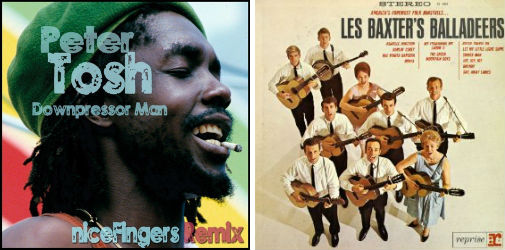
Where you gonna run to? Tim LaHaye and Billy Graham vs. Peter Tosh and Nina Simone
by Fred Clark
Mary Kate Waymon was a Methodist minister and housemaid who lived and preached in North Carolina in the first half of the 20th century. She was a revivalist — an evangelistic preacher who taught conversion and spiritual renewal.
If that were all we knew about her, we would guess that as a revival-meeting preacher, she was squarely within the white evangelical tradition of American Christianity. She was, after all, an evangelist who preached less than 100 miles from where the great white evangelical icon Billy Graham first began preaching around the same time in the same state of North Carolina.
But the Rev. Waymon was an African-American revivalist preacher, and that means that her theology, her gospel, and her understanding of revival was very different from the theology, gospel, and meaning of revival taught by the many white evangelical revivalists who preached throughout the Jim Crow South of the early 20th century.
To illustrate that difference, consider the following recording of one of those revivalist songs. This is Nina Simone’s version of “Sinnerman” — a song that Simone, born Eunice Kathleen Waymon, said she learned as a child playing piano and singing in her mother’s revival meetings:
Click here to view the embedded video.
This song is thought to date back to the early years of the 20th-century, circulating for decades in churches and revival meetings — both black and white — before it began to be recorded by folk and jazz musicians in the 1950s. The lyrics, warning sinners against judgment day, bear all the hallmarks of revivalist Christianity and the escapist form of apocalyptic belief that has shaped white evangelicalism in America from Scofield to Tim LaHaye. It’s based on a passage from the book of Revelation — a portion of scripture known to fans of the Left Behind series as the “Wrath of the Lamb” earthquake:
When he opened the sixth seal, I looked, and there came a great earthquake; the sun became black as sackcloth, the full moon became like blood, and the stars of the sky fell to the earth as the fig tree drops its winter fruit when shaken by a gale. The sky vanished like a scroll rolling itself up, and every mountain and island was removed from its place. Then the kings of the earth and the magnates and the generals and the rich and the powerful, and everyone, slave and free, hid in the caves and among the rocks of the mountains, calling to the mountains and rocks, “Fall on us and hide us from the face of the one seated on the throne and from the wrath of the Lamb; for the great day of their wrath has come, and who is able to stand?”
In a white revivalist meeting, the apocalyptic message here would have been otherwordly. It would have served as a warning to save your soul from judgment and Hell in the afterlife. You, as an individual sinner, face eternal damnation unless you, as an individual sinner, ask God to forgive your individual sins.
For a sense of what that might have sounded like in a white revival meeting, give a listen to this recording of “Sinner Man” by Les Baxter’s Balladeers. It’s not just the music there that sounds, well, whiter. It also reflects a distinctively white theology – a white gospel, white biblical narrative, and a white interpretation of apocalypse. It offers a white understanding of salvation based upon a white understanding of sin.
Same words. Different sermon.
The lyrics of the Les Baxter version are almost identical to the lyrics sung by Nina Simone. Almost. But notice the word that’s missing here — the central, endlessly repeated refrain in Simone’s rendition: Power. “Power,” she sings, “power, power, power.” It’s an invocation and an implication.
Now look again at that passage from the biblical Apocalypse and who it is that John of Patmos says will be crying out to the rocks: “the kings of the earth and the magnates and the generals and the rich and powerful.” Yes, and also “everyone, slave and free,” because the whole system is coming crashing down and this cataclysmic day of wrath will upend the entire world. That revolutionary upheaval affects everyone, but the focus of that wrath, John says, is on the kings, on “the rich and powerful.”
It seems, then, that Simone — and her mother, the Rev. Waymon — have retained something vital from that biblical vision of judgment day that the white revivalist tradition has forgotten or distorted.
That difference was underscored in another reinvention and reincarnation of this old revivalist song, when Peter Tosh translated it into a liberationist anthem, “Downpressor Man.”
Click here to view the embedded video.
“Downpressor” is the Rastafari term for oppressor — a biblical word that is as pervasive in the scripture as it is absent from white evangelical pulpits. Peter Tosh’s Rasta sermon on Revelation 6 has no patience for the pieties of white evangelical revivalism. He doesn’t allow anyone to mistake this for an altar call urging sinners to repent from drinking and dancing and cussing and fornicating. His warning of judgment day keeps the focus squarely on those named in John’s Apocalypse — “the kings of the earth, and the great men, and the rich men, and the chief captains, and the mighty men.”
Tosh’s “Downpressor Man” thus conveys a warning that was far, far different from the warning preached by the white revivalists of the early 20th century who called “Sinner Man” to repent and be saved from his sins. But I don’t think his message is at all different from the meaning of “Sinnerman” as it was sung by Nina Simone — not when she performed it as a music legend in the 1960s, and not when she performed it as a little girl at her mother’s black church revival meetings in the 1930s and ’40s.
25 Aug 14:32


I Played That! #25: Conqueror (TRS-80)
by Dave
Either my memory has failed me or the Internet has.
In high school, the GT (Gifted and Talented) room was where we hung out. GT at my school was a joke; we didn’t do anything in there except goof off, with little to no structured activities. We had some tools at our disposal, though, one of which was a TRS-80 Model III.
There were a few games we played on it. One was some kind of Risk-like wargame. Another was called, I think, Conqueror.
The only trace I can find of Conqueror is from archives of “CLOAD” magazine, a newsletter about programming on the TRS-80. These were simple, free games, which lines up with my memories. But apart from tables of contents, I can’t find any discussion or screen shots of the games themselves to see if the Conqueror they mention is the one I remember. Let’s assume it is.
Conqueror was a dead simple game. You were a gun at the bottom of the screen, and you could move horizontally and fire. Alien spacecraft would zip along the top of the screen and you had to shoot them. They would shoot at you, but if you shot one of their missiles it would eliminate it.
The only challenge was to your patience. This was proven when, one morning, before school, someone — I don’t remember who, but I don’t think it was me — loaded up Conqueror and set a stapler on the space bar (the “fire” button). Then they walked away. When we returned at lunch the stapler had racked up a score so high it had gone into scientific notation. It simply fired constantly, eliminating aliens and their missiles. And it could have gone on that way forever.
The stapler was declared the King of Conqueror and given all rights and privileges of that title.
Not long afterwards, a sequel to Conqueror showed up. I don’t remember its name, but it was identical except for one detail: when you shot an alien, it would fall out of the sky and you had to dodge its indestructible corpse. The stapler sucked at this game and would die right out of the gate.
The “gifted and talented” kids had triumphed over their would-be mechanical master.
25 Aug 14:08
Hugo Commentary
by noreply@blogger.com (Philip Sandifer)
Oh, fine, let's just make this the Hugo thread, as apparently I want to say stuff.
First of all, Vox Day lost, and that feels fucking amazing.
Second of all, the "burn it all" No Award position lost, which means I did too. And frankly, that feels fucking amazing too. I mean, don't get me wrong; I don't regret voting No Award in every category. I stand by every word.
But I want to go back to something I said in "Guided by the Beauty of Their Weapons," which was that the thing I have always loved about the Hugos is their capacity for weirdness. The Hugos are a great literary award because they have a wonderful unpredictability that happens with surprisingly few outright bad and unjustifiable winners. There aren't a lot of awards like that. The Oscars and the Emmys are littered with far more flatly undeserving winners and clear travesties, and never do anything nearly as weird as give awards to XKCD and Digger.
So yeah, my side only won five categories. What a crushing defeat; we only doubled the total number of No Awards in history in the course of a near complete repudiation of the Sad Puppies, with the only Puppy winner being something that would have made the ballot anyway, and helpfully shutting down the argument that the electorate only voted on politics, as opposed to considering politics alongside other things. (Even if I freely admit that I did vote on politics, clearly the electorate didn't.)
Meanwhile, we had Laura J. Mixon, who exposed a loathsome troll within the progressive science fiction community, and who used her acceptance speech to speak out for #BlackLivesMatter. We had a beautiful refusal to obey the "don't clap until the end" rule for Terry Pratchett. We had the beautiful moment of Robert Silverberg telling stories of the 1968 Worldcon in Berkeley, a date and place that speaks volumes about what the actual heritage of science fiction is, as opposed to the ahistorical lies peddled by Brad Torgersen. We had a win for Orphan Black, one of the most self-consciously diverse shows on television, and a good one to boot. We had, over and over again, voice after voice raised in support of that heritage. And we even had a Dalek on stage, so the Puppies can't complain they weren't represented.
But most beautifully of all, we had all the prose awards given go out to works published in translation, which is a genuine victory for diversity.
That's the award I love and respect. That's why the Hugos were worth fighting for in the first place.
This was an enormously good night. Thank you to each an every one of you who stepped up, bought supporting memberships, and made it happen.
I lost; we won.
EDIT (Sunday morning): And the good news keeps coming. The fairest and most effective plan to reform the nomination process, aka "E Pluribus Hugo," just passed at the Business Meeting. It'll need to be ratified at next year's Worldcon, but it looks like next year will be the last year of fending off fascist entryists, and like come 2017 we can get back to being fans.
Just in time for All the Birds in the Sky to win.
First of all, Vox Day lost, and that feels fucking amazing.
Second of all, the "burn it all" No Award position lost, which means I did too. And frankly, that feels fucking amazing too. I mean, don't get me wrong; I don't regret voting No Award in every category. I stand by every word.
But I want to go back to something I said in "Guided by the Beauty of Their Weapons," which was that the thing I have always loved about the Hugos is their capacity for weirdness. The Hugos are a great literary award because they have a wonderful unpredictability that happens with surprisingly few outright bad and unjustifiable winners. There aren't a lot of awards like that. The Oscars and the Emmys are littered with far more flatly undeserving winners and clear travesties, and never do anything nearly as weird as give awards to XKCD and Digger.
So yeah, my side only won five categories. What a crushing defeat; we only doubled the total number of No Awards in history in the course of a near complete repudiation of the Sad Puppies, with the only Puppy winner being something that would have made the ballot anyway, and helpfully shutting down the argument that the electorate only voted on politics, as opposed to considering politics alongside other things. (Even if I freely admit that I did vote on politics, clearly the electorate didn't.)
Meanwhile, we had Laura J. Mixon, who exposed a loathsome troll within the progressive science fiction community, and who used her acceptance speech to speak out for #BlackLivesMatter. We had a beautiful refusal to obey the "don't clap until the end" rule for Terry Pratchett. We had the beautiful moment of Robert Silverberg telling stories of the 1968 Worldcon in Berkeley, a date and place that speaks volumes about what the actual heritage of science fiction is, as opposed to the ahistorical lies peddled by Brad Torgersen. We had a win for Orphan Black, one of the most self-consciously diverse shows on television, and a good one to boot. We had, over and over again, voice after voice raised in support of that heritage. And we even had a Dalek on stage, so the Puppies can't complain they weren't represented.
But most beautifully of all, we had all the prose awards given go out to works published in translation, which is a genuine victory for diversity.
That's the award I love and respect. That's why the Hugos were worth fighting for in the first place.
This was an enormously good night. Thank you to each an every one of you who stepped up, bought supporting memberships, and made it happen.
I lost; we won.
EDIT (Sunday morning): And the good news keeps coming. The fairest and most effective plan to reform the nomination process, aka "E Pluribus Hugo," just passed at the Business Meeting. It'll need to be ratified at next year's Worldcon, but it looks like next year will be the last year of fending off fascist entryists, and like come 2017 we can get back to being fans.
Just in time for All the Birds in the Sky to win.
25 Aug 13:18
The Award of Cruelty
by Jack Graham
Diversity and social justice issues were creeping into the Hugo Awards, or rather into the cultural artifacts they celebrate, as such issues creep into the culture generally. It happens because people are getting more and more interested in them, more open to them, and caring more about them. This is, by the way, the product of material struggles for recognition and equal rights by people who are marginalised by mainstream culture in the West (i.e. racist, sexist, transphobic, bourgeois-hegemonic culture). It must be stressed that such claims are not only valid on their face but also are represented, in artistic terms, by valuable work that deserves recognition.
The Puppies saw this trend and it infuriated them. Just as they are doubtless infuriated by any such progress, by the increasing volume of the voices they used to be able to talk over and down to with impunity, by the increasing - and increasingly recognised - validity of these voices, not only in themselves but in their abilities. The Hugos are, the Puppies think, their turf, just as the rabble of GamerGate, and the constituency they pander to, imagine that video games are their turf. They took the gradual changes occuring in an institution that has always reflected a seam of progressivism in SF/Fantasy (just as it has always reflected other seams) and blew the phenomenon up out of all proportion. (Seriously, I wish their distorted view of Hugos, and culture generally, were really true, and the voices they hate and fear really were as ascendant as they fantasize them to be.)
They saw this smidge of progress and imagined that it constituted some kind of attack upon their freedom. They imagined it, and believed it, having chosen to imagine and believe it... because it's amazing how sincerely and passionately people can believe ridiculous things that further their interests, confirm their prejudices and pamper their privileges. They did this because that's what reactionaries always do. It's a classic maneuvre when you're rallying around the defence of established privilege and entrenched power relations (which is what reactionary politics always is, at base): paint yourself as the victim. It's great camouflage. And they love it too. They love the smell of the victim paint on their bodies, drying on them, crusting and cracking, leaving a trail of victim flakes everywhere they go. Conservatives and reactionaries and fascists and ressentimentalists are as fond of being the victim as the whingeing, entitled, self-pitying minorities that live in their imaginations. (There is probably something psychological to be made of the right-wing love of victimhood, and the way they always portray themselves in much the same terms that they complain about in their confabulated enemies and hate-figures. I remember how, at school, bullies would always howl "But he started it!" and "It wasn't my fault!" when caught, and then pout self-pityingly at the injustice of being told not to bully.)
But yeah, they interpret the struggles of the marginalised and mocked, their demands for justice, as an attack. Moderate demands. Not wanting to overturn the table. Just wanting a seat. A seat, moreover, that has been hard won and earned fair 'n' square. That was what the Puppies were scared of. Fewer seats for them to spread out on. And here's the thing: in their stupid, crude, self-pitying, myopic way they have a point. The less oppressed some people are, the less powerful are the people who used to benefit from their oppression. Yeah. True. What they get wrong is the construction they put on this.
The Puppies, and the ressentimental and truculent group they represent, then paint any unified resistance as totalitarian groupthink, as the effect of drones all obeying a single politicized agenda. Because this is another classic maneuvre. Efface your own deeply political motives (what could be more political than the aggressive defence of one's own privilege in the face of attempts by others to become less subject to you?) and then angrily ascribe political motives and agendas to the people combating you. Your own motives are, by definition, pure. Pure in the sense of being disinterested. The spurious notion of impartiality as being a middle way between two extremes (i.e. the extreme of power and the extreme of powerlessness) is a fallacy often embraced by the right for the sake of argument.
Always, the oppressors and/or their useful idiots think of oppression as, and describe it as, the norm. The baseline. Zero on the meter, from which atypical readings diverge into the plus or minus. The current state of things (or the current state of things as they imagine it, sometimes mapping nostalgia onto now) is, obviously, good because it benefits them. Obviously normal because it benefits them. Obviously the best way to do things beause it benefits them. Obviously democratic and fair beause it benefits them. "I love freedom," goes the thinking, "ergo when I get to dictate the terms of the debate, that's freedom. When things are arranged to benefit and privilege and prioritise me, that's freedom." This way of thinking, by the way, is hardly unique to the hard right. It is characteristic of managerialist liberalism. For liberal elites (see Noam Chomsky, not Rand Paul, for a definition of what this actually mean), this is pretty much what 'democracy' means: social arrangements dominated and managed by liberal technocrats and intellectuals, without too much interference from the people. (Yes, I know, I sound like some of the 'radical' right here... and there are areas where such people will spout rhetoric that sounds like a radical analysis of liberal capitalism... but BEWARE, because that's just the cynical populism of the right, just evidence of their failure to understand the real problems of democracy even as they dumbly sense them.)
The normalising of the current state of injustice means that entities like the Puppies can, once again, paint their angry, sclerotic, dudebroish, O'Reillyesque defence of their own privilege as a defence of liberty. Ultimately, however, the liberty being defended is their liberty to run the place without anybody questioning it. Their liberty to help themselves to the biggest slices of pie (anybody cries shennanigans when you take more than your share and you accuse them of wanting all the pie for themselves - it's as old as the hills). Their liberty to dominate the culture and set the agenda, and patronize people different from them. Their liberty to insist upon outdated cultural assumptions and definitions in the face of evidence and demands which refute them. Other liberties mean nothing to them. The liberty of people not in the privileged group to write and read what they like, to influence the wider culture, to unify to combat their own marginalisation, to be recognised not only for their humanity and rights but also for their achievements... entities like the Puppies are openly hostile to such liberties, because for all their libertarian bluster they are, essentially, doing nothing more than fighting a rearguard action against cultural trends which terrify them because they chip away at their old hegemonic position.
These generalisations are useful because they can be applied at other levels of our culture. What I say above is generally true of right-wing movements anywhere and anywhen, I find. To the extent that they are significant at all, I think the Puppies are significant as an example. A vivid, close-to-home example for people in the SF/Fantasy community. But then, as I say, the SF/Fantasy community is already expanding to include more and more people who already know exactly how people like this operate, either because they are increasingly politicised or because they have to cope with this kind of bullshit on a day-to-day level because of their own positionality. Which is precisely the scary fact that glavanised first the Sad then the Rabid Puppies, much as they might try to hide their true fears under layers of code and dogwhistling, and faux-victimhood, and disingenuously apolitical nostalgia for simplicity, and more-in-sorrow-than-in-anger lamentation about the kids on their lawn.
The Puppies will claim to be champions of democracy. But the kinds of gradual shifts that we see represented in the changing face of the Hugos are democracy. To the extent that shifts in attitudes entails shifts in demands, and shifts in demands brings on shifts in what gets published, it may even be a legitimate instance of consumer democracy! It's also a symptom of the fact that we're in a relatively small and marginal subculture here (i.e. the kinds of people who write and/or read SF novellas published by relatively small presses.) In any case, the manifestation of such democratic changes in things like the Hugos is usually pretty weak and watery and late compared to the real thing. Established and entrenched structures are slow to change, and slow to register change from without... as indeed are established and entrenched subcultures and their attitudes. But the Hugos are voted for. So the access of people to the levers of this structure, or this expression of the views of a subculture if you prefer, makes it a reasonable barometer (if you'll permit me to mix metaphors flagrantly). Precisely why the Puppies attacked it. And thus a minority tries to dominate artificially in order to stop a majority dominating organically... and, as always, the canny thing is for the reactionaries to claim persecution. The standard reactionary technique.
Just look at the media's reaction to the clamour of those alienated from a right-wing Labour party to rejoin and vote for a 'left-wing' leadership candidate, an MP who has the temerity to be a moderate social-democrat instead of hugging the extreme neoliberalism that the media likes to call the 'centre'. In many ways, this is an instructive comparison because it's almost an mirror image of what happened with the Puppies and the Hugos. Instead of an institution that more-or-less accurately acts as a barometer for the views and tastes of the community it concerns, Labour is a party utterly alienated from those it claims to represent. Instead of mass-reactionary entryism in an effort to distort results rightwards, Labour is being rejoined by people who want to reclaim it for those it was historically supposed to serve. The bass-ackwards view of events concerning the Hugos which is peddled by the Puppies is mirrored in the bass-ackwards view of Labour's leadership election by the right-wing UK media. (How long, by the way, before the Puppies nominate the Mail's dystopian sci-fi about an apocalyptic Corbyn premiereship for next year's Hugos? Purely on artistic merit, natch.)
There is not even a grain of truth to the Puppie's performative bloviating about democracy, anymore than there is in the UK media's bloviating about 'responsible, adult politics'. It might be argued that if reactionaries want to join and pay their membership fee so they can vote in the Hugos, then that's fair enough. The Hugos are a barometer because they have some responsiveness to public opinion, which itself is a function of the fact that, unlike the Oscars and Baftas and so on, they are voted on by anyone who cares enough to pay a minimal sum for the pleasure of doing so. And are the Puppies not members of the public, and paid-up voters? This falls flat, and is revealed as mere sophistry, because they are - in true fascist style - taking advantage of democratic structures in order to countermand democratic results. They artificially dominated the proceedings and squidged out genuinely representative nominations. But, ultimately, I'm just not that fussed about the legitimacy or good standing of an awards ceremony. What it represents on the other hand... or rather what is represented by the changing face of the nominations and nominees... that's rather more important.
The issue here is that the various Puppy-endorsed nonentities had no business being on the nominations if the nominations are supposed to represent an organic and democratic reflection of the state of fan culture. The Puppies warped the Hugos out of recognition and usefulness as a result of their ballot-stuffing antics. They actively, deliberately and effectively excluded people who would've been on the ballots otherwise, and in so doing markedly reduced diversity. Their argument would doubtless be that diversity is not something we have the right to expect. It can't be enforced. No 'positive discrimination'. But, as usual, they are operating in bad faith to the point of dishonesty; distorting reality to the point of inverting it. Diversity was, as can clearly see, going to occur naturally and organically and democratically. They, the Puppies, set about artificially stifling it. They have the right to their say, of course, but not to dominate proceedings dishonestly and artificially in the name of rebalancing something that was never out of balance in the first place. Again, balance seems to them, naturally, to be the state of affairs where they get what they want. It really is incredible how the people sat at the top of a pyramid (or strangely invested, for peculiar psychological reasons of their own, in the ideology of the people at the top of a pyramid) can look down and see it as a level playing field, and thus resent it when anyone tries to flatten it. "Democracy!" hollers the self-righteous and outraged minority from above at the crowd below trying pull stones out of the base of the structure. "If you can't climb then you don't deserve to get this high!" they say, forgetting that they were just lifted and plonked on top.
They'd love us to get sidetracked on the issue of the legitimacy of political voting (which, in any case, has now been addressed by the Hugos with their 'E Pluribus Hugo' amendment to the nomination process), because they have an easy retort to anyone who says they voted on a political agenda. They have the time-honoured playground response, the "I know you are but what am I?" response. Moreover, they have the claim that they only did what they did because 'we' did it first. And when we respond with our counter attack, they can then do the obvious and say "ahhhh look, you voted based on politics not on the quality of the text! You did exactly what we accused you of doing! By fighting us you have proved our point! Ahhhh!". I know that this is how they think because twitter is currently infested with Puppy-supporters and GamerGate-types doing and saying precisely these things, making precisely these 'arguments'.
But Lee & Herring fans will know what I mean when I say "this is not an 'ahhhh' situation". Again, their argument is two-faced sophistry. The Hugos were changing all by themselves (as it were), without 'us' having to consciously organise any sort of SJW conspiracy. This doesn't make them wonder if 'our' movement might actually be organic and democratic rather than a bullying minority... or at least, if they do wonder such things, they don't admit it. Again, if it strays from what the think is 'normal' (i.e. the set of arrangements that privileges them and their preferences) then obviously someone is conspiring against normality.
In the service of this 'argument', they elide voting politically and voting for things you genuinely like because of (or partly because of) your politics. But - and it really is embarrassing to have to point out simplicities like this to adults - there's a difference.
Of course you are likely to like things you agree with. Part of why I like China Mieville is because he has a very similar worldview to me (admittedly, this is partly because I've taken a lot of my worldview from his). He writes interestingly about things that interest me. He writes inspiringly about things that inspire me (there's no point denying that I love Iron Council partly because it engages favourably with revolutionary politics - I find that thrilling). He writes with horror about things that horrify me. I don't have to stop and look away in revulsion when he makes racist observations about people of colour, as I do when I'm reading (the equally fascinating) Lovecraft, or whoever. Vox Day said, in his interview with Phil Sandifer, that China Mieville is one of his favourite writers. I choose to believe that, because I can understand how Lovecraft is one of Mieville's favourite writers. Let's give Day the benefit of the doubt and assume he's telling the truth, simply because we know from our own experience how such things are possible. Day, on the other hand, champions the piffling work of John C. Wright, with its mechanical and lumpen Christian allegory and metaphor, presumably because it pushes a worldview (the inherent value and moral supremacy of Christian civilisation) that he finds salutary and inspiring, as inspiring as I find Mieville's depiction of revolution from below. For the sake of argument: Mieville is to me as Wright is to Day. Lovecraft is to me as Mieville is to Day. All we've done here is point out the obvious fact that Day and I are on opposite sides. Well, we knew that. I'm happy to concede that taste is politically-invested. They vote for the stuff they like partly because it represents their politics. We vote for the stuff we like partly because it represents our politics. (They'd probably want to talk about positive discrimination or reverse racism or misandry or something... some variation on the idea that by prioritising things like diversity we're squeezing out the rights of the neutral, non-political fan/reader... because, for them, the neutral/vanilla human is a white straight guy and the non-political or apolitical is that which hugs his perspective. This is exactly the underlying meaning of the kind of laments for the loss of good old-fashioned adventure stories about robots and space battles that you get from 'moderate' Sad Puppies like Torgersen and Correia.)
But it's their tactic to accuse us of a totalising insistence upon ideological consistency, manifested in a determination to vote politically in the Hugos. On a superficial level, this is (or should be) easy for anyone to see through. The sheer hypocrisy and bad faith of the argument advertises itself. "You voted 'No Award' so you want politics to dominate the awards!" they say, in response to our response to their attempt to politically dominate the awards. I mean, fuck. Bad faith and hypocrisy that blatant and brazen is usually only seen in Western mainstream media reports about Israel.
And another thing: 'we' know full well when 'we' are producing or reading or praising material which has a political valence or agenda, precisely because from 'our' side such political valences and agendas are oppositional. When a person of colour, or a trans person, or a woman writes a book, she knows she is doing something political and oppositional (whether she wants to be so categorised or not) just by doing so. When a writer creates a trans or gay protagonist for their novel, they know that is an oppositional political act. How could it not be, even if the writer wanted it to not be, given the climate in which such choices are made? Remember, the privileged take their own position as neutral. The oppressed and marginalised have no such luxury... which is precisely why it wouldn't even be illegitimate to deliberately stack the Hugos in favour of diversity! The political actions of the right and left (for want of a better term for the broad church of opinion behind more diversity in SF) are not morally equivalent. Positive discrimination is not as bad as the discrimination it aims to counteract. Climbing is climbing, but climbing up and climbing down are different. You can't shit up a pyramid, as Stavvers said. The interminable whinges of the right about "reverse racism" and "misandry" have been adequately covered elsewhere so I won't reiterate them. Suffice it to say that we can demonstrate, materially and empirically, that there is such a thing as oppression and such people as the marginalised. So the Puppies' claim to moral equivalence breaks down, even more so any claim they make to moral superiority. There is a certain point at which "yeah, well, that's just, like, your opinion, man" breaks down and facts intrude. It having been established that there is such a thing as oppression, and such people as the marginalised, there is a clear moral superiority to those making political/artistic moves from below, political/artistic moves which tend to combat the objectively provable injustice.
This isn't to say that I'm claiming, by fiat, to have right on our side, and that we can thus dictate what is or is not published, reviewed, awarded, etc. That is their caricature of us, and also their disguised (even from themselves, it seems) self-portrait. If Vox wants to caricature people like me as doing something authoritarian with my reading habits, well, let him. C'est la guerre. Only to be expected from a reactionary who cloaks his fascist bullshit in rhetoric about liberty from the authoritarian left, etc. But it's also a case of c'est la guerre when I, and others like me, fight back against his politically motivated maneuvres. I'm happy to admit political motivation when it comes to art, especially when it comes to fascism. You can't launch a blatantly political attack upon art and then cry "Politics!" when someone responds... or rather you can, but not without making yourself look like the dishonest dickwad you are.
The truth is that there is no such thing as politically neutral fiction, or as the politically value-neutral judgement of fiction. Same goes for visual art. Same goes for criticism and most forms of non-fiction. It's hypocritical bullshit to argue, as the Puppies do, that you can and should make judgements free of political evaluations, and that you're an ideological zealot if you don't. In any case, the Puppies usually make this argument performatively and in bad faith. Even when they sincerely think they're being apolitical, praising things that seem (to them) to be neutral, you have to remember that for them a neutral and normal world is precisely one where their own prejudices and privileges are taken for granted. For them, their choices are apolitical by definition. No matter how ideologically they choose, they must always perform the role of the ingenuous, blinking naif who just likes what he likes and doesn't get why some people are 'offended' by it (if in fact they are).
And, more fundamentally, even if you are consciously and scrupulously apolitical (some hope), that itself is a political choice. In the face of manifest injustice, particularly within your own camp, neutrality is the same as siding with the powerful. Not allowing your politics to dominate your own, let alone anyone else's, taste in art, is obviously the right way to go, as long as you don't fool yourself (or try to pretend that) your politics has no effect on what you like or don't like. This has nothing to do with whether or not we should let fascists dominate a high-profile award. Some people have said to me, both before and after the results: "isn't it unfair to penalise nominees because of a political tactic of voting 'No Award'?" This is really just the liberal version of the fascist "ahhhh!". And my response was and is: at this point, the issue of the merit or otherwise of the works under consideration has become secondary. Of primary importance now is fighting a fascist incursion. This isn't to say that those works should be judged by their politics. This is to say that judging them in any way at all has now become a matter for another time, another place, another arena. An arena uncompromised by fascism.
Fascism is a dealbreaker. Normally I'd be happy to sit back and let awards be won by all manner of stuff I dislike and disagree with. Moffat's Doctor Who has won loads of Hugos in recent years. The Best Dramatic Presentation (Long Form) category has seen some politically atrocious films nominated in recent years. The Dark Knight, Iron Man, District 9, Avatar, Captain America, Iron Man 3. All ghastly to one extent or another. Generally, as it happens, the Hugos have dodged the worst of these bullets (with only Inception being an outright ghastly winner). The point is, I didn't care. Of course the Hugo Award for movies is going to films that push bourgeois ideology, imperialist values, sexism, the worship of corporate billionaires, the war on terror, the dehumanization of Arabs, etc. That's the kind of world we live in, a world where extremely repulsive ideas like these are normal and normalised (and thus taken as neutral by people who aren't on the sharp edge of their effects). "In any epoch the ruling ideas will be the ideas of the ruling class", as Marx said. I don't even have that much of a problem with Guardians of the Galaxy, except that it became the chosen candidate of the Puppies.
[That's reason enough for a little diversion actually. Why did they favour Guardians of the Galaxy? Possibly because their other main options - the other films that ended up on the nominations list, for example - were potentially queasy from a Puppy perspective. Captain America: The Winter Soldier, which was partly a resurrection of the 70s conspiracy thriller, was interpreted by many as containing some kind of suspicion or critique of American government institutions. You can't expect blinkered, philistine, textually-myopic idiots like the Puppies to notice that actually it goes out of its way to provide Western power structures with even more alibis than your average film of it's type. Like some liberal commentators, the right probably found the film to be an astonishing explosion of left-wing radicalism. Similarly, The Lego Movie, which was claimed by some (including, dismayingly, some on the left) to be a critique of capitalism... a bizarre idea. As for Interstellar, I expect many of the Puppies or Puppyish were infuriated by the assertion that a girl might become a scientist. Some can quote tracts of sociobiologistic psuedo-sociology at you to prove that women don't make good scientists. Other just assume there aren't any women scientists to speak of, take their own assumption as obvious fact, and then ask rhetorical questions about "who invented everything, eh?"]
But back to the point. Much as I hated every last one of the movies on this year's Hugo nominations, I have no particular political issue with people voting for them. I suddenly do have a problem, however, when one of them gets recommended by a fascist to other fascists, and/or fascist sympathisers and fellow travellers. I'd have an issue with my own favourite film this year winning awards if they were awarded by fascists. It wouldn't make me like it any less, but I'd oppose the award. Because fascism isn't just another viewpoint amongst viewpoints. Fascism is the seed of the destruction of all other viewpoints. Moreover, it is the amorphous, pilfered, cobbled-together scavenger ideology which represents counter-revolution. It is explicitly the politics of division of people who should be united. It is the antithesis of human liberation. It is a program for protecting the bourgeois order from attacks economic, political or cultural. No matter what revolutionary verbiage it may use, fascism is always on the side of the bourgeois status quo... but the bourgeois status quo with a vengeance, with its most savage instincts let loose. And make no mistake: 'Vox Day' is a fascist, or near enough to being one as makes no odds. Whatever his piffling self-justifications and triangulations, whatever his double-talk and sophistry and barely comprehensible evasions, his views run the gamut of fascist obsessions both classical and current, from the civilisational rhetoric, the Breivikian Islamophobia, the crypto-Christian triumphalism, the sexism, the cultural racism and pseudo-scientific contempt for the humanity of people of colour. He can backtrack on his description of N.K. Jeminsin as a "half savage" all he likes. He can try to efface it by insisting on his asserted Native American heritage (would it really change anything it Hitler turned out to have been a bit Jewish?), by claiming that he based it on some psuedo-philosophical bit of bullshit instead of some pseudo-scientific bit of bullshit, by claiming he only did it to troll her into calling him a racist (nifty strategy: con someone into calling you a racist by being flagrantly racist towards them, then claim they're a hysterical SJW because they accurately characterised your comments!)... none of this exculpates him. This is routine, bog-standard, drearily predictable flim-flam that you get from every tuppeny-ha'penny fascist these days. Retreat from the almost-universally frowned-upon biologistic claims of classic fascists to half-baked culturalist assertions, then angrily respond "Islam ain't a race - duh!" (or equivalent, according to circumstance) to anyone who calls you out. This is precisely what Mr Day does in a recent interview in which he makes some scarcely-intelligible distinction between 'real Africans' you get in Europe and 'African Americans', going on to imply that Europe is now plagued by culturally-backward African immigrants (it's okay for him to be a migrant, of course... see what I was saying above about their idea of 'normal' being synonymous with their own positionality) who don't know how to use toilets properly.
[His racism against Africans seems - if some of these recent statements are taken into account - to be curiously faecally-fixated. Racism, particularly racism against black people, has always been libidinously inflected, full of obsession about black people's imagined bodily functions, cleanliness (or supposed lack thereof), dicks, sex drives, etc. Vox Day seems no exception. There is evidently something curiously exciting to him about the idea of Africans spreading poo around Christendom. I detect a perverse pleasure in seeing Christendom defiled by the bodily fluids of the desirable/terrifying Other. It's tempting to just say that he gets reverse pleasure from seeing (or rather fantasizing about) such things because the scenario of a culturally backward "half savage" making a dirty protest out of Western civilisation is gloriously confirming of his prejudices... but I'm tempted to think that he may find it gloriously exciting in other ways (which is fine with me, I'm not judgemental... not about peccadiloes anyway). I'm also tempted to bring in Freud's concept of the anal fixation. There is some evidence for a correlation between anal personality types and political conservatism, in particular race prejudice. Disturbingly, Vox seems to display personality traits associated with both anal retentiveness and anal expulsiveness! Was Mummy strict and Daddy lenient? Daddy's a jailed tax protestor isn't he... I suspect he was probably the strict (retentive) one, now I come to think about it. Perhaps Vox just doesn't mind, as long as it's anal. You can certainly see the expulsive type in his apparent desire to fling his shit around and imagine he's doing us all a favour by so doing, though he lacks the material generosity Freud associated with the expulsive. He also lacks the rebelliousness, though I'm sure he imagines himself to be a rebel. I dare any fan of Vox to be offended by the above.]
So there we have it: however compromised and messy they may be, the Hugos reflect something organic about the changing state of fan culture precisely because they are, at least to some extent, democratically controlled. The priority isn't to rescue the Hugos or their voting system from manipulation just for their sake, no more than the priority for someone like me is to rescue the bourgeois parliamentary democratic system from the encroachments of the BNP and UKIP because I love the bourgeois parliamentary democratic system. The point is to oppose the Puppies because I oppose their ideology and the stuff they do with it. Because their ideology is crass and selfish and reactionary, because it fails the empirical test, because it's a defence of privilege against a movement of the oppressed, because in its extreme form (Vox Day et al) it's crypto-fascist and racist and sexist and Islamophobic, and because its effect is to attack progress towards greater recognition for the marginalised. That doesn't just hurt the marginalised; as someone invested in real democracy, it hurts me to. Even in the little pocket universe of SF/Fantasy awards, this matters. SF/Fantasy punches above its weight, culturally speaking. Aside from any personal investment in the 'scene', this is reason enough to care.
The Puppies saw this trend and it infuriated them. Just as they are doubtless infuriated by any such progress, by the increasing volume of the voices they used to be able to talk over and down to with impunity, by the increasing - and increasingly recognised - validity of these voices, not only in themselves but in their abilities. The Hugos are, the Puppies think, their turf, just as the rabble of GamerGate, and the constituency they pander to, imagine that video games are their turf. They took the gradual changes occuring in an institution that has always reflected a seam of progressivism in SF/Fantasy (just as it has always reflected other seams) and blew the phenomenon up out of all proportion. (Seriously, I wish their distorted view of Hugos, and culture generally, were really true, and the voices they hate and fear really were as ascendant as they fantasize them to be.)
They saw this smidge of progress and imagined that it constituted some kind of attack upon their freedom. They imagined it, and believed it, having chosen to imagine and believe it... because it's amazing how sincerely and passionately people can believe ridiculous things that further their interests, confirm their prejudices and pamper their privileges. They did this because that's what reactionaries always do. It's a classic maneuvre when you're rallying around the defence of established privilege and entrenched power relations (which is what reactionary politics always is, at base): paint yourself as the victim. It's great camouflage. And they love it too. They love the smell of the victim paint on their bodies, drying on them, crusting and cracking, leaving a trail of victim flakes everywhere they go. Conservatives and reactionaries and fascists and ressentimentalists are as fond of being the victim as the whingeing, entitled, self-pitying minorities that live in their imaginations. (There is probably something psychological to be made of the right-wing love of victimhood, and the way they always portray themselves in much the same terms that they complain about in their confabulated enemies and hate-figures. I remember how, at school, bullies would always howl "But he started it!" and "It wasn't my fault!" when caught, and then pout self-pityingly at the injustice of being told not to bully.)
But yeah, they interpret the struggles of the marginalised and mocked, their demands for justice, as an attack. Moderate demands. Not wanting to overturn the table. Just wanting a seat. A seat, moreover, that has been hard won and earned fair 'n' square. That was what the Puppies were scared of. Fewer seats for them to spread out on. And here's the thing: in their stupid, crude, self-pitying, myopic way they have a point. The less oppressed some people are, the less powerful are the people who used to benefit from their oppression. Yeah. True. What they get wrong is the construction they put on this.
The Puppies, and the ressentimental and truculent group they represent, then paint any unified resistance as totalitarian groupthink, as the effect of drones all obeying a single politicized agenda. Because this is another classic maneuvre. Efface your own deeply political motives (what could be more political than the aggressive defence of one's own privilege in the face of attempts by others to become less subject to you?) and then angrily ascribe political motives and agendas to the people combating you. Your own motives are, by definition, pure. Pure in the sense of being disinterested. The spurious notion of impartiality as being a middle way between two extremes (i.e. the extreme of power and the extreme of powerlessness) is a fallacy often embraced by the right for the sake of argument.
Always, the oppressors and/or their useful idiots think of oppression as, and describe it as, the norm. The baseline. Zero on the meter, from which atypical readings diverge into the plus or minus. The current state of things (or the current state of things as they imagine it, sometimes mapping nostalgia onto now) is, obviously, good because it benefits them. Obviously normal because it benefits them. Obviously the best way to do things beause it benefits them. Obviously democratic and fair beause it benefits them. "I love freedom," goes the thinking, "ergo when I get to dictate the terms of the debate, that's freedom. When things are arranged to benefit and privilege and prioritise me, that's freedom." This way of thinking, by the way, is hardly unique to the hard right. It is characteristic of managerialist liberalism. For liberal elites (see Noam Chomsky, not Rand Paul, for a definition of what this actually mean), this is pretty much what 'democracy' means: social arrangements dominated and managed by liberal technocrats and intellectuals, without too much interference from the people. (Yes, I know, I sound like some of the 'radical' right here... and there are areas where such people will spout rhetoric that sounds like a radical analysis of liberal capitalism... but BEWARE, because that's just the cynical populism of the right, just evidence of their failure to understand the real problems of democracy even as they dumbly sense them.)
The normalising of the current state of injustice means that entities like the Puppies can, once again, paint their angry, sclerotic, dudebroish, O'Reillyesque defence of their own privilege as a defence of liberty. Ultimately, however, the liberty being defended is their liberty to run the place without anybody questioning it. Their liberty to help themselves to the biggest slices of pie (anybody cries shennanigans when you take more than your share and you accuse them of wanting all the pie for themselves - it's as old as the hills). Their liberty to dominate the culture and set the agenda, and patronize people different from them. Their liberty to insist upon outdated cultural assumptions and definitions in the face of evidence and demands which refute them. Other liberties mean nothing to them. The liberty of people not in the privileged group to write and read what they like, to influence the wider culture, to unify to combat their own marginalisation, to be recognised not only for their humanity and rights but also for their achievements... entities like the Puppies are openly hostile to such liberties, because for all their libertarian bluster they are, essentially, doing nothing more than fighting a rearguard action against cultural trends which terrify them because they chip away at their old hegemonic position.
These generalisations are useful because they can be applied at other levels of our culture. What I say above is generally true of right-wing movements anywhere and anywhen, I find. To the extent that they are significant at all, I think the Puppies are significant as an example. A vivid, close-to-home example for people in the SF/Fantasy community. But then, as I say, the SF/Fantasy community is already expanding to include more and more people who already know exactly how people like this operate, either because they are increasingly politicised or because they have to cope with this kind of bullshit on a day-to-day level because of their own positionality. Which is precisely the scary fact that glavanised first the Sad then the Rabid Puppies, much as they might try to hide their true fears under layers of code and dogwhistling, and faux-victimhood, and disingenuously apolitical nostalgia for simplicity, and more-in-sorrow-than-in-anger lamentation about the kids on their lawn.
The Puppies will claim to be champions of democracy. But the kinds of gradual shifts that we see represented in the changing face of the Hugos are democracy. To the extent that shifts in attitudes entails shifts in demands, and shifts in demands brings on shifts in what gets published, it may even be a legitimate instance of consumer democracy! It's also a symptom of the fact that we're in a relatively small and marginal subculture here (i.e. the kinds of people who write and/or read SF novellas published by relatively small presses.) In any case, the manifestation of such democratic changes in things like the Hugos is usually pretty weak and watery and late compared to the real thing. Established and entrenched structures are slow to change, and slow to register change from without... as indeed are established and entrenched subcultures and their attitudes. But the Hugos are voted for. So the access of people to the levers of this structure, or this expression of the views of a subculture if you prefer, makes it a reasonable barometer (if you'll permit me to mix metaphors flagrantly). Precisely why the Puppies attacked it. And thus a minority tries to dominate artificially in order to stop a majority dominating organically... and, as always, the canny thing is for the reactionaries to claim persecution. The standard reactionary technique.
Just look at the media's reaction to the clamour of those alienated from a right-wing Labour party to rejoin and vote for a 'left-wing' leadership candidate, an MP who has the temerity to be a moderate social-democrat instead of hugging the extreme neoliberalism that the media likes to call the 'centre'. In many ways, this is an instructive comparison because it's almost an mirror image of what happened with the Puppies and the Hugos. Instead of an institution that more-or-less accurately acts as a barometer for the views and tastes of the community it concerns, Labour is a party utterly alienated from those it claims to represent. Instead of mass-reactionary entryism in an effort to distort results rightwards, Labour is being rejoined by people who want to reclaim it for those it was historically supposed to serve. The bass-ackwards view of events concerning the Hugos which is peddled by the Puppies is mirrored in the bass-ackwards view of Labour's leadership election by the right-wing UK media. (How long, by the way, before the Puppies nominate the Mail's dystopian sci-fi about an apocalyptic Corbyn premiereship for next year's Hugos? Purely on artistic merit, natch.)
There is not even a grain of truth to the Puppie's performative bloviating about democracy, anymore than there is in the UK media's bloviating about 'responsible, adult politics'. It might be argued that if reactionaries want to join and pay their membership fee so they can vote in the Hugos, then that's fair enough. The Hugos are a barometer because they have some responsiveness to public opinion, which itself is a function of the fact that, unlike the Oscars and Baftas and so on, they are voted on by anyone who cares enough to pay a minimal sum for the pleasure of doing so. And are the Puppies not members of the public, and paid-up voters? This falls flat, and is revealed as mere sophistry, because they are - in true fascist style - taking advantage of democratic structures in order to countermand democratic results. They artificially dominated the proceedings and squidged out genuinely representative nominations. But, ultimately, I'm just not that fussed about the legitimacy or good standing of an awards ceremony. What it represents on the other hand... or rather what is represented by the changing face of the nominations and nominees... that's rather more important.
The issue here is that the various Puppy-endorsed nonentities had no business being on the nominations if the nominations are supposed to represent an organic and democratic reflection of the state of fan culture. The Puppies warped the Hugos out of recognition and usefulness as a result of their ballot-stuffing antics. They actively, deliberately and effectively excluded people who would've been on the ballots otherwise, and in so doing markedly reduced diversity. Their argument would doubtless be that diversity is not something we have the right to expect. It can't be enforced. No 'positive discrimination'. But, as usual, they are operating in bad faith to the point of dishonesty; distorting reality to the point of inverting it. Diversity was, as can clearly see, going to occur naturally and organically and democratically. They, the Puppies, set about artificially stifling it. They have the right to their say, of course, but not to dominate proceedings dishonestly and artificially in the name of rebalancing something that was never out of balance in the first place. Again, balance seems to them, naturally, to be the state of affairs where they get what they want. It really is incredible how the people sat at the top of a pyramid (or strangely invested, for peculiar psychological reasons of their own, in the ideology of the people at the top of a pyramid) can look down and see it as a level playing field, and thus resent it when anyone tries to flatten it. "Democracy!" hollers the self-righteous and outraged minority from above at the crowd below trying pull stones out of the base of the structure. "If you can't climb then you don't deserve to get this high!" they say, forgetting that they were just lifted and plonked on top.
They'd love us to get sidetracked on the issue of the legitimacy of political voting (which, in any case, has now been addressed by the Hugos with their 'E Pluribus Hugo' amendment to the nomination process), because they have an easy retort to anyone who says they voted on a political agenda. They have the time-honoured playground response, the "I know you are but what am I?" response. Moreover, they have the claim that they only did what they did because 'we' did it first. And when we respond with our counter attack, they can then do the obvious and say "ahhhh look, you voted based on politics not on the quality of the text! You did exactly what we accused you of doing! By fighting us you have proved our point! Ahhhh!". I know that this is how they think because twitter is currently infested with Puppy-supporters and GamerGate-types doing and saying precisely these things, making precisely these 'arguments'.
But Lee & Herring fans will know what I mean when I say "this is not an 'ahhhh' situation". Again, their argument is two-faced sophistry. The Hugos were changing all by themselves (as it were), without 'us' having to consciously organise any sort of SJW conspiracy. This doesn't make them wonder if 'our' movement might actually be organic and democratic rather than a bullying minority... or at least, if they do wonder such things, they don't admit it. Again, if it strays from what the think is 'normal' (i.e. the set of arrangements that privileges them and their preferences) then obviously someone is conspiring against normality.
In the service of this 'argument', they elide voting politically and voting for things you genuinely like because of (or partly because of) your politics. But - and it really is embarrassing to have to point out simplicities like this to adults - there's a difference.
Of course you are likely to like things you agree with. Part of why I like China Mieville is because he has a very similar worldview to me (admittedly, this is partly because I've taken a lot of my worldview from his). He writes interestingly about things that interest me. He writes inspiringly about things that inspire me (there's no point denying that I love Iron Council partly because it engages favourably with revolutionary politics - I find that thrilling). He writes with horror about things that horrify me. I don't have to stop and look away in revulsion when he makes racist observations about people of colour, as I do when I'm reading (the equally fascinating) Lovecraft, or whoever. Vox Day said, in his interview with Phil Sandifer, that China Mieville is one of his favourite writers. I choose to believe that, because I can understand how Lovecraft is one of Mieville's favourite writers. Let's give Day the benefit of the doubt and assume he's telling the truth, simply because we know from our own experience how such things are possible. Day, on the other hand, champions the piffling work of John C. Wright, with its mechanical and lumpen Christian allegory and metaphor, presumably because it pushes a worldview (the inherent value and moral supremacy of Christian civilisation) that he finds salutary and inspiring, as inspiring as I find Mieville's depiction of revolution from below. For the sake of argument: Mieville is to me as Wright is to Day. Lovecraft is to me as Mieville is to Day. All we've done here is point out the obvious fact that Day and I are on opposite sides. Well, we knew that. I'm happy to concede that taste is politically-invested. They vote for the stuff they like partly because it represents their politics. We vote for the stuff we like partly because it represents our politics. (They'd probably want to talk about positive discrimination or reverse racism or misandry or something... some variation on the idea that by prioritising things like diversity we're squeezing out the rights of the neutral, non-political fan/reader... because, for them, the neutral/vanilla human is a white straight guy and the non-political or apolitical is that which hugs his perspective. This is exactly the underlying meaning of the kind of laments for the loss of good old-fashioned adventure stories about robots and space battles that you get from 'moderate' Sad Puppies like Torgersen and Correia.)
But it's their tactic to accuse us of a totalising insistence upon ideological consistency, manifested in a determination to vote politically in the Hugos. On a superficial level, this is (or should be) easy for anyone to see through. The sheer hypocrisy and bad faith of the argument advertises itself. "You voted 'No Award' so you want politics to dominate the awards!" they say, in response to our response to their attempt to politically dominate the awards. I mean, fuck. Bad faith and hypocrisy that blatant and brazen is usually only seen in Western mainstream media reports about Israel.
And another thing: 'we' know full well when 'we' are producing or reading or praising material which has a political valence or agenda, precisely because from 'our' side such political valences and agendas are oppositional. When a person of colour, or a trans person, or a woman writes a book, she knows she is doing something political and oppositional (whether she wants to be so categorised or not) just by doing so. When a writer creates a trans or gay protagonist for their novel, they know that is an oppositional political act. How could it not be, even if the writer wanted it to not be, given the climate in which such choices are made? Remember, the privileged take their own position as neutral. The oppressed and marginalised have no such luxury... which is precisely why it wouldn't even be illegitimate to deliberately stack the Hugos in favour of diversity! The political actions of the right and left (for want of a better term for the broad church of opinion behind more diversity in SF) are not morally equivalent. Positive discrimination is not as bad as the discrimination it aims to counteract. Climbing is climbing, but climbing up and climbing down are different. You can't shit up a pyramid, as Stavvers said. The interminable whinges of the right about "reverse racism" and "misandry" have been adequately covered elsewhere so I won't reiterate them. Suffice it to say that we can demonstrate, materially and empirically, that there is such a thing as oppression and such people as the marginalised. So the Puppies' claim to moral equivalence breaks down, even more so any claim they make to moral superiority. There is a certain point at which "yeah, well, that's just, like, your opinion, man" breaks down and facts intrude. It having been established that there is such a thing as oppression, and such people as the marginalised, there is a clear moral superiority to those making political/artistic moves from below, political/artistic moves which tend to combat the objectively provable injustice.
This isn't to say that I'm claiming, by fiat, to have right on our side, and that we can thus dictate what is or is not published, reviewed, awarded, etc. That is their caricature of us, and also their disguised (even from themselves, it seems) self-portrait. If Vox wants to caricature people like me as doing something authoritarian with my reading habits, well, let him. C'est la guerre. Only to be expected from a reactionary who cloaks his fascist bullshit in rhetoric about liberty from the authoritarian left, etc. But it's also a case of c'est la guerre when I, and others like me, fight back against his politically motivated maneuvres. I'm happy to admit political motivation when it comes to art, especially when it comes to fascism. You can't launch a blatantly political attack upon art and then cry "Politics!" when someone responds... or rather you can, but not without making yourself look like the dishonest dickwad you are.
The truth is that there is no such thing as politically neutral fiction, or as the politically value-neutral judgement of fiction. Same goes for visual art. Same goes for criticism and most forms of non-fiction. It's hypocritical bullshit to argue, as the Puppies do, that you can and should make judgements free of political evaluations, and that you're an ideological zealot if you don't. In any case, the Puppies usually make this argument performatively and in bad faith. Even when they sincerely think they're being apolitical, praising things that seem (to them) to be neutral, you have to remember that for them a neutral and normal world is precisely one where their own prejudices and privileges are taken for granted. For them, their choices are apolitical by definition. No matter how ideologically they choose, they must always perform the role of the ingenuous, blinking naif who just likes what he likes and doesn't get why some people are 'offended' by it (if in fact they are).
And, more fundamentally, even if you are consciously and scrupulously apolitical (some hope), that itself is a political choice. In the face of manifest injustice, particularly within your own camp, neutrality is the same as siding with the powerful. Not allowing your politics to dominate your own, let alone anyone else's, taste in art, is obviously the right way to go, as long as you don't fool yourself (or try to pretend that) your politics has no effect on what you like or don't like. This has nothing to do with whether or not we should let fascists dominate a high-profile award. Some people have said to me, both before and after the results: "isn't it unfair to penalise nominees because of a political tactic of voting 'No Award'?" This is really just the liberal version of the fascist "ahhhh!". And my response was and is: at this point, the issue of the merit or otherwise of the works under consideration has become secondary. Of primary importance now is fighting a fascist incursion. This isn't to say that those works should be judged by their politics. This is to say that judging them in any way at all has now become a matter for another time, another place, another arena. An arena uncompromised by fascism.
Fascism is a dealbreaker. Normally I'd be happy to sit back and let awards be won by all manner of stuff I dislike and disagree with. Moffat's Doctor Who has won loads of Hugos in recent years. The Best Dramatic Presentation (Long Form) category has seen some politically atrocious films nominated in recent years. The Dark Knight, Iron Man, District 9, Avatar, Captain America, Iron Man 3. All ghastly to one extent or another. Generally, as it happens, the Hugos have dodged the worst of these bullets (with only Inception being an outright ghastly winner). The point is, I didn't care. Of course the Hugo Award for movies is going to films that push bourgeois ideology, imperialist values, sexism, the worship of corporate billionaires, the war on terror, the dehumanization of Arabs, etc. That's the kind of world we live in, a world where extremely repulsive ideas like these are normal and normalised (and thus taken as neutral by people who aren't on the sharp edge of their effects). "In any epoch the ruling ideas will be the ideas of the ruling class", as Marx said. I don't even have that much of a problem with Guardians of the Galaxy, except that it became the chosen candidate of the Puppies.
[That's reason enough for a little diversion actually. Why did they favour Guardians of the Galaxy? Possibly because their other main options - the other films that ended up on the nominations list, for example - were potentially queasy from a Puppy perspective. Captain America: The Winter Soldier, which was partly a resurrection of the 70s conspiracy thriller, was interpreted by many as containing some kind of suspicion or critique of American government institutions. You can't expect blinkered, philistine, textually-myopic idiots like the Puppies to notice that actually it goes out of its way to provide Western power structures with even more alibis than your average film of it's type. Like some liberal commentators, the right probably found the film to be an astonishing explosion of left-wing radicalism. Similarly, The Lego Movie, which was claimed by some (including, dismayingly, some on the left) to be a critique of capitalism... a bizarre idea. As for Interstellar, I expect many of the Puppies or Puppyish were infuriated by the assertion that a girl might become a scientist. Some can quote tracts of sociobiologistic psuedo-sociology at you to prove that women don't make good scientists. Other just assume there aren't any women scientists to speak of, take their own assumption as obvious fact, and then ask rhetorical questions about "who invented everything, eh?"]
But back to the point. Much as I hated every last one of the movies on this year's Hugo nominations, I have no particular political issue with people voting for them. I suddenly do have a problem, however, when one of them gets recommended by a fascist to other fascists, and/or fascist sympathisers and fellow travellers. I'd have an issue with my own favourite film this year winning awards if they were awarded by fascists. It wouldn't make me like it any less, but I'd oppose the award. Because fascism isn't just another viewpoint amongst viewpoints. Fascism is the seed of the destruction of all other viewpoints. Moreover, it is the amorphous, pilfered, cobbled-together scavenger ideology which represents counter-revolution. It is explicitly the politics of division of people who should be united. It is the antithesis of human liberation. It is a program for protecting the bourgeois order from attacks economic, political or cultural. No matter what revolutionary verbiage it may use, fascism is always on the side of the bourgeois status quo... but the bourgeois status quo with a vengeance, with its most savage instincts let loose. And make no mistake: 'Vox Day' is a fascist, or near enough to being one as makes no odds. Whatever his piffling self-justifications and triangulations, whatever his double-talk and sophistry and barely comprehensible evasions, his views run the gamut of fascist obsessions both classical and current, from the civilisational rhetoric, the Breivikian Islamophobia, the crypto-Christian triumphalism, the sexism, the cultural racism and pseudo-scientific contempt for the humanity of people of colour. He can backtrack on his description of N.K. Jeminsin as a "half savage" all he likes. He can try to efface it by insisting on his asserted Native American heritage (would it really change anything it Hitler turned out to have been a bit Jewish?), by claiming that he based it on some psuedo-philosophical bit of bullshit instead of some pseudo-scientific bit of bullshit, by claiming he only did it to troll her into calling him a racist (nifty strategy: con someone into calling you a racist by being flagrantly racist towards them, then claim they're a hysterical SJW because they accurately characterised your comments!)... none of this exculpates him. This is routine, bog-standard, drearily predictable flim-flam that you get from every tuppeny-ha'penny fascist these days. Retreat from the almost-universally frowned-upon biologistic claims of classic fascists to half-baked culturalist assertions, then angrily respond "Islam ain't a race - duh!" (or equivalent, according to circumstance) to anyone who calls you out. This is precisely what Mr Day does in a recent interview in which he makes some scarcely-intelligible distinction between 'real Africans' you get in Europe and 'African Americans', going on to imply that Europe is now plagued by culturally-backward African immigrants (it's okay for him to be a migrant, of course... see what I was saying above about their idea of 'normal' being synonymous with their own positionality) who don't know how to use toilets properly.
[His racism against Africans seems - if some of these recent statements are taken into account - to be curiously faecally-fixated. Racism, particularly racism against black people, has always been libidinously inflected, full of obsession about black people's imagined bodily functions, cleanliness (or supposed lack thereof), dicks, sex drives, etc. Vox Day seems no exception. There is evidently something curiously exciting to him about the idea of Africans spreading poo around Christendom. I detect a perverse pleasure in seeing Christendom defiled by the bodily fluids of the desirable/terrifying Other. It's tempting to just say that he gets reverse pleasure from seeing (or rather fantasizing about) such things because the scenario of a culturally backward "half savage" making a dirty protest out of Western civilisation is gloriously confirming of his prejudices... but I'm tempted to think that he may find it gloriously exciting in other ways (which is fine with me, I'm not judgemental... not about peccadiloes anyway). I'm also tempted to bring in Freud's concept of the anal fixation. There is some evidence for a correlation between anal personality types and political conservatism, in particular race prejudice. Disturbingly, Vox seems to display personality traits associated with both anal retentiveness and anal expulsiveness! Was Mummy strict and Daddy lenient? Daddy's a jailed tax protestor isn't he... I suspect he was probably the strict (retentive) one, now I come to think about it. Perhaps Vox just doesn't mind, as long as it's anal. You can certainly see the expulsive type in his apparent desire to fling his shit around and imagine he's doing us all a favour by so doing, though he lacks the material generosity Freud associated with the expulsive. He also lacks the rebelliousness, though I'm sure he imagines himself to be a rebel. I dare any fan of Vox to be offended by the above.]
So there we have it: however compromised and messy they may be, the Hugos reflect something organic about the changing state of fan culture precisely because they are, at least to some extent, democratically controlled. The priority isn't to rescue the Hugos or their voting system from manipulation just for their sake, no more than the priority for someone like me is to rescue the bourgeois parliamentary democratic system from the encroachments of the BNP and UKIP because I love the bourgeois parliamentary democratic system. The point is to oppose the Puppies because I oppose their ideology and the stuff they do with it. Because their ideology is crass and selfish and reactionary, because it fails the empirical test, because it's a defence of privilege against a movement of the oppressed, because in its extreme form (Vox Day et al) it's crypto-fascist and racist and sexist and Islamophobic, and because its effect is to attack progress towards greater recognition for the marginalised. That doesn't just hurt the marginalised; as someone invested in real democracy, it hurts me to. Even in the little pocket universe of SF/Fantasy awards, this matters. SF/Fantasy punches above its weight, culturally speaking. Aside from any personal investment in the 'scene', this is reason enough to care.
25 Aug 11:28
Next year's Hugos: What I'm going to do
Mike Glyer over at File 770 has a tremendous assembly of reaction to the Hugo Awards, including some truly epic whining from the Sad Puppies (and my own post from Sunday morning). The votes were clearly cast against the slates on principle (apart from BDP) rather than on the quality of the work - there is no other way to read the figures. I'm sure that voters were motivated in this by 1) a general reaction against slates, 2) dislike of the politics of the slatemongers and 3) disgust at the poor quality of some of the slated candidates, in I think roughly that order, and I don't see any point in pretending that the votes against, say, Weisskopf and Gilbert were motivated by a strong feeling that Liz Gorinsky was in fact the best editor of the year rather than by the feeling that Weisskopf and Gilbert were on the ballot through illegitimate tactics. Fans rejected their candidacy not because of the quality of their work, but because of how they had got there (though it should be added that Weisskopf supplied very little evidence in her own support).
That wasn't quite as harsh a reaction as I would have liked, of course. Like Matt Foster, I would have preferred No Award to win in the categories where there was only one non-puppy candidate, and therefore no clear choice between legitimate candidates. This view came closest to prevailing in Best Novelette, where No Award actually got the most first preferences but lost on transfers from slated works. However, fandom as a whole clearly took the view that it is preferable to hand out the rockets to non-slate candidates, to make sure that the message is heard loud and clear, and I certainly do not begrudge or challenge the victories of Thomas Olde Heuvelt, Julie Dillon, Journey Planet, Laura J. Mixon and Wesley Chu, all of whom got my second preference.
Having had 48 hours to let it sink in that a clear majority of voting fans simply rejected the slate, I am basically sad but relieved, and still angry at those who cannot accept that they did a stupid, venal and evil thing which fandom at large refused to tolerate. Mike Glyer's roundup catches the most prominent frothing responses, but there is plenty more out there. But now that it is all over, there is little point in reading the words of people I disagree with for the sake of being outraged.
Instead, I recognise that my own failure to nominate this year was part of the problem, and I am going to make damn sure that between now and the nomination deadline in 2016 I have read much more widely in this year's published SF, including short fiction, graphic stories and related works, and I will aim to nominate five in each category. Brandon Kempner published a watchlist for novels some time ago, and there are a couple of other initiatives here and here covering more categories. I shall also regularly review where I've got to and what I currently feel like nominating. (At present the only SF published in 2015 that I have read is the four Doctor Who spinoff novels, of which the best is City of Death, but I know that they are unlikely to get on the final ballot and will save my nominations for more likely candidates.)
The more people who do this, the more likely that we can cut off any renewed attempt at slate-mongering at the nominations stage. Don't (just) get mad; get even.
That wasn't quite as harsh a reaction as I would have liked, of course. Like Matt Foster, I would have preferred No Award to win in the categories where there was only one non-puppy candidate, and therefore no clear choice between legitimate candidates. This view came closest to prevailing in Best Novelette, where No Award actually got the most first preferences but lost on transfers from slated works. However, fandom as a whole clearly took the view that it is preferable to hand out the rockets to non-slate candidates, to make sure that the message is heard loud and clear, and I certainly do not begrudge or challenge the victories of Thomas Olde Heuvelt, Julie Dillon, Journey Planet, Laura J. Mixon and Wesley Chu, all of whom got my second preference.
Having had 48 hours to let it sink in that a clear majority of voting fans simply rejected the slate, I am basically sad but relieved, and still angry at those who cannot accept that they did a stupid, venal and evil thing which fandom at large refused to tolerate. Mike Glyer's roundup catches the most prominent frothing responses, but there is plenty more out there. But now that it is all over, there is little point in reading the words of people I disagree with for the sake of being outraged.
Instead, I recognise that my own failure to nominate this year was part of the problem, and I am going to make damn sure that between now and the nomination deadline in 2016 I have read much more widely in this year's published SF, including short fiction, graphic stories and related works, and I will aim to nominate five in each category. Brandon Kempner published a watchlist for novels some time ago, and there are a couple of other initiatives here and here covering more categories. I shall also regularly review where I've got to and what I currently feel like nominating. (At present the only SF published in 2015 that I have read is the four Doctor Who spinoff novels, of which the best is City of Death, but I know that they are unlikely to get on the final ballot and will save my nominations for more likely candidates.)
The more people who do this, the more likely that we can cut off any renewed attempt at slate-mongering at the nominations stage. Don't (just) get mad; get even.


25 Aug 10:03

The Top 20 Voice Actors: Mae Questel
by evanier

This is an entry to Mark Evanier's list of the twenty top voice actors in American animated cartoons between 1928 and 1968. For more on this list, read this.
Mae Questel
Most Famous Roles: (Tie:) Betty Boop, Olive Oyl
Other Notable Roles: Little Audrey, Casper the Friendly Ghost (at times), many supporting parts in Popeye cartoons including Swee'Pea.
What She Did Besides Cartoon Voices: Lots of character roles in movies and television, including a part in the film, Funny Girl. But where you really saw her face was in commercials. She did hundreds of them including a long-running series for Scott Towels as "Aunt Bluebell."
Why She's On This List: A lot of the personality of Betty Boop came from Ms. Questel, who was hired to do an impression of the popular singer Helen Kane but who turned the role into a unique and adorable performance. And acting in those cartoons wasn't easy because at the Fleischer Studio, they did the animation first and the actors had to perform with personality while matching already-animated lip movements and gestures. She wasn't the only person who did Betty or Olive Oyl either but after her, when anyone else did those characters, they were trying to replicate Mae Questel.
Fun Fact: A number of actors filled in as Popeye for his main voice, Jack Mercer, while Mercer was in the service. Ms. Questel claimed that one of the fill-ins was her and she often accompanied this claim with a credible Popeye impression. No one however has identified an actual cartoon which featured her speaking for the Sailor Man…which doesn't mean it didn't happen.
The post The Top 20 Voice Actors: Mae Questel appeared first on News From ME.
25 Aug 09:16
Bible Verses Where The Word “Wicked” Has Been Replaced With “Problematic”
by Mallory Ortberg
Genesis 13:12-13
Abram dwelt in the land of Canaan, and Lot dwelt in the cities of the plain and pitched his tent even as far as Sodom. But the men of Sodom were exceedingly problematic and sinful against the Lord.
Genesis 18:23
And Abraham came near and said, “Would You also destroy the bitchin' with the problematic?"
Exodus 9:27
And Pharaoh sent and called for Moses and Aaron, and said to them, “I have sinned this time. The Lord is righteous, and my people and I are problematic."
Read more Bible Verses Where The Word “Wicked” Has Been Replaced With “Problematic” at The Toast.
25 Aug 09:15
Nine eBooks all at $2.99
Nine of my eBooks are now available to US readers on Kindle and iTunes for $2.99
24 Aug 20:03


Being a Jerk About the Hugos: Not as Effective a Strategy as You Might Think
by John Scalzi
(Warning: Hugo neepery. Avoid if you don’t care.)
As most of you know, at last Saturday’s Hugo Awards ceremony, the voters, of which there were a record number, chose not to offer awards in five categories rather than to give the award to nominees who got on the ballot because of the Sad/Rabid Puppy slating campaign. In the categories in which awards were given, in nearly all cases the Puppy nominees in the category finished below “No Award.” The only category where a Puppy nominee prevailed was in Best Dramatic Presentation, in which one of their choices was Guardians of the Galaxy. There’s not a lot of credit they can take for that one.
Why did the Puppies fare so poorly? There has already been much speculation and analysis on the matter, and there will continue to be for some time. But in my estimation (and leaving out issues of literary quality of the nominations, which is super-subjective), the reason for their massive and historic failure is simple:
They acted like jerks, and performed a series of jerk maneuvers.
Specifically:
- They created slates for awards that are meant to be about an individual’s personal tastes and choices. That’s a jerk maneuver.
- They gloated about the slates getting on the ballot, and the upset that this caused other people. That’s a jerk maneuver.
- They created an imaginary cabal of people and asserted without evidence that this cabal indulged in slate-making, and used this assertion to justify their own bad action. That’s a jerk maneuver.
- They spent months insulting the people they associated with their imaginary cabal. That’s a jerk maneuver.
- They spent months crapping on the writers they dragooned into their imaginary cabal, and crapping on the work those writers created. That’s a jerk maneuver.
- They spent months denigrating the award they went out of their way to build slates for. That’s a jerk maneuver.
- They spent months pissing on the people who love and care about the awards, and the convention that hosts both. That’s a jerk maneuver.
- They expected the people who they’d been treating with contempt to give them the respect they would not afford them. That’s a jerk maneuver.
- They pretended they didn’t actually care about the awards for which they put in months and sometimes years of effort to get work on the ballot. That’s a jerk maneuver.
- They had the poor grace to whine about people potentially voting “no award,” which is fully allowed by the rules, after gleefully pointing out that slating was not disallowed. That’s a jerk maneuver.
The first of these points in itself would almost certainly have been enough to motivate people to vote against the slates, and the nominees who willingly (or, sadly in a number of cases, unwittingly) found themselves on them. But the other nine points didn’t help, and a lot of the people who declared themselves Puppies or allied themselves with them went out of their way to do some or all of those points. Repeatedly, and with increasing foaminess as things went along.
Here’s the thing: If you perform a bunch of jerk maneuvers, people are likely to treat you like you’re a jerk.
Consonantly: If you perform a bunch of jerk maneuvers, you might, in fact, actually be a jerk. Not always. But the correlation is there, and that correlation gets increasingly significant the more jerk maneuvers you perform.
There is (usually) no crime in performing a jerk maneuver, or acting like a jerk. Everyone can, and has, acted like a jerk from time to time. It’s a regrettable but natural part of the human experience. But most people have the good sense to understand that acting like a jerk should not be a lifestyle choice, and that if you make it one, people will respond to you based on your choices.
As they did, in this case, with the Hugos. The Hugo vote against the Puppy slates was not about politics, or cabals, or one species of science fiction and fantasy over another, no matter what anyone would like you to believe — or at the very least, it wasn’t mostly about those things. It was about small group of people acting like jerks, and another, rather larger group, expressing their displeasure at them acting so.
Mind you, I don’t expect the core Puppies to recognize this; indeed I expect them to say they haven’t done a single thing that has been other than forthright and noble and correct. Well, and here’s the thing about that: acting like an jerk and then asserting that no, it’s everyone else that’s been acting like a jerk, is the biggest jerk maneuver of all.
(Comments on this piece off for now, because I’m about to start an event and have a super-busy day today. I might turn them on later.)
Tertiarymatt, Luke.stirling and 2 others like this
24 Aug 13:00
Bad puppies, no awards
by Charlie Stross
I'm still at the worldcon, so too busy to blog regularly; won't be home until the back end of the week.
But for now, if you want to know what the sound and fury over the Hugo awards was all about, you could do worse than read this WIRED article, Who Won Science Fiction's Hugo Awards and why it Matters (which gives a pretty good view of the social media context), and if you're a glutton for punishment File 770 has kept track of everything (warning: over a million words of reportage on the whole debacle).
Also, props to George R. R. Martin for talking sense, keeping a level head while everyone was running around shrieking with their hair or beard (sometimes both) on fire), and for salving the burn of injustice with the Alfie awards at his memorable after-party.
I've been seeing a lot of disbelief and anger among the puppies (and gamergaters—there seems to be about a 90% overlap) on twitter in the past 12 hours. They didn't seem to realize that "No Award" was always an option on the Hugos. They packed the shortlists with their candidates but didn't understand that the actual voters (a much larger cohort than the folks who nominate works earlier in the year) are free to say "all of these things suck: we're not having any of it". By analogy, imagine if members of the Tea Party packed the US republican party primary with their candidates, forcing a choice between Tea Party candidate A and Tea Party candidate B on the Republican party, so that the Republicans run a Tea Party candidate for president. Pretty neat, huh? Until, that is, the broader electorate go into the voting booth and say "no way!"
They packed the primary. The voters expressed their opinion. The problem is, the Hugos aren't an election, they're a beauty pageant. And my heart goes out to those folks who found themselves named on a puppy slate and withdrew from the nomination (such as Annie Bellet and Marko Kloos), those who were on a slate but didn't know what was going on and so lost to "no award", and to those folks who would have been on the Hugo shortlist this year if not for a bunch of dipshits who decided that only people they approved of should be allowed to compete in the beauty pageant.
23 Aug 13:55
Day 5347: DOCTOR WHO: Don’t Care Was Made to Care
by Millennium Dome
Saturday:
As the new season of Doctor Woo approaches, I thought we might warm up by reviewing one that we missed last year.
Of course, this was on in the running up to the Wedding of the Century™ when daddies got very busy sorting out their big day. Which is NO EXCUSE. Still, it certainly didn’t help that this one’s a stinker!

As the new season of Doctor Woo approaches, I thought we might warm up by reviewing one that we missed last year.
Of course, this was on in the running up to the Wedding of the Century™ when daddies got very busy sorting out their big day. Which is NO EXCUSE. Still, it certainly didn’t help that this one’s a stinker!

There’s a school that enjoys “The Caretaker” as a fun romp that advances the character’s story arcs.
I don’t. I loathe this episode. It’s full of people being horrid to each other. And has a really rubbish monster.
This is the episode where we find out what Danny Pink is really like. And it turns out he’s a monster too. Controlling, manipulative, and keeping his emotions buried beneath secrecy, he’s already half way to becoming a Cyberman. Maybe it’s that affinity and not that he’s so so special and wuvs Clara so so much that’s going to let him retain control in the (spoilers) season finale.
He protests that Clara has kept secrets from him, when he’s not telling her about his own past, he’s buried his own name and is staying buttoned up about the child he killed. He is outraged that she has lied to him, right at the moment when he has lied to her so that he can sneak around the school to find out about the Doctor. He unjustly accuses the Doctor of being the man to send you into a burning building when running into a burning building is almost literally what he caught the Doctor doing. His uncontrollable need to demonstrate that he’s the man means putting down Clara’s bravery and saying she ought to have been scared (like a girly), undermining her and trying to force her to be dependent on him. Not something that the Doctor ever does. By the end, he is possessive, jealous and possibly psychotic when he makes Clara give him an unkeepable promise to run to him when the Doctor steps over the line. The first thing Clara needs to do is run to the Doctor to tell him Danny has stepped over the line.
Clara though is far from perfect here either. The opening montage showing her rushing from adrenaline fuelled adventure to date to adventure to date, eventually almost breaking down but telling herself she can have it all… she’s showing every sign of addiction, including lying to everyone including herself. Her worst moment comes when she betrays the Doctor’s trust (not for the last time, either, this season) by stealing the invisibility watch and, faster than you can say Ring of Gyges, gives it to Danny so he can abuse its power to snoop on the Doctor. She too has almost psychotic breaks: snapping at the Doctor about space boglins when he leans through her classroom window to correct her on Jane Austin’s dates; and again when she starts to free-associate the most ludicrous lie yet about the very obvious alien incursion being a surprise school play. It is cringe-making to see her embarrass herself like this. But worse, no one cares: the Doctor and Danny are both expecting her to make them feel better – which indeed she ends up doing – rather than trying to help her when she so clearly needs them to.
So it’s just about possible that the Doctor is actually being the least unpleasant and irrational person this week.
When he tries to lure the monster into the school – as he explains it himself, the largest empty building – he’s trying to do the responsible thing. Is he responsible for the danger being there in the first place? He does say that it’s all the artron energy – presumably from all those TARDIS landings – that has attracted the threat. But then arguably he’s trying to clear up after the mess he’s made. And what responsibility Clara, when it’s all for her benefit that he keeps coming back here again and again?
The monster-of-the-week in question (other than Danny) is the Skovox Blitzer rolly-toy: armed to the teeth; capable of destroying the planet; and, as usual, unable to hit the broadside of a barn.
Why wasn’t it a Dalek? Functionally it’s a Dalek. It’s got the same shape in the plot as a Dalek… in fact come to think of it it’s got roughly the same shape as a Dalek in the physical sense too. And it’s not like they haven’t been actually in Coal Hill School before. (That would be the last time the Doctor was offered the position of school caretaker. Though he was a bit overqualified for the position.) It could even have been a white-and-gold Imperial one left over from“Asylum of the Daleks”the Shoreditch Incident in 1963 (“Remembrance of the Daleks”).
And the Doctor could have pointed at a Dalek and said: “That is a soldier. That is the ultimate in soldiers. And they made me be a soldier. And on Christmas they made me be a soldier all over again. For a thousand years. And then I died. So that, Clara, THAT is why I hate soldiers.”
Because seriously sometimes you really do need to make the subtext the text.
And of course, Danny beats the Blitzer monster with… P.E. That ludicrous look-at-me spring jump. Given the way it talks – all sub-Mechonoid numbers mixed with language – would it have been totally beyond the wit of man for the writer (TV’s Gareth Roberts and Steven Moffat) to have him distract it with maths? (And of course you could not have done that to a Dalek!)
It’s not that the episode is without merit, or moments. That opening montage, if it weren’t so emotionally troubling. Capaldi’s wicked glee when schoolgirl Courtney says she’s a disruptive influence and he shakes her by the hand. And his “I may have a vacancy” line. And that she does get to travel in the TARDIS. Chris Addison as the unctuous afterlife receptionist Seb, and our little glimpse of Missy this week. Oh my god… she’s a bit busy.
Incidentally we get confirmation in passing that Missy’s heaven is the Promised Land mentioned in “Deep Breath” and “Robots of Sherwood”, even though the robots who’ve been trying to get there don’t really seem to fit with that once we find out that it’s a… but I’m telling you the plot.
And there’s an intriguing moment when the Doctor reveals that he thinks that he and Clara look the same age. And given that Clara is wound all around the Doctor’s timeline, then from the Gallifreyan point of view, it’s not impossible that that is exactly what they do look like to him.
But these are like glimpses into another – better – story, possibly some kind of black comedy assembled from these parts but… funny.
There are a lot of times where – and I may be totally misreading it here, in part because one of the writers is Gareth Roberts who is famously witty and the other is award-winning comedy writer Steven Moffat, – we appear to be being invited to laugh at these people, as though emotional distress is supposed to be funny. Chunks of this have the shape of a farce – Clara running down corridors; the mistaken identity of Clara’s boyfriend; the whole “hilarious” parents evening and the monster must never meet. And then they do the thing that farce cannot do and “drop the plates”, have the thing that mustn’t happen happen, i.e. have Danny actually collide with Clara’s other real life. And instead of hilarity ensuing, we just get spikes of raw pain.
Back in Moffat’s first season we had a roughly parallel arc for Amy and Rory. Amy ran away with the Doctor for “secret” adventures behind Rory’s back, but also kept secret from the Doctor that she had a boyfriend (whom she loved); halfway through the season we had a turning point – “Vampires of Venice” – where the Doctor and Rory collided, and Rory got to tell the Doctor a few home truths. And then Rory evolved. Okay, maybe he got killed a couple of times too many along the way. But he became a person who held his own in the TARDIS crew, and supported Amy’s choices and was worthy of her.
“The Caretaker” is no such turning point. Danny rejects all the choices that Rory takes, rejects all the wonders that are on offer in the Doctor’s magic box, and never grows into a better person.
Of course Danny is free to reject those things. That’s his choice. That doesn’t make him a bad person.
But what makes for poor storytelling, why this is poor in comparison with season five, is that “Doctor Who” – always seen as transformative – has no such effect on Danny.
(What does make Danny a bad person is that his tries to reject those choices for Clara and the Doctor too. He knows best. So he needs to control the Doctor by labelling him “an officer”, putting him into a box. He needs to control Clara by putting her into a “relationship” where only she needs make promises to him and he need make none to her (because he’s the boss). That’s why Danny’s a monster: because he will do anything to control other people. That’s what has always defined the villain in Doctor Who.)
At the time of broadcast, we didn’t know that that was the way the series would go; we could have hoped that this was a – deliberate – low point and that the characters’ behaviour here would be seen to be mistakes from which they learned and put things right. Instead, everyone will carry on making the same mistakes and worse lying and covering up so as to stop others seeing they are making the same mistakes.
People do behave like that in the real world. But they are not healthy and happy people. And “Doctor Who” has a responsibility to say to the audience: treating other people like this is not good.
Nobody wins today. When this happens in “classic” Doctor Who – in “Warriors of the Deep”, say – the Doctor sees that it is a disaster and at least has the grace to decry the carnage with a “There should have been another way”.
“Warriors of the Deep” is better than this.
Next Time… Do not get your hopes up for ALL the missing episodes… last time I said I’d try that the diary entries fell off a cliff again. But IF we manage it, next time we discover the ultimate Kinder Surprise and face the ultimate moral dilemma… without the Doctor. Another episode that divides fan opinion. Which way will I vote? And will Clara choose to “Kill the Moon”?
23 Aug 13:49
 I missed it at the time, but at the end of last month the Telegraph ran an endearing sketch of Tim Farron in Jon Tolley's record shop in Kingston:
Tim Farron among the racks of vinyl
by Jonathan Calder

He flipped through the racks of LPs, murmuring excitedly. “Joy Division at the front there! Marvellous.” Lovingly he fondled an album by The Clash. “Now, is this the UK version or the US version? Ah, it’s the UK version – the US version has (White Man) In Hammersmith Palais on it, and this doesn’t!”
It was strangely endearing to watch: an actual political leader, muttering about track listings like a character from Nick Hornby. It’s hard to imagine David Cameron or Jeremy Corbyn, say, demonstrating such an unashamedly nerdish enthusiasm for music.
“Oh, I’m a massive trainspotter,” said Mr Farron proudly. “Huge pop anorak.” He’d lost count of his records, but they were “in the four figures”. They were kept in “Daddy’s pop cupboard, as the kids call it”. He even still listened to cassettes in “my banger” (his car).
He appears to have inherited his passion from his father, who “was a DJ in the Seventies on Friday and Saturday nights in a nightclub not far from Preston. I used to get his cast-offs. On one occasion I deliberately damaged one of his Chic records so I could have it.”
23 Aug 08:57
Hugo Awards 2015 - full analysis
There were very few close results this year. Hugo voters delivered decisive verdicts on what they wanted and didn't want to win. Outside the Dramatic Presentation categories, not a single Puppy nominee beat No Award. No Award won five categories, all on the first count, and also got the most first preferences for Best Novelette. Also worth noting that the two fiction categories that were awarded went to translated works, the first time that translations have ever won Hugos for fiction as far as I know.
I have found only two contests (and pretty minor at that) where the margin was less than 50 votes - Bryan Thomas Schmidt beat Vox Day for fourth place in Best Editor (Short Form) by 12 votes, and Steve Stiles beat Brad Foster for fourth place in Best Fan Artist by 37. Most years there would be at least half a dozen.
Wesley Chu, Elizabeth Leggett, Laura J. Mixon, Journey Planet, Orphan Black, The Day The World Turned Upside Down and The Three-Body Problem all won their awards despite being the last finalist nominated.
At the nominations stage, there were also very few near misses, thanks in part to the lock that the Puppies managed to achieve on this part of the process.
The details:
Best Novel: Three Body Problem leads at all stages, winning by precisely 200 votes over Goblin Emperor. Goblin Emperor second, Ancillary Sword third. No Award beats Skin Game for fourth place, Skin Game beats Dark Between the Stars for fifth. Near misses: Trial by Fire, by Charles E. Gannon, was 11 votes behind Three Body Problem; Torgersen's The Chaplain's War was three votes behind that. Non-puppies Lock In, by John Scalzi, and City of Stairs, by Robert Jackson Bennett, were further behind. Correia and Kloos declined nomination.
Best Novella: No Award gets 65.4% of first prefs. Second place goes to Flow, third to Big Boys Don't Cry. The three Wright stories come last, One Bright Star to Guide Them 4th, The Plural of Helen of Troy 5th, Pale Realms of Shade 6th. The five that missed nomination were The Slow Regard of Silent Things, by Patrick Rothfuss; The Regular, by Ken Liu; Nebula winner Yesterday’s Kin, by Nancy Kress; Grand Jete (The Great Leap), by Rachel Swirsky and The Mothers of Voorhisville, by Mary Rickert.
Best Novelette: No Award gets most first preferences, 1730 to 1700 for The Day The World Turned Upside Down, but is overtaken by transfers, especially from The Triple Sun, and Olde Heuvelt wins by 2618 to 2078. No Award takes second place with over 60% of vote. The Triple Sun third, Ashes to Ashes fourth, The Journeyman: in the Stone House fifth, Championship B'Tok sixth. The four nearest misses were: Each to Each, by Seanan McGuire; The Devil In America, by Kai Ashante Wilson; The Litany of Earth, by Ruthana Emrys and The Magician and Laplace’s Demon, by Tom Crosshill. One John C Wright story was disqualified.
Best Short Story: No Award gets 58.0% of first preferences. 2nd Totaled, 3rd A Single Samurai, 4th Turncoat, 5th On A Spiritual Plain, John C Wright last again with The Parliament of Beasts and Birds. Tuesdays with Molakesh the Destroyer, by Megan Grey, was ruled ineligible and Annie Bellet withdrew Goodnight Stars which topped the nominations list. The five stories that missed were Nebula winner Jackalope Wives, by Ursula Vernon; The Breath of War, by Aliette de Bodard; The Truth About Owls Amal El-Mohtar; When it Ends, He Catches Her, by Eugie Foster, published the week she died; and A Kiss With Teeth, by Max Gladstone. Well done puppies.
Best Related Work: No Award's best showing, with 66.5% of first prefs. 2nd The Hot Equations; 3rd Why Science is Never Settled; 4th Transhuman and Subhuman; 5th Letters from Gardner; 6th Wisdom from my Internet. The five that missed nomination: What Makes This Book so Great, by Jo Walton; Chicks Dig Gaming; Shadows Beneath: The Writing Excuses Anthology; Invisible: Personal Essays on Representation in SF, by Jim C. Hines and Tropes vs Women: Women as Background Decoration, by Anita Sarkeesian.
Best Graphic Story: Ms Marvel well ahead, but No Award is third on first preferences and stays in until the last count. 2nd Saga 3, 3rd Rat Queens, 4th Sex Criminals, 5th No Award, 6th Zombie Nation. Saga vol 4 was one vote off nomination. (Was it eligible?)
BDP Long Form: Guardians of the Galaxy well ahead at all stages. 2nd Captain America. 3rd Edge of Tomorrow (I think on anti-Puppy transfers as it was in fourth pace on previous counts). 4th Interstellar. 5th The Lego Movie (the only Puppy nominee that I gave any lower preference to). Nearest miss was Big Hero 6.
BDP Short Form: Orphan Black convincingly ahead at all stages. Doctor Who: Listen clearly ahead for second place. Game of Thrones beats No Award for third. The Flash beats No Award for fourth. Grimm beats No Award for fifth place, relatively narrowly (by 86 votes). Missed by nine votes: Agents of Shield: Turn, Turn, Turn. Missed by ten: Game of Thrones: The Lion and the Rose. Supernatural: Dog Dean Afternoon was ruled ineligible.
Best Editor Short Form: No Award gets 55.1% of first preferences. Mike Resnick a comfortable second, followed by 3rd Jennifer Brozek, 4th Bryan Thomas Schmidt (by 12 votes over Vox Day), 5th Vox Day over Edmund R. Schubert who had withdrawn. The five who missed nomination were John Joseph Adams, Neil Clarke, Ellen Datlow, Jonathan Strahan and Sheila Williams.
Best Editor Long Form: No Award gets 50.9% of first preferences. 2nd Toni Weisskopf, 3rd Sheila Gilbert, 4th Anne Sowards, 5th Jim Minz, 6th Vox Day. The five who missed nomination were Liz Gorinsky, Beth Meacham, Patrick Nielsen Hayden, Lee Harris and Anne Perry.
Best Professional Artist: Julie Dillon gets 63.2% of first preferences. For second place, No Award gets 57.6% of first preferences. 3rd Kirk DouPonce, 4th Alan Pollack, 5th Nick Greenwood, 6th Carter Reid. The four who missed were John Picacio, Galen Dara, Stephan Martiniere and Chris McGrath. Jon Eno was ruled ineligible.
Best Semiprozine: Lightspeed had a resounding lead at all stages. Strange Horizons a very clear second, Beneath Ceaseless Skies an even clearer third. No Award then comes resoundingly fourth, Abyss and Apex narrowly fifth, Andromeda Spaceways In-Flight Magazine sixth. The two that missed were The Book Smugglers and Interzone.
Best Fanzine: Journey Planet has it on the first count with just over 50% of first prefs. No Award even more clearly gets the second place. 3rd Black Gate, 4th Tangent Online, 5th Elitist Book Reviews, 6th The Revenge of Hump Day. The four that missed were The Drink Tank, Lady Business, File 770 and A Dribble of Ink.
Best Fancast: A narrow lead on first prefs for Galactic Suburbia converts to a decent win over Tea and Jeopardy, which gets a decisive second place. No Award gets an even more decisive third place. 4th The Sci Phi Show, 5th Adventures in SciFi Publishing, 6th Dungeon Crawlers Radio. The three that missed were The Coode Street Podcast, Verity! and The Skiffy and Fanty Show.
Best Fan Writer: Laura J. Mixon just under 50% of first preferences, tipped over by transfers from Amanda S. Green. No Award second on first preferences, takes 2nd place with 67.9%. 3rd Jeffro Johnson over Cedar Sanderson, 4th Dave Freer over Cedar Sanderson, 5th Amanda S. Green over Cedar Sanderson. Matthew David Surridge decined nomination, allowing Mixon onto the ballot. The other four near misses were Abigail Nussbaum, Liz Bourke, Natalie Luhrs and Mark Oshiro.
Best Fan Artist: Elizabeth Legget legs it in style, well ahead of the competition and winning on the third round with three others still in contention. Spring Schoenhuth takes second place ahead of Brad Foster. Ninni Aalto takes third place ahead of Brad Foster. Steve Stiles takes fourth place by 37 votes ahead of Brad Foster (which I think is, remarkably, the closest result of the evening). Brad Foster confortably ahead of No Award for fifth place. Maurine Starkey missed nomination by 3 votes.
John W Campbell Award: Wesley Chu gets 60.5% of first preferences. No Award gets 59.4% of first prefs for second place. 3rd Kary English, 4th Eric S. Raymond, 5th Jason Cordova, 6th Rolf Nelson. The four who missed were Andy Weir (would he have been eligible?), Alyssa Wong, Carmen Maria Marchado and Django Wexler.
Let's hope that this is more enjoyable next year.
I have found only two contests (and pretty minor at that) where the margin was less than 50 votes - Bryan Thomas Schmidt beat Vox Day for fourth place in Best Editor (Short Form) by 12 votes, and Steve Stiles beat Brad Foster for fourth place in Best Fan Artist by 37. Most years there would be at least half a dozen.
Wesley Chu, Elizabeth Leggett, Laura J. Mixon, Journey Planet, Orphan Black, The Day The World Turned Upside Down and The Three-Body Problem all won their awards despite being the last finalist nominated.
At the nominations stage, there were also very few near misses, thanks in part to the lock that the Puppies managed to achieve on this part of the process.
- The tightest squeeze for the ballot was in Best Fancast, where The Coode Street Podcast missed by one vote, Verity! by three and The Skiffy and Fanty Show by nine.
- Saga vol 4 missed Best Graphic Story by a single vote (was it eligible?) and the latest Schlock Mercenary by nine.
- Seanan McGuire's Each to Each missed Best Novelette by three votes, and Kai Ashante Wilson's The Devil in America missed it by seven.
- Maurine Starkey missed Best Fan Artist by three votes, and seven others were less than ten below the cutoff.
- The Drink Tank missed Best Fanzine by eight votes. For Best Dramatic Presentation (Short Form), Agents of Shield: Turn, Turn, Turn missed by nine votes and Game of Thrones: The Lion and the Rose by ten.
- The Book Smugglers missed Best Semiprozine by 10 votes.
- Charles E. Gannon's Trial By Fire was 11 votes off the Best Novel ballot, and Andy Weir was likewise 11 behind Wesley Chu for the Campbell Award.
The details:
Best Novel: Three Body Problem leads at all stages, winning by precisely 200 votes over Goblin Emperor. Goblin Emperor second, Ancillary Sword third. No Award beats Skin Game for fourth place, Skin Game beats Dark Between the Stars for fifth. Near misses: Trial by Fire, by Charles E. Gannon, was 11 votes behind Three Body Problem; Torgersen's The Chaplain's War was three votes behind that. Non-puppies Lock In, by John Scalzi, and City of Stairs, by Robert Jackson Bennett, were further behind. Correia and Kloos declined nomination.
Best Novella: No Award gets 65.4% of first prefs. Second place goes to Flow, third to Big Boys Don't Cry. The three Wright stories come last, One Bright Star to Guide Them 4th, The Plural of Helen of Troy 5th, Pale Realms of Shade 6th. The five that missed nomination were The Slow Regard of Silent Things, by Patrick Rothfuss; The Regular, by Ken Liu; Nebula winner Yesterday’s Kin, by Nancy Kress; Grand Jete (The Great Leap), by Rachel Swirsky and The Mothers of Voorhisville, by Mary Rickert.
Best Novelette: No Award gets most first preferences, 1730 to 1700 for The Day The World Turned Upside Down, but is overtaken by transfers, especially from The Triple Sun, and Olde Heuvelt wins by 2618 to 2078. No Award takes second place with over 60% of vote. The Triple Sun third, Ashes to Ashes fourth, The Journeyman: in the Stone House fifth, Championship B'Tok sixth. The four nearest misses were: Each to Each, by Seanan McGuire; The Devil In America, by Kai Ashante Wilson; The Litany of Earth, by Ruthana Emrys and The Magician and Laplace’s Demon, by Tom Crosshill. One John C Wright story was disqualified.
Best Short Story: No Award gets 58.0% of first preferences. 2nd Totaled, 3rd A Single Samurai, 4th Turncoat, 5th On A Spiritual Plain, John C Wright last again with The Parliament of Beasts and Birds. Tuesdays with Molakesh the Destroyer, by Megan Grey, was ruled ineligible and Annie Bellet withdrew Goodnight Stars which topped the nominations list. The five stories that missed were Nebula winner Jackalope Wives, by Ursula Vernon; The Breath of War, by Aliette de Bodard; The Truth About Owls Amal El-Mohtar; When it Ends, He Catches Her, by Eugie Foster, published the week she died; and A Kiss With Teeth, by Max Gladstone. Well done puppies.
Best Related Work: No Award's best showing, with 66.5% of first prefs. 2nd The Hot Equations; 3rd Why Science is Never Settled; 4th Transhuman and Subhuman; 5th Letters from Gardner; 6th Wisdom from my Internet. The five that missed nomination: What Makes This Book so Great, by Jo Walton; Chicks Dig Gaming; Shadows Beneath: The Writing Excuses Anthology; Invisible: Personal Essays on Representation in SF, by Jim C. Hines and Tropes vs Women: Women as Background Decoration, by Anita Sarkeesian.
Best Graphic Story: Ms Marvel well ahead, but No Award is third on first preferences and stays in until the last count. 2nd Saga 3, 3rd Rat Queens, 4th Sex Criminals, 5th No Award, 6th Zombie Nation. Saga vol 4 was one vote off nomination. (Was it eligible?)
BDP Long Form: Guardians of the Galaxy well ahead at all stages. 2nd Captain America. 3rd Edge of Tomorrow (I think on anti-Puppy transfers as it was in fourth pace on previous counts). 4th Interstellar. 5th The Lego Movie (the only Puppy nominee that I gave any lower preference to). Nearest miss was Big Hero 6.
BDP Short Form: Orphan Black convincingly ahead at all stages. Doctor Who: Listen clearly ahead for second place. Game of Thrones beats No Award for third. The Flash beats No Award for fourth. Grimm beats No Award for fifth place, relatively narrowly (by 86 votes). Missed by nine votes: Agents of Shield: Turn, Turn, Turn. Missed by ten: Game of Thrones: The Lion and the Rose. Supernatural: Dog Dean Afternoon was ruled ineligible.
Best Editor Short Form: No Award gets 55.1% of first preferences. Mike Resnick a comfortable second, followed by 3rd Jennifer Brozek, 4th Bryan Thomas Schmidt (by 12 votes over Vox Day), 5th Vox Day over Edmund R. Schubert who had withdrawn. The five who missed nomination were John Joseph Adams, Neil Clarke, Ellen Datlow, Jonathan Strahan and Sheila Williams.
Best Editor Long Form: No Award gets 50.9% of first preferences. 2nd Toni Weisskopf, 3rd Sheila Gilbert, 4th Anne Sowards, 5th Jim Minz, 6th Vox Day. The five who missed nomination were Liz Gorinsky, Beth Meacham, Patrick Nielsen Hayden, Lee Harris and Anne Perry.
Best Professional Artist: Julie Dillon gets 63.2% of first preferences. For second place, No Award gets 57.6% of first preferences. 3rd Kirk DouPonce, 4th Alan Pollack, 5th Nick Greenwood, 6th Carter Reid. The four who missed were John Picacio, Galen Dara, Stephan Martiniere and Chris McGrath. Jon Eno was ruled ineligible.
Best Semiprozine: Lightspeed had a resounding lead at all stages. Strange Horizons a very clear second, Beneath Ceaseless Skies an even clearer third. No Award then comes resoundingly fourth, Abyss and Apex narrowly fifth, Andromeda Spaceways In-Flight Magazine sixth. The two that missed were The Book Smugglers and Interzone.
Best Fanzine: Journey Planet has it on the first count with just over 50% of first prefs. No Award even more clearly gets the second place. 3rd Black Gate, 4th Tangent Online, 5th Elitist Book Reviews, 6th The Revenge of Hump Day. The four that missed were The Drink Tank, Lady Business, File 770 and A Dribble of Ink.
Best Fancast: A narrow lead on first prefs for Galactic Suburbia converts to a decent win over Tea and Jeopardy, which gets a decisive second place. No Award gets an even more decisive third place. 4th The Sci Phi Show, 5th Adventures in SciFi Publishing, 6th Dungeon Crawlers Radio. The three that missed were The Coode Street Podcast, Verity! and The Skiffy and Fanty Show.
Best Fan Writer: Laura J. Mixon just under 50% of first preferences, tipped over by transfers from Amanda S. Green. No Award second on first preferences, takes 2nd place with 67.9%. 3rd Jeffro Johnson over Cedar Sanderson, 4th Dave Freer over Cedar Sanderson, 5th Amanda S. Green over Cedar Sanderson. Matthew David Surridge decined nomination, allowing Mixon onto the ballot. The other four near misses were Abigail Nussbaum, Liz Bourke, Natalie Luhrs and Mark Oshiro.
Best Fan Artist: Elizabeth Legget legs it in style, well ahead of the competition and winning on the third round with three others still in contention. Spring Schoenhuth takes second place ahead of Brad Foster. Ninni Aalto takes third place ahead of Brad Foster. Steve Stiles takes fourth place by 37 votes ahead of Brad Foster (which I think is, remarkably, the closest result of the evening). Brad Foster confortably ahead of No Award for fifth place. Maurine Starkey missed nomination by 3 votes.
John W Campbell Award: Wesley Chu gets 60.5% of first preferences. No Award gets 59.4% of first prefs for second place. 3rd Kary English, 4th Eric S. Raymond, 5th Jason Cordova, 6th Rolf Nelson. The four who missed were Andy Weir (would he have been eligible?), Alyssa Wong, Carmen Maria Marchado and Django Wexler.
Let's hope that this is more enjoyable next year.
23 Aug 08:30
While we are waiting for the full stats, a thought on how the #SadPuppies failed
It all could have been more difficult. The campaign to No Award the Puppy slates this year was made much easier by two factors, both of which were eerily predicted by Cat (I think  catsittingstill) in a comment on Brad Torgersen's blog after last year:
It's reasonable to say that this advice was completely ignored. Brad Torgersen bragged of the "open" "transparent" process by which his slate was selected, but in fact it was just him and his mates deciding which of their mates should be on the list, without any actual judgement about quality. For all the Puppy complaints about cliques, political messages and works getting nominated which are of poor quality and are't sfnal enough, in too many cases they did exactly what they accused the imaginary cabal of doing. And people notice.
Cat's second point is even more important. Correia, as Puppy spokesman, was petulant but at least persistent. Torgersen was far worse: he is good at stringing words together to make an emotional point, not always that good at choosing the right word to make an intellectual point, and lousy at engaging with other people's arguments. Journalists who knew little of the situation and suddenly needed to write about it took one look at his blog, with made-up acronyms and made-up enemies, and decided who was right and who was wrong pretty quickly. That impression would have been confirmed by looking at other Puppy blogs, or indeed reading the comments to Torgersen's, in which one Puppy author threatened to turn up at an opponent's house - which he had located - with a gun.
It would have been tougher to argue for No Award this year if the Puppies had chosen better material and had had a spokesperson who cultivated the neutrals rather than annoying them. Will they learn for next year? I doubt it.
catsittingstill) in a comment on Brad Torgersen's blog after last year:
Next time, bring your best game. Read a lot, talk among each other, pick your *best* stories. No bland reguritated elf seeks god never finds him though but boy won’t it upset the Hugo voters stories. Encourage your readers to nominate for quality, and *only* to nominate things they have actually read and liked. If you get stuff among the finalists, encourage your readers to read *everything* before voting. Even if there are people on the other side that aren’t taking the high road, after this year’s performance, you can’t afford to play tit-for-tat.
Remember that it’s partly a popularity contest. Choose for your spokesman someone who can avoid being a weapons-grade jerk in public... You desperately need a spokesperson who can respond to an essay about moving beyond binary gender–if they respond at all–with a “I’m sure you thought it went without saying, but just in case, don’t forget to write a good story also” instead of a 4,000 word rant attacking a position–“don’t bother writing good stories”–that the essay writer never took. You need someone who doesn’t accuse the average WorldCon voter of lying about what we like–voting for stuff we hate because of the author’s race or sexual preference.
If you want the Hugos to be about the best pulp, fine; people can like pulp and that’s okay–you’ll need about 3K more voters who prefer pulp to literary, but that could be possible. But you really need a leader for your campaign who can avoid antagonizing the neutrals.
It's reasonable to say that this advice was completely ignored. Brad Torgersen bragged of the "open" "transparent" process by which his slate was selected, but in fact it was just him and his mates deciding which of their mates should be on the list, without any actual judgement about quality. For all the Puppy complaints about cliques, political messages and works getting nominated which are of poor quality and are't sfnal enough, in too many cases they did exactly what they accused the imaginary cabal of doing. And people notice.
Cat's second point is even more important. Correia, as Puppy spokesman, was petulant but at least persistent. Torgersen was far worse: he is good at stringing words together to make an emotional point, not always that good at choosing the right word to make an intellectual point, and lousy at engaging with other people's arguments. Journalists who knew little of the situation and suddenly needed to write about it took one look at his blog, with made-up acronyms and made-up enemies, and decided who was right and who was wrong pretty quickly. That impression would have been confirmed by looking at other Puppy blogs, or indeed reading the comments to Torgersen's, in which one Puppy author threatened to turn up at an opponent's house - which he had located - with a gun.
It would have been tougher to argue for No Award this year if the Puppies had chosen better material and had had a spokesperson who cultivated the neutrals rather than annoying them. Will they learn for next year? I doubt it.
22 Aug 20:59

Sofia Samatar, A Stranger in Olondria
by Wesley
I haven’t posted to this blog in ages. I want to start writing again about the books I read: I don’t feel like I’ve been thinking about any of them as much as I should, and as a result I’ve increasingly gone for books with less in them to think about. Writing blog posts helps me get my thoughts in order.
I’m out of practice again and I expect for some time my writing will be terrible. One reason I haven’t blogged in a while is that everything I wrote seemed clumsy and pompous. Maybe before I can write well again I’ll just have to work through a clumsy pompous phase.
I’ll start by finishing book reviews I left half-written months ago. Like this one:
Sofia Samatar’s A Stranger in Olondria was the best fantasy novel I read in 2014, and maybe the best fantasy novel of 2013, period. It’s among a few books that restored my interest in SF and fantasy at a time when I’d nearly given up on the genres.
Stranger is a secondary-world fantasy about Jevick of Tyom, a young merchant who travels to a foreign country whose language and literature he loves. When the ghost of a fellow islander turns up to dictate her memoirs he’s caught between two religious factions with different ideas about people who can speak with ghosts, and discovers how little he knows the place.
I’ve seen reviews of Stranger complain the early chapters aren’t heavy on plot. This isn’t wrong, but it misses the point: Stranger just isn’t doing what these reviewers expected. The first couple of chapters are first-person immersive fantasy written as memoir, and you might expect that approach to continue through the end of the book, but this novel isn’t satisfied with a single genre or voice. Here’s a paragraph from the chapter when Jevick first sees the Olondrian city of Bain:
I loved the book markets under the swinging trees, the vast array of books on tables, in boxes, stacked on the ground, and the grand old villas converted into bookshops. I loved the Old City also, which is called the “Quarter of Sighs,” with its barred windows and brooding fortified towers, and I loved to watch the canal winding below the streets and bridges and the stealthy boats among the shadows of trees.
This is literary travel writing about an imaginary place. Jevick builds an impressionistic portrait of Bain from the specific details a charmed foreign tourist would notice, “selling” Bain to the reader as in a travel article. Later Jevick wakes after a wild night and sees only Bain’s tawdry side, the opposite of the details he noticed before. When the haunting begins Stranger conveys Jevick’s confusion with fragmented present tense excerpts from his diary. Stranger is an anthology of different kinds of fantasy writing, slipping into whatever style suits the story in that moment.
At the time I read it this was just what I needed. See, SF fandom has this obsession with “transparent prose.” Prose, in this theory, is a clear, clean window through which the reader “sees” a story. The text disappears; the content flows pure and undistorted from the writer’s brain to the reader’s. Which makes no sense, because the prose is what the content is made of. I like good straightforward prose, but most “transparent prose” novels are devoid of personality or voice. They erase their narrators and points of view, posing as stories told by nobody. I’ve given up on popular, much-recommended SF and fantasy novels because they read like neutral Wikipedia summaries of themselves. A Stranger in Olondria restored my enthusiasm for the genres by moving through several styles of writing and doing them all brilliantly.
Those same reviews seemed to feel that Stranger picked up halfway through, and I think that’s because after Olondria’s religious squabbles ensnare Jevick his story enters more familiar territory, resembling the quest fantasies whose heroes learn their world (and teach it to the readers) by traveling it. Jevick gets one take on Olondria from its religious authorities, and another from the cultists interested in his newfound abilities as a medium, and the people and places he encounters as he travels deepen and complicate both sides of the argument. Stranger travels through other genres along the way–history, folktales, poetry. The climax of the novel is the story of Jissavet, Jevick’s ghost. Jevick and Jissavet both write memoirs but their voices are nothing alike. This is partly characterization but also partly structural: Jissavet speaks extemporaneously. She orders her story thematically as well as chronologically, letting one memory remind her of another as people do when recollecting aloud.
It’s a book about books that itself samples many kinds of books. And in saying that I may have just put some people off. Since the audience for novels inevitably consists of people who love books, it’s tempting for stories about books to get overly sentimental. Books change readers’ lives, dude; create worlds in which they escape their miseries. These stories ascribe near-magical powers and omniscient wisdom to our favorite pulped-wood products, sometimes flat-out declaring that books are better than people. I’ve felt this myself sometimes; that’s probably true of anybody who loves books.
A Stranger in Olondria is a novel, so you know it’s going to come down on the pro-book side. But the story it tells is more complicated. Jevick’s books haven’t fully prepared him for life and his story is partly about learning to love them wisely. I won’t get too far into this topic; there’s a review at Asking the Wrong Questions that goes deeper than I can manage. But Stranger’s argument for the value of literacy is more specific and more interesting than most “Books Rule!” stories.
One of the few books I managed to review in the last couple of years was Barbara Hanawalt’s The Ties That Bound, a social history of medieval British peasant communities. Hanawalt resorted to combing through accident reports to reconstruct these peoples’ lives. There aren’t many primary sources on medieval peasants; they weren’t always literate and didn’t leave many letters or diaries. Their families knew their stories, and maybe passed them down for a few generations, but it’s hard to get the wider world to care about great-grandpa William’s misadventure with the haywain. So the pre-mass-literacy Europeans we know best are the upper classes, those famous and influential enough to be written about. The closer you get to the present the less true that is. The spread of mass literacy meant that more and more people, and more and more kinds of people, sent letters and kept diaries. Our view of 13th-century peasants is almost entirely from the outside, but we can learn more about the point of view of, for example, 19th-century mill workers.
What’s most relevant to Stranger is that literacy doesn’t just preserve the voices of people overlooked by history. It preserves the voices of people no one, even their peers, thought worth listening to in the first place. The stories that survive through oral tradition do so because a community actively chose to pass them along, and the criteria it uses to make those choices aren’t necessarily good. Every family has relatives they don’t talk about and every community has people they’ve decided don’t matter. Jissavet is desperate for Jevick to write her book because the illness she died of made her an outcast. In life no one would listen to her. And maybe no one wants to listen to her now, but writing, unlike speech, can survive without anyone actively paying attention. Barring accident or active censorship, the words will still be there if and when someone wants to listen.
When Jevick returns home, he decides to become a kind of teacher called a tchavi. Traditionally these teachers lived on mountains, making prospective students struggle to reach them like gurus out of New Yorker cartoons. Jevick instead comes into town, teaching anyone who wants to write.
Books are as close as we can get to long-distance mind-to-mind communication. They fulfill their potential when they give minds of all kinds the chance to connect. And writing can communicate across time: if no one wants to hear it now, it will (assuming at least one copy survives) still be waiting, unchanged, for a more receptive audience.
22 Aug 20:14
The Satan-selling con-men are boring. Their Satan-buying audience is fascinating.
by Fred Clark
Yesterday I wrote about Zachary King, the latest in a long line of self-professed “former Satanists.” King is a liar and a con artist, but whatever, he doesn’t really interest me all that much. The problem isn’t con artists like King. The problem is their audience.
King is just the most recent “Satan seller” stepping up to meet the unmet demand for this shtick ever since Mike Warnke was exposed as a liar and a fraud. There’s a huge audience desperate for someone to come along and take all the money and adulation they used to shovel at Warnke, and we can hardly blame a guy like Zack King for taking advantage of that opportunity. Birds gotta fly, fish gotta swim, grifters gotta grift.
When I say that King is exactly like Mike Warnke, that’s not a criticism of him — or even of Warnke.*
 The problem is not the fraudsters “selling Satan.” The problem is the huge market of good Christian people eagerly buying Satan.
I love the book Selling Satan: The Evangelical Media and the Mike Warnke Scandal by Mike Hertenstein and Jon Trott. It’s a terrific piece of investigative journalism — one that any would-be journalist would benefit from studying because of the way the authors’ earnest evangelical piety makes them reluctant skeptics. Hertenstein and Trott are instinctively nice — they’re inclined to be trusting, forgiving and gracious. It clearly pains them to apply the skeptical tools of the journalist to others they regard as brothers and sisters in Christ. But they do it anyway, and the result is something like reading All the President’s Men as written by Rod and Todd Flanders.**
But Selling Satan only tells half the story, and it is, by far, the less interesting half.
The authors provide extensive, ironclad, thorough documentation proving that Warnke is a liar and a fraud. The compilation of that evidence is a valuable service. But Mike Warnke’s story, ultimately, is fairly bland. Why did he lie? For money. Yawn.
That’s all you need to know about Mike Warnke and all you need to know about Zack King. They are men who are willing to lie in pursuit of money, and men who are willing to lie in pursuit of money are, frankly, not all that interesting or original. There isn’t much more we need to learn about them, and there isn’t much more we can learn from them.
But their audience … ah, those folks are interesting. They’re not chasing money. They’re after something else — something they value more than money, or integrity, or truth, or reality. And that is worth exploring.
I read Sarah Zagorski’s article on Zachary King at LifeNew.com and I am, frankly, bored by Zack King. But I am fascinated by Zagorski, and by her bosses at LifeNews.com, and by the huge audience of “pro-lifers” who create the demand-driven market for clichéd con-men like Zack King.
King is telling Zagorski and her audience what they want to hear. And what they want to hear — what they want, they desire, they wish for and hope for — is a horror story:
There was a woman in stirrups about to have a baby who was surrounded by 13 top members of our coven, which were all high priests and priestesses. I was inside the circle with the woman and the abortion doctor. All the adult members of my coven were there. There were several women kneeling on the floor, swaying back and forth chanting “our body and ourselves” over and over again. Off to the side were several male members of our coven all chanting and praying. …
The doctor reached in, ripped the baby out and threw it onto the floor where these women were swaying. The women looked like they were possessed, and when the doctor threw the baby out to them, they cannibalized the baby.***
I have, for years now, attempted to explore what it is that would make anyone want to believe that such things really happen, routinely. I have proposed and supported and defended several theories about why it is that so many millions of American Christians want or need such stories to be real.
Those theories, obviously, are not flattering to those millions of American Christians, because how could they be? How could there be any healthy, admirable, faithful, loving explanation for why people would desperately want to believe in cannibalistic Satanic baby-killers?
But let’s not worry about those explanations or those motives just now.
Here let’s just note, yet again, the sheer fact we have just encountered. Not the fact that a guy like Zack King is claiming to have witnessed and perpetrated outrageous horrors, but the fact that Sarah Zagorski is happy and eager to report them, and the fact that LifeNews.com considers such horrors a story “too good to check.”
And the fact that millions of “pro-life” American Christians have just shown us, yet again, that they prefer this monstrous fantasy to reality — that they cannot tolerate daily life a world that doesn’t include cannibalism and Satanic baby-killers killing babies for Satan.
- – - – - – - – - – - -
* We can, however, criticize Zachary King for his shoddy craftsmanship. He’s got the hair and the look, but apart from that he seems like a hack. Most of his patter is lifted, verbatim, from stuff written decades ago by guys like Warnke and Bob Larson. There’s no originality, no flair, no sense that he’s moving the story forward or making it his own. That’s just lazy. And it makes him the con-man equivalent of a joke-thief.
King’s only innovation seems to be his decision to focus on a less-tapped-out niche audience. Warnke’s and Larson’s shtick played well among white evangelicals, so King seems to be testing how it works among far-right Gothic Catholics. That’s shrewd, but he doesn’t seem to have fully explored the different approaches needed to milk that audience. Warnke raked it in from evangelicals through the collection plate and scary direct mail fundraisers, plus he sold books and albums and VHS tapes. King, likewise, is working the speaking circuit and selling DVDs and, eventually, books. (He needs to get his butt in gear and finish those, even if that means hiring a ghostwriter — that’s what Larson and Hal Lindsey did and it worked for them.) But King doesn’t seem to appreciate the difference between the shlock for sale in your local Family Christian Book Center and the shlock for sale in your local St. Jude Shop. If a crafty pro like Warnke had been working the Catholic angle, he’d have been pulling in five figures a month just in candles and rosaries and prayer cards.
** There’s so much to read, so if I can’t convince you to add the entire book to your nightstand pile, let me just urge you to read, at least, Hertenstein and Trott’s final chapter. That surreal coda finds these good evangelical guys enjoying the hospitality of Anton LaVey — founder of the “Church of Satan” and longtime bogeyman of white evangelical Christians. The bogeyman serves them tea. He plays the piano and sings some Gershwin standards.
*** That bit about the Satanic baby-killing cannibal women chanting “our body and ourselves” is the one glimmer of originality that makes me wonder if, perhaps, Zachary King is more than the two-bit, derivative huckster he otherwise appears to be. That line is so transparently over-the-top that King seems to be winking broadly at the camera. This suggests two possibilities. One is that King simply has such contempt for the rubes he’s fleecing that he can’t resist pushing the limits of how much he can get them to swallow.
But there’s another possibility — one which might also explain why he hasn’t yet finished those books he’s supposedly writing and why he’s been so lackadaisical in exploiting other ways to monetize this shtick. It’s also possible that King is playing a long game of performance art — something in the vein of Andy Kaufman or Lucien Greaves. It’s possible that “Former Satanist Zachary King” is a character created by an artist (who may or may not also be named Zachary King) in order to explore the very questions I’m discussing here about the nightmare-desiring audience for this sanctimonious horror story.
21 Aug 11:09

Get off the bus. (Remember when blogrolls were a thing?)
by Fred Clark
A decade ago, when blogs were still cool, everybody had a blogroll. Right there, on the main page of every blog was a long list of other blogs — a list that offered the exciting possibility of discovery, of exploration, conversation, inspiration and cross-pollination.
Blogrolls were necessary back then as a kind of Lonely Planet Guidebook to the blogosphere, which at the time was a sprawling, rapidly growing new universe online. The Internet had become, briefly, a place to be explored — a world that required and rewarded exploration. Blogrolls laid out a trail for explorers, an endless, twisting path marked by signposts and graffiti and hobo symbols.
In the years just before the blogosphere emerged and exploded, there had been a background-level battle over the shape of the Internet. AOL had been the most powerful and visible representative of one side of that argument, operating its shiny fleet of tour buses for Internet tourists. Stay seated on the bus, follow the instructions of the tour guide, keep in line, stick to the schedule, raise your hand if you have a question, move along, get back on the bus.
Facebook, basically.
Ugh. That’s not how many of us wanted to explore the Internet. We wanted to see it for ourselves without the corporate guided tour and the strict itinerary. We didn’t want to be passive tourists, but active explorers, with a backpack and railpass instead of a seat on a tour bus. We wanted to be free to wander, to discover, to experience it all without being directed and instructed and told where to look and what to see and what to think about it.
And for a while there, after the flood of AOL CDs finally dried up and its fleet of tour buses broke down, it looked like the backpackers would win. Blogrolls became an important way for us to share our travels with one another — recommending new places that were worth a visit.
That didn’t last. Facebook came along with its larger, shinier fleet of buses and the AOL model of Internet tourism returned with a vengeance. Facebook’s dominance was so overwhelming that the Internet reshaped itself as a tourist trap. It became Branson, Missouri, or one of those tourist piers in a Caribbean port city where cruise ships can stop for an hour or two. Now it’s got chain restaurants, generic hotels, souvenir shops and aggregators lining every street to compete for the attention of the tourists on the Facebook buses.
The blogosphere? Yeah, I’ve seen it. The bus stopped at Planet Hollywood there. I bought a T-shirt.
This new world didn’t need blogrolls anymore. They withered, ignored and untended, slowly collapsing from linkrot and neglect. Like trackbacks — those briefly glorious blog-linking marvels that drowned in a sea of spam — blogrolls became a sad relic of a once-promising future, now defunct.
So I decided to update the blogroll here. Check it out. All those links are live and active. Explore them. Click on old favorites you haven’t visited in a while because the Facebook buses haven’t included them on the guided tour. Click on anything you’ve never heard of before. Wander around. Meet the locals and the natives and the townies. Get lost. Get out of line. Stray from the path.
Get off the bus.

21 Aug 09:38
Legal Eagles
by evanier

Monday evenings in 1932 and 1933, an NBC radio program called Five Star Theater presented episodes of a comedy series called Flywheel, Shyster and Flywheel starring Groucho as the slippery attorney Waldorf T. Flywheel and Chico Marx as his assistant, Emanuel Ravelli. Years later in The Big Store, Groucho would play the equally-slippery detective Wolf J. Flywheel and Chico had already used the name Emanuel Ravelli in Animal Crackers.
When I first became involved in Marx Brothers fandom and history, all traces of these shows had disappeared off the face of the planet but for a few reviews and magazine articles about them. Eventually, the audio surfaced for pieces of a few episodes and one complete one. You can click below and hear the one complete one…
In 1988, someone found almost all of the scripts (25 out of 26) in The Library of Congress. They were published in book form and a number of folks recorded new re-creations with faux Grouchos and Chicos. The most ambitious of these projects was done in the early nineties for BBC Radio.
They took some liberties with the material, sometimes combining two or more of the original scripts to make one episode, sometimes interpolating songs. In one, their Groucho sings "Lydia the Tattooed Lady" which the real one sang in the 1939 movie At the Circus. The tune probably hadn't even been written when Flywheel, Shyster and Flywheel was originally airing.
Still, the shows are entertaining and every so often, the BBC puts them up on their website for our listening pleasure. "Every so often" includes now. For the next 29 days, you can listen to the first episode at this link and others will be available there in the future. Don't thank me. Thank Chris Collins, who let me know this one was back up.
The post Legal Eagles appeared first on News From ME.
19 Aug 15:28
Yvonne Craig, R.I.P.
by evanier
How To Know When You're Getting Old: When you read obits for women on whom you once had crushes.
The fact that Yvonne Craig was 78 didn't make me feel old. To me, no matter how old she was, she was and always will be the age when I first saw her on TV. Oddly enough, it was not seeing her play Batgirl that aroused my interest. It was seeing her not play Batgirl. She couldn't be that beautiful to me in the costume because you couldn't see her face. Call me perverted if you like but I think the most attractive part of any attractive person is their face, especially around the eyes and smile.
Yvonne Craig had a great face. The rest of her was nice too but I sure liked that face.
The crush did not last long. Back then — back when was she on the Batman show and I was fifteen — my crushes ran hot for an average of about three weeks…and hey, why not? I mean, if it's all fantasy, right? If you're going to fall in love with women you'll never meet, why not play the field? Yvonne was actually one of my longer crushes. I think she held the title for a little over ninety days, finishing ahead of Abby Dalton though falling several months shy of Mary Tyler Moore in her Laura Petrie days.
During my Yvonne crush, I didn't think I'd ever get closer to her than the publicity photo at below right. That's her pretending to be reading a copy of Detective Comics #359, the issue containing the debut of Batgirl and — and this of course is why this issue is so valuable now to collectors — a letter in the letters page from me. Based on the expression on Yvonne's face, it seemed obvious to me that she was reading my letter when this photo was taken.

But I did meet her. Around the turn of the century, the Hollywood Collectors Show hosted one of the 87,000 cast reunions for the Batman show. Those people saw more of each other at reunions and conventions than they ever did on the set. It was at the Beverly Garland Hotel and they had Adam and Burt and Julie and Frank and a few others…and Yvonne. An agent I knew named Fred Westbrook had booked most of them in and he was there, protecting his clients from…well, just about everybody.
We chatted for a while and then Fred took me around to introduce me. Somehow, I found myself seated between Yvonne Craig and Julie Newmar — a place I once would have foregone my inheritance to sit in. We talked while they both signed autographs for a long line and I was impressed with how nice and tolerant they both were with their fans. Most were no trouble but one out of about every twenty-five seemed to have been green-screened into our world. The ladies were even nice to them.
They both struck me as being very smart and very aware. You meet a lot of show business performers who are clueless about who they really are and what people like about them and what, if anything, they represent to their fans. Not these two ladies. They knew.
One of the photos Yvonne was selling and signing was the above pic of her with the comic book and I couldn't resist. I told her I had a letter published in that issue. She was way more impressed than she should have been.
A few fans later, a guy about my age had a copy of Detective Comics #359 that he wanted her to sign. Her handler collected the fee, Yvonne signed it and as she was about to hand it back to the gentleman, she asked me, "Is this the issue with your letter in it?" I told her it was and she began paging through it to find the letter page.
I looked at the owner of the comic. He had an uneasy look about her handling it so much. I knew that look. From a near-lifetime of being around collectors, I knew he was very, very interested in preserving its resale price and therefore feared her creasing or marring the pages. Actually, I knew that before she went searching through it because he'd declined to have her personalize the autograph.
Ms. Craig finally located the letter page and instantly had the exact same expression as in the photo. I guess her memory wasn't the greatest because she didn't seem to remember reading my letter when the photo was taken in 1967. Here — I'll let you see that letter. It's one of the better things I ever wrote…

That's it. Wish I could write like that now.
Yvonne read it aloud and I had to explain to her who the Elongated Man was. She then passed the issue over to Julie to read and be impressed. Ms. Newmar handled it with even less care and I could see its owner wondering if he should or could snatch it from the claws of Catwoman in order to preserve its near-mint condition. But then he really freaked out when he heard Yvonne say, "Hey, Mark. You should sign it too."
There was no way in the friggin' world that guy wanted me scrawling anything on his precious copy of Detective Comics #359. He yelled "No thanks" with much more urgency than was necessary. Yvonne said, "Oh, don't worry. He won't charge you for it." Then she handed me her signing pen and urged me to write my name in it.
I saw the guy cringe. Then when I handed the pen back to her and said, "I think he just wanted your signature on it," I saw him uncringe. He thanked me most sincerely and got away from there with his comic before anyone could do anything else to it.
And then I looked at Yvonne and saw her snicker. She knew exactly what she was putting him through. Like I said: Very smart and very aware.
I should probably end this here but there's one other incident that happened a few minutes later that I will never forget. You have to trust me here, dear readers. The first part of this, you'll have no trouble believing. In fact, you'll easily believe the whole thing up until the last line but I swear it's true.
A rather nervous man also around my age approached the table and purchased several photos of Ms. Craig and Ms. Newmar in the skimpiest of apparel. They had many pics from which one could choose. He picked all the ones of Yvonne in a bikini and all the ones of Julie in lingerie. He paid a hefty fee for the photos and he asked that Yvonne and Julie personalize their signatures, which they were glad to do. He had prepared little 3×5 cards for each with his difficult-to-spell first name and both ladies complimented him on being so thoughtful.
Before he moved on, he addressed the two of them as if he'd written and rehearsed a little speech. He said, "I'd like to thank both of you for helping me through a difficult age of my life. I used to tune in the Batman show every time it was on to see you two. I was very disappointed, Miss Newmar, when there were episodes you were not in and very outraged when they had other women playing Catwoman. Nothing against Miss Eartha Kitt, of course, but for me there was only one Catwoman."
"That's very sweet of you," Julie said.
"I also maintained two scrapbooks, one for each of you, and every time I came across a photo of either of you, it would go into the appropriate scrapbook. Sad to say, I lost them in a flood but while I had them, they were very special to me. The photos of you two were very special to me as these will be."
"That's so nice of you," Yvonne said. Her tone of voice contained a subtle hint that that he should move on and let the next person in line make their purchases but he went on. He wasn't going to move on until he was certain he'd conveyed his message.
"I hope you understand. Looking at those photos of you made me feel so good. They just lightened up my life because you were both so lovely and wonderful and I wanted to make sure you understood."
"We understand," Yvonne said. "Thank you so much and now, if you'd let the others who've been waiting in line have their turns." He thanked them both five more times then finally slithered away with his purchases.
Once he was gone, Yvonne Craig turned to me and said, so no one else could hear: "Another guy who wants to make sure we understand that he masturbated to our photos."
The post Yvonne Craig, R.I.P. appeared first on News From ME.