The puckered “mouth” of the chayote squash is just asking for googly eyes!
The puckered “mouth” of the chayote squash is just asking for googly eyes!
Matthew KochNear as I can tell, this dude's job is finding neat stuff like this, cataloging it, and telling us about it. Awesome.
.
.
.
.

HEY. ABYSS.
HEY. THE ABYSS, I’M TALKING TO YOU.
YOU WANT TO HAVE A STARING CONTEST?
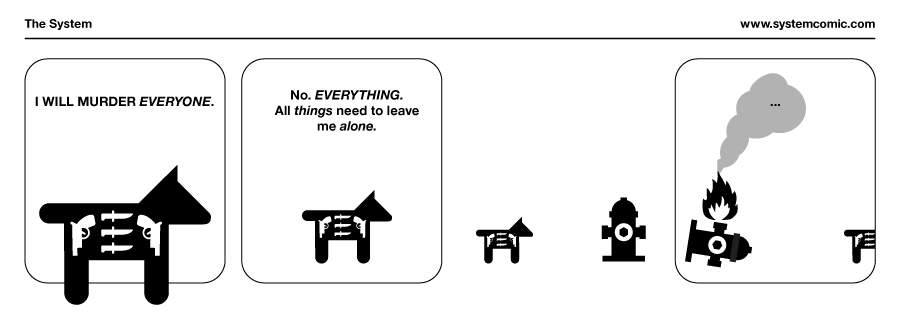
Jimmy the Murderdog is having that kinda day. He has that kinda day every day.
If you’re having that kinda day, watch this:
Matthew KochShared photos before, I believe. Just now discovered video.
 South Korean artist Wang Zi Won creates enlightened robots, including the Buddha and an idealized mechanical doll based upon himself, as a guidepost for a future in which technology lead to self-actualization:
Humans will evolve and adapt themselves to enhanced science and technology just as men and animals in the past evolved to adapt themselves to their natural circumstances. The artist sees this as our destiny, not as a negative, gloomy dystopia.
The artist considers it important to escape from human bondage in order to achieve harmony between men and machines. He thinks this harmony can be achieved through the process of religious practices and spiritual enlightenment.
The machine man was based on the artist, but this “I” is not a past “I” any more. His own existence vanishes, and a new being-as-machine man emerges. Z is thus a process of becoming the perfect “I”.
Macklemore's Billboard #1 hit single "Thrift Shop" gets a word-for-word MS Paint treatment!
Submitted by: Unknown
Share on Facebook

The continuous Fourier transform takes an input function f(x) in the time domain and turns it into a new function, ƒ̂(x) in the frequency domain. (These can represent other things too, but that’s besides the point.)
(Tumblr kept rejecting the proper sized GIFs, so they may look blurry, pixelated or compressed to you. There’s also HD video.)
In the first animation, the Fourier transform (as usually defined in signal processing) is applied to the rectangular function, returning the normalized sinc function.
In the second animation, the transform is reapplied to the normalized sinc function, and we get our original rect function back.
It takes four iterations of the Fourier transform to get back to the original function. We say it is a 4-periodic automorphism.
However, in this particular example, and with this particular definition of the Fourier transform, the rect function and the sinc function are exact inverses of each other. Using other definitions would require four applications, as we would get a distorted rect and sinc function in the intermediate steps.
For simplicity, I opted for this so I don’t have very tall and very wide intermediate functions, or the need for a very long animation. It doesn’t really work visually, and the details can be easily extrapolated once the main idea gets across, I think.
In this example, it also happens that there are no imaginary/sine components, so you’re looking at the real/cosine components only.
Shown at left, overlaid on the red time domain curve, you’ll notice a changing yellow curve. This is the approximation using the components extracted from the frequency domain “found” so far (the blue cosines sweeping the surface). The approximation is calculated by adding all the components, by integrating along the entire surface (this is continuous, remember?)
As we add more and more of the components, the approximation improves. In some special cases, it is exact. For the rect function, it isn’t, and you get some wavy artifacts in some places (the sudden jumps, aka discontinuities). These are due to Gibbs phenomenon, and are the main cause of ringing artifacts. As you’ll probably notice, the approximation is pretty much dead on for the sinc function, as shown in the second animation.
The illustration shows the domains in the interval [-5,5], but the Fourier transform extends infinitely to all directions, of course.
The surface illustrated here isn’t too far off from the approach used in Fourier operators. If you consider the surfaces defined by z = cos(xy) and z = sin(xy), you get the cosine and sine Fourier operators. Having complex values lets you mix both into one thing.
The surface you see in the first animation is just z = cos(2πxy)sinc(πy). The Fourier transform can be thought of as multiplying a function by these continuous operators, and integrating the result. This can be very neatly performed using matrix multiplication in the discrete cases. (New drinking game: take a shot every time linear algebra shows up in any mathematical discussion.)
This also explains why the Fourier transform is cyclic after 4 iterations: rotating 90° four times gets you back to your original position. By using different rotation angles, you get fractional Fourier transforms. Awesome stuff.
NOTE: This animation is a follow-up to the previous one on time/frequency domains, showing discrete frequency components. Check that one out too, as it may help with understanding this one.
Sadly, I had to reduce the images to 400 pixels wide instead of 500. Tumblr wouldn’t accept it otherwise. However, a HD video is also available:
This animation would probably look better with a different way of rendering that surface. Sorry, I don’t have anything better available at the moment, but I’ll work on it. If I do come up with something, I’ll post an update.

TIE BEES TO YR FINGERTIPS & OPERATE SMARTPHONE TOUCHSCREEN TO ACCESS BEEWEB, THE SECRET INTERNET OF BEES
Matthew KochMost of the "relaxing" tunes they mention have beats that are a bit distracting; that Marconi Union track is spot-on (for me), though. Link, as Old Reader doesn't seem to approve of embedded soundcloud: http://www.youtube.com/watch?v=CySNhHVAokQ
Scientists discover most relaxing tune ever
Sound therapists and Manchester band Marconi Union compiled the song. Scientists played it to 40 women and found it to be more effective at helping them relax than songs by Enya, Mozart and Coldplay.
Weightless works by using specific rhythms, tones, frequencies and intervals to relax the listener. A continuous rhythm of 60 BPM causes the brainwaves and heart rate to synchronise with the rhythm: a process known as ‘entrainment’. Low underlying bass tones relax the listener and a low whooshing sound with a trance-like quality takes the listener into an even deeper state of calm.
Dr David Lewis, one of the UK’s leading stress specialists said: “‘Weightless’ induced the greatest relaxation – higher than any of the other music tested. Brain imaging studies have shown that music works at a very deep level within the brain, stimulating not only those regions responsible for processing sound but also ones associated with emotions.”
The study - commissioned by bubble bath and shower gel firm Radox Spa - found the song was even more relaxing than a massage, walk or cup of tea. So relaxing is the tune, apparently, that people are being Rex advised against listening to it while driving.
The top 10 most relaxing tunes were: 1. Marconi Union - Weightless 2. Airstream - Electra 3. DJ Shah - Mellomaniac (Chill Out Mix) 4. Enya - Watermark 5. Coldplay - Strawberry Swing 6. Barcelona - Please Don’t Go 7. All Saints - Pure Shores 8. AdelevSomeone Like You 9. Mozart - Canzonetta Sull’aria 10. Cafe Del Mar - We Can FlyThis is so interesting.
Hold on.
WHAT WOULD HAPPEN IF YOU COMBINED IT WITH RAINY MOOD?
I just combined it with Rainy Mood.
IT’S FUCKING AMAZING.
holy shit i fell asleep to this last night and had the greatest sleep ive had in fucking ages
I ACTUALLY DID FEEL MY HEARTBEAT MATCH THE BEAT OF THE TRACK AND IT FREAKED ME THE FUCK OUT
OMFG yeah. I feel awesome now.
Flippin’ love some chill ambient. Collected an MP3 cd’s worth for long car rides / emergency chill-out.


Tilda Swinton as Gabriel in Constantine
PAGING THE INFAMOUS BLUEJAY.
This was one of two things that made this movie bearable.
See also: visual inspiration for one of the main characters in the book series I’m working on.
…someday I’ll actually start referring to them by name, as this isn’t exactly a hidden blog anymore. Whateverrrr.
Oh hello there, enormous ladyboner, how’s it going?
Matthew Koch"But the trial proves just how thorny it will be to get artificial intelligence to communicate naturally."
Swearing is fucking natural, goddammit.
Two years ago, Brown attempted to teach Watson the Urban Dictionary. The popular website contains definitions for terms ranging from Internet abbreviations like OMG, short for “Oh, my God,” to slang such as “hot mess.”
But Watson couldn’t distinguish between polite language and profanity — which the Urban Dictionary is full of. Watson picked up some bad habits from reading Wikipedia as well. In tests it even used the word “bullshit” in an answer to a researcher’s query.
Ultimately, Brown’s 35-person team developed a filter to keep Watson from swearing and scraped the Urban Dictionary from its memory. But the trial proves just how thorny it will be to get artificial intelligence to communicate naturally. Brown is now training Watson as a diagnostic tool for hospitals.
”
>Real spider webs captured behind glass
New Jersey-based artist Emil ‘Rocky’ Fiore managed to capture the fragile beauty of spiderwebs by mounting them behind glass. Fiore lightly sprays the webs in aluminum silver paint to imitate the texture of dew.
Of his work, Fiore states: ‘My concept is simply to catch the web. to preserve its beauty. and unlike photographs, my method isolates the web and displays the structure and design free of any distracting background. of course each and every one is a real spiders web and they are as varied as snowflakes or fingerprints, yet they are highly stylized and recognizable by species to a trained eye’.




This is kinda how I feel today.


Some of my favorites from 53 Terrible Jokes in Under 4 Minutes
Why do the French make omelets with only one egg?
Because in France, one egg is an oeuf.
I lost my shit.


I never knew Patrick Stewart was such a cuddly guy! ADORBS!
Edit: Original taken down. This one’s stayed up for a month, though: http://www.youtube.com/watch?v=lnOKAfliK0k


Motherboard Earth by Alain Bousquet
Encoded in our DNA is the organic circuitry of life, programming everything from our physical structure to the hardwired commands needed to run, fight, or play. Alain’s series of interlaced circuits create a user interface for the abstract ideas we use to build our world.