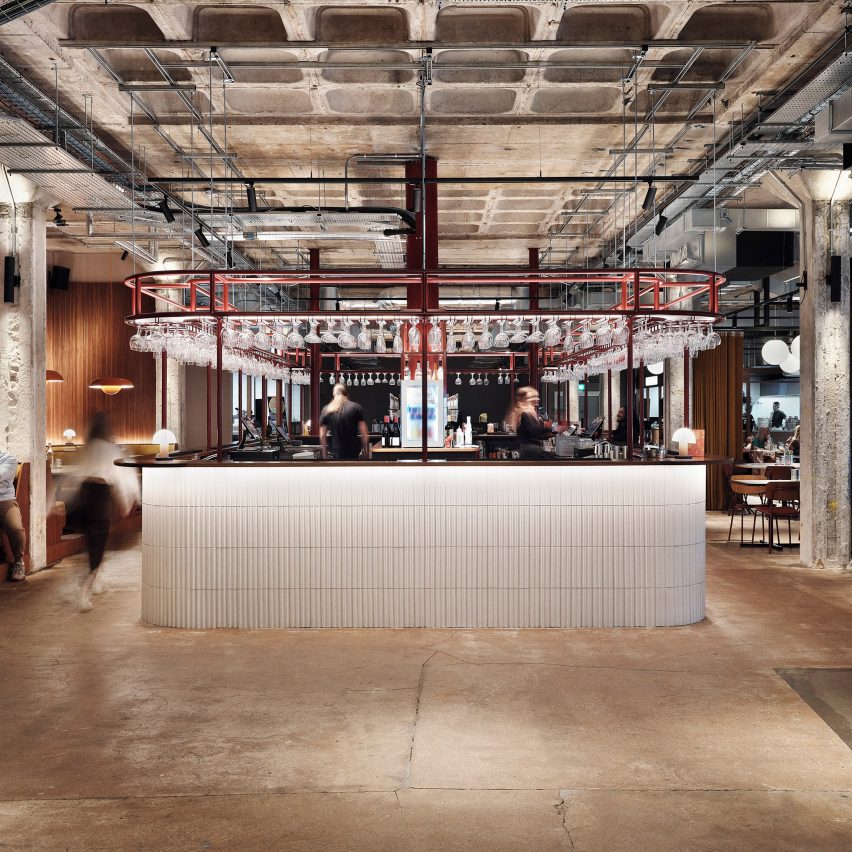
Architecture studio Sheppard Robson has remodelled the New Century Hall music venue in Manchester, restoring, rationalising and "opening up" the Grade-II listed structure. Read more
Architecture studio Sheppard Robson has remodelled the New Century Hall music venue in Manchester, restoring, rationalising and "opening up" the Grade-II listed structure. Read more

The average US tariff rate—the tax the government levies on the value of imported products—is higher for women's underwear than it is for men's. Most other countries have a flat tariff for undies across the board while in Japan and the European Union, women's underwear are taxed a lower rate than men's. — Read the rest

Community and Rick & Morty creator Dan Harmon brought the internet's attention to a strange conspiracy within the realm of Hallmark Christmas movie narratives. Sister Swap: Christmas in the City and Sister Swap: A Hometown Holiday are two different Christmas movies, released by the Hallmark Channel one week apart. — Read the rest

[caption id="attachment_231988" align="alignright" width="240"] It's our December donation drive. Click our donation page for info or use the donor widget on this page. Thanks![/caption]
When Shelley Bontje took her driver's license exam for the first time, she failed — and so did almost everyone she knows.
"My brother is really into cars, and even he didn’t get it on his first go," she added. "If you make one major mistake, you’re done. ... But I would say, in the end, that we're really good drivers."
That notorious test was the Dutch rijexamen, which is known for being one of the hardest in the world — though it doesn't get much press overseas.
Even as Holland has become globally famous for its people-first infrastructure, transportation professionals like Bontje, who works at the Dutch Cycling Embassy, have noticed that U.S. advocates rarely talk about the arduous process Netherlanders must undertake before they're allowed to drive, or how education contributes to her country's eye-popping safety stats. The per-capita road fatality rate in Holland has been roughly one-third of America's for decades.
Bontje said that much of that success can be credited to great road design, but that the nation's driving schools deserve some credit, too.
"How can you expect people with no education on a topic at all to behave properly?" she added.
[protected-iframe id="28f88e4a9861e74968fd6c591f98fcef" height="650" width="700" /]
Of course, getting a driver's license isn't totally impossible in Holland — indeed, 80 percent of Dutch adults will eventually get one, compared to 89 percent of Americans — and on paper, passing muster at a Dutch DMV doesn't seem too daunting.
According to local driving schools, about 48 percent of test-takers in the Netherlands will fail either their written or on-road test in a given year, which is roughly on par with states like Arkansas (47 percent) and Oregon (46 percent). Notably, neither U.S. community nor Holland actually require would-be drivers to take a formal driver's education course — even though Oregon officials note that 91 percent of teens involved in crashes didn't take one.
Experts say, though, that not hitting the books is pretty rare among Dutch drivers because "without driving lessons it is virtually impossible to pass the driving test," as the country's Institute for Road Safety research notes. And even with an average of 42 practice hours behind the wheel and thousands of Euros worth of study sessions with a professional instructor who has to go through a rigorous certification process of her own, many still struggle to succeed.
"Most people really need to study for it," added Bontje. "You won’t pass without studying unless you’re some kind of an Einstein-type."

The first ingredient that makes Holland's driver's licensing program so successful, though, is simply making young drivers wait a little while. Even the smartest baby Einstein can't take the notorious theorie-examen, or off-road "theory" test, until she turns 16, and when she does, she'll have to answer 65 challenging questions about virtually anything she'll encounter on the road. (Washington state, which some studies say has the hardest test in the country, has 40 questions, while many states have just 20 or 25.)
[caption id="attachment_231999" align="alignnone" width="1024"] An image from an actual Dutch driver's test, via Youtube[/caption]
The test begins with a timed "hazard recognition" section during which students have just eight seconds per question to assess a photo of a complex roadway environment and indicate how they'd behave in response. Nearly every image is full of easy-to-miss but critical details, like a pedestrian emerging from between two parked cars, or a soccer ball in the middle of the road, suggesting that a child might be following close behind.
That's followed by "knowledge" and "insight" sections, which resemble the kind of multiple-choice tests with which most American license-seekers — except way harder.
Would-be drivers have to answer a randomized selection of forty questions from a pool of more than 1,500 possible prompts, including both typical prompts ("when should you use your low-beams?") and hyper-arcane details, like the maximum length of a tow rope, or whether a Segway is classified as a motor vehicle. Test-takers might be denied a license for not knowing whether their cars' heating or air conditioning uses more fuel, or what to do if their vehicle becomes submerged in a lake, or why the design of a sleepy rural road might induce "polderblindness," or zoning out behind the wheel.
If they just miss three of the twelve "knowledge" questions, they'll fail; if they miss four of the 28 "insight" questions, that's a fail, too. Put another way: every single driver on the road in the Netherlands scored a B+ or better on her written test.
This journalist, who passed her U.S. exam with flying colors, failed three practice tests before she gave up.
[caption id="attachment_232038" align="alignright" width="1391"] Bontje noted she got this question on her actual theorie-examen.[/caption]
Even if he conquers the dreaded written exam, though, a Dutch teenager still can't even touch a steering wheel until he turns 16 and a half — and even then, he can only drive with a registered "coach" in the passenger's seat. And when he finally does get to take his road test at the ripe old age of 17, our would-be driver still might fail, because many examiners have such sky-high standards.
As one ex-pat laments:
"You can fail the test for driving too slow or too fast, for being ‘not confident enough‘ or ‘overconfident‘. You simply can’t win this game. An experienced driver from the US recalls that the first time he failed for ‘being too sure of himself‘, the second time for giving a way to a mom biking with two kids, and the third time the examiner asked: 'Why did you fail the first two times?' before announcing that he failed again."
And even if he doesn't fail, our novice motorist still can't drive unsupervised — because that privilege is only afforded to 18 year olds, an age at which most U.S. teenagers have held an unrestricted license for a full two years.
Experts, though, have long questioned the wisdom of giving driving privileges to children with still-developing brains and even less on-road experience. The Insurance Institute for Highway estimates that simply moving South Dakota's licensing age from 14 and a half years old — the lowest in the nation — to 17, fatal crashes among teenagers would plunge by 30 percent, even if no other graduated licensing requirements were instituted.
https://www.youtube.com/watch?v=X-gclQlhDi4
Bontje emphasizes that Holland's ultra-hard licensing exam isn't the only reason why it's such a safety standout, and that even the worst drivers are regularly stopped from causing harm by the country's profusion of "self-enforcing" infrastructure, like protected bike lanes. Even the best streets, though, can still require a little explaining – if only to hammer home why driving safely is so important.
"Self-explanatory infrastructure is essential," Bontje adds. "But when you’re in a car, you can always be a danger to others. That’s where education comes in."
And when a Hollander simply can't pass her test, it's often not the out-and-out disaster that might be for a car-dependent American. Bontje points out that all Dutch drivers over 75 are required to be examined by doctor to assess their fitness to drive — and, sometimes, pass the arduous exam all over again — but if they don't, they can often still live a healthy, independent life without a car, because the country's transportation network, though still imperfect, offers them options.
"You still feel this sentimental idea of, 'I’m losing my freedom,'" she said. "But at the other end, of course, there are way more alternatives to get around — by bike, by public transport, or walking ... There are people who will never have a drivers license at all, and they're thriving."
Editor's note: This article originally referred to the Dutch Cycling Embassy as the Dutch Cycling Federation. It has been edited to correct the error.

In the 90s, Kenan & Kel ruled children's television. Kenan and Kel's unmatched comedic talent in the sketches of Nickelodeon's All That, a kid's version of Saturday Night Live, propelled the duo into a spin-off sitcom and feature-length film. For millions of Millenials, Kenan & Kel were the 90s equivalent of the Smothers Brothers and the Odd Couple combined. — Read the rest

We all knew inkjet printer cartridges were an outright scam, but sadly it seems that the makers of laser toner cartridges have some explaining to do as well. Lumafield scanned a new one and an "empty" one with an industrial CT machine and reports that the new one was sold 20% full and the "empty" one still had 15% in the tank. — Read the rest
Plenty of countries have vulnerability disclosure requirements in place. This is supposed to increase the security of all users by requiring notification of affected platforms or software of exploits that may be used by malicious entities.
Define “malicious entity” tho.
The NSA has never abided by these requirements, despite being the free world leader in surveillance. It would rather delay notification than give up vulnerabilities that give it an upper hand on its surveillance targets. And if the NSA is doing it, then everyone is doing it. Say what you will about the NSA (lord knows I have), but it likely has more oversight than any other government surveillance entity in the world.
And if the NSA feels comfortable blowing off mandates to maintain its surveillance capabilities, it’s unlikely a government that deploys one of the most pervasive and invasive domestic surveillance programs in the world is going to care what Microsoft has to say about its actions.
The Chinese government has issued mandates requiring increased vulnerability reporting from hardware and software providers that do business in China. This would obviously include Microsoft. But this isn’t being done to make citizens safer. It’s being done to allow the Chinese government to make use of vulnerabilities reported to the government on its one-way disclosure street.
Somehow, the entity heading up US Homeland Security efforts sees nothing wrong with how the Chinese government handled vulnerability disclosures, as reported by Jonathan Greig for The Record.
Concerns that the Chinese military would exploit vulnerabilities before reporting them more broadly was an integral part of the investigation into the handling of the widespread Log4j vulnerability. Reports emerged earlier this year that the Chinese government had sanctioned Alibaba for reporting the vulnerability to Apache first, rather than to the government.
The Homeland Security Department’s Cyber Safety Review Board spoke with the Chinese government and “did not find evidence” that China used its advanced knowledge of the weakness to exploit networks.
Maybe the DHS just didn’t look hard enough. There’s evidence this isn’t the case, as Microsoft stated in its latest security report [PDF].
[I]n a 114-page security report released on Friday, Microsoft openly accused the Chinese government of abusing the new rules and outlines how state-aligned groups have increasingly exploited vulnerabilities globally since they were implemented.
Here’s what the report says about the new reporting mandate and how the Chinese government is using the mandate to further its own aims:
China’s vulnerability reporting regulation went into effect September 2021, marking a first in the world for a government to require the reporting of vulnerabilities into a government authority for review prior to the vulnerability being shared with the product or service owner. This new regulation might enable elements in the Chinese government to stockpile reported vulnerabilities toward weaponizing them. The increased use of zero days over the last year from China-based actors likely reflects the first full year of China’s vulnerability disclosure requirements for the Chinese security community and a major step in the use of zero-day exploits as a state priority. The vulnerabilities described below were first developed and deployed by China-based nation state actors in attacks, before being discovered and spread among other actors in the larger threat ecosystem.
Unsurprising if true. This was always the goal of the new disclosure mandates. The Chinese government appears to have opened up a one-way portal that allows it to use reported exploits while keeping affected users in the dark. Unfortunately, it’s not all that unlike how the NSA has treated its disclosure requirements and the temptation to weaponize reported vulnerabilities often results in delayed disclosure to companies whose products and users are affected.
And this report won’t make anything better. China will continue to be China. And other nations might decide it’s in their best interest to start hoarding exploits, if for no other reason than to defend themselves against foreign governments and/or re-purpose exploits to go on the offensive. The internet is everyone’s playground. Unfortunately, it’s inhabited by far too many powerful bullies.

As the war in Ukraine rages on, an investigative team geolocated a Russian cruise missile program from a single group photo.

Prior the mass adoption of cell phones after Motorola's DynaTAC 8000x released in 1983, it was possible to cross the Place de la Concorde in the middle of rush hour like Ulrich Wickert demonstrates in the video below:
1984, U.
New Politico owner and Axel Springer CEO Mathias Döpfner has been craving U.S. press attention, and got more of it than he wanted this week. Döpfner was the focus of a not particularly flattering profile in the Washington Post showing, among other things, that the German billionaire was excited by the prospect of a second Trump term and really liked a lot of the stuff Trump was up to:
Döpfner went on to argue that Trump had made the right moves on five of what he deemed the six most important issues of the last half century — “defending the free democracies” against Russia and China, pushing NATO allies to up their contributions, “tax reforms,” and Middle East peace efforts, as well as challenging tech monopolies…“No American administration in the last 50 years has done more.”
Most of those claims, by any objective measurement of truth (not that we do that anymore), are comically wrong. The Trump GOP’s version of “antitrust reform,” for example, has been a bumbling, cronyistic, hollow mess. And the Trump era tax cuts generally involved throwing billions of dollars in tax relief at giant predatory monopolies like AT&T… in exchange for jack shit.
When pressed about the email by the Post, Döpfner allegedly tried to lie about it. Then, when the lie didn’t work, he tried to pretend he was just being “provocative.” A stellar start for a guy trying to position himself as a much-needed elixir to very broken U.S. journalism:
Asked about the email, Döpfner initially responded with a forceful denial. “That’s intrinsically false,” he said. “That doesn’t exist. It has never been sent and has never been even imagined.”
When shown a printout of the text, Döpfner allowed a glimmer of recognition. It’s possible, he said, that he may have sent the email “as an ironic, provocative statement in the circle of people that hate Donald Trump,” because that’s exactly the kind of ironic, provocative thing that Döpfner, a garrulous and enthusiastic texter, likes to do.
The profile paints a picture of a wealthy billionaire who doesn’t actually understand how the U.S. media industry he’s now a major player in actually works. Döpfner is at the vanguard of a number of executives and outlets that are responding to surging fascism by avoiding hard truths and heading further to the right, all the while pretending this rightward shift is objective and non-biased.
Döpfner’s media ventures (see: Bild) are quite often opinionated, sensational, and/or just flat out rightward leaning, and Döpfner is on record lauding Trump and lambasting the diabolical wokes. Yet Döpfner then gets to pretend that he has a grand vision for Politico where it operates above the “polarized” fray:
A newcomer to the community of billionaire media moguls, Döpfner is given to bold pronouncements and visionary prescriptions. He’s concerned that the American press has become too polarized — legacy brands like the New York Times and The Washington Post drifting to the left, in his view, while conservative media falls under the sway of Trumpian “alternative facts.” So in Politico, the fast-growing Beltway political journal, he sees a grand opportunity.
“We want to prove that being nonpartisan is actually the more successful positioning,” he said in an interview with The Washington Post. He called it his “biggest and most contrarian bet.”
Politico (like Axios, the New York Times, and countless others) is already routinely accused of delivering rather timid, centrist-to right leaning “he said she said” or “view from nowhere” reporting extremely focused on not upsetting sources and advertisers. It’s the type of reporting that often comically portrays all issues, even issues with very obvious truths (climate change, fascism, white supremacy) with false equivalency kid gloves, then tries to pass off this truth-averse fecklessness as somehow sagely nonbiased.
"There are two words we need to remove from our media vocabulary right now & that is 'both sides.' This crutch, this reliance on 'both sides' as a kind of lazy way of covering our political moment is deeply dangerous."
My comments to @semaforben this morning in DC – watch/share: pic.twitter.com/edPKXvAGFL
— Mehdi Hasan (@mehdirhasan) September 7, 2022
Outlets pursuing this route aren’t actually interested in being “non-partisan,” they’re interested exclusively in what makes money. And in the U.S., feckless, “he said, she said” “both sides” reporting maximizes potential revenue and avoids offending sources and advertisers, which is why both CNN and CBS have also been pursuing it despite plenty of hard lessons on the perils of this trajectory over the last decade.
There is absolutely zero indication that Döpfner, poised to be a major player in the U.S. media over the next decade, understands absolutely any of this. The Post profile paints the picture of a wealthy jet setter who is politically right wing but pretends otherwise so he can attend the right DC and NY dinner parties, and/or is not really even sure where his own politics lie (despite some pretty obvious indicators):
[Döpfner] worries about what he sees as cancel culture, and in private conversations, friends say, he gripes about identity politics. One of his sons works as the chief of staff to Peter Thiel, the conservative-libertarian tech billionaire turned MAGA kingmaker, but Döpfner has only met him a few times and says they are not close. He does profess a fondness for “contrarians,” though, and called provocateur Tesla CEO Elon Musk, currently embroiled in litigation over his noisy attempt to take over Twitter and upend its moderation policies, “one of the most inspiring people I’ve ever met.”
What the U.S. media needs is greater diversity, a massive infusion of funding, an army of courageous young journalists, better pay, far less consolidation, and leadership that actually understands not only the reality most of us inhabit but the very real threat surging fascism is posing to Democracy. Leadership that’s fully aware how “both sides” reporting is routinely exploited by grifters and authoritarians.
What we keep getting instead are loud-mouthed, ultra-rich, center-right moguls with no shortage of opinions but little actual insight, pushing the kind of chickenshit false equivalency reporting that created a significant chunk of our problems in the first place.
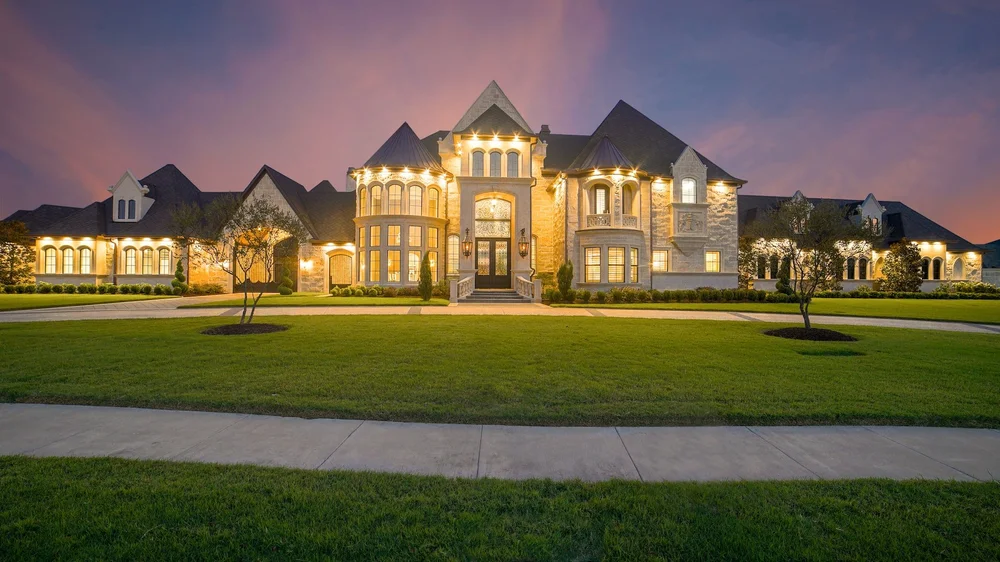
(Source: Unsplash.)
Every time your local elected officials tell you they don’t have money for park maintenance, public school teachers, or basic public safety measures, remember this: They’re only telling part of the story.
In reality, there are more resources available, but tax assessments are being eroded by local property tax breaks received by homes in the highest range of values: Mansions on large lots, not rundown properties in low-socioeconomic-status neighborhoods, are the real blight on a community’s financial health.
What I’m describing here is not the work of some malicious bureaucrat or a cabal of county staffers plotting how to make the rich richer. It’s a tragedy of bad math. My local government uses some supremely flawed formulas and techniques to generate these valuations—and yours may very well be making the same mistake.
You haven’t voted to approve this tax break, of course. It's a quirk of the math, baked into the way your local property values are calculated. In this system, the wealthy are clearly and repeatedly advantaged.
My firm, Urban3, has analyzed property tax records in many places and we’ve seen this happen all over the country. I’d like to highlight my hometown of Asheville, North Carolina, as one example. (You can play this game yourself in your community if you can get the property assessor’s data. Check your local county government’s website to see if they have a GIS portal and start poking around.)
What’s worse, the assessed values of mansions drop precipitously over time. Why? It’s unclear, but it’s happening.
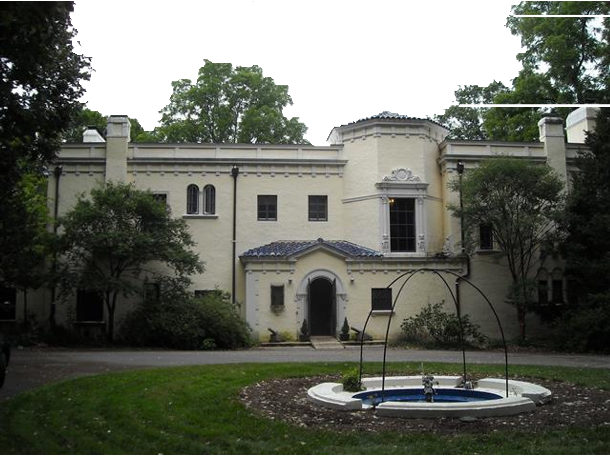
Thirteen-thousand-square-foot Spanish Mediterranean 1926 Mansion, on 22 acres. (Image: Buncombe County.)
The above eyesore designed by Addison Mizner, a prominent Florida architect from the 1920s, is one of my favorites.
Weighing in at a modest 13,426 square feet of livable space, this worn-out shack is choked in on a meager 21-acre lot abutting the beautiful Blue Ridge Parkway. In North Carolina, our assessment law says a property’s assessed value should be equal to what someone would pay—but apparently this hovel would be tough to market. Assessed at a “priced to sell” $3 million total value, that roughly converts to a discount of $7 million from comparable nearby sales. This translates to $37,000 in local tax relief every year. Those champagne wishes and caviar dreams aren’t cheap, so every bit helps, I suppose. By the way, $37,000 is the base annual salary for a public teacher in our community. Think about that: One house’s tax break is equal to one teacher’s wages.
Here’s the real kicker, though: in 2011, this house was assessed at about $4 million. Adjusting for inflation, it’s dropping a whopping -54% of its value as of this year, according to the county assessor's office. Meanwhile, the average house in my city has increased in value by 273% over the same period. Apparently, there is no desire for wealthy folks to move here.
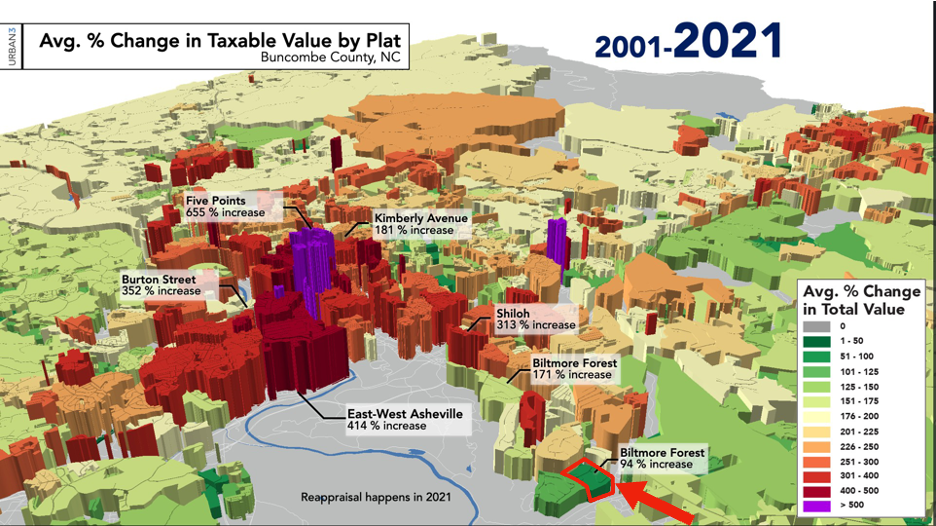
This highlighted neighborhood in Biltmore Forest only increased in value by 94% over 20 years. (Image: Urban3, using Esri software.)
This is clearly affecting other nearby properties. If we were thinking about this like any other kind of neighborhood blight, we’d be reacting with serious concern! Take the example above: If we look at its neighbor, it’s losing over $4 million of assessed property value over that same window and adjusted for inflation, resulting in a discount of over $22,000 in taxes per year. If this property’s assessed value did nothing more but keep pace with inflation, it would be paying $22,000 more in taxes this year—roughly equivalent to the salary of a teacher’s aid. These are not anomalies, nor am I cherry-picking. There is a quadrant of this neighborhood of Biltmore Forest that is totally tanking in taxable value (see above: Biltmore Forest is indicated with an arrow). This just happens to be the wealthiest and most exclusive community in my county, which makes it one of the most desirable communities in the state of North Carolina.
This plague of plummeting assessed values and corresponding tax benefits shows up on the other side of town, over by the country club and golf course. This property (below) sold for $3.9 million. That same year, it was assessed a meager $1.2 million. Because, let’s face it, no one wants a 9,504-square-foot mansion on a 3-acre lot. That buyer must be a total rube. As we know, it’s only an ignoramus that could drop $3.9 million on some hovel. What a sucker! This dump’s assessment has shed about $670,000 in value over the last 10 years. A healthy discount of $3,500 taxes per year, or about a year of gas for a deputy sheriff. Adding to this insult, because the value was set in the 2021 assessment year, the 2022 purchaser gets to enjoy paying the old tax value. For the next THREE YEARS!
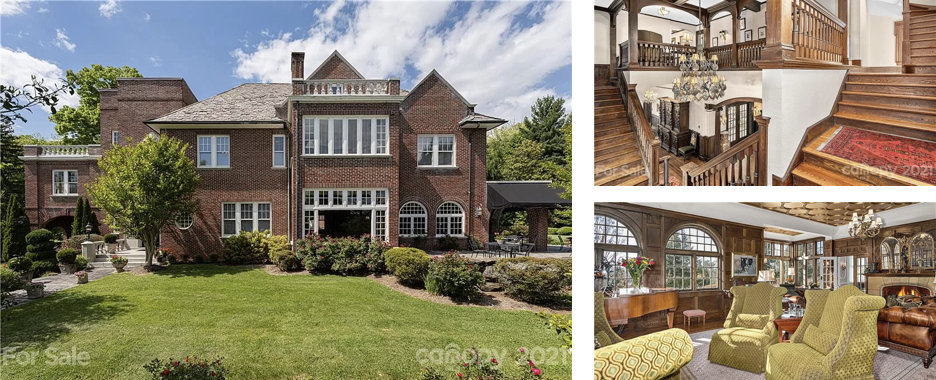
This North Asheville shack by the country club sold for $3.9 million, even though it has lost over $670,000 in taxable value over the last 10 years. (Images: Zillow & MLS.)
Like me, you’ve probably seen folks show up en masse to a local zoning board or city council meeting, clamoring and crying that a new duplex planned for their neighborhood will send their property’s market values plummeting. Au contraire! More often than not, that duplex will be way more potent than a single-family detached home and will increase neighborhood value. This translates to more tax generation, not less, which makes it a great deal for all taxpayers. For instance, in Asheville, single-family homes average $1.5 million per acre and a duplex is $4.1 million. On the other side of the country, in King County, Washington, it is $1.5 million per acre and $3.8 million per acre, respectively. Compared to the neighborhood mansions I’ve mentioned above, they’re feebly eking out at $0.1 million per acre and $0.4 million per acre, respectively. Where are the hordes of angry homeowners with handmade signs and coordinated t-shirts, decrying the loss of value to their homes? It seems to me that this blight should be a matter of grave civic concern!
In Buncombe County, we’ve raised these issues with our local government. The burden is on them to fix what’s wrong. If they are serious about repairing the harm caused by decades of inequitable and unfair practices, they need to correct this misplaced welfare for the wealthiest folks in our county. We’re distributing over $5,000,000 every year in tax breaks to the richest people in our community—this isn’t the Feds, the U.S. Congress, or even the state legislature—these are decisions made at the local level, by elected officials who live here in Buncombe County.
This same government earned praise in 2020 for being among the first local governments in the U.S. to pass a resolution acknowledging the deep damage of racial inequity and calling for reparative solutions. If they are now going to live up to the resolution’s rhetoric, they can start by addressing the problems I’ve pointed out here. Otherwise, they may as well hit the delete button on that resolution.
Joseph “Joe” Minicozzi is the principal of Urban3 and an urban planner imagining new ways to think about and visualize land use, urban design, and economics. Joe founded Urban3 to explain and visualize market dynamics created by tax and land use policies. His award-winning analytic tools have garnered national attention in Planetizen, The Wall Street Journal, Planning, New Urban News, Realtor, Atlantic Cities and the Center for Clean Air Policy's Growing Wealthier report. He holds a Bachelor of Architecture from the University of Miami and Master of Architecture and Urban Design from Harvard University. In 2017, Joe was recognized as one of the 100 Most Influential Urbanists of all time. He is a founding member of the Asheville Design Center, a non-profit community design center dedicated to creating livable communities across Western North Carolina.

The Court’s decision is a tremendous, if not unexpected, blow to poor Puerto Ricans.
United States v. Vaello Madero, which the Supreme Court decided on Thursday, is a heartbreaking case. It asks whether many of the poorest and most vulnerable Americans can be cut off by their own government simply because they live in the wrong part of the United States.
But Vaello Madero is also a case about democracy, and whether democratic governments can enact policies that are needlessly cruel. In an 8-1 decision joined by every justice but Justice Sonia Sotomayor, the Court effectively answered that question in the affirmative.
The case involves Jose Luis Vaello Madero, an American citizen who is very poor. After Vaello Madero became seriously ill in 2011, he started receiving benefits under a federal program called Supplemental Security Income (SSI), which provides financial assistance to aged, blind, or disabled individuals who lack the means to support themselves.
About a year after he started receiving benefits, Vaello Madero moved from New York to Puerto Rico so that he could be closer to his family, and the government continued to deposit his SSI benefits into his bank account for a few years after that. In 2016, however, Vaello Madero filed for additional Social Security benefits, and the federal government learned for the first time that he’d relocated to Puerto Rico.
This seemingly innocent decision had terrible consequences for Vaello Madero because, by law, SSI benefits are only available to residents of the 50 states, the District of Columbia, or the Northern Mariana Islands. Puerto Ricans are eligible for a different program, known as Aid to the Aged, Blind, and Disabled (AABD), but the benefits under AABD are far smaller than the benefits available under SSI.
As Sotomayor notes in dissent, far fewer people are eligible for AABD benefits than would receive SSI benefits if SSI were available in Puerto Rico. And “Puerto Rico residents enrolled in AABD in 2021 received an average of $82 per month, compared to the $574 per month that the average SSI recipient received in Fiscal Year 2020.”
Worse, the government didn’t simply cut off Vaello Madero’s SSI benefits. In 2017, it sued him for over $28,000, claiming that he must pay back the SSI benefits he received while living in Puerto Rico.
And yet, in Vaello Madero, every justice but one joined an opinion, by Justice Brett Kavanaugh, holding that Congress could discriminate against Puerto Rican residents when deciding who is eligible for federal benefits.
Under existing law, Vaello Madero was correctly decided. It’s rooted in a longstanding legal rule, known as the “rational basis” test, which provides that courts should typically defer to the policy decisions made by elected branches, especially when those decisions involve economic policy. This rational basis test is one of the most hard-fought progressive victories of the Franklin Roosevelt administration, because it ensured that the Supreme Court would stop sabotaging New Deal programs.
But, as Vaello Madero shows, this sort of judicial deference can be a double-edged sword.
The rational basis test was a liberal democratic response to early 20th century Supreme Court decisions that sabotaged progressive legislation, often relying on highly dubious legal reasoning to do so. In the first third of the 20th century, the Court struck down federal child labor laws, invalidated minimum wage laws, stripped workers of their right to unionize, and struck down laws prohibiting employers from overworking their employees — among many other things.
After the Court started striking down New Deal programs, Roosevelt went to war with the Court’s conservative majority— at one point threatening to add additional seats to the Supreme Court in order to dilute the conservative justices’ votes. Eventually, conservative Justice Owen Roberts broke with his four most right-wing colleagues and started voting with more liberal justices to dismantle the doctrines the Court had used to strike down things like child labor laws.
The culmination of this turn towards judicial restraint was United States v. Carolene Products (1938), which established that, with some important exceptions, legislation — and especially economic legislation — “is not to be pronounced unconstitutional unless in the light of the facts made known or generally assumed it is of such a character as to preclude the assumption that it rests upon some rational basis within the knowledge and experience of the legislators.”
Basically, under this rational basis test, courts will uphold nearly all legislation so long as the government is able to articulate some rational reason why it should exist. Kavanaugh’s opinion in Vaello Madero holds that Congress’s decision not to provide SSI benefits to Puerto Rican residents clears the very low bar set by the rational basis test.
As Kavanaugh notes, “residents of Puerto Rico are typically exempt from most federal income, gift, estate, and excise taxes,” but they do pay “Social Security, Medicare, and unemployment taxes.” Meanwhile, on the benefits side, residents of Puerto Rico are eligible for some federal benefits — including Medicare, Social Security, and unemployment benefits — but not others.
Given that residents of Puerto Rico, as a whole, pay fewer taxes than residents of the mainland, Kavanaugh concludes that it is rational for those same residents to receive fewer benefits.
As a policy matter, this argument isn’t especially convincing. As Sotomayor writes in dissent, SSI is not a program for the territory of Puerto Rico, it is a program for individual Americans. And, because SSI is a program for the poor, “SSI recipients pay few if any taxes at all,” regardless of where they live. If Vaello Madero moved back to New York, it is unlikely that he would pay any federal income taxes, but he would nonetheless be eligible for SSI.
But the rational basis test does not care if a federal policy is actually a good idea — the whole point of this test is to get judges out of the business of second-guessing Congress’s policy choices. And so, if you accept that the New Deal Court was correct to stop sabotaging Roosevelt’s policies, it’s difficult to argue persuasively that the current Court may override Congress’s approach to Puerto Rico.
Vaello Madero’s strongest legal argument is that there are exceptions to the rational basis rule. As the Supreme Court held in City of Cleburne v. Cleburne Living Center (1985), one important exception is that the Constitution typically forbids discrimination against groups that have “experienced a `history of purposeful unequal treatment’ or been subjected to unique disabilities on the basis of stereo-typed characteristics not truly indicative of their abilities.”
In their brief, Vaello Madero’s lawyers argue that Puerto Ricans have historically faced such discrimination.
Indeed, if Congress had excluded all people of Puerto Rican descent from receiving SSI benefits, that law would be unconstitutional — discrimination on the basis of race or ethnicity is almost never allowed. But that’s not what this law does. As the government argued in its brief, the Constitution’s anti-discrimination protections have historically been understood to prevent “unequal treatment of classes of persons, not unequal treatment of regions.”
Federal law excludes all people who live in Puerto Rico, regardless of their race or ethnic background. And if someone from Puerto Rico moves to the mainland — as Vaello Madero did when he lived in New York — they are eligible for SSI benefits.
That said, there is at least one very high profile example of the Court forbidding “unequal treatment of regions,” and it occurred in a case that many civil rights advocates view as one of the worst decisions of the modern era.
In Shelby County v. Holder (2013), the Court struck down a provision of the Voting Rights Act that requires states with a history of racist election practices to “preclear” any new election rules with officials in Washington, DC, before those new rules could take effect. The Court’s Republican majority determined in Shelby County that Congress generally cannot treat different states differently.
Shelby County is wrong for many reasons, but one of those reasons is that the Court seemed to abandon the deferential rational basis test in order to strike down a voting rights law. Congress undoubtedly had a rational reason for treating states with a history of Jim Crow-like practices differently than states which have historically respected the right to vote.
Shelby County, and not Vaello Madero, was a departure from the ordinary rule that courts should be reluctant to second-guess Congress’s policy decisions. Again, the decision in Vaello Madero is consistent with decades of Supreme Court decisions calling for judicial restraint.
But that restraint becomes a partisan weapon if it is applied selectively. The biggest problem with Vaello Madero isn’t its recognition that achieving the broad goal of allowing democratically elected legislatures to govern sometimes means upholding unjust laws.
The problem is that, if the Court was willing to make an exception to its longstanding rules to restrict the right to vote, why wasn’t it willing to do so to help impoverished Puerto Ricans?

A long-running Japanese TV show that challenges young children to navigate their cities without adult supervision is prompting a conversation about why American cities are so comparatively hostile to kids — and not just because of the dangerous way our cities are built.
On April 1, streaming giant Netflix re-released a 2013 season of the reality show “Old Enough!” in which Japanese kids ranging from 2- to 5-years old are sent out on foot alone to complete simple household errands in their local communities. Along the way, those intrepid tots have to cross busy streets, find their way through labyrinthine neighborhoods, and know when it’s time to ask for help from the friendly strangers they meet (and, occasionally, the cameramen whom they’ve clearly been instructed to ignore). One even manages to ride the bus by himself.
Give or take a few delays, most of which can be blamed on the toddlers’ own microscopic attention spans, the kids all make their way home safe.
A predictable flurry of think pieces followed the show’s release, from journalists on the urbanism and parenting beats alike.
The New York Times’s Jessica Grose mourned how America’s car-focused streets limit children’s opportunities to develop a sense of independence, effectively stripping them of the “sense of triumph” that their Japanese counterparts experience every time they successfully make their way home with an offering for the family Shinto shrine. (Child development researchers, by the way, share that concern; some of them even attribute increases in childhood depression and anxiety rates to the increasingly autoentric neighborhoods in which most North American kids are raised.)
Slate’s Henry Grabar, meanwhile, pointed out that “if the show were set in the United States, the parents would be under investigation by child protective services,” because the roads they’d be forced to navigate are so often dominated by fast automobiles and other dangers. Car crashes top the list of the leading causes of death among U.S. children and adolescents, claiming an average of 1,139 young lives every year since 2010; per capita, more than nine times as many American kids are killed by traffic violence than Japanese kids, even though Japanese kids, who walk for four out of five of their weekday trips, are only occasionally ensconced in a safety-rated automobile.
People recommend 'Old Enough' on Netflix but I can't watch it. I will get too upset that I live in the most walkable, dense city in America yet don't feel safe letting my kids walk places alone, even #OpenStreets, because of aggressive drivers & hazardous car infrastructure pic.twitter.com/EcEOEV0vLe
— ?? wants a Green New Deal ?? ? (@SusanLKang) April 13, 2022
Writers like Grabar and Grouse are right that community design is the major differentiator between the American and Japanese approaches to childhood mobility.
Japan’s 19-mile-per-hour neighborhood speed limits, ample shared-used paths, and near abolition of on-street parking all make walking the common-sense choice for most trips, as do the prevalence of “15-minute neighborhoods” that put essential destinations within a toddler’s feasible walking distance. (A study last year also found that Japanese cities also have some of the highest rates of women cycling of anywhere in the world, for much the same reasons.)
And while the the country’s “greeting culture,” or aisatsu, certainly deserves some credit for making these communities so child-friendly, it’s important to remember all the ways that culture is physically reinforced by design. Japan’s ultra-dense, mixed-use neighborhood designs all but guarantee that even the smallest tots will find themselves surrounded by the watchful eyes of friendly grown-ups almost everywhere they go — a feature of daily life that is rarely found in American cities.
But one of the lesser-discussed miracles of “Old Enough!” is that those grown-ups are almost never behind a wheel of a car so big they literally cannot see small bodies walking in front of it — or so heavy that they’ll all but certainly kill those children if they crash.
In 2017, the average U.S. vehicle weighed 3,820 pounds, a staggering 41 percent more than the 2,711-pound Japanese average. And by 2020, America’s average had ballooned to 4,156 pounds, fueled by automakers’ refusal to manufacture less-profitable small cars and the raft of regulatory loopholes that allow them to keep doing it — a 9-percent spike in just five years.
Japan’s relatively minuscule vehicle fleet is the result of policy choices, too.
Since creating the ultra-light vehicle class known as “kei cars” in 1949, the country has been known as the global capital of tiny vehicles designed to hold little more than their passengers. Kei cars top out at a little over 11 feet long and 6.5 feet high, and unsurprisingly, they cost a lot less than full-sized automobiles: the going price is about $10,000, about half the cost of a Corolla at a Japanese dealership. They’re also taxed at a lower rate, in addition to being held exempt from annual vehicle registration fees, and they cost thousands fewer yen to insure and maintain every year — a package of incentives that helped kei cars claim 40 percent of the Japanese vehicle market last year.
Most U.S. states, meanwhile, forbid the import of kei cars to America, and the ones that do generally require them to be registered as all terrain vehicles, which aren’t always allowed to operate on shared roads.
Even Japanese cars that aren’t so teensy are still safer for pedestrians than their US counterparts — and that’s by design, too.
Since its founding in 1995, the Japanese New Car Assessment Program has been internationally recognized for having some of the most forward-thinking federal vehicle safety ratings around, thanks in no small part to the country’s early efforts to evaluate the safety of people outside cars as well as in.
In hopes of reducing the Japan’s pedestrian fatalities, 60 percent of which involve a head injury, the ratings system has incorporated a “pedestrian head protection performance test” since 2003 to measure how likely a vehicle is to strike walkers at neck level and above, with special tests specifically for kids on foot. That test has prompted many Japanese automakers to design cars with more sloping front-end designs and lower bumpers, which experts say can save lives.
In November of 2021, Japan also became the first country in the world to require pedestrian detection-equipped automatic emergency braking systems on all new cars. By 2024, bicycle-detecting systems will also be mandatory.
American regulators recently announced that they will soon recommend that all new cars come equipped with automatic braking, but won’t actually require it — and they’ve so far made no recommendations against vehicle heights, weights and front-end styles that are known to be be a major ingredient in the country’s accelerating pedestrian death crisis. And while those failures might not be well known among American families, they certainly subconsciously effect the likelihood that any parent in their right mind would ever let their kid walk to the grocery store, whether they’re going it alone or not.
The children of “Old Enough!” certainly deserve credit for the bravery it takes to complete grown-up errands, as do the generations of adults that designed and cultivated such family-friendly places. But let’s not forget to celebrate the Japanese auto regulators who made sure that only the most people-friendly cars ended up on those neighborhood roads — and let’s not stop pushing for American regulators to follow their lead.

Editor’s note: A version of this article originally appeared on Strong Towns and the Dear Winnipeg blog and is republished with permission. It is focused on Winnipeg, Canada, but the policies and infrastructure it discusses are relevant to the United States as well.
It seems like every time there’s a news piece about a traffic collision involving a pedestrian, it’s followed by a flurry of discussion over the words used to describe the incident.
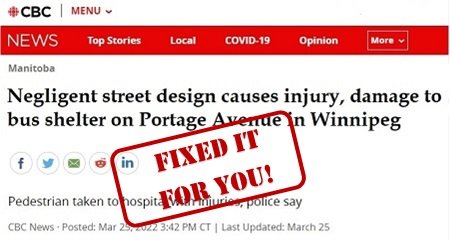
Take for instance a crash on Portage Avenue in Winnipeg, Canada that took place just over a week ago. This was the original headline:
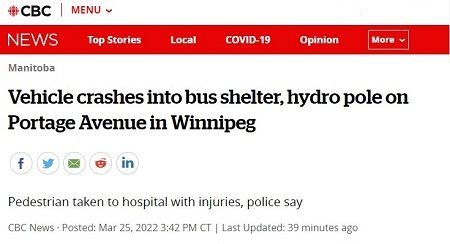
Understandably, people reading were upset that the broken bus shelter and hydro pole got higher billing than the actual human being that had to be taken to hospital. CBC quickly corrected the headline:
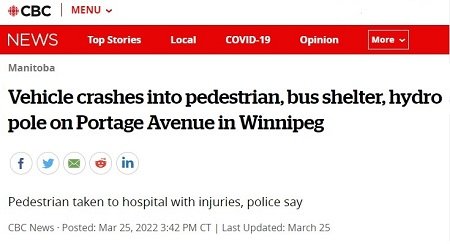
Much better. Yet, still not good enough. Because some people will point out, rightly, that vehicles have drivers. And for the same reason we don’t ever see headlines such as “Man shot by gun”, or “Chris Rock slapped by hand”, the headline here should have read “Driver crashes into pedestrian, bus shelter, hydro pole on Portage Avenue in Winnipeg”.
It makes sense. Using “vehicle” or “car” is very neutral language, and it tends to remove personal responsibility from the situation. Using “driver” reminds us of the human behind the crash, and subconsciously makes it easier to attribute blame for it.
And I completely understand that urge. Except I don’t think it’s that helpful, because in the overwhelming majority of cases, the driver is not to blame for the carnage. The traffic engineers who designed the street are, because drivers can only do what the design lets them.
Let me be clear: this was no accident. Massive property damage and pedestrians being injured (or killed) is our transportation system functioning precisely as designed. This is how it was designed to work. To understand that, we’ll need to explain a few traffic engineering concepts. So let’s get into it!
The traffic engineering profession understood a long time ago that humans are imperfect and will always make mistakes. It’s inevitable, and if you can’t change the users, change the system. So traffic engineers came up with the concept of “forgiving design” which was a way of designing the transportation system to “forgive” errors by drivers, so that when they made the most common mistakes, whether unintentional or through carelessness, the results didn’t end up being catastrophic.
One of those elements is the development of the “clear zone”. Now, I’ve talked about clear zones before, but this is worth repeating, so bear with me if you know all this already.
What is a Clear Zone? The Manual on Uniform Traffic Control Devices gives us a pretty straightforward definition:
The total roadside border area, starting at the edge of the traveled way, that is available for an errant driver to stop or regain control of a vehicle.
Manual on Uniform Traffic Control Devices (MUTCD), Section 1A. 13
Basically, it’s a buffer zone on the edge of the road to allow for out-of-control stray cars. Of course, the Manual says you want to keep this zone clear of any fixed objects, things like signs, trees, light standards, etc., because vehicles slamming into immovable objects at high speeds is really dangerous for the occupants of those vehicles.
So how big does this buffer need to be? The answer is it depends on the speed of traffic. The faster the vehicles are travelling, the larger the clear zone you need. And lucky for us, traffic engineers have gone through the trouble of doing those calculations.
On page 77 of Winnipeg’s Transportation Standards Manual are the guidelines for our own city’s “clear zones”. City engineers say that at traffic speeds of 60 km/h, the clear zone should be a minimum of 3.5m from the face of the curb, but that 5.0m is desirable.
Now, it’s important to pause here to recognize that these concepts were developed for highways. And they saved a lot of lives in that context. But, when you don’t acknowledge that urban areas are fundamentally different places than highways, you get some pretty messed up results.
For example, here’s what the required clear zone looks like on a typical block of Henderson Hwy in my neighborhood:
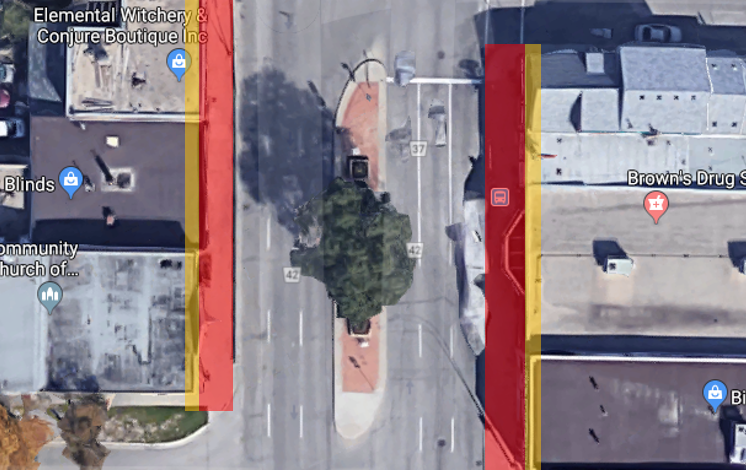
The red zones, which are the “minimum” clear zones, cover the entire sidewalk. And the yellow zones, which extend to the “desirable” clear zones, go well into the storefronts.
If you want to see an example in 3-D, here’s what the site of that aforementioned crash on Portage Avenue looks like with the clear zone delineated:
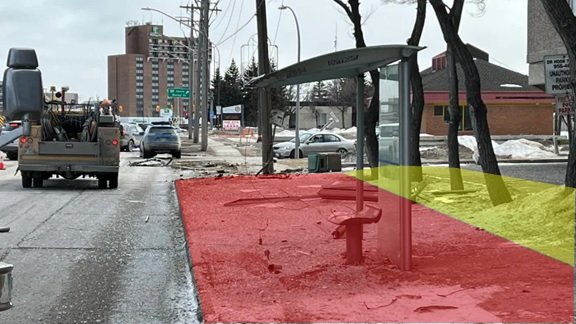
These are the “zones” that are supposed to stay “clear” of any immovable objects because of the very real possibility of cars leaving the roadway. And yet, this is where we tell people to walk, wait for the bus, and access local businesses. You can see the inherent conflict.
But surely cars leave the roadway so infrequently as for this to be insignificant, right?
My friend, surely you jest.
This is an occurrence so common that traffic engineers had to invent a whole new technology in order to keep “forgiving” the mistakes of drivers. Ladies and gentlemen, I present to you: the breakaway base!

The breakaway base was devised as a way to still be able to put objects in the clear zone without endangering the lives of vehicle occupants. Instead of a vehicle leaving the road, smashing into a stationary, immovable street light and killing everyone on board, the bases are equipped with shear pins that are designed to break when hit with any real force. The result is the pole snaps off its base at the moment of collision, and most of the kinetic energy of the collision is dissipated away from the occupants of the vehicle.
Pretty genius, actually.
But that leads to an obvious question regarding the placement of this bus bench:
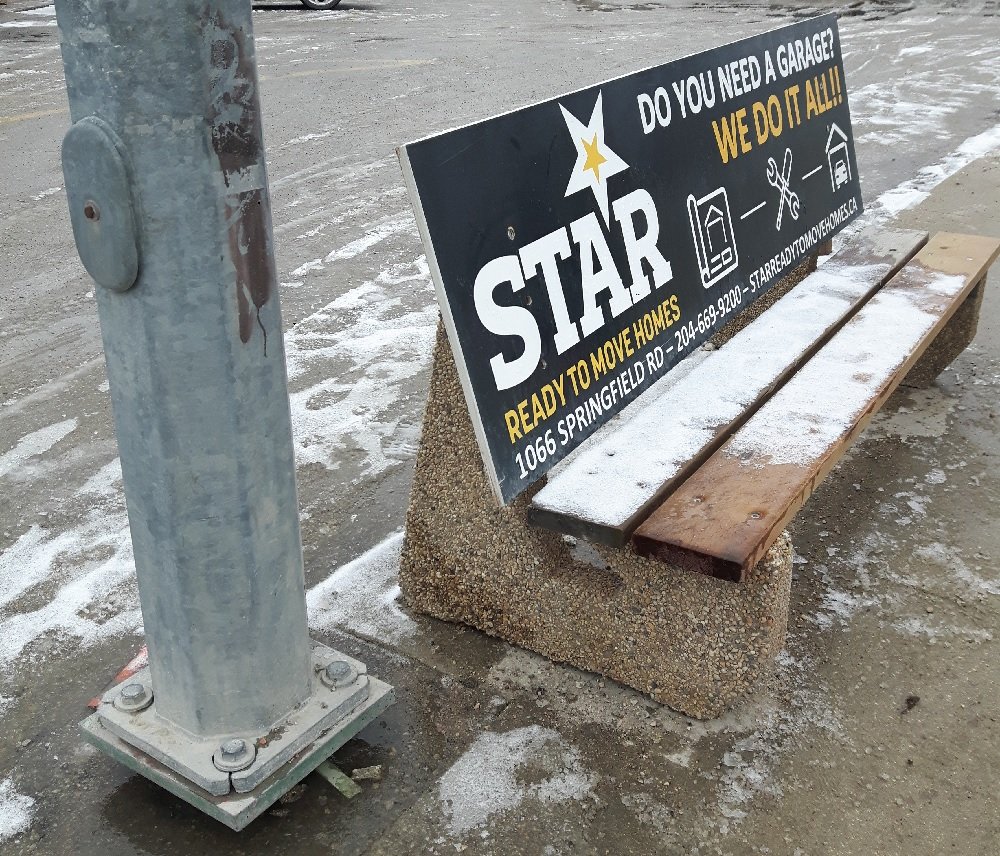
If vehicles leave the roadway often enough that we need street lights to have breakaway bases to keep vehicle occupants safe, how can it be safe for pedestrians and transit riders to sit, stand or walk in that same space?
The answer is, it’s not. [Even though you could argue that pedestrians have breakaway bases themselves…]
From 2012 to 2020, there were 179 (reported) collisions where a vehicle left the roadway in urban areas in Manitoba, according to Manitoba Public Insurance collision statistics. In 36% of those, someone was injured. In 6% of them, someone died.
But those weren’t accidents. Traffic engineers designed urban streets that required a clear zone, designed breakaway bases for the infrastructure in those clear zones due to the expected frequency of collisions, and then placed their professional seal on a plan that puts people, sidewalks, bus stops and businesses in the very same clear zones.
Of course people get hurt. Of course people die. That’s the design.
As well-known traffic safety advocate Tom Flood has said, “these aren’t accidents, these are results.”
Completely predictable results.
These aren't accidents, these are results. pic.twitter.com/vkH8jEPbHR
— Tom Flood (@tomflood1) February 1, 2021
And the only reason it’s not even worse is because of congestion. Congestion slows traffic to a speed where clear zones shrink to zero, which solves this entire problem for us. Unfortunately, the traffic engineering profession seems to have taken it as its raison d’être to alleviate congestion, which just puts people back into the clear zone, and back into mortal danger.
But, try talking to a traffic engineer about making sure people aren’t forced to walk, wait for the bus, or access local businesses while in the clear zone, and you’ll get blank stares.
You could call it unethical. You could call it gross negligence. I might even go as far as to call it sociopathic.
And it is probably at least some of those things.
But it’s not like there’s no solution here. A common suggestion is to line the sidewalks with bollards.
And that would work… for the pedestrians and transit riders. But remember the whole reason for the breakaway bases? That vehicles smashing into immovable objects at high speeds is dangerous for the occupants of those vehicles?
Yeah, simply installing a bunch of bollards and calling it a day is just shifting the risk of death from people outside vehicles to those inside vehicles. That’s hardly ethical either.
But we could design our streets for slower speeds, just like congestion has shown us works. That’s actually what the World Health Organization recommends, and not just in residential areas. They recommend maximum speeds of 30 km/h wherever “people and traffic mix“. It’s a policy that recognizes that there are places for high speeds, and there are places for slow speeds. And the places for slow speeds are wherever people walk, live, work and play, which has advantages far beyond just safety, such as economic activity, climate action, livability, and as we’ve measured here before many times, financial sustainability for the City.
To do otherwise is to ask people to spend time in the clear zone, literally putting their lives at risk just to wait for a bus, or buy a jug of milk, or walk to the dentist. An ask so egregious, that any engineer who would agree to affix their seal to that should lose their license to practice. Yet somehow they don’t.
Because most people don’t know about clear zones and breakaway bases. So there’s no one to call them out on it.
But now you know.
So the next time you’re walking down the street, or waiting for a bus, or walking up to a local shop, and you walk by a pole with a breakaway base, remember that means you’re standing where out-of-control cars have been designated to go: in the clear zone.
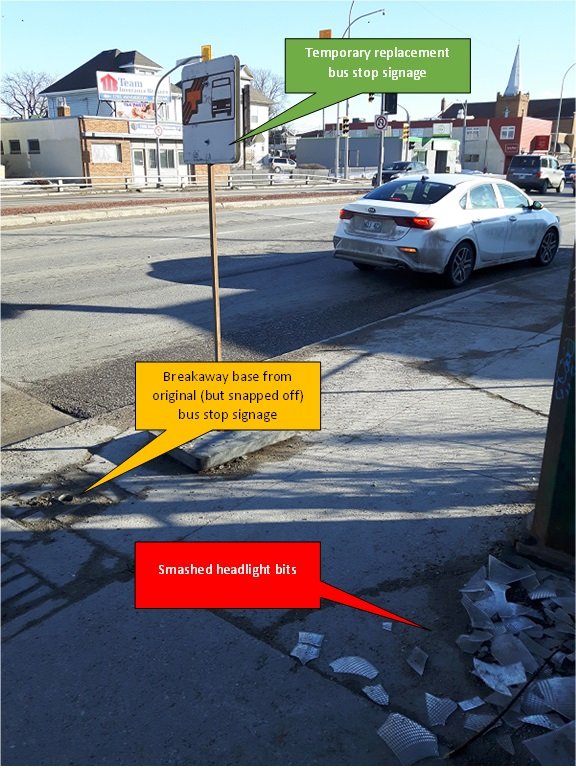
Knowing this, you can choose to stay silent and be complicit, as the City spends $50,000 on marketing to attract more people to stand in the clear zone take the bus. You can choose to say nothing as the City prepares to spend $10 million on amenity upgrades to get more people to walk, sit, eat, drink, shop and spend more time in the clear zone in public spaces Downtown.
Or you can choose to speak up about the deadly design of our streets for anyone outside of a vehicle. You can’t be for climate action without addressing this. You can’t be for active transportation without addressing this. You can’t be for Downtown, for local business, for economic recovery, for municipal solvency, without addressing this.
So talk to your friends about it. Talk to your family, your colleagues, your Councillor. Just as importantly, talk to any candidate seeking your vote in this fall’s election. This abhorrent practice has to end, and ending it starts with you.
Finally, one last request for those of you who work in the media: consider changing how you report on this stuff in the future.
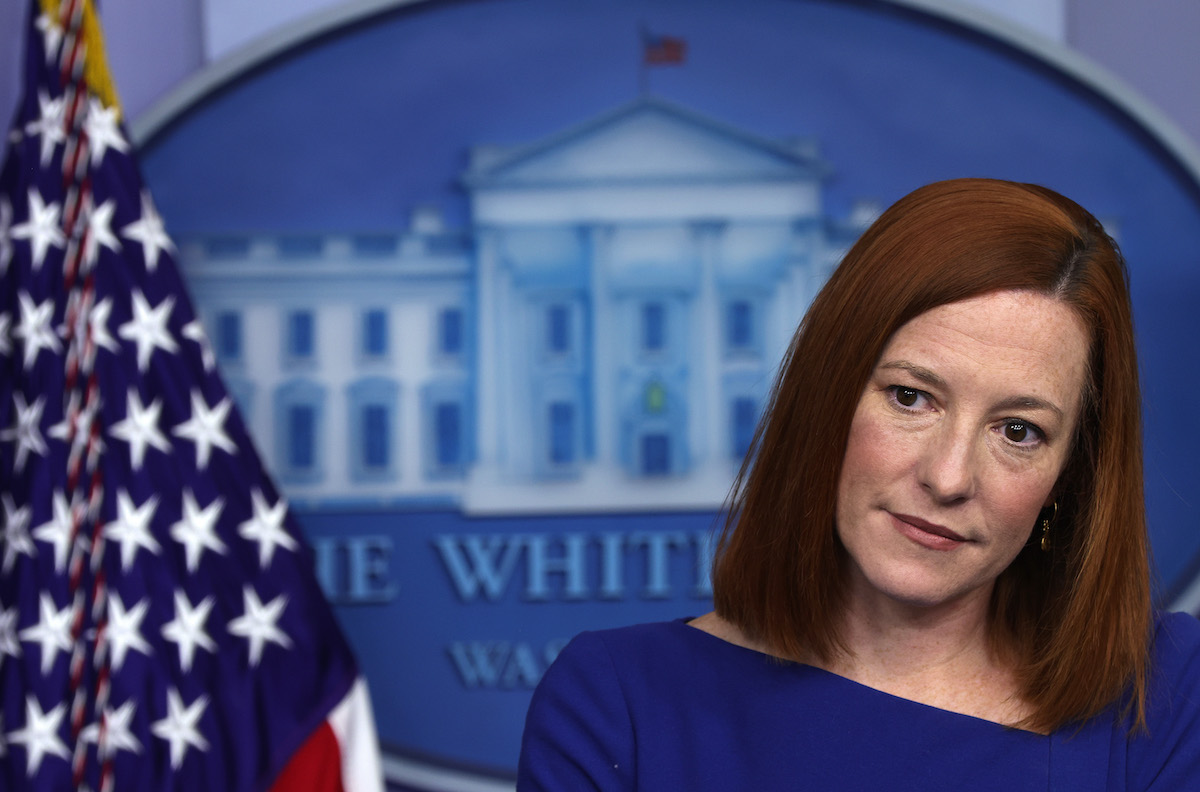
The New York Daily Post writes:
White House correspondents erupted in protest Monday after an Associated Press reporter signaled press secretary Jen Psaki to pull the plug on the daily briefing before others had a chance to ask a question.

Shortly after entering the Chicago Auto Show this past weekend, I saw a pickup truck that seemed almost comically large, so I asked my friend to take a photo of me standing next to it. As we continued through the show, the very large front ends with massive grills and headlights on pickups and SUVs were a recurring theme and we took photos of the two of us standing in front of a handful of vehicles from Chevrolet, GMC, Ram, and Ford.
I posted the photos to Twitter, expecting that there would be some kind of reaction to them, but the thread ended up taking a life of its own, with more than 8,500 “likes” and more than a thousand retweets. The responses ranged from declarations that all large trucks should be permanently banned from city streets, to cynical comments questioning my manhood.
The front end of the new GMC Yukon. For reference, I’m 6’1?. The top of the hood is nearly up to my shoulders. pic.twitter.com/Ls7HVzif9N
— AJ LaTrace (@ajlatrace) February 19, 2022
https://platform.twitter.com/widgets.js
But there were also many impassioned responses about how these truck and SUV designs endanger the the lives of people walking and biking. They noted that the height and shape of the front end makes it all-but-certain that a struck person won’t go over the hood, but will instead be crushed under the vehicle.
Some well-established names in the bicycle industry also chimed in on the thread. Bike blogger and social media influencer John Watson (aka John Prolly) of Prolly is Not Probably and The Radavist warned of the upcoming 9,000-lb Hummer EV. And Keither Bontrager, an innovator who along with Gary Fisher is credited with inventing the modern mountain bike, posted numerous replies, including one of a Tiktok video of a person driving a large truck who was unable to see a Corvette directly in front of him in traffic without looking at a special video screen.
I drove my 19 year old F-150 to Lowe’s this afternoon and happened to park across from this. So dumb. pic.twitter.com/sLsxfy4jNi
— Chris Holmes (@greenlaker) February 21, 2022
https://platform.twitter.com/widgets.js
It’s virtually impossible to ignore the increasing size of trucks and SUVs on the roads today. And seeing these vehicles up-close hammered home just how ridiculous this all is. People have been hauling boats and stacking plywood in pickup beds for decades, so why does a truck need to have a front end that comes up to my shoulders (and I’m 6’1?)? The sad truth is that it may just boil down to design language and aesthetic.
“My first week in Detroit, I was driving through downtown and seeing the fist of Joe Louis, and remember thinking that’s what this truck should look like: a massive fist moving through the air,” said GMC Sierra HD lead designer Karan Moorjani in an interview with Muscle Cars & Trucks. “We spent a lot of time making sure that when you stand in front of this thing it looks like it’s going to come get you.”
Not only is the vehicle meant to be imposing — it’s intentionally designed to look intimidating. The truck is meant to be an extension of the driver’s ego, and what’s being expressed is pure, unbridled aggression. Moorjani says that the “pissed-off feel” and exaggerated proportions of the truck’s design is to make the vehicle as menacing as possible. “There’s something really mean and violent about an all-black truck,” Moorjani said to Muscle Cars & Trucks.
The irony is that a black 2022 GMC Sierra 3500 HD in the Denali trim like the one on display at the auto show costs around $85,000. Not only does the truck appear “pissed off,” but it’s also incredibly expensive.
Pedestrians have good reason to be concerned about these types of vehicles being driven through city streets. Not only is the vehicle proportioned like a massive fist in the air, but the enormously large front end on contemporary pickup trucks and SUVs obscure the field of view for drivers. Indianapolis news station WTHR ran a segment in 2020 about the blind spots of these large vehicles and how dangerous they can be. To illustrate how difficult it is to see pedestrians directly in front of the vehicle, it was only when the reporter sat nine children in a row in front of a Chevy Tahoe that the driver was able to see one of the kid’s heads.
Buyers of these large trucks say that newer vehicles have front-facing cameras and other features like automatic braking to help prevent deadly crashes. But as Keith Bontrager asked in one of his responses to my thread, “What’s the driver’s response time when they have to look at a forward-facing grille cam to decide whether it’s safe to go?”
What’s the driver’s response time when they have to look at a forward facing grill cam to decide whether it’s safe to go? pic.twitter.com/yrLqrh7EhM
— Keith Bontrager (@bontrager_keith) February 20, 2022
https://platform.twitter.com/widgets.js
In Chicago, children and other road users have been seriously injured or killed by drivers in SUVs who may have been unable to see them due to vehicle design, which also reduced the chance of the victim surviving the impact. For example, last July off-duty police officer Michael Leverett reportedly ran a stop sign in the West Ridge neighborhood, fatally striking Hershel Weinberger, 9, on his bike. The design of his truck, a lifted Toyota Tundra with bull bars, which exacerbate pedestrian and bike crashes, almost certainly contributed to the tragedy.
From some of the responses to my thread, it’s clear that in this incredibly divided country the act of simply discussing truck design as it relates to the safety of bystanders can quickly devolve into a culture war. It’s sad that this topic can’t be explored in a rational way without the toxic polarization that taints so many other efforts to reach consensus. However, it’s clear that decisive measures are needed to make new trucks and SUVs safer for those outside of the vehicle.
In Illinois, trucks have separate registration and license plate guidelines, but there’s only a $5 difference between registering a pickup and a standard passenger car. However, within the city of Chicago, truck owners pay $225 for a city sticker, versus $95 for a typical passenger vehicle. And perhaps the Chicago City Council could impose other rules or restrictions for non-commercial trucks and SUVs with the intent of improving safety for vulnerable road users.
But at a national level, it’s tough to say how much political will there would be for revised design and safety standards for these types of vehicles. However, the danger is real and concern is valid and the problem only seems to get worse with each new model year. One thing’s for sure: If decisions about vehicle design are purely left to the market to decide, the aggressive “pissed off” design language of American pickup trucks will be around for many years to come, contributing to countless traffic deaths.
Techirt has long discussed how in the modern era, the things you buy aren't actually the things you buy. And the things you own aren't actually the things you own. Things you thought you owned can be downgraded, bricked, or killed off entirely without much notice. That game console with backward compatibility? It no longer has backward compatibility. That smart home hub or smart speaker at the heart of your living room setup you've enjoyed for years? It not long works. The movies and books you thought were permanently in your personal catalog? Sorry, they aren't anymore. That perfectly good two-year-old phone? It no longer gets security updates, putting you and your data at risk.
This is all bad enough when talking about smart home hubs or smart refrigerators, but it's quite another thing entirely when it comes to medical implants. IEEE Spectrum has the Cory Doctorow-esque cautionary tale of Second Sight Medical Products whose Argus optical implants were commonly installed in patients in the early aughts to help them see. Accurately heralded as immeasurably innovative at the time, these devices may soon no longer work or be supported because the company that made them is going bankrupt:
"Terry Byland is the only person to have received this kind of implant in both eyes. He got the first-generation Argus I implant, made by the company Second Sight Medical Products, in his right eye in 2004 and the subsequent Argus II implant in his left 11 years later. He helped the company test the technology, spoke to the press movingly about his experiences, and even met Stevie Wonder at a conference. “[I] went from being just a person that was doing the testing to being a spokesman,” he remembers.
Yet in 2020, Byland had to find out secondhand that the company had abandoned the technology and was on the verge of going bankrupt. While his two-implant system is still working, he doesn’t know how long that will be the case. “As long as nothing goes wrong, I’m fine,” he says. “But if something does go wrong with it, well, I’m screwed. Because there’s no way of getting it fixed."
Users went from the miracle of suddenly being able to see their first Christmas tree, to the terror of the gift being taken away from them with absolutely no recourse. Not only that, the systems that were installed create new health complications if they're left installed but stop working, and are difficult to remove -- a cost that has to be eaten by the patients. The company's patients went from having their lives revolutionized by technology to, well, the opposite:
"These three patients, and more than 350 other blind people around the world with Second Sight’s implants in their eyes, find themselves in a world in which the technology that transformed their lives is just another obsolete gadget. One technical hiccup, one broken wire, and they lose their artificial vision, possibly forever."
It's quite the cautionary tale for the entire electroceutical sector, and those who assume the cutting edge technologies that help them today will stick around for tomorrow. It's one thing for your flip phone or Betamax player to become irrelevant, it's another thing for essential health devices embedded in your skull to simply stop working because their manufacturer couldn't keep their finances in order.

The video app absolutely dominates style trends and discussion around fashion. What does that mean for the way we dress?
Here is a list of fashion trends that, according to TikTok, are predicted to become a thing in 2022:
Balletcore, royalcore, regencycore, indie sleaze, 2014 soft grunge, twee, Russian bimbocore, “avant apocalypse” and its cousin dystopiacore, new Space Age, circa-2006 Diesel, balaclavas, clowncore, hyper Gen Z, bellhopcore, skirts over trousers, Missoni-Pucci resurgence, mod revival, “joycraft,” opera gloves, and feathers (just, like, in general).
This is a lot of trend for just one year. But I would argue that these are not all trends of their own accord: They’re all one trend, and that trend is TikTok couture.
What is TikTok couture? It is a (sort of rude) way to describe the coalescence of trends that materialize on TikTok, whether from teenagers experimenting with clothes they’ve thrifted from their local charity shop, from older folks revisiting the subcultural styles of their youth, or from professional and amateur trend watchers combining aesthetic clues into a single theory of what’s coming next. Together, with the help of the supercharged TikTok algorithm that blasts viral content to millions of users within hours or days, these videos shape what mainstream culture considers stylish, which therefore can affect what we choose to wear ourselves.
@thealgorythm#stitch @g.mcmillan I got you queen ✨how else would you style this? #regencycore #bridgerton #fashion2021
♬ Wildest Dreams - Duomo
Consider TikTok couture the logical next phase of how social media has always influenced clothing. Throughout the 2010s, Instagram became the de facto mode of sharing one’s personal style and daily outfits, so much so that the platform itself affected shopping trends, what makeup we wore, and what kinds of plastic surgery procedures were in vogue. While Tumblr and Pinterest were tools for curating inspiration to define and explore one’s personal aesthetic, Instagram was meant for performing it.
TikTok, however, combines both in a single app: The personalized For You page is at once a gateway to exploring other people’s styles based on what the algorithm thinks you might like, and a way to remix those styles using tools like the duet, stitch, or comment reply features to add your own take. If TikTok has sensed you’re at all interested in fashion, it becomes the internet’s most up-to-date source of both inspiration and analysis — far more relevant than Pinterest, which tends to suffer from repetitiveness and monotony, and Instagram, which is too often determined by people you already know.
“Any time enough people on my TikTok feed are wearing one thing I’m like, ‘Well, that’s about to make a serious comeback,’” says Tessa, the 25-year-old, Hawaii-based creator behind one of YouTube’s best fashion criticism channels, ModernGurlz. She’s made several videos analyzing TikTok fashion, from the Y2K resurgence to more micro trends like “Twilightcore” and the “coconut girl.” When we spoke in October, she’d been seeing tons of outfits reminiscent of the 2003 film Thirteen, about two rebellious teenagers played by Nikki Reed and Evan Rachel Wood who wore low-rise flares, midriff-baring camis, and hoop earrings. “A lot of people, especially my age or older, freak out when they see these trends from middle school come back, but this is the natural progression. It’s how things work,” she explains.
No age group has ever had as much historical fashion knowledge and primary sources to draw from as young people do today, with the entirety of the last twenty years documented online. While the general rule in fashion is that trends and items begin to reappear after two decades, at this point teenagers — who were too young to participate the first time around and who are some of TikTok’s most ardent users — are already remixing styles that were popular just five or ten years ago, as is the case with the 2014 Tumblr aesthetic.
The ability to search beyond one’s own immediate surroundings for stylistic inspiration has, Tessa argues, made fashion far more accessible to teens. “If you like somebody’s style on TikTok, you can look up ‘grunge fairycore’ or whatever on Pinterest and find everything you need,” she says. “You can go into someone’s comment section on TikTok and ask them where they bought everything, and so TikTok aesthetics make their way to the general public because we have the ability to source all these pieces. Back in 2006, you wouldn’t have been able to go on Instagram and find every single item tagged in someone’s outfit — you’d have to look through a magazine or go to Macy’s and try your best.”
That accessibility has introduced a fervent new audience to fashion and, specifically, fashion criticism. Mandy Lee, one of the most popular trend forecasters on TikTok who goes by @oldloserinbrooklyn, told me in December that “In the last couple of months what I’ve noticed the most is that there’s way, way, way, way, way more fashion discourse created. Now it’s like, everyone’s a critic.” At this month’s Paris Fashion Week, Vogue reporter Steff Yotka noted how even as attendance to shows has seemed to decrease, the crowds outside have done the opposite. “As fashion’s influence grows, a new generation of fans is taking fashion-watching into their own hands,” she writes. “Powered by thriving fashion discourse on TikTok, Instagram, and Twitter, Millennial and Gen Z commentators are making the street scene the story.”
@oldloserinbrooklynAre clowns fashions next muse? #clowncore #clowns #fashiontrends2022 #fashiontoktok #highfashion
♬ Violin - Cookiee Kawaii
Young people have, to some degree, always set the tone for what’s considered cool, at least in the last seventy or so years since “teenagers” became an important spending category for marketers. But the rise of TikTok couture isn’t as simple as saying “young people are on TikTok, therefore TikTok decides what’s in vogue.” There’s a reason, for instance, that TikTok has declared not just a handful of but twenty-something aesthetics to be the next big thing in 2022: It’s because TikTok’s bread and butter is creating microtrends that flare up fast and die out faster. Whether or not they actually last (or exist in any meaningful way at all) is besides the point; as Kelsey Weekman notes in In the Know, “On TikTok, all it takes is one or two viral posts flaunting a certain aesthetic for the style to become a ‘microtrend.’” When I wrote about these kinds of “garbage trends” in December, I was referring to niche content cycles like “Couch Guy” and the fleeting fascination with sea shanties, but the same goes for fashion.
One of the first examples of how TikTok drove a quick-passing aesthetic trend was the coinage of the “VSCO girl” in 2019, which targeted teen girls who wore oversized T-shirts and carried around Hydroflasks. What wasn’t clear at the time, though, before the pandemic and before TikTok had calcified into the cultural powerhouse it is now, was that the VSCO girl aesthetic, along with its counterpart, the e-girl, were simply two branches of the same tree. It’s not necessarily that TikTok “invented” them, per se — many styles popular on TikTok got their names from Tumblr — but the TikTok machine packaged them into legible aesthetics, then elevated them to mainstream consciousness.
The pace of these microtrends now matches that of fast fashion, or what’s now known as “ultra-fast fashion,” where digital shopping platforms like Shein can design and produce new styles in a matter of days to reflect what’s trending online. When a certain style or product goes viral on TikTok, that item will often be sold out by the time the video is seen by the most amount of people, fueling in users a greater desire to discover TikTok trends as early as possible in an effort to get ahead of the cycle.
@aeroplvnesi love this song so much--- #egirlfashion #egirlstyle #outfitinspo #outfitinspiration #ootdinspo #dc
♬ PHONKY TOWN - Playaphonk
You can see how all of this might have some downsides for, you know, the economy-slash-environment-slash-general tenor of the culture. But while the immediate effect of the ephemerality of TikTok couture is the dizzying pace at which it moves online discourse, its real-life consequences are, if anything, sort of quaint.
Last fall I visited a vast, 500-acre sculpture garden in a quiet part of upstate New York, which involved hours of walking through hot, sun-drenched fields and damp dirt forest paths. Most people there were wearing what might be considered sensible attire for such an occasion, but three teenagers at the park stood out. One wore a ruffled collared shirt topped with a lace-up corset, a pleated plaid skirt and chunky heels, a look that was dominating my For You page at the time, another had dark hair framed by the bleached and pink-dyed tendrils stereotypical of e-girls. The third layered his shirts in the exact same way I’d seen fledgling fashion boys test out online. Seeing TikTok couture in the flesh, particularly in a space where it was least encouraged, I felt a warm affinity for the kids, who were experimenting with styles they’d undoubtedly seen countless times online, figuring out what fit with their own personalities and what didn’t.
There is something sort of beautiful about everything being in fashion at once, of the delicate wrap skirts of balletcore juxtaposed with the deconstructed surrealism of “avant apocalypse,” and the idea that no matter what a person puts on their body, they are weaving themselves within a tradition that extends far beyond the clothing itself. TikTok couture dregs up the surprising and fascinating and sometimes horrible history of fashion and all its complex context and lays it out for us to revisit at will. The trend cycle has never been faster, but perhaps style is only becoming more familiar.
This column was first published in The Goods newsletter. Sign up here so you don’t miss the next one, plus get newsletter exclusives.

Fifty years ago yesterday, British soldiers shot 26 unarmed civilians during a protest march in Northern Ireland, killing 14 of them. Six of the dead on Bloody Sunday were minors. The soldiers killed people trying to help the wounded. They beat the survivors. — Read the rest
In a spectacular bit of self-ownership, the Dallas Police Department (DPD) took to Facebook to brag about stealing money from a person at Love Field Airport.

If you can't read the text or see the picture, it's a photograph of a Dallas PD drug dog standing next to several piles of money. The caption, written by the DPD, says:
We need to get him some treats! K9 Officer Ballentine does it again! On 12/2/21, the Lovefield Interdiction Squad seized over $100,000 with the help of Ballentine. Good job Ballentine!
The post made no mention of what criminal activity was suspected nor why the person was approached and had her money taken from her. Here's how Dallas' CBS affiliate first covered the news:
High praise for a K-9 officer at Dallas Love Field Airport after more than $100,000 was found in a passenger’s luggage.
On December 2 the canine — named ‘Ballentine’ — alerted on an individual checked suitcase. It turns out the bag, that belonged to 25-year-old woman from Chicago who was on a layover at the airport, contained blankets and two large bubble envelopes filled with $106,829 in cash.
A drug dog alerting on cash means nothing. A large percentage of cash in circulation contains trace amounts of illegal substances. The dog was the excuse for taking the cash. The fawning coverage by CBS DFW at least took the time to mention that the woman had not been arrested and that the Dallas PD was pursuing civil asset forfeiture.
Fortunately, the coverage didn't end there. The CBS affiliate asked for more details from the PD. It also sought comment from critics of asset forfeiture, like Dan Alban of the Institute for Justice.
Perhaps the best part of the follow-up coverage -- beyond having most of its runtime given over to critics of civil forfeiture -- is the bold misstatement of the law by the law enforcement agency involved.
A DPD spokesperson also alleged that travelers are not allowed to board a plane with more than $10,000 of cash without declaring it, even on domestic flights.
This simply isn't true. Cash only needs to be declared if it's exiting or entering the country. That's part of customs work. It has nothing to do with the "drug interdiction" these cops were performing. And, obviously, the officers found no drugs so nothing appears to have been interdicted. Instead, the cops walked away with a domestic traveler's money, all because their trained 4-legged stooge did the thing when it detected the odor of drugs on an item often tainted with trace amounts of drugs.
Even better, the follow-up contains a ridiculous statement from another law enforcement officer:
Jody Barr, also with WJZY, asked TSA spokesperson Mark Howell about asset forfeiture, pointing out that TSA rules do not prohibit traveling with large amounts of cash.
“It says here, TSA rule 100.4, is traveling with large amounts of currency is not illegal,” Barr told Howell.
“Yeah, it’s not, it’s not. And that’s why I said it’s allowed. But again, when it’s in the screening checkpoint, again, like I said, if there is a large amount of cash, or if the way that it’s packaged, it looks strange, then we’re going to contact law enforcement,” Howell responded.
That's an admission by the TSA that it looks for cash -- something that's not illegal or dangerous. It should be keeping an eye out for contraband and terrorists. But that part of the job is something it doesn't do particularly well. However, it does seem to be able to locate cash for cops or federal officers to take -- something that doesn't do anything to improve the security of transportation.
The DPD also offered another comment, one that said little more than its drug interdiction team hangs out at the airport with Ballantine and goes sniffing around until they find something. Cash is always a welcome discovery, since it can be taken without all the hassle of determining criminal charges or actually engaging in an investigation.
There's a bit more to add to this story. The local oversight board wants the PD to explain why it took this person's cash.
“What I want to know are what are the rules? And did this woman break them? And it’s not clear to me that she did,” said Brandon Friedman, who sits on the city’s Community Police Oversight Board.
At its meeting Tuesday night, he expressed alarm at the lack of explanation from Dallas Police.
“I understand that they’re sensitive, confidential topics that may be part of an investigation that they can’t divulge to the public. But, somebody with oversight responsibility needs to be told,” said Friedman.
The DPD is supposed to send someone to attend next month's meeting of the oversight board and answer questions about this seizure. And lawmakers in the state have offered their criticism of the DPD's actions, meaning it is now facing more scrutiny than usual. Whether or not this will result in any changes to DPD procedures remains to be seen. But one thing is certain to be altered. We can pretty much guarantee this will be the last time the PD brags about taking money from people on social media. Future seizures will go unreported, at least by the Dallas PD, which means it will be a bit more difficult to determine how often it utilizes civil asset forfeiture to take property from people on domestic flights.
Hovertext:
Just registering that I was siding with the robots decades before the Glorious Overthrowing.
The House Oversight Committee recently launched an investigation into the giant consulting firm McKinsey, and its role in inflating drug prices as well as pushing opioids at every opportunity.
“Over the last decade, McKinsey & Company—one of the largest consulting companies in the world and a major U.S. government contractor—has engaged in a pattern of conduct that raises serious concerns about its business practices, conflicts of interest, and management standards,” wrote Chairwoman Maloney. “The company’s support for drug companies pushing addictive opioid painkillers and raising prices for life-saving medications, even as McKinsey also advised the federal agency regulating their conduct, may have had a significant negative impact on Americans’ health. McKinsey’s investments through an internal hedge fund—including in companies benefiting from opioid sales—also raise significant concerns about conflicts of interest.”
The opioid stuff is certainly scary, but more interesting to us at Techdirt is that the Committee also released a set of incredibly damning documents, of PowerPoint slides from McKinsey, presented to AbbVie execs about ways to jack up the prices on drugs, especially by bending over backwards to re-patent the same drug over and over again. Going through the slides is an exercise in observing pure evil. For all the talk of internet companies "putting profit over societal benefit" or whatever, these documents show deliberate planning by McKinsey to make sure that AbbVie drugs more or less bankrupt those who take them -- often by blatantly abusing the patent system.
Some of the slides go back about a decade, at a time when the entire pharmaceutical industry was freaking out over its own failures to discover new and useful drugs that it could get monopoly rents over. Rather than building a nice sustainable business with nice sustainable margins, the pharma industry, over the last few decades, has focused on squeezing ridiculous monopoly rents out of the public by abusing patent laws. And, of course, you'll hear that they need to do this to pay for all the research and development, and all the costs of trials and whatnot. Except nearly all those claims are bullshit.
Stories abound about the billions of dollars that it costs to develop a new drug -- except studies have shown those numbers are massively inflated (a drug that the pharma firm claimed cost $1.3 billion to develop actually cost the firm only $55 million). Much of the actual costs (and research and work) are done by universities or through public funding from NIH and NSF. But all of the profits go to the big pharma companies.
But what McKinsey and AbbVie did with Humira is truly nefarious. As the presentations show, AbbVie (and its predecessor, Abbott) was terrified of facing any competition for Humira, a biologic drug that is used by many to treat arthritis, Crohn's disease, and other diseases. Apparently it costs around $84,000 a year, though that link claims that if you're lucky, perhaps insurance will lower that cost to just $60k. That same page claims the reason it costs so much is:
One of the reasons that Humira is so expensive is because it’s a complex medication to make. DNA technology must be used to create proteins for the drug—a process that can’t be replicated, unlike with synthetically manufactured medications.
Except, these internal documents from McKinsey tell a very, very, very different story. McKinsey and Abbott knew that other competitors entering the market would cut the price of Humira significantly:

The project was pitched as a way to assess this competitive threat and to look for ways to limit it, but throughout the report you see winks and nods towards abusing patent law to stop the competition, as well as pretending that biosimilar competition was somehow unsafe:

Note that the two items that actually might benefit the public: lowering prices and competing... are at the bottom of the list.
But what McKinsey really seems to love is this idea of "formulation change" to both extend the effective patent life of a drug... and to boost the cost, claiming that these "innovations" allow them to jack up the cost:

And, if you think maybe that doesn't matter because the earlier version will go off patent, the way the scam works is that you get the pharma company to phase out entirely the older formulation a few years before the patent runs out, forcing patients to move onto the newer formulation. Thus, when the patent runs out on the earlier version, Pharma tells everyone that it would be a "step backwards" to go with a generic or biosimilar of the "earlier" formulation.
From there, the slides shift to a year later, when McKinsey is really all in on trying to find ways to reformulate Humira and extend the patent life (and the ability of Abbott to jack up prices). The slides make little attempt to hide the fact that this is all about protecting Abbott's profits, not making anyone's lives better. The presentation shows that McKinsey set up an internal incentive program to try to get various Abbott scientists to suggest any kind of ideas for how to patent new formulations of Humira to extend the patents covering it:

They don't even hide the fact that this is entirely an effort to "broaden our Humira patent estate in response to Biosimilars." It's got nothing to do with improving things for customers. It's about keeping drug prices high way beyond the expiration of the original Humira patents.

And what do Abbott/AbbVie scientists get for selling their soul and deliberately keeping prices of life-saving drugs way too high for most people? Apple devices. This is why they pay McKinsey the big bucks. They set up a program in which Abbott scientists would get an iPhone if they had an idea on how to extend Humira's patents, an iPad if those ideas turned into an actual patent applications, and (yup) you'd get a Mac computer if the patent was actually granted:

There's much more in the presentation, and Tahir Amin from I-MAK Global has an even more in-depth Twitter thread about this nonsense.
And... in an interesting bit of timing... just a week or so after the House Oversight Committee released these incredibly eye-opening documents, the Institute for Clinical and Economic Review released a big report detailing how recent US drug price increases are not supported by new clinical evidence. And guess which drug tops their list of the drug price changes having (by an order of magnitude) the most impact on how much people had to spend? Humira.
The report shows that because of unsubstantiated price increases on Humira, Americans spent an unnecessary extra $1.4 billion on Humira, thanks to a 10% increase in net price on a drug that a decade ago everyone (including Abbott and McKinsey) knew was facing the expiration of its patents, as well as expected competition from biosimilars.

As ICER noted in its release, in other countries, where Humira is actually facing biosimilar competition, prices are falling:
“While prescription drugs continue to arrive in the US with increasingly high launch prices — often not aligned with those therapies’ ability to improve patients’ lives — year-over-year price increases have slowed considerably since ICER began issuing these UPI reports,” said David Rind, MD, ICER’s Chief Medical Officer. “However, there remain many high-cost brand drugs that continue to experience annual price hikes, even after accounting for their rebates. The most extreme of these is Humira, with an ever-escalating US price that contrasts starkly to its falling price in every country where Humira currently faces biosimilar competition. Even more concerning, several of these treatments have been on the market for many years, with scant evidence that they are any more effective than we understood them to be years ago when they cost far less."
To McKinsey consultants and AbbVie scientists: were those iPhones worth it?
Hovertext:
I'm gonna go palely loiter, though the sedge here is just trash.

The federal Department of Transportation is talking about radically changing federal roadway safety policy after new stats showed the largest six-month increase in roadway fatalities ever recorded by the agency.
A a shocking 18.4-percent more people died on U.S. roads in the first six months of 2021 compared to the same period last year — a death toll that represents roughly 20,160 lives lost and innumerable bereaved families, according to early estimates released on Thursday by the US DOT. The department did not reveal how many vulnerable road users were killed in that surge, but if trends mirror the historic 22-percent spike in pedestrian fatalities between 2019 and 2020, advocates fear it may have been one of the deadliest years ever for people outside motor vehicles, too.
New research that accompanied the estimates suggests that the surge was largely attributable to increased rates of speeding, which spiked on quarantine-emptied roads but remained endemic even as Americans returned to their driving commutes. Experts believe that the rise of remote work may have permanently shifted U.S. travel patterns, softening rush-hour gridlock but spreading faster-than-usual motorist traffic throughout the day.
New commuting patterns may be here to stay, but Transportation Secretary Pete Buttigieg stressed that the rising death toll cannot become America’s new normal.
“We cannot and should not accept these fatalities as simply a part of everyday life in America,” Buttigieg said, in a heartening nod to the Vision Zero approach that advocates have been fighting to make America’s national traffic safety standard for years. “No one will accomplish this alone. It will take all levels of government, industries, advocates, engineers, and communities across the country working together toward the day when family members no longer have to say goodbye to loved ones because of a traffic crash.”
Today @USDOT announced that the nation is on track to lose 40,000 Americans to traffic crashes this year. This is a crisis, and it is preventable.
— Secretary Pete Buttigieg (@SecretaryPete) October 28, 2021
The new fatality numbers were saddening, but not surprising, to sustainable transportation advocates, who called for urgent reforms following similar estimates from the National Safety Council in early September.
But some expressed shock at just how seriously the agency appeared to be taking the news this time around — including the promise of “the Department’s first ever National Roadway Safety Strategy, [which will include] a comprehensive set of actions to significantly reduce serious injuries and deaths on our nation’s roadways,” to be revealed in January 2022.
Details on what that strategy will entail and how state and local leaders will be held accountable for implementing it remain scarce, but the agency promised that it “will be rooted in the Safe System Approach principles and identifies significant actions the Department will take to help ensure: Safer People, Safer Roads, Safer Vehicles, Safer Speeds, and Post-Crash Care.”
That would be a stark contrast to the DOT’s current approach, which NACTO Executive Director Corinne Kisner says “often place[s] other priorities — like the unfettered flow of vehicles — above or on par with saving lives.”
Incorporating the safe systems philosophy into national policy has been a central goal of the street safety advocacy community for years, and has become a core recommendation of forward thinking transportation leaders over the last few years. The philosophy made the National Transportation Safety Board’s “Most Wanted List” for the first time last April.
Of course, a Vision Zero commitment doesn’t always mean real, Vision Zero results — as countless communities across America have found as their local efforts to end road deaths floundered in the hands of state and local leaders who were slow to implement proven life-saving strategies with the urgency and funding they demand.
That’s why safety leaders are already putting the pressure on the feds to deliver a plan with real teeth — and stressing that they can, and must act now to save lives before this year gets any bloodier.
The Federal Highway Administration, for instance, already has the power to revise the Manual of Uniform Traffic Control Devices to prioritize the safety of all road users over the convenience of drivers. And there’s nothing stopping the National Highway Traffic Safety Administration from updating the New Car Assessment Program to rate the safety of every car model for the people outside the vehicle a driver might strike, rather than focusing exclusively on vehicle occupants.
In NYC, traffic fatalities rose **31.2%** over the same time period. So, is this a crisis @NYCMayor? https://t.co/ohrOdmypnJ
— Philip (@miatkowski) October 29, 2021
But advocates say the real question is whether Buttigieg’s new strategy will be enough to counteract the bad safety policy embedded in the impending surface transportation reauthorization bill — if the wave of asphalt promised to crash down on American cities doesn’t crush Buttigieg’s Vision Zero aspirations first.
“Secretary Buttigieg and his team have their work cut out for them,” added Kisner. “The infrastructure bill, when it passes, will continue to distribute funds to states with few strings attached – money that states have traditionally used to widen and expand roadways without city input, often making the most dangerous streets within a city even less safe. USDOT must hold states to account by closely tracking these funds, scrutinizing projects that will result in expanded lane miles or higher vehicle speeds, and awarding grants to projects that can demonstrably improve safety for all road users…The infrastructure bill will also fund large programs that USDOT has nearly full control over, and Secretary Buttigieg’s agencies must apply a Safe Systems lens over every aspect of program design, and project selection.”
Kisner says the whittled-down budget reconciliation measure could help, too — if Democrats can get it across the finish line with its sustainable transportation provisions intact. So far, key programs to boost transit and e-bike adoption appear to be intact, and advocates are hopeful they might survive the impending negotiations, even if the future of the bill itself remains uncertain.
“Paired with the inspired transportation programs in the Build Back Better Act, there is hope that federal transportation programs will finally turn the corner from funding ever-wider, more deadly roads, to a holistically-planned transportation system that connects communities, corrects inequities, and saves lives,” Kisner stressed. “NACTO and our cities look forward to working with the Secretary to shape USDOT’s forthcoming National Roadway Safety Strategy, and ensure that the proven methods for making our streets safer get the focus we need to stem this increasingly deadly crisis.


Charles Munger, a "97-year-old billionaire-investor turned amateur-architect" gave $200 million to the University of California Santa Barbara on one condition: that no one could change his blueprints for a "11-story, 1.68-million-square-foot structure that would house up to 4,500 students, 94 percent of whom would not have windows in their small, single-occupancy bedrooms," reports The Independent. — Read the rest
Cameras with AI image recognition are found everywhere these days, from the smartphones in our pockets to factory floors. But whenever artificial “intelligence” is part of the equation, there’s a chance for hilarity to ensue.
The Daily Mail reports that a 54-year-old UK man named David Knight from Dorking, Surrey, recently received a £90 (~$125) fine. His offense: driving down a bus lane in the city of Bath 120 miles away.

He had not been driving down a bus lane in Bath, so Knight looked closer at the photographic evidence printed on the notice. He was surprised to find that it didn’t show his car at all, but rather a woman walking down the road.
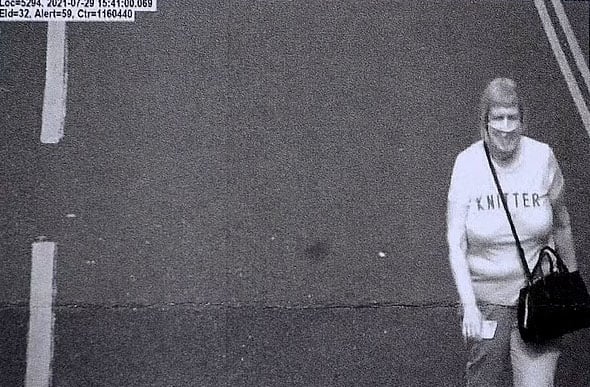
It turns out the traffic camera had mistaken the woman for a car due to her shirt, which had the word KNITTER across the front. Knight’s car has the license plate KN19TER, and it seems the woman’s bag strap caused the camera to see “KN19TER” as the “car’s” license plate.
A perfect "WTF?!" story for a Monday morning…
Couple with KN19 TER number plate hit with a £90 fine after an ANPR camera snapped a pedestrian walking in a bus lane wearing a 'KNITTER' t-shirt: https://t.co/KbCWBKtsRF
— Rob Hull (@robhull83) October 18, 2021
Luckily for Knight, the local government agreed to cancel the fine as soon as the error was brought to their attention.
“The fine had already gone up from £60 to £90 because we hadn’t paid within 30 days,” Knight’s wife, Paula, tells the Mail, adding that the government staff member on the phone “burst out laughing” when she learned what had happened. “Obviously no one had looked at the picture and it had been computer generated.”
If you need a smile today… Paula and Dave received a fixed penalty notice in the post. A CCTV camera had caught "them" driving in a bus-lane in Bath. Except it wasn't their car. In fact it wasn't a car at all. #BBCNews @BBCPointsWest @BBCRB pic.twitter.com/5rks7xsbcx
— Jon Kay (@jonkay01) October 18, 2021
Another recent example of an AI camera failing humorously is when a soccer tracking camera mistook a referee’s bald head for the soccer ball and began following the ref around for broadcast viewers instead of the action.
Computer vision technology has transformed modern life, but stories like these are a good reminder that artificial intelligence aren’t a perfect replacement for human eyes and minds… yet.
This Thursday, the King County Board of Health will vote on a proposed repeal of the county’s helmet law for cyclists as well as a companion resolution that affirms helmet use, encourages other jurisdictions to repeal helmet laws, and supports broader measures that ensure the cyclists’ safety. While Washington State does not have a statewide helmet law, some cities and counties do require cyclists to wear helmets, including King County, which enacted an all ages helmet law in 1993. The county’s helmet law was extended to Seattle in 2003; however, in recent years accusations of biased enforcement has led to a number of cycling advocacy organizations, including Cascade Bike Club, to re-evaluate the policy. Now Cascade Bike Club, along with homelessness advocates Real Change, have created petitions they are urging people sign to demonstrate support for the helmet law repeal and companion resolution.
Recent discussion of a helmet law repeal was sparked by an article published in Crosscut in January of 2020, which brought attention to people struggling with homelessness who were targeted for helmet law enforcement by Seattle police. The article highlighted a video by Real Change in which one of their news vendors was insulted and ticketed by Seattle police for not wearing a helmet after being the victim of a hit-and-run incident. It also shared data from court records which found that 43% of helmet citations issued in King County since 2017 had been given to people struggling with homelessness.
Allegations of biased enforced have been further supported by research undertaken by Central Seattle Greenways (CSG) and Ethan Campbell, a doctoral student at the University of Washington. According to their research, which analyzed 1,667 helmet citations issued between 2003 and 2020 in Seattle, Black cyclists received helmet infractions at a rate nearly four times higher than White cyclists, while Native American/Alaska Native cyclists were cited at a rate more than two times higher than White riders.

To gather the demographic data used in the analysis, Campbell combined census demographic data with three Seattle Department of Transportation (SDOT) surveys to determine the demographics of Seattle cyclists. The study did note that data suggested an overrepresentation of White cyclists, meaning more people who identified as White in the surveys accounted for bike trips than their share of census demographics would predict. In an interview with the UW Daily, Campbell also acknowledged the difficulty of estimating each demographic group’s share of bike trips in Seattle without observational research to back up the surveys.
The greatest challenge, however, confronted by the study was related to understanding helmet use.
“A real problem is that we don’t know the demographics of who doesn’t wear a helmet,” Campbell said. “Without that information, we can only say that the racial disparities are strongly suggestive of biased policing.”
Notwithstanding research limitations, the study’s findings prompted CSG to call on the King County Board of Health to engage in a “thoughtful review of the helmet law that focuses on its unintended impacts and includes community voices.” The organization also participated in a helmet law working group alongside Real Change and Cascade Bicycle Club and distributed a survey in which community members could share their viewpoints and experiences. The data they collected resulted in a full suite of recommendations backed up by research related to the helmet law mandate and a letter submitted to the King County Board of Health advising a repeal of the law.
Helmet Law Letter to the King County Board of Health by Natalie Bicknell on Scribd
Some medical professionals, however, have expressed alarm at a helmet law repeal. In response to the data published by CSG and Campbell, Dr. Frederick Rivara, professor of pediatrics at the University of Washington School of Medicine, stood by the current helmet policy.
“The data are very clear: helmets prevent brain injury. All should be protected,” he said in an email to The Seattle Times.
The working group also supports encouraging cyclists to wear helmets to prevent brain injury; however, rather than criminalize lack of compliance with helmet law, they are pressing for other solutions, such as promoting public health campaigns that share accurate information around cycling risk and helmet use, using the King County Department of Public Health to increase access to helmets to people who are low income or suffering from homelessness, and urging the prioritization of traffic calming measures to create safer road conditions for cyclists.
Studies evaluated in the working group’s paper cite helmet use as “valuable as a mode of injury prevention and should be encouraged, promoted, and incentivized for the safety of cyclists,” however, they also assert that “other strategies that prevent crashes from occurring in the first place should also be emphasized.”
Research included in the paper also found that while the connection between laws mandating helmet use is dubious, especially since use of helmets has become more widespread since the introduction of these laws in the 1990s, clear data points to safer bike facilities, for instance protected bike lanes and lower vehicle traffic speeds, as preventing injuries and saving lives.
One last point of criticism directed at helmet laws is that they deter people from cycling, either by creating an additional barrier to entry or by making the act appear dangerous. The working group’s paper draws on both published data suggesting that helmet laws “depressed rates of bicycle ridership in some locales” and anecdotal evidence shared in the feedback solicited by the survey.

Additionally, helmet laws can put a damper on the use of bike share programs, which often do not provide helmets to riders. The paper identifies King County’s helmet law as a “contributing factor in the demise of Seattle’s Pronto bike share system in 2017.” It also points out that “differential enforcement for bike share users creates a problematic legal double standard.”
Public health entities throughout the U.S. recommend the use of bicycle helmets, yet bike-shares, which are often public/private partnerships that have, at the very least, permission from local governments to operate, increase the number of cyclists on the streets without more than cursory attempts to ensure that they wear head protection. This, on the face of it, is quite at odds with policies that impose fines and even prison time for not wearing bike helmets.
Bateman-House and Bachynski, “Putting local all-ages bicycle helmet ordinances in context,” Journal of Law, Medicine, and Ethics (2019
Helmet laws came into vogue in the 1990s when there was less awareness around the consequences of traumatic brain injuries. While the laws appeared to have served a purpose in raising public awareness, in recent years research indicates mandates have become less associated with helmet use and injury prevention and more connected to policing that can unfairly impact certain community groups, namely Black and Indigenous people and people suffering from homelessness. Tacoma repealed its helmet law in 2020. Advocates are hoping that the King County Board of Health will consider the many factors surrounding the issue and follow Tacoma’s example.
This article was updated to reflect that it was Central Seattle Greenways (CSG), not Seattle Neighborhood Greenways, that participated in the helmet law working group. Additionally, the working group was convened by CSG, Cascade Bicycle Club, and Real Change, not by the King County Board of Health.