By Barbara Kinney...(Read...)
It’s well-established that Donald Trump’s campaign doesn’t do most of the things a traditional political team does. There’s scarcely any policy, weak fundraising, and no ground game. But in one classic area of political positioning, the Trump team has proven it is historically great at one classic tactic: expectations setting.
With a few hours to go before the first presidential debate, it’s hard to see what the Republican nominee could do to avoid the meeting being judged at least a tie. Through a combination of months of campaigning, leaks about his debate prep, and aggressive working of the referees, Trump has set expectations so low that it’s hard to imagine how he finishes the debate without getting positive reviews from mainstream commentators.
At The Washington Post, James Hohmann rounds up a few glaring examples: A Politico reporter saying, “If he does passably, we’ll all say he won”; The New York Times’ Yamiche Alcindor saying, “A lot of people are going to look at Donald Trump and think, ‘Hey, if he can even get out a good sentence and show off his experience, then he's doing well’”; NPR saddling Clinton with “the burden of high expectations.” Andrew Kaczynski spotted this moment on MSNBC:
this is real pic.twitter.com/2RVT6MoNMo
— andrew kaczynski (@BuzzFeedAndrew) September 26, 2016
The point here is not that any of these particular people or sources are sinning; it’s about the general picture.
And it’s a picture that the Trump campaign has carefully painted over the course of the last few weeks and months.
Beginning in August, Trump effectively threatened to skip the debates. He argued that it was improper that one of them was scheduled against an NFL game and claimed falsely that the NFL had asked him to get it changed. He also said he wanted to see who the moderators were and what the rules were. Industry insiders speculated that the final slate of moderators was chosen in part to placate Trump.
If so, it worked, sort of. Trump agreed to debate but kept up his attack. For example, he derided NBC’s Lester Holt, the moderator of Monday’s debate, in an interview with Bill O’Reilly. “Look, it's a phony system,” he said. “Lester is a Democrat. I mean, they are all Democrats. Okay? It's a very unfair system.”
Trump was wrong: Holt is a registered Republican. Asked about this on Monday, Trump campaign manager Kellyanne Conway offered the novel defense that her boss wasn’t lying; he was simply shooting off at the mouth when he had no idea what he was talking about. “I don’t know that he knew what Lester Holt’s voter registration was,” she said. “He didn’t lie. A lie would mean that he knew the man’s party registration.”
After Matt Lauer failed, during a forum earlier this month, to point out that Trump was lying about opposing the Iraq War, progressives began pushing for debate moderators to fact-check in real time. Trump aides rallied against that idea, and on Sunday, Janet Brown, the executive director of the Commission on Presidential Debates, sided with them. “I don't think it's a good idea to get the moderator into essentially serving as the Encyclopedia Britannica,” she said on CNN’s Reliable Sources.
All of this has the effect of putting both the commission and Holt on the defensive. Once Trump had threatened to quit and preemptively convicted the moderator of bias, Holt is pressured to bend over backward to appear fair—which means less real-time accountability for Trump, and an effort to be even-handed, regardless of the material.
He’s not just working the refs, though—he’s also, to continue the metaphor, working the sportswriters. Last week, the Times ran likely the most detailed story on debate preparation to see publication. Relying on advisers, friends, and surrogates, the reporters heard this about Trump:
This may or may not be an accurate depiction. Separately, aides told Politico that Trump’s team has constructed an elaborate psychological profile of Clinton that he’s using to prepare. It’s hard to tell what is a psych-out and what’s real, but the effect of the balance of these leaks is to present Trump as so bumbling that simply standing up straight is an achievement.
Meanwhile, Kellyanne Conway is working the same jujitsu on reporters that Trump did on Holt, warning that reporters are biased against her nominee. It’s a no-lose proposition: Either reporters self-police, or else Trump’s supporters will simply write off anything they say as biased, regardless of the content.
But viewing this as the work of just a few weeks overlooks how important Trump’s entire campaign has been to creating this situation. Even if the Trump campaign hadn’t attacked Holt, made their candidate seem indifferent, and policed reporters, Trump the candidate has set the stage through his statements over the past 16 months.
Political reporting is heavily centered around two conventions. One, much remarked-upon and derided as “false equivalence” is the practice of comparing two things as like and like, even when they are not. A pair of Politico stories over the weekend, fact-checks of each candidate, offer an opportunity to see how to handle this right and wrong. As Donald Monynihan pointed out, reporters chided Clinton for a statement about how Trump’s tax plan would affect him because, they said, she was relying on Trump’s own, likely false, estimate of his net worth. On the other hand, Politico also concluded, “Trump’s mishandling of facts and propensity for exaggeration so greatly exceed Clinton’s as to make the comparison almost ludicrous.”
A second, perhaps underrated convention is comparing a candidate to him- or herself. This is where Trump has truly excelled. Because he has said so man outlandish things—and because, as Salena Zito memorably put it recently, the press takes Trump literally but not seriously—reporters are ill-equipped to assess Trump against any sort of objective standard. It is certainly true that Trump is sui generis, and while that does not preclude detached analysis, it makes it very challenging.
An example of this dynamic was also on display over the weekend. After the Clinton campaign announced it was inviting billionaire Mark Cuban, a veteran Trump troll, to the debate, Trump announced that he had invited Gennifer Flowers, who had an affair with Bill Clinton decades ago. Flowers even confirmed that she was attending. It was then left to Conway and Trump’s running mate, Mike Pence, to break the news that Flowers would not actually be there.
By the standards of almost any campaign, either of these moves would be bonkers: A presidential candidate inviting the former mistress of his rival’s husband to a debate, or the fact that he did so and then thought better of it and was forced to do a 180. By Trump standards, however, the whole episode elicited mostly weary shrugs: Seems about right.
The silver lining for the Clinton campaign in this is that the scrutiny on lowered expectations has produced a pervasive sense of panic among many Democrats—in turn lowering her own expectations, and perhaps helping to motivate them to turn out in her support.
What does this mean for a voter who wants to understand what goes on in the debate? There will be some strong analysis of the debate that doesn’t fall into these traps, but the important thing is to watch out for either candidate being graded on a curve, to spot it when it happens, and to account for it.
I have received at least a dozen emails and notes on social media in the past two days from people who say they got flat tires from tacks on the new Westlake bikeway. Evan Bush at the Seattle Times called some area bike shops, who said they’ve been pulling a lot of these tacks from flat tires in recent days.
Seattle Police are aware of the issue, and SDOT staff were out today picking them up with magnetic rollers.
Crews using magnetic rollers to pick up spilled nails along westlake today. pic.twitter.com/SPOUGbP1Jg
— Dongho Chang (@dongho_chang) September 23, 2016

Photo courtesy of reader Chris
We have yet to receive any information confirming that the tacks were set intentionally by some awful asshole assaulting strangers completely at random, but both such intentional acts have occurred in Seattle in recent years (though it’s been a while).
In 2013, someone set tacks on the then-new Alaskan Way Trail. That one was almost certainly intentional since the tacks were all carefully set pointing up.
In 2011, tacks caused all kinds of problems on the I-90 Bridge Trail. That one sure seemed intentional, since it’s not clear how else they would get to a car-free part of the bridge.
In this case, the tacks are on a brand new bikeway that recently opened after years of debate and legal wrangling. I hope this was a mistake by some clumsy carpet installer. Because if it was intentional, that’s very disturbing.
A flat tire is annoying, but if someone has a blowout they could fall and get seriously hurt. Attacking people at random is a sign of a seriously disturbed person. If anyone has information, contact the police.

Republican state senate candidates in Iowa have been releasing advertisements in recent weeks, introducing their lives, views, and plans. With all the photos and videos emerging at around the same time, someone noticed something peculiar: the candidates are all seen talking to the exact same group of kids in the same school hallway.
The “stock students” were first spotted by Iowa Starting Line after the candidates posted their ads to their Facebook pages.
“It seems the Republicans’ Senate Majority Fund brought in all their targeted candidates and senators to one city to do a big joint TV shoot with their consultant,” the Iowa news site writes. “They all appear to be in the same small business working with machinery as well, but the school shot stands out in particular.”
Here’s a collection of photos and stills (from video ads) showing the stock students:
Waylon Brown

Dan Zumbach

Dan Dawson

Jeff Edler

Craig Johnson

Mark Lofgren

Bonnie Sadler

Iowa Starting Line points out that both the Democratic and Republican party do coordinated ad shoots with candidates, particularly in smaller states. But when the ads are running alongside each other in the same media markets, the similarities become a more noticeable.
I don’t know if you’re aware but Star Trek isn’t the only pop culture phenomenon celebrating a major milestone. This year marks the 25th anniversary of the Disney animated classic, Beauty and the Beast, which means it’s time to freak out because that was a while ago and you’re super old now. Kidding.
Angela Lansbury, who many will recognize as the voice of Mrs. Potts in the film and whose parents will probably recognize her as Jessica Fletcher on Murder, She Wrote, made a surprise appearance at the Lincoln Center following a special screening.
According to Entertainment Weekly, legendary composer Alan Menken treated fans to a medley of his greatest hits from movies like Aladdin, live-action musical Enchanted with Amy Adams, The Little Mermaid and Hercules. When it came time for Beauty and the Beast, Lansbury came out on stage to offer some vocal assistance and she didn’t miss a beat.
The special 25th anniversary edition of the film is available on DVD and Blu-ray now. A live-action reboot starring Emma Watson, Dan Stevens, Luke Evans, Emma Thompson and so many more heads to theaters next year.
(via You Bent My Wookie, image via screencap)
Want more stories like this? Become a subscriber and support the site!
—The Mary Sue has a strict comment policy that forbids, but is not limited to, personal insults toward anyone, hate speech, and trolling.—
Follow The Mary Sue on Twitter, Facebook, Tumblr, Pinterest, & Google+.
MuckRock is offering a grant of 250 requests (a $1,000 value), plus our invaluable FOIA expertise, to between one and three inaugural Thiel Fellows who propose projects that help the public better understand organizations or areas of research and public policy connected with Thiel.As MuckRock notes, many of Thiel's efforts touch on government activities (which would make them open to certain FOIA requests):
Peter Thiel - co-founder of both PayPal and Palantir and an early Facebook investor - has profoundly reshaped industry after industry and, ultimately, remade the world to fit his radical vision of the future. Unfortunately, despite his impact in industries ranging from digital payments and mass government surveillance to radical life extension and seasteading, the media has done relatively little reporting on the details of his companies, often leaving the public in the dark on his contributions to society.Vice's Motherboard tech site has also stepped up and agreed to double the amount so that even more people can file Thiel-related FOIAs.
Kristen Bell has a message for employers with gender wage gaps: Save money by hiring more women!
Hey, businesses are always looking to cut corners and maximize profits at the expense of their employees anyway, right? It still sounds completely ridiculous, doesn’t it? Yeah, so does paying women less than men for doing the same work.
Bell’s video comes as the first part of a new Huffington Post video series specifically for celebrities to raise awareness around important issues, so keep an eye out, because this is just one of the many unfortunate equality issues facing us today.
—The Mary Sue has a strict comment policy that forbids, but is not limited to, personal insults toward anyone, hate speech, and trolling.—
Follow The Mary Sue on Twitter, Facebook, Tumblr, Pinterest, & Google+.
Want more stories like this? Become a subscriber and support the site!

Filmmaker Michel Gondry shot a video for an old White Stripes' track "City Lights," without telling Jack White or Third Man Records, and surprised them with it last week. The just-finished track is included on the new collection Jack White Acoustic Recordings 1998 - 2016.
"City Lights" was written for The White Stripes' GET BEHIND ME SATAN but then forgotten until White revisited the 2005 album for Third Man's Record Store Day 2015 vinyl reissue and finished the recording in 2016. The track is the first new, worldwide commercially released song by The White Stripes since 2008.

BAHFest West is coming soon! We are still looking for more geeks to submit proposals. Click here for more info.
This month, university students across the state will begin their latest academic year. But even though they’ll be paying a lot of money to attend a college or university, many will sit in classes with teachers who are not paid a living wage and are given few benefits.
This teaching staff will have no reason to be loyal to their school’s mission, dash between several institutions to pay bills, and are often denied backing to conduct research or apply for grants. They also have no opportunity to receive teaching awards and other recognition for academic achievements.
This is the world of adjunct professors like me, contracted teachers hired only when main faculty members are away or the census expands at the last minute. We constitute more than half of post-secondary faculties nationwide, according to the American Association of University Professors.
But we can be discarded just as quickly as we are hired, the intellectual Kleenex of academia.
Most adjuncts receive no benefits or health insurance, and only limited access to the services accorded full-time faculty, if that. We are often assigned classes at the last minute, paid by the course or credit hour, but are not compensated for holding office hours, grading, or course prep.
Nevertheless, departments expect us to keep up with research in our field, publish, and receive excellent student evaluations.
When was the last time you ever heard of university administrators taking a cut in pay? As institutions reduce the number of full-time faculty and starve their adjuncts, they bloat higher-ups’ compensation and numbers. All this, despite the outcry from citizens and politicians that higher ed is too expensive.
So why don’t I apply for a full-time position, get a job in the private sector, or join a union? I’ve tried all three paths. To begin, tenure-track jobs in academia are becoming as rare as a Sizzler steak. I’ve worked in the private sector, but have spent a lot of years developing my knowledge base and refining my teaching skills. Why should I be compelled to give up my passion to sell futures at Goldman Sachs because of a system that takes advantage of an overcrowded market for teaching staff?
As for unions, some adjuncts have unionized, but it is a tough slog. Resistance from administrations is ferocious, as they stand to lose a lot of money to pay us a decent wage and provide job security, a cost that would certainly be dumped on parents and students.
Adjuncts receive scant comity from departmental colleagues, rarely a permanent desk or dedicated computer, yet we are expected to do everything a tenure-track employee would. We are rarely consulted about class syllabus or departmental decisions. We are notified—sometimes only days in advance—when we are needed, and then have texts and class lists shoved at us. We do our best to cope and shine for our students.
Pupils may never see me again after the course ends, never mind if they need a recommendation or just talk about their grade or receive career guidance, because I can’t afford to stay on campus when I’m not teaching. That fact frustrates me to no end, since consulting with students is rewarding for both them and me. In the end, we all get cheated.
Yes, teaching at the university level is a career choice, but even more important, it’s also the education that will prepare students for their careers to come. If you or your child will set sail on the U.S.S. University this fall, you’d do well to find out who’s actually pulling the oars.

“Jade” (2016), all images via Yulia Brodskaya
Utilizing vibrantly colored paper, artist and illustrator Yulia Brodskaya (previously here and here), creates unique three-dimensional portraits that reflect the beauty found in old age. Each work contains a palette of colors that remain at the center of her focus, recently concentrating on precious jewel tones that also serve as the title for each portrait. Previously Brodskaya had referred to these quilled pieces as drawings, but the more expressionistic her style becomes, the more her work reflects a painterly approach.
“I used to say that I was drawing with paper, but I believe with this technique I’ve found a way to paint with paper,” said Brodskaya to Colossal. “I mix strips of paper as I would mix paints on a palette. These artworks are all about color and the unique, tactile feel that paper strips add to it. The portraits resemble oil and acrylic painting (especially from a distance), but with a textured paper twist.”
You can find more images of Brodskaya’s quilled paper paintings on her blog and Facebook, and see a step-by-step demonstration of her process in the video below.

“Jade” (2016)

“Topaz” (2016)

“Topaz” (2016)

“Amethyst” (2016)

“Amethyst” (2016)

“Amethyst” (2016)
As the car-free lifestyle grows increasingly popular, a team of architects is developing an apartment building to match it.
When Cykelhuset, or “bike house,” opens in Malmö, Sweden, this December, it will be the country’s first residential complex with no parking spaces attached to it, says Anders Gustafsson, part of the team from architecture firm Hauschild + Siegel, which designed the building. Malmö, Gustafsson adds, “is becoming more and more bike-friendly while building codes are stuck in a car-centered ideology.” The city generally mandates that around one parking spot be attached to each apartment unit; with Cykelhuset, the Hauschild + Siegel team decided “to challenge the status quo by presenting an alternative,” Gustafsson says.
Cykelhuset “started with a political intervention to challenge the city’s parking rules,” Gustafsson says. He and his colleague Cord Siegel pitched Malmö’s planning department with a proposal to funnel the money saved by forgoing parking-space construction into creating a comprehensively bike-friendly environment for residents. Swayed by the architect’s push toward building with urban sustainability in mind, the planning department gave them the green light.
The seven-story building, situated just a few minutes away from the central train station, will include a large indoor bike-parking area; the elevators, balconies, and doors will be built wider to accommodate unwieldy handlebars and wheels. A fleet of “cargo bikes” will be available for transporting small kids or groceries in large pull-along sidecars. Cykelhuset will equip each apartment with an extra-large mailbox where residents can receive oversize shipments too large to manage on a bike.

On the first floor of the building, 34 rooms will be set aside for nightly rentals, like a motel. Each “cycle motel” apartment comes with a bike, which visitors can pick up at the nearby train station, ride to Cykelhuset, and use throughout their stay.
While the idea of the building is to do away with cars entirely—the pitch document to the Malmö planning department said “all trips in Malmö can be done by bike”—the architects have capitulated to their occasional necessity. A built-in “mobility subscription” entitles residents to rides via a local carpool service, and a few free train and bus trips per month in the case of truly dismal weather. Free yearly bike tune-ups and repairs will also be offered on site.
In addition to promoting a sustainable lifestyle, the architects designed the building to operate with a very shallow environmental footprint. Solar energy generates the building’s heat and hot water, and greenery watered by automatic irrigation systems dominates the façade, Gustafsson says. Large private planters line each balcony; a shared greenhouse collects rainwater and provides communal space for residents.
Sustainable construction in Sweden, Gustafsson says, “has largely revolved around minimizing energy usage in the construction process, and the energy spent by inhabitants while inside the building.” Cykelhuset reimagines the role an apartment building can play in shifting the lifestyle of its residents and the city around it, and it all comes down to cycling. Even the building’s windows, Gustafsson says, take their inspiration from a bike: they’re round, in homage to the wheels that the architects hope will soon be carting everyone around Malmö.
H/t Fast Company
CORRECTION: This post has been updated to correct the spelling of Cykelhuset’s name.

The New York Times' Daniel Victor posted this to the site yesterday, an item soon jokingly hailed as being among the newspaper of record's greatest hits. A clever blog post given the swanky headline font, perhaps Victor's trusted with publish-button privileges and it's just one of those little jokes editors tolerate now and again.
Today, amazingly, wonderfully, the Times printed it.

The hashtag search Pulitzer is good this morning if you like reading serious journalists lamenting, on Twitter, what this turn of events says about the increasing triviality of their business.
In 1838, the priests at the helm of Georgetown University sold 272 slaves who worked on Jesuit plantations in southern Maryland, the proceeds of which were used to pay off the university’s debts. Now, nearly two centuries after they made that profit, university officials are trying to make amends to the families of those slaves.
The university announced Thursday that in an effort to “respond to its historical ties to the institution of slavery,” the descendants of those 272 slaves will receive admission to the university in the same way it treats other legacy applicants whose parents or siblings are alumni. According to The New York Times, the policy will apply to descendants of all the slaves whose labor benefited Georgetown, not just those sold in 1838. The university did not respond immediately to a request for clarification.
“The most appropriate ways for us to redress the participation of our predecessors in the institution of slavery is to address the manifestations of the legacy of slavery in our time,” said Georgetown President John J. DeGioia, who will offer a formal apology detail the university’s plan at a press conference Thursday afternoon.
While this treatment of student descendants of slaves in admissions is unprecedented, the announcement follows similar news from elite universities like Brown and Harvard, which have also made efforts to publicly reckon with the racism that is cemented in their pasts. From removing a slaveholder’s mural from a dining hall to nixing the title of “housemaster,” each public atonement reveals the magnitude to which racism has always been entangled in America’s most sacred institutions—oftentimes, and in this case, as an explicit source of profit.
Last September—amid a series of protests on college campuses nationwide about racism and lack of inclusion—DeGioia convened a group at Georgetown composed of faculty, students, and alumni, including some of the descendants of those slaves, to make recommendations on how to acknowledge the slavery connection. Some of their recommendations included: renaming two halls, a formal apology, creating an institute to study slavery, and developing a public memorial to the enslaved. Their recommendations, however, didn’t extend beyond the adjusted admissions policy; they didn’t recommend that those accepted be compensated financially through scholarships.
The original sale of the 272 slaves was an example of the institution and America’s storied history with racism. But it was also a financial transaction whose benefactor was clear. Addressing the current manifestations of Georgetown’s participation in slavery through an admissions policy begets their acknowledgment of their social failure. But Georgetown’s cost of attendance totals nearly $70,000—how will it ensure that these students can actually take advantage of the new offer? Minority families already possess less wealth overall than white families, and minorities and poor students already shoulder the most student debt. There is no real reconciliation in lumping black families into the same broad policy as families that have been sending their kids to Georgetown for generations regardless. It is still unclear what kind of programs and funding will be set aside for these students once admitted.
The policy will undoubtedly help some students gain access to an elite education. But in failing to ensure that the accepted students actually thrive once they get there, it serves as another example of universities falling short of their commitment to educate students of all backgrounds.
Unless you’re a stevedore or are involved in logistics, you’re probably not terribly familiar with Hanjin Shipping out of South Korea. So news of the company’s bankruptcy filing on Wednesday may have been slightly off your radar. But when one of the world’s largest shipping companies goes belly-up, it can have ripple effects that may mess with your holiday.
When Hanjin filed for bankruptcy protection on Aug. 31, it left the company’s dozens of mega-freighters targets for potential seizure should they reach ports. As Reuters notes, a number of Hanjin ships have already been seized at ports in China, while Bloomberg points to ships stranded at sea, and at least one port where dock workers refused to do anything with a Hanjin ship.
We’ve all seen those huge containers stacked up high at ports or railyards, but we might not give much thought to the fact that those hulking metal boxes contain just about everything we buy: electronics, furniture, clothing, food, cars, books, you name it.
If those containers don’t get to port — whether it’s because the ship it sitting idle off the coast or because a ship has been seized and can’t move on to its next destination — the items in them can’t be offloaded, broken down, trucked, railed, flown, or droned to warehouses, and then on to stores or customers.
It’s particularly troubling for these delays to occur now, as many retailers are beginning to stock up their warehouses in time for the holidays. Christmas might seem like it will never come, but with man retailers now starting holiday promotions in early to mid-November, companies have only a few weeks to get all these items imported and ready for customers. For entirely new product lines or models, there is no existing inventory to protect against shortfalls.
Korean electronics biggie LG has already canceled its shipping orders with Hanjin and is looking for another carrier to, quite literally, pick up that load.
Samsung, which has its own problem with shipping delays related to possible product safety concerns, has also reportedly been scrambling for new shipping options, primarily to the U.S.
There are other competitors willing to step in to fill the gap left by Hanjin. Hyundai says it is deploying 13 ships on two routes that had previously been exclusive to Hanjin.
“This will have an impact on the entire industry,” a director at the Korea International Freight Forwarders Association tells Reuters, adding that companies have been flooding the organization with calls from companies worried they won’t be able to reach the U.S. in time. Meanwhile, Korean government officials said this week that the Hanjin collapse will impact ports in the country for the next two to three months.
The bankruptcy has reportedly had an immediate effect on the costs of shipping, notes the Wall Street Journal, which reports that the per-container cost of shipping from the main Korean port of Busan to Los Angeles has nearly tripled since Monday.
“We expect freight rates to the U.S. and Europe to continue rising in coming days,” said one freight broker.
A VP with one California shipping and logistics company tells the Journal, “There’s going to be exorbitant costs,” because of the Hanjin bankruptcy. “Everything is unraveling.”
His company expects to only have to write off around $7,000 in unpaid invoices from Hanjin, but says there others in his business that “had all their eggs in one basket with Hanjin” and “may go under.”
So if those transportation companies go under, then that could mean higher costs from the remaining companies that move in to scoop up their business. Meanwhile, when the shipments that Hanjin should be delivering finally do make it to port, retailers may have to pay extra for expedited service.
It remains to be seen if any of these expected additional costs or hassles will result in higher prices or stock shortages — or if retailers and manufacturers will wait until after the holiday to try earning back these unexpected expenses — but this definitely is not a good way to kick off the holiday shipping season.

During the morning rush hour, London commuters pour out of the Oxford Circus station like oil, and dissipate down cobbled lanes to their offices. In the evenings, they surge back into the Underground, on their way to homes and families.
Each day, two million commuters take the city’s subway back and forth to work, a rhythmic pulse of riders that has now been visualized in a neat interactive map created by Oliver O’Brien, a researcher at University College London, and commissioned by mapping company HERE.
O’Brien’s map tracks the volume of passengers from one station to the next, for every 15-minute interval between 5 in the morning and 2 a.m. the same night. The result is hypnotic: London’s 11 train lines throb with life, especially during the morning and evening rush hours:
The London Underground ridership looks like a heartbeat 🚇❤️ https://t.co/KragWmNoIn pic.twitter.com/k9vHXaYxIe
— HERE (@here) August 24, 2016
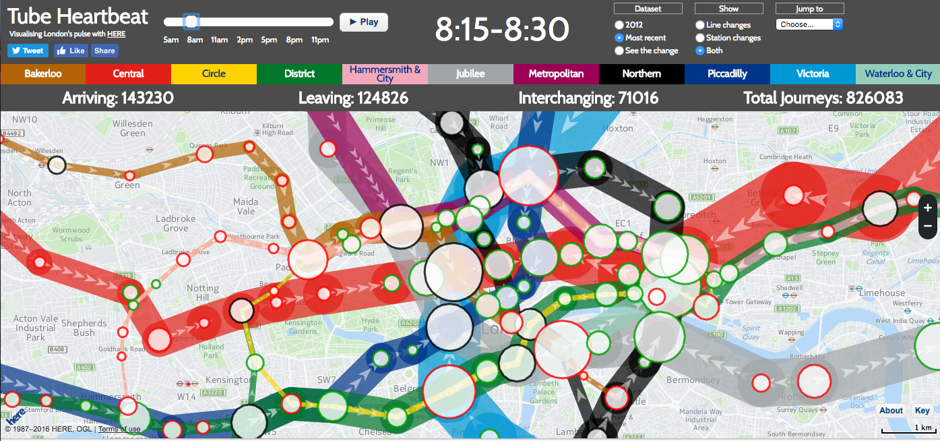
Alongside the bulging train lines, fluctuating numbers show the total passengers entering and exiting each of the 168 stations, along with those transferring between train lines for every 15 minute period. Here’s what 8:15-8:30 a.m. looks like on O’Brien’s map:
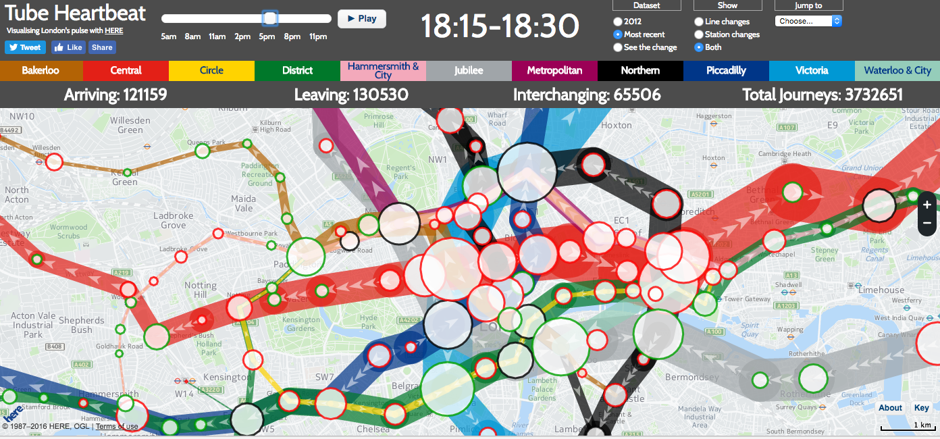
And this is what 6:15-6:30 in the evening looks like:
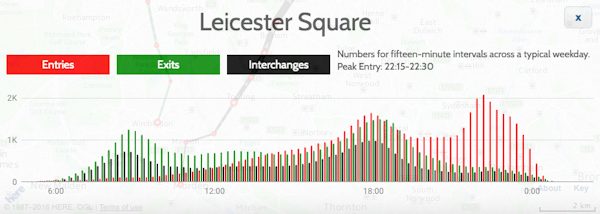
O’Brien also lets users dive deep into details for each station, as well as each line. Here’s a graph showing how busy Leicester Square is in the evenings, when theater-enthusiasts are heading home from a show:
There a number of similarly interesting patterns in ridership across the different station. O’Brien lists some broad ones in the introduction to the map:
- Peak time at Leicester Square is after 10pm - the tube is a popular way to get back to homes and hotels after a night at the theatre.
- Closing museums cause an early peak in South Kensington, while shoppers on Oxford Street can also be seen in the stats.
- School kids cause spikes in usage across certain quieter stations, particularly in outer London.
- West Ham's morning peak entry is an hour before everyone else! Other stations have two morning peaks.
- Some places are changing character. Stratford now has almost as many people arriving as leaving in the morning peak.
One thing is clear from this map: The lines of the Underground are certainly the veins and arteries of the city. Via HERE’s blog post about the map:
People have compared large cities to the human body since their foundations. Their roads and rail lines are their metaphorical blood vessels, bearing people and fresh resources to its major organs and transporting them away at the end of the day.
Perhaps nowhere is this more true than London.
As the executive director of the Los Angeles County Bicycle Coalition, it’s Tamika Butler’s job to champion safer streets for pedestrians and cyclists. She’s trying to help Los Angeles fulfill its pledge to be a “Vision Zero” city—by eliminating all traffic fatalities and serious injuries in the city by 2025.
But what “safety” means depends on who you’re talking to. She knows that firsthand.
A couple years ago, Butler was driving home from a downtown L.A bar, in a neighborhood packed with bikes and foot traffic. She’d been out with her wife Kelly and a handful of colleagues from the nonprofit where she used to work. The car belonged to Kelly, who was a little tipsy. So Butler, who doesn’t drink, had taken the wheel, while Kelly sat shotgun and a few young co-workers squeezed in the back to hitch rides home.
“We get pulled over,” says Butler. “The officer steps out and tells me, ‘I felt like you were speeding, and it’s not safe, because there are people walking and biking around here.’”
Butler is black. Her staffers were all people of color. Her wife is white. According to Butler, the officer then walked around to the passenger side of the car and bent down to meet Kelly’s eyes. “He points to me, and asks Kelly, ‘Did he make you get in the car?’” Butler recalls, noting that she sometimes gets identified as a man. “And Kelly says, ‘Um, she’s my wife, and this is my car.’” The officer flashed his torch on Butler and her staff members. “Then he looks back at Kelly, and asks, “So why on earth is she driving?’”
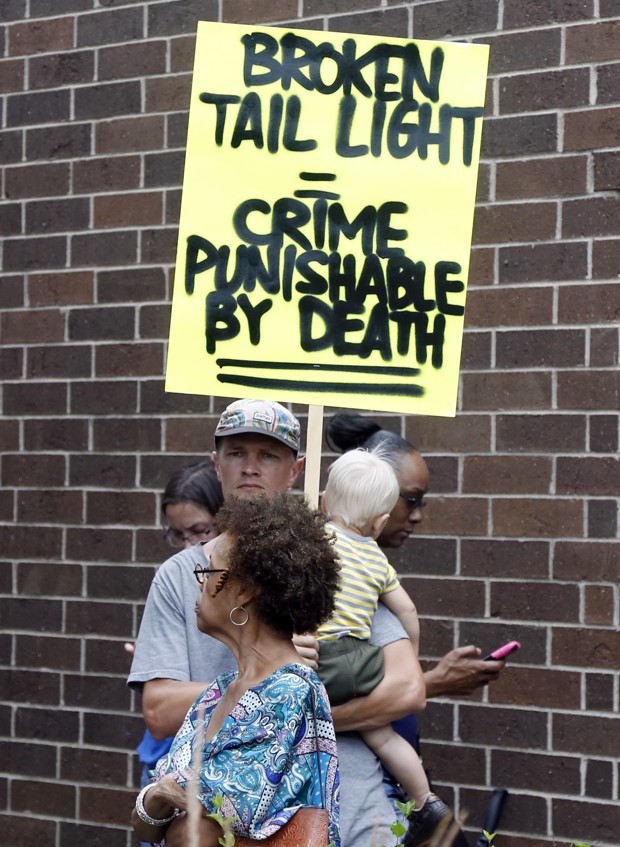
Butler apologized for speeding (though she maintains that she hadn’t been), and the officer ultimately let her go with a warning. But the incident resonated with her as a relatively tame example of how easily things can get ugly when racial discrimination mixes with traffic safety. “There’s a special type of attention that folks of color get from police,” she says. That doesn’t only happen when she’s behind the wheel. “There are also places I intentionally won’t bike or walk because I know I will invite potentially life-threatening attention.”
It’s no secret that people of color face outsize risks when it comes to encounters with law enforcement. African-American drivers, in particular, are more likely to be stopped and searched than drivers of other races, even where they are less likely to be carrying or doing anything illegal. They are more likely to be subjected to excessive force. Getting pulled over for “driving while black” also leads to more arrests among African Americans, opening a “trapdoor into the criminal justice system that can have a lifelong impact, especially for those without the financial or other resources to negotiate it,” as New York Times reported last year.
And while these stops rarely escalate towards violence, things can turn lethal when they do. Philando Castile, Sandra Bland, Walter Scott, and Samuel Dubose were all African-American motorists whose lives ended after getting pulled over by police over for minor driving infractions. Their names rose to national prominence through protests led by Black Lives Matter and other groups calling for an end to police killings. The movement has called attention to the quotidian horror of police violence in communities of color, and the resulting distrust. These issues have rightfully been at the front and center of U.S. politics in recent years.
Another brand of street safety politics has also emerged, much more quietly, over a similar timeline. That’s Vision Zero, the campaign to end cyclist and pedestrian deaths and injuries. Started in Sweden in 1997, the movement has built momentum in American cities over the past few years. Austin, Boston, Chicago, Fort Lauderdale, Los Angeles, New York City, Portland, San Francisco, Seattle, Washington, D.C., and others have all pledged to reach that magic numeral within 10 to 15 years, by collecting data to determine which streets are most vulnerable to traffic violence and then following three “pillars” of action to end it.
The first pillar, “engineering,” focuses on designing streets with slower vehicle speeds, wider sidewalks, and protected bike paths. The second, “education,” is meant to align and unify local neighborhoods with the goals and expectations of the campaign. The third, “enforcement,” means using policing strategies to target dangerous traffic behaviors and street corridors with high crash rates.
“This is a ‘zero tolerance’ policy that seems winnable, within a certain timeline,” says Naomi Doerner, an active transportation planner and advocate who has worked informally with the national Vision Zero Network. “That’s very enticing for leaders within a city administration.”
But as with other kinds of zero tolerance policies, Vision Zero risks handing low-income people of color the short end of the stick. In particular, that last “E” is troubling to Doerner and other advocates of both racial and transportation justice, in light of how easily the lives of people of color can be threatened by traffic stops. For many cities pledging to the platform, the negative impacts of discriminatory law enforcement has seemed to be a non-issue, or an afterthought at best, according to Adonia Lugo, a transportation equity consultant and urban anthropologist. “It always seemed off to me that it wasn’t coming up as a special topic,” says Lugo. “How do we rely on enforcement in a settings where people are pointing out that we don’t actually enforce these laws in an equitable way?”
Lugo has thought a lot about this question. In September 2015, she wrote a lengthy blog post, “Unsolicited Advice for Vision Zero,” which touches both on the question of Vision Zero’s support of law enforcement as well as on some of the underlying tensions that keep many bike and pedestrian advocates from even recognizing the concerns of people of color. She drew on first-hand experience from a job (which she wound up quitting) managing an equity initiative at the League of American Bicyclists:
I remember the meeting in summer 2014 where my boss told us that Vision Zero would be the policy framework the organization furthered from then on. With my inclusion filter on, it sounded like another example of white bike advocates looking to Northern Europe for solutions instead of turning to urban communities in the U.S. to find out how they've managed to get by walking, biking, and using transit all these years.
Those Northern European societies that created Vision Zero are far more racially homogenous than the U.S., explains Lugo. The history and social policies of these countries present very different realities than those faced by Americans of color. To put it bluntly, racial profiling in traffic stops may not be a problem of the same magnitude in Sweden as it is in the U.S. And the white, relatively affluent, and male-dominated world of American bicycle and pedestrian advocacy can often be blind to that fact.
Vision Zero’s Scandinavian roots are especially concerning given the fact that in many American cities, lower-income communities of color suffer from the highest rates of pedestrian fatalities and unsafe street design. And because of that long history of excessive policing with little accountability, there can also be a major lack of trust in law enforcement in these neighborhoods. “Traffic violence is a huge problem, but not everyone is ready to see policing as a solution,” Lugo writes in the blog post. “Why hasn't this element of Vision Zero been drastically changed by now?”
It’s near impossible to say whether Vision Zero campaigns in U.S. cities have contributed to over-policing and winnowing public trust in law enforcement. What is clear is that, although officer-initiated enforcement is supposed to be a last resort under the Vision Zero platform, that hasn’t always been the case. New York City’s changing traffic-safety culture has been lauded as the campaign’s greatest success in the U.S. to date; Under Mayor Bill de Blasio’s 63-point action plan, the city saw traffic deaths plummet 22 percent, with pedestrian fatalities down 27 percent between 2014 and 2015. But as Fast Company recently reported, it and other Vision Zero cities have been coming down hard with officer-initiated enforcement:
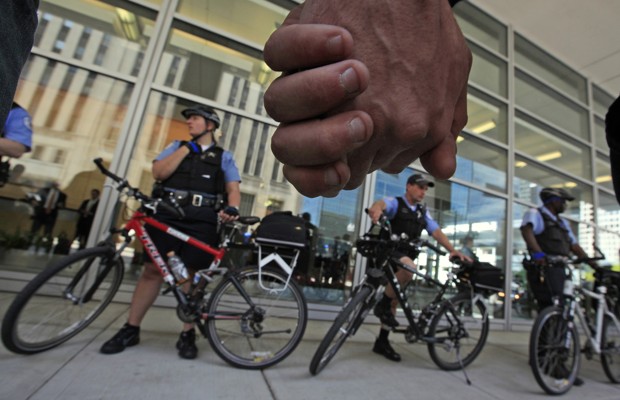
In New York, police have significantly ramped up traffic safety policing as priority in Mayor de Blasio’s administration (though they are still shockingly unlikely to prosecute hit-and-run drivers and often spend time ticketing cyclists). And while the emphasis is supposed to be on dangerous violations, data show that the NYPD still focus on minor offenses. In Chicago, the dangerous streets that would be targets for more traffic safety enforcement are mostly on the South and West sides. In D.C., the government wants to increase speeding fines to $1,000.
Leah Shahum, the founder and executive director of the Vision Zero Network, stresses that enforcement is, and was always, meant to be a secondary and complementary to engineering, and that additional traffic enforcement is never supposed to occur without intensive community engagement. But she also frankly acknowledges that the campaign didn’t take the question of equitable enforcement seriously enough from the start. In the wake of “appalling violence in Minnesota, Louisiana, and Texas” earlier this summer, she wrote a candid statement on the Vision Zero Network website about her early “missteps” with the campaign, including failing to include a more diverse range of perspectives when developing Vision Zero’s goals in U.S. cities and over-emphasizing the role of enforcement. Perhaps if the organization had been more inclusive from the start, it might have done things differently, Shahum wrote:
From a traffic safety perspective, this includes relying on enforcement too much and not being bold and brave enough in other areas, such as designing streets and setting policies that truly prioritize safety…. No amount of police presence can overcome road designs and policies that simply don’t work well enough.
Vision Zero may be a flawed campaign in some ways, but that doesn’t mean it’s not useful. Many transportation justice advocates agree that an even stronger focus on road engineering is the best way forward. Sam Sinyangwe, a policy analyst and data scientist who works with the police reform group Campaign Zero, says his organization originally drew inspiration from Vision Zero as a data-driven platform seeking to end police violence and improve accountability. He sees the “engineering” pillar as a promising way to encourage street planning that addresses transportation disparities faced by communities of color. “The issues with traffic-related deaths stem from the built environment, and the inequities inherent in it,” he says. “We can’t use policing as a solution to a problem that’s about racial inequity.”
Sinyangwe is optimistic that groups like his can find more overlap than conflict with Vision Zero. After all, they are all part of movements focused on the safety and equality of human life. The national Vision Zero campaign could also eventually move towards more explicit support of the goals of groups like Campaign Zero. Shahum’s deputy director, Zach Vanderkooy, says via email, “I don't think it's impossible to imagine that police reform would become part of a recommended suite of Vision Zero actions.”
Sinyangwe, Butler, Doerner, and others agree that it’s crucial for traffic enforcement to focus on the handful of violations that truly endanger lives, such as speeding, red-light running, failure to yield, and impaired and distracted driving, rather than on “broken windows”-type infractions like expired tags or failure to signal a lane change (which was the offense that Sandra Bland was pulled over for, according to the arresting officer). Automated traffic enforcement, such as speed traps and school safety zone cameras, can help mitigate police bias, but where they are positioned, and how they are used, are still important considerations. Cities need to be careful about how they administer traffic fines so that they don’t over-burden low-income drivers and encourage more resentment of police.
“You can’t just give more tickets and think that changes everything,” says Butler. “Maybe it slows some people down. But for others, it just builds on years of mistrust. It stands between a mom putting food on her table and paying rent.”
Some Vision Zero cities have added a fourth E to their platforms: equity. In San Francisco, police officers has been directed to narrow their attention to a few behaviors that drive fatalities. That city is also set to launch a major speed enforcement campaign that focuses heavily on education and engagement (the police will use Lidar cameras on corridors with high injury rates). Cities like D.C., Chicago, and New York City are using cameras to enforce speed limits (several states have laws restricting cities from using these kinds of technologies). Portland has been a national leader in “diversion programs,” which educate people who have broken traffic laws as an alternative to punishing them with fines or jail time. Some cities in the Vision Zero network are also looking into traffic fines that are tiered by income, like Finland famously has. “Better officer training is another thing that we’re thinking about,” says Shahum. “How are we training law enforcement so that they’re more aware of top safety problems?”
For Tamika Butler, aligning the goals of racial justice advocates and Vision Zero boils down to one thing first: getting everyone at the same table, and figuring out what “safety” means for everyone. That means a diverse coalition that isn’t afraid to question the established schools of thought, whether from Sweden or the local police department.
Last year Butler helped assemble such a group to think about how to implement the goals of Vision Zero in L.A. The meetings involved transportation leaders, racial justice advocates, city officials, police officers, youth groups, and other community organizations that had nothing to do with transit, and Butler says they produced much more nuanced conversations than others she’s had with bike advocates alone. She was especially delighted to see a handful of LAPD officers showing up and engaging. Of course, reforming the entire department is a much bigger matter. To make safe streets for everyone, there’s still a long road ahead in L.A. and beyond.
“There will probably always be that tension,” she says. “But I hope we can figure it out how to overcome it. And that for me, personally, is coming less as an executive director and more as a young black American who feels that the stakes are too high.”

This is an open thread.

France has banned women in their country from wearing full-body, head-covering bathing suits. And "burkini police" are patrolling the beaches to catch violators, making them remove their swimwear. People are expressing their opinion on social media. Examples:
Just let this sink in. Men with guns forcing a women to undress, with the weight of the law behind them. pic.twitter.com/4BI16Bbss9
— Abdul-Azim আজিম (@AbdulAzim) August 23, 2016
1925 vs 2016. 90 years later and we're still policing women on what they wear to the beach. #BurkiniBan pic.twitter.com/gOUKM8H8NZ
— Matthew Ruddle (@RuddleMatthew) August 24, 2016
Handing themselves in to the French police. pic.twitter.com/JvOLrRfcHs
— Giles Fraser (@giles_fraser) August 24, 2016
Time for a swimwear quiz: Banned in France or not? 4 photos to highlight the hateful idiocy of the #BurkiniBan pic.twitter.com/ZGaGDbOhmY
— Andrew Stroehlein (@astroehlein) August 18, 2016
Armed french cops force woman to remove clothing on Nice beach. Has it come to this? #BurkiniBan pic.twitter.com/xMg71qC111
— Ian Fraser (@Ian_Fraser) August 24, 2016
[via]
The burkini row may seem banal, and to some a surreal inversion of laws in Islamic countries, but it has become yet another flame in the murderous tinderbox of Islamism in France, invoking issues of control over the body, religious freedom, racism, provocation, terrorism, Islam and Islamophobia, republicanism and what the French call laïcité. Lïïcité is the hardest for people outside France to understand: our words “laity” and “secularism” fail to express the depth of allergy to all things theocratic, which is endemic to French societal fabric since the revolution.Others are pointing out the absurdities when compared to what's allowed. I've seen several versions of this, but this one is my favorite:
Just to be clear everyone, only ONE of these is illegal to wear on the beach in France, #BurkiniBan pic.twitter.com/74HQhbZYPV
— Ally (@_AllysonMarie_) August 24, 2016
Just let this sink in. Men with guns forcing a women to undress, with the weight of the law behind them. pic.twitter.com/4BI16Bbss9
— Abdul-Azim আজিম (@AbdulAzim) August 23, 2016
Christian Estrosi ... has published a press release by the city of Nice, to announce that he would file a complaint against those who would broadcast pictures of municipal police verbalize women guilty of exercising what they believed to be their freedom to dress from head to feet on the beaches.Wait. Showing accurate photos creates defamation against the police? How's that work? Estrosi apparently says that legal actions have already been filed, though Numerama was unable to confirm any legal actions as yet. The article also notes that despite Estrosi implying otherwise, police do not have any sort of special protections that say they cannot be photographed while in public.
" Photos showing municipal police of Nice in the exercise of their functions have been circulating this morning on social networks and raise defamation and threats against these agents ," the statement said.


![[After setting your car on fire] Listen, your car's temperature has changed before.](http://imgs.xkcd.com/comics/earth_temperature_timeline.png "[After setting your car on fire] Listen, your car's temperature has changed before.")