Shared posts

23 Aug 23:14

Italy's Birthday Present to 18-Year-Olds: €500

by Eillie Anzilotti

On their 18th birthdays, Italian teens will soon wake up to a pretty sweet gift from the government: a “cultural bonus” to the tune of €500. The teens can spend the money on anything from visits to museums and national parks to books and concert tickets.

The scheme will launch on September 15, and every Italian teen whose birthday falls before December 31st of this year will receive the bonus, according to The Local. A total of €290 million in government money will be apportioned out to some 574,000 lucky youngins. The bonus will also retroactively apply to those born in 1998 who’ve already turned 18 this year.

The initiative “reminds [youth] how important cultural consumption is, both for enriching yourself as a person and strengthening the fabric of our society,” the Italian parliamentary undersecretary Tommaso Nannicini said in The Local.

The €500 will not simply be delivered as cold, hard cash: to access the funds, teens will have to download an application, 18app, and register through one of the country’s five identity-verification portals to receive login credentials. The app creates a voucher for each purchase, which will be invoiced to the government to verify that whatever the money is spent on is, in fact, culturally enriching. The €500 will be up for grabs from a teen’s birthday until the end of 2017 (or until all the money has been spent).

According to Corriere, the scheme was initially intended for only Italian natives, but the government will extend the bonus to foreign-born Italians with a residential permit.

Other governments are working on schemes to distribute no-strings-attached money to people, but the intent of those funding programs is mainly to alleviate poverty: the Canadian province of Ontario will set aside part of its 2017-2018 budget to test out a program that would cover people’s basic living expenses; Finland and the Netherlands recently proposed similar initiatives that would allot people between $800 and $1,000 per month to spend on living expenses.

The 18app program operates with a different purpose in mind. The scheme, Nannicini said in Corriere, is an experimental approach to cultural funding. Rather than the government picking and choosing which institutions to financially support, Nannicini says that the initiative leaves those decisions up to individuals’ preferences. 18app also reads as the Italian government investing in its cultural future. “The initiative sends a clear message to youngsters, reminding them that they belong to a community [that] welcomes them once they come of age,” Nannicini added.

According to The Local, the Italian government will follow up next year with a similar program, this time benefitting teachers.

H/t Atlas Obscura

23 Aug 16:56

One Answer to School Attendance: Washing Machines

by Mimi Kirk

Dr. Melody Gunn, the former principal of Gibson Elementary in St. Louis, couldn’t figure out why student attendance was on the low side. All of Gibson’s kids were provided free or reduced lunches, and the school facilitated transportation.

In talking to parents, Gunn discovered that many didn’t have easy access to washing machines. Or if they did have machines, they couldn't always use them because they couldn’t afford detergent, or their electricity had been shut off. For these families, laundry had to take a backseat to more pressing needs such as food and rent.

It turned out that when students didn’t have clean clothes, they often stayed home from school out of embarrassment. Logan, an eighth-grader, spoke about how difficult it is for others to understand his problem: “I think people don’t talk about not having clean clothes because it makes you want to cry or go home or run away or something. It doesn’t feel good.”


CityFixer

CityFixer image

Solutions for an Urbanizing World


Gunn reached out to the Whirlpool company to see if it could help, and it donated a washer and dryer to her school. She then invited students who had missed more than 10 days of school to bring in their clothes for laundering. Whirlpool later gave 16 more schools in districts in St. Louis and Fairfield, California, washers and dryers through a new program.

“After just one month, we saw an impact,” Gunn tells CityLab. The more long-term results of the program have actually been remarkable. The first year saw over 90 percent of tracked students increase their attendance, with those most in need of the service averaging an increase of almost 2 weeks. Teachers surveyed reported that 95 percent of participants showed more motivation in class and were more apt to participate in extra-curricular activities. The results support research demonstrating that chronic absenteeism isn’t because of kids’ lack of smarts or motivation, but is largely due to coming from a low-income household.

With the United States confronting such profound problems as structural inequality and racism, clean clothing may seem like a band aid on a festering wound. Gunn says that as a public educator, she’s simply looking to serve her public’s needs and provide a model for other communities to emulate. “What’s around me is what I can control,” she explains. “This is our responsibility. It’s a need. It’s not a want.”

Whirlpool says it will expand the program next year to at least 20 additional schools, including one in Baltimore and one in Nashville. Over 300 schools have expressed interest in the program.

15 Aug 19:49

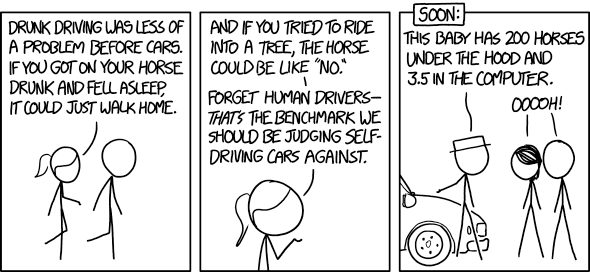
Horses

This car has 240% of a horse's decision-making ability and produces only 30% as much poop.
15 Aug 18:41

“Pocket” Bike Lanes: A Small Step to Make Intersections Work Better?

by Angie Schmitt

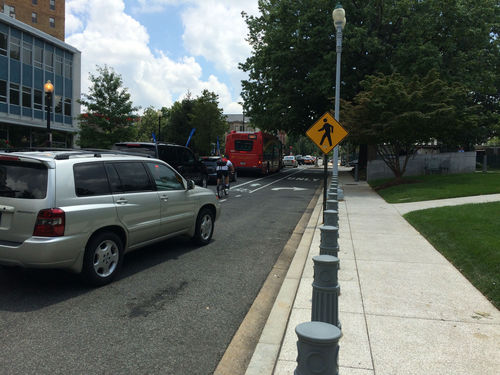
Photo: Greater Greater Washington

Photo by Mike Goodno (DDOT) via Greater Greater Washington

A bike lane that appears at an intersection to help guide bicyclists out of the way of turning drivers — in Washington, D.C., they call this a “pocket lane.” David Cranor writes at Greater Greater Washington that the District is looking to add them along streets that don’t otherwise have bike lanes, targeting intersections where they might help avoid conflicts. He says:

The District Department of Transportation recently installed “pocket lanes” on southbound 2nd Street NE at Massachusetts Avenue and at Hawaii Avenue and Taylor Street NE. A type of through bike lane that’s less than a block long and doesn’t continue on the other side of the intersection, they sit between the lane for going straight or turning left and the right turn lane.

Pocket lanes have several uses, and they make intersections more efficient for everyone. For starters, they keep people on bikes who are heading straight through an intersection from having to wait behind a queue of left-turning vehicles, whose drivers are in turn waiting for a break in oncoming traffic. They also keep drivers from having to wait in line behind a cyclist who’s traveling straight.

Another benefit is that they give people on bikes their own space that’s to the left of right-turning traffic, which prevents a situation known as the “right hook.” The “right hook” occurs when a driver who’s turning right hits a cyclist riding on the right hand side of traffic and going straight.

Have you seen “pocket lanes” in your city? On streets without bike lanes, would a “pocket lane” be a low-cost way to help guide drivers and cyclists through intersections? Would you appreciate more of them in your city or not?

Elsewhere on the Network today: Mobility Lab explains how Portland’s TriMet transit agency helped pioneer the open data system that has spurred a wave of private innovation in transit apps, with major benefits for riders. The Urbanist explains the many ways roundabouts are superior to ordinary intersections. And Market Urbanism says that intercity buses, long undermined by government policies aimed at protecting public investments in rail, are making a comeback in Europe, with some potential benefits for consumers.

12 Aug 22:30

Forget Skynet: AI is already making things terrible for people who aren't rich white dudes

by Cory Doctorow

Kate Crawford (previously) takes to the New York Times's editorial page to ask why rich white guys act like the big risk of machine-learning systems is that they'll evolve into Skynet-like apex-predators that subjugate the human race, when there are already rampant problems with machine learning: algorithmic racist sentencing, algorithmic, racist and sexist discrimination, algorithmic harassment, algorithmic hiring bias, algorithmic terrorist watchlisting, algorithmic racist policing, and a host of other algorithmic cruelties and nonsense, each one imbued with unassailable objectivity thanks to its mathematical underpinnings. (more…)

12 Aug 18:42

North Korean builders use crystal meth to speed up skyscraper progress

by Jessica Mairs

Methamphetamine is being doled out to North Korean construction workers in a bid to speed up progress on a skyscraper in the capital city of Pyongyang, according to reports. (more…)

12 Aug 17:12

Cash grants to people with unexpected bills successfully prevents homelessness

by Cory Doctorow

Nickelsville_02

In The impact of homelessness prevention programs on homelessness (Scihub mirror), a group of academic and government economists show that giving an average of $1,000 to people in danger of losing their homes due to unexpected bills (for example, emergency medical bills) is a successful strategy for preventing homelessness, which costs society a lot more than $1,000 -- more importantly, these kinds of cash grants do not create a culture of "dependency" that leads to recklessness, nor does it have a merely temporary effect. (more…)

11 Aug 20:23

If People Can’t Afford to Live Near Work, They Probably Won’t Bike Commute

by Angie Schmitt

How out of control are Bay Area housing prices? It costs so much to live in Palo Alto that Kate Vershov Downing — a lawyer who served on the Planning and Transportation Commission — announced this week that she and her husband — a software developer — are moving to Santa Cruz. She resigned her seat on the commission.

This is what a $7 million house looks like in Palo Alto, California. Photo: RedFin

A $7 million house in Palo Alto. Photo: RedFin

Before her resignation, Downing had been a lonely voice in favor of new housing construction in a city that has resisted it even as job growth has pushed rents into the stratosphere.

Richard Masoner at Cyclelicio.us says the story is a great illustration of why land use matters to active transportation:

They probably have a combined income well north of a quarter of million per year, but they cannot afford to live near their Silicon Valley jobs. Kate and her family have decided to move to Santa Cruz, and Ms. Downing can no longer serve on Palo Alto’s Planning and Transportation Commission where she has been an outspoken thorn in the side of a city council that refuses even modest increases in higher-density housing development.

Kate’s one-way commute will now exceed 30 miles, while Stephen will now travel over 40 miles to his job. The distance and nearly 3000 feet of elevation gain for each direction give even strong, avid cyclists reason to pause, especially if they value family time and work-life balance.

Much of Palo Alto is very bikeable, and 7.3% of residents tell the US Census that they bike to work. But if Silicon Valley workers can’t afford to live within reasonable biking distance of their jobs, that means more cars on the road and more cars taking up parking spaces in Palo Alto and surrounding cities, which in turn leads to lower quality of life due to noise and air quality for the residents who continue to vote against senior homes and two-story zoning.

As a few people besides me have been pointing out lately, fewer than 20% of trips are work trips, so focusing on riding bikes for fun and errands can help nudge the needle up, but even these close-to-home trips become more of a chore when you spend three to four hours of your day just on the commute.

Elsewhere on the Network today: Streets.mn explains how a local group is trying to organize transit riders around building better bus stops. And Greater Greater Washington uses three maps to explain some fundamental differences between central D.C. and its outer neighborhoods.

10 Aug 20:10

5 Reasons No One Should Ever Take the Straddling Bus Seriously

by Angie Schmitt

A Chinese inventor actually built and tested this concept last week -- but it only emboldened skeptics of the concept. Photo: Youtube via Popular Science

A Chinese firm built and tested a prototype of this on a short track, but that might be the end of the road for the straddling bus. Image via Popular Science

The taller the bus, the harder it falls. Since 2010, a Chinese firm’s “straddling bus” concept has captured the imagination of people around the globe who want to avoid the hassle of carving out street space for transit. But a “test run” last week in the city of Qinhuangdao looks like it was the final blaze of glory for this idea.

Shortly after the test run, Chinese state media attacked the reputation of Song Youzhou, the designer of the “transit-elevated bus,” and labeled the project an elaborate scam to bilk investors. Whether or not you believe those allegations, the straddling bus is full of holes so big, you could drive a car through them (yuck yuck).

Here are five of the biggest.

1. It’s a train, not a bus

Let’s get this out of the way first. The “bus” would run on tracks. It’s a mistake to assume — as many people apparently have — that you could just plop a straddling bus with rubber tires on any old roadway and watch it go. Building tracks would be expensive and present a whole host of design challenges.

2. It only goes straight

This is a big one. How does a 25-foot-wide elevated train operating just above street traffic make turns? The 300-meter test run last week didn’t include any. Can you imagine this enormous vehicle making right-angle turns on ordinary streets? (If you’re wondering, some thought has in fact been given to the drivers who happen to be straddled by the bus at the time it turns. Special traffic signals underneath the bus would tell them to stop. What could go wrong?)

3. It can’t run on streets with overpasses

The bus is 16 feet tall and could not clear overpasses and bridges in cities like Beijing, according to the Times.

4. It’s not even that good at straddling

Guangzhou Bus Rapid Transit carries 1 million riders a day. Photo: Wikipedia

Guangzhou Bus Rapid Transit carries 1 million riders a day. Photo: Wikipedia

The clearance under the “bus” is 2.1 meters, but the maximum vehicle height in China is 4.5 meters. The one thing the straddling bus is supposed to do — straddle — it can’t do very well.

5. It’s just a fantasy to avoid building real transitways

This is the crux of the issue. Dedicated bus lanes can speed transit riders past traffic — no gimmicky technology needed. But cities have to be willing to claim that street space. If they do, transit lanes can easily move many more people than car lanes.

Indeed, the 14-mile bus rapid transit system in Guangzhou, China, is closing in on 1 million passengers a day. Now that the straddling bus has been debunked, maybe more places will look to replicate Guangzhou’s real-life success instead of fantasizing about something that will never happen.

05 Aug 15:59

Rio Olympics Selling Knockoffs Versions Of Its Own Merchandise

by Mary Beth Quirk

In an effort to circumvent efforts by counterfeiters, organizers of the Rio Olympics have created a line of products that are, well, knockoffs of the Games’ official merchandise.

Recognizing that many Brazilians can’t afford to shell out big bucks on merchandise like T-shirts emblazoned with the Olympics logo, organizers have licensed almost identical products — with differences like thinner fabric — at a lower price, Bloomberg reports.

For example: an official tee sold at an Olympics gift store highly trafficked by tourists might cost 95 reais, or $29, while the low-cost version sells for just 40 reais, around $12.25.

Usually, officials at the games have to chase around counterfeiters peddling cheap fakes. But this way, they can compete with them instead, Sylmara Multini, head of licensing at Rio 2016 told Bloomberg.

“The best way to combat piracy is by using product,” Multini said in an interview, adding that the cheaper versions are expected to account for 60% of sales and 40% of revenue. “If you have a 40-real T-shirt, we feel most of the population will be able to engage with our product.”

To Foil Counterfeiters, Rio 2016 Makes Its Own Knockoffs [Bloomberg]

03 Aug 15:38

Cities finally realize they don’t need to require so much damn parking

by Ben Adler

Walgreens-shutterstock-c

Some cities are starting to get smarter about parking, and that’s leading to less driving.

For the last half-century, zoning codes in many American cities and suburbs — even relatively walkable, transit-heavy ones — have typically required developers to provide a certain amount of parking for each new home or business, often far more spots than are needed. The costs of building that parking get passed on to residents and customers whether or not they drive. By subsidizing parking in that way, we encourage people to drive. And surrounding every building with parking makes cities less friendly to walkers and eats up green space.

But there’s been a spate of good news on this topic in the last year. New York City recognized that people who live in low-income projects with public transit access were very unlikely to own cars. So, in its recently passed rezoning, the city eliminated parking requirements for low-income, “inclusionary” (meaning some units are affordable for low- or middle-income families), and affordable senior housing developments that are within a half-mile of mass transit.

Some New York City real estate developers are moving away from excess parking too. Mass transit options are so rich in Midtown Manhattan that city parking requirements are largely absent there, but developers have sometimes chosen to build a lot of parking capacity into their projects anyway, to appeal to future homebuyers, office workers, and store customers. That’s not the case, though, with the massive Hudson Yards project being built on the West Side of Manhattan, which will include 5,000 housing units, five office towers, and a retail center. It may have as few as 200 parking spaces. “That anything of this scale — and built near the Lincoln Tunnel and the West Side Highway — would eschew parking in this way is a clear testament to how much New York City has changed,” observed Politico New York last year. “As public transit options expand, and millennials continue to skew trends away from car ownership, the necessity for buildings to supply parking is dwindling.”

Other big, progressive cities are making similar moves. Chicago has a surplus of mandated free parking. But, last year, it expanded areas targeted for transit-oriented development, where parking requirements are minimal or nonexistent. In January, Washington, D.C., reduced parking requirements for multi-family buildings and commercial buildings near metro stations and along high-speed bus routes.

The impetus is economic as much as environmental. Hot cities such as Chicago and D.C. suffer from spiraling housing costs, and eliminating expensive parking requirements can help alleviate that burden. “Builders find that parking minimums are high-cost, and for a high-cost city like D.C., that is one of the issues with affordability,” says Christopher Coes, director of LOCUS, a program at Smart Growth America that advocates for sustainable, walkable development. In fact, cities can use the reward of reduced parking requirements as an incentive to get developers to build more affordable housing.

Seattle has gradually eliminated parking requirements in much of the city, starting with commercial buildings and downtown and growing to include residential neighborhoods with good mass transit access. “There are a number of examples in the Northwest of cities reducing parking requirements,” says Alan Durning, executive director of the Sightline Institute, a Seattle-based environmental policy think tank.

Even smaller cities far from the coasts are breaking the habit of forcing free parking on their residents and businesses. Last year, the Fayetteville, Arkansas, city council eliminated parking minimums for every new building except homes. Previously, for example, a restaurant was obligated to provide one parking space for every 100 square feet. In Buffalo, New York, that dowdy emblem of industrial decline, Mayor Byron Brown’s proposed “Green Code” would eliminate parking requirements entirely.

“A lot of cities are reducing parking requirements around transit stations and in the denser areas,” says Donald Shoup, a professor of urban planning at UCLA and author of The High Cost of Free Parking. “It’s becoming obvious that minimum parking requirements prevent a lot of good things from happening,” he says. For example, if a developer has to build two parking spaces for every new apartment, or dozens of parking spaces for every new restaurant, there is no way to convert an old building that doesn’t have a parking lot or garage into new homes or businesses.

Many European cities, as you would expect, are ahead of the U.S. on this trend. Amsterdam, Copenhagen, Hamburg, Paris, and others have reduced or eliminated parking requirements over the last 15 years. According to a 2011 study by the New York City-based Institute for Transportation and Development Policy, a sustainable transportation advocacy group, those cities had less traffic and lower emissions as a result.

Although parking reform is catching on in the U.S., progress has been inconsistent. Many cities are leaving their parking requirements untouched, and some have actually increased them.

Portland, Oregon, surprisingly, has been one of the backsliders at times. In 2013, the Portland City Council took a step backward from its smart growth leadership and instituted parking minimums for new apartment buildings in certain neighborhoods with expanding populations. The councilors were responding to current residents who feared that a stream of newcomers would make street parking difficult. But, last month, the city council decided not to enact new parking minimums in Northwest Portland, another area with rapid housing development. Urbanism advocates in Portland cheered. They’ve argued that the proposed parking mandates would have pushed up prices for new apartments and condos in Northwest Portland or deterred them from being built at all.

Still, even when progress is made, it’s usually just in areas like downtowns. Outlying residential neighborhoods, and especially separate suburban towns, still typically require excessive parking for every new development. And eliminating mandatory garages or parking lots is only the first stage of true reform. Free curbside parking is also a huge subsidy for drivers. Shoup advocates charging for street parking in addition to eliminating parking minimums. That’s a long way off, but at least things are finally moving in the right direction.


Filed under: Article, Cities
29 Jul 17:27

How Scalpers Make More Money Off Broadway’s ‘Hamilton’ Than The Show’s Producers

by Laura Northrup

There’s good news for impatient theater fans who want to see the hit Broadway show “Hamilton.” After ticket prices peaked between this year’s Tony awards on June 12 and the departure of some original cast members a month later, they’ve now plummeted… to only about six to ten times their original face value.

Back in 2007, New York repealed many of its laws against ticket scalping, though people in the industry prefer the more politically correct and respectable-sounding term “broker” now. Instead of standing in a line and buying up as many tickets as they can, brokers create bots to virtually scoop up those tickets much faster.

The problem is that now that Ticketmaster lists resale tickets right on the page where customers would buy tickets directly from the theater if any were available. Sites like StubHub also seem much more legitimate than buying a ticket for cash from around the corner from the theater.

The result is that there’s a frenzy over tickets to this show, and Broadway hasn’t really had to deal with this situation before. The New York Times calls each performance of the show a mini-Super Bowl in terms of getting tickets and prices rising and falling at the last minute.

The Times built its own ticket bot to track prices, though the team could have added features that would have let them scoop up tickets to resell, too. While a possible solution to the problem of revenue streams in the news industry, that would have been extremely unethical. What the bot let the Times do was track prices over time across multiple resale sites and box-office sales on the original site through Ticketmaster.

The bot calculated that the show earned many times what they originally spent on the tickets, earning money for using some software instead of actually producing a show.

State Attorney General Eric Schneiderman has increased the penalties for buyers caught using ticketing bots, and has proposed capping the prices of tickets on the resale market. That change would also probably have unintended consequences.

How Scalpers Make Their Millions With ‘Hamilton’ [New York Times]

29 Jul 17:06

Seattleites Own More Cars Than Atlantans, and Other Surprising Comparisons

by Angie Schmitt

Screen Shot 2016-07-27 at 12.02.45 PMHere’s an interesting glimpse at car ownership in a cross-section of American and Canadian cities, courtesy of a recent report from the Shared Use Mobility Center.

This table comes from SUMC’s analysis of car-share and bike-share [PDF]. We trimmed it to highlight the cars per household across the 27 cities — 25 in America and two in Canada — in SUMC’s report. The sample is meant to include different types and sizes of cities — it’s not a list of the biggest cities. And the data comes from core cities, not entire regions with the suburban belt included.

Among these 27 cities, household car ownership is lowest in New York, Washington, Boston, Philadelphia, Buffalo, San Francisco, and Toronto. Not many surprises there.

But the car ownership numbers do make for some unexpected city-to-city comparisons:

  • The average household in Seattle, for instance, owns more cars than the average household in notoriously sprawling Atlanta.
  • Car ownership is higher in bike-friendly Boulder than in unwalkable Las Vegas.
  • In Portland, households typically own more cars than in Miami, and the rate isn’t much lower than in Houston.

You can’t read too much into this one table, but it does suggest that some cities haven’t overcome car dependence as much as their reputations may suggest.

SUMC notes in its report that car ownership rates are basically a function of the strength of the transit system — the better the transit, the fewer cars people own.

28 Jul 22:12

67 Congress Members Tell Feds: Measure the Movement of People, Not Cars

by Angie Schmitt

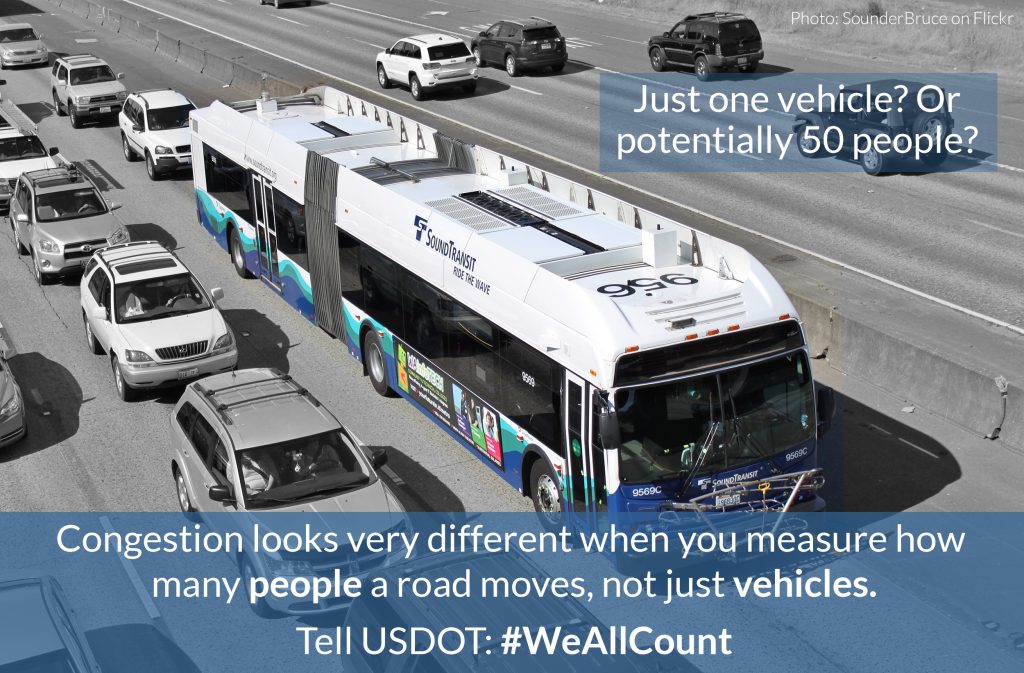
A proposed rule from U.S. DOT could undermine transit. Image: Transportation for America

If U.S. DOT doesn’t change its proposed congestion metric, 50 people riding in a bus will count as much as one person in an SUV. Image: Transportation for America

The federal government hands states about $40 billion a year for transportation, money they can basically spend however they want. The result in many places is a lot of expensive, traffic-inducing highways that get clogged with cars soon after they’re finished. Can measuring the effect of all this spending lead to better decisions?

U.S. DOT is developing a metric to assess how well states address congestion. This is a minefield — if the new congestion rule only measures the movement of cars, it’s going to entrench 60 years of failed transportation policy. Unfortunately, the first draft of the DOT rule left a lot to be desired.

Reformers have been pushing the agency to revise the rule so it takes a broader, multi-modal view of congestion. Stephen Lee Davis at Transportation for America reports 19 senators and 48 U.S. representatives have written a letter to U.S. DOT [PDF] demanding a healthier approach.

The Congress members write:

If we focus, as this proposed rule does, on keeping traffic moving at high speeds at all times of day on all types of roads and streets, then the result is easy to predict: states and MPOs will prioritize investments to increase average speeds for cars, at the expense of goals to provide safe, reliable, environmentally sensitive, multi-modal transportation options for all users of the transportation system, despite those goals being stated in federal statute. This singular focus on moving vehicles undermines the progress this Administration has made on multi-modal planning and investments through the TIGER program. Encouraging faster speeds on roadways undermines the safety of roads for all users, as well as the economic vitality of our communities.

The excessive congestion performance measure should be amended to assess people hours of delay and not just vehicles. This change is critical to account for the many non-single occupancy vehicle users, including transit bus riders and bicyclists and pedestrians traveling along the corridor, which provide critical congestion relief and could be undercounted or even penalized under this measure.

The letter also insists that U.S. DOT require state and regional transportation agencies to assess the impact of projects on greenhouse gas emissions.

U.S. DOT is currently accepting comments about the rule change. You can weigh in and help promote a better policy.

Elsewhere on the Network today: The Transport Politic offers a side-by-side comparison of the Republican and Democratic transportation platforms. Bike Portland highlights a study that found streetcar tracks cause a large number of cyclist injuries in Toronto. And The Fifth Square wants Philadelphia Mayor Jim Kenney to enforce parking rules on South Broad year round, like the city is during the DNC.

22 Jul 20:09

7 “Health” Products From The Past That Would Never Make It Onto Shelves Today

by Mary Beth Quirk

If someone walked up to you today and suggested you drink radioactive water to reinvigorate your body, or offered you a cigarette to ease your asthma symptoms, you’d probably walk away quickly, in the hope that such craziness isn’t contagious. Yet not that long ago, these and other questionable “health” products were openly marketed to the public as great ideas.

Take a walk with us down memory lane for a look at products that more than a few people once thought were sound ways to improve your health, but which now may make you wonder how humankind made it through the Twentieth Century.

1. Lysol as Contraception & Vaginal Hygiene Product

lysol1
The first thing you think of when you think of Lysol is probably germs, as we use the product today as a disinfectant. But killing germs meant something entirely different at one point in Lysol’s history, when the product was widely advertised as a douching product for women to maintain “daintiness” down there. It also had another scary purpose, however: Mother Jones cites Andrea Tone who writes in her book Devices and Desires: A History of Contraceptives in America that it was also the most common form of birth control from 1940 until 1960, when “The Pill” first hit the market.

2. Radium Water

WaiferX/WaiferX
Feeling sluggish? How about a swig of water with a splash of radium in it? It might seem ridiculous to casually ingest radioactive fluids, but radium water had its time in the spotlight around 100 years ago.

You could use the “Revigator,” which was a water dispenser made of ceramic lined with uranium ore. Just fill it with water and let the radium-lined jug do its work overnight!

There was also William A. Bailey, a man who called himself a doctor but held no medical degree, who founded Radium Company and peddled Radithor, a medicine that was essential radium dissolved in water that he claimed would “invigorate” his patients.

BlueShift12

Eben Byers was one of Bailey’s wealthiest clients, Popular Science noted in 2004. He drank more than 1,000 bottles of Radithor, before his jaw fell off and he died. His autopsy revealed large holes in his brain and skull.

3. Ozone Paper & Cigarettes For Asthmatics

British Medical Journal, 1878
The idea of someone with asthma lighting up anything in an effort to breathe better is laughable by today’s standards, but things were different in the 19th century.

“Preparations such as Potter’s Asthma Cigarettes, Himrod’s Cure for Asthma, Asthmador Cigarettes, Dr. J.D. Kellog’s Asthma Remedy, Espic, Legras, and Escouflaire powders, and ozone paper were aggressively marketed and sold over the counter in most Western countries,” Mark Jackson writes in Asthma: A Biography.

4. Listerine To Treat Dandruff, Gonorrhea

LIFE
Long before it was sold as mouthwash to ward off halitosis, and some time after it was sold for its original use as a surgical antiseptic in the 1880s, Listerine served as a sort of catch-all for whatever might ail you — including treating dandruff, as seen above.

“Originally invented as a surgical antiseptic (and named after the founding father of antiseptics, Dr. Joseph Lister), its uses were varied—they including foot cleaning, floor scrubbing and gonorrhea treating,” Smithsonian Magazine noted.

By the 1920s, the company had come up with a better idea, and invented the word “halitosis” — using a Latin root, to mean “unpleasant breath” — pushing Listerine as the way to cure it.

5. Vitamin Donuts

National Archives
Just try offering young Henryson or wee Everly a healthy doughnut today, and see what their parents say. Not gonna happen. Sure, these sugary treats might’ve brought “pep and vigor” to the kids way back when, but today we call that a sugar high, that will only lead to a sugar crash.

6. 7-Up… For Babies

7upvintage
While we’re on the topic of nutrition for the younger set, how about calming that squalling baby down by filling his bottle with sugary soda, like this ad from 1953 suggests? With today’s concerns over childhood obesity, it’s doubtful you’d see an ad for soda featuring anyone this young.

7. “Violet Rays,” The Revitalizing Cure-All

vi_rex_violet_rays1In 1922, “Violet Rays” were another cure-all, with products like this Vi-Rex device, which promised to make you “vital, compelling, and magnetic,” Collectors Weekly noted in a roundup of dangerous ads.

Though the device plugged into a light socket to work, another ad says Vi-Rex is “not a vibrator, and will not contract the muscles or shock nerves.”

“Its magic rays pass through every cell and tissue, creating ‘cellular massage’ — the most beneficial electrical treatment known,” the ad claims.

Whatever it did or didn’t do, a spate of recalls and lawsuits over the product led to the Food and Drug Administration banning these devices. The last manufacturer of violet ray devices in the U.S. appears to have been Master Electric, but in 1951 the company was hit with a lawsuit in Marion, Indiana, and the devices were seized by the FDA.

22 Jul 19:59

Elon Musk’s “Master Plan” Won’t Work for Cities

by Angie Schmitt

Elon Musk. Photo: Steve Jurvetson via Flickr

Elon Musk knows technology, but he doesn’t understand cities so well. Photo: Steve Jurvetson/Flickr

Earlier this week tech entrepreneur Elon Musk released his updated “master plan” for Tesla, including some thoughts on how autonomous mini-buses will supplant today’s transit and “take people all the way to their destination.” Like every Musk pronouncement, this one got a lot of buzz — but it also drew some healthy skepticism.

One reason to doubt Musk’s plan is that it clearly would not work in cities, writes Jarrett Walker at Human Transit:

Musk assumes that transit is an engineering problem, about vehicle design and technology. In fact, providing cost-effective and liberating transportation in cities requires solving a geometry problem, and he’s not even seeing it. In this he’s repeating a common delusion, one I hear all the time in urbanist and technology circles.

Musk’s vision is fine for low-density outer suburbia and rural areas. But when we get to dense cities, where big transit vehicles (including buses) are carrying significant ridership, Musk’s vision is a disaster. That’s because it takes lots of people out of big transit vehicles and puts them into small ones, which increases the total number of vehicles on the road at any time…

The reigning fantasy of Musk’s argument is that we must always “take people all the way to their destination.”   To do this we must abolish the need to ever change vehicles — from a train to a bus, from a car to a train, from a bus to a bike — and of course we also abolish walking.  This implies a vision in which buses are shrunk into something like taxis, because a vehicle going directly from your exact origin toyour exact destination at your chosen time won’t be useful to many people other than you.

So a bus with 4o people on it today is blown apart into, what, little driverless vans with an average of two each, a 20-fold increase in the number of vehicles?   It doesn’t matter if they’re electric or driverless.  Where will they all fit in the urban street?  And when they take over, what room will be left for wider sidewalks, bike lanes, pocket parks, or indeed anything but a vast river of vehicles?

Elsewhere on the Network today: Greater Greater Washington considers whether a plan to link Georgetown to Rosslyn via gondola is realistic. Renew ATL shares a press release about how Atlanta intends to use $260 million in potential sales tax revenue to improve transit, walking, and biking. And The Urban Edge says Nashville’s new transportation plan could be a model for cities across the Sun Belt.

22 Jul 19:56

Portraits of Foxes and Their Unique Personalities Explained

by Roeselien Raimond

foxfaces_1

When, during the sixties, Jane Goodall gave wild chimpanzees a name instead of a number, she put the science world upside down. Anonymous animals were no longer nothing more than a number. Using something as apparently simple as a name, she validated their individuality and uniqueness.

When you face a fox, you face personality.

Many years from then, we still tend to grossly underestimate our fellow earthlings and regard them like interchangeable particles of a uniform set. Did you ever realize that “the fox,” as our beloved pet dog or the cat, consists of countless individuals, each with their own specific characteristics?

Some are a little dumb, others quite intelligent. Some creative and entrepreneurial, other boring and passive. Some are even downright funny. So many foxes, so many faces. Literally! And each “face” hides a unique character.

Since all those faces speak volumes, I’d like to introduce you to 12 prominent fox personalities:

Smiling Fox

foxfaces_2

The mother of all foxes. Almost literally. Relaxed must have been her middle name and enjoying her second nature. Being the personification of satisfaction itself, she could just calmly sit in the sun for hours and hours, watching her grandchildren play and relish this sight. Moreover, she was living proof that animals can smile.

Motto: It’s All Right. Always Has Been and Always Will Be.

Miss Fox

foxfaces_3

Quite a character, this is a fox with attitude. No one ever mocked this lady, not even her little fox kits. Challenge Mom’s authority; bite guaranteed. And with the looks. With her bright red, full coat, her slender muscular body, long straight nose, proud ears and irresistible smokey eyes, she would win any beauty contest with ease. She was less talented with regard to her choice of men, since most of her offspring weren’t blessed with her beauty, but were born with a jaw abnormality instead.

Motto: I’m Too Sexy For This Site.

Hunter Fox

foxfaces_4

This lady in red was standing front row when red coats were distributed. Never before had I seen a fox with such a perfect red cloak.

The same goes for the distribution of self-confidence and courage. As a young fox she proved to be a mistress in making perfect mouse jumps. While her siblings lied lazily in the sun, she fanatically worked on her pouncing skills. And this discipline paid off: nowadays she bets higher and may call herself the mistress of chasing rabbits.

Motto: You Say Jump, I Say ‘How High?

Funny Fox

foxfaces_5

Should fox humor exist, she’s definitely got it! As well as a huge fox heart. When her big sister left the parental territory, she decided, against all fox mores, to come along. As a reward for room and board she treated her sister with a daily cleanup.

When the Queen Mum died, she became alpha fox willy-nilly. Someone’s got to do the job, right? From airy joker, she turned into a lady who knows the ropes. By resolutely wiping mothers lovers from the territory, she claimed direct order. She may be one of the smallest foxes, but size does not matter in fox country. Owning the biggest mouth does.

Motto: It’s a Woman’s World.

One-Of-A-Fox

foxfaces_6

Being the smallest and weakest of the litter, she worked her way up to crowd pleaser. Rightly so. She had tough competition to her beauty queen mum, but won the race on character points.

With her uniqueness, she became the uncrowned princess of the dunes. And despite her slightly misshapen jaw and unfoxy coat, she was a beauty as well. She proved that an animal has a free will and is able to make her own personal choices.

Motto: I Did it my Way.

Old Dog Fox

foxfaces_7

When I first met him he was already very old. As one happy grandpa on a bench at the jeu de boules, he was sitting in the sun. With a face only a mother could love and his unabashed attitude, he made me laugh.

Had he been a human I’m convinced he would, like an old expired hippy, go on and on about his childhood mischiefs.

Motto: Happy happy joy joy.

Serious Fox

foxfaces_8

The most respectable fox of the class. Unlike almost all other foxes, she actually has no bad habits at all. Therefore, she’s the only one who actually behaves by the book and does exactly what you would expect from a red fox: she hunts mice, she sleeps, she eats, she cares for posterity, brings them up and chases her boys away as soon as they reach adolescence.

You won’t find them neater fox… or a more boring one either. (sorry, Serious Fox!)

Motto: Why NOT So Serious?

Don Fox

foxfaces_9

The Don Juan of foxes. Before reaching the age of one year, during mating season, he ran through the dunes like a madman. No female fox could resist this sad, intense gaze. All female foxes, from minor to elderly, he wrapped around his paw effortlessly.

There’s a good chance that in the the future the dunes will be flooded with little fox kits with this intriguing sad glance…

Motto: Who’s Your Daddy?!

Eager Fox

foxfaces_10

As a young fox her favorite thing in the world was to steal just dug-up lizards from her brother. This hunting technique was successful until puberty, when little brother suddenly became big bro and revised ratios.

Since that time she has improved her hunting techniques, specializing in the looting of nests. Once a thief, always a thief, but a very sweet thief indeed!

Motto: Better well stolen than bad invented.

Hyper Fox

foxfaces_11

Small enthusiastic madcap with grand ambitions to succeed her mother as alpha fox; the sooner the better. She bent the fox rules by becoming teenage mom. She dominates the biggest and strongest men with her own secret weapon: terrible hysterical squeaking that makes the biggest fox shrimp. And all this is totally compensated by her wonderful sweet character and a gorgeous smile, which she inherited from her grandmother.

Motto: It’s Mine, Even Though It’s Not.

Modest Fox

foxfaces_12

Lacking a mirror, he will never know how irresistibly handsome he is, and is doomed to remain modesty itself. By not acting like the beau he is (or just being afraid of another shouting match) he let go of all the females. No matter how agitated it gets, he will keep his composure. Always. And wait quietly.

Motto: My Time Will Come. Maybe. One Day.

Beaten Fox

foxfaces_13

Aight. This guy may look like the Mike Tyson among foxes, with his imposing shaggy stature and scarred face. But looks can be deceiving and you couldn’t be further from the truth.

This is the sissy among foxes. Even the smallest female fox gets him squeaking on the floor effortlessly. He is a softy that’s literally scarred by a heavy fox life. He probably thinks back with nostalgia to the days when the vixen accepted him as a partner in his territory, removed his ticks, and licked his wounds. Fox life can be hard and, regrettably, the heyday of romance and loving care are over for him.

Motto: Life’s a B***h.


Image credits: Roeselien Raimond is a Dutch photographer and former Web designer who was seduced into a career as a nature photographer. To see more of her work, visit her website or give her a follow on Facebook, Instagram, and 500px. This article was also published here.

15 Jul 19:36

No, Driverless Cars Won’t Make Transit Obsolete

by Angie Schmitt

When driverless cars hit the market (which may not be as soon as advertised), nobody denies that they will change transportation planning.

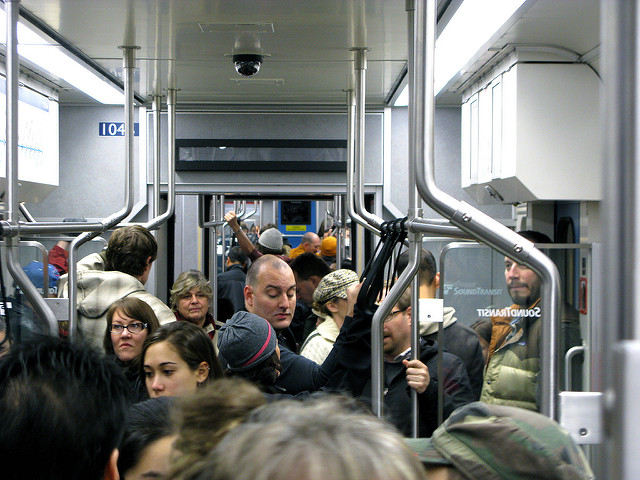
There just isn't room for all these folks to drive into Seattle. Photo: Seattle Transit Blog

There just isn’t room for every Seattle transit rider to hop into cars instead. Photo: Oran Viriyincy at Seattle Transit Blog

But let’s put one claim to rest: Driverless cars will not make transit obsolete, especially not high-capacity transit serving dense urban areas.

Bryan Mistele, CEO of traffic data firm Inrix, recently placed a piece in the notoriously anti-transit Seattle Times arguing that the region’s $53 billion light rail expansion plan, known as ST3, could be “obsolete” by the time it’s finished.

Brent White at Seattle Transit Blog debunks the argument:

The claim that autonomous vehicles will render fixed-route transit obsolete is particularly unfounded, with basic geometric facts providing the reality check. Yet nonetheless the argument has become a trendy political talking point, as Fortune documented back in 2014. Generously assume that “small form factor” vehicles succeed in doubling vehicle throughput capacity (a big if!). Then assume a standard vehicle occupancy rate of 1.5. Assuming these two factors, the capacity test for autonomous vehicles as congestion reducers and transit replacers is whether or not transit could reliably carry more than 3 people in the same space. That’s a laughably low bar for any urban transit agency. And for a central city like Seattle’s, with 35% of people already taking transit while using 10% of the space? Any major transfer of people from transit to small autonomous vehicles would represent a loss of capacity, not a gain.

A further problem with autonomous car technology is that it is being designed around the paradigm of maximizing efficient and safe flow of cars around each other (and talking to each other, presumably using a master protocol agreed to among all manufacturers). There have even been calls for removing traffic lights from city intersections to provide continuous flow of autonomous vehicles, to the direct detriment of people walking and biking. A team at MIT went so far as to model how autonomous cars could go around each other at intersections, and forgot to add pedestrians and bicyclists entirely, as chronicled by Citylab.

From the get-go, designers of autonomous vehicles have focused on replacing human-driven cars. Those who extend that mission to replacing bikes, buses, trains, and walking have missed an important point: Driverless cars can take up less space than human-driven cars, but they just don’t take up less space than crowds of pedestrians, bikes, buses, and certainly not grade-separated trains stuffed with hundreds of passengers. Smarter investors will sense an opportunity to apply the technology broadly to transit, and work with transit agencies to improve automatic train and bus control technology rather than antagonize these agencies based on poorly-thought-out ideological notions of forcing everyone into cars.

Elsewhere on the Network today: Mobility Lab reports on how American military bases are improving for walking and biking. And Urban Edge considers why Black Lives Matter protests occupy highways.

15 Jul 18:11

“Brexit”-Inspired Puns Join “-gate,” “-gasm” & “-pocalypse” In Baker’s Dozen Of Abused Suffixes

by Mary Beth Quirk

Before every scandal became a “gate,” there was Watergate. Before every event that lasts longer than it should was labeled a “thon,” there was Marathon. Now the headlines about Britain’s decision to leave the European Union have resulted in a spate of “Brexit”-inspired puns.

In fact, the term Brexit itself isn’t the original source for this play on words — a simple smash-up of “Britain” and “exit.” The Brit use of the term was inspired by “Grexit,” a word created to label speculation that financially troubled Greece would exit the European Union in 2015.

Now the term “Frexit” is being bandied about by even the stuffiest of old-school media outlets to discuss the possibility of France leaving the EU, while stateside there is increasing use of “Texit” and “Calexit” to describe movements in the nation’s two most populous states.

This straightforward, if occasionally clunky, slapping of known suffixes to form new words is just something we humans love to do. It’s a form of linguistic and cultural shorthand we use when trying to communicate a concept that may lack a single, defining term.

Want something that sounds like economics but has to do with buying and selling cheese and all the market fluctuations involved? “Cheese-nomics.” Done.

Other word evolutions don’t make much sense outside of a cultural context, like with the proliferation of words ending with “gate” to suggest a scandal. Did Deflategate have anything to do with an apartment complex in Washington, D.C.? No, but that “gate” implies something shady and secretive by referencing the June 1972 break-in at the Democratic National Committee office at the Watergate complex and its subsequent cover-up.

Herewith, we present a slew of suffixes that have been swiped, borrowed, and otherwise used to make a new word when we humans can’t come up with anything else.

1. -gate

Origin: As mentioned above, the “gate” suffix got its start with Watergate. The complex itself is named after a large wooden water gate that marks the spot where the Ohio Canal meets the Potomac River, The Washington Post noted in 2004.
How it’s used now: The suffix is now used to suggest the existence of a far-reaching scandal, unethical behavior, or perhaps a cover-up of some sort. There’s football’s Deflategate (did the New England Patriots illegally deflate footballs?), Nipplegate (born the moment Justin Timberlake showed the world Janet Jackson’s nipple during a Super Bowl halftime show), and Bendgate (in which iPhone 6 Plus users claimed their phones were bending), to name just a few.

“The diorama, a recent invention, which carried an optical illusion a degree further than panoramas, had given rise to a mania among art students for ending every word with rama. The Maison Vauquer had caught the infection from a young artist among the boarders.

‘Well, Monsieur-r-r Poiret,’ said the employé from the Museacute;um, ‘how is your health-orama?” …’There is an uncommon frozerama outside!” said Vautrin. …

‘Aha! here is a magnificent soupe-au-rama,” cried Poiret as Christophe came in bearing the soup with cautious heed.

‘I beg your pardon, sir,” said Mme. Vauquer; ‘it is soupe aux choux.”

All the young men roared with laughter.”

2. -o-rama/-a-rama

Origin: It all started with “panorama,” from the Greek “pan” plus “horama,” meaning view, or sight, advice column Straight Dope said back in 1984. The panorama was what a guy named Robert Barker called his invention in 1789, “a type of painting showing a wide-angle view of some notable scene.” Diorama followed, and that seems to have kicked off the -arama fad, as Balzac wrote in his 1834 novel Old Goriot (see excerpt at right).
How it’s used now: If there’s a sight to behold, it’s gonna have -rama on the end of it, whether it’s a sale-o-rama, a spell-o-rama, cheese-o-rama, or drama-o-rama. With your mama. Some guy on the internet listed a whole bunch more here, in this list-o-rama.

3.-palooza

Origin: It all goes back to “Lollapalooza,” which Merriam Webster defines as “a person or thing that is particularly impressive or attractive.” Though its origin is unknown, Merriam Webster says its first known use was 1896, nearly a century before then Jane’s Addiction frontman Perry Farrell branded his traveling music festival with the name.
How it’s used now: These days, “palooza” is tacked onto words too describe anything that has a lot of something: booze-a-palooza, fun-a-palooza, cheese-a-palooza, looser-palooza, snooze-a-palooza or even a palooza-palooza.

4.-athon

Origin: We’ve all heard the story of the Greek messenger Pheidippides, who ran from Marathon to Athens (26.1 miles or so) with the news that Greece had beaten the Persians in the battle of Marathon. You’ve probably known someone who’s run a marathon at least well enough to bug you for donations.
How it’s used now: The suffix is tacked on to words to describe anything that’s long-lasting or a difficult task. There have been telethons, walkathons, danceathons, talkathons, wordathons, and if my hopes and dreams come true, cheeseathons.

5.-cation

Origin: Vacation comes from the Latin, vacare, to be unoccupied. In modern English, it means taking time off from work or school to go somewhere fun.
How it’s used now: At some point in the early 21st century, some thoroughly awful evil person decided that tacking the word “cation” on anything that rhymes with “bay” was acceptable to mean “I’m unoccupied,” so we now have bastardized versions of the word like the utterly deplorable “staycation” (staying at home and not working),“playcation” (playing on vacation?), and “daycation” (just taking the day off). Then we all just gave up, and beachcation, sleepcation, footballcation, campcation, and generally just stuck any word in front of the suffix. Honestly? Vacation is all I ever wanted. That and a cheesecation.

Consumerist

6. -tastic

Origin: When something was extraordinarily good, or extraordinarily large, or just an extraordinary tale, it was called fantastic. “My, isn’t Aaron Rodgers a fantastic quarterback?” or, “That cheesehead looks fantastic on you!”
How it’s used now: Starting in the 1930s, anything with “tastic” tacked on meant “forming adjectives denoting someone or something regarded as an extremely good example of their particular type,” as Oxford Dictionaries puts it. Or sometimes, things that are large in number. “This cheese cave is cheesetastic.” Other examples include but are not limited to: Funtastic, crapcastic, beertastic, cattastic, pizzatastic, smashtastic, Mr. Boombastic, and of course, Comcastic.

7. -pocalypse

Origin: This one will save you absolutely no time, as it’s just one letter off “apocalypse,” which is “an event involving destruction or damage on an awesome or catastrophic scale,” Oxford Dictionaries says.
How it’s used now: If it’s the end of some kind of world as you know it, you can slap a -pocalypse on it to say so. There was New York City’s Snowpocalypse, which really turned into boozepocalypse; Chipotlapocalypse; Twinkiepocalypse; or heaven forbid, a cheesepocalypse. Did it just start raining a lot? It must be a rainpocalypse!

8. -itude

Origin: If you’ve got an attitude, it means you have a settled way of thinking or feeling about a topic, which is usually shown in your behavior. Like your parents always told you, “Don’t give me attitude.”
How it’s used now: We’ve all got a new attitude, and by “we,” I mean anything can now be ascribed to your state of mind — catitude, dudeitude, baditude, saditude, cheeseitude, raditude, daditude, maditude. Snarkitude not wanted.

(via Swinging Sixties)

9. -ercize

Origin: Exercise, which is any activity you do that requires you to move your body around with the intention of improving health.
How it’s used now: At some point, we Americans decided that some displays of physical effort were just too exciting to go by that old name. Why not do some jazzy steps instead… and call it Jazzercise (which has been around since 1969)? Or if you’re really feeling lazy and kind of sexy (?), you could just Relaxacize. In addition: boxercise, sexercise, watercise, cheesercise.

10. -gasm

Origin: Orgasm, that thing that humans like to have at the end of sex that feels fantastic.
How it’s used now: Tack on a -gasm to any word that is involved with an explosion of wonderfulness. Some people have eargasms, or joygasms, cheesegasms or cakegasms, dragongasms or wordgasms. We are not here to judge your gasm.

11. -oholic/-ahalic

Origin: Alcholic, one addicted to drinking alcohol.
How it’s used now: This suffix is tacked onto words nowadays to refer to anything you can’t stop doing, i.e. workaholic, rageaholic, shopaholic, cheeseaholic, Tweetaholic, duckfaceselfie-aholic.

12. -ista

Origin: This Spanish suffix is used to much like we use “-istic,” like in optimistic or altruistic. If you’re an altruist in Mexico, you’re an altruista. Or if you’re a member of a a member of a left-wing Nicaraguan political organization named after Augusto César Sandino, you’re a Sandinista, a term many American first heard in the 1960s.
How it’s used now: It’s pretty much used the same way now — if you’re into fashion, you’re a (cringe) fashionista. If you serve coffee at a bar/cafe and insist on calling sizes something other than “small,” “medium,” and large, you’re a barista.

15 Jul 18:02

Jayapal, Walkinshaw Head into Primary with Big Media Endorsements

by Josh Feit
Jayapal nets Stranger endorsement, Walkinshaw picks up Seattle Times.
15 Jul 17:59

Why do Pokemon avoid black neighborhoods?

by Cory Doctorow

maxresdefault

The crowdsourced database that was use to seed locations to catch Pokemon in Pokemon Go came from early augmented reality games that were played by overwhelmingly affluent (and thus, disproportionately white) people, who, in an increasingly racially segregated America, are less and less likely to venture into black neighborhoods, meaning that fewer Pokemon-catching landmarks have been tagged there. (more…)

13 Jul 23:27

When Will the Feds Stop Outlawing Railcars Used By the Rest of the World?

by Angie Schmitt

The removal of 115 railcars from service in Philadelphia last week was the latest example of the troubles American commuter rail agencies face when purchasing rolling stock. Thanks to cracks in a critical component of the railcars, riders are looking at severe service reductions for at least the entire summer. While U.S. DOT floated a regulatory change that could prevent similar failures, it’s been tied up in the federal bureaucracy for three years.

Philadelphia's defective railcars highlight some of the problems with U.S. passenger rail regulations. Photo: SEPTA

Philadelphia’s defective railcars highlight some of the problems with U.S. train safety regulations. Photo: SEPTA

SEPTA purchased the flawed railcars three years ago. The exact cause of the defect has yet to be determined, but it’s clear that procuring rolling stock is riskier and more complex than it needs to be, due to Federal Railroad Administration safety regulations.

An FRA rule dating back to 1945 requires trains to withstand 800,000 pounds of force, according to a report by David Edmondson for the Competitive Enterprise Institute [PDF]. This makes American trains much heavier than European and Asian models, as well as more expensive to build and operate. Passenger railcars in the U.S. have been likened to “a high-velocity bank vault,” as former Amtrak CEO David Gunn put it.

Because of these unusual standards, American rail agencies can’t just acquire the same trains used in Europe or Asia. Instead, railcars here must be custom-designed for America’s relatively small market, which drives up cost and risk. Philadelphia’s Silverliner V cars — the ones with the defect — were 10,000 pounds heavier than originally planned. The manufacturer, an American subsidiary of the South Korea-based Hyundai, had never designed stainless steel railcars to FRA standards.

For all the added expense, America’s brand of rail safety carries its own hazards. “A heavier train takes longer to decelerate, which makes crashes more likely to occur,” writes Edmondson. Rather than building bank vaults on rails, European and Asian rail systems focus on preventing collisions in the first place, using technology like positive train control.

In 2013, after years of pressure from rail advocates, U.S. DOT finally issued a notice that it was considering a rule change to allow lighter, more efficient trains on American tracks. But the policy has advanced at a snail’s pace. Later that year, the FRA’s Robert Lauby said he expected the change to take effect in 2015, but it is still tied up in the federal rulemaking process.

An FRA spokesperson told Streetsblog the draft rule, which has yet to be published publicly, was just sent to the Office of Management and Budget this April. OMB can adjust the draft rule before it is presented for public comment, adjusted again by U.S. DOT, and enacted.

There is no noticeable resistance to reform within the rail industry. The FRA’s Railroad Safety Advisory Committee, which includes representatives from the American Public Transportation Association, Amtrak, NHTSA, and other industry groups, unanimously recommended the rule change, according to a source in Congress familiar with the rulemaking process.

The only thing holding back progress, it seems, is the leisurely pace of bureaucracy at the White House and U.S. DOT.

13 Jul 06:54

Standards Body Whines That People Who Want Free Access To The Law Probably Also Want 'Free Sex'

by Mike Masnick
You would think that "the law" is obviously part of the public domain. It seems particularly crazy to think that any part of the law itself might be covered by copyright, or (worse) locked up behind some sort of paywall where you cannot read it. Carl Malamud has spent many years working to make sure the law is freely accessible... and he's been sued a bunch of times and is still in the middle of many lawsuits, including one from the State of Georgia for publishing its official annotated code (the state claims the annotations are covered by copyright).

But there's another area that he's fought over for many years: the idea that standards that are "incorporated by reference" into the law should also be public. The issue is that many lawmakers, when creating regulations will often cite private industry "standards" as part of the regulations. So, things like building codes may cite standards for, say, sheet metal and air conditioning that were put together by the Sheet Metal and Air Conditioning Contractors National Association (SMACNA), and say that buildings need to follow SMACNA's standards. And those standards may be great -- but if you can't actually read the standards, how can you obey the law. At one point SMACNA went after Malamud for publishing its standards. And while they eventually backed down, others are still in court against Malamud -- including the American Society for Testing & Materials (ASTM), whose case against Malamud is set to go to trial in the fall.

In the midst of all of this, various standards making bodies, along with the American National Standards Institute (ANSI), have been working over time to get the American Bar Association to adopt a proposal that limits publication of standards that are incorporated by reference. ANSI has pushed for a solution it prefers called "reasonable availability," in which the standard-makers decide by themselves how best to make the standards "available." ANSI, for example, hosts a bunch of incorporated by reference standards on its website -- but the only way to read them is to install a special kind of DRM (Windows and Mac only) that makes the documents purely read only. You are not allowed to save them. You are not allowed to download them permanently. You are not allowed to print them. And it's not all standards that are incorporated by reference. Why do they do this? Well, most of them sell their standards to professionals who need to buy them, and they don't want to give up on that revenue source (especially once those standards are incorporated by reference because at that point they become mandatory).

Either way, there was an attempt to push through a bad proposal at the ABA, getting it to take an official stance on standards that were incorporated by reference, but the first attempt was denied when various parts of the ABA pointed out that only a small group had worked on the issue. A larger task force was formed, but oddly, that task force was amazingly one-sided, including a number of people connected to ANSI or its supporters (including its former chair, Oliver Smoot, and its General Counsel, Patricia Griffin). Malamud asked multiple sections of the ABA if he could be a part of the working group and was denied. Not surprisingly, the final recommendation, which the ABA is about to consider next month, does not recognize that standards incorporated by reference should be widely and freely available, since they are the law. Instead, it takes a much more restrictive approach, whereby such standards would need to be made available (an improvement from the current situation), but that availability can still be in a very restrictive and locked down manner (such as with DRM and limitations).

The fact that it takes a small step in the right direction already has ANSI upset, and it's whining to its members asking them to tell the ABA not to support this proposal, dropping all sorts of FUD about how it will kill off various standards bodies, and complaining that the process by which this proposal was created was "closed" (leaving aside that ANSI and its friends made up a decent portion of the folks on the working group). Malamud has now sent a massive book detailing all of the problems with the proposal and noting that supporters of it are trying to rush it through, potentially looking to influence some of the lawsuits that he's currently involved in (such as the one about to go to trial). Some task force members raised the concern that it seems weird for the ABA to stake out a position on an issue that is about to be resolved by the courts. Either way, somewhat amazingly, both Malamud and ANSI agree that they don't want the ABA to accept the current proposal -- but for wildly different reasons.

Malamud's packet is impressive in the details and evidence that it presents. But his major complaint is that the ABA is making a huge mistake in trying to "balance" the interests of standards bodies that get money from locked up standards and the public. There's no need for balance here. General common sense says the public should win here and the law itself should be public and freely accessible. But that's not how the task force looked at this:
Think for a moment about the interests that are being “reconciled.” On the one side are the proprietary interests of a few nonprofit organizations, organizations that eagerly seek to have some of their standards incorporated into law, and also profit greatly from the sale of numerous products, such as the sale of non-mandatory standards, training, and certification. Nonprofit organizations such as ANSI have done quite well under the current system, paying million-dollar salaries to their executives and receiving numerous government subsidies, plus the all-important market positioning they get from being an official provider of an important segment of federal law. This is an enviable market position for a nonprofit, and they have profited handsomely from that position.

What is being balanced against those “proprietary interests” are the rights of the American people to read and speak the law. Joe S. Bhatia, the president of ANSI, put it well when he stated clearly that “a standard that has been incorporated by reference does have the force of law, and it should be available.” These standards are integral to the regulations, no different than any other edict of government. Public safety laws are too important to be carved out as a special category of edict of government, a category subject to arbitrary limitations on use.

The way that “balance” was struck is what disturbs those of us who wished to participate. The task force is asking the ABA House of Delegates to endorse severe restrictions on how citizens can access regulations, in the form of “read-only” documents on the Internet. The term “readonly” is a term that doesn’t make any sense to those of us who work on the Internet. What are being proposed are a series of licensing restrictions created by a click-through terms of use agreement, coupled with technical restrictions enforced by “Digital Rights Management” (DRM) technical measures. But the law is not a Hollywood movie and it is not a Tom Clancy novel. The law is special in our democracy, or in any society that observes the rule of law. The law belongs to the people and edicts of government are not subject to copyright under long-standing doctrines of common law and the clear and unambiguous policy of the U.S. Copyright Office.
And really, the principle here is pretty clear and shouldn't involve that much debate. If it's included as part of the law, it needs to be widely and freely available.
For those of us in the American Bar Association, the concept of “read only” flies directly against the work practices of members of the bar who must use the law to do their jobs. Lawyers do not simply read the law, they cite the law and copy it, they publish extracts in documents such as briefs, treatises, and newsletters. If we entertain the notion that a category of our law requires a license in order to repeat those laws—and that is precisely the position today of ANSI and its fellow SDOs—the bar will be faced with a situation where permission to use the law may be granted only after the extraction of unreasonable rents and a request for permission, which may be arbitrarily granted or refused. This is not a theoretical situation; it is the current stance of the organizations that drafted this resolution and they are proposing that Congress codify those restrictions.

Most disturbing in the resolution that the ABA is being asked to endorse is the idea that the right to speak the law—to post it on the Internet in a transformative fashion that allows others to use it more effectively—belongs to a single private party, and that private party may require a license before others are permitted to work with the material. Just imagine if John B. West had needed a license before including court opinions in his National Reporter System, an innovation that became central to the practice of law in the United States. Allowing only a single party, or those to whom they arbitrarily grant a license, to control access to primary legal materials deliberately retards innovation in order to maximize revenue through a monopoly over crucial components of federal public safety law. Putting the brakes on innovation for presentation of the law not only hurts democracy, it hurts the legal profession, depriving lawyers of better tools and services.
The packet that Malamud put together also includes some of the emails that were sent around as part of the working group's deliberations, including one rather incredible one in which ANSI board member Dan Bart of Valley View Corporation, completely mocks the idea that standards that are part of the law should be available for free -- saying that "some people are still clamoring for free beer and free sex too." Apparently, this individual feels everyone should pay for sex.
Even ignoring what one hopes is an inadvertent slip up in logical arguments, the email completely ignores the issue. People aren't just asking for random stuff for free -- they're asking for the law to be freely available to the public. If you don't want that to happen, don't get your standard included in the law.

If you go through the emails included in the packet there are even more details, including the co-chair of the ABA's SciTech Technical Standardization Committee stepping down for being effectively ignored during the process of deciding on the resolution and not allowed to join the working group.

The whole thing is a mess. It's not even clear why the ABA should be considering this point at all. And, if it must consider it, why would it not support the most obvious conclusion: if it's a part of the law, it's part of the law and needs to be widely and freely available, not locked down by DRM.

Permalink | Comments | Email This Story
13 Jul 05:21

Prisma Gives Your Photos the Look of Famous Paintings

by Michael Zhang

stylefamouspaintinfeat

Prisma is a new camera app that transforms your photos to look like paintings by famous artists. It goes beyond the film simulation filters that are widely available these days to offer a surprisingly realistic painting filter.

The app says it uses a combination of neural networks and artificial intelligence to work its magic. It appears that the algorithm behind the app was originally published back in late 2015, generating quite a bit of excitement at the time. Now the technology can be carried around with you in your pocket.

The app has a minimalist interface and is extremely easy to use. Once you load it up, you can either snap a photo with the built-in camera or select a photo from your device:

initialscreen

You’re then presented with a long list of icons representing the different art styles you can transform your photo into.

filters

Tap a style and after a few moments of computation, the result is shown on the screen. You can slide your finger to the left and right to adjust the intensity of the look from 0% to 100%.

crunching

Here’s a before and after example of a photo that had the style “Gothic” applied:

example

Here are a few more examples from the Prisma website that show what the app is capable of:

examples

You can get started with using Prisma by downloading the free app from the iTunes App Store. Video and Android support are both reportedly coming very soon.

11 Jul 22:34

Amazon is building treehouses for its employees to cry in

by Brittany Vincent
Amazon is hard at work on offering its employees something decidedly out of the ordinary when it comes to office culture. Instead of something frivolous like special chairs or a cafe, employees are getting a special greenhouse, which will contain a c...
11 Jul 21:27

That Time Bill Gates Accidentally Shamed Bangkok Into Burying Its Power Lines

by Mimi Kirk

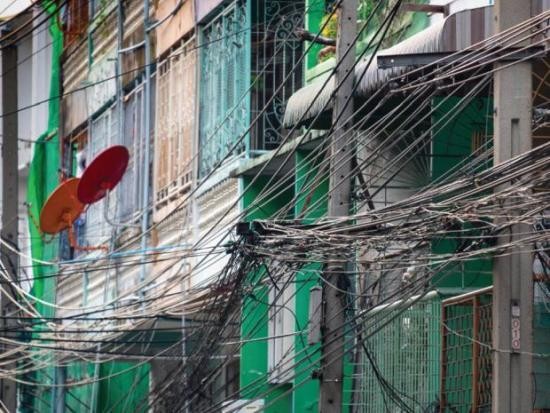
Late last month, Bill Gates made a gaffe on social media. He posted a photo to his Facebook page of a mass of wires hanging from a concrete pole on a Bangkok street, lamenting the fact that urban areas like the Thai capital “suffer from frequent blackouts.” He added that such a situation compels people to illegally tap into the grid “at great personal risk”—hence the dangerous-looking wires.

It turns out that Bangkok rarely has problems with its electricity, and that the wires pictured in Gates’ photo were actually low-voltage ones for phones and cable television. Thai citizens and the Thai government were not amused. Facebook users rushed to point out Gates’ error, and the country’s Provincial Electricity Authority reportedly created a graphic showing how high-voltage power lines sit high on their poles, while low-voltage wires are positioned much lower.

Bill Gates posted this image along with a false supposition that faulty infrastructure in Bangkok causes frequent power cuts. He’s since taken the posting down from Facebook.  

The jumble of wires pictured in Gates’ photo is in fact a common sight in Bangkok and other Thai cities. The danger of the wires is not so much that they are en plein air, but that cable and phone companies rent the poles from state electricity authorities to hang their wires. In recent years the poles have become so overburdened that they are prone to collapsing. As a result, the state has been rejecting new rental requests, hampering Thailand’s burgeoning digital economy. And though the Thai government has been talking about moving cables underground since 2011, it’s an expensive proposition—and as such has been slow going.

Gates’ message, however incorrect, appears to have spurred the government to faster action. Within a week of his Facebook post, Thai authorities, at the urging of Prime Minister Prayuth Chan-ocha, announced a plan to spend around 50 billion baht ($1.4 billion) to put 79 miles of cables underground on 39 roads in Bangkok and surrounding areas. The project’s deadline is now 2020—five years ahead of schedule.

A Bangkok Post editorial lauded the move, noting that Mr. Gates “had a good point to make” even though he “literally got his wires crossed.” Sirinya Wattanasukchai, an assistant editor at the Post, wrote a more caustic response, inviting Mr. Gates to tour more of Bangkok so he can shame the government into action on other projects. “I’ll urge him not to post [more] photographs on [social media],” she wrote. “That would be an embarrassment to the government… But in doing so, maybe some of the age-old problems would melt away.”

07 Jul 22:59

Missing dash-cam video raises questions about police oversight

by David Kroman

More than two years after the Seattle Police Department learned that its in-car video cameras were frequently dropping frames, at times leaving gaps of more than an hour in video records, the problem remains. Although several media outlets reported in April 2014 that SPD had addressed the problem, internal data reveals that there have been nearly 30,000 incidents of dropped frames since the supposed fix, an average of 35 times a day across the city.

While the problem is present across the police department, of the 20 officers who had the most dropped frames, 12 were out of the South Precinct. Seven of those were on the so-called “Ocean” beat along Beacon Hill. One officer, who on multiple occasions lost close to an hour of video footage, had recently been the subject of a dismissed lawsuit for tightening handcuffs too tightly.

Seattle Police Department Director of Transparency and Privacy Mary Perry points out that the number of incidents per day are down by about a third since the department first learned of the problem. “This is not something that’s a binary situation,” she says, painting the solution as a thing done over time rather than overnight.

Regardless, the problem raises questions about the role of video in policing and, more importantly, about who’s looking over the shoulder of a police department in the midst of transition. These questions are made even more relevant by Mayor Ed Murray’s recent decision to not reappoint anyone to the two civilian watchdog positions inside the department, waiting, he’s said, for clarity on oversight moving forward.


While police body cameras continue to be a topic of fierce debate, in-car video cameras have been mounted on the dashboards of police vehicles in Seattle for years. The grainy footage, with the radio crackling in the background, has been a tool in courts as well as a conduit for greater scrutiny of police officers’ behavior. Its use and reliability has also been a major point of emphasis for the monitor overseeing federally mandated reforms.

Its power has been obvious in recent years. In footage from 2010, Native American woodcarver John T. Williams can be seen crossing in front of a dash cam with a carving knife. Sixteen seconds later officer Ian Birke fires his gun into Williams’ back, killing the man and spurring the Department of Justice’s investigation into SPD. The settlement agreement between the city and the Justice department continues today.

More recently, a seven-second in-car video clip captured the shooting death of Che Taylor last February, called at once justified by the SPD and a set up by the NAACP.

Although less than 1 percent of footage is effected by dropped frames, the average time lost is 16.2 seconds — enough to black out hugely important clips.

When the department learned of the in-car video issues in 2014, the City Attorney’s Office took them seriously enough to notify defense lawyers and present them with the opportunity to challenge court cases. In the end, no cases hinged on anything lost in the videos.

SPD said in a statement at the time that it was working with the cameras’ manufacturer, COBAN, and had installed a software update to fix the issue. The department also hired an outside video forensics analyst to study the extent of the issue.

Meanwhile, people inside the department told local media the problem had been fixed. Head of the City Auditor’s Office, David Jones, said in an email last week, “We heard from SPD that new software had fixed the frame dropping problem, but we didn’t look into it.”

But Perry’s definition of “fixed” is different than the layman might interpret it. “That’s like saying your computer’s been fixed,” she says, when in reality there’s always going to be another bug. She says there are IT people inside the department working on resolving the issue with the outside forensics firm. But because the computer system is old, it’s likely that it will never be resolved completely. “I hate to say we’re doing the best we can,” she says, “but that’s what we’re doing.”

Perry points out that the city documents its progress on data.seattle.gov. “When we can’t get to zero, then the best thing we can do is inform.”


In some ways, the SPD is under immense scrutiny because of its settlement agreement with the DOJ. A city appointed monitor releases lengthy reports on the department’s progress. But his examinations are focused on achieving the specific goals of the settlement agreement, which focus mostly on use-of-force policies, trainings and accountability systems. And when the department eventually does fulfill the agreement, he will depart.

The City Auditor’s Office theoretically acts as an oversight office for the whole city, but it only has a staff of nine. That means they tend to focus on only a select few issues over the course of a year.

The department’s in-house accountability and disciplinary office, known as the Office of Professional Accountability, employs a civilian director and the city contracts a civilian auditor to provide independent oversight of the office. The auditor, retired judge Anne Levinson, is the closest thing the department has to civilian scrutiny. For years now, she has released lengthy recommendations for improving not only the OPA, but the department as a whole.

But her time is consumed with examining disciplinary investigations, not whether problems with in-car videos are being fixed. And when she does make broader recommendations, they are just those: recommendations. Public officials are free to take them or leave them.

Oversight of broad departmental functionality is minimal, as highlighted by recent head scratching issues inside the department. In 2014, questions of preferential overtime offerings only surfaced when an officer filed a lawsuit and accused the leadership of keeping friends on an overtime “gravy train.” When a recent $500,000 outside audit of the police department’s staffing was delayed into this year, the issue only went public when the Seattle City Council realized they had to make budget decisions without it. And a backlog of rape cases in the department’s sexual assault unit only went public through media disclosures.

Levinson has long advocated for a civilian position with the broad authority to investigate the department as a whole, something akin to an inspector general. If everything goes as planned, accountability legislation could make that a reality this summer.

Anticipating this new position, Mayor Ed Murray recently made a show of thanking Levinson as well as the civilian director of OPA, Pierce Murphy, for their service, inviting them to reapply for the new position. He has said publicly that Levinson and Murphy could continue on an interim basis until the inspector general was solidified.

However, Levinson had already told Murray she would be leaving at the end of June with the expectation he would find someone to fill her position. Murray has argued he doesn’t think that would have made sense because of the uncertain future of oversight. But to those skeptical of even the best laid plans for police reform, it leaves a worrying gap.


Crosscut, with the help of KCTS9’s senior technical producer Joseph Liu, did an analysis of the dropped dash cam footage, and found that, while much of it seems random, there are patterns. Cross-referenced with SPD badge numbers, the data reveals that certain officers appear to lose more footage than others.

SPD has long blamed the issues on a glitch. The data seems to support that: the numbers tend to repeat at oddly specific time frames such as 10.2 seconds or 19.4 seconds.

Occasionally, however, the camera cuts out for longer. Marcus Inouye of the North Precinct, who was recently the subject of a dismissed lawsuit for tightening handcuffs too tightly, lost an hour on June 23, 2014 and again on November 11, 2015.

Officer James Moran lost more than an hour on October 3, 2015. Office Lloyd Harris lost an hour and a half on May 24, 2014.

Sarah Emerson, a police officer out of the North Precinct, had the most instances of dropped footage with 613 since April 2014. If you assume she worked five days a week, that’s more than once a day that some portion of her feed was lost.

Emily Akiyama in the East Precinct comes in second at 533 instances; Brett Bullard from the South Precinct comes in third, dropping footage 498 times.

The issue seemed to occur most often in the South Precinct. When asked about this, neither Perry nor SPD spokesperson Sean Whitcomb could say why, guessing that perhaps there was one or two faulty cars there. Perry said she would notify relevant parties.

Whitcomb ultimately blames resources, saying that with focus on body cameras and expanding staff, there isn’t the money to buy the infallible system. “I think it’s fair to say that we are doing an admirable job,” he says. “That’s not to say that it’s perfect, but we’re doing the best we can.”

His comments, though, highlight the problem central to police reform advocates: that it is often departments that are the ones calling an issue “fixed.” Were it someone like Anne Levinson saying so, the diagnosis would perhaps carry more weight.

06 Jul 17:33

Epipens have more than quintupled in price since 2004

by Cory Doctorow

6871649561_d5861b9811_b

Epipens -- self-injection sticks carried by people with deadly allergies, which have to be replaced twice a year -- were developed by NASA at taxpayer expense, were patented by a government scientist who receives no royalties, require no marketing, and have gone from as little as $60 each to up to $606 in a few short years (during which time the company has switched to selling them exclusively in two-packs). (more…)

06 Jul 17:33

Patagonia study shows Patagonia fleece jackets a pollutant

by Jason Weisberger

The Pacific Gyre

Turns out those jackets made of recycled plastic are putting lots of plastic into our oceans. Patagonia has led a study showing artificial textiles release a lot of fragments when washed. Eventually those fibers make it into the sea. Patagonia is pushing an effort amongst industry peers to develop standards limiting this form of pollution.

Via Outside:

Fast-forward four more years, and the fibers finally got everyone’s attention. The science was piling on, showing that wastewater treatment plants couldn’t filter out all synthetic fibers, and that toxins such as DDT and PCBs can bind to them as they make their way into watersheds. It also showed that small aquatic species ingest the fibers, and that fish and bivalves sold for human consumption also contain microfibers. Experiments have shown that microplastics can lead to poor health outcomes in some species, and research is underway to find out how the plastics affect humans.

Jill Dumain, director of environmental strategy at Patagonia, was one of the people paying attention to all the news. In early 2015, she and the company’s leadership decided to commission a study to find out if and how Patagonia’s iconic and well-loved fleeces and some other synthetic products were contributing to the problem. The results recently came in, and they’re not good.

The study, performed by graduate students at the Bren School of Environmental Science and Management at the University of California, Santa Barbara, found that during laundering, a single fleece jacket sheds as many as 250,000 synthetic fibers—significantly more than the 1,900 fibers Browne first recorded. Based on an estimate of consumers across the world laundering 100,000 Patagonia jackets each year, the amount of fibers being released into public waterways is equivalent to the amount of plastic in up to 11,900 grocery bags.

The experiment involved five pieces of apparel: three Patagonia fleece jackets, each with slightly different construction, as well as a nylon shell jacket that contains polyester insulation, plus a fifth specimen—a “budget” fleece jacket made by an undisclosed brand. Replicates of each jacket were washed multiple times, both in front-loading and top-loading washing machines. The effluent from each cycle was collected and put through a two-step filtration system that captured fibers with both a 333- and 20-micrometer mesh screen.

The jackets were then put through a 24-hour “killer wash,” which Patagonia uses to simulate the aging of a garment. The researchers did this to test whether older garments might shed more fibers as they age. After repeating the washing tests on these artificially aged jackets, they saw that age indeed increases fiber release by 80 percent.

04 Jul 18:35

Saturday Morning Breakfast Cereal - Self-Driving Car Ethics

by tech@thehiveworks.com


Hovertext:
Then, one day, Jesus Chrysler will come.

New comic!
Today's News:

Hey geeks-- we've been doing some testing and software stuff this week and it's created a lot of issues with bad ads and RSS feed bugs. We are working to get everything ironed out, but if you see something buggy, please let me know. If something has changed for the worse on your end, it is not intentional!