KAISER WILHELM
(happy halloween from the flux machine!)

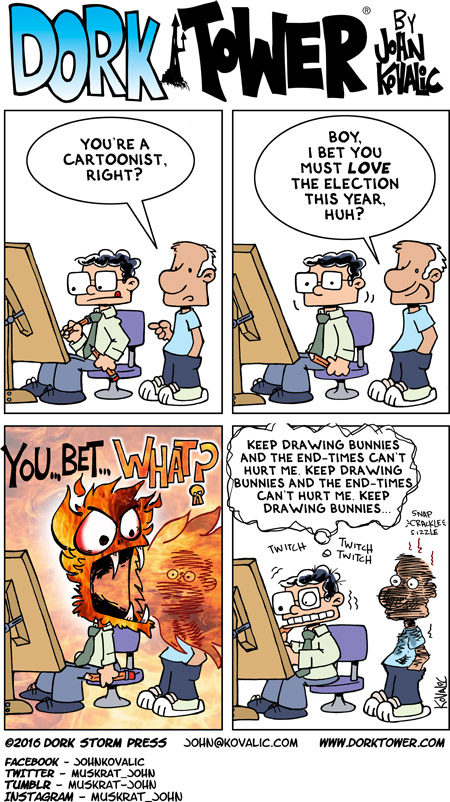
A couple of days ago, an off-handed Twitter conversation with my pal Ken Hite (I KNOW, RIGHT?) sparked an idea for Thursday’s DORK TOWER.
It's a Frankenberry Halloween DORK TOWER TUESDAY! New strip up at https://t.co/J5HWa8Fl5C
Be a Ghoul: RT (plz 'k thx!) and enjoy! pic.twitter.com/L9mObV01Bu
— Such a John Kovalic (@muskrat_john) October 25, 2016
@muskrat_john Also, Count Chocula was actually a voivode, closer in rank to a prince.
— Kenneth Hite (@kennethhite) October 25, 2016
@kennethhite Though consensus is unanimous: Boo Berry is the ghost of Cap'n Cruch, lost at sea. Of his bones are coral made.
— Such a John Kovalic (@muskrat_john) October 25, 2016
@muskrat_john Those are marshmallows that were his eyes
— Kenneth Hite (@kennethhite) October 25, 2016
@kennethhite Crap now I am legally bound to draw this.
— Such a John Kovalic (@muskrat_john) October 25, 2016
Thus being legally bound to draw it, I did.
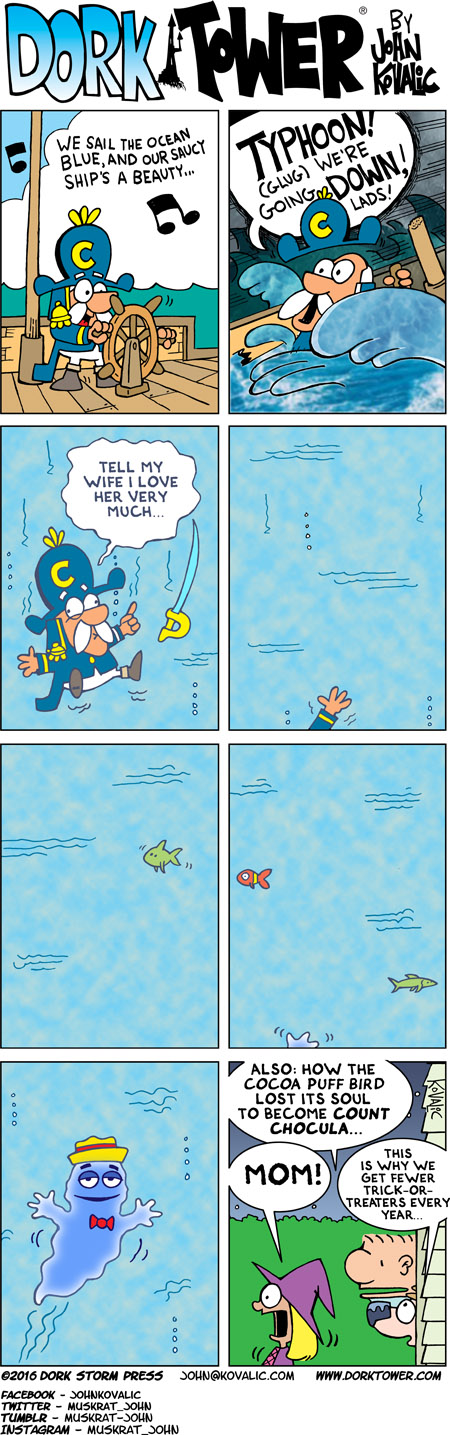
Is this darker than most Dork Towers? Yes. Yes, it is. Though having Igor and Carson at the end lightened it jussssst enough, I thought.
More importantly, it amused me to have the Cap’n warbling a Gilbert and Sullivan HMS Pinafore sea shanty, almost as much as to have him gurgling a line from David Bowie’s Space Oddity.
But then I wondered, was the last line really necessary? Yes, it tied it in to Halloween (and, indeed, into Dork Tower).
I liked the strip as it stood, but thought that less, in this case, might be more. So I changed it to this:
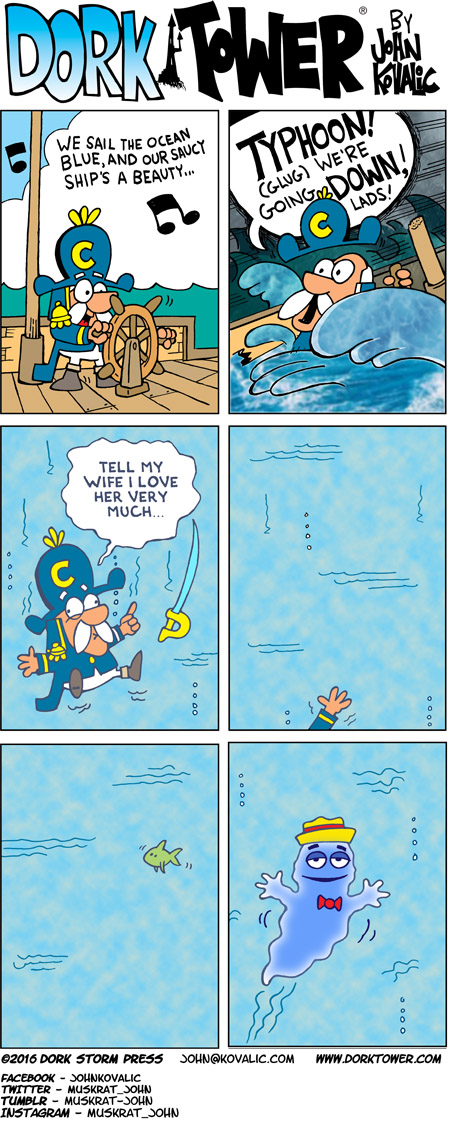
I wasn’t totally happy with the timing (thought there should be more of a pause before the rise of Boo Berry), and then I wondered, were any lines really necessary?
Also, without Igor at the end, the Cap’ns tunes suddenly felts awfully sad.
Gilbert and Sullivan and Bowie were chopped, and the strip became this:
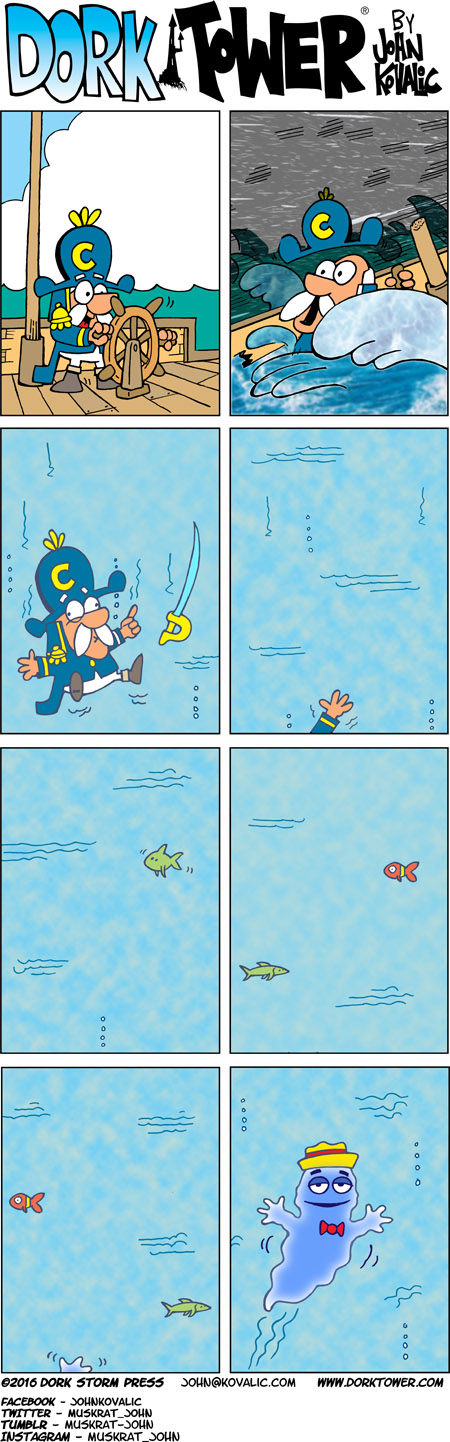
I don’t do “silent” strips often, but the idea intrigued me. It was something different, anyway, for me, and that’s part of the fun of the job. So I’d stripped the strip of the three aspects that originally had me giggling (Igor’s presence, and the musical call-outs). But it was a clear choice: Less, in this case, was a lot more.
Anyway, that’s how you overthink a perfectly good cartoon. And how you make it up to people, by showing them the original iterations anyway.
HAPPY HALLOWEEN!
–John
PS: Apologies to all the overseas folks who didn’t “get” this Dork Tower at all. Cap’n Crunch and Boo Berry are popular US cereal brand mascots. Thus is the joke explained, thus is the joke no longer funny. You’re welcome!

I became an RSS user when Google Reader came out in 2005. Like a lot of people, I got pretty obsessed with Twitter around 2007. By 2010 I still had accounts with Google Reader and Twitter and checked in on both maybe once a week. But somewhere along the line I started getting most of my information from Facebook. Let’s just say it wasn’t the same quality of information I was used to.
By 2012, I closed my Facebook account for a few months and then in 2014 I closed it permanently. These days I rely on The Old Reader and Instagram on a daily basis and once every other week or so check in on Twitter. I stay informed and get inspired using The Old Reader and get that social fix on Instagram.
My primary areas of focus on The Old Reader are Business and Technology, News, Culture, and Music. I follow a few other things as well like Food and Sports. The feeds that I follow are diverse, but all are a million times more effective at keeping me up to date than my old Facebook friends once were. On top of all that, I believe in The Open Web (http://blog.theoldreader.com/post/67563942900/rss-and-the-open-web) which doesn’t thrive in private social networks.
The question I ask myself all the time is: why did I ever stop using an RSS reader?
What I’m really excited about is hearing why you guys use RSS. Feel free to leave a comment, but if you’re up for it, drop an email to rss4ever@theoldreader.com telling us a little about yourself, why you use RSS, how long you’ve been using it, and 5 feeds that you think other people in our community will love. We’re hoping to feature one or two of you on our blog in the near future and also value the direct input we receive from each of you.
Thanks for using The Old Reader!



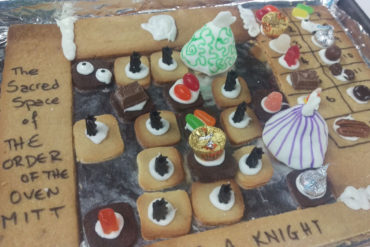
Set your table in time-honoured positions.
The classic “use cutlery from the outside-in” still holds, but I realised there’s a little more to it than that. And I learned what a charger is.
Amalgamation of tips from the cookbook I use most, the Joy of Cooking.
 |
| 19 Days Left |
Since Death Valley is below sea level could we dig a hole to the ocean and fill it up with water?
—Nick Traeden
Yes! We can do anything we want. We shouldn't do this, though, because it would be gross.

Death Valley is an endorheic basin[1]"Big hole" in California. The floor of the valley is about 80 meters below sea level. It contains the lowest point on land in North America[2]Excluding artificial points like mines. and is the hottest place on Earth.[3]If you're about to say "Wait, what about Liby—," then don't worry, I'm with you. Just hang on and read a few more words ahead!
Now, if you're the sort of person who's into world records, you might have heard that the hottest place on Earth was Al Azizia, Libya. Al Azizia recorded a temperature of 58.0°C (136.4°F) in 1922, a mark Death Valley has never come close to. So what gives?

It turns out Al Azizia has recently been stripped of its record. In 2010, an exhaustive—and definitely a little obsessive—investigation led by Christopher C. Burt convinced the World Meteorological Organization that the Libyan measurement was probably a mistake. This left Death Valley with the record of 56.7°C (134°F), set in 1913. Case closed!

Except it's not quite settled. Burt has raised questions about the 1913 record as well, and has gone so far as to catalog a number of historical extremes along with a credibility score for each. The "real" record is probably 53.9°C (129°F). This temperature has been recorded four times, in 1960, 1998, 2005, and 2007—every time in Death Valley.
These records were recorded with modern instruments and are considered reliable. They also make sense from a theoretical point of view. Geographers have calculated[4]This Army Corps of Engineers publication cites a couple of sources for this, including a 1963 paper by G. Hoffman. Unfortunately, that paper is in German, which I can't read, so I've just decided to trust that the Army Corps of Engineers writers Dr. Paul F. Krause and Kathleen L. Flood aren't pulling a fast one on me. that the highest possible temperature in ideal spots (in desert basins like Death Valley) during the 20th century is 55°-56°C, so 54°C sounds like a reasonable world record.
Now, back to Nick's question.[5]This is nowhere NEAR the record for "most boring digression into world record trivia." That record was recently challenged by IBM computer capable of producing millions of boring pieces of trivia per second, but the machine narrowly lost to reigning human champion Ken Jennings.

Since Death Valley is below sea level, we could, as Nick suggests, flood it with seawater. It would take a lot of digging, since there's a lot of Earth in the way. The lowest route to Death Valley is probably by traveling up the Colorado River watershed, along the Arizona border past Quartzsite,[6]Trivia: If you want to reach Quartzsite, Arizona from my school, Christopher Newport University, you just step out onto Warwick Blvd (Rt. 60) and turn left. That's it—Route 60 runs across the country, from the CNU campus in Virginia to I-10 just outside Quartzsite. then northwest[7]Possibly following one of the routes shown on page G34 in this report. past Zzyzx, which is a real place.

If you did all that digging, you could create a channel from the Gulf of California to Death Valley, and water would flow in. We can use this handy stream-flow calculator to figure out how wide we'd need to make the channel. A channel 20 meters deep and 100 meters wide should be able to fill it in a few months. A really wide channel—like the kind carved by glacial floods—could fill it in hours.
We know it's possible to create this kind of inland sea because we've done it before—by accident. In 1905, irrigation engineers working on the Colorado River made some mistakes. During a flood, the entire Colorado river broke through into the Alamo Canal and flowed directly into the Salton basin to the north. By the time they repaired the canal, two years later, the Salton basin had become the Salton Sea—one of the larger human-caused changes to the world map.
The Salton Sea is fed mainly by agricultural runoff, so it's become saline[8]"Salty" and hypereutrophic.[9]"Gross" Large numbers of dead fish, combined with algal decay and unusual chemistry, have created a smell that the US Geological Survey describes as "objectionable," "noxious," "unique," and "pervasive." The sea is a birdwatching hot spot, but also the site of a lot of mass bird die-offs, so kind of a mixed bag if you're into birds. In recent years, the water has been evaporating quickly, leaving behind dried toxic residue which is swept up into dust storms. Work to clean up and rehabilitate the region is ongoing.
All in all, the Salton Sea is a mess—and Nick wants to make another one.

Nick's Death Valley project would start off connected to the ocean, but without a source of flowing water at the Death Valley end,[10](It's a desert.) the channel would gradually silt up. The link to the ocean would eventually be broken, the sea would start to evaporate, the water would become saline, algae would bloom, and eventually the US Geological Survey would start complaining about the smell.
There would be one more consequence to all this. Thanks to the flood of cold ocean water burying the whole region, Death Valley would stop setting temperature records, and someone else would eventually claim to have broken their 129°F record. The Death Valley records would have to be compared to the newer candidates, which would probably use slightly different methods ... and that means one thing:
A World Meteorological Organization expert panel!


Holidays & Days of Note for October 13, 2016
* International Skeptics Day
* National Yorkshire Pudding Day (I assume England) There is also one in February!
* Fontinaia (Old Rome) Fontinaia was the Roman festival for the veneration of holy wells, springs & fountains.
* Columbus Tells a Lie Day. It was discovered that Columbus’ ships really landed on the 13th of October 1492, he was persuaded by Dutch sailor Piet de Stuini (or DeStynie) to change it to the 12th in the logs because he said that the number 13 might frighten sailors and future investors. The change was detected by an Italian study group called the Colombiani.

The S-curve.
A remarkably common pattern for the evolution of many things. You see it all the time in the evolution of technical things, but also many systems in general.
When you start to reach the top of the limits of what one system can do you’ll start to see a focus on efficiency, cost reduction and small improvements and optimisation. This is great because it forces a new creative solution to arise in order to make any real progress. An image search gives a few examples.
Also, see some related sketchplanations: The long nose of innovation, designing for adoption, understanding the chasm.

Just a reminder that BAH West tickets are going fast! As of last night we'd already sold 1/4th of tickets, so we're now expecting to sell out a bit early. Buy soon to lock in a spot! It's going to be a great night!