Yuval Pinter
Shared posts
Comic for 2019.01.27
Yuval PinterThis one's actually semantically interesting.
Mountain Mao
From an anonymous contributor in Taiwan:
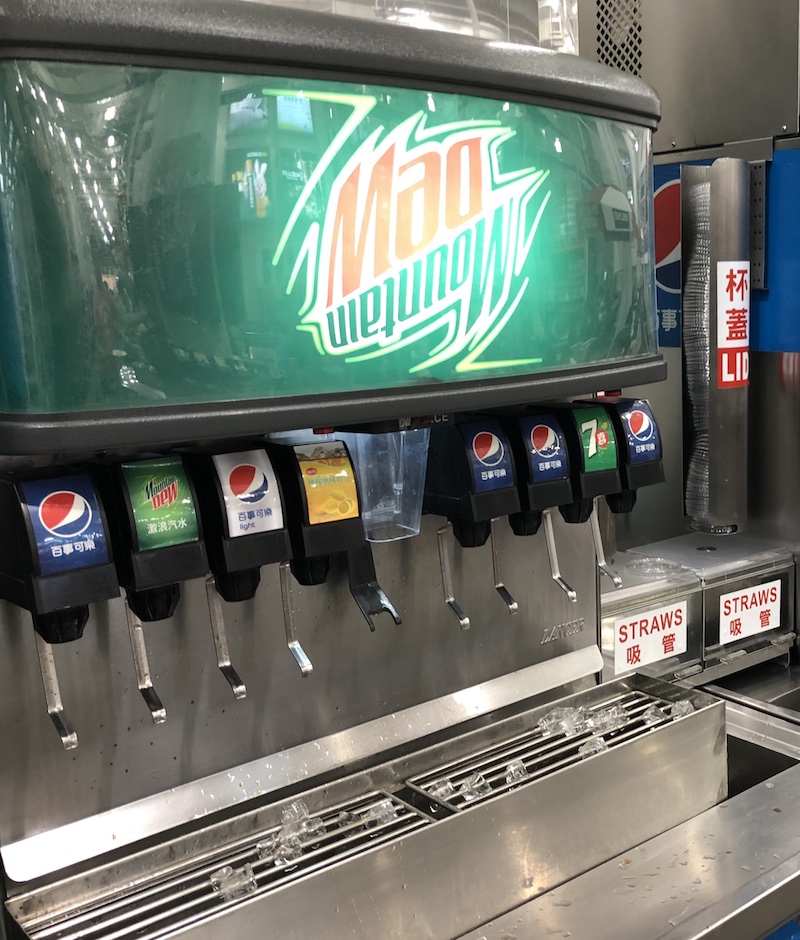
The correct orientation of the logo is visible on the drink dispenser selections just below the panel with the large letters at the top.
Is this an innocent error? Or an act of subversion?
"Your discipline doesn’t exist"
Comic for January 21, 2019
some scientists use the odds of developing these brains as a way to measure how unacceptable a cosmological theory is, which seems backwards, because these brains are officially awesome. and i'm not even a random cosmic intelligence saying that!!
| archive - contact - sexy exciting merchandise - search - about |

| ← previous | January 18th, 2019 | next |
|
January 18th, 2019: This comic is brought to you by my brain. – Ryan | ||
Mandarin.
Sarah Zhang uses the recent appearance of a mandarin duck in Central Park as a springboard to share an interesting bit of etymology:
Yes, true, mandarin ducks are native to China, where Mandarin is the official language. But the word mandarin has a more roundabout origin. It does not come from Mandarin Chinese, which refers to itself as putonghua (or “common speech”) and China, the country, as zhongguo (or “Middle Kingdom”). It doesn’t come from any other variant of Chinese, either. Its origins are Portuguese.
This one word encapsulates an entire colonial history. In the 16th century, Portuguese explorers were among the first Europeans to reach China. Traders and missionaries followed, settling into Macau on land leased from China’s Ming dynasty rulers. The Portuguese called the Ming officials they met mandarim, which comes from menteri in Malay and, before that, mantrī in Sanskrit, both of which mean “minister” or “counselor.” It makes sense that Portuguese would borrow from Malay; they were simultaneously colonizing Malacca on the Malay peninsula. […]
Over time, the Portuguese coinage of “mandarin” took on other meanings. The Ming dynasty officials wore yellow robes, which may be why “mandarin” came to mean a type of citrus. “Mandarin” also lent its names to colorful animals native to Asia but new to Europeans, like wasps and snakes and, of course, ducks. And the language the Chinese officials spoke became “Mandarin,” which is how the English name for the language more than 1 billion people in China speak still comes from Portuguese.
(For more on the history of Mandarin Chinese itself, see the very interesting comment by Bathrobe in this LH thread.) Thanks, Trevor!
if a tree falls in a forest does it make more or less forest
Yuval Pintermasterpiece.
| archive - contact - sexy exciting merchandise - search - about |

| ← previous | January 11th, 2019 | next |
|
January 11th, 2019: I GOT SOME OPINIONS ABOUT TREES – Ryan | ||
confession time: in dinosaur comics continuity, everyone mentioned here is absolutely a dinosaur
| archive - contact - sexy exciting merchandise - search - about |

| ← previous | January 9th, 2019 | next |
|
January 9th, 2019: HAPPY 2019! This is the most surreal part of the year for me, because it's the part of the year where I get to change the copyright date on the comic, way down there in the lower left-hand corner, moving the "8" to a "9". I started this comic in 2003 and never expected I'd make it past the year, let alone over FIFTEEN of them! So thank you so much for making that possible. You are individually and collectively the best! The comic's birthday is the 1st of February and I'll have more to say then! – Ryan | ||

Saturday Morning Breakfast Cereal - Conscious
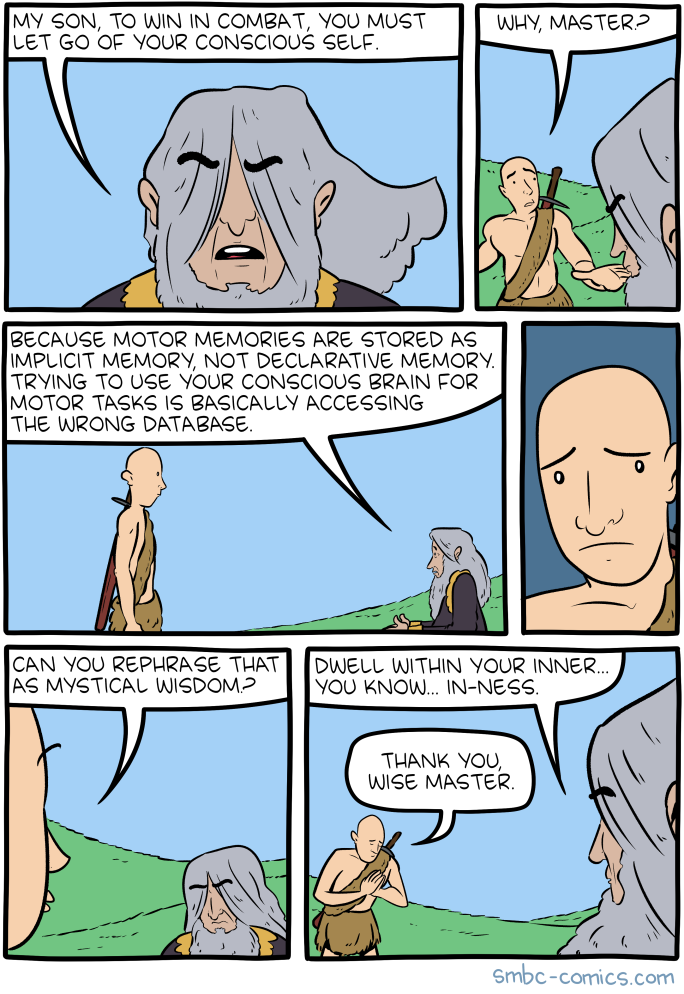
Click here to go see the bonus panel!
Hovertext:
I think you could make a really good Star Wars movie where scientists discover force access is just a matter of implicit memory, and the robes and sayings are all just layered on top.
Today's News:
Happy New Year, geeks!
Fore-Edge Painting.
This has, technically speaking, nothing to do with language, but it has to do with books, and it’s so beautiful I can’t resist posting it: 40 Hidden Artworks Painted on the Edges of Books.
A fore-edge painting is a technique of painting on the edges of the pages of a book. The artwork can only be seen when the pages are fanned, as seen in the animation below. When the book is closed, you don’t see the image because it is hidden by the gilding (i.e., the gold leaf applied to the edges of the page). According to Encyclopedia Britannica, fore-edge paintings first arose during the European Middle Ages but came to prominence during the mid-17th century to the late 19th century. Anne C. Bromer for the Boston Public Library writes, “Most fore-edge painters working for binding firms did not sign their work, which explains why it is difficult to pinpoint and date the hidden paintings.”
Thanks to the generous gifts from Anne and David Bromer and Albert H. Wiggin, the Boston Public Library holds one of the finest collections of fore-edge paintings in the United States. Most of the collection has been put online for the world to enjoy and features more than 200 high-resolution images; complete with additional videos, articles and information. The University of Iowa and Colossal recently featured a few fore-edge paintings with animated gifs that can also be seen below.
15. The rambler, v.1 1825 by Samuel Johnson (Old Wych Street, London) and 31. Lalla Rookh, 1818 by Thomas Moore (Tyburn Turnpike, London) are particular favorites of mine — I’m a city boy, and I love street scenes.
וישב סולשיאר העירה בראות סבלם
״וישב סולשיאר העירה בראות סבלם״. בהקשר הפוסט הזה.
התארחתי אתמול בפודקאסט ויש לי כמה הערות נוספות:
המועדון יצא מתחושת הפחד של ״מה יהיה״. מינה את מאמנה של קבוצת מולדה פוטבול קלאב.זה מה שהיה צריך לקרות ב-2015 קצת אחר השלב הזה של העונה. ואן חאל כבר פוטר מעשית אבל הושאר עד סיום העונה. בגלל הפחד. לא בגלל הפחד שגיגס לא טוב מספיק אלא מהתחושה שהוא טוב מספיק. הפחד המשתק – האם המאמן וורלד קלאס, האם הרכש וורלד קלאס – היה משתק.
נכון, התפקיד הוא זמני. סולשיאר כבר היה כמה פעמים במקום הנכון בזמן הנכון ועשה את הדבר הנכון.
מוריניו עף? אז עכשיו פוגבה? אז עכשיו וודוורד?
אני אומר לא. לגבי שחקנים אני אבטח בסולשיאר. אבטח בכך שהוא מתייעץ – גם עם המנג׳ר שפעם לא השאיר את פוגבה. המועדון במידה רבה חוזר לידי המפלגה הפרגוסונית. והמשכיל בעת ההיא יידום.
ולגבי וודוורד. אני לא סובל אותו. אני לא סובל את העובדה שהוא היה אדריכל המינוף ועכשיו המנכ״ל. אבל הוא נכנע כרגע. הוא החל במהלך ההבראה.הוא מוותר על השליטה בענייני הכדורגל. הוא חוזר אל אנשי המועדון מימים ימימה. וההדחה שלו אינה מטרה.
נחזור על כל העדר
[פוסט זה הוא פוסט חצי-אורח בשיתוף עם לימור נעמן]
חזרתיות בשפה היא תופעה מעניינת. דוברים יכולים לחזור על משפט שלם, אולי באינטונציה שונה, כדי להבהיר שהם עומדים לחלוטין מאחורי הרעיון שהם מבטאים (היא היתה שלך עוד בשלום, ג'רי. היא היתה שלך עוד בשלום). אם נרד לקומת המרתף, יש מילים שמכילות רצפי צלילים חוזרים, נניח כלבלב או צהבהב בעברית, באופן שיש לו משמעות מסודרת (כאן – הקטנה או החלשה). בעברית אולי זה לא ממש פרודוקטיבי (כלומר, מבנה שגם מילים חדשות לחלוטין ישתלבו בו בהקשרים חדשים לחלוטין, והמשמעות תהיה צפויה), לפחות לא על כל מילה (מחשבשב כספסף? כאילו, איחס?), אבל יש שפות כמו אינדונזית בהן זה ממש חלק מהדקדוק, במקרה שלה – ריבוי (kura – צב. kurakura – צבים). כשזה ברמת הבפנוכו של המילה כמו כאן, בלשנים קוראים לזה רדופליקציה (reduplication), ואנחנו משוכנעים שיש שם בדיחה מודעת לעצמה על התי"מ שהביטוי יוצר [למיטיבי לכת, יש את המאמר שלוקח את המשחק הזה עד 11 – רה-רדופליקעיישן לאלעק מאראנץ].
בין שני אלה, יש גם תופעה בשם ראיטרציה תחבירית (syntactic reiteration), שבה חוזרים על מילה בודדת באופן שמייצג סמנטיקה מסובכת יותר, סמנטיקה ששפות אחרות כנראה יבטאו באמצעות הרכב תחבירי סטנדרטי. באנגלית, למשל, ניתן לחזור על מילה כדי לנתק ממנה משמעות מטאפורית או כדי להעצים משמעות בסיסית שלה. תחשבו על הציטוט הנפוץ בסדרות נעורים אמריקאיות – Do you like him, or do you like-like him? האם את משתמשת במובן הלא-מחייב של "בסדר לי להיות בסביבתו", או שמא החיבוב שלך נושק לתחום הרומנטי? וגם – What kind of sandwich do you want – like a hamburger, or a sandwich-sandwich? האם האידיולקט (ניב אישי) שלך הוא מאלה שכוללים את ההמבורגר בקטגוריית הכריכים, או שהתכוונת שאזמין לך סנדוויץ' פרוטוטיפי שמורכב מממרח ודברים-חתוכים-דק בין פיסות לחם בלבד?

מה הוא רוצה מאיתנו זה עם הסנדוויצ'ים שלו. מקור: טוויטר
בעברית יש (גם) את העניין הזה של ההעצמה – הלילה הוא לפעמים שחור ולפעמים שחור-שחור, תבשילים מקראיים הם לפעמים האדום האדום הזה, הגבר הסטריאוטיפי הוא לעתים גבר-גבר. אתה אוהב אותה או אוהב-אוהב אותה? אבל בעברית עוד נעסוק.
יש שפות שבהן לטקטיקה הזאת יש משמעויות יותר מרוחקות, כאלה שיוצאות מתחום המילה עצמה. למשל, באיטלקית סיציליאנית ראיטרציה יכולה לסמל העצמת פעולה:
האיש מדבר-מדבר
במקרה הזה הכוונה היא שנושא המשפט מדבר יותר מדי, או שהוא מזיין את השכל בכישרון רב. עוד שימוש למבנה הזה הוא במיקום אירוע או מאפיין כלשהם על שטח נרחב:
חיפשתי אותך שוק-שוק
משמעו חיפשתי אותך בשוק, אבל גם חיפשתי אותך בכל השוק. עוד דוגמה היא "יש לו פרצוף פצעים-פצעים" – כל הפרצוף שלו מלא פצעים (אפשר לראות את זה גם בעברית תלמודית: "בשרו נעשה חידודים חידודים").
אבל אנחנו בתוך עמנו חיים (לפחות כשאנחנו לא בלימודים), ועברית מודרנית כפּרה עליה יצקה סמנטיקה מעניינת אף היא אל תוככי הראיטרציה התחבירית (בנוסף על אופציית ההעצמה שהזכרנו קודם, שדי תחומה לתבנית אינטונציה מאוד מסוימת, בה מדגישים את המילה שאינה הראש התחבירי של הצירוף; ובנוסף על הביטוי הקפוא אחד-אחד בהוראתו הלא-נפוצה מדי של "לקחת פרטים משתי רשימות לסירוגין").
המשמעות המוכרת, והפרודוקטיבית, והמגניבה, היא של "אחד-אחד", מה קוראים ביידיש וואן ת'ינג אט א טיים [1]. כך, אם נאמר "עברתי על טיים-הליין של חידושי הניו יורק טיימס ציוץ-ציוץ", תהיה ברורה הכוונה "עברתי על כל ציוץ שם באופן פרטני, אחד אחרי השני". אם נאמר "אכלתי את האורז גרגיר-גרגיר", מתקבלת התמונה של אכילה מאוד איטית, כל פעם יש לי רק גרגיר אחד בהפה.

פרה פרה (מקור: פליקר)
שימו לב שהיו כאן שני מרכיבים למשמעות. האחד, הכל דבר בתורו, "פרה פרה" אם תרצו, הוא בלתי נמנע. זו מטרת התופעה. כפועל יוצא, שם העצם החוזר חייב להיות ספיר, בן מניה, אחרת לא יהיה איך לעבור עליו ("שחיתי לאורך הבריכה מים-מים"???). השני הוא השלמות, או אולי יסודיות, של הפעולה המתבצעת, ככל שהיא נתונה בזמן עבר. יכול להיות שלא הספקתי הכל, אבל אז חובה עליי לציין זאת, ואפילו זה לא תמיד יספיק. "(אני עובר / ?עברתי) על טיים-הליין של שמעון ריקלין ציוץ ציוץ, בינתיים הגעתי רק עד מאי 2018". "?הילדה אכלה את האורז גרגיר-גרגיר עד שנמאס לה".
הטריגר לזה הפוסט הוא שזיהינו משמעות קשורה לזו של אחד-אחד, אבל איכשהו קצת שונה: כשהאלמנט החוזר הוא יחידת זמן, יש פתח לסמנטיקה אחרת. כשאני אומר "יום יום אני צריך להתמודד עם מה שעשיתי", אין פה באמת משמעות בדידה של אקט יומי, ומצד שני לא באמת משתמע שבכל יום ספציפי יש רגע ניתן לזיהוי שבו אני מתמודד עם אותו מעשה. הכוונה היא שבאופן כללי, מצב הנפש שלי הוא כזה שמכיל התמודדות, ואין חופשה מהנושא. אם משהו יזכיר לי את העניין, אאלץ להתמודד איתו. אם פספסתי ציוץ באותו טיים הליין, יצאתי טועה. אם פספסתי יום בתהליך ההתמודדות, לא ממש. באותה מידה, יכול להיות שבכל יום בדיד אני מתמודד עם העניין פעמים רבות. [במאמר מוסגר, לפעמים יום הוא רק יום: זוהר ארגוב תולש מהלוח דף יום-יום. בבירור, זהו אקט שקורה פעם אחת ביום, לא פחות ולא יותר.]
לימור מציעה פתרון לפלונטר: אם אפשר לתאר את טיים-הליין כמורכב ממקטעים של 280 תווים (גג!), כך אפשר לומר גם שהשעות ב"אני חושב עלייך שעה שעה" מורכבות כל אחת ממקטעים של שישים דקות – בפועל גם כל ציוץ נקרא על ידי יובל מילה מילה. במובן הזה, גם פיד הטוויטר וגם הזמן עצמו הם רצף: אחרי כל דקה באה עוד דקה, ואחרי כל ציוץ בא עוד ציוץ שממשיך אותו. מכאן שאירוע קריאת הציוצים הוא גם חלקיק וגם גל, ואפשר להתמקד בכל אחד מהאלמנטים – הרצף והמקטעים שמרכיבים אותו – לפי מה שמתאים לסיטואציה. התרגיל הסמנטי הזה נקרא refocusing, ואפשר לראות אותו גם באירועים שבהם נוסף פתאום עוד משתתף, כמו במשפט "רגע אחד לא השגחתי עליו והוא רץ לי לכביש". המשתתף הראשי באירוע הוא הזאטוט הנמרץ, אבל המילה לי מאירה בזרקור על הקורבן האמיתי בסיפור הזה: האמא המסכנה שלא מבינה במה חטאה שיש לה ילד כזה.
אז אם נקבל את העובדה שזמן הוא יצור מיוחד ומורכב בעולם המושגים שלנו, ושלא כל הדרכים הזמינות לנו לחלק אותו (לימים, לשעות, לדקות) הן שימושיות בהקשרים כמו "לחשוב על מישהי" או "להתמודד עם משהו", נוכל להבין את הצורך הזה בהגמשת תופעת החזרה, במקום להידרש למשמעות נוספת שלה.
[1] אנקדוטת #היבריש מאותה ענבל דאשתקד: "לא הכל ביחד אבא, אחד בזמן".
[לימור נעמן היא מאסטרנטית לתחביר באוניברסיטת לייפציג. יובל פינטר הוא דוקטורנט לעיבוד שפה במכון הטכנולוגי של ג'ורג'יה.]
Comic for 2018.12.15

i call this the theory of Reverse Psychohistory
| archive - contact - sexy exciting merchandise - search - about |

| ← previous | December 5th, 2018 | next |
|
December 5th, 2018: TIME TRAVEL BANDANAS HAVE ARRIVED!! – Ryan | ||
Why Did I Leave Quora, Why It Is Not Such a Big Deal, and Why Do I Nevertheless Hope to Come Back
This post is sad and angry. I don’t mention any names, but some people may read it and identify themselves here. Here’s my request to these people: I hope that this doesn’t hurt you personally. It’s not my intention to hurt anyone personally. All people have to do their jobs; sometimes they are happy about what they do despite some people’s complaints, sometimes they aren’t happy, but do it anyway because they need to pay bills, or because that it’s necessary for some kind of greater good. I totally get it. There’s a certain chance that I’ll meet some of you online or in real life. If this ever happens, I hope you don’t feel embarrassed or intimidated. I’ll be happy to meet you and I promise to be friendly. Thanks for understanding.
I used to be a prolific writer on the question and answer website Quora. I was even named a “Top Writer” four times. Sadly, in 2018 this once-fine website ruined itself.
The problematic signs were there even earlier, but the true catastrophe began with the “Links” feature. This feature adds links to articles on other websites to the Quora feed. Before this feature’s introduction the feed consisted mostly of questions and answers, as one would expect from, you know, a questions and answers website.
The articles and the websites shown as “Links” in the feed are selected automatically by Quora’s software. How does this software work is a mystery. There appears to be some intention to show things that are related to the topics that the user follows, but it also suggests unrelated topics. Sometimes they are labelled “Topic you might like”. Sometimes they aren’t labelled at all:

There’s no way to select a website to follow and see links from. There is a way to mute websites, but other sites will be shown instead.
There’s also no way to remove all the Links from the feed completely. By popular demand from Quora users, a volunteer made a browser extension called “Qure” that does it, but it only works on the web and not on the Quora mobile app.
The Link items in the feed look almost exactly like questions, which is severely distracting, and feels out of place. Quora staff people who work on this feature know it—”the links feel out of place” is a direct quote from a staff person. They know that many users dislike them, but they choose to show them anyway. “We’ll show links less to people who don’t like them” is also a direct quote from a staff person.
Let this sink in: They know that some people don’t like the links, and they show them to these people anyway. My logic—I won’t even bother calling it “ethics”—tells me that when you know that a person doesn’t like a thing, you don’t show that thing to that person at all unless you have a particularly good reason and you can explain it.
Another problematic feature that Quora introduced in 2018 is “Share”. This sounds like a sensible thing to have on any modern website, but on Quora it has a somewhat different meaning. “Sharing” on Quora means putting an item in your followers’ feed with a comment.
This is similar to retweeting with a comment on Twitter. It works fairly well on Twitter, but Quora is not Twitter. In Twitter everything is limited to 280 characters—the tweets and the comments on retweets. On Quora answers can and should be longer, but the comments are short, and this feels imbalanced.
What’s worse, even though Quora says that the comments on shared items “provide additional insight“, they are actually rather pointless. In fact, many of them are not even really written by people, but filled semi-automatically: “This is interesting“, “This is informative”, “Great summary”, “I recommend reading this“, etc. Those that are actually written by humans are not much better, for example: “H.R. has been a wonderful teacher and excellent writer. Since joining Quora last year I’ve latched on to his brilliance – he’s earned his place firmly”. This says nothing substantial that couldn’t be expressed by simply upvoting the writer’s answer.
Both links and answers can be shared. I’ve just explained why sharing answers is pointless. Sharing links is a weird thing: On one hand, seeing a link that was shared by a Quora user makes relatively more sense than seeing a link that was added to the feed by faceless software for some reason I don’t know. In practice, however, it doesn’t make the link any more sensible or useful. Shared links feel totally relevant on Facebook and Twitter, but Quora is neither Facebook nor Twitter. It’s a site for questions and answers, or at least it used to be one.
And then there are the items that are questions or answers, but that are shown to me on my feed for mysterious reasons: They are categorized under a topic I don’t follow, they are written by users that I don’t follow, and they weren’t even upvoted or shared by users that I do follow. They are just totally, completely unrelated to me.
Occasionally they are labelled as “Topic you might like” or “Author you might like”, but sometimes they don’t even carry this label.
It’s difficult to discuss this feature because unlike “Share” and “Links” it doesn’t even have a name. It’s just… random stuff that I didn’t ask to see, and that appears in my feed. In this blog post I’ll call it Nonsense. It’s not a nice name, but that’s what it is. (I really want to know this feature’s real name. It surely has one. If you are on Quora staff, please tell me what it is. I won’t reveal your identity.)
I would possibly understand showing this Nonsense to new users: Quora may want to suggest you stuff to follow to get you hooked. But I’ve had the account for seven years, I follow lots of people and topics, I visit the site several times a day, and I know very well what I want.
What’s worse, Nonsense items are shown to me while many items written by people I do follow are not. I followed people on Quora because their personality or knowledge genuinely interested me. To me, “Follow” means that I’m interested in seeing stuff written by these people. But Quora decided to disregard my specific request, and to show me Nonsense instead.
There’s no way to run away from Link items, from Share items, and from Nonsense items. Quora has a Mute feature, but for the most part it does more harm than good:
- When you mute a Link item it mutes a particular link source, for example New York Times or Breitbart (yes, both are available), but when you mute one source, other sources are shown instead and there appears to be no end to it.
- When you see an answer on a topic you don’t follow, you can mute that topic, but this (probably) means that if an answer is written in this topic by a user that you do follow, you won’t see it. This is often not what one wants. For example, “Entertainment” is a topic on which answers are often shown to me, even though I don’t follow it. I don’t want to see this random answers, but if a user I follow posts an answer in a question for which this is one of the topics, I’d be OK with seeing it.
- When you see an “Author you might like”, and you don’t actually like that author, you can mute them. As above, this is not necessarily what I want: If that author happens to write an answer on a topic I follow, I’ll be OK with seeing it. I just don’t want to see that author’s answers when they are completely unrelated to me, but this is a feature, and there’s no way to get rid of it.
When I first saw the Links in February 2018, I was immediately appalled: What is this thing that is neither a question nor an answer?! When I saw that I cannot remove them from my feed, I pretty much immediately decided to stop using the site. It was clear to me that something is badly wrong.
Even thought I deleted my Facebook account in 2015, I created a new one some time after the links were introduced, just so that I could join the private Quora Top Writers Feedback group. For several months I tried talking to the Quora staff people in that group and understand: Why do the links even exist? Why are they so random and useless? Why are pointless items shown to me? I got almost zero substantial replies.
I intentionally came back to sincerely using Quora, thinking that the algorithms will learn my behavior, and show me more relevant links, or no links at all. This didn’t work, of course, and Quora became even worse when the awful Share and Nonsense features were added, so in June 2018 I stopped posting there almost completely.
After some more time, the Facebook group’s moderator didn’t like my questions about these unfortunate features, and removed me from the group, too. The explanation was that they were repetitive, which is understandable; what is less understandable is that instead of removing me from the group they could try answering the questions. They didn’t. They did suggest sending my complaints to a particular email address for Top Writers. I did it, and I received no reply.
So that’s it, I guess.
A legitimate question arises: Could I use Quora without the feed? Not really, because the best thing about Quora was that before the disastrous 2018 changes it showed me answers that interest me and questions that need answers on topics about which I know something. Without this, the site is not that useful. It moved to being oriented much more towards readers who are prone to click on clickbait and to writers who are local Quora “stars”. I don’t belong to either group.
(Before I go into the last conclusions, I should mention one unrelated and very positive thing that Quora did in 2018: Expansion of its internationalization efforts. For years, Quora used to be explicitly English-only. Later, Quora introduced sites in several new languages, among them Spanish, German, Hindi, Portuguese, Indonesian, and French. It also added an answer translation feature, which, while not yet implemented perfectly, is a step in a very good direction. I hope that it gets developed further and doesn’t get killed.)
I have a bit of a price to pay for publishing this blog post. I probably won’t be a top writer again (this came with pretty nice swag). I might be banned; not that it matters, because I plan to deactivate the account anyway. I may run into Quora staff people at professional conferences, and things may get awkward (see the top of this answer—I do hope to meet you, and I hope that it won’t get too awkward).
But at the same time… it’s not actually a big deal. Even though before 2018 Quora was a really nice place to ask my questions and to answer questions for which people need an answer, it is nowhere near being a truly essential site like Wikipedia. Stopping to read and write there every day allowed me to focus better on family and work, and also to revive some old neglected projects, such as translating Wikipedia articles or proofreading Gesenius’ Hebrew Grammar at Wikisource.
All that said, yeah, I’d probably be happy to come back. The web does need a good question and answer site, with relevant topics, with pleasant design, and with good moderation. Quora used to be such a site. It is no longer such a site, with or without me. It can easily go back to being one. However, this will only happen when it becomes possible to remove Links, Shared items, and Nonsense from the feed.
A couple of last conclusions:
- On a website that has the characteristics of being a social network or a writers community, users need to be empowered somehow. It’s not easy, and it has costs, but when it’s done right, it’s worth it. Wikipedia empowers its users ridiculously: on no other site can the users edit the site’s CSS and JavaScript (not all users, but a lot of them). Reddit is not as transparent as Wikipedia, but it’s quite empowering as well: subreddit moderators can pressure the site’s management. The results of this pressure may be unpleasant and controversial, but it’s nevertheless good to have balances. Quora users are not empowered at all. It gives the company a lot of control, but is it actually good?
- Some people enjoy random weird algorithmically-selected stuff, and some people don’t. I hate the Links, and the Nonsense items, and a lot of other users hate them, but some people are fine with them. And that’s OK. That’s what preferences are for.
Receptive multilingualism
In the latest The Atlantic, Michael Erard describes a fascinating linguistic phenomenon: "The Small Island Where 500 People Speak Nine Different Languages: Its inhabitants can understand each other thanks to a peculiar linguistic phenomenon".
The article begins:
On South Goulburn Island, a small, forested isle off Australia’s northern coast, a settlement called Warruwi Community consists of some 500 people who speak among themselves around nine different languages. This is one of the last places in Australia—and probably the world—where so many indigenous languages exist together. There’s the Mawng language, but also one called Bininj Kunwok and another called Yolngu-Matha, and Burarra, Ndjébbana and Na-kara, Kunbarlang, Iwaidja, Torres Strait Creole, and English.
None of these languages, except English, is spoken by more than a few thousand people. Several, such as Ndjébbana and Mawng, are spoken by groups numbering in the hundreds. For all these individuals to understand one another, one might expect South Goulburn to be an island of polyglots, or a place where residents have hashed out a pidgin to share, like a sort of linguistic stone soup. Rather, they just talk to one another in their own language or languages, which they can do because everyone else understands some or all of the languages but doesn’t speak them.
The name for this phenomenon is “receptive multilingualism”, something I'd never heard of before reading Erard's article. Upon first learning of receptive multilingualism, it seemed improbable. How could a community use as many as nine different languages? Upon giving it more thought, however, the probability that members of a group living in a zone where many languages are in daily contact would develop passive fluency in several of them began to make sense.
From my own experience of people living in an environment where two languages are in common use, say English and Mandarin where English is the dominant language of society, I have observed that children will understand almost everything their parents say in Mandarin but answer them in English, and may barely be able to say anything in Mandarin beyond a few halting phrases.
In Singapore, where English, Mandarin, Cantonese, Hokkien, Teochew, Tamil, and other languages are spoken regularly, people pick up a considerable amount of ability to understand bits and pieces of many of these languages, but can usually only speak one of them well. On the other hand, they have developed a special type of English, called Singlish, that includes fragments of all the languages that are in frequent use in Singapore.
All of this leads me to conclude that, in general, passive recognition of languages is easier than active production, and that this holds true both with speech and writing.
Readings
- "English vs. Singlish" (7/28/18)
- "Pinyin for Singlish" (3/7/16)
- "New Singaporean and Hong Kong terms in the OED" (5/12/16)
- "Singlish: alive and well" (5/14/16)
- "Singlish under siege" (7/1/18)
[h.t. Chiu-kuei Wang]
Algebra

I’m on the road, visiting schools and talking with kids about comics! So I’ll be posting my comics a little differently this week!
Saturday Morning Breakfast Cereal - Christ
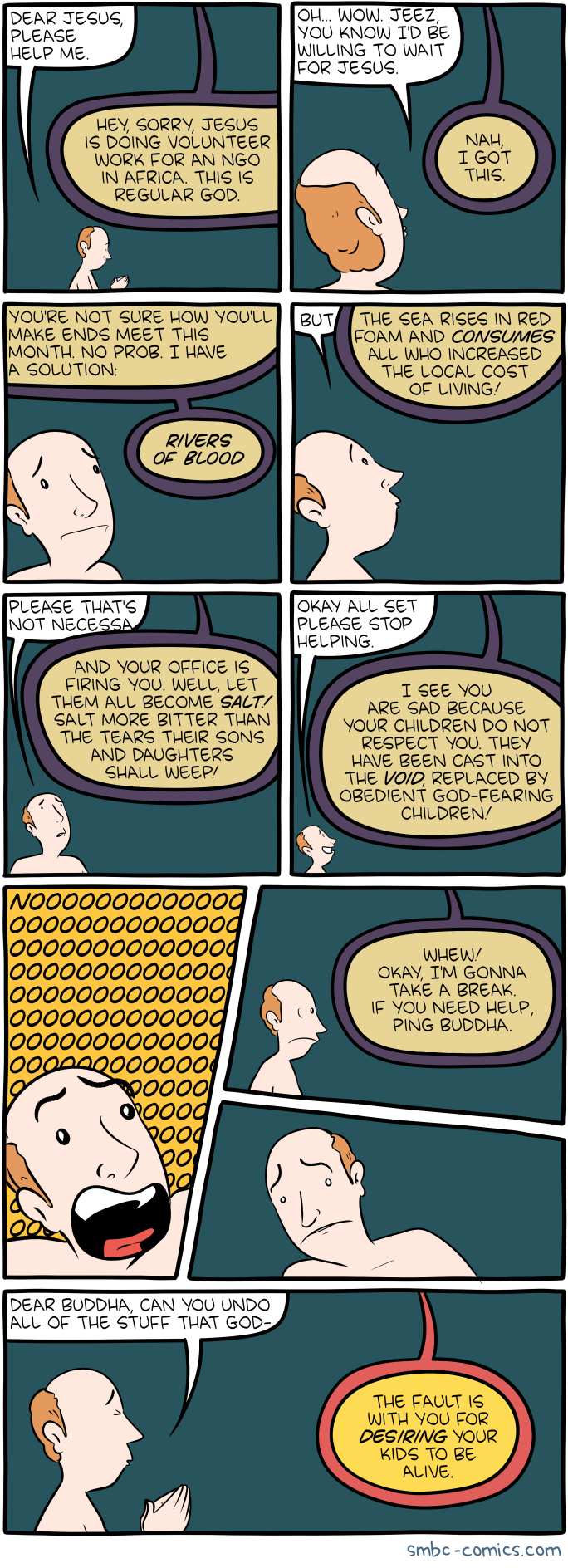
Click here to go see the bonus panel!
Hovertext:
Wait, does Buddha come from above or sideways or what?
Today's News:
"China has no intention to touch the cheese of any country"
Yuval PinterAmericans haven't heard of "Who Moved My Cheese", apparently.
A tweet by Kelsey Munro:
https://twitter.com/KelseyMunro/status/1062464615257231360
Here's the article in which the Chinese vice minister of foreign affairs is quoted as making this profound declaration: "China says no country should try to obstruct its Pacific 'friendship'", by Kirsty Needham, The Sydney Morning Herald (11'14'18):
"No country should try to obstruct the friendship and cooperation… China has no intention to touch the cheese of any country, instead China is committed to make the pie of cooperation larger," said Chinese vice minister of foreign affairs Zheng Zeguang, when asked about the expansion of Australian aid in the Pacific.
Is this what he's referring to?
"Diary Of A Wimpy Kid Clip 'Cheese Touch'"
Or is it this immortal idiomatic expression?
chī dòufu 吃豆腐 (lit., "eat tofu", but use idiomatically to mean "take advantage of someone else; grope / take liberties with a woman")
Reading
"Vanity plates, writing systems, and the sexualization of tofu" (9/23/11)
[h.t. Geoff Wade]
Comic for November 13, 2018

Korean refrigerator onomatopoeia
From a tweet by Claire Varley:
The troubleshooting section for our new fridge has melted my heart. Imagine being the copywriter who sat there for hours trying to decipher the language of fridge… pic.twitter.com/H7AAd2sn6T
— Claire Varley (@clairepvarley) November 9, 2018
Since the refrigerator was made by LG, these transcriptions must be what refrigerator talk sounds like to a Korean.
People who are good with machines really can hear these subtle differences and make accurate diagnoses based on them. My brother Joe, who has had a symbiotic relationship with a succession of vans that he has driven millions of miles all over the country for more than forty years, can usually figure out what's wrong with a car just by turning it on and intently listening to it for awhile. I'm not sure, though, if the average housewife would be able to distinguish between "deureureuk~" and "kureureuk", much less all the other subtle sounds spoken by a Korean refrigerator.
[h.t. Ben Zimmer]
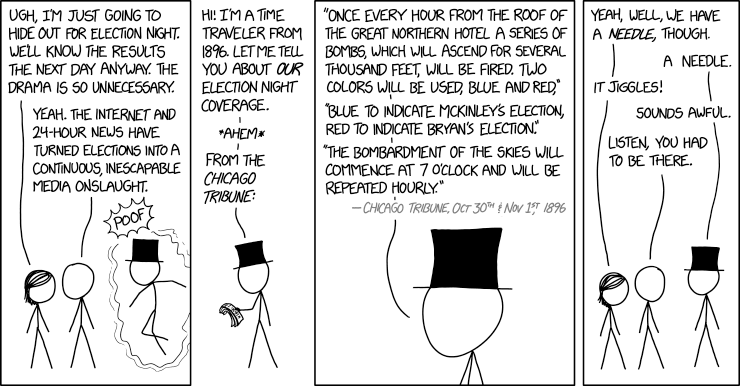
Election Night
Yuval PinterNote that they had the correct color sheme back then - blue for republican, red for democrat.
הישר מלהיט האקרנים, “סרן אמריקה: מלחמת אזרחים”, כאשר...

הישר מלהיט האקרנים, “סרן אמריקה: מלחמת אזרחים”, כאשר הסרן מתעמת עם אדם-מגהץ.
Comic for 2018.11.03
Comic for November 06, 2018
Yuval Pinterit me
Unfinished Business

Here are more ghosts!
And it’s your last chance to enter my Halloween contest! Winners to be announced on Halloween! 🙂
How Not to Rock the Semantic Boat
By Yuval Pinter
Imagine you’re building a boat, starting from a heap of parts. With each new board or screw, you make sure that it fits the adjacent parts, and that the material type is suitable for the section of the boat it’s in. But there are also bigger concerns to consider – is the new part changing the structure of the boat as a whole? Will it remain stable, or will it start rocking? Maybe there are other places where this part fits that would make more sense, but it’s not even where you’re currently looking.

Photo credit: Wikimedia Commons
In Natural Language Processing (NLP), some aspects of linguistic structure are like a boat. Specifically, the structure known as a semantic graph helps a wide variety of AI systems represent knowledge about the world by explicitly connecting linguistic concepts using different relations to create a massive network where each dictionary entry has its place. A few examples, from the manually-crafted semantic graph WordNet, include:
- cat is a mammal.
- wheel is a part of a vehicle.
- Rome is an instance of national capital.
- musical is derived from music.
- language is like a boat. (Just kidding about this one.)

Photo credit: Wikimedia Commons
These individual connections are the alluded “adjacent fits” from the boat metaphor. There are tens of thousands of parts in WordNet, and hundreds of thousands of these connections, of about a dozen types. But there is also a wider perspective to look through – that of the overall structure of the graph. For example, consider the “is a” relation, known in the trade as hypernymy. If we were to create hypernym connections between cat and mammal, then mammal and animal, then animal and cat, we would be building a structure that represents an impossible fact, that cat is both more general and more specific than animal. Other ways of rocking the boat can be the inclusion of improbable facts. For example, that cat is both mammal and vehicle. These mistakes can be averted if we know that the hypernym graph cannot contain directed cycles (for the first case) and that it should have as few concepts with multiple outgoing edges as possible (for the second).
In our paper, Predicting Semantic Relations using Global Graph Properties, we look into how this type of graph-level information (which we call global) can help find meaningful relations in a semantic graph. This task is typically done using adjacency-based techniques (which we call local), most of which are based on word embeddings.
First, we train a strong local model on English WordNet on the task of predicting a hidden side in a relation edge when the other side and the relation type are known. For example, the model is asked “which word is derived from music?” and is expected to know the answer, musical. In practice, what the model does is compute a score based on a neural network which composes representations (embeddings) for musical and derived-from with every concept in the dictionary, and ranks them based on this score. The training objective (and testing metric) is to rank music as high as possible.
Once this model is trained, we use its scoring ability to train a second component which is based on the global features of the graph. Each feature is a count of some graph property:
- How many concepts are hypernyms of other concepts?
- How many concepts are both a hypernym of something and a part of something?
- How many concept pairs are connected both via a derivation relation and a common domain topic?
And so on, totaling about 1,000 features. Using a training regime we call Max-Margin Markov Graph Models, or M3GM, we learn weights for each feature and use them to score the graph each time a new relation is suggested. In test time, we use the global model to re-rank the top 100 suggestions from the local model, and as our experiment shows, gain major improvements over the basic model.
Digging in, we see how specific improvements are motivated in facts we know (or suspected) about linguistic structure. For example, our global model learned that fewer hypernym concepts are better – we don’t want an excess of general concepts that spread the graph too wide or too deep. When the model is asked what the hypernym of Indian lettuce is, the local component wants to choose garden lettuce, but the global part rejects this new hypernym and selects (correctly) herb, an existing hypernym, in its place.

Photo credit: Yuval Pinter
You can find details of our model, and discussions of other ways the different weights correspond to insights about the structure of language, in the paper. Our code is available here.
====
Yuval Pinter and Jacob Eisenstein. Predicting Semantic Relations using Global Graph Properties. In Proceedings of the Conference on Empirical Methods in Natural Language Processing (EMNLP), 2018.
