Shared posts

15 Nov 03:09

Trent Reznor Award nomination

by Mark Liberman

It's been a while since we posted a nomination for the Trent Reznor Prize for Tricky Embedding — I believe that the most recent nomination was in April of 2012.  But here's a worthy suggestion from Laura Bailey:

The source is China Mieville's 2010 novel Kraken, and here's the sentence in a larger context:

DANE WOULD NOT LET LONDONMANCERS REENTER THE RUINED rooms of the kraken church to which he returned. They were not sure of their relationship to him nor he of his to them anymore— were they allies, still? Wati, traumatised and almost unconscious, could not breach the still-extant barriers. Only Billy came with Dane. When they descended, there were others there, though. The last scattered Krakenists, come home, in mourning.

Around the same number as there had been for the service that Billy had witnessed, but that had been just a regular Sabbath, a sermon: this was the last gathering in the world. Those lapsed, busy, usually too tainted by secularism and the exhaustions of everyday life to attend with the regularity the faith they professed would prefer were all here.

A couple of those muscular young men, though most of the enforcers of devotion had been guards, and guarding, and were gone. Mostly these were unremarkable men and women of all types. The end of a church.

I'll leave it as an exercise for the commenters to produce a parse tree.


10 Nov 23:20

"I think the audience will eat him alive. But I want to be there to hear it."

“I think the audience will eat him alive. But I want to be there to hear it.”
10 Nov 19:59

Turnout, Burnout

by יובל פינטר
Since Tuesday's elections, I've been hearing a lot about the alleged irresponsibility of the American voter, not turning out for the elections. At the same time, there has been the usual fuss over the electoral college system and how some states are meaningless to bother going out to vote.

I have yet to see a piece trying to tie the two together (please correct me if I'm wrong).

My claim is simple: citing the nationwide 56.5% figure as a strong indicator for voter apathy is somewhat misleading. If a Californian feels they don't see the point in voting (and registering beforehand), it's different than a Pennsylvania voter (in this elections cycle at least, but pretty much usually). It's unfair, but understandable, if there's a (say) 15 point difference in their turnout rates.

Let's look at the numbers then, shall we? On the x axis, we'll place the ultimate victory margin (collected Thursday from Wikipedia) as a proxy for how inclined an average voter was to believe that his vote would be crucial. It's not a perfect proxy of course, as there were some state-level surprises. Maybe poll margins prior to registration deadlines would have been a better one. The y axis will denote the voting turnout (collected from electproject.org).

Before the chart, observational data: of the 11 states with highest voter turnout rate, 10 ended up with a margin under 5%. Of the 10 states with margin under 4%, only one had a turnout of less than 60%. Now you can look at the chart, including a simple linear trend line.

2016-state-voting

Forgive my dataviz-unsavviness. I wish I knew how to add state labels to each point on gsheets.

As you can see, the results are pretty straightforward. With a not-bad correlation of 0.21, it seems voters chose to turn out based on how close they anticipated the race to be in their state. I didn't leave out the outliers but they're not shown in this chart (DC is always ridiculous, this time with an 86% victory margin. Hawaii significantly undervoted with a 34% turnout, way under the next, California at 45.5%). It was cool to see Utah as a special case here with its 3-way race – a 19% D-R margin brought significantly less people to the polls than Montana or Washington state who ended up with about the same margin.

All in all, the voters who mattered in this Presidential election (tough phrasing but that's the way it is) came in at about 65%, much higher than the national average.

It's worth noting that the numbers, even for the swing states, are still low compared to most of the democratic world. But I'll also note that the US has other factors going for it, such as the no-day-off thing, or the huge amount of expats allowed to vote, which is a unique characteristic. According to electproject, these compose roughly 2% of the eligible electorate.

10 Nov 13:11

Comic for November 10, 2016

Dilbert readers - Please visit Dilbert.com to read this feature. Due to changes with our feeds, we are now making this RSS feed a link to Dilbert.com.
08 Nov 21:16

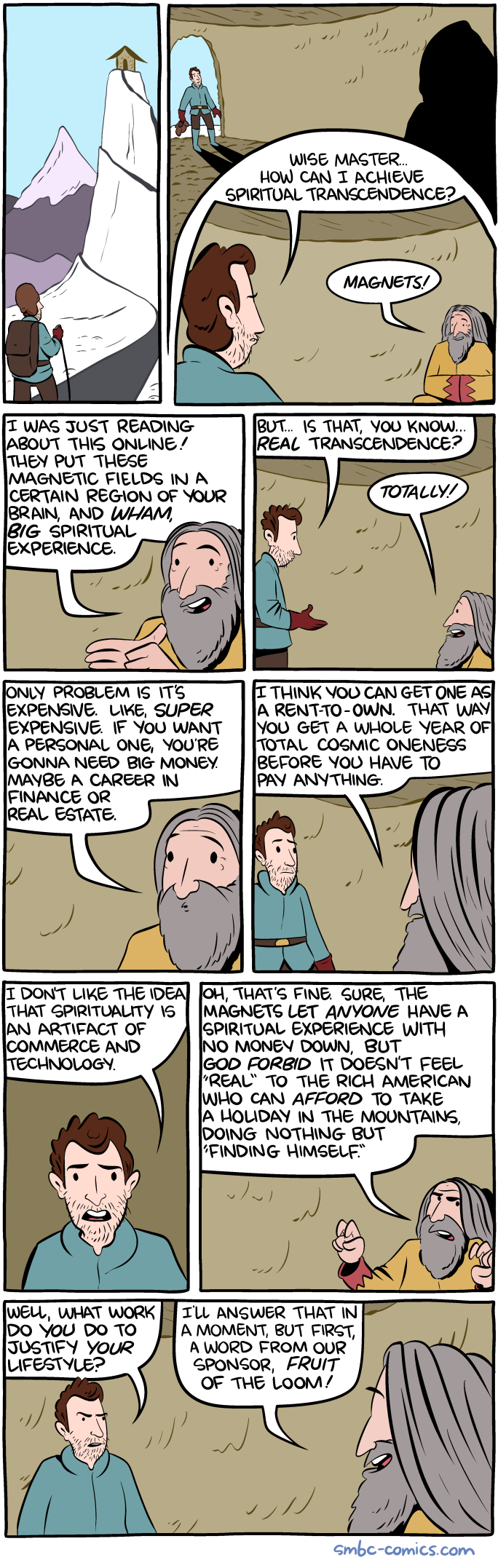
Saturday Morning Breakfast Cereal - Transcendence

by tech@thehiveworks.com


Hovertext:
STOP READING COMICS AND GO VOTE

New comic!
Today's News:

GO VOTE

07 Nov 23:18

"The title is the closest I’ve seen to manuscript clickbait"

“The title is the closest I’ve seen to manuscript clickbait”
07 Nov 00:49

Member fifth of November? I member!


Member fifth of November? I member!

04 Nov 16:49

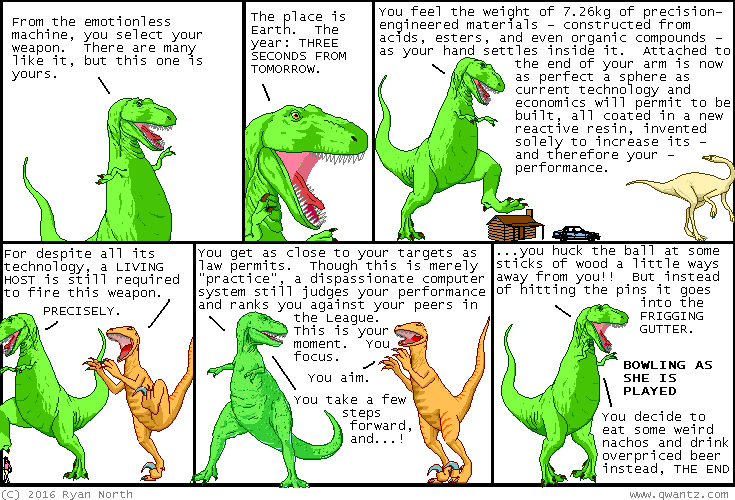
in my twenties some friends had a combination bowling and makeout club and i thought the "makeout club" part was a joke BUT IT WASN'T

archive - contact - sexy exciting merchandise - search - about
← previous November 4th, 2016 next

November 4th, 2016: I'm in Leeds! Are you coming to the Thought Bubble convention happening THIS WEEKEND and also RIGHT NOW?? I sure hope so because it's gonna be GREAT!!

– Ryan

24 Oct 17:42

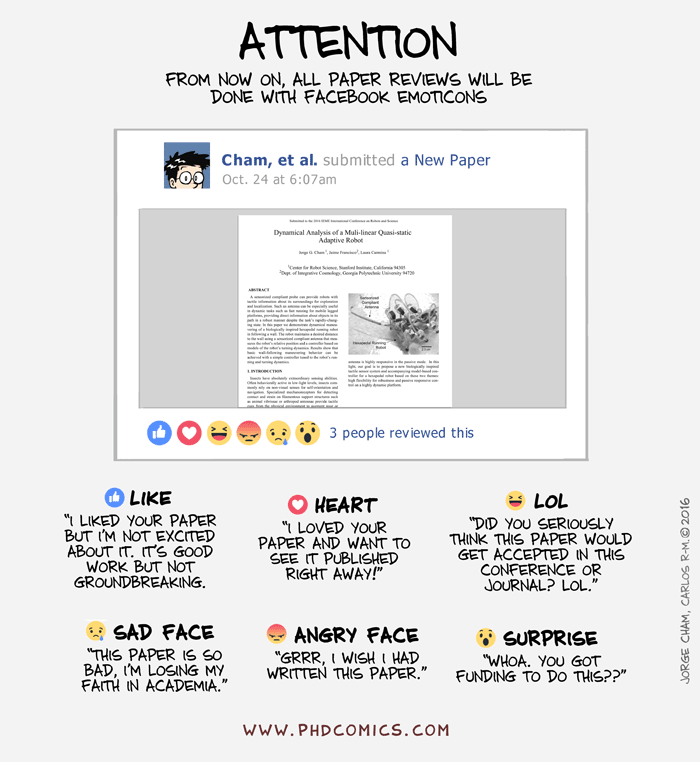
10/24/16 PHD comic: 'A new method for reviews'

Piled Higher & Deeper by Jorge Cham
www.phdcomics.com
Click on the title below to read the comic
title: "A new method for reviews" - originally published 10/24/2016

For the latest news in PHD Comics, CLICK HERE!

24 Oct 12:20

Lunch Time

by Doug

Lunch Time

Time for Halloween comics! And tomorrow, you’ll get a chance to win a bunch of cool stuff in my annual caption contest!

21 Oct 23:16

תדבק לשוני לימין חיכי

by יובל פינטר

קוראינו המסורים יודעים את המסורת – כשיש מערכת בחירות סוערת, דגש קל לא נשאר אדיש!

לכן מה יותר טבעי מהעיתוי הנוכחי לשתף אתכם בניסוי-הצעצוע האחרון שלי? שאלת המחקר אקטואלית מאין כמוה – האם הצד המועדף בשחרור צידי מושפע מהצד הדומיננטי בשאר אברי הגוף? אמ;לק: כן! אזהרת טריגר להמשך הפוסט – פונטיקה.

נתחיל במה-זה-לעזאזל-שחרור-צדי. ובכן, חלקכם אולי למד בשיעורי לשון שישנן כמה דרכים לסווג את (רוב) העיצורים בשפות אנוש. האחת היא מקום החיתוך: איפה הלשון עוצרת את זרימת האוויר לפני הפתיחה. סיווג זה מבחין בין *[b] (לא הלשון עוצרת אלא השפה), [d] (הלשון קרובה לשן), ו-[k] (הלשון פוגשת בחך העליון). עוד אחת היא קוליות: האם מיתרי הקול רועדים בזמן ההגייה, או לחלופין – האם העיצור משתנה בעת לחישה. זה הסיווג שמבחין בין [b] (קולי) ל-[p] (בלתי קולי), או בהתאמה [g] ו-[k].

הסיווג השלישי הוא קצת יותר פרי-סטייל ויש בו טוויסטים מעניינים. מדובר במה קוראים אותו אופן החיתוך. עיצור פוצץ חוסם את מלוא זרימת האוויר ומשתחרר בבת אחת, כמו [d]. עיצור חוכך נותן לאוויר לחמוק דרך פתח צר ואפשר למשוך את הגייתו עוד ועוד, נגיד [z]. יש עיצורים מקורבים, שם הפתח פחות צר ועובר יותר אוויר. אלה [j] (יו"ד עיצורית) ו-[w] למשל. יש מחונככים כמו צ'די וג'ימל, יש אפיים כמו [n] ו-[m], שם האוויר חסום בחלל הפה אבל עובר דרך האף (ולכן ההגיה משתנה כשבצודדיב). יש מיליון סוגים של רי"ש בעולם, ולכל אחד אופן חיתוך משלו.

ויש את החומד הזה שעונה לשם עיצור צדי. בעברית יש רק את ה-[l], הלמ"ד. בשפות אחרות יש גם את הגרסה ה"כהה" שלו, [ɫ], שם הלשון יותר אחורנית (דוברים אנגלית? תגידו "lie bill"). אצלי לפחות, כשהעיצור בא בין תנועות באופן טבעי, ההגיה קלה וברורה למדי: האמצע של הלשון חוסם את החלק שבין השן לחך (המכתש) ושני הצדדים מונמכים ונותנים לאוויר לעבור. לעומת זאת, כשהגאים נוגעים זה בזה תמיד קורים דברים מוזרים. תגידו רגע "אנשום" ושימו לב איפה הלשון בנו"ן. עכשיו תגידו "אנקום" וחייכם ישתנו לבלי היכר. תכונות החיתוך של עיצור אחד יכולים להשפיע על הגיית עיצור סמוך. אז מה שהבחנתי בו הוא שכשהלמ"ד שלי באה אחרי [t], כמו למשל במילה "אטלס", התופעה ההכרחית הנקראת שחרור צדי (lateral release) מתבטאת אצלי ללא יוצא מן הכלל בשחרור פתאומי של אוויר רק מצד ימין. צד שמאל של הלשון נשאר בחסימה.

אמרתם לעצמכם ושמתם לב מה קרה אצלכם? יופי, אתם מוזמנים לענות לסקר (דוברי עברית, דוברי אנגלית) אבל כבר שמעתם את הרקע אז יכול להיות שזוהמתם כמשתתפים תמימים. למזלכם, 66 נשמות טהורות כן ענו לסקר ומהוות מדגם נאה**. העם תיאר מה קורה אצלו, האם זה תמיד קורה ומהי היד הדומיננטית שלו. למה? כי זו ההיפותזה שהעליתי – אני מעדיף שחרור מימין כי היד החזקה שלי היא ימין. סקירת הספרות שלי אמנם היתה שטחית למדי וכללה כמה ניסוחי חיפושים בגוגל סקולר (העליתי חרס) ושיחה עם הפונטיקאי המדופלם דר' אוון כהן (לא הכיר התייחסות בספרות), אבל זה הכיף שבכובע הבלוגר.

קיצר, התוצאות נחמדות למדי אם מנכים את הלא-מעניינים ומתעלמים מגודל המדגם שנשאר. נתחיל מזה שכל דוברי האנגלית טענו שהשחרור אצלם מגיע מהאמצע, אבל היו רק שבעה עונים וכולם ימניים אז רק בעירבון מאוד מוגבל אפשר לנחש שזה קשור לעובדה שבאנגלית מדובר כאמור ב-l כהה, שמקום חיתוכה אחורי יותר ולכן החסימה מראש קלה יותר. עם זאת, גם בקרב דוברי העברית רוב גדול טען לשחרור אמצעי (42 מתוך 59). עוד אחדת ענהתה שהלשון לא פוגשת את החך. נשארנו עם 16 מופלאים, שנחתכים כך:

שמאל ימין יד / שחרור
5 8 ימין
3 0 שמאל

(סטטיסקטיה כללית – 8/57 מאלה שענו על היד הדומיננטית הם שמאליים, שזה בערך היחס הרגיל באוכלוסיה).

אז כן, אין במדגם (המזערי) שלי מישהו עם יד שמאלית דומיננטית שמשחרר [l] מצד ימין. בקרב ימני-היד יש רוב של 62% לימני-השחרור. אבל יאללה, נחכה שיצטברו עוד איזה אלף-אלפיים תשובות ונעדכן. תהנו מהמשך העימות.

* בחרתי ברוב המקרים לסמן עיצורים בכתיב לטיני, כמיטב מסורת אבות ה-IPA,  כי הוא הרבה פחות מבלבל.

** לא באמת.

16 Oct 00:31

Even My Advisor Called My Thesis Depressing

Conflict, Security and Development, Department of War Studies, King’s College London

The Burden of Damascus: A Mixed Methods Analysis of Armed Group Formation in Syria

14 Oct 16:15

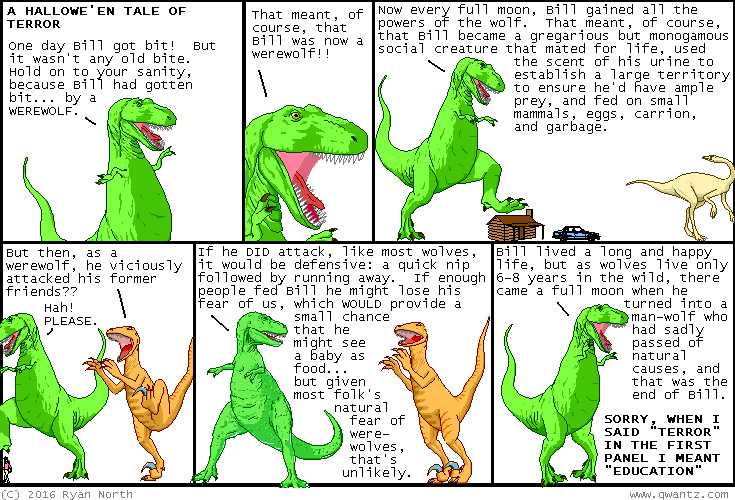
a hallowe'en tale of terror, part i

archive - contact - sexy exciting merchandise - search - about
← previous October 14th, 2016 next

October 14th, 2016: Still on my book tour! COME SAY HI TO ME AND MY PALS

– Ryan

14 Oct 00:37

Anonymous

"Efficiency is intelligent laziness."
10 Oct 23:00

"The english languish should be improved"

“The english languish should be improved”
03 Oct 15:41

"They have addressed most of the reviewer comments, although their responses to a few of them remind..."

“They have addressed most of the reviewer comments, although their responses to a few of them remind me of Donald Trump.”
30 Sep 23:10

The possessive Jesus of composition

by Geoffrey K. Pullum

Let me explain, very informally, what a predictive text imitator is. It is a computer program that takes as input a passage of training text and produces as output a new text that is composed quasi-randomly except that it matches the training text with regard to the frequencies of word or character sequences up to some fixed finite length k.

(There has to be such a length limit, of course: the only text in which the word sequence of Melville's Moby-Dick is matched perfectly is Melville's Moby-Dick, but what a predictive text imitator trained on Moby-Dick would do is to produce quasi-random fake-Moby-Dickish gibberish in which each sequence of not more than k units matches Moby-Dick with respect to the transition probabilities between adjacent units.)

I tell you this because a couple of months ago Jamie Brew made a predictive text imitator and trained it on my least favorite book in the world, William Strunk's The Elements of Style (1918). He then set it to work writing the first ten sections of a new quasi-randomly generated book. You can see the results here. The first point at which I broke down and laughed till there were tears in my eyes was at the section heading 'The Possessive Jesus of Composition and Publication'. But there were other such points too. Take a look at it. And trust me: following the advice in Jamie Brew's version of the book won't do your writing much more harm than following the original.

My reasons for despising the original work by Strunk (and the even worse 1959 revision by E. B. White) are given here, and in greater detail here. Jamie Brew's astonishingly spare website is here. His code and various technical details are available on Github here. His own description of his program is that it is "a writing engine intended to imitate the predictive text function on smartphones." His description of the form of the training corpus his program uses is that it consists of "a tree with the frequencies of all n-grams up to a certain size present in a source, and information about which words precede and follow these." (The n-grams might be character sequences; I'm not sure about that.) I don't know anything about whether he tweaked the output to get his version of Elements or whether the program just spat out the whole hilarious thing, formatting and all.

[Comments on this post have been closed by the possessive Jesus of composition and publication.]

30 Sep 16:36

Don't do it Donald!

by Lydia Grant
Yuval Pinter

טוב פשוט יום מוצלח היום

30 Sep 16:36

Damn girl...

by Lydia Grant

30 Sep 16:32

Current Job

by Doug
30 Sep 16:32

Comic for 2016.09.30

New Cyanide and Happiness Comic
29 Sep 17:11

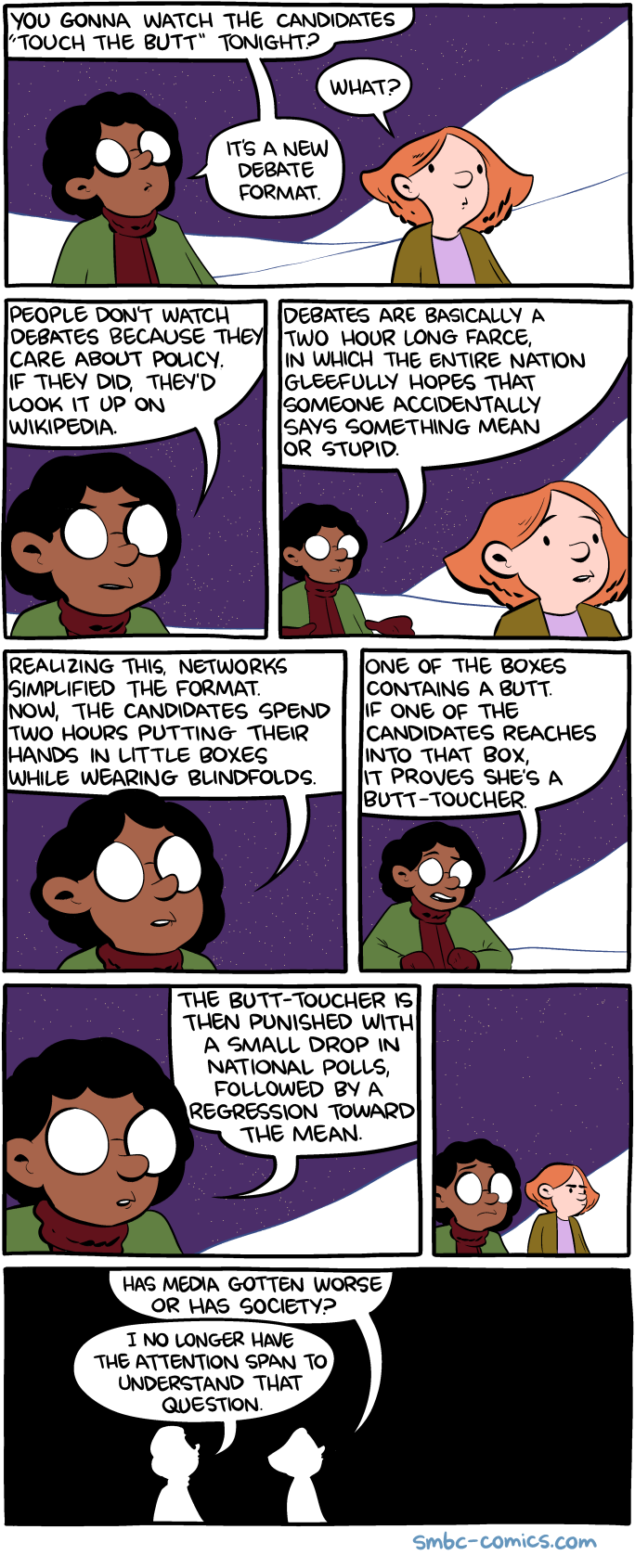
Saturday Morning Breakfast Cereal - A New Debate Format

by tech@thehiveworks.com


Hovertext:
Networks: I am prepared to direct this pilot at a moment's notice.

New comic!
Today's News:

BOOK REVIEWS!


I had to stop the experiment for a bit because I wasn't getting much reading done while finishing up a project. But, I'm back on track, and I'm going to try to run weekly book reviews from here on out.


For transparency: If you click the links below, for the next 24 hours, if you buy something on amazon, SMBC gets a small payment. So, basically, if one of the books below looks tempting, we'd appreciate if you clicked the link before buying.


This is a new thing we're doing, so if you have any thoughts on how it can be improved, please let us know.


Aug 17 - Shocked (Casarett)


A quick bit of history and science on the topic of bringing humans back from the brink of death. It’s a quick read, with a lot of dorky humor injected. It’s not bad, and there are a lot of neat stories and weird science, but it kind of felt like it was Not Quite Mary Roach. Still, fun if you’re interested in the topic.


Verdict: 3/5


Aug 20 - Red Notice (Browder)


An INSANE memoir about Browder’s life in high finance, going on adventures making crazy deals as the Soviet Union collapses and breaks apart. Making deals required him to go to strange places and repeatedly risk being assassinated. He sounds like he’s totally nuts, but it’s a hell of a story.


Verdict: 4/5


Aug 25 - The Conundrum (Owen)


An interesting book. It starts with the economic observation that efficiency (which theoretically is good for the environment) often leads to increased consumption (which is probably bad for the environment). Owen suggests that if efficiency tends to lead us to consume more, the only way to save the environment is to reduce our lifestyles.


I don’t buy everything he’s saying, but I think it’s a very interesting argument that’s worth confronting.


Verdict: 3.5/5


Aug 27 - Woe to Live On (Woodrell)


A great novel about a group of Confederate soldiers, written with a lot of realism and depth. An interesting feature of this book is that it’s stylistically very 19th century, but it yet contains the violence and sex that tend to be elided in actual books from that period.


Verdict: 5/5


Sept 1 - How Everything Became War and the Military Became Everything (Brooks)


This was a pretty excellent book. It’s a sort of combination of a memoir of Rosa Brooks’ time in the Pentagon, along with the history and psychology of how (according to her) our relationship to war has changed for the worse in recent times.


Verdict: 3.5/5


Sept 3 - White Trash (Isenberg)


A good historiography of poor whites in the history of the United States, and how they tend to be viewed by cultural elites. I felt like it got a bit less compelling as we got to modern times, but maybe that’s just because I’m more familiar with life now than life 300 years ago.


Verdict: 3/5


Sept 5 - Eye in the Sky (Dick)


Like a lot of these early Philip K Dick novels, I feel like it’s a cool idea and a well-developed world, but the execution is really hokey.


The plot is about a bunch of people who get zapped by a high energy beam, who then somehow start serially inhabiting each other’s consciousnesses. Each such universe contains the strange biases of its consciousness. It’s fun, but it’s really just 1950s pulp stuff, despite the clever premise.


Verdict: 2/5


Sept 6 - Messy (Harford)


A fun little book on how interesting ideas often come from what Harford refers to as “messy” situations, in the broad sense of (supposedly) non-ideal creative environments. It contains a lot of fun stories ranging from musicians to scientists.


Verdict: This book is written by an author I have met personally, and I’ve decided my policy on such reviews is that I won’t list a number verdict.


Sept 7 - The Man Who Japed (Dick)


A dystopia story about a sort of puritanical world, only the puritanical culture stems from something like suburban American cultural norms circa 1950. It’s all right. Dick has so many stories about controlling prudish middle-aged women that I’m starting to wonder if the character isn’t based on someone real.


Verdict: 2.5


Sept 9 - The Broken Bubble (Dick)


Now this is something interesting! It’s Philip K Dick, but not science fiction, and it wasn’t published until after his death. Early on in his career, Dick wrote literary fiction, and I would say this is the best one I’ve read so far. It’s not perfect, but it’s pretty good. It’s a story about two couples - one very young and accidentally pregnant, and one divorced because they were unable to conceive. The dynamics are really interesting, but it lacks the subtlety and depth that Dick would later develop. I found myself wishing he had come back to this novel later in life.


Verdict: 3/5


Sept 14 - The End of the Cold War (Service)


A very enjoyable and in depth history of the last six years of the USSR. The only part that was slightly odd was that now and then he seemed to really fanboy over Ronald Reagan. I certainly don’t mind reading history books from people with political views (because the alternative doesn’t exist), but it felt out of place in such a long meticulous work of history. Still, quite good!


3.5/5

29 Sep 12:48

"An alternative to counting sheep."

Yuval Pinter

שריפה אחים

“An alternative to counting sheep.”
26 Sep 05:18

Comic for 2016.09.26

New Cyanide and Happiness Comic
24 Sep 20:50

Baby proofing.

by Lydia Grant
21 Sep 18:23

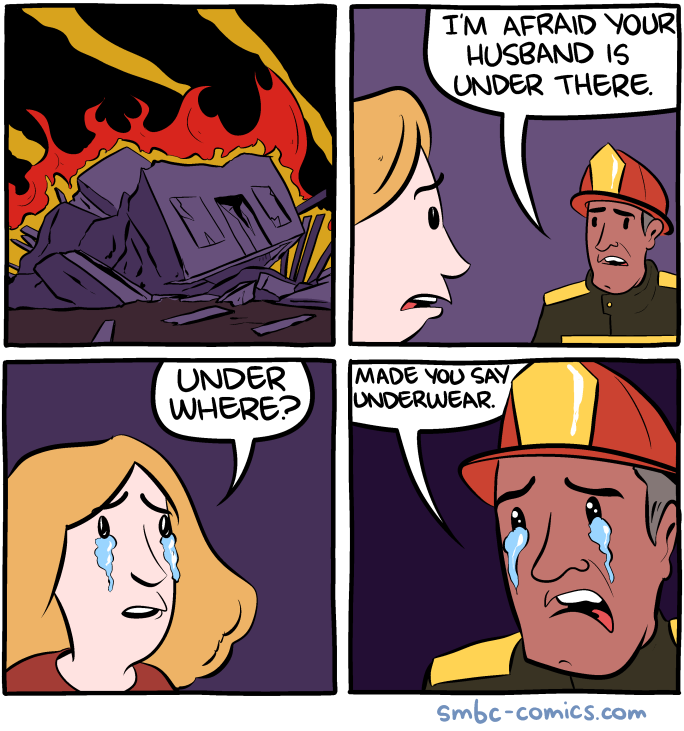
Saturday Morning Breakfast Cereal - Your Husband

by tech@thehiveworks.com


Hovertext:
Written in the hopes that Cyanide and Happiness didn't do this joke first.

New comic!
Today's News:

Not even joking - I had to upload this comic from my garage because we thought we had a carbon monoxide leak. So, while I was onlining things, there were actual firemen in my home.

20 Sep 15:02

Annals of Rediscovery

by Mark Liberman
Yuval Pinter

במיוחד בשבילך איתמר

Harry Collins, Willow Leonard-Clarke, Hannah O'Mahoney, "Um, er: How meaning varies between speech and its typed transcript":

We use an extract from an interview concerning gravitational wave physics to show that the meaning of hesitancies within speech are different when spoken and when read from the corresponding transcript. When used in speech, hesitancies can indicate a pause for thought, when read in a transcript they indicate uncertainty. In a series of experiments the perceived uncertainty of the transcript was shown to be higher than the perceived uncertainty of the spoken version with almost no overlap for any respondent. We propose that finding and the method could be the beginning of a new subject we call 'Language Code Analysis' which would systematically examine how meanings change when the 'same' words are communicated via different media and symbol systems.

For my part, I've performed a series of experiments showing that the rate at which a ball rolls down an inclined plane varies, in a strikingly lawful way, with the angle of the plane to a plumb line. I propose that this finding and the method employed could be the beginning of a new subject I call "Physical Motion Analysis", which would systematically examine how position and velocity change when the same objects are subjected to different forces and constraints.

In fairness to Collins, Distinguished Research Professor at Cardiff University who "conceived and designed the project which emerged from his gravitational-wave studies", and to his co-authors, the bibliography of their study on how the medium affects the message does include Sachs, Schegloff & Jefferson 1974, Ochs 1979, Halliday 1985, and Clark and Fox Tree 2002. So my foundational paper on Physical Motion Analysis will have some of the relevant classic references in its bibliography as well.


19 Sep 22:32

"The investigator is in the top 50% of his field"

“The investigator is in the top 50% of his field”
19 Sep 15:29

Comic for 2016.09.18

New Cyanide and Happiness Comic
15 Sep 14:46

מחירי הדירות – לאן? והאם כדאי לרכוש כיום דירה?

by משכנתאמן
Yuval Pinter

אני חושב שזה הנסיון הראשון שלו להומור ב-4שנים שאני עוקב אחרי הבלוג

מחירי הדירות - לאן? והאם כדאי לרכוש כיום דירה?
קרדיט: FreeDigitalPhotos.net

מדי פעם אני חוטא וכותב לכם בנושאים שלא תמיד יש לי עליהם תשובה ברורה ובדוקה, אך עדיין חשוב ומעניין לעסוק בהם.

אחד נושאים שמלווים את הבלוג הזה מאז שהוא נולד הוא: מה יקרה למחירי הדירות? זאת שאלה שרלוונטית כיום יותר מתמיד – האם המחירים יעלו או ירדו? האם זו תקופה טובה לרכוש דירה או לא? אני מזהיר מראש שאין לי את התשובה המדייקת, אבל אני כן אנסה לשפוך קצת אור על הנושא.

מוכנים? בואו נתחיל.

מה קרה למספר העסקאות והמחירים מתחילת השנה?

זו שאלה טובה, אבל הבעיה שאין לנו נתון אחד וברור להסתמך עליו, ישנם מספר גורמים (משרד האוצר, הלמ״ס, השמאי הממשלתי ועוד) שמסקרים את מחירי הדיור ואנו רואים שלא תמיד התשובות שלהם דומות.

הכלכלן הראשי של משרד האוצר פרסם בתחילת השבוע סקירה בה הוא הציג ירידה חדה בביקושים, הנה כמה דוגמאות:

  1. מספר הדירות שנמכרו ברבעון השני היה נמוך בכ-5% מהרבעון הראשון
  2. מספר הדירות שנמכרו ברבעון זה היה נמוך בכ-21% בהשוואה לרבעון הקודם בשנה שעברה (חשוב לזכור, כי בשנה שעברה היה עומס של רכישות ברבעון שקדם לנו כי אנשים מיהרו לרכוש דירה להשקעה לפני שמס הרכישה עלה).
  3. בנוסף – מאז העלאת מס הרכישה בשנה שעברה, אנו רואים ירידה ברכישות משקיעים (משקלם בשוק ירד מכ-25% לכ-20%), בחודשים האחרונים יש מכירת דירות על-ידי משקיעים יותר מאשר רכישה, וגם המחירים אותם הם דורשים על הדירות שהם מוכרים הולכים ויורדים (ירדו בכ-20% מתחילת השנה).

במקביל, הלשכה המרכזית לסטטיסטיקה פרסמה נתון שדי תומך בנתונים למעלה ומעידה על ירידה של 6.7% במכירת הדירות החדשות מקבלן לעומת שנה שעברה (חודשים ינואר-יולי).

הנתון הכי מעניין היה של משרד האוצר שדיווח כי מחירי הדירות ירדו בחודש האחרון (ירידה מינימלית של 0.3%) אבל עדיין כל ירידה היום מתקבלת בחיוך גדול אצל האוצר. לכך הגיב מיד בנק ישראל בביקורת משלו ואמר שאין "להתלהב" מנתוני חודש בודד ויש להמתין זמן רב יותר על מנת לראות מה הכיוון של מחירי הדירות.

מבולבלים? גם אנחנו…

בואו נסכם את הנתונים הנ״ל – אין ספק שיש פחות עסקאות בשוק הנדל"ן, אין ספק שמשקיעים רוכשים פחות דירות כיום ואין ספק שבאוצר ורוכשי דירה ראשונה מעוניינים שמחירי הדירות יירדו.

יחד עם זאת, אנו לא באמת רואים עדיין ירידה רשמית וברורה של מחירי הדירות אלא ניצנים של רגיעה שלא מבטיחים לנו כלום כלפי העתיד.

אז מה עושים – רוכשים או לא רוכשים?

עברנו לשאלה המעניינת יותר לדעתי, כי אני יכול להציף אתכם במספרים ונתונים עד מחר ועדיין תשארו מבולבלים, אני רוצה לחלק את התשובה שלי לפי אוכלוסיות ולתת לכל אוכלוסיה את התשובה שלי.

אני מאוד מבקש להבהיר שוב ושוב שאני אדם פרטי ואין לי מידע פנים (לא נראה לי שלמישהו יש) ואין לי מושג באמת מה יקרה, זו דעתי הפרטית ואין לכך ערובה וביטוח שהיא נכונה.

אוכלוסיית חסרי הדירה

למי שאין כיום דירה ורוצה לרכשו אחת כזו, אני מחלק שוב את התשובה שלי לשני חלקים:

  • למי שרשום ומשתתף פעיל במסגרת המחיר למשתכן:
    אני ממליץ להמתין עם הרכישה, לגשת לכמה שיותר הגרלות במסגרת התכנית כדי שבאמת תמצו את המבצע הזה כמה שיותר (גובה ההנחה שמקבלים במחיר למשתכן הוא ענק ושווה את ההמתנה ברכישה).

  • למי שלא זכאי (או שהמחיר למשתכן לא מעניין אותו):
    אני מציע לעשות בדיקה כלכלית מקיפה (והיום עם מחירי הדירות ומחירי המשכנתאות הבדיקה הזו חשובה הרבה יותר מבעבר). אם אתם רואים שאתם מסוגלים לעמוד בהוצאה בכבוד (גם כאשר הריביות יעלו) ואם אתם רואים דירה שהולמת את הצרכים והיכולות שלכם, אני חושב שכדאי לכם לקנות ולא להמתין לירידת מחירי הדירות.

אוכלוסיית משדרגי הדיור

פה התשובה טיפה יותר קלה, הרי אתם מחזיקים נכס בידיכם ואם מחירי הדירות יירדו זה גם ייפגע בכם (כי המחיר של הנכס שלכם יירד) אבל גם ייטיב אתכם (כי מחיר הנכס החדש שלכם יירד ותשלמו עליו פחות).

למרות שירידת מחירי הדירות אמורה בגדול להיטיב עמכם (כי הנכס החדש כנראה יירד ביותר מאשר הנכס הישן), גם פה הייתי ממליץ למי שבדק היטב מבחינה פיננסית אם הוא יכול לעמוד בהוצאות ולמי שמצא דירה שהולמת את צרכיו לרכוש את הדירה ולא להמתין לירידת המחירים אם וכאשר תגיע.

אוכלוסיית המשקיעים

פה התשובה שלי קצת אחרת.
אני חושב שהמשקיעים צריכים לשבת קצת על הגדר ולבדוק מה יקרה באחד מהסעיפים הבאים:

  1. מה תהיה המדיניות של הממשלה מול המשקיעים – כרגע המדיניות לא נוחה וייתכן שהמגמה הזו תמשיך ואף תחריף (הכוונה כמובן להעלאת מס הרכישה, שינויים במיסוי של משקיעים ״כבדים״, וכדומה).
  2. לבדוק טוב את התשואה על הדירה (אני מדבר על התשואה השנתית מההשכרה, כי ייתכן ובשנים הבאות לא נראה שוב עליות במחירי הדירות ולכן נצטרך להסתפק בתשואה השנתית בלבד).
  3. לחפש מציאות, כי מחירי הדירות כיום כבר לא מהווים השקעה "בטוחה" כמו לפני כמה שנים, ולא תמיד המשקיעים יוצאים עם רווחים מעסקה שעלתה להם יקר ולכן היום כבר "לא כל מטאטא יורה" אלא יש לבחור בפינצטה נכסים להשקעה ולבחון חלופות השקעה נוספות.

לסיכום,
אם אני אנסה לבכם בכמה משפטים את הסעיפים הקודמים, בנוגע לכדאיות רכישת דירה, זה יהיה כך:

  1. למי שאין דירה ומחיר למשתכן רלווני ומעניין אותו – שיחכה לרכישה במסגרת התכנית
  2. למי שאין דירה ומחיר המשתכן לא מעניין אותו (או שהוא לא זכאי) – שירכוש (בתנאי שבחן טוב את היכולות שלו ומצא נכס מתאים).
  3. למי שמשדרג דיור – שירכוש (כנ״ל – בתנאי שבחן טוב את היכולות ומצא נכס מתאים).
  4. למי שמחפש לרכוש דירה להשקעה – שימתין להזדמנות בלתי חוזרת (כלומר, מציאה אמיתית) או לירידת מחירי הדיור.

כמו שכתבתי בתחילת הפוסט, מדובר בדעה אישית שלי (ולא תמיד אני צודק, אתם מוזמנים לשאול את אשתי), אני מאוד אשמח לשמוע את דעתכם ולראות מה אתם חושבים על מחירי הדירות.

נ.ב: אני מזמין אתכם להירשם לניוזלטר של האתר (זה בחינם וללא דואר זבל) ולהיות הראשונים שמקבלים עדכונים על פוסטים חדשים – ההרשמה מתבצעת מכאן.