Yuval Pinter
Shared posts
מינוס הגירה מינוס עצבנית
Yuval Pinterיאללה איתמר, תורך
כותרת האייטם הלוהט בברנז'ה ניוז באר שבע והנגב גורסת:
למ"ס: נמשכת ההגירה השלילית מב"ש
והנה תצלום מסך למפקפקין:

יופי של אתר מותאם לנייד יש להם, אגב
ההקשר הברור מהכתבה הוא שקיימת מגמה מתמשכת שלפיה כמות האנשים העוזבים את באר שבע גדולה מכמות העוברים אליה. המממ… נראה כמו עוד אחד לתיקי שלילת היתר, הלא כן? ובכן, המממ.
מהי הגירה? מעבר אדם ממגורים במקום א' למקום ב'. אז נאמר שהוא מהגר מא' לב'. לכאורה נאמר עכשיו, אם יש הגירה גדולה מעיר אז הרבה אנשים עוזבים אותה, ואם יש הגירה מועטה אז מעט עוזבים אותה, ונמשיך באותו כיוון ונגיע להגירה שלילית שבה מספר שלילי של אנשים עוזבים אותה, ומאחר שאצלנו במוח אין גלישה נומרית, נבצע רציונליזציה ונשפץ את הפרשנות כך שנבין כי מספר האנשים שעוזבים קטן ממספר האנשים שנכנסים. כלומר ההיפך מכוונת המשורר מפרש-הלמ"ס.
אבל רגע. אם היינו קוראים בכותרת "נמשכת ההגירה החיובית מב"ש" היינו זורמים? או "נמשכת ההגירה השלילית לב"ש"? אני חושב שבשני המקרים התשובה, ובכן, שלילית. אמנם יש כאן בעיה, אבל היא אחרת. הגירה שלילית היא מושג דמוגרפי מקובל ומוכר מספיק בשביל להופיע בכותרת של דיווח שאינו במוסף כלכלי. העניין הוא שהוא מאפיין של מקום (אולי על פני תקופה) ואין לו כיווניות (ולראיה המהלך המחשבתי הדי מאולץ שתיארתי לעיל). אמרת הגירה שלילית? אמרת "סך הנכנסים קטן מסך היוצאים". הגירה שלילית אינה מבאר שבע או לבאר שבע, אלא פשוט בבאר שבע. הסוגיה כאן תחבירית ולא סמנטית.
[תודה לרפאל כהן על שצייץפיסבק את הכתבה, וחצי תודה ליעל נצר ששמה לב לבעייתיות במקביל אלי]
חוק ההסדרה עבר בקריאה שלישית.
Yuval Pinterבהתחלה אפילו לא ראיתי שהוא סידר גם את הפנים

חוק ההסדרה עבר בקריאה שלישית.
מעשה באבן
Yuval Pinterמשובח


Inaugural embedding again
"Inaugural Embedding", 9/9/2005:
|
0
|
1
|
2
|
3
|
4
|
Mean
Sentence Length |
|
| Washington1789 |
629
(44%) |
554
(39%) |
206
(14%) |
36
(3%) |
5
(<1%) |
60
|
| Lincoln1865 |
440
(63%) |
222
(32%) |
38
(5%) |
0
|
0
|
26
|
| Bush2005 |
1842
(88%) |
244
(12%) |
4
(<1%) |
0
|
0
|
22
|
| Trump2017 |
1264
(87%) |
178
(12%) |
15
(1%) |
0
|
0
|
15
|
"The evolution of disornamentation", 3/1/2005
"Elaborate interiors and plain language", 6/3/2016.
Comic for January 29, 2017
Partial negative concord
Steven Hsieh, "Joking Around: We spoke with that Carlsbad city councilor with the sexist Facebook post", SF Reporter 1/24/2017 [emphasis added]:
Carlsbad City Councilor JR Doporto drew widespread criticism today after KOB 4 highlighted a Facebook post he wrote mocking women who participated in Saturday's nationwide demonstrations against President Donald Trump. […]
After angry comments rained down on his Facebook page, he doubled down on his jokes with additional posts. […]
We caught up with Doporto this afternoon on the phone to hear his thoughts. […]
Q: I don't think anyone is disputing that you have the right to say what you want to say. I guess the question was: The march was for women's rights. And the particular joke you made was disparaging towards women and some of the stereotypes you used were—it seemed you were thumbing your nose at what was taking place. Does that make sense to you?
A: Yeah, yeah. I was thumbing my nose at what was taking place. Enough already. Let's get on. Women have had rights for … years that I have been alive. I don't see no rights they don't have that a man has. When are they going to get on and move on? I believe if a Democratic president was elected, Hillary, I don't think we would've had those protests.
Karen Sumner, who sent me the link, commented: "This is likely an example of a simple and easily-recognized language thing to Language Log folks, but I scratched my head when I saw it. Still scratching, to be honest."
What's puzzling here is that negative concord is responsible for the second negation ("no rights"), but the third one ("don't have") is an independent aspect of the sentence's meaning — though it could also have been spread by negative concord.
Thus Bill Labov's celebrated example "It ain't no cat can't get in no coop" is equivalent to standard "There's no cat that can get in any coop", where negative concord has spread the negation not only to the object "no cat" but also (twice) into the relative clause "can't get in no coop". On that model, Mr. Doporto's "I don't see no rights they don't have that a man has" would be equivalent to standard "I don't see any rights (that) they have that a man has". And in context, that would be a definite head-scratcher.
But what seems to have happened is that Doporto indeed spread the negation to the object "no rights", but he already meant to put an independent negation on the relative clause "that they don't have". And he (for that reason?) he didn't spread negation to the second clause "that a man has". So what he meant, in standard formal English, would be something like "I don't see any rights that a man has that women don't also have".
This is logically consistent with the tweet that got him into trouble in the first place, since it refers to "rights" that women have that men presumably don't:

Editing wars at London Bridge Street
As of the time of writing, you only get one hit if you ask Google to show you all the pages on the web containing the word sequence in order legally to minimise. That lone hit leads you to an anonymous leader in The Times (there is a paywall) in which this sentence occurs:
Companies are gaming the system in order legally to minimise their tax liability.
The highly unnatural syntax has the hallmark of having been created or edited by someone who would rather poison a puppy than allow an adverb to intrude between infinitival to and its following plain-form verb. But in this case there is more to the story.
Through contacts at The Times I have managed to find out who wrote that leader (I could tell you, but then I'd have to kill you). I have communicated with him, and — brace yourself for a shock — he did not write this sentence in that form. What he wrote, of course, was Companies are gaming the system in order to legally minimise their tax liability.
What makes this even more ironic is that The Times has a weekly language column written by Oliver Kamm. Oddly, it is titled "The Pedant", despite the fact that Kamm has published a fine book on language called Accidence Will Happen: The Non-Pedantic Guide to English, with a title so sophisticated that only those with a classical education will understand it, since accidence is now universally called inflection. He is the opposite of a pedant). On January 14, Kamm's column was headed: "There's no grammatical objection to split infinitives." Kamm was quoting Language Log, of course, citing an example I pointed out in The Economist, and he fully endorses the view I expressed when I discussed it on December 28th.
So at one desk in The Times's office building at No. 1 London Bridge Street sits Oliver Kamm — a man so sophisticated and intelligent that he reads Language Log — writing columns arguing for good syntactic sense; and at some other desk, perhaps nearby, also drawing a salary (much less justifiably), sits a subeditor with a green eyeshade and a brain the size of a walnut, moving adverbs from positions where they modify what they are supposed to modify (to legally minimize) to positions where they don't even sound like vaguely reasonable English (in order legally to minimize).
Listen: I keep reading articles saying that soon all sorts of jobs — doctor, lawyer, long-distance truck driver — are going to be taken over by computers. And although I'm skeptical, I can certainly say that moving adverbs one word to the left is a job that could be taken over by a computer. This command (using the Unix sed stream editor, which is there on all Macintoshes and Linux machines) will take in order to abcly xyz, where abc and xyz are arbitrary strings of lower-case letters, and change it to in order abcly to xyz, just in case unnatural word order is what The Times really wants:
sed 's/in order to \([a-z]*ly\) \([a-z]*\)/in order \1 to \2/g'There. Just run that over everything before it goes in the paper. It could easily be generalized to cover all sorts of other constructions. Computational linguists could readily fix it up to apply to all verbs in infinitival complements, and other adjuncts than just -ly adverbs. So let's do that, and liberate the human editors who currently waste their very limited intracranial resources by doing this sort of nonsensical manual work. They can perhaps be set to more useful tasks, like filling the coffee-bean bins and milk tanks in the coffee machines.
Later we can just quietly erase the editing commands that replaced the subeditors, and get back to the practice of letting sophisticated writers position their adverbs wherever they think the sense of the sentence demands. But that will be in the far future, when interstellar travel is commonplace and superstition about "splitting the infinitive" has finally died out.
The thing my advisor invented is basically useless
PhD, Mathematics, University of Pittsburgh
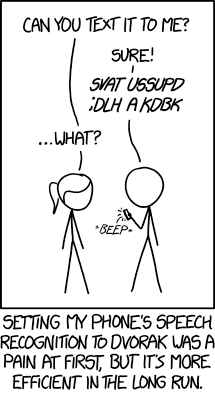
Voice Commands
Yuval Pinterחקצד שחייכתי ממנו! זהו, הלכה ההקצאה ל-2017
Après Babel in Marseilles
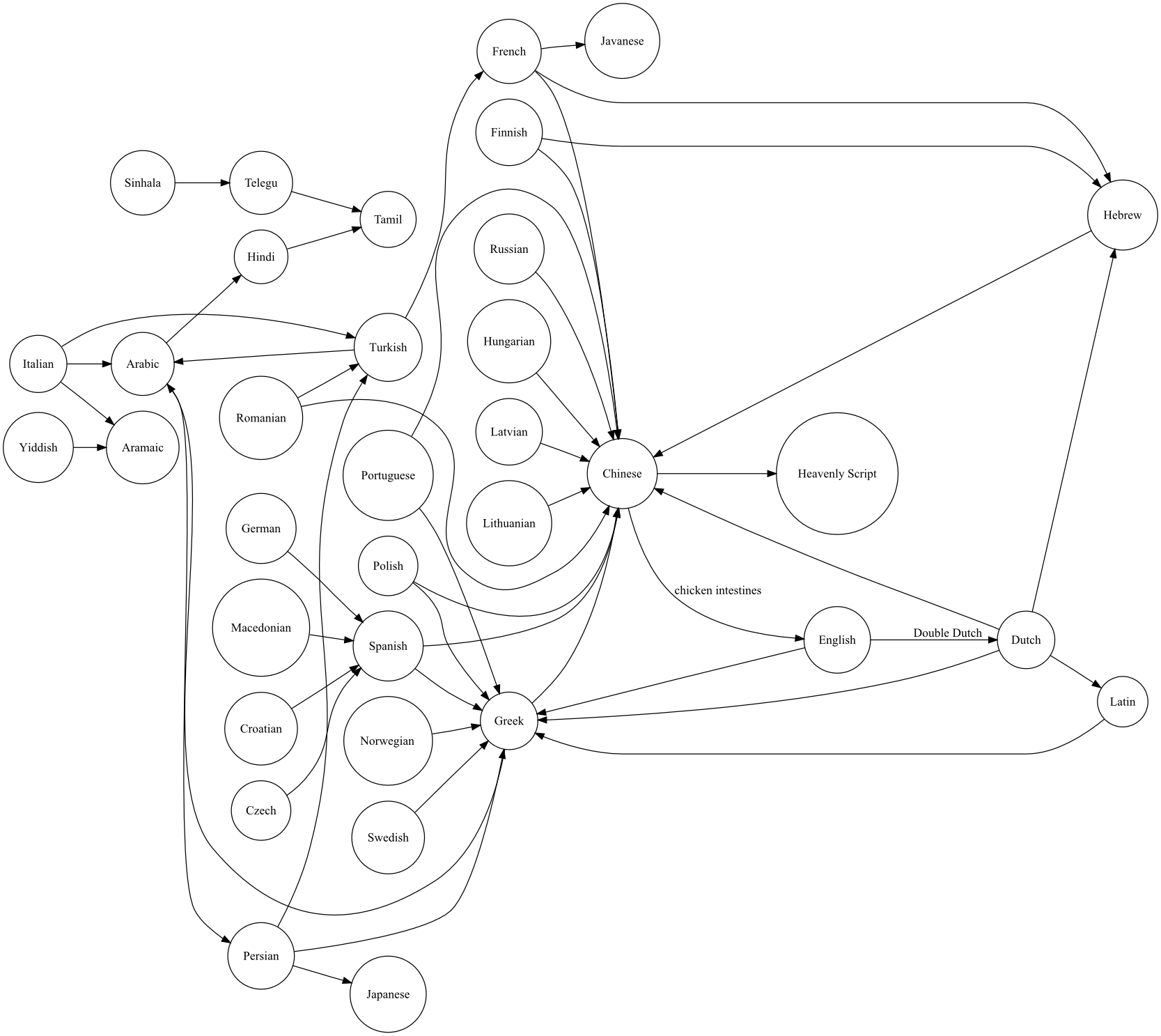
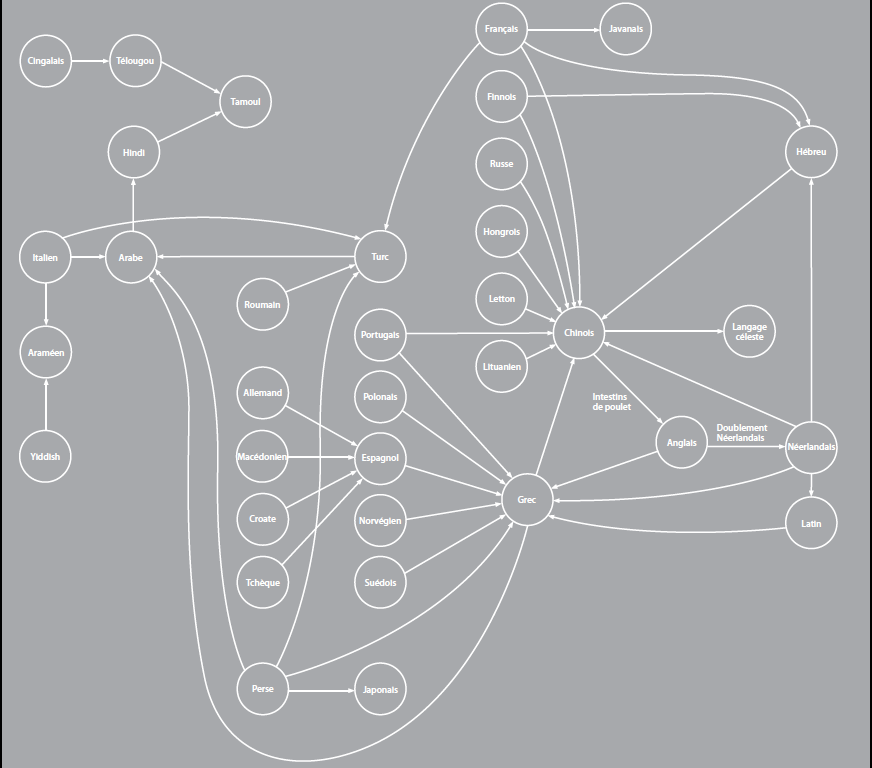
At Le Musée des Civilizations de l'Europe et de la Méditerranée in Marseilles, there's an exposition called "Après Babel, Traduire", which includes a translated version of "The directed graph of stereotypical incomprehensibility", 1/15/2009:
| From LLOG: | From MuCEM: |
 |
 |
Comic for 2017.01.17
Saturday Morning Breakfast Cereal - Obstetrimetrics
Yuval Pinterהאפטרקומיק
.png)
it's here! another intelligent and education installment of dinosaur comics, ready for you to share on social media so your friends know you're intelligent and educational too!!
Yuval PinterClearly
| archive - contact - sexy exciting merchandise - search - about | |||
 |
|||
| ← previous | January 11th, 2017 | next | |
|
January 11th, 2017: How is your New Year's resolution coming? Hopefully excellent, unless you resolved to be more horrible this year, in which case, I'm not afraid to say it: I HOPE YOUR RESOLUTION IS GOING POORLY!!!!!!! – Ryan | |||

the meaning of the acronym "I.R.D.' is left as an exercise for the reader, with a note that the correct answer is PROBABLY not "inflatable reaming devices"
| archive - contact - sexy exciting merchandise - search - about | |||
 |
|||
| ← previous | January 7th, 2017 | next | |
|
January 7th, 2017: Man this "without using facts" comic was super easy to write, because I didn't need to do any research! Have I just discovered the cheat code... FOR REALITY?? – Ryan | |||
ביום ראשון אהבה וסולידריות, ביום שני פלגנות ושנאה
עיתון 'ידיעות אחרונות' מתיימר לקדם אהבה וסולידריות בעם. יום למחרת הוא יורד לשפל מדרגה מקצועי, כדי לקדם בדיוק את ההיפך

שמעו סיפור: גוף קטן ולא מאד מוכר בשם "הפורום המשפטי לישראל ציונית ודמוקרטית" (תקציב הפעילות השנתי שלו עומד על כמיליון שקלים בערך), שלח מכתב למנהלי רשתות שיווק ביהודה ושומרון ובו הפנה את תשומת לבם לעובדה שחוק השקיות אינו חל עליהם.
מטרת המכתב היתה להצביע על אי השוויון החוקי בין תושבי יו"ש לתושבי פנים הקו הירוק, כדי להדגיש את האבסורד שבמצב ולהביאו על תיקונו, כלומר להחיל את החוק הישראלי, ובתוכו חוק השקיות, גם על יו"ש.
מובן מאליו שהגוף ששלח את המכתב לא נבחר מעולם על ידי איש לייצג ציבור כלשהו. מבירור שערכה 'פרספקטיבה' עולה שבהחלטה לשלוח את המכתב שותפו כחמישה אנשים. שלושה משפטנים שהמליצו למנכ"ל ולרכזת הפעילות. המנכ"ל, נחי איל, אומר שמספר האנשים "לא רלוונטי" ומקבל על עצמו את האחריות לשליחת המכתב.
כך או כך, זו הכותרת שניתנה לידיעה שעסקה במכתב בעיתון 'ידיעות אחרונות' היום, 9.1.

בגוף הידיעה צוינה העובדה שמאחורי המכתב עומד אותו גוף, אבל הכותרת… האם יהיה זה מוגזם לטעון שמטרתה של הכותרת היתה להציג בזדון את המתנחלים באור מרגיז ולגרום לקוראי העיתון להתעצבן עליהם?
אם לשפוט לפי מבחן התוצאה, התשובה הלא מפתיעה היא שבהחלט כן. למעלה מ 170 תגובות התפרסמו לגרסה המקוונת של הידיעה באתר ynet, שגם זכתה ללמעלה מ 600 שיתופים. 99% מהתגובות היו כמובן נוטפות ארס כלפי ה"מתנחלים" ה"דורשים".
"אדוני הארץ", "נצלנים", "פושעים", "פרזיטים", "מזרח פרוע", "ארץ ישראל המזוהמת", ועוד כיוצא באלו מסרי אחדות ואחווה ראו עורכי האתר לנכון לפרסם במדור התגובות לידיעה.
זאת למשל היתה תגובתו של ח"כ דוב חנין:

וזאת היתה תגובתו של מנכ"ל שלום עכשיו לשעבר יריב אופנהיימר:

עורכי 'ידיעות אחרונות' ו'ynet' ידעו היטב שמאחורי היוזמה עמדו כחמישה אנשים בלבד, שאיש לא בחרם לייצג אף אחד זולת עצמם, ושמטרת יוזמתם (העקומה בדיעבד), היתה להצביע דווקא על פרצה בחוק ולבקש את החלתו, כלומר על ההיפך הגמור מהמסר המפלג בכותרת.
כמה צינית נראית הכותרת הזו, נוכח היומרה הנפוחה והריקה של 'ידיעות אחרונות' לקרוא ל"אחדות" רק יום אחד לפני כן, יום ראשון 8.1, בגיליון שהקדיש כפולת עמודים חגיגית וכותרת בצבע כחול ל"עצרת האהבה והסולידריות" שארגן סרן זיו שילון ב"כיכר האחדות".


כשהוקרן הסרט ״ברלין אלכסנדרפלאץ״ בניו יורק חויבו קוני הכרטיסים...
Yuval PinterOMG יש בפוסטר שגיאת איטס-איטס בפונט ענקי

הסיבה לכך היא שהסרט, שהוקרן במקור בגרמניה כמיני סדרה טלוויזיונית, נמשך 15.5 שעות.
What Is a True Translation?
Peter Adamson writes at Aeon about the “well-funded translation movement that unfolded during the Abbasid caliphate,” which “sought to import Greek philosophy and science into Islamic culture”:
[…] A well-heeled Muslim who moved in court circles, al-Kindī oversaw the activity of Christian scholars who could render Greek into Arabic. The results were mixed. The circle’s version of Aristotle’s Metaphysics can be almost incomprehensible at times (to be fair, one could say this of the Greek Metaphysics too), while their ‘translation’ of the writings of Plotinus often takes the form of a free paraphrase with new, added material.
It’s a particularly dramatic example of something that is characteristic of the Greek-Arabic translations more generally – and perhaps of all philosophical translations. Those who have themselves translated philosophy from a foreign language will know that, to attempt it, you need a deep understanding of what you are reading. Along the way, you must make difficult choices about how to render the source text into the target language, and the reader (who might not know, or not be able to access, the original version) will be at the mercy of the translator’s decisions.
Here’s my favourite example. Aristotle uses the Greek word eidos to mean both ‘form’ – as in ‘substances are made of form and matter’ – and ‘species’ – as in ‘human is a species that falls under the genus of animal’. But in Arabic, as in English, there are two different words (‘form’ is ṣūra, ‘species’ is nawʿ). As a result, the Arabic translators had to decide, every time they came across the word eidos, which of these concepts Aristotle had in mind – sometimes it was obvious, but sometimes not. The Arabic Plotinus, however, goes far beyond such necessary decisions of terminology. It makes dramatic interventions into the text, which help to bring out the relevance of Plotinus’ teaching for monotheistic theology, repurposing the Neoplatonic idea of a supreme and utterly simple first principle as the mighty Creator of the Abrahamic faiths.
What was the role of al-Kindī himself in all this? We’re not entirely sure, actually. It seems clear that he did no translating himself, and he might not even have known much Greek. But it is recorded that he ‘corrected’ the Arabic Plotinus, which could have extended to adding his own ideas to the text. Evidently, al-Kindī and his collaborators thought that a ‘true’ translation would be one that conveys truth, not just one that has fidelity to the source text.
Very interesting stuff. Thanks, Paul!
Central European incomprehensibility
From Nikola Gotovac:
Today I was introduced to the web page "The directed graph of stereotypical incomprehensibility".
There is one quite common misconception about Croatian language on that graph (and similar languages – Slovenian, Serbian, and Bosnian). To be more precise, the expression "it is all spanish village to me" is actually mis-translated to english, since the saying is "to su meni španska sela". In Croatian language the adjective for spanish is "španjolska", not "Španska". "Španska" means – one owned by "špan", or in today-croatian, "župan".
Please check Wikipedia for meaning of the term Župan. As the župan is part of governing establishment, the expression means "it is all strange to me" or "it does not belong to me, so I do not know" or "it is somebody else's (thing)". Therefore, although it is tempting to direct this expression on Spain, the meaning is quite different.
Although I know next to nothing about Croatian, a bit of web search suggests that Dr. Gotovac is wrong, and that the župan idea is a philological eggcorn.
We can start with some dictionaries:
Wiktionary for Serbo-Croatian:
špȃnska sèla n pl (Cyrillic spelling шпа̑нска сѐла)
- (literally) Spanish villages
- a topic about which one is ignorant
- It's all Greek to me
For španski, Wiktionary gives
špȃnskī (Cyrillic spelling шпа̑нскӣ)
- (Bosnia, Serbia) Spanish
- (Bosnia, Serbia, in masculine, substantive) the Spanish language
with (Croatian): špànjōlskī as an "Alternative form".
The glosbe.com Croatian-English dictionary gives:
španski Spanish
and
to su za mene španska sela.
It is for me a Spanish village = be Greek to me.
But still, maybe these španski-based versions are all just modern inventions, misunderstandings of an older Župan-based expression?
I don't think so, because the Serbo-Croatian expressions — like a lot of other aspects of Serbo-Croatian culture and language — are almost certainly borrowed from German.
Edwin Zeydel, "Das kommt mir Spanisch vor", The Journal of English and Germanic Philology, 1922, explains how and when "Spanish" or "Spanish villages" became a proverbial equivalent of incomprehensible weirdness for German speakers:
The immediate origin of the expression "das kommt mir spanisch vor,"—practically synonymous with the more usual proverb "das sind mir bohmische Dorfer"— in its customary present-day connotation of something strange, rare or outlandish, has probably been correctly traced to the seventeenth century. For although in discussing it, Borchardt says that it arose at the time of the introduction of Spanish customs into Germany by Charles V, he quotes only Simplicissimus: "Bey diesem Herrn kam mir alles widerwertig und fast Spanisch vor" and no sixteenth century author. Wander,' too, does not attempt to trace the saying any further back, but mentions the reports of German travelers and adventurers who had been in Spain as having given rise to it. […]
In turning back, at Borchardt's suggestion, to the sixteenth century, we find that Spain and its people were practically unknown in Germany, and that such knowledge on the subject as existed can be traced to unreliable, wildly imaginative adventurers or to pilgrims. In fact, at the beginning of the century, Spain was hardly considered a part of the European continent at all.
This Academic Universal-Lexikon entry confirms the German usage.
And we can close with a passage from Goethe's Die Leiden des jungen Werter (1774), because why not:
Am 24. Dezember 1771
Der Gesandte macht mir viel Verdruß, ich habe es vorausgesehn. Er ist der pünktlichste Narr, den es nur geben kann; Schritt vor Schritt und umständlich wie eine Base; ein Mensch, der nie mit sich selbst zufrieden ist, und dem es daher niemand zu Danke machen kann. Ich arbeite gern leicht weg, und wie es steht, so steht es; da ist er imstande, mir einen Aufsatz zurückzugeben und zu sagen: »er ist gut, aber sehen Sie ihn durch, man findet immer ein besseres Wort, eine reinere Partikel«. – Da möchte ich des Teufels werden. Kein Und, kein Bindewörtchen darf außenbleiben, und von allen Inversionen, die mir manchmal entfahren, ist er ein Todfeind; wenn man seinen Period nicht nach der hergebrachten Melodie heraborgelt, so versteht er gar nichts drin. Das ist ein Leiden, mit so einem Menschen zu tun zu haben.
Das Vertrauen des Grafen von C… ist noch das einzige, was mich schadlos hält. Er sagte mir letzthin ganz aufrichtig, wie unzufrieden er mit der Langsamkeit und Bedenklichkeit meines Gesandten sei«. Die Leute erschweren es sich und andern. Doch«, sagte er, »man muß sich darein resignieren wie ein Reisender, der über einen Berg muß; freilich, wäre der Berg nicht da, so wär der Weg viel bequemer und kürzer; er ist nun aber da, und man soll hinüber!«
Mein Alter spürt auch wohl den Vorzug, den mit der Graf vor ihm gibt, und das ärgert ihn, und er ergreift jede Gelegenheit, Übels gegen mich vom Grafen zu reden, ich halte, wie natürlich, Widerpart, und dadurch wird die Sache nur schlimmer. Gestern gar brachte er mich auf, denn ich war mit gemeint: zu so Weltgeschäften sei der Graf ganz gut, er habe viele Leichtigkeit zu arbeiten und führe eine gute Feder, doch an gründlicher Gelehrsamkeit mangle es ihm wie allen Belletristen. Dazu machte er eine Miene, als ob er sagen wollte: »fühlst du den Stich?« aber es tat bei mir nicht die Wirkung; ich verachtete den Menschen, der so denken und sich so betragen konnte. Ich hielt ihm stand und focht mit ziemlicher Heftigkeit. Ich sagte, der Graf sei ein Mann, vor dem man Achtung haben müsse, wegen seines Charakters sowohl als wegen seiner Kenntnisse«. Ich habe«, sagt' ich, »niemand gekannt, dem es so geglückt wäre, seinen Geist zu erweitern, ihn über unzählige Gegenstände zu verbreiten und doch diese Tätigkeit fürs gemeine Leben zu behalten«. – das waren dem Gehirne spanische Dörfer, und ich empfahl mich, um nicht über ein weiteres Deraisonnement noch mehr Galle zu schlucken.
Note that this English translation doesn't even try to replicate the incomprehensible-nation metaphor:
DECEMBER 24.
As I anticipated, the ambassador occasions me infinite annoyance. He is the most punctilious blockhead under heaven. He does everything step by step, with the trifling minuteness of an old woman; and he is a man whom it is impossible to please, because he is never pleased with himself. I like to do business regularly and cheerfully, and, when it is finished, to leave it. But he constantly returns my papers to me, saying, "They will do," but recommending me to look over them again, as "one may always improve by using a better word or a more appropriate particle." I then lose all patience, and wish myself at the devil's. Not a conjunction, not an adverb, must be omitted: he has a deadly antipathy to all those transpositions of which I am so fond; and, if the music of our periods is not tuned to the established, official key, he cannot comprehend our meaning. It is deplorable to be connected with such a fellow.
My acquaintance with the Count C—is the only compensation for such an evil. He told me frankly, the other day, that he was much displeased with the difficulties and delays of the ambassador; that people like him are obstacles, both to themselves and to others. "But," added he, "one must submit, like a traveller who has to ascend a mountain: if the mountain was not there, the road would be both shorter and pleasanter; but there it is, and he must get over it."
The old man perceives the count's partiality for me: this annoys him, and, he seizes every opportunity to depreciate the count in my hearing. I naturally defend him, and that only makes matters worse. Yesterday he made me indignant, for he also alluded to me. "The count," he said, "is a man of the world, and a good man of business: his style is good, and he writes with facility; but, like other geniuses, he has no solid learning." He looked at me with an expression that seemed to ask if I felt the blow. But it did not produce the desired effect: I despise a man who can think and act in such a manner. However, I made a stand, and answered with not a little warmth. The count, I said, was a man entitled to respect, alike for his character and his acquirements. I had never met a person whose mind was stored with more useful and extensive knowledge,—who had, in fact, mastered such an infinite variety of subjects, and who yet retained all his activity for the details of ordinary business. This was altogether beyond his comprehension; and I took my leave, lest my anger should be too highly excited by some new absurdity of his.


let's learn science from music, this will definitely go well and not somehow disparage both science and music at the same time
| archive - contact - sexy exciting merchandise - search - about | |||
 |
|||
| ← previous | December 5th, 2016 | next | |
|
December 5th, 2016: Anyway here's the song so you can learn while you read!! – Ryan | |||


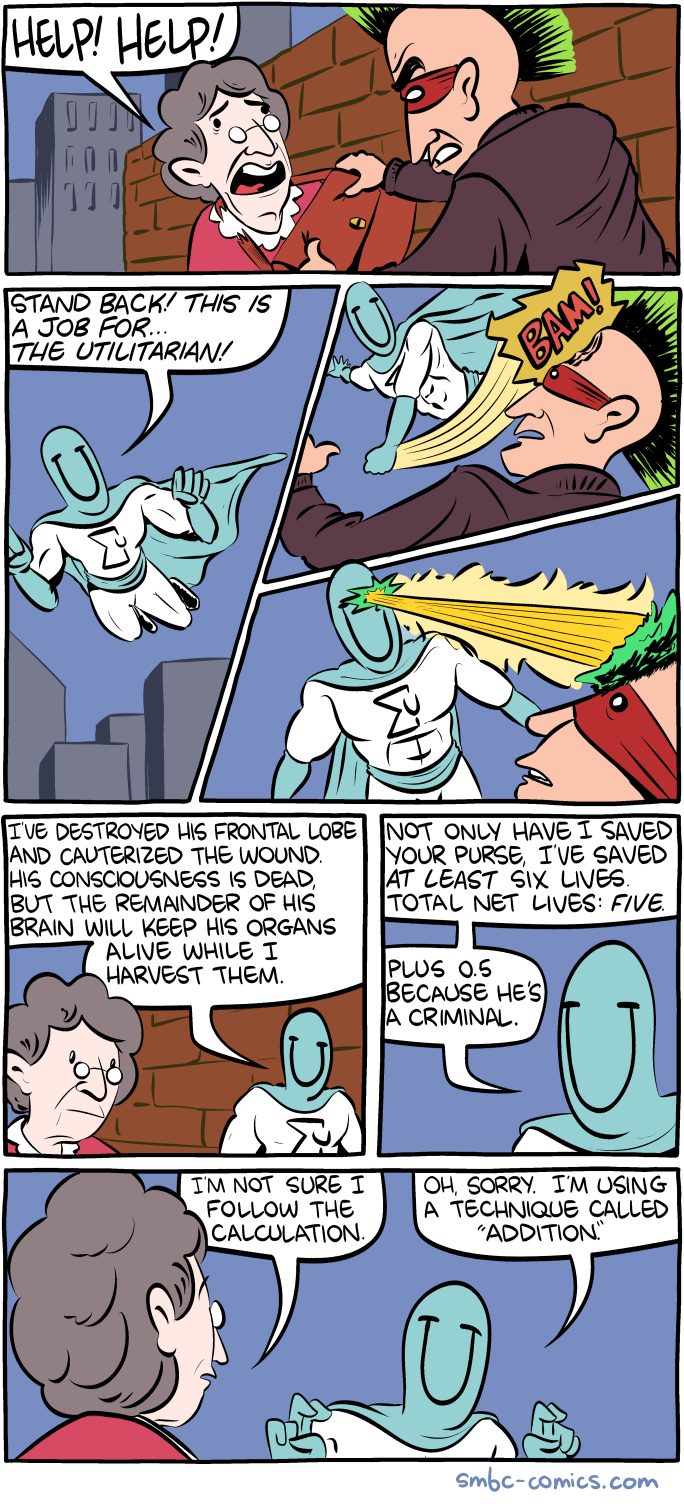
Saturday Morning Breakfast Cereal - The Greatest Possible Superhero
Yuval Pinterpretty sucky aftercomic tho

בעקבות הפוסט הקודם פייסבוק חסמו חלק מהמנהלים שלנו.

בעקבות הפוסט הקודם פייסבוק חסמו חלק מהמנהלים שלנו.