8 years ago, Universal Music sent a takedown notice over Stephanie
Lenz’s 29-second Youtube video of her kids dancing in the kitchen to
Prince’s “Let’s Go Crazy.”
EFF took on Lenz’s case, arguing that Universal knew that 29 seconds of
incidental background music was fair use and was abusing the DMCA
through its censorship notice.
The Ninth Circuit Court of Appeals ruled in Lenz’s and EFF’s favor
today, ruling that rightsholders must consider fair use before issuing
takedowns. The court found that people whose creations were censored
through DMCA abuse could sue the companies that filed the censorship
demands, even if they couldn’t show monetary damages from the
censorship.
Next up: another trial where we find out if Universal has to pay damages for knowingly abusing the DMCA.
A realistic look at poly networks from Philly.com this week.
In recent years, mainstream media coverage of polyamory (a popular approach to consensual nonmonogamy) has been increasing. But usually, it focuses on the forms of polyamory that resemble conventional monogamy in significant ways:
Family-style polyamory, where more than two adults with overlapping intimate relationships also live with (or at least very near) each other and function as a family unit.
Couple+ polyamory, where an established (and usually formerly monogamous) couple “opens up” to allow other relationships, but their primary relationship is assumed to be the top priority — and other partners and relationships are presumed to defer to this.
This column is not all about couples: the main sources interviewed definitely have a network approach to polyamory, not family-style or couple+.
It’s a refreshing look at the diversity that can exist in polyamory, the different types of relationships which may overlap in a poly network. In my forthcoming book about unconventional relationships, Off the Relationship Escalator, I’ll explain how overlapping, fluid networks of relationships tends to be how polyamory usually works out in the real world. Sure, more structured family-style and couple+ polyamory do happen, but I agree with Schit — they’re not nearly as prevalent as they once were.
It’s worth a read. Just remember: It’s a mainstream U.S. news site, so don’t bother reading the comments, which are predictably intolerant and scathing.
Dr. Timaree Schmit holds a doctorate in Human Sexuality Education from Widener University, and is a regular columnist on Philly.com. She also hosts the weekly Sex with Timaree podcast (available via iTunes and RSS)
Just a taste of what I’m dealing with. Here’s a very small part of my library of quotes curated from my survey on unconventional relationships. (Click to enlarge)
Over 1500 people responded to my survey on unconventional relationships. They had a lot to say, and I’m sure you don’t want to wait for my book to start hearing some of it! As I finish editing and publishing the first book from this project, I’d like to start publishing on this blog a few times a week, quotes that are especially interesting and meaningful.
I’d like your help. What topics would you like to hear about? Please help me select some key voices and topics from my extensive library of quotes.
It took me about two years to read through these responses to spot themes and common threads — and so far, I’ve only parsed completely through the first 1000 responses. (I promise, I’ll go through the rest after I get the first book in my series out. 1000 was enough to start!)
The main point of the survey was to explore issues and hear people’s stories. So I’ve compiled an immense library of quotes that I’d like to use in my series of books — the stuff people said that I think is important to share. In all, I identified 57 major themes in the first 1000 survey responses. Below is a detailed list of themes and sub-themes.
What strikes your fancy? Please comment below or e-mail me to tell me which themes or sub-themes you’d like to hear more about, and I’ll make presenting those quotes a high priority for future blog posts.
Note that this list of topics was created initially for my own reference only. I think it’ll probably make sense to others — but if you’re puzzled by something here, just ask.
Thanks!
1. Asexual relationships:
Asexual identity or experience
Asexual longer stories
Asexual relationship examples
Aromantic relationships
Ideals asexual
Observations asexual
Blended relationships: asexual/sexual
2. Assumptions & stereotypes:
norms assumptions general
problems with assumptions in a relationship
stereotypes about swingers
assumptions/norms in poly community
assumptions in Escalator relationships
assumptions asexuality
sexism assumptions
stereotypes poly/nonmonogamy
from stereotypes
3. Authenticity:
authenticity general
norms & authenticity
ethics values authenticity
better relationships authenticity
choice vs obligation
expression and authenticity
4. Autonomy:
autonomy observations
autonomy <-> freedom connection
better relationships autonomy
self esteem/empowerment autonomy
logistics autonomy
downside of autonomy
ideals autonomy
5. Benefits of unconvenional relationships:
emotional benefits
benefits opportunities
logistical benefits
hard but worth it
new experiences
variety
6. Breakups and de-escalation:
examples de-escalation
observations de-escalation
retaining connection through de-escalation
de-escalating from marriage/living together
conjugal -> companionate life partners
planning, negotiation for de/re-escalation
benefits de-escalation
problems/bad experiences de-escalation
stigma & de-escalation;
breakups & transitions
7. Challenges in unconventional relationships:
social awkwardness
▾ same challenges as in conventional relationships
bad breakups
observations
jealousy
relationship maintenance
mismatched assumptions, expectations, needs
perfectionism
risk
logistics/rights
being single/unpartnered
skills
partners unavailable when you want/need
partners different from how they seemed or what they claimed
▾ unique challenges for unconventional relationships
challenges between partners
observations
courtship differences/challenges
metamour challenges
drama
challenges relating to outside world
ripeoplee effects, negative
conflicting feelings between relationships
no challenges/problems
geographical challenges
8. Cheating:
cheating examples
ethics and cheating
former cheaters
poly/open views on cheating, cheaters
involved with/approached by a cheater
9. Commitment:
Escalator = commitment
observations about commitment
benefits of commitment
downsides of commitment
examples unconventional commitment
evolving commitment
benefits of less/no commitment
downsides of less/no commitment
10. Communication:
benefits of communication
failed/avoided communication
skills communication
risks & problems of communication
communicating with others about unconventional relationships
helping others via communication
communication is overrated
▾ communication is more work
more work good
more work bad
11. Compersion:
feelings of compersion
compersion other benefits
compersion not easy/natural
obstacles to compersion
observations compersion
12. Connection, bonding and intimacy:
feeling connected
unconventional = better/more connection
unconventional = less/worse connection
maintaining connection
challenges/obstacles to connection
connection observations
sex and bonding
stigma = disconnection from others
connect but don’t suffocate
fear/aversion of intimacy
valuing commitment over individualism
13. Couple privilege:
bad experiences with couple privilege
Couple privilege lack of recognition
Couple privilege killed my relationship
view from inside couple privilege
observations couple privilege
prefer/ok with couple privilege
internalized couple privilege
beyond couple+ nonmonogamy
couple-centric society
14. Differences:
benefits of differences
OK w/ asymmetric rship rules/prefs/status
missing pieces
accommodating change
not-quite-perfect differences
incompatibilities
skills managing differences
differences observations
▾ happy complements, compromises
off-esc makes rships possible
examples workable differences
15. Disclosure:
handling disclosure
don’t ask don’t tell & disclosure
discomfort & disclosure
privacy settings
ethics disclosure
cheating & disclosure
don’t ask don’t tell from 2 sides
16. Escalator broken:
social norms problematic
bad experiences/feelings on Escalator
Escalator killed my relationship
currently monogamous and having problems w/ Escalator
Escalator hangover
observations
17. Escalator-ish relationships:
monogamous but no marriage
leaving Escalator options open
poly/open Escalatorish examples
Escalator-ish ideals
Escalator-ish language, mentality examples
doubt/ambivalence from the Escalator
18. Ethics & values:
experiences with ethcial quandaries problems
consent, abuse
honesty
questions about ethics
personal ethics & values
observations
closet & ethics
controlling/hindering others
19. Family-style poly/open relationship networks:
examples: immediate family 2+ adults
poly extended family
observations family
ideals family
20. Finding partners:
partner selection skills
experiences finding partners
problems finding partners
disclosing unconventional status, preference
problems w/ Escalator expectations of others
small dating pool
swingers finding partners
online dating
observations finding partners
what helps (or would help) finding partners
21. Freedom:
freedom to connect with others
tradeoffs w/ freedom
freedom = better relationships
problems w/ freedom
exploring variety
benefits of freedom
norms/pressure freedom
freedom v. stress/fear
22. Friendlier world:
acceptance, nonjudgment, compassion, positivity
acceptance works both ways
activism
change already happening/inevitable
child custody
conversations
diversity
education, socialization
economics, class
employment safety
housing options
kink & friendlier world;
law politics government
marriage needs to change
media
mundane details
norms that need to change
polarization is bad
sex norms that need to change
normalize it
outness helps
pessimism, not there yet
places to meet, gather, talk
religion problems
research
role models
social media
subculture problems
unfriendly world OK
What I (can) do
23. Friend-lover gray area & relationship anarchy:
friend/lover gray area
devaluation of nonsexual/non-family relationships
value of friendships
post-intimacy friendship
emotionally intimate friendships
fluid friend<->lover relationships
sexual friendships / FWB
observations friendship
relationship anarchy
24. Hierarchy:
nonhierarchical people chafing at hierarchy assumptions
prefer hierarchy
experiences of primary status
really wants a primary partner
secondary/nonprimary view on hierarchy
predefined roles for new partners
mixed/overlapping ranks
nonhierarchical open/poly marriage
dislike/avoid/uncomfortable w/ hierarchy
25. Ideals & dreams for relationships:
conceptual or emotional ideals
logistical ideals
unknown, uncertain, flexible ideals
specific structure ideals
living arrangements ideals
living the dream
mono would prefer open
no relationships = ideal
obstacles to dream
closeted ideals
26. Jealousy:
experience of jealousy
shame about feeling jealous
jealousy kills relationships
non-fatal but serious problems w/ jealousy
pros and cons of jealousy
addressing jealousy
observations jealousy
no problems jealousy
27. Kink:
observations re kink
differences & kink
kink-specific issues
roles: kink v. relationship
examples & experiences kink;
ideals kink
not into kink
28. Knowing relationship options:
clueing people in about options
pressures that discourage knowing/exploring options
quotes problems because people don’t know options
normalizing options
resources should reflect more diversity of options
what people should know about options
media and options
option research needed
visibility creates awareness
how I discovered options
difference it makes to know options
before I knew about options
29. Labels, language & definitions:
how people define/choose labels
monogamous swingers
avoided, fuzzy, malleable labels
implied assumptions in language
inadequate langauge
drawbacks of specific labels
benefits labels
observations language/labels
conflations and contradictions
30. Living arrangements:
ambivalence/hard choices living arrangements
living apart
living with family/friends (not partners)
flexible/fluid living arrangements
part-time living arrangements
▾ living w/ partners
ideal = living w/ partners
living w/ partners + space for yourselves
living together benefits
examples living w/ partners
issues/problems/fears living w/ partners
observations living w/ partners
▾ communal living
ideal communal/neighbor living
examples communal/neightbor tribe/family
31. Long distance relationships:
changes/fluidity & distance
at least 1 local relationship preferred
observations LDR
experiences LDR
priority, intensity & distance
what helps LDR
Escalator assumptions & LDR
LDR advantages
LDR drawbacks
31. Longevity:
great short-term relationships
stigma/stereotypes & longevity;
form changes, connection remains
examples 5+ year unconventional relationships
goal is not longevity
prefer/value longevity
observations longevity
longevity as a goal
32. Love, intimacy & acceptance:
love
intimacy
belonging, acceptance
33. Marriage:
quotes observations marriage general
why I got/would get married
Why I’m not married
problems/issues in marriage
abolish/opposed to legal marriage
de-privilege legal marriage
others’ assumptions re marriage
same sex marriage movement
▾ marriage examples
examples nonmonogamy & married;
examples downplaying being married
examples/views plural marriage / co-spouses
examples married & unmarried partners in network;
34. Metamours:
observations metamours
benefits/good experiences metamours
metamours ideals
metamours what helps
problems metamours
35. Monogamous peoples’ views:
wants/curious about nonmonogamy
consciously chose monogamy after considering options
This month marks the 40th anniversary of Pink Floyd's Wish You Were Here. It's a good time to celebrate that moment, when the portals opened and a stream of cosmic creative force spilled into our reality.
Apple's iOS devices have long included apps that you're unlikely to use (do you really need a stock tracker?), and that list only seems to be getting longer. That's potentially a big problem, especially when the company is still shipping 16GB flag...
Mid-’60s psychedelia and all its acid and white witches has been mined pretty intensely in the last decade or so, but Jessie Jones’s solo debut exists almost as if to say that’s no reason to stop. Formerly of Orange County’s Feeding People, which was getting some significant attention before breaking up in 2013, Jones took a couple years off to travel the country and discover a much less garage-dependent take on a ’60s sound. The resulting self-titled solo record is psychedelic bubble pop with a good dose of believing in your own crystal visions, which is to say that it’s fun and catchy and convincingly whimsical.
Jones’ self-titled album—her first since Feeding People’s 2013 dissolution—suffers no shortage of these infectious psych-pop moments that, no matter how sticky an organ part or bass line gets, remain lithe through Jones’ melt-in-your-mouth voice. For proof, look no further than the album’s opening track and first single, “Sugar Coated.” Led off by folk fingerpicking, the song soon reveals itself to be feast of ’50s piano pop, Wall of Sound vocals, even a touch of jazz percussion. These elements should not all work together in such a tidy package—a feeling replicated all over Jessie Jones—but she brings them together for one of the best (and sweetest-sounding) musical kiss-offs you’ll hear this year.
The Los Angeles Times called one track, “Sugar Coated,” the “brightest, most whimsical kiss-off song one will hear this year,” and Pitchfork concluded the album’s far-ranging instrumental approaches present an intriguing psychological portrait:
Mottled with giddy tambourines and spattering drum fills, the album is a little bipolar in its approach to instrumentation, but it isn’t messy….Jessie Jones is a well-rounded introduction, one that holds little back. When asked about her personal philosophy, Jones is frank. “Love yourself and speak your truth. I believe in individualism, I’m not anything but who I am is only something I live with.” This album’s inconsistencies are deliberate. Without them, she would be presenting a false identity, an incomplete version of herself. With them, we can more fully work toward understanding Jessie Jones, the individual.
LA Record’s interview offers more of this kind of radical honesty from Jones, although the interviewer may have gotten too carried away probing into the fact that Jones believes she’s been abducted by aliens. Whatever abductions took place, she seems to have used the material well, so we’ll leave it at that.
LOS ANGELES — This week, an exhibition of Chicano art opens, an essayistic documentary from filmmaker Chris Marker screens, a book signing brings together former Interview magazine editor Bob Colacello and photographer Catherine Opie, and more.
Giorgio Morandi + Robert Ryman: Object / Space
When: Opens Saturday, September 19, 4–6pm
Where: Kohn Gallery (1227 North Highland Avenue, Hollywood, Los Angeles)
Giorgio Morandi spent nearly his entire career painting still lifes — specifically, a seemingly endless array of washed-out vases, bowls, and bottles arranged on his studio table. Teetering between representation and abstraction, his paintings are masterful explorations into the subtleties of color, form, and composition. With its upcoming exhibition Object / Space, Kohn Gallery aims to draw connections between Morandi’s single-minded obsessiveness and that of Robert Ryman, who, for 60 years, has created nothing but abstract white paintings. Focusing on texture, scale, and gesture, Ryman has squeezed a remarkable amount of life from his narrow and reductive approach.
Giorgio Morandi, “Natura morta” (1950), oil on canvas, 13 4/5 x 17 7/10 inches; Robert Ryman, “Page” (1998), oil on canvas, 15 x 15 inches (via kohngallery.com)
Somewhere Over El Arco Iris: Chicano Landscapes 1971—2015
When: Opens Saturday, September 19, 7–10pm
Where: Museum of Latin American Art (MOLAA) (628 Alamitos Ave, Long Beach, California)
Somewhat surprisingly, Long Beach’s Museum of Latin American Art has never held an exhibition focused exclusively on Chicano artists from Southern California. Somewhere Over El Arco Iris is the museum’s first show to present work from this significant movement, featuring over 40 years of landscape painting, photography, and mixed-media works. Artists included range from Patssi Valdez and Gronk of seminal East Los Angeles based collective ASCO, to contemporary street artists Jaime “Germs” Zacarias and Johnny KMDZ Rodriguez.
Johnny KMNDZ Rodriguez, “Atascado” (2015), acrylic on panel, 48” x 60″ (courtesy KP Projects and the AltaMed Art Collection, via molaa.org)
Cerebral Vortex
When: Opens Saturday, September 19, 7–9pm
Where: MAMA Gallery (1242 Palmetto Street, Downtown, Los Angeles)
This Saturday, MAMA opens Cerebral Vortex, a multi-sensory, consciousness-expanding group show. Angeline Rivas creates an immersive installation based on her detailed ballpoint ink drawings, while Galen Pehrson’s hand-drawn animation peeks out from a hole in the wall. Double Diamond Sun Body’s video work will inject some absurdity into the mix, while polymath James Franco will be on a pay phone talking about his mind. On opening night, composer Jonathan Bepler, who has collaborated with artist Matthew Barney, will present a reinterpreted scene from Barney’s recent epic film The River of Fundament (on view now at MOCA).
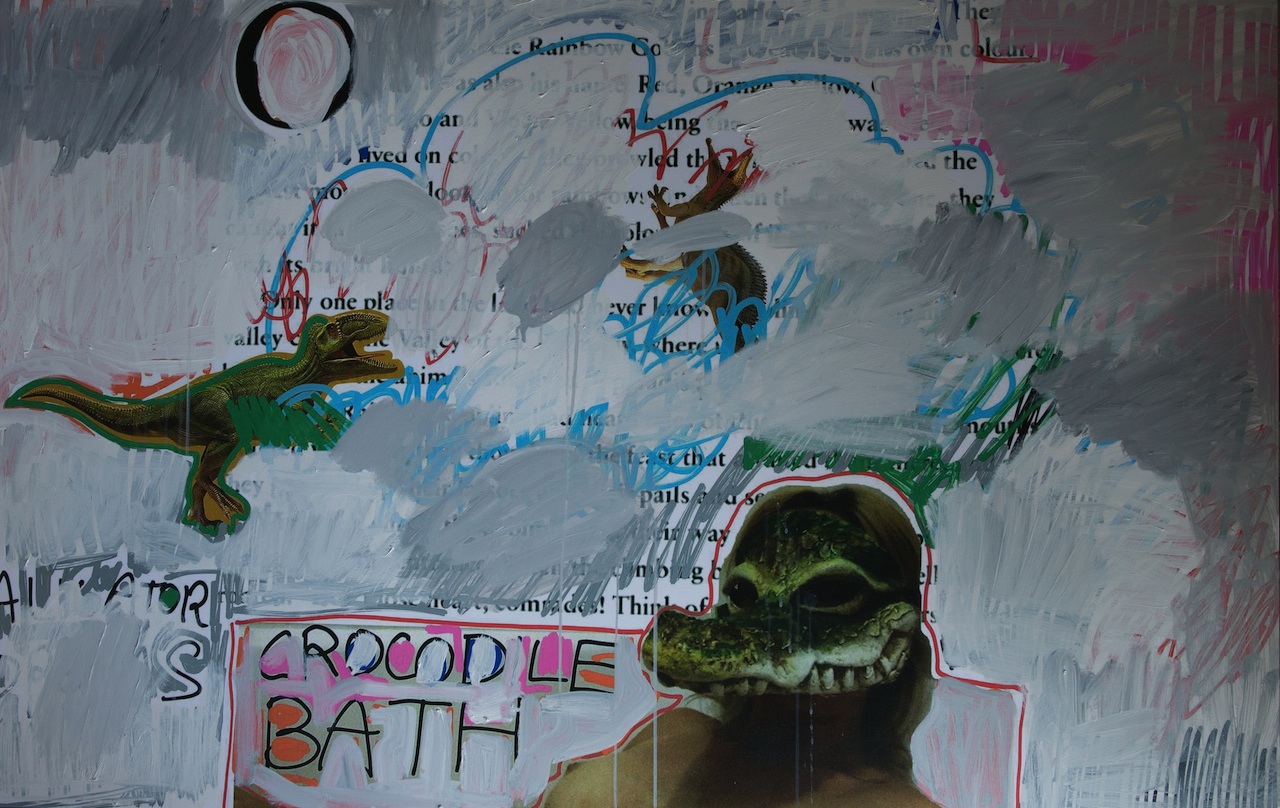
James Franco, “Rainbow Goblin A” (2015), acrylic on printed canvas, 52 x 69.5 inches (via mama.gallery)
Manuel Scano Larrazàbal: Inexorable Acephalous Magnificence orHow the Shit Hits the Fan
When: Opens Saturday, September 19, 7–10pm
Where: Museum as Retail Space (MaRS) (649 S. Anderson St., Boyle Heights, Los Angeles)
For the past century or so, artists have used machines to remove their hand from the creative process. Manuel Scano Larrazàbal’s large-scale drawings fit within this lineage, but the results could hardly be described as mechanical. Constructed from oscillating fans, string, and dangling markers, his drawing contraption creates works that reflect an organic sense of randomness and whimsy. Throughout the run of the exhibition, titled Inexorable Acephalous Magnificence orHow the Shit Hits the Fan, his site-specific apparatus will be producing drawings including a 270 square-foot monumental painting.
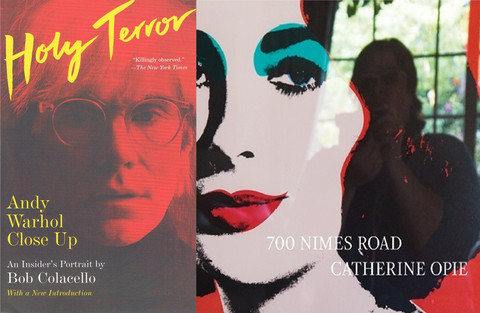
Bob Colacello’s ‘Holy Terror: Andy Warhol Close Up, ‘and Catherine Opie’s ‘700 Nimes Road’ (via artcatalogues.com)
Bob Colacello & Catherine Opie in Conversation
When: Sunday, September 20, 4–6pm
Where: Art Catalogues at the Los Angeles County Museum of Art (LACMA) (5905 Wilshire Boulevard, Mid-Wilshire, Los Angeles)
As editor of Andy Warhol’s Interview magazine in the ’70s, Bob Colacello had intimate insight into the life of the famously guarded artist. His recently reprinted 1990 book Holy Terror: Andy Warhol Close Up is considered one of the best insider accounts of Warhol’s life. Photographer Catherine Opie is best known for her direct and candid portraits of American subcultures — from queer communities to high school football players. Her new book 700 Nimes Road captures a different kind of “indirect portrait” of Elizabeth Taylor through images of her home and possessions. This Sunday, Art Catalogues hosts a book signing and conversation between Colacello and Opie on fame, persona, and pop culture.
When: Sunday, September 20, 7:30pm
Where: Veggie Cloud (5210 Monte Vista Street, Highland Park, Los Angeles)
The works of influential French filmmaker Chris Marker range from experimental movies like the 1962 photomontage short La Jetée to essayistic documentaries. An avowed political leftist, Marker’s films often focused on the social upheavals of the time, such as anti-American ¡Cuba Sí! (1961), which featured interviews with Castro. A Grin Without a Cat (1977) is Marker’s attempt to portray the development of global Socialism since 1968, specifically in France and Latin America, contrasting initial hope with the ensuing reality.
Researchers have found that black children suffering from appendicitis tend to receive less pain medication than white children.
Maggie Fox via NBC News:
Black children with acute appendicitis — a clearly painful emergency — are less likely than white children to get painkillers in the emergency room, researchers reported Monday.
And nearly as troubling, only about half of any of...
[This is a short summary; please click the story headline to read the full story on our site]
The cries of "What about the babeeeez?" get louder and louder as the delusional dogs of the right and their opportunistic fleas demand that no more government tax dollars go to Planned Parenthood. Even as the fake organization that set up a fake sting to get fake videos to fake a scandal release yet another bullshit tape that purports to show skeevy activity, motherfuckin' true believers are takin' it to the motherfuckin' wall. Government shutdown, bitches, rather than give tax money to an organization that spends even a red cent on making baby jerky or whatever it is they're accused of.
In fact, if you don't support defunding Planned Parenthood, you are one of those no-good assholes who "care more about facilitating the harvesting of baby body parts than they do about the lives of those children and the conscience objections of the citizens they serve," says Rep. Kevin McCarthy of California and the Majority Leader in the House. McCarthy, it should be noted, voted several times against expanding the Children's Health Insurance Program so it could cover more kids. So maybe he should just calm the fuck down over who cares about the kiddies.
You know who won't calm the fuck down, even if you use a cattle prod and an elephant tranq gun? Erick "Erick" Erickson of the conservative baby wipe known as RedState. For Erickson, if you believe that aborted fetuses should be used for research in medical science, you're worse than an asshole. Oh, much, much worse: "This is a fight on principle over whether the Republican Party should stand by and let our tax dollars be used to subsidize the American Mengeles of Planned Parenthood or not. This is a fight about whether our tax dollars should be used to subsidize harvesting children’s brains and hearts and lungs and livers." Now, it might seem that American Mengele would be the worst reality competition show ever, but Erickson really believes that fetal tissue research with dead fetuses is the same as torturing live children to death.
Remember: almost all abortions are done before the second trimester. Almost no abortions are done in the third. We're not talking about stone-cold killing a ten year-old here.
But this is where the nutzoid wing of the conservative wing of the Republican Party is declaring, "You shall not pass." And with rational statements like "Children in the United States of America are being cut up and sold for scrap," you can bet that the debate is going to be as dignified as we've come to expect from the GOP.
One GOP "moderate" in Congress is offering a deal to try to head off the shutdown, saying, "Hey, let's just defund those few Planned Parenthoods that actually do provide fetal tissue to researchers." It's a measure of how degraded our politics has become that "moderate Republican" now means, "Wants to keep the government running." And this is putting the leadership in Congress, McConnell and Boehner, on a collision course with the fucking loons, like Ted Cruz, who needs to do something other than be a lamprey on Trump's ass in order to get attention to his presidential campaign.
It's like we're dealing with mad bombers, the kind who you think you can bargain with but who click the switch no matter how reasonable you think you sound.
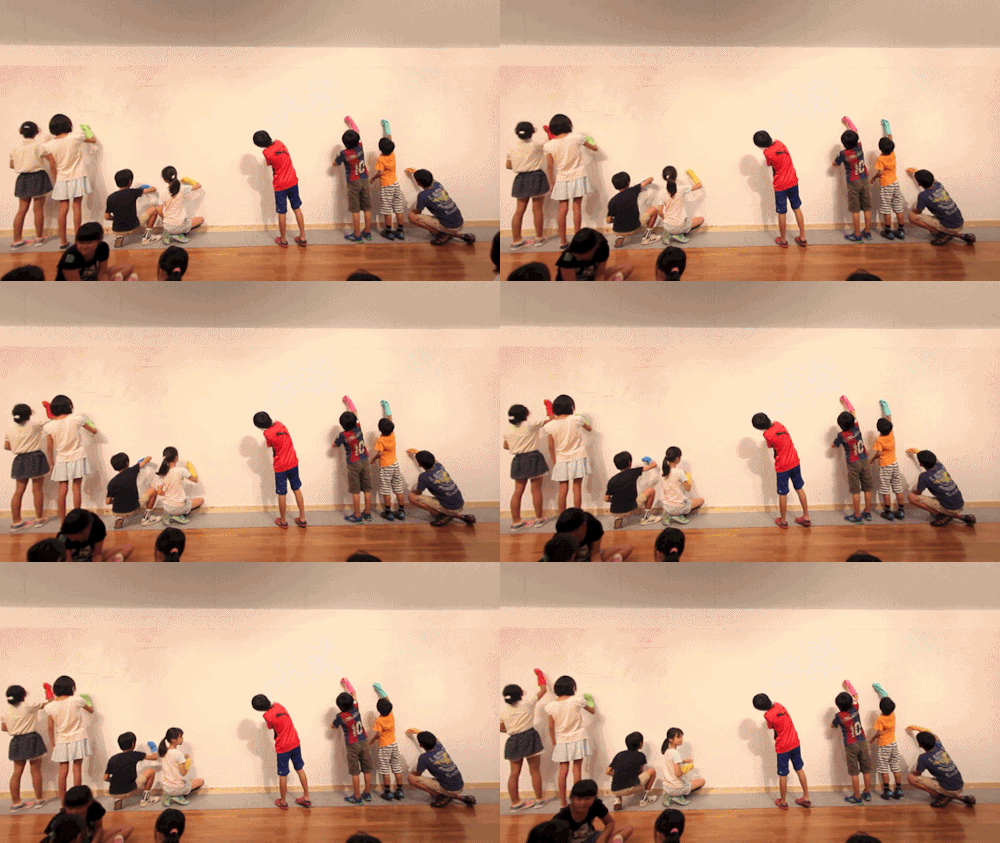
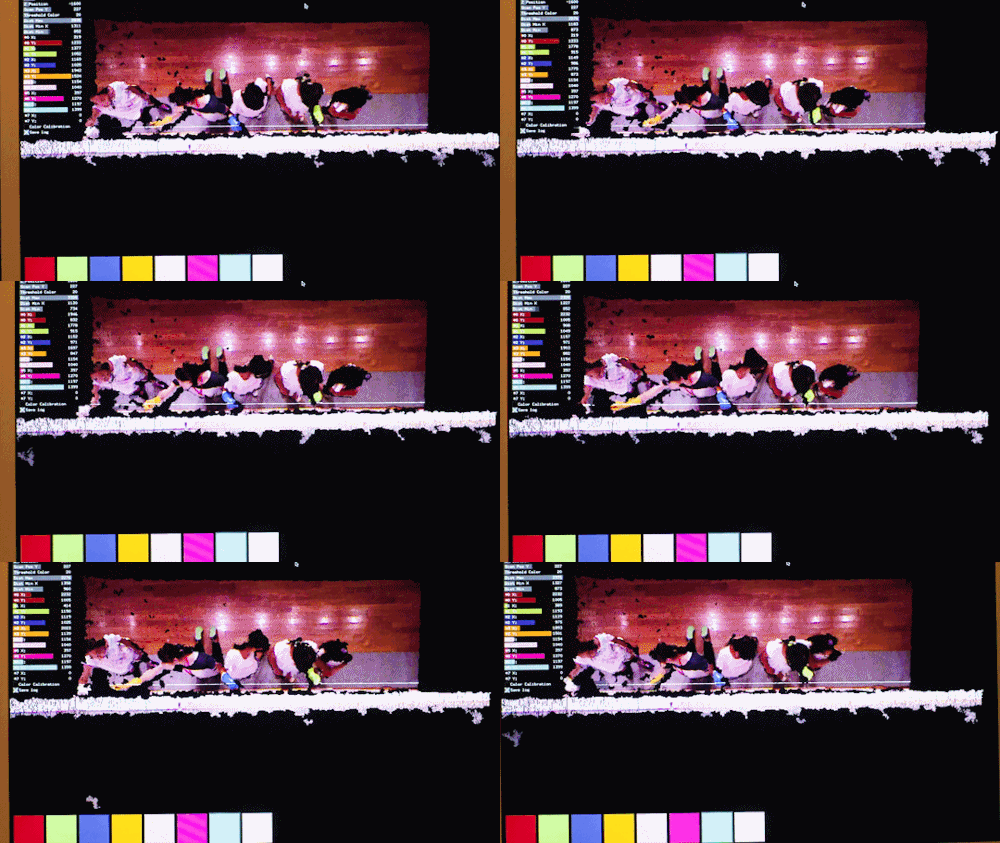
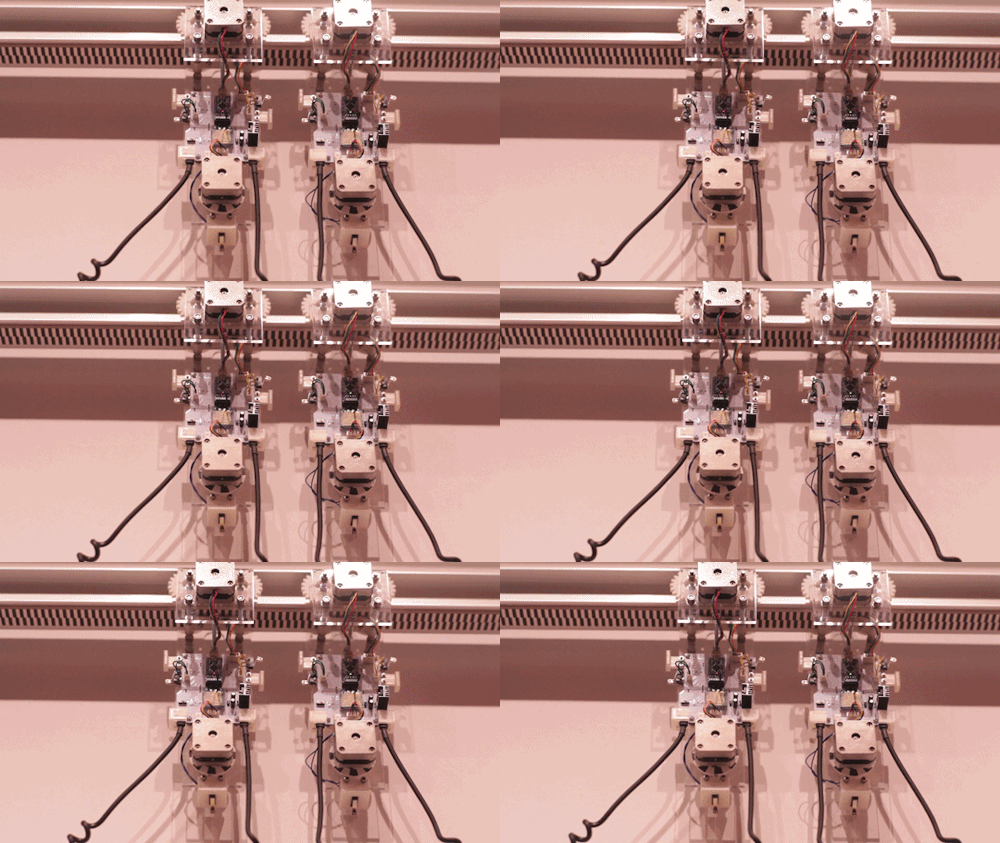
Installations by Yamaguchi Takahiro and So Kanno explores themes related to imitation and replication through mark making using robotics, computer vision and machine learning.
The first project, Replicate, is a workshop featuring a group of schoolchildren drawing on a wall, whose movements are captured using depth-camera data:
The second project, Letters, uses handwriting written in nearby book, breaking down the penstrokes into individual parts with machine learning, and reconstructs them as markings for the drawing robot to replicate:
SDM2 - Letters, which theme is learning, generates lines looks like
letters but doesn’t make sense by machine learning system which learnd
shapes and patterns of hand writing strokes with ignoring meaning of
them.
On street in some international city, you hear a lot of different kind
of language, and it’s possible to distinguish what language it is
without understanding its meaning. It means human learns sound before
meaning.
This project attempts to make a same phenomenon with artificial
intelligence and hand writing letters. Lines generated by system with
biased learning and removing meaning from hand writing letters, how does
it look?
The installations are currently on view at the 21_21 Design Sight Gallery, Roppongi, Tokyo, which you can find out more here
Creative coder Patricio Gonzalez Vivo has been developing many graphical shaders for maps recently, and his latest is a tribute to well-renowned tech artist Ryoji Ikeda.
Waking from a dream you don’t remember but that nevertheless was powerful enough to leave you with a sense of of having been with people who are somehow both friends and strangers, as well as—you suspect—your ex
+ complete empty space in the part of your brain where today's day of the week should be
+ encroaching dread that it might, after all, still be a weekday
+ rueful thoughts re: said ex/said weekday
+ determination to overcome rueful thoughts
Loyalty to the outfit you meant to wear today
+ surprise and disappointment that it has turned out not to be seasonally appropriate
+ stubborn rebellion against the weather—fuck you weather, you don’t own me—
Deep-seated lizard-brain love when the word MOM pops up on your phone
+ reluctance to answer because God MOM
+ irritation because MOM God
+ serious urgency re: getting out of the door on time
+ distraction re: MOM
+ confusion re: what is she chattering on about?
+ that creeping back-of-the-brain feeling that you’re leaving something behind
Sense of accomplishment re: leaving on time
+ sense of inadequacy re: realizing you left that thing behind
Yesterday I walked past a man with a t-shirt that called out in big block letters, “DON’T ASK ME 4 SHIT.” The other day I encountered a woman wearing a t-shirt on which was written a message less imperative and more charming: “Help. I’ve kidnapped myself. Give me $1,000,000 or you’ll never see me again.”
Having grown up in New York City, I’ve spent a good deal of my time in this urban sphere reading other people’s clothing messages. I’ve come to suspect that this type of public proclamation is more than what might be perceived as an attempt to communicate a particular message.
First, let’s acknowledge the distinct types of messages. Some tees are worn to claim affiliation with a group, a practice, or an event, for example those worn on the occasion of a family reunion, or a charitable event. These indicate participant status. In these cases the wearing is a means of clan or tribal identification. This description also applies to aggressive messages: “Explicit Lyrics: Parental Advisory,” that may be signaling membership in a particularly bellicose tribe. Certain tees self-consciously claim membership in a select group: “Independent Woman,” or “Game lock’d tight” (with the Nike swoosh insignia is both signaling affiliation with the corporation and an elite group of athletes).
Some t-shirts communicate imperatives as if to suggest a course correction or a exhortation to be ethical or to leave the wearer unmolested: “Get your flu shot today,” “Keep calm and carry on,” (and the seemingly hundred permutations of this) “Be the change you want,” “Bitch, don’t kill my vibe.”
Some make declarations that aim to impart a clue as to the sensibilities of the wearer, such as, “Auto correct can go to he’ll,” “Sarcastic comment loading; please wait.” Among my favorites of this genre is the tee with an image of Magritte’s infamous pipe with the snarky legend “Bitch, I might be”, and one that’s an enduring crowd pleaser: “Bitter.” (which contains the determinedly conclusive period at the end). Besides proclamations , advisories, and commands, t-shirts pose questions, and rhetorical queries: How did this happen?, or How did I get here?
Though performing different functions these messages are essentially bids for public recognition of the uniqueness of the wearer. It’s as if the person wearing the tee is saying that the edict, observation, or ID badge is representative of him or her. The prevalence of these messages suggests something about living in a cityscape that by default tends to render us anonymous in the avenues of public life: shopping, travel, cultural participation. Rising above the white noise of public interaction seems more crucial to us now, which perhaps is related to more of us on the planet living in cities than not — a circumstance that has come to be in the last few years.
It is important to us to be seen, to really be seen, that is, recognized for our unique individuality, even though we cannot help but compromise this status by wearing a t-shirt that many others also wear to claim distinction. Perhaps the compromise does not invalidate the effort. Becoming invisible is akin to become insignificant and inconsequential. We assert personality through our linguistic clothing messages; the personal item as a political act of refusing to socially be lost from sight.
Japan’s Meiji period (1868–1912) is commonly described as a time of quick economic and political modernization and self-conscious competition with Western military might and colonial aspirations. The Meiji Restoration of 1868 marked the end of feudal rule, of an agriculturally dependent economy, and of Buddhism as the official state religion (replaced with Shintô, which holds the emperor to be divine). Under the reign of Emperor Mutsuhito, Japan adopted a constitution with an elected parliament, built military might, experienced massive transportation and industrial industry growth, and put in place a national education system. Pale Pink and Light Blue, a current exhibition at the Museum for Photography in Berlin’s Kunstbibliothek, captures one aspect of the period’s modernization: the rise of commercial photography.
The images in Pale Pink and Light Blue were made using early photographic techniques, including albumen printing, which uses an egg-white paper base and silver nitrate to capture an image after exposure to a negative, and salt printing, which requires sodium chloride and silver nitrate to produce a positive image. Hand-tinted, there is a painterliness to these works, whose palette is aptly described by the exhibition’s title.
The subject of many of the works is surprisingly “traditional,” depicting not rapid modernization, but rather geishas and landscapes. This choice of subject in a society that was so self-consciously concerned with modernization is best understood by the simple rationale of commercial success. As the exhibition text describes, many of the images were produced for foreigners — students on a Grand Tour or tourists seeking a kitsch souvenir. Technology here worked in the service not of self-reflection but of industry, which is actually perhaps a particularly modern use of the image.
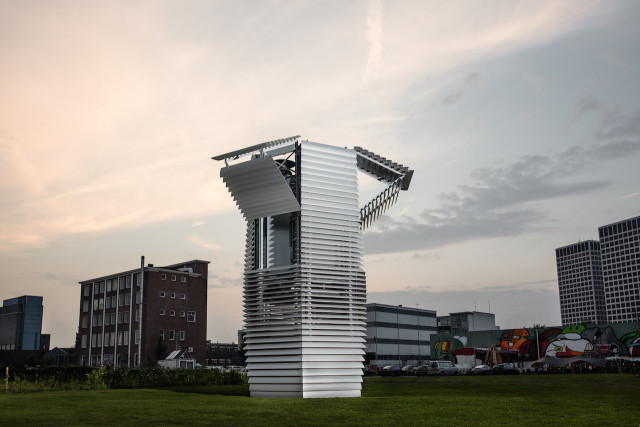
Studio Roosegaarde, the Smog Free Project (2015) (all photos courtesy Studio Roosegaarde)
This month, a 23-foot-tall outdoor structure that improves the air quality of the surrounding area landed in Rotterdam. Created by Dutch designer Daan Roosegaarde and his studio, and recently funded through Kickstarter, the Smog Free Tower is billed as the “largest smog vacuum cleaner in the world.” After it filters smog from the air, it compresses the collected waste particles into cubes that can be embedded into jewelry such as rings and cufflinks — and, hopefully, prompt further conversations about extreme air pollution.
Studio Roosegaarde, the Smog Free Project (2015) (click to enlarge)
Air pollution is visible in many cities, from Beijing to São Paulo. According to Roosegaarde, people in the Netherlands live nine months shorter due to the amount of smog present in the country’s air. The Smog Free Tower, a steel and aluminum structure whose layered exterior walls resemble drawn blinds, creates pockets of clean air in public space through patented ion technology that filters 30 cubic meters of air every hour. Running on green energy, it uses no more electricity than a water boiler.
“By charging the Smog Free Tower with a small positive current, an electrode will send positive ions into the air,” Studio Roosegaarde told Hyperallergic via email. “These ions will attach themselves to fine dust particles. A negatively charged surface — the counter electrode — will then draw the positive ions in, together with the fine dust particles. The fine dust that would normally harm us is collected together with the ions and stored inside of the tower. This technology manages to capture ultra-fine smog particles, which regular filter systems fail to do.”
Roosegaarde has previously designed other visually striking projects with an environmental function. He has proposed planting bioluminescent trees in place of street lights; last year, he brought “Van Gogh Bicycle Path” to Eindhoven, a glow-in-the-dark bike route energized by solar panels. The Smog Free Tower is more minimal in appearance than these innovations, resembling a sleek redesign of an air purifier, but it commands attention due to its sheer height. And unlike ionic air purifiers sold in stores, which have drawn criticism for (ironically) potentially releasing pollutants, Roosegaarde’s tower does not produce additional irritants.
“We have indeed considered this in our design process,” Studio Roosegaarde said. “We are using a different technique, which resembles the charged plate technique, but which does not create any ozone.
“In short, what makes our technology so unique is its effectiveness against all fine dust, its low-energy consumption, the low maintenance required by our system, its ability to clean large quantities of air at once, and its ability to do so at very high speed.” After its launch in Rotterdam, the Smog Free Tower will travel the world with plans for it to stop in Mumbai and Beijing — the city where its engineers experienced the heavy air pollution that first inspired the concept.
‘Durga’ with photographs by Sara Hylton, curated by Kim Hubbard of National Geographic and nominated by Jamel Shabazz, exploring resilience in the aftermath of the 2015 Nepal earthquake. It is one of the “Emergi-Cubes” of work nominated by photo professionals for small shipping pallet displays at Photoville in Brooklyn Bridge Park. (all photos by the author for Hyperallergic)
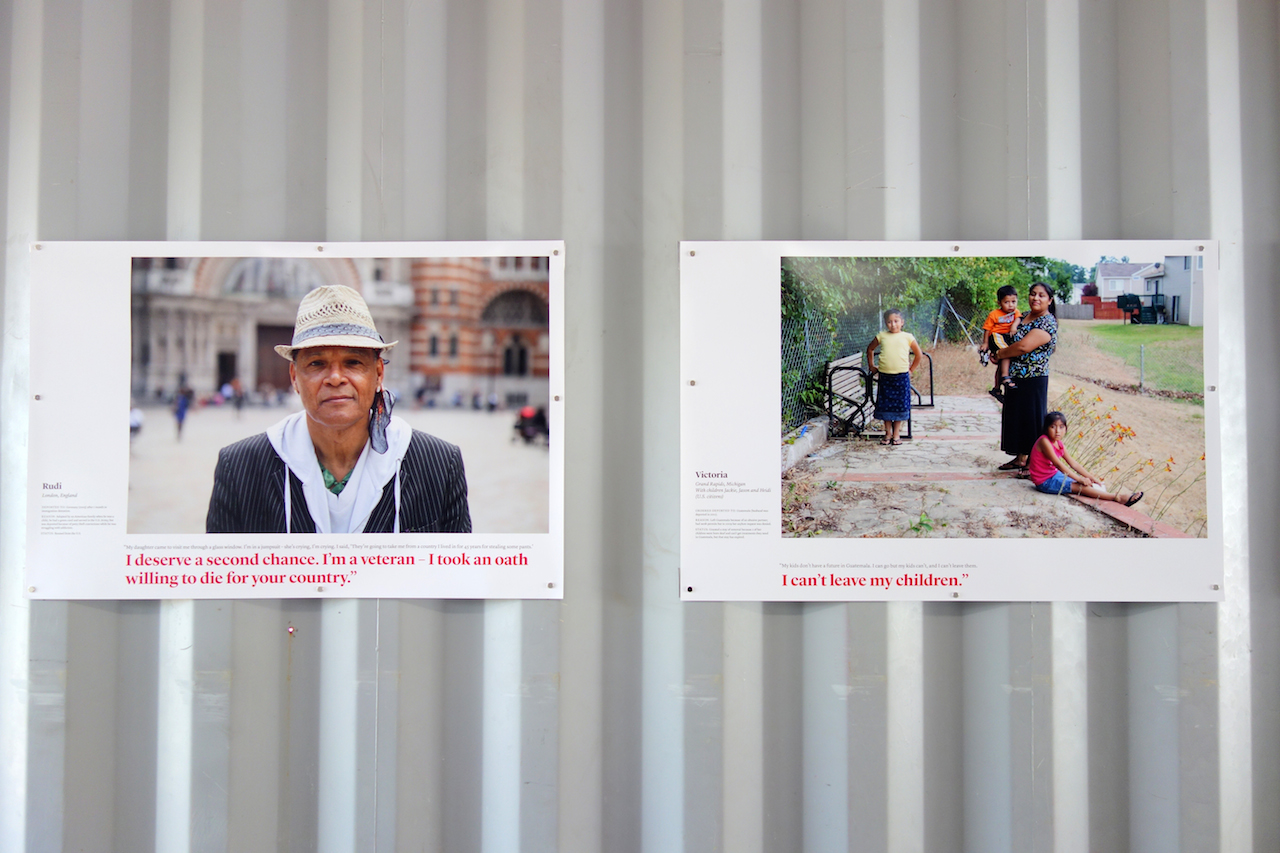
Last weekend, the 2015 edition of Photoville opened the doors of its repurposed shipping containers for a two-week fair of photography. There are over 60 individual exhibitions presented by United Photo Industries (UPI) in the outdoor space alongside Pier 5 in Brooklyn Bridge Park, with a strong focus on photojournalism and ongoing global issues.
For this year’s edition of the annual event, which launched in 2012, the installations are both inside and outside the containers. Smaller displays of emerging photographers’ work nominated by seasoned professionals are presented on square shipping pallets called “Emergi-Cubes.” These have some captivating series like Sara Hylton’s “Durga,” on the aftermath of the 2015 Nepal earthquake; Alícia Rius’s “The Disturbing Beauty of Sphynx Cats,” on the odd appearance of the hairless house cats; and the “Welcome to Dilley” project by Chris Gregory, Natalie Keyssar, Jake Naughton, and Alejandro Torres Viera, on the largest immigrant detention center in the United States moving into a small Texas town.
Alicia Rius, ‘The Disturbing Beauty of Sphynx Cats,’ curated by Stella Kramer (click to enlarge)
Alongside are heavy photography hitters like National Geographic, Getty Images, the New York Times, and a double-decker container for Instagram. There is definitely an infiltration of the social media aesthetic and quick-fire availability of iPhone photography, such as with the Getty Images Instagram Grant Recipients, who include Dmitry Markov’s moving — even if heavily filtered — series on orphan children in Pskov, Russia.
Still, the most compelling work is among the in-depth photojournalism projects. Radcliffe Roye’s When Living Is a Protest is particularly immediate with his 2015 portraits on racial tensions and protest as a passive and aggressive act in New York, South Carolina, Mississippi, Memphis, and Ferguson, Missouri. There are also mapping projects like “Toxic Sites US,” presented by Open Society Foundations, with photography by Brooke Singer of 1,300 Superfund sites, and “The Geography of Poverty” cartographic installation with photos by Matt Black geotagged to census data on the poor communities of the United States. Alongside are series with a more international view, like Daniel Berehulak’s Pulitzer-winning “Scenes from the Ebola Crisis” for the New York Times from Liberia, Sierra Leone, and Guinea; and Stephanie Sinclair’s “Too Young to Wed” on child marriage in Afghanistan.
Photoville continues through this Sunday, with weekend programming including a discussion on documenting climate change, a medical response workshop for journalists in dangerous and remote areas, and a talk on alternative models for documentary storytelling.
Radcliffe Roye, ‘When Living Is a Protest,’ presented by United Photo Industries, on 2015 protests and everyday life in New York, South Carolina, Mississippi, Memphis, and Ferguson, Missouri
Radcliffe Roye, ‘When Living Is a Protest,’ presented by United Photo Industries, on 2015 protests and everyday life in New York, South Carolina, Mississippi, Memphis, and Ferguson, Missouri
‘Scenes from the Ebola Crisis,’ presented by the New York Times Lens Blog, with photography by Daniel Berehulak from covering the Ebola crisis in Liberia, Sierra Leone, and Guinea
Stephanie Sinclair, ‘Too Young to Wed,’ on child marriage in Afghanistan. Presented by Too Young To Wed, curated by Stephanie Sinclair and Christina Piaia
‘Toxic Sites US,’ presented by Open Society Foundations, with visual and text descriptions for 1,300 Superfund sites, featuring photography by Brooke Singer
‘Welcome to Dilley’ with photographs by Chris Gergory, Natalie Keyssar, Jake Naughton, and Alejandro Torres Viera, on the small town’s new South Texas Family Residential Center, the largest immigrant detention center in the country
‘American Exile: Detained, Deported, and Divided,’ with photographs by Graham Macindoe and interviews by Susan Stellin with immigrants who have been ordered deported from the United States and their family members. Supported by Pentagram, Families for Freedom, Parsons School of Design, and the Alicia Patterson Foundation
Photograph by Malin Fezehai, presented by Photo District News Magazine in their ‘Emerging Photographers to Watch’ installation
Photographs by Dmitry Markov from Pskov, Russia, focused on orphan children, presented by Getty Images and Instagram as part of the ‘2015 Getty Images Instagram Grant Recipients’
Glenna Gordon, ‘Diagram of the Heart,’ a series on Muslim romance novels in Northern Nigeria and the daily life they interpret, presented by Open Society Documentary Project and curated by Siobhan Riordan
Glenna Gordon, ‘Diagram of the Heart,’ a series on Muslim romance novels in Northern Nigeria and the daily life they interpret, presented by Open Society Documentary Project and curated by Siobhan Riordan
Tiffany Smith, ‘For Tropical Girls Who Have Considered Ethnogenesis When the Native Sun is Remote,’ nominated by Jerry Vezzuso
Edoardo Delille and Gabriele Galimberti, ‘En Plein Air,’ a series on sports in the lives of people in Rio de Janeiro
Lynn Johnson, ‘Blast Force Survivors,’ with portraits of soldiers who made masks visualizing the invisible trauma of blast force experiences
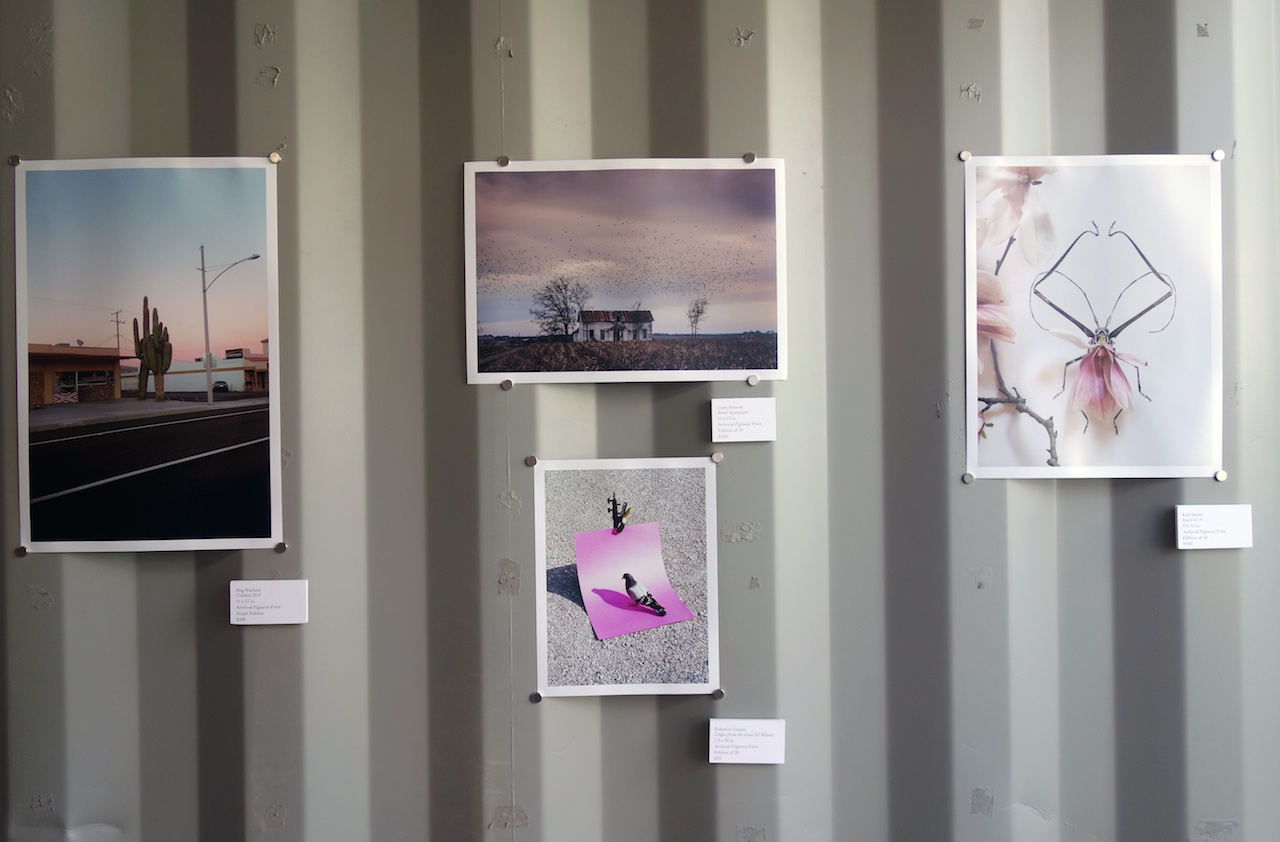
From left to right: photographs by Meg Wachter, Liam Sinnott, Federico Ciamei, and Kari Herer, in ‘Flora & Fauna’ presented by Feature Shoot
Ellen Kok, ‘Cadets,’ a series on the importance of the military in the lives of teenagers in an underserved area of the United States
Li Qiang, ‘WWII Chinese Veterans,’ presented by Yiheimage, a community of professional photographers in China, and curated by Siqi Yang
“The Geography of Poverty'” installation with photography by Matt Black geotagged with census data to map the poor communities of the United States
Photoville continues at the Pier 5 Uplands in Brooklyn Bridge Park (Corner of Joralemon Street and Furman Street, Brooklyn Heights) through September 20.
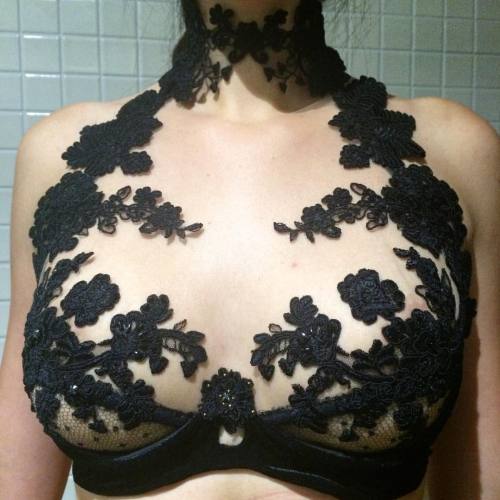
Words cannot express how much I love this bra. I’m honestly having trouble coming up with a caption here besides “I want this.” By new designer @jane_hardcore. #ococ15









 Apple's iOS devices have long included apps that you're unlikely to use (do you really need a stock tracker?), and that list only seems to be getting longer. That's potentially a big problem, especially when the company is still shipping 16GB flag...
 Giorgio Morandi + Robert Ryman: Object / Space


 One reporter discovers that beating around the bush isn’t always the best way to get an answer.












 First, let’s acknowledge the distinct types of messages. Some tees are worn to claim affiliation with a group, a practice, or an event, for example those worn on the occasion of a family reunion, or a charitable event. These indicate participant status. In these cases the wearing is a means of clan or tribal identification. This description also applies to aggressive messages: “Explicit Lyrics: Parental Advisory,” that may be signaling membership in a particularly bellicose tribe. Certain tees self-consciously claim membership in a select group: “Independent Woman,” or “Game lock’d tight” (with the Nike swoosh insignia is both signaling affiliation with the corporation and an elite group of athletes).