Shared posts

17 Sep 10:25

A Barbara Hepworth Retrospective Hampered by Her Male Contemporaries

by Olivia McEwan
t00699

Barbara Hepworth, “Pelagos” (1946), Sculpture Elm and strings on oak, 430 x 460 x 385 mm (Tate © Bowness)

LONDON — Barbara Hepworth: Sculpture for a Modern World marks one of the last exhibitions backed by the outgoing Tate Britain director, Penelope Curtis. The first major retrospective of Hepworth in London for half a century seeks to revisit this modernist sculptor who has long been overshadowed by her male contemporaries Henry Moore, Ben Nicholson, and others. It’s very easy to blame institutionalized sexism for the oversight of her significance on an international stage, the show says, and this clearly feels like a pet project for Curtis, who is a specialist in British sculpture.

Finally, Hepworth will be shown as the giant she really is. Except Curtis’s five-year tenure at Tate Britain has not been troublesome for nothing: despite rearranging the permanent collection to critical and public acclaim, a series of curatorial missteps and eyebrow-raising exhibition ideas (see Art Under Attack of 2013, or the weird Ruin Lust of the same year) has caused some critics to despair, with Waldemar Januszczak sensationally calling for her resignation. The curation here is, sadly, no less complicated and ultimately does Hepworth few favors.

Biog 25

Barbara Hepworth in the Palais de la Danse studio, St Ives, at work on the wood carving “Hollow Form with White Interior” (1963) (Photo by Val Wilmer, © Bowness) (click to enlarge)

The exhibition’s attack is two-pronged in its aim: to revisit Hepworth’s role in the development of international avant-garde sculpture, and to analyze her works in the wider context of the St. Ives landscape, where she lived in the latter part of her life and to which she owed much inspiration. To start, Hepworth’s small studio carvings place her in a trend amongst sculptors in the 1920s to hand-carve everything — harder stones especially — themselves. Considering we mostly associate Hepworth with large, abstract forms, it is a delight to see smaller scale, representational renderings of animals emerge from natural shapes (works that have mostly traveled from private collections: another plus). Yet her undoubtedly charming, squat toad in green onyx pales next to John Skeaping’s (her first husband) mighty sleeping buffalo in lapis lazuli, or a snake by Henry Moore, both of which are displayed adjacent to Hepworth’s work. Certainly, she can hold her own against her male contemporaries, but she doesn’t rise above or add her own ideas to the group.

This resounds throughout the first gallery, not helped by its layout which decides to isolate each sculpture within innumerable infernal Perspex boxes scattered throughout the floor in seemingly random order, as if curated by someone who specialized in crowd flow control (were the curators expecting the record-breaking visitor numbers enjoyed by the blockbuster Steve McQueen exhibition at the Victoria and Albert museum?). Hepworth’s wood carvings are lost amongst others of similar character and style by Alan L. Durst, Eric Gill, and Henri Gaudier-Brzeska — having the captions positioned all over the shop doesn’t help to compare or even identify who sculpted what. This certainly shows how involved and integrated Hepworth was in the modernist movement, yet the arrangement doesn’t make the case for highlighting her talent above anyone else’s. It feels a little empty to find celebration in a female sculptor simply because she can equal her male contemporaries.

The exhibition progresses to the period of Hepworth’s marriage to Ben Nicholson and the artistic interchange that resulted, her pieces encircled (and probably outnumbered) by scores of Nicholson’s drawings and paintings on the walls. There is a certain interest in the exchange of visual language and motifs between the two; however, the comparison threatens to yet again contextualize Hepworth’s work against someone else’s — so far she has not emerged with her own voice. It is by no means intentional, but nonetheless intriguing, that a couple of her rarely seen drawings of surgical operations on first inspection look uncannily like Moore’s own pen and ink washes.

id_122

Barbara Hepworth, “Oval Form (Trezion)” (1961–63), bronze, 940 x 1440 x 870 mm (Aberdeen Art Gallery and Museums Collections Photograph courtesy The Kröller-Müller Otterlo, The Netherlands, photo by Mary Ann Sullivan, Blufton University © Bowness)

By the decades of the 1920s and ‘30s, however, the sculpture we recognize as distinctly hers emerges: the seemingly impossibly smooth marbles of “Three Forms” (1935), larger scale wood carvings with painted interiors, cut through with harp-like strings. Gone are the imprisoning boxes, and we can enjoy the clean, abstract, and carefully considered disks, blobs, and columns. They express an enormous silent power in their monumental size and form. Perhaps one reason for Hepworth being overlooked is her sculptures’ deceptive simplicity, and a dedication to harmony and restraint as opposed to anything approaching turmoil or conflict. “Pierced Hemisphere” (1937) of the Hepworth Gallery in Wakefield in the North of England, and “Two Segments and a Sphere” (1935–6) from a private New York collection make irresistible use of the highly polished surfaces of wood and marble respectively, eradicating the traces of the clumsy human hand.

These works stand alone, free from comparative works in rooms that seem as clean and free from clutter as the sculptures themselves. Such is their strength it is a shame there is not more exhibition space given over to them, which inadvertently indicates that they really need to be appreciated in the outdoor context as originally intended.

What undermines the show more than anything else is a lack of natural light and the categorical impossibility of a London gallery fulfilling its own criteria of examining Hepworth’s work against the St. Ives landscape. We can admire the polished wood finish of her enormous sculptures underneath the mellow gallery spotlights, yet they do not offer the intended brilliant blue-rich daylight that Hepworth originally conceived her works within, and as such something in our visual and textural understanding of the work is immediately denied us. In the final room, there is a recreation of the pavilion designed by Gerrit Rietveld to house a retrospective of Hepworth’s works at the 1965 Kröller-Müller museum in the Netherlands, with one wall covered with a photograph of trees, as if half-heartedly conveying something of the pavilion’s original natural setting. The model highlights how clinical the whole display now feels.

entrance_to_flats_3

Photo-collage with “Helicoids in Sphere” in the entrance hall of flats designed by Alfred and Emil Roth and Marcel Breuer at Doldertal, Zurich (1939), photograph, gelatin silver prints on paper (Private collection © The Hepworth Photograph Collection)

Sculpture for a Modern World is honorable in its earnest survey of the overshadowed Hepworth. Yet the very settings of the gallery format deny appreciation of her work on a very fundamental level, and in this respect the curators have set themselves an impossible task. Similarly, while proposing her as a greater and more influential sculptor than previously recognized, these curatorial decisions to swamp her with contemporaries have almost the opposite effect. It seems that the biggest recognition she will enjoy remains “Single Form” (1961–4), the 21-foot tall bronze standing outside the United Nations Building in New York, mentioned here in passing in a wall caption.

Barbara Hepworth: Sculpture for a Modern World continues at the Tate Britain (Millbank, London SW1P 4RG) through October 25. 

17 Sep 10:25

Pausing for Thought

by Dave Brockington


legolandAs I posted in July, senior management at LGM has applied intense pressure casually suggested that I share some of the media work that I do.  A regular morning feature on BBC Radio Devon is a brief segment towards the end of the Early Show (0500 to 0630) entitled Pause for Thought. The format is appealing, as rather than being a set piece interview, or a panel discussion, I get about three minutes of free air to discuss any topic that interests me. Given the nature of the format, I have to write a script, which I probably put more effort into than is really necessary.  The usual effort needs to be taken in pitching the topic and discussion to the audience; this doesn’t only vary across media outlets, but also within shows on the same station. Feedback has been positive (which might be why they keep inviting me back to do this), and while my earlier runs concentrated solely on purely academic issues, I’m branching out into more autobiographical material, which makes sense given the time of day and the nature of the audience.

I sort of like the routine of waking every morning at 5am, catch a taxi to the studio at 5:50, on air at 6:20, but I would not want to do this every day of my life.  Thankfully, Saturday and Sunday’s spots are recorded in the studio on Friday morning. I’m currently in the midst of my fifth weekly run on Pause for Thought since it first started in 2012, and the first three entries are linked below (it’s always at the end of the show, so the time in parentheses is about where I come on).

Monday, 14 September. (1:19:45) Blending Families. The photo above relates to this entry; it’s the five of us taken at Legoland Windsor on a typical August day in England.

Tuesday, 15 September. (1:21:00) Jeremy Corbyn and Labour’s Chances. There’s some overlap here with my post on Saturday.

Wednesday, 16 September. (1:22:30) Heads of State and Government: the benefits of a dual system (UK) vs the same person (US).

17 Sep 10:25

Hearing Aunt Harriet

by Debbie Nathan

FacebookTwitterGoogle+PinterestTumblrEmailPrintFriendlyShare

In the archives of the Dolph Briscoe Center for American History at the University of Texas at Austin, our writer found a previously unknown audiotape of an interview with a woman who’d been born into slavery.

One day in the early 1940s on the south side of Austin, Texas, a young white man named John Henry Faulk carried a very large recording machine into the home of an elderly black woman named Harriet Smith. The two were neighbors: Faulk’s family lived only four blocks from Smith, and she had known him since he was a baby. He was in his late twenties when he brought the recorder to her house, and she was in her early eighties. Faulk addressed her as “Aunt Harriet.” She called him “Mr. Faulk.”

Many years later, Faulk would remember Aunt Harriet as an amusing old woman about whom people liked to tell funny stories.

Faulk knew all about telling funny stories, especially about blacks. He had been doing this since high school, reciting Shakespeare plays, for instance, as though Hamlet and Henry IV were characters on Amos ‘n’ Andy. He cheerfully called one such performance a “nice little nigger story.”

As a student at the University of Texas at Austin, he performed these stories at social gatherings, including parties organized by his professors. He studied with famed Texas folklorist J. Frank Dobie, as well as John Lomax and his son Alan—who had “discovered” blues musician Lead Belly in prison in Louisiana and would later find and record Muddy Waters in the Mississippi Delta. When Dobie and the Lomaxes first met Faulk, they were impressed by his uncanny ability to ape the speech of black Americans—often as a joke.

And yet, by the standards of the day, Faulk was far less racist than most white Southerners. A few years after he interviewed Smith, he would join the NAACP. His upbringing had been unusual: His father was a longtime socialist who advocated for racial equality, and the family had lived in an integrated neighborhood in Austin. Faulk grew up playing with black children. By the time he visited Harriet Smith’s house, he had been tapped for an antiracism project—audio recording black church sermons in heavily African-American parts of the Brazos River Bottom region of East Texas. The Julius Rosenwald Foundation, an early 20th-century fund renowned for promoting black education and culture in the Jim Crow South, bankrolled the work.

To carry out the project, Faulk was given a machine that weighed more than 130 pounds and etched grooves onto a metal disc while the speaker talked into a microphone. He stored this cumbersome equipment in the back of a car and drove it to rural Texas in late 1941. There, he recorded black congregations singing and shouting, their preachers sermonizing, and families weeping at funerals. He also took the gear to Negro house parties in his own neighborhood in Austin, where he recorded young men singing blues and young women crooning Billie Holiday.
As I discovered recently, he also went to Aunt Harriet’s.

***

 One of the WPA’s projects was to record the reminiscences of elderly blacks who had been liberated from bondage at the end of the Civil War.

It wasn’t Smith’s only encounter with a recording device. She was of continuing interest to Faulk because she had been a slave in the 19th century, and in the previous decade, Faulk’s mentors, John and Alan Lomax, during trips they made through the South to collect folk music, had recorded some interviews with former slaves. By 1937, John Lomax was the national folklore advisor for the government’s Federal Writers’ Project (FWP), which was part of the New Deal’s Works Progress Administration (the WPA). One of the FWP’s projects was to record the reminiscences of elderly blacks who had been liberated from bondage at the end of the Civil War. FWP workers interviewed about 2,300 people. After the FWP was over, the Library of Congress continued to collect interviews, and Faulk participated in that effort. Almost none were audio recorded—the vast majority of the interviews were simply written down by the government workers as notes then transcribed onto paper and eventually filed in Washington. Today, these written first-person accounts of life under the peculiar institution can be downloaded for free from Project Gutenberg. The Library of Congress also posts them.

***

A few months ago, another white man, Dylann Storm Roof, visited a black church—this one in Charleston, South Carolina—and shot to death nine congregants. Months before committing the murders, he posted a comment on a white supremacy website that he administered, noting that one thing leading him to consider black people as racially inferior was his study of ex-slave narratives. These narratives showed, Roof wrote, that antebellum American slaves were happy in their bondage. Their happiness, he wrote, was being kept secret. This infuriated him.

I have reviewed many of these narratives. I started months ago, after discovering that one set of my great-great-grandparents owned two female slaves (and that another great-great-grandfather fought in the Confederate Army). The skeletons of this history had for generations been closeted in my liberal, civil-rights-activist Texas Jewish family. This is a family who went to interracial fellowship gatherings in segregated Houston during the 1950s and encouraged its white children (including me) to ride at the back of the bus and to use restrooms and water fountains marked “colored” instead of “white.” Using an easy-to-find document on ancestry.com, the 1860 Federal Slave Census, I discovered my family’s slavery secret. I called a reunion of the kin to break the news. Then I developed an almost obsessive interest in the ex-slave narratives.

Many interviewees told cheerful stories about their enslavement.

Going through my first few scores of them, I was shocked to notice the same thing that Roof mentioned—that many interviewees told cheerful stories about their enslavement.

Jim Allen, for instance, was an 87-year-old former slave in West Point, Mississippi when the WPA interviewed him in 1937. He talked about how much he loved his owners: “Ole Miss was so good, I’d do anything fer her.….”

John Cameron, from Jackson, Mississippi, expressed similar feelings: “My old Marster was de bes’ man in de worl’.… Us had plenty t’ eat and warm clo’es an’ shoes…us ain’t never min’ workin’ for old Marster…that meant good livin’ an’ bein’ took care of right.”

Anna Baker, at 80 years old, in Aberdeen, Mississippi, recalled running to greet her owner when he returned to the plantation from town: “Here come de marster, root toot toot!” Josephine Bristow remembered her master returning from journeys and delighting her with remarks such as, “Yonder my little niggers! How my little niggers?”

And Harriet Smith, the funny old woman in Austin, told John Henry Faulk that her white owners were “good to us. Good. They never whipped none of their colored people.”

***

Confused about these apparent encomiums to slavery by people who themselves had been slaves, I put down the narratives and sought out critical analysis by historians and other scholars. There are, it turns out, many reasons why elderly black people in the early 20th century might have reflected happily upon their bondage in the 19th.

One reason, the literature points out, is that almost all of the WPA interviewers were white Southerners. Some had grandparents (and even parents) who had owned the very people they were interviewing—in Southern towns still under the terroristic grip of Jim Crow. (Faulk’s grandparents had owned slaves, though he never talked publicly about that, and it’s likely that his parents had known the family who owned Harriet Smith.) Some interviewers – including Faulk, when he interviewed Harriet Smith — posed leading questions encouraging ex-slaves to emphasize the positive. Faulk asked Smith, “Some folks awful good to their slaves, weren’t they?” Lately it has come to light that when the answers weren’t positive, many WPA regional administrators abridged the transcripts. Or they mothballed the interviews entirely and never sent them to Washington.

Furthermore, many of the interviewees lived in decrepit shacks, wore ragged clothes, and were sick and hungry. The Depression was raging, and Southern blacks, routinely denied government aid because of their race, were especially desperate. Many thought the WPA interviewers, being from the government, could get them food and monetary “relief.” The interview transcripts record them begging for help. Many likely said what they thought the interviewer wanted to hear in order to receive assistance.

Slave children typically experienced something vaguely resembling free, early white childhood, which, over eight decades later, many remembered in a haze of fondness.

But perhaps the strongest and most poignant explanation for fond memories of slavery is that the majority of the interviewees, born in the 1850s and 1860s, were young children during the Civil War. (Harriet Smith was about six and a half years old when Yankee troops finally occupied Texas and declared emancipation in June 1865.) Years later, those children, now elderly, recalled that, even on the most brutal plantations of that period, slaves were not put to hard field labor until they reached the age of 10 or 12. Among enlightened owners, animal-husbandry theories abounded regarding how best to extract maximum, long-term productivity from slaves. One tenet was that the child slave’s body should be well nourished and left at rest until adolescence, to assure good development and hardiness. Thus, except for relatively light jobs such as caring for younger children, many young slave boys and girls were allowed to spend at least some of their days playing—even with their owners’ sons and daughters. Slave children typically experienced something vaguely resembling free, early white childhood, which, over eight decades later, many remembered in a haze of fondness. This is the “happiness” that Dylann Storm Roof read about. As did I.

***

However, just as I did, Roof undoubtedly also read chilling accounts of the way these children were treated like small animals, even in relatively good circumstances. Henry Brown, from South Carolina, remembered how his owner, a Dr. Rose, “gave me to his son, Dr. Arthur Barnwell Rose, for a Christmas present.” Solbert Butler, also of South Carolina, remembered how his “massa take me as a little boy as a pet,” with a little bed to sleep on at night near the master’s big bed—as a dog today sleeps in its owner’s room on a monogrammed dog pallet mail-ordered from Lands’ End. Jim Allen was also kept as a “pet” – after his previous master lost him in a whiskey debt. Allen recalled that his new master, the creditor, “tuk me, out’n the yard where I was playing marbles. De law ‘lowed de fust thing de man saw, he could take.”

Then, there were far worse circumstances. The mother of J. W. Terrill, of Madisonville, Texas, served, once a week for years, as her white male owner’s concubine. As a result, Terrill was mulatto, the son of “my mammy’s master.” Furious about the existence of his mixed-race issue, Terrill’s father “willed I must wear a bell till I was 21 years old, strapped ‘round my shoulders with the bell ‘bout three feet from my head in steel frame.” Terrill commented to the WPA interviewer that he “never knowed what it was to lay down in bed and get a good night’s sleep till I was ‘bout 17 year old, when my father died and my missy took the bell offen me.”

Then there were the auctions, during which, even if children were not the goods for sale, they witnessed other people on the block and never forgot it. Jake Terriell, during his childhood as a slave in South Carolina, told his interviewer that he “seed slaves sold and you has heared cattle bawl when de calves took from de mammy and dat de way de slaves bawls.”

Children saw and overheard casual murder, with utter lack of response from authorities except to dispose of the bodies. Lou Williams, from Maryland, recalled living “close to de meanest owner in de country…he keeps overseers to beat de niggers and he has de big leather bullwhip with lead in de end, and he beats some slaves to death. We heared dem holler and holler till dey couldn’t holler no mo! Den dey jes’ sorta grunt every lick till dey die…de whole top of de ground jes’ looks like a river of blood…sometime de law come out and make him bury dem.”

“Lawd, Lawd,” Williams concluded. “Dem was awful times.”

***

But to the eyes of white transcribers and even contemporary readers, those times probably don’t seem as bad as they would if they had been written down for posterity in Standard English—all those “de’s” for “the,” “jes” for “just,” that man who remembered how he “seed” slaves being auctioned rather than saw them, the children who “heared” instead of heard dying people holler until they “hollered no mo.” All those apostrophes and missing consonants at the ends of syllables, the mangled verbs, and verbs about things that happened past tense yet were uttered using the present. Verbs describing people who, the interviewees knew, had died as slaves many years ago, yet the ex-slaves said of these people that “they die,” as if their deaths were just happening or had not yet happened.

How curious nowadays to read these quirks of English. They were quirks that white writers used to mock black people, even before Mark Twain practically institutionalized the practice. In the pages of Huckleberry Finn, Twain’s black character, Jim, spoke in a riot of misspelling. Twain’s use of “nex’ day” for “next day,” “git” for “get,” “didn’” for “didn’t,” and “uv” for “of” is what linguists call eye writing, because it brings dialect to the eye. To the reader, this orthography makes the speech of people like Jim look different from educated white people’s speech. But eye writing is a cheap, hierarchical trick. In fact, many Americans of different classes, geographic regions, and ethnicities say “uv”, “nex’ day,” and “didn’.”

Eye writing probably targeted blacks more than any other group.

Yet in fiction, funny-page cartoons, and folklore scholarship from the late 19th century until well into the 20th, eye writing was a common way of marking and (consciously or unconsciously) belittling classes of people considered less successful or less than American. Immigrants were one target. Another was white Appalachians (whose speech was extravagantly eye-written in the comic strip Li’l Abner).

Eye writing probably targeted blacks more than any other group. Respectable writers did the work, and respectable readers chuckled. In 1932, the dean of the Texas State College for Women published Chocolate Drops from the South, a collection of what his grandson Edmund V. White III, the renowned contemporary writer about gay life, would many years later deride as “’nigger’ joke books.” The jokes were replete with stereotypes about blacks: that the females were promiscuous and ever ready to cheat on their husbands, that males were happily prone to commit deadly violence with guns, knives, and dangerous household goods. A typical joke in Chocolate Drops has a woman asking “Rufus,” her partner, “Whut is yo’ gwine do wid dat razor?” Rufus answers, “See dem two shoes undah de baid. If de ain’t no man in ‘em, Ah is gwine tuh shave.” Also included is a joke about a lynching. In one of her “My Day” newspaper columns from 1937, Eleanor Roosevelt enthusiastically recommended Chocolate Drops to “anyone who wants a laugh a day.”

Meanwhile, those WPA interviews, which Dylann Storm Roof and the rest of us would encounter decades later, are replete with stories of “happiness” rendered in the most egregious eye writing: “Ever since I a child I is liked white folks…I got a heap mo’ in slavery dan I does now; was sorry when Freedom got here.”

***

There is one tiny set of ex-slave interviews that is unequivocally dignified. These are audio recordings of about a dozen people, made mostly in the 1930s and ’40s. They total some 260 minutes, just over four hours. Some are so clear that you can’t believe they are more than a half-century old; others are scratchy and muffled. Regardless of quality, however, the sounds on these recordings go straight to the ear, unmarred by eye writing. They are unadulterated voices of human beings, reminiscing about their enslavement.

One is a man who (it has since been established) was a great-great-grandson of Betty Hemings, the slave matriarch at Monticello, one of whose children was Sally Hemings, the enslaved mother of six of Thomas Jefferson’s children. A photo taken in 1949, the year he was interviewed (not as part of the WPA, but by a Library of Congress engineer who was also his nephew) shows the man gray-bearded and tall yet bent with age. From his first utterance, he booms, belts, and declaims, like an oracle from an ancient world. “My name is Fountain Hughes!” he shouts. He tells us he is 101 years old, from Virginia, and that his grandfather belonged to the president.

And then, in the absence of eye writing to bemuse, confuse, or amuse us, Fountain Hughes’s voice—the voice of an American who was enslaved—raises our skin with gooseflesh.

So does Harriet Smith’s voice on a recording John Henry Faulk made of her in Austin, which he sent to Washington. Speaking to him in the 1940s, she now speaks to us from the living dead of history—and from the Library of Congress.

***

Click to view slideshow.

Smith’s and the other ex-slaves’ stories were, for a long time, unavailable to the public. Finally, in 1972, the written interviews, filed with the Library of Congress in the 1940s, were published as a mammoth series titled The American Slave: A Composite Autobiography. But the small collection of audio recordings, etched in lacquer and aluminum, remained in storage and mostly forgotten.

Publication of the written interviews corresponded with a rash of interest by sociolinguists in what has come to be known as AAVE, or African American Vernacular English.

Education researchers and schoolteachers had assumed that black students were speech deprived and intellectually inferior. Labov’s investigations showed that, on the contrary, nationwide, African-American vernacular speech was as complex and grammatical as any other dialect.

One of these scholars was Columbia University’s William Labov (now at the University of Pennsylvania), who, in the 1960s, researched inner-city black children’s dialect in African-American communities like Harlem. Education researchers and schoolteachers had assumed that black students were speech deprived and intellectually inferior. Labov’s investigations showed that, on the contrary, nationwide, African-American vernacular speech was as complex and grammatical as any other dialect.

Labov’s work fit well into the era of the Civil Rights, Black Power, and the War on Poverty. It was buttressed when linguists such as J. L. Dillard proposed that the dialect of American blacks came not from fractured versions of white Southerners’ speech, but from an antique, transatlantic pidgin used by European and English slave traders to communicate with one another and with their human cargo. By definition, a pidgin is a language with reduced vocabulary and simplified grammar that is native to none of its speakers. The transatlantic version probably had no verbs inflected for past tense, only one or two pronouns, and a mélange of words from Romance, English, and African languages. By definition, if a pidgin is spoken long enough, children are born who end up speaking it as a native language. At that point it ceases being a pidgin and starts to “creolize,” meaning that its grammar gains complexity, and its vocabulary expands. Dillard believed that, beginning in colonial America, slave children on plantations came to speak a creole similar to those spoken on slave-plantation islands of the Caribbean. And eventually, the creole evolved into a modern dialect: African American Vernacular English.

Take “pickaninny,” a Southern word for a black child. Dillard argued that this word came from pequeño or pequeñiño, Spanish and Portuguese, respectively, for “small.”

Dillard presented intriguing evidence for his thesis. Take “pickaninny,” a Southern word for a black child. Dillard argued that this word came from pequeño or pequeñiño, Spanish and Portuguese, respectively, for “small.” Words from these languages were widespread in the transatlantic pidgin, Dillard pointed out, and some must have been handed down to American Black English.

There was other evidence of creolization. Black vernacular speech tends to omit the “copula,” forms of “be,” as in “He going” and “My father tall.” Meanwhile, the dialect adds “aspect” markers before verbs, such as “done” for the perfective, completed past (“She done put on a clown costume yesterday”) and “be” for the imperfect or habitual (“She always be a clown on Halloween”).

Other linguists disagreed with Dillard that Black English in America derived from pidgin and creole. They thought it was more of a remnant of 18th- and 19th-century white speech, including archaic features—such as “brung” for “brought” and “ax” for “ask”—that almost no white people in America use today but that were common centuries ago in white America and parts of Great Britain.

Finding the tapes was like unearthing a time capsule, and the linguists couldn’t wait to compare ex-slaves’ speech with that of contemporary blacks.

In the late 1980s, the Library of Congress dubbed the ex-slave audio recordings onto tape. Sociolinguists studying black vernacular English got excited—they assumed that even though people like Harriet Smith and Fountain Hughes were interviewed in the 20th century, their grammar and pronunciation were essentially the same as when they were children in the 1830s, ’40s, and ’50s. Finding the tapes was like unearthing a time capsule, and the linguists couldn’t wait to compare ex-slaves’ speech with that of contemporary blacks. The differences would cast light on the evolution of a dialect and show whether it was “converging” with contemporary white speech, as the linguists put it, or diverging because of persistent racial segregation and inequality.

So researchers started listening to the tapes. But they soon realized that people like Harriet Smith challenged sociolinguistic assumptions.

***

For one thing, the ex-slaves did not speak with the comico-linguistic neatness of an Amos ‘n’ Andy show. For every occasion when an elderly interviewee left out the copula in one phrase, in another utterance, a form of “to be” appeared. Fountain Hughes provides a typical example. “We afraid to go,” he said, recalling a night, in his boyhood, soon after liberation, when he was homeless and worried about finding a safe place to sleep. In a previous sentence, however, Hughes had said, “we was afraid to go.” Harriet Smith spoke similarly. She almost always said “was” and “were” when referring to the past. But then she didn’t, as when talking about her younger siblings, born in freedom, versus an antebellum cohort of children that included her: “We the only two in slavery times.”

In trying to interpret grammatical variations in ex-slave speech, another challenge researchers faced was that they knew very little about their audiotaped informants. They knew that most had been children in bondage. But what happened after the Civil War? Where did they live? How did they make a living? Did they receive any schooling? What exposure did they have to white speech, first as slaves and then as free people?

Information like this is crucial to understanding how and why a person speaks as she does. It wasn’t just that the WPA interviewers hadn’t asked— sometimes they had. A bigger problem was that years after the interviews yet still before the Internet, it was exceedingly difficult to research the biographies of humble people who were no longer alive.
And perhaps the biggest problem: Even when an ex-slave provided detailed information about life during and after liberation, the data sometimes got misfiled, or worse, ignored.

Take Harriet Smith. When Smith correctly told Faulk she was from near the little, Hill Country Texas town Buda, he at first repeated the town name correctly, then changed the “d” sound to “l.” This second pronunciation was wrong, but Faulk’s voice prevailed over Smith’s. The Library of Congress interview transcript has her as being from near “Beullah”—a non-existent name in the Texas geography lexicon (a town named “Beulah” with one “l” did briefly exist at the turn of last century, but it has no relationship to Buda or to Harriet Smith).

***

Just as anyone can sit in a bathrobe today and play with Ancestry.com to find out which white people owned slaves, it’s also easy to learn where the slaves lived after they were freed. Starting in 1870, the census shows Smith as a young teenager in a rural community just about twenty miles south of Austin, in Hays County, Texas. She stays in Hays County until the census finds her in 1920, at age 62, in Austin, only doors from Faulk’s house. There is no evidence that Smith ever lived elsewhere, and when she talks about her life on the recordings, she talks only about these places—in detail.

It seems that neither Faulk nor those who later analyzed Smith’s utterances really listened.

But it seems that neither Faulk nor those who later analyzed Smith’s utterances really listened. For years the Library of Congress, and every book and scholarly article that has mentioned her, have described her as an ex-field-slave from Hempstead, Texas.

Hempstead is notorious lately. It is where Sandra Bland, a 28-year-old black woman, died in a county jail this year, after being stopped and arrested by a state trooper who violated her rights. Hempstead is more than 100 miles from Hays County and Austin, in a region of East Texas with a terrible history. Before the Civil War and long into Jim Crow, the economy of Hempstead and its environs derived from cotton and plantations; its culture was plagued by racism that was entrenched and violent. Between 1877 and 1950, Waller County, which encompasses Hempstead, had far more lynchings than most other Texas counties.

Faulk knew how bad things were there. Driving through the area in 1941 with his recording gear, he talked to a black woman who remembered another woman, a mother, who “refused to allow her little 7 yr. old boy to go work for some white man,” as Faulk wrote to Alan Lomax. “She sassed the white man and he came back and killed her.” Faulk quoted another black woman complaining that in Hempstead proper, “they won’t let us Negroes have chu’ch aftuh 10 at night.” A man remarked that, though the Civil War had been over for generations, “The folks down dere ain nevuh heahed dey’s free yit.”

“Chu’ch.” “Nevuh.” “Yit.” Albeit with a pen instead of his voice, Faulk couldn’t help doing Amos ‘n’ Andy.

For sociolinguists studying the history of Black English, it’s vital to know about things like plantations and lynchings. Pidgins and creoles are thought to have developed when slaves had little contact with whites, especially in brutal plantation economies, where relatively few owners lived among overwhelming numbers of blacks. That was the situation in Hempstead. But not in Texas Hill Country, where Smith grew up and where the economy was dominated by livestock breeding on small spreads with a handful of slaves apiece, and where white families lived in relative intimacy with their chattel. Smith’s mother borrowed her mistress’s gray horse to run errands.

Smith told Faulk all about this. She told him the names of her owner and his brothers, a prominent family—one brother was John Wheeler Bunton, a signer of the Texas Declaration of Independence. No doubt Faulk and his family knew the Buntons. The census shows that before and after the Civil War, they lived exactly where Smith said they did, in Hays County, just south of Austin. But when Faulk sent Smith’s interview to Washington, it must have been bundled with his church-service discs. An apparent clerical error turned Smith into a field laborer on a big East Texas plantation—even though she described herself in the audio as a “nurse,” meaning a babysitter during slavery, whose grandmother had been a midwife (apparently for white as well as black women), and whose mother was the white Bunton family’s cook. All this means that Smith’s linguistic world was probably quite different from what sociolinguists have supposed—far more integrated with that of white people.

And they were not just any white people. Another fact about Harriet Smith emerges easily nowadays via one of those bath-robed perusals of Ancestry.com. In her interview long available from the Library of Congress, Smith tells Faulk that her owner during slavery was “Jim Bunton, the baby boy.” She was talking about James Monroe Bunton, the youngest of several slave-holding brothers out on the ranches and farmlands near Austin. One, Robert Holmes Bunton, had a daughter named Eliza. Born in 1849, she was destined before the Civil War to be a slave holder by inheritance–perhaps even to receive one as a Christmas gift or wedding present. During visits to her extended family, she may have played with an item of her uncle’s property: the young child Harriet Smith. Eliza was the grandmother of President Lyndon Baines Johnson.

***

This year, not long after I learned about the slaves in my family, I had a chance to go through John Henry Faulk’s archives at UT Austin’s Briscoe Center. Faulk left behind hundreds of tapes that are now MP3 files. I listened, aghast, to his “nigger stories.” I sampled his spoofs of conservative yahoos and heard his lovingly recorded East Texas black church services from before World War II.

Then I noticed an MP3 marked “Harriet Smith.” I recognized the name from that obsessed time when I’d plowed through the ex-slave narratives. I listened and realized I was hearing 17 minutes of a recording that Faulk had somehow neglected to send to the Library of Congress. I called an archivist there. He said they had many other minutes of Smith, of course—the stuff filed for years under “Hempstead, Texas.” But the archivists at the Library of Congress didn’t have this segment. They’d never heard of it.

The tape I discovered is in some ways no different from the Harriet Smith material that scholars have known about for decades. People used to use the bark from live oak trees to make medicine, she reminisces in response to Faulk’s questions about her youth. Her grandmother baked “fine” cakes for Sunday dinner. Panthers once roamed the area and killed the family’s calves.

She describes children being rounded up to be sold at auction. It wasn’t a white person who did the rounding up. It was a “colored man,” Smith says, perhaps to maintain calm among the children, to keep them from suspecting they were about to be sold.

But in this same interview, Smith gives utterly chilling reminiscences of slavery that I have not seen or heard in other narratives. She describes children being rounded up to be sold at auction. It wasn’t a white person who did the rounding up. It was a “colored man,” Smith says, perhaps to maintain calm among the children, to keep them from suspecting they were about to be sold. The colored man, Smith tells Faulk, “carry these children down.…He say, ‘Bid that child a thousand dollars’….Sold ‘em just like you sell your stock in Austin.”

And the most nauseating recollection of all: Smith remembering a conversation with a preacher she knew, who told her about a woman whose young son was sold from her. The son grew up, and after freedom, Smith says, he apparently met his mother and the two didn’t know they were kin. “He married her own son and didn’t know it,” Smith says.

“Lord, have mercy!” Faulk says, shocked. Apparently he had not noticed what you might have just now: that Smith used the masculine pronoun “he” to represent a mother. Pronoun reduction—changing “she’s” to “he’s”—is a classic feature of a creole. Maybe it provides evidence for the linguists’ “creolization” hypothesis; maybe it doesn’t. One thing is certain: If one were too attentive to the fine points of Black English grammar, one might forget that Smith was describing something beyond grammar—that two black people were forced into one of our culture’s worst nightmares. Parent-child incest.

***

Smith’s own family seems to have clawed itself out of the horror of slavery and made heroic lives for themselves. Here again, Faulk paid no attention.

In the recorded interviews, Smith drops myriad crumbs of information about her childhood in Hays County, near the little town of Buda. In the 1870s, a white man sold a few hundred acres of adjacent land to a group of freed slaves, including Smith’s parents, Clarisa and Elias Bunton. They called their new, all-black agricultural colony Antioch, after the ancient Greek city known as the cradle of Christianity. Smith’s family not only farmed their land in Antioch, but in 1874 they also donated a parcel to build a school for the colony’s black children released from bondage.

*********************

John Henry Faulk died in 1990; his grave is in Austin. Within a generation of his recorded encounter with Harriet Smith, Faulk had largely abandoned his imitations of black dialect. In 1974, on National Public Radio, he told a folksy story about Christmas in rural Texas in which the black and white characters all talked exactly alike. A few years later, he confessed to an interviewer on Austin television that he felt “uncomfortable” with the eye writing of his youth.

Harriet Smith died in 1946, 69 years before Dylann Storm Roof got so upset about the ex-slave narratives, and an equal number of years before Sandra Bland was arrested and died in jail in Hempstead.

Smith is buried in an all-black cemetery in the old black agricultural colony Antioch, nowhere near Hempstead. Sandra Bland lies underground in the suburbs of Chicago.

In South Carolina, Dylann Storm Roof awaits trail for multiple murders and faces a sentence of death.

The post Hearing Aunt Harriet appeared first on JSTOR Daily.

17 Sep 10:08

That’ll look cute.image | twitter | facebook


That’ll look cute.

image | twitter | facebook

17 Sep 10:08

afroui: Maria Kallas [2/12/1923 ~ 16/9/1977] “Don’t talk to...


afroui:

Maria Kallas [2/12/1923 ~ 16/9/1977]

“Don’t talk to me about rules, dear. Wherever I stay I make the goddam rules.”

17 Sep 10:08

Jagged Wood Fragments Find New Purpose When Fused with Resin by Jeweler Britta Boeckmann

by Christopher Jobson

resin-1

Melbourne-based designer and jeweler Britta Boeckmann has a way of seeing the perfect in the imperfect, a skill she uses to form a hugely diverse array of wearable objects from fused wood and resin. Each pendant, ring, or pair of earrings is made one at a time by hand without the aid of template, a process that allows the pieces to evolve organically as she works.

After graduating in 2013 with an industrial design degree, Boeckmann moved from Germany to Melbourne (by way of London) where she joined the Wangaratta Woodworkers studio. Working three times a week she quickly perfected her jewelry fabrication techniques and soon found a market for her wares. Boeckmann now has her own studio and sells her pieces online under the brand “BoldB” on Etsy. You can see an archive of her design on her website. (via So Super Awesome)

resin-9

resin-2

resin-8

resin-3

resin-4

resin-5

resin-7

resin-6

17 Sep 10:08

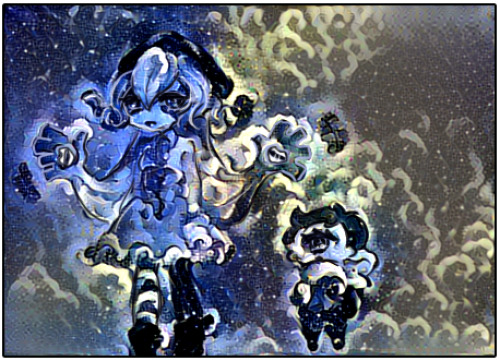
Generative ComicsExperiment from samim and manga artist Kedamami...


Generative Comics

Experiment from samim and manga artist Kedamami explores the possibilities of styling cartoons with a neural network methodology:

Comics is a medium used to express ideas via images. Their history can be traced back as far as the Lascaux cave paintings. In Japan, comics are called Manga and are wildly popular. For this experiment, I collaborated with Kedamami, a talented Japanese Manga creator, living in Berlin.

To get started, she created two custom Mangas. We then processed them with the recently published Neural Algorithm of Artistic Style (StyleNet). StyleNet captures & transfers the stylistic information of images. Countless style guide images & parameters were tested. Finally, the StyleNet outputs were manually re-processed by Kedamami.

One of the primary aims of this experiment was to explore StyleNet as a creative authoring tool.

More Here

17 Sep 10:07

Let’s Lock Them All Up Just to be Sure

by Scott Lemieux

Speaking of authoritarianism, with an extra glaze of racism:

Fourteen-year-old Ahmed Mohamed just wanted to get noticed by his teachers.

Instead, he got arrested.

In an incident that has raised allegations of racism and made a Texas school district the target of online outrage, the ninth grader was pulled out of school in handcuffs after a digital clock he built himself was mistaken for a bomb.

Mohamed, a self-assured kid with thick-framed glasses and a serious expression, had just started at MacArthur High School a few weeks ago. The Irving, Tex., ninth grader has a talent for tinkering — he constructs his own radios and once built a Bluetooth speaker as a gift for his friend — and he wanted to show his new teachers what he could do. So on Sunday night, he quickly put together a homemade digital clock (“just something small,” as he casually put it to the Dallas Morning News: a circuit board and power supply connected to a digital display) and proudly offered it to his engineering teacher the next day.

But the teacher looked wary.

“He was like, ‘That’s really nice,’” Mohamed told the Dallas Morning News. “‘I would advise you not to show any other teachers.’”

During English class, the clock beeped, annoying his teacher. When he brought the device up to her afterward, she told him “it looks like a bomb,” according to Mohamed.

“I told her, ‘It doesn’t look like a bomb to me,’” he told the Dallas Morning News.

But the English teacher kept the clock, and during sixth period, Mohamed was pulled out of class by the principal.

“They took me to a room filled with five officers in which they interrogated me and searched through my stuff and took my tablet and my invention,” the teen said. “They were like, ‘So you tried to make a bomb?’ I told them no, I was trying to make a clock.”

But his questioner responded, “It looks like a movie bomb to me.”

Mohamed told NBC-Dallas Fort Worth that he was taken to police headquarters, handcuffed and fingerprinted.

In summary, a 14-year-old made a clock. He never said it was anything but a clock. He was racially profiled and ultimately arrested on no grounds whatsoever. Surely the school is apologetic, right?

Mohamed’s family said that the teen has been suspended from school for three days.

If you’re looking to the reprehensible, self-congratulatory letter the school sent out to provide any serious explanation for why someone who was entirely innocent of anything was suspended after being arrested, you’re out of luck.

…more here.

17 Sep 10:07

Notable San Francisco: 9/16–9/22

by Charles Kruger

Wednesday 9/16: Scott Esposito talks with Mexican fiction writer Guadalupe Nettel about her first novel to appear in English translation, The Body Where I Was Born. Read Amy Rowland‘s recent review in the New York Times if you need to get motivated for this one. Free, 7:30 p.m., Green Apple Books on the Park.

Also tonight, Oakland-based novelist Ayize Jama-Everett will be in North Beach to celebrate the release of two new books, The Entropy of Bones and The Liminal War. Free, 7 p.m., City Lights Bookstore.

Thursday 9/17: Alley Cat Books presents a Triple Threat Book Launch with first books from Siamak Vossoughi, Alicia Jo Rabins, and Tracey Knapp. Siamek Vossoughi has won a Flannery O’Connor Award for short fiction; Alicia Jo Rabins won the American Poetry Review/Honickman First book Prize for Divinity School; and Tracey Knapp has received scholarships from Tin House Writers’ Workshop and the Dorothy Sargent Rosenberg Poetry Fund, among other accomplishments. Free, 7 p.m., Alley Cat Books.

Although this column usually doesn’t feature high-priced events, how could we fail to notice Miranda July at City Arts & Lectures, along with singer/songwriter Thao Nguyen? And, besides, it’s a benefit for the 826 Valencia Scholarship Program. This’ll be worth every penny. $29, 7:30 p.m., The Nourse.

Friday 9/18: ZYZZYVA celebrates the release of its Fall issue (No. 104) with readings by Molly Spencer, Joseph Di Prisco, Caille Millner, and Kathleen Alcott. Free, 7 p.m., Diesel, A Bookstore.

Omnidawn presents their Fall Book Release Party featuring Andrea Baker, Barbara Claire Freeman, Cecil Giscombe, Douglas Piccinnini, Margaret Ross, Cassandra Smith, and Emily Capettini. If you don’t recognize all these names, check out the links. This is a high-powered lineup! Free, 7:30 p.m., Moe’s Books. 

Saturday 9/19: The Monday Night Literary Journal introduces issue #14 with featured readers Raina J. León, David M. Morini, and Nicole Trigg. Free, 3 p.m., The Octopus Literary Salon.

The Aggregate Space Gallery’s Featherboard Writing Series presents art and writers together. Tonight, the art exhibition, AlterLand Escape, features sculpture, video, and multi-channel installation works by Centa Schumacher, John Tronsor, and May Wilson. Featured readers are Writer in Residence Nico Peck, Aja Couchois Duncan, and Janice Lobo Sapigao. Free, 6 p.m., Aggregate Space Gallery. 

Sunday 9/20: Small Press Traffic presents a reading and conversation with Hugo Garcia-Manriquez and Dolores Dorantes. $6-$10 (no one turned away for lack of funds), 5:30 p.m., Artists’ Television Access.

Monday 9/21: At The Inkwell: Fiction Night features Elena Mauli Shapiro, Apollo Papafrangou, Kathryn Kruse, and Carolina de Robertis. Free, 7 p.m., Alley Cat Books.

Tuesday 9/22: Nomadic Press presents the debut of Be Live About It, co-hosted by Alexandra Naughton and J. K. Fowler. The press blurb reads: Think Oakland Nights … Live meets Saturday Night Live meets The Tonight Show: in-house instrumental band, a little over one hour of programming, a featured poet, comedian, and physical performer, and a sit-down interview where the co-hosts dive into the process and personality of one of the features on that particular night. The initial line-up is yet to be announced, but, on the other hand, Nomadic Press has yet to disappoint. Free (donations kindly requested), 8 p.m., Woods Bar & Brewery.

*

This week’s theatre recommendation comes from Richard Connema of the San Francisco Bay Theatre Critics Circle, who suggests the revival of Tennessee William’s A Streetcar Named Desire presented by the Role Players Ensemble at the Village Theatre in Danville, closing this weekend, with only two performances remaining. Connema describes this production as “one of the best productions I have seen of this . . . classic.” Connema should know. As a camerman on the Warner Brothers lot, he worked on the film starring Marlon Brando. For further information, click here.

*

Evan Karp presents video of this week’s featured local author Lewis DeSimone, Click here to read an interview.

And here’s video from one of last week’s SF Notables, Pelekinesis Meets Nomadic Press and the Bay, featuring the impish Brooklyn writer, Peter Cherches.

*** 

If you have a Bay Area event listing you’d like us to consider, please contact notableSF@therumpus.net as far in advance as possible, and include the date of the event in the subject line.

Related Posts:

17 Sep 10:06

In Which We Achieve Maximum Giving Tree

by John Scalzi

At the front of our property stood four ash trees, which were lovely but over the last few years became diseased, in no small part because of emerald ash borers, which landed in Ohio in 2003, apparently, and have taken out a substantial number of trees. Including ours; three of the four were basically dead trees standing, and the fourth was on its way.

So, today, down they came, all four of them. In their place, for now, are four piles of firewood which we will use in the fire pit out back, and later, four new trees, probably maples, more or less where the ash trees stood. It will take time for them to grow to the height of the ash trees, but, you know. We’re not planning on going anywhere at the moment.

I was sad to see the trees come down, but as noted they weren’t exactly healthy trees; bringing them down was the right thing to do. In the coming months, as the nights get colder and suited for fires in the backyard, I’ll toast some s’mores in their honor.


17 Sep 10:06

creepyartetc: Artist: Takato YamamotoMore creepy art

17 Sep 10:06

Saturday Morning Breakfast Cereal - Age of Exploration

by admin@smbc-comics.com

Hovertext: I'm just saying, whenever we go to Mars, I'm not going on the first boat.


New comic!
Today's News:
17 Sep 10:06

What Do David Lynch’s Movies Say About Sex?

by Lauren Carroll Harris

[Pete and Alice are having sex]
Pete: “I want you!”
Alice: [whispers in his ear] “You'll never have me.”

- Lost Highway

Of all the terrifyingly true things David Lynch has said, this rings the loudest bells for me: “Sex is a doorway to something so powerful and mystical, but movies usually depict it in a completely flat way…” He’s dead right. Despite the ubiquity of sexual imagery and objectified women, sex is still one of our biggest taboos, and its representation in mainstream and even much independent film still so unsophisticated, so uniform, so unlike the experience and diversity of the real thing.

Lynch’s strange, disorienting, and often downright creepy take on sex – a background but essential part of his trademark – is set to haunt our screens and psyches again with the new iteration of Twin Peaks, written and directed by the man himself, to start shooting in September for the Showtime network.

Read more What Do David Lynch’s Movies Say About Sex? at The Toast.

17 Sep 10:05

“Femme On Femme” Is The Most

by Mallory Ortberg

Friend of the Toast Sara Cantor (she's single, ladies) just guest starred in her first-ever music video, describing it to me thusly: a "disco witch sex coven commits femme-on-femme glitter bondage." Reader, I watched it.

Read more “Femme On Femme” Is The Most at The Toast.

17 Sep 10:04

unicornempire: ryannorth: startrekships: airyairyquitecontrary...


unicornempire:

ryannorth:

startrekships:

airyairyquitecontrary:

blue-author:

unstoppablyplushjuggernaut:

KIRK THIS WHY YOU GOTTA FILL OUT THE LOG

I’ve heard the theory that Kirk’s logs just get circulated round headquarters for lulz before being dumped in the circular file as obvious fabrications by someone bored with a frontier posting.

“Hey, have you seen this one? He says he fought Apollo.”

“What, the old earth probe?”

“Try the old earth GOD!”

“Hilarious! Classic Kirk! That’s better than the time when he was transported to an evil dimenison.”

The reason why in The Naked Now it was Riker who remembered that the previous polywater infection had happened is that he’s the sort of person who would read The Hilarious Adventures of Captain Kirk for fun.

I especially like this idea because of the implication that all the other captains in Starfleet are reporting perfectly ordinary experiences like visiting a space station, dropping off supplies at a colony, bit of a stand-off with some Klingons in disputed space but got out of it unscathed - and then there’s Kirk all, “sorry guys we’ve been off course this week because my first officer seriously needed to get laid (LIKE YOU HAVE NO IDEA MY NECK STILL HURTS)” and “let me tell you about the Chicago Gangster planet” and “WHIPPED AND THROWN IN JAIL BY SPACE NAZIS.”

I actually really like the above explanation

I thought this was already canon

It would be pretty hard to believe a field report where evil doubles had pointy mustaches and such. I can’t really blame them.

17 Sep 10:03

A Portal to the Other Side of the Earth

by Margaret Carrigan
img1_yale portal_SS

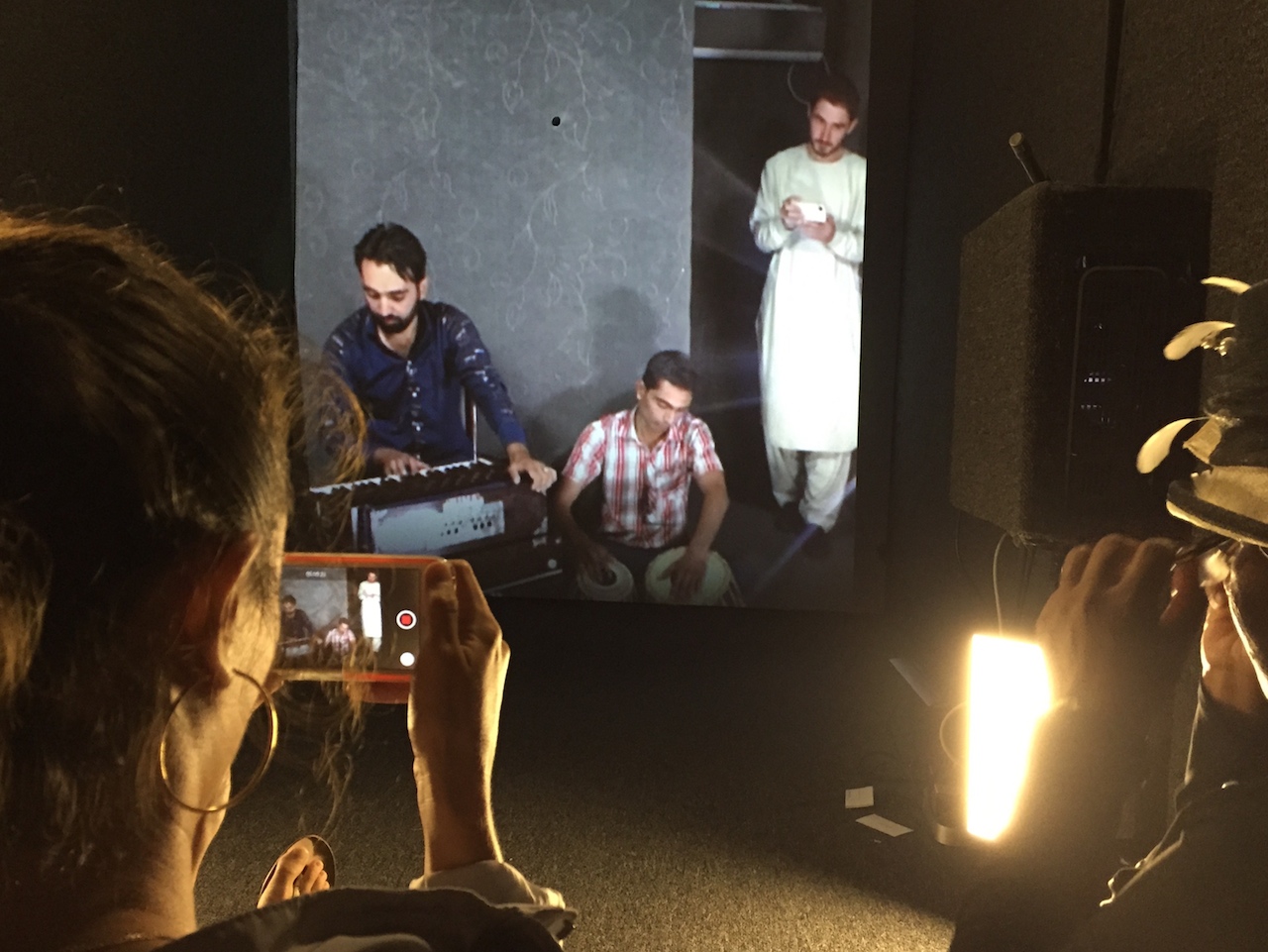
Portal at Yale University (image courtesy Shared_Studios)

WASHINGTON, DC — If pricey airfares have kept you from going abroad lately, you can travel by shipping container for free thanks to Shared_Studios’ Portals. Painted a lustrous gold on the outside and furnished with premier audio-visual technology inside, these spacious crates offer incomparably quick travel times to Mexico, Honduras, Cuba, Afghanistan, Iran, and more. The only downside is your adventure is limited to 20 minutes.

Shared_Studios launched the portals in December 2014, and they’ve been making their way across the world ever since. The latest portal cropped up on the University of Maryland’s campus, where participants signed up for 20-minute immersive video chat sessions with people located in either Herat, Afghanistan; Tehran, Iran; Mexico City, Mexico; or El Progresso, Honduras. Translators are on hand to facilitate conversation, but if you share a language with your chat buddy, you’re left alone with them to make small talk in what feels like the same room.

An art, design, and technology collective, Shared_Studios’ projects all have a social practice bent to them, seeking to connect disparate communities through communication and creative collaboration. Founders Amar Bakshi and Michelle Moghtader both have a background in foreign correspondence — Bakshi used to travel on behalf of the Washington Post and Moghtader has traveled throughout the Middle East and her writing has been featured on Reuters and CNN. By connecting geographically distant people in an immediate and sensorial way through their projects, Bakshi and Moghtader essentially cut out the media middleman — the journalist.

image 3_interiorUMD_MM

Afghan participants perform for American visitors in UMD’s Portal (photo by the author for Hyperallergic)

Nevertheless, the project faces some of the same hurdles journalists come up against, namely that of unbiased reportage. Consider that the majority of the portals have been set up on leading college campuses (US venues include Yale, Georgetown, and soon Vanderbilt) or in conjunction with art galleries. Alternatively, the portals are installed in large, expensive, liberal cities like New York, San Francisco, Mexico City, Herat, etc. To a point, this is unavoidable since universities and urban centers have the necessary resources and people to enable the portals. Yet it also skews the participating demographic toward affluent (or at least comfortable), educated, and open-minded young professionals.

I stepped into the University of Maryland portal at 10:30 pm and met Omid, a 20-something in Afghanistan who was just waking up (it was 7:30 am over there). I don’t speak Farsi, but thankfully he spoke perfect English. We chatted congenially about our jobs, upcoming holidays, and what we studied in school. Omid is in the process of applying to scholarship programs to go abroad for his Master’s; having recently completed my own MA, we commiserated over the outlandish cost of graduate programs. His smartphone dinged a few times with Facebook Messenger notifications — a reassuring global constant. I pulled out my phone and suggested we become Facebook friends; within a few minutes we were messaging each other outside of the portal.

img2_herat portal_ss

Herat portal under construction (image courtesy Shared_Studios)

In reality, the portals offer a glimpse of distant lives, but not-so-distant lifestyles. Perhaps in an effort to expand the conversation, Shared_Studios recently announced that they will connect to Zimbabwe and Jordan’s Zaatari Camp for Syrian refugees at the end of the month. But for now, as millennials with access to education and wifi, it’s fairly easy for Omid and me to be friends.

Correction: A previous version of this article incorrectly stated that Michelle Moghtader was from Iran and wrote for CNN and Reuters while she was there. This has been fixed.

The Portal at the University of Maryland was on view at the Clarice Center for the Performing Arts (College Park, Maryland) from September 9–15; it will reopen at Vanderbilt University’s South Patio Lawn on September 18 and remain on view through October 18.

17 Sep 10:02

20 Facts About Living in Poverty That Rich People Never Have to Think About

by Benjamin Irwin
A crude drawing of one person standing on a large piggy bank and another on a small oneIf you've never been poor, you probably believe some of these common misperceptions about the lives of people in poverty. Here's the truth.
17 Sep 10:02

Cops Don't Deserve Your Anger, According to Cop Leader

by Rude One
Bullying, power-mad New York Patrolmen's Benevolent Association President Patrick Lynch wants you to know that your lying eyes are meaningless when it comes to the innately good judgment of NYPD officers. Specifically, fuck you, you scum, for daring to think that Officer James Frascatore might not have had a damn good reason for tackling the shit out of former professional tennis player James Blake: "If you have never struggled with someone who is resisting arrest or who pulled a gun or knife on you when you approached them for breaking a law, then you are not qualified to judge the actions of police officers putting themselves in harm's way for the public good."

Yeah, walk a mile in their motherfuckin' shoes, dicks. Lynch goes on, "In the unfortunate case of former tennis pro, James Blake, -- who was clearly but mistakenly identified by a complainant -- there certainly can be mitigating circumstances which caused the officer to handle the situation in the manner he did." So obviously, the cop thought Blake was a violent criminal capable of...oh, what? The crime was credit card fraud? You fucking kidding? Then fuck that thug, Frascatore, and the mob boss, Lynch, who is trying to cover the thug's ass.

Lynch says, "[N]o one should ever jump to an uninformed conclusion based upon a few seconds of video. Let all of the facts lead where they will" and that cops should get a pass on such judgment because "of the dangers we routinely face." Attacking reporters all the way through, Lynch concludes, "Due process is the American way of obtaining justice, not summary professional execution called for by editorial writers."

Tell you what's not "due process," asshole. When cops routinely use excessive force in cases like this, like Eric Garner, like many, many other ones where people are either innocent or have committed, at best, non-violent crimes. And let's not even get into the militarization of the cops that has made shit so much worse, with entire SWAT teams beating up and degrading people based on misinformation. Officers in those moments are pretty much saying, "Fuck due process," and becoming judge, jury, and, in the worst cases, executioner, doing shit that, without a badge, would put anyone behind bars. The cops routinely deny people the rights that Lynch whines that his officers deserve. Respect gets respect, fucker.

At one point in his pissy little screed, Lynch bitches about accusations against Frascatore, "That is irresponsible, unjust and un-American." No, that's free speech, man. We know you have a problem with constitutional rights, but, Jesus, that's an easy one.

Look, being a cop can be a suck-ass gig. We get that. You have to deal with shit that nobody not on the job would ever understand. We keep hearing that it's only a few bad apples, that most police officers are good people who want to work to make their communities better. But you gotta be willing to give up the shitheads who fuck it up for you, who make you seem like you're the enemy. This Frascatore cocksucker should have been out of a job a long time ago.

And, frankly, Lynch looks like a total stooge for not getting out front and saying, "Yeah, this guy needs to go. He makes the rest of us look like shit."
17 Sep 09:59

Texas Police Won't Charge Muslim Boy With Clock Possession

by Kevin

As you've probably heard (Dallas Morning News Washington Post, Popehat, everybody else who gets up earlier than I do, which is apparently everybody), police in Irving, Texas, have announced that they will not bring charges against 14-year-old Ahmed Mohamed.

This is mostly because he did nothing even remotely illegal.

not a criminalThat didn't stop them from taking him away in handcuffs, though, after they decided the digital clock he built was "suspicious in nature" and that they didn't like his answers to their questions.

Just to be clear, as a New York court has just recently reaffirmed recently, you can say whatever you goddamn well please to the authorities (short of making actual credible threats, at least). Saying "the wrong thing" to a government official is not illegal. This is what the First Amendment is for.

Nor is being "suspicious" justification for an arrest, or even for stopping you on the street, unless the officer has a reasonable suspicion that crime is afoot and can actually articulate why he or she believes that. So why did they arrest him, exactly?

Well, he built this and brought it to school:

0916ahmedclock

It is a digital clock. (Ahmed likes to build things.) His English teacher thought it "look[ed] like a bomb. I'm confident that she, like virtually every other civilian, has never seen a real bomb, and this doesn't look anything like the bundle of dynamite with attached analog clock that she probably has seen in cartoons. Nor are there any explosives in this "bomb," but it does have that big digital display that we've all seen in movie bombs. The principal confirmed that this is what they had in mind. "It looks like a movie bomb to me," he reportedly told Ahmed.

But neither they nor the police ever believed it was in fact a bomb, as they all admitted later. Nor did they believe he was trying to get them to believe that. "We have no information that he claimed it was a bomb," said a police spokesman, and they never had any. "He kept maintaining it was a clock"—because it was—"but there was no broader explanation," the spokesman said. He couldn't explain what sort of "broader explanation" they were looking for, but I guess they wanted him to explain to their satisfaction that he wasn't going to use it like in the movies. The police chief seemed to confirm that this morning when he said the English teacher "was concerned that it was possibly the infrastructure for a bomb."

She almost certainly didn't use that word, for one of two reasons: either (1) it's got too many syllables for her brain to process or (2) she knows that's not what "infrastructure" even means. But the more important thing is that his statement confirms she never thought it was in fact a bomb, and the chief also admitted there was never any evidence that he "intended to create alarm" with what they insisted on calling a "hoax bomb."

He, of course, still defended what they had done, as did Irving's mayor (who has previously expressed great concern about "Sharia law" taking over in Texas, which is also stupid). This is because so many scary things have happened that "we have to err on the side of caution," he said, in this case by arresting a 14-year-old for no reason. And it was completely irrelevant, he insisted, that this particular 14-year-old was a dark-skinned Muslim named "Ahmed Mohamed." Their reaction "would have been the same" under any circumstances, he claimed.

Which is either not true or an admission that they would violate any 14-year-old's rights by arresting him or her without reasonable suspicion of a crime. Take your pick.

17 Sep 08:07

Language as Passive-Aggression

by Kelly Lynn Thomas

At the Atlantic, Megan Garber proposes a new word to describe words and phrases that have come to mean their opposite, like “honestly,” “no offense,” and “literally”:

So here’s one proposal: Let’s call these words “smarmonyms.” Because they’re the words that exist because we English-speakers can be, at times, awkward and passive-aggressive and jerky and, yes, a little bit smarmy.

Related Posts:

16 Sep 07:29

Non-religious woman who refused judge's order to meet with Christian counselor loses her sons

by Mark Frauenfelder

Holly Salzman of Albuquerque, New Mexico went to court to resolve coparenting issues with her ex-husband. The judge ordered Salzman to attend 10 sessions with a counselor named Mary Pepper (Photo).

Read the rest
16 Sep 07:26

How to make tea like a Brit

Sophianotloren

People are funny :) Also, pedants and prescriptivists piss me off. Do what works for you!

minim-calibre:

silveraspen:

shelikespretties:

mustangsally78:

babbledevice:

jenniferrpovey:

cameoamalthea:

teiocho:

reglissenoire:

clockworktardis:

betabites:

hexmeridian:

ecologistsarealwaysfine:

dustseeing:

glitterarygetsit:

ivyblossom:

turnabout:

areyoufamous:

Every time someone in fic makes tea straight in the mug, I cringe. I think, perhaps, fandom has conflated how the boys make tea on tour with how they would make it at home. When you’re on the road, especially in the United States, you can usually get a kettle, but you can’t always depend on a teapot. Therefore, you make a cup of tea in a mug, like an animal.

That isn’t how I make tea at home. I’m a Canadian with an English dad and gran, and, yes, everyone is different. But I offer my experience as a guide. My parents drink coffee in the morning and tea in the evening. My granny likes tea always. I drink it at least once a day.

EQUIPMENT

Tea requires a kettle, a teapot, a tea cosy, a mug, and maybe a spoon.

Your kettle can be electric; I like a stovetop whistling kettle. Pour any leftover water out every time you fill it. Boil as much water as the kettle holds. You’re going to want it.

Every British household has a bulk standard LARGE teapot, then maybe a few fun and fancy ones. You need a workhorse, but you also need something to show off for company. A big brown betty is nice, enough to hold more than a couple of cups of tea.

You must have a tea cosy or else your tea will go cold. A tea cosy is a quilted or knitted cover that goes over top of your pot. If you don’t have a grandmother who makes them, buy one at a craft fair from someone else’s grandmother.

Pour your tea into whatever mug you like. I only use cups with saucers at my granny’s house, and even then that’s only if she’s serving biscuits.

If you like your tea with sugar, you’re going to want a spoon to stir it. A saucer comes in handy here because then you have somewhere to put your dirty spoon.

When I’m making tea for me, I pour the milk directly from the carton in the fridge. But if I’m serving tea for company in the living room, then I’ll put the milk in a little jug. Always milk; never cream.

TEA

Just like Canadians always mean “ice hockey” when we say hockey, Brits always mean “black tea” when we say tea. We never mean green. We never mean peppermint.

Most often, we mean Tetley. Tetley has been my family’s brand of choice my entire life. We collected and sent away boxtops to collect tiny ceramic animal figures that I played with as a child. Tetley tea is sweet, but not sugary. It brews orangey brown

We all know that Louis’s favourite brand is Yorkshire. This is basically the same kind of tea. It’s a black tea, but a little darker, a bit more musty. Not, I must admit, my favourite. Feel free to write the boys teasing him for his sub-standard taste.

Tea comes in boxes of bags, no strings or tags attached. Keep your tea in an airtight and solid container. Glass is no good because the light gets through.

It’s basically impossible to get regular black tea in the United States. I have relatives who travel with tea bags. I usually drink Earl Grey or green when I’m in the States. But you have to know that it’s not the same thing. Most Brits see that as unnecessary fanciness when we just want a cup of tea.

Yes, I drink other kinds of tea. In my cupboard right now, I have some fruit teas I like to drink iced, I have a loose tea blend that’s a little caramel-y, I have some sencha, some jasmine, and a box of Earl Grey. Sometimes I make a cup with loose tea in a tea ball hanging in a mug. But when I want tea, just a cup of tea, I make a pot of Tetley.

[Photos from Wikipedia.]

HOW TO

Wikipedia has a really good step-by-step description. This is pretty much how I do it. My granny is a stickler for warming the pot before you drop in the tea bag, but I learned from my Canadian mom, who never bothered. I do like to rinse my pot, though, because there’s almost always tea in there from the night before, so you might as well use hot tap water.

(A quick note here: don’t wash your teapot. Just rinse it whenever you use it, and you’ll be fine. You want a teapot to be seasoned like a good cast iron pan. Granted, I do wipe down the outside occasionally.)

1. Boil the water. No need for a thermometer here. Just get it to a rolling boil.

2. (optional) Swirl a bit of water in the empty pot to warm it.

3. Toss in 1 or 2 tea bags, depending on the size of your pot. If you plan to drink more than one cup, go with two.

4. Fill the teapot with water. Put the lid on. Put the tea cosy on top.

5. Let it steep at least a minute. I like to pull the tea bags out before five minutes. Some people leave them in to the bitter end.

6. Pour a bit of milk in your mug. Then pour the tea. Some people prefer tea first, then milk, to better judge the amount of milk required. I recognise this as a valid preference. But I’m a milk first person.

7. (optional) Add sugar and stir to dissolve. I like milk first because you don’t have to stir if you don’t take sugar. Fewer dishes.

8. Then drink and enjoy.

9. Want another cup? Of course you do! That’s why I always make a pot of tea, even though I’m just one person.

No matter how big your mug is, you’ll inevitably find yourself wanting more tea. Too much milk? Balance it out with a bit more tea from the pot. Gone cold? Warm it up. That’s why you have a tea cosy.

(Please don’t microwave tea. Just make another pot. It’s cheap.)

Tea isn’t coffee. It’s not the kind of thing you make in the morning just to be conscious. You don’t throw it in a mug as you’re headed out the door. It’s tradition and comfort, meant to be held in your hands for warmth. It’s why we make tea whenever something bad happens, whenever we feel sad, and even when we don’t know how to feel. A cup of tea makes us feel better.

And a person who knows the way we like it makes us feel loved.

ilu. 

I have spent the last hour or so in an on-and-off-again strop over the fact that someone on the internet compared Yorkshire tea, the finest honest brew possible on this planet, to Tetley (TETLEY!!!!) and found it wanting. I don’t know who this Louis character is, but he whatever else he’s lacking in life, he’s got enough sense to have reasonable taste in tea. I’m on his side on this one. Don’t let the bastards grind you down, Louis.

Additionally: black tea does not want a rolling boil. You are scorching your tea. (Though, if you’re drinking TETLEY, there’s no reasonable tea there to scorch, so maybe it makes no difference.) Officially, black tea should be brewed in water at 205F/96C, which is just before a full boil. This makes a big difference and I’m a bit ashamed to say so because I realize how hipster that sounds. But it’s true. I learned this by being very impatient and pouring water as it was approaching a boil instead of waiting for the roll. Not letting the kettle come to a full boil just makes a better cup of tea. I accepted this as a fact and then got a temperature controlled kettle which does mechanically what I did out of impatience, which is how I learned that I was not the first person to discover that tea is scorched by boiling water.

Which is also how I know that Yorkshire is a superior tea. Because I have a mouth and tastebuds.

It also demonstrates how far down the tea rabbit hole you can go. Save yourself, friends. Don’t do as I have done. Leave me here to suffer alone! Take a box of Yorkshire with you, though. You’ll need that.

Oh, Canadians. You sweet summer children. I love your sense of humour, your mounties, your exceptionally attractive populace. In fact, I just woke up from a dream about snogging a Canadian. But for serious, I have never met tea snobs like Canadians. Y'all take this WAY more seriously than actual British people. (Nerds.)

As an Actual Brit living in Actual Britain amongst other Actual Brits, let me tell you this: we stick the tea bag (usually a supermarket red label brand, because Tetleys is the same thing but expensive and Yorkshire has a complex flavour beyond our “oh god I need a cuppa” requirements–but tastes do vary) in a mug, pour on water from our electric kettle, mash it against the side of a mug with a tea spoon because we’re sure as hell not going to wait for it to steep, are you mad? we want our tea NOW! add milk and sugar as required, then drink immediately whilst saying “oh god, I needed that”. It is ABSOLUTELY a wake-you-up drink and very few people can be bothered to faff about with a teapot.

Obviously, there are Actual British people who use teapots, and no-one’s criticising their use. But a sizeable majority make their tea as described above. Do remember that not all Actual Brits spend our days lounging in our country house clutching our teddy bear with a pot of tea on tap. We work in offices, on building sites, on service desks; most of us don’t have the time or inclination for a teapot. We’re not all Tom Hiddleston. Insisting that a teapot is The One True British Way is not only laughably inaccurate, but pretty classist.

And I bet Tom Hiddleston makes his tea in a mug too.

Yep. If it takes more than a minute from kettle to mouth, you’re doing it wrong.

Whoever was defending Yorkshire tea, aka the queen’s tea, aka the finest brew to ever exist, god bless you I say.

watching people on tumblr argue about how to make tea is my new favourite spectator sport. 

HOW COULD MY OWN NEPHEW SAY SUCH A THING

I’m with glitterarygetsit. It takes way too long to make tea in a pot for one person and teapots are buggers to clean. On the other hand, if I invited someone round to tea I’d definitely make the tea in the pot.  Since my taste buds barely exist, I like Tetley Bold, which is made from the dregs of the tea leaves. I know this because I used to live on a tea estate in Tanzania, where we grew fields and fields of tea, with a tea factory and tea pluckers carrying baskets strapped to their brows and everything. And our tea was Fair Trade tea.I think this makes me the winner in the tea snob stakes. 

lol I don’t even own a teapot. I make my tea just like glitterarygetsit said. I often see these beautiful photos of tea being posted on this site and I’m sitting here with a mug of muck that’s only useful for dunking ginger nuts in.

T

What is, however, true, is that English tea always comes with milk. You have to be really quick on your feet to get it without.

Goodness, my actual British immigrant in-laws make tea like animals almost all the time. Their relatives still in the UK, too, except on Occasions.

Also, travelers, don’t panic. We are provincial, but black tea, including imports like PG Tips and Yorkshire Gold if you happen on the right spot, is readily available in metropolitan areas in the U.S. Tetley, too, though I’m not sure it’s the same as elsewhere. (I have no idea outside metropolitan areas, because I don’t live in them.)

I GET MY PG TIPS IN BULK FROM AMAZON.

MY ANGLO FAMILY MEMBERS DRINK ANIMAL TEA. IT’S ALL ABOUT THE BUILDERS’, YO.

My Taylors of Harrogate Yorkshire Blend makes my life so much happier. Mmmm, tea.

I am reminded that I need to stock up on tea again. 

This is hilarious.

Black tea is, indeed, easy to find pretty much anywhere in the US, urban or rural. This includes most chain restaurants, though you will have to specifically request milk and they will, in fact, look at you funny.

My mother, my aunts, and my Gram (all Canadian of Scottish and English parentage–two different sides there) are/were all of the Warm the Pot First school, and thus this is how I was taught to make tea. Every one of them has their own, probably wrong, opinion about what tea to drink.

Me? Do you know how much Red Rose I’ve consumed over the years because it CAME WITH A FIGURINE? 

Made in a mug, because really, it’s just me drinking the damn tea.

Also, I load it up with so much sugar and milk that it kind of doesn’t actually matter what’s in the actual bag. 

I’m American, I have no proper place in this fight. WITH THAT SAID: In the morning, I brew my tea in a (smallish, Alice In Wonderland -themed) tea pot, and drink it from a fancy tea cup and saucer. However, my morning tea of choice is usually some sort of ridiculously-flavored black tea, like rose-violet-chocolate, pumpkin chai, pear caramel, and so on. Plain black tea is a base, people. A base to add other flavors to!

Any tea I drink after the morning pot (or two) is made in the mug, and is usually a ridiculously-flavored green tea or herbal tisane, with bonus attention given if it has hibiscus, rose, cinnamon, and possibly the word “vampire” in the name.

The moral of this story: brew your tea however makes sense to you! DRINK YOUR TEA! 

(And then follow it up with coffee.)

16 Sep 07:09

"Beware the autumn people. For some, autumn comes early, stays late, through life, where October..."

“Beware the autumn people.
For some, autumn comes early, stays late, through life, where October follows September and November touches October and then instead of December and Christ’s birth there is no Bethlehem Star, no rejoicing, but September comes again and old October and so on down the years, with no winter, spring or revivifying summer.
For these beings, fall is the only normal season, the only weather, there be no choice beyond.
Where do they come from? The dust.
Where do they go? The grave.
Does blood stir their veins? No, the night wind.
What ticks in their head? The worm.
What speaks through their mouth? The toad.
What sees from their eye? The snake.
What hears with their ear? The abyss between the stars.
They sift the human storm for souls, eat flesh of reason, fill tombs with sinners. They frenzy forth. In gusts they beetle-scurry, creep, thread, filter, motion, make all moons sullen, and surely cloud all clear-run waters. The spider-web hears them, trembles—breaks.
Such are the autumn people.”

- Ray Bradbury, Something Wicked This Way Comes (1962)e (via amber-and-ice)
16 Sep 07:07

Sno-Blo

by Erik Loomis
16 Sep 07:07

sosuperawesome: Works in progress by Dilara Yarci on Tumblr


sosuperawesome:

Works in progress by Dilara Yarci on Tumblr

16 Sep 07:07

breelandwalker: queen-of-halloween13: I don’t know why there are people who are complaining that...

breelandwalker:

queen-of-halloween13:

I don’t know why there are people who are complaining that loving Halloween is starting to be a trend, like let it be a trend, let the spoopy take over and engulf the earth

I say let Halloween take over three to four months of the year the same as Christmas does. Have early store displays, have thematic music playing everywhere, have people wish each other a happy Halloween holiday season, have even more public festivals.

RELEASE THE SPOOPY.

16 Sep 07:05

Photo


16 Sep 07:05

This is completely appropriate today.


This is completely appropriate today.

16 Sep 07:03

Photo


16 Sep 07:02

The Machinery of Death

by Scott Lemieux

I recently mentioned the case of Richard Glossip, whose execution was greenlighted by the Supreme Court despite Oklahoma’s intention to use a potentially cruel and unusual method of execution, and despite the fact that Oklahoma’s evidence that he committed the murder for which he was condemned is rather negligible.  Well, today is the day the injustice might happen:

Oklahoma is set to execute Richard Glossip, despite grave doubts about his guilt. A chorus of people that includes Republican former Sen. Tom Coburn; Virgin Group CEO Richard Branson; and Barry Switzer, the beloved former Oklahoma Sooners football coach, has called for Oklahoma Gov. Mary Fallin to grant a stay of execution. If she does not, and if the Supreme Court does not step in, Glossip will be put to death Wednesday.

The Supreme Court considered Glossip’s case in June, though the issue before the court dealt narrowly with Oklahoma’s lethal injection procedure. The court ruled 5–4 in Glossip v. Gross that states may continue to use a cocktail of drugs that has led to prolonged, possibly excruciating executions. Justice Stephen Breyer wrote a dissent suggesting that the death penalty is too broken to fix and that the Supreme Court should reconsider its constitutionality. Justice Antonin Scalia ridiculed Breyer’s suggestion, treating it as nothing more than a recycled request that a minority of the court has raised over the years: “Welcome to Groundhog day,” he wrote.

Scalia is correct. It is Groundhog Day—just not in the way he intended. Over and over again, the Supreme Court has been chillingly dismissive of serious questions about the death penalty. And over and over again, new evidence has suggested or even proved that the condemned prisoners at the center of these cases are innocent.

Two examples are particularly striking. Scalia specifically mentioned half brothers Leon Brown and Henry Lee McCollum, both on death row at the time, in one opinion. He wrote that an execution would be an “enviable” death for Brown and McCollum relative to the death of the victim—an “11-year old girl raped by four men and then killed by stuffing her panties down her throat.” In another decision, Chief Justice John Roberts ridiculed the claim of then-condemned Paul House that the scratches on his body did not demonstrate that he committed murder, but rather that he had obtained the wounds from “tearing down a building, and from a cat.” “Scratches from a cat, indeed,” Roberts wrote mockingly.

DNA evidence later cleared these men, saving the lives of Henry Lee McCollum and Paul House despite the fallibility of our institutions of justice. Unfortunately, there is no DNA test that can save Richard Glossip’s life.

The fact that his fate rests in the hands of Scalia, Roberts, and their ideological comrades is certainly encouraging!