Microsoft has said it will provide the authorities with encryption keys for any Windows PC data protected by Bitlocker, where it has received a warrant to do so. The admission comes after the FBI served Microsoft with a search warrant in early 2025 (thanks, Forbes) compelling it to provide the keys for data held and encrypted on three laptops that, the Feds claim, contained evidence proving Covid-related fraud on Guam.
The data in question was protected with BitLocker, which is automatically enabled on most modern Windows PCs to encrypt the PC's hard drive. Users can choose to store the keys on a separate device, or via Microsoft's cloud service (which is the default option). In the Guam case the keys had been stored on Microsoft's servers, and were provided to the authorities.
"While key recovery offers convenience, it also carries a risk of unwanted access, so Microsoft believes customers are in the best position to decide how to manage their keys," said Microsoft spokesperson Charles Chamberlayne, adding that the company receives around 20 such requests per year. If the decryption key is not stored on Microsoft's servers, the company can't do anything.
So: don't say you haven't been warned. Though as far back as 2005, when Microsoft launched Bitlocker, there have been claims that the FBI and other security agencies asked the firm to include a backdoor.
It is "simply irresponsible for tech companies to ship products in a way that allows them to secretly turn over users' encryption keys," said Democratic Senator Ron Wyden. "Allowing ICE or other Trump goons to secretly obtain a user’s encryption keys is giving them access to the entirety of that person’s digital life, and risks the personal safety and security of users and their families."
It seems unlikely that Microsoft will change tack here, so the best bet for anyone concerned about such issues is to look elsewhere. Apple is notably different in this area, having previously fought an FBI order to help the agency access iPhones belonging to terrorists involved in the 2015 San Bernardino shooting. In that case, the FBI ultimately bypassed Apple. Both it and Meta allow keys to be stored on their servers but, crucially, allow users to encrypt the files, meaning no third parties can access them.
(Image credit: Getty Images)
"This is private data on a private computer and they made the architectural choice to hold access to that data," said Matt Green, cryptography expert from Johns Hopkins University. "If Apple can do it, if Google can do it, then Microsoft can do it. Microsoft is the only company that's not doing this. It's a little weird…
"The lesson here is that if you have access to keys, eventually law enforcement is going to come. My experience is, once the U.S. government gets used to having a capability, it's very hard to get rid of it."
The warrant in the Guam case has been successfully executed. The case itself is ongoing and the lawyer for defendant Charissa Tenorio, who pleaded not guilty, said prosecutors had information from her client’s computer that included references to BitLocker keys provided to the FBI.
As if MicroSlop wasn't enough to kick Windows to the curb. Linux continues to improve, in the meantime.
Microsoft provided the FBI with BitLocker encryption recovery keys following a warrant request, allowing federal agents to decrypt hard drives belonging to suspects in an alleged fraud investigation in Guam, reports TechCrunch.
BitLocker is Windows' full-disk encryption feature. Recovery keys allow authorized users to access encrypted drives when standard authentication methods fail. — Read the rest
As the son of a man who was a historical reenactor, pre-internet Tolkien lorehead, and casual collector of bladed weaponry, my upbringing was of a very specific flavor. While I've overheard more complaints about the accuracy of period film costumes than anyone ever should, it did have its benefits—like getting to browse the occasional catalogs that would arrive in our mailbox selling replicas of historical and fictional swords. Hours of my youth were spent fascinated by the fact that there were people out there making Oakeshott Type XVIII longswords and copies of Gandalf's Glamdring.
In other words, I was destined from a young age to be the kind of person who'd see that Bladesong, a fantasy swordsmithing simulator, is launching in early access on Steam next week, and immediately add it to PC Gamer's task tracking software with the addendum "hell yes dude this is videogames."
(Image credit: Mythwright)
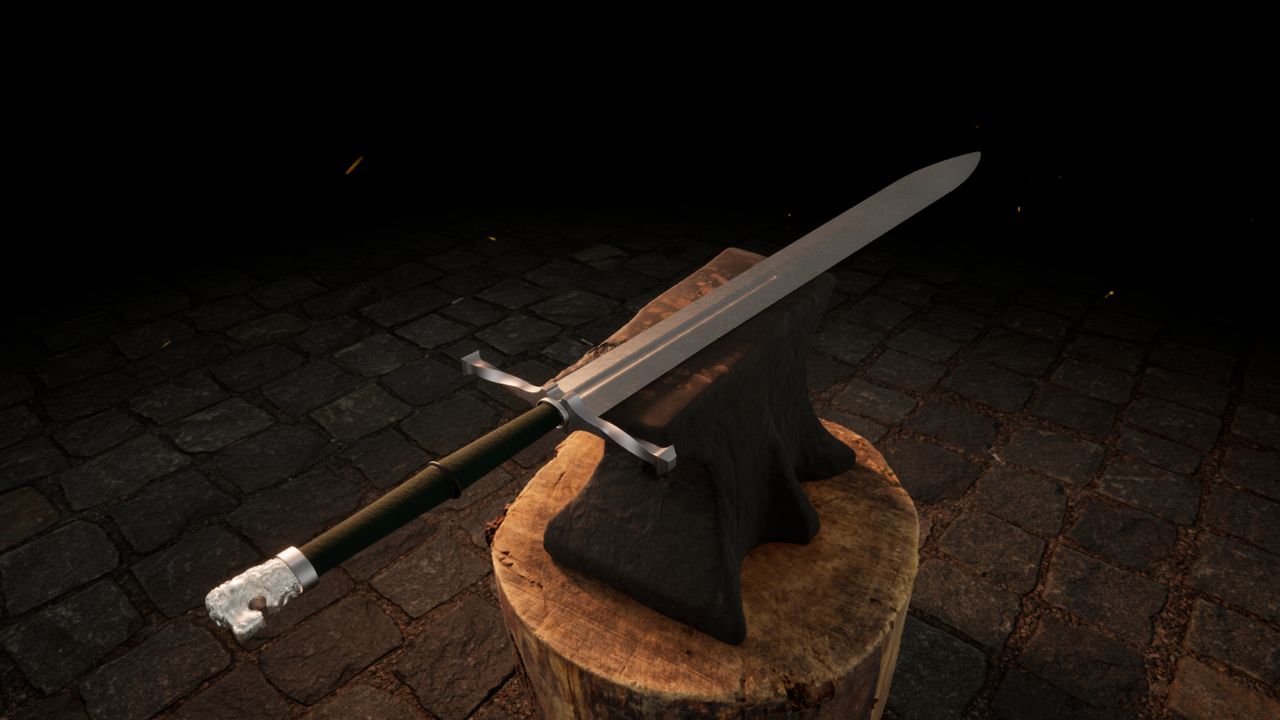
Bladesong promises an elaborate and intricate toolset for handcrafting your Platonic ideal of a cool sword—whether that's a period-accurate arming sword or a glowing, rune-etched work of high fantasy maximalism with appropriately absurd proportions. There's a demo available now, and while it only offers a limited selection of the full game's swordsmithing features, it's more than enough to stir my internal childhood sword sicko.
Bladesong's simulated blacksmithing allows shaping of a blade's length, width, thickness, and cross-section. With some precise hammering, you can taper its dimensions, or curve it, or alter the spine width and concavity of one or both of its edges. It has dynamic fuller technology. It has modular hilt construction using freely malleable quellon segments and scalable grips. It's a simulation clearly, undeniably, and admirably designed by and for extreme sword weirdos.
It also has a surprisingly compelling story mode. I expected to be working as a fantasy blacksmith, but I didn't expect to be thrust into an eerie medieval postapocalypse where I'd be shaping swords for what pockets of civilization remain in a world whose gods have died. It's good, flavorful writing—and meeting the specifications of my miserable customers is satisfying, too, requiring attention to the delicate interplay of blade weight, shape, and balance that shifts with each hammer blow.
(Image credit: Mythwright)
And that's just the demo. The early access launch will bring all sorts of additional engraving options, ornamentations, materials, and blade shaping techniques. I might have thought Glamdring was the coolest possible sword as a kid, but by this time next week, Gandalf's going to be feeling deeply inadequate.
Bladesong launches in early access on Steam on January 22.
It’s easy to look at these and assume “well, high crime cities need more police,” but i think that’s putting the cart before the horse.
Police make crime worse.
Police take fiscal oxygen out of the room, away from actual social support programs. The money spent on policing could go to housing, nutritional services, healthcare, civil rights, building inspections, labor rights enforcement, street maintenance, public transportation. But it goes to paying guys to sit around idling Ford Explorers all day and hitting poor people with sticks.
Crime follows poverty in absolutely every single case. Every single “high crime city” is because of the fucking poverty.
Please join the team that makes it possible for your friendly neighborhood comic strip Tom the Dancing Bug to exist in this world! JOIN US FOR 2026 IN THE INNER HIVE, and be the first kid on your block to get each week's Tom the Dancing Bug comic – before it's published anywhere. — Read the rest
This video is a joy to watch. Cary Elwes and Mandy Patinkin discuss how that incredible sword fight, where neither was actually left-handed, came to be.
The swordfight between Inigo Montoya and the Dread Pirate Roberts in The Princess Bride remains, somehow, the best sword fight ever filmed. — Read the rest
Outside the world of open-source computing, it's getting pretty hard to escape artificial intelligence being jammed down our throats for even the most banal tasks. Google's Gmail was already awful — it watches what you type, what you buy, and who you correspond with, all in the name of monetization. — Read the rest
Where some are sick of AI usage, others are sick of debate about AI usage. And when it comes to mentioning the use of LLMs in kernel documentation, Linux creator Linus Torvalds seems to be very much in the latter camp.
As reported by The Register, Linux kernel engineer for Oracle, Lorenzo Stoakes, recently critiqued Torvalds, arguing that AI tools are not the same as any other tool and need unique documentation and flagging. Stoakes then replied to Dave Hansen, kernel hacker at Intel, saying, "We're noticing a lot more LLM slop than we used to. It is becoming more and more of an issue."
Stoakes argues LLMs have had a negative impact in many areas, "for which you need only take a cursory glance at the world to observe". Furthering this point, Stoakes says, "Thinking LLMs are 'just another tool' is to say effectively that the kernel is immune from this. Which seems to me a silly position."
This is where Torvalds comes into the conversation. He says, "No. Your position is the silly one. There is *zero* point in talking about AI slop. That's just plain stupid. Why? Because the AI slop people aren't going to document their patches as such. That's such an obvious truism that I don't understand why anybody even brings up AI slop."
Torvals argues that he wants no kernel development documentation to mention AI, as "We have enough people on both sides of the 'sky is falling' and 'it's going to revolutionize software engineering', I don't want some kernel development docs to take either stance."
(Image credit: Jim Sugar via Getty Images)
Effectively, the 'it's just a tool' statement is one that backs up this belief. Torvalds says the "AI slop issue" won't be solved through kernel documentation, and AI documentation is, instead "pointless posturing". It is worth noting that Torvalds does see value in AI tools, as expressed back in 2024.
a. For the tech press to not gleefully report that the kernel just accepts AI patches now since hey it's just another tool.
b. To be able to refer back to the document when rejecting series.
"As to point a., as I said before in other threads, I remain concerned that the second the tech press say 'the kernel accepts AI patches now' we'll see an influx. It's sad we have to think about that, but it's a fact of life."
As is the way within the AI debate, one side argues that accepting AI work as any other directly human created work could open the floodgates for AI agents, and another wishes for it to be welcomed as any other tool. Some within the threads have highlighted patches successfully laid out by AI, but the conversation around it seems much bigger than that. There might be 'zero point in talking about AI slop', and yet the thread has only grown since.
On January 1, everything published in 1930 entered the U.S. public domain. According to Standard Ebooks, the volunteer-run project prepared 20 new free ebooks to celebrate, including some major titles: Dashiell Hammett's The Maltese Falcon, William Faulkner's As I Lay Dying, Franz Kafka's The Castle, and Agatha Christie's The Murder at the Vicarage — the first full-length Miss Marple novel. — Read the rest
Please join the team that makes it possible for your friendly neighborhood comic strip Tom the Dancing Bug to exist in this world! And be the first on your block to get each week's Tom the Dancing Bug comic! JOIN US FOR 2026 IN THE INNER HIVE! — Read the rest
Bronze instrument or carnyx dug up in Norfolk in area inhabited by Celtic tribe led by warrior who fought Romans
An “extraordinary” iron age war trumpet that may have links to the Celtic tribe led by Boudicca in the period they were battling the invading Roman army has been discovered by archaeologists in Norfolk.
The bronze trumpet or carnyx is only the third ever found in Britain, and the most complete example discovered anywhere in the world. Fashioned in the shape of a snarling wild animal, the object would have been mounted on a long mouthpiece high above the heads of warriors, allowing it to be sounded to intimidate the enemy in battle.
Too bad Inoreader cut the social features, I know a lot of us are back here because of it. Has anyone around here used Feedly, and does it have commenting and following users?
Time was, entire social castes would be dedicated to divining the intentions of the gods. Chicken entrails, the flight of birds, the rolling of thunder—all this and more was used by ancient peoples befuddled by the randomness of life, in an attempt to impose some order on the world, some meaning on their triumphs and their suffering.
We've outgrown all that these days. In the place of arbitrary and distant gods we have arbitrary and distant algorithms: vast lattices of code that no one really understands, whose purpose seems to be to make the entire world more insane and more racist.
(Image credit: Bay 12)
Their workings are indefinable, their intentions obscure, and they probably determine a vast amount of what you watch, read, and listen to. I know they do for me. Apple News feeds me news, my YouTube home feed suggests videos, Spotify introduces me to the latest and greatest music generated by data centres the size of Idaho. I don't have to think about anything at all; it just comes to me.
It's kind of awful, really—a vast abdication of responsibility on my part. Well, no more. You and me, we're making 2026 the year of the glorious return of the RSS reader.
Keep it really simple, stupid
If you're young, the notion of an RSS (that's Really Simple Syndication, by the by) reader might essentially be Lostech to you. Let me briefly explain. Time was, we used to have the means to plug our favourite websites—you know, to pick one at random, something like PC Gamer dot com—into a little bit of software that would present you with a simple, chronological feed of content published to a website. Yes, the internet used to be good.
(Image credit: Rockstar Games)
The end of Google Reader in 2013 was more or less the death knell for that era of internet and that style of content aggregation—save for podcasts, which still rely on RSS to make their way to most of your listening apps of choice. Google's RSS app was far from the only bit of kit you could use to sub to a site, but it was a popular one, and in the wake of its passing more than a few sites started to let their RSS feeds lie fallow, sparking a cycle of decline.
But to hell with that, I say. It might not have the strength it did in the old days, but RSS is still around, and you can use it yourself right now.
It might be pure heresy to invoke the brand on PC Gamer, but if you've got an Apple device to hand, I really can't recommend Reeder enough. There are two versions: Reeder and Reeder Classic. The first is a (very cheap: a buck a month) subscription and the latter is a $10 one-time buy. Either way, I've been using one version of Reeder or another for years and loved it—you can just plug your favourite websites in and live the chronological life.
If you don't have any Apple gubbins to hand, don't despair. It ain't perfect—there's AI guff in there you can generally ignore, the odd upsell, and you don't host it yourself—but Feedly is a perfectly cromulent service for anyone who just wants to dip their toe into RSS waters without much faff.
(Image credit: Behaviour Interactive, AMC)
If you decide you like the life, you can export your feeds into an OPML file to import into something a bit more robust and a bit more hosted-on-your-own-device.
Inoreader is another service along similar lines that RSS sickos recommend a lot, but I can't vouch for it personally.
But I know you. You want only the best, most intense solutions to the modern problems of enshittification. If you can't bear to get your syndicated content off someone else's servers, I recommend giving FreshRSS a punt. You can self-host it on your own server and tweak it to your heart's content, maximising privacy and customisability for an increase in faff. That's, ah, a little more advanced though. I really would recommend starting with one of the more basic solutions before you dive in.
And when you do, please do remember to stick PC Gamer on there. I'm trying to make a living here.
At what point do actions supersede words to declare intentions? Apparently we're at war with Venezuela, despite a lack of a congressional action.
If you somehow managed to miss it, not even a week into the year, everyone's favorite orange skid mark has already felt the need to plop out another distraction from the release of the Epstein Files. This one? It isn't good. — Read the rest


























![[link]](https://i.redd.it/bbye4uzx62gg1.png)
![[link]](https://i.redd.it/k3gvn4aul3hg1.jpeg)
![[link]](https://i.redd.it/enukhx1eaidg1.jpeg)
![[link]](https://i.redd.it/kc1zkma7w0dg1.jpeg)
![[link]](https://i.redd.it/fzwzs4k0sscg1.jpeg)
![[link]](https://i.redd.it/trnb5wdxplcg1.jpeg)
![[link]](https://i.redd.it/uv3cn22u5icg1.jpeg)
![[link]](https://i.redd.it/5pplvrqoxcbg1.png)
![[link]](https://i.redd.it/p6z2tl6eyxbg1.jpeg)
![[link]](https://i.redd.it/s9sh2f7mpxbg1.jpeg)