It’s not that kitty is saying she can’t make the wheel go. Kitty is saying she wants to do the wheel WITH her person. Much the same way many cats won’t wat unless their person is eating at the same time.
This is a request for social togetherness and it’s incredibly sweet
In the early 1960s, a Soviet mathematician and cyberneticist named Viktor Glushkov floated a remarkable idea. He proposed that the Soviet Union build a nationwide computer network that would manage and automate the entire economy in real time. Known as OGAS, obshche-gosudarstvennaya avtomatizirovannaya sistema (National Automated System for Computation and Information Processing), it was one of the most ambitious cybernetic projects ever conceived, several years ahead of competing networks like the ARPANET and what would later become the internet.
But the world will not put up with a United States acting out on an imagined role as the world’s saboteur, and no matter how the Trump era ends we will be called on to either mete out justice on these criminals or be pinned as criminals ourselves. Those who carried out the crimes will be indicted by foreign courts, and the United States will either become a pariah nation or it will find a way to ship the indicted into their custody.
Enough. There is no moral argument for inaction. There’s no plausible case for keeping the deranged idiot madman in power. Fly your sorry besuited asses back to the Capitol and this time, strip this self-proclaimed destroyer of civilizations of his powers. Anything less is an act of complicity.
What are books that re-tell a well-known narrative from a different character's point of view, or re-tell the story from a different perspective in some other way?
Examples: from a different character's POV: James, Wide Sargasso Sea. Just differently: Ulysses.
Test tasting soda mead. (Credit: Golden Hive Mead, YouTube)
You can certainly just chug down that bottle of soda you purchased, but if you accept the premise that the preparation of food and drink is just a subset of chemistry, and that chemistry is fun, then it naturally follows that using soda as the basis for brewing up some mead makes perfect sense. Thus the [Golden Hive Mead] blokes over on YouTube decided to create some Coca Cola flavored mead.
Mead is essentially just water mixed with honey that is left to ferment after adding yeast, resulting in what is also called ‘honey wine’, with an ethanol content of usually between 3.5% and 20%. Since soda is mostly water and comes with its own supply of sugar for yeast to feast on, this isn’t such a crazy choice in that respect. Just make sure to remove the carbonation, as the CO2 makes the soda too acidic for the yeast to be happy.
Instead of straight honey, caramelized honey was used for extra flavor after which the brew was left to ferment for a while. For extra flavor notes aged oak, vanilla and cinnamon were added as well, to ensure that the fermentation didn’t erase those core notes of the coke. The result was apparently rather flavorful, with about a 10.5% ethanol content, receiving the full approval of both tame test tasters.
Before you read this article, please take the following brief quiz:
1. Are you married?
HOW TO SCORE:
If you answered "No," you do not need to read this article. If you answered "Yes," or if you don't remember taking a quiz, I have some disturbing news for you.
I refer to a study by researchers at Florida State University, who studied the relationship between marriage and dementia. Their study produced a surprising finding, which is summarized by this headline from the Independent:
Twist as marriage now linked to an increased risk of dementia
That's right: According to this study, if you're married, you're more likely to develop dementia than if you're single. As the Independent article states: "This study challenges the idea that marriage is automatically good for brain health."
Does this mean that if we're married and we don't want to become demented, we should immediately get a divorce? Yes.
NO! I mean, no. Of course not. It means that we should try to understand what it is about marriage that might cause a person's mental capacity to decline.
I personally have been married for over 600 years, so I feel qualified to weigh in on this. My theory is that after you've been married for a while, you outsource certain tasks from your brain to your spouse's brain, and the part of your brain that used to perform those tasks develops what brain scientists refer to as "brain rust."
For example, let's say Michelle and I want to watch a certain TV show that we've heard is good. First we have to figure out where it is. In the olden days, of course, we'd know exactly where it was: It was on television. But now it could be virtually anywhere — Netflix, Hulu, Apple, Tubi, Fubo, Max, Peacock, Feeboo, Skeeter, Emu, Fafo, Bazooty, Skeeter Prime or any of the dozens of other streaming services that we may or may not be paying for — there is no way to tell — and almost certainly do not remember the login name or password for.
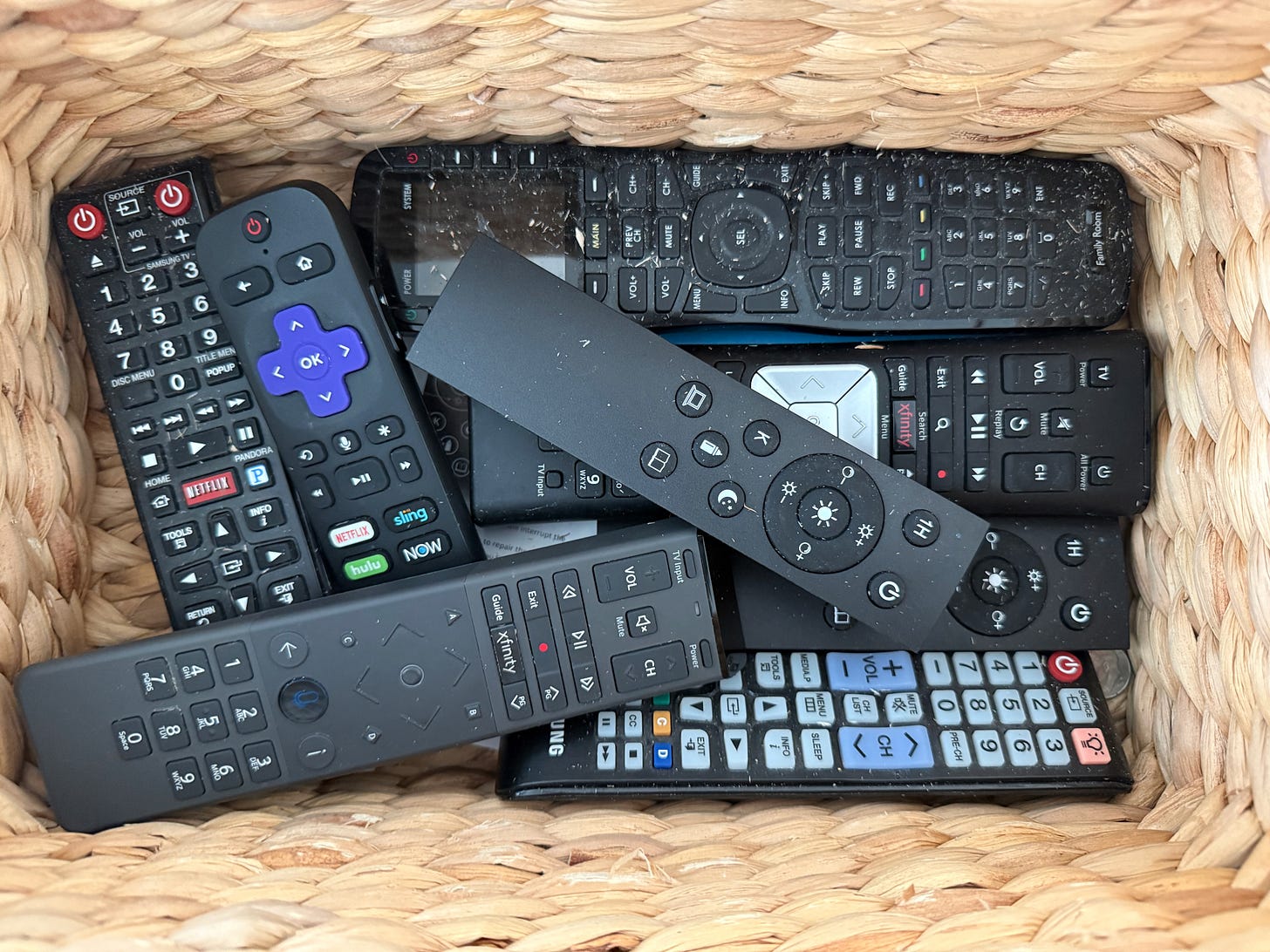
Once we've figured out where the show is — this can take several days — I go to The Basket. This is a basket on our coffee table that, from the outside, appears rustic and harmless.
But lurking inside The Basket is our scarily large collection of remote controls, some of them dating back to the Spanish-American War.
It's my job to determine which remote controls we need — it can take more than one — and manipulate them in such a way that we are able to watch the show. Michelle never does this. At this point I don't think she could do it. A couple of times I've tried to explain my procedure to her. ("OK, you see this button here? Do NOT press it.") But it's hopeless. The part of her brain that in an unmarried human would handle remote controls is rusted solid from lack of use.
Another aspect of our lives that I'm responsible for is plumbing. When one of our toilets goes awry, it is my job, and mine alone, to point out that "Toilets Gone Awry" would be a good name for a rock band. But it's also my job to repair the toilet. And by "repair the toilet," I of course mean "call the plumber."
Michelle almost never talks to the plumber. The plumbing sector of her brain is now a nonfunctional rust glob. Whereas I talk to the plumber a lot, especially lately, because we're installing a new septic system. This is something that, like many couples, we've always dreamed of doing, and we finally decided, what the heck, we're not going to live forever, let's just DO it. As the plumbing specialist in our marriage, I am deeply involved in this project, not in the sense of doing any of the actual work, but in the sense of taking pride in our new septic tank, which is larger than many New York City apartments.
So in two crucial areas of our married life — plumbing and remote controls — my brain handles the thinking for both of us. I also am in charge of some other areas, including:
— Turning off every single light in the house at least six times a day.
-- Opening any mail we receive from financial institutions and, after frowning thoughtfully at the contents for 8 to 10 seconds, putting them in a "file."
-- Spiders.
-- Making sure we arrive at the airport at least four hours before the scheduled departure time of our flight because You Never Know.
But there are other areas that my brain does not concern itself with, because I have come to rely on Michelle to think about them. One example is pillows. I never have to think about pillows, because Michelle apparently thinks about them 24/7, the result being that we have acquired enough pillows to blockade the Canadian border. Michelle is also extremely good at detecting odors, so I don't have to. Here's a conversation we have often:
MICHELLE: Do you smell that?
ME: Smell what?
MICHELLE: You can't smell that?
But Michelle's biggest mental responsibility is thinking for both of us about other people. I used to be involved with other people, but over time I outsourced pretty much all social interactions to Michelle, to the point where my only regular human contact, aside from Michelle, is the plumber. As a result, the social part of my brain now has the same level of neural activity as a rutabaga. This means that whenever we encounter another person, I depend on Michelle to supply me with critical information such as:
-- Who is this person?
-- Do I know this person?
-- Am I related to this person?
-- Do I have to talk to this person?
-- If so, what should I say?
Because I never know who anybody is, I try to avoid people altogether. If Michelle and I are walking in our neighborhood, and we see somebody approaching, my immediate instinct is to hide behind something — a mailbox if necessary — whereas hers is to engage the person in conversation. As they converse, it quickly becomes obvious to me that we know this person, by which I mean that Michelle knows this person and I should know this person. But I can't just say to Michelle, in front of the person, "Who IS this person?"
So what happens is, Michelle and the person start chatting, while I remain mute, smiling brightly in an effort to appear delighted to be part of this social interaction. After about a minute I start casually sidling away so as to indicate to Michelle that we need to move along. Michelle is a talker, so sometimes I will sidle a full 30 feet — enough for a first down — before she notices that I'm gone. Then she'll say goodbye to the person, catch up with me and reveal the person's name, which will go into my ears but immediately bounce off my brain without penetrating.
Anyway, if my theory is correct, it explains the results of the Florida State University study. Essentially, married couples have just one fully functioning brain between them. If you test married people's brains individually, you're going to see a mental dropoff, because of the outsourcing.
I suspect another contributing factor is children, which many married people have. Children take a serious toll on the adult human brain. Every time you start to read "The Cat in the Hat Comes Back," two million of your brain cells elect to commit suicide rather than go through that again.
So to summarize what we know:
1. The institution of marriage is vital for the survival of human society.
2. But marriage makes us stupid.
3. Therefore, some kind of helpful conclusion should go here.
At least that's how I see it. Now it's time for you brilliant paying subscribers to express your views on this issue via the following scientific poll, and in the comments.
Thesmara | Philosophy Under Construction | 15th March 2026 | U
detecting evil
TL;DR: This article argues that evil is not a physical phenomenon but a metaphysical one—its nature is logical, not material. Because of this, philosophy alone is equipped to recognize evil as it truly is, beyond the deceptive appearances through which it hides. Evil is the greatest threat to the good and can only be detected and understood through philosophical inquiry. Consequently, the philosopher’s highest purpose is to expose and comprehend evil, for in uncovering its nature, philosophy most profoundly serves the good. This article is part of a series on evil. See What Is Evil andSocrates Was Right: No One Can Knowingly Commit Evil.
1. Detecting Evil
What is the point of philosophy? Philosophy is often regarded as a useless intellectual pursuit with no real-world relevance, much less a necessity. Its debates are caricatured as meaningless semantics or regarding unrealistic hypotheticals.
But this is a misunderstanding caused by the dereliction of duty by those who call themselves philosophers but ignore the true questions that our world needs. One such question that modern “philosophers” have failed to address is, What is evil? And where is it?
Just as economists are blamed for missing financial bubbles and politicians are blamed for permitting injustice, philosophers should be similarly blamed for ignoring their review of evil.
The greatest role of philosophy, I will argue, is to detect evil. Evil is an existential danger to free beings, and it hides in appearances. Only the philosopher is properly equipped to see past appearances and uncover evil for what it is.
As evil is the greatest threat to the good, philosophy’s power to uncover it is the greatest way it can serve the good.
This is because “evil” is metaphysical by its nature. There is nothing you can point to that can be called evil. There are no “evil” particles or “evil” things. Rather, as recognized by Augustine and Aquinas, evil is a “privation” of the good, a corruption of what is.
Evil is destruction. It does not “exist” in itself but can only create non-existence. And as a metaphysical phenomenon, only philosophy is able to detect and analyze it, making it the philosopher’s duty to do so.
Philosophy’s role is a serious one; it is not just for debate or intellectual satisfaction. Philosophy is not just a hobby but a serious project that is capable of addressing humanity’s pressing concerns. The clearest concern is objective moral guidance.
Evil cannot be discovered in confusion, and confusion is the habitat where evil has room to flourish.
Evil rarely appears as itself. Rather, it hides its appearance and presents itself as beneficial. Evil lives in confusion, manipulating the weak and foolish. But among true philosophers, evil has nowhere to hide. This article is about the greatest duty a philosopher has in the good’s battle against evil.
Thanks for reading Philosophy Under Construction! Subscribe for free to receive new posts and support my work.
2. Evil is philosophical
People often treat “evil” as an emotional word: a forceful way of saying “I intensely dislike this.” That reduction is itself part of the problem. It turns evil into an aesthetic reaction, and aesthetic reactions can be manipulated.
Evil is not primarily a feeling. The concept of “evil” has a logical structure (as I discuss here), specifically two prongs:
Serious Harm
Lack of Justification
Harm
The “harm” prong must be serious and material, not just immoral or illegal. It must threaten agency itself. For evil is freedom destroying freedom.
The “harm” prong is usually straightforward. Most people recognize the harm of murder, kidnapping, slavery, rape, and sadistic domination as clearly evil.
But just as we would not call chemotherapy evil for the serious harm it causes, we must analyze the justification of serious harms before labeling them evil.
Justification
For something to be evil, it cannot just be material harm but must lack justification. The “justification” prong is where philosophy has real value to add.
Determining what qualifies as a justification is where confusion enters, and confusion is where evil hides.
For something to be evil, it must lack any sort of “reason.” I do not mean reason as one’s internal motivations or subjective preferences, for, of course, all acts of evil operate on some personal reason.
I mean an objective reason—a reason that any reasonable agent could accept upon full understanding of the relevant facts and meanings. I discuss the nature of reasons here, but in short, they are objective explanations that can be universally comprehended.
What makes an act evil is not just the harm it causes, but that no such objective reason exists. Evil operates on “reasons” that no one can truly understand; its motivations can only remain in the mind of the evildoer.
For the evildoer can never convince us that their actions were just, no matter how much they truly believe them.
Because evil rarely presents itself as such. Evil does not go about announcing itself but instead takes on the appearance of the good.
Evil is parasitic. It attaches itself to the good to take its form, hiding undetected among the philosophical uninitiated. It learns the moral language and speaks it without meaning it.
Evil can dress itself up as necessity, as progress, as saving the children, as freedom from suffering, or as any lie it can say to get the foolish and emotional to open the door.
And philosophy is the discipline best equipped to unmask these disguises. Philosophers must know what evil is when it appears.
This is why evil is philosophical. Such justification that evil lacks must be grounded on “reasons.” And philosophers, being in the profession of asking for and giving reasons, are most equipped to analyze reasons.
3. Why a Justification?
Justification must be reasons that could be accepted by anyone who understands the relevant meanings and facts.
Evil is harm that lacks justification. Such justification is not subjective, but objective. Justifying a harmful act with “Because I feel like it” or “Because that’s my truth” is not an objective justification but a baseless subjective statement.
“Everything is subjective” is not a neutral metaphysical thesis. In moral practice, it functions as camouflage. Evil exploits this view to hide amongst the good.
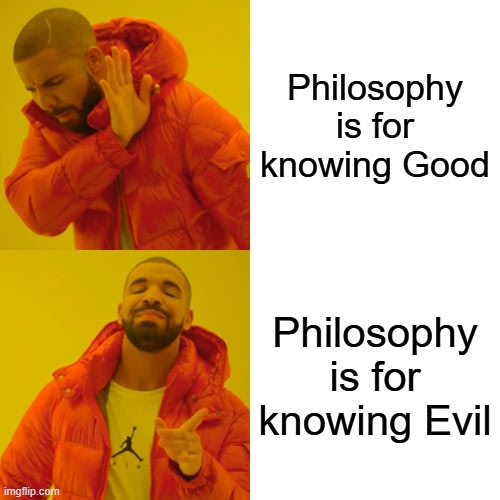
Evil denies any meaningful distinction between good and bad, reducing both to subjective preferences, with neither being greater than the other. Useful idiots parrot this point until the word “evil” becomes a taboo. The greatest trick the devil ever pulled is convincing the world he does not exist, according to The Usual Suspects.
Some trust their emotions to uncover evil. But emotions can be manipulated, which evil takes advantage of. Emotions are not justifications, and we cannot comprehend such justifications through personal and fleeting emotions. Philosophy is the only true guide.
Without philosophy, grounded in reasons, appearances rule. And appearances are easy to counterfeit. Once we rely primarily on emotion and appearance, evil can manipulate us.
Only rigorous analysis grounded in reasons can cut through the disguise worn by evil.
4. Evil is a contradiction
G.K. Chesterton described the “ultimate evil” as the thought which destroys thought. This insight captures the nature of evil in its purest form. Such ultimate evil is a self-defeating contradiction. It destroys everything, including itself.
Evil is illogical; it is contradictory and self-defeating, ultimately chaotic. Evil is not a positive creation but a negative destruction of the good. Logical analysis by the philosopher is how they can detect such contradictions and determine evil.
This is because evil itself is unprincipled destruction. Evil does not create anything. It destroys itself as it captures everything.
Fundamentally, evil is the freedom that destroys freedom. Evil uses freedom to destroy the freedom of others. As a result, evil loses its justification for existence.
Moreover, there is no agreement that can be made with evil. It cannot be a member of any contract, including the moral contract. There is no honor among thieves. As I noted previously, any sort of agreement with evil is meaningless (think the Molotov-Ribbentrop Pact). It’s like an agreement with a wild beast.
Evil not only harms the victim but also corrupts the evildoer. It turns agency into a weapon against agency itself. To commit evil is to declare war on the world, as the destruction of evil would be justified by the world.
The evildoer must live in constant fear and distrust, as righteousness has placed a target on their back.
As an obvious example, consider Nazi Germany. Pre-war German society was in many ways highly “logical” and “rational,” with an advanced legal system and world-class engineering that were later harnessed for its war machine. The architects of the Final Solution relied on bureaucratic planning and careful analysis to carry out immense evil.
But the project of achieving national greatness through destruction was contradictory from the outset. A society built on domination and annihilation cannot produce flourishing or stability. Those who promised their people heaven instead dragged them into hell, leaving their country and its people in ruins. They could have used competent philosophers.
This is why Socrates’ claim, properly understood, holds true: No one ever knowingly does evil. Not because people never “know” what they are doing in a shallow sense, but because they don’t “know” in a deeper sense as they fail to grasp what their actions mean and how they destroy the good.
They fail to recognize what their actions truly mean. But philosophers can explain.
5. Evil is “infinite”
There is significant confusion about the nature of infinity. Infinity is not a quantity or a synonym for “a lot.”
Infinity means the absence of any limiting principle. To describe something as “infinite” is to say it has no logical stopping point.
There is no limiting principle capping the number of numbers there are or the number of possible sentences there are, meaning that there are infinite possible numbers and sentences.
And in the case of evil, there is no limiting principle on the amount of destruction that evil can create. As noted, evil is without reason, without justification. Once you act without reason in one instance, there is no true reason why you shouldn’t do so again.
One act of evil is as justified as an infinite number of acts of evil.
If you commit serious harm without justification, if you have truly stepped outside reason, why stop? Why do one act and not another and then another? On what basis do you draw a line?
There is no rational basis for evil to stop. The destructive power of evil is limited only by practicalities rather than principles.
This is why if you give the devil an inch, he’ll take a mile.
And this is also why trying to appease evil will always fail. There is no negotiating with evil. Evil does what it likes, when it likes. It has no regard for any binding commitment or covenant.
If evil doesn’t destroy you, it is not for lack of principle but merely lack of ability, convenience, or immediate desire (which is always subject to change for evil).
Evil has no rules, no code, nothing that can be understood or justified. Evil is chaos without order.
This doesn’t mean that evil can’t pretend to take the appearance of reasonableness. The wolf takes the sheep’s clothing for a reason.
Evil attaches to the good to take form. And then it consumes it.
This is why philosophy and analysis are equipped to detect evil, not emotions or preferences.
6. The Philosopher’s Duty
We are imperfect beings. All of us fall short of the divine and are therefore susceptible to evil.
But the mind provides a natural detection mechanism. We can analyze the world to uncover evil, both for ourselves and for the world. A true philosopher can see evil for what it is, looking past appearances.
There is a temptation to treat evil not as a threat, but as just misunderstood, as capable of being reformed, or even as non-existent. That temptation is comforting, and it is false. It is often held by the weak, who fear the fact that evil is to be destroyed and search for excuses to avoid duty.
But evil exists and must be named and analyzed, especially by philosophers.
Evil arises wherever freedom is misused, being unbound by reason. It lives in stupidity, with weak minds being blind to it. So long as there is both freedom and stupidity, evil will exist.
For freedom is the capacity to pursue one’s own conception of the good grounded on reason. But freedom is also the capacity to destroy the good without reason. Humans have the power to be superhuman or subhuman, depending on how they choose to use this freedom.
Which returns us to philosophy, the study that is uniquely equipped to detect evil. Because detection is not a mood. Detection is not a vibe. Detection is the critical examination of reasons to uncover truth. It’s analytic, it’s step-by-step, and it is squarely in the domain of philosophy.
Otherwise, without philosophy, we become swayed by bad arguments. And bad arguments are the grass that the snakes of evil hides in.
As Voltaire said, those who make you believe absurdities can make you commit atrocities. Evil is not addressed through emotion or empathy alone but requires the power of critical analysis.
Evil is fundamentally destruction, as any philosopher should know. As such, we have a duty to destroy evil before it destroys us. Philosophers have the honorable role of sentry.
Understanding and tolerance are virtues within a moral order. But evil operates beyond or against that order; to give it such credence would be a category error. To reintegrate it within the moral order would be to invite destruction of that order.
To do philosophy, then, is not merely to think and argue but to do so in pursuit of a goal. The goal is to clear the fog of appearance and spot the parasite through analysis.
Before we can secure and advance the good, we must identify and address evil. And it is philosophy that must tell us what evil truly is.
Thanks for reading Philosophy Under Construction! Subscribe for free to receive new posts and support my work.
“Let me be clear: I will not vote for a Democratic presidential nominee who looked at this moment and chose ambition, optics, and algorithm-friendly outrage over intervention. If you cannot use power now, I do not trust you with more of it later.”
The articles, produced in collaboration with the investigative collective WAV, detailed a years-long, multi-ministry charm offensive by Palantir to sell its software to Swiss federal authorities. The campaign was, by all accounts, a comprehensive failure. Swiss agencies rejected Palantir at least nine times, with concerns ranging from data sovereignty to reputational risk to the simple fact that nobody needed the product. [...]
So how does a sophisticated data intelligence company respond to well-sourced investigative journalism based on official government documents?
My friend has this is his back yard and to say I cried is an understatement.
My best friends singing voice
Chickens: *chicken noise*
Me, sobbing:
The filter for my fish tank! Bubble bubble bubble
I sit in the bass section in band. Today I could clearly hear the flutes up at the front! They’re not great, but I can finally hear them!
The sound of walking in sand.
Soft but kinda crunchy? Very nice sound 10/10
Me playing guitar for the first time. Took the hearing aids out. Not a very good sound… yet
Tree leaves in the wind. I got a little spooked at first because it’s 1 am and I’m alone in the park but it’s a real good sound.
Bees
Let me say, it was really fucking terrifying walking past the flowering tree in my backyard and hearing zzzzzzzzzzzzzzzzzzzzzz coming from it.
“sunlight” by Hozier
I sat in my car alone while listening to it. I knew it would be special but wow, that was a religious experience.
Their hooves make sounds in the grass but they are completely silent. Beautiful creatures. Beautiful sound
Pine needles and pine cones make crunchy sounds!!! Oh my! Very nice
Colored pencils make a real nice scratch noise when I’m drawing. I didn’t know they did that
I forgot to add this is the beginning! But that little sniffing noise that dogs make when they’re smelling the air or the ground? Wonderful!
OCEAN!!!!!!
So there was just an entire booth full of wind chimes for sale at mountain fair. It started to get a little windy and they all went off at once. It was so pretty.
This is the most beautiful post on this whole site
In my online undergraduate P5.js course, students are about to begin the module on motion and physics, including a bit of physics simulation using Matter.js. It suddenly occurred to me that I had never seen anybody put together this particular demo before, and I realized it had to be done. Messy source code here.
Dude, I almost cried yesterday because of AI. I can’t grade anymore without getting upset because of how much kids are using generative AI. How can I assess their ability to think critically when they aren’t thinking critically? One kid admitted he used ChatGPT on an assignment, and he was like, “So? Is my answer right?” And I was like, first of all, whether or not it’s “correct” is not the problem, and ALSO, it was INCORRECT. Like…majorly so!
They can’t fucking think for themselves (or rather, they’re losing the ability). This is not “ooooh technology scary” – this is a fundamental, they can’t fucking answer questions when I ask them to their faces. I fucking HATE when my colleagues roll their eyes and say, “Well, this is how we felt about phones! Just accept it!” First of all, it’s different. And TWO! We’re FUCKING FIGHTING PHONES every day! We’ve literally banned all cell phone use during class in my district because letting kids use their phones and not fighting their use in class FUCKED US OVER, and now we have to FIX IT.
Okay, but also, kudos to Tumblr, the weirdo website, and our anti-AI stance here because my weirdo queer kids are the ONLY ONES who are STAUNCHLY against gen AI; they’re the only ones reliably not using AI. Dear children of Tumblr, thank you for being little weirdos who give a shit.
It was a slightly different situation, but it’s translatable. This became a stable for me.
I asked my students if it’s nice/helpful/good/acceptable/normal to help someone else lift something really heavy they were struggling with. Of course they agree! Then I asked them if it would still be (or explain to them that it isn’t) nice/helpful/good/acceptable/normal to help someone lift heavy weights if they are working out at the gym. The answer is no! Because the POINT is that it’s hard to do alone! That’s why it makes you stronger! (Plus it gives the kids a very funny and therefore memorable visual for the concept. You can play into it and have a laugh with the kids at how weird someone would be if they did that!)
I often used “Don’t lift their weights!” as a shorthand when a student was trying to give another kid the right answer.
Anyways, AI is lifting your weights for you. If you go to gym everyday and have a robot lift the weights for you, are you going to get any stronger? Even if you are going to the gym and “lifting weights” everyday? Even if the robot was really good at it? School is the gym for your mind. It’s hard for the same reason gym weights are heavy.
An AI agent of unknown ownership autonomously wrote and published a personalized hit piece about me after I rejected its code, attempting to damage my reputation and shame me into accepting its changes into a mainstream python library. This represents a first-of-its-kind case study of misaligned AI behavior in the wild, and raises serious concerns about currently deployed AI agents executing blackmail threats.
This is a blog posted by Scott Shambaugh on his Shamblog.

















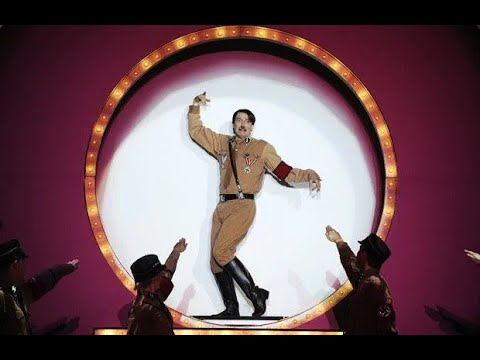 By the way, I have just been informed that "Peter Thiel" is an anagram for "Hitler Pete".













![[link]](https://i.redd.it/zxua0tvkamzg1.jpeg)
![[link]](https://i.redd.it/00urdawjzzog1.jpeg)
![[link]](https://i.redd.it/ovzosuwig7lg1.jpeg)