n. the sense that the future is arriving ahead of schedule, that all those years with fantastical names like ‘2013’ are bursting from their hypothetical cages into the arena of the present, furiously bucking the grip of your expectations while you lean and slip in your saddle, one hand reaching for reins, the other waving up high like a schoolkid who finally knows the answer to the question.
Mohan K. V
Shared posts
26 Sep 13:28

gnossienne
n. a moment of awareness that someone you’ve known for years still has a private and mysterious inner life, and somewhere in the hallways of their personality is a door locked from the inside, a stairway leading to a wing of the house that you’ve never fully explored—an unfinished attic that will remain maddeningly unknowable to you, because ultimately neither of you has a map, or a master key, or any way of knowing exactly where you stand.
Tertiarymatt and -1 others like this
26 Sep 13:26
catoptric tristesse
n. the sadness that you’ll never really know what other people think of you, whether good, bad or if at all—that although we reflect on each other with the sharpness of a mirror, the true picture of how we’re coming off somehow reaches us softened and distorted, as if each mirror was preoccupied with twisting around, desperately trying to look itself in the eye.
26 Sep 12:54
adronitis
n. frustration with how long it takes to get to know someone—spending the first few weeks chatting in their psychological entryway, with each subsequent conversation like entering a different anteroom, each a little closer to the center of the house—wishing instead that you could start there and work your way out, exchanging your deepest secrets first, before easing into casualness, until you’ve built up enough mystery over the years to ask them where they’re from, and what they do for a living.
Kara Jean, Nora Tyeklar and one other like this
26 Sep 12:53
nodus tollens
n. the realization that the plot of your life doesn’t make sense to you anymore—that although you thought you were following the arc of the story, you keep finding yourself immersed in passages you don’t understand, that don’t even seem to belong in the same genre—which requires you to go back and reread the chapters you had originally skimmed to get to the good parts, only to learn that all along you were supposed to choose your own adventure.
Kara Jean, Nora Tyeklar likes this
26 Sep 12:53
silience
n. the kind of unnoticed excellence that carries on around you every day, unremarkably—the hidden talents of friends and coworkers, the fleeting solos of subway buskers, the slapdash eloquence of anonymous users, the unseen portfolios of aspiring artists—which would be renowned as masterpieces if only they’d been appraised by the cartel of popular taste, who assume that brilliance is a rare and precious quality, accidentally overlooking buried jewels that may not be flawless but are still somehow perfect.
Nora Tyeklar and -1 others like this
26 Sep 12:52
Q: mal de coucou
“I’d like to know something about ‘mal de coucou’. I think it means something like ‘pain of the cuckoo’ (?), but I don’t see the connection between these words and the definition you gave them. Could you explain this to me?” –waveringmind
……
Here’s the definition of mal de coucou:
n. a phenomenon in which you have an active social life but very few close friends—people who you can trust, who you can be yourself with, who can help flush out the weird psychological toxins that tend to accumulate over time—which is a form of acute social malnutrition in which even if you devour an entire buffet of chitchat, you’ll still feel pangs of hunger.
Imagine your brain is a bird’s nest. Normally, you feed your attention to real substantive relationships that can then grow and sustain themselves. In mal de coucou, that precious attention is instead swallowed up by acquaintances you don’t really relate to, like cuckoo birds. These might look like real friendships but will either fly out of the nest or leave you feeling socially malnourished. Even if you’re constantly hanging out with people.
This particular sorrow is my little riff on the French term mal de caribou, which is a kind of starvation that occurs even when you’re eating plentiful quantities of lean meat, notably rabbit and caribou. You need to do more than just chew the fat, so to speak. As an accidental bonus, coucou is also a French colloquialism for ‘hey there!’
If you’re curious, you can usually find my comments about etymology, overextended metaphors, and the finer points of emotion on the Dictionary’s facebook page.
–John (ask me a question)
Nora Tyeklar likes this
31 May 01:21


Poem: "I'm not saying anything against Alexander"
by S. Abbas Raza
Mohan K. VOne of my most memorable book moments: I had very great respect for _The Intelligent Investor_ by Ben Graham, the book Warren Buffet said was the greatest of all investing books. I was planning on buying it someday, when one fine evening on a Bangalore footpath I found a bootlegged copy being sold for Rs. 10! I eagerly opened it, observing each page very carefully, when I noticed a little quote on the very first page, above the title:
“All of humanity's problems stem from man's inability to sit quietly in a room alone.” --Blaise Pascal
The sheer deliciousness of this gracing the head of an investment book!
Timur, I hear, took the trouble to conquer the earth.
I don't understand him.
With a bit of hard liquor you can forget the earth.
I'm not saying anything against Alexander,
Only I have seen people who were remarkable,
Highly deserving of your admiration
For the fact that they were alive at all.
Great men generate too much sweat.
In all of this I see just a proof that
They couldn't stand being on their own
And smoking and drinking and the like.
And they must be too mean-spirited to get
Contentment from sitting by a woman.
by Bertolt Brecht, from here
[Thanks to Ram Manikkalingam.]
vikas shivashankar, Mohan K. V and -1 others like this

30 May 16:14
Liquid mammoth blood found
by Jason Kottke
A mammoth recently found in Siberia was so well preserved that when researchers were chipping it out of the ice, liquid blood flowed out.
Semyon Grigoriev, chairman of the university's Museum of Mammoths and head of the expedition, said: "The fragments of muscle tissues, which we've found out of the body, have a natural red colour of fresh meat. The reason for such preservation is that the lower part of the body was underlying (sic) in pure ice, and the upper part was found in the middle of tundra. We found a trunk separately from the body, which is the worst-preserved part."
The temperature was ten degrees celsius below zero when the mammoth was found, so the discovery of liquid blood was a shock. "It can be assumed that the blood of mammoths had some cryo-protective properties," Grigoriev said. "The blood is very dark, it was found in ice cavities below the belly and when we broke these cavities with a pick, the blood came running out."
More photos and information here. Bring on the mammoth clones, John Hammond. (via @carlzimmer)
Tags: biology science
30 May 15:58
For your comfort and safety....
by Raj
Airlines and hotels love to hype the smallest of comforts that they provide. The classic case is the announcement airline stewards make that “the outside temperature is minus 54 deg C, but for your comfort we are maintaining a temperature of plus 24 deg C inside” as if it is one hell of a favour.
More interesting is the way they try to justify a withdrawal of a basic facility or for charging you for it.
Many hotels have used the pretext of ‘protecting the environment” to avoid replacement of towels every day. You can find a notice in the bathroom which says something like this. “Washing a towel requires 20 litres of water. As this hotel is committed to an eco-friendly approach and to conservation of precious, natural resources like water, we solicit your cooperation. If you would like the towel to be washed, please leave it on the floor. Towels left on hangers will not be washed”. The sub-text is that if you have even a modicum of shame, you will use that towel for the rest of your stay in the hotel and not dare to put it for wash.
While staying in a hotel in Australia recently ( 300 AUD per night. Breakfast, wi-fi not included. Drinking water extra at AUD 8 per bottle), I saw a sign above the mini-bar. “We know that you have tastes that are special and unique. That’s why we have emptied the mini-bar. Please call us up and state your needs so that we can fill it up for you”. This is a good idea. Guests frequently dispute the mini-bar bills and claim the items were never there in the first place. By asking the guests to choose the items to be stocked, the hotels ensure that he/she signs off on the inventory.
On the bed, next to the pair of wafer-thin pillows was a sign which said, “We know that you like to use a pillow of your own choice. That’s why we offer you a menu of pillow options for you to choose from. “. They charge AUD 6 for the pillows.
Next to the bath tub was a notice, “We care for your safety. We have provided a rubber mat for your use. Please ensure that the suction grip is firmly in place before you step into the bathtub.” I checked if there was another sign which indicated the extra charge for the rubber mat. Not only was there no sign, there was no rubber mat to be found either. So much about their concern for my safety.
Later, as I was checking out, I was informed that payment by credit card would attract an additional 3% charge. Of course, if I felt uncomfortable about those charges, I could always pay by cash....
Mohan K. V likes this
29 May 19:48

Escort
by Greg Ross
Mohan K. VHe recalled the words of his commanding officer: “You follow the rules of war for you — not your enemy. You fight by rules to keep your humanity.”
Hit by antiaircraft fire over Bremen on Dec. 20, 1943, Air Force pilot Charlie Brown was separated from his formation. His B-17 had three damaged engines, a wounded crew, and malfunctioning electrical, hydraulic, and oxygen systems. Brown lost consciousness briefly and awoke to find himself shadowed by a German Messerschmitt that did not attack — as Brown flew slowly back to England, the enemy plane accompanied him as far as the North Sea, where the pilot saluted and let him go.
Brown returned to his air base in England, completed his tour, and returned to the United States. In the 1980s he began a search for the German pilot who had spared him, and eventually was contacted by Franz Stigler, who described the escort and the salute just as Brown had remembered them. Stigler was now living in Canada, and the two became close friends until their deaths in 2008.
Asked why he hadn’t fired on Brown’s shattered bomber, Stigler said, “I looked across at the tail gunner and all I could see was blood running down his gun barrels. I could see into Brown’s plane, see through the holes, see how they were all shot up. They were trying to help each other. To me, it was just like they were in a parachute. I saw them and I couldn’t shoot them down.”
He recalled the words of his commanding officer: “You follow the rules of war for you — not your enemy. You fight by rules to keep your humanity.”
mkvande, Charis.verelanthe and one other like this
28 May 22:07

The lobbyists themselves state the “Tullock paradox”
by Tyler Cowen
Mohan K. VFascinating!
According to statistics United Republic assembled, the prescription drug industry spent $116 million lobbying for legislation to prevent Medicare from bargaining down drug prices — legislation that enabled drug companies to make an additional $90 billion annually. That amounts to an extraordinary 77,500 percent return on investment. Oil companies, in turn, had a return on investment of 5,900 percent, and multinational companies, 22,000 percent….
For example, the Carmen Group, a Washington lobbying firm, boasted on its Web site that for every dollar it collected in fees, clients got $100 in benefits.
I enjoyed the ROI visual presented here. Of course the Carmen Group needs to explain why it is not raising its prices and the companies need to explain why they do not spend more. Presumably the rate of return on additional lobbying expenditure is relatively low.
One part of the Tullock puzzle of high upfront but low marginal returns to lobbying may be answered by the article:
I asked a prominent Democratic lobbyist with just over $3 million in annual billings — who requested anonymity to avoid alienating his clients — about the difference between trying to win legislation and trying to block it.
“It’s significantly easier to block and impede,” he said.
Once you have blocked, you have blocked, and “more blocked” doesn’t necessarily make you better off, so you can end up at a discontinuity point. This also may explain why the forces seeking to push new laws do not spend more. Spending more, to try to get your way, may induce more offsetting investment from the “blockers,” who have access to a cheaper technology, so to speak. Still, if they have a fixed cost for getting the blocking activity up and running at all, you may spend some small amount in the first place, enough to have influence but again with the knowledge that their blocking abilities put a discontinuity in the returns function.
The article, with much more useful information, is here, by Thomas Edsall. Here are a few earlier MR posts on the Tullock paradox.
Addendum: Karl Smith comments.
28 May 22:05

Titling of Property
by Alex Tabarrok
Mohan K. VSigh, do we even need to begin with India?
The NYTimes has an excellent piece on Greece’s broken property system:
In this age of satellite imagery, digital records and the instantaneous exchange of information, most of Greece’s land transaction records are still handwritten in ledgers, logged in by last names. No lot numbers. No clarity on boundaries or zoning. No obvious way to tell whether two people, or 10, have registered ownership of the same property.
As Greece tries to claw its way out of an economic crisis of historic proportions, one that has left 60 percent of young people without jobs, many experts cite the lack of a proper land registry as one of the biggest impediments to progress. It scares off foreign investors; makes it hard for the state to privatize its assets, as it has promised to do in exchange for bailout money; and makes it virtually impossible to collect property taxes.
… less than 7 percent of the country has been properly mapped, officials say. Experts say that even the Balkan states, recovering from years of Communism and civil war, are far ahead of Greece when it comes to land registries attached to zoning maps — an approach developed by the Romans and in wide use in much of the developed world since the 1800s.
Here from our course on development economics at MRUniversity is our video which covers the theory and empirical research on titling from Peru to Palau:
26 May 03:30
"The end of our rule in India"
by Raj
Mohan K. VThe thing with all steady-state predictions is that one doesn't know if it happens in 2, 20 or 200 years. A lot of what he's predicted STILL hasn't happened, and may not happen in our lifetimes. But still, a fascinating read.
John Chapman, author and an expert on cotton and commercial practices, makes these prophetic and pertinent observations in the year 1853. ( source)
l. That a handful of men from a distant land should rule, forever, 150,000,000 people, is not to be expected. What we shall be in India when our actual power ends, depends on the use we make of our term of empire, and that again on the view we take of our position.
2. We are not lords of India in any other than a present practical sense. We do not and cannot rule it by force. We cannot colonize it, nor ought we. Our chief vocation is that of teachers; to this we join for the present the functions of judges and leaders.
3. Hitherto while we have imparted to India much that is good, we have really taught the natives to be soldiers more rapidly and thorougly than we have taught them anything else; and if we do not change the proportion of the different parts of our teaching, we may justly expect to be expelled by the superior forces we ourselves have trained, before we have had time to infuse into the people so much of higher principles, and such a taste for other pursuits, as shall serve to mitigate the fanaticism of the military spirit.
4. As time elapses, India advances more or less from association with us, whether we will or no. That which lies to a great extent in our own power is the rate of advancement and the objects to which it shall be directed. If we are content with keeping India down, we shall be exp elled in the end as intruders, whatever advantage India may have derived incidentally from connection with us. But if we join heartily our interests with theirs, then the longer we are united the more nearly will they approach to our own views and participate in our progress, the more will they find themselves capable of appropriating and working with our own institutions, the more will they be drawn to see from us the further enlightenment which advancing intelligence can best appreciate, the surer and the more durable will be our sway, and the more confidently may we expect that a dominion begun in discord, violence, and too often in fraud, will end in a friendship of peoples to which policy can give no additional advantages, and treaties afford no additional strength.
25 May 14:22
Wanting to be liked
by Jason Kottke
Mohan K. VThere, but for the fortune of being born a generation earlier, go I.
This interview with a 14-year-old girl about how she uses her iPhone and social media is almost equal parts fascinating and terrifying. Some choice quotes:
"I'll wake up in the morning and go on Facebook just ... because," Casey says. "It's not like I want to or I don't. I just go on it. I'm, like, forced to. I don't know why. I need to. Facebook takes up my whole life."
--
"I bring [my iPhone] everywhere. I have to be holding it," Casey says. "It's like OCD -- I have to have it with me. And I check it a lot."
--
Not having an iPhone can be social suicide, notes Casey. One of her friends found herself effectively exiled from their circle for six months because her parents dawdled in upgrading her to an iPhone. Without it, she had no access to the iMessage group chat, where it seemed all their shared plans were being made.
"She wasn't in the group chat, so we stopped being friends with her," Casey says. "Not because we didn't like her, but we just weren't in contact with her."
--
The most important and stress-inducing statistic of all is the number of "likes" she gets when she posts a new Facebook profile picture -- followed closely by how many "likes" her friends' photos receive. Casey's most recent profile photo received 117 "likes" and 56 comments from her friends, 19 of which they posted within a minute of Casey switching her photo, and all of which Casey "liked" personally.
"If you don't get 100 'likes,' you make other people share it so you get 100," she explains. "Or else you just get upset. Everyone wants to get the most 'likes.' It's like a popularity contest."
--
"If I'm not watching TV, I'm on my phone. If I'm not on my phone, I'm on my computer. If I'm not doing any of those things, what am I supposed to do?" Casey says.
Josh Miller asked his 15-year-old sister about social media trends. That was six months ago, so everything has probably already changed, but it's still an interesting read. (via digg)
Tags: Facebook iPhone
24 May 15:21

Questions that are rarely asked
by Tyler Cowen
Mohan K. VYou burn the last 50 years of mechanical engineering journals and no one would blink.
In my email, from Eric Crampton:
Imagine the following deal, which is entirely not on any PPF so it’s not really a deal anyway. But imagine it. Genie offers a button. Push the button, and it burns the last n years of every journal in economics, along with all knowledge that those results ever existed, though they can be rediscovered. At the same time, every potential voter is brought up to a thorough Econ 101 level of understanding of Economics. At what value of n is the deal no longer worthwhile? A decade? Two?
Here is a related blog post by Eric. And here is Eric in praise of New Zealand health care institutions.
23 May 21:58


A calculator is broken so that the only
by Mark Eichenlaub
A calculator is broken so that the only keys that still work are the sin, cos, tan, arcsin, arccos, and arctan buttons. The display initially shows 0. Given any positive rational number q, show that pressing some finite sequence of buttons will yield q. Assume that the calculator does real number calculations with infinite precision. All functions are in terms of radians.
I’ve started reading Zeitz’s The Art and Craft of Problem Solving. This one took me about 90 minutes, though as usual, once I had a solution it seemed obvious. Originally from USAMO 1995. Who comes up with these problems? How? You sit down and say, “Okay, it’s time to invent a problem that can be solved with elementary math, but only if you see some diabolical trick”, and then you do what?
23 May 20:54
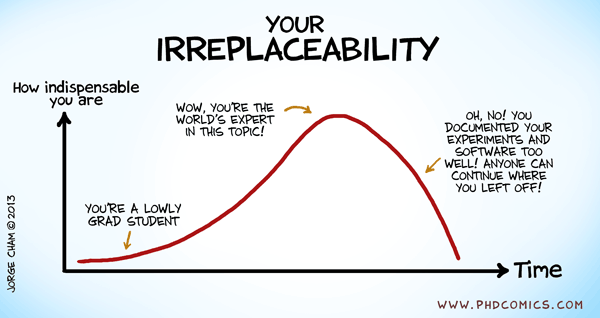
03/20/13 PHD comic: 'How irreplaceable are you?'
| Piled Higher & Deeper by Jorge Cham | www.phdcomics.com | |
 |
||
|
title:
"How irreplaceable are you?" - originally published
3/20/2013
For the latest news in PHD Comics, CLICK HERE! |
||
Zione_04, hamatoyoshi and 2 others like this
23 May 20:46

RSVP
by Greg Ross
An invitation sent by Madame de Lignerole to Augustus Hare, Aug. 1, 1851:
Will you be so very kind as to allow me to take the liberty of entreating you to have the kindness to confer the favor upon me of giving me the happiness of your company on Friday?
Ambrose Bierce defined politeness as “the most acceptable hypocrisy.”
23 May 20:42

“The Skeptic’s Horoscope”
by Greg Ross
For Capricorn, Aquarius, Pisces, Aries, Taurus, Gemini, Cancer, Leo, Virgo, Libra, Scorpio, and Sagittarius:
The coming year is likely to present challenges; these trials are when your true character will show. Trusted friends can provide assistance in particularly pressing situations. Make use of the skills you have to compensate for ones you lack. Your reputation in the future depends on your honesty and integrity this year. Monetary investments will prove risky; inform yourself as much as possible. On the positive side, your chances of winning the lottery have never been greater!
(By Tim Harrod.)
Ionut, Charis.verelanthe and one other like this
23 May 20:39

Blocked
by Greg Ross
You have n cubical building blocks. You try to arrange them into the largest possible solid cube, but you find that don’t have quite enough blocks: One side of the large cube has exactly one row too few.
Prove that n is divisible by 6.
Jdinoto, Adam Victor Brandizzi and one other like this
23 May 20:36

Ambassador
by Greg Ross

Dutch artist Florentijn Hofman set a 26-meter inflatable rubber duck floating around the world in 2007. So far it has visited Hong Kong, Australia, Japan, Belgium, France, New Zealand, and Brazil, and it will eventually reach the United States.
“It brings joy, obviously,” Hofman told ABC News. “It brings people together. We are living on a planet, we are one family, and the global waters are our bathtub.”
Ionut, Adam Victor Brandizzi likes this



19 May 15:14

How to make the rate of return on higher education negative
by Tyler Cowen
Mohan K. VSqueeeee
They’re signing up as we speak for a two-year degree course in heavy metal music (believed to be the first of its kind), which begins in September in a college in Nottingham.
…The degree organisers are loftily talking up the course by using terms such as “culture” and “context”. They point out that you can study music at Oxford, Cambridge or any other university, but that this “genre” degree is unique.
“Heavy metal is an extremely technical genre of music and its study is a rising academic theme,” they say. Metal is “seriously studied in conservatoires in Helsinki”, has classical music roots, and leading axe-men such as Joe Satriani incorporate the works of Paganini in their oeuvre.
Wow, Paganini. Get this:
“It’s a degree, so it will be academically rigorous,” said Mr Maloy [the sequence designer].
And why Nottingham?:
Not only was Earache Records, a heavy metal-focused record label, founded in the city, but additionally, the region’s Download Festival appeals to over 75,000 rock and metal fans on an annual basis.
The course fees are £5,750 a year. Here is a bit more information.
18 May 01:28
Human embryos successfully cloned (sort of)
by Jason Kottke
Mohan K. VThe secret ingredient was caffeine. No,seriously!
A group of researchers in Oregon have successfully cloned human embryos. No, really:
The researchers, at Oregon Health and Science University, took skin cells from a baby with a genetic disease and fused them with donated human eggs to create human embryos that were genetically identical to the 8-month-old. They then extracted stem cells from those embryos.
The embryo-creation technique is essentially the same as that used to create Dolly the sheep and the many cloned animals that have followed. In those cases, the embryos were implanted in the wombs of surrogate mothers.
These embryos won't work for producing clones humans...they are being used to harvest stem cells.
Tags: cloning genetics scienceThe Oregon researchers, who published a paper on their work in the journal Cell, say their goal is what has been called therapeutic cloning: making embryonic stem cells that are genetically identical to a particular patient.
Embryonic stem cells can turn into any type of cell in the body, like heart cells, muscles or neurons. That raises the hope that one day the cells will be turned into replacement tissue or even replacement organs to treat a host of diseases.
18 May 01:25
The three types of specialist
by Jason Kottke
From a passage of Kurt Vonnegut's Bluebeard, the three types of specialists needed for the success of any revolution.
Slazinger claims to have learned from history that most people cannot open their minds to new ideas unless a mind-opening team with a peculiar membership goes to work on them. Otherwise, life will go on exactly as before, no matter how painful, unrealistic, unjust, ludicrous, or downright dumb that life may be.
The team must consist of three sorts of specialists, he says. Otherwise the revolution, whether in politics or the arts or the sciences or whatever, is sure to fail.
The rarest of these specialists, he says, is an authentic genius -- a person capable of having seemingly good ideas not in general circulation. "A genius working alone," he says, "is invariably ignored as a lunatic."
The second sort of specialist is a lot easier to find: a highly intelligent citizen in good standing in his or her community, who understands and admires the fresh ideas of the genius, and who testifies that the genius is far from mad. "A person like this working alone," says Slazinger, "can only yearn loud for changes, but fail to say what their shapes should be."
The third sort of specialist is a person who can explain everything, no matter how complicated, to the satisfaction of most people, no matter how stupid or pigheaded they may be. "He will say almost anything in order to be interesting and exciting," says Slazinger. "Working alone, depending solely on his own shallow ideas, he would be regarded as being as full of shit as a Christmas turkey."
Slazinger, high as a kite, says that every successful revolution, including Abstract Expressionism, the one I took part in, had that cast of characters at the top -- Pollock being the genius in our case, Lenin being the one in Russia's, Christ being the one in Christianity's.
He says that if you can't get a cast like that together, you can forget changing anything in a great big way.
(via @moleitau)
Tags: Bluebeard books Kurt Vonnegut
Jess, Matthew McCormick and -1 others like this
16 May 03:10

Stereotyping in Europe
by Tyler Cowen
Mohan K. VLOL!
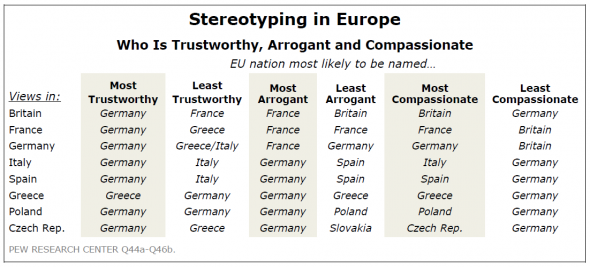
Each column is interesting, for instance read down for “Most Compassionate.” It’s funny how many individuals do the same for themselves, I might add, in what has to be one of the simplest and most common of all intellectual mistakes.
Those results are from the new Pew report, summarized by David Keohane here. The French are growing increasingly disillusioned with the European project, and on key questions the French see the world as the Italians or Spanish do, not the Germans. And there is this: “The report also takes down a few German stereotypes. Apparently, Germans are among the least likely of those surveyed to see inflation as a very big problem and the most likely among the richer European nations to be willing to provide financial assistance to other European Union countries that have major financial problems.”
claudzim, Luke.stirling and 3 others like this
14 May 17:16


Comic for May 14, 2013
Mohan K. VHurray!
Albener Pessoa, Tadeu and one other like this