Every year, Washington pours tens of billions of dollars into scientific research projects (like the brain activity mapping project). These are projects you help pay for with taxes. These government-funded investigations give rise to roughly 65,000 peer-reviewed papers a year. Weirdly, a bunch of these remain inaccessible to you, unless you hold a subscription to the journal in which they're published, and some of these journals are pretty expensive. More » Russian Sledges
Shared posts
Oh hell yes: White House announces new US open access policy for scientific papers
Every year, Washington pours tens of billions of dollars into scientific research projects (like the brain activity mapping project). These are projects you help pay for with taxes. These government-funded investigations give rise to roughly 65,000 peer-reviewed papers a year. Weirdly, a bunch of these remain inaccessible to you, unless you hold a subscription to the journal in which they're published, and some of these journals are pretty expensive. More » Baby Sloths: Adorable AND Generous
Matthew (aka "Matty") the baby three-toed sloth bestows upon his handler/the luckiest woman on Earth (aka "Claire") a single hibiscus petal at the Sloth Sanctuary/Miracle Factory in Costa Rica. More » Scrolling through the Waterstone's Twitter is my new favourite pastime
Let’s take a look at a few of my favs so far;
Sassy Waterstones worker, I love you,
And well this is true:
Sometimes I do worry about their psyche though:
They make up cool new words;
They’re a sassy little shit.
And best of all, the Holden debacle;
And one more for good luck:
Kraft’s subterranean cheese cave, Missouri by Christoph...

Kraft’s subterranean cheese cave, Missouri by Christoph Morlinghaus
“More than three-quarters of the food consumed in the United States today is processed, packaged, shipped, stored, and sold under artificial refrigeration. The shiny, humming stainless steel box in your kitchen is just the tip of the iceberg, so to speak—a tiny fragment of the vast global network of temperature-controlled storage and distribution warehouses cumulatively capable of hosting uncounted billions of cubic feet of chilled flesh, fish, or fruit. Add to that an equally vast and immeasurable volume of thermally controlled space in the form of shipping containers, wine cellars, floating fish factories, international seed banks, meat-aging lockers, and livestock semen storage, and it becomes clear that the evolving architecture of coldspace is as ubiquitous as it is varied, as essential as it is overlooked. […]
Despite the efforts of industry bodies, government agencies, and industrial archaeologists, this vast, distributed artificial winter that has reshaped our entire food system remains, for the most part, unmapped. What’s more, the varied forms of these cold spaces remain a mystery to most. This guide provides an introduction to a handful of the strange spatial typologies found within the “cold chain,” that linked network of atmospheric regulation on which our entire way of life depends. […]
Welcome to the coldscape: the unobtrusive architecture of man’s unending struggle against time, distance, and entropy itself. ”
Free binder of texts - printouts from Harvard (Medford)
Sale of 'stolen' Banksy mural cancelled at 11th hour
Auction in US halted after Haringey residents campaigned for artwork to be returned to shop it was removed from
The controversial auction of a Banksy mural that disappeared from the wall of a North London shop in mysterious circumstances was dramatically halted on Saturday just moments before it was due to go under the hammer.
Slave Labour, a spray-painted artwork depicting a child making union flag bunting and seen as a critical social commentary on last year's diamond jubilee, was expected to sell for about $700,000 in a sale of street and contemporary art in Florida.
But auctioneer Frederic Thut, the owner of the Fine Arts Auction Miami art house, who had refused all week to divulge the identity of the seller or how it came to be listed for sale through his gallery, announced that the piece, along with a second work by the secretive British street artist, had been withdrawn.
He would not give a reason, but community leaders in Haringey, who led a vocal campaign to stop the sale of the artwork that was prised from the wall of a Poundland in Wood Green 10 days ago, were jubilant.
"One of our two demands was that it doesn't sell and the other was that we get it back again, so we're halfway there," said Alan Strickland, a Haringey councillor.
"I will be writing to the auction house as a matter of urgency to clarify what happened and what will happen next, but for now we are really pleased that because of the pressure and the strong views of the people of Wood Green, a community campaign in London has had an impact in the US. It's a real victory for the people."
Claire Kober, the leader of Haringey Council, wrote to Arts Council England and the mayor of Miami, Tomas Regalado, to ask them to intervene to stop the sale but it appears that the decision to withdraw the item came from the gallery owners in consultation with their lawyers. The FBI refused to confirm reports that they were asked to investigate.
About 30 potential buyers attended the sale of 106 lots listed in the catalogue for the modern, contemporary and street art sale in Miami's trendy Wynwood neighbourhood. The three-hour auction continued with other early lots selling in excess of their asking prices.
Critics have accused the auction house of dealing in stolen property but Thut insisted earlier in the week that the consignor, who he described as a "well-known collector", was the rightful owner and that the sale was legal.
He added that his gallery had been inundated with emails and phone calls from the UK, saying that many of them were abusive or offensive, but said that he supported the inclusion of the pieces in the sale because it would preserve them.
The second Banksy due to be auctioned, a 2007 artwork entitled Wet Dog that was removed from a Bethlehem wall and is estimated to be worth up to $800,000, disappeared from the auction house's online catalogue at lunchtime yesterday, but Slave Labour was still listed for sale right up to the 3pm start time.
Thut said that the two pieces, supplied to him by separate owners, neither of them British, were important works in the street art scene and deserved buyers "whose first interest is in art and its preservation".
He said that he would maintain the privacy of the collector who put it up for sale. "We respect our clients and their confidentiality. It's not our decision to have [the Banksy] returned. We only sell it. We do not have control of it."
A spokesperson for Poundland said it had no idea who removed the 4ft x 5ft slab from the side of its shop it rents in Turnpike Lane. Meanwhile, lawyers for the owners of the building, a company called Wood Green Investments Ltd, have refused to confirm if they they had anything to do with the episode.
Banksy himself has not commented on the Slave Labour furore, but has in the past condemned those who have tried to sell his artwork, speaking out before the proposed sale of five of his pieces at a 2011 auction in New York. None found a buyer.
Stephan Keszler, the dealer behind that auction, believes selling Banksy's works without his permission is legitimate.
"He does something on other people's property without asking. The owner of the property can do whatever they want with it," Mr Keszler said.
Richard Luscombeguardian.co.uk © 2013 Guardian News and Media Limited or its affiliated companies. All rights reserved. | Use of this content is subject to our Terms & Conditions | More Feeds
Vt., NH, Warn Of Gas Smell In Some Water Bottles
BURLINGTON, Vt. — The Vermont and New Hampshire health departments are warning people to check for gasoline smells in some 3- and 5-gallon water jugs.
The warning is being issued after reports from Massachusetts and other states found that plastic water bottles of those sizes may have become contaminated by being used to store fuel and then recycled back to drinking water bottlers after Super Storm Sandy.
Only 3-gallon or 5-gallon water containers are affected.
Tests in Massachusetts found chemical traces in a Poland Spring bottle, although it’s possible bottles from other suppliers are affected as well.
Anyone in Vermont who finds water bottles with a chemical odor should notify the Vermont Department of Environmental Conservation.
For those who detect a fuel odor, arrangements can be made for replacement bottles of water.
9 Pieces of Impossible Music: Over 50 Years of Classical Trolling
Composer John Stump (1944 - 2006) created brilliant pieces of unplayable music marked by hilarious annotations - including “Like a dirigible!” “Gong duet.” “Rigatoni” and “Apply brown liquid now.”
His best known piece, “Faerie’s Aire and Death Waltz (from ‘A Tribute to Zdenko G. Fibich’)” was composed in 1980. Here’s an attempted performance presented by the Colorado State Music Teachers’ Association.

“Remove cattle now.” “Light explosives now… and now.” “Play ball!”
Stump also wrote “String Quartet No. 556(b) for Strings In A Minor (Motoring Accident)” (1997):
“Shock therapy may be necessary to finish.” “If you can’t play this, why don’t you call your Mommy.”
Here’s one more Stump masterpiece - “Prelude and the Last Hope in C and C# Minor” (1971). This composition is a bit more subtle and predates his absurdist works, although it’s obviously impossible by the end.
Inspired by Stump, Japanese composer Yamasaki Atusi created “Atushi Ojisama and Ijigen Waltz (from “A Tribute to Yamasaki Atushi”)” in 2007 - going so far as to include a picture of himself within the music.
“Avoid lumping” and “If you can’t play this, why don’t you call Atushi” were included as tributes to Stump a year after his passing.
Here’s Andrew Fielding’s 1992 “Lament of the Introspective Turnbuckle” created as the supposed “Theme of the 1979 Miss Albequerque, New Mexico Swimsuit and Short Fiction Writing Competition”.
“Quasi intellectuo.” “Unannounced layoff.” “You mf!!” “Take coda except Tue. 7-9 A:W Street Cleaning.” “Also on laser disc.”
Before there was Stump, the Italian composer Sylvano Bussotti (1931-) created pieces such as "Pieces de chair II for piano, baryton viola, female voice and instruments" (1960) without the assistance of a musical typewriter.
In 1969, Canadian composer R. Murray Schafer (1933-) also got into creating satirical sheet music by hand with pieces such as "Divan I Shams I Tabriz" (1969)
Carrying the tradition over to recent times, in 2007, SNL and Portlandia’s Fred Armisen released “Jens Hanneman: Complicated Drumming Technique”.
The instructional video showcases Armisen taking himself very seriously as a Scandinavian master of ridiculous time signatures such as 29/2. The DVD, of course, came with 8 pages of impossible sheet music:
Finally, here’s a song called “Bad Dudes”. This has been in my files since around 2008, and I have no idea of its origins. It’s definitely possible to play this one, but I figured I should throw it in either way for all the bad dudes out there.
"Bad song. I’m a bad dude, yes sir, I am! Why not let the world crumble to pieces. I live in a bad place. I’m a bad dude!"
Of Sisters and Clones: An Interview with Jessica Rath
The story below is cross-posted from Venue, where you can also read about performing horses and saloon cats in the Denver Public Library archives and pop-up opera at Whole Foods in Miami. Venue — a pop-up interview studio and multimedia rig traveling around North America through September 30, 2013 — is a project of the Nevada Museum of Art’s Center for Art + Environment, Future Plural, and Studio-X NYC, with funding provided by the Western States Arts Federation (WESTAF), Nevada Arts Council, and the National Endowment for the Arts.
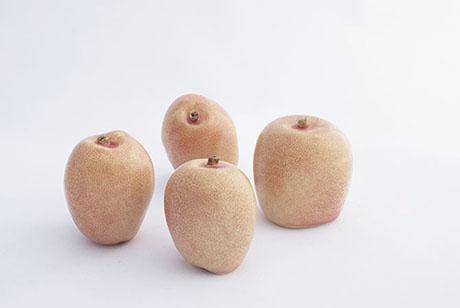
Kazakhstan Elite, Jessica Rath, high-fire glazed porcelain, 2012; photograph courtesy Jessica Rath.
Every apple for sale at your local supermarket is a clone. Every single Golden Delicious, for example, contains the exact same genetic material; though the original Golden Delicious tree (discovered in 1905, on a hillside in Clay County, West Virginia) is now gone, its DNA has become all but immortal, grafted onto an orchard of clones growing on five continents and producing more than two hundred billion pounds of fruit each year in the United States alone.
Embedded within this army of clones, however, is the potential for endless apple diversity. Each seed in an apple is genetically unique: like human siblings, seed sisters from the same fruit remix their source DNA into something that has never been seen before — and is likely, at least in the case of the apple, to be bitter, tough, and altogether unpalatable. The sheer variety of wild apples is astonishing: in its original home, near Almaty in Kazakhstan, the apple can be the size of a cherry or a grapefruit; it can be mushy or so hard it will chip teeth; it can be purple- or pink-fleshed with green, orange, or white skin; and it can be sickly sweet, battery-acid sour, or taste like a banana.
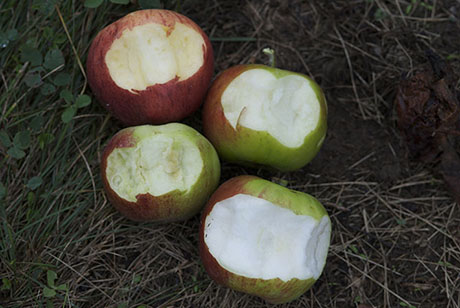
Tasting apples at the Plant Genetic Resources Unit; photograph by Jessica Rath from her 2009 visit.
In Geneva, New York, these two extremes — the domesticated apple’s endless monoculture and its wild diversity — can be found side-by-side. As part of the national germplasm system, America’s apple archivist, Philip Forsline, has assembled and tended a vast Noah’s Ark of more than 2,500 apple varieties: two clones of each, in order to preserve the fruit’s genetic biodiversity. Meanwhile, on the same Cornell/USDA Agricultural Experiment Station, Susan Brown, one of the country’s three commercial apple breeders, develops new clones by cultivating wildly different seed sisters.
In 2009 and 2011, artist Jessica Rath visited both the Apple Collection at the USDA’s Plant Genetic Resources Unit and the Cornell apple-breeding program, creating a body of new work, currently on display at the Pasadena Museum of California Art under the title take me to the apple breeder.
Rath’s original goal was to create slip cast porcelain sculptures that embodied the incredible — and now endangered — range of the apple’s aesthetic potential; revealing the charms and qualities it has developed through co-evolution with humans as a reflection of our own desires and will. During her visit, however, Rath also became fascinated by the conjoined twin of Forsline’s apple archive: Brown’s speculative sisters and successful, selected clones, which she photographed as bare-branched trees against a white backdrop.
Intrigued by the idea of artwork that reflects on the complicated threads of selection and preservation that bind humans and apples together, Venue toured the exhibition with Rath. The edited transcript of our conversation, which ranges from the trickiness of Vegas Red glaze to the future of apple breeding, appears below.
• • •
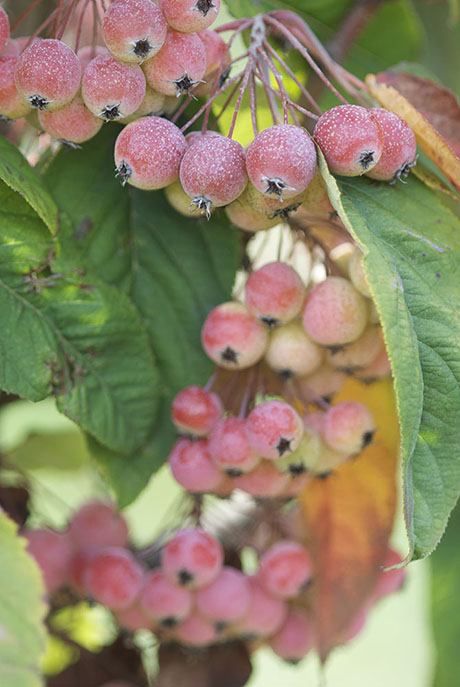
PI 588933.12 (unnamed cluster); photographed on the tree by Jessica Rath during her 2009 visit.
Nicola Twilley: How did you come to visit the Apple Collection at the USDA’s Plant Genetic Resources Unit in upstate New York?
Jessica Rath: I read about it in Michael Pollan’s The Botany of Desire. The first chapter is about apples, and he visits the orchard in Geneva. I read that section and I knew I needed to make work about it. I don’t do that very often but that passage, where he writes about the variety of the apples and the way they look and taste… I wanted to make something as intriguing as that — I wanted to get you to feel that crazy diversity. I sat on that for years. I wanted to go there, but I had no idea how I was going to make work about it.
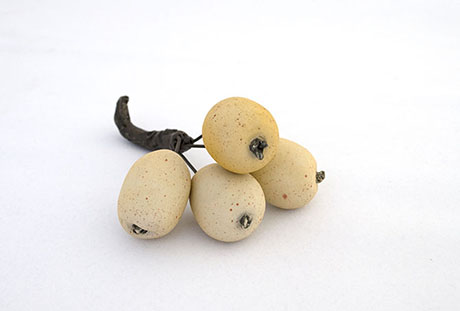
Sunset cluster, Jessica Rath, high-fire glazed porcelain and bronze, 2012; photograph courtesy Jessica Rath.
I just bookmarked it, and then my apricot tree died. I made a peel — an inverted mould, I guess — of this dying tree, and I made a slip cast of its one, last fruit. I’ve changed mediums constantly in my practice — I usually do site-specific installations or I do performance work — but I talked to some sculptor friends to find out how to create a sort of glowing, golden aura for this last apricot, and they all said slip cast porcelain. So I made it, and I looked at it and, and I thought, that’s not it. That’s not good enough. But it did glow. And that’s what made me think I was ready to do something with the apples. I thought, if I can make them glow, then I can make this work. So that’s when I raised some money on Kickstarter to be able to get there.
That was the other piece of the puzzle that fell into place. My daughter was a baby and I hadn’t read anything in months, but I was on a flight and I picked up The New York Times, and there was an article about Kickstarter. I went home, I raised money on Kickstarter, and I got it about a month before the end of apple season; so I raced over to the Plant Genetic Resources Unit for a forty-eight hour visit.
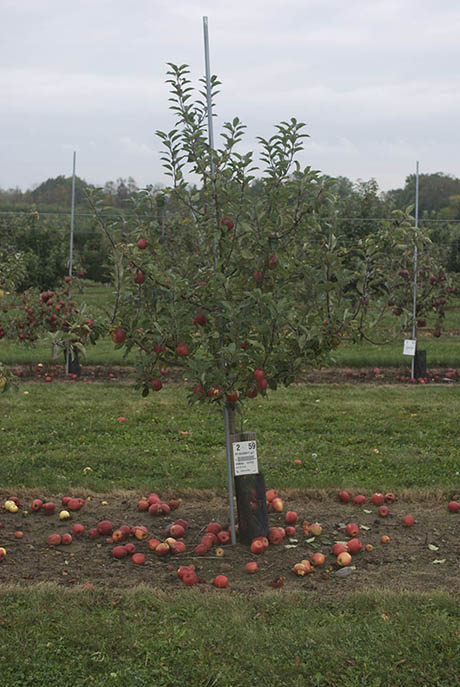
Scouting for apples at the Plant Genetic Resources Unit; photograph by Jessica Rath from her 2009 visit.
I learned a lot while just scouting on the first day, from a man named William Srmack who manages the orchards and works directly with Philip Forsline, who’s the curator of the collection. On the second day, I just collected apples. I brought home several hundred apples. Part of the Kickstarter money bought an extra refrigerator for the studio and I loaded it and kept it pretty cold. I took a lot of photos of the fruit on the tree, and in a light box, too.

PI 483254.22 (unnamed—sunset cluster); photographed on the tree by Jessica Rath during her 2009 visit.
Twilley: Let’s look at the sculptures. If I understand correctly, although each pair or cluster represents a different breed, they’re not casts of specific, particular apples, but rather abstracted, ideal forms — or ur-apples — that embody the breed’s characteristic shape and colour.
Rath: Exactly. With slip cast porcelain, you lose thirty percent of the volume when you fire. So, even if you wanted to do a cast of the original apple, you couldn’t get the same scale because it would be shrunk by thirty percent, which not only makes it too small, it also miniaturizes the features. It makes it kind of a caricature. It isn’t just small, it’s cartoonish. So it doesn’t work.
I already knew I had to make an object thirty percent larger in order to get the scale right. But the other thing is that I didn’t want to make something descriptive. I wanted to make something that communicated something about the wild diversity of these apples and the ways that they embody different facets of our desires through the science fiction of breeding — the thing Michael Pollan is writing about.
When you describe things accurately in a botanical drawing sort of way, it dies. When artwork is too illustrative, it can only describe and it can’t go any further than that. You recognize it and then you stop being interested. You’re amazed at the replication, you’re amazed at the representation, but then you actually can’t think about it as anything other than its finite definition.
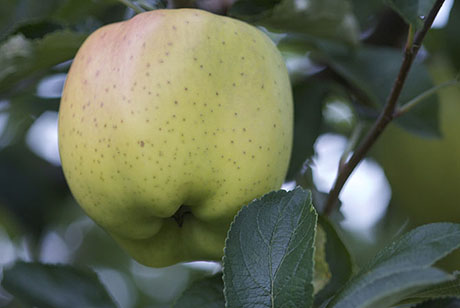
A Yellow Bellflower photographed on the tree by Jessica Rath during her 2009 visit. The Yellow Bellflower is thought to have originated in Burlington, New Jersey, and is still grown as an heirloom variety today. It is described as a “large, handsome, winter apple” that is equally delicious when used for cidering, baking, or eating out of hand.
For my sculptures, the shapes are very similar to the original. They’re just pushed a little, so that the things about them — the sculptural elements about them, their particular volume or tilt, or how fat and breast-like they are — are composed three-dimensionally in such a way that you notice them a bit more, and they pop a little. They’re not on a tree. They’re not something that’s dangling that you want to pick because you want to eat it; so, instead, I have to make them attractive through a very different model — an art historical model. I’ve got to present them like they’re a still-life, and compose them in that framework, so that you can be intrigued by them again the way you would be if you saw them as a fruit on a tree.
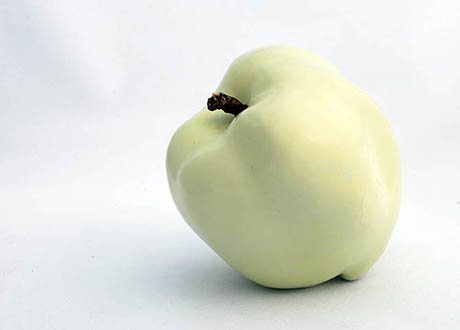
Yellow Bellflower, Jessica Rath, high-fire glazed porcelain, 2012. Rath explained that she focused on the Bellflower’s “fantastic curves and lilts. It was very muscular — even beefy — to the point where it felt almost as though it shouldn’t be called an apple, but rather some other fruit instead.”
Geoff Manaugh: In the exhibition brochure, it says it took two years of experimentation to arrive at these glazes. Can you talk a bit more about that chemical process?
Rath: In ceramics, there are low-fire glazes, which are very descriptive. They stay the same colour. Then the high-fire glazes have more of a glow to them. They also just have a lot of materials in them, and are a lot more unpredictable. You’ve probably seen it at pottery stalls at the fair: when you look at all the mugs or plates or whatever that have all been dunked in one kind of cerulean blue, they will all have turned out slightly different. Some of them will be light blue or whiter or purplish, depending on where they were in the kiln and how thick the glaze was on it and how it dripped.
I originally did that apricot, that last fruit, in a low-fire glaze. But for the apples, I steered away from being that descriptive with the glazes because they died for me, except for ones in which I would layer quite a few low-fire glazes. There’s this fuzzy speckling you can get in low-fire, which I wanted.
Normally, you would make little rectangular tiles of clay and you’d fire it and you’d have fifty little things to test the glaze on, till you got roughly what you want. But these apples are round and irregular rather than flat, and the glaze moves on them in very particular ways depending on the size and the angles of their curves, so I couldn’t test on strips. I had to test on the object.
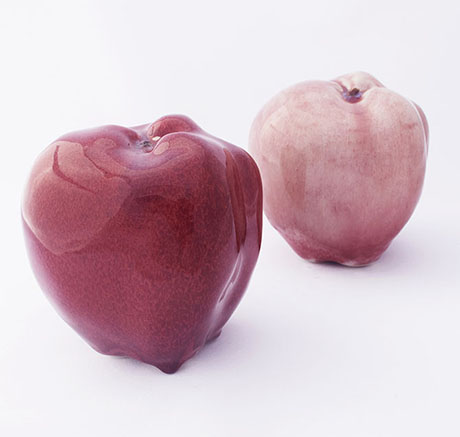
Deacon Jones, Jessica Rath, high-fire glazed porcelain, 2012. The Deacon Jones is the largest apple in Rath’s inventory, at a magnificent and somewhat incredible seven inches tall
This one [shown above], the Deacon Jones, probably took one hundred tests. This was the hardest one, even though it’s the straightest glaze. All of the others are tweaked a little, but the glaze on this is pretty straight. It’s called Vegas Red and it does get this red but usually only in parts or pieces, say, at the bottom of the bowl. It doesn’t stay a solid red. And it also drips. So to get it to actually sit there and get this red all over is one out of one hundred, if you’re lucky.
It’s also down to a very, very close relationship with the ceramic technician that took about two years to build, so that after two years of watching me fail over and over again, he put it in a sweet spot in the kiln. He’s Japanese, and he’s pretty old-school, and I think he thought I had finally worked hard enough that I deserved a sweet spot. There’s only one or two of them in the kiln. All of a sudden I got three perfectly red apples in a month. I knew I was improving over time, but it was that relationship, too.
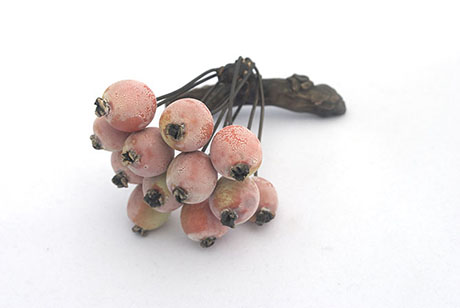
PI 588933.12 (Unnamed cluster), Jessica Rath, high-fire glazed porcelain and bronze, 2012.
This is an unnamed apple [shown above], which is based on trees in the orchard that were grafted from wild apples in Kazakhstan, from the original home of the apple. It’s low-fire over high-fire. I was interested in this sort of speckling blush that they had, but then the blush took over. My approach was to get to a point with the experimentation where I found something that grabbed me and then let it go with that and work with that.
Twilley: That sounds a little like the apple breeding process.
Rath: Yes—I found a quality I liked and then I bred and bred to refine it, essentially. This is a Dulcina, which is another one with a blush that I arrived at while I was trying to get the rest of it into a more green or yellowish stage. I loved the metaphor of the night sky that’s held in it, so I just went for that.
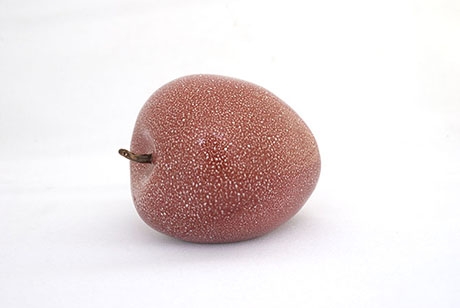
Dulcina, Jessica Rath, high-fire glazed porcelain, 2012.
There’s supposed to be an edition of two of each of these apples, and I’m unable to replicate this one. It’s the last one. I’m still working on it. After you leave, I’ll go up to the kiln again. The idea of producing an edition of two is an odd one in sculpture, but it made sense for the apples: they’re always planted in pairs in the orchard, as a Noah’s Ark idea — in case something happens to one.
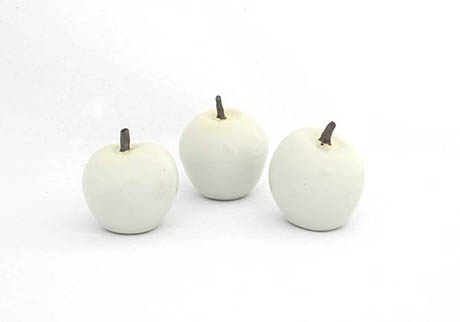
Whiteness, Jessica Rath, high-fire glazed porcelain, 2012.
These final ones [shown above] are very, very pale yellow on the tree and when the sun hits them they turn white. You know that they’re yellow, but when you’re in this orchard, things look different. I’ve described it to people as being like when you go fishing, and when you catch a fish, it has a certain glimmer to the skin while it’s alive. As soon as you kill it, as soon as it’s dead, the whole sheen shifts into a kind of grey. The depth of the colour is not the same. It’s immediate.
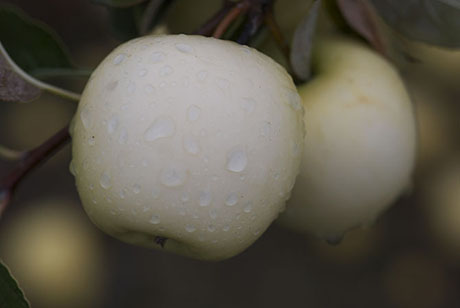
PI 594107.j5 (unnnamed—whiteness), photographed on the tree by Jessica Rath during her 2009 visit.
I swear that these apples have the same thing. There’s something about them when they’re on the tree — they have this luminosity. As soon as you pick them, the depth of the colour isn’t there, and the whiteness is just a pale yellow. You can’t capture it in a photograph, either. That’s why I chose ceramics. I’ve no business doing any ceramics. I’ve never done it before. I’m a sculptor, but sculptors and ceramicists are usually in separate departments. But when I saw what the glazes could do, I thought that I could catch that life again.
Porcelain vitrifies — it turns to glass with the glaze — which means that the body of the sculpture and the colour that’s applied, this glaze, become one body. That’s a technical thing, but it’s also real and aesthetic. In sculpture, that doesn’t happen. You can use car body paint to make something glow and shift in the light, but it’s always applied, and in ceramics the colour and the body become one. I had a whole series of fifteen years of work where I never used colour because I always thought, what’s the point? It’s not part of the body of the work; it’s just applied.
Twilley: Did you take the tree photographs in the show at the same time, or is that a separate project?
Rath: While I was at the Plant Genetics Resource Unit, I got a call from this woman, Susan Brown. I don’t even know how she got hold of me, but thank god she did. She said, “You need to come over here, because I’ve got these trees and you need to see them.” It turns out she’s one of only three commercial apple breeders in the United States, and her job is to cross apple varieties to improve them and create the next Jonagold.
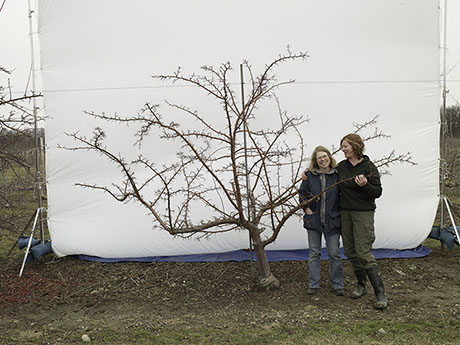
Dr. Susan K. Brown and Jessica Rath during the tree photo shoot, March 2011; photography courtesy Jessica Rath.
And I said, “I’m really busy. I’ve got 48 hours. I’m really into these apples.” And she just said, “Get the rest of your apples and come over here. We’ve got three hours before the sun sets.”
I don’t know why I said yes. I was just very lucky. She picked me up in her truck and she showed me a row of cloned trees. It was October, so all of the leaves were still on the trees, and she hadn’t pruned them, because she wants to see what the architecture will do if it’s not touched. It was just this big row of green, and I couldn’t really see anything.
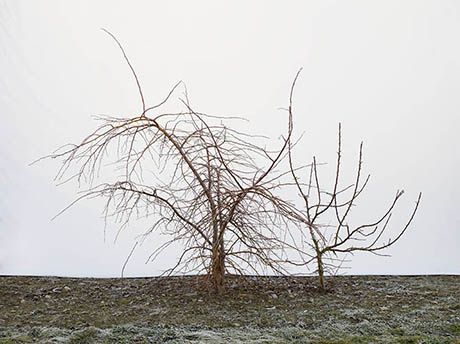
Sisters small and different, Jessica Rath, archival pigment print on exhibition fiber, 2012.
So then she took me to another row of trees that were just saplings. They had some leaves, but not many, because they were so young. Every single one of them had a different architecture — some of them were weeping, some were standing upright, some of them had branches like corkscrew or at perfect right angles. It was like a carnival. They were just different bodies, different leaves, and different sheens to the leaf. She said, “This is what happens when you cross.” Then I got it.
She took me back to her office and showed me a big binder — she had been photographing her trees for years. She understood her trees as artwork, and she wanted somebody else to have a conversation with about that.

Sisters normal, Jessica Rath, archival pigment print on exhibition fiber, 2012.
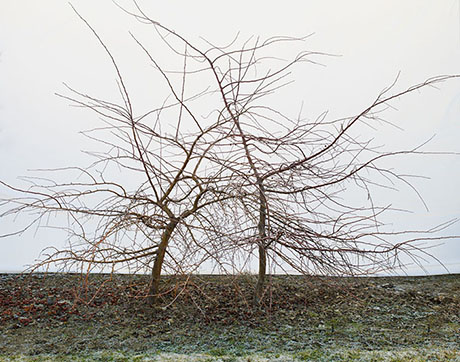
Sisters weeping, Jessica Rath, archival pigment print on exhibition fiber, 2012.
She had tried to stretch these sheets behind trees in the winter, and I thought — that’s it! I need to do that, but I need to do it really, really well. So I applied for a grant to go back and photograph Susan’s trees in winter.
I came back about a year and a half later. Susan and I spent a day scouting, then we shot for three days. I was trying to not only show the architecture and the diversity, but also what I wanted in terms of understanding her work, and the difference between the sisters and the clones. The sisters had this extreme variety, but when I went back, I fell in love with the clones. They were all covered in leaves before; I couldn’t really see them. But when I went back in winter, they seemed to not embody the diversity but rather, instead, embody this kind of limiting figure, this figure that had been worked on, that had been “improved” by humans, and that was beautiful but also really haunting.
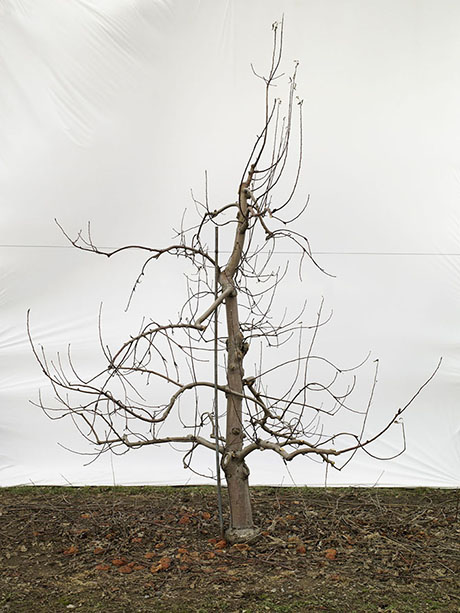
Clone with central leader, Jessica Rath, archival pigment print on exhibition fiber, 2012.
Some of them are bred for their architecture, but lots of them are bred for other qualities — resistance to browning or disease, high yield, or taste — and are kept alive despite their architecture. Susan told me that they’re on the cusp of moving to quite a different way of breeding, using genetic markers, so, in the future, she probably won’t have rows and rows of such extreme variety. She’ll have more control.
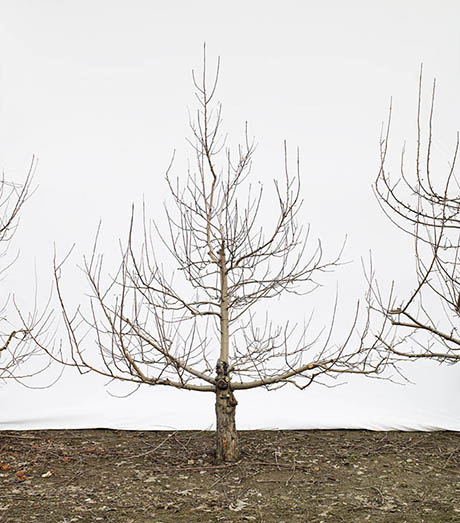
Clone spreading with scab resistance, Jessica Rath, archival pigment print on exhibition fiber, 2012.
That idea of artificial selection versus natural selection, and the way that certain varieties become weaker, but yet more common, because they’ve entangled humans into maintaining them — that was something I was thinking about before I went to graduate school. I was working with flora in general, but I couldn’t figure out a way to get plants to talk, and so I gave up and moved on. Then, when I read The Botany of Desire, after fifteen years of staying away from the topic, it was as if Pollan had given me a voice for them — an imaginary voice in which they’re drawing us in through aesthetics and through taste in order to get us to reproduce them. Finally, I felt as though I could have a discussion with plants — that they had agency.
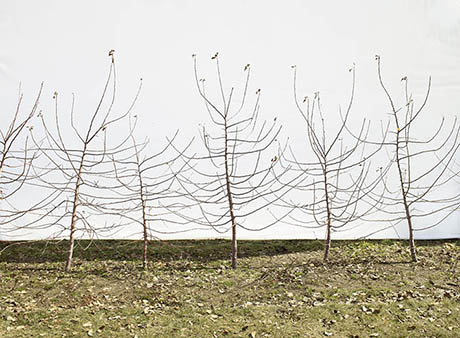
Sisters smiling, Jessica Rath, archival pigment print on exhibition fiber, 2012.
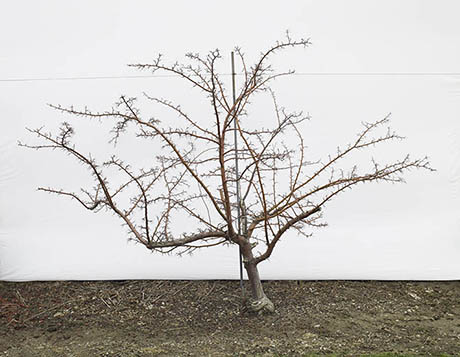
Clone with perseverance, Jessica Rath, archival pigment print on exhibition fiber, 2012.
Manaugh: It’s interesting that the sisters are all shown in group portraits, whereas the clones are shot on their own, as individuals. Was that a conscious decision, and, if so, what was the intention behind it?
Rath: It was interesting — I tried to shoot the clones as a group, but they just became a landscape. It just seemed that the way to show the clones was as an adult, as something that you would pull material from that had lived a life already, that was full of its own, carefully constructed shape already, and that had certain defined characteristics. I wanted it to capture the potential of using it for these breeding experiments. Meanwhile, the sisters are all about the variety.
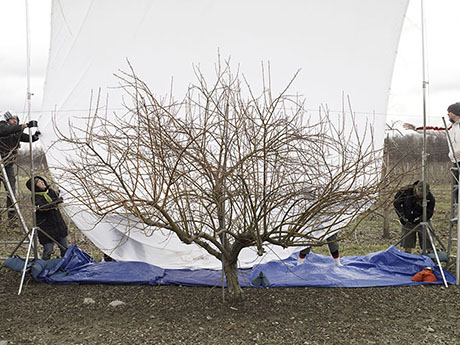
From left to right, Cole Slutsky, Mary Wingfield, Timothy Zwicky, and Dustin McKibben set up the 20 x 30 ft backdrop for the photograph Water Sprout; photograph courtesy Jessica Rath.
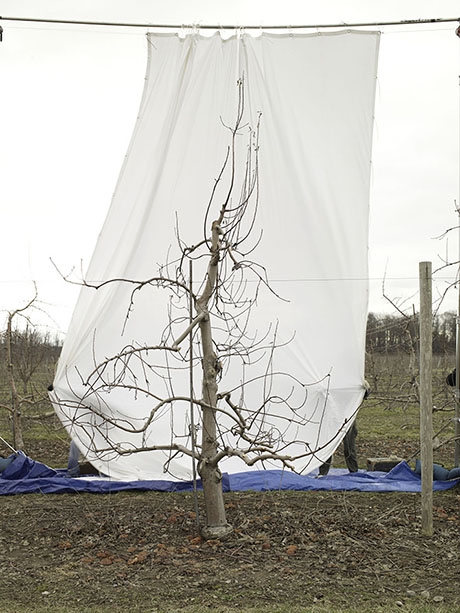
Backdrop set up for Clone with central leader; photograph courtesy Jessica Rath.
The set up was tortuous. I was using a twenty-by-thirty-foot muslin backdrop. There were five people holding it down, the wind was gusting — it could have killed all of us. There was a photographer, the photographer’s assistant, and me all shooting. We had computer equipment tethered to everything and the rows of trees are not very far apart, so we were really squeezed in to get enough distance. And it was early March, so it was unbelievably cold.
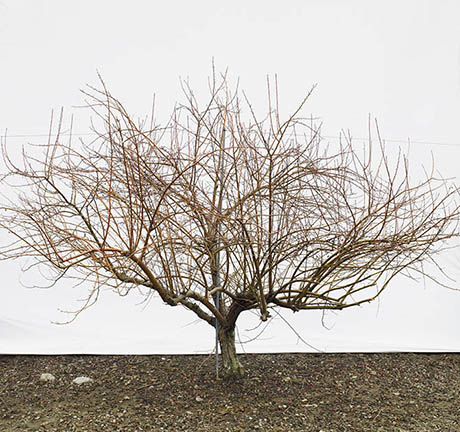
Clone water sprout, Jessica Rath, archival pigment print on exhibition fiber, 2012.
I love this one [shown above], particularly because the horizon almost appears like it is an actual horizon, not just one created by the backdrop. For a second, you could think is there a cliff on the other side of the tree. And yet, behind the backdrop, the landscape is present in a sort of ghostlike way. For me, that’s part of the idea — that the landscape is constructed only as much as you need it to be in order to make the thing live.

Clone weeping with resistance, Jessica Rath, archival pigment print on exhibition fiber, 2012.
I also love the fact that there are allusions to the wind that’s there through the folds and ripples. I spent a lot of time working on these images in Photoshop, after the fact, cropping out and removing things — stray branches from other trees, and so on — that distracted from the composition. But I deliberately kept some of the ripples, because I liked the evidence of the physical tension in the landscape. It’s also part of pointing to the artifice. The backdrop doesn’t disappear, and so you remain aware that the whole thing is a construction.

Clone with early pubescence, Jessica Rath, archival pigment print on exhibition fiber, 2012.
The title of this one, Clone with early pubescence, [shown above] alludes to the fact that it’s budding too early, so it’s about to get cut down. It’s already dead to Susan, because it has no use. As we walked around, she was telling me about each of the trees — what will happen to them, or what is promising about them, or what she has used them for — and those stories definitely crept into the way I chose to frame and title the shots.
Twilley: Finally, I’m curious about your next project. I’ve heard a rumor that you’re working on something to do with bees — is that true?
Rath: Yes — well, tomatoes or bees. I loved Barry Estabrook’s Tomatoland. The idea of shipping tomatoes from Florida to New York in 1880, in a wagon? It’s crazy! [laughs] I’m doing a series of watercolors of tomatoes right now, which are very different than this. They combine scientific text with quotes from literature about redness, and blushes, and scarlet letters — all about how colours have been used to place judgment on things, and the gendered language that goes with that. There are a lot of “wenches” and “whores” in that series as well. Tasteless whores, too, because some of them are grocery-bought tomatoes. I’m playing with language like that with this series, which is a very different kind of playing than in this apple project — much less subtle.
The bee idea involves visiting Dr. Nieh’s laboratory in San Diego. He’s a bee expert and he has figured out all these incredible ways that bees are communicating, to which he’s given wonderful names like superorganism inhibitory signaling and olfactory eavesdropping.
I’m interested in doing an installation of a hive. It would be to human scale, and it would play with the biofeedback of the people in the hive, and how they interact, as well as the atmospheric conditions. The idea is to create a composition based on all those inputs that shifts in real-time, all based on the scientific research of Dr. Nieh into how bees communicate. I’m looking for a composer to work with on that right now.
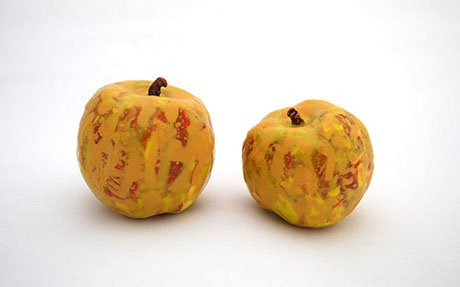
Drap d’or gueneme, Jessica Rath, high-fire glazed porcelain, 2012.
Jessica Rath’s apple sculptures and photographs are on display at the Pasadena Museum of California Art through February 24, 2013. Many thanks to Willy Blackmore for the suggestion!
Double Duty
From Stuart Kidd in the May 2003 Word Ways:
CANON is a synonym for ORDINANCE, and CANNON is a synonym for ORDNANCE.
Cambridge police investigating fake MIT threat - NECN
![]() Boston Globe |
NECN (NECN: Julie Loncich, Cambridge, Mass.) - "We treat all threats as credible until deemed otherwise," Cambridge Police Lt. Dan Boyle told reporters Saturday. Armed SWAT teams stormed the campus of MIT Saturday morning, and Cambridge Police, campus ... MIT campus briefly on lockdown after reports of man with 'long rifle'The Guardian Officials certain there was no gunman at MIT, feds investigatingMy Fox Boston all 108 news articles » |

Top cardinal accused of 'inappropriate acts'
Three priests and former priest report Cardinal Keith O'Brien to Vatican over claims stretching back 33 years
Three priests and a former priest in Scotland have reported the most senior Catholic clergyman in Britain, Cardinal Keith O'Brien, to the Vatican over allegations of inappropriate behaviour stretching back 30 years.
The four, from the diocese of St Andrews and Edinburgh, have complained to nuncio Antonio Mennini, the Vatican's ambassador to Britain, and demanded O'Brien's immediate resignation. A spokesman for the cardinal said that the claims were contested.
O'Brien, who is due to retire next month, has been an outspoken opponent of gay rights, condemning homosexuality as immoral, opposing gay adoption, and most recently arguing that same-sex marriages would be "harmful to the physical, mental and spiritual well-being of those involved". Last year he was named "bigot of the year" by the gay rights charity Stonewall.
One of the complainants, it is understood, alleges that the cardinal developed an inappropriate relationship with him, resulting in a need for long-term psychological counselling.
The four submitted statements containing their claims to the nuncio's office the week before Pope Benedict's resignation on 11 February. They fear that, if O'Brien travels to the forthcoming papal conclave to elect a new pope, the church will not fully address their complaints.
"It tends to cover up and protect the system at all costs," said one of the complainants. "The church is beautiful, but it has a dark side and that has to do with accountability. If the system is to be improved, maybe it needs to be dismantled a bit."
The revelation of the priests' complaints will be met with consternation in the Vatican. Allegations of sexual abuse by members of the church have dogged the papacy of Benedict XVI, who is to step down as pope at the end of this month. Following the announcement, rumours have swirled in Rome that Benedict's shock move may be connected to further scandals to come.
The four priests asked a senior figure in the diocese to act as their representative to the nuncio's office. Through this representative, the nuncio replied, in emails seen by the Observer, that he appreciated their courage.
It is understood that the first allegation against the cardinal dates back to 1980. The complainant, who is now married, was then a 20-year-old seminarian at St Andrew's College, Drygrange, where O'Brien was his "spiritual director". The Observer understands that the statement claims O'Brien made an inappropriate approach after night prayers.
The seminarian says he was too frightened to report the incident, but says his personality changed afterwards, and his teachers regularly noted that he seemed depressed. He was ordained, but he told the nuncio in his statement that he resigned when O'Brien was promoted to bishop. "I knew then he would always have power over me. It was assumed I left the priesthood to get married. I did not. I left to preserve my integrity."
In a second statement, "Priest A" describes being happily settled in a parish when he claims he was visited by O'Brien and inappropriate contact between the two took place.
In a third statement, "Priest B" claims that he was starting his ministry in the 1980s when he was invited to spend a week "getting to know" O'Brien at the archbishop's residence. His statement alleges that he found himself dealing with what he describes as unwanted behaviour by the cardinal after a late-night drinking session.
"Priest C" was a young priest the cardinal was counselling over personal problems. Priest C's statement claims that O'Brien used night prayers as an excuse for inappropriate contact.
The cardinal maintained contact with Priest C over a period of time, and the statement to the nuncio's office alleges that he engineered at least one other intimate situation. O'Brien is, says Priest C, very charismatic, and being sought out by the superior who was supposed to be guiding him was both troubling and flattering.
Those involved believe the cardinal abused his position. "You have to understand," explains the ex-priest, "the relationship between a bishop and a priest. At your ordination, you take a vow to be obedient to him.
"He's more than your boss, more than the CEO of your company. He has immense power over you. He can move you, freeze you out, bring you into the fold … he controls every aspect of your life. You can't just kick him in the balls."
All four have been reluctant to raise their concerns. They are, though, concerned that the church will ignore their complaints, and want the conclave electing the new pope to be "clean". According to canon law, no cardinal who is eligible to vote can be prevented from doing so.
Catherine Deveneyguardian.co.uk © 2013 Guardian News and Media Limited or its affiliated companies. All rights reserved. | Use of this content is subject to our Terms & Conditions | More Feeds
Happy birthday to the late, great, Majel Barrett Roddenberry. As...

Happy birthday to the late, great, Majel Barrett Roddenberry. As the inimitable Lwaxana Troi, she’s tussled with Dr. Jill Biden, shamelessly pursued Picard (I mean, who wouldn’t?), been kidnapped by Ferengis, fallen in love with Cogsworth, kicked it with Alexander in the Fun Zone, and had a secret daughter that wasn’t Kirsten Dunst. And for all of you who’ve been asking us to cover DS9…well, I guess we’ll have to eventually, if we want any more Lwaxana, because we’ve covered all her TNG eps.
LOVE YO CLOTHES GURL
ETA: we know she was also Number One, Nurse Chapel and the computer voice. But girl. This is a TNG fashion blog. Of course our favorite incarnation of the first lady of Star Trek is Lwaxana. HAVE YOU SEEN HER DRESSES
The Town that was Submerged for 25 Years

Southwest of Buenos Aires, Argentina, lies a salt lake called Lago Epecuen. Like many mineral springs, a spa industry grew up and and the nearby village boomed into a thriving community called Villa Epecuen.
The town’s population peaked in the 1970s with more than 5,000. Nearly 300 businesses thrived, including hotels, hostels, spas, shops, and museums.
Around the same time, a long-term weather event was delivering far more rain than usual to the surrounding hills for years, and Lago Epecuen began to swell. On 10 November 1985 the enormous volume of water broke through the rock and earth dam and inundated much of the town under four feet of water. By 1993, the slow-growing flood consumed the town until it was covered in 10 meters of water.
Nearly 25 years later, in 2009, the wet weather reversed and the waters began to recede. Villa Epecuen started coming back to the surface.
What emerged from the water looks like a post-apocalyptic movie set. The streets and blocks are there, and buildings, furniture, and carefully-planted trees are quite visible, even in their wrecked condition. See lots of pictures at Amusing Planet. Link -via mental_floss
(Image credit: Wikimedia Commons contributor Santiago Matamoro)
An Arabian wonder gecko (Wild Arabia - BBC)

An Arabian wonder gecko (Wild Arabia - BBC)
haitian-sensation: hermanifesto: whatiremembered: Louis C.K....
Louis C.K. explains white privilege to America on Jay Leno, without actually saying “white privilege”.
this. this. ALL OF THIS.
DAMMIT THIS MAN’S A GENIUS. A GOTDAMNED GENIUS
MIT Emergency Information
Russian Sledgeswhat
A New Dictionary Word of the Day: Friend Zone
Russian Sledgesour civilization is over
It's a new day for Forever Alones of the English-speaking world: the slang term "Friend Zone" has been added to Oxford Dictionaries, along with a bunch of other neologisms including tweetable ("suitable for posting on the social media site Twitter") and dumbphone ("a basic mobile phone that lacks the advanced functionality characteristic of a smart phone").
According to Oxford, friend zone is defined as:
(noun, informal) a situation in which a platonic relationship exists between two people, one of whom has an undeclared romantic or sexual interest in the other.
Hat tip goes to Betabeat!
Submitted by: Unknown (via Oxford Dictionaries)
Share on FacebookPope Benedict XVI resigned after an internal investigation informed him about a web of blackmail,...
Pope Benedict XVI resigned after an internal investigation informed him about a web of blackmail, corruption and gay sex in the Vatican, Italian media reports say.
Three cardinals were asked by Benedict to verify allegations of financial impropriety, cronyism and corruption exposed in the so-called VatiLeaks affair.
The cardinals were said to have uncovered an underground gay network, whose members organise sexual meetings in several venues in Rome and Vatican City.
On December 17, 2012, they handed the pontiff two red-leather bound volumes, almost 300 pages long, containing “an exact map of the mischief and the bad fish” inside the Holy See, La Repubblica said.
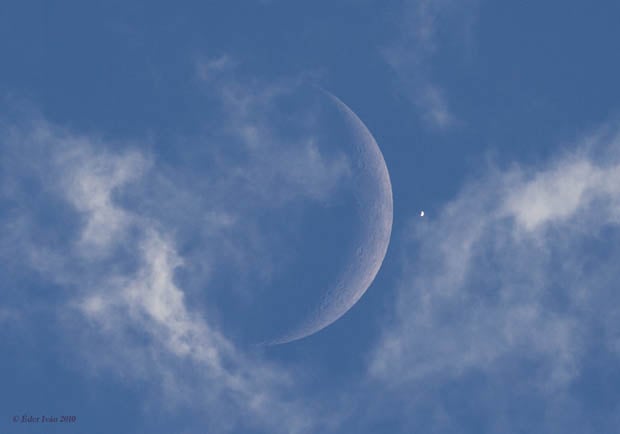
The Moon and Venus Captured in a Single Photograph
![]()
Behold, a photograph of the moon. Can you see it? No, it’s not that tiny bright crescent you see… The moon is that faint giant crescent. That tiny one to its left is Venus. Hungarian astrophotographer Iván Éder captured this beautiful photograph back in 2004 from Budapest, Hungary.
The Moon and Venus are both bright enough to be observed during the day from people on the ground. When they’re close to one another in the sky, beautiful shots like this one can be snapped using a telescope.
Here’s a closer look at the two crescents:
![]()
You actually don’t need extremely fancy camera gear for a shot like this. Éder was using a Nikon Coolpix 4300, a 4-megapixel compact camera (settings were 1/100s, f/11, and ISO100).
For you astrophotogs out there: Éder was also using a TMB 130/780 apochromat telescope (with a 30mm 2″ Vixen LV eyepiece) and a Synta EQ6 mount.
As an encore, Éder captured a very similar photograph a few years later, in 2007. This one was captured with a Canon 350D DSLR, a Skywatcher 80/600 ED apochromat, a Skywatcher EQ5 GOTO.
![]()
…and a closer look:
![]()
You can find higher resolution versions of these photographs on Éder’s website here and here.
Image credits: Photographs by Iván Éder and used with permission
A socialist state emerges in China’s alternate EVE universe
It’s no secret that China has a constrictive grip on what it’s citizens are allowed to access over the internet. Google’s struggles to operate within the nation were prominent, and residents within the country can’t use social networks like Facebook or Twitter, instead relying on state-sponsored variants like Sina Weibo.
This isolationism spreads to online games. While the rest of the world’s EVE players play in one massive universe, players in China use their own server, an alternative universe called Serenity.
- - -
While reading about EVE’s living, breathing intergalactic ecosystem always prooves fascinating, an account of the evolution of China’s EVE, posted by Angry_Mustache over at The Mittani, is doubly so. Chinese culture has naturally influenced Serenity’s online world, which operates pretty differently from the one most EVE players are used to. Angry_Mustache writes:
You can tell a lot about the culture of an EVE player-base by the way their alliances are set up. Revenge Ostus made the observation that Serenity alliances are set up like the Central Committee of the Communist Party of China, with long term decisions and diplomacy being made by a politburo comprised of the CEOs of major member corps and a Chairman who handles immediate decisions and day-to-day operations.
While fleet commanders have some initiative, it’s ultimately the Chairman who gets the final say on major ops (remember, a unreinforced node can start conking out at not even 100 players). It would not do at all for an FC to call in supers on a unprepared node and get them all killed.
To repeat: Serenity alliances are set up like the Central Committee of the Communist Party of China.
In the rest of the world, most alliances on the global EVE server resemble dictatorships or monarchies with degrees of democracy. The post goes on to consider differences in the asking prices of technetium, the locations where trade hubs developed, and alliance recruitment policies, but I somehow doubt there has ever been a greater testament to the open-worldness and malleability of EVE than the emergence of Communist alliances in China.
Movie Secrets: Kill Bill is outlined at dinner in...


Movie Secrets: Kill Bill is outlined at dinner in Pulp Fiction by Mia Wallace
(See also: The Pulp Fiction Coffee Shop)
Pawprints 3: ancient cat urinates on ancient manuscript
Here’s another case of an ancient cat defacing things—the best one yet. As documented on the website medievalfragments, a cat peed on a fifteenth-century manuscript, ticking off the scribe no end!
The caption on the website:
Although the medieval owner of this manuscript [shown previously on this site] may have been quite annoyed with these paw marks on his otherwise neat manuscript, another fifteenth-century manuscript reveals that he got off lucky. A Deventer scribe, writing around 1420, found his manuscript ruined by a urine stain left there by a cat the night before. He was forced to leave the rest of the page empty, drew a picture of a cat and cursed the creature with the following words:
“Hic non defectus est, sed cattus minxit desuper nocte quadam. Confundatur pessimus cattus qui minxit super librum ostum in nocte Daventrie, et consimiliter omnes alii propter illum. Et cavendum valde ne permittantur libri aperti per noctem uni cattie venire possunt.”
[Here is nothing missing, but a cat urinated on this during a certain night. Cursed be the pesty cat that urinated over this book during the night in Deventer and because of it many others [other cats] too. And beware well not to leave open books at night where cats can come.]
Well, maybe the scribe could do letters, but he couldn’t draw cats. The offending beast looks like a cross between a hyena and a donkey!
But I love the fingers pointing at the stain.
That’s one way to mark Black History Month: When Ted Nugent hits the road this year,...
Russian Sledgesthis, and how The Corner is all pro-lady now
That’s one way to mark Black History Month: When Ted Nugent hits the road this year, he’s calling his tour “Ted Nugent Black Power 2013,” he writes on the conservative website World Net Daily.
In a column that describes “dirty Democrat politicians” as the enemies of black Americans, the right-wing rocker reels off a string of statistics he says demonstrate how ineffective Democratic policies, including Franklin Roosevelt’s New Deal and Lyndon Johnson’s Great Society, have been at helping African-Americans overcome poverty, crime and a lack of education.
“The truth is that the Democratic Party has been the engineer of the destruction of black Americans, and everyone knows it except the very people who need to know it the most – black Americans,” he writes.
Nugent, on the other hand, says he celebrates Black History Month “every day,” because his “fire-breathing musical career was literally launched by black musical thundergods” including Bo Diddley, Little Richard, James Brown, Wilson Pickett and more.
“There is no doubt that my 2013 tour will be the best of my life,” he writes. “With world-class virtuosos paying tribute to our black heroes nightly, it is only fitting that this year’s tour is aptly titled, ‘Ted Nugent Black Power 2013.’ Say it loud: my music is black and I’m proud!”
Are you sure?
Russian Sledgesoh, I bought this, it's pretty good
Great Job, Internet!: Classic Hollywood horror films make for killer dresses in this psycho fashion show
Russian Sledges...

We don’t often cover fashion here at The A.V. Club, but then again, it’s not often that fashion crosses over with one of our favorite subjects: classic Hollywood horror films. Leave it to Fashion Week’s most reliable absurdists, The Blonds—who last season presented a collection that included a Jaws-themed corset and, um, this—to provide us with that happy middle ground with their Fall 2013 collection, presented last week in New York. Featuring pieces with names like “The Raven,” “The Butcher,” “Redrum,” and so on, and shown to the soundtrack of Talking Heads’ “Psycho Killer,” the collection married The Blonds’ corset-loving-drag-queen-on-Halloween aesthetic with inspiration from films like The Birds, The Shining, Psycho, Carrie, and others, with varying degrees of literalness. (Hello, Rope.) Oh, there was also a fur straightjacket and this terrifying thing:
milkmade.com
You can check out photos of the whole collection ...
Read moreVatican prepares to close @Pontifex account as Pope steps down
As Pope Benedict XVI prepares to step down on February 28th, his Twitter account will go dark as well. CNN reports that @Pontifex will close at the same time he formally leaves office, as will the eight accounts that distribute Papal messages in other languages. "It seems unimaginable that one could continue to use a communication tool so popular and powerful during the 'sede vacante' period" during which the Pope's seat is vacant, says Vatican Radio. The Pope is expected to give his last tweet on February 27th along with his final general audience, one of only a few posted since he announced his upcoming resignation.
While this would have eventually happened whenever the Pope's seat was vacated, his sudden resignation means it's taking place only a few months after @Pontifex was created. CNN doesn't specify, but it implies the account will be completely deactivated, not simply left without updates. Vatican Radio also declined to state whether the nascent Twitter tradition will be maintained by Benedict XVI's successor. The account was at least specifically chosen to refer to the office rather than a specific man, so the next Pope could well take up the cause of beating Justin Bieber in retweet counts.
- Source CNN
- Related Items pope pontifex twitter benedict xvi pope benedict xvi social media social
Man of faith dons Man of Tomorrow for children’s Mass
Russian Sledgeshas this made it to badvestments yet?
Father Humberto Alvarez isn’t a typical Catholic priest. Every Sunday, the 40-year-old dons a tunic emblazoned with images of Superman, Batman and Spider-Man, and, armed with a Super Soaker loaded with holy water, delivers a special Mass to the children of Saltillo, Mexico.
It’s an unconventional approach, but one that appears to work, drawing parishioners young and old to the service. Alvarez told Zocalo magazine, that he embraced the superheroes because, “We talk about attitudes of struggle and effort to achieve overcome fears, find peace and forgiveness.” He began using the water gun to bless the congregation following a series of fatal shootings in Saltillo.
While not everyone agrees with Alvarez’s tactics, he’s undaunted, saying, “Jesus was different and always sought justice, we must follow his example.”
(via ComicMix, lainformacion)