
Russian Sledges
Shared posts
27 Mar 00:22
Self-Referential Doritos Locos Tacos Chips, Based on Taco Bell Tacos
by Rusty Blazenhoff

Doritos has announced that Doritos Locos Tacos tortilla chips, based on Taco Bell tacos of the same name (which use refashioned Doritos chips as shells), will soon be released in two flavors: nacho cheese and cool ranch. It’s not surprising that both brands, Doritos and Taco Bell, are owned by parent company PepsiCo. These super meta chips will be available on April 8, 2013.

via Gothamist
27 Mar 00:22
I’m Google, A Mesmerizing Blog of Visually Connected Images & Video
by EDW Lynch

The beautiful Tumblr blog I’m Google is a seemingly endless stream of visually connected images and videos that slowly evolve over time. The media is grouped into themed batches: ski jumps lead to water slides, which lead to pools, which lead to crater lakes, and so on. The blog’s creator, artist Dina Kelberman, finds the media during long hours spent on Google Image Search and YouTube. Be sure to scroll through the site, it has to be visited to be fully appreciated.
I feel that my experience wandering through Google Image Search and YouTube hunting for obscure information and encountering unexpected results is a very common one. My blog serves as a visual representation of this phenomenon. This ability to endlessly drift from one topic to the next is the inherently fascinating quality that makes the internet so amazing.

via Colossal
Russian Sledges, firehose likes this
27 Mar 00:21



The Evolution Of Google Reader Started With A Crash
by Jason Shellen
Editor’s note: Jason Shellen is a former Googler and founding product manager of Google Reader. He is now co-founder at Boxer and advisor at Tapedeck. Follow him on his blog and on Twitter @shellen.
As part of Google’s recent announcement that it is shutting down Google Reader in July, I thought looking back at the history of how our beloved, but beleaguered, feed reader came to be, why we’ll miss it and what we really want in the future.
Back in the days on the Blogger team, we spent a lot of time thinking about how to get people blogging after they had signed up. However, when Blogger achieved critical mass, the need to model good blogging seemed less important since great writers, musicians, photographers and journalists were gravitating towards the form and showing the rest of us what made good blog content. The questions we began to hear from users changed from “How and what do I blog?” to “Where do I find the good ones?” and “How do I keep up with all of these great blogs?” Naturally, blog search and a blog reader or aggregator of some sort couldn’t be too far off.
Meanwhile, there was an ever-increasing number of good Windows and Mac desktop aggregators popping up (Feed Demon, NewsGator, Radio Userland and NetNewsWire). They were mostly made by great independent developers but didn’t have a web-app component until a few years later. Then along came Bloglines. It was the first feed aggregator that our Blogger team gravitated towards. It was very simple at first and gained more powerful features over time. But my personal frustrations were growing not just with Bloglines, but with some of the social integrations I wanted to see on the web.
I remember a very early version of Firefox had crashed, taking with it my open Bloglines tab and thus losing the 100+ items that it would surely “mark as read.” If I went back to Bloglines it would appear as if I had read all of those items, and there would be no way to catch up. I was upset!
I wheeled around in my chair in the Blogger bullpen and complained to Biz Stone: “I wish there were some sort of eye tracking that would tell which item I had read and saved my state!” He agreed with my wacky proposal. I continued to stew.
Aside from dreaming up features for products I didn’t control, I had spent a considerable amount of time at Google helping to form the cross-industry group that ultimately published the Atom feed format and Atom Publishing Protocol. We were pushing Atom to become a recognized Internet standard, with companies such as Six Apart, IBM and Macromedia onboard. When Blogger turned on Atom feeds for all of our millions of users, Blogger single-handedly became the No. 1 producer of feeds in the world. This was huge for aggregators, because for any of them to become mainstream, more content in a subscribable format was needed.
One beautiful wonderful thing happened along the way to creating Atom.
Atom was an effort to make feed reading and subscriptions more consumer friendly. If we were really successful with what we had built, we imagined a world where you didn’t need to market the plumbing of a technology to realize the benefit. Some who embraced RSS-only saw this as an opportunity to latch onto a brewing controversy or, worse, as the window to market RSS to consumers. The next few years would be a boring marketing landscape, as we saw orange and blue chicklets slapped up haphazardly around the web. In hindsight it’s easy to see that consumers understood words like “follow” or “friend” for content they wanted delivered regularly rather than “subscribe,” “RSS” or “Atom feed.”
One beautiful wonderful thing happened along the way to creating Atom. For a few years, I had kept a little side-blog right alongside my main blog at shellen.com. The main view showed larger posts, but I was using some server-side code to read a file I was publishing in another directory and display the second blog on the right-hand column. It was great for shorter posts, but I wondered if there would be a way to display an Atom feed alongside my blog instead of my slapped-together solution.
I wondered this aloud to Chris Wetherell one day in 2004, an engineer on the Blogger team.
“Say Chris, do you suppose you could display an Atom feed in JavaScript?” He took the challenge and “Feedless” was born. I dropped in a few files on my blog server and pointed it to my new Blogger-created Atom feed. It worked!
However, Chris wanted to show me something else. He quickly modified his first script into something that could display more than one feed into a beast that could blend items together. My mind raced and I saw the value immediately. We could create Blogger Friends, a page on Blogger where you could see all of the blog posts from your friends. LiveJournal had something like this years earlier but maybe you could even follow people who weren’t on Blogger? Before long this was all Chris and I could talk about, and plans began for Chris’ 20 percent project to become a full-fledged Google project in early 2005.
The “Goals and Objectives” section of the product plan for Project Fusion (an early codename for Google Reader) stated “Our goal is to build a robust web service and best-of-breed user interface for viewing subscriptions. We will be producing an API for read/unread state of individual posts on a per-user basis and will also build our feed viewer on top of this API.” Pretty geeky stuff. However, we also had a vision statement that was sufficiently less geeky and more jaw-droppingly, ambitious. “Our vision is to become the world’s best collaborative and intelligent web content delivery service.”
I’m sad to see it go but Google Reader shutting down isn’t a surprise to me.
As far as we were concerned, the text of blog posts was just the beginning of a content revolution. In fact that early codename, Fusion, was meant to be a hint of the future of how web content would be consumed, fused together perhaps in a new TV-like format.
The future was ripe with possibilities. Our little team was going to launch our product on Google Labs, which meant we could try wild ideas. We knew that Google Video was around the corner and YouTube was still an independent but promising site. We also knew that the Picasa acquisition would help bring fast photo embedding and display to the web. The possibilities were seemingly endless. Our short-term vision included tying all of this together in an easy-to-consume way that also allowed you to easily share it with friends and find or subscribe to more content from a search box powered by Google all from within our app.
In October 2005, Google Reader launched to 100,000 of our closest friends. The team pulled off some amazing feats in a short amount of time. We quickly learned that there was indeed a truly long tail of feed-based content. We experimented with audio, video and photo content displays. We became the relied-upon backend for iGoogle’s feed-based gadgets and had a Reader gadget on iGoogle that became one of my favorite ways to use Reader.
But in early 2006, it was clear to me that, while I was proud of what we were building, we weren’t likely to be that magical fusion of all things digital. I moved on to other projects at Google. Reader was and remains today a great delivery system of content you knew you wanted to see every day.
I’m sad to see it go, but Google Reader shutting down isn’t a surprise to me. The recent hiccups and fact that it remained separate from any other Google social efforts didn’t bode well for its long-term health. I’m certainly overwhelmed by the petition and public outcry. And who doesn’t love a good “Downfall” parody? But what is it that we’re responding to in Google’s decision to shutter Reader?
Reader was like TiVo for the web, appealing to completists and skippers alike.
Reader was an application that felt like you were in control of the programming. You could summon the content you told it to keep track of at your leisure. Reader was like TiVo for the web, appealing to completists and skippers alike. Read everything or read nothing. The choice was yours. When we started Reader, I envisioned something a little more like Google News that knew about your likes and dislikes and would program based on what we thought we knew about you. Indeed recommendations became a part of Reader in the past few years.
But it’s no surprise that Facebook and Twitter (who know an awful lot about what you like) are in a better position to deliver suggested content these days. They don’t explicitly put you in the driver’s seat of programming what you see. We rely on the people (or brands) we follow to act as filters. But it’s not that level of control we came to expect with Reader.
A feed reader lets you subscribe to known content. A feed reader lets you know about content you should subscribe to. A good feed reader lets you know what your friends are reading and gives you the opportunity to share. A smart feed reader displays content in a specific way based on the content and shows you only what you need to know and nothing you don’t. Perhaps the smartest of them all doesn’t need to care whether or not this content comes from a feed at all, toes the line between curating and creating content, and maybe already exists.
I’ve been asked a lot recently if an aggregator or feed reader is even needed these days and what should take Reader’s place. Certainly the folks at Feedly, Digg, Zite and others have promising efforts, but my recommendation is to build something that moves beyond the confines of reading or feeds. Just build the world’s best collaborative and intelligent content-delivery service.
[Illustration: Bryce Durbin]
Jakewastaken, Tertiarymatt and one other like this
26 Mar 22:04
Forecast
by John Gruber
Forecast:
About a year ago, we released a little app for the iPhone and iPad called Dark Sky, attempting to do something new and interesting for weather forecasting, a field we think had become pretty stagnant. Approaching 100k sales, it’s been fairly successful; however, we’ve been continually asked for more: international support, longer-term forecasting, an Android app, and so on.
Rather than cram these things into Dark Sky, we decided to do something grander: create our own full-featured weather service from scratch, complete with 7-day forecasts that cover the whole world, beautiful weather visualizations, and a time machine for exploring the weather in the past and far future.
Bold move.
★
Tertiarymatt, firehose and -1 others like this
26 Mar 21:55
Google Objects To Existence Of New Swedish Word
by russiansledges
The Swedish version of the word — “ogooglebar” — made the Language Council of Sweden’s 2012 list of words that aren’t in the Swedish dictionary but have entered common parlance. The council defined it as something “that cannot be found on the Web with a search engine.”
But Google objected, asking for changes showing the expression specifically refers to Google searches and a disclaimer saying Google is a registered trademark, the council said Tuesday.




26 Mar 20:38
I know it probably seems a contradiction for an ad industry...
Russian Sledgesself-fucking books
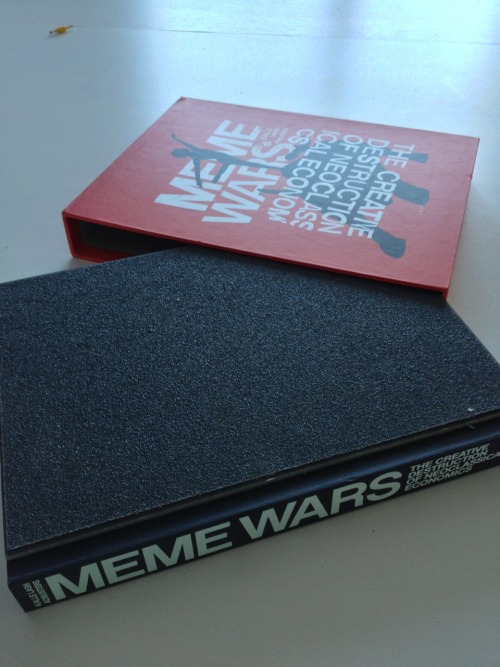
I know it probably seems a contradiction for an ad industry drone to look for alternatives to capitalism, but this book aims to make us rethink things. Ironically it’s also an extremely expensive and desirable piece of design. The cover, for instance, is made of sandpaper.
26 Mar 20:06






abluegirl: Living Wall These vegetated surfaces don’t just...
Russian Sledgesffcfe
These vegetated surfaces don’t just look pretty. They have other benefits as well, including cooling city blocks, reducing loud noises, and improving a building’s energy efficiency.What’s more, a recent modeling study shows that green walls can potentially reduce large amounts of air pollution in what’s called a “street canyon,” or the corridor between tall buildings.
For the study, Thomas Pugh, a biogeochemist at the Karlsruhe Institute of Technology in Germany, and his colleagues created a computer model of a green wall with generic vegetation in a Western European city. Then they recorded chemical reactions based on a variety of factors, such as wind speed and building placement.
The simulation revealed a clear pattern: A green wall in a street canyon trapped or absorbed large amounts of nitrogen dioxide and particulate matter—both pollutants harmful to people, said Pugh. Compared with reducing emissions from cars, little attention has been focused on how to trap or take up more of the pollutants, added Pugh, whose study was published last year in the journal Environmental Science & Technology.
That’s why the green-wall study is “putting forward an alternative solution that might allow [governments] to improve air quality in these problem hot spots,” he said.Compared with reducing emissions from cars, little attention has been focused on how to trap or take up more of the pollutants, added Pugh, whose study was published last year in the journal Environmental Science & Technology.
That’s why the green-wall study is “putting forward an alternative solution that might allow [governments] to improve air quality in these problem hot spots,” he said.
Rickatyahoodotcom, Digitman801 and 3 others like this
26 Mar 19:13


Stephen Colbert's Sister Is Polling Pretty Well Against Mark Sanford
by Elspeth Reeve
Mark Sanford, famous for not hiking on the Appalachian Trail, is polling behind Elizabeth Colbert Busch, famous for being the sister of a guy who lampoons conservatives, in the race for South Carolina's conservative first congressional district. According to Public Policy Polling, which is run by people with Democratic views, Colbert Busch, who is running as a Democrat, is just ahead of Sanford, a Republican, by a margin of 47 percent to 45 percent in their poll of likely voters.
While that is within the poll's 2.9 percent margin of error, it's still a surprising result because Charleston-area district has been a safe Republican district. Republicans have held the seat since 1981. President Obama is seen favorably by 41 percent of voters there -- and unfavorably by 57 percent. Republican Tim Scott was reelected in the district by 62 percent to 35 percent in 2012 (He The seat is open after Gov. Nikki Haley appointed him to fill Jim DeMint's Senate seat). Redistricting that will be in effect for the May 7 election made the seat no less safe for Republicans, according Roll Call's Joshua Miller.
So Colbert Busch remains the underdog. But the poll shows how unpopular Sanford remains, perhaps because of the spectacular way in which he revealed he was having an affair with an Argentinian lady who was not his wife. Sanford is likely to win a runoff to be the Republican nominee -- he's polling 53 percent to Curtis Bostic's 43 percent. PPP finds 58 percent of voters see Sanford unfavorably, while 34 percent see him favorably. Compare that to Colbert Busch, who's seen favorably by 45 percent of voters and unfavorably by 31 percent. But even Stephen Colbert's approval rating is higher than Sanford's at 36 percent.
 |
 |
Tertiarymatt likes this
26 Mar 19:13


Can a Female Leader Put an End to the Secret Service's Boys Club?
by Connor Simpson
Following an awful scandal in which a bunch of Secret Service agents were busted for drinking and partying with hookers in Columbia, the President is moving towards a "culture change" by appointing the first woman ever to run his security detail.
The Washington Post's Scott Wilson reports Obama will name Julia Pierson, 55 and a 30-year Secret Service veteran, the new director of the agency later this afternoon. Officials told Wilson it was an effort to bring a "culture change" to the notorious boys club reputation the Secret Service has earned over the years.
Last April, a scandal erupted when a group of male Secret Service officers partied like maniacs at the Hotel Caribe in Cartagena, Colombia ahead of the President's arrival for a diplomatic visit. One agent named Arthur Huntington allegedly tried to pay $50 for an $800 bill, but it wasn't at the bar. It was with a call girl. Oh, and it was a woman who was left to handle that mess, too. Nine agents eventually left or lost their jobs. Former Secret Service director Mark Sullivan announced his retirement last month.
As an aside, the Post screwed up their announcement originally. Their initial headline read that Pierson would be appointed CIA director, meaning John Brennan was suddenly out of a job. That prompted this response from one Post writer:
Arrrrgh. Do our copy editors not know the difference between the CIA and the Secret Service?
— Rajiv Chandrasekaran (@rajivwashpost) March 26, 2013
|
|
26 Mar 19:10






rumregrets: amandaabbington: ( x ) you are ridiculous...
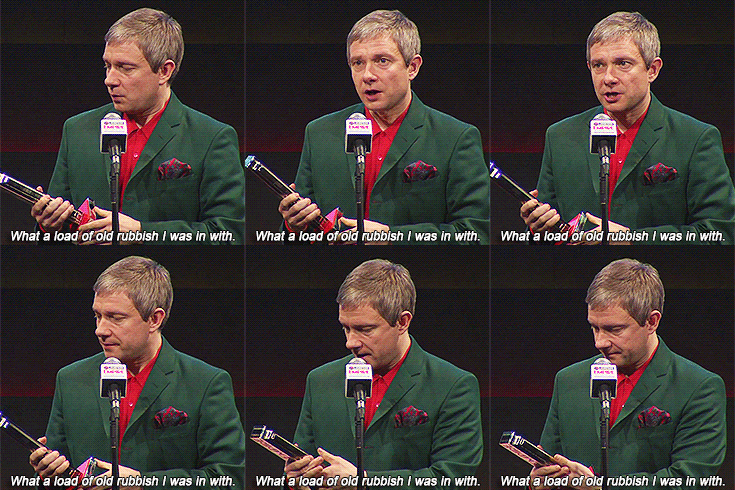
( x )
you are ridiculous sir.
Hysteria. It’s a measure of his gifts that he can keep his face straight while delivering such material. :)
Russian Sledges, firehose and -1 others like this
26 Mar 17:37
Longform Reprints: Pitch Battles by Colin Dickey by Colin Dickey
by russiansledges
Russian SledgesOpera singers + Lyndon LaRouche + Rudolf Steiner + the ISO + Nazis = #soundstudies
Tertiarymatt, Billtron likes this
26 Mar 17:37
Digg Hints Its Replacement For Google Reader Will Include Social Media Content
by samzenpus
RougeFemme writes "To capitalize on Google Reader's shutdown, Digg is building an RSS reader from scratch. But this Reader replacement will go beyond RSS to include social media content, like Facebook, Tumblr, Hacker News, Reddit, LinkedIn, etc. From their blog post: 'Google did a lot of things right with its Reader, but based on what we’re hearing from users, there is room for meaningful improvement. We want to build a product that’s clean and flexible, that bends easily and intuitively to the needs of different users. We want to experiment with and add value to the sources of information that are increasingly important, but difficult to surface and organize in most reader applications — like Twitter, Facebook, Tumblr, Reddit, LinkedIn, or Hacker News. We likely won’t get everything we want into v1, but we believe it’s worth exploring." 


Read more of this story at Slashdot.
Jakewastaken, Fred Souza and -1 others like this


26 Mar 15:59


Tennessee Gripped By Sharia Scare
by Josh Marshall
Fresh on the heels of war threats from Georgia the Tennessee state legislature was gripped yesterday in a Sharia scare over a feared Muslim foot washing sink.
|
|
26 Mar 14:41

guardian.co.uk © 2013 Guardian News and Media Limited or its affiliated companies. All rights reserved. | Use of this content is subject to our Terms & Conditions | More Feeds


Cold spring kills thousands of newborn lambs
by Martin Wainwright, Henry McDonald
Russian Sledgesattn lg (sheep)
Helicopters drop food as farmers in isolated rural areas struggle to save animals
Fears for the UK's already embattled upland sheep-farmers have been raised by the return of winter to the hill country which has cost the lives of thousands of newborn lambs.
Emergency crews have helped with rescues in Scotland, Northern Ireland, Wales and the Pennines and Cumbria but the sheer graft of digging into snow-blanketed fields has come too late for many flocks.
Shielded by thick fleeces, ewes have largely survived the drifts, which have topped five metres (16.4ft) in many parts of the fells and mountains. But in spite of modern protective measures including plastic jackets to warm young lambs, rescue has often come too late.
In Northern Ireland helicopters have been deployed to carry out food drops to animals in isolated rural areas cut off by the snow. At the height of the extreme weather, up to 140,000 homes and businesses were without power as heavy snow and ice brought down power cables in counties Down and Antrim.
With power restored to most households and businesses, the focus has switched to the plight of thousands of livestock cut off in snowbound mountainous areas without food.
Sinn Féin's agriculture minister, Michelle O'Neill, said: "It is a severe situation. People have said that this is worse than 1963. Some of the scenes are harrowing – to see farmers bring in sheep that have died in the snow. People are angry and concerned. We have an animal welfare issue. Farmers need a food drop. We have a surveillance helicopter so that we can see where the livestock are and then we have an MoD helicopter which is prepared to make a food drop."
The blow to agriculture and the economy has been worsened by the scale of power failures which saw more than 3,000 people cut off for a fifth day in parts of Argyll and the island of Arran. For the first time in Scottish and Southern Energy's history two large metal pylons were toppled by snow and ice. The last to fall was in 1987 in the far north of Scotland.
Drifts are still blocking roads in hilly areas with continuing fierce cold and occasional snow flurries doing nothing to ease the situation. The Met Office issued further yellow "be aware" alerts for ice in Scotland and north-east England and snow in the north-east, Yorkshire and the east Midlands and said that severe cold weather and icy conditions would last at least until Friday morning.
"Bitterly cold easterly winds will persist this week, bringing snow showers to north-east England and light snow flurries across other areas of England," it forecasted. "With lying snow and partial snow melt during the daytimes, icy conditions are likely during the nights."
Social service departments in affected areas are stretched to reach isolated homes to check that all is well and the Age Sector Platform called for an emergency winter fuel payment to pensioners as the chill persists. The prevailing easterly winds are forecast to keep temperatures exceedingly cold until late April, except in the south-west where their clash with milder Atlantic fronts promises weeks of rain.
Paul Mott, a forecaster with MeteoGroup, said drier conditions were likely for most of the country in the runup to Easter but a slow thaw at the end of the week would be able to make little progress. He said: "We should see temperatures creeping up to 4C or 5C (39F or 41F) during the days by about Friday but there is still going to be a very sharp frost during the night. For the foreseeable future it is going to stay cold, and the snow on the ground is likely to last for some time."
Transport problems also persist with the AA attending 16,000 callouts on Monday, 6,000 more than the seasonal average. Rail services have been better on Tuesday but drifting snow has blocked trains in the Midlands between Rugeley Trent Valley and Hednesford and signalling problems have disrupted services in East Anglia between Thetford and Norwich and in Kent between Queenborough and Swale.
Malcolm Roberts, a farmer in Oswestry, Shropshire, had been expecting 600 lambs before the end of the month but is now having to pile up small victims of the snow while rescuing his 200 ewes. He said: "Every day since the snow hit, and surely for days to come, I'm having to go and pick up lamb corpses from ewes who have given birth outdoors. Newborns can only survive for around half an hour in the freezing temperatures – and the snow is so thick that some are even buried.
"We have to get through it, what else can you do? But there's no doubt the financial impact will be absolutely devastating. This is my living and if you're not successful raising lambs you can't survive – that's the bottom line. We spend more trying to feed the animals, more on fuel, more to run the farm but as livestock die you end up having less produce to sell and are hit hard."
The farm does not have enough room for indoor lambing, a problem widely shared by small sheep breeders. Vegetable crops have also been affected. Tim Gilbert, who grows fruit and vegetables on the edge of Hereford, said: "After last year's horrendous rain-filled summer we had been hoping that 2013 would be much better. It's always disastrous when it snows. We've had to stop completely for at least a fortnight. The effect not only hits us but also impacts on our customers who rely on us."
A spokesman for the National Farmers Union said: "Severe weather warnings are still in place and the majority of farmers are out there, battling freezing temperatures, to protect their livelihoods, families and income. It's relentless."
The power blackout in Scotland has been described as the worst for 30 years with 400 engineers working to repair lines. A spokesman for Scottish and Southern Energy said: "Scottish Hydro Power Distribution engineers are continuing their intense and brave efforts to restore power to homes in Argyll and Arran following unprecedented weather conditions.
"Instances of significant damage to the electricity network infrastructure have been among the worst seen for 30 years, with the weight of line icing pressurising the transmission lines around Crossaig where transmission towers were felled by the conditions. Transmission overhead lines staff have started working to make towers safe and carry out temporary repairs after finally gaining access to the location earlier today."
Scottish Power said: "Our engineers have encountered some of the most difficult conditions they have ever faced attempting to restore supplies." The company has set up eight field kitchens in Argyll and Arran and delivered 18 large generators and 50 smaller ones to supplement existing resources such as the generator at Arran War Memorial which is keeping power going. Royal Navy helicopters and lifeboats have joined ferries in taking the islands supplies.
Martin Wainwright Henry McDonaldguardian.co.uk © 2013 Guardian News and Media Limited or its affiliated companies. All rights reserved. | Use of this content is subject to our Terms & Conditions | More Feeds
26 Mar 14:41



solar-tsunami: allonsymytardis: He can say it to an inanimate...
by lunalyss
He can say it to an inanimate object, but he can’t say it to Rose Tyler.
OUCH!
firehose likes this
26 Mar 14:39

Summer Falls - Book Cover & Details
BBC Books have sent DWO the cover and details for the upcoming Doctor Who book title; Summer Falls.
Synopsis:
“When summer falls, the Lord of Winter will arise...”
In the seaside village of Watchcombe, young Kate is determined to make the most of her last week of summer holiday. But when she discovers a mysterious painting entitled ‘The Lord of Winter’ in a charity shop, it leads her on an adventure she never could have planned. Kate soon realises the old seacape, painted long ago by an eccentric local artist, is actually a puzzle. And with the help of some bizarre new acquaintances – including a museum curator's magical cat, a miserable neighbour, and a lonely boy – she plans on solving it.
And then, one morning Kate wakes up to a world changed forever. For the Lord of Winter is coming – and Kate has a very important decision to make.
‘Summer Falls’, a book written by Amelia Williams, is featured at the beginning of episode (The Bells of Saint John) of the new series of Doctor Who. It is being read by Artie, one of the children taken care of by Clara (as played by Jenna-Louise Coleman).
+ Summer Falls is released on 4th April 2013, Priced £1.99.
+ Preorder details will be available here soon.
[Source: BBC Books]

26 Mar 14:38
 Hyperkin's reveal of the "RetroN 4" console at the Midwest Gaming Classic turned out to be the unveiling of the RetroN 5, with the addition of another cartridge slot for Japanese Famicom games (which have 60 pin connectors vs. the NES's 72 pin). Now the console supports Nintendo, Famicom, SNES, Genesis (plus Mega Drive), and Game Boy Advance (with Game Boy/Color support), all over HDMI, with controller ports for NES, SNES, and Genesis controllers, as well as its own wireless Bluetooth controllers. The company plans to make the controllers remappable and usable cross-platform, but those features are still in the works.
The console upscales old games to HDMI with special image processing to make them look decent on HD screens. It also supports save states just like emulators do, with an SD card slot to store saves. Furthermore, you can speed up gameplay and remap the Bluetooth controller buttons to control these features.
Hyperkin doesn't have a firm price or release date, but is hoping to release the console around July for less than $100.
'RetroN 5' console plays NES, SNES, Genesis, GBA and Famicom, supports HDMI, save states
by JC Fletcher
Hyperkin's reveal of the "RetroN 4" console at the Midwest Gaming Classic turned out to be the unveiling of the RetroN 5, with the addition of another cartridge slot for Japanese Famicom games (which have 60 pin connectors vs. the NES's 72 pin). Now the console supports Nintendo, Famicom, SNES, Genesis (plus Mega Drive), and Game Boy Advance (with Game Boy/Color support), all over HDMI, with controller ports for NES, SNES, and Genesis controllers, as well as its own wireless Bluetooth controllers. The company plans to make the controllers remappable and usable cross-platform, but those features are still in the works.The console upscales old games to HDMI with special image processing to make them look decent on HD screens. It also supports save states just like emulators do, with an SD card slot to store saves. Furthermore, you can speed up gameplay and remap the Bluetooth controller buttons to control these features.
Hyperkin doesn't have a firm price or release date, but is hoping to release the console around July for less than $100.
 'RetroN 5' console plays NES, SNES, Genesis, GBA and Famicom, supports HDMI, save states originally appeared on Joystiq on Sun, 24 Mar 2013 21:00:00 EST. Please see our terms for use of feeds.
Tertiarymatt likes this
26 Mar 13:53


West Point Housekeeper Facing As Much Jail Time As Steubenville Rapist For Stealing A Bag Of Frozen Meatballs
by Zoe Schlanger
NEETZAN ZIMMERMAN | Gawker
A housekeeper at West Point who was busted with a bag full of frozen meatballs that didn't belong to her is facing two years in prison on federal charges of larceny and possession of stolen property.
Put in perspective, that's the same amount of time Trent Mays was sentenced to serve following his conviction in the Steubenville rape trial.
56-year-old Estelle Casimir stands accused of trying to make away with a bag of frozen meatballs that were slated to be served to at the West Point Cadet Mess Hall.
According to court documents, a supervisor became suspicious after spotting Casimir with a grocery bag in her hand.
Confronted, Casimir, who is responsible for cleaning the mess hall latrines and does not handle food, claimed she found the meatballs in a trash container "and was on her way to dispose of them in another trash container."
An affidavit signed by the operations manager on duty does not specify how many meatballs were in the bag.
At an initial court hearing earlier this month, Casimir pleaded not guilty to the charges. Her next court date is scheduled for April 19th.
In the meantime, she has been forced to look elsewhere for employment after the food services company Watson Services, her employer of 28 years, suspended her pending the outcome of the trial.
"I just sit in the house," Casimir is quoted as saying. "I don't have anything to do."
[photos via AP, Hot Cheap & Easy]
Gawker dishes the nation's most current and cutting gossip across media, entertainment, technology, and business. Founded in 2002 and namechecked frequently in mainstream publications, the site is essential reading for those who want big media hypocrisy debunked and faux-sincerity exposed, all with a healthy dose of snark.
|
|


26 Mar 12:00


Half Moon Orchard Gin
by Jessica Sanchez

"Half Moon Orchard Gin is named after the ship Henry Hudson used to explore the river which now bears his name. Rather than focus on the botanical mix like most gins, the adventurous Tuthilltown crew began by distilling the base spirit from New York State wheat and apples to create a smooth, round gin that is superbly drinkable."
|
|
26 Mar 11:57
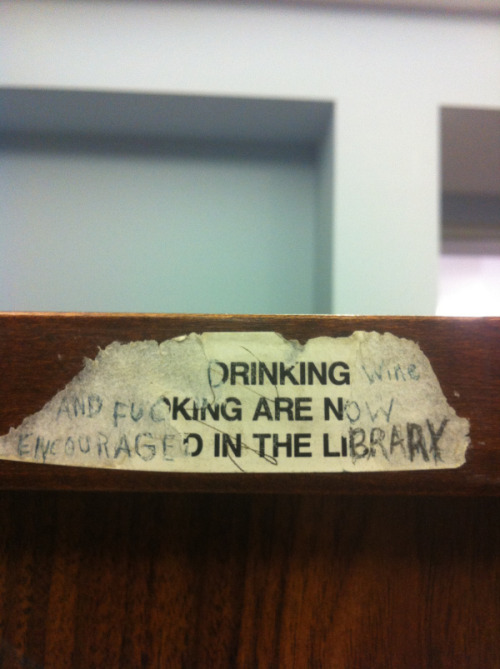
showslow: Demolition of the old US 281 bridge in Marble Falls...
Russian Sledges#whereoverbeygrewup

Osiasjota, Sofía Henao and 2 others like this
26 Mar 11:57
"Your passport has just been stamped for entry into the Land of Bullshit"
by Mark Liberman
A couple of years ago, Geoff Pullum put it this way:
Long-time Language Log readers will recall that we have often said here before that whenever someone says that the X people have no word for Y in their language you should put your hand on your wallet — to make sure it's still there. The people who witter on about who has a word for what hardly ever even know the languages they are talking about, and in the vast majority of cases (check out some of the cases on this list) their claim is false.
Yesterday, Tom Scocca was even more acerbic:
Whenever you hear someone explain that a concept is so foreign to this or that culture that people cannot even use their language to describe it, it is safe to assume your passport has just been stamped for entry into the Land of Bullshit.
Tom was talking about David Brooks' recent column on "The Learning Virtues", which claimed that "American high school students tease nerds, while there is no such concept in the Chinese vocabulary." As Tom notes,
There are multiple dictionary entries for "nerd" in Chinese, including terms for a dull and tasteless person (乏味的人, fáwèi de rén) and for someone excessively enthusiastic about computers (电脑迷, diànnǎomí).
The word for "nerd" in the sense Brooks means—"pedant" or "bookworm"—is "书呆子" (shūdāizi). If you're too shiftlessly American to have an English-Chinese dictionary handy, you can literally type "nerd" into Google Translate and find it.
I've already linked to a longer list of word-for-X debunking than any rational person would want to read, and I'm not in a position to evaluate the linguistic and cultural congruence of Chinese and English words for nerd-like states and actions, beyond repeating Geoff Pullum's advice to watch out for your conceptual wallet. So let me pick up on Tom's observation that "it wouldn't be a David Brooks column if he didn't try to reduce those complexities to a glib and shaky factoid".
In my opinion, David Brooks has an unparalleled ability to shape an intellectually interesting idea into the rhetorical arc of an 800-word op-ed piece. The trouble is, a central part of his genius is choosing the little factoids that perfectly illustrate his points. No doubt he's happy enough to use a true fact if the right one comes to hand, but whenever I've checked, the details have turned out to be somewhere between mischaracterized and invented.
The emblematic case remains Brooks' claim that it was impossible to spend $20 on dinner in Franklin County, PA, dissected in a Philadelphia Magazine article that Tom Scocca linked to ("Boo-Boos in Paradise", April 2004). Some examples from previous LL posts:
"David Brooks, Cognitive Neuroscientist", 6/12/2006
"David Brooks, Neuroendocrinologist", 9/17/2006
"David Brooks, Social Psychologist", 8/13/2008
"The butterfly and the elephant", 11/28/2009
Georgia Young, firehose likes this


26 Mar 11:53
Little Outliner, A Browser-Based Outlining Program by Dave Winer
by Kimber Streams

Bloging and RSS pioneer Dave Winer has launched Little Outliner, a simple browser-based JavaScript program released through his new company Small Picture that allows users to create and share organized outlines. Users can create, delete, organize, and customize useful idea outlines to be stored, shared, and accessed from any browser. Little Outliner is free and available now.
via Dave Winer
firehose likes this