


I rarely drive these days, and when I do, it’s bloody terrifying. Even though I grew up driving and drove every day for fifteen years, my lack of practice is palpable as I grip the steering wheel. Every time I get behind the wheel, in order to silence my own fears about all of the ways in which I might crash, I ruminate over the anxieties that people have about teenagers and driving. I try not to get distracted in my own driving by looking to see if other drivers are texting while driving, but I can’t help but muse about these things. And while I was driving down the 101 in California last week, it hit me: driving is about to become obsolete.
The history of cars in America is tied up with what it means to be American in the first place. American history —with its ups and downs — can be understood through the automobile industry. In fact, it can be summed up with one word: Detroit. Once a booming metropolis, this one-industry town iconically highlights the issues that surround globalization, class inequality, and labor identities. But entwined with the very real economic factors surrounding the automobile industry is an American obsession with freedom.
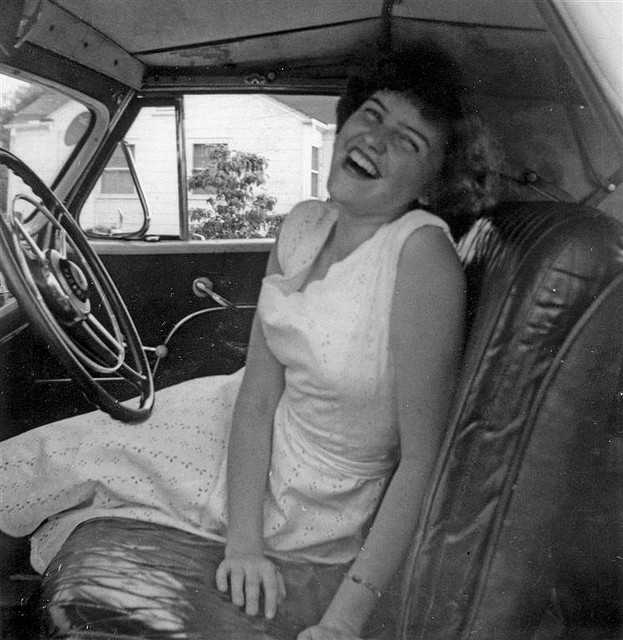 It used to be that getting access to a car was the ultimate marker of freedom. As a teenager in the nineties, I longed for my sixteenth birthday and all that was represented by a driver’s license. Today, this sentiment is not echoed by the teens that I meet. Some still desperately want a car, but it doesn’t have the same symbolic feeling that it once did. When I ask teens about driving, what they share with me reveals the burdens imposed by this supposed tool of freedom. They talk about the costs — especially the cost of gas. They talk about the rules — especially the rules that limit them from driving with other teens in the car. And they talk about the risks — regurgitating back countless PSAs on drinking or texting while driving. While plenty of teens still drive, the very notion of driving doesn’t prompt the twinkle in their eyes that I knew from my classmates.
Driving used to be hard work. Before there was power steering and automatic transmission, maneuvering a car took effort. Driving used to be a gateway for learning. Before there were computers in every part of a car, curious youth could easily tear apart their cars and tinker with their innards. Learning to drive and manipulate a car used to be admired. Driving also used to be fun. Although speed limits and safety belts have saved many lives, I still remember the ways in which we would experiment with the boundaries of a car by testing its limits in parking lots on winter days. And I will never forget my first cross-country road trip, when I embraced the openness of the road and pushed my car to the limits and felt the wind on my face. Freedom, I felt freedom.
Today, what I feel is boredom, if not misery. The actual mechanisms of driving are easy, fooling me into a lull when I get into a car. Even with stimuli all around me, all I get to do is pump the gas, hit the brakes, and steer the wheel no more than ten degrees. My body is bored and my brain turns off. By contrast, I totally get the allure of the phone—or anything that would be more interesting than trying to navigate the road while changing the radio station to avoid the incessant chatter from not-very-entertaining DJs.
 It’s rare that I hear many adults talk about driving with much joy. Some still get giddy about their cars; I hear this most often from my privileged friends when they get access to a car that changes their relationship to driving, such as an electric car or a hybrid or a Tesla. But even in those cases, I hear enthusiasm for a month before people go back to moaning about traffic and parking and surveillance. Outside of my friends, I hear people lament gas prices and tolls and this, that, or the other regulation. And when I listen to parents, they’re always complaining about having to drive their kids here, there, and everywhere. Not surprisingly, the teens that I meet rarely hear people talk joyously about cars. They hear it as a hassle.
So where does this end up? Data from both the CDC and AAA suggests that fewer and fewer American teens are bothering to even get their driver’s license. There’s so much handwringing about driving dangers, so much effort towards passing new laws and restrictions targeting teens in particular, and so much anxiety about distracted driving. Not surprisingly, more and more teens are throwing their hands in the air and giving up, demanding their parents drive them because there’s no other way. This, in turn, means that parents hate driving even more. And since our government is incapable of working together to invest in infrastructural investments, thereby undermining any hopes of public transit in huge parts of the country, what we’re effectively doing is laying the groundwork for autonomous vehicles. 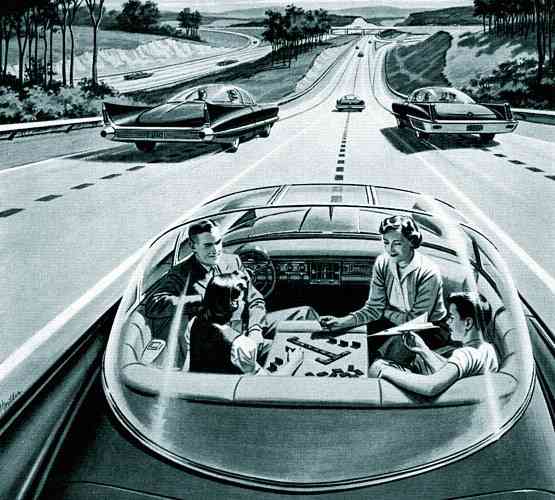 It’s been 75 years since General Motors exhibited an autonomous car at the 1939 World’s Fair, but we’ve now created the cultural conditions for this innovation to fit into American society.
We’re going to see a decade of people flipping out over fear that autonomous vehicles are dangerous, even though I expect them to be a lot less dangerous that sleepy drivers, drunken drivers, distracted drivers, and inexperienced drivers. Older populations that still associate driving with freedom are going to be resistant to the very idea of autonomous vehicles, but both parents and teenagers will start to see them as more freeing than driving. We’re still a long way from autonomous vehicles being meaningfully accessible to the general population. But we’re going to get there. We’ve spent the last thirty years ratcheting up fears and safety measures around cars, and we’ve successfully undermined the cultural appeal of driving. This is what will open the doors to a new form of transportation. And the opportunities for innovation here are only just beginning.
(This entry was first posted on May 5, 2014 at Medium under the title “Will my grandchildren learn to drive? I expect not” as part of The Message.)
The automatic sliding doors that we're familiar with from Star Trek are way smarter than the automatic sliding doors that we're familiar with from real life. In Star Trek, doors seem to know when characters want to go through them, and they never open by accident when someone is just walking by. Also, they manage to never be in the way when a character is running towards them at full speed (you try this at the mall and see what happens). Is it really too much to expect for automatic doors to have this sort of intelligence? It's not like we're asking for a Transporter. Now robotics researchers have (finally) made it happen.
There are two major improvements taking place here. First, the door is opened only for people who intend to use it. And second, the speed, width, and timing of the door opening is determined based on observations of the positions, speed, and number of people who are walking. The door estimates when you'll arrive at it, and times its opening such that it will have just finished opening itself as you get there. If you're in a hurry, the door cranks up its opening speed to make sure it gets out of your way in time. It also opens wider to admit more people at once when it has to. The door won't be able to tell whether to keep itself closed if you pause directly before it for dramatic effect, but otherwise, it's about as smart as a Star Trek door is.
The secret to this intelligence is no secret: the door has a fancy custom sensor (a 3D time-of-flight laser scanner) coupled with algorithms that can detect people, track their motion, and make educated guesses about whether or not they're aiming for the door. Somewhat unusually for a research paper like this, there is some serious consideration of practicalities, too. The sensor is designed to function in places with ambient light ranging from direct sunlight to total darkness (between 0 and 200,000 lx), and software can compensate for snow, rain, water on the sensor itself, and interference from other nearby sensors.
This fancier sensor comes at an additional cost than a conventional automatic door sensor. The researchers say that the custom sensor that they developed might add about $1,000 to the cost of a door, which sounds like a lot. However, the cost of hardware like this is something that tends to reduce itself dramatically year over year, so we'd like to think that we'd be able to experience smart doors like this without having to live long enough to see the maiden voyage of the USS Enterprise.
"Development of Intelligent Automatic Door System," by Daiki Nishida, Kumiko Tsuzura, Shunsuke Kudoh, Kazuo Takai, Tatsuhiro Momodori, Norihiro Asada, Toshihiro Mori, Takashi Suehiro, and Tetsuo Tomizawa from The University of Electro-Communications, and Hokuyo Automatic Co., was presented last week at ICRA 2014 in Hong Kong.





Noir Vol. 2, Marko Manev

We’ve all seen images of fantastic 3D printed shoes over the past couple of years, but if you were to look close and handle them, you’d find they weren’t particularly wearable. Now that’s set to change.
Designer Mary Huang has developed a new line of shoes, “Myth”, that, according to her are wearable. She says:
Each design is 90-100% made from components manufactured on small desktop machines, optimized for scalable 3d printing production. Hand finishing on the shoes is kept to a minimum, in keeping with the goal of making finished consumer products from 3D printers, so that designs manifest directly from digital to physical.
Even better, Huang intends on developing new pairs for the Myth line:
New designs will be released every month or so, and will expand to flats and boots down the line.
We believe this to be significant. Here we have a fashion designer who is now regularly producing totally wearable 3D printed items. Aside from “hard” pieces like jewelry, we’re not sure any other 3D printed fashion has these properties.


Architectural photography of Michael Wolf, showcasing the cramped and densely populated lifestyle of Hong Kong’s megacities
A Hong Kong VC fund has just appointed an algorithm to its board.
Deep Knowledge Ventures, a firm that focuses on age-related disease drugs and regenerative medicine projects, says the program, called VITAL, can make investment recommendations about life sciences firms by poring over large amounts of data.
Just like other members of the board, the algorithm gets to vote on whether the firm makes an investment in a specific company or not. The program will be the sixth member of DKV’s board.
”


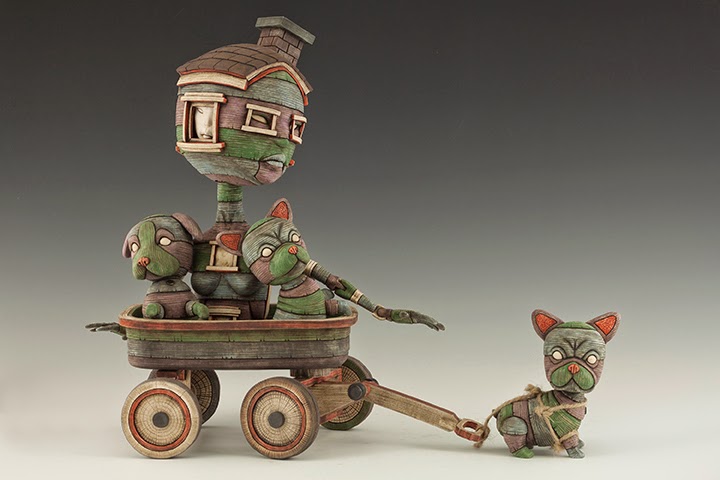
We know you've been asking for it for a long time and we're beyond thrilled to announce our next Maker Material: Wax!

 |
| "Parallels" @ Henry |


 |
| Calvin Ma @ Abmeyer + Wood |


 |
| Howard Marlow @ Punch |
 |
| Andy Kehoe & Red Walitzki @ Roq la Rue |



 |
| Amber Anderson @ Space |

 |
| Andrew Miller @ Essentia |



 |
| "Crow/Raven" @ ArtEast |

 |
| Juliette Aristides @ Gage |
 |
| Kate Protage & Dan Hawkins @ SAM Gallery |

 |
| Cait Willis @ Ghost Gallery |


 |
| Siolo Thompson @ Joe Bar |

 |
| "Summer Moon" @ Twilight Gallery |
 |
| Paper Plate Studios @ Twilight Gallery |
 |
| Tiny Fat Bird @ Twilight Gallery |
 |
| "Indigenous" @ Bherd Studios |


 |
| "Party On" @ Push/Pull |


*Those Lockheed F-35 fighter helmets really seem a bit much.

If you are like us, you would have been watching SpaceX unveil their astonishing new spacecraft, the Dragon V2.
It’s SpaceX’s first human-rated ship, which they intend to use for ground-to-low-orbit transfers. Seating seven, the ship’s interior is, beyond any doubt, suitable for any science fiction setting. Except it’s a real spaceship.

One of the Dragon V2’s features is the ability to land the capsule using an array of embedded rocket engines, as well as for a quick exit in case of emergency during launch. The SuperDraco thruster engine will be used in pairs for redundancy.
But here’s the thing: the thrusters are 3D printed in metal. SpaceX says:
The SuperDraco engine chamber is manufactured using state-of-the-art direct metal laser sintering (DMLS), otherwise known as 3D printing. The chamber is regeneratively cooled and printed in Inconel, a high-performance superalloy that offers both high strength and toughness for increased reliability.
There’s one thing they didn’t say: They believe so strongly in the reliability of 3D printing that they’d bet their lives on it.
Via SpaceX
"What if every book for the past 500 years had been reporting its readers at headquarters?"


What does the future of fashion look like?
Watch: Patagonia And Adidas Toil Away On The Next Big Breakthrough In Clothing


Today, New Matter, launched their new and elegant desktop 3D Printer, MOD-t, on Indiegogo. There are a lot of Desktop 3D Printers on the market, and many companies and creatives have one for home iteration and leverage our million-dollar machines for the high-resolution, premium quality we ensure with our designs. New Matter's entrance into the space with MOD-t caught my eye for a few reasons...

Evolution made the male ruff bird after watching one too many British period dramas. Don’t ever say its taste isn’t refined.





![[Astronomer peers into telescope] [Jaws theme begins playing]](http://imgs.xkcd.com/comics/fish.png "[Astronomer peers into telescope] [Jaws theme begins playing]")


