Before setting his sights once again on the far-off moon Pandora for the next Avatar adventure, filmmaker and aquanaut James Cameron has bequeathed arguably his greatest technological accomplishment to science. Cameron’s DEEPSEA CHALLENGER submarine, which he drove to the deepest part of this planet last March, will in June arrive at Woods Hole Oceanographic Institution (WHOI) in Massachusetts, ultimately helping researchers there better understand life in Earth’s last unexplored frontier. [More]
You don’t hear much about Guantanamo these days, unless you keep an eye on the writings of Pulitzer Prize-winning journalist Charlie Savage. Last week, Savage reported on a hunger strike involving 93 prisoners that’s now in its third month. Ostensibly the protest is in response to prison guards handling the Koran in disrespectful ways. But the real cause comes down to this: “a growing sense among many prisoners, some of whom have been held without trial for more than 11 years, that they will never go home.”
As part of Savage’s reporting on Gitmo, he has also created a photo blog that gives us insight into the prison library and its odd collection of books. The library offers prisoners access to Captain America comics (that must go over well with enemy combatants); pulp romance books by Danielle Steele (another choice pick for Islamists); the complete Harry Potter series (I imagine the Prisoner of Azkaban volume hits home); some more serious works by Gabriel Garcia Marquez, C.S. Lewis, Tolkien and Charles Dickens; an assortment of religious books; and the occasional self help book like The Anxiety & Phobia Workbook.
According to news reports, the library currently has 3,500 volumes on pre-approved topics. Prisoners have to order books in advance. (They can’t just wonder through the stacks.) And the most popular books include Agatha Christie mysteries, the self-help manual Don’t Be Sad; the The Lord of the Rings; and, of course, Harry Potter.
We know that other prisons have given their residents access to our collections of Free Audio Books and Free eBooks. But I doubt that will be happening at Gitmo any time soon.
What results is not only a catchy musical piece, but a peek into the first-person visual perspective of the instrument player as things continue to happen in the room. It’s as if the music is being scored for that moment, as the dog and baby play in the background.
This clip from the Eden Channel shares two musical traditions of the BaAka Forest People: polyphonic singing — when two or more voices join together with independent melodies at the same time — and, dressed in a costume of leaves, a theatrical ceremony that features dancing and joking as forest spirits.
Though they’ll grow to be predators someday, there are currently 3 lion cubs, a tiger cub and a hyena cub — all under six months old — that are enjoying an unusual friendship. Travel to the Akwaaba Lodge in Rustenburg, South Africa to meet Delano, Romeo, Maximus, Bella, and Milika…
So many people claim to be on a “diet”—a term used very loosely these days. Many dieters confess to “cheating.” Some cheat on the weekends as a reward for a good week of eating, others don’t make it to the weekend, and are lured in by non-diet food mid-week. I have done the weekend cheats and had great success, but would be lying if I said I resisted mid-weak temptations now and again.
I love to eat. I constantly think about food—if it’s not the food I’m eating, I’m very aware of what others are eating around me. In the past I have dieted strictly for months, and I’ve eaten like a savage for weeks. I have felt great adhering to my diet, and guilty about eating shitty food. I can’t seem to find the middle area: where people wake up and decide what to eat throughout the day, grazing on snacks to hold them over till lunch, or dinner, or whatever. I want to know what meals I’m going to eat as part of my diet, or I want to eat something that will give me instant gratification—usually ice cream, peanut butter, donuts, cakes, etc.
Over the past couple of years, I can think of many hilarious/shameful situations as a result of my cheating. Most involve family, Cristi, or Steel since I’m around them most. Here are some examples:
Hilarious: I can’t remember what diet I was following when Cristi started working at Penn but I was very consistent during the week and had a cheat meal on Fridays. After I cheat it is very noticeable the next day—I hold tons of water because I tend to gorge myself on sugary treats, and my face gets puffy. I remember deviating one week, and when Cristi and I were benching, she looked at me and asked, “Are you ok? Looks like you were crying or something.” I answered, “No, I just ate a bunch of food last night so my eyes are puffy.” I knew exactly what she was talking about, and we both laughed about it—the day after cheating effects were new for Cristi!
Shameful: Unlike Cristi just noticing the puffy-post-cheating look, Steel knowsthe look and always calls me on it. Since I typically ask him for diet suggestions, the weekly regimen is cut and dry, but I’ve deviated quite a few times. In fact, I cheated about 10 weeks out from competing and I remember Steel was pissed. I gave him every reason to doubt me and asked if he thought I could stick it out. He answered, “Well…given your track record…” So when I see him after unplanned-cheating (that’s more like a feeding frenzy), rather then say, “Hi” I’m usually greeted with the question, “Did you cheat?!” I’m never really prepared to answer, “Yes,” but the truth always comes out. I remember once Steel asked about 7 times before finally I admitted to it, which is just awful!
I know I can stick to a diet. I also know I can eat copious amounts of food in one sitting without recognizing any satiety till I actually feel sick. We’ve all indulged at some point. Whether your vice is sweet, savory or of the bottled variety, I’m always fascinated when others say they can eat “A LOT”—whatever your definition of a lot is, I don’t believe you.
When I cheat, it’s either all or none. I’m the ultimate enabler when I want to be. Food is definitely a drug, and sometimes I just can’t get enough….
Ice Cream-my FAVORITE food-I don’t like mint chocolate chip, but anything else…bring it on! Ben & Jerry’s pints are single servings as far as I’m concerned. Breyers and Edy’s have some great flavors. And yes, I’ve eaten an entire container of these in one sitting. All ice cream is better with whipped cream!
Peanut Butter-Skippy's is the best! For such a dense food/spread, I tend to ignore the recommended serving. Come on—2 tablespoons? That’s nothing! When I’m committed to my diet, I don’t eat it at all. Otherwise, I tend to enjoy heaping spoonfuls, and once in a while, the entire container.
Baked Goods- I can’t decide if it’s the texture of cakes, the frosting on top, or the crunch of certain candy toppings, but I LOVE pastries. I’m not talking about the boxed grocery store items or stopping in Dunkin Donuts. When I’m in the mood for treats, I will typically go out of my way to get—what I consider—the BEST! Here are a few great places:
Crumbs Bake Shop in Rittenhouse Philadelphia (best cupcakes)
Fritz’s Bakery in Langhorne, PA (best sticky buns with whipped cream cheese icing)
Termini Brother's in South Philly (best cannolis)
McMillan’s Bakery in Haddon, NJ (best cream puff éclair)
Riehl’s Bakery in the Newtown, PA Farmers Market: This place is a gold mine for donuts, Danish, whoopie pies, cookies, cakes, and breads! Love this place!
I recognize my nonsensical cheat meals could be problematic. I’m not proud of eating tons. It’s definitely not normal, and I get mad at myself for a few days, but looking back I don’t care. When I do it again, I will care at the time, but I know I can stay on track. If I didn’t have physique goals, and didn’t love lifting and competing in sports/activities that require weigh-ins, I can’t imagine what I would be like. Lost that’s for sure! Dieting, and cheating, is all a matter of choice. You control what you put in your mouth.
Tracy is an Assistant Strength Coach at the University of Pennsylvania. She holds the USAPL PA State squat record in the 148lb class with a lift of 402 lbs, and recently finished second in bodybuilding at the Steve Stone Metropolitan Competition in New York. She can be contacted at tracydzimmer@gmail.com
Talisker has unveiled a new million pound upgrade to its distillery visitor facilities. Jonny McCormick traveled to the Isle of Skye to take a look.
There are precious few signs that spring has arrived on Skye. The fabric of the mountainside is a muted patchwork of exhausted greens and intense purples from the quiescent winter grass and last summer’s heather. A severe storm is grinding itself out on the Hebrides, with dense, savage rainclouds enveloping the summits of the Cuillins on the Minginish peninsula. Rain and snowmelt have swollen the many burns and streams which cascade down steep slopes into the lochs; the unpredictable routes of the brilliant white torrents reminiscent of the legs running down your whisky glass. I approach Talisker distillery after a five hour coast-to-coast drive, the car whipped by rain every single minute of the journey. Talisker: give me shelter from the storm.
Talisker welcomed 60,000 visitors last year, the highest footfall of any Diageo-owned distillery in Scotland. This is a growing brand that continues to receive attention with smart updated packaging, premium limited editions, and new no-age-statement line extensions including Talisker Storm and the new Talisker Port Ruighe. These are soon to be joined by Talisker Dark Storm, a new Travel Retail expression matured in heavily charred casks.
No wonder the parent company has invested seriously in how the distillery in Carbost presents itself to the world. It’s styled by the tagline “Made By The Sea,” and as I enter, they are not kidding around. Carved waves surge out of the floorboards, lapping at information stations that encapsulate materials central to whisky making here: copper for the stills, the wood of the wormtubs, and the curious U-bend in the lyne arms with the skinny re-entrant pipe that loops condensed spirit back down into Talisker’s wash stills. Hand in hand are the rugged elements representing the strong winds driving the waves onto the rocks in Loch Harport, yachting sails, and rigging marking the maritime positioning fitting the distillery’s exposed setting.
The stories are rich from the distillery’s origins in 1830 with Hugh MacAskill who orchestrated the Clearances on Skye, the dependency on old Clyde puffers to bring in raw materials and take away casks to the mainland, and the night of the major stillhouse fire in 1960. The new ground floor reception area is a triumph of contemporary design and a breath of fresh (salty) air compared with the former upstairs lounge area where expectant visitors used to sip a dram in the past, while tour numbers grew to a critical mass. The new space has come at the expense of part of the sea-facing Duty Free Warehouse #4, but the tour still offers a view into this working warehouse where the oldest casks on site are maturing (currently two casks filled in 1979).
Talisker offer a basic tour at £7 (around $10-11) and an in-depth tasting tour for £25 ($38) that takes around two hours and includes a tasting of five different expressions plus an opportunity to try Talisker new make. This year, they are introducing something new with a ‘tasting without a tour’ session for repeat visitors and whisky enthusiasts who have seen it all before and just want to get their nose into the new products. The new tasting room has a colorful border of jumbled texts and fonts like a wood type block, each singing out a distinctive flavor descriptor; honeycombs, smoky bacon, wooden fish boxes….
This room will host the tasting tours and visiting media representatives like today, when a party of French journalists are attending a press launch for Talisker Port Ruighe. The space where the tours conclude is my favorite part of the redesign; a versatile room that can be partitioned by a blue swing panel covered in slogans of the key messages. The areas are bounded by vertical wooden planks, each laser cut with the names and flavors of a different expression of Talisker single malt whisky.
It’s the clever little touches that impress, such as the mirrors beside the narrow dunnage warehouse windows to increase the natural light and the sail ropes that hoist the vertical planks upwards like storm covers hiding cannon muzzles on a man-of-war. When the visitor season hits full swing later this summer, the tour guides will be conducting 30-35 tours per day with tour groups coming into this area for tastings every 15 minutes.
I’ve been visiting Skye since I was a boy and it still takes me a second to remember to use the Skye bridge and not pull off the road at Kyle of Lochalsh down to wait for the roll-on-roll-off ferry to make the short crossing to Kyleakin. Despite today’s cataclysmic downpour, I can reassure you that the Isle of Skye looks glorious in the summertime if you are planning a trip. The impressive new million pound facilities at Talisker Distillery will handsomely reward your efforts for making the journey. This display will leave you with a deeper understanding of the necessary characteristics embodied in the spirit of the Islanders: resilient, inventive, humorous, tough, self-sufficient, waterproof, patient, lucky.
Six years ago, industrial designer Sam Pearce was sitting in an airport when "I saw a mother pushing her child in a buggy," he writes. "The front wheel hit a slight kerb [sic] and the child jolted forward because of the impact. It happened several times in the time I was waiting there." He then did what many ID'ers do, which is to find the nearest piece of paper and sketch out a potential solution. What he drew in his notebook was this:
A simple idea for a wheel with built-in suspension.
Two years later, while off-road cycling, he remembered the sketch and began thinking if a suspension system like that could be built into a bike wheel. Now, many years of tinkering later, what Pearce has come up with is this:
It's called the Loopwheel, and its system of "tangential suspension"—essentially leaf springs folded back in on themselves—are not only workable, but they provide a gentler ride over sharp obstacles due to physics:
For now, Pearce is focusing on developing Loopwheels for smaller bikes, because the design "[allows] suspension where suspension can't normally fit," as with a folding bike design.
Last month Pearce debuted his creation at the UK's Bespoked Bicycle show. Response was tremendous, and he's now seeking Kickstarter funding to get the Loopwheel into proper production; up until now he's been making them as one-offs in his shop.
We were duly impressed with David Soukup's painstakingly detailed stencils when we first saw them back in 2011—I could hardly believe that some of those ultrafine lines were stenciled and not applied by an implement (or at least masked off). He's pleased to announce a solo show at Maxwell Colette gallery in his current hometown of Chicago: "This show is one of my most personal to date, and marks a return to some of the imagery and technical precision that I became known for."
I hadn't realized that he lost his way (the mural project, pictured above, dates to October of last year), but earlier this year, Soukup wrote that "I had been cutting stencils for so long that I really lost what made them most important to me, and why I started doing them in the first place."
In any case, we're glad he's back on track with his first exhibition in 16 months, featuring "over 20 pieces of new work (both stencils and screenprints)." The title, Perennial Escapism, is an obvious play on the subject matter, but the rather literal take on an exit strategy belies the integrity of the subject matter: the imagery is "derived from the artist's own photographs of early 20th century wrought iron fire escapes in Chicago." To hear Soukup tell it:
This work represents a personal 'escape' so to speak. I went back to what first made me passionate. I drew inspiration not just from the city imagery itself, but from the textures, the grit, and the distress that makes up a city. Perennial Escapism marks the beginning of a new direction, one I've never been more excited to pursue.
Where his previous work was more collage-y and surreal, the stark new compositions evoke film stills, superimposed on a baselayer of impasto on the wood panels to achieve the effect of a vaguely patina'd or otherwise weathered surface. Per the press release:
Soukup's paintings combine visual elements of graphic design and collage with the tactile elements of paint and reclaimed materials to create decidedly urban motifs. He hand-cuts the elaborate stencils, some up to four feet in length, that are utilized to create his paintings. The resulting latticework of iron bars and shadows echoes the visual experience of his everyday life, and reflects his obsession with meticulous detail.
We're pleased to present an exclusive preview of Perennial Escapism:
The new $100 bill we looked at is loaded up with anti-counterfeiting measures. As a result, the thing is butt-ugly, no? Way too crowded with design elements, and some of you will insist that older money is a lot classier-looking. Well, not so fast--let's go back to the 1860s, when the U.S. Treasury first began issuing paper currency. Have a look at this $1 bill from 1862:
The $2 bill from the same year doesn't look much better:
And 1862's $5 bill gets even crazier, wedging in a statue of Freedom personified under a Romanesque arch, with Alexander Hamilton hanging out on the lower right:
Mayflies are relatives of dragonflies and damselflies, and they also have aquatic larvae that predates on small invertebrates or eat something more vegetarian, like algae. Like in many insects, their nymphs (larva is not a technically correct term for them) are the main stage of the life cycle taking up to a year to develop into an adult and adults won't live longer than a day. The nymphs are small (less than a centimeter) and without proper optics it's impossible to see how beautiful they are. See more >>
The picture above might look like something coming straight from my camera attached to my microscope, but don't be deceived. That's just bubble coral from the Indian Ocean and not even a macro shot.
One of divers' mottoes is "take nothing but pictures, leave nothing but bubbles." But do divers really leave reefs unharmed? Being a biologist with reef conservation experience made me see my vacations differently. While everyone seems to come to tropical destinations to enjoy water activities, spend time on sunny beaches, and look at colorful fish and corals, I automatically start evaluating reef damage and looking for coral diseases. The last trip to Thailand made me question such things as whether or not conservation biologists are pessimistic in general or is it just me. I also started wondering if it's possible to come to a place without harming its environment, particularly if you are a diver.
Oh Joy, Sex Toy
I’ll be creating reviews of sex toys, events, porn, workshops, birth control and, well, basically anything that has to do with sex, sexuality and the sex industry!
Oh Joy, Sex Toy (OJST) is a weekly comic that updates every Tuesday to bring you reviews of everything that relates to sex, sexuality and the sex industry. From toys to workshops to birth control and much more, no stone will be left unturned, no vibrator left unused, no nipple left unpinched. With the aid of guest reviewers, this comic will cover products for ALL the different anatomies people posses, from vulvas to penises and beyond. OJST strives to be relevant to all different genders, body types, and sexualities.
DANG! Exciting! I hope you enjoy
(Credit to Amy T. Falcone for coming up with the title and Scott Kurtz for inventing “A celebration of fornication” You guys are better at this than I am.)
Since time immemorial — or, in any case, since the mid-twentieth century — adolescents have looked to rock stars for life lessons. This works out better with some rock stars than others, of course, and in bygone days kids would have to infer these lessons from song lyrics and the occasional Rolling Stone interview. Now that most of their musical idols maintain active, even garrulous presences on several forms of social media at once, internet-age youngsters in need of counsel have a great deal more material to work with. Certain rock stars have taken this responsibility seriously, as you can see in the video above featuring Radiohead mastermind Thom Yorke and producer/multi-instrumentalist Nigel Godrich (also known as the men behind the supergroup Atoms for Peace). If you find yourself confused by boys, let these two fortysomething Brits clear it right up.
You can find a little more coverage of the video at, yes, Rolling Stone. “Yorke is particularly sage about teenage love woes,” writes the magazine’s Jon Blistein. “‘If you have a crush on him,’ Yorke says, ‘if you’re really, really, really, really shy, which is what I was at that age — also, I was at a boys’ school so it was impossible to meet girls anyway — how about just write him a note? Or throw him against the wall some time.’” Yorke and Godrich’s seventeen minutes of advice comes as the latest installment in the series “Ask a Grown Man” from Rookie, just the sort of web magazine we wish we could have had back when we were teenage girls — if we were ever teenage girls, that is. We’ve previously featured Ira Glass’ segment, and you can enjoy other moments of sagacity with the likes of comedian-filmmaker Judd Apatow, talk-show host Jimmy Fallon, and actor John Hamm. You certainly wouldn’t find them in the pages of Sassy.
To some fans of his not-exactly-a-sitcom Louie, Louis C.K. simply appeared a few years ago, fully formed and acclaimed by his peers as perhaps the most skilled, dedicated comedic craftsmen working today. But he does have a past, stretching back well beyond his voice role on the animated series Home Movies and his direction of the film Pootie Tang, and he has offered up entertaining fragments of it online. Above you’ll find his earliest known short film, Ice Cream. Begin watching this black-and-white meditation on the vagaries of disaffected twentysomething love in the nineties — one which opens in a convenient store, no less — and you’ll immediately think of Kevin Smith’s Clerks. But C.K. made Ice Cream in 1993, the year before Clerks came out, and it tilts in directions even Smith wouldn’t dare predict, ultimately arriving at a mariachi band-scored finale.
Just above, we have 1998′s Hello There. In four minutes, the film follows a catatonic-looking fellow (played by comedian Ron Lynch) wearing a poorly fitting suit and a cassette recorder around his neck as he makes his way through town. “Excuse me,” his machine says when he presses its play button, “do you have the correct time?” A bystander nervously answers. “Hello there,” his speaker blares to a bum dozing in a cardboard box, “is that a new hat? You are a good guy.” As the morning continues, we come to understand that this eccentric is not the only one of his kind. Below you can watch that same year’s Brunch, which throws the verbally NSFW comedian Rick Shapiro into a sharply observed mid-morning huddle of pontificating senior citizens. These all come from Louis C.K.s official Youtube channel, and indeed, C.K. presciently made them in a form neatly suited to the Youtube era, just as Louie has proven an ideal artistic, intellectual, and financial fit for the modern cable television landscape.
Punk rock has died a thousand deaths in the West. Almost as soon as the mass media picked it up, punk split into several hundred subspecies and spawned other monoliths—post-punk, new wave, “alternative.” Given that history, it’s generally assumed—a couple generations of suburban mallrats aside—that the original movement flashed and failed, overtaken by keyboards and drum machines, corporate greed and narcissism. But that history is incomplete. As a recent Guardian headline proclaims, punk rock is “alive and kicking in a repressive state near you.” The cause célèbre of international punk is, of course, Russia’s Pussy Riot, three of whose members were convicted of “hooliganism” and sent to labor camps. But dissident punk scenes thrive under the radar in many other places hostile to dissent, such as Burma, Indonesia, and China.
And while the contemporary phenomenon of global punk makes for fascinating news stories, a new documentary, Punk in Africa, demonstrates that international punk rock is as old as the Western variety. It just never got the same press. In South Africa, shortly after the 1976 Soweto Uprising, multi-racial punk bands began to form, with names like Gay Marines, National Wake, and Screaming Foetus. Meeting and performing under the pall of Apartheid, these bands defied laws against racial mixing and braved constant harassment by police. As one member of National Wake says in the trailer above, “the vice squad would visit us, sometimes three times in one day.” He calls the racial territory the band had to navigate a “minefield.”
A lot of the Afropunk featured in the film is reminiscent of the meeting of black and white sounds and musicians in England, especially in bands like The Clash, The Beat and The Specials. Later African ska bands like Hog Hoggity Hog and The Rudimentals certainly carry on that tradition. But many of the bands profiled—from South Africa, Zimbabwe, and Mozambique—melded raw punk energy with African polyrhythms and distinctive local sounds and instrumentation. National Wake provides a good example of such hybridization. The live performance above even includes a drum solo—anathema to most Western punk rock.
Punk in Africa promises to add some necessary balance to the slew of punk histories that focus only on Britain and the U.S.. In the interview above, one of the documentary’s directors, Deon Maas, points out that the “punk thing in Africa” started virtually weeks after its U.K. cousin, first in imitation, then as a true movement in its own right. Like the international punk scenes burgeoning around the world today, it’s a movement that deserves to be heard.
Whisky Advocate’s managing editor, Lew Bryson, reports on his recent trip to Scotland.
I was invited to join a press trip to Highland Park distillery recently. I accepted, and added on two days of my own to visit other distilleries in the Highlands. The trip was last week, and after a pleasant Sunday afternoon in the cask ale bars of Edinburgh, we flew up to Kirkwall on Orkney on a brisk Monday morning, dropped our bags at the Lynnfield Hotel, and went to the distillery. We stood in the courtyard, smelling the peat burning in the maltings, looking at tubs filled with tiny daffodils, and feeling the sleet fall lightly on our heads and shoulders. That’s Orkney for you.
Highland Park does floor malting of about 20% of its malt, and smokes it all with Orkney peat to between 35 and 50 ppm of phenols. The local peat is unique, and densely layered with heather. We went out to the peat cuttings the following day, and could see heather roots right down to the 5,000 year level. The other 80% of the malt is unpeated and is bought in. The 80/20 blend is the same in all mashing, and yields the familiarly gentle peat character of Highland Park, with a phenol level of about 2 ppm in the spirit.
Highland Park’s whisky is all aged in oloroso sherry-seasoned casks; some made from American oak, some from Spanish oak (about 50/50), but all sherry (which made for an amusing “Ah HA!” moment when we spotted a small number of port pipes; they were experimental, and may never make it to a bottling). They vary the ratios of American/ Spanish and first-fill/refill to get different character for the different bottlings. The 30 Year Old, for instance, has no first-fill casks; the 25 Year Old is 50% first-fill casks.
It was broadly hinted to us that the Edrington Group would like to reserve as much Highland Park as possible for single malt bottling (they’ve already cut back on the amount of barrels being released to independent bottlers). With the same kind of demand driving things at The Macallan, you wonder what the future is for Famous Grouse and Cutty Sark.
After a fascinating second day getting the Orkney experience—standing stones, cliffs, more sleet, a Neolithic chamber tomb, the peat bogs, Scapa Flow, and fish and chips in a harborside pub—we left Kirkwall Wednesday morning, and I rented a car to drive to Speyside. My first stop was The Macallan, where my guide, Ian Duncan, told me that they’re now running 24/7 every day of the year, except for three weeks of maintenance in July. Yes, every day of the year, even Christmas and New Year’s, which is how they’re putting out 9.2 million liters a year (even given their “curiously small stills”).
The visitor center has an excellent display on wood, which shows the structure of oak, explaining how oak is watertight, but also, very slowly, breathes. The oak they’re largely looking at, of course, is Spanish and American oak used in sherry casks, which now cost The Macallan about £650 each, compared to £500 only two years ago. Do yourself a favor: drink more sherry!
Unfortunately, since I was traveling solo, I wasn’t able to taste anything, so I pushed on to The Glenlivet, where I was met by international brand ambassador Ian Logan. It was a bit late in the afternoon, so we had the place largely to ourselves, and we paused for a moment in the new distillation hall, a soaring place with a grand view across the valley. The stills are oil-fired, but natural gas is coming: I’d been held up by the construction along the way. The new stills are in addition to the old ones and give the distillery a capacity of 10.5 million liters a year, trying to keep up with a booming demand that had increased sales of Glenlivet from 2,500 cases a year in the 1970s to 250,000 cases in 2001, and an amazing 825,000 cases in 2012.
I asked Ian about the still geometry; why are the stills at Glenlivet shaped the way they are? He called over brewer Richard Clark, who cocked his head and said, “Because that’s the way we’ve always done it. But really, that’s what it is. Whatever the reason they were built the way they were, keep doing it the same way, because that’s how your spirit is.”
That led us into a discussion of quality vs. consistency. The distillation here is highly consistent because of automation. That’s not necessarily higher quality every time, Ian noted, but it makes for a regularly higher level overall, and it’s always the same. Automation may make a smaller workforce possible—there are ten people making the whisky here—but it’s still the people who make the whisky, he said.
Then we had a chat about limits. The last downturn in the industry was in the 1980s, Ian said, but Chivas kept making whisky, and Glenlivet is set for older whiskies because of that. “It will turn down again,” he said. “It always does. Everything does. Everything is cyclical.” There are other limits on growth; everyone I talked to on this trip had water on their mind, a limiting factor even here in rainy Scotland as production expands in response to demand.
I drove on up past Inverness, and spent the night at The Anderson in Fortrose, owned by an old acquaintance from Philly, Jim Anderson (and he has a great whisky bar). It was a short drive to Tain the next morning, where Annette MacKenzie took me around a quiet Glenmorangie that was slowly coming back to life after annual maintenance. They did a total refurbishment three years ago, and are looking at 6 million liters production this year.
It was quiet at the distillery, but things were stirring. Malt was being delivered, and steam was slowly being turned back on. “Good to hear the noise!” Annette called to the stillman. Then she told me that because the sounds of the steam and the bubbles and the gushes of the stillhouse are so important, and the stillman leans to listen to every little nuance, “You can’t sneak up on a stillman.”
I drove back southeast, backtracking to The Dalmore, where Shauna Jennens took me around. We saw the two sets of stills—the “little rascals” and the “big bastards”—with the odd flat tops of the wash stills and the unique cooling water jackets of the spirit stills.
“It’s an unbalanced distilling system,” explained stillman Mark Hallas. “The spirit’s different coming off the different stills, but over 24 hours it balances. It’s all manually controlled, they call it ‘dynamic distillation.’” He grinned. “Automate it all you want, the most important part is the meat in the machine.” He grinned again, and tapped the side of his head.
The meat in the machine at Dalmore that everyone knows best is Richard Paterson’s nose, of course, and though he wasn’t there that morning, his presence was palpable: in videos, in pictures, and in the complicated blending that’s done with six different casks and finishes for the single malts. Even a simple nose like mine noticed that the smell in these dunnage warehouses, right beside the Cromarty Firth, is unique: malt, wood, stemmy grape, and salt.
And here I did finally give in and have a small drink of Matusalem oloroso sherry; “good stuff,” as Shauna pronounced it, and it was rich, fruity, and delicious. We followed it with a bare quarter-ounce of King Alexander III, and the relation was clear. It was a very good moment, looking out the window, across the sun-beaten firth, ready to push on.
Push on I did, with one more stop before heading back to the Edinburgh airport to fly home. I drove east to Elgin, and then up the Spey to Rothes, where I met Fiona Toovey for a tour of Forsyths, the still manufacturers. Once kitted out with reflective vest and steel-toed shoes, we walked the yard, full of coppersmiths banging away with hammers of differing sizes, saw the large pits for the mechanical hammers, and the shop where Forsyths rides out the cyclical whisky industry with work on specialized steel welding and shaping for the gas and oil drilling industry.
They were gearing up for the summer maintenance period here as well. A warehouse was filling with new and refurbished stills and condensers, and a small army of fitters would swarm on them to get them into quiet distilleries during the short summer break. Things are good at Forsyths, and only getting better as more major distillery expansions are announced.
That was the end of my trip, but for the intensely scenic drive down to Edinburgh (and a quick stop to take a few pictures at Tullibardine for my sister). The Scotch whisky industry is successful and expanding, and looking challenges straight in the eye. Where will the water come from to make the whisky? Where will the wood come from for sherry aging? Where will the money come from to build more warehouses than current sales need (but future sales depend on)? Time will tell. For now, all is well in the glens and on the islands.
It’s a good job I’ve at last found someone to replace me in a few years. I’d like to introduce you to Tom Ritson my apprentice cutter for the last year. By coincidence, Tom grew up in the same area as myself and also went to the same school. You cant get more English Cut than that even by his name which is local to the area. So let’s hope he enjoys the business as I have for the last thirty years. I only feel like I’ve been in this trade for five minutes but incredibly it will be thirty years next November since I entered this trade finishing at Anderson & Sheppard before starting on my own with Edwin of Steed in 1995. Time flies when your having fun.
Many of my customers know Tom already but he’s rapidly learning our craft and will hopefully be wielding the tape for his own clients in the not too distant future. You’ve may have been wondering where I’ve been as the posts have been somewhat scarce. It’s pretty easy to deduce why, a very busy expanding business and two young boys taking up the rest of my time. So there’s never enough hours in the day to cut, teach, run a business and write.
Fortunately, young Tom is not only learning very well, he thoroughly loves the craft. So much so he wants to teach the next generation all about it. He’s going to fill the gap of the often overworked Tom senior and help out with the blog.
We’ll be freshening it up this summer and doing something very exciting. Tom will be posting regularly about his journey through the trade. He’ll be showing you literally what’s being cut and made and give you a new aspect to the trade from an apprentice mastering his craft. I hope you’ll enjoy the regular updates and pictures and also following Tom’s career develop. I certainly know the readers of English Cut will wish him every success.
Talking of bright futures I’d like to wish my good friend Hugh McLeod and his new wife of two weeks many wonderful, happy years together. Early readers of English Cut will remember that it was Hugh who gave me the idea to start writing down my experiences in this wonderful trade. Hence, English Cut was born. The first ever tailoring blog.
I’m’ off on my usual spring trip to the USA next week and my full itinerary is here. Next year I hope Tom will be joining me so he can meet our friends in the US and carry the bags.
On this blog I’ve frequently mentioned his book “Seeing Like a State“, and also enjoyed his “The Art of Not Being Governed: An Anarchist History of Upland Southeast Asia” with its interesting perspectives on state resistance. I found it particular interesting due to the connections I could see between his work on fugitive societies from the state, resonated with my own experience working with and researching Maroons in the Americas.
He introduces his new book with a preface which argues for the value of an “anarchist squint,” which I believe has many resonances with resilience research. In the preface (pdf) he writes:
James C. Scott in his preface to his new book “Two Cheers for Anarchism:”
Lacking a comprehensive anarchist worldview and philosophy, and in any case wary of nomothetic ways of seeing, I am making a case for a sort of anarchist squint. What I aim to show is that if you put on anarchist glasses and look at the history of popular movements, revolutions, ordinary politics, and the state from that angle, certain insights will appear that are obscured from almost any other angle. It will also become apparent that anarchist principles are active in the aspirations and political action of people who have never heard of anarchism or anarchist philosophy. One thing that heaves into view, I believe, is what Pierre-Joseph Proudhon had in mind when he first used the term “anarchism,” namely, mutuality, or cooperation without hierarchy or state rule. Another is the anarchist tolerance for confusion and improvisation that accompanies social learning, and confidence in spontaneous cooperation and reciprocity. Here Rosa Luxemburg’s preference, in the long run, for the honest mistakes of the working class over the wisdom of the executive decisions of a handful of vanguard party elites is indicative of this stance. My claim, then, is fairly modest. These glasses, I think, offer a sharper image and better depth of field than most of the alternatives.
Scott goes on to define what he means by an anarchist squint:
My anarchist squint involves a defense of politics, conflict, and debate, and the perpetual uncertainty and learning they entail. This means that I reject the major stream of utopian scientism that dominated much of anarchist thought around the turn of the twentieth century. In light of the huge strides in industry, chemistry, medicine, engineering, and transportation, it was no wonder that high modernist optimism on the right and the left led to the belief that the problem of scarcity had, in principle, been solved. Scientific progress, many believed, had uncovered the laws of nature, and with them the means to solve the problems of subsistence, social organization, and institutional design on a scientific basis. As men became more rational and knowledgeable, science would tell us how we should live, and politics would no longer be necessary. …. For many anarchists the same vision of progress pointed the way toward an economy in which the state was beside the point. Not only have we subsequently learned both that material plenty, far from banishing politics, creates new spheres of political struggle but also that statist socialism was less “the administration of ” things than the trade union of the ruling class protecting its privileges.
Unlike many anarchist thinkers, I do not believe that the state is everywhere and always the enemy of freedom.
…
Nor do I believe that the state is the only institution that endangers freedom. To assert so would be to ignore a long and deep history of pre-state slavery, property in women, warfare, and bondage. It is one thing to disagree utterly with Hobbes about the nature of society before the existence of the state (nasty, brutish, and short) and another to believe that “the state of nature” was an unbroken landscape of communal property, cooperation, and peace.
…
The last strand of anarchist thought I definitely wish to distance myself from is the sort of libertarianism that tolerates (or even encourages) great differences in wealth, property, and status. Freedom and (small “d”) democracy are, in conditions of rampant inequality, a cruel sham as Bakunin understood. There is no authentic freedom where huge differences make voluntary agreements or exchanges nothing more than legalized plunder.
…
What is clear to anyone except a market fundamentalist (of the sort who would ethically condone a citizen’s selling himself—voluntarily, of course—as a chattel slave) is that democracy is a cruel hoax without relative equality. This, of course, is the great dilemma for an anarchist. If relative equality is a necessary condition of mutuality and freedom, how can it be guaranteed except through the state? Facing this conundrum, I believe that both theoretically and practically, the abolition of the state is not an option. We are stuck, alas, with Leviathan, though not at all for the reasons Hobbes had supposed, and the challenge is to tame it. That challenge may well be beyond our reach.
Anyone with too much time on their hands who happens to find themselves wondering what it is am I am doing can read these, and get a better idea.
Recently I developed a short reading list for PhD students working on ecosystem services at the Stockholm Resilience Centre. This list seeks to cover and introduce a broad area of ecosystem service research with a focus on understanding ecosystem services in a social-ecological context, with a special focus on resilience.
Kremen, C. (2005). Managing ecosystem services: what do we need to know about their ecology?. Ecology Letters, 8(5), 468-479.
Lavorel, S., Grigulis, K., Fourier, J. & Cedex, G. (2012) How fundamental plant functional trait relationships scale-up to trade-offs and synergies in ecosystem services. Journal of Ecology, 100, 128–140.
Institutions & ES
Jack, B.K., Kousky, C. & Sims, K.R.E. (2008) Designing payments for ecosystem services: Lessons from previous experience with incentive-based mechanisms. PNAS, 105, 9465–70.
Muradian, R., Corbera, E., Pascual, U., Kosoy, N. & May, P.H. (2010) Reconciling theory and practice: An alternative conceptual framework for understanding payments for environmental services. Ecological Economics, 69, 1202–1208.
Chan, Kai MA, et al. 2012 Where are cultural and social in ecosystem services? A framework for constructive engagement. BioScience 62(8): 744-756.
Daw, T., Brown, K., Rosendo, S. & Pomeroy, R. 2011 Applying the ecosystem services concept to poverty alleviation: the need to disaggregate human well-being. Environmental Conservation, 38, 370–379.
Daniel, T. C., Muhar, A., Arnberger, A., Aznar, O., Boyd, J. W., Chan, K., … & von der Dunk, A. 2012. Contributions of cultural services to the ecosystem services agenda. PNAS, 109(23), 8812-8819.
Fisher, B., Turner, R. & Morling, P. (2009) Defining and classifying ecosystem services for decision making. Ecological Economics, 68, 643–653.
ES & Resilience
Biggs, R., Schlüter, M., Biggs, D., Bohensky, E. L., BurnSilver, S., Cundill, G., … & West, P. C. (2012). Toward Principles for Enhancing the Resilience of Ecosystem Services. Annual Review of Environment and Resources, 37(1).
Enfors et al., 2008 Making investments in dryland development work: participatory scenario planning in the Makanya catchment, Tanzania. Ecology and Society, 13 (2)42
Raudsepp-Hearne, C., Peterson, G.D., Tengö, M., Bennett, E.M., Holland, T., Benessaiah, K., MacDonald, G.K. & Pfeifer, L. (2010) Untangling the Environmentalist’s Paradox: Why Is Human Well-being Increasing as Ecosystem Services Degrade? BioScience, 60, 576–589.
Raudsepp-Hearne, C., Peterson, G.D. & Bennett, E.M. (2010) Ecosystem service bundles for analyzing tradeoffs in diverse landscapes. PNAS, 107, 5242–7.
Nelson, E., Mendoza, G., Regetz, J., Polasky, S., Tallis, H., Cameron, Dr., Chan, K.M., Daily, G.C., Goldstein, J., Kareiva, P.M., Lonsdorf, E., Naidoo, R., Ricketts, T.H. & Shaw, Mr. (2009) Modeling multiple ecosystem services, biodiversity conservation, commodity production, and tradeoffs at landscape scales. Frontiers in Ecology and the Environment, 7, 4–11.
Implementation
Cowling, R.M., Egoh, B., Knight, A.T., O’Farrell, P.J., Reyers, B., Rouget’ll, M., Roux, D.J., Welz, A. & Wilhelm-Rechman, A. (2008) An operational model for mainstreaming ecosystem services for implementation. PNAS, 105, 9483–9488.
Daily, G.C., Polasky, S., Goldstein, J., Kareiva, P.M., Mooney, H. a, Pejchar, L., Ricketts, T.H., Salzman, J. & Shallenberger, R. (2009b) Ecosystem services in decision making: time to deliver. Frontiers in Ecology & the Environment, 7, 21–28.
Carpenter, S.R., Mooney, H. a, Agard, J., Capistrano, D., Defries, R.S., Díaz, S., Dietz, T., Duraiappah, A.K., Oteng-Yeboah, A., Pereira, H.M., Perrings, C., Reid, W. V, Sarukhan, J., Scholes, R.J. & Whyte, A. 2009. Science for managing ecosystem services: Beyond the Millennium Ecosystem Assessment. PNAS, 106, 1305–12.
Kinzig, A., Perrings, C., Chapin III, F., Polasky, S., Smith, V., Tilman, D. & Turner II, B. 2011. Paying for Ecosystem Services — Promise and Peril. Science, 334, 603–604.
Kremen, C. and R.S. Ostfeld. 2005. A call to ecologists: measuring, analyzing, and managing ecosystem services. Frontiers in Ecology and Environment 3:10:540-548.
Norgaard, R.B. 2010. Ecosystem services: From eye-opening metaphor to complexity blinder. Ecological Economics, 69, 1219–1227.
This list over emphasizes the research from Stockholm Resilience Centre, which is useful for us, but probably not for those with other interests. For those who are interested – I have a broader open Mendeley of papers of ecosystem services – here.
Please suggest papers that our students should be reading in the comments.
In case you haven’t heard, the Internet has a lot of, shall we say, inaccuracies. Hypothes.is is trying to add a new layer to web browsing, in which experts can annotate online info and vouch for (or discredit) its veracity.
The web has spread a lot of knowledge, but also helped propagate a lot of untruth. From Sarah Palin’s "death panels," to bogus science linking vaccines to autism, the democratization of information, while a fine idea, hasn’t always furthered understanding. Sometimes, it’s simply given license to liars, bullshitters, and worse.
Of course, there are controls. Sites freeze out spammers and trolls, moderate discussion, and have voting systems that bring more useful remarks to the top. But comment sections are not ideal. There’s a lot of verbiage to wade through. It’s not contextual. And, you never really know if a commenter is an honest broker, or in the pay of some company or interest group (yes, people do write shit for money). More fundamentally, the conversation increasingly doesn’t belong to us, if it ever did. That comment on Facebook is just another opportunity for the ad sales team.
To give truth more chance, an ambitious start-up named Hypothes.is wants to add a new layer to the web--one that’s not owned by anybody, but is open-source, and part of the commons. Call it the "annotation layer," or "crowd-sourced peer-review." Essentially, it is annotation capability that brings the information-validation of Wikipedia to everything that’s not Wikipedia.
"It’s infrastructure for the analysis of information," says founder Dan Whaley. That could be just fixing a spelling error, or having 1,000 experts go line by line through the healthcare bill, or financial filings. Using reputation-modeling that privileges people who actually know about stuff, the system creates information trails, showing what research or news preceded the text in question, and what other work it led to afterwards. "This is collaborative research that blurs the line between pre- and post-publication," he says.
Whaley wants Hypothes.is to be available in several forms, including as a browser plug-in (download an early version here) and an API that’s open to third-party developers. Crucially, though, nobody will own it. Sites won’t need to enable the technology; it will be part of the open toolkit of the net itself.
It’s infrastructure for the analysis of information.
The idea of a conversation "around the web" has a long history, as Whaley admits. The creators of the first browser imagined annotation capability, but ditched the idea when they realized how much server capacity they would need to facilitate it. Since then, the likes of Third Voice and Fleck have wanted to do similar things. Whaley doesn’t see such projects as reason for pessimism, but rather as evidence of need. "The fact that it’s such a persistent pursuit of so many people for so long is testament to how important it is that we find a way to make it happen," he says.
And those ex-ventures can be instructive. Before starting Hypothes.is, he spoke with many people involved, learning about mistakes to avoid. Poor user interfaces, a lack of reputation management, that the companies were for-profit--all either invalidated, or made those ventures less attractive, he says.
Whaley isn’t against making money. In the late-'90s, he made a fortune from GetThere, an early travel reservation tool that went public, before being acquired by Sabre for $757 million. He just thinks that something standards-based, rather than owned by one entity, has a better chance of success. "For something like this, you need a little more Wikipedia and Mozilla, and a little less Facebook and Google."



 You don’t hear much about Guantanamo these days, unless you keep an eye on the writings of Pulitzer Prize-winning journalist Charlie Savage. Last week, Savage reported on a hunger strike involving 93 prisoners that’s now in its third month. Ostensibly the protest is in response to prison guards handling the Koran in disrespectful ways. But the real cause comes down to this: “a growing sense among many prisoners, some of whom have been held without trial for more than 11 years, that they will never go home.”





 Hilarious: I can’t remember what diet I was following when Cristi started working at Penn but I was very consistent during the week and had a cheat meal on Fridays. After I cheat it is very noticeable the next day—I hold tons of water because I tend to gorge myself on sugary treats, and my face gets puffy. I remember deviating one week, and when Cristi and I were benching, she looked at me and asked, “Are you ok? Looks like you were crying or something.” I answered, “No, I just ate a bunch of food last night so my eyes are puffy.” I knew exactly what she was talking about, and we both laughed about it—the day after cheating effects were new for Cristi!
 I know I can stick to a diet. I also know I can eat copious amounts of food in one sitting without recognizing any satiety till I actually feel sick. We’ve all indulged at some point. Whether your vice is sweet, savory or of the bottled variety, I’m always fascinated when others say they can eat “A LOT”—whatever your definition of a lot is, I don’t believe you.
 Hilarious: I can’t remember what diet I was following when Cristi started working at Penn but I was very consistent during the week and had a cheat meal on Fridays. After I cheat it is very noticeable the next day—I hold tons of water because I tend to gorge myself on sugary treats, and my face gets puffy. I remember deviating one week, and when Cristi and I were benching, she looked at me and asked, “Are you ok? Looks like you were crying or something.” I answered, “No, I just ate a bunch of food last night so my eyes are puffy.” I knew exactly what she was talking about, and we both laughed about it—the day after cheating effects were new for Cristi!
 I know I can stick to a diet. I also know I can eat copious amounts of food in one sitting without recognizing any satiety till I actually feel sick. We’ve all indulged at some point. Whether your vice is sweet, savory or of the bottled variety, I’m always fascinated when others say they can eat “A LOT”—whatever your definition of a lot is, I don’t believe you.


 and intense purples from the quiescent winter grass and last summer’s heather. A severe storm is grinding itself out on the Hebrides, with dense, savage rainclouds enveloping the summits of the Cuillins on the Minginish peninsula. Rain and snowmelt have swollen the many burns and streams which cascade down steep slopes into the lochs; the unpredictable routes of the brilliant white torrents reminiscent of the legs running down your whisky glass. I approach Talisker distillery after a five hour coast-to-coast drive, the car whipped by rain every single minute of the journey. Talisker: give me shelter from the storm.
 No wonder the parent company has invested seriously in how the distillery in Carbost presents itself to the world. It’s styled by the tagline “Made By The Sea,” and as I enter, they are not kidding around. Carved waves surge out of the floorboards, lapping at information stations that encapsulate materials central to whisky making here: copper for the stills, the wood of the wormtubs, and the curious U-bend in the lyne arms with the skinny re-entrant pipe that loops condensed spirit back down into Talisker’s wash stills. Hand in hand are the rugged elements representing the strong winds driving the waves onto the rocks in Loch Harport, yachting sails, and rigging marking the maritime positioning fitting the distillery’s exposed setting.
 £25 ($38) that takes around two hours and includes a tasting of five different expressions plus an opportunity to try Talisker new make. This year, they are introducing something new with a ‘tasting without a tour’ session for repeat visitors and whisky enthusiasts who have seen it all before and just want to get their nose into the new products. The new tasting room has a colorful border of jumbled texts and fonts like a wood type block, each singing out a distinctive flavor descriptor; honeycombs, smoky bacon, wooden fish boxes….
 I’ve been visiting Skye since I was a boy and it still takes me a second to remember to use the Skye bridge and not pull off the road at Kyle of Lochalsh down to wait for the roll-on-roll-off ferry to make the short crossing to Kyleakin. Despite today’s cataclysmic downpour, I can reassure you that the Isle of Skye looks glorious in the summertime if you are planning a trip. The impressive new million pound facilities at Talisker Distillery will handsomely reward your efforts for making the journey. This display will leave you with a deeper understanding of the necessary characteristics embodied in the spirit of the Islanders: resilient, inventive, humorous, tough, self-sufficient, waterproof, patient, lucky.


 Images courtesy of the artist


















 The local peat is unique, and densely layered with heather. We went out to the peat cuttings the following day, and could see heather roots right down to the 5,000 year level. The other 80% of the malt is unpeated and is bought in. The 80/20 blend is the same in all mashing, and yields the familiarly gentle peat character of Highland Park, with a phenol level of about 2 ppm in the spirit.
 After a fascinating second day getting the Orkney experience—standing stones, cliffs, more sleet, a Neolithic chamber tomb, the peat bogs, Scapa Flow, and fish and chips in a harborside pub—we left Kirkwall Wednesday morning, and I rented a car to drive to Speyside. My first stop was The Macallan, where my guide, Ian Duncan, told me that they’re now running 24/7 every day of the year, except for three weeks of maintenance in July. Yes, every day of the year, even Christmas and New Year’s, which is how they’re putting out 9.2 million liters a year (even given their “curiously small stills”).
 Anderson (and he has a great whisky bar). It was a short drive to Tain the next morning, where Annette MacKenzie took me around a quiet Glenmorangie that was slowly coming back to life after annual maintenance. They did a total refurbishment three years ago, and are looking at 6 million liters production this year.
 Push on I did, with one more stop before heading back to the Edinburgh airport to fly home. I drove east to Elgin, and then up the Spey to Rothes, where I met Fiona Toovey for a tour of Forsyths, the still manufacturers. Once kitted out with reflective vest and steel-toed shoes, we walked the yard, full of coppersmiths banging away with hammers of differing sizes, saw the large pits for the mechanical hammers, and the shop where Forsyths rides out the cyclical whisky industry with work on specialized steel welding and shaping for the gas and oil drilling industry.
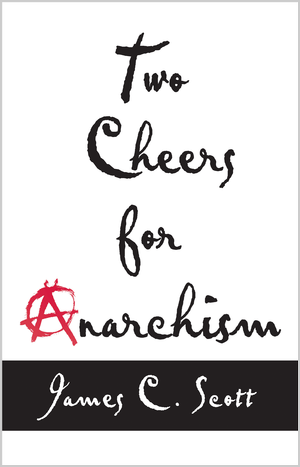 Political scientist James C. Scott, author of a series of ground breaking books that explore some of political and anthropological aspects of resilience has a new book out Two Cheers for Anarchism: Six Easy Pieces on Autonomy, Dignity, and Meaningful Work and Play.

