Shared posts

10 Dec 00:13

White1: 1. My Wall

Tertiarymatt

This is so goddamn good.

track art

MY WALL


And I do walk upon Wan’s Dyke
And I do survey the land
And I did become the Reaper with my own bare hands╔
For I am Wodan,
Though, some call me Hermes,
Some call me Roman Mercury,
God of cargos,
God of weather,
Hanging God of boundaries,
Hanging God of Gibbet Hill
Killing God of hidden doorways.


Spinning the yarn from Wansdyke to Silbury
Spinning the taelbook, telling the tale
Telling the tellbook to all and sundry
Keltiberians and Irish Gael
Then I hear camp followers bellow afar
Their shrieking lament for Johnny Guitar:


“Look to the farthest far horiz...

21 Apr 21:10

Self-medication in animals much more widespread than believed

Tertiarymatt

The bee angle here is pretty interesting.

It's been known for decades that animals such as chimpanzees seek out medicinal herbs to treat their diseases. But in recent years, the list of animal pharmacists has grown much longer, and it now appears that the practice of animal self-medication is a lot more widespread than previously thought, according to ecologists.
21 Apr 21:07

Enzymes from horse feces could hold secrets to streamlining biofuel production

Tertiarymatt

HORSESHIT

Stepping into unexplored territory in efforts to use corn stalks, grass and other non-food plants to make biofuels, scientists have now described the discovery of a potential treasure-trove of candidate enzymes in fungi thriving in the feces and intestinal tracts of horses.
21 Apr 20:55

Study upends model of how dividing cells monitor distribution of chromosomes

Tertiarymatt

Molecular biology always blows my mind.

A recent study upends the model for how dividing cells monitor the equal distribution of their chromosomes —- a process that often runs awry in cancer. By targeting Aurora B kinase, their discovery has overturned the prevailing model of advanced cell division.
21 Apr 20:10

How CBS s The Big Bang Theory Humanizes Scientists

Tertiarymatt

Because "scientists" aren't "real people" to most Americans, apparently?

PROFILE [More]

21 Apr 19:29

Readings, here and there, plus comments

by Ryan
Tertiarymatt

Lot of serious stuff here. Sometimes I think I'd be better off making whiskey.

Also, trigger warning for sexual assault.

Lots of things to read, but not much time to post about each one.  So, why not post some snippets, links, and comments?  Ok, I will then.

1. Check out this important post by Kate Clancy about harassment and abuse in anthropological fieldwork.  Here’s the intro:

It was getting late, the student center all but deserted. My old friend and I had a table to ourselves, awkwardly wedged among the chairs that had been set in a circle for an invited talk I had just given to some undergraduates about issues for women in science.

My friend alluded to having a challenging field site. Her face, which was usually open and bright, with a smile so infectious and delighted and thoroughly optimistic you couldn’t help but love her, was subdued, careful. She talked around it for a while. Then she told me of her sexual assault in the field.

Now, go read the rest.  In the mean time, here’s one of the most powerful points from Clancy: “Too many of us, the authors of this study included, have told ourselves and others that we just need to “suck it up,” just endure one more day, to keep our heads down and power through. Survival in field-based academic science can’t just be about who can put up with or witness abuse the longest – that is not an appropriate metric to measure who is the best at their science.”  Clancy is absolutely right.  Read it.  Time to stop this trend of enduring abuse, of turning the other way, in order to “make it” in the academy.

2. Sarah Kendzior speaks out about Academia’s Indentured Servants.  Yes, she’s talking about adjuncts, right on the heels of this recent interview.  One quote:

Most adjuncts teach at multiple universities while still not making enough to stay above the poverty line. Some are on welfare or homeless. Others depend on charity drives held by their peers. Adjuncts are generally not allowed to have offices or participate in faculty meetings. When they ask for a living wage or benefits, they can be fired. Their contingent status allows them no recourse.

No one forces a scholar to work as an adjunct. So why do some of America’s brightest PhDs – many of whom are authors of books and articles on labour, power, or injustice – accept such terrible conditions?

A good question.  Why do so many people accept these conditions?  Because there aren’t any alternatives?  What I’m wondering is how long folks are going to keep putting up with all this before they decide to band together and make some changes.  Anyone?

3. Economic historian Jerry Muller “explains” the reasons for inequality over on PBS.org.  He says it’s really not a matter of politics, and that politics are “not likely to reverse it.”  Instead, his argument is based upon his ideas about the role of the family, the rising status of women, and something he calls “assortive mating.”  Hmmm.  Let me know what you think about this one, Savage Readers.

4. Simon Batterbury asks: Where have the radical scholars gone?  Toward the end of the post he talks about what being a “radical” means these days:

Academic radicalism is now situated in an altered social context from the period of its formation. In the context of the mainstream neoliberal university today, assisting others in and outside  the sector and doing your share, is actually progressive, even radical.

While research and writing  is a vital part of what we do, and provides the evidence to support social change, it does not make you a progressive or radical scholar to behave unpleasantly while carving out the time and space to do it. If this hurts others, or leads you to ignore them or any sense of obligation to them. This  is the case even if your substantive research is ‘radical’ or progressive  in its content. If you are rude and selfish, drop the radical label. You don’t deserve it.

I have seen a few of these sorts of calls asking where the radicals have gone.  I don’t know.  I’m not sure about this one.  Mostly because I don’t think we should consider people “radicals” if they are concerned with looking out for others and working toward social change.  Is that really all that radical?  Should this be a radical position?  And when it comes to a lot of the issues that face the university today, I wonder less about where the radicals have gone and more about why more everyday, decent anthropologists and academics aren’t speaking up.  You don’t really have to be all that radical to see that things have gone awry. /soapbox

5. Speaking of radicals, this famous anthropologist can’t get a job in the USA.  Is this a sign of deep problems in the academy?  You decide.

6. Did you know Amy Goodman of Democracy Now! has a degree in anthropology?  Well, now you do:

It was 1984, and Goodman had just graduated from Harvard with a degree in anthropology. She was living with her parents on Long Island, contemplating graduate school in biochemistry, when she happened to station-surf across WBAI. “I was just completely shocked by this place I stumbled on,” she recalls. “It was just raw. It was all the beauty and horror that is New York in all of its myriad accents. And I said, What is this place?”

Not long after, Goodman landed an apprenticeship at the station. She started out making documentaries, then moved to covering local news stories, and two years later she was running the WBAI newsroom.”For the first couple of years, Amy was the person I learned everything from,” says independent radio producer David Isay, who got his start in 1987 when Goodman encouraged him to produce his first radio piece and who went on to win a MacArthur “genius” award. “She was fired up. We would stay up all night working on stories. She was basically exactly the same as she is now.”

That’s a pretty good use of an anthro degree, if you ask me.  Goodman gives me hope.  For a life outside of the academy.

7. Lastly, if you haven’t read this piece by Faye Harrison, you should.  From the intro:

Despite the history of Boasianism (Baker 1998) and Du Boisian (Harrison and Nonini 1992) and other antiracist legacies … racism’s academic sites include the institutions, activities, practices, and discourses that comprise anthropology as a discipline and profession. This is often acknowledged from time to time without undergoing the thorough self-criticism and antiracist actions required to improve the situation and solve the problem. Antiracism has to be more than intermittent intellectual abstraction. (my emphasis)

21 Apr 19:15

During his appearance on Jimmy Kimmel Live, Harrison Ford goes...

Tertiarymatt

Harrison has a good sense of humor.


During his appearance on Jimmy Kimmel Live, Harrison Ford goes off on a member of the audience.

21 Apr 18:43

anthropology, race & racism III: oops, wrong guy edition

by Ryan
Tertiarymatt

The bad side of Boston being fully of Angry Catholic Tough Guys.

I have three links for you:

1. The Saudi marathon man:

What made them suspect him? He was running—so was everyone. The police reportedly thought he smelled like explosives; his wounds might have suggested why. He said something about thinking there would be a second bomb—as there was, and often is, to target responders. If that was the reason he gave for running, it was a sensible one. He asked if anyone was dead—a question people were screaming. And he was from Saudi Arabia, which is around where the logic stops. Was it just the way he looked, or did he, in the chaos, maybe call for God with a name that someone found strange?

What happened next didn’t take long. “Investigators have a suspect—a Saudi Arabian national—in the horrific Boston Marathon bombings, The Post has learned.” That’s the New York Post, which went on to cite Fox News. The “Saudi suspect”—still faceless—suddenly gave anxieties a form.

2. Meet the two immigrant runners who were wrongly fingered as “possible suspects” in the Boston Marathon bombing:

Barhoum, a Moroccan immigrant who attends Revere High School outside Boston, apparently became aware yesterday that his photo was being linked to the bomb plot. In a Facebook post he assured his 1776 friends that “u will see guys I’m did not do anything.” Noting that “Shit is real,” Barhoum reported that he was going “to the court rightnow,” adding later that, “I’m just going to tell them that it was not me.”

3. Jezebel: It took two whole days for a random Muslim to get assaulted in Boston:

A Palestinian woman said she was assaulted while taking a late morning stroll with her baby daughter and friend by a man who accused her of being a terrorist. We thought someone would’ve been publicly attacked and berated for secretly planning the Boston Marathon bombings within hours of the explosions, but nope — racists managed to contain themselves for two days. Bravo.

I was in San Diego back in September 2001.  I remember the day of the attacks, and the news reports filled with stories about heroism and “the American spirit.”  Which is great–people really do rise up in these kinds of moments and work to help out their fellow human beings.  At least some do.  But I also remember the reports about assaults on people who “looked like terrorists” (like this case, for example), and I remember how, in the following days, many people seemed to be overtaken by fear.  Fear of terrorists and terrorism.  Fear of anyone who looked “suspicious.”  Fear of anyone who “looked different.”  The moments of coming together quickly gave way to a sort of mass paranoia.  And that reminds me of that old quote about the only thing we really have to fear is fear itself.  It consumes people in a deep, irrational way.  And there’s absolutely no excuse for the kinds of things that are done in the name of fear. 

Ok, one last link.  Check out this piece by Tim Wise: On White Privilege and the Boston Marathon Bombing.

*Hat tip to Paul Manning for posting some of these great links on FB. 


21 Apr 18:35

"Way Too Bright" Supernova Eludes Astronomers

Tertiarymatt

Or it could be that the standard cosmological model is flawed.

All supernovae are bright. When a star ends its life in a cataclysmic explosion, it emits a burst of energy and light that can outshine the rest of the galaxy in which it resides. But some supernovae are a little too bright --at least from the standpoint of the researchers trying to figure out what caused them.

[More]
21 Apr 17:47

Finding My Inner Neandertal

Tertiarymatt

Humans like to get around.

[caption id="attachment_11823" align="alignright" width="277" caption="Credit: Genographic Project"] [/caption]Odds are you carry DNA from a Neandertal, Denisovan or some other archaic human. Just a few years ago such a statement would have been virtually unthinkable. For decades evidence from genetics seemed to support the theory that anatomically modern humans arose as a new species in a single locale in Africa and subsequently spread out from there, replacing archaic humans throughout the Old World without mating with them. But in recent years geneticists have determined that, contrary to that conventional view, anatomically modern Homo sapiens did in fact interbreed with archaic humans, and that their DNA persists in people today. In the May issue of Scientific American, Michael Hammer of the University of Arizona in Tucson examines the latest genetic findings and explores the possibility that DNA from these extinct relatives helped H. sapiens become the wildly successful species it is today. [More]
21 Apr 17:32

Norway's Ruling Party Backs Oil Drilling around Arctic Islands

OSLO (Reuters) - Norway took a major step towards opening up an environmentally sensitive Arctic area to oil and gas exploration when the ruling Labour Party gave the go-ahead on Sunday for an impact study.

Exploration in the waters around the Lofoten islands just above the Arctic circle is becoming one of the most contentious issues for parliamentary elections in September.

The picturesque area had been off limits because it is home to the world's richest cod stocks, with environmental groups and the tourism industry opposed to any development.

The Labour party voted for the study, a precursor to any exploration, but also said it would take another vote in 2015, before actual drilling could begin.

Oil is the Norwegian economy's lifeblood - the nation is the world's seventh-biggest oil exporter and western Europe's biggest gas supplier.

Its sprawling offshore energy sector continuously needs new areas to explore to halt the decline in production and energy firms have argued that they should be allowed to investigate the Lofoten islands.

Norway's oil production will fall to a 25-year low this year as North Sea fields mature. [More]

21 Apr 12:15

Stabilizing Collectives in the Study of Transformation: Instead of “key-individuals” | Resilience Science

Tertiarymatt

Shared for Bl00.

Stabilizing Collectives in the Study of Transformation: Instead of “key-individuals” | Resilience Science:

The previous blog post puts focus on a quite problematic nexus within social-ecological studies, and management theory more generally: the focus on “key-individuals”, “leaders”, and “institutional or social entrepreneurs” to explain change and ‘transformation’. In my new chapter on “Transformative Collective Action” (Ernstson, 2011a; see blog post here) I review some of that literature and conclude that such constructs can create an analytical trap, or blindness, since these constructs provides the analyst a too easy way out for explaining change; ‘key-individuals’ tend to step out on the scene like ready-made ‘magic boxes’ to put things right, very much like a deus ex machina in Greek or Brechtian dramas, who suddenly solves intractable problems.

19 Apr 04:23

Kathryn Schulz on Being a Literary Night Owl -- New York Magazine

Tertiarymatt

Seriously. My adviser is up at like 4 in the morning, and I can't get away from early AM classes. It's driving me nuts.

Kathryn Schulz on Being a Literary Night Owl -- New York Magazine:

I can’t remember a time when I wasn’t a night owl. As a kid, I read in bed until hours that would have horrified my parents, had they known. I can recall staying up until 2 a.m. to finish (of all things) Ballet Shoes—a cliff-hanger, apparently, when you are 8 years old. A few years later, I stayed up past three reading The Mists of Avalon, my usual late-night alertness enhanced, no doubt, by the sex scenes. I pulled my first all-nighter halfway through sixth grade. I was 11. There was no particular reason for it, that first time. I didn’t have homework, wasn’t behind on any project, wasn’t in the grips of preadolescent angst. I just wasn’t tired. I read for a while, then put U2’s Joshua Tree into a tape deck, turned the volume as low as possible, and—okay, yes, I realize this is going to sound insane, but I was teaching myself to juggle at the time, and so I did: three and four soft, hacky-sack-like objects, conveniently quiet when I goofed and they hit the ground. The music was quiet, too. It’s a funny thing about music, something I’ve had occasion to observe many times since then: When you are the only person awake in an otherwise silent house, you can turn the volume so low that it wouldn’t register on a VU meter—so low that it becomes impossibly, asymptotically close to off—and you will still hear it just fine. I was listening to “One Tree Hill” for probably the fourth time when I realized that the sky outside my window was paling over to day. Predictably, getting up in the morning—not that morning; every morning—was a misery. By seventh grade I walked to school, and I was never not late, which was unfortunate, because I hate being late. (As an adult, I am scrupulously punctual; but then, I also scrupulously avoid early-morning meetings.) On weekends, liberated, I routinely slept until eleven or noon. My oldest childhood friend, a kind of temporal negative of me, often slept over at my house; without fail, by the time I woke up, she would be dressed, breakfasted, and 140 pages into a book she’d started that morning. This annoyed me. Even more annoying, though, were family vacations, when my parents, sister, and I would all share a hotel room. In the mornings, called upon to rouse myself, I would burrow under the covers and play dead. I can recall my father, who is among the most congenial human beings ever to walk the planet, throwing pillow after pillow at my buried, groaning head.

I suspect part of the reason I am having a hard time in my PhD program at the moment is because I can’t work at night, as I prefer to do. 

18 Apr 13:42

When “culture” erases history

by Ryan

Sure, sometimes “culture” can tell us a lot about human behavior and differences.  But there are also times when arguments based upon the concept of culture can obscure just as much as they reveal.

Right now I am in the middle of going through all of my interviews, making notes, and looking for themes I can draw from for my dissertation.  Things are coming along.  I figured I’d share some of what I am doing…sort of let you in on the process as I work through it.  If you don’t already know, my research is about the conflicts over tourism development on the East Cape region of Baja California Sur.  These conflicts are, in part, about development.  Or, more specifically, about what type of development people want to see happen in the region.  Some of the area’s residents are in favor of large scale development, some root for something along the lines of “sustainable development,” and still others basically don’t want to see *anything* change at all.  I worked in a small coastal community in the heart of the East Cape, a place where land ownership is one of the most critical issues.

For the last several years, there was a massive project planned for the area which would have basically meant the creation of a tourism city the size of Cancun right smack in the middle of this region.  The proposed location was about 15 km from the community where I worked.  This project loomed large throughout my fieldwork.  Keep in mind that the biggest community around this part of the cape has about 5000 people (the next biggest has about 2500, and the rest of the communities along this part of the cape are much, much smaller).  The proposed project would supposedly bring upwards of 120,000 new residents.  It was big.  Unlike the other side of the cape, which is the home of the massive tourism development at Los Cabos, the East Cape remains relatively undeveloped.  This development project, known somewhat ironically as “Cabo Cortes,”* promised to bring considerable change to the region.  Some people were in favor of this change, and others were stridently against it.  If nothing else, Cabo Cortes was a lightening rod for conflict, debate, and disagreement.

But the social conflicts in the region also had some deeper, more historical roots.  They are literally about control of land–who has the legal rights to the land, and who doesn’t.  Whoever actually has legal claim to the land has a lot of say when it comes to development and the future of the region.  Obviously.  This issue has become increasingly more contentious in recent years.  Why?  Because the value of land went through the roof as the zone became more and more known as a potential site for tourism, development, and investment.  The same piece of coastal land you could buy for about $10,000 dollars in the 1980s is now worth upwards of $500,000 dollars.  Or more.  Hence the intensified conflicts over land title, ownership, and control.

In the community where I worked, there are some very specific–and often very personal–histories at the heart of the land battles between various factions.  The two primary factions are the Mexican residents, on the one hand, and the “gringos” on the other (aka the American and Canadian expats, second home residents, retirees, and others who live there full or part-time).  The histories of this place help to explain the roots of the land battles, and they also tell you a lot about some of the divisions that exist between the two sides of the community to this day.

But there’s something going on in some of my interviews and informal conversations that does a sort of sleight of hand with these local histories.  Despite a widespread knowledge of the history of the community, some folks still chalk up the social conflicts to “culture,” which I find both perplexing and intriguing.  For example, I just went through an interview with a non-Mexican resident who has been living in the community for more than a decade.  Let’s call her Barbara.**  Barbara knows the histories of the place quite well.  She recounted, in detail, some of the key aspects of the current disputes over land (which basically come down to whether a very large parcel of land was acquired legally, or whether it was stolen).  She knows all of the names, and knows what happened between different people.  She tells stories about long-running land battles, greed, land grabs, and deep, personal hatreds.  She knows her history.

At the end of the interview,  I ask Barbara about community relations over time, and what she thinks will happen between the two sides.  She starts off by telling me that the older generations of Mexicans, the ones who were around when the land disputes started, still harbor a lot of resentment toward the gringos.  She says that there are members of that generation who still feel that all the land is theirs, and that the gringos have taken it and sold it to others unfairly.  And, she tells me, they still make comments about someday getting all of it back, and somehow taking possession all of the houses the gringos/expats have built.  But, she continues, “they don’t have legal rights to the land and they should have got them, they could have, and now after this land grab happened, it’s too late.”  They sold out, she tells me, and now there’s really no going back.  And, to this day, she says, there’s a lot of animosity about what happened.  When it comes to the continuing relations between the two sides of the community, at best the Mexican residents “tolerate” the gringos, she tells me.  “[W]e’ll never really be a part of the community,” she says.

This is the point where she brings in culture.  She tells me, sure, people from the two sides will say hello to one another, but they aren’t going to be sharing dinner with one another anytime soon.  It’s just not going to happen.  Barbara continues:

So I mean they respect us, but it’s never going to be–it’s one of the sad things to me living here is that we’ll never be part of this community.  But you notice that in the United States too the Mexicans don’t really want to be part of the community there, it’s a cultural thing–it’s a Mexican mentality … and so I don’t know, that’s kind of sad, but that’s their culture, and I’m not here to change their culture, that’s for sure.

So, despite all of her very specific knowledge about the histories between the two sides of the community, in the final tally Barbara argues that the real heart of the problem is a cultural.  It’s a cultural thing, as she says.  She knows the histories, knows how certain conflicts came about.  She knows these details quite readily–this is undeniable.  But when it comes to seeking out a larger answer about the divisions in her community, she resorts to an argument based upon culture.  Why?  Well, that’s a good question.  At this point I don’t really have an answer, but I can say that similar versions of this culture-based argument came up fairly frequently.

Various people used culture-based arguments to explain differences between groups during my fieldwork.  Interestingly, as with Barbara, many these arguments often shifted back and forth between specifics (actual events, people, etc) to generalized statements about culture (ie the “Mexicans” tend to do X, Y, or Z).  Often there were cases in which specific grievances (e.g. a minor labor dispute) were explained away by generalizations about larger groups.  Culture played a key role in some of those explanations.  In Barbara’s case, cultural differences provide a deeper answer for why the two sides of the community cannot get along.  Maybe this sort of culture-based argument also provides an easier, or more convenient answer to a frustrating situation.  She seems to argue that there are intrinsic cultural tendencies or traits in “Mexicans” (she includes Mexican-Americans in this as well) that make it impossible for the two communities to get along, to deal with the past, and to find a way to sit down and break some bread.  So her views and ideas about culture somehow trump her knowledge of history.

I think this dismissal of history is critical, especially using culture as the ultimate explanatory tool.  And it’s actually not all that uncommon to see this sort of thing–the use of culture to displace, if not efface, very real histories.  I’m thinking of some of the “culture of poverty” arguments, and this instance in which David Brooks used the idea of culture to explain away poverty in Haiti.  I see similar uses of culture in the mainstream media, TV news, etc all the time.  Often, culture is seen as a deep, static, unchanging sort of quality that different human groups possess.  So culture is what helps to explain why people do things differently.  What’s the problem, you ask?  Well, the static version of culture that we often see in these sorts of public debates looks pretty outdated–if not outright wrong–from a contemporary anthropological point of view.  That’s because anthropologists, in general, tend to have a much more dynamic, less bounded view of what culture means these days.  The “culture” we hear about from folks like Brooks, and even in some of my interviews, seems to be stuck somewhere in the early part of the 20th century.  So why is it that this version of culture is so prevalent?  Why do we hear them so often?  That’s a pretty good question.  My theory: because anthropologists used to get their ideas out into the public quite a bit more, and the dominant–and very static–notion of culture that gets so much air time these days comes from the days of Boas, Mead, and Benedict.  Maybe this is another reason why our ideas need to find their way outside of the halls of academia.  When it comes to the idea of culture, I think the pop version could use a bit of an anthropological update.  It’s about 50 years out of date if you ask me.  Maybe more.

Back in 1982, Eric Wolf wrote an essay called “Culture: Panacea or Problem?”  This essay became part of the 2001 book Pathways of Power.  His goal in the essay was to explore the idea of culture, and to raise questions “about how cultures were assumed to be integrated and to persist over time, seemingly immune to the turmoils of history and unaffected by the implications of power” (2001: 307).  Wolf interrogates what he calls the “old culture concept,” arguing for a view of culture that accounts for unfolding processes, history, and power.  Wolf argues that culture is surely not some “panacea” that can explain away human behaviors and differences at the drop of a hat.  Instead, it’s a starting point: “It’s value is methodological: ‘Look for connections!’  It still takes work and thought to discover what these connections may be and, indeed, whether any connections exist” (308).  One the strongest points he raises is that notions about static, isolated cultures can only be sustained “as long as one abjures any interest in history” (310).  History is key, for Wolf, in revealing the complex interconnections that exist between human groups–even those that are often thought of as clearly defined cultural groups.  “For example,” he writes, “even a little pinch of history would make the society and culture we call Iroquois more problematic and less securely grounded than it has been in our anthropology books” (310).  What I find particularly powerful about Wolf’s argument is his insistence on viewing culture not as a “master plan” to be assumed, but rather as something that is continuously in a process of “construction, deconstruction, and reconstruction, under the impact of multiple processes operative over wide fields of social and cultural connections” (313).  Culture should be seen as a problem to be explored, rather than as some inherent, assumed quality of particular human groups.

This brings me back to my interview with Barbara.  Her use of culture skirts the histories she knows so well.  What does this mean?  I think it’s pretty fair to say that the tensions between the two sides of the community are much less a “cultural” problem than they are a matter of specific disputes over land (and money).  Now, I have to make it clear that sweeping generalizations are by no means unique to one side of the community.  I heard plenty of talk from the “gringos” about how “the Mexicans” supposedly act, but there was also more than enough talk about the nature of “gringos” coming from Mexican residents.  Stereotypes know few bounds.  So the bias/prejudice issue is certainly a two-way street.  But I really only heard the specifically cultural argument from the gringo/expat side of the community.  That is unique in this case.  I am still in the process of figuring out what this means, where it comes from, and how I am going to address it in my writing.

One of my goals with this research is to understand the conflicts in this community, and this means listening to how people talk about social tensions, conflicts, and disputes.  How did Barbara come to her understandings and beliefs about the role of culture in shaping the relations in her community?  Why, considering all of her knowledge of the conflicts and disputes between people, would she use culture as the ultimate explanation?  Well, these are empirical questions that deserve more exploration, and this is one trajectory that I am working on chasing down.  It’s not exactly the dominant theme in my research, but it’s a key subtext that lies beneath some of the ongoing conflicts and relationships.  Again, as I said above, at this point I don’t really have any grand answers.  This use–or misuse–of the idea of culture is quite common, and I think it’s a clear case that calls for some more anthropological engagement.  Because culture is, after all, one of our bread and butter concepts–even if it has run a bit wild on us (all the more reason to get back into the game, no?).  In the end, I think one role for cultural anthropology–in this specific case and other related instances–is to point out when culture is a viable, meaningful explanatory factor, and, just as importantly, when it’s not.  Granted, sometimes culture can tell us a lot about human differences.  Sometimes culture is the answer.  But when culture is used to make an end run around history (and politics), well, maybe it’s time to take a closer look.

*It’s ironic because the project gets its name from Hernan Cortes, who was able to sack the Aztecs in 1521, but who failed to conquer the rugged Baja peninsula in the 1530s.

**Not her real name.

References

Wolf, Eric R.  2001.  Culture: Panacea or Problem?  In Pathways of Power: Building an Anthropology of the Modern World.  Berkeley: University of California Press.


17 Apr 14:02

An Indignity on Two Fronts

by Christopher Wright
Help Desk, by Christopher B. Wright
17 Apr 04:38

Cat Really Loves Being Vacuumed (by FaqYouTB) Honest to god cat...


Cat Really Loves Being Vacuumed (by FaqYouTB)

Honest to god cat vacuuming. 

16 Apr 22:07

(via Three Panel Soul)

Tertiarymatt

This appears to be true regardless of your skill level, as far as I can tell.

16 Apr 00:46

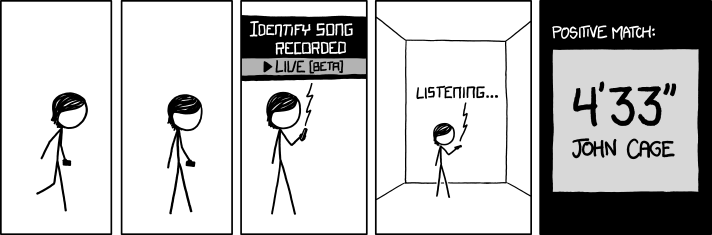
Silence

All music is just performances of 4'33" in studios where another band happened to be playing at the time.
14 Apr 17:05

Recipe: Homemade Sarsaparilla Soda from Scratch

by Ricky
Tertiarymatt

I'm experimenting with this plant myself at the moment. I kind of swamped it out with too many ingredients, I think. I really am fond of sarsaparilla, though.

Ever wondered what a "sarsaparilla" is while watching classic cartoons/westerns?
Well, I wanted to know myself. I did manage to try one from a local grocery store(which I will review in the future), but I wasn't satisfied. Why? It tasted too much like root beer to me, and so i decided to make my own Sarsaparilla without using the same ingredients that would be used for root beer(sassafras, licorice root, anise, cinnamon, nutmeg, wintergreen, clove, etc.).
It turned out really well, and this, along with my cream soda, has been my tastiest soda to date.
It's a short list of ingredients, and I'm finding with certain things this is best.

3 tbsp. Sarsaparilla(about 1 oz.)
1x 6 in. Vanilla bean-cut into many small segments
3 Cardamom seed pods
2 cups of sugar
1 tbsp. honey
1/8 tsp. Ale Yeast
1 gallon of water.

Bring 1/2 gallon of water to a boil in a stock pot with Sarsaparilla, vanilla bean and cardamom.
Let simmer about 20 minutes. Stir in the honey, and then remove from heat. Let steep another 20 minutes, covered. Stir in 2 cups of sugar until dissolved, then add 1/2 gallon of water to the brew. Let cool to 90 degrees.
Scoop about a little bit of brew water out into a small glass or coffee mug, add yeast and let sit for 5-10 minutes.
While letting the yeast get to work, strain the brew into another vessel. Add yeast, stir well, and bottle.
Remember to stir your brew as you bottle to ensure the most even distribution of yeast.
Bottle and let sit for about 36 hours(more time for cooler climates, less time for hotter climates).

The resulting brew was sweet, herbal, slightly spiced(from the cardamom), and very refreshing.
My daughters enjoyed the soda quite a bit, and a friend's children also each drank a bottle with no complaints. I didn't strain my batch incredibly well, so I got a few swigs that resulted in root pieces in the mouth, but it's not unlike getting some "tea shake" in your mouth if you're a loose-leaf tea brewer.
Sarsaparilla is entirely different than any root beer you've ever had before, and making it for yourself will allow you to experience it as an entirely new entity separate from it's more popular cousin.
Cheers!
Cheers!
14 Apr 02:01

Radial Arms: Alternative Form Factor for 3D Printers?

Tertiarymatt

This is an interesting approach. Could go places!

Jon-Wise-3d-printer.jpg

The shape of a 3D printer is easy to envision: "Form follows function" dictates that they all have rigid parts aligned in the X-, Y- and Z-axes that the print head will travel along. But a fellow named Jon Wise is tinkering with an alternate design that uses radial arms rather than a grid-based Cartesian system of plotting, making his mock-up look less like a box and more like a drawing machine.

"Standard 3D printers require significant mechanical structure to provide movement on the three axes," writes Wise. "This alternative design uses radial arms with a minimum of mechanical engineering." If 3D printers were all designed this way, assuming the pieces had the appropriate rigidity, they could use less materials in their construction and, through clever design, be made more portable. Sure there'd be more calculations required for plotting, but Wise farms that out to the diminutive, inexpensive Raspberry Pi computer board:

This brains-over-brawn approach is intriguing. It would be neat if it not only folded up, but if there were little laser sensors hooked up to a processor that could constantly make microadjustments to the stepper motors to compensate for slop in the parts. If even a clumsy craftsperson could slap one of these together, and a computer brain did the heavy lifting in terms of calculations, it could open up a lot of possibilities for bringing precision production to areas where precision is in short supply.

(more...)


14 Apr 00:01

Spittballing on Human Habitat

by noreply@blogger.com (M.S. Patterson)
Tertiarymatt

Emblogulations Continue on a surprisingly frequent basis. #selfshare

(Note, this post represents me kicking these ideas around, and beginning an initial exploration of them... as such, it will not be heavily cited beyond what I think readers may need to understand a given point)

Recently, some thoughts have arisen in the lab I belong to about a different way to think of cities: as human habitat, modified by humans through all our ecological behavior to suit us.

It's a given that all species alter their habitat.  They may do this through herbivory, nest building, tunneling, alteration of biogeochemical cycles, even by changing the local climate.  The impacts of many species are relatively minor compared on their own.  A handful of species directly produce large changes in their environment through their behavior that other organisms have to reckon with.  Beavers, elephants, and humans spring to mind.  For the bulk of our few million years on the planet hominins have been no more of a force to reckon with than most other species.

Even after the emergence of Homo sapiens sapiens--possibly the most versatile and hardy animal to grace the face of the Earth--we didn't tend to have too outsize an impact.  We may have cleared some land, burned grasslands in a purposeful way, and eaten a number of species into extinction, but we have otherwise lived within our niche as omnivorous apex predators without massively disturbing the Earth at large.

This would largely seem to be because humans historically lived in a relatively integrated manner within other ecosystems, making both intensive and extensive use of resources as necessary, and often being highly mobile (whether residentially or logistically).  The high mobility and relatively small numbers of humans kept us from doing too much damage to the ecosystems we inhabited.  Our versatility and cleverness occasionally enabled us to abuse our surroundings in ways other species cannot.  After all, wolves can't switch to shellfish and tubers after all the giant flightless birds have been eaten.


As we moved towards cultural sedentism and an agrarian lifestyle, the degree to which we altered the landscape would seem to have intensified.  Larger and larger patches of landscape became entirely dominated by humans to support increasing populations, and at some point in the neighborhood of 5,000 years ago conurbations appeared as a unique land use.  We'll probably never know exactly why, other than that humans like to group together, many of us seem to like living in dense groups, and there does seem to be definite advantages to city dwelling for us as a species.  Urban environments represent one of the apexes of human modification of the environment, and are steadily becoming the dominant form of human habitat.

Humans currently occupy three "types" of habitat, to varying degrees:  (1) Integrated, (2) urbanized, and (3) support.

-Village-
Villiage, by Vit Hassan
 Integrated habitats are those closest to the historic way of life of H. sapiens sapiens.  They're likely occupied largely by people in undeveloped parts of the world, where people still practice relatively mobile lifestyles, or where they engage in subsistence farming and/or pastorlism.  This habitat likely represents the minimum of human alteration of an ecosystem, but not necessarily the minimum density of humans on the landscape.

Chicago (ILL) Willis Tower ( Ex. SEARS Tower ) 1974, east side " the loop "
Chicago (ILL) Willis Tower ( Ex. SEARS Tower ) 1974,
east side "the loop ", by vincent desjardin
Urbanized habitats or ecosystems have a high density of human habitation and activity, and are characterized by drastic alteration of the environment by human infrastructure, particularly impervious surfaces.  These areas are where most people in the developed world live.  They are typically very low in the ecological resources necessary to actually maintain human habitation, and are thus partially dependent on the importation of the products of other ecosystems.


IMG_2263 German Fields
German Fields, by mike maccaffery
"Support" ecosystems are the necessary mirror-image of urbanized habitat: they have a very low density of people and high densities of ecosystem functions.  They exist to serve the needs of non-residents, who appropriate and benefit from the primary productivity, water storage and purification, and influence on climate that support ecosystems produce.  They are often just as deeply modified as urbanized ecosystems, with greatly altered hydrology, geomorphic processes, biogeochemistry, and food webs.

I should be clear that I don't believe any of these are as clear and simple as they are written and represented as here.  Not every bit of urban habitat is downtown Chicago, and not every piece of support habitat is an intensive monoculture.  Nor is every integrated habitat self sufficient or "in harmony" with nature (as we tend to think about these things, which I challenge).

On this point especially I should be very clear:  None of these habitats is more "natural" than any other.  They are all the result of Homo sapiens sapiens altering habitat to suit its needs. There is nothing unnatural about the built environment or agricultural monocultures.  They may not be sustainable, or particularly stable without intensive energy inputs, but this is not to say that they are unnatural.  One might even view them only as disturbed to the extent that the ability of other species to meet their needs is disrupted.  After all, a beaver must constantly repair its dam, and leaf cutter ants work like crazy to keep their fungal gardens supplied with leaves and at just the right temperature and humidity. From the perspective of the beaver or the colony of ants, they do not disturb the ecosystem, particularly since the organisms and landscapes that have evolved with them have developed ways to accommodate their activities.

Okay, so perhaps humans have three types of habitat.  What of it?  The big idea here, the thing worth thinking about, is that the idea of treating cities and their support systems as human habitat may be an important way of reconciling "human" systems and "natural" systems.  It allows us to explicitly look at the functions of the city (be they social, economic, or what have you) in terms of human habitat needs.  Does a policy make a city more suitable for successful habitation by humans, or less?  Does it reduce the load on support landscapes, or increase it? Can we understand the movement of humans in terms of habitat suitability?  Thinking of cities in this way may allow us to bring many of the tools of traditional ecology to bear on humans in interesting ways.

It definitely something I will be thinking about in the near future.
12 Apr 04:43

KnobFeel: Reviews of Knobs

Tertiarymatt

Feelin' knobs.

knobfeel.jpg

If there's an audiophile's version of kicking the tires on a used car, I'm guessing it's turning the knobs on an amp. Short of actually listening to the thing, I for one would like to feel how the knob turns, see how it feels in my fingers, and detect if it has the properly heavy amount of turning resistance that makes me think it's well-built.

Well, some guy went ahead and started a blog called KnobFeel, with the sole mission of posting "Reviews based purely on the feel of the knob." Perhaps in a bid to increase his international traffic, the anonymous poster (who hails from English-speaking Britain) has devised an interesting way to ensure his reviews hurdle any potential language barriers:

Here's yesterday's review:

(more...)


12 Apr 02:30

Around the Web Digest

by Matt Thompson
Tertiarymatt

There's a lot of reading here.

There hasn’t been an Around the Web Digest since the Savage Minds home site went down and we had to set up its temporary digs here. That means we’re over due for a round-up of February and March! You can receive (semi-)daily links via our twitter accnt @savageminds or by liking our Facebook page. If you’ve seen something around the web that you’d like to share with the Savage Minds community, mention us in a tweet with the link. You can also email me at [mdthomps@odu.edu].

Here’s a sample of what we’ve been reading. To the links!

February

March


11 Apr 02:20

…and the winner is…. 

Tertiarymatt

So, nerdglaze is live. Though currently just a tumblr, basically.


…and the winner is…. 

10 Apr 17:12

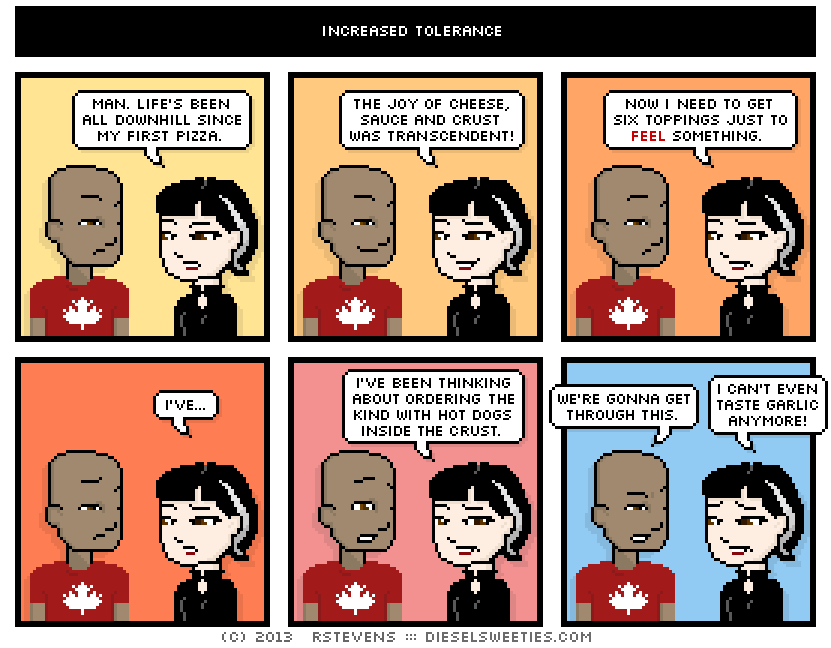
Increased Tolerance

Tertiarymatt

Pizza... I long for you.

meep!

Pizza.

Beware.

10 Apr 05:23

Chapter 6: Creative Fiction, Page 9.

by IronSpike
Tertiarymatt

Shit be gettin' racial up in here.

I’ll bet you think this doesn’t happen.

09 Apr 21:58

Art After Occupy

by Molly Crabapple
Tertiarymatt

Molly is so great.

Molly Crabapple / Shell Game

Molly Crabapple / Shell Game

It’s not typical for artists to go out and see the world. Most prefer to sit politely in their studios and make increasingly refined versions of the same piece until they die. Once, artists had a monopoly on image making. If a newspaper wanted a war covered, they sent an illustrator along with a reporter. But once photography became sufficiently advanced, visual art turned to the inner world.

I grew up thinking art was frivolous. Artists are court jesters, Fabergé egg makers — we’re Boucher and Damien Hirst, making exquisite objects for the elite, whatever their bohemianism, deeply felt convictions, couldn’t wipe that away.

As a broke art school dropout, I worked as a model. Not the fancy fashion kind — I’m a foot too short. I was a naked model for amateur photographers. Nothing will make you think about money and power like smearing yourself with jam and posing for dentists with expensive cameras.

I wasn’t great at making money off my looks. But beautiful girls were an addiction. Never have I seen a stripper without thinking she was a philosopher queen. Burlesque was blowing up in New York. I started drawing the dancers.

Burlesque girls are alchemists. They’re steel-tough performers who are willing to use kitchens as dressing rooms, haul their costume bags through the snow, go into debt for Swarovski crystals, all for five the minutes on stage that they’re goddesses.

I grew up with a Toulouse Lautrec fetish. Toulouse Lautrec was the poster artist for the Moulin Rouge. He was an alcoholic dwarf with syphilis whose posters captured all the ambition and darkness behind a can-can girl’s ruffles. I wanted to be Toulouse Lautrec! We liked the same drinks! We were the same height!

When I got the job as a staff artist at a nightclub, the dream came true. It was the sort of impossibly swank joint where Saudi princelings blew $20,000 a night on champagne. Meanwhile, onstage, the world’s best vaudeville performers would do acrobatic, carefully choreographed acts about cutting off banker’s heads. My boss had the depravity of a Borgia prince, but goddamn, he understood my art. I drew my beloved performers as gods. Customers were coke snorting pigs.

It got me thinking that all it takes to get political is a sharp eye, a mocking disposition, a discomfort with your place.

Artists are in an odd space. On one hand, we’re the most fancy of the fancy. People don’t know art, but know what they like –– implying that art is a rarified space, requiring advanced education, where they couldn’t presume to judge. Average people are told over and over again that their instincts on art are stupid and wrong.

My one brush with proletarian labor was doing murals on a construction site. Unlike the other workers, I was allowed to drink on the job and come in whenever I wanted. I was the artist. I was fancy. I could be trusted.

On the other hand? I’m an artist. My job is to apply colored mud onto a surface. Just like the construction workers on the mural job, I’d be covered in toxic dust, freezing and wobbling on a rickety platform. I have dirty nails and rough hands. When famous artists pay young people ten bucks an hour to do their work for them, they’re reproducing the worst excesses of the financial world. Art is carpentry as much as metaphysics. We’re blue collar workers with pretenses at the sublime.

I thought a lot about all these things, but I never let them bleed into my work. I’d marched against the Iraq War. The failure of those million lefty marches made organized political resistance in America feel like theater. To do a poster around an issue felt like a preachy lie. I also felt that because I was a pretty-girl illustrator with a sex industry past, activism was above me. So I’d sell my work and donate the money to abortion funds.

Molly Crabapple / Shell Game

Molly Crabapple / Shell Game

Then In 2011, the world exploded. In one country after another, people sat down in their cities’ main squares — Tahrir, Syntagma, Puerta del Sol, Zuccotti — and said the old world’s machine was dead. All the police charges in the world convince them otherwise.

Singer Paul Robeson said, “The artist must take sides. He must elect to fight for freedom or slavery. I have made my choice. I had no alternative.” He was speaking during the Spanish Civil War, but he might have been speaking to me when Occupy Wall Street set up tents outside my window.

An artist can engage with politics as a documentarian or propagandist, or just as a searching human, trying to puzzle out where the world broke. I first went down to Zuccotti Park to draw the protesters. The media said they were dirty hippie scumbags. I knew they weren’t. They were veterans and construction guys and old ladies doing knitting. Someone held up a sign saying “Give a damn.”

Zuccotti Park itself was a mini city, with a library, a free clinic, a gourmet soup kitchen, and even a table giving out free cigarettes. In the middle of New York City, where every usage of public space is regimented, here was a space that was free. It was also a space where the Left, often an ineffectual snakepit, came together. Union guys stood shoulder to shoulder with Brooklyn party promoters.

The police arrested 700 people at a time, and barricaded half of downtown Manhattan. Power was afraid.

I wanted to help however I could. I donated money and clothes and tarps. I turned my apartment into a press room. Journalists from around the world charged their laptops on my power outlets and drank my booze. I also began to draw protest posters. When the police raided Occupy Oakland, they put a veteran in a coma by shooting him in the head with a tear gas canister. As a response, I drew “Can You See the New World Through the Tear Gas.”

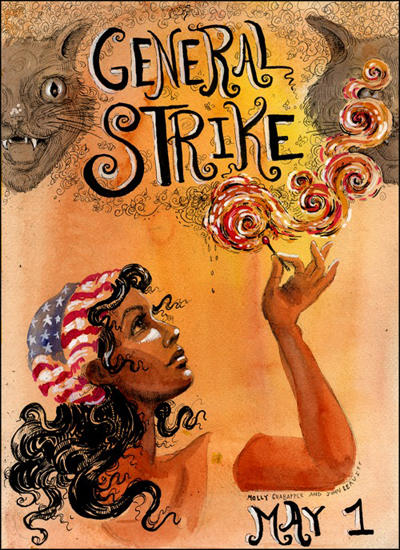
I’d put the posters for download online, or give the files to Occupier friends. Hours later, they’d be on the streets as protest signs. My May Day poster was my most widely distributed image. I reenvisioned the classic worker: a muscular, square jawed proletarian whose job has been outsourced to China, as a Latina woman. It was wheat-pasted on walls across the world.

When I made art for OWS, I was trying to win over skeptics like myself. We all know what activist art looks like. It’s red and black, Soviet-influenced, with lots of hard angles. This is gorgeous design. But saying the revolution has an aesthetic is like saying the revolution has a shoe brand. I wanted art for people who had never considered themselves activists, but who cared deeply for their friends and the world. I kept my Rococo aesthetic. I drew women. I drew animals. I drew protest art that looked like a fairy tale.

Artists are individualists. My favorite muralist, Diego Rivera, was repeatedly expelled from the Communist Party for being too idiosyncratic for the powers of the time. Orwell showed writers their responsibility to look as unflinchingly at their friends as their enemies, even when it is hardest. Artists must do the same. If you’re an activist, there’s a constant, evil temptation to airbrush your own best side. But the best political art is the product not of movements but of the flawed, searching individual mind.


During Occupy, I became friends with the young British journalist named Laurie Penny. In November, the police cleared the camps. They cracked skulls, sealed off lower Manhattan, and threw the mini-city into dump trucks. Laurie climbed down my rusty old fire escape at 3am to get behind police lines. In the days that followed, we’d drink and smoke and try to figure out what would happen next. Occupy was just one of the movements rattling the world in 2011. We decided to do work together about another one.

Right now, Greece is an EU country sliding into fascism, racked with debt and austerity. A third of the population is unemployed. The Nazi Golden Dawn is the third most popular party. Its logo is a broken swastika. It murders immigrants. Its parliamentary representatives post photographs to social media of themselves taking part in pogroms and punch female politicians on TV.

But Greece is also the stage for leftist resistance. On TV, you can see footage of street demonstrations blanketed with fire and tear gas. What you don’t see are places like Navarino Park, a parking lot torn up by anarchists with jackhammers and made into a kids’ playground. You don’t see the people who are feeding and clothing each other when their society has failed.

Laurie and I decided to go to Athens, and record what we saw. We spent a week interviewing activists and immigrants, getting dead drunk at parties, and watching bloody street demonstrations. Out of the experience, we made Discordia.

This was the first time I had used art as reportage. We live in the most image saturated age in history. A thousand Twitpics mark the occasion whenever a cop cracks a protesters skull. I wanted to prove that artists had a reason to leave the studio. To prove old-fashioned illustration had something to say.

I found that drawings, like photojournalism, distill the essential. They remove photo blur, accidents of lighting. Visual art, unlike photos or journalism, has no pretense of objectivity. It’s joyfully, defiantly subjective. It’s truth is individual. Picasso’s Guernica didn’t show what a body looks like after a carpet-bombing. It showed the hideousness of war.

Laurie would interview and I would draw. Artists are the dorks in the corner, and drawing gives them an excuse to creepilly stare. I got images of places where photographs weren’t allowed — like anarchist cafes under threat by the police. I drew the police themselves, hulking comic-book caricatures of men, with shields and guns and tear gas canisters, who hung out on the street corners and hassled anyone young or brown. Laurie later called me out on making them look like things rather than humans. But maybe when you put on the uniform, that’s what you become.

We covered the leftist newspaper Eleftherotpoia, a newspaper that before the crisis had had the stature of the Guardian. But the owner embezzled and didn’t pay her workers. The reporters threw her out. Now they worked without pay, sustained by cigarettes, raki, and investigative journalism.

I drew the memorial of Alexandros Grigoropolos. Alexandros was a 16-year-old boy shot in the back of the head by police. His memorial is the angry, graffiti covered heart of the graffiti covered city. Behind it is a mural of gas-mask wearing protesters, and the tagline ACAB –– All Cops Are Bastards.

I drew striking steelworkers. I worked from Laurie’s photos of an anti-fascist demonstration. The Golden Dawn was going around an immigrant neighborhood, demanding the Pakistani store owners close their businesses. The immigrants demonstrated to show that they were not afraid. At the start of the demonstration, the police announced they wouldn’t defend the protesters from fascist attacks. I drew a young Pakistani boy walking through that protest, through bloody sidewalks and Nazi graffiti, in an homage to Rockwell’s anti-segregation painting, “The Problem We All Live With.”

Back home, working from iPhone snaps and conversations with Laurie, I reconstructed the city on paper. I tied the art together with graffiti. Athens has more of it, and with more dark humor and poetry, than I’d ever seen. “Don’t rely on the police for everything. Hit yourself.” “Fuck heroes. Fight Now.” “Mom, I’ll be late. We’re at war.” When I drew people I tried to not only draw what they looked like, but who they were — the strength and worry and courage and pain. I tried to capture the electricity in the Athens air. Laurie’s words were fierce and powerful things. I wanted to make art that held up to them.

I got arrested within days of finishing Discordia. I’m “not the type who gets arrested” — meaning I’m a little middle-class white girl. Cops flirt with me instead. But at the anniversary of Occupy Wall Street, a cop dragged me into the street. I was released from jail eleven hours later with the charge of blocking traffic. They arrested 150 people that day. We were locked in freezing cells so small we had to take turns sitting down. We lined up in front of each other so male officers couldn’t watch us go to the bathroom.

Occupy Wall Street taught middle-class kids what poor people and people of color have always known: the law is a cruel and arbitrary thing that turns against you in a second. I was furious and shaken for everyone, protester or not, thrown for no reason in that awful place. The next day I drew our jail cell for CNN. That protest turned out to be the last real gasp of Occupy Wall Street. After hurricane Sandy wrecked New York, Occupy turned to helping our powerless, waterless neighbors. But it was never the same.

2011 is over. The ecstatic rebellions have faded away under police batons and their own mismanagement. But the year changed us. It changed my art. It changed me. And we will see another 2011. Images have power. There’s a reason Syrian cartoonist Ali Ferzat’s hands were broken by the regime. In New Delhi, caricaturist Aseem Trivedi is charged with sedition. Thomas Nast’s illustrations helped bring down Tammany Hall. Images get under the skin, past compassion fatigue, to the raw edges of your heart.

I drew to relate to people. I drew the popular kids in school so they wouldn’t hit me. I drew my way into nightclubs who wouldn’t let me past the doorman. I drew to show Moroccan street kids I was more than a dumb tourist. I’m not much at conversation, but I could get some pretty lines on a piece of paper. Drawing was a way to take the world, make it comprehensible, put it on a sketchbook, make it mine. My political art started in the same way. I drew protest art because the world was changing. I wanted to be a full human, and to do that, I had to let my work change with it. I couldn’t look away.
09 Apr 03:48

Team Mendeley is joining Elsevier. Good things are about to happen!

by Victor
Tertiarymatt

My response to this is "FUCK"

Today we are excited to announce that Mendeley is joining Elsevier! You might already have heard some rumors and speculation about this in the past few weeks. We hope you’ll understand that we couldn’t address the rumors head-on until there was some actual news to share with you. Now that the union is official, we [...]
08 Apr 21:06

Bonded Debt and the Plundering of Our Cities

by Ann

This essay originally appeared in Tidal

“There’s the United States and there’s Moody’s Bond Rating Service. The United States can destroy you by dropping bombs, and Moody’s can destroy you by downgrading your bonds. And believe me, it’s not clear sometimes who’s more powerful.”

The year is 1996, and the speaker is Thomas Friedman, warmonger and breathless cheerleader for neoliberalism. He declares that the new global superpower is a bond credit ratings agency. To make some sense of this, we need to jump back nearly a century. It’s 1909, European financial imperialists have been purchasing bonds for nearly four hundred years; the U.S. bond market is already several times larger than that of any other country. Power is shifting. John Moody, a financial analyst from New Jersey, invents a revolutionary technique for assessing railroad securities. He establishes a private firm, Moody’s Bond Rating Service. An empire is born.

Today, bonds are a multi-trillion dollar market, and ratings agencies like Moody’s and S&P play a central role in maintaining the global debt economy. They do it by producing reports on the creditworthiness of cities and public authorities.

How does that translate to power?

The Keynesian era of public funding is long past. In cities across the US, infrastructure has been left to rot, and federal support for urban development has been replaced by debt. Towns and municipalities must fend for themselves. Resources, from health care to electricity, are increasingly controlled by banks that underwrite the bonds cities need to survive. Agencies, in collaboration with banks, determine which cities will make good on their debt. It’s quite simple, really. Control the money, control the city, control the people.

Unsurprisingly, this has led to disaster, time and again. Take Scranton, PA, which in 2012 threatened to default on a bond. Moody’s retaliated with a punitive credit downgrade, one of the ‘bombs’ so giddily referenced by Friedman. In response, Scranton obediently sliced the wages of public employees down to minimum wage. All hail the credit score.

Or take Stockton, CA, which is battling with creditors over pensions for public workers. Or New Jersey, which has one of the highest numbers of junk-rated municipalities in the nation, a fatal blow for communities like Camden that have already endured four decades of economic crisis.

Let’s be clear: this is not just a matter of greed. The federal government actively formalizes the power of ratings agencies. Once firms issue their ratings, regulatory officials use those assessments to determine which municipalities can sell bonds to which investors. Ratings agencies, then, make enormous profits by assuring that cities comply with regulations that they helped codify in the first place. The municipal bond market is a blatant collaboration between the government and the finance industry to privatize the commons.

Bond ratings agencies further control our lives through the disciplining apparatus of the credit score. The restructuring of the US economy requires that municipalities compete with each other to attract buyers for bonds. Institutions, such as pension funds, are the fastest growing investor category. By law, though, such institutions cannot purchase high percentages of low-grade debt. Municipalities that issue bonds are under enormous pressure to maintain good credit. Countless cities around the US are one downgrade away from becoming a Scranton or a Camden, a form of financial terrorism by the 1%.

What can we do? This age of austerity requires a social movement in which we refuse to pay illegitimate debt. Our struggle is guided by some key questions. Which debts are legitimate and which are not? Would we rather fund schools and hospitals or pay debt service to Wall Street? Do the profits of international investors outweigh the right of pensioners to retire with dignity or the right of students to attend well-funded schools? What kind of world do we want to live in?

Communities around the country are already challenging banks and ratings agencies. Oakland, CA, is fighting to cancel interest rate swaps with Goldman Sachs, a courageous step that guarantees a shredded credit rating for years to come. Baltimore, a city where 80% of school children qualify for free or reduced-price lunch, is lead plaintiff in a lawsuit to recover money lost as a result of the rigging of LIBOR, the mechanism that determines many interest rates. Taking a cue from the community debt audits underway in Europe, activists in Chicago are working to identify illegitimate debts on municipal balance sheets with an eye toward organizing debt refusal campaigns. In NYC, where the minimum wage is $7.25 an hour, it costs as much as $5 for a round-tip subway or bus ride. A coalition called No Fare Hikes is rolling out a fare refusal campaign and declaring that public transportation is a right.

To the banks and the ratings agencies that plunder our cities, we say, We owe you nothing! To our neighborhoods and communities, we say, Reclaim what is already yours!


08 Apr 20:54

Corporate HQ Superdesigns, Part 2: Apple "Spaceship" to Give New Meaning to the Term "High Tolerance"

Tertiarymatt

This is sort of ludicrous. If I were a shareholder I would be furious to see that this is what Apple is spending its cash on.

As a regular human I'm pretty annoyed by this being what they're spending their cash on. 5 billion dollars is a pretty enormous amount of money.

0apple-hq-ss-update.jpg

Hard to believe it's been nearly two years since we saw that video of Steve Jobs pitching Apple's Norman-Foster-designed "spaceship" HQ to the Cupertino City Council. Jobs, sadly, passed away just months later. But Jobs' influence is still very much ingrained in the ongoing design process of the building. That is why the building will likely be magnificent. It is also why the timetable has been pushed back to 2016, and why the cost estimate has now risen to nearly $5 billion. (For scale, the new World Trade Center in NYC rings in at $3.9 billion.)

We know Apple's got curved glass down, though it isn't cheap to produce. We know the building's plans call for it to sustainably generate its own electricity, as many of their facilities now do, and that that isn't cheap either. But as Businessweek reports,

The true expense of the campus lies not in green tech, though, as much as the materials--as well as what product designers call "fit and finish." As with Apple's products, Jobs wanted no seam, gap, or paintbrush stroke showing; every wall, floor, and even ceiling is to be polished to a supernatural smoothness. All of the interior wood was to be harvested from a specific species of maple, and only the finer-quality "heartwood" at the center of the trees would be used, says one person briefed on the plan last year.

That's not the crazy part, though. This is: "Jobs insisted that the tiny gaps where walls and other surfaces come together be no more than 1/32 of an inch across, vs. the typical 1/8 inch in most U.S. construction." Anyone who's ever built anything or installed anything using conventional power tools knows that's insanely difficult. It's easy for even an inexperienced craftsperson to take 1/8-inch off of something, as that's the width of a sawblade. The skilled among you can get things down to 1/16, even by eyeballing. But I don't know anyone who can consistently hit 1/32. It's not just twice as hard as getting something down to 1/16, it is an order of magnitude more difficult, and essentially demands less humans and more CNC.

If that didn't get your attention, maybe this will:

Jobs even wanted the ceilings to be polished concrete. Contractors would typically erect molds with crude scaffolds to pour the cement in place, but that leaves unsightly ruts where the scaffolding puts extra pressure on the surfaces. According to two people who've seen the plans, Apple will instead cast the ceilings in molds on the floor and lift them into place, a far more expensive approach that left one person involved in the project speechless.

I should point out that I don't think these demands are crazy in a pejorative way; if anyone can pull this off, it's Apple. Shareholders are complaining about the price of construction, but you don't build something like this purely to increase the bottom line. Jobs said it best during his pitch to the Council: "We have a shot at building the best office building in the world. I really do think that architecture students will come here to see it."

(more...)