Shared posts

09 May 07:19

Lucida Dreams Come True: Kickstart a 21st-Century Version of a 19th-Century Optical Drawing Aid

Tertiarymatt

Neat, but frustrating.

PabloGarcia_GolanLevin-Neolucida-1.jpgLooks cool...

When I used to work for an artist who specialized in photorealistic portraiture, I remember watching the assistants use a projector to draft the preliminary pencilwork for his medium-to-large scale (30”×40”+) paintings. Since we were working with digital compositions, it was a simple matter of lining up the image with the canvas or archival paper, then painstakingly tracing the photograph and background onto it.

PabloGarcia_GolanLevin-Neolucida-modelDrawing.jpg

Now that software has democratized and simplified the tools of creating images, I imagine this is a common practice in artists' studios. But what about drawing from real life? Most everyone has seen or at least heard of camera obscura, but it turns out there's a somewhat more, um, obscure tool that draftsmen of yore had at their disposal.

PabloGarcia_GolanLevin-Neolucida-CameraLucida.jpg

Pablo Garcia and Golan Levin (Art Professors at SAIC and CMU, respectively) note that "long before Google Glass... there was the Camera Lucida." The device is a "prism on a stick," a portable lens-like device that is affixed to a drawing surface, allowing the user to accurately reproduce an image before them by hand.

We have designed the NeoLucida: the first portable camera lucida to be manufactured in nearly a century—and the lowest-cost commercial camera lucida ever designed. We want to make this remarkable device widely available to students, artists, architects, and anyone who loves to draw from life. But to be clear: our NeoLucida is not just a product, but a provocation. In manufacturing a camera lucida for the 21st century, our aim is to stimulate interest in media archaeology—the tightly interconnected history of visual culture and imaging technologies.

PabloGarcia_GolanLevin-Neolucida-sidebyside.jpg

According to the well-illustrated history page on the Neolucida website, the device was invented by Sir William Hyde Wollaston in 1807, though the Wikipedia article suggests that it was actually developed by Johannes Kepler, whose dioptrice dates back to 1611, nearly two centuries prior.
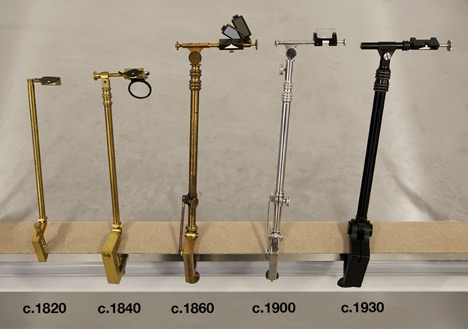
PabloGarcia_GolanLevin-Neolucida-egs.jpgSelections from Pablo Garcia's personal collection of vintage camera lucidas

(more...)


09 May 07:10

On the Anniversary of V-E Day, Buick Releases Photos of "The Hot Rod of World War II"

Tertiarymatt

TANKS

buick-hellcat-m18-001.jpg

Today marks "V-E Day," the day that World War II ended in Europe. And in a couple of weeks, it will be the 110th anniversary of Buick. To tie both anniversaries together, the automaker has released photos of the most fearsome Buick to ever come off the production line: The M18 Hellcat, a World-War-II-era tank destroyer.

buick-hellcat-m18-002.jpg

In 1942, the last civilian Buick rolled off of the production line, and the factory immediately began retooling for war. Like much of American industry, GM had earlier been tasked with supporting the war effort, and when the tasks were divvied up Harley Earl's design studio found themselves with an unusual design assignment: Forget the Roadmaster—we need something that can kill enemy tanks.

Earl and his team came up with the Hellcat, a bad-ass nine-cylinder, 450 horsepower vehicle that weighed 20 tons. (For scale, a Roadmaster of the era weighed about two tons.) Despite the weight, the Hellcat had a top speed of over 60 miles per hour thanks to its engines, which were actually designed to power airplanes.

buick-hellcat-m18-003.jpg

"The Hellcat was considered the hot rod of World War II," says Bill Gross, an historian with M18 restoration experience. "And Buick engineers also made it quiet by tank standards, so it was very successful at getting in, hitting a target, and getting out. To give perspective, most German tanks of the day were capable of just 20 mph and even today's M1 Abrams tank is outpaced by the Hellcat."

buick-hellcat-m18-005.jpg

(more...)


09 May 07:08

Creatively Defaced Streetscapes

defaced-streetscapes-001.jpg

defaced-streetscapes-006.jpg

As we saw in "Creatively Defaced Textbooks," it's easy enough to create drawings in a book that you take home with you, or hide behind the back of the student in front of you. It's a much greater challenge to deface—or upgrade, depending on your point of view—a streetscape, where your artistic talents may draw the unwanted attention of the authorities.

defaced-streetscapes-003.jpg

But, you know, nothing stops art.

defaced-streetscapes-002.jpg

(more...)


09 May 07:07

Truffle deflection


Truffle deflection

08 May 09:34

dylanmeconis: Dudes in the Pacific Northwest - particularly...

Tertiarymatt

We've seen some of this, this week. Oh yes we have.


dylanmeconis:

Dudes in the Pacific Northwest - particularly pasty white dudes - have this collective need to rip their shirts off the first time the temperature pokes above 65 °F (~18° C).

Not to go for a jog around the park, mind you; just to, like, air out? In the middle of a business and shopping district.

WE ARE NOT AMUSED.

TRU FAQS

08 May 09:34

alanfriedman: Good Morning Star Shine

Tertiarymatt

This man's solar photography is so gorgeous.


alanfriedman:

Good Morning Star Shine

08 May 05:35

The great divide: a Taranov split

by Rusty
Tertiarymatt

This is pretty weird.

I recognized the cacophony coming from my top-bar hive. The insistent roar told me those bees were ready to swarm. They were milling about, climbing up the sides of the hive, flying but not foraging. I had just returned from a week on the road and didn’t feel like messing with bees, but they were [...]
08 May 05:21

Develop Off-Grid Energy Products with BioLite in Brooklyn, New York

Tertiarymatt

This would be a fun gig.

Work for BioLite!


wants a Product Engineer
in Brooklyn, New York

BioLite is a for-profit social enterprise that develops, manufactures and markets distributed energy solutions for off-grid communities around the world.

If you join their team as a Product Engineer, your work will serve their main target markets: 1) developing world families living in energy poverty, and 2) outdoor enthusiasts seeking fuel-independent cooking and charging. Either way, you'll be making the world a better place!

This is a unique opportunity to join a fast-moving startup with both a technical and creative environment in the heart of Brooklyn. If you have experience creating, engineering, and detailing consumer products for manufacture, you're perfect for the job.

Apply Now

(more...)


07 May 08:02

An IkeaBot's Innovative Rubber Band Wrench

Tertiarymatt

Clever.

torque-gripper-001.jpg

The KUKA YouBot Omni-Directional Mobile Platform with Arm is a small, arm-on-a-skateboard type of robot that can perform simple tasks. Recently Ross Knepper, a robotics reseacher at MIT, and his team hacked up a couple of them to assemble store-bought IKEA furniture. While it was primarily an exercise, versus designing a commercially-viable product, we were pretty impressed by his solution for screwing the legs into the Lack sidetable that you'll see here:

The YouBot doesn't come with an "end effector" that can perform the rotating motion you and I would do with two hands to get that leg into the table. Knepper's team devised an elegant workaround, using rubber bands attached to two different rings:

torque-gripper-003.jpg

(more...)


06 May 20:51

dansolomon: That video up there is from KLRU’s Women and Girls...

Tertiarymatt

This is important.


dansolomon:

That video up there is from KLRU’s Women and Girls Lead program, about my wife, Katherine Craft, and Conspire Theatre, the organization she started that provides theatre and creative writing classes to women incarcerated at Travis County Jail. 

I mention her on this here blog every so often, and every time that I do, I get a few people asking how they can be involved. Here is one very important answer: donate to the Conspire Theatre Pub Quiz Fundraiser that is going on right now!

I’m captaining a team for the quiz, and we’re trying to raise at least $600 for Conspire, so they can continue the work that they do every week in Travis County Jail. If you’ve ever talked with me about the organization for more than two minutes, you may have heard why raising money for Conspire is very difficult: 

  • It does work with a population that most people don’t give a shit about. (“I don’t get free theater classes,” they say, “Why should a bunch of criminals?”)
  • The people who do care about incarcerated women mostly want to fund services for them that are scripture-based, and Conspire don’t preach.
  • The work they do is invisible, for the most part. That KLRU video is the first thing to ever be filmed of Conspire’s work (and it was actually shot in Gatesville Prison, where Conspire does intensive workshops a few times a year — jails aren’t keen on letting photographers and filmmakers in). It’s really hard to explain to people why they should support something that they can’t see. 
  • Using art as a healing and transformative (and, yes, anti-recidivist) tool is still pretty radical to people who don’t recognize that these things are actually often more effective at teaching life skills than “life skills” classes. 
  • Doing this work with women — whose reasons for incarceration and needs while they’re in jail are very different from those of their male counterparts — isn’t, frankly, as fascinating to people as doing work like this with men. You know that This American Life episode where those guys in the St. Louis prison perform Shakespeare? That’s what we call a man-bites-dog story: Big, tough guy inmates being moved to tears by Shakespeare? People are fascinated by that. Those organizations are definitely worthwhile, but when you do something similar with women, people pay less attention. Frustrating, but true. 

So that is the wall that fundraising is up against. This is all in Texas, too. There is not a lot of institutional money in Texas for work with prisoners. Which means that they have to do things like a Pub Quiz Fundraiser. I am captaining a team of six (if you’re in Austin and want to play and help fundraise, there are a couple of open slots left) that is going to bring glory to the names of all who fund the campaign by clobbering the opposition in this quiz. 

You give Conspire Money. They provide vital classes to one of the most vulnerable populations in Texas. (Incarcerated women have it rough, y’all.) We enter and win this pub quiz, carrying a Game Of Thrones-like banner in the name of those who supported via the link

$600 is our minimum goal. I’m pretty convinced that there are enough people who give a shit about incarcerated women out here, and who have a couple bucks to chip in, that we can break that number with time to spare, and make sure they can afford to offer these classes (and more! They’re launching a program for women who’ve been released this summer, so they can continue to find support after incarceration!) to women for a long time to come. Can you help? 

It feels weird to use this Tumblr to ask y’all for money. But this shit is really important, and if people like you don’t help, there is literally almost no one else who cares about this stuff. 

04 May 06:36

Facebooks, Literally

RaphaelDaha-WrittenPortraits-AnneFrank.jpgVanGoghAbdolah.jpgClockwise from top: Anne Frank, Kaler Abdolah, Vincent Van Gogh

Dutch creative director Raphael Dahan has nearly 20 years of experience as a digital artist and photo retoucher, and he demonstratess his expert hand in a series of images of books that are intended to look like busts... which is to say that you the images are remarkably photorealistic renderings, easily mistaken for photos of actual books that have been carved to resemble faces.

RaphaelDaha-WrittenPortraits-AnneFrankDetail.jpg

Dahan created several of these images for Bookweek 2011; the digital portrait of Anne Frank features an excerpt from her diary.

RaphaelDaha-WrittenPortraits-LouisVanGaal.jpg

RaphaelDaha-WrittenPortraits-LouisVanGaalDetail.jpg

RaphaelDaha-WrittenPortraits-LouisVanGaal3D.jpg

(more...)


04 May 06:21

Peer Review and Congressional Oversight – An Invited Post

by Kerim
Tertiarymatt

This shit makes my blood boil.

[The following is an invited post by Megan Tracy.]

About two weeks ago, I received an email from one of the editors of the Science Insider blog. He began: “You’ve probably heard that your NSF grant to study the [Chinese] melamine poisoning scandal was targeted at two House science committee hearings yesterday.” I hadn’t heard and this is the first time my research has become the target of what feels like the never-ending rounds of partisan politics. The original critique of my project and the others being targeted is that they fail to directly benefit the American people. I was, quite frankly, rather surprised to be included as my project examines China’s evolving food regulatory system and has direct relevance for America’s food safety and security. The targeting of particular awards are not (and never are) about their specific content or quality but rather involve broader issues including the allocation of funding, peer review and congressional oversight. (It can, however, certainly feel direct especially when the intellectual merit of your specific grant is questioned and copies of the peer reviews and the program officer’s evaluations are requested in a letter written by the committee’s chairman. As a recent Slate article notes, these attacks appear to be winning. this year, for example, the Coburn amendment successfully limits NSF funding in political science to those that promote national security or the economic interests of the US. The same article argues that with a few exceptions, the social sciences have not been pushing back and are failing to present arguments with much traction in today’s economic and political climate.

The history of selecting grants for congressional censure by both parties is long, including the Golden Fleece awards handed out by former Senator Proxmire. Grants, I’m told, are selected largely by their titles and broadly critiqued for being a waste of taxpayer money. This year, the argument has focused on the peer review process itself with Rep. Lamar Smith, the Chairman of the House of Representatives Committee on Science, Space, and Technology drafting new legislation, the “High Quality Research Act” that he claims will “[maintain] the current peer review process and [improve] on it by adding a layer of accountability." The arguments are familiar as are the reactions on both sides of the political fence. Many news websites and blogs together with the comments posted to them summarize these arguments so I’ll only note the general contours here. One side argues that science funded by US taxpayers should not only be held accountable to the public but also be directly in the American public interest. How this will be done in practice is not yet clearly laid out in the draft bill (which can be seen here). The defense of peer review is vociferous–notably by another committee member, Eddie Bernice Johnson, but also in the comments on websites dedicated to science-related issues, higher education and the so-called liberal media. Even President Obama has weighed in. Critics of Smith’s draft legislation point out that the peer review process already pulls together experts to evaluate one another on scientific merit and potential value to society (broadly construed) rather than on the politics of the moment. The peer review process at NSF meets these goals with the requirement that research must meet both intellectual merit and broader impacts in order to be funded see discussion here. These basic requirements seek to ensure that promising scientific research with both immediate, practical benefits as well as work with long-term and unpredictable pay-offs receive funding.

Is anthropology paying attention? I certainly hope so. Out of the five grants targeted in Smith’s letter, two were funded primarily by NSF’s Cultural Anthropology program and a third received a small amount of support. As we all know, funding is tight and few avenues are available to conduct long-term research in our field. Political scientists spent time at a recent meeting discussing the issue and coming up with a list of tangible actions that could be taken by both the discipline and individuals (see here). Their suggestions are not discipline-specific and, especially for anthropologists like myself wondering how to respond without clear guidance yet from our discipline, certainly worth a look.

Megan Tracy is an assistant professor at James Madison University. She is currently in Beijing conducting her NSF-funded research on China’s evolving food safety regulatory system and the transformation process of regulatory measures into on-farm practices following a series of scandals in the domestic dairy industry.


04 May 05:59

David Bowie Recalls the Strange Experience of Inventing the Character Ziggy Stardust (1977)

by Josh Jones
Tertiarymatt

Creepy Uncle David autoshare.

Oh, not another Bowie post! Oh yes, yes it is. We don’t keep our love for Bowie secret, and along with his first album in ten years comes new archival material: new to us that is, and maybe to you too.

Now, if your primary experience of Bowie was through his early 70s character Ziggy Stardust—a rock opera creation as much as Hedwig or Dr. Frank-N-Furter—it would be easy to believe Bowie was Ziggy. He inhabited the character so fully that it’s hard to imagine he was playing a very deliberate part the whole time.

But of course, he was. Ziggy and the Spiders were, as Bowie says above, a “theater piece.” Previously, we’ve featured a documentary (see again below) that chronicles the rise of Ziggy Stardust, from Bowie’s somewhat obscure beginnings to his breakout as the character. In the 1977 interview clip above from the CBC, watch Bowie, as himself, describe the experience of being Ziggy.

He talks of his influences—a mélange of kabuki theater, mime, and New York art rock (“Velvet Underground, whatever”). He calls the music from Ziggy Stardust and the Spiders From Mars “a British view of American street energy.” In retrospect, it’s easy to see the act as just that, but in the moment, Bowie’s fans believed in Ziggy as surely as they believed anything else. Watch, for example, as starstruck audience members rapturously mouth the words to “Moonage Daydream” in this clip from D.A. Pennebaker’s Ziggy Stardust film.

Pennebaker’s film caught Bowie’s final performance as the alien rock star at London’s Hammersmith in 1973. No doubt these fans were horribly crushed when Ziggy announced his retirement before the final song. But I’m sure they kept their electric eye on the re-invented Bowie in Berlin, a period he also discusses above, when he left L.A. for Germany and began working with Brian Eno and Iggy Pop.

Related Content:

The Story of Ziggy Stardust: How David Bowie Created the Character that Made Him Famous

David Bowie Sings ‘I Got You Babe’ with Marianne Faithfull in His Last Performance As Ziggy Stardust

David Bowie Releases Vintage Videos of His Greatest Hits from the 1970s and 1980s

Josh Jones is a writer and musician based in Washington, DC. Follow him @jdmagness

David Bowie Recalls the Strange Experience of Inventing the Character Ziggy Stardust (1977){POSTLINK} is a post from: Open Culture. You can follow Open Culture on Facebook, Twitter, Google Plus and by Email.

04 May 05:50

Leonard Susskind Teaches You “The Theoretical Minimum” for Understanding Modern Physics

by Dan Colman
Tertiarymatt

So, this is pretty cool.

susskind-g

For the past decade, Leonard Susskind, one of America’s pre-eminent physicists, has taught a series of six courses in Stanford’s Continuing Studies program.  The series ”explores the essential theoretical foundations of modern physics,” helping lifelong learners (like you) attain the “theoretical minimum” for thinking intelligently about modern physics. Over the years, the Continuing Studies program (where, in full disclosure, I serve as the director) has taped the lectures and made them available to a global audience on YouTube and iTunes. We’ve even burned the lectures onto CDs and shipped them to remote locations in Afghanistan and Nepal where connectivity is still lacking.

This week, Susskind’s popular lectures found a new home of sorts with the launch of The Theoretical Minimum, a new web site that presents the six courses in a way that’s neat, clean and easy to navigate. The site also offers a short text summary of each lecture, plus related reference materials. You can jump into the courses and get started on your own intellectual journey via this list:

Note: Susskind’s courses, and many others, also appear in the Physics section of our collection of 700 Free Online Courses.

Related Content:

Free: Richard Feynman’s Physics Lectures from Cornell (1964)

Demystifying the Higgs Boson with Leonard Susskind, the Father of String Theory

Michio Kaku Explains the Physics Behind Absolutely Everything

Leonard Susskind, Father of String Theory, Warmly Remembers His Friend, Richard Feynman

3 comment(s)

04 May 05:48

Kurt Vonnegut to John F. Kennedy: ‘On Occasion, I Write Pretty Well’

by Mike Springer

VonnegutToJFKFinal

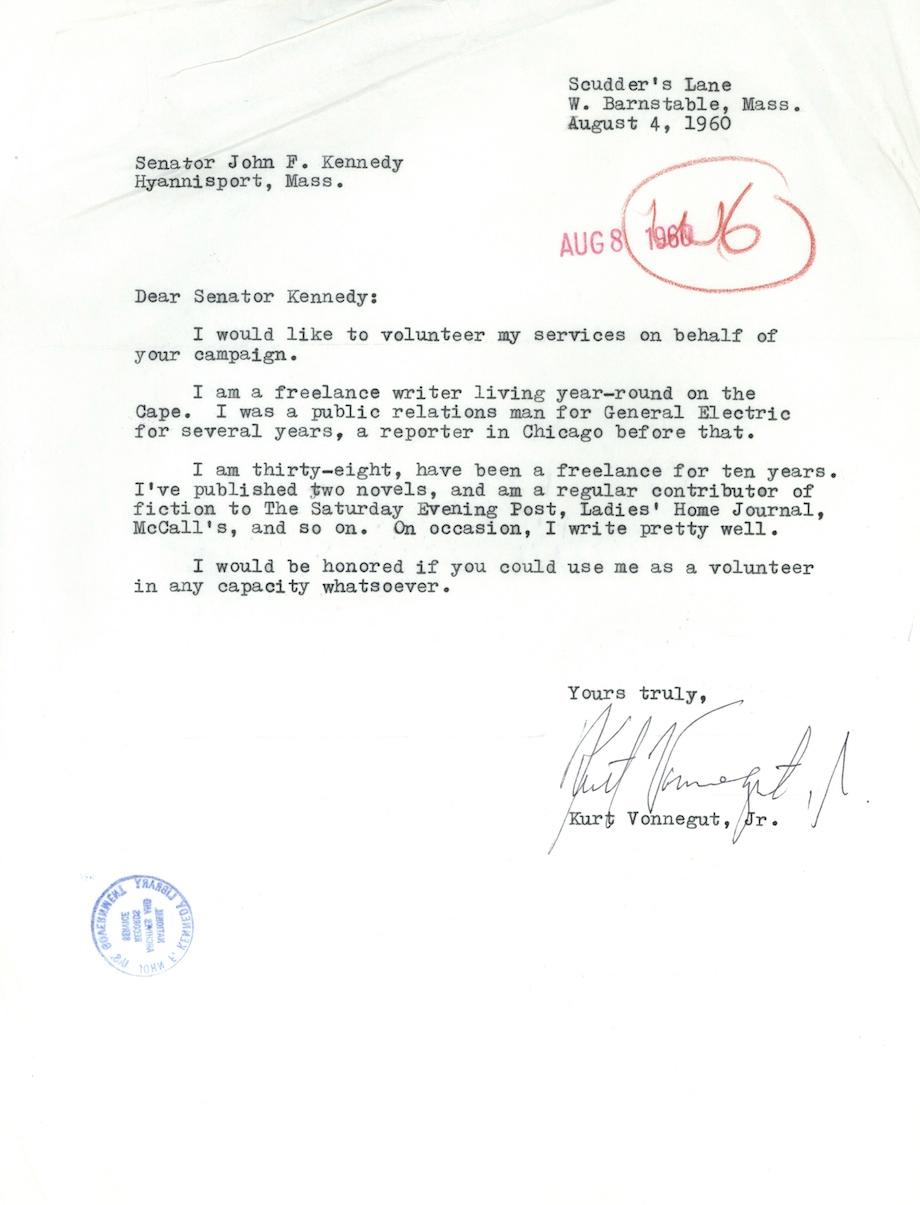
When archivist Stacey Chandler was combing through one of the “Massachusetts” files recently at the John F. Kennedy Presidential Library and Museum in Boston, she stumbled on something unexpected: a letter to Kennedy from an obscure writer named Kurt Vonnegut, volunteering his services on Kennedy’s presidential campaign.

The letter (click the image above to see it larger) was written on August 4, 1960, when Vonnegut was a struggling fiction writer and a failed Saab dealer living on Cape Cod, in the town of West Barnstable, Massachusetts. He had written two novels: Player Piano (1952) and The Sirens of Titan (1959). In a few declarative sentences, Vonnegut outlines his writing experience and offers his help. There is no record at the JFK Library of a reply from Kennedy and, according to Rebecca Onion at Slate, no mention of the subject in two Vonnegut biographies.

“I am thirty-eight,” writes Vonnegut, “have been a freelance for ten years. I’ve published two novels, and am a regular contributor of fiction to The Saturday Evening Post, Ladies’ Home Journal, McCall’s, and so on. On occasion, I write pretty well.”

via Slate/Archivally Speaking

Related Content:

Kurt Vonnegut’s Eight Tips on How to Write a Good Short Story

Kurt Vonnegut Reads from Slaughterhouse-Five

Kurt Vonnegut’s Tips for Teaching at the Iowa Writers’ Workshop (1967)

3 comment(s)

04 May 05:46

In honor of Today’s Release

Tertiarymatt

ba-dum-tish


In honor of Today’s Release

04 May 05:45

Photographer Todd McLellan has been on my mind ever since I saw...

by rion


Photographer Todd McLellan has been on my mind ever since I saw this post on making an Inventor’s Box: a collection of tools and second-hand electronics for kids to disassemble, organize, wreck, rebuild, or reinvent into something completely different… you name it! 

In this time-lapse video (or this one), watch Todd disassemble different kinds of machines so that they can be meticulously arranged and photographed. Here are two examples of the final product:

Then view his project, Things Come Apart, where he’s also photographed the same parts “flying” through the air.

McLellan’s photographs seek to challenge our disposable culture by making transparent all the things that we regularly throw away. He said he wanted to get inside the older objects to show the quality, beauty and care that went into the original manufacturing process.

“I hope people think a little bit more about the things they use. Not that people should have feelings for objects, but instead think about ‘reuse and recycle,’ not just ‘use and discard.’ “

The Chicago Museum of Science and Industry is featuring Things Come Apart until May 19th, 2013, or check out McLellen’s new book available for pre-order on Amazon: Things Come Apart: A Teardown Manual for Modern Living.

via NPR.

Related art from parts: One Plastic Beach.

04 May 05:44

Papercraft Car Modeling Skillz

Tertiarymatt

Okay, this is pretty much just craziness.

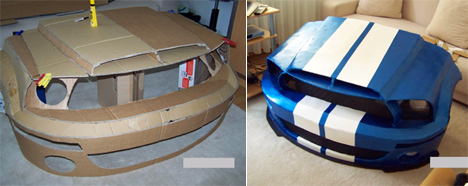
papercraft-cars-001.jpg

papercraft-cars-002.jpg

papercraft-cars-003.jpg

While there's a tendency among designers to obsess over pens, we all know that you can draw with just about anything; Leonardo da Vinci was scratching stuff out with a rock on a slate, for chrissakes.

The "papercraft" movement shows the same can be said for modelmaking. While it's nowhere near as time-efficient as scraping modeling clay off of a buck, paper can be transformed into stunningly complex surfaces—for those with the patience and raw talent. First off, check out designer Taras Lesko's take on the Pagani Zonda supercar. (Music warning, turn your speakers down.)

(more...)


04 May 05:32

The best in sanitary practices?

by Rusty
Tertiarymatt

Every see bee poop? No? Well now you have.

Sunshine made an unexpected appearance yesterday afternoon, so I got my camera and went looking for . . . well, I really didn’t know. Just something. The big-leaf maples were heavy with blossoms, the bees were soaring, and it seemed like an all-around good day for photos. What I found was completely unexpected. I started [...]
04 May 05:30

My teacher says bees have five eyes. She’s creepy.

by Rusty
I agree she sounds kind of creepy. But here’s the problem: she is right. All types of bees really do have five eyes. The two big eyes on a bee are called compound eyes because they are made up of thousands of tiny lenses. Each lens (called a facet) sees a small part of a [...]
03 May 20:27

Airwave Afterlife

Tertiarymatt

Somewhere out there, a planet is hearing Slayer for the first time.


Ads by Project Wonderful! Your ad could be here, right now.

This comic was inspired in equal parts by the untimely death of Jeff Hanneman from Slayer and this SMBC strip. RIP Jeff.

We have some wonderful new items available in the QC Store! You should check them out!

03 May 11:09

Inspired by Joey Ramone’s posthumous love letter to New...

by rion
Tertiarymatt

I need a leather jacket.


Inspired by Joey Ramone’s posthumous love letter to New York City, directed by Greg Jardin, high school student Kevin Chiu spent two months taking 1991 photos of 140 Hunter College HS peers and teachers to create his own stop-motion homage.

More (The Hunter Pixilation Project) is scored to the song Leaves by Cheers Elephant.

Enjoy the video inspiration, too:

Thanks, Kevin.

03 May 07:04

How to properly defeat a dragon. Poor guy was just nerd...

Tertiarymatt

Reading is Radical!


How to properly defeat a dragon. Poor guy was just nerd glazing….

03 May 01:33

A lesson in tradition taught in a less traditional way, How to...

by rion


A lesson in tradition taught in a less traditional way, How to Tie a Bow tie taught with stop-motion… by a bow tie. 

Related: more clothes videos + and other tutorials.

via This N That and Some Shirts.

03 May 01:29

In this beautifully illustrated lesson from TED Ed, science...

by rion


In this beautifully illustrated lesson from TED Ed, science writer and educator Carl Zimmer explains some answers to the question, How did feathers evolve

From his article in National Geographic: 

Most of us will never get to see nature’s greatest marvels in person. We won’t get a glimpse of a colossal squid’s eye, as big as a basketball. The closest we’ll get to a narwhal’s unicornlike tusk is a photograph. But there is one natural wonder that just about all of us can see, simply by stepping outside: dinosaurs using their feathers to fly.

With animation by Armella Leung, see how today’s birds are related to the dinosaurs of the past, and how fossils with feathers have helped us understand that connection.

Related viewing: evolution, dinosaursbirdsflying, and a robot that flies like a bird.

02 May 07:43

THANKS OBAMA


THANKS OBAMA

01 May 15:53

Internet Startup Pitch Theater

the world's most dangerous kitten
30 Apr 11:13

Issue 10: The Sickness Within

by Christopher Wright
Tertiarymatt

I really do recommend reading Curveball. It's good. This installment in particular is pretty damn sharp.

Curveball, by Christopher B. Wright

Story: Christopher Wright
Cover: Garth Graham
Logo: Garth Graham

30 Apr 09:01

Why We Must Remember Rohwer

by geoff.s.weeks
George Takei on Boston, Tule Lake and Rohwer Internment Camp

Last week, just before the attacks in Boston, I took a pilgrimage. I traveled to Arkansas to dedicate the Japanese American Internment Museum in McGehee. The town lies between two places of great sadness: Jerome internment camp to the southwest, and Rohwer camp to the northeast. Over seventy years ago, my family and I were forced from our home in Los Angeles at gunpoint by U.S.

read more

30 Apr 09:00

Tom Donhou's 100MPH Singlespeed Bicycle, Plus More Than You Ever Cared to Know about Human-Powered Vehicles (in a Single Archive)

Tertiarymatt

Wacky bikes.

Donhou-HPVCOMP.jpgImages by Oli Woodman, IHPVA & Fred Rompelberg

Earlier this week, we picked up on Sam Pearce's Loopwheel, which was unveiled at last month's Bespoked Bristol show (generally regarded as UK's response to NAHBS), for which Pearce is currently seeking fundingvia Kickstarter. Tom Donhou's booth was another standout from the third edition of the show—thoroughly documented in a photo gallery on Bike Radar—specifically, his head-turning fixed-gear, built expressly for speed.

Donhou-crankDetail-viaBikeRadar_OliWoodman.jpgPhoto by Oli Woodman

Indeed, Donhou is stepping up to the plate, so to speak, in an attempt to break 100 mph on a relatively standard diamond-frame bicycle. The disc that vaguely resembles a chrome pizza is, in fact, a 104-tooth chainring—roughly twice the size of the standard 53T big ring on most cranksets—custom fabricated by Royce. (Assuming the cog is somewhere in the 12–15ish range, Donhou's contraption is geared at an astronomical 200+ gear-inches; for reference, Wikipedia notes that "a gearing in gear inches the same as a person's height in inches is a comfortable gear for riding on the flat." In other words, the obscene gearing would be comfortable from someone no less than 16’8”.)

Donhou-viaTelegraph.jpgImage via the Telegraph

Donhou admits that he was somewhat chagrined by early press that misrepresented his machine as a contender for a world record, he set the record straight in Road.cc

I'm really into land speed record stuff, in the 60s when the guys were battling it out down on the salt flats almost doubling the speed limits in a couple of years, I love all that stuff. I know a bit about cars but I could never afford to take a car over there...

So I built this with the intention to feel it out, I don't know how fast it can go, that's my best guess as to what I can do. I built the bike how I thought it should look. No wind tunnels involved, it's all grassroots, it's done in that spirit of those guys in the 60s testing jet engines in their sheds. It's that spirit. We'll see if we can stay on it if we get up to 100mph. We've tested it up to 60mph.

Donhou-reverse-viaBikeRadar_OliWoodman.jpgPhoto by Oli Woodman

Donhou is confident that he can break triple digits, though he acknowledges that the effort is something of an ad hoc endeavor: although my fellow cycling enthusiasts know that Columbus MAX tubes are among the best available, Donhou has been booking a decommissioned airstrip as weather allows; a modified Ford Zephyr serves as the pacecar. As he told the Telegraph, "What started as just a bit of fun started to get a lot more serious pretty quick and now we're gunning for 100mph. It's just been really DIY, there's not been a load of money put into this."

Donhou-handlebarDetail-viaBikeRadar_OliWoodman.jpgThe dropped bars are also pretty intense, though these have been de rigueur for pursuit/TT bikes for decades. Photo by Oli Woodman

(more...)